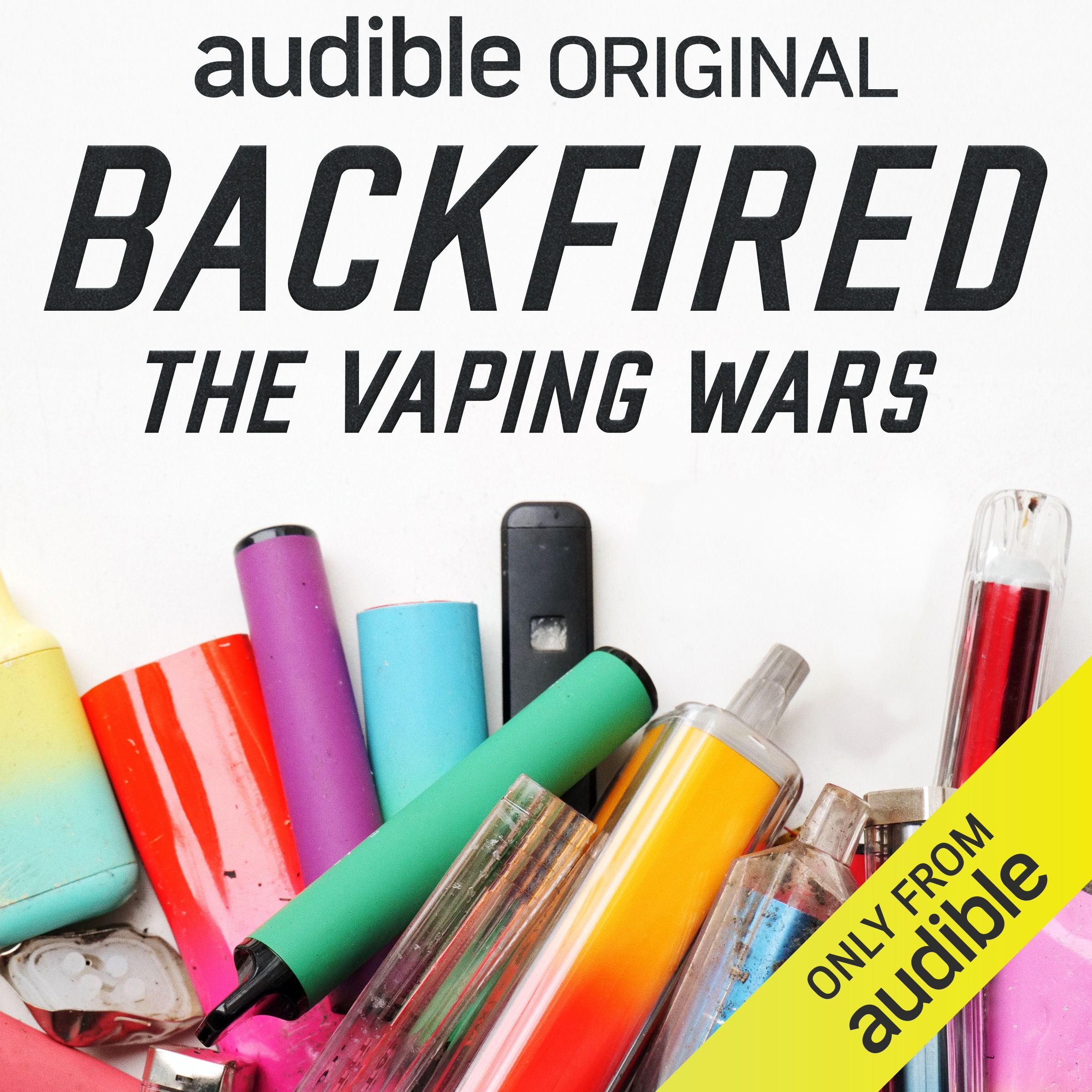
Backfired: The Vaping Wars
Press play and read along
Transcript
Speaker 1 This episode is brought to you by the Cosmopolitan of Las Vegas.
Speaker 3 Las Vegas is magical at night.
Speaker 1 When the sun sets, Las Vegas transforms.
Speaker 2 And at the heart of it all is the Cosmopolitan of Las Vegas, a luxury resort destination where bold experiences unfold.
Speaker 7 Sip a martini inside the chandelier, discover hidden speakeasies, striking art, and unforgettable views of the Bellagio fountains and the Las Vegas skyline from your terrace suite.
Speaker 7 From restaurants to cocktail lounges and high-energy nightlife, every moment invites indulgence.
Speaker 1 It's not just a hotel stay.
Speaker 7 It's an only-in-Vegas experience.
Speaker 1 Book your stay now at thecosmopolitanlasvegas.com.
Speaker 2 Huge savings on Dell AI PCs with Intel Core Ultra processors are here, and they are newly designed to help you do more faster.
Speaker 4 They can generate code, edit images, multitask without lag, draft emails, summarize documents, create live translations, and even extend your battery life.
Speaker 4 That's the power of Dell AI with Intel Inside. Upgrade today by visiting dell.com slash deals.
Speaker 11 This is 99% Invisible.
Speaker 4 I'm Roman Mars.
Speaker 7 For decades, people have been trying to figure out how to create a cigarette without many of the downsides. You know, the things that make smoking the biggest cause of preventable death in America.
Speaker 3 The tar, the carcinogens, and all that stuff. Cigarette companies tried to create quote-unquote safe, combustion-free smoking devices as far back as the 1980s.
Speaker 2 They were all huge flops.
Speaker 8 Then in the 2000s, e-cigarettes first hit the market.
Speaker 11 These early models looked almost like cigarettes, but they gave themselves away in subtle ways.
Speaker 12 If you looked really closely, you could see that they were made of plastic or metal, and they had a little glowing light on the tip meant to resemble the cherry at the end of a lit cigarette.
Speaker 13 Or you might remember the big clunky vaporizers that resembled walkie-talkies and required users to tinker with battery coils and pour so-called e-liquid into them by hand.
Speaker 7 None of these ended up breaking into the mainstream.
Speaker 7 Until, in 2015, a company called Jewel Labs rolled out a new nicotine vape that caught fire, both with adult smokers who used them to kick their old-fashioned smoking habit and with young people, children, who just thought they were cool.
Speaker 5 The Jewel became a phenomenon, not strictly speaking as a smoking cessation device, but as an entirely new habit, jeweling.
Speaker 7 In addition to limiting some of the harm of smoking, it seemed to threaten an entire generation with nicotine addiction.
Speaker 3 The new podcast, Backfired, The Vaping Wars, dives into the stories behind the Jewel's success and its failures.
Speaker 7 Listening to the show, it's clear that what began as an arguably promising innovation in harm reduction inspired a backlash that, in turn, opened the door to a veritable wild west of vaping products.
Speaker 7 Today, we're going to present you with the first episode in which hosts Leon Napok and Ariel Pardis track how Jules' founders figured out that the right combination of chemistry and design could unlock their product's potential and enhance its addictive qualities.
Speaker 2 It's really fascinating stuff.
Speaker 17 Check it out.
Speaker 21 One afternoon last fall, I sent a Slack message to Arielle Pardes, my co-host on this podcast. I needed to tell her something.
Speaker 23 I feel nervous.
Speaker 23 Because every time a conversation starts with, I need to tell you something.
Speaker 15 It's not good.
Speaker 23
Generally, not good, but this one could be good. I don't know.
I'm going to remain optimistic.
Speaker 25 Arielle and I had spent months reporting on vaping, trying to figure out how it had gone from a niche hobby to a billion-dollar industry in the space of just a decade.
Speaker 25 And the entire time we were doing this, I was also trying to quit vaping myself and telling Arielle about it. Sometimes.
Speaker 28 Yesterday when we were recording, and we can probably play this clip because I'm pretty sure we were rowing.
Speaker 15 Oh, no.
Speaker 29 At one point, you were like.
Speaker 23 Leon, was that a vape?
Speaker 15 No.
Speaker 23 That did really sound like a vape.
Speaker 28 I don't vape anymore.
Speaker 30 What was that sound?
Speaker 15 I don't know.
Speaker 28 I was on my phone for a second.
Speaker 15 Don't lie to us, Leon. I'm not on tape.
Speaker 28 I'm not lying. The phone makes a weird sound sometimes.
Speaker 28 I just flatly lied, being like, it's not. And we moved on.
Speaker 19 But it was a vape.
Speaker 23 Why did you lie?
Speaker 31 Because I really thought it was going to be my own little secret until I threw it away later in the day.
Speaker 35 And if it was, if literally only I knew, it would be like it never happened.
Speaker 28 That's why I lied.
Speaker 23 But it's literally on tape.
Speaker 23 We all knew it happened and now there's concrete proof of it.
Speaker 23 Damn.
Speaker 12 Damn.
Speaker 23 Well, thank you for your delayed honesty. And
Speaker 15 sorry I lied to you.
Speaker 23 I forgive you.
Speaker 25 A few years ago, there was really only one vaping product that I and everyone else I knew was using.
Speaker 15 The Jewel.
Speaker 35 In fact, that's what I thought we'd be making this podcast about.
Speaker 14 Juul.
Speaker 26 But once we dug into it, we discovered there are now literally thousands of vape brands on the market in flavors like luscious lemon and watermelon ice and cheesecake.
Speaker 18 You know the Cambrian explosion that's responsible for all the world's biodiversity?
Speaker 25 That's kind of where we're at with nicotine vapes right now.
Speaker 35 And I, unfortunately, have sampled a lot of them.
Speaker 40 I've tried the Air Bar, I've tried ELF bars, I've tried Esco bars, I've tried Miley's, and I like them.
Speaker 42 I hate how much I like them.
Speaker 17 And I hate
Speaker 40 how hard it is for me to stop using them.
Speaker 12 I bought one this morning.
Speaker 23 Why did you buy an Airbar this morning?
Speaker 42 Because my Airbar died last night.
Speaker 23 You know, that's not what I meant.
Speaker 23 Watching Leon grapple with his addiction was pretty eye-opening for me.
Speaker 23 I didn't grow up around anyone who smoked cigarettes, and as an adult in the Bay Area, I didn't know many people who vaped either.
Speaker 23 In fact, in 2019, I voted to ban the sale of nicotine vapes in San Francisco. They just seemed obviously bad.
Speaker 23 So when we started working on this podcast, I wondered if our reporting would change my mind.
Speaker 43 My feelings about vaping were complicated.
Speaker 33 When I was growing up, both of my parents smoked cigarettes, and I picked up the habit when I got to college.
Speaker 38 Then, during my senior year, my dad died of lung cancer.
Speaker 35 He was just 47 years old.
Speaker 45 And yet, even after that, I had a really hard time quitting.
Speaker 20 I tried nicotine patches and gum and even hypnosis, and nothing ever stuck. Until I discovered the jewel.
Speaker 46 And honestly, it was a godsend.
Speaker 47 If I had a jewel in my pocket, I just didn't smoke cigarettes or even think about them.
Speaker 43 But at the same time, because I jeweled all day, including inside at my desk, I became way more addicted to nicotine than I ever was as a smoker.
Speaker 23 All of this is why, when we first started our reporting, we weren't sure how to feel about Jewel and all of the vape companies that have come since.
Speaker 23 Were they saving people's lives or profiting off of their weaknesses?
Speaker 25 It's safe to say we've both been shocked by what we've learned as we've spent the past year trying to get to the bottom of who is winning and who is losing what we've come to think of as the vaping wars.
Speaker 23
Because it's not just one war. There's the war for dominance in the market.
Send the logo and the flavor you want and these Chinese manufacturers will send you tens of thousands of them.
Speaker 23
Jewel is like not cool anymore. It's the puff bar.
Elf Bar and ESCO Bar have not received FDA authorization.
Speaker 49 Thousands of unauthorized vapes are pouring into the United States from China. It's almost like we just can't stop this.
Speaker 50 We are at the cusp of something that could be a catastrophe.
Speaker 34 And there's also a war between two bitterly opposed camps.
Speaker 18 One focused on preventing a new generation from getting addicted to nicotine.
Speaker 51 They came into a kid's school.
Speaker 23 This is predatory behavior. And the other focused on the potential of vapes to save millions of lives.
Speaker 50 First puff, I knew that I was going to quit smoking.
Speaker 10 But before all that, there was, first, Jules War on Big Tobacco, which began at Stanford University before the first vape had even hit the market.
Speaker 23 That's where we're going to begin our story. Two decades ago, when two graduate students in a design program came up with what seemed like a simple solution to the problem of cigarettes.
Speaker 13 I remember being like, this is it. This is the dream.
Speaker 23 I'm Arielle Pardes. I've been a reporter covering Silicon Valley for publications like Wired and the Information for the last eight years.
Speaker 38 And I'm Leon Napok, host of the podcast Yasko and the co-creator of Slowburn.
Speaker 23 From Audible Originals and Prologue Projects, this is Backfired, a podcast about the business of unintended consequences.
Speaker 50 Episode 1, Smoking Gun.
Speaker 25 In January of 2015, a 30-something entrepreneur named James Monsies sat down for an interview with a journalist.
Speaker 26 It was just a few months before the jewel would be released.
Speaker 53 I know when I started this this in grad school and at Stanford.
Speaker 53 We didn't really have like a hard-set goal on starting a company out of it.
Speaker 33 Certainly, the past decade had been a struggle.
Speaker 22 But Moncis felt like the company he had co-founded with his classmate, Adam Bowen, was finally on the cusp of revolutionizing the world of nicotine.
Speaker 48 So he was ready to tell their origin story.
Speaker 53 So you wanted to start at the beginning?
Speaker 54 I want to start at the beginning. Okay.
Speaker 54
That's easy. If I can remember it now, it's been so long.
long.
Speaker 54 I'm just kidding. It's permanently ingrained in my mind.
Speaker 31 Bowen and Monsies had met over a decade earlier in 2003 when they were both enrolled in a master's program at Stanford.
Speaker 22 The program was a mix of art, mechanical engineering, and industrial design.
Speaker 53 Traditionally, 90% or so of the people who came out of that program would start companies.
Speaker 23 People who showed up in this program weren't just in grad school to be in grad school. They were on a mission.
Speaker 46 This is Liz Gerber.
Speaker 26 She attended the program around the same time as Bowen and Monsieur's.
Speaker 23 People were talking about the power of technology, the potential of connecting people. The discussion about unintended consequences in the product design world was minimal.
Speaker 38 Just to place you in this moment in time, 2003 was the year MySpace debuted.
Speaker 31 Apple introduced the iTunes Music Store, and WordPress helped kick off the blogging era.
Speaker 23
We were doing things in a different way at that time. Anything felt possible and it wasn't commercially driven.
It was really let's envision the future in which we want to live.
Speaker 21 As she hung around Stanford's campus, Gerber became friendly with Bowen and Moncis.
Speaker 21 She watched as the two started to tinker with various product ideas in the school's legendary design lab.
Speaker 35 Ideas like furniture that could be molded into different shapes, as well as high-tech business cards that would transmit your information with a single tap.
Speaker 36 But Gerber remembers that it wasn't just their work that made Bowen and Moncis stand out.
Speaker 23 Everybody knew each other, but the smokers definitely knew each other. There were about four students who regularly smoked.
Speaker 36 By 2003, smoking rates among young people were in free fall. I remember being very much in the minority in college when I would smoke outside of our dorm.
Speaker 45 Bowen and Moncy's experienced much the same thing.
Speaker 23 I remember I once took them to task for smoking right outside the door because I was like, hey guys, like, this is the way I get in. This is the way everybody has to get in.
Speaker 23 Like, fine, smoke, but smoke somewhere away from where everybody has to, you know, come in and out of the door.
Speaker 36 Monseys in particular felt shame over his smoking. His grandfather, a smoker, had died from lung cancer.
Speaker 22 And growing up, Moncis' mom taught him to hate cigarettes.
Speaker 33 And yet, he'd picked up the habit anyway.
Speaker 22 Then, one day, he was having a cigarette with Bowen outside the design lab, and a light bulb went off.
Speaker 54 We just kind of looked at each other and thought, you know, this would be a really interesting space to look at. And then the safety and shelter of academia, right?
Speaker 53 Why not look at something that's a huge opportunity and a huge sort of social problem?
Speaker 45 What they realized was that there were a lot of smokers who wanted to quit, and no one had come up with a truly effective way to help them do it.
Speaker 43 Bowen and Monsieur decided this was the problem they wanted to focus on in their master's thesis. So they got to work researching their idea.
Speaker 22 That was when they discovered a number of earlier attempts by big tobacco companies to create a safer cigarette.
Speaker 33 Among them was the Premier, which R.J.
Speaker 32 Reynolds released in 1988.
Speaker 55 Premier is the premiere of a cigarette which heats tobacco rather than burns it, thus eliminating most of the smoke, much of the odor, and all of the ash.
Speaker 42 Under the code name Project Spa, R.J.
Speaker 36 Reynolds spent years and hundreds of millions of of dollars developing the device.
Speaker 35 The big innovation behind it was that it heated tobacco instead of burning it, thereby removing the most dangerous part of smoking, the combustion that creates tar.
Speaker 20 Still, Reynolds was careful not to say that the Premier was safer, just that it was cleaner.
Speaker 56 We substantially reduce many of the controversial compounds found in the smoke of tobacco burning cigarettes, virtually eliminate side-stream smoke, no ash. There is a cleaner taste.
Speaker 56 It is a different taste.
Speaker 48 But that different taste wasn't a hit with early users.
Speaker 55 It doesn't taste like you're smoking tobacco. What does it taste like? Like you're smoking plastic?
Speaker 35 Reynolds gave up on the Premiere after a short test period.
Speaker 21 But as Bowen and Moncis found out, that was not the end of Big Tobacco's efforts to create a safer cigarette.
Speaker 35 In 1998, Philip Morris released the Accord.
Speaker 57 Accord is really a smoking system. It includes what would appear to be a traditional cigarette that is inserted into a special lighter.
Speaker 57 The lighter has sensors in it and when you take a puff, it burns the tobacco in the cigarette.
Speaker 36 Like the Premier, the Accord was designed to vaporize tobacco leaves by gently heating them, which was supposed to prevent users from inhaling deadly chemicals.
Speaker 21 But also like the Premier, the Accord tasted bad and failed to take off with customers.
Speaker 36 The timing was also not great.
Speaker 35 As it happened, the Accord was released just as Philip Morris, along with several other big tobacco companies, agreed to pay billions of dollars in a court-ordered settlement.
Speaker 16 This settlement is clearly an important step in the right direction for our country.
Speaker 16 It reflects the first time tobacco companies will be held financially accountable for the damage their product does to our nation's health and the long struggle to protect our children from tobacco.
Speaker 25 As part of the settlement, Tobacco companies were forced to make millions of internal documents public, including some that showed they had lied about the health risks of smoking.
Speaker 38 This database was released just two years before Bowen and Monsieurs had their revelation outside the Stanford Design Lab.
Speaker 35 In fact, it's where they found out about all the early failed attempts at safer cigarettes.
Speaker 31 Now, they could use Big Tobacco's research to beat them at their own game.
Speaker 54 We got so much information that you wouldn't be able to get in most industries. Yeah, and we were able to catch up
Speaker 53 to a huge, huge industry in no time.
Speaker 45 Soon, Bowen and Monsies started working on a prototype.
Speaker 20 The key innovation they were keen to tinker with was this idea that if you heat tobacco leaves at a lower temperature instead of burning them, you can still get nicotine, but without the deadly tar that leads to lung cancer.
Speaker 47 The question was how to design a device that could do that in a way that was portable, satisfying for smokers, and hopefully cool to look at.
Speaker 22 It turned out to be a much bigger challenge than Bowen and Moncis had anticipated.
Speaker 35 By June of 2005, Bowen and Moncis were ready to present their thesis idea to their classmates.
Speaker 39 It would, hopefully, be the first step towards securing potential funding. and turning their product into something more than just a good idea.
Speaker 25 Moncis introduced the device, which they were now calling Plume, the rational future of smoking.
Speaker 58 So the name was Salas.
Speaker 59 It's now Plume, at least temporarily.
Speaker 21 Moncies quickly ran through what he and Bowen had discovered about Big Tobacco's attempts to make a less deadly cigarette and explained why he thought all of them were pretty lame.
Speaker 58 Really, there's no design innovation going on in smoking whatsoever because big tobacco is really interested in not shooting themselves
Speaker 60 in their own foot. Like
Speaker 53 sell cigarettes, and that's very much what they do.
Speaker 35 Then it was Bowen's turn to speak.
Speaker 21 He made the case for why the plume would be different.
Speaker 60 So our goal was to basically create a whole new experience for people that pertains to the positive aspects of smoking, like the ritual and everything, but makes it as healthy and socially acceptable as possible.
Speaker 21 Healthy and socially acceptable.
Speaker 19 The plume wouldn't be smelly like a cigarette, nor would it raise the ire of classmates like Liz Gerber.
Speaker 20 Instead, it would be safe and maybe even cool.
Speaker 60 We feel that we could take tobacco back to being a luxury good and not so much a sort of drug delivery device that cigarettes have become.
Speaker 21 The plume looked nothing like existing tobacco products.
Speaker 48 It was sleek.
Speaker 21 It had a cartridge system that Bowen compared to the Nespresso.
Speaker 36 And it came in a variety of flavors.
Speaker 21 When the presentation was over, the room lit up with applause.
Speaker 23 They had some beautiful drawings. I remember the look of it being very attractive.
Speaker 34 To Liz Gerber, the plume didn't just look good.
Speaker 38 There was almost something romantic about it.
Speaker 23 I also thought the name plume sounded really beautiful. It made me think of like the 1920s flappers with the long cigarettes and like the
Speaker 23 wavy smoke coming out. And it kind of had this
Speaker 23 elegant association.
Speaker 23 I remember also thinking
Speaker 23 about unintended consequences. Like what if in addition to helping people quit and reducing secondhand smoke, it also makes smoking sexier.
Speaker 23
After graduating, Bowen and Monsies worked on the plume from a small room in Bowen's house. Their first challenge was to build the device.
But in order to do that, they needed money.
Speaker 23 The problem was a lot of big venture capital funds were prohibited from investing in the vice space, which included drugs, alcohol, and even supposedly safe cigarettes.
Speaker 23 So after getting a few rejections, Bowen and Monse sent a plea to a Stanford email list. Eventually, a few angel investors agreed to take a chance on the company.
Speaker 23 By the spring of 2007, Plume raised nearly half a million dollars. And finally, the company was ready to make its first hire.
Speaker 50 My name is Kurt Sonderager, and I was the first employee at Plume, which went on to become Jewel.
Speaker 23 In 2007, Kurt Sonderager was a 41-year-old marketing director at Red Bull. He was the kind of person who religiously attended Burning Man and spent his vacations surfing in Bali.
Speaker 23 He was also a smoker.
Speaker 50
I was a longtime smoker, heavily conflicted. I was eating well, exercising a lot, but it was the monkey.
I couldn't get off my back.
Speaker 23 One day, Sonderager received a cryptic LinkedIn message about a new company in need of a marketing director. Bowen and Monsies invited Sonderager to meet them at a posh hotel in San Francisco.
Speaker 50 I went to sit down and there are this two kind of slightly disheveled, you know, graduate student looking guys. And, you know, we shook hands and I went to take things out of my pocket as we do.
Speaker 50 You know, one of the things when i put it on the table kind of shockingly i noticed it was a pack of cigarettes i was very ashamed of smoking and it's not something i was proud of certainly not in a first interview with a company i knew nothing about and adam and james kind of looked at each other and smiled slightly
Speaker 23 As the meeting went on, Sonder Ager realized why Bowen and Monsies were pleased to find out he was a smoker. They told him about plume and described how vaporization worked.
Speaker 50 One of the things they made very clear was they didn't want it to look like a cigarette. They wanted it to be its own thing,
Speaker 50 that they weren't trying to replicate the cigarette paradigm. They were going to change that paradigm.
Speaker 23 The plume was still just a prototype, but Sonder Ager totally bought into the vision.
Speaker 50 We had Nicorette, gum, we have patches, we have all kinds of tools that people could use to stop smoking, but it wasn't working.
Speaker 50 So clearly, there's something to the ritual of smoking that smokers really can't let go of. And I bought into that 100%.
Speaker 4 I'm one of them.
Speaker 23 Sonderager started at Plume in September of 2007. He likes to tell a story about his first day when he showed up to find the office had no desks.
Speaker 23 So he ran out to Home Depot to buy some supplies to make some.
Speaker 23 And yet, Bowen and Monsies told Sonderager they were planning to launch Plume in just a few months.
Speaker 50 That was not easy. There was certainly a lot to do, but as a marketing person and not as an engineer, I couldn't really jump in with them on a lot of the things.
Speaker 50 The only thing I could kind of help out with other than branding and website and social media and all that stuff was the flavor development.
Speaker 23 The plume used a butane flame to heat a tiny metal cup, kind of like a Nespresso pod, filled with tobacco leaves and mixed with commercial food flavoring.
Speaker 23
The heat produced a vapor, which would then be inhaled through a mouthpiece. Overall, it resembled a large chunky pen.
Sonder Ager said he always thought about it as a portable hookah.
Speaker 50
Kind of a hookah in your pocket. So there were these little pods that had tobacco in them and we didn't want to just vape the straight tobacco.
It's a little bit boring.
Speaker 50 It doesn't have that much flavor. So following the hookah bottle, we started with adding different flavors and mixing it with the tobacco before filling these little pods.
Speaker 23 Bowen and Monsies had always imagined the plume as a flavored product. Bowen, in particular, was often experimenting by combining tobacco leaves with various flavors in big mixing bowls.
Speaker 23 Some early flavors included cinnamon and butter. Bowen would leave pods on Sonderager's desk for him to sample, and eventually they settled on six flavors.
Speaker 53 Peach.
Speaker 50 The peach was called orchard. Café Noir Gold, which is like a more traditional tobacco flavor.
Speaker 50 Rocket, which was like a
Speaker 50 strong flavor. And the two herbal flavors were blue tea and kick-ass mint.
Speaker 23 As fun as it was to try out flavors, getting the plume ready for market was taking way longer than the founders and Sonderager had hoped. All of a sudden, it was 2009.
Speaker 23 The original launch date had come and gone, and they were still testing the plume to mixed reviews. At one point, Sondereger lent a plume to a friend to take to Burning Man.
Speaker 23 Afterwards, the friend reported that, quote, the harsh playa conditions did not mix well with pluming. There are too many working pieces and too many steps in the pluming process.
Speaker 23 Sonder Ager's friend said that by comparison, SIGGIS are simple.
Speaker 50 We pushed ahead anyway because we needed to get something to market. Investors were getting a little bit antsy and we needed to show some results.
Speaker 50 And at the same time, they knew that they would, you know, fail small, fail early, and
Speaker 50 keep iterating on the design.
Speaker 23 Finally, in late 2009, so five years after Bowen and Monsies came up with the idea, they soft-launched the plume.
Speaker 23 Sonder Ager put an image on their website of the black Model 1 with the words, small, dark, and handsome. He also posted on a few message boards that the plume was hitting the market soon.
Speaker 23 Hundreds of pre-orders came rolling in. A camera crew from a news website paid a a visit to their office, and Monsies demonstrated the Model 1 for the reporter.
Speaker 62 So I'm pluming this device because I'm not smoking.
Speaker 51 So then when you inhale,
Speaker 14 you get this vapor.
Speaker 62 But it's not smoke, it's just vapor.
Speaker 23 Moncies went on to compare the process to steeping tea.
Speaker 62 When you put a tea bag into hot water, you're extracting the aroma, you're extracting the caffeine.
Speaker 62 So we've found a new way to make tea and have a very different experience that's more suited to people who are smokers.
Speaker 51 So you get the nicotine, you get the flavor, but you don't actually burn the tobacco.
Speaker 23 The reporter points out that Bowen and Monsieurs are steering clear of claiming that the plume is safer than a regular cigarette.
Speaker 23 Instead, Bowen used a familiar word, cleaner.
Speaker 41 We believe that it is a cleaner ritual and alleviates a lot of the social and environmental concerns otherwise ascribed to smoking.
Speaker 23 And Monsieur's finished by further distancing the product from cigarettes.
Speaker 51 What we've tried to do is create a new paradigm, something that doesn't look like a cigarette, it doesn't feel or taste like a cigarette.
Speaker 62 It's different.
Speaker 23 The media interest suggested there was some momentum, but not enough.
Speaker 23 Like its big tobacco predecessors, the Plume Model 1 was a flop.
Speaker 23
For one thing, it wasn't satisfying as a nicotine delivery system. Sonderager would often plume all morning and then go downstairs and have a cigarette.
But also, often the device just didn't work.
Speaker 23 Sonder Ager had a hard time communicating that to the founders. He remembered one instance in particular when Bowen just wasn't accepting the flaws he was telling him about.
Speaker 50
I said, look, Adam, just come with me. Let's make the rounds and let's see how this goes.
And we went to like five head shops that day.
Speaker 50
And I remember one of the shops in particular, we went in there cold and presented the device to the guy. I just put it down on the table.
I explained how it worked.
Speaker 50
And the guy, everything that could have gone wrong, did wrong. He couldn't get the butane in it.
When he went to start it, he shocked his finger. He used it for a little bit.
Speaker 50 The mouthpiece fell off and he broke his lip.
Speaker 50 And I remember seeing Adam's face, just like he knew that these were problems, but when he saw it, like in five minutes, how all the major flaws came to light with one user in one interaction.
Speaker 50 I think that was the beginning of the end of, okay, we need to recalibrate, go back to the drawing board, fix this thing. It's not ready for prime time.
Speaker 23 Something had to change, but it wasn't obvious what should be fixed first out of the plume's many, many problems.
Speaker 4 You're listening to Backfired on 99% Invisible.
Speaker 14 More after this.
Speaker 3 Forged by nature and alive with fall color, Maine does autumn the way it's meant to be.
Speaker 3 Think quiet, misty mornings, glowing foliage, salt-scented breezes, then fresh lobster, dress-pressed cider, and warm doughnuts straight from the farm.
Speaker 3 There's no script here, just woods, waves, and whatever comes next.
Speaker 6 This fall, write your story in Maine.
Speaker 5 Start planning at visitmaine.com.
Speaker 63 Article makes it effortless to create a stylish, long-lasting home at an unbeatable price.
Speaker 63 Whatever your personal style may be, Article offers a curated range of mid-century modern, coastal, and scandy-inspired pieces that not only shine on their own, but also pair seamlessly with nearly any other article product.
Speaker 63 Their carefully selected collections feature high-quality, meaningful pieces that will stand the test of time. There is no filler.
Speaker 63 Every item is chosen for its craftsmanship, design, and lasting value. My house is like an article furniture longitudinal study.
Speaker 3 I sleep in an article bed.
Speaker 64 My wife Joy works at, and we eat at an article dining room table, and we sit in article chairs. And it has been this way for years and years and years.
Speaker 63 All the furniture I've ever gotten from Article is still in service and performing at its peak. Article is offering our listeners $50 off your first purchase of $100 or more.
Speaker 63 To claim, visit article.com/slash 99, and the discount will be automatically applied at checkout. That's article.com/slash 99 for $50 off your first purchase of $100 or more.
Speaker 52 This episode is brought to you by Progressive, where drivers who save by switching save nearly $750 on average. Plus, auto customers qualify for an average of seven discounts.
Speaker 52 Quote now at progressive.com to see if you could save.
Speaker 52 Progressive Casualty Insurance Company and affiliates, national average 12-month savings of $744 by new customer survey, who save with Progressive between June 2022 and May 2023.
Speaker 52 Potential savings will vary. Discounts not available available in all states and situations.
Speaker 65 This episode is brought to you by PNC Bank. Some people think podcasts about architecture are boring.
Speaker 65 Yeah, well, sometimes the details are boring, but that's what creates stable foundations and construction that lasts.
Speaker 14 And that's something that everyone wants.
Speaker 65 It's like banking with PNC. It might seem boring to save, plan, and make calculated decisions with your bank, but keeping your money boring is what helps you live a happily, fulfilled life.
Speaker 65 PNC Bank, brilliantly boring since 1865.
Speaker 5 PNC Bank National Association member FDIC.
Speaker 35 According to emails we've seen from December of 2010, tensions started to emerge between Bowen and Monsies.
Speaker 42 Bowen felt the company's number one goal should be pursuing deep lung nicotine delivery, the thing that, as he put it in one email, literally keeps smokers coming back for more.
Speaker 23 Monsieurs worried that would essentially mean they were trying to make their device as addictive as possible. He replied, if deep lung makes the product more enjoyable, then great.
Speaker 23 If the purpose is to keep people coming back for more, then I'm not sure I'm on board. Moncies wanted people to plume because they enjoyed pluming, not because they were chemically addicted to it.
Speaker 42 Eventually, they settled on a compromise.
Speaker 20 They would focus on a new version of the plume that solved what Moncis euphemistically called its user interaction issues, while also researching improvements to nicotine delivery.
Speaker 35 But doing both of these things would require money, money the company didn't have.
Speaker 23 In fact, early investors had seen the failure of the Plume Model 1 and assumed that Bowen and Monsies would give up, that the future of smoking had been just another promising idea from Silicon Valley that ended up amounting to nothing much.
Speaker 35 But Bowen and Monsies weren't ready to fold.
Speaker 27 Instead, they agreed to accept millions of dollars in investment capital from a Japanese tobacco company, exactly the type of company they had set out to disrupt and, frankly, destroy.
Speaker 35 To Kurt Sondereger, it initially seemed like a deal with the devil.
Speaker 50 I was a little conflicted about it, but I also realized that why Japan Tobacco was doing it, because they weren't doing it to kill the technology, as sometimes happens with tech companies, right?
Speaker 50 They buy a potential competitor and just kill it, wipe it out.
Speaker 10 They
Speaker 50
saw this also as the future. So if a big tobacco company in a smoking crazy country like Japan could come in and say, hey, this is the future of smoking, great.
Keep going, guys.
Speaker 50 Keep innovating until you get it right.
Speaker 23 Plus, for Sonder Ager, it helped that Japan tobacco was Japanese.
Speaker 50
It didn't feel as bad as like Altrio or Philip Morris. Do you know what I mean? It's Japan tobacco.
It's all the way on the other side of the world.
Speaker 23 With the investment in hand, the new plan was to have a revamped product on the market, hopefully within a year or so.
Speaker 23 But Sonderager didn't want to wait that long and decided to move on from the company.
Speaker 50 So I departed. And what happened was instead of fixing the plume right away, they actually came out with the PAX.
Speaker 45 The PAX was Bowen and Moncie's solution to their cash flow problem.
Speaker 20 Officially, it was a loose leaf vaporizer.
Speaker 27 Unofficially, it was a weed vape.
Speaker 50 It was funny because with the many investors that we talked to about this, quite often the first thing they would say, like under their breath, they would say, yeah, this is cool.
Speaker 3 Does it work for weed?
Speaker 15 You know?
Speaker 50 So when enough people ask you if it works for weed, you have to ask yourself like,
Speaker 50 no, but we can make one that really works well for weed. So I think that's what they did.
Speaker 26 Using their vaporization technology to help stoners wasn't exactly Bone and Monse's primary mission.
Speaker 25 But it was another compromise they were willing to make in order to keep the company afloat.
Speaker 39 And to their credit, they really didn't half-ass it.
Speaker 26 The PAX was born of a collaboration with Yves Behar, the Swiss designer best known for the Soda Stream bottle and the Jawbone Bluetooth headset.
Speaker 50 It was like a $200 or $300
Speaker 50 vaporizer and they sold hundreds of thousands of them. It was like the best-selling vaporizer in the country for weed and it gave them what they needed.
Speaker 45 Finally, Bowen and Moncis had a best-selling product.
Speaker 35 And with the new influx of cash, they continued to refine the Plume.
Speaker 36 They also hired more employees.
Speaker 13 All I remember is going into then where the customer service representatives worked, which was out of like a supply closet with like some retrofitted bathroom. And I thought, this is it.
Speaker 13 This is the dream. Like I was so pumped to be there.
Speaker 23
Lorenzo Castillo was still in college when he joined Plume to work part-time as a customer service representative. It was exactly what he hoped for.
The company was still small, but growing.
Speaker 23 It had a strong happy hour culture, no rules against vaping in the office, and his team had a habit of dressing up in suits and ties on Fridays, since every other day people wore t-shirts and jeans.
Speaker 23 In other words, it was a lot of fun.
Speaker 13 We would wait for the leadership team to come back from lunch.
Speaker 13 And when they would, we would shoot foam darts at them. And this is one of the videos where we're just barraging them with foam darts as they walk in.
Speaker 13 You can see James catch one and shoot it back at us, right? And that was kind of, and he sat right next to us.
Speaker 13 That was like part of what enabled us to have that fun atmosphere, that he wasn't beyond having a little fun in situations like that.
Speaker 23 Castillo loved the PAX, as did all of his friends.
Speaker 13
When it came to like Secret Santa, for the couple of years that I worked there, I would bring a PAX, and that was always a big hit. I mean, in my mind, right, this is it.
This is the product, right?
Speaker 13 A discrete way to smoke pot where you don't have to burn anything.
Speaker 23 But he also understood that the device wasn't the company's main ambition.
Speaker 13 I always saw the PAX as a pleasant diversion from the mission that James and Adam had initially set out on.
Speaker 13 I think they really wanted to reinvent tobacco and how it was consumed as opposed to creating a discrete way for people to vaporize pot.
Speaker 23 Even as sales of the PAX took off, Bowen and Monsies were still focused on improving the design of the next version of the plume, the Model 2.
Speaker 23 Crucially, they switched from a butane heat source to a USB rechargeable battery, so no more unpleasant shocks.
Speaker 13 And I actually have one.
Speaker 66 I have a Model 2.
Speaker 13 I brought it in.
Speaker 61 You have one in your pocket right now.
Speaker 12 Yeah, yeah, yeah.
Speaker 13
And it's funny, like it's, you know, you look on this and it's fairly discreet. Of course, it's dead as hell.
But it's still got, this is probably my favorite thing. It's still got a rocket pod in it.
Speaker 13 And if you want, you can smell it and you can still smell the rocket pod if you twist it out.
Speaker 61 Wow.
Speaker 13 That was my favorite flavor.
Speaker 15 Rocket.
Speaker 23 I don't even know how I would describe this flavor. It doesn't smell like something that exists in nature.
Speaker 13
Some people, including myself, say Christmas, but yeah, no, I hear you. I think it's got like a cinnamon hit to it.
It just, you know how they say smell is like the biggest hit of nostalgia?
Speaker 13 Smelling that brings me back to those times.
Speaker 23 The Plume Model 2 was launched in 2013 with a swanky party in San Francisco. The company also co-sponsored a New York Fashion Week album release party for Robin Thick.
Speaker 23 According to the New York Times, most attendees were a bit confused by the plume. A brand ambassador had to explain to users, they're very popular, very international.
Speaker 23 They smell like cookies.
Speaker 23 Glitz and confusion aside, the hope was that, finally, the company could build on the success of the PACs with an e-cigarette that actually worked.
Speaker 13 Anything Model 2 that came in was treated with white glove service.
Speaker 13 We were told to escalate that to our more senior customer service representatives and to really thoroughly work with those customers in terms of what's wrong, how can we help you?
Speaker 13 I think that really showed where the priorities were for that company at that time.
Speaker 23 Bowen and Moncis were eager to get feedback from customers about the new and improved version of their device. The problem was there weren't that many Model 2 customers to learn from.
Speaker 13 I remember we had an all hands.
Speaker 13 And during that all hands, an engineer who is, I'm not going to name names, but was known to be vocal, rose his hand and said, exactly how many Model 2s have been sold.
Speaker 13 I remember that being a palpably awkward moment where it was clear that it wasn't the hit that I think we wanted it to be as a company.
Speaker 23 The Plume Model 2 had been an improvement on the Model 1, but it still had many of the same problems. The mouthpiece felt fragile, and it had to be recharged every three or four uses.
Speaker 23 Crucially, it didn't solve the problem Bowen had now been highlighting for years.
Speaker 23 It still didn't deliver enough nicotine to satisfy smokers.
Speaker 13 Heating was a problem with the Model 2. There was like some inconsistencies with the mixtures because it was still like a leaf-based product with the pods.
Speaker 13 And I think that led to like a less than desired user experience.
Speaker 39 It was clear the entire way way the Model 2 worked by vaporizing tobacco leaves just wasn't delivering a satisfying amount of nicotine.
Speaker 19 So Bowen and Monsies went back to the tobacco documents they had first discovered while they were at Stanford.
Speaker 37 That was where they hit upon secret research from R.J.
Speaker 35 Reynolds into something called nicotine salts.
Speaker 25 The documents showed that in the 1980s, scientists at the company reported that combining pure nicotine with an acid would create a special kind of salt.
Speaker 25 This salt eliminated the unpleasant effects that came with increasing the concentration of nicotine.
Speaker 15 But R.J.
Speaker 25 Reynolds had never commercialized this breakthrough.
Speaker 31 Apparently, they were concerned that it would produce such a smooth cigarette that people wouldn't realize they were smoking way too much.
Speaker 25 and that they would just keep smoking until they accidentally overdosed on nicotine.
Speaker 26 This seemed like a really promising potential solution, but only if Bowen and Monsey's were willing to completely redesign how their nicotine vape worked.
Speaker 26 Instead of vaporizing tobacco leaves like the Model 2, a new device would need to mix nicotine in a liquid that would then be heated as an aerosol.
Speaker 26 This would require expertise that went far beyond Bowen and Monsey's Stanford design credentials.
Speaker 25 So they hired a chemist to help.
Speaker 35 Her name was Chen Wei Xing.
Speaker 67 They were a strong team with mechanical engineering background and product design, but they didn't have anybody with chemistry training. And that's why they had this opening.
Speaker 35 Shing had a PhD in chemical engineering.
Speaker 20 She'd worked for big pharmaceutical companies on things like asthma inhalers and an inhalable migraine drug.
Speaker 43 Shing did not respond to our request to speak with her.
Speaker 31 So what you're hearing is an interview she did with Bloomberg in 2019.
Speaker 67 I told specifically to the recruiter in the beginning that I was not a smoker and I don't plan to start smoking.
Speaker 67 And then they said it's not a requirement,
Speaker 67 even though many of their team, they are smokers.
Speaker 19 Shing recalled that Bowen and Monsies were actually pluming during her job interview.
Speaker 67 It was not as annoying at all as somebody smoking next to you.
Speaker 35 She also recalled that they seemed aware that some scientists in the field of healthcare might be hesitant to work on a tobacco-related product.
Speaker 67 But I actually hold different views on that because I think being somebody develops medications, right, or drugs, it's actually to treat sickness.
Speaker 67 But I do see smoking as a behavior causing a lot of health problem and then causing a lot of stress on public health space in general.
Speaker 35 Shing took the job in 2013 and set about trying to figure out how to deliver a nicotine hit that would convert serious smokers.
Speaker 12 It would need to have just enough burn and a little hit to the back of the throat, but it couldn't be too harsh to handle.
Speaker 27 Shing conducted her research in a lab that was set apart from the rest of the office.
Speaker 35 Lorenzo Castillo, the customer service rep, thinks that was not an accident.
Speaker 13
I remember like being like, wow, they're really putting research under lock and key. Like you don't walk by engineering anymore.
Engineering is on the far side of the building.
Speaker 13 And that to me was like, oh, there's, there's definitely like a different part of the building for them. They were really working on something special back there and they wanted to limit distractions.
Speaker 25 Working closely with Bowen, Shing mixed different formulas of e-liquids and recruited coworkers to give feedback on the flavor and the nicotine hit.
Speaker 19 They called this buzz testing.
Speaker 22 Castillo remembered that his boss was one of the people who opted in to trying the new technology.
Speaker 13 She was a cigarette smoker and she volunteered.
Speaker 31 Shing documented her test subjects' reactions to the new formulation.
Speaker 34 She wanted to know, did their heart rate increase?
Speaker 48 Did they get a throat hit?
Speaker 29 Did they feel a buzz?
Speaker 15 I remember being like, whoa, that's new.
Speaker 13 That's they're doing something that is a lot more data-intensive than anything we've done in the past.
Speaker 33 Eventually, it became clear that nicotine salts were delivering a hit that was way, way stronger than anything Plume One or two could give you.
Speaker 42 Shing had cracked the code.
Speaker 67 When those volunteers
Speaker 67 came to you and say that they haven't touched their cigarette pack for a while. Well, I do think that we have a great product and we should let more people try it.
Speaker 22 On October 10th, 2014, Bowen and Shing filed a patent to protect their innovation.
Speaker 32 In their application, they reported having, quote, unexpectedly discovered that certain nicotine liquid formulations provide satisfaction that was similar to smoking a traditional cigarette.
Speaker 17 In fact, their formulation was so strong that it made users' heart rates skyrocket higher and faster than if they just smoked.
Speaker 35 In other words, it had the potential to be even more addictive.
Speaker 23 While Bowen and Shing were at work on the nicotine formula, Monse started thinking about a new design for their new device. He wanted it to be more like the PAX.
Speaker 15 PAX
Speaker 50 was that aesthetic was born out of everybody on the team's immediate, you know, instinctual distaste for this 420 aesthetic.
Speaker 23 Josh Morenstein was a designer at the firm that worked on the PAX.
Speaker 23 He remembers one detail in particular from his early interactions with Bowen and Monsieurs.
Speaker 50
The main thing I remember was that they were constantly, constantly vaping. Constantly.
And there was a giant bowl, like a salad bowl that had hundreds of multicolored plume pods.
Speaker 50 Those are the little Nespresso guys. And then there was another bowl that had hundreds of used pods and they would go through them constantly, right? Constantly sucking on these things.
Speaker 23 Monsieurs wanted their new device to be easier to use than the plume, something that people would want to keep in their pocket and something they'd want to show off.
Speaker 50 The main component of the brief was,
Speaker 50 let's design something that has permanence, to use his words. And the idea was to create something that was reusable and rechargeable and refillable.
Speaker 50 People have to want this thing that has to feel special.
Speaker 23 Monsieur has offered Morenstein and his partner a contract for a few weeks of design work on this new concept. They agreed to take on the project and came up with a whole host of designs.
Speaker 23 Finally, when they felt they were almost tapped out, we said, is there anything that we've kind of left
Speaker 50 undiscovered? And I think I said, what would it be like to smoke in the future? Would you really use a cylinder?
Speaker 50 This is all based off of the way that traditional tobacco is manufactured and processed and rolled. And I had a USB key on my keychain, which was a tiny little rectilinear form and it was sheet metal.
Speaker 50 It was rolled and those are pretty inexpensive. And I said, what if it was like this?
Speaker 23 Like a USB stick.
Speaker 23 He put the one on his keychain up to his lips.
Speaker 50 And it felt felt better than trying to wrap your mouth around a circular shape.
Speaker 23 Morenstein and his partner dubbed this version the slab, and they got to work drawing up the concept.
Speaker 23 They decided that you should be able to charge the device by sticking it into your computer, just like a USB stick.
Speaker 23 In June of 2013, they presented the slab to Bowen and Monsies.
Speaker 50 We have the original presentation here that we shared with the team at Juul.
Speaker 23 The PowerPoint shows the product already named Jewel.
Speaker 23 Morenstein didn't know when or how that name had been decided, but he recalled Bowen and Monsieur's already having settled on it before he was hired.
Speaker 23 Bowen would later clarify that the name was inspired by jewels, like gems,
Speaker 23 and jewel, the scientific unit of energy.
Speaker 50 you know, it kind of sits between the fingers in a slim way, and it's actually more comfortable than a cylinder would be.
Speaker 23 And they were just immediately like, this is it. This is the one.
Speaker 50 There's no question this is the one.
Speaker 23 At this point in our interview, Morenstein put away the PowerPoint and pulled out one of the early prototypes of the jewel. Can I hold this jewel prototype?
Speaker 59 Yeah.
Speaker 23 It's remarkably similar to the jewel we know and love today.
Speaker 50 It's probably the most famous thing I've ever designed.
Speaker 18 For sure.
Speaker 50 At the end, I think we made $16,000 on it.
Speaker 23 Morenstein went on to design the Fellow Gooseneck Kettle, the Open Spaces Shoe Rack, and Athena Club Razors.
Speaker 23 But the jewel is far and away the most recognizable product he's ever designed. That's because it's one of the most recognizable products of the 21st century, like the iPhone and the Tesla Model 3.
Speaker 23 Like smartphones and cars, e-cigarettes had existed long before the jewel came along. But it was Morenstein's design that made the jewel stand out.
Speaker 42 Frankly, I think we did a good job.
Speaker 50 You know what I mean? Like I still have, I'm like, oh, we kind of nailed it.
Speaker 23 Yeah, it's iconic.
Speaker 30 Yeah.
Speaker 50 And that's what we were hired to do.
Speaker 23 By early 2015, Adam Bowen and James Monsies were finally ready to release the jewel into the world.
Speaker 23 10 years after first presenting their idea to their classmates at Stanford, they started agreeing to interviews, like the one you heard at the beginning of this episode, where Moncies teased their upcoming product launch.
Speaker 60 So let's talk about this year. What is next? What's in store for you guys?
Speaker 53 A lot of great stuff.
Speaker 30 It's all a top secret.
Speaker 54 Yeah, we'll have more than one really awesome new product out this year.
Speaker 23 One really awesome new product. When Kurt Sonderager got his hands on the jewel, he was really impressed with how far Bone and Monsey's had come from the prototype they showed him back in 2007.
Speaker 23 What did you think?
Speaker 50 You know, they definitely fixed the product
Speaker 50
in every sense of the word. It was super easy.
There were no pain points. There was no butane.
There was no shock. It was easy to put a pot in and take a pot out.
Speaker 50 So I knew it was going to be pretty big. I didn't have any idea how big it actually got.
Speaker 23 He only had one concern. What if Bowen and Moncis had made their product a little too good?
Speaker 50 I gave it to one of my buddies who owns a bar here in Encinitas, and he was a heavy smoker. And he finally completely gave up on cigarettes.
Speaker 50 And when I gave him this jewel, he told me, said, shit, I feel like I'm addicted again.
Speaker 43 This season on Backfired, we'll take you inside Jewel's rides and its precipitous fall.
Speaker 68 I didn't understand until it clicked. You can smoke the jewel wherever you want.
Speaker 23 New crazy cigarettes, it's called Jewel, and it is flying off the shelves.
Speaker 68 This thing is really sexy and disruptive.
Speaker 23 There is such a thing as a company growing too fast.
Speaker 46 Jewel grew too fast.
Speaker 16 I'm going to go over a couple different ways to hit your Jewel while you're in school and not get caught.
Speaker 50 We literally called our bathroom the Jewel Room.
Speaker 23 Tonight, authorities investigating what could be the country's first death linked to vaping.
Speaker 13 I think it was the beginning of the end for Juul.
Speaker 43 We'll also hear from the co-founder of Jewel, James Monsies, who has not spoken publicly about the company in nearly half a decade.
Speaker 69 We could have done a lot better job collectively of dealing with this if we hadn't been so focused on finding a new enemy so quickly.
Speaker 23 We'll meet the new owners of the next generation of vape companies and the frustrated authorities who have been powerless to rein them in.
Speaker 13 We invested about $2 million and we blew it up immediately into a multi-million dollar company within 90 days.
Speaker 35 It's like imagine you're walking down the street and someone's like, here, take this like 500 bucks.
Speaker 50 Like run, run, run, run.
Speaker 23 We didn't predict what I now believe is an epidemic of e-cigarette use among teenagers it was a witch's brew of public health concerns the teens are very clever they seem to evade where the regulations go u.s agents recently seized more than 1.4 million illegal e-cigarettes it can almost feel like a game of you know whack-a-mole and finally i'll try to figure out how to end my own personal vaping war or at least come to some sort of truce.
Speaker 24 My mom doesn't really know about any of this, so I'm contemplating how I will talk about it on the podcast if I will.
Speaker 23 I feel like a great way to tell your parents about your nicotine addiction is to launch a podcast series.
Speaker 23 Backfired is presented by Audible Originals and Prologue Projects. The show is hosted by Leon Napok and me, Ariel Pardas.
Speaker 43 Our senior producer was Sam Lee.
Speaker 20 Our editor was Kim Gittleson. Our producers were Dustin DeSoto and Catherine Sullivan.
Speaker 33 Our assistant producer was Arlene Arevalo.
Speaker 23
Sound design by Andrew Parsons. Archival research and fact-checking by Francis Carr.
Our theme song and score were composed by Emma Munger.
Speaker 47 Audio mix by Erica Wong.
Speaker 29 Copyright Counsel provided by Peter Yassi and Brandon Butler at Yassi Butler PLLC.
Speaker 23
Heather Juan Tesoreo is our executive producer at Audible Originals. Mike Charzik is the head of production at Audible Studios.
Rachel Gyatza is Audible's chief content officer.
Speaker 21 Special thanks to Gabriel Montoya and Thomas Perfetti.
Speaker 23 Backfired was co-created by Kim Gittelson for Prologue Projects. Sound recording copyright 2024 by Prologue Projects.
Speaker 4 You can find the full season of Backfired for free if you're an Audible subscriber.
Speaker 4 It's created by the team at Prologue Projects, which has produced many excellent podcast documentaries hosted by by Leon Napok, including Many Seasons of Fiasco and Think Twice, Michael Jackson.