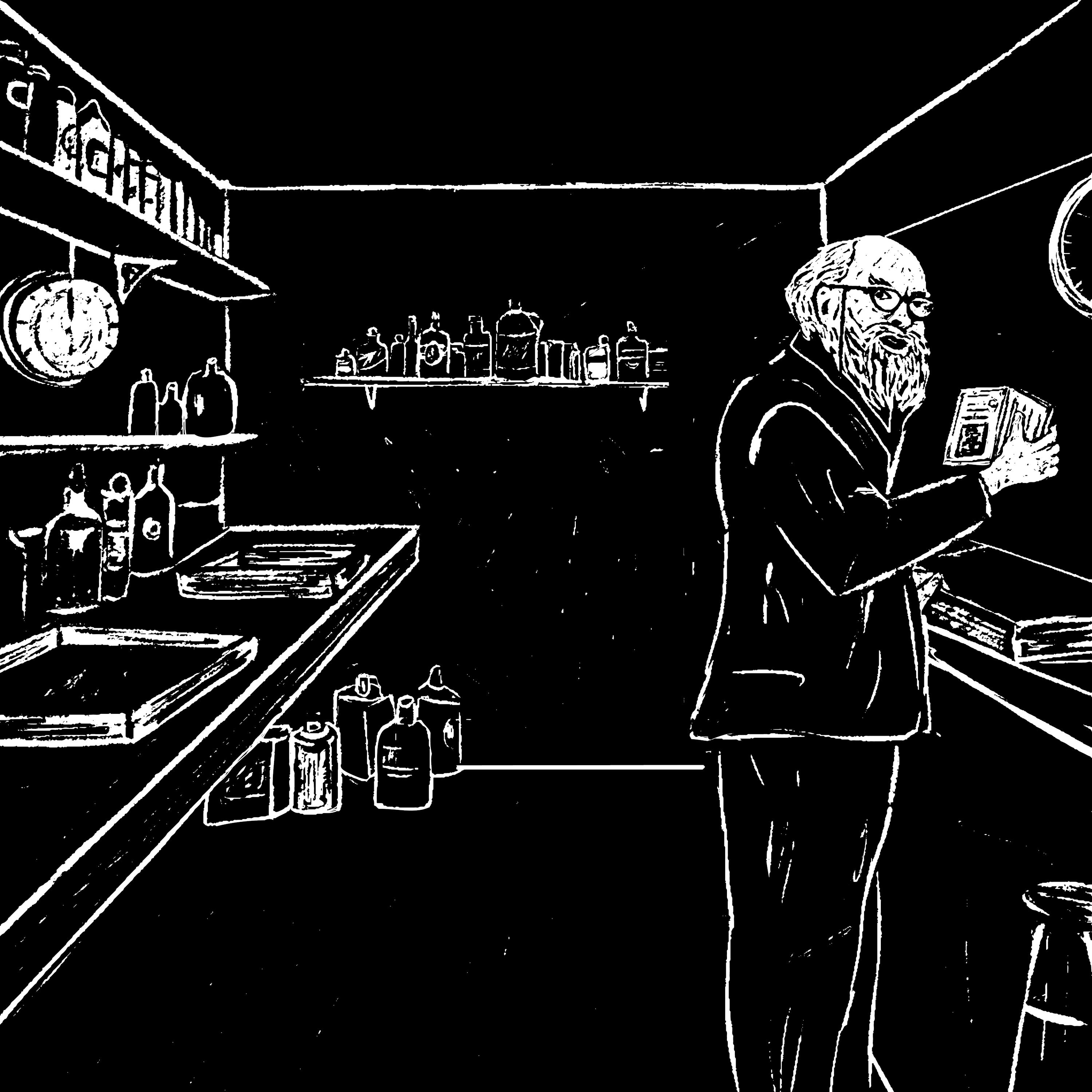
Indelible Ink
Sarah Kaminsky’s book is Adolfo Kaminsky: A Forger’s Life.
Say hello on Twitter, Facebook and Instagram. Sign up for our occasional newsletter, The Accomplice. Follow the show and review us on Apple Podcasts: iTunes.com/CriminalShow.
Sign up for Criminal Plus to get behind-the-scenes bonus episodes of Criminal, ad-free listening of all of our shows, members-only merch, and more. Learn more and sign up here.
Listen back through our archives at youtube.com/criminalpodcast.
We also make This is Love and Phoebe Reads a Mystery.
Artwork by Julienne Alexander. Check out our online shop.
Episode transcripts are posted on our website.
Learn more about your ad choices. Visit podcastchoices.com/adchoices
Press play and read along
Transcript
Speaker 1 Support for criminal comes from BetterHelp. Many American adults get the blues this time of year, sometimes as a result of seasonal affective disorder.
Speaker 1 But BetterHelp wants to encourage you to reach out, get coffee with an old friend, write a letter to a family member, and take that first step to connect with a licensed therapist using BetterHelp.
Speaker 1 This month, don't wait to reach out. Whether you're checking in on a friend or reaching out to a therapist yourself, BetterHelp makes it easier to take that first step.
Speaker 1 You can get 10% off your first month at betterhelp.com slash criminal. That's betterhelp.com slash criminal.
Speaker 1
Support for criminal comes from Ollie. Having a happy, healthy dog starts with what you put in their bowl.
That's why Ollie delivers fresh, human-grade food that your dog will love.
Speaker 1 Go to ollie.com slash Phoebe. Tell them all about your dog and use code Phoebe to get 60% off your welcome kit when you subscribe today.
Speaker 1 Plus, they offer a happiness guarantee on the first box. So if you're not completely satisfied, you'll get your money back.
Speaker 1 That's o-l-l-ie-e.com/slash phoebe and enter code Phoebe to get 60% off your first box.
Speaker 2 Adolfo Kaminsky was 18 years old when his family was arrested and taken to a Nazi internment camp in France called Drancy.
Speaker 3 On the walls, you had like graffitis of people who were trying to let a message for their family before leaving the camp, you know? They were just saying like,
Speaker 3 hi, it's Hannah, a message for my mother. I was there,
Speaker 3 you know, things like that.
Speaker 2 Adolfo was told that his job at the camp would be to paint over the messages.
Speaker 3 So, what he used to do is, after the painting, he used to rewrite them, but in very small, with
Speaker 3 not a needle, but something a little bit bigger than a needle, you know, so the Nazis would not see that it was something colored on the wall, but he used to reproduce all the messages.
Speaker 2 This is Adolfo's daughter, Sarah Kaminsky.
Speaker 2 She says her father and his family were released from the camp after three months. They made their way to Paris, which was occupied by the Nazis.
Speaker 2 And Adolfo and his family realized they wouldn't be safe there. They needed new identities.
Speaker 2 Adolfo's father knew of someone who was secretly working with the resistance against the Nazis.
Speaker 2 They asked for pictures of the family to make fake papers.
Speaker 2 They arranged to meet on a university campus.
Speaker 3 So my grandfather asked my father to go there because he was like looking like a student.
Speaker 3 And he went there and he met a young man, a student in chemistry. and he gave him the photos of all the family.
Speaker 2 The student went by the name Penguin.
Speaker 3 So he asked, okay, we are going to change your name.
Speaker 3 And for your profession, what do you want me to put? Do you want to be a student? And my father said, no, no, I can't be a student. I need to get money to earn a living.
Speaker 3 So
Speaker 3 say that I am a dire.
Speaker 3 And then the man from the resistance was very interested. He said, a dire, but so that's what you are, a dire? Are you able to erase stains?
Speaker 3 He said, yes, of course I'm the best at that. And what about inks? Are you able to erase inks? He said, of course, I'm able to erase anything.
Speaker 3 And he said, okay, we,
Speaker 3 all the resistants in France, have one problem.
Speaker 3 There is one ink that we can't, absolutely can't erase. It is the Waterman ink.
Speaker 2 Waterman was a company in Paris that manufactured fountain pens.
Speaker 3 Do you know how we can do with this?
Speaker 3
We already analyzed it. It's a methyl.
It's a blue of methyl.
Speaker 2 Methylene blue was a kind of dye.
Speaker 3
And my father said, okay, that's very simple. You use lactic acid.
You just do that. You will see it.
Will erase it
Speaker 3
immediately. So the man from the resistance was really, really impressed.
He said, okay, just
Speaker 3 let us make a try
Speaker 3 and we will contact you.
Speaker 2 Before his family was arrested, Adolfo had worked with a chemist at a dairy in the small town where they lived.
Speaker 2 The dairy would buy cream from farmers to turn into butter,
Speaker 2 but they would pay the farmers for the cream based on how much fat was in it, not by volume or by weight. to make sure it wasn't watered down.
Speaker 2 Adolfo remembered that the dairy chemist would use methylene blue to figure out how much fat was in each batch of cream,
Speaker 2 adding it to a sample and observing how long it took the lactic acid in the cream to make the dye disappear.
Speaker 2 Penguin and the resistance agents, who specialized in fake papers, tried what Adolfo had suggested with the lactic acid, and it worked.
Speaker 3 So they came back to see my father, and they said, we need someone to to manage the lab of forging of forging documents we need someone and we think it can be you I'm Phoebe Judge this is criminal
Speaker 2 what was your father like as a as a kid
Speaker 3 He was very intelligent.
Speaker 3
He was always the first of his class. And he used to talk three different languages.
And he was only seven years old. He used to speak Russian, Spanish, and French.
So he was really, really smart.
Speaker 3 But he also was a very shy boy. Very, very shy.
Speaker 2 Adolfo's parents were from Russia, but they had met in Paris in 1916.
Speaker 2 His father had been a reporter for a socialist Jewish newspaper, and his mother had fled the mob attacks of Jewish people in Russia, the pogroms.
Speaker 2
The family had to flee to Argentina because of their socialist ties. Adolfo was born there.
Before he turned five, they moved back to France.
Speaker 2 When Adolfo was 13 and living in a small town called Vir, he set up a school newspaper with a classmate. It was the principal's idea.
Speaker 2 He suggested it to them because they'd already finished all their schoolwork and he thought this would be something that would keep them from getting bored.
Speaker 2 Adolfo and his classmate bought a cheap old printing press. They would go ask other printers for letters in fonts that had gone out of style.
Speaker 2 But soon, Adolfo had to stop going to school.
Speaker 3 Studying was kind of expensive, and
Speaker 2 so
Speaker 3 when he was 14 years old, he had to work.
Speaker 2
He He got a job in a factory. This was the late 1930s.
And in 1940, Germany invaded France.
Speaker 3 The Nazis arrived in Vier, in Normandy, where he used to live, and they fired him because he was a Jew. And so he decided to try to find another job.
Speaker 2 Under German occupation, there were new laws about what jobs Jewish people could have.
Speaker 2 Adolfo saw an advertisement for a job as a dyer's apprentice, mostly dying old military uniforms to make them into clothes civilians could wear. Khaki turned dark brown or navy.
Speaker 2 The dyer was a chemical engineer who'd been in the French army. Adolfo got the job.
Speaker 3 For him, it was magical
Speaker 3 what he could do with the colors, erasing the colors, putting the colors.
Speaker 3 So
Speaker 3 this was magic.
Speaker 2 It fascinated him him to see how if you put fabric in a tub of water with a dye that made the water look black eventually the clothes would turn black while the water would become clear again he was like totally um impressed that he could change things with chemistry
Speaker 2 adolfo bought a chemistry book at a flea market He couldn't stop asking questions at work. Adolfo remembered the dyer saying, so far I've had employees who are happy just to do their work well.
Speaker 2 With you, I have to talk all the time.
Speaker 2 Adolfo asked if he could take some dye home to experiment with. He would try experiments in the kitchen, but after a few explosions, his parents said no more chemicals in the house.
Speaker 3 I think it combined all he liked: mathematics,
Speaker 3 color, artistic things, and he wanted to continue to learn.
Speaker 2 Sometimes people would come to the dyer asking for help removing stains.
Speaker 2 Adolpho remembered he got so good at removing difficult stains that people would come from other towns to bring him lace gloves and silk wedding dresses to clean.
Speaker 3 All the money he could get from his work, he used to spend it to buy a chemistry lab.
Speaker 3 So, but piece by piece, you know, not all together.
Speaker 2 Adolfo had seen a set of laboratory flasks and tubes and a microscope for sale in the window of a drugstore in town.
Speaker 2 The pharmacist at the drugstore was named Mr. Brancor.
Speaker 2 Adolpho remembered Mr. Brancor showed him the set and they talked about chemistry.
Speaker 1 And then
Speaker 2 Brancor agreed to set it aside and sell it to Adolpho one flask at a time.
Speaker 2 We'll be right back.
Speaker 1 Support for criminal comes from BetterHelp. The holidays can be a wonderful, but often hectic and sometimes lonely time of year.
Speaker 1 Therapy can help you make sure you're taking care of yourself, no matter what.
Speaker 1 BetterHelp does the initial matching work to find the right therapist for you so you can focus on your goals in the short and long term. This December, start a new tradition by taking care of you.
Speaker 1 Our listeners get 10% off at betterhelp.com slash criminal. That's betterhelp.com slash criminal.
Speaker 1 With the Spark Cash Plus card from Capital One, you can earn unlimited 2% cash back on every purchase. And you get big purchasing power so your business can spend more and earn more.
Speaker 1 Stephen Brandon and Bruno, the business owners of SandCloud, reinvested their 2% cash back to help build their retail presence. Now, that's serious business.
Speaker 1 What could the Spark Cash Plus card from Capital One do for your business? Capital One, what's in your wallet? Find out more at capital1.com/slash Spark Cash Plus. Terms apply.
Speaker 2 During the first year of the German occupation occupation of France, Adolfo Kaminsky's uncle, his mother's brother, assaulted a German officer. He escaped to Paris to hide.
Speaker 2 Adolfo's mother would send him letters there, but one day the family heard that the Germans had intercepted one of her letters, which meant they had her brother's address.
Speaker 2 She left immediately to go to Paris to warn him.
Speaker 3 So she went and took the train, and during the way,
Speaker 3 she's been pushed.
Speaker 2 They found her body on the train tracks. The family never found out what really happened, but Adolfo believed she was killed by German police.
Speaker 2 Detectives believed that she had opened the train car door, thinking it was a bathroom, and had fallen out.
Speaker 2 When Sarah Kaminsky asked her father why he didn't believe the detectives, he said,
Speaker 2 Now you tell me, if someone told you I'd fallen out of the train because I'd confused the outside door with that to the toilets, what would you say?
Speaker 2 Adolfo Kaminsky was 15 years old when his mother died,
Speaker 2 and after that, he buried himself even more deeply in his chemistry research.
Speaker 2 It was around this time that he also started working with the chemist at the dairy.
Speaker 3 When his mother was killed,
Speaker 3 I think it was the only thing he had to
Speaker 3 forget
Speaker 3 or to not to think too much about the death of his mother.
Speaker 2 He'd started making candles and bars of soap in his makeshift laboratory and he would fill orders given to him by the drugstore pharmacist, Mr. Brancour.
Speaker 2 They became close.
Speaker 2 Eventually, Adolfo realized that the drugstore was just a front, and that Mr. Brancour was a French intelligence agent who was involved in sabotaging the Nazis.
Speaker 3 He was so devastated by the death of his mother and he didn't know what to do and he wanted revenge and but he was like
Speaker 3 he couldn't do anything. Then the man, this man,
Speaker 3 told him, okay, if you want to help, you can help with your chemistry.
Speaker 2
Mr. Brancour gave Adolpho small jobs at first.
He created chemical products that would rust the railways and began making detonators, small devices used to set off explosions.
Speaker 2 It was a year later, in 1943, when Adolfo Kaminski and his family were arrested and taken to Dronci.
Speaker 2 The family was released after three months because they had citizenship in another country, Argentina, which had a diplomatic agreement with the Nazis.
Speaker 2 Once they got out, Adolpho met the resistance agent, Penguin, who was excited he knew how to remove Waterman Ink.
Speaker 2 Penguin introduced Adolpho to other members of the Resistance, two men who went by giraffe and heron.
Speaker 2
They gave him a blank ID card. He filled it out with false information.
And he was in, a member of the resistance.
Speaker 3
So the network he was in was supposed to consider him as a child. He was supposed to be hidden in the countryside, in farmers' houses.
But then they said, okay, even if you are not an adult,
Speaker 3 if you agree, you will be the boss of the lab and you will stay with us.
Speaker 2 When he got to take a close look at the methods they were using in their lab, Crayons and Correction Fluid and Bleach, he knew he could help.
Speaker 3
He began to work and to say, okay, you have to stop doing like that. We are going to do like this, like this, like this.
And he changed all the lab.
Speaker 2 The lab was making all kinds of documents.
Speaker 3 If you wanted to hide as a Jew,
Speaker 3
an identity card was not enough. Absolutely not.
Because,
Speaker 3 you know, everybody had food cards. So your food card had to be forged too.
Speaker 3 And if you wanted to be sure to pretend not to be a Jew, what would be really good is to have a baptism certificate, for example, things like that, you see?
Speaker 3 So to save one person, you needed more than three papers.
Speaker 2 Including Adolfo, there were five people who worked in the lab. None of them were more than 24 years old.
Speaker 2 They kept the location of the lab a secret, even from other members of the resistance.
Speaker 3 They had a lot of chemistry in the lab, and it could smell, and it could, you know, it's not easy to hide.
Speaker 3 So they used to say that they were artists, and that's why they had so many chemistry and painting, and they used to put all their artwork on the walls.
Speaker 3 You know, they used to make very, very easy art, I mean, and to pretend they were good artists, but behind the paintings, they could hide the papers, the documents.
Speaker 2 They would make as many as 500 papers in a week.
Speaker 2 Anyone who needed forged documents knew to ask someone in the resistance, and the police knew it too.
Speaker 3 The rule was that normally the people from the lab would never deliver directly to someone because it was too dangerous.
Speaker 2
Instead, Adolpho would meet up with a liaison agent, often a woman. They would meet in public and pretend to be on a date.
Adolpho would bring a rose to make it look real and hand over the documents.
Speaker 2 And the woman would get them to the people who needed them.
Speaker 2 Often the documents were fake papers for Jewish children who needed to be moved to safer locations.
Speaker 3 They would take a hundred children and pretend it's a summer camp or something like that and bring them to the south with the false documents.
Speaker 2 Occasionally, Adolfo would deliver the documents himself, especially if there was immediate danger.
Speaker 3 He remembered one
Speaker 3
woman alone. I think she didn't have a husband anymore.
Maybe he died at the war, and she was the mother of four little children.
Speaker 2 When Adolpho offered her papers, she didn't want them. She asked why they should hide when they'd done nothing wrong.
Speaker 3 And he begged her to
Speaker 3 take the document. He said that his network was able to hide her children,
Speaker 3 but she continued to say no, no, no. And this is something he remembered until the rest of his life.
Speaker 2
I mean, it must have been very hard. I mean, working all night with these documents, going out and running around, putting himself in.
And he was young, too. This must have really hard for him.
Speaker 3 Yes,
Speaker 3 it was really hard for him. What he said was that it was hard, but
Speaker 3 not hard as if he was doing nothing.
Speaker 1 So
Speaker 3 he always said that if he had done nothing, maybe he would have not survived.
Speaker 3 And even with the fear, sometimes in the lab they had happy moments, like being teenagers together, and
Speaker 3 he had the same danger doing something or doing nothing.
Speaker 3 The people who were deported, sent to death camps, they did nothing wrong. So taking risks or not, for him, was the same danger.
Speaker 3 And
Speaker 3 one day he received the order to make documents for 300 children, but they had only three days and it was absolutely impossible.
Speaker 2 They only had three days because they'd heard that the Nazis were planning raids on 10 homes for children.
Speaker 2 They needed to make at least three documents per child.
Speaker 2
By the end of the first day, they'd finished less than a quarter of the documents they needed. Adolfo didn't sleep.
He told himself, it's a simple calculation.
Speaker 2 In one hour, I can make 30 blank documents. If I sleep for an hour, 30 people will die.
Speaker 2 By the morning of the third day, they'd finished over 800 documents.
Speaker 3 But at the very end, he fainted.
Speaker 2 His colleague told him to go to sleep. Quote, we need a forger, not another corpse.
Speaker 2 Later, in August of 1944, Adolpho heard that his friend Penguin had been arrested with a group of thirty children and sent to Auschwitz.
Speaker 2
And then, French and American armies arrived to liberate Paris from the German army. There was fighting in the streets.
Adolpho volunteered to help the French army carry the wounded on stretchers.
Speaker 2 He never saw Penguin again.
Speaker 2 What did he do after liberation?
Speaker 3 After the liberation, it's you know, all the people who were part of the lab were students, so they went back to their studies.
Speaker 3 Um
Speaker 3 he had no studies, he had nothing to do. He was like very lonely, and um
Speaker 3 he went to see his father. His father was living in a very, very small room and
Speaker 3 something was very broken. He didn't know what to do.
Speaker 2 Then Adolfo heard from someone in the French army's secret service. They needed a forger.
Speaker 3 Paris was liberated, but the war was not finished. And
Speaker 3 in Germany, the camps were still burning people, and so they needed to send secret agents in Germany to bring proof of the horrors in the death camps. So
Speaker 3 then he went back to forgery.
Speaker 2 Adolfo's job was to meet with French intelligence agents before they went to Germany. The agents would try to find and infiltrate lesser-known concentration camps.
Speaker 2 especially ones where Nazis conducted medical experiments on the people they imprisoned. The agents were supposed to collect evidence of their crimes before they could destroy it.
Speaker 2 Adolpho would talk with each agent about their real past, and then would help them come up with a fake backstory.
Speaker 2 Then he would make the German documents to back it up.
Speaker 2 IDs, but also receipts, library cards, movie tickets, letters from fictional fiancés, prescriptions.
Speaker 2
The French army started paying for all of Adolpho's expenses. They put him up in a hotel and gave him a whole floor of a building to work.
He had a private car and a driver. He said,
Speaker 2 I had become a state forger, a new status.
Speaker 2 He had to keep working under a fake name, and he told his family and friends from the resistance he was just a government clerk.
Speaker 2 Decades later, when Sarah Kaminsky was growing up in the 1980s, she says her father wouldn't talk much about his life during the war.
Speaker 3 I mean, my father didn't want to talk about this because
Speaker 3 even if he saved lives, it was
Speaker 3 with an illegal way, in an illegal way. And he wanted to raise us as good men and women, you know, and he wanted us to obey the laws.
Speaker 2 Did he ever teach you to forge anything?
Speaker 3
No, of course not. He would never teach me to forge anything or to lie or anything like that.
But
Speaker 3 what happened once, you know, I think I was 12 or 13 years old, and I brought a bad mark.
Speaker 3 And my parents were supposed to sign it.
Speaker 3 I didn't know that
Speaker 3 he had been a forger.
Speaker 2 Sarah decided to try to forge her mother's signature on the bad grade.
Speaker 3 So I tried, you know, I made tests and I tried to make it
Speaker 3 the same
Speaker 3 and then I put this my false signature on the paper and my mother discovered it she was so upset and very unhappy and she said okay but you will see when when your father will see that
Speaker 3 so I was I went to hide in my room and
Speaker 3 really
Speaker 3 like I was ashamed very ashamed and my father came back from work he sat on on the bed and I thought he was going to be as upset as my mother and he just began to laugh, but to laugh out loud.
Speaker 3 He couldn't stop laughing, so I was really, really surprised. Why was he laughing like that? And he just told me, Sarah, have you seen this signature?
Speaker 3
You see that it is much too small. It's not good.
It's not good work. And, you know, I didn't know yet that he had been a forger, but later I just thought that
Speaker 3 he was, you know, maybe disappointed and that I would never make a good forger.
Speaker 2
After the war ended, Adolfo Kaminsky tried to find jobs as a photographer or as a dyer. He worked for a company that made large photographs for movie sets.
Then he opened his own photography lab.
Speaker 2 He later told Sarah that it was difficult to adjust to normal life.
Speaker 2 My nightmares were haunted by too many faces, he said.
Speaker 2 But he was still approached to make forged documents, and he continued to agree.
Speaker 2 Was it hard for him to keep up
Speaker 2 family and relationships because he was always getting pulled into these secret projects that he couldn't talk about?
Speaker 3 Yes, all his life he could not do things as anyone normal.
Speaker 3 One of his ex-girlfriends was sure that he was cheating, you know, he was maybe somewhere with women or things like that, but no, he was hiding in a lab
Speaker 3 making forged documents.
Speaker 2 One time, he even planned to move to America for a girlfriend. Her name was Sarah Elizabeth.
Speaker 2 But then he was approached by a group called the Suitcase Carriers. who were helping the National Liberation Front, or FLN.
Speaker 2 They needed his help forging forging documents for Algerians fighting for independence from the French.
Speaker 3 Sarah Elizabeth was waiting for him in New York, and he couldn't tell her why he was not joining her.
Speaker 3 So he was just trying to send her letters to say, I will come, but later, let me time, let me some time. And she was answering,
Speaker 3
what are you doing? I'm waiting for you. My parents are supposed to meet you.
We are going to marry. What are you doing? And he couldn't say the truth.
Speaker 3 So she just thought that he was, you know, far from the eyes, far from the heart.
Speaker 3 So she sent a last letter in which she drew, she drew herself walking far and her footprints in the snow of New York, you know, to say, Goodbye. I'm leaving the relationship.
Speaker 2 We'll be right back.
Speaker 1 Support for criminal comes from Saks 5th Avenue. Saks 5th Avenue makes it easy to do holiday shopping your way, whether you're looking for the right gift or the right outfit.
Speaker 1 Saks is where you can find everything from a Jimmy Chew bag for a sister who's hard to shop for to a Prada jacket for yourself to dress up for holiday dinner.
Speaker 1 If you don't know where to start, Sachs.com will filter just for items that match your personal style so you can save time shopping and spend more time just enjoying the holidays.
Speaker 1 Make shopping fun and easy this season and find gifts that suit your holiday style at Saks 5th Avenue.
Speaker 1 With the Spark Cash Plus card from Capital One, you can earn a limited 2% cash back on every purchase. And you get big purchasing power so your business can spend more and earn more.
Speaker 1 Stephen Brandon and Bruno, the business owners of SandCloud, reinvested their 2% cash back to help build their retail presence. Now, that's serious business.
Speaker 1 What could the Spark Cash Plus card from Capital One do for your business? Capital One, what's in your wallet? Find out more at capital1.com/slash SparkCash Plus. Terms apply.
Speaker 2 Adolfo Kaminski still had the stamps, sample IDs, and engraving plates he'd used to make documents in the 40s.
Speaker 2 But by the late 1950s, the way official legal documents looked kept changing.
Speaker 3 There was one very famous document who was really supposed to be unforgeable,
Speaker 3 and this was the Switzerland passport.
Speaker 2 Once, he was given two days by the suitcase carriers to create two Swiss passports. He wasn't sure he could do it.
Speaker 2 The cover of the Swiss passport was made from an unusual material. He'd never heard of anyone being able to replicate it.
Speaker 2 The first day and night, he tried mixing together paper with cellulose and glue in different amounts, then drawing it in sheets, but nothing was working.
Speaker 3
He couldn't sleep because of that. So even if his dreams, he was still trying to find the solution.
So he went to sleep, and when he woke up, he had the solution.
Speaker 2 He'd had a dream about cutting up pieces of gauze for bandaging wounds and adding them to the paper mixture. And that worked.
Speaker 3 But what he didn't know is that the man who asked him for the passport didn't really need this passport. He he just made a joke with another man of the network and said, okay,
Speaker 3 this man, this forger, is able to forge anything, but we are going to see if he's able to do that. And they were sure that he would say, okay, I'm not able to do it.
Speaker 3 So they were so surprised that he was able to do it that they never told him during all the war they didn't tell him that it was just a bet.
Speaker 3 So they told him later.
Speaker 2 By now, Adolpho was in his mid-30s. He'd been forging since he was 18.
Speaker 2 His work made it difficult to be close to people.
Speaker 3 So every time he felt in love with a woman,
Speaker 3 she just
Speaker 3 left him.
Speaker 2 Adolfo had gotten married after World War II and had two kids, Marta and Serge.
Speaker 2
But two years in, his marriage fell apart. His ex-wife had custody of the children as they grew up.
But Adolpho was supposed to visit on weekends and take them on walks. Often, he wouldn't show up.
Speaker 2 Sometimes he wouldn't be in touch for long periods of time.
Speaker 3 He could disappear for weeks, sometimes for months, and once he disappeared during two years, and the kids... They were around maybe 12 years old.
Speaker 3 They really thought that he was dead.
Speaker 2 The Algerians won independence from France in 1962.
Speaker 2 Adolfo finished up his work with the suitcase carriers.
Speaker 2 But new contacts started coming to him with requests from resistance movements around the world. In Spain, the Dominican Republic, Venezuela, Angola, Guinea-Bissau.
Speaker 2 Also, American deserters in Vietnam and the African National Congress in South Africa.
Speaker 3 He didn't want to be paid by the networks because he wanted to be sure to be able to say yes or to say no.
Speaker 2 Adolfo thought that if he relied on forging for income, he might have to say yes to things he disagreed with.
Speaker 3 So, because he was not paid, he had to work. So, he used the lab of photography during the day, was the forgering lab during the night, you see.
Speaker 3 But he really had a lot of problems with money.
Speaker 3 He stayed poor.
Speaker 2 He later told Sarah he felt like if he took money, quote, I'd become a mercenary.
Speaker 3 It was like he had debt
Speaker 3 because he was a survivor. So in Jancy,
Speaker 3 he saw thousands and thousands and thousands of people going to the death camps. And he saw his best friend
Speaker 3
going to the death camps. and he couldn't do anything.
It was like,
Speaker 3 even at the very end of his life, it is something
Speaker 3 for which he felt a lot of guilt.
Speaker 3 I would say that. The guilt of being a survivor and
Speaker 3 the guilt of
Speaker 3 of being
Speaker 3 incapable of doing anything, you see.
Speaker 3 So he had to save other people.
Speaker 3 You know, it was a need
Speaker 3 and not something he was proud of.
Speaker 3
He had one liaison agent and it was Jeanette. Jeanette was a like him, Jeanette was a Jew.
She was hiding during World War II with her mother.
Speaker 2 Jeannette had worked with Adolpho during the Algerian War.
Speaker 3 And she continued for the liberation movements of South America. And
Speaker 3 she was working for a Guatemala network. And she really wanted to go there and to fight and to fight with a weapon.
Speaker 3 And they were very close, my father and her, but he didn't like
Speaker 3 that.
Speaker 2 He didn't want her to go.
Speaker 2 But she still asked him for a forged passport.
Speaker 3 And he said no, but she insisted, and he gave her the documents.
Speaker 2 Sometime later, he was reading the newspaper Le Monde in a café, and he saw an article about a young French woman who had shot herself when the police knocked on her door. He was sure it was Jeanette.
Speaker 3 Her name was not in the newspaper, but of course
Speaker 3 With the description of this French woman,
Speaker 3 he knew it could be only her.
Speaker 2 How did he respond to that?
Speaker 3 He wanted to stop.
Speaker 3 He wanted to stop everything, you know.
Speaker 3
He was tired. But the problem is like when you have begin something, it's really, really hard to stop.
So
Speaker 3 he wanted to have a normal life, but it was impossible because all the people he knew were people in clandestinity doing what he was doing.
Speaker 3 But then
Speaker 3 something happened, which
Speaker 3 forced him to stop.
Speaker 2 Adolfo had received a request for South African passports, documents for anti-apartheid militants.
Speaker 2 A liaison agent brought him an example passport, one that seemed borrowed or stolen, to base the copies on.
Speaker 2 The photo on the passport was of a black South African man, around 30 years old.
Speaker 2 And one side of the passport cover was bent.
Speaker 2 Adolfo studied the passport and told his liaison agent that he could do it.
Speaker 2 But then he stopped hearing from the agent.
Speaker 3 His liaison agent disappeared for one month and then two months, and so he was like
Speaker 3 very anxious about that. And then another man from another network, who he was not used to work with,
Speaker 3 came to see him and said,
Speaker 3 do you still make forged documents? And then the man gave him a model and say, can you try to reproduce this? He gave him the model and it was the same model.
Speaker 3 It was the same man on the picture, it was the same name, it was exactly the same passport. So this was really weird because he had given the passport back to his liaison agent, which had disappeared.
Speaker 2 Adolfo was nervous. He told the man no, he couldn't reproduce the passport.
Speaker 2 And then he went to Algeria for a vacation and met up with an old friend who lived there.
Speaker 3 And the man told him, do you still make forgery?
Speaker 3 So my father said, no.
Speaker 3 And he said, because
Speaker 3
we need to help the South African. And I have a passport.
Maybe you could try. And he gave him the passport.
And it was the same again. The same passport.
So this was...
Speaker 3 He never knew what happened, but he was sure that something was like
Speaker 3 a trap.
Speaker 3 It was impossible that the same passport could be brought to him from three different people not living in the same country. So he was kind of sure that the police or another network was trying
Speaker 3 to
Speaker 3 find the forger.
Speaker 2 Adolfo went back to France and decided he had to leave the country.
Speaker 2 He'd been forging documents for almost 30 years.
Speaker 2 He moved to Algeria and got a job teaching photography at a university.
Speaker 3 And then he met my mother.
Speaker 2 Sarah's mother, Layla, was an activist campaigning for the decolonization of Africa.
Speaker 2 Adolfo and Layla got married and had three children. Sarah is the youngest.
Speaker 2
As Sarah got older, her father told her more about his past. He'd always said he would write a book, but never did.
So Sarah started writing one with him instead.
Speaker 2 She tried to track down people he'd worked with as a forger.
Speaker 2 What was it like meeting meeting people from his past?
Speaker 3 The thing is that the man they knew was not the man I knew.
Speaker 3 I knew a very
Speaker 3 tender father, very
Speaker 3 quiet and patient.
Speaker 3 And what they told me is that he was very strict.
Speaker 3 And the people I met
Speaker 3 from his past were like all of them were heroes. All the time, I was thinking, okay, this man should have a book too, and for this woman, I should write two books.
Speaker 3 So, of course, I could not, I was not able to do that. But it's so impressive to meet this kind of people who stayed in the shadow and had this kind of lives,
Speaker 3 in imaginable lives.
Speaker 2 Adolfo Kaminsky died last year in January of 2023. He was 97.
Speaker 2 One obituary read, Mr. Kaminsky estimated that the underground network he was part of helped save 10,000 people, most of them children.
Speaker 3 When we put
Speaker 3 him in the grave, then there was a sunshine. A sunshine just right on his grave
Speaker 3 and everybody lost like, okay, he's got
Speaker 3 his last
Speaker 3 sunshine.
Speaker 2
Criminal is created by Lauren Spohr and me. Nydia Wilson is our senior producer.
Katie Bishop is our supervising producer.
Speaker 2 Our producers are Susannah Robertson, Jackie Sejiko, Lily Clark, Lena Sillison, and Megan Kinnane. Our engineer is Veronica Simonetti.
Speaker 2
Julian Alexander makes original illustrations for each episode of Criminal. You can see them at thisiscriminal.com.
And sign up for our newsletter at thisiscriminal.com slash newsletter.
Speaker 2 Sarah Kaminski's book is Adolfo Kaminsky, A Forger's Life. You can find a link in our show notes.
Speaker 2 We hope you'll join our new membership program, Criminal Plus. Once you sign up, you can listen to criminal episodes without any ads.
Speaker 2 And you'll get bonus episodes with me and criminal co-creator, Lauren Spohr, too. To learn more, go to thisiscriminal.com slash plus.
Speaker 2 We're on Facebook and Twitter at Criminal Show and Instagram at criminal underscore podcast. We're also on YouTube at youtube.com slash criminal podcast.
Speaker 2
Criminal is part of the Vox Media Podcast Network. Discover more great shows at podcast.voxmedia.com.
I'm Phoebe Judge. This is Criminal.
Speaker 1 Oh, the car from Carvana's here.
Speaker 1
Well, will you look at that? It's exactly what I ordered. Like, precisely.
It would be crazy if there were any catches. But there aren't, right? Right.
Because that's how car buying should be.
Speaker 1
With Carvana, you get the car you want. Choose delivery or pickup and a week to love it or return it.
Buy your car today with Carvana. Delivery or pickup fees may apply.
Speaker 1 Limitations and exclusions may apply. See our seven-day return policy at Carvana.com.
Speaker 4 Support for this show comes from Nature Sunshine All-New Marine Glow Collagen. How much time do you think you spend with a screen in front of your face on any given day?
Speaker 4 Well, if you're anything like the average American, you probably spend about seven hours staring at a screen. Nature Sunshine knows that contact with blue light is unavoidable.
Speaker 4 That's why they've combined the skin-enhancing power of marine collagen and blue light-fighting lutein to support your eyes and skin in a blue light-filled world.
Speaker 4 Experience more radiant skin and proven eye protection with Nature Sunshine New Marine Glow, the only collagen product clinically proven to support eye and skin health and defend against blue light.
Speaker 4 Try Nature Sunshine New Marine Glow now at nature sunshine.com.