The Fortune Cookie Quest
Learn more about your ad choices. Visit podcastchoices.com/adchoices
Press play and read along
Transcript
Speaker 1 We have asked you here to play a game that this time we're calling Sears for Cookie.
Speaker 4 Yay, today Gastropod is still on hiatus, and instead, we're going to play Wait, Wait, Don't Tell Me.
Speaker 5 That actually sounds like a fabulous plan, and I would definitely enjoy it, but Cynthia, you know that's not what's happening. That said, why not listen to just a little bit more? I like cookies.
Speaker 1 One of the most famous cookie people around is Wally Amos, better known as Famous Amos. You've seen his cookies.
Speaker 1 What is Famous Amos' other claim to fame? Was it A, as a talent agent, he discovered Simon and Garfunkel? B, he set and still holds the world record for number of cigarettes smoked at once.
Speaker 1 Or C, he happens to be a champion Morris dancer.
Speaker 1
You're going to go for A, as a talent agent, he discovered Simon and Garfunkel? Yeah. Yes, you're right.
That's what he did. did.
Speaker 7 I believe it! It's true. First, that story is totally wild.
Speaker 11 And now we can reveal that Gastropod is making an episode about one of my all-time favorite duos, the only one where I can sing quite possibly every single song they ever sang together, word for word.
Speaker 5 Which is something I never knew about you, and which is very exciting, because I too know every word of every Simon and Garfunkel song ever recorded.
Speaker 9 Somehow, Nikki, it never even occurred to me to ask because you're a Brit who doesn't have 70s activist American parents like I did. I never imagined we could possibly share this.
Speaker 5
But I grew up in suburban London on country music and Simon and Garfunkel. Don't ask me to explain.
But hey, if we ever get to take a gastropod road trip again, the soundtrack is sorted.
Speaker 5 Honestly, I don't know which is more astonishing, that Simon and Garfunkel were discovered by Famous Amos, or that you and I both know all the lyrics to the entire Simon and Goff Frankel Irv, and we never realized.
Speaker 9 But unfortunately, this episode is not about either of those truly shocking facts.
Speaker 10 So let's just head back to wait, wait.
Speaker 1 Fortune, you know, see if you get go for perfect here, why not? Everything else you've got. No, oh god! Come on!
Speaker 1 Come on.
Speaker 1 Fortune cookies don't get a lot of attention because they're free, they taste like sweetened cardboard, but on occasion, on one occasion, a fortune cookie changed lives.
Speaker 16 How?
Speaker 1 A, a desperate message inside a cookie led to the freeing of 50 imprisoned Fortune cookie factory workers.
Speaker 1
B, a Fortune cookie typo introduced the phrase on fleek to the language. Uh-huh.
Or C, a Fortune cookie correctly predicted Powerball numbers leading to 110 people winning $100,000 each.
Speaker 1 I say
Speaker 1 C.
Speaker 1 C? You're right again!
Speaker 5
This truly happened. And yes, you guessed it.
D.
Speaker 5 This episode is truly all about everything fortune cookie.
Speaker 9 But just in case you're wondering, this is actually Gastropod, not wait, wait, don't tell me. And I am Cynthia Graeber.
Speaker 5
And I'm Nicola Twilley. And it's still kind of the new year in my mind.
And anyway, it's definitely the Chinese New Year. And what better time for some good fortune in cookie form?
Speaker 19 I, like many Americans who grew up eating out frequently at Chinese restaurants, I enjoyed quite a number of fortune cookies.
Speaker 10 But I'd never see them sold downtown for Chinese New Year.
Speaker 9 So are these these cookies also enjoyed in China?
Speaker 22 Are they really Chinese?
Speaker 5 Also, who writes all those fortunes and do they actually know the Powerball numbers ahead of time?
Speaker 9 All that plus Freaky Friday, Dennis the Menace, and The Simpsons.
Speaker 5 Gastropod is part of the Vox Media Podcast Network in partnership with Ether.
Speaker 24 With a Spark Cash Plus card from Capital One, you earn unlimited 2% cash back on every purchase.
Speaker 23 And you get big purchasing power. So your business can spend more and earn more.
Speaker 24 Capital One, what's in your wallet?
Speaker 23 Find out more at capital one.com slash spark cash plus. Terms apply.
Speaker 24 With a Spark Cash Plus card from Capital One, you earn unlimited 2% cash back on every purchase.
Speaker 23 And you get big purchasing power. So your business can spend more and earn more.
Speaker 24 Capital One, what's in your wallet?
Speaker 23 Find out more at capital1.com/slash spark cash plus terms apply.
Speaker 12 On a recent reporting trip to San Francisco, Nikki and I visited one of the country's oldest still operating fortune cookie factories.
Speaker 11 It's on a little side street in Chinatown, and the factory is only about the size of a small corner store like a bodega.
Speaker 5 As soon as you step off the street, you are in the middle of cookie madness.
Speaker 5 There's a whole production line with machines mixing cookie batter and other machines piping out thin flat circles of that batter like crack.
Speaker 14 Ooh, the batter is being mixed.
Speaker 26 Those thin cookie discs go into an oven, and as soon as they come out, while they're still soft and malleable, a couple of older Chinese women pick them up with their bare hands and quickly fold the cookie disc around a small piece of paper.
Speaker 14 You need just the right malleability.
Speaker 5 It is totally mesmerizing what she's doing. Look at that.
Speaker 9 Very smooth.
Speaker 5 I sense that if I did that, it would not turn out the same way.
Speaker 27 There's no way.
Speaker 29 Yeah everything is it looks really simple but everything is a mystery. You know when the thing comes out it takes four seconds if you don't get it done in the destroyer.
Speaker 29 So actually once it opened up and she had to throw it right away within four seconds. Four seconds the key to get it done.
Speaker 5
This is Kevin Chang. He's the owner of the Golden Gate Fortune Cookie Factory.
It's been in his family for decades.
Speaker 29
Our recipe is unique. You don't get that recipe outside.
My mom created this
Speaker 29 recipe for 59 years.
Speaker 22 Visiting one of the country's oldest fortune cookie factories was fun, but it didn't answer my question, which is really, where do fortune cookies come from?
Speaker 12 So, for that, we turn to someone who's been on the show before.
Speaker 30 So, fortune cookies are a confectionery that are most famed in the United States. They are yellow and shaped like Pac-Man.
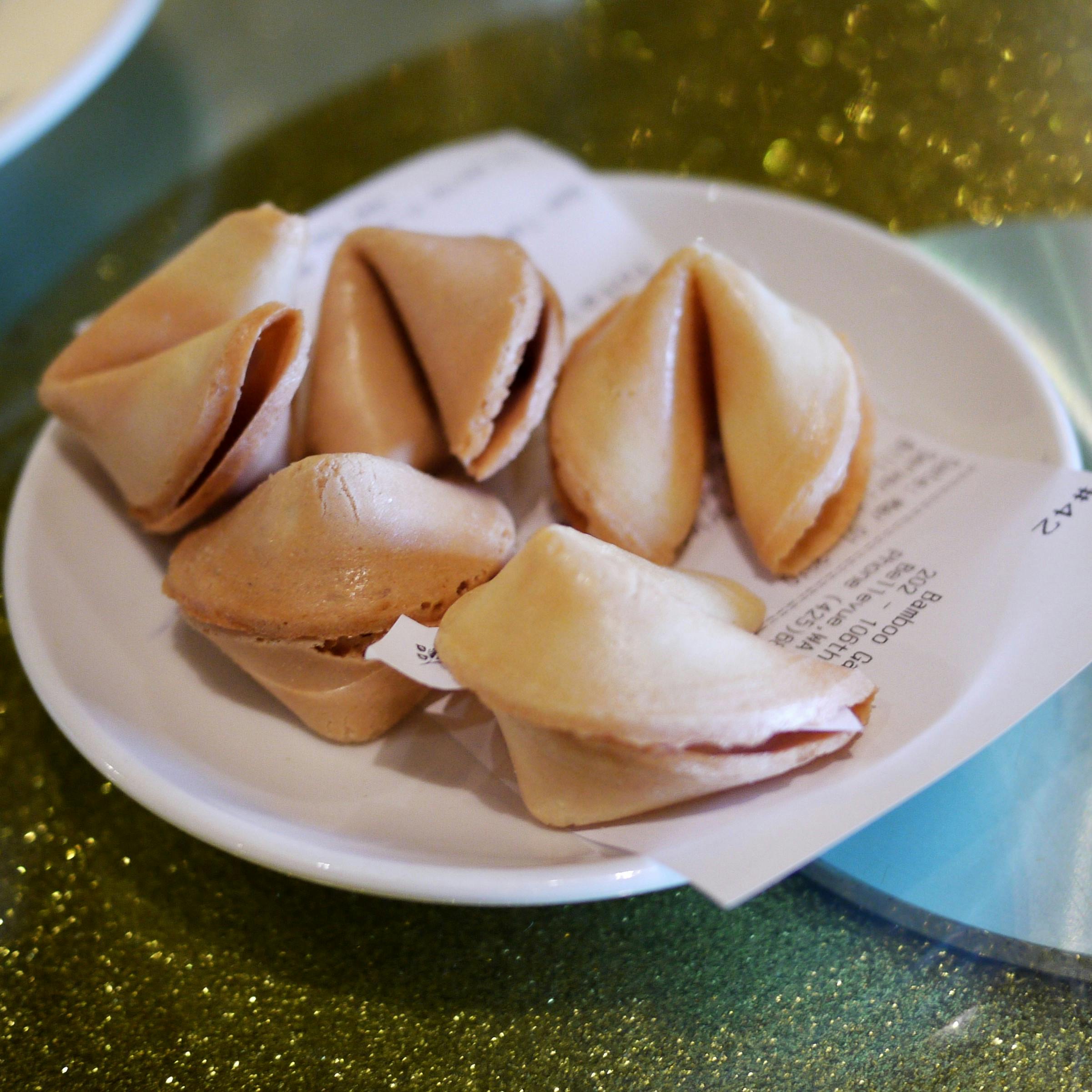
Speaker 30 The ones that are most, you know, sort of the canonical fortune cookie is vanilla and butter-flavored yellow cookie that's sort of like originally grilled as a circle and then like folded and then folded again with a piece of paper inside.
Speaker 12 That's Jenny Aitley and she wrote an entire book called The Fortune Cookie Chronicles.
Speaker 30 And they are associated with Chinese restaurants, which is the main place of distributing them. They are made now in American huge volumes.
Speaker 5 Jenny, who's Chinese American, grew up eating fortune cookies like basically every other American.
Speaker 30
I don't know that we ate them because they're actually not that yummy tasting. So I think, you know, if you're, I use them.
I used fortune cookies.
Speaker 30 I consumed them, but they were kind of mostly just a vessel to bring that little tweet
Speaker 30
into my life. But yeah, they were definitely a huge part of growing up.
Chinese American in New York City.
Speaker 9 Jenny just assumed that because these cookies came only with Chinese food, that they were, of course, Chinese.
Speaker 30 And then it was only when I was like in seventh grade or so that I read a book called The Joy Luck Club by Amy Tan, where I learned fortune cookies weren't Chinese. And I was like, what?
Speaker 30 And it was like learning there was no Santa Claus and Easter Bunny or Tooth Fairy, like all at once. I mean, it just like kind of shook your foundation of like what the world was.
Speaker 9 In the book The Joy Luck Club, which is a book I read a long time ago and quite enjoyed, a couple of Chinese immigrant women get a job in a fortune cookie factory and they are quite amused by this strange thing that isn't Chinese at all.
Speaker 5 So if a fortune cookie isn't a traditional Chinese dessert, what actually is?
Speaker 30
I mean, basically they used to serve like orange slices. That's actually what real Chinese restaurants are for, you know, Chinese people.
The dessert is like fruit and like melon or orange.
Speaker 30 It is not fortune cookies. Another common dessert would be like red bean soup or like red bean soup with tapioca or like green bean soup.
Speaker 5 Not my idea of a good time, I'll be honest.
Speaker 20 Not mine either.
Speaker 19 And Jenny agrees.
Speaker 30 Historically, Chinese dessert's not great, right? Like, you know, they were really into the moon cake, which like looks and tastes like a hockey puck.
Speaker 30
I mean, I really like appreciate the cultural significance, the holiday, you know. But they're terrible.
I mean, mooncakes are like really, really just terrible desserts.
Speaker 15 Jenny told us that desserts in general taste good because of sugar and fat, and Chinese desserts typically have very little of either one.
Speaker 11 And then on top of that, the Chinese didn't historically use ovens because there wasn't a lot of wood to heat ovens.
Speaker 9 We talked about this in our oven episode, but the result is not a big dessert culture.
Speaker 5 So Jenny wondered, if fortune cookies are not a traditional Chinese dessert, then where are they from? And how did they become so popular at American Chinese restaurants?
Speaker 9 Jenny had spent quite a while with this question kind of floating around her mind.
Speaker 9 She was thinking about how popular Chinese restaurants were in America and why they all handed out this strange little article at the end of the meal.
Speaker 30 And then, as part of that journey, you know, there was this event that happened where 110 people, surprising number, came in second in a Powerball lottery in 2005.
Speaker 5 This is is the story behind that wait-wait question.
Speaker 5 All these people won second prize in the Powerball drawing, which means 110 people, each of them taking home somewhere between $100,000 and $500,000.
Speaker 30 And, you know, statistically, based on the number of tickets that were sold, it should have been like three or four. You know, it really stunned the organizers of the lottery.
Speaker 30 They're like, is this a scam? Is there fraud? Does someone collude? You know, is there a leak?
Speaker 5 The organizers were confused. How did so many people have an identical number that was prize winning?
Speaker 30 They asked, you know, the first person, so where did you get your number from?
Speaker 30 You know, and they had been thinking like maybe it was like from a TV show that they looked at lost and they looked up the young and restless, which both had plot lines involved, you know, winning lottery numbers and people will often use those kinds of numbers and it wasn't that.
Speaker 30 And it wasn't until the people started coming in that, you know, they said like, oh, you know, it's from a fortune cookie. And the second person was like, oh, I got it from a fortune cookie.
Speaker 30 And the third person was like, I, also got it from a fortune cookie. And the person in Tennessee actually still had that little slip of paper with the fortune cookie numbers in their wallet.
Speaker 5 Turns out the choosing of lottery numbers based on a fortune cookie's lucky numbers is not actually super rare. And every so often, people win thanks to their cookie.
Speaker 31 66-year-old Charles Jackson of North Carolina came forward yesterday to claim the prize from Saturday night's Powerball jackpot worth more than $344 million.
Speaker 31 He's a retired retail worker. He chose the cash option, which will land him about $233 million.
Speaker 31 He said he has been playing the same lottery numbers for years, which he actually got off of a fortune cookie that his granddaughter had at a Vietnamese restaurant years ago. So that strategy worked.
Speaker 7 Congratulations, Emma Duvall, on a $2 million
Speaker 7 win.
Speaker 5 Yes, $2 million.
Speaker 31 She's digging it. That was February in a Powerball drawing.
Speaker 12 Well, it turns out after years of playing birthdays, anniversaries you know trying to pick her own numbers it wasn't working out she tried a lucky lotto number from a fortune cookie's at the bottom i lost 10 million bucks we're going to chinatown after this so apparently it's not super unusual to win based on your fortune cookie but what was kind of shocking in 2005 was just how many people at how many different restaurants all around the country had the same number jenny decided to visit all those restaurants and talk to the people who ate there and it was just so interesting because you would talk to them and you know the stories were like different, but they were the same.
Speaker 30 Like, it was lunch, it was, it was dinner, it was takeout, it was sit-down, it was delivery, it was with friends, it was with family, it was last week, it was a month ago, it was three months ago, but they all had a thing in common, which is all came down to like Chinese food and all came down to a fortune cookie.
Speaker 30 So, that sort of like unified them, and it just kind of gave me a sense of just how American fortune cookies were.
Speaker 5 At this point, Jenny began to realize she had a project on her hands, specifically a book and then a movie that teased out all the stories behind these truly American Chinese foods and how much a part of American life they are.
Speaker 35 I'm from a small town in Montana, Missoula, Montana. And I remember going to, you know, the pink and the red booths with the neon and getting the white takeout boxes with the fortune cookies.
Speaker 36 We had a favorite Chinese restaurant. It was called
Speaker 36 W-A-I, W-A-I-Y-Y. And it was about maybe what, a mile from
Speaker 36
the house. Yeah, we were there a lot.
They had the best Chinese buffet you've ever had.
Speaker 3
Moms doesn't want to cook, oh, let's call in for Chinese. It's fast, it's easy, and you don't have to do any dishes because everything is right there for you.
They even throw in a plastic fork.
Speaker 12 That's from the movie The Search for General Tzu, and in the movie, and in our episode, The United States of Chinese Food, Jenny explores the origin of dishes like chopped suey and General Tzu's chicken, and of course, fortune cookies.
Speaker 5 Spoiler, all of these things turn out to be basically as American as apple pie. Fortune cookies have been so popular in America for so long that they show up in golden oldies.
Speaker 5 There's a whole movie called The Fortune Cookie, directed by the famous Hollywood director Billy Wilder in the 1960s.
Speaker 21 And fortune cookies show up in the classic early 60s TV show Dennis the Menace.
Speaker 37 Say, Mom, is it all right if I invite a little friend in to have a fortune cookie, too?
Speaker 38 Well, of course you could, dear, but I'm afraid there aren't any left.
Speaker 32 Oh, well, Alice, do me a favor and let Dennis's friend have mine.
Speaker 2 Keepers please, Mr.
Speaker 37 Wilson.
Speaker 37 It's all right. You can come on in and have a fortune cookie too, Tiny.
Speaker 5 Turns out Dennis's friend is a very cute puppy called Tiny. Here, Tiny.
Speaker 5 Hey, not the whole cookie.
Speaker 5 This is your fortune.
Speaker 32 Well, what does it say?
Speaker 39 Beware.
Speaker 37
You are about to lead a dog's life. Jeepers, Mr.
Wilson, this fortune cookie must be meant for you.
Speaker 11 Oh, for those glory black and white mom and apron days of Dennis the Menace.
Speaker 9 That rascally dog Tiny ate the fortune.
Speaker 5 Such jolly japes.
Speaker 18 The fortune cookie has made more modern appearances as well.
Speaker 21 It's shown up in episodes of Star Trek and the Smurfs and The Simpsons.
Speaker 1 What's your fortune say?
Speaker 40 You will enjoy the company of others. Wow, that's exactly what I'm enjoying right now.
Speaker 41 Spooky.
Speaker 42 Today is your lucky day, yeah. Pfft.
Speaker 40 Hey, Homer, if I was you, I wouldn't be so quick to say pft. If it's your lucky day, you'd be a fool not to take advantage of it.
Speaker 42 Hey, any part of a cookie you can't eat is just a waste of time.
Speaker 5 OMG, you are never gonna believe what happens next. Homer slips, falls, hits a vending machine, and all the chocolate bars and Twizzlers and Doritos fall out on top of him.
Speaker 1 What incredible good luck!
Speaker 17 Just as the cookie foretold.
Speaker 11 If that's not enough, the modern version of Freaky Friday, where the mom and daughter switch bodies, it happens because of a magic fortune cookie.
Speaker 39
You can just cut me some slack just this once more. I am beyond cutting you slack, Anna.
But you are not going to the audition. Yes, I am.
No, you're not. Why not? Because I said so.
Speaker 5 Cookie. So not to labor the point, but I think we've established that fortune cookies are integral to the highest products of American culture and civilization.
Speaker 5 But we still haven't figured out where and when they were actually invented.
Speaker 9 That's coming up after the break.
Speaker 17 All right, remember, the machine knows if you're lying. First statement: Carvana will give you a real offer on your car all online.
Speaker 17
False. True, actually.
You can sell your car in minutes.
Speaker 9 False? That's gotta be. True again.
Speaker 17 Carvana will pick up your car from your door, or you can drop it off at one of their car vending machines.
Speaker 6 Sounds too good to be true, so true.
Speaker 17
Finally, caught on. Nice job.
Honesty isn't just their policy, it's their entire model. Sell your car today, too.
Speaker 6 Carvana.
Speaker 17 Pickup fees may apply.
Speaker 33 Let's be honest. Are you happy with your job?
Speaker 6 Like, really happy?
Speaker 33 The unfortunate fact is that a huge number of people can't say yes to that. Far too many of us are stuck in a job we've outgrown, or one we never wanted in the first place.
Speaker 33 But still, we stick it out, and we give reasons like, what if the next move is even worse? I've already put years into this place.
Speaker 33 And maybe the most common one, isn't everyone kind of miserable at work? But there's a difference between reasons for staying and excuses for not leaving. It's time to get unstuck.
Speaker 33 It's time for strawberry.me. They match you with a certified career coach who helps you go from where you are to where you actually want to be.
Speaker 33 Your coach helps you get clear on your goals, create a plan, build your confidence, and keeps you accountable along the way. So don't leave your career to chance.
Speaker 33
Take action and own your future with a professional coach in your corner. Go to strawberry.me/slash unstuck to claim a special offer.
That's strawberry.me slash unstuck.
Speaker 5 Jenny's early research showed that by the 1950s, after World War II, the fortune cookie was everywhere. So she figured she had to look even earlier to find out where it came from.
Speaker 5 And the first thing she found was a legal case.
Speaker 30 There was a sort of fake trial that took place in San Francisco that pitted Los Angeles to San Francisco as the original home of the fortune cookie.
Speaker 11 This was not a real trial, of course.
Speaker 14 It took place in the 1980s at this thing called the Court of Historical Review in San Francisco.
Speaker 11 They had representatives from both sides, the Los Angeles side and the San Francisco side, and both sides argued why their city was the original home of the fortune cookie back before World War II.
Speaker 30 And they both had myths
Speaker 30 or local lore about how fortune cookies were introduced in the United States. You know, there's one story out of the Japanese tea garden, Golden Gate Park.
Speaker 30 There's another one out of Los Angeles and bakeries there.
Speaker 5 Regular listeners will know that I live in Los Angeles, so I'm sort of biased. It's 100% of a better city than San Francisco, so why wouldn't we have invented the fortune cookie too?
Speaker 9 All you San Francisco people listening, ignore what Nikki just said.
Speaker 4 Your city is lovely, too.
Speaker 21 But anyway, the Los Angeles claim centers around a guy named David Zheng, who was a Chinese immigrant from Canton.
Speaker 15 He was the founder of the Hong Kong Noodle Company in LA before World War I.
Speaker 5 David's son George told the court that the idea for putting a fortune inside a cookie originally came from a traditional game supposedly played by aristocrats in China.
Speaker 5 The way this game went, you would be given writing implements and a sort of twisted cake that contained a writing prompt, and then you were expected to make up a wise little story to share.
Speaker 7 Jenny said another story printed in the New York Times and used at the trial, it said that David had created these cookies with little fortunes inside to cheer up downtrodden men on the streets of Los Angeles and the messages had been written by a minister.
Speaker 5 But the San Francisco side wasn't having any of this. They came with receipts and they claimed that the fortune cookie wasn't Chinese in origin at all.
Speaker 21 The San Francisco side was led by a city employee named Sally Osaki and she said that fortune cookies got their start at the Japanese tea garden in Golden Gate Park before World War I, and they were introduced by a Japanese immigrant named Makoto Hagiwara.
Speaker 9 And Sally pulled out a couple of round black iron grills like round waffle irons to prove it.
Speaker 12 The original fortune cookies were cooked on these types of grills.
Speaker 5 And the judge ruled in favor of San Francisco, which is totally unfair because later an even older Japanese bakery in LA, one which is still around today, they also found their old traditional cookie grilling tools.
Speaker 5 So I declare this is a mistrial.
Speaker 26 It's still not clear whether the cookies originated in Los Angeles or in San Francisco, but one thing is clear: the stories of a Chinese origin in either city were definitely wrong.
Speaker 30 It was easy and quick to recognize that those were not the origin of the fortune cookie, and that it definitely had some kind of Japanese connection to it.
Speaker 9 After all, in both cities, Japanese bakeries were where those cookies were originally made.
Speaker 5 So, the challenge facing Jenny was to tease out exactly what that Japanese connection was. Because it's not like everybody in Japan is like, fortune cookies, we know them, we love them.
Speaker 5 So were fortune cookies from Japan and just got forgotten there? Or did they get invented by Japanese Americans or what? The mystery deepened.
Speaker 15 And then came the big breakthrough.
Speaker 26 One of Jenny's sources, he's actually a descendant of one of the owners of one of the original Japanese bakeries in San Francisco making fortune cookies.
Speaker 15 He told her that a Japanese researcher had come poking around and asking questions about fortune cookies.
Speaker 12 She showed him a wood block print that looked like a man cooking fortune cookies over a fire, and the print was from 1878 in Japan. This is decades before any of the American claims.
Speaker 30
And so it is a individual who looks like a bigger. He's in a kimono.
You know, he has those little round like griddles with long, long handles. And you can see like they're little round thingies.
Speaker 30 And not to the degree where you can actually tell that they are fortune cookie shaped.
Speaker 5
But still, it seemed like a clue, and so Jenny followed it all the way back to its source. She tracked down this researcher.
Her name is Yasuko Nakamachi, and she studies Japanese confectionery.
Speaker 26 Yasuko had first noticed fortune cookies on a trip to New York.
Speaker 19 Like everyone else, she thought they were Chinese.
Speaker 22 But a few years later, back in Japan, she was doing some research as per usual, and she found a reference in a book to Japanese cookies that were folded around little pieces of paper.
Speaker 13 Those seemed to her to be suspiciously like a fortune cookie.
Speaker 5 These Japanese cookies were supposedly a regional speciality, and so Yasuko decided to travel to the small town mentioned in the book.
Speaker 5 And lo and behold, bakers in this town were still making these kind of cookies for New Year.
Speaker 5 Then, as Yasuko dug deeper, she realized these kinds of cookies were mentioned in a few different places in Japanese literature and historical records.
Speaker 5 An American is even quoted in one of these back in 1883. He described these cookies as being crisp and, quote, tasting like ginger snaps without the ginger.
Speaker 9 I'm not sure what that even means. But Yasuko looked and looked and then found the final smoking gun.
Speaker 26 That's when she found one of the few remaining copies of a book that had the 1878 print, the one with a guy grilling the cookies.
Speaker 11 A label on the drawing said they were called tsujira-senbei.
Speaker 26 This means bell cracker.
Speaker 11 In other areas, they were called a different name that translates to fortune crackers.
Speaker 5 Jenny traveled to Japan to meet up with Yasuko and they went on an expedition to a shrine in a town outside Kyoto, where Yasuko said they could see these Japanese fortune crackers being made.
Speaker 30 Where there is a whole series of little
Speaker 30 mom-pop like hand bakeries outside a big temple where they're still making fortune cookie like things and with grills.
Speaker 30 And it's kind of funky because they're not like little and yellow like the ones that we have in the United States.
Speaker 30 They're big and brown and they're like, they're kind of have a soy and miso flavor to them. So they're a little bit more savory.
Speaker 30 You grill them and then sometimes you roll them up and so they become you know like a distant cousin of a fortune cookie. So like if you see it, it's like the DNA.
Speaker 30 You know, if you take like your ancestry.com or you're like 23andMe thing and you're like, oh my god, here are all the relatives I did not know I had.
Speaker 30 That is what it kind of looked like when we went back.
Speaker 22 And these miso-flavored folded Japanese Krispy crackers did in fact have a piece of paper inside.
Speaker 30
The piece of paper is not inside Pac-Man's body. It's like in his mouth.
Like he's like eating like or like holding onto it with his mouth.
Speaker 5 And what was interesting is that they tended not to be like fortunes as we think of as fortunes they were like pieces of poetry or maybe like a little song lurk you know they were they were just pretty prose right but they are not making oracle like predictions about like your future these japanese cookies are savory and they're bigger and then the fortunes are sort of wedged in the claws of the cookie not inside it and they're more poetic than predictive still jenny and yasuko Yasuko are convinced that these are definitely the ancestral origins of the Fortune cookie, the inspiration for the yellow Pac-Man American version we know and love, or at least expect.
Speaker 5 Which means we can conclusively conclude that the fortune cookie has its roots in Japan originally, not China.
Speaker 15 But then, so, how did the fortune cookie become Chinese?
Speaker 9 Or really more specifically, how did it become a specialty in American Chinese restaurants?
Speaker 30 What happened is, you know, back in the day, people weren't eating sushi or raw fish in America. I mean, this is where, you know, salt was like the very exciting spice of the day.
Speaker 30 So Japanese people were not running Japanese restaurants. They ran Chinese restaurants because at that point, chop sue is very popular.
Speaker 30 And so the Japanese restaurants needed desserts because Americans expect dessert. And
Speaker 30 they started serving a Japanese confectionery, which is the Fortunes.
Speaker 30 cookies to their Chinese restaurant patrons.
Speaker 14 So that's how Japanese Americans made little cookies that were sold in Chinese restaurants on the West Coast.
Speaker 21 But this still doesn't explain why these came to be thought of as really a Chinese American invention and how they became so famous all around the country.
Speaker 9 That story coming up after the break.
Speaker 34 Avoiding your unfinished home projects because you're not sure where to start? Thumbtack knows homes, so you don't have to. Don't know the difference between matte paint finish and satin?
Speaker 34 Or what that clunking sound from your dryer is? With thumbtack, you don't have to be a home pro.
Speaker 9 You just have have to hire one.
Speaker 34 You can hire top-rated pros, see price estimates, and read reviews all on the app. Download today.
Speaker 44 Support for this show comes from Odo. Running a business is hard enough, so why make it harder with a dozen different apps that don't talk to each other? Introducing Odo.
Speaker 44
It's the only business software you'll ever need. It's an all-in-one, fully integrated platform that makes your work easier.
CRM, accounting, inventory, e-commerce, and more.
Speaker 44
And the best part, Odu replaces multiple expensive platforms for a fraction of the cost. That's why over thousands of businesses have made the switch.
So why not you?
Speaker 43 Try Odu for free at odu.com. That's odoo.com.
Speaker 5 Okay, so one part of the story of how fortune cookies came to be in Chinese restaurants in America is because in the early 1900s, Japanese restaurateurs were serving Chinese food.
Speaker 5 But the other part, how they became 100% Chinese American, is to do with a not very pleasant part of American history during the Second World War.
Speaker 30 Because of the Japanese internment, you know, under an order, executive order signed by Franklin Delano Roosevelt, who, you know, is still considered one of our great presidents, but this is definitely a blemish on his record.
Speaker 30 You know, they basically rounded up anyone who was of Japanese descent within 60 miles of the coast.
Speaker 45 When the Japanese attacked Pearl Harbor, our west coast became a potential combat zone. Living in that zone were more than 100,000 persons of Japanese ancestry.
Speaker 45 Two-thirds of them American citizens, one-third aliens.
Speaker 45
We knew that some among them were potentially dangerous. Most were loyal.
But no one knew what would happen among this concentrated population if Japanese forces should try to invade our shores.
Speaker 45 Military authorities therefore determined that all of them, citizens and aliens alike, would have to move.
Speaker 28 Have to move, that's one way to phrase it.
Speaker 12 This is from a 1943 propaganda movie made by the U.S.
Speaker 18 Office of War Information.
Speaker 45 In small towns as well as large, up and down the coast, the moving continued. Behind them, they left shops and homes they had occupied for many years.
Speaker 5 Around 120,000 Japanese men, women, and children, many of them American citizens, were moved into internment camps.
Speaker 5 They were only allowed to bring what they could carry, and most of them lost everything. Their possessions, their businesses, their land.
Speaker 26 Back in the cities, Japanese Americans weren't the only ones who had been running Chinese restaurants.
Speaker 18 Chinese immigrants were too.
Speaker 10 And they had also started to serve fortune cookies.
Speaker 26 And so they bought Japanese cookie grills or took over Japanese fortune cookie businesses from Japanese Americans who were now in internment camps.
Speaker 5 By the time the war was over, the fortune cookie business was solidly Chinese American and they had really made it their own.
Speaker 30 And they started making them and they started making them at scale.
Speaker 5 Jenny told us that Chinese inventors started tinkering with the traditional cookie making process trying to make it cheaper and quicker.
Speaker 30 Instead of making them, you know, very bespoke on these like hand grills, you started seeing these machines, these automated fortune cookie custom Rube Goldberg-like devices start like churning out little yellow circles and then you had a human at the other end that needed to fold them.
Speaker 7 This is exactly what we saw at Golden Gate in San Francisco.
Speaker 11 There was a conveyor belt running through the machine.
Speaker 21 The machine was dolloping out these perfect round thin disks of batter.
Speaker 11 Kevin's machine is more than 50 years old and it's still running.
Speaker 5 But the folding and putting in the fortune, that's all still done by hand, which Kevin said slows things down.
Speaker 29 We are the old school way, the original way.
Speaker 12 The big breakthrough did actually come from a Chinese immigrant.
Speaker 21 He invented a machine that he introduced in 1967, and the machine could take the place of the women.
Speaker 22 It could slip in the paper as the cookie was being folded over.
Speaker 26 Working by hand, one woman might be able to fold a thousand cookies an hour.
Speaker 21 The best machines today can do 6,000 an hour, and so businesses can easily scale up to more than a million cookies a day.
Speaker 12 Kevin can only make 10,000.
Speaker 5 This mechanization is part of what made fortune cookies cheap enough to give away at Chinese restaurants across America.
Speaker 30 So there's a lot of consolidation with the dominant player being wonton food. Because they just had scale and so it could make them cheaper and so they could just sell them for cheaper.
Speaker 5 By making fortune cookies so cheap and so ubiquitous, Chinese Americans had made fortune cookies American. They are as everyday and as unremarkable as ice and soda and endless coffee refills.
Speaker 30 Americans expect them, but they're almost like a commodity, right? Because it's not like people are like, ooh, this place has much yummier fortune cookies, so I'm going to go there.
Speaker 27 But fortune cookies aren't ubiquitous just because they're cheap and restaurants could hand them out.
Speaker 20 They became so iconic because Chinese restaurants became super popular.
Speaker 21 That's the story we tell in the United States of Chinese food, and again, you should check it out.
Speaker 18 But the end result is fortune cookies really took off after the Second World War.
Speaker 30 The extent that fortune cookies like literally like caught fire as a culinary phenomenon post-World War II is astounding. The point like they were used in presidential campaigns in 1960.
Speaker 5 Two Democratic candidates to be specific who filled them with campaign messages and gave them out at the Democratic convention.
Speaker 5 But neither of them became president. Not such good fortune in their cookies.
Speaker 21 As the fortune cookie business grew, the little crispy treats were so cheap to make that the cookies actually became something Chinese-American noodle companies started to make and give away for free to restaurants to get their business.
Speaker 26 The news and weather guy Al Roker visited one of those noodle factories in Brooklyn.
Speaker 38
An estimated 90% of the world's fortune cookies are made by Longtime. Factory cranking out more than 4 million cookies a day.
That adds up to 1.6 billion fortune cookies a year.
Speaker 5 So the thing that happens when 90% of your fortune cookies are made in one factory in Brooklyn is that when you print lucky numbers and by coincidence they match the powerball, you can create a hundred plus winners at a time, as Jenny discovered.
Speaker 9 But it also means that the people who write the fortunes inside can get a little burnt out.
Speaker 16 Well, I'm getting a writer's block more often, so that's why James will be helping out and he'll be taking over the responsibility.
Speaker 5 This is Donald Lau, the CFO of Wanton Foods. He's talking to KMET, a radio station in San Bernardino.
Speaker 16
When we bought the factory back in the mid eighties, we decided to update the fortunes. And since my English was the best among the group, I was given the job.
I guess I got the job by default.
Speaker 16 Writing fortunes was never part of my career projection.
Speaker 19 Over the course of Donald's career, fortunes have certainly changed.
Speaker 16 Well, in the old days, all the fortunes were
Speaker 16 the horoscope type fortunes.
Speaker 16 You will do this and this, you will meet that person, you will find love, things like that.
Speaker 16 But over time, we introduced some Chinese philosophy and humor into the fortune cookies.
Speaker 5 Kevin Chang at Golden Gate in San Francisco told us he has 5,000 pre-written fortunes that he rotates.
Speaker 29
So we have two types of fortune. One is the regular one that accepted by normal people.
The other one is semi-non-normal because they're adult ones, the funny, jokes.
Speaker 29 But they're not offensive, but they're just jokes.
Speaker 29
How about I start one with the regular one for just one? Okay, that's easy. You see this one? The back one has a number on it.
People use that for lottery numbers.
Speaker 29
You will win success in whatever you attempt. That's motivating.
Sure.
Speaker 7 Kevin also has some risque ones that are for the specialty adult cookies, and those will leap to your imagination.
Speaker 9 But he did tell us that in the normal cookies, he has to be careful not to offend anyone.
Speaker 5 At Wanton Foods, James Wong, the IT guy, recently took over from Donald and he told KMET that even the most harmless seeming fortune can be taken the wrong way.
Speaker 46 And it was apparently read by someone that is having trouble with the marriage. The husband is about to go off on a business trip.
Speaker 46
He was in a Chinese restaurant with his wife and got his fortune cookie. The message read, romance is in the air in your next trip.
The wife got very upset and decided that it's our fault.
Speaker 20 Lawsuits from jealous spouses aside.
Speaker 22 In theory, writing fortune sounds like an easy job, but it was often too hard for the cookie company bakers and professionals to do themselves, so they hired out.
Speaker 21 Jenny says in the 1970s, the main fortune teller was a 20-something Mexican-American named Faustino Corona.
Speaker 5 There's who's writing them, and then there's what they say. Jenny told us that in the 50s and 60s, fortune cookies often shared a little ancient wisdom.
Speaker 5 Many of them started with Confucius says, although Confucius didn't actually say 99% of the things on the fortunes.
Speaker 20 By the time Donald came along, fortunes had become actual fortunes.
Speaker 21 Something was going to happen to you, maybe something soon, and it was always something good.
Speaker 30 Because, you know, fortune cookies are part of a service industry.
Speaker 30 So if like someone gets a bad fortune, they're angry at the restaurant, they give bad tips, the restaurant complains to the distributor, distributor complains at a factory, the factory complains to people who write the fortunes.
Speaker 30 So fortunes have just been like like wiped clean of any negative connotation, right? And generally, they have to be very general, use purpose.
Speaker 30 Like, if there's a dark and handsome man in your future, it means something different to a 26-year-old versus like a six-year-old, right?
Speaker 30 So, so you have to be very careful to make these things much more applicable.
Speaker 5 So, eventually, to please the largest number of Americans, fortunes basically turned into Hallmark cards, like this one that Jenny saved from a recent meal.
Speaker 30 Make decisions from the heart and use your head to make it work out, which I really liked. It's sort of like follow your passion and just figure it out later.
Speaker 7 Jenny loves that particular fortune.
Speaker 9 She got this one on the back of her phone, and she told us that getting a fortune, not necessarily from a cookie, it's actually pretty common in Asia.
Speaker 9 But unlike in America, it doesn't always have good news.
Speaker 30 Honestly, like half of them are negative, right? And like your health is going to suffer. And
Speaker 30 that's okay, because like life is some ups, some downs.
Speaker 5
But that is not the American way. It's all about relentless positivity here.
Which brings us to my favorite Fortune cookie quiz.
Speaker 41 Is this a Booker tweet or Fortune cookie?
Speaker 9 This was a Washington Post quiz and a Washington Post video because apparently Senator Corey Booker's Twitter feed is full of heartfelt truisms. So here goes.
Speaker 22 Is it Corey or is it a cookie?
Speaker 41 Okay, here's the first one. Those who mistake kindness for weakness reveal that they themselves are weak.
Speaker 12 Booker or Fortune Cookie? Hmm.
Speaker 41
It's Corey Booker from November 17th, and it got nearly 300 retweets. Okay, next one.
Judge each day not by the harvest you reap, but by the seeds you plant.
Speaker 12 Booker or Fortune cookie.
Speaker 7 That sounds like it could be Booker, but in fact, it's a Fortune cookie.
Speaker 5 I guess the moral is fortune cookies for president. I mean, they could not be more American.
Speaker 9 It's true, even though they're originally Japanese and you get them at Chinese restaurants.
Speaker 20 They come from a mix and adaptation of different immigrant cultures, like a lot of things we consider super American.
Speaker 30 So as I like to say, you know, fortune cookies, invented by the Japanese, popularized by the Chinese, but ultimately consumed by Americans. And, like, Americans love fortune cookies, right?
Speaker 30 They have like chocolate fortune cookies, rainbow fortune cookies, Hanukkah fortune cookies. They're like fortune cookies for dogs.
Speaker 7 I do have quite a soft spot for fortune cookies, the normal ones, not the Hanukkah versions.
Speaker 21 So, my partner Tim and I recently got some Chinese takeout, and I stole his fortune cookie too.
Speaker 9 So, I have two right here to crack open. Double the fortune.
Speaker 5 I feel like karmically that's gonna backfire, but you do you, Cynthia. I got my solo fortune cookie from a little takeout place down the street.
Speaker 5 I walked in and asked to buy one, and the lady gave it to me, which is truly double fortune.
Speaker 9 Okay, here we go. Here we go.
Speaker 15 One.
Speaker 15 And two.
Speaker 22 Courage is the hallmark of the warrior.
Speaker 14 Yes. And then embrace change.
Speaker 13 Don't battle it.
Speaker 5
I love it. Those are so uplifting, Cynthia.
You are a warrior.
Speaker 4 I'm totally uplifted.
Speaker 5 Okay, mine, never stop searching for that thing that seems to escape you.
Speaker 4 I feel like that's slightly like double-edged.
Speaker 9 Yours doesn't sound quite as happy. I'm like, what? I mean, how do you know?
Speaker 5
Damn. Okay, fortune cookie, I feel seen.
And then I turned my fortune over and looked on the back. Oh man, mine has a QR code.
I'm like in the 21st century here. What the heck?
Speaker 9 You have an ad on yours.
Speaker 5 It says Kung Fu on the CW. New New series, 6 p.m.
Speaker 5 I have stream free next day, and there's my QR. Wow, it's a sponsored Fortune.
Speaker 9 I love that. Even our Fortune cookies aren't immune to the forces of capitalism.
Speaker 7 If there's white space, there's space for an ad.
Speaker 9 I know everybody says they taste like cardboard, but I have to say, I kind of like them.
Speaker 5 They taste like cardboard, but they're fine.
Speaker 9 Yeah, they taste like sweetened cracker, like cookie, sweet and crunchy cookie bits. A little stale.
Speaker 13 That's all.
Speaker 5 I will say, if you're looking for crunch, you can't go wrong with a Fortune cookie.
Speaker 19 They are very crunchy.
Speaker 9 Okay, here's to fortune cookies.
Speaker 21 Thanks this episode to Jenny Aitley and Kevin Chen.
Speaker 18 We have links to Jenny's book and to Kevin's Fortune Cookie Factory in San Francisco on our website, gastropod.com.
Speaker 5
Happy New Year to everyone. May your fortune be good.
And if you win the Power Bowl, don't forget to support your favorite podcast.
Speaker 19 We'll be back in two weeks with the first of a special two-part series on a brew that's dark, dreamy, and captivates millions around the world every day.
Speaker 8 That's right, we are finally waking up and smelling the coffee.
Speaker 9 Till then.
Speaker 47 What do walking 10,000 steps every day, eating five servings of fruits and veggies, and getting eight hours of sleep have in common?
Speaker 6 They're all healthy choices. But do all healthier choices really pay off?
Speaker 47 With prescription plans from CVS CareMark, they do. Their plan designs give your members more choice, which gives your members more ways to get on, stay on, and manage their meds.
Speaker 47 And that helps your business control your costs because healthier members are better for business. Go to cmk.co slash access to learn more about helping your members stay adherent.
Speaker 47 That's cmk.co slash acc.
Speaker 3 Support for the show comes from Train Dreams, the new film from Netflix.
Speaker 3 Based on Dennis Johnson's novella, TrainDreams is the moving portrait of a man who leads a life of unexpected depth and beauty during a rapidly changing time in America.
Speaker 3 Set in the early 20th century, it's an ode to a vanishing way of life and to the extraordinary possibilities that exist within even the simplest of existences.
Speaker 3 In a time when we are all searching for purpose, Train Dreams feels timeless because the frontier isn't just a place, it's a state of being. Train Dreams, now playing only on Netflix.