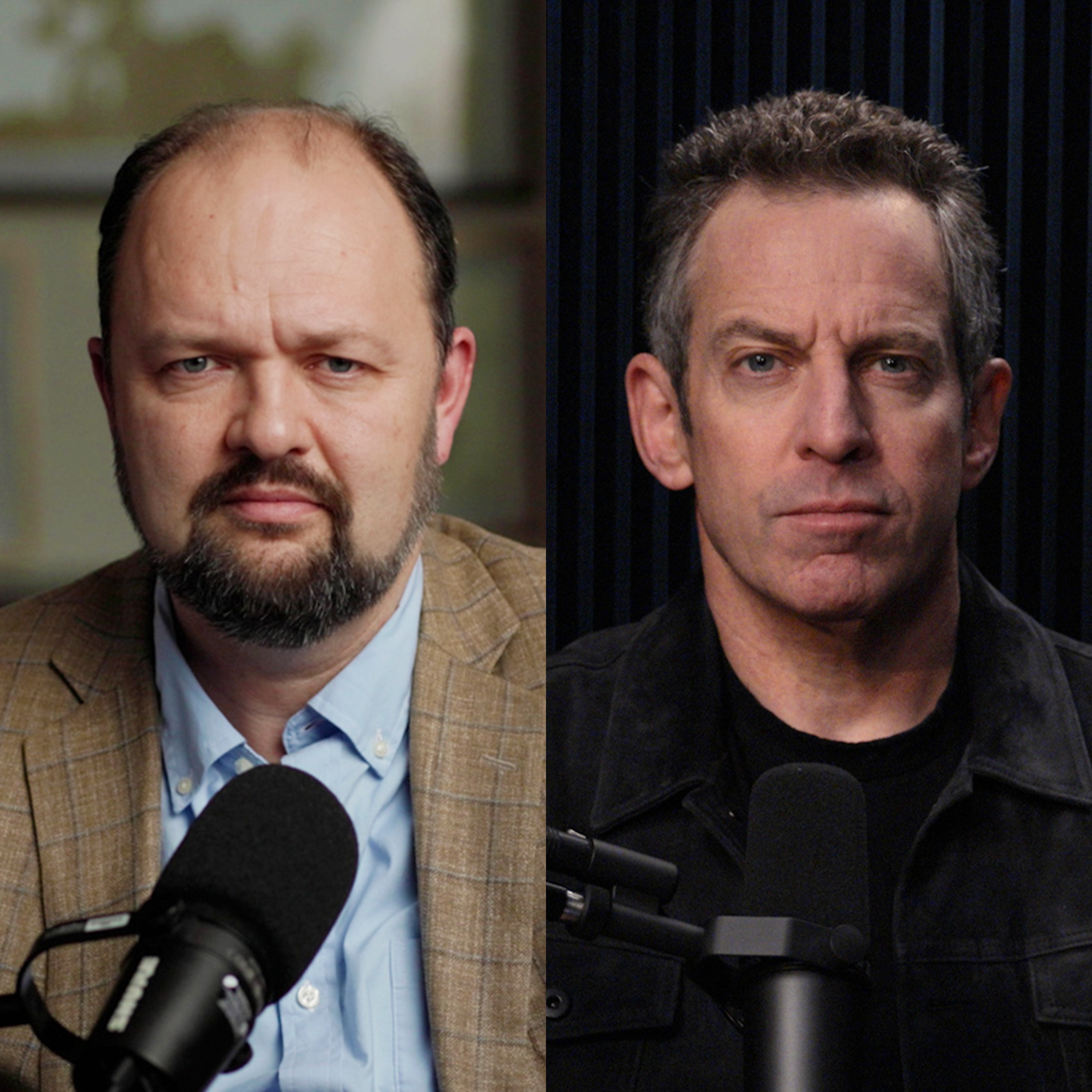
#443 — What Is Christian Nationalism?
Sam Harris speaks with Douglas Wilson about his book Frequently Shouted Questions about Christian Nationalism. They discuss Wilson's debates with Christopher Hitchens, the landscape of American evangelicalism, young-earth creationism, pre- vs. post-millennialism, the concept of dominionism, what Christian nationalism actually means, the supposed failure of secularism, the separation of church and state, religious tests for public office, women's suffrage, homosexuality and sodomy laws, capital punishment for adultery, the biblical case for slavery, the foundations of morality without God, Charlie Kirk's memorial service, heaven and hell as consequentialist frameworks, the nature of miracles, and other topics.
If the Making Sense podcast logo in your player is BLACK, you can SUBSCRIBE to gain access to all full-length episodes at samharris.org/subscribe.
Press play and read along
Transcript
Speaker 1 I'm here with Doug Wilson. Doug, thanks for joining me.
Speaker 2 Great to be with you. Thank you.
Speaker 1
So you debated my friend Christopher Hitchens back in the day. That was probably, I don't know, 15 years ago or so.
Did you remember what year you did those debates?
Speaker 2 I don't remember the year.
Speaker 2 It was a wonderful time, actually. Christopher and I got along great, actually.
Speaker 1 Yeah, you seem to. So I watched the documentary that was born of that collision that was literally titled Collision.
Speaker 2 Right.
Speaker 1 And you guys were debating if memory serves whether Christianity is good for the world. That was kind of the focusing question.
Speaker 2 Yeah. Yeah, correct.
Speaker 1
So we won't, we probably won't recapitulate much of that. I mean, I think we might fall into debate on a few topics.
I think that's inevitable.
Speaker 1 But what I really want to start with here is just to have you educate me and my audience about the American religious landscape. I just have a bunch of questions for you.
Speaker 1
I should say you have a new book titled Frequently Shouted Questions About Christian Nationalism. Yeah.
So we'll get into that. But just to orient us.
Speaker 1 Maybe just the first question is, how would you differentiate it from what most Americans might think of as mainstream Christianity, if that phrase means much.
Speaker 2 So, in the Baskins and Robbins of Christianity, what flavor am I? Yep.
Speaker 2 Rocky Road. That's what I am.
Speaker 2
So, basically, I grew up in an evangelical home, conservative, Bible-believing parents. My mom had been a missionary in Japan.
My father was a Navy officer who got out to do personal evangelism.
Speaker 2 So, I grew up in a home that was decidedly Christian and evangelical.
Speaker 2 Evangelical in, I was born in 1953, evangelical during my boyhood prior to Jimmy Carter simply meant conservative Bible believers outside the mainline denominations.
Speaker 2 There had been a big battle in the first part of the 20th century in the mainlines, the Presbyterian church, the Methodist church, and so on, between liberalism and what came to be called fundamentalism.
Speaker 2 And basically the liberals won and captured the mainline denominations. The conservative believers sort of retreated into
Speaker 2 the woods and built their own alternative structure. They abandoned the seminaries and built Bible colleges, built Christian radio stations and stayed there until the 1970s, more or less.
Speaker 2 And I grew up in that quadrant of the of the Christian faith.
Speaker 2 In the 70s, you might say, led by Francis Schaefer, polarized by Francis Schaefer, the conservative believers re-engaged in what became known as the culture wars back in the days of the moral majority and the Christian coalition,
Speaker 2 those folks. And that was something that we were part of.
Speaker 2 And there has been in recent years, after the election of Jimmy Carter, who was an avowed born-again Christian, there was a resurgence of people identifying themselves with evangelicalism, and it grew significantly, so maybe spectacularly, became a movement, and then it too developed a right-wing and a left-wing, you know, conservative and more moderate or liberal.
Speaker 2 And the most recent iteration of it would be COVID and post-COVID, where the red-pilled evangelicals who have become more and more pronounced in their willingness to be Christian in public has coalesced.
Speaker 2 And the moderates have done what has usually been done, which is try to mute these divisions and
Speaker 2 play well with others and try to get along as best they may. That's basically a 30,000-foot flyover of where I think we are.
Speaker 1 So would you consider yourself a Christian fundamentalist, a biblical literalist, an absolutist?
Speaker 1 How would you differentiate those terms? And
Speaker 2 what are you?
Speaker 2 Yeah, that's great.
Speaker 2 I would consider myself a fundamentalist in the sense of believing the fundamentals of the Christian faith. I believe the Apostles' Creed, in other words.
Speaker 2 And I believe it in the sense that it was held when it was first handed down. But fundamentalist has also taken on cultural significance.
Speaker 2 So like a fundamentalist is someone who wears a black skinny necktie and uses, is a King James Version only guy and that sort of thing. That's sort of a cultural phenomenon.
Speaker 2 And I'm not necessarily fundamentalist in that sense, but I do believe the fundamentalists of the Christian faith.
Speaker 2 I would describe myself as a biblical absolutist, which is not the same thing as taking the Bible literally.
Speaker 2 A biblical absolutist is someone who would take the Bible naturally, taking it the way it presents itself to be taken.
Speaker 2
So when Luke writes his gospel and he says at the beginning, I interviewed a bunch of eyewitnesses and I wrote it down carefully. He's presenting it as sober history.
So I take it as sober history.
Speaker 2
Psalms that are poetry present themselves as poetry. I take it as poetry.
When the book of Revelation presents itself as apocalyptic literature, I take it as apocalyptic literature and not as literal.
Speaker 2 surveillance cameras of the future. So you want to take the Bible naturally and respect the genre in which it was written, whether it's history, poetry, prophecy, apocalyptic, and so on.
Speaker 1 So taking the Bible naturally, what does the concept of biblical inerrancy do for you? Do you think the Bible is still inerrant, but some sections can't be taken literally?
Speaker 1 Or is that how that breaks up the most part?
Speaker 2 So for example, as a biblical absolutist, I believe the Bible. So I would say what the Bible intends to convey by what it wrote down, I seek to take it that way.
Speaker 2 So I seek to understand it the way it was originally intended and then take that to the bank. But when Jesus says, I am the door, I don't look for a doorknob.
Speaker 2
Or in Psalm 23, you don't have to go find a green pasture to lie down in. to be a good Christian.
I don't take it literally that way.
Speaker 1 Is there anyone who takes it? Yeah, I mean, literally, literally. I mean, I can't imagine anyone is.
Speaker 2 There are some people. There honestly, there are some people who try.
Speaker 2
It cannot be done consistently, but there are some people that try. There's a school of theology called dispensationalism.
Right.
Speaker 2 And the watchword for that school of theology is literal unless absurd.
Speaker 2 So you take it literally. unless you find yourself dealing with round squares.
Speaker 1 So why aren't you a dispensationalist then?
Speaker 2 All right. So, that's a
Speaker 2 big question, but I would say it boils down to the relationship of the Old Testament to the New Testament. So, there are two basic approaches.
Speaker 2 One of them says that the Old Testament doesn't apply unless the New Testament says that it does. And the other view says the Old Testament applies unless the New Testament says that it doesn't.
Speaker 2 Right.
Speaker 2 So, I'm a Reformed Christian, reformed Presbyterian Christian, and not a dispensationalist.
Speaker 2 And I would belong to the school of thought that says the entire Bible is to be taken as the word of God and the Old Testament applies to us today, unless the New Testament says that it doesn't.
Speaker 2 And the principal, the central example of that would be the animal sacrifices in the Old Testament. So the animal sacrifices are there.
Speaker 2
The New Testament says that Christ's death fulfilled all the animal sacrifices. so we're not to offer up animal sacrifices anymore.
So the New Testament says we're not to. So I say good, we're not to.
Speaker 2
But the other approach basically parks in the New Testament first. And if the New Testament repeats something from the Old Testament, then okay, that's obligatory.
But they're New Testament centered.
Speaker 1 Okay, so just to get my bearings here, so how old do you think the universe is based on your reading of the Bible or
Speaker 1 any other stream of information?
Speaker 2 Yeah, based on my rudimentary math skills,
Speaker 2 the world is about 6,000 years old. Okay.
Speaker 1 Okay. So.
Speaker 2 I'm a young earth creationist. Right.
Speaker 1 Okay.
Speaker 1 So anyone kind of coming at this from the outside, from secular society, trying to fit you in the canonical debates around the collision between science and religion and evolutionary biology and Christian theology understands which side of that argument you're on.
Speaker 2 Right.
Speaker 2 I'm an anti-Darwinist, young earth creationist.
Speaker 2 Having said that, and I know that many of your viewers and people who follow you and have read your stuff are going to park me right next to the flat earth guys, you know, because of that statement of how old
Speaker 2
the world is. But one of the things that I would just point out in passing.
is when people say that the universe, the cosmos, is 14 billion years old or
Speaker 2 whatever the current number is, they are presupposing a Newtonian balcony somewhere that they get to stand on to watch the whole thing.
Speaker 2 And one of the things that relativity shows us is that time is not what we, you know, where is my question would be, where is the cosmos 14 billion years old?
Speaker 2 Is it at the center at the point of the explosion? Is it at the event horizon? What clock are you using to calculate the age of the Earth?
Speaker 2 Well, generally, the rudimentary textbook answer is we imagine a Newtonian clock and it looks like an Earthbound perspective. And I would say things like time and eternity are not that simple.
Speaker 1 Okay, but then why would you be tempted to sign on the dotted line with something like 6,000 years old? I mean, the claim that the world...
Speaker 1 to take it out of the cosmos for a second and just talk about the rock we're on, to claim that the world is 6,000 years old is to make
Speaker 1 a fairly straightforward claim about calendar time. I mean, because you're making that claim about, if I said, well, how long ago did the miracles depicted in the Bible, how long ago did they occur?
Speaker 1
You're saying, okay, walk back a day and another day and another day in the timeline of your life. And then it's before you were born.
And then it's about 2,000 years before that.
Speaker 1
Right. And a year is still a year.
It's still 365 days of the sort that we would recognize. So you have a fairly standard view of time to capture that.
Speaker 1 And presumably you're walking that all the way back to the beginning and you just have 6,000 years to deal with.
Speaker 2
Right. That is exactly correct.
If I go back to Genesis, where it gives us the genealogies and it says that so-and-so was the father of so-and-so
Speaker 2 and he fathered this son when he was 150 years old.
Speaker 2 And there's a whole chain that goes back, and it's just a straightforward math problem.
Speaker 2 So if you're going to believe the Bible, I believe the first 11 chapters of Genesis are to be taken as authoritative and not just chapters 12 and on. So,
Speaker 2
I just accept it in a straightforward way. I believe in a historical atom.
I don't believe in evolution at all.
Speaker 2
Well, let me correct that. I do believe in variation within species.
So, if
Speaker 2 every creationist, for example, looking at the human race, sees the different ethnic groups, Asians and blacks and whites and so on, and believes that they are all descended from Noah and his wife.
Speaker 2 So clearly we believe in variation within species, but we don't believe in the transformation of one species to another.
Speaker 2 Right, right. Okay.
Speaker 2 So I'm resisting the temptation to get into any of those details with you because I really just do want you to educate me before we get sidetracked on anything thank you so your church is you're a postmillennialist rather than a pre-millennium millennialist please unpick those concepts for us so most pre-millennialists are are dispensationalists the the fellows i mentioned earlier and the three main positions with regard to the millennium which is the millennium is a thousand years of peace that christians like to fight about
Speaker 2 so there you go um So you have the millennium and the premillennialists believe that Christ returns prior to the millennium.
Speaker 2 So all of these, you have the fixed time period of the millennium and then where you place the return of Christ with regard to that millennium.
Speaker 2 So the premillennialist believes that Christ will return and then there's going to be a thousand years of peace.
Speaker 2 The amillennialist, which is another view not mentioned here, the ah is a term of negation, which says that they believe the millennium is a figurative, a figurative symbolic reality, the reign of Christians with Christ in the heavenly places.
Speaker 2 And then
Speaker 2
after some indefinite period of time, Christ returns. So there's no literal earthly millennium for the ah millennialist.
Then the postmillennialist believes that the gospel is going to be victorious.
Speaker 2
The nations will be discipled. The great commission will be successfully fulfilled.
The nations will come to Christ.
Speaker 2
And that will usher in the millennium, this golden period, after which Christ will return post-millennium. So pre-millennial, Christ comes before it.
Post-millennial, he comes after.
Speaker 2 And all millennial believes there is no literal earthly millennium.
Speaker 1 So in all the talk about the rapture that people are familiar with and the left behind novels that were much talked about in secular culture and widely read in Christian culture, Is that entire conversation a premillennialist one, or do you have some part in that as well?
Speaker 2 No.
Speaker 2 That entire conversation is dispensational and premillennial. And most even, so the Reformed Calvinist, Presbyterian types that I represent are not in the North American evangelical mainstream.
Speaker 2 There were a significant presence there, but North American evangelicalism is overwhelmingly dispensational, overwhelmingly premillennial.
Speaker 2 So post-millennialists like myself are very much in the minority report.
Speaker 1 Right. Now, it seems to me to have pretty big implications.
Speaker 1 So the problem with pre-millennialism, again, from a secular point of view, is that it seems to invite almost a kind of nihilism. I mean, it's sort of...
Speaker 1 The worse things get on some level, the better things get from that point of view. The world can completely unravel, and at any moment, the good people are going to be raptured.
Speaker 1 There's nothing really to construct or to care for or to maintain here necessarily. But on your view, the post-millennial view, which frankly is a little more like the view of Islam, right?
Speaker 1 There's this notion of we, the good religious people who believe in God rightly, effectively need to conquer the world and establish a thousand years of peace and prosperity and good Christian order before
Speaker 1 history will properly end with the return of Christ.
Speaker 2
Correct in broad outlines. The one difference that I would make is that Paul in 2 Corinthians 10 says that our weapons for doing this are not carnal.
So we don't use physical force.
Speaker 2 It's not to be advanced by the sword.
Speaker 2 In
Speaker 2 Romans 4.13, Paul says that Abraham was promised that he would inherit the world, but not by law, rather through the righteousness of faith. So that's the one thing.
Speaker 2 The other thing is I think you're right about the,
Speaker 2 and if you had a dispensationalist on, he could present a case for why maybe this is unfair.
Speaker 2 I'm not trying to be unfair to them, but as I've watched the dispensational vibe affect Christians, the worse things get, the more people think that we're right on schedule.
Speaker 2 You know, okay, the Jesus is going to appear anytime and take us out of here. And so they view the,
Speaker 2
because they also believe that we're in the last days. We're coming up on the last little bit.
Yeah. And they feel like the last helicopter flight out of Saigon.
Speaker 2 You know, the rapture is God helicoptering us out of here. And then you let the world go to blazes.
Speaker 1 And which is on your account,
Speaker 1 you're absolutely sure we're nowhere near the last days. In fact, we're probably not even within a thousand years of the last days.
Speaker 2 That's correct. I believe that future school children will be looking back on our era, studying us as part of the early church.
Speaker 2
So I think we've got a long way to go. And I believe that our labors to make the world a better place are not in vain.
As Paul says in 1 Corinthians 15, 58, your labors in the Lord are not in vain.
Speaker 2 I believe that we can make the world a better place. And I believe that if God blesses, that will be, he will bless and prosper it.
Speaker 1 And we want to leave it better than we found it so this seems to be a pretty big point around which to have such a difference of opinion yeah how is the difference of view here justified by recourse to the bible what do the dispensationalists say you're wrong about and and how do you return the compliment
Speaker 2 yeah that i think that's a great question
Speaker 2
the way i describe it is this let's say someone converts to Christianity while in college. You know, their life falls apart.
They have a crisis conversion.
Speaker 2
They go buy a Bible and they say, I'm interested to find out what it teaches about the end times. Oftentimes, new Christians want to study the book of Revelation first, which is not smart.
Yeah.
Speaker 2
It's the climate. And so they, yeah, they get a Bible and they start reading through it.
And in Matthew 24, for example, Jesus describes what scholars call decreation language.
Speaker 2
Decreation language is what I call collapsing solar system language. The The moon turns blood red, the sun goes dark, the stars fall from the heavens.
And so it's that's apocalyptic imagery.
Speaker 2
And Jesus uses it there in Matthew 24. So this new Christian reads it and he says, okay, I'm a Christian now.
I believe the Bible. And it talks about the sun and the moon and the stars all going out.
Speaker 2
And they go out and... the sun just went down and the moon is right up there and the stars are all there.
And so they say, okay,
Speaker 2 since this is true, it must be talking about the future. It must be talking about the end of the world,
Speaker 2
right? It hasn't happened yet. So it's talking about the end of the world.
That's one way of approaching it. And that's the way the dispensationalists interpret it.
Speaker 2 And that school of thought is called the futurist approach.
Speaker 2 So you look at these prophecies and say, They haven't clearly haven't happened yet. And so they must be something that is going to happen in the the future.
Speaker 2 I belong to the Predarist school of thought. And Predor comes from the Latin word for past,
Speaker 2 where you look at this language in Matthew 24, and the disciples begin that chapter by saying, Jesus tells them, you see all these temple buildings, not one stone is going to be left on another.
Speaker 2 The disciples come to him and say, when's this going to happen? What will be the sign of the end of the age?
Speaker 2
And then Jesus lays out all of Matthew 24, and in the course of which he uses that collapsing solar system language. Well, he's quoting from Isaiah 13.
Right. All right.
Speaker 2 And if you go back to Isaiah 13, verse 10, there's that language. And then you back up to the first verse of Isaiah 13, and it's an oracle concerning the king of Babylon.
Speaker 2 And then you say, okay, this same decreation language occurs in Isaiah 34, where it's applied to the king applied to Edom. And then it happens in Ezekiel, where it's applied to Egypt.
Speaker 2 It happens in the book of Amos, where it's applied to Israel. It happens in the book of Joel,
Speaker 2 where it's applied to Israel. And so you say, okay, I want to interpret the New Testament from the lessons I learned reading the Old Testament.
Speaker 2 And everywhere in the Old Testament, where it uses the decreation language, it's always talking about the destruction. of a nation state or a city.
Speaker 1 So you're thinking it's like 70 AD this stuff came to pass?
Speaker 2 Absolutely. So Jesus says expressly that this generation will not pass away until all these things have been fulfilled.
Speaker 2
So it's an idiomatic, Hebraic way of saying your lights are going to go out. Your dynasty, your regime is going to collapse.
It's going to fail. Everything is going to come down around your ears.
Speaker 2 So that language, and that's how it's used. Every time it's used in the Old Testament, it's always talking about that.
Speaker 2 And then Jesus says, this temple is going to be destroyed, not one stone left on another. The disciples ask when this is going to happen.
Speaker 2 Jesus says within one generation and then quotes, quotes the Old Testament to that effect.
Speaker 2 So basically, what Bertrand Russell, for example, and others have pointed out, Jesus thought he was living at the end of the world.
Speaker 2 Well,
Speaker 2 I don't think Jesus thought that at all. I believe that Jesus thought he was living at the end of the Judaic Aeon,
Speaker 2 living at the end of the old Israel that was going to come crashing down in 70 AD.
Speaker 1 Okay, a few more concepts here that I have questions about. So where does the concept of dominionism fit in here? What is meant by that term?
Speaker 2 Okay, good.
Speaker 2 In Genesis, where God creates Adam, he delivers what is called the cultural mandate to be fruitful,
Speaker 2 multiply, replenish the earth. Then after the flood, the cultural mandate is
Speaker 2 reinstated and God gives the same basic cultural mandate to Noah and his descendants.
Speaker 2 Fill the earth, multiply, replenish the earth, take care of it.
Speaker 2 And then in the New Testament, I believe that we have a New Testament variation on the same theme in the Great Commission where Jesus says, all authority in heaven and on earth has been given to me.
Speaker 2 Therefore, go disciple the nations, baptizing them, teaching them to obey everything I've commanded you. And then the book of Hebrews says,
Speaker 2 we don't see everything subjected to man yet, but we see Jesus. So we walk by faith looking to subdue the earth in a productive, flourishing way.
Speaker 2 And that is called, in our circles, exercising dominion.
Speaker 2 So it's not rape the earth. It's cultivate the earth so that it flourishes.
Speaker 1 But are you part of the new apostolic reformation? Because I associate Dominionism with that movement.
Speaker 2 No, that basically, that, as I understand it, is a movement that's going on in charismatic circles.
Speaker 2 And I think you'd probably find some areas of what they say that would map onto what we're saying, but we're coming from different places.
Speaker 1 Okay, so what now to the title of your book, What is Christian Nationalism, given all that you have said so far?
Speaker 2 Yeah, Christian nationalism is, in the short form, is the conviction that secularism is a failed project.
Speaker 2 The attempt to govern ourselves without reference to a transcendent reality is coming up short. And we're starting to see the pieces fall off around us in a number of different ways.
Speaker 2 Post-World War II, sort of the
Speaker 2 liberal democratic, secular heyday, the high watermark of liberal democratic secularism. The United States was king of the hill and everything looked like Fukuyama talked about the end of history.
Speaker 2 You know, it
Speaker 2
looked like we've gotten there. A lot of Christians sort of went along for the ride.
Okay, I love my country and things look swell and everybody, the sky's still blue and everything.
Speaker 2 But beginning in the 60s with the sexual revolution.
Speaker 2 And then the downstream effects of the sexual revolution and the place where we are now with drag queens and transsexuals and furries and, you know, all the nor what I call the normies and the grillers.
Speaker 2 You know, this, the suburban average Christian guy is looking at the world and he thinks everyone has lost their ever-loving mind. What's, what is going on?
Speaker 2 So Justice Jackson of the Supreme Court couldn't answer the question, what is a woman in her confirmation hearings because she's not a a biologist, which is to me like saying, I don't know whether it's raining or not because I'm not a meteorologist.
Speaker 2
But a lot of people looked at that. A lot of regular people looked at that.
And
Speaker 2 they're just left aghast.
Speaker 2 And
Speaker 2 they've come to the conclusion, many of them, that the secular project
Speaker 2 has sort of done a face plant. And particularly in the last five years, where I travel in circles where people believe that virtually every respected institution in America disgraced itself
Speaker 2 in the last five years, whether it was the military or Congress or the courts or higher education or the
Speaker 2 CDC or the military, everything just came unstuck. And so a lot of people don't know what to believe anymore, don't know what to think.
Speaker 2 I grew up in a high trust society.
Speaker 2 And we are now at the at the dregs level, the basement level of we're a low trust society, and then some.
Speaker 2 And that leaves a lot of people susceptible to conspiracy theories and the latest thing they read on the internet.
Speaker 2 And other people, it's opened them up to things that we were saying 20 years ago or 30 years ago. about the necessity of a confession that Christ is Lord.
Speaker 2 We need a transcendent grounding for what we say we're going to do as a people together. And if we don't have that transcendent grounding, then everything comes apart in our hands as it is doing.
Speaker 2 So the conviction that secularism is a failed project and that Christians need to be Christians in public and say, I believe that what we need to do is confess our dependence upon God.
Speaker 2
and upon his son, Jesus Christ, and orient ourselves that way. That's the short form of saying Christian nationalism.
Okay, well, great.
Speaker 1 Let me just make sure we're dealing with the same definition of secularism because many people confuse that term with atheism, right? So secularism in my lexicon has no implication of atheism.
Speaker 1 It's simply an agreement, and it's really born of the Christian tradition, an agreement to keep religion out of politics and any kind of coercive posture with respect to public life.
Speaker 1 So you can be a Christian in the privacy of your life and in your home.
Speaker 1 I can be an atheist or a Muslim or a Buddhist or whatever I want to be. And
Speaker 1 we agree that in the public square, it's not that we're not going to express our faith in any conspicuous way. You can wear whatever you want to wear.
Speaker 1 You can announce that you guys are celebrating on any given day, a certain holy moment.
Speaker 1 With respect to the laws that the government is going to make and the requirements on citizenry, those are going to be basically agnostic with respect to anyone's faith commitments.
Speaker 2
That's how I think of secularism. And I can come part way in agreeing with you.
Secular, at first I agree that secular does not necessitate atheism.
Speaker 2
For example, in the medieval period, there were the regular clergy. who were living according to monastic rule.
And then there were the secular clergy
Speaker 2 who were out in the villages and towns ministering to regular people. Also, there is secular life that is,
Speaker 2 the word profane comes from profanum, outside the temple.
Speaker 2 So you could say there's the sacred space, and then if we're using this lowercase s, there's the sacred space, word and sacrament, the worship services proper, and then there's the secular realm, which is...
Speaker 2 the world of automobile mechanics and computer coding and just regular life. So I don't mind using using the word secular there in that sense.
Speaker 2 And a Christian can be in his secular life a believer in God and so on. But secularism, the way I was talking about the secular project, had to do with the way you just formulated it.
Speaker 2 And here's, this would be the thing that we find we're up against and what we disagree with.
Speaker 2
I believe that corporate entities like nations, towns, nations, cities, denominations, universities are moral agents. They can launch genocidal attacks, for example.
They can break treaties.
Speaker 2
They can oppress a minority within their boundaries. A university can break a contract that they made with a professor.
They can break their word. So individuals are moral agents.
Speaker 2 But when we come together to act in concert, we remain moral agents.
Speaker 2 And when we come together as Americans to make a moral, you know, moral decision, my very favorite question in this is by what standard?
Speaker 2 Now, if you have the secular space, we have to be agnostic about our Islam or Hinduism or Christianity or atheism, then what possible moral standard could we have? Can we adopt?
Speaker 2 If someone said, well, how about utilitarianism? I say, yeah, but I'm not a utilitarian.
Speaker 2 I don't follow Jeremy Bentham or Jon Stuart Mill. You know, why do we do a lowest common denominator morality? And what is permissible and not permissible?
Speaker 2 So, for example, is monogamy the norm because we live in a downstream from a Christian heritage. Or if we bring in millions of Muslims, do we go up to four wives the way Muhammad taught?
Speaker 2 Is that an option?
Speaker 2 So basically, I think that we have painted ourselves into a corner with the immigration debate has
Speaker 2 slopped over into the debate about how we make collective moral choices.
Speaker 2 And it's frightfully confusing because not all worldviews generate the same moral system. And it places they're radically at odds with one another.
Speaker 2 And so if someone says, look, why don't we just adopt the morality of the average NPR listener? I'd say, well, I'm not, I I don't listen to NPR. Why?
Speaker 2 You know, how are we going to navigate this when we have I'm not sure I would sign on that dotted line either, frankly.
Speaker 2 Yeah. Well, if we come common ground.
Speaker 1 I think we'll get into the foundations of morality pretty soon. But again, I still just want to spiral in on
Speaker 1
what your project is. Right.
So, and I should remind people who,
Speaker 1 or inform people who may not be aware of this, we're speaking today not merely because there's this point of contact with Hitch that you debated, my friend, and
Speaker 1 I find you interesting for that reason, but you have become, in the intervening years, very relevant in the religious political landscape.
Speaker 1 I mean, you've attracted a fair amount of press recently because Pete Hegseth, who runs our war machine, the Department of Defense, is if he's not in your congregation, he's been influenced by you as a pastor, correct?
Speaker 2 Yeah,
Speaker 2
he's a member of a church that's in our denomination. Right.
Yes.
Speaker 1 So maybe you can just describe that. How big is your church and how many churches are in your denomination?
Speaker 2 In this cosmic scheme of things, we're a small denomination.
Speaker 2 We're about, if you count in the mission churches and candidate churches, we have about 170 congregations, mostly in North America, but we have congregations in Europe and in the Philippines and Japan and Canada.
Speaker 2 So we have about 170 congregations, maybe 30 to 40,000 people in these congregations.
Speaker 2 And
Speaker 2 so
Speaker 2 it's a small denomination as denominations go, but we are also connected to a number of, you know, we have a publishing house
Speaker 2 here in Moscow, and we have, we're doing a number of things that have, as you said, attracted notice. Yeah.
Speaker 2 So we're in the game anyway. Yeah.
Speaker 1 Well, I think I just want to ask you some more questions that will perhaps tease out the ways in which this project, the Christian nationalist project, may be at odds with what many people, certainly many secular people, will hope to have achieved in our country and globally.
Speaker 2 Can I offer something that might prime the pump and might just get it out of the way at the beginning?
Speaker 2 Christian nationalism is not about fusing church and state.
Speaker 2 Okay. So
Speaker 1 you still like the line from Matthew and elsewhere that you render unto Caesar those things that are Caesar's and unto God, those things that are God's?
Speaker 2 That is correct. And so I am a big fan of the First Amendment.
Speaker 2 Now,
Speaker 2 and this has to be parsed out carefully because the First Amendment was addressing the federal level. The only entity that could violate the First Amendment was Congress.
Speaker 2 Congress shall make no law concerning the establishment of religion. The founders did not want a church of the United States the way there's a church of England or the way there's a church of Denmark.
Speaker 2 And I agree with that wholeheartedly. At the time the Constitution was ratified, three of the states came in with hard establishment at the state level.
Speaker 2 Massachusetts, Connecticut, and New Hampshire all came in with the Congregational Church.
Speaker 2 And then when Vermont came in, as the 14th state after the Constitution was adopted, they came in with a hard establishment also.
Speaker 2 Other states, like South Carolina, had what I would call a soft establishment, where South Carolina said, basically, the Protestant religion is the official faith of this state, but there was no connection to any denomination.
Speaker 2 That would be
Speaker 2 soft establishment. Now, I believe that
Speaker 2 a hard establishment at the state level is also a bad idea.
Speaker 2 I'm against it at the state level, also, but it's not an unconstitutional idea because the states that ratified the Constitution were practicing hard establishment and soft establishment, and they had religious tests for office at the state level, but they were prohibited at the federal level.
Speaker 2 So I'm in favor of the First Amendment. I applaud the separation of church and state.
Speaker 2 And I would argue for a separation of form a formal separation of church and state at the state level, but then I would, and this would be the place where we'd get into a possible disagreement.
Speaker 2 I don't think it's possible to separate morality and state. And as soon as you are talking about morality, you have to answer the question, which one, which morality?
Speaker 1 So, well, I'm sure the devil will be in the details here.
Speaker 1 Are you saying there would be no religious test to hold public office? So Muslims and atheists could be members of Congress or become president?
Speaker 1 Or would you then say that how could a Muslim or an atheist have the requisite morality to serve in those offices?
Speaker 2 If we were to return to the form of Christian nationalism that we had during the early 19th century, and that's what we had at the founding, was a form of Christian nationalism then.
Speaker 2
What frequently the states would do is they prohibited public office to someone who didn't believe in God. or a future state of rewards and punishments.
That was a common phraseology.
Speaker 2 But so they did have religious tests, bare minimum religious tests at the state level, but those were excluded at the federal level.
Speaker 2 Now, if, and this is another thing, if we're whiteboarding this and you're, you're asking me to describe the ideal Christian republic 500 years from now, I would sketch out a number of things.
Speaker 2 We could talk about this Presbyterian utopia 500 years from now. If you you ask me what my interest is right now, my interest right now is not to exclude atheists and Muslims right now.
Speaker 2
We've got bigger fish to fry in the moment. Right.
So
Speaker 1 just so that I can understand the significance of that, the way you're introducing time there, you're arguing for a kind of pragmatism and incrementalism.
Speaker 1 on the way to the Presbyterian utopia you would want to get to. If you could wave a magic wand, you'd get us us there immediately, but you know you can't.
Speaker 1 So you want to figure out a path between where we are now and there.
Speaker 2
Right. That is correct.
Because I believe that Jesus taught that the way to get from here to there is by peaceful means, preaching, persuasion, church planting. And that's a time.
Speaker 2 You've got to let the bread rise before you bake it. And so consequently, I don't want to do anything in a tyrannical, heavy-handed way.
Speaker 1
Right. Okay.
Well, I'm going to go searching for tyranny or the next best thing.
Speaker 1 So let's linger on this phrase Christian nationalism for just another second, because what do you do with all the people who will answer to that name who seem to mean a few more things by it?
Speaker 1 I mean, there's kind of a white ethno-state
Speaker 1
yearning that one hears among so-called Christian nationalists. There's a fair amount of anti-Semitism one can find among Christian nationalists.
How do you view those?
Speaker 1 Are those contaminants to to this concept or are those parts of it?
Speaker 2 No,
Speaker 2
those are contaminants to it. And one of the things that we're involved in doing, I've written one book, Mere Christendom.
I've written
Speaker 2 and Cannon Press, our publisher, published Stephen Wolfe's book, The Case for Christian Nationalism, then My Mere Christendom. and then frequently shouted questions that you just referred to.
Speaker 2 And we have been very, very careful to keep all traces of white ethnocentrism, anti-Semitism, all of that stuff out.
Speaker 2 So the stuff that we're arguing for does not include that.
Speaker 2
That's not an element of it. You are right that there are places that I call on the dank right.
There are places on the dank right
Speaker 2
and on the internet mostly, on Twitter mostly, some of which are actual, actual anti-Jew. I don't like the word anti-Semitism.
It's almost worthless now.
Speaker 2 Like racism is almost worthless now, but ethnic white supremacy or Jew hate or things like that are either people with very troubled spiritual lives,
Speaker 2
it's not the Christian way, or they are FBI bots trying to make everything look bad. And we agree that sort of thing does look bad.
Now, in the providence of God, I have gotten to the place,
Speaker 2 it's a gift of God, but I've gotten to the place where I'm able to speak as a representative of Christian nationalism.
Speaker 2 And as long as Christian nationalism is associated with the kind of project that we want to see, which is simply an acknowledgement that Jesus rose from the dead and that has ramifications for how we live corporately and has nothing to do with hating the Jews.
Speaker 2 and nothing to do with despising blacks or Asians, I'm happy. If Nick Fuentes, for example, succeeded in becoming the figurehead of Christian nationalism, and
Speaker 2 he's the one on the cover of time,
Speaker 2 then I would cheerfully hand in my chips and ask you to deal me out. And I'll go call myself something else.
Speaker 1 Look for a new name. Yeah.
Speaker 2 Look for a new name.
Speaker 1 Well, so then what do you think about the Jews and their
Speaker 1 problematic place in the history of Christianity? I mean,
Speaker 1 it's strange to have to remind anyone of this, but Jesus was Jewish and all the apostles were Jewish, the Virgin Mary was Jewish.
Speaker 1 So anti-Semitism has always been a bit of a conundrum, except for the fact that when you look at what it means to be a Jew for the last 2,000 years in the presence of Christianity, it has meant, by definition, a repudiation of the central tenet of Christianity, which is that Jesus was the Messiah and the Son of God, et cetera.
Speaker 1 So the animosity, the theological animosity animosity that that kindled is fairly easy to explain and straightforward.
Speaker 1 How do you view Jews, Judaism, and the history and the present moment of Jew hatred in the light of your faith?
Speaker 2 Yes, you put your finger on it. Basically, for many conservative Jews, or let me qualify that, practicing Jews.
Speaker 2 They would be more upset, for example, if their youngest son became a Christian than they would be if he became an atheist. Right.
Speaker 2 And for many Jews, the central point of identity of being Jewish is sort of not Christian. And it's a tangled history that goes all the way back.
Speaker 2
And it has to do with the rejection of the messiahship of Christ. So Christians say that Christ is the Messiah of Israel.
And the practicing Jew today says, no, he isn't.
Speaker 2
And Jesus either rose from the dead or he didn't. And that's not a point you can split the difference on.
So as a Christian, I'm not a Jew.
Speaker 2 And a Jew who believes what he has taught, he has been taught by his rabbi is not a Christian.
Speaker 2 That doesn't mean, it doesn't follow from that, that we as Christians are allowed to be venomous toward people who don't believe. Basically, it goes back to my earlier point.
Speaker 2 We should preach the gospel, love, charity, compassion, put together an apologetic for the Christian faith, including an apologetic for the Jews, and seek to persuade them.
Speaker 2 And where there have been Christian, and I would say oftentimes Christian in name only, pogroms and persecutions of the Jews, we'd say that that was awful, that was wicked, and that should not be done.
Speaker 2
And I was, and this walks right into an argument. Let's say I'm having a discussion or a debate with a fellow Christian who doesn't like the idea of Christian nationalism.
You know, he's a Christian.
Speaker 2 He wants to go to heaven when he dies, but
Speaker 2 his central belief is, as my friend Joe Rigny says, you shall not do Christendom. You shall not do a Christendom.
Speaker 2 So I'm talking to him and he says, well, I'm afraid that if you Christian nationalists get their way and you establish a Christian state, you're going to persecute the Jews.
Speaker 2
You're going to start locking them up or exiling them. You're going to do what Christians in the past have done.
And I would say, well, I hope not. I hope we don't do that.
Speaker 2 But let's say for the sake of argument that we did. Let's say that we took over and we started mistreating the Jews.
Speaker 2 I would ask you, do you think Jesus in heaven, what do you think Jesus in heaven thinks of about what we're doing to the Jews? Would he be for it or against it? Or does he not care?
Speaker 2
And those are basically the options. Either Jesus...
likes what we're doing to the Jews, in which case I'd have to rethink everything, or he doesn't care.
Speaker 1 Let me ask you, I mean, it seems if we're asking about the point of view of Jesus, what is the fate of the Jews or all really all non-Christians on the day of judgment, in your view? Yeah.
Speaker 2
Yeah. The fate of everyone who's outside of Christ.
If someone is outside Christ, Jew or Gentile, they are lost.
Speaker 1 So they go to hell for eternity. That's the eschatology.
Speaker 2 But not for being Jewish. People go to hell for being sinners, not for being Jewish or Navajo or Swedish.
Speaker 2 The issue is
Speaker 2
their sin. And Christ is the only remedy for sin.
So if someone's outside of Christ, I believe they're lost. But the fact that someone's lost doesn't give me the right to abuse and mistreat them.
Speaker 2 If I start abusing and mistreating them, then I'm just giving the world evidence that I am lost.
Speaker 2
It's just not right. So if...
If Christ is, either Christ approves of what we're doing, which is ridiculous, or he doesn't care, in which case, why should I care?
Speaker 2 Or Christ disapproves of what we Christian nationalists are doing to the Jews.
Speaker 2 And if Christ disapproves of it, then I would ask my friend, well, should we modify our behavior in the light of what Christ disapproves of? And he says, yeah, I think we should stop it.
Speaker 2
And I'd say, yeah, I agree with that. And welcome to Christian nationalism.
Because what we're doing is we're wanting to conform our behavior to what Christ would have us do.
Speaker 2 That's the bottom line. Yeah.
Speaker 1 And I think we'll get to this. Obviously, you can get a very benign, pacifist sort of ethic out of at least Christ in half his moods in the gospel.
Speaker 1 But what seems unavoidable here is that if you really think the stakes are this high, I mean, if the difference between believing the right thing about Christ and God and the moral organization of the universe and believing the wrong thing really amounts to an eternity in paradise or an eternity in hell at the end of
Speaker 1 when the final reckoning is made, then it seems to me you do have a problem of tolerance in that there's only so much blasphemy and apostasy and religious confusion you can tolerate, right?
Speaker 1 So if your neighbor is preaching his errant gospel too loudly in your Presbyterian utopia, if you find out that the teacher at your kid's school is
Speaker 1 not even preaching an alternate religion, but just calling into doubt some essential feature of what you deem to be the right religion, the eternal salvation of your children's soul hangs in the balance, right?
Speaker 1 So this is right. This is worse than having a pedophile on the playground who can only damage your child for, you know, within the precincts of this life.
Speaker 1 You're talking about somebody who could, by their serpent's tongue and malicious reasoning, so confuse your child that they would spend eternity in hell.
Speaker 1 Just how much can a good Christian be expected to tolerate on that? Yeah,
Speaker 2 why wouldn't we crack down on that guy? So you're forgetting in my Presbyterian utopia, there would be no public schools. So
Speaker 2
it's all private education, which means that you would fire that teacher. You would say, okay, so you solve that problem immediately.
But this is
Speaker 2 the larger question that you pose is one that I address in my book, Mere Christendom. And this, the thing that Christians who are too hasty or too eager for the imposition of blasphemy laws.
Speaker 2 Well, first, first, before going any further, I would say all societies have blasphemy laws.
Speaker 2 We call them by different names, but I could go downtown in any major city in America and get arrested within half an hour simply on the basis of what I was saying.
Speaker 2 So it's what you blaspheme, what you're not allowed to blaspheme, not whether you blaspheme. So that's the first thing.
Speaker 2
But the second thing, from a Christian perspective, is that Christians should never forget that the Lord Jesus was executed on a blasphemy charge. That's why he was killed.
Blasphemy.
Speaker 2 And when we give the government the authority to define blasphemy, what we're doing, in effect, unless we have a robust system of checks and balances, what we're doing is giving them impunity for their blasphemy.
Speaker 2 All the way through the scripture,
Speaker 2 in Old Testament and New Testament, the greatest blasphemers are the state, the kings and principalities and powers.
Speaker 2 And so what I want to do is I want to
Speaker 2 restrain the greatest blasphemer first. So if someone says, okay, we Christian nationalists have got power, let's suppress that village atheist who's putting out that newsletter with 17 subscribers.
Speaker 2 I would argue, no, let's leave that guy alone.
Speaker 2 Just leave him be, because we have to figure out how to restrain the greatest blasphemer first, which overwhelmingly in scripture is the kind of state that executed jesus and being a religious state doesn't keep them from being blasphemous and dostovsky had i think great great spiritual insight here when he had jesus hauled up in front of the grand inquisitor the brothers garamatsov yeah yeah so what what you have there is christians have to have strengthened their view of how wicked blasphemy is, but they have to realize that the state is the one that is primed to be the greatest blasphemer and to do the greatest damage with their blasphemies.
Speaker 2 So I want to restrain the state from blaspheming. And that means we have to deal with the village atheist blasphemer with other lesser means.
Speaker 2 And not, I really want to have resort to the law as a last resort.
Speaker 1 Well, so then just where does your Christian nationalism, if it were fully accomplished, intrude into the lives of those who don't consider themselves Christian nationalists?
Speaker 1 So take gay marriage and homosexuality generally.
Speaker 1 What's your take there?
Speaker 2 Yeah, let's say if I were Christian nationalist king for a day, Obergefell would be done.
Speaker 2 No same-sex mirage at all.
Speaker 1 Same-sex couples would not be able to get married. They would not be able to adopt children.
Speaker 1 Would their sex be illegal and punishable?
Speaker 2 You mean the sexual acts?
Speaker 1 Yeah, the sodomy.
Speaker 2 So I believe, and this is, let me frame this first. When I first began ministering in the 70s as a preacher, sodomy was a felony in all 50 states.
Speaker 2 Now, the point I'm making here is that the America of the late 70s was not a totalitarian hellhole, but
Speaker 2 we had laws like that on the books.
Speaker 2 And what that basically amounted to in practice was was the ability of a magistrate, a local municipal police department or whatever, to shut down bathhouses, to have a vice - and that'd be the sort of thing that I'd be interested in, a vice squad that could shut down bathhouses or deal with prostitution.
Speaker 1 Although sodomy is not quite the right framing because obviously sodomy can be accomplished between a man and a woman as well, right? So that presumably should also be illegal and punishable.
Speaker 2 That was the case in English and American law.
Speaker 2 That was the case. And it depends on whether you're talking about oral or anal.
Speaker 2 It depends on that sort of thing.
Speaker 1 But I think,
Speaker 1 if I'm not mistaken, are considered sodomy, right?
Speaker 2 Right. According to the legal definition as it pertained that time, yes.
Speaker 2 But there are indications in the Song of Solomon, which is biblical erotica.
Speaker 2 And this goes back to my point earlier about being a biblical absolutist and taking the literature the way it presents itself. The Song of Solomon is.
Speaker 1 You're going to tell me the Song of Solomon is going to save Fallatio for a waiting public?
Speaker 2 Yeah, well, yes.
Speaker 2 All right.
Speaker 1 So is that the good news?
Speaker 2 Well, it might be the good news for some people, but
Speaker 2 the point is that in the Song of Solomon, particularly if you read a commentary or a translation that didn't tidy things up or boulderize it for the public, there are some pretty racy aspects to the Song of Solomon.
Speaker 2 And I wouldn't want to make anything illegal that uh would outlaw the song of solomon or categorize the song of solomon as pornography that would be an example of christian wowsers going too far now what normally what normally happened and there was a case out of texas where some officers went to a i forgot the name of the case but they went to a house they had a warrant for some other offense.
Speaker 2 I don't know, the drug offense or, but they had a warrant and they went into the house and they caught a couple of guys in the act. And so they threw that charge in also.
Speaker 2 I am primarily interested in the suppression of public vice. So no more homosexual marriages, no more pride parades,
Speaker 2 no more flaunting, that sort of thing. But I
Speaker 2 don't want a sex Gestapo either. So
Speaker 2 in many ways, I'm a libertarian. And so I want,
Speaker 2 jumping over to an illustration of the public space, there would be Muslims and Hindus would be free to think what they think and pray the way they pray and gather together with other people, but there would be no minarets.
Speaker 2 Church bells, yes, but no minarets because the public space belongs to Christ.
Speaker 1 So what about adultery then? What should be the... punishment for adultery, if I'm not mistaken,
Speaker 1 the biblical, at least Old Testament punishment is you get stoned to death or otherwise put to death. Right.
Speaker 2 Actually,
Speaker 2 this is the case for homosexuality and adultery, heterosexual sin, and adultery both. The capital offenses in the Old Testament, many people take them as minimum penalties.
Speaker 2 That's the threshold. You've got to do at least that.
Speaker 2 I take them as maximum penalties. And there are reasons for that.
Speaker 1 What do you mean you've got to do at least that? What can you do beyond stoning someone to death?
Speaker 2 Oh, there'd be other things, you know, tear down the monuments.
Speaker 2 You could find.
Speaker 1 You could destroy the cattle as well as the person you just known today.
Speaker 2 Right.
Speaker 2 I'm sure that people could come up with something. But the point is, I don't take it as the minimum penalty where you have to do that.
Speaker 2 I take it as the maximum where King David committed adultery, but wasn't executed for it.
Speaker 2 King Asa and King Jehoshaphat closed the bathhouses and exiled the homosexuals and didn't execute any of them, but they were praised for their action. So you have indications of this.
Speaker 2 So relating to your question about adultery,
Speaker 2 one of the first things I would do is get rid of no-fault divorce so that divorce had to be for cause and it had to be a violation of the covenant. And adultery is a violation of the covenant.
Speaker 1 So again, I don't think you're being at all evasive here, but I just want to put a fine point on it.
Speaker 1 You are open-minded with respect to the sanction of capital punishment in response to homosexuality and adultery.
Speaker 1 There are cases in which you think that could be the maximum biblical sanction could be and should be applied.
Speaker 2 Correct. There are, I could envision a circumstance where that could happen, capital punishment could be applied without injustice.
Speaker 2 Right. So I can envision that.
Speaker 2 That doesn't mean, however, that you just have a conveyor belt and
Speaker 2 you're just going to apply that sanction woodenly.
Speaker 1 Well, one case does come to mind.
Speaker 1 We have a president of the United States who is widely believed to have committed adultery on his current wife just after she delivered their son with a porn star with whom he, we can only imagine, also committed sodomy.
Speaker 1 Shouldn't that be a killing offense, if any, should be?
Speaker 2
Well, if so, that could be. Yeah.
So, but
Speaker 2
don't go in the speculation with the Stormy Daniels one. I think if you go earlier to his first marriage, I think that's acknowledged on all hands that Trump was not a faithful husband.
Right.
Speaker 1
Okay. So then that's a scenario where stoning to death or otherwise being put to death at least should have been on the menu.
Someone should have been deciding whether or not to do that in his case.
Speaker 2 Yeah, I think that's a so for example, I mentioned King David earlier. King David was the king.
Speaker 2 And obviously, having someone who is the head of the government who is who is guilty of that sort of crime, you do have certain practical problems about how to go about it.
Speaker 2 But in terms of what a person deserves, adultery, a man who will betray his wife will betray anything or anyone. And
Speaker 2 in the biblical world, it is a very, very serious thing.
Speaker 2 Okay.
Speaker 1 Well, what about the rights of women? I think you have or at least.
Speaker 2 I'm for them.
Speaker 1 Yeah, but what about the right to vote? I think there's been some controversy around this question. Should women be able to vote?
Speaker 2 So
Speaker 2 I mentioned earlier what my agenda would be if I were suddenly making decisions about what would happen tomorrow.
Speaker 2 You know, no abortion tomorrow, or Bergerfellow is gone tomorrow. Women and voting is a thornier problem.
Speaker 2 What I would prefer to see there is something like what we do in our church, in our church government. We vote by household.
Speaker 2 And so normally, under ordinary circumstances, the head of the household casts the vote for the household.
Speaker 2 And when the woman is the head of the household, a widow or divorced woman or a single woman who's out on her own with her own household, she votes in our church elections, she votes as well.
Speaker 2 So it's not an XXXY chromosome thing. It's a household thing for us.
Speaker 2 Now, what I would like to do is I'd like the church to practice that kind of polity in church government for a century or two and have people admiring it and seeing how well it works and adopting it gradually and slowly into our civic affairs.
Speaker 2 So basically the same way that republicanism became, small R republicanism became a thing where that polity was beta tested, test driven first in church governments, in the Presbyterian movement and in the Reformed Christian movement.
Speaker 2
This is how churches governed themselves. And that became sort of the lab in which we test drove this sort of governance.
And it translated quite naturally into the civic arena.
Speaker 1 So in the fullness of time, a single woman would still be able to vote, but once she married, then her husband would vote for her?
Speaker 2
Yeah, well. Her husband wouldn't vote instead of her.
Her husband would cast the vote that she and her husband and household,
Speaker 2 he was representing the whole household.
Speaker 1 Presumably he would have the power to simply decide what the household should be voting, right? I mean,
Speaker 1 isn't he in the leadership position there? Yes.
Speaker 2 If they disagreed, he would break the tie and he might break the tie by going with her desires or he might break the tie his way.
Speaker 2 But under the current system, where the husband and wife go both go vote,
Speaker 2 if they agree with each other, all you're doing is multiplying the total tally by two. And
Speaker 2 if they disagree with each other, then they're just canceling each other out. They might as well just save the gas money and stay home and have a nice steak dinner.
Speaker 1 But it just seems there's something strange about the idea that, I don't know, someone like Amy Coney Barrett, who's a Supreme Court justice doing
Speaker 1 the Lord's work, presumably, supporting
Speaker 1 the view of many religious people in this country. By virtue of being married, she shouldn't be able to vote or vote her conscience if it differed from her husband's in this scheme.
Speaker 2 Yes, it seems
Speaker 2 the reason this strikes us, slaps us in the face as being very odd is because we are an atomistic generation.
Speaker 2
We think that the primary unit of society is the individual. And each individual is like a BB.
And then you put all the BBs in a sack and it's like a big beanbag. So you can push it in anywhere.
Speaker 2 And then you have certain lax moral things, things, ubiquitous porn and other things, that in effect grease the BBs.
Speaker 2 I believe I'm a Burkean conservative, and I would go back to Burke's notion of the little platoons. I think a healthy society is a molecular society
Speaker 2
where each individual bonds in complex molecules with family, extended family. churches, denomination, towns, that sort of thing.
You have complex molecules forming.
Speaker 2 And because we have a sort sort of a radical individualistic and egalitarian view we want each individual to cast their sacred vote and we treat it almost in a sacramental way and it's like a civic sacrament i believe that the society would be much healthier if men uh learned to think of themselves as representing not their own opinions but rather representing their household.
Speaker 2 So, so if the problem with individualism is this teaching all the individuals to think selfishly instead of in terms of their responsibility to their loved ones.
Speaker 1 Well, then what about slavery? Why can't we practice it? And it seems to me, theologically, at least, the slaveholders of the South were on firmer ground than the abolitionists.
Speaker 1 It seems pretty clear from my reading of the Bible that Jesus and Paul and anyone else you might mention in the New Testament certainly expected the institution of slavery to endure.
Speaker 1 And they, you know, rather than abolish it or castigate slaveholders as evil, they simply admonished both slaveholders and slaves to behave in certain ways so as to make the institution more sane, perhaps.
Speaker 1 But this was not a picture of a world in which slavery was obviously against God's law. Right.
Speaker 2 I have to begin by congratulating you for reading the Bible more accurately than many Christians on this point.
Speaker 2 So, and let me put it to this way.
Speaker 2 I've often said that there are times where a theological liberal or an unbeliever can be trusted more fully with representing what the Bible says than an evangelical inerrantist can be.
Speaker 2 And the reason is the evangelical inerrantist is stuck with whatever he comes up with.
Speaker 2 If an unbeliever, such as yourself, can read Paul and say, this is what Paul Paul taught, ho, ho, ho. You know, but an evangelical who says, this is what Paul taught, he has to say,
Speaker 2 I agree with that, right?
Speaker 2 And the problem is if he doesn't agree with that, or if he's going to get in big time trouble, if he says out loud what the Bible actually says.
Speaker 2
Now, as it happens, I believe that slavery as an institution is gone and good riddance. And I'm not trying to, I don't want to redo or do over at Gettysburg.
So that's not what this is about.
Speaker 2 But I do believe honesty with the text, and this goes back to my commitment to biblical absolutism, would recognize that Philemon, the book of Philemon, is a letter written by the Apostle Paul returning a runaway slave, Anesimus, to his master, Philemon, who was a friend of Paul's and probably one of the elders or leaders in the church at Colossa.
Speaker 2 So, and then you have 1 Timothy 6 and Ephesians and multiple places in the New Testament where it tells Christian masters how to behave and it tells Christian slaves how to behave.
Speaker 2 Slavery was ubiquitous in the Roman Empire and Christian masters are taught what to do. Christian slaves are taught what to do.
Speaker 2 And the Ten Commandments that many Christians are fighting to get back into the public schools, the Ten Commandments are delivered to a slave-owning people.
Speaker 2 And
Speaker 2 two of the Ten Commandments have slaves in them.
Speaker 2 The fourth commandment on the Sabbath, you have to give a Sabbath rest to your men servants and your maidservants, your slaves, male and female slaves.
Speaker 2 And then the 10th commandment, you're not allowed to covet your neighbor's slaves.
Speaker 2 So bare minimum honesty requires Christians, if they say,
Speaker 1 I'm with the Bible all the way.
Speaker 2 Well, we have to say, according to the Bible, A man could be a responsible Christian and a slave owner and not be in sin simply because he was in that relationship.
Speaker 2 He would have to do all the things the Bible said to do. And I think he would agree that manumission was the long-term desired goal because the Spirit of the Lord brings liberty with him.
Speaker 2
The gospel sets people free, sets men and women free. And I think that has civic ramifications and has implications for the slave trade and so on.
But you're absolutely right.
Speaker 2 One other thing, the slave trade is prohibited in scripture. Kidnapping was a capital offense
Speaker 2 in order to sell someone, was a capital offense in the Old Testament. And the slave trade, the middle passage slave trade was appalling and abomination.
Speaker 2 And so by talking about the relation of a Christian master and a Christian slave, I'm not defending all the abuses.
Speaker 1 Yeah, except it would have been so easy had God or Jesus or anyone else in the Bible wanted to make it clear that slavery was an abomination, they simply could have said that, right? I mean,
Speaker 1 on your account, they have the principal crimes, murder and theft and blasphemy and idolatry and homosexuality even have been specified and ruled out of Christian morality, but slavery hasn't.
Speaker 1 Literally owning another person and forcing them to be your farm equipment is part of the culture, part of the culture back then, yes.
Speaker 1 But there are many things that are part of the culture that Christianity disavowed, and this was not one of them.
Speaker 1 So it seems to me that, if we're being honest, what has happened in your case, and the reason why you're grateful that we don't have to re-litigate this and the slavery, the chattel slavery is behind us, is that you have received some instruction from a larger moral conversation, a secular moral conversation, the larger moral progress of Western philosophy and the growth of humanism and other notions of human rights that are not best found or even on this particular point, even possible to find in the Bible.
Speaker 2 Well, actually, Ross Douth tried to press me
Speaker 2 on the same point. And
Speaker 2 with regard to slavery, in the modern world, the movement toward the abolition of the slave trade and the movement against the whole enterprise, which as Thomas Sowell has pointed out, slavery was ubiquitous in the world, and there's one civilization that recoiled from it at a certain point, and that was the West.
Speaker 2 That was one of the prime movers in that was one of my heroes, William Wilberforce, a member of a member of parliament, an ardent evangelical, part of the Clapham sect that was an abolitionist sect that was that fought.
Speaker 1 Many abolitionists were religious, clearly, but what I'm arguing is that if the theological case is better made in defense of the slaveholders, which I think it quite obviously is, and you seem to agree, then we should just be honest that what is informing the morality of the abolitionist is a wider conversation, an extra-biblical conversation, i.e.
Speaker 1 a conversation that does not find its cash value in judgments of good and evil in the Bible.
Speaker 1 Where you, I know this because I know if we're going to talk about the foundations of morality, you're going to say that an atheist like myself has to make it up, whereas a Christian can just find it all in the Bible.
Speaker 1 But my point is, you're not finding this in the Bible.
Speaker 2 Well, I think I am. So,
Speaker 2
and here's why. I don't want to go to the outside, unbelieving, secular world for a great advance in human morality.
Like, I tell you what,
Speaker 2 let's not have slaves anymore. I believe that there are good reasons for seeing that Paul, particularly Paul, was playing the long game in his fight against slavery.
Speaker 2 What he was doing is subverting a pervasive institution. And he subverted it in a number of ways.
Speaker 2 So, for example, he said, masters, treat your slaves as a fellow human being, as remembering you have a master in heaven. So he flattened the relationship.
Speaker 2 In the Roman Empire, a slave was simply an animated tool.
Speaker 2
There were no rights at all. And Paul prohibited that.
And he said, in Christ, there's neither Jew nor Greek, slave nor free, male nor female. So he laid that down.
Speaker 2
In Corinthians, he said, if you're a slave and you have an opportunity for freedom, take it. This is obviously to be preferred.
And probably
Speaker 2 the central text that I'd point to is the letter of Philemon, where Paul says, I'm returning Onesimus to you.
Speaker 2 I was tempted to keep him so that he could be your servant to me on your behalf, but I didn't want to do anything apart from your will.
Speaker 2 But it's very clear that Paul wanted Philemon to set Onesimus free.
Speaker 2 And
Speaker 2 an early bishop of Ephesus
Speaker 2 was a man named Onesimus. And I believe that Philemon fulfilled Paul's wish.
Speaker 2 And you see all kinds of things within the book of Philemon that indicate the long-term logic of the gospel is subversive of the slave trade. But
Speaker 2 what you're right about is that it's not a quick fix. So it's possible for a slave owner to be a good Christian and have a Christian slave and treat him right.
Speaker 2 That's possible, which ardent abolitionists denied. So I would affirm the slave owners in the South had the better part of the argument there.
Speaker 1 So presumably you'd find it hard to argue against your descendants in your
Speaker 1 Presbyterian utopia who decide to bring back the practice of slavery slavery by recourse to the biblical reasoning.
Speaker 2 Yeah,
Speaker 2 we'd have to have an argument, but I can assure you we would have one.
Speaker 1 But it's an argument you would probably lose if you had recourse to only the Bible.
Speaker 2 Well, I don't know.
Speaker 2 Basically, I've recently written a commentary on the book of Philemon, and it's astonishing
Speaker 2
how subversive Paul was. with regard to the whole institution.
The issue is, it's sort of like it's like polygamy. So the Christian faith is inherently monogamous.
Speaker 2
God created Adam and Eve, not Adam and Eve and Sally and Susie. So it's that's the creation norm.
Christ and his bride, Christ is a monogamous, Christ and his bride.
Speaker 2
The New Testament requires a bishop to be the one woman man. And so you have those like three facts in the Bible.
And it comes into a polygamous world.
Speaker 2
And over centuries, the Christian monogamous ideal emerged. And I think in much the same way that the anti-slavery mentality emerged.
But I think it emerges naturally out of the Christian worldview.
Speaker 1 Well, so then what about something like killing your children for talking back to you, which seems to be suggested in Leviticus or Deuteronomy or Exodus or all three?
Speaker 2
Deuteronomy. Deuteronomy.
I just read that this morning, actually.
Speaker 1 So why don't we stone our children to death for talking back to us?
Speaker 2 Okay, so in the Old Testament, when the parents turn over the rebellious delinquent child, the level of rebellion had to have been really significant. It was not an example of
Speaker 2 mom and son getting in argument over the dishes, and he said, do them yourself.
Speaker 2
That's not a capital crime. It's interesting that...
that passage of executing a rebellious son is a requirement that Jesus repeats in the Gospel of Mark without embarrassment. Jesus said,
Speaker 2 you know, the word of God says, honor your father and mother, and whoever curses father or mother, let him die the death.
Speaker 2
But you say, and Jesus attacks the Pharisees for jiggering with that requirement. So he was not about to apologize for it, and neither am I.
But I do want to maintain perspective.
Speaker 2 So for a father and mother to turn their wastrel son over to the authorities to be executed, his behavior had to have been really, really bad.
Speaker 1 Well, let me make it worse then. So, I mean, these are all killing offenses, if memory serves in Deuteronomy.
Speaker 1 But let's say your wayward son or daughter goes off to a yoga class and decides that they would really rather worship the god Shiva, and they come back and can't be discouraged from that project. And
Speaker 1 on top of that, they're gay. On top of that, they want to work on the Sabbath.
Speaker 1 The compound error upon error here.
Speaker 1 Surely you can turn that child over to the authorities for killing.
Speaker 2 Yes, if, all right, here's, and this is the big if that we talked about earlier.
Speaker 2 When Jesus had the woman caught in adultery brought to him in the Gospel of John, what you have is a textbook case of how you deal with that kind of sin in a new covenant way.
Speaker 2
It's not that the sin is okay. The sin is not okay.
And you want to effectively deal with it.
Speaker 2 You don't want to just say girls will be girls or boys will be boys and you don't want to jolly it along. You want to actually deal with it.
Speaker 2 So coming down with sort of the rough justice of Deuteronomy on one little
Speaker 2 snide remark to mom and you're executed or
Speaker 2
the yoga class or that sort of thing. That's not how I'd go back to Romans 4.13.
That's not how the kingdom of God is established in the new covenant.
Speaker 2
In 2 Corinthians 10, it says, we don't use carnal weapons. So we don't try to institute this regime by means of knocking heads together or punishing people.
It's simply not the way it comes about.
Speaker 2 Now,
Speaker 2 once it's established, once that everybody acknowledges, the authority of God's word and we're living in this republic and someone sins in a high-handed way, I can see that it's going to have an impact on the laws.
Speaker 2 And I can see that at some point, certain high-handed rebellions would be dealt with that way. And it says in Proverbs, if you strike the fool, the simple learn wisdom.
Speaker 2 So if someone is guilty of outlandish behavior, you know, let's say a priest molesting altar boys. And
Speaker 2 in that setting, that person is executed for it, that's going to to steady a lot of people up.
Speaker 1
Yeah. So what I heard you say there, I think, is you invoke this notion, this kind of pragmatic notion of incrementalism.
How do we get from here to there?
Speaker 1 But once we get there, it sounds like the sanction for transgression will be quite a bit clearer, right?
Speaker 2
And biblical. I'm not going to.
One of the things, one of my baseline convictions is I'm not going to apologize for any sanction that's clearly in the Bible.
Speaker 2 So when these judgments fell on people back in Moses' Israel, right, when the man, there was a man who was executed for picking up sticks on the Sabbath, I'm not going to apologize for that.
Speaker 2 That was wholly righteous and good.
Speaker 2
When someone was executed for the various offenses you mentioned back then, that was wholly righteous and good. So I'm not going to apologize.
for anything in the Bible.
Speaker 2 Now, when it comes to what we are going to do in the light of that, that, one of the reasons I want to be prudent and careful is not because, oh, look, there's infidels out there watching us and we've got to sort of be aware of their progressive gaze.
Speaker 2 I want to be prudent and careful and slow because the fundamental premise here is the people, the civil magistrates who are running this show are sinners also.
Speaker 2 So one of the reasons I am such an ardent believer in limited government is because rulers, kings, princes, congressmen are sinners.
Speaker 2 And when you give them power, the more power you give them, as it says in Federalist 48, says that power is of an encroaching nature. Power wants more power.
Speaker 2 And I'm just deeply suspicious of the people who want lots of power in order to execute sinners or...
Speaker 2 flog sinners or do the because oftentimes the people that want to do that are the biggest sinners So this is one of the reasons why I admire the U.S.
Speaker 2 Constitution so much, because it is a work of theological genius.
Speaker 2 The American Constitution has, as its underlying assumption, never trust an American.
Speaker 2 Never trust anybody with too much power. And I believe that that's a deeply theological point.
Speaker 1 Right. But it'd be, you want to be prudent and slow, but you still want to get there.
Speaker 1 And when you get there, there is going to be defined by a condition of sufficient purity and probity and wisdom on the part of everyone concerned, such that you're not going to be surrounded and run by, your society is not going to be full of and run by sinners who just want lots of power.
Speaker 1 These are going to be good Christians with a biblical worldview. But then in that context, picking up sticks on the Sabbath could well be a killing offense because it's biblical.
Speaker 2 Yeah.
Speaker 2
So, sure. Okay.
All right. But, but let me let me compare this to where we are now, right? From a Christian vantage point, we are dealing.
Speaker 2 We are making these points in a culture that has to date legally dismembered 60 million Americans in abortion. Talking about
Speaker 2 abortion. So when we're talking about things like slavery, it would be better for a black American to be conceived in in Charleston in 1855 than in Baltimore in 2025, right? Your odds are better.
Speaker 2 Your chances are better.
Speaker 1 Despite the temptation of the invitation, I don't want to open the abortion debate because I think
Speaker 1 it'll just take
Speaker 1 too long to get it to anywhere like the end zone.
Speaker 1 I would just point out that in my view, the problem of abortion of a single human fetus at whatever stage is a question of suffering or the absence of suffering.
Speaker 1 And if there is suffering, I will grant you it's a moral problem.
Speaker 1 However you look at it, I can't imagine you can believe that there's more suffering entailed by being aborted at the eight-week mark of conception or gestation when there's more suffering there than in the life of a fully intact person who must live as a slave.
Speaker 1 for years and decades. I mean, there's just simply more suffering there.
Speaker 1
There's much more experience. There's more good human happiness that that person is deprived of and knows that he or she is deprived of.
There's the lash of the whip, et cetera.
Speaker 1 So I mean, the comparison seems specious to me.
Speaker 2 I can come with you part way. If the metric were suffering,
Speaker 2
then certainly an abortifascent. That would be my metric, yeah.
An abortive fascient that causes a fertilized egg to not implant is an abortion. in my understanding.
Okay. And there's no.
Speaker 1 And that's equivalently, that concerns you to the same degree as a murder? Yeah, it is a murder.
Speaker 1 So a single cell not achieving implantation is as much of a moral offense and problem worth avoiding than
Speaker 2 but then what do you do with the fact that God is the greatest abortionist of all by that account because so many such a high percentage of pregnancies end in miscarriage naturally if the good lord gave me a heart attack right now he would not be guilty of murder the lord gives life and the lord he's the only one who has the right to take it away or authorize it but the I was simply pointing out my agreement with you.
Speaker 1 That if suffering were the metric, yeah.
Speaker 2 If suffering were the metric, then you've got a sound point, but I don't think it's the metric.
Speaker 2 And I'm simply trying to explain to you where evangelicals who are attracted to the kind of civic polity that I'm talking about are, what context do they believe themselves to be living in?
Speaker 2 They believe themselves to be living in a bloodthirsty culture.
Speaker 1 Well, if suffering is not the metric, I think I'm going to follow this thread a little bit longer. If suffering is not the metric, what's wrong with going to hell?
Speaker 1 I mean, presumably the problem for me, in your view, is that being an atheist of whatever spiritual convictions, my fundamental confusion about the status of the Bible and the status of Jesus and God, et cetera, is very likely to lead, or if not certainly going to lead to my spending eternity in a condition of excruciating suffering.
Speaker 1 Isn't suffering still the cash value of all of that badness in the end?
Speaker 2 No.
Speaker 2 No.
Speaker 1 What's wrong with hell apart from the suffering?
Speaker 2 Well,
Speaker 2 it is the condition that warrants it. So the central problem with hell is the absence of relationship with God.
Speaker 2 And the suffering is simply the consequence of that. So
Speaker 2 put it this way.
Speaker 1 What's good about having a relationship with God? What's good about heaven then?
Speaker 2 Oh, we were created for relationship with God.
Speaker 2 And so one of the descriptions of hell is the outer darkness, utter loneliness, you know, being cut off from all communion and love and everything that's good.
Speaker 2 And so what's happening is the dynamics of damnation are that someone has once said that heaven is where we say to God, thy will be done. And hell is where God says to man, thy will be done.
Speaker 2 So the wrath of God in Romans 1, the wrath of God is explained as, therefore, God gave them up.
Speaker 2 So the mercy of God is God restraining us from becoming what we would become apart from his restraining mercy.
Speaker 2 And damnation is the moment where he chooses to let go of the reins and let us run headlong. And when we run headlong, we sort of curve in upon ourselves.
Speaker 2 And so the issue is not, and this is an important point, it's not as though you cheated at cards one too many times.
Speaker 2 And so God is going to throw you into a dungeon and have devils torture you with red-hot pinchers because you cheated at cards. It's not like that.
Speaker 2 The damnation is becoming what, in one sense, hell and heaven are the same thing.
Speaker 2 Heaven is where you become what you have been becoming, and hell is where you become what you have been becoming all along. So I think of hell as the ultimate gollamization of someone.
Speaker 2 So they continue to devour themselves and everything collapses into this agony. But it's not someone who is sort of standing there and
Speaker 2
just the way they are now. And then God has someone torture you.
I don't believe hell is God's torture chamber. I don't think it's like that.
I think it's much more a sinner collapsing in on himself.
Speaker 1 Well, that's fine, but what's wrong with agony in that case?
Speaker 2 Well, it's very unpleasant.
Speaker 1 Exactly. So again, the cash value of all of this is a matter of experience, right?
Speaker 1 If the light simply went out, if there was no experience after death, then presumably you would find nothing of interest in this part of the debate.
Speaker 1 What is of profound interest and of paramount importance to you is based on a belief in eternity, there are two very different outcomes on offer, right?
Speaker 1 There is an eternity of agony and an eternity of the, presumably the opposite of agony, some kind of, you know, utterly rapturous and fulfilling proximity to or union with or contemplation of God, right?
Speaker 1
I mean, I'm putting words in your mouth, but presumably I'm not too far off. No.
It's the difference there that matters. My point is that difference is experiential.
Speaker 1 That difference is a question of suffering and its antithesis. And so at the end of the day, you too are anchoring your moral worldview to the question of suffering.
Speaker 2
Yeah. So Jesus certainly encourages us to begin our thinking at that point.
He says, don't fear those who can kill the body only, but fear the one who can throw both body and soul into hell.
Speaker 2
And fear has to do with punishment. C.S.
Lewis says that pain, God speaks to us through a megaphone in pain.
Speaker 2 So it does begin there.
Speaker 2 So where does it end?
Speaker 1 How does it ever escape there? I mean, you got me to, at the end of that contemplation, you got me all the way to agony.
Speaker 1 I'm right back where I started, which is the synonym for suffering.
Speaker 2 Basically, I think a judicious understanding of this is the abhorrent thing about hell is not that I'm going to be in agony forever and ever. That's not the most abhorrent thing about it.
Speaker 2 The most abhorrent thing about it is that I deserve to be in agony forever and ever. In other words,
Speaker 2
I'm the kind of person. So think of it this way.
Paul says in Romans that the wages of sin is death, but the gift of God is eternal life. So heaven and hell are not symmetrical.
Speaker 2
It's an entirely asymmetrical thing. So hell is a paycheck down to the last penny.
And heaven is a gift. It's a grace.
So what happens is when someone's suffering in hell,
Speaker 2
the fundamental issue is not that I'm suffering these agonies. The fundamental issue is that I deserve every penny of it.
I'm the kind of person that deserves this.
Speaker 1 But the deserving part, if that has any cash value at all, it has the value of compounding the misery. The knowledge that I deserve this agony is itself another layer of my suffering.
Speaker 1 I mean, you're basically, you're describing the logic of the most acute sort of shame-framed, shame-based. you know, flourish on top of my whatever physical agony there is.
Speaker 1
There's this additional insult that I'm culpable for all of this. I deserve it.
I turned away from God. I'm getting exactly what I deserve and I'm getting it good and hard.
Speaker 1 Again, you're simply describing the experience of being in hell, which is suffering.
Speaker 2 Correct.
Speaker 2 Some of this is, we're chicken and egging it.
Speaker 2
So I do grant that acute suffering and agony is an essential part of this. The Bible teaches that.
It's not like. It's a day at the beach.
Speaker 1 Well, my point is that there's nothing else you can put in there that matters apart from more experience that is awful, right? And it could be psychological experience. It could be emotional.
Speaker 1 It could be sensory. It could come in channels that don't even exist for us as social primates in our current fallen state, but will exist in the fullness of time in our soul bodies after death.
Speaker 1 There'll be a thousand ways to suffer where now we only have five or six. But whatever you're going to give me, what's bad about hell is just how awful it is to be separated from God, right?
Speaker 1 In all the ways one could be separated from God.
Speaker 2 Yeah, that's awful. But I don't think you can separate the agony from the dessert.
Speaker 1 Well, that's fine. But again, I'm just saying
Speaker 1 what you tried to do in your differentiating my approach to thinking about something like abortion or presumably anything else in terms of suffering and your approach is to take morality off what I consider to be a kind of consequentialist or utilitarian gold standard of it matters what the experience is, right?
Speaker 1 Like that's the
Speaker 1 level of consequences
Speaker 1 is whether this is causing suffering or not for any being that can suffer. And you seem to want to say, well, no, no,
Speaker 1 the real area of concern has nothing in principle to do with that. It has to do with
Speaker 1 what God wants or following God's law or proximity to God.
Speaker 1 And my point to you is that when you drill down down on all of that, all the theology and all the metaphysics, what you still really care about is suffering and glory, you know, at the level of experience and their vast difference.
Speaker 1 And so you're a consequentialist.
Speaker 1 You're a utilitarian. You're just your utilitarian concerns are framed by Christianity and your expectation of what happens after death.
Speaker 2 Right. Well, it's a consequentialist in the framing of a personal God, the triune God of Scripture,
Speaker 2
who blesses faithfulness and who curses rebellion. Right.
So it's all personal, but it's it's not billiard ball physics consequentialism. Oh, sure.
Speaker 2 Right. But so it's a personal thing, yes.
Speaker 1 Okay. So,
Speaker 1 well, I think we're going to still stay here near the foundations of morality for a bit, but I have a question about the assassination of Charlie Kirk and the
Speaker 1 response to it that I saw.
Speaker 1
And there are two very different responses. I mean, I'm sure you watched some, if not all, of the memorial.
Yeah, I did. And
Speaker 1 I mean, there were some, I think, quite deranged and scary eruptions of really kind of divisive hatred on that stage. But one thing that was quite beautiful and arresting was Erica Kirk's eulogy,
Speaker 1 wherein she forgave her husband's killer,
Speaker 1 seemingly drawing her ethics directly from the Sermon on the Mount.
Speaker 1 But if I'm not mistaken, you struck a different note on social media.
Speaker 1 I I think this is a quote, and please correct me if I'm wrong, but you wrote, the preacher in Ecclesiastes tells us there's a time for love and a time for hate, a time for war and a time for peace.
Speaker 1 This is not the time for love and peace. One,
Speaker 1 why do you draw that lesson
Speaker 1 as a Christian? And as a Christian, how would you be able to say that Erica Kirk is drawing the wrong lesson?
Speaker 2 First, I would say that I admired Erica Kirk's speech very much. So I had the same reaction to it it that you did.
Speaker 2 I thought it was wonderful. So there's that.
Speaker 2 And so then the question would be, if I could anticipate you, how do I reconcile that take with her
Speaker 2 Sermon on the Mount forgiveness with the
Speaker 2 duty of the magistrate to punish? Right.
Speaker 2
So what I would do is go to Romans chapter 12 and 13. together.
In the original book of Romans, they didn't have chapter and verse markings. The whole thing was all of a piece.
Speaker 2
And if you're reading down through chapter 12, you see Paul functioning at a very high Sermon on the Mount levels. Bless those who curse you.
Do not take vengeance.
Speaker 2 For vengeance is mine, saith the Lord. Paul is very much in the Erica Kirk vein in Romans 12.
Speaker 2 And he says, don't take personal vengeance, but not because vengeance is wrong, but because vengeance is mine, saith the Lord.
Speaker 2 And then in chapter 13, it goes on to say that the civil magistrates are no authority exists except has been established by god and they are established as god's deacon of wrath so there's no incongruity for the christian there's no incongruity between personally forgiving someone who has wronged me and leaving room for the cops to arrest him right so I think the two things blend nicely.
Speaker 2 I don't think Trump's comments at the memorial service blended with what Erica Kirk was saying because Trump was vocalizing and he was aware of it too.
Speaker 2 He vocalized sort of personal animosity like, I hate my enemies
Speaker 2 and, you know, Erica is a better Christian than I am, that sort of thing. So I think that there was a gap between what Erica was saying and what Trump was saying.
Speaker 2 But I don't think there's a gap between what Erica was saying and if the shooter receives receives a fair trial and if they go through it, I see no problem with him being executed for that.
Speaker 2 But I think that Erica could pray for him, forgive him, send him a Bible before his execution and not be contradicting her willingness for him to be executed because it says in Ecclesiastes 8, 11, where justice is not speedily executed upon the criminal, there the heart of man is filled to do evil.
Speaker 2 So I think the magistrate has the responsibility to execute that level of wrongdoing, to bring down judgment on it.
Speaker 2 But I also believe that Christians have the solemn responsibility to love their enemies.
Speaker 1 Okay, well, that way of partitioning things actually makes sense. You might be surprised to hear from my point of view.
Speaker 1 We've talked about this a little bit, but I guess I'd like you to just take a clean swing at it. What is wrong with atheism in your view?
Speaker 2
Okay. I believe that atheism collapses upon itself.
I don't think it's sustainable because if I
Speaker 2
belong to an apologetics school of thought called presuppositionalism. Okay.
And so what I what I try to do is ask, what kind of universe do I think I'm in?
Speaker 2 And is my behavior currently consistent with that universe? Okay.
Speaker 2 So if I believe that there is no God and and that what's going on around me is this concatenation of atoms, you know, cascading down through history. And basically time and chance happen to them all.
Speaker 2 And this is just the cosmos is 10 tons of confetti dumped into an F5 tornado.
Speaker 2 It's like Heraclitus, everything is chaos, then I, a small piece of that chaos, cannot know anything including that it's chaos.
Speaker 2 Like the fish doesn't know that it's wet. So if there is no God,
Speaker 2 what kind of cosmos would that necessitate? And if I'm living in that kind of cosmos, then how is it possible for me to know that I'm living in that kind of cosmos?
Speaker 2 So for me, it's an epistemological question.
Speaker 2 How do I know what I know? How do I know that I'm knowing? And am I actually a knowing being?
Speaker 2
So if you spill the milk on on the kitchen floor and you want to know how it got there, you don't ask the milk. It doesn't know.
It's the accident. Okay, but
Speaker 1 in that account, you seem not to be making contact with what it's actually like to be an atheist, right?
Speaker 1 I mean, so, I mean, an atheist is a person like yourself who is conscious, who recognizes from the moment of birth forward or thereabouts that there's a range of experience on offer in this condition.
Speaker 1 And some of these experiences are very pleasant and some are very unpleasant. And once
Speaker 1 language comes online, we have a common understanding of the world that is both more fundamental and wider reaching than anything in the Bible.
Speaker 1 In fact, it's only by virtue of having learned language in the first place that you can ever pick up a Bible and read it and get anything out of it. And
Speaker 1
from an atheist point of view, it's impressive. If that is a work of omniscience, it's impressive how much is not in that book.
And
Speaker 1 when you think of how perfect a book could be if it were written by an omniscient being and compare that book of your imagination to what actually exists as scripture, the discordance there is also impressive, which is to say that
Speaker 1 the greatest book on morality doesn't even get the question of slavery right or not quite right.
Speaker 2 But if there is no God, If there is no God, there is no right answer on slavery.
Speaker 1 Well, but that's simply not true because, again, we have this universe that admits of very, very positive experiences and very, very negative ones.
Speaker 1 And you and I share, you and I are united in our preference for the former, right?
Speaker 1 If there is a heaven to go to and a hell uh yawning beneath, I certainly would want to be in that heaven just as you would want to be in that heaven because I care about the difference between eternal torment and eternal satisfaction.
Speaker 2 But the nerve endings, uh, Sam, the nerve endings of all the sentient beings that are
Speaker 2 are not hooked up together.
Speaker 2 So, consequently, there's no such thing as the collective amount of pain that's going on because the nerve endings, the experience of pain is discrete in all the different individuals that have those nerve endings.
Speaker 2 Right. And so consequently...
Speaker 1 Well, I mean that it's not shared, but there's still a colour. We can still talk about,
Speaker 1 certainly certain purposes, we can talk about collective experience, right?
Speaker 1 If you have 10 people in a room and they all have a similar experience of it's, you know, it's being too hot in the room and, you know, where's the thermostat we can play that language game and we're not driven insane by it we know the room's too hot and and it's because all 10 of us are sweating right and so someone proposes okay there's 10 of us here let's enslave this guy and make him guard the thermostat right um so which would be permitted by the bible i would point out but not by my secular morality
Speaker 2 well but my question is why wouldn't it be allowed by your secular morality because there are consequences to a practice like that.
Speaker 1 And
Speaker 1 in the full analysis, we can agree, or rational people can agree, that certain consequences are worse than others.
Speaker 2 And not for me.
Speaker 1 Well, no, because
Speaker 1 no one wants,
Speaker 1 again, this is like a classic attack on consequentialism, the idea that, well,
Speaker 1 on the consequentialist account, if it's all about just the greatest good for the greatest number, Why can't your doctor,
Speaker 1 when you show up for a physical, why can't your doctor, knowing that he's got five people, other five other patients who could use your organs, why can't he just bring you into his back room and knock you out and vivisect you and deliver your organs to the five needy patients who are waiting for them?
Speaker 2 Well, okay,
Speaker 1 in the tightness of that frame, you may imagine it's hard to argue against that on consequentialist terms because you've got one dead person and five people who have been saved.
Speaker 1 But if you look at the larger footprint of
Speaker 1 the consequences of that practice, if you look at what it would be like to live in a society where all of us knew at any time we might be yanked out of the waiting room and vivisected, murdered by our own doctors who we've entrusted to keep us healthy because someone else needs our organs, exactly no one would want to live in that society for good reason.
Speaker 1 It would be a society of terror and distrust, right?
Speaker 2 No, that's why you don't tell them.
Speaker 1 Well, no, but again, still a society of terror and distrust the moment. No, no, you don't tell them.
Speaker 2 It's not terror and distrust if nobody tells them.
Speaker 1 Of course, because people would be disappearing under those conditions. Where's mom? Mom went to the doctor.
Speaker 1 Why didn't she come back? Oh,
Speaker 1 she died in the doctor's office because we stole her organs.
Speaker 2 This is not the way that the world works.
Speaker 1 We are collectively entangled in all sorts of ways where
Speaker 1 certainly most of the time, I'll grant you you can create corner conditions where the temptation for torture or the temptation to scapegoat or to mistreat the
Speaker 1 single person for the benefit of the mob can be sharpened up to a point where it can be harder and harder to argue against it in that limited case.
Speaker 1 But in general, we know that all of these boats rise with the same tide.
Speaker 1 We know that each of us, most of the time, are better off in a fair society rather than a radically corrupt one, even though we can point to the instance of corruption that would work to our private advantage.
Speaker 1 So you can argue for these compromises and trade-offs because you just have a larger footprint of consequences that you're rationally evaluating.
Speaker 2 Right. So I agree with you that if mom went to the doctor for a hangnail and
Speaker 2 her condition took an unfortunate turn,
Speaker 2 yeah, that'd be obviously ridiculous. And I also agree with you that the consequentialist hypotheticals can be expanded to the point where
Speaker 2 it'd be hard for the consequentialist to argue on their own terms. For the Christian, I do agree that it's far better to live in a fair-minded society that cares about justice.
Speaker 2 What I would maintain, however, is that we need to define justice.
Speaker 2 What is it? And
Speaker 2 why do we define it a certain way? What moral system does it arise out of? And is it obligatory on people who don't? have that moral system. So if we have the Kantian ethic, the
Speaker 2
categorical imperative, or utilitarian ethic, I'm a Christian. I'm not a Kantian.
I'm not
Speaker 2 a utilitarian. Why am I bound by this?
Speaker 1 I mean, again, I would argue that you are.
Speaker 1 A utilitarian is not quite the right word, given some of the associations, but the more generic term, consequentialist, I think is, and I would argue that you and everyone else, when you really drill down on what you care about and what you could conceivably care about, you are a consequentialist.
Speaker 1 And if you care about the difference between eternity in hell with its agony agony and its just desserts and eternity with God,
Speaker 1 you are talking about consequences, the consequences of living rightly within the law as you believe it to exist.
Speaker 1 Now, whether you're right about whether we live in such a universe, that remains to be seen.
Speaker 1 And I think there are reasons to believe you're not. But if you were right, again,
Speaker 1 what you care about in that scheme is consequences.
Speaker 2 Right. Now, here's the question I would have for you.
Speaker 2
If you look back over human history and you look at all the tyrants tyrants and despots and criminal warlords and whatnot, who we would say on a human level got away with it. Yeah.
Right.
Speaker 2
They maintained power until they died. They got away with it and they got away with all kinds of rape and pillage and everything.
And they died 200 years ago.
Speaker 2
We look at that person and say, there is no judgment. There is no reckoning for that person.
That person bet wisely or luckily. He landed on his feet.
Speaker 1 Okay, but you see what you're walking into here because on your account, salvation has nothing really at the end of the day to do with a person's behavior.
Speaker 1 So I can find you an atheist who behaves impeccably better than 99.9% of Christians his whole life does nothing but donate blood and donate money and
Speaker 1 comfort the dying, et cetera. But because he's an atheist, he's going to spend eternity in hell.
Speaker 1 And I can find you a rapacious psychopath who on death row comes to Jesus in the most impeccable fashion in the last hours of his life after having raped and killed and tortured and being put to death by a duly constituted secular state, but he's being put to death having found Christ in those last moments,
Speaker 1 found him fully, found him without residue. He will spend eternity in heaven.
Speaker 1 That makes a mockery of any distinction we would make. as a matter of terrestrial morality.
Speaker 2 Right. So
Speaker 2 I said earlier that heaven was a gift and that hell was a paycheck. And so your scenario is the thief on the cross received the gift.
Speaker 2 He was a scoundrel and
Speaker 2
it was a deathbed conversion with no bed. And he was forgiven.
Today you'll be with me in paradise. And
Speaker 2
someone else was a moral, upright citizen, always did what was expected of him and so forth. and is lost eternally because he didn't have Christ.
Yeah, I embrace that. I embrace that.
I embrace that.
Speaker 1 Well, so, but I'm just saying that it interacts unhelpfully with the rejoinder you were just putting forward, which is all these awful people in the past are not going to be judged in my view, in my worldview.
Speaker 1 They got away with murder, quite literally. But I'm pointing out all the circumstances where good Christians at the end can get away with murder all the while.
Speaker 1 And the best people who've ever lived in terms of their terrestrial morality will spend eternity in hell just because they didn't believe the right things about God.
Speaker 2 So you agree that both our positions have people in them who get away with murder?
Speaker 2 Yes.
Speaker 2
Okay. Now, what I'm saying is the person who got away with murder.
Or seemed to.
Speaker 1 I mean, I honestly don't know
Speaker 1 what happens after death. And what the, you know, obviously, if I were a Buddhist, you know, I'm, I don't consider myself one, although I've gotten a lot of wisdom from Buddhism.
Speaker 1 In a Buddhist framework, you have a very different way of accounting for all of this, and no one gets away with anything. But
Speaker 1
there's no personal God meeting out justice. justice.
There's just a law of karma. I can't say that I believe we have good evidence for that either.
Speaker 1 Certainly not
Speaker 1
as a scheme that settles all accounts after death. But problem live.
I mean, it's very easy to map the law of karma onto one's life and see
Speaker 1 some evidence for it in the sense that if you behave in certain ways, the world tends to push back. And
Speaker 1
there's a kind of lawfulness to that. But certain people seem to do get away fairly scot-free with behaving badly.
Right.
Speaker 2 And so we could point to maybe you've heard the joke about the Buddhist who said to the Christian that he was going to get into his karma and run over your dogma.
Speaker 1 No, I hadn't heard that one.
Speaker 2 All right.
Speaker 1 So finally, maybe I can just ask you about the belief in the veracity of the Bible and the veracity of the miracles in the Bible. I mean, presumably, the miracles are important.
Speaker 1
You know, if Christ be not raised, your faith is vain. Right.
I mean, let me just, I'll just, I'll kind of cut to the chase in the interest of time, just given how
Speaker 1 I view this as
Speaker 1 inscrutable in the sense that there are many other sets of miracles you could believe in, but you don't. And some of them would seemingly be more credible or easier to assess.
Speaker 1 I mean, like, you take an Indian guru like Sai Baba. I don't know if you ever heard of Satya Sai Baba, the South Indian guru.
Speaker 1 He died about 15 years ago, but he had a very large community of mostly European devotees, but not mostly, but many European devotees were living with him in India.
Speaker 1 Basically, all of the miracles attributed to Jesus were attributed to Satya Saibaba. He was born of a virgin.
Speaker 1 He raised the dead. He produced all kinds of water into wine sort of miracles.
Speaker 1 These seemingly were well attested to, in the sense that you could find people still alive today who will claim to have seen them.
Speaker 1 And yet, none of this merited even an hour on cable television at the time, right? I mean, this is all sort of obviously incredible, not worth paying attention to.
Speaker 1 And yet your faith in the miracles of Christianity seems to be founded on the following translation, which is if you take this same set of claims and you move it back 2,000 years into the first century, you know, Roman Empire and put it in a context of a pre-scientific context where you have people who have not even been exposed to anything like a scientific worldview and the sort of empirical and logical demands it would impose on them.
Speaker 1 And
Speaker 1 you make the testimony about this set of miracles not contemporaneous, but some generation, some two generations, or at least one generation, a generation and a half removed.
Speaker 1 So you have copies upon copies of texts written by people who were at the closest account, I think, you know, 35 years after the life of Jesus, and in some cases, a full century after the life of Jesus.
Speaker 1 And you have that testimony to a set of miracles, suddenly that is more credible than the miracles that you're not even interested in that I could immediately point to you to, I mean, there are even YouTube videos of some of these miracles or purported miracles of Satya Saibaba.
Speaker 1 I, as an atheist, view both of these situations as analogous, and yet your religion is founded on the latter, and it seems in some basic sense
Speaker 1 less amenable to truth testing than the circumstance around Satya Saibaba that presumably you don't find compelling just even at a glance.
Speaker 2 So first, I'm a thoroughgoing supernaturalist.
Speaker 2
So I just accept the account of the miracles in the Bible straight up, straight no-chaser. Right.
Okay, so Jesus walked on water. He turned water to wine.
He rose from the dead.
Speaker 2 He fed the 5,000, all of that. So I'm a thoroughgoing supernaturalist because I believe in a spiritual world.
Speaker 2 And I believe that Jesus was uniquely situated in the intersection between that spiritual world and our material world. But I don't believe that miracles were limited to the person of the Christ.
Speaker 2
His apostles did miracles. The prophets in the Old Testament did miracles.
And I don't even have any a priori commitment to saying pagans or non-believers are incapable of doing miracles.
Speaker 2 In fact, just the reverse.
Speaker 2 When Moses and Aaron were confronting Pharaoh and they threw down the rod and it turned into a snake, Pharaoh's magicians did the same thing with their rods and they turned them into snakes.
Speaker 2 I believe in the reality of a spiritual world, right?
Speaker 2 And I believe, for example, at Philippi, when Paul cast the demon out of the fortune-telling slave girl, literally in the Greek, she had the spirit of a python, which meant she was a devotee of the god Apollo, who the oracle at Delphi was the Pythoness.
Speaker 2 So she told fortunes and she actually told fortunes. There was something there.
Speaker 1 So you wouldn't doubt if I told you that there was a Hindu guru alive today who is performing miracles, you wouldn't be inclined to doubt the possibility of that at this point?
Speaker 2 No, no, I would say the fact that he might have some genuine spiritual power is on the table for me. Right.
Speaker 2 But, you know, fraudulent, I've seen illusionists, Western magicians, illusionists, do some amazing things also.
Speaker 2
And if they put on a robe and went out to an ignorant population, they could pass themselves off as a great guru also. So I budget for that.
That's a, it could be fraud.
Speaker 2 It could be a genuine spiritual power.
Speaker 2 And I would link it to Deuteronomy 13 and Deuteronomy 18, where if someone leads you after another God, then even
Speaker 2 even if they're doing powers and wonders and stuff, you don't follow them because it's a different God.
Speaker 1 So if miracles are not the point, how do you establish the primacy of
Speaker 2 the points? Miracles are one of the points.
Speaker 1 Okay, so
Speaker 1 is it the specific miracles that attest to the unique divinity of Jesus? Because, I mean, if I got you somebody, again,
Speaker 1 about whom it was claimed he was born of a virgin and he walked on water and he turned water into wine etc and he claimed to be god i mean this is all you can you can find hindus and others who who check all these boxes how is it that you can differentiate your set of truth claims anchored to the the ministry of jesus from all of that yeah this would go back to the deuteronomy 13 deuteronomy 18 thing uh when jesus came he came as the promised messiah of god so he was born of a virgin true but isaiah prophesied it 700 years beforehand.
Speaker 2 So I'm looking at all this converging on Jesus of Nazareth.
Speaker 1 Or simply the text, knowing about Isaiah and the other prophetic books, the New Testament texts could have been written so as to connect those dots, right? That's another plausible interpretation.
Speaker 2 Basically, if we're sitting down to discuss the options, that's one of them, right? So you can...
Speaker 2 You can't arrange where you're going to be born, but you can arrange what you tell people about where you were born. So that's a fair objection.
Speaker 2 So basically, I would look at Christ as the Messiah of God, the promised Messiah of God, promised over centuries, and he comes and he authenticates his mission with his miracles and his manner of life and his teaching.
Speaker 2 So I find his teaching compelling, self-authenticating.
Speaker 2 There was something.
Speaker 2
I'd want to go to Lewis's trilemma here. This guy was not a nutcase.
He has too much moral shrewdness to be a nutcase. And he has too much moral shrewdness to be a liar and a charlatan.
Speaker 2 And that leaves us with, he was who he claimed to be. And then when you couple it with the miracles and the resurrection, I find a compelling, compelling case.
Speaker 2 And I look at that and I respond in faith. But I don't,
Speaker 2
and this I'd appealed to Lewis again, I don't believe that pagans can do nothing. I don't believe that it's all empty and hollow over in paganism.
I believe that they inhabit the spiritual world also.
Speaker 2 And many of them are more in tune with that spiritual world than many Western materialist Christians are.
Speaker 1
Doug Wilson, it's been an education. Thank you so much for your time.
Great to meet you. Well, thank you.
Speaker 2
Thank you. And it was a pleasure being on your podcast.
Thank you. Sam, can I tell you one thing before I go? Sure.
That was the best interview I've had in years. Oh, nice.
Thank you. Nice.
Thank you.
Speaker 2 That was just really fair-minded. I really appreciate it.
Speaker 1
That was really good. I just want to know what you think.
So I try to get there.
Speaker 2 Not everybody does want to know. Yeah.
Speaker 1 Thank you. Take care, Doug.
Speaker 2 All right.