T-Diamond Stylus - The Visit: Media Club Plus S02E08

2h 35m

Welcome to Media Club Plus: a podcast about diving into the media that interests us and the stories that excite us. This season we're watching a selection of M Night Shyamalan movies.

This episode we watched The Visit and next time we'll be back with Split. Also have you seen our most recent Patreon episode, the Last Airbender watchalong that Austin joined us for? It's good! We've got a new bonus in the can too, the Season 1 crew reassembled to record an episode on the non canon movie Phantom Rouge, so stay tuned for that!

In this one, a pair of siblings try to avoid dealing with their feelings about their absent father by trying to fix their mom's feelings about her estranged parents. They do this by going to the middle of nowhere to meet them for the first time while making a documentary about it. Unfortunately, they're in a horror movie, so it goes way bad!

Featuring Keith Carberry (@KeithJCarberry), Sylvi Bullet (@SYLVIBULLET), Ali Acampora (@Ali-online), Arthur Martinez-Tebbel (@amtebbel) and Jack De Quidt (@notquitereal), the first thirdest guest on Media Club Plus season 2 (but the third thirdest overall)

Produced by Keith Carberry

Music by Jack de Quidt (available at notquitereal.bandcamp.com)

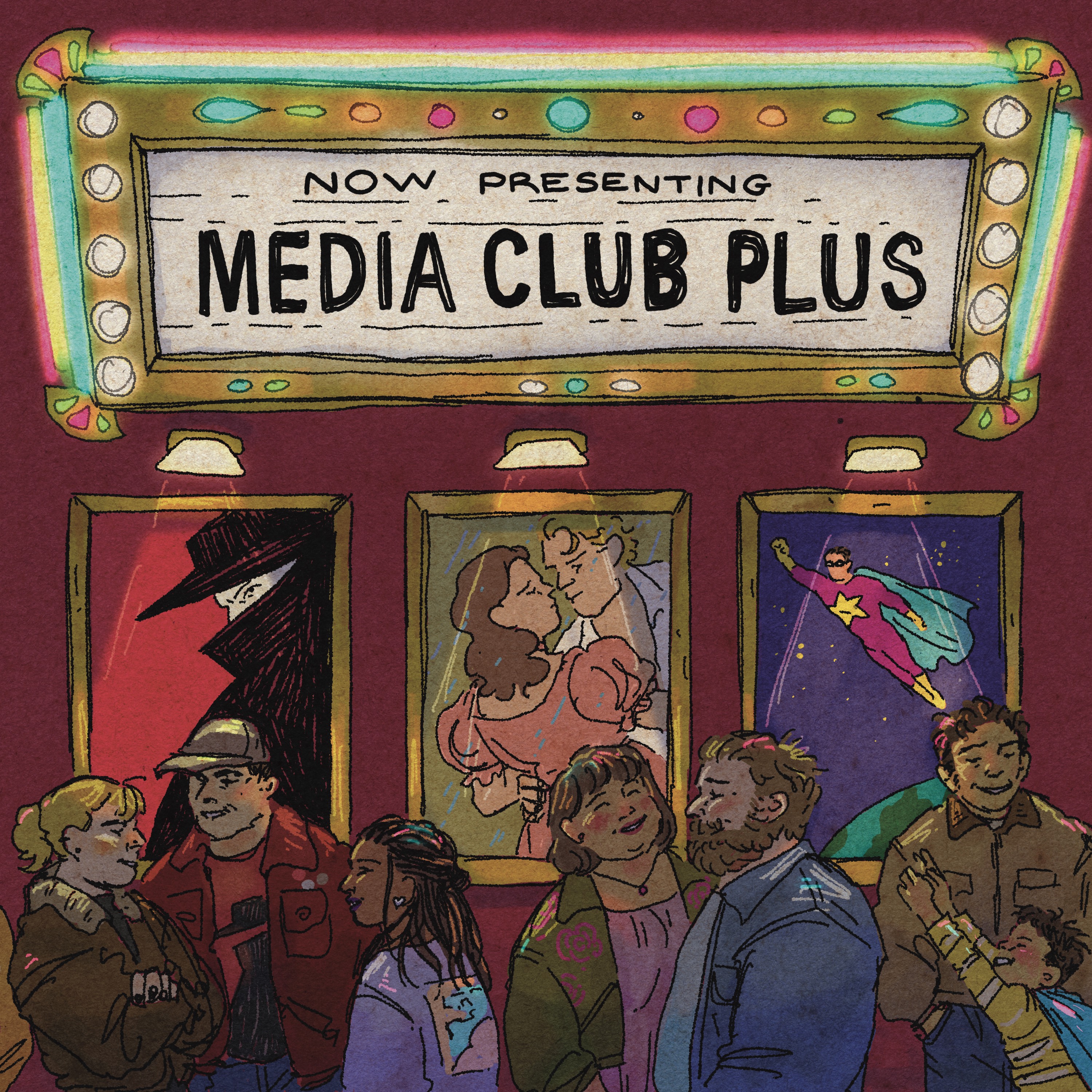
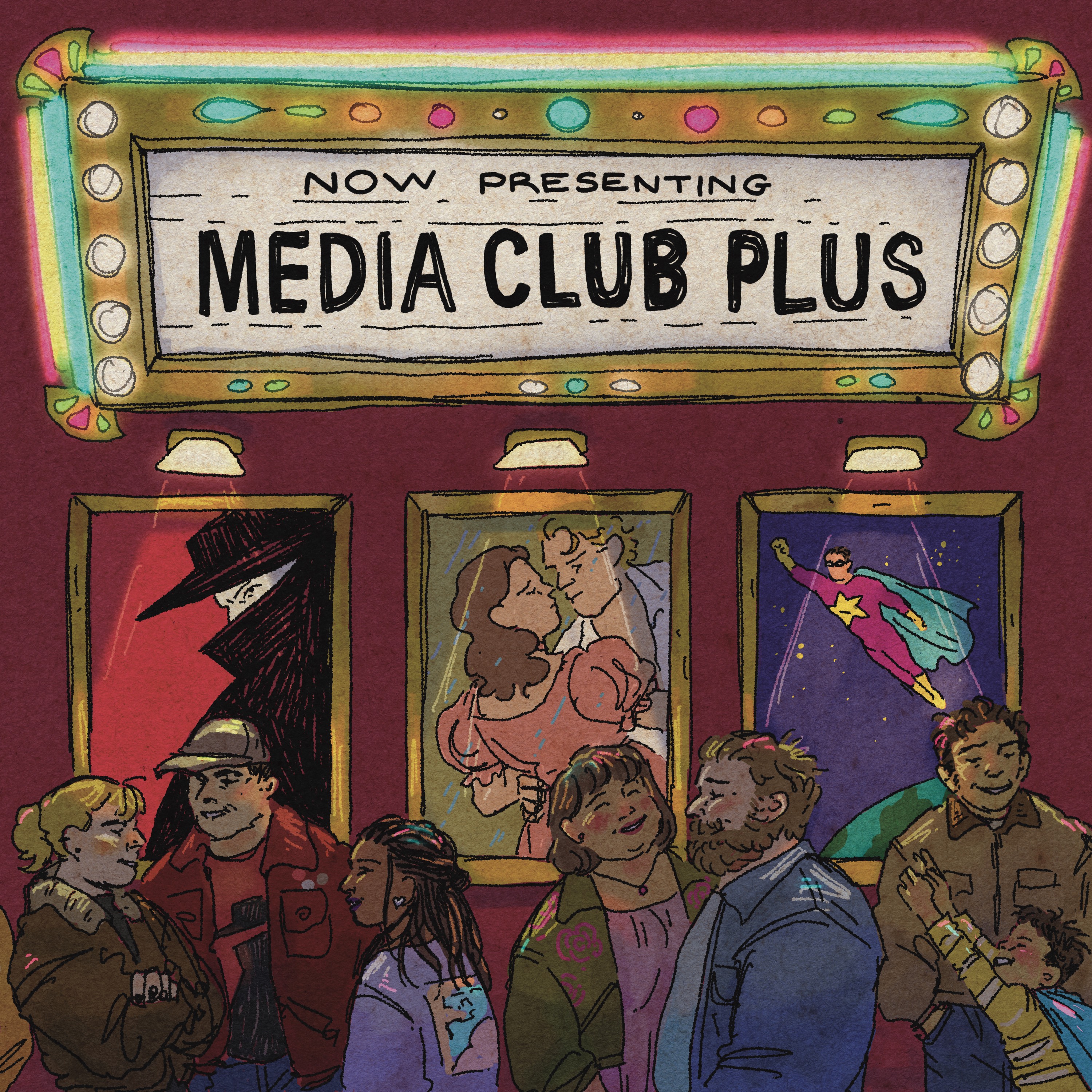
Cover Art by by Annie Johnston-Glick (@dancynrewanniejg.com

To find the screenshots for this episode, check out this post on our patreon, friendsatthetable.cash

This episode was made with support from listeners like you! To support us, you can go to http://friendsatthetable.cash

...Or find our merch here http://friendsatthetable.shop

To find transcripts of the episodes, go to http://TranscriptsattheTable.com

Press play and read along

Runtime: 2h 35m

Transcript

Yeah.

Greetings from Media Club Plus, a podcast about plunging into the media that thrills us and the stories that chill us.

As always, we have been dragged to you by friends at the table. Before our next season, we'll be subjecting ourselves to the twisted mind of M.
Night Shyamalan.

It's just a movie. It's a real movie.

It's a fitting intro for once, too. Yeah, this one works.
I thought it'd be really funny if I read the intro like

Normal because it's the first one that's kind of scary.

That would have been a good village, but it's scary. Yeah, you know.
Sixth Sense is kind of scary. The village is kind of scary.
I mean,

I don't think that those movies were kind of scary.

And I feel like I have a lot of people. Pete likes being hunted by a monster in the woods.

The concept was scary. Like, on paper, it could be a scary movie, but it was made in a way that it wasn't scary.
It had potential if done right and it wasn't done right.

Yeah, or, you know, it's not, I wouldn't say that the Sixth Sense was going for scary.

The Sixth Sense, I still don't really think of that much of a horror movie outside of a couple sequences, but horror is such a broad tent now that anything that has blood and guts and ghosts is a horror movie.

This was such a normal movie to me. This was so like a movie, like a guy who made a movie and he made a movie and look at, which is a, which is a bar that our friend has not cleared in a little while.

And it's a very literal description of the production of this movie. Yeah.
That it's a movie. I went and made a movie.
I went and made a movie. Yeah.

I guess it's sort of high level.

Allie, what were you going to say? What was that, Allie? I'm shocked about how little I knew about this movie going into it.

Yeah, I pretty much all I knew was

the horror comes from old people, which is like 99% of horror movies made in

this decade. So I've been prepared.
I didn't know it was found footage. I didn't know it was a scary movie.

I couldn't even really tell you when it came out or if I had ever seen it advertised ever in my life. I don't think that ever happens.
Weirdly,

I did an okay job guessing what this movie was going to be about. I thought it was going to be a holiday movie.

I thought that everything about this movie, my guess was that, like, make it Thanksgiving, and that was my guess.

I suppose just vague winter. It's just so.
Yeah, just vague winter. Yeah, they don't have like a Thanksgiving or a a Christmas theme.
But I, it's weird.

I had always considered the visit was going to be like visiting a house and not like aliens visiting, which I only thought of

like between after we recorded the last time. And I was like, well, I think it's going to be like you're visiting your grandma, which is what it was.

And then I was like, wait, fuck, visit could be aliens. I forgot about the other definition of visit.
I mean, and then aliens get mentioned. Aliens do get mentioned.

And then I, yeah, then I started the movie and I was like, oh, it was the, it was like visiting your grandparents. And then I was like, oh, is it both? But it's not.

Before we get too far in, do we want to, we didn't do any, we should introduce ourselves. Introductions, yeah.
My name is Keith J. Carberry.
You can find me online by searching Keith J. Carberry.

You can find the let's plays that I do at youtube.com slash run button where we've got

by the time this is out, like a whole Silent Hill F let's play probably that you can go watch.

And I should have also started posting publicly the

Lorelei and the Laser Eyes Let's Play that we did. That's right now only on Patreon.
So if you want all of those, you can go to Patreon, the run button Patreon, not the Friends of the Table one.

With me, as always, is Sylvie Bullet.

Hey, I'm Sylvia. You can find me most places at Sylvie Bullet, but but you should also go to the Friends of the Table Patreon at friends of the table.cash.

I cannot stress enough how much you should go to that one, too.

And you should check out Side Story, Sidestory.show. It's the gaming podcast that we do in addition to this and Friends of the Table.

It's good. Jackson I were just both on it and it was a fun time.

Art Martinez Tebble.

Hey, you should also go to friends of the table.shop to buy a t-shirt or a sticker or a glass, I think. We still have the glasses, right?

Yeah. Drinking glasses, not vision glasses.
I don't think we can. And at first, I thought you said you said glass, like loose glass, which we also don't sell there.

Send us 20 bucks and we will send you some loose glass

inspired by the visit. Inspired by the visit, inspired by the climactic scene of the visit.
That has some loose glass in it, yeah.

Alia Kampora.

Hi, thank you for listening to Media Club Plus.

You're welcome.

I have to, otherwise, I can't keep the conversation. You're welcome as well.
Yeah, uh, and already mentioned, Jack DeKeet, welcome back for the thirdest time.

Am I the first thirdist? You're the first thirdist in the secondest season. Yeah, whoa, because Oscar was the first thirdist in history for the show, I believe.
Yeah, I believe, I believe so.

I'm back because

I love horror movies and he made a real one.

He really did. Yeah.

I think this movie is tremendous.

Really? I like this film. Yeah, I have this.
Yeah, I like this film a lot. Wow.
Yeah, good movie. Are we fighting?

Tell me what they're refighting. No, I think that it's like good.
I think it's like... Here is how I feel.

So much of

watching the happening with Eulot. And having that conversation about how he was trying to make a B movie and kind of just blundering over every hurdle.

Like, it was as though he knew what the hurdles were, and he just ran straight into every single one of them. Like, I think you make a fucking B horror movie.
This is how you do it.

Yeah, I think I'm sorry, go on. I think it is politically and ideologically fucked.
And we're gonna talk more about that, presumably, over the course of this recording.

But I think, in terms of like hitting horror beats, playing like a four cast member tense horror that has some really good

humor, some really good

scary stuff, some nice like

bone-shaking, cheap jump scares that work really well, and some nice like slow dread stuff.

This is an enjoyable horror movie. I had a really good time with this one.

Yeah, it feels to me like with the happening, we got like this like film student idea of a B movie. Like, well, I've seen all these movies.

I'm gonna make something that like speaks to this language, language. And that's just not what the modern film going audience is thinking about.
And this movie feels like he was

sad after these movies of his kept bombing. And someone showed him paranormal activity.
It was like, I can fucking make that.

Let me get the guy who made that.

Well, he didn't.

It went the other way.

This is like so much better shot than any found footage movie I've seen comparatively like most of them i guess i've never seen another found footage movie okay well this movie goes out of its way to like find like in universe reasons that the shots are just way better like i'm gonna hide the camera here in a place that makes the shot into the kitchen amazing yeah i agree you know like the thing that m night has not lost um is just no matter how bad his movies are is that he he gets really good good set decorators to get really good sets, and he has a good eye for how to frame those sets.

And even in movies that suck shit, that part of it is like pretty good.

And this is a pretty good movie, so that part of it's actually really good.

Yeah.

It's surprisingly tricky to

certain.

I'm very sorry. I'm looking at the letterbox for this movie as we're all talking.
I just saw Sylvie's review.

Did you just review this on Letterboxd? No, I reviewed it after I watched it.

I mean, well, just sorted by recent.

Yeah, there I am. I didn't mean just as in just this minute.
I mean, just as in this week. Well, yeah, because I saw it for the first time.
It's true. It's never occurred to me.

I'm so inconsistent with Letterbox that I don't really even use it, but it's never occurred to me to review one of the Media Club Plus movies on Letterboxd. I've been, I haven't been star rating them.

I don't want to give away too much. I'd give away a lot in my review of this one, though, which is, and also, if you want to follow me, it's just Sylvie Bullet, like I mentioned.

He's back, baby. Two exclamation points emoji.
MediaClub.plus.

Wow. I'm sorry, Jack.

Before we...

We should get to the recap and start kind of like breaking the movie down. But to your point,

Keith, about like M-Night just has a really good eye for set design and set dressing and hiring people who can do that. It is like surprising how

easy he makes this house set look and feel, given that he essentially he claims to only have two cameras. I believe that's true kind of throughout the whole movie.
Canon was big, by the way,

in this era of like making their

prosumer purchasable at a Best Buy cameras seem like you could make a movie or a TV show with them.

Yeah, I do not believe they shot on those cameras, but those are the cameras the characters are holding.

They famously had a deal with House where the finale of one of the seasons was filmed entirely using a Canon EOS like

D6 or something. I don't remember the cameras from the mid-20s.

So Canon is doing this being like, we'll pay you to use our Best Buy camera. These are great cameras.
I'm not like shitting on the camera, the Canon EOS camera.

I have a Canon EOS camera, which is why I noticed it right away that they have a canon eos um yeah i i don't i don't believe it either just but how this movie was made i don't think he was going out and getting these kind of sponsorship deals but canon there was a there's like a canon ass like move your hand to show the logo shot i really

i would not be like too shocked if this is one of those things where that those are the cameras they used but they used like they added extra equipment to it famously like i'm thinking of how what's it called?

The Tangerine Project? Is that what it's called? That was

on the iPhone, yeah. Famously shot on iPhones, but they used like

extra, like they added lenses and stuff to it. Of course, you're going to rig out your camera.
Yeah, like, like, I imagine that is if that, if they are using these cameras, it's a situation like that.

When Soderberg shoots on iPhones as well, he, like, will have a whole rig going. But yeah, the house is internally consistent.
People move around it really nicely.

This is a film essentially set in one location, and the the flow of the house is really, really great. Um, what happens in this movie?

Oh, wait, wait, wait. I think we've all heard about roughly how we feel about it, except Allie.

Oh, sure. It's okay, it's a fine movie.

I was scared by it. There's like a weird thing, and I, I, I,

I feel like I should bring it up later, but I feel like the

worst thing I can say about this movie is that

I don't know that it has a lot of re-watchability.

And I think that some of the benefit of some of M-Night's earlier scripts are sort of the like, or movies structured in this way, the sort of like, oh, once you kind of know what's happening, when you watch it again, it's like more interesting.

Yeah. And I feel like

I disagree.

Okay. I haven't seen this movie in almost exactly 10 years.

But I was immediately like, oh, knowing how it goes, there's something something different. And I don't want to push off the summary too much longer.

But did you all sort of get that you were supposed to think it was ghosts?

No, never. No.

You were absolutely supposed to think it was like a demonic possession movie. You were supposed to think

that it was a paranormal activity because the previous like four years to this movie coming out was nothing but found footage movies about ghosts. Yeah.

And also, there was bits where it was like they, when they bring up that she's a werewolf, I was like, oh, is that what we're supposed to think?

Yeah,

like,

well, yeah, let's go into the summary because there's something about this movie in M. Night's writing that I immediately was like, oh, okay, I know what it is.

So, Sylvie, if you. Yeah.

15 years after leaving home to be with her now ex, Loretta Jameson gets a message from her estranged parents asking if her two children, Becca and Tyler, can come visit for a week to finally meet their grandparents.

The two kids, who want their mom to be able to go on a cruise with her boyfriend slash just be happy for once, agree, with Becca, an aspiring young filmmaker, deciding to make a documentary out of the whole thing and giving us M.

Night Shyamalan's first and only found footage horror film. She's not the only artist in the family, mind you.

Young Tyler, also known as T-Diamond Styles, just loves to freestyle, as well as being the second camera operator for his sister's movie.

Things start off normal enough, if not a little awkward, when they first meet Nana and Pop-Pop.

Nana makes some cookies, Pop-Pop spends a little time in his shed, and the kids get told that 9.30 is bedtime because they're old people.

But after dark is when we get our first hints that something might be a little weird.

While sneaking down to get some more of those cookies I mentioned, Becca sees Nana projectile vomiting in the middle of the night. Seems fine.

It's explained away by Pop-Pop, something that's going to become a trend for the rest of this week, and the kids go back to getting to know their grandparents.

The two of them play hide-and-seek under the house, but Nana decides to get involved and chases chases them on all fours in a scene that genuinely got a little jump out of me.

Tyler, who has had an issue with germaphobia since their dad left, finds his worst nightmare in their grandparents' shed, a bunch of Pop-Pop's shitty old diapers.

Remember how he said Pop-Pop explained away Nana's vomit? Well, Nana explains away the poop. He's a proud old man who gets embarrassed, so he leaves his poopy diapers out there to burn them later.

It's super normal. During this day, we also get one of the first visits to the house from a guy named Dr.
Sam who works at Mapleshade, the hospital where Nana and Pop-Pop volunteer as counselors.

And he wanted to come check on them because they haven't been seen in a few days. Unfortunately, the grandparents are out in a walk and can't see them right now, which is a shame.

That night, the two kids hear something outside their door, and when they open it, they find Nana completely naked scratching at the walls of the house.

The next day, Pop-Pop, while dressing up for a costume party that is not actually happening, explains to Becca what sundowning is, a form of dementia that intensifies after dark, and that Nana suffers from this condition.

So everything's fine and completely normal.

Becca tries to talk to Nana about her mom twice, the first time Nana changes the subject and gets Becca to climb inside the oven to clean it, before she agrees to be interviewed.

The sit-down interview follows and is the second time she asks about the circumstances of Loretta leaving home, but Nana immediately starts having an episode, reacting almost violently to the question and declaring that she will not star in Becca's movie anymore.

The two siblings go out for a walk with Tyler tastefully making fun of the way Nana moves during her sundowning episodes before they find her staring down a weird creepy well. Probably fine.

There's another visit to the house, Stacey, a nice young lady who credits Nana and Pop Pop with helping her through the Maple Shade Rehab Program when she was going through the worst of it.

She also mentions some scuttlebutt at the hospital that could be a reason why they haven't been back to volunteer more. Weird.
We don't get more details now, unfortunately.

Becca hears Nana laughing in the other room a little bit later, assuming she's watching TV. I believe she says, maybe

she watches the same TV shows as mom. She is not.
She is staring at the wall and laughing to, quote, keep the darkies in their cave. And once she stops, she tries to the deep darkies, sorry.

I just made it sound like Nana's doing a racial thing. It's not that, but it's a weird thing to say.
I thought that I would have remembered her saying that, but she's deep, yeah, yeah.

Sorry, she adds deep at the beginning of it. Um, and once she stops, she tries to seemingly crush her own head with the scarf she's wearing.

I don't know, you guys can tell me how you interpreted that specific move after I finish the summary. Becca finds Pop-Pop in the shed, cleaning his shotgun normal style, with his mouth.

Tyler, who's been pushing to hide a camera at night, finally gets Becca to agree and they see footage of Nana running around the house on all fours before finding the camera, screaming at it, and standing in front of the kids' room with a kitchen knife for the rest of the night.

This is when the kids decide they need to be ready to get the hell out of here, and thankfully their mom's gonna be home soon.

Stacy also stops by again, getting in a fight with the grandparents outside the house before the kids go back to getting ready to leave.

Becca finally gets the interview she's been trying to get with Nana where she forgives Loretta Loretta for whatever happened before she left, but not until after Nana gets to talk about some aliens that take people to their planet by spitting on them.

I'll admit, I did not get a good transcript of this scene written down, but I'm sure we'll be digging deeper into it. They were spitting into the pond with their spit drops.

And it helps them drink people sleep. Yeah.

Almost immediately after this, we get the other shoe to drop. While on Skype with their mom, Becca and Tyler, who are begging to pick her up, pick them up, show

Loretta over the webcam, Nana and Pop Pop standing outside, where we are informed that those are not their grandparents. She has never seen those people before in her life.

They're about to start their escape when the two old strangers come back inside. Becca gets shut in the oven again by fake Nana

after being asked to clean it, and the kids try to escape only to discover Stacy's body hanging from a tree behind the house and are forced to play the world's most uncomfortable game of Yahtzee.

Becca excuses herself.

It's pretty good. Becca excuses herself and goes down to the basement where she discovers the bodies of her real grandparents.
Pop-pop follows her down and introduces himself as Mitchell.

He explains that he did this because Claire, Nana, drowned her two children in a way that is very reminiscent of the alien story she told, and that she deserves a chance to be a grandma.

He says that their grandparents at Mapleshade kept talking about them and that that was a bad thing to do because they were so excited to see them.

You know, it's fine.

Tyler, meanwhile, is frozen in fear in the kitchen. Oh wait, I missed a line.
Sorry.

He also says that the two kids are going to join Claire's children and he locks Becca upstairs in a room with Claire.

Tyler, meanwhile, is frozen in fear in the kitchen and has literally the worst night of his life, while Mitchell smears shit on the poor kid's face and rambles into the camera about how he's a seer who can see the real face of humanity.

Becca manages to escape the room with Claire, stabbing the phonana to death with a shard of broken mirror and breaking out of the room by destroying the doorknob with her camera.

She tries to rescue Tyler, leaping on Mitchell's back and telling her brother to run away. But Teen Diamond Styles does not run away.

He tackles the old man multiple times and then bashes his head in with the refrigerator door.

The two kids finally get out of the house, reuniting with their mother under the rain while police finally show up to investigate what's going on.

Loretta explains the explosive exit from her parents' home was actually

she hit her mom and her father in retaliation hit her and a few weeks later, I don't, I can't remember the specific time period she gives, she received a call from them, presumably to try and patch things up, that she never answered.

And she tells Becca that forgiveness was always there if she wanted it, and that she shouldn't hold on to anger.

This leads into a little montage of Tyler and Becca's kids with their dad before the movie ends.

But our final shot, which is crucial, is Tyler doing a freestyle rap about the events of the movie over the credits. And that is the visit of Night Shyamalan.

Everybody in basically everybody in this movie is doing a great job. I think.
Yeah, I don't know if they're...

I don't think there was a single performance that felt like it was dragging down.

I think Catherine Hahn, who plays the mom, made some like, was really able to make some dialogue that shouldn't work work. I really like Catherine Hahn.

It's the first time I think in an M-Night movie, there's someone who I recognized

and was like, oh, I already like them. except maybe Bruce Willis, but that's a highly qualified like.

You don't like Samuel L. Jackson? Who hurt you? Oh, no, okay, okay.
I like Samuel Jackson. I forgot that I liked him because of how much I didn't like him in Unbreakable.

She's in such an interesting pull here because I think of her as such a comedy actress that, like, there was already something uncanny about the like found footage format once it's like,

oh, that's the lady from the wedding crashers or whatever. You know what I mean?

Like, it was like, it was like another plane of existence where I like had to buy into this um and i think that it kind of works because it you know the visit is really towing a line between horror and comedy yeah i think that there's even like um

there's like rumor or whatever or maybe m night said this um that like he said it that there are like two there were two cuts of the movie one that was like full horror one that was like full comedy and then he ended up like kind of weaving them finding a place in the middle to release it and that's weird

and yeah i am i'm very curious about

what is or isn't included in those two i would love to see a release of those two cuts like on one disc

that'd be fun

the visit trilogy and yeah

i think you know what i think is really interesting about this movie is it completely flips my normal experience of an M-Night movie where I really like the first half and then the second half, I'm like,

this is dog shit.

But this one, you like the second half more? Yeah, the second half is so much better than the first half to me.

I think that the first half,

it's a little slow. And there's, he's really over.
These are some fucking lemony snicket ass kids. These kids are precocious as hell.
Oh, I like them.

They're way overwritten, I think.

They're doing a good job, especially Becca.

What is her name? It's

Olivia

DeJong.

I don't know if it's a soft J or a hard J. Yeah.
DeGaunch.

DeGaunch.

DeGaunch.

I think she does a good job sometimes like translating this precociousness into a usable performance, but it's a little tough. And as

the visit starts to unravel,

and this is nice to me, the characters are like less able to do that performance of like being a smart kid. and are just kind of afraid and confused.
And so

it makes that earlier stuff feel way more intentional. And it's happening less as the movie goes on.
Yeah, I feel like I have a lot of grace for these characters and these performances, both because,

you know, the movie gets to do a really fun thing of like,

you know, you calling out that it seems a little overacted or like they're, they're like too on the nose is like, these are kids who are putting themselves on camera and performing on camera.

Like, the characters are performing as much as the actors.

There's already that sort of like, whatever their actual personalities are are pushed to 120% or whatever. Plus meeting people for the first time.
Plus, like,

I really appreciate that there's this sort of like already heightened, like...

emotional intelligence, I guess is the way to say this, because of this recent divorce. The sort of like intention of them going into this is like, we kind of want to do this as a favor to our mom.

And also like

becca being the one to be like i'm being artsy about this and i think that this is like

like going to be my big break as an amateur filmmaker as well as like this is going to fix the holes in my heart and in my family yeah i really like yeah sorry

no i just like i i i think that they draw that line really well and i feel like it helps me buy into the sort of like sarcadeness of these children in the performance.

I think it works better with Becca in terms of like feeling like a kid who wants to be a grown-up, but is not actually like is trying to behave like I'm an adult, I'm this serious artist stuff.

I'm gonna take care of my little brother during all this. And then when things are breaking down, you're like, no, she is still just a kid.
Like, it's fucked that she's in this situation. Yeah.

I think Ed Oxenbold, who is playing Tyler,

has really figured some stuff out.

I think that he is a very capable actor who is being asked to deliver some extremely awkward child dialogue and some of the worst freestyle rapping you have ever seen. Truly,

it is really atrociously bad. It's so funny because there's a part where he talks about his cell phone having no bars, and I just went, yeah, man, we've heard.
We've heard.

And

the kids regularly misuse misuse AAV

or just expressions children would use. M-Night was clearly like, what do kids say? And he watched it.

But then at the same time, there are these moments of like either having to land a joke well or land a bit of physical comedy or land

fear or anxiety that Ed Oxenbold is just

doing really, really well with.

There's a running gag that gets increasingly sort of sad and flat and sinister, which is that the children have to pretend to be playing repeatedly so that their grandparents don't get suspicious.

But the only way they can think of pretending to play is standing in one place exactly outside the house and throwing a ball up and down.

And as the movie continues, Tyler starts getting kind of fun with it. He like throws the ball in the air and spins round, and Becca says, What? And he says the line, That's how children play.

Which is this is incredible to me.

This is some real, like, not only are they so completely out of their depth that even their own understanding of, like, what a child is supposed to do is starting to come apart, but these are also freestyle rapping camera,

canon camera,

big break children, not stand outside and play with the ball children. And so they just, they can't do it.
There's a great moment where

Another running gag is that Tyler doesn't really know how to use the camera.

Becca does.

There's a really good early scene where Becca says, just try to be formal as in classicism. And we hard cut to Tyler just like screaming into the camera,

like wiggling his tongue around. Good guy.
Yeah, at one point, he just flips the camera the bird very precisely. You can tell he's very excited to have this camera and flip the bird to it.

Um, uh, at one point, he breaks into the uh shed, as Sylvie said, and finds the diapers. Um, but before he does, he does a little piece to camera, he's like, What's in there?

Uh, and he says, Is it dead bodies? and then realizes he's botched the line and does like four or five takes of Is it Dead Bodies?

And this like

this kid

with this performance. I didn't

hear him botch the line. I just heard, to me, he said it, and I just thought that he was just like considering the reality of it.

No, he's trying, he's trying to rebuild, which is great because one of my favorite things in the first half of the movie is how deliberately Becca is directing the documentary,

setting up scenes,

trying to get people to act naturally, like thinking, trying to imagine a finished product

that looks good in a way that is not quite documentary-like.

It is not documentarian,

but she wants it to look like how a documentary looks. So she needs her brother to look forlorn by the swing.
So, like, go stand over by the swing so I can get you looking forlorn by the swing.

Let it move naturally. Naturally, yeah, let it move organically.

The metaphors snap together here.

I don't think necessarily particularly

with much nuance, but they're like trying to look like a documentary, but not actually being a documentary, trying to look like a family, but not actually being a family, et cetera, et cetera.

Something really funny is happening with the way Becca chooses to shoot this, where, like Keith said, she's being very deliberate, and often when she's talking about film, she's she's not very good at it because she's 15 or whatever.

This is fine.

She says things like, um, try to be formal as in classicism. Uh, she

has like really weird understanding. She has like she knows that she should talk about tension in shots and how shots are composed, but um, can't really like pull it off.

But at the same time, she shoots this movie beautifully and she edits it incredibly. Yeah, if we were to believe that she edited this, like, damn, those title cards, she crushed it.

Yeah, instead of it being Luke

Luke,

hold on. Luke Sierrochi,

now veteran M-Night editor. It is her movie.

There's a bit early on when she is playing this ridiculous, overblown kind of like radio classical music

and saying that it's going provide a nice contrast to the scene of going around the house and we see this scene as she's cut it and it's not good but by the end of the movie when that music does come in as they escape the house

it's working you know

they've got it to work the rain the the sirens the flashing blue light this music coming up it's really good as a thing

oh sorry go on oh go no you go ahead there's a beautiful shot beautiful piece of editing that i really like that i thought was so fun to think about Becca being the one editing it, where after we see

Nana scratching the walls, nude scratching the walls,

it cuts to the next day and we see all of the like evergreen trees in the yard have been wrapped up for the winter and so have become these kind of like weird, lumpy, misshapen, sort of mummified trees.

And it's such a nice

like subtle shift in visuals of one sinister thing shifting into another sinister thing that those two images flow together really nicely and that Becca was, you know, after all this trauma, like, yeah, that cuts good.

Yeah, there is a lot of the movie that's dedicated to kind of

Tyler on the beacam filming Becca editing the footage they've already shot, which is really funny. I think that's a great, it's one of my favorite parts of the movie is like

all the different ways that

they're con that the movie is being constructed

in the movie. Yeah.
Yes. Although, not to be too much of a shit here, but it is where it like takes me out of the idea that this is

like, really? This isn't her cut of this movie, and you can tell because she left all this shit in, right? Like, anyone else? No, just me?

That didn't really bother me. Yeah,

I think that

this is

an easy suspension of disbelief for me.

Oh, sure. I'm not like...

But yeah. That at the end, they're like, actually, this is the movie.
That's where it becomes like.

Well, if you had this footage, what would you cut it into? Would you cut it into a present for your mom, or would you make a horror movie out of it?

It doesn't matter.

But it's a weird. It is weird, but if you've got the footage, you know, you can tell that she's ambitious.

I also like in Becca's defense here, she ends up, if we're assuming she's doing it, making it both because she includes all this horror movie stuff. She does.

But then also the like interviews that they do of each other and her thing of like, I refuse to put footage of my dad in this. And then that's literally how the movie ends.
Like,

it does have this like emotional, she achieves both things in a way that seems very childish.

Well, and I'm a fucking sucker for shit like this, but I, I, that, like, her, the Catherine Hahn speech about, like, how you can't hang on to anger, followed by the footage that she said she wouldn't put in unless because it meant she'd forgiven her father.

Yeah, yeah, like, oh my god, fucking

love it. What's that? Why do you think you're a sucker for this? Are you asking what makes you a sucker about it, or why do you think this is for suckers?

No, uh, what makes why what makes you susceptible to it? What gives Aunt Martinez Tebel this feeling? Yeah. Um,

You know, I think there's, it's a lot. I think part of it is just like, I don't know why, but in like the late 2000s, I just decided that movies were going to, that like every movie could make me cry.

That just like,

I don't know what it was, but I distinctly remember like,

I don't know, I don't, I must have been up.

Like, I walked out of up being like, Jesus, that was a sad movie. And then just like going on like a run of just movies making making me sad.

But this in particular, I think, is wrapped up with my father is dead.

And now I am a father. So like, stuff about parenting is just like, it's a little, you know, the, it's playing from the short T's for me.
But like,

I think it's, I think it's terribly effective. Yeah.
I'm professional. Because Sean knows how to, how to,

how to, how to land it, I think, too.

Yeah. Yeah.
This also, like, I think is going to speak to like, like, this hits some of the themes that he really likes with Parenthood 2. He's like,

both the sort of like absent parent thing and then, as well as the, like,

trying to not have your kids repeat the same

like

mistakes you've made. I think that there's like a through line for some of the stuff with, I can't remember the actor's name, but that the dad of

What's Her Face from the Village and

the stuff in Unbreakable, I think, is a through line. But in here, it's like, oh, yeah, the dad actually left in this one, as opposed to they were just having a

separation and he was planning on leaving. And I think this stuff is going to come back up again.
This is the stuff.

Oh, Gunky. This is the stuff I'm not sure about.
Like,

I think the movie is

really working on its premises.

Like, it is

being about family. It's being about like connections or severed connections.

It's being about like performing and performances that you put on for family.

Like it like kids,

how kids change when their parents are divorced, like

feeling

not worthwhile, feeling like trying to find where what happened, like, but also not having a full view of what's going on.

like it's doing all this stuff it's doing a really good job of it but that one specific thing of

like I won't put him in the movie because that means I forgive him that is like the that is kind of the the the hitch for me of like

it that's not that doesn't mean that and the movie kind of just says that that's what that would mean and I don't it didn't feel in the moment it didn't feel true and then when they use it at the end to to sort of bring it home with like not holding on to anger, where I also don't feel like that, I feel like you, I feel like people can hold on to anger and that it's actually fine and that it doesn't, it won't put you in a horror movie.

Um,

that

means it because she says it means it, yeah. Well, but she says that, that it means it because End Night wrote that she would say that,

yeah, that's how movies work, right? Right, yeah, but, but the character is allowed to think something that isn't true.

Yeah, but that's, but then you can then judge the quality of that thought, and I judge it to be an incomplete thought. Well, she's a child, and isn't that useful for him as the writer?

I think Em Knight is doing something really

odd and

interesting, and I don't know, necessarily successful, in that he is both trying to blend a pretty

like reactionary horror movie, like straightforward horror movie.

There are two quote-unquote mad people. They are mad within the fiction of the movie and they are very dangerous.
And they are attacking two children. And he's trying to blend that.

with like the classic M-Night,

I want to explore

sort of vaguely, superly, but at the same time very earnestly the character's particular fears or anxieties. And this is not unusual for horror.

You know, you do tend to make a horror movie work by like scaffolding it around, you know, core emotive beliefs that the characters have, the way you want to see them change, and then you make them be chased.

by a man with a knife or something. This is how horror's been done forever.

But it's as though M-Knight is both trying to make a Frank Capra movie in the way that he often likes to do and a John Carpenter Carpenter movie. And he's like smashing them into each other,

which produces this really weird moment towards the end where both Tyler and Becca perfectly end up in situations where they have to overcome the exact anxiety that they had.

Becca has to turn and look into the mirror. We've learned that she's not been looking at herself in the mirror because she believes that she's worthless since their father left.

She has to turn to look into the mirror to see Nana creeping up behind her. Tyler has to withstand this awful attack by pop-pop,

and Tyler is germophobic.

It's like all the lines kind of draw together very perfectly and very

melodramatically towards the end. There's a lot of like, I described this movie to my partner after we watched it as just like an exercise in sort of the horror version of Setup and Punchline.

The whole first half of the movie is all the setups. Like, you get the stuff with

the.

oh god, I had it a second ago and I've completely lost it. Germaphobe stuff for one germaphobe stuff, but there's the um

there is the stuff with the oven. We get the like sort of tension early on, and then we get the like when things finally go bad, we get the like even scarier version of it.
There's the stuff with um

the visits to the not to not to I'm not being cute there, I just don't have another word for it. The visits of the two people from Maple Shade coming by, um, the sort of

the

wall of people that they've helped, and then the reveal after that.

I had better examples when I had this thought like 10 minutes ago, but I couldn't get,

I can't remember what they were anymore.

But I think it actually works pretty well. I don't, I'm not, when I say that, like, M.
Night's Back, I mean he made a fun movie.

I don't think this movie is better than like a three and a half star, if that.

But I think that it works really well in the form of these Bloomhouse low-budget horror movies to make the like

perfectly adequate roller coaster you want. That if you think a little bit too much about, you'll be like, huh, this is very ideologically suspect.
Hey, three and a half stars is really good.

Three and a half stars is fine.

I would, I think three stars is fine.

Yeah. Out of five?

Cool, man.

Three is fine, and three and a half is good. You're just,

your hairs are very thin.

Well, that is the tragedy of the five-star rating.

Yeah.

Can we talk about

the performances of Nana and Pop-Pop? They are fantastic. These people have fantastic.
They are really great. Oh, my.
I wish Nana had a better wig. You wish Nana

had a better wig. Her wig looks really bad in some scenes.
Oh, I thought that was on purpose. I thought that was on purpose, too.

I thought it was on purpose and that the twist was going to be that they are wearing old age makeup. Oh, that's funny because she went on.
They're very spry. They're very spry.

She really can run on all fours. She really can run on all fours.
Yeah, I felt that their hair was getting worse over time and that that was a signifier of their of their decay.

I think that is probably true. I just all I noticed was that like when she comes up from under the

like underneath the house, both my partner and I were like, damn, her wig is like really bad right now.

You know, I saw, I saw, I saw a video once of someone saying that they're, that they are wig blind and that when they watch a movie, they just believe that that's that person's hair no matter what.

I feel that way. I've never thought about someone wearing a wig once in my life unless they're wearing a wig that is signaling to you that it's a wig.

Her hair, or the wig did not, like, the idea of a wig didn't occur to me once in the whole movie.

built different i don't know what's weird yeah nana is played by deanna dunnegan and pop-pop is played by peter mcrobby and i was i knew going into this movie that um i knew what the twist was and i was

really

hmm

i was expecting the escalation to the kind of wide-eyed screaming horror of the last 15 minutes of the movie to happen much earlier.

But the like click, click, click of the roller coaster through the performance of Nana and Pop-Pop, I think is great.

They have conversations with these people, they move around the house, they offer them

food and drink, they are

sinister in increasingly peculiar ways.

But I think the kind of like herky jerky escalation in the grandparents is pitched really well. And so much of that is in these two performers.

Yeah, it comes across, like, they definitely have those moments where, like, Tyler does one of his god-awful raps in the kitchen, and they get really excited about it in the way that, like, grandparents would be over their grandson in, like, a way that's kind of cute.

And then, like, they do a good job of threading the needle of being like,

oh, maybe, like, obviously, we all know the twist is not going to be that they really are just dealing with dementia. I mean, they are, but like, they're not, they're, you know what I mean.

Um, the twist isn't going to be that they're just old and weird. It's going to be something more sinister than that, but they managed to play the sort of like

struggling with having an older relative who is dealing with this stuff pretty well. Yeah, they patiently explain each other.
Yeah. Yeah.
In

very classic M. Night Shyamalan fashion, um, this is a movie about like the main character of the movie denying the premise of the movie for way longer than you would think is reasonable or possible,

which is a pet peeve of mine with his movies.

And

it is kind of held together with

Nana and Pop Hop's performances.

The first time that she asks Becca to clean the oven by getting into the oven, there's a beautiful line delivery. Barely contained, oh, I have the button for it, which I forgot about.

There's a barely contained

impulse in her arms. You can see in her arms how badly she wants to close the door to the oven.
She's shaking with

everything she has to not ruin the perfect weekend that she has with these kids. by closing the door on her in the oven.
And I think that is sort of

one of the more interesting parts of the movie to me is how, you know, everything else aside,

their goal is to have a good week with the kids.

And then kill them.

And then is that unclear? Is that clear or unclear? Past a certain point, they die,

right? Death. Yeah.
So

I, you know, the, the, the, the, the, the, the hinge that this movie spins on is like they're explaining everything away by like, oh, we're old, you know, we're, uh, you know, uh, Nana has dementia, Pop Op has incontinence.

Becca is very sensitive to the idea that, that they are simply old and that Tyler's fear is a

socially conservative fear that is unfounded. And then the movie's like, then the movie's like, Tyler.
Tyler was right. Tyler was right.
Yeah.

This is how I describe this film as being quite conservative. Yeah.
Yes.

I think this was like a second viewing

revelation, for lack of a better word.

I think they were always going to kill them. Yeah.
I think it's clear at the end that

they were always going to murder them at the end. This was a murder suicide was the vibe I got from the moment Pop Pop was sucking off the shotgun.

Well, but that was, he was sucking off that shotgun way before he was going to murder anybody. I know, but still.

He's

not doing great with the idea that he's going to murder these children. The white thing with yellow eyes was tormenting him.
This is what I was thinking: is that

they killed. They obviously

start.

The movie starts after they have already murdered

the real Nanon pop-pop Jameson.

Certainly, by the time they appear in it, it's possible they murder them.

I guess it's possible.

But it seems like the last day or two before they leave anyway it doesn't matter uh uh th they're recently murdered which means that they're recently replaced by the fake nanon pop pop who we know for the movie um

whatever

whatever help that they were getting in the facility where they escaped from is going to be

you know wearing out over the course of the movie.

To me, they may not have been like, and we get to kill the kids at the end, because part of it is trying to

sort of soothe

Nana, who killed her own kids by drowning them in

the lake of the

Cinemorphia, the Cinema

aliens.

Cinemorphitellia or something else. Yeah, it's like Morphitellia.
There we go. Yeah.

My mixer cut it off. So I had to find the file on my computer.
Cinemorphitelia.

I think that these desires for me, they only felt like they were starting to crop up

as they had less and less control over themselves. But it's possible in a second viewing that I could change my mind on that for sure.

I hear you, but pop-pop in the basement at the end is very much like, and you'll be joining them.

And that sort of sounds like it was the plan the whole time. Again,

we can't know this.

There's no material to tell us. But that's what I think.
There's like some stuff in the background that made me think that too.

Like there was like a bunch of gasoline in the basement, if I'm remembering right, that made me be like, oh, is this movie ending with this house getting burned down while they're inside?

As a kid who grew up with grandparents on a farm, there's just gasoline all over the place. Yeah.
Uh-huh.

I thought it was

grew up with grandparents on a farm who tried to murder me one day.

We had a barn. We had a barn that was full of gasoline, you know, just full of gasoline.

I don't think that's safe. I think if anyone ever asks you, you should.
Yeah, man.

Did you grow up on a compound?

Yes, kind of. Yeah, you did, man.
I know.

I think some of this relates to what I was hinting at earlier with the like

re-watchability versus satisfaction of like the quote-unquote twist here, which is a thing that we like, you know, audiences mid over all of the time.

But like, I, it's not that i think that this movie had an unsatisfying twist because i don't think that i think that like the you know the the length that it plays out the deceit of this the sort of like very gentle um explaining away of the issues the like tension we were talking about before about the like

you're here with your family, but you also don't know these people at all.

And you're sort of like trying to be gracious about being in their space and being young and frustrated or bored or whatever else like all of that stuff is really fun but like in m night fashion when pop pop comes into the room and is like bedtime is at nine o'clock and also please don't go into the basement i was like okay so the secret of all of this is in the basement.

This is M-night, like in the, in signs saying don't go to the lake. This is the fucking treat.
Like, this was the setup I was trying to remember. Thank you, Alan.
That was the big one.

It's just like, once I heard that, I was like, oh, okay, the entire tension on this movie is waiting for someone to open that door. And it doesn't happen until maybe

20, 30 minutes left on the runtime. Oh, I think actually it's more like

nine minutes left on the runtime. It's really close to the bottom.

It's very close to the end.

So like, yeah, I don't know. Like, I, again, I went into this movie knowing basically nothing about it.
So I do think some of the conceit of like, is the terror coming from the house?

Is,

you know,

in thinking about like the way that you can write movies about children and the sort of like

social terror of that bleeding into like this actual terror is all like, you know, the sort of like.

question of like, what should I be looking at as an audience viewer? Like, what, what, what is tension to me versus versus what is tension to the character?

And having a lot of that immediately deflated by like, oh, I know how M-Knight does these scripts.

Yeah. Like, okay, well, part of me wants to grant it because it's such a trope of the like, don't go in the one room.
That's like such a

I think I've seen that in, I've only seen a dozen horror movies, and I think I've seen that in 10 horror movies. Sure, sure, sure, sure.
It's just that he is never

willing to do, like, he does it so frequently, and he's never like twists upon that, you know what I mean? Upon that audience expectation.

So I just like, I remember feeling like, oh, okay, during that scene. Yeah.

Just waiting for them to get to the basement.

I thought, I mean, I'm essentially with you, Ali.

I think that both those moments, the don't come out of your room after 9.30 and don't go into the basement, which are actually two separate scenes, the actual delivery of them, I really liked.

I think that the actor playing, so the actor playing nana has this incredible control over her body her physicality is incredible the scenes where she's chasing them um

in the under the house and she manages to get her body into this sort of like spider-like posture um when she's running through the house uh and crawling through the house there's this weird sort of like looseness and lightness to her body almost like a dance um i think her physicality is incredible and then in the emotional side when there's a scene where she's like getting emotional and crying, and like the dimples on her chin are like

flexing in and out in a way that is

feels completely impossible to do. If someone asked me to do that on camera, I would never be able to get that to happen.
It's like a beautiful high melodrama performance.

And it's like a funny thing to think about, but the thing she did immediately before this was win a Tony.

Really? That kind of surprised me.

She sort of has the like triple threat. She has the triple threat vibe of some, you know, an actor, a singer, and a dancer gives you a really rounded, rigorous control over what your body can do.

I was about to say, that makes the physical acting, she does make a lot of sense, actually.

And then Pop-Pop, Peter McRobby.

This is not a subtle movie at all, but he manages to play some of Pop-Pop's dialogue with this really odd, sad, confused subtlety.

To Allie's point, when he says there's

there's mold in the basement, so don't go down there, he throws it midway through a conversation, like a normal conversation while they are unpacking, as though it is something he knows he needs to say, but like can't wait properly for the moment, and it just kind of like bubbles out of him.

He's like, oh, and don't go in the basement.

Um, similarly, he tells her that they can't come out of their room after 9:30 while he is dressing to go out to a party that he is not supposed to go out, uh, or he the party doesn't exist.

Um, and he delivers this, um,

otherwise pretty sinister request or demand so casually and with so much sort of sensitivity towards his wife.

Um, similarly, when uh she catches him with the gun in his mouth, uh, he says, I was just cleaning it, and then as though he knows that he has lost, as though he knows that he can't sell this anymore, repeats, I was just cleaning it in like a variety of different ways.

I think that's the best fine reading in the whole movie.

I think

by the way, also, the way it's filmed is so like you walked in on your grandpa

jerking it. Yeah.

When he's cleaning the guy, I was just cleaning it. I'm just saying.
I was just cleaning it. Like, I'm just saying.

There was some weird stuff happening.

There's some.

I suppose we should talk about that later, actually.

Can I play the clip of uh the oven from uh we were talking about earlier? Yes, absolutely.

Nana, can I ask you about mom?

Maybe you'd be okay to talk for a minute in an interview.

Would you mind getting inside the oven to clean it?

I'm sorry.

I'm too big. I can't reach back there.

The kitchen's got to be clean.

The oven's off.

Yeah, sure. Yeah, sure.

Get farther farther in there

all the way in

Okay,

I'll star in your movie

She's good, she's good I like the way that

she

in that in the performance and in the dialogue

She seems unable to guess what someone's hesitation about this might be

because when she says you know

the oven's not on

yeah that if anyone ever says that to you

If anyone ever

asked you to clear their oven and said then says the oven's off, don't get in that oven. Yeah.
Nope. That's someone who's thinking about turning the oven on.
Yeah.

they're Hansel and Greteling, you know. This is what was I really

go ahead, Jack. I just, I really liked the Hansel and Gretel thing here is not subtle, and I really liked it.
Yeah.

The

I can't remember what I was going to say. Oh, no.
Nah. That's okay.
It wasn't a big deal. Which is another like, that's why the twist.
The twist isn't just that it's not their grandparents.

The twist is that it's it's mundane. Yeah.
This is, I do remember now. This is the, this is the thing.
This is like the kernel of like, I'm trying to guess, like, what is going on with them?

The movie's always inviting you to, to be like, what is happening with the grandparents, obviously.

And

it was really difficult to settle on an explanation, an explanation because

I would see a scene like that,

or with the grandfather with the gun,

or um,

uh, the clawing at the door, um,

uh, or the like jump scares where she'll just like appear behind them, face like right in the camera, being creepy and weird. And it's like, oh, they can't, they can't censor themselves.

They're like, they're trying to hide that something's wrong with them, and they can't hide it. And that is a very strange dynamic

that the the twist of the movie perfectly accounts for, basically.

But it does make it hard to be like, oh, well, it's ghosts. Oh, well, they're witches.
Oh, well, it's aliens.

You're right. It does make it easier to suspend the disbelief of why the kids are like, oh, it is just dementia, though.

Like, that is a thing of like not really being able to sort of hide when something's wrong. Yeah, this is a value.

I'm not judging the movie for this. I think it's an interesting thing

that makes makes it hard to like draw a conclusion that makes sense. And I almost felt silly that I didn't see the twist coming

because it was so like I knew that there was something about them. Like,

there's something going on here. But when they turn the camera and it's like, those aren't my parents, I was like, oh, of course, of course.

You know, it's so important to the movie that they've never seen,

that Catherine Hahn never sees the grandparents. That

sabotage the camera.

You know, all of this stuff. Like that, like,

even knowing that, like, why did she sabotage the camera?

It didn't click to me. Like, I was like, oh, so they can't, like,

video for help, but they have the...

They have their phones, but the phones don't really work.

I was like trying to figure out, like, what exactly is this all for?

and it's all to it was to prevent Catherine Hahn from seeing them. I think that this

twist, like technically, like the

sort of the moment of the twist is killer. I think this is the this is up there for me with the

I See Dead People is presented as a as an emotive moment. You know,

that scene is so good in the sixth sense, but it's not like

like feeling like the roller coaster suddenly moves. I think that the movie puts so much effort in and Catherine Hahn does such a good job, and the like

almost play-like, like theater-like execution of this twist makes that moment just sing for me.

I love the part where she's trying to tell them they're talking about other stuff, still explaining all the stuff, and are not listening to Catherine Hahn,

who's trying to explain, I don't know those people.

Yeah, and I understand that she's surprised, but you would just interrupt your children if they were talking about something else and you had to tell them that those people they've been with are strangers.

She was trying.

Well, I think it's part of why this is so successful because it like the kids at this point are already like, we have to leave. Yeah, we have to get out.

We are scared enough by just the

reality of who these people are without knowing that we are actually in this like weird fly flytrap.

Like we are at the point where it is unexplained if like

it is just sundowning or the fact that Nana has found the camera and reacted to it so extremely.

I guess we didn't go over this, but like what happens the night before the kids decide to leave and this reveal happens is they finally leave the camera out and

Nana like seems to immediately find it um carry it around put it in places where she can like perform weirdly for it and then carry around a knife and like bang on their door while holding a knife um and then that's when they're like mom's gonna be here tomorrow we have to we have to leave immediately so that the fact that it's like you know

whether or not

the truth of these people is that they're we're related to them and they are just violent and strange is such like a

good place to be in a horror movie if it's just like a weird horror movie about family issues but then to like

and then be like oh my god i have no idea who those people are is such like it feels really satisfying in the watch it like it just is like oh shit it's like a it's like a perfect knowledge twist where like

It's like Keith said, all these little things of like, if person X had only seen person Y or if the people had been around at that moment, you you know, the

sometimes when a twist relies on like a web of coincidences, it can feel really arbitrary. But here, that web of coincidence is so precise that the moment it happens, you're like, oh my God,

of course this has happened.

I think it's great. And I think that, you know, you cast Catherine Hahn for that moment, right?

I mean, you also cast her for the scene at the very end, but I feel like those are the two beats that she has to hit as a performer, and she hits both of them. Yeah.

And it's, we didn't really talk about like the making of this movie, but M. Night Shyamalan goes and makes this movie with his own money.

There's a $5 million budget with like a $95 million box office, something like that. Yeah,

he makes the movie by borrowing against his house.

Makes this movie and then goes and sells it to Blumhouse to distribute, essentially. Universal slash Blumhouse.

And part of it must have been like, I'm sitting there, like Catherine Hahn worked two days on this movie, right? That's like

how this budget gets low.

Is you hire Catherine Hahn, who isn't like an A-list actor by any means, but is like the only person in this movie with a serious quote or even like something resembling a serious quote.

And you're like, well, but you don't need your full quote for this because you're going to do two, maybe three days. Yeah.

She's in three scenes. One of them is.

Yeah, the only thing that had me, because it's like the video calls are, could all be the same day.

Maybe they aren't because the kids might not have like the ability to, they might want to shoot the kids in a little more sequence to like

get the emotion correct. Sure.
But then she's the

scene at the beginning and the scene at the end are definitely the same shooting

time.

And then

whenever she's in a, she's on the fake cruise ship. Yeah.
I mean, maybe it's a real cruise ship. And that's, that's a location.
There's, there's, there's stuff going on there.

Part of the quote, send me on a cruise. Yeah.

Send me on a cruise with a bunch of extras. I want to judge a hairy chess contest.

Yeah.

The weird thing about some of the budgeting is that I also read that like

they did like thousands of auditions for the kids in this movie.

Like hundreds and thousands before they ended up settling on these these two kids.

Allie says settling on these kids. Yeah, we're designing on them.

And then just like the amount of like money that is thrown into a bucket and burned at that point. Like, I don't know what finances are.
Like, I guess to go to auditions, people pay for it themselves.

So I don't know. You have to pay the casting to do the casting, but that's it.

Yeah,

it might not. I don't know how many.

people you have to reject before the casting person's like actually i want more money for this because i think the casting director just takes an amount of money and and does the job

great.

Yeah, no, no, no. I think that they did a tremendous job.
And, like, we've, there's no complaints about the performances here. I just can't imagine fully

believing in the visit enough to,

you know,

load five million dollars off of my house. But do you have uh, do you have how much this movie made, Allie?

I don't. It's 90, it's 99 million.

This movie made $99 million on a $5 million budget. This is a huge success.

Yeah.

And it transforms his career. It does.
Yeah.

Despite actually underperforming in the box office

compared to like the last, everything since Lady in the Water made way more money, but also had way bigger budgets. Yeah, yeah.
That's the thing, though, right?

It's not do you make money. It's how much money you make.
And this, he, he, after this, he goes on a

i mean essentially we could talk about trap when we get to it but he go the next one two three four movies are all pretty low budget especially for him

and and this in terms of the uh mnite shaimalan mythos um

ticks three boxes at once

the the thing that people say about mnight is he makes bad films and this film is fine um you you don't look at it and go this is a disaster The other thing that they say is his films, like, bomb.

It makes $98 million on a $5 million budget. And the third thing people say is that his twists are bad.
And I think this is a film with a great twist.

And so, in terms of like, you know, you often hear people say, like, M-Night is back, as our dear Sylvie says in her... That's me, I'm dear Sylvie.

M-Night is back. I think part of the reason that that is the line with this movie is that, like, he just hits three home runs as far as the like people's problems with M-Night are concerned.

A problem that I have with M-Night that I think we just we have to talk about is that by revealing that it is not supernatural,

this movie's politics and this movie's treatment of disability comes rapidly in line with previous M-Night disability thinking.

The note that I wrote when I remembered how this movie works is I said, this movie's thesis is like, old people aren't so bad, but mad people are. And it's like, that is absolutely how it goes.

You know, we have the

old people horror is like a staple in horror movie making. The horror of the elderly body, the horror of an old person as somebody that has like come loose from

quote-unquote proper life. There is like some real exploitative work done on old bodies.
You see this with like Pearl. You see this with Barbarian.
The

The famous kind of like line is that contemporary horror can't think of anything scarier than a naked old lady.

And I think that there are degrees of subtlety to that, but I think that

the point is being made correctly. And then you also have so much horror about the quote-unquote crazy person.

Setting aside the fact that people experiencing psychosis are infinitely more likely to be harmed by others than to harm anybody themselves, The the capital M, capital P, mad person is a fixture in horror cinema.

And there is something really

cynical and reactionary about the move from one to the other of saying like, you know, it's okay to be old, it's okay to be incontinent. And, you know, sometimes when people

are sundowning or they or they get elderly, they can be quite scary if you're a child.

It's all very normal and natural. And then pivot straight into, no, these people are mentally ill and there is something wrong with them.

It's grotesque.

And I think that part of the reason that it works is that the movie is playing on grotesquery, you know, but I think that ideologically and politically, I don't feel good about what's going on in it.

And it's just like,

it's the same drum. beating again and again.
And it's like, I, you know, it's, it's tough because

like, I, I want to talk about it because

obviously we disagree with it and we think that there are like more creative ways to go down these lines about ways people can feel strange or uncanny or the way that fear is there or whatever but like it just seems

like it's such a disappointment that m night can't escape his contemporaries in that way because it's not like horror is a genre that deals with mental illness or the perception of mental institutions or any of that stuff well by any means.

But the fact that, like,

you know, we're getting it with

the,

it starts with unbreakable, right? With the, the, uh, no, not unbreakable. It starts with the sixth sentence, which is former therapist

killed by his former patient because

being

mentally ill makes you a dangerous and violent person. And then we get into

there's probably a little bit of an unbreakable because

there is

Samuel Jackson's character is evil because he is depressed, because he is disabled. And life sucks when you're disabled.
So what else would you do?

Yeah, Bruce Jackson's wife says that out loud, basically like, look,

when you're sick enough, it makes you crazy. Uh-huh.

Although, I guess to go back, the Sixth Sense, the person isn't mentally ill.

They've just been tormented by ghosts their whole lives. Right.
That one is ghosts. That one is.

Well, this is

the other thing of like,

we're not so sure about therapy as a solution to the problems of the world, which also does pop up in this because they talk about how Catherine Hahn's

been to a therapist and the therapy isn't helping how sad she is. Yeah, I think that's the thing in Sixth Sense is the, the

anti-therapy. Cynicism about therapy.
Oh, yeah, the therapy failed him so badly that he had to become a murderer in his

because he wasn't listening right. He was listening to it.
That he had to do a vigilante killing of his therapist. And this shows back up again in the happening with like the science thing.

Like science doesn't have an explanation for stuff. Science.
Maybe he is a Scientologist. Maybe he's a Scientologist.

Yeah,

you know, we can't

know the science is the name we put on our best guesses for the mysteries of the world. And that's not good enough if you're being haunted by ghosts or if the plants are spewing out kill yourself gas.

Yeah. In the village, we have the village, yeah.

No, sorry, you go ahead, Ali. You'll drink these out.
I mean, yeah, the village has one of our worst depictions yet, which is the

Adrian Brody's character,

who is

also violent and disabled disabled the same way.

That one is truly despicable.

That is a little bit. And then some of the worst that I've seen in a movie, I think.

It's about to get worse with Split.

It's just.

Worse? It just

might be back the other way again. Because I don't want to get ahead of ourselves too much, but

isn't that one also just ghosts?

No, I mean, because I mean, I don't know, I don't know the

twist with split, but like the setup is you are being like kidnapped with a guy with multi multiple personality disorder and like the like all stereotype and fear around that.

Um,

so

it's not going well. Um, and it just like, I don't know, I don't know how you become,

I'm sure people list who've listened to friends of the table can say they are bad about representation and speaking about this specific thing again and again and again but like to be

as

like

to like we're talking about like 10 or 15 years of making movie like to have your opinion on this stuff not

elevate at any point um to just feel like oh it's obvious that people struggling with mental illness are scary and and demonic and can be a scapegoat in all senses.

It's just like, it's getting really tired. It bothers me the most when he tries to get clever with it.
When he tries to do something like Noah

and say that Noah and Ivy are like purer in some way, and the way he uses Noah as a sort of like depersoned violence, you know, we talked in the village.

Clear pond that the

ink of society drips into into and makes right.

And

I'm not excusing it, but it plays

differently. I don't know why I said it like that.
It plays differently for me in something like the visit, where what he's essentially saying is that they're monsters.

This is equally fucked, but is fucked in a way that somehow seems more earnest.

If you know what I mean. The fact that he's out there being like, I have to try and put a bow in it.
I have to try and say something, you know, progressive or interesting or nuanced about Noah.

And in the visit, he's just like they're evil old people who are gonna kill you because they've gone mad I think it I think it hurts the it hurts the village that it's such a um

it's such a thoughtful way to be a piece of shit Yeah,

this is just being a piece of shit. Yeah, the village is just like, it's so easy just to be like, yeah, the bad guys were escaped mental patients.
Like, okay, welcome to every horror movie ever made.

It just feels easy and cheap, and that it is, that it has been done a hundred times

softens the blow because it's so normal, which doesn't make it good. It just makes it the normal shitty thing instead of a weird tack on

expectations, I guess. Earlier, I described it as like the

M-Knight is kind of trying to blend Capra and John Carpenter.

And I think that what happens is that, uh, in the village, he's trying to tell this mental health story with the Capra part of his brain, and it's despicable, and in the visit, he's trying to play to tell it with the John Carpenter bit of his brain, and it's still bad, but he's coming at it from like a completely different sort of sensibility.

Um,

it's

how how

you know, Ali, you said 15 years of doing this, how come you don't change? You know, how come you don't think any further about this? What do you think is happening?

I mean,

you know,

we are not in a culture, we might be now, I barely believe that. We could be now, but we definitely weren't then in,

you know, none of the reviews of any of his movies were thinking about this and talking about it in a serious sense.

Like, it was clear when we were talking about the Adrian Brody stuff that that was just like things that actors did and sometimes got Oscar nominees over it.

Like, you know, there, there's a way that he thinks that he's being sort of like romantic or justified about some of this stuff.

And, like, the, you know, the, it's so tropey in this movie that I can't,

I can't imagine when it's become so commonplace in your art and your writing to just be like, oh, well, mental illness is setting dressing for this that, like, the idea that he's putting here is challenged challenged at all.

You know,

it just, yeah, it is. I do think, Al, you hit on how tropey it is.
I do think that, like, in a movie that is throwing tropes at you over and over again, sometimes as pure distraction,

it

it fits in with what the rest of the movie is doing. Um, there's a great shot towards the end

when

Nana is chasing Becca around the bedroom during the climax scene, where she like wraps herself up in

the sheet and appears as a ghost, like a sort of

the idea of a ghost.

And she's also reaching up from under the bed in that scene, like the horror movie image of a hand emerging from under the bed. And this is just a like a

brief and obvious visual metaphor,

or not even a metaphor, a visual allusion to the sort of stuff the movie is doing the whole time, which is like showing you different paths the movie could take if it was about different things.

Art, you asked at the beginning if any of us had thought about ghosts for the rest of the movie.

And that was, I genuinely, I didn't think about ghosts until they showed me a ghost at the very end.

But in that way, I think it all sort of fits in with

like that the reveal of like

oh, you know, they escaped a menstrual institution and they're criminally insane and they're murder.

They're they're all they're they're already murderers and uh uh you know for some reason they had escaped and no one was making that big of a deal out of it. Just some scuttlebutt.

Just some scuttlebutt is, I guess, what um

well also Jerry the police officer won't pick up his damn phone about anything. Yeah, what's going on with Jerry the police officer? That was funny.

Oh, do they kill the police officer?

I don't think so. I think it's just supposed to be like small town.

Like internal issues. Like, it's such a, it's an interesting thing because you can,

you know, I, as disappointed, you know, I'm disappointed with the way that I already know that he treats these issues.

But I think that there's something in the way that it adds to the puzzle box

that isn't so damning, except that it's, I don't know, I don't know what I'm saying. But like the, you know, the thing of like

the real grandparents presumably were

already expected to take this time off.

This sort of like repeated like,

oh, we just kind of wanted to come to talk to them. And it's just so interesting that they just happen to not be here.

Um, oh, we just kind of want to talk to them about this thing that was also happening, and presumably, you know, the way that the other characters are experiencing this is like

these volunteers who come to this place

on their own will and we're already going to be busy are not here to be a part of the like, oh, two people escaped gossip.

Um,

that, yeah, I don't know. I don't know.
I don't know how you like can include all of those elements and not make it seem lazy and

like insensitive.

Especially in a movie that could be like

the addressing of,

you know, dealing with issues of age and

things like that on the surface are, I guess, kind of things that you don't see in movies pretty often.

I mean, are like the sort of things that you go to movies for to kind of have that experience happen.

Yeah,

you know what I mean? It sucks that they use the, I think, reasonable and sensitive

acceptance of their age as a way to imperil them because actually their age and their

mental illness does make them dangerous. Like, it kind of like

sneaky. It's getting like sneakily shitty to

kind of couch this explanation of how, you know,

society discards and fears the elderly only. And that is like, but this time, but this time, actually, it's right.
They were right. Yeah.
Yeah.

And I'm sure that that happens to other movies. I can't think of like a good example of that happening, but it felt familiar to me while it was happening: of like, well, of course they're dangerous.

I'm watching a movie. It wouldn't be a movie if they weren't dangerous.

So I know that this is going to be end up, this is going to end up being wrong. I just don't know exactly how yet.

And it's, you know, not to say, I also want to say like it's familiarity and that it doesn't kind of strike as hard as something like Noah doesn't necessarily make it

like

you could make an argument that because it's so familiar it's worse because it's both lazy and

it confirms people's existing biases like

maybe in 2004 or whatever something about Noah was confirming an audience's bias but I I certainly don't watch uh that performance and see anything true about the world that seems familiar and known, that audiences would be like,

Yeah, this is true about

people with some developmental disability, how they behave, and what could happen with them if they were around bad people.

It just kind of felt like a bizarre way to handle a performance and a character that was completely unnecessary, I think, to the way that the movie functioned.

But the fact that it goes the

it goes down so easy in in this because it's so culturally accepted to be like, yeah, crazy people are crazy and they kill.

Yeah, it's Philadelphia. They're in Kiladelphia.
Oh my God. Wow.

It's the way things work in a B-movie rather than in social realism, you know?

In the last 20 minutes of the movie, something really impressive happens to the camera work, which is that as

they go to leave after things have gone very wrong, you know, we know that we're in trouble and as the grandparents are setting up for a final board game night, which the kids know is very, very bad news,

they head outside and open the door and see, and we only see kind of like...

in soft focus in the background, the hanging body of Stacey, the woman who came to visit them earlier and presumably confronted them about who they were.

And Becca is holding the camera and at that moment, Pop-Up kind of like shuts the door and is like, it's time for a board game.

And because Becca is afraid, and because she doesn't have time to set up camera positions, the cinematography takes advantage of this by suddenly becoming really claustrophobic.

You know, the only camera position she can do is put the camera down on the table next to you and, you know, maybe occasionally tilt it out of the way.

And it felt like such an organic, clever way to shift the way this film looks in its kind of final moments while also playing up the this film is being shot by Becca.

Yeah, there's a

wild

sort of frenetic energy to that Yahtzee game

because it's a great movie.

It's the best scene in the movie, and

there's only one

part of it that I really didn't like.

But

it feels like the grandparents already know the jig is up for them. Like they

know they've been caught. I don't know if they know how they've been caught, but they're also like

they have less and less control over themselves.

And

I think it's that. I think it's that they just don't

have it to

that they've that they're deteriorating over the course of time away from treatment. Yes.

I think you're supposed to get from

I I totally agree. But like, they know that there's a dead person outside, and they're trying to hide it, and they're trying to keep them in the room.
And

they have this lovely bickering about playing Yahtzee.

At one point,

Nana calls herself a Yahtzee master and very reproachfully pop-up says, You're not a Yahtzee master, that takes 10 years, which I thought was a really good line.

Their bickering about Yahtzee is very funny.

The part of it that I think was very strangely written is that,

Jack, I think you had those reversed. I think that Pop Pop's the Yahtzeem.

And

he insists

when Tyler is doing a better job than Nana at playing Yahtzee, he's playing with tactics. He says, like, he's playing with Milton Bradley-approved tactics.
And Becca somehow picks up on this.

And they're like, Yahtzee's made by Hasbro. It used to be made

by Milton Bradley. The Trump card she thinks it is.
Right.

Yeah, because Hasbro bought Milton Bradley. So it is kind of the same guys.
Right. Yeah, and like, shut up.

Yeah. Shut up.
I was confused about like why this is an important part of the script to include. It seems to me that what they're trying to say is that,

of course, you would know that it's Hasbro and not Milton Bradley.

You don't have to be from Providence, Rhode Island, home of Hasbro, to know that.

And Keith J. Cobury.
To know that, and they're moving to Boston. Long story.

To know that

Hasbro bought Milton Bradley. And so you'd have to be from the moon to think that it's still Milden Bradley that makes Yahtzee.

So you guys must not have been

living somewhere where

you would have heard the news. But they saw the corpse outside.
We've superseded this. I know.
It's so weird. It's so weird.

Well, I think that, I mean, it's less that, like, I think that she thinks that she's getting them and more that like

the social barrier has... broken down such that she's not stopping herself from being a needling little teenager.

Like when you're trying to be gracious and a good guest and trying to explain your newly met grandmother that rap is a form of modern poetry, that's one thing.

But when you get to the end of it all and you think that you've seen a great dead body outside, you're going to correct the guy that you're afraid of, right?

They really have bigger fish to fry though than who you are.

I guess, you know, you're not wrong on that, but I do think that it's just like one of those, like she's, she's being tense and she's being mean and she's like willing to fight back in that way it's connected and when you're a teen girl one of your only ways to fight back is being like hey i think you're wrong about that it's connected to the line about the cafeteria where they say something about the cafeteria and she's like what cafeteria um

and in my head i was like well aren't they supposed to volunteer at a hospital that cafeteria

uh but it is supposed to i think indicate

that they would be patients it would have to be patients to be talking in the cafeteria. I don't know how a cafeteria works.
It's not really how a cafeteria works.

I don't know. I just found that annoying and I wanted to point it out.
Otherwise, it's the best feature of the movie.

This

what I am about to say is going to sound like I'm being glib. I know.

This kind of trap that M-Night sets up in this movie, the seeing the hanging body and the door closing, and you now being in this sort of like very high stakes bottle episode, that you know exactly how fucked it is.

Other people in the scene know how fucked it is with you.

It seems like there is no way out, and the purpose of the movie is to like play the bottle episode incredibly intensely until you figure the way out.

He is going to come back to this. He's obviously going to come back to it in Trap, where he blows that premise up to the whole movie and kind of plays themes and variations on this idea.

But I feel like this is the first time he has really done one of these sequences that we're going to see again and again in the project.

You're going to see it in Knock at the Cabin, you're going to see it in Old.

You're almost certainly going to see it in Splits.

The moment in the movie when like the other shoe drops and the characters are like physically sealed inside this location and they have to like do some sort of combinatrix inside to get their way out.

And it was really fun seeing that happen. and knowing, oh my God,

having figured this out, he's going to come back to this again over the rest of his career.

Well, because he tried this before in signs, and instead of figuring out how to get out, he just lets the he just has the aliens run away.

Yeah, which is not satisfying. And this, they kill both the old people.
Yeah.

Oh, and this movie has an ending. And this movie has an ending.
And it's the best ending easily by far. I mean, I was excited about the happening having an ending merely for having one.

It happened to be a terrible ending.

But this one has a real ending, and it's okay.

It's not as good as The Sixth Sense.

Doesn't have an ending.

Well, that's the end of the. Okay, that's wrong.

Saying it's not as good as The Sixth Sense is just sort of like the title of this season now. You know?

Yeah, I think I think. The Sixth Sense was the best one, and it's not coming back.

I had about as much fun with this as I did with The Sixth Sense, but I do think The Sixth Sense was a much better movie. But, you know, in terms of like

being in the movie theater and saying Wahoo, which is how you judge a movie. Yeah.

They're about even for me.

It's a Mario-based system. The WPM Wahoo's basic system.

It's three stars, Yahoo, and Yahoo.

Yes. Yes.
It's a very narrow criteria.

Should we talk about how this Yahtzee game breaks bad?

How does the Yahtzee game break bad?

Becca says, all right,

I have to go and change the battery for my camera. Right.
And rather than going to try and escape, she goes into the basement. This is because she's a character in a B-movie.

I have no problem with this.

This is where she finds her parents and is interrupted by

grandpa. She is delivering a sort of...

So there are two very specific

found footage references that I think M-Night is working with.

The scene where she stands outside the bedroom with the knife all night feels like a paranormal activity reference where Sylvie, what's her name? Katie?

Oh, I don't remember any of the characters from Paranormal Activity.

Katie is the central character in the Paranormal Activity franchise. And

by the way, I love when she puts the camera down with the knife. She can't her own angle, which is great.
Yeah, it's lovely.

They're all born filmmakers. Yeah.

Famously, there's a scene in Paranormal Activity where Katie is caught on the security camera standing motionless by the bed all night. That feels like Nana at the door with the knife.

And then towards the end, um,

Becca pointing the camera up to her face and introducing herself by name in the moment that she is, like, the most imperiled is...

the protagonist of the Blair Witch Project, famously introducing herself and apologizing to the camera, kind of, when she realizes that the jig is up.

Mitchell also introduces himself. He says, hi, I'm Mitchell, which I thought was a really good line.

This felt like a play on the signs basement sequence.

The kid standing in the basement and then the arm coming out. Like flipping that being like the light turning on and seeing Mitchell standing there.

And he chases her around the basement. She says, Everybody's dying tonight, Becca.
No, he says, We're all dying today, Becca, which is a great line. Yeah.

I don't have his

dialogue here.

I have his from later when he's talking to the camera, but I do have a few buttons that I haven't pressed.

And one of them is the introduction of the

Sinmora Fatellia.

Oh, the most time aliens. Yeah.

That might be a good play

thing to drop here where it's sort of like where the mask has really fallen.

This is like before they see the dead body, but after they've decided they have to get out as soon as possible. And they're waiting for their mom to show up.

These aren't your real grandparents. Yeah, so after they have they can't pretend to play with the ball any longer,

she's decided, I guess I'll give them each one more

interview. And Tara's like, what are you thinking? And Pop Hop gives his

interview. He says

basically he was fired for seeing a white thing with yellow eyes in

the coal mine where he worked.

And

it was real, and they fired him over it.

And Nana talks about Synmorphitelia. Tell me anything.
Whatever you want to talk about. I know a story.

It's about water.

Great. Narv.

There is a pond

that has little creatures in it.

These creatures are from another planet, but no one realizes it.

These creatures spit into the water all day long.

Their spit can make you sleep, but not die.

When people go underwater in the pond,

they go into a deep sleep,

a really beautiful sleep.

The creatures from another planet have many people at the bottom of the pond, storing them up.

They are going to take them back to their planet of Sinmorphitellia one day.

That's just a made-up story. It's not really.
I thought it was done, sorry. Wow, that's that's some story.
And the creatures have antennas, but they are invisible antennas.

You're right that it sounded dumb, but I had to include the antennas thing. The antenna thing, which is the real thing I wanted to yup after, if I'm being honest, she has this like

it's similar to the like

the oven's not on, like

this very uncanny way of giving the wrong information. You read a script.
That's how you read a script.

Like, there is a gravitas to the way she is speaking that is really impressive.

And I think that M-Night has...

M-Night loves to overegged the pudding. And in a lot of ways, this monologue is an incredibly over-egged pudding.
But this actress has figured out a way to make it work.

I don't know if she performs it very still.

As the number one M-Night's over-egging his pudding guy, I'm not sure that this one's overegged because I think it's doing something really interesting, which is that it's trying to set you up for another one of their series of like fake out red herring twists of like it's it's been aliens the whole time um but it include it gives you too much information like

it feels over egged but it's because she's crazy

Yes, I think the line, it makes you sleep but not die, is just really nice writing.

Yeah, but then she's talking about Sin Morvitellia, and it's like, if it was aliens, M-Night Shyamalan would never tell you that their home planet is called Sinmor Vitalia.

No, that is not how M-Night does. Right.

So then that's when it's when he's, it's only when he's telling you that it's aliens that you have to go like, okay, well, it's definitely not aliens because invisible antenna and Sinmor Vitalia, that's not how he does it.

Although, when she couldn't open any doors, she was running around the hallway and not opening any doors. I was like, maybe this is a callback to signs where his aliens couldn't open any doors.

It's like it's only invisible aliens when the movie cost five million dollars and you ran out of money, right? That's the yeah

Yeah, uh-huh The pop-pops version of this is this

the the white shape with eyes which he then with yellow eyes he then says is outside the farm. It's waiting for them.
Yeah.

And he's also delivered with kind of gravitas or a kind of attention to the performance. He has the delivery delivery of like, I've met dozens of guys like this.
My grandfather is like this old,

powerfully strong men who have this sort of like gentle gruffness

that everything they say sounds very serious

and

can sometimes not necessarily unpleasant. No, and they can sound sad and it can sound

proud. Like when she talked about when Nana talked about how he's too proud

to, he's so proud that he has to hide his shitty diapers in the, in the thing, like,

you know, my grandfather, he's 95, he can't, he has such bad hearing, but he's so vain that he won't wear his hearing aids because he doesn't want to feel old and he doesn't want people to look at him and see that he's old and can't hear.

Which is relatable. When he puts them on, he's instantly 20 years younger.
He's vibrant and talking and interesting. He's like the most interesting guy in the world

when he's telling his insane stories about things that have happened.

And then he doesn't have them in because he's too proud to wear them. And he can't take part in conversations because he can't hear what's happening around him.

And like, this is what the movie's telling you about old people is that, like,

when you get old, parts of your life are sad now.

And

we have to deal with that as their grandchildren. That, like, it's not weird and scary, it's just reality.

And it's a shame that the movie kind of doubles back on that a lot.

But, like, I can feel the reality in pop-hop in those moments when I'm like, I know people who are like that.

There's another thing, there's another point that I want to bring up when we're talking about like melodramatic and like weird, uncanny ways of speaking,

which is

Becca

getting to

a point in the situation where she feels like she is in real danger, but she can't fully remove herself because she has to get an elixir for her mother.

And every time she says this, it just feels stranger and sadder and more childlike. And like,

you know,

the reveal ends up being pretty straightforward. Like the elixir that I want to get for my mom is her mom or her parents saying on camera that they are willing to forgive her.

Like, this is the problem in my mother's life and I need to fix it. And the only way that I can fix it is through this art form that I suddenly think is really important to me is so

sad. It's really sad.
And it's like a little bit funny because you could think of being 13 and thinking that this is the real, a literal elixir. Like it's just

And they don't, they don't gild it too much. Like I think that she really only says those words maybe two or three times in the movie.

And sort of towards the end where, you know she's sort of getting desperate and sort of like wanting to feel like she can still relate and be gracious to these people and accept the reality of aging

and you know that just like the the like

you know what Keith was just talking about about how pop-hop is so relatable the like it is so relatable to think that you're 13 and be like God, being 40 and divorced is so awful and I understand it and I know what being an adult is like and I know what my mother needs.

And then, you know, being in a house with people in their 70s and 80s, and then suddenly being like, oh my God, like life keeps going on, and these experiences are just going to keep being further from what I know

is,

it's just like

it feels so considered. And

like the fact that it's so relatable and so,

you know,

compassionate makes me more disappointed in the ways that this movie just turns it into like a hook. You know, like the, the, like,

horror is allowed to make you think deeply about these uncomfortable things.

Um, and I think that like being willing to write a movie that can be very funny and truthful about those things is really fun until you're like, oh, well, they're mental patients.

The way that they, thankfully, they don't betray the

interesting things about the movie is how, you know, Ali, you were just talking about how it flips forward.

You know, she's worried about her mom, and then all of a sudden she's with her grandparents, and now she has like this whole other stage of life that she's worried about, but it also flips backwards.

What she's worried about is, you know, her mom's relationship with her parents as a sort of cover for her own worry about her relationship with her father and is sort of like

working on the working on the problem she can see instead of the problem that she can't see.

Even though her and her brother, they have those

trade interviews and they both have like the moment where they accuse each other of being sadder than they let on about their dad. And neither one of them really accept it.

I guess maybe they both accept it, kind of, but they quickly brush those feelings under the rug in order to deal with the more pressing issue of

these,

our grandparents are acting weird.

yeah

this is also there with the this is how children play line as well it's it's it's a it's a very similar kind of sadness yeah um I really want to watch the movie that Allie cut out of

I want that to be on the Blu-ray disc I want the one that's all horror I want the one that's all comedy and I want the one where Allie just got all the dailies and like pulled this further out of the movie um because I think you're right um

I just think that,

like you say, it kind of tumbles apart there towards the end. I'd love to talk about these interviews.
You know, we have learned that

the divorce and

their dad moving out has kind of produced two fairly neat problems that these children have. Obviously, these problems are representative of other stuff, but in the movie...

They are expressed as Tyler being very germaphobic and Becca

not looking at herself in the mirror.

Tyler's interview is first, right? Yeah, I do have them.

You want me to play them? They're not. Hold on, I just want to say one.
I had like a full old person moment with the first time she said elixir just before we move on.

Where the first time she said elixir, I like paused the movie. It's like, what the fuck? Elixir? Like a full-on,

what did they say?

Moment.

I'm fully embarrassing.

Like,

why are they talking? Like, what's the elixir?

Time comes for us all.

But yes, these interviews are both excellent. All right,

let me play them and we can talk about it. So, Tyler first.
Tyler first, and then Becca. So, their running back, who's big, makes it past the line, and I'm the only one left to tackle him.

All I gotta do is tackle him, put my hands around him, and tackle him, but

I just stand there.

They call it freezing, and I can hear everyone yelling. Coach Doherty, Dad, my teammates, and

he gets the first down and runs and runs, and the other team is celebrating, and I'm still standing there.

Then the assistant coach came and got me, and

Dad patted me on the shoulder and then went to the car and he

never told me he was angry or anything.

You think dad didn't say anything and left because you didn't tackle another eight-year-old in a game five years ago?

Well, when you say it like that, it sounds stupid.

I should say that I usually don't do this.

A lot of the clips in this episode were edited for time because there's a lot of space in the dialogue.

So that was edited down by by about 25 seconds to be able to fit it in a normal size clip.

His delivery on, well, when you put it like that is great. This kid's like non-verbal acting is fantastic.

He has this sort of mannerism where he talks out of the corner of his mouth.

Really good work with where his gaze falls.

I think that

it's hard to act when you're a kid. It's hard to act

generally. And I think that especially just pointing the camera at you in in like a straight shot and saying, you have to sell this thing, I think he does a really good job.

And did we cover that both of these kids are Australian? Yeah, we did not.

No, I had no idea.

Yeah, that's impressive, right? Yeah, and he's doing a very good Philly accent to my not-from Philly ear, but from the Northeast.

I had no idea these children were not Americans. Yeah, no clue.
Why did he get two Australians? He saw thousands of people, couldn't find anyone.

These were the the two we liked. I don't know what you want.

I need two really good child actors. Oh, and they need to be Australian.
Yeah.

Alright, Becca's interview. How come you don't look at yourself in the mirror?

Okay.

Fine. What's this now?

Besides, when you're editing, you don't like looking at yourself.

You never look at yourself in the mirror. You comb your hair with your back to the mirror, and I see you brush your teeth.

You look down the whole time. time.

Your sweater's inside out. Did you know that?

Did you see that in the mirror this morning?

Is that correct?

It doesn't feel so good, does it?

It's a really awkward scene.

He's such a shit. I love it so much.

He's also also zooming in during this scene.

She says to him, are you adjusting the focal length? And he says, nope. I don't know what that is.
And she says, are you zooming the camera? And he says, nope.

But he is. Do you think it's intentional? I interpreted it as him not realizing he's zooming.
Oh, I thought that he was doing it on purpose to highlight how upset she was. Ah, okay.

But he, like, fucks it up. He does.
Oh, that's right. I thought it was nice.
He's being a really good Zoom. I actually really like that.
Yeah, I think he's a good scenario.

Yeah, I thought that I was like, wow, he's got an iPhone.

I don't think that kid's figured that out yet.

And of course, because it's a horror movie, something's about to happen in the background. Something's about to happen in the background.

Of course, I've seen this movie, but I don't remember that shit. But yeah, I was like,

we're going to get like a jump scare. We're going to see some clue in the back there.
Yeah. And there wasn't Gallopagon.
Tricked. Tricked.
Tricked into not looking at the actor.

So maybe it wasn't the best.

I was, for what it's worth, I was looking at the actor

um i also didn't notice that her swagter was inside out i also didn't until it was a good detail yeah

um

the uh

i think the interviews are good i think that like

it is occasionally uncanny how uh

excellent the footage is we talked about earlier um

but you know were you gonna make you gonna put out a movie that looks like it was shot by 15 year

No.

They've done that, and it doesn't look good. They have done that.
We talked about paranormal activity.

Sure.

Chronicle is fun footage, right? Yeah, Chronicle, I think. Paranormal activity is usually fixed

cameras. I just don't like that movie very much.
The paranormal activity movies are so bad. Yeah.

I like the one with the camera on the rotating fan.

That's a fun scene. Which one is that?

Four or something. I don't know.
Next world.

One of them is a Kinect. That one's offensive.

Not like morally. It means morally.

It is just product placement. Yeah.
Do what? Let's see.

Where are we in this movie that we have anything more? They're about to kill the grandparents.

These things snap together in a way that I think is too neat. I mentioned that earlier.
Tyler.

Camera goes looking in the mirror to break the mirror to get the glass to stab the grandma, and then um, uh, Tyler actively playing the role of the football player to kill uh pop-pop. Can I play it?

Can you play pop-up as the exposer?

Oh, yeah, this is good. I love this.
This was great to me. I really liked him.
You are blind, you are blind.

I am the exposer,

I am a seer.

I see

the

veiny

deformed

face of the world.

So rare for me. I was like, he could have doubled that speech and I would have been happy.
I really,

maybe, maybe if it was doubled, I wouldn't feel that way. Maybe he's leaving me wanting more.
But I'm like, let me hear more about Pop-Hop the Exposer. This is after he's already covered

Tyler's face and his own shit. Sorry, not Tyler's own history.

Although, and then it's not in any of the...

Like, he puts the diaper in his face, and there's like one shot where his face kind of looks like it might have shit in it. Yeah.
And then

when he snaps out of it and does the tackle, there is definitely not shit on his face. Oh my god.
I didn't know.

And like, yeah, it's like they didn't have the budget to do the makeup or like they ended up putting a bitch. They're just swiping in later.

I think it's smart to pull the punch because I think it will work. It makes you have the visceral reaction when it's out of focus in the background.

Because in the background of the clip that Keith just played, you can see Tyler with something on his face. Yeah.

And, like, I think it's, I think it is, I don't know, I think it'd be a bit much if they gave you the like in focus lingering on the old man's shit on this 13-year-old's face.

He wants heroes in his movies, and it wouldn't, it would dampen the heroic scene of

beating the old man to death with a fridge if he did that. If he was cheering and doing his little football thing with a face covered in shit, I do think that

it is

a continuity error, not a mistake, but like a

poorly thought-out sequence.

I would like to go on record as saying that you should be allowed to murder people with fridges if they have said they're about to murder you. I know.
Oh, totally self-defense. Self-defense for sure.

But he's going so he's so into it that Becca pulls him off of the old man. I mean, that's adrenaline, right? That's how I read that.
Well, and people in horror movies are always stopping too soon.

Um, if someone's ever trying to kill you, don't, don't, like, they're always like, oh, they're unconscious, and then like moving on.

If you knock some, if someone's trying to kill you, you knock them unconscious, you gotta, you gotta kill them. Yeah, double-tap Mike Myers, yeah, the

Halloween character, not the

actor, Or maybe

I mean, listen, he's trying to kill. If Austin Powers is trying to kill you, double tap him as well.
But yeah,

Scream is correct about this.

The diaper scene is just so gross and is essentially, you know, in just King Things, they talk about King going for the gross out.

M Night is just playing this thing to the hilt.

It's not great. I don't know that.

They really wanted

a kind of static,

slow, humiliating horror to contrast the fast, adrenaline-filled nightmare horror in the bedroom. Yeah.
But I think the bedroom scene is much better.

Although, this did give us the I am the exposer, which I think is great.

Yeah, there's one thing about this scene between Pop-Pop and Tyler that I liked, and that's when Pop-Pop's like, I never liked you.

Both of them say that. Oh, they do? They do, yeah.
Nana says,

I never liked you to Becca. She says something to that effect.
Oh, I totally missed that line.

Because, like, it makes sense for Pop-Pop because he was like, I'm doing this for my wife because we don't have kids anymore.

And so it's right, it scans to me to be like, this is a favor. You're not, I don't care about you like she does.

It's weird to have her say the same thing.

Well, so, you know, as someone who has murdered her own children, maybe she just doesn't have the patience for children that she thinks she does.

Yeah, she really didn't seem impatient. She wanted to roast her in an oven twice.

Yeah.

This explains the violent reaction to the wanting to talk about your daughter scene, right? Yeah. Yeah.
For sure. Sure, that she killed killed her own children.

And she's trying to bury it underneath this sort of alien fantasy.

Yeah.

Both the parents are dead. They run out and are rescued by their mom in

with the police. At this point, the cinematography comes apart completely into this kind of abstract collage of rain.

I laughed so hard at the rain bit because I remembered what Bob Balavan said in The Lady in the Water about the like, oh, they meet in the rain and it cleanses away. And I'm like,

okay, man. Wow.
M. Night loves this shit, huh?

Yeah.

Yep.

Look, there's one thing I know about M. Night Shyamalan is he went to film school.

And

he will show you.

Maybe he should have listened to critics more.

Maybe if he had, maybe he had a stronger stomach to see what critics were saying about his movies, he wouldn't have made so many big mistakes all in a row and then have to finance his house to make a movie

i don't yeah i don't

hmm you buy a house for 90 million dollars though you can absolutely you could maybe buy two

maybe buy two maybe what could a house what could a house cost 50 million possibly cost michael um i mean this is definitely the movie he made the most money on right because he put up the money and the deal he made was just distribution.

Yeah, like this is easily the most money he put in his pocket after a movie. So

scoreboard, I guess, is the.

Maybe he should do this more.

And post-trap,

well, actually, so what M-Night is doing right now is very confusing. He just released a book.
Did you know this? No. No.
Is this the thing he was working on with Nicholas Sparks? It is.

Nicholas Sparks and M. Knight just made a book together.
Who is Nicholas?

He is a sort of like a young adult targeted romance author. I believe he wrote the notebook.
Oh, yeah, the notebook. Yeah, look at that.

Yeah, a lot of really famous, like, sort of

romance novels of the.

Dear John, I know that one too. Also a movie.
Yeah. A lot of his stuff has been adapted.
And I think, isn't this M-Night thing also being adapted? M-Night

and Nicholas Sparks are making this adaptation together. So what happened is

they developed this idea together. They put the collaboration with Shyamalan's pitch and device characters during their first meeting, says Wikipedia.

And then Shyamalan has gone off to write the screenplay with input from Sparks, and Sparks has written the novel with input from Shyamalan. I think that's a great idea.

I don't, I mean, I can't speak to the quality of Nicholas Sparks, but I can speak to the quality of M. Night Shyamalan's writing.

And so, to get a really successful author to write the book that your movie's based on, I think that

that's shoring up his biggest weakness. I think Sylvie, would you like to? I definitely haven't read a Nicholas Stars.

Is he a worse writer than M. Night Shamalan?

I mean, I admittedly have mostly just seen adaptations of his work, but he is pretty hacky.

Again, worse than Emma Shamalan, though? This is something I don't know because I don't want to give him a note. He's very hacky.
Yeah, like

it, it really is a mileage-may vary thing here.

It's a different kind of package. People love the notebook.

People love

all of these movies. Yeah.
Yeah.

Yeah, I've never seen any of these movies I've ever read. I've seen starring Nathan Phillian.
Like, people love a lot of dog shit, dude.

Oh, that's the movie where he's a writer and he's on, he's going.

No, it's a TV show. That's a TV show.
Is the rookie? Yeah, it's Castle. Is the rookie a movie? No, it's also a TV show.
I just pulled for a bad TV show. Oh, okay.

But I think it ran for like a hundred years. He's been shooting cops, I guess.
I think it's still on, yeah.

He loves being a cop. Great.
Cool. Was Castle? I thought Castle was like a PI.

Castle's a writer who's having writers block, so he's on a permanent ride-along with the cops, helping them solve their cases by writing the solutions to them. Get the fuck out of here.

That's what I'm saying. Eighth season of The Rookie will premiere on January 6th, 2026.
Wow. Never seen Castle, by the way.
So if I'm wrong about exactly how that works.

No, you nailed it. Okay, great.

And he's not a. He can't.
How do you do eight seasons of a show called The Rookie?

New rookies each time. He's going to be like retiring soon.

Last thing that I think we need to talk about is Catherine Hahn's revelation of what happened on the day that she left.

We need to pause this for a second because I am about to be handed a baby and I really want to participate in this part of this conversation. Okay.
Oh, yeah, yeah, yeah.

And the baby does too.

Hi.

Oh.

Did you have a good time at the store?

Can you say hi?

It's hard, I know. You only like to say hi when you see people.
Yeah, she doesn't know we're here.

Red.

Red?

Mets?

Oh, don't grab the pop filter.

Oh my god,

med.

Med. I think she's saying that the Spider-Man bomb story is mad.
Oh, that's true, yeah. Med.

Hey.

Hey, yeah.

Okay.

Okay, say bye-bye, Debbie. Have a good nap.

Bye-bye.

All right.

So fucking cute. Why did she say head?

I think she was looking at a baseball. I have a baseball on my desk.
I see. It is sort of head.
She is sort of a head. I mean, it is Mr.
Mets' head. Yeah.
It is Mr. Mets.

I was close when I said Mets, shockingly. Yeah, well, she was saying mad before.

Mad? Jessica pointed out

there's a box with a picture of a comic book villain on my desk as well, and that looks mad.

Okay. Oh, yeah.

Learning about the world.

Yeah. Mad.
Head.

Yeah. The rest.

You know, being by bean the bag fills. Um.

Okay.

Do we talk about that? How do we want to talk about this, Catherine Hahn? What happened on the day? So this is a mystery that is, comes up again and again during the movie.

Something broke very bad on the day that she left to be with her much older boyfriend. Her scumbag, who was a substitute teacher,

a substitute teacher. Yeah.

And her parents

do not like this.

You know,

reasonable to not like that.

It's, yeah, I mean, it's introduced, it's introduced so early and with

like, like before they even leave on the visit. This is classic plotting.
First, first thing in, last thing out. This is very

exactly right.

And it's it's fun. I mean, like, you know, especially when the mystery is so obscured, to have this be the first drop in the bucket, essentially, is

the first interview with the mother, sort of this like setup of the like,

here's the documentary.

But Becca asks, can you tell me about, can you tell me what you did on the day that you left?

And Catherine Hahn saying,

I refuse to say that.

You know, if they want to tell you, they can, but I'm not going to.

It's so like.

It's good. It's good script writing, let me tell you.

It's weird parenting, but it's great script writing. It's super weird parenting.
The idea that you would let your kids go on this trip without you is

even if you're not staying, that you wouldn't like,

yeah.

I don't know.

It feels understandable when you realize how small the action is and like how

the, you know, the reveal, the thing of like forgiveness was always there

if I was willing to go get it. The idea that Catherine Hahn's character thinks

what she did was such a betrayal to her parents that she never went over the hump of apologizing,

but

is not too proud

to say,

oh, I think my parents deserve

to know their grandchildren. Like, I have severed this relationship in a way that I do not feel capable of repairing, but I also don't think that that should affect

these other people's relationships separately is like feels human and complicated in a way that feels satisfying.

But I, you know, I just, I cannot imagine being a mom and being like, well, I don't want to tell you, but you should have like this difficult conversation about, but the stranger. Go with God.

Yeah, I think that there are several moments in the movie where you can see, just as Keith described, seeing

Nana's arm, you know, as she's desperately trying to control herself from slamming the...

oven door shut. You can see Catherine Hahn wanting to say something or wanting to think something.
There's the great moment during the first

call when she is just desperate to ask them, how are Nana and pop-up? Have they said anything about me? No, you don't have to answer that or whatever.

And Catherine Hahn plays the like desperately wanting this information, desperately wanting something approaching a reconciliation, but not, but pulling back and letting her children handle that.

I really like the performance from Catherine Hahn there. And then, you know, what she reveals in the end is that it was physically physically violent, which I think is really interesting.

And the violence was instigated by Catherine, the physical violence was instigated by Catherine Hahn. You know, she says, they cussed at me, then I hit mom, then dad hit me.

And there's something so blunt and

like a shock of cold water of seeing their mom say this down the camera. I thought it was a really interesting moment.

Although you skipped what I think is an important thing, is that she went to leave and her mom got in her way. Her mom does instigate the physicality.

She does, yes. But the first blow is from Catherine Hunt.
Absolutely.

Yeah, and that's like,

if that happened to you, it would be the most upsetting thing that happened to you in that year, probably, right? Like.

In that year, yeah, for a while. Yeah.

And then there's the... Setting aside the perhaps crime your partner at the time committed in dating you at all

and then there's the the child's camera capturing their mother plainly saying plainly describing the violence in that family

you know if your mom looked you in the eye and said i hit my mom and then my dad hit me

If the thing that Becca is looking for is the elixir,

that is not what is happening on camera in this moment. I mean, it's there is an argument that there is some sort of catharsis, but it's not the elixir that Becca is looking for, right?

Yeah. I mean, it ends up being, I mean, the movie makes it that, right? And that her mom is able to say, like, this was a mistake that I made.

This is a mistake that you were capable of not making yourself. Right.
Instead of Becca feeling like,

oh, well, obviously my mom was so betrayed and she has these broken relationships in her life. And maybe,

you know, the reason

my parents split up is because my mom has not healed this part of herself or whatever. Like, you know,

the relationship failed and it was instigated from this one moment. So maybe I can go fix it.

Yeah, I don't know.

Yeah.

It's tough because it's sort of, you know, they've spent a movie kind of paralleling

Catherine Hahn and her parents and then Becca and Tyler and the father

and this idea of forgiveness and, you know, whose job it is to forgive who. And, you know, Catherine Hahn,

she

was dating her teacher. She hit her mom.

The secret, that her secret was that, like, despite what she had told the kids that made them feel like she needed forgiveness from them,

you know, Catherine Hahn reveals at the end, like,

like, no, like, they,

uh,

did I get, did I get this mixed up?

They think that she needs to hear from the parents, I forgive you, and was denied that. And then she says, like, no, no, like, I could have gotten that.

Like, I, was the one who couldn't handle the relationship.

And then she gives the advice about,

like, don't hold on to anger. And it's like, okay, the kids are struggling with anger towards their father,

but they don't have the same kind of issue that she has with her parents where they exchanged blows. Their father's just kind of a scumbag who left them to move to Palo Alto without a phone number.

Like, that's not the same kind of issue. She was,

she was presumably 18

and she got in a physical fight with her parents. These kids were pre-teens or whatever,

and their dad left their mom and them permanently to go live with

barista

in Palo Alto. In Palo Alto.

Yeah, their their dad sucks. Their dad sucks.
She sucks. This is what I said.
They're getting like, they don't need to forgive him and, in fact, shouldn't.

And it is not a problem to hold on to that anger. It doesn't make you a bad person to let those feelings exist permanently.

You cannot forgive someone and decide you're not going to be angry anymore.

I think that's sort of like where we might.

The movie, of course, does not do the movie conflates. Those two things, though.
Like, I'm i'm doing

but like i'm doing the work here saying that like she doesn't it doesn't have to like i i guess the movie says that it means she's forgiven him but it could be as simple as like

she's decided she's not angry and therefore the act of putting this footage in the movie doesn't

mean the same thing

and of course it does it like i can't i can't beat the movie at being the movie But I do think that it's true that you don't have to be

like that, you know, being angry at someone doesn't necessarily help. It doesn't change the fact that like Keith is completely right that like these kids are still owed an apology.
Right. And they're,

this moon is fresh. Yeah.
You know, like, I, uh, like,

I don't live my life. in anger, right? But I can conjure up that anger when I'm talking about the things that make me angry.
And I can feel them and then I can put them away.

And

that's its own sort of thing. And it's a different, it's different than saying, like, let it go.
Like, it doesn't serve you. And it's like, I don't know.
I feel like I have been served by my anger.

I feel like, actually, I feel like it happens all the time.

You know, not to be like explosive or

be kind of like

you know be frozen in time about the time that you didn't tackle a kid or not be able to look myself in the mirror because i feel worthless that's a

different thing and it's not i and i don't think the solution to that is like

well you have to let go of your anger

i'm saying i think it's the like the the resentment is like taking poison and waiting for the other person to die bit of it

sure is that a is that a saying that anyone else has heard before

I've heard that I haven't heard that

and like that that feels like you know Catherine Hahn has not been made happy by being angry at her parents for 15 years

right and that you should you should consider that in your life

this is the first piece of advice that she's giving her child after

sending them off to figure this out themselves but you know

yeah I don't think Catherine Hahn is a particularly good parent.

Yeah. Just that there's something of her,

there's, there's, there's a root in her philosophy. Well, this is the, this is the elixir, right? Like, the kids don't know, know something's wrong.
They don't know exactly what's wrong.

She's so, she's been so busy self-pitying that she hasn't been a good parent.

Yes.

Art's taking his reading glasses off and leaning forward. The elixir?

What are the ingredients to the elixir? Maybe it's in the basement. Maybe it's in the basement.

It's gasoline.

That's the elixir of the car.

Last time you watched this,

you were not a parent and now you are a parent.

Did you notice a change in your feeling about it? I feel like we haven't, we've talked a little about like what these kind of parent and child movies feel like now you are a parent, but

this is a parent and child movie in a big way, I think.

It is and it isn't, right? Because

like the parenting in it is all wrapped up in these bad relationships that I simply don't have. I'm not estranged from my parents for 15 years.
I don't think I'm on the verge of

either leaving or being left by my partner for a barista and Palo Alto. Although I suppose the true flip would be Providence.

Right, yeah, going in the other direction. Going in the other, putting the continent between us.
Palo Alto seems possible, actually.

Just GPS. Right, yeah,

yeah. If we did split up, Palo Alto would be an almost reasonable place for one of us to move.

I say almost. It's still like an eight-hour drive, I think.
But

way closer than Philadelphia and Palo Alto.

The family relationships here are so much more broken than mine are and are likely to end up that I don't feel that like pull, except in the sense that I cannot imagine just being like, well, here's some people I haven't talked to in 15 years.

Get on the train and go see them.

That doesn't feel

like

my daughter literally can't play.

What's that? Does imperiled children play differently to you now?

Not at this, not this age, children, yet. All right.
You're sort of like, that's a whole other book.

Yeah. It's still easy to feel for imperiled children because we're humans.
Because of humanity, yeah.

But like

that picture from the Dodgers who sat out the World Series and then the week after the World Series revealed that it was because their baby had died shortly after being born that

hit me. I feel like that hit me as a parent.
Like, I don't think anyone's like, that must have been easy. But, like,

the idea that

their child died

at days old

felt devastating. Yeah.
Yes. In a way that I don't think it would have before.
Meanwhile, I think having a difficult relationship with my father when he was alive made this movie more irritating than

speaking to me.

I find this in most movies, but when they do the, when they do the parent, this just came up in After Earth, when they do the, the, the parent-child thing wrong,

it's so, it is like,

it's so irritating. It's like an itch that I can't scratch where I'm like,

you know,

when a piece of media is trying to make excuses for parents, it drives me absolutely up the wall. It drives me fucking crazy.

And because people who make movies are usually closer to being parents than to being children,

it happens to be a child. Oh, it's a cruel world, doesn't it? Yeah.
Unlike this movie, kids are not often making movies.

This happens to be a movie in which a child is making a movie, but the movie is actually being made by a guy who is a parent.

And so there's sort of this inherent kind of dishonesty to the whole affair when you're trying to have kids tell a story about parents, but it's actually a parent telling a story about kids, telling a story about parents, and forgiving parents in the movie.

Then you're like, well, this is just a parent forgiving themselves.

Fuck you.

You puppeted those people. Yeah.
That's that

really really bugs me. But I'm very, when it's done right, I'm very sensitive to it in a good way.
I'm like, you know, really speak, you know, don't, don't have me listen to a sad father-son song.

That really, that could really work, which is how I know that it's the movie's fault and not my fault.

Yeah,

it is a clumsy bit. Having her say the thing about it means she's forgiven him, and then having the footage at the end does make it clumsy.
But

I do think there's room for that to be less annoying

if you are willing to put

extra work into meeting the movie where it does not ask to be met. Yeah.

It's sort of the one,

it's one of the things

where it's so hard for me to meet the movie. I don't, this doesn't like ruin the movie for me.
I can put it in its own box about like, you know,

typical stuff that sucks box. Don't worry about it.
Uh, but we're doing a podcast where we talk about the stuff that's in that box. So I have to bring it up and talk about it.

Is it as egregious to you as because, like, the

stuff towards the end of signs made you and continues to make you so mad. Yeah, really mad.
Yeah.

Is it more or less than that? No, because it's it's sort of like one lazy line that gets brought up for cheap closure versus, I think,

like a kind of structurally poisonous

like like

attempt like the whole the whole thing is built on a bad foundation

in signs

and a lot of the stuff in sign at the end of signs I do really like like I like the kind of intentional Deus Ex Machina stuff like you know people will talk about signs as if there's a deus ex machina by mistake, but it's that, but no, it's, it's sort of like intentionally, you know,

again, you know, it's intentional because an hour earlier, the director told it to you, right? Yes. And, and, and all this stuff, you know, God is working through the mother to save this family.

It's literally a deus ex machina on purpose. So it, it, you can, you can not like it, but you can't act like it's a mistake.
Uh,

The part of the ending of science that bugs me is

that it doesn't trust the audience to

pick up on that, maybe right or wrong, but it makes the movie worse for me by how highlighted they have to make it. And the like the double dip into the flashback that's really irritating.
And,

you know, they do like four Deus Ex Machinas all in a row,

culminating in the asthma thing. It's like, okay, this is one too many.
This is now in poor taste.

I don't want to.

I really don't want drags in the weeds, but that's not a Deus Ex Machina.

It is. Is there anything else

about this? It's not

that we want to go to the machine. It is not God coming out of the machine.
It really isn't.

I mean,

it's just foreshadowing. It's just God that built the machine.
I don't know how you want.

You know, I think that we're splitting hands.

It feels contrived, I think, is that bad. Yeah, I think you could say it feels contrived.
It's not.

Okay. Well, let's talk about what a Deus Ex Machina is.
Well, no,

let's not. All right, let's go back to Ancient Greece.

Is there any other business? No, I do want to talk for an hour about the Deus Ex Machina thing.

Well, you and Art can do that later.

Yeah, we're going to end this season with a Patreon bonus where Keith and I get increasingly mad about each other's opinions on science

until we run out of tape or we're not friends anymore.

There's no tape. I mean, it's not what I'm talking about anymore.

It's all on Elixir now.

Elixir? Yeah, Elixir. The recipe is in the day.
They're nowhere.

Do we have anything else? I don't think we have anything else, but I could be wrong. This was a pretty, yeah, no, this was a pretty simple one for me.

It was just like, yeah, this is a fun horror movie that has the problems that a lot of modern horror movies have have with regards to both the elderly and people with mental illness. Yeah.

I like the scary.

Yeah, the scares were good. It was like a re- It was a really fun Bloomhouse horror movie.

I mean, yeah, I can't, I like this way better than anything we've seen recently, for sure.

Yeah.

Yeah, I'm trying to think. What's the thing? The stuff that I think...

The thing about this with me is like I don't know if I necessarily think it's better like like 100% better than some of the stuff we've seen but I think it is

because it's not aiming as high it is a way more enjoyable watch yeah that's how that's how I felt I felt about previous Shyamalan movies that I'm like oh because it's not so lofty it ends up not being the fall ends up not being so hard when it inevitably isn't that good But I just think as a movie, it is like competently written, competently constructed, well-directed.

What more can you ask for?

Jack, I like that earlier

you hit all of

the things that people say, talk shit about M. Night Shabbat on, and that this movie is able to avoid all of those pitfalls.
I think that that's basically how I feel about this.

It doesn't have any of his big issues.

And it does have a lot of his strengths.

Yeah, I agree.

What are you watching next?

Is it split? I believe it is split. It is split.
Now, it's going to be tough, my guess about what split is because I think I actually do already know what split is. Yeah, you probably do.

But if you want to know what I'm doing, does anyone not know? Does anyone want to?

Nah, I know. Okay.

So, to my knowledge, split is James McAvoy

has has

a disassociative identity disorder resulting in a number of kooky characters that are maybe also criminals,

and

something

happens to make it a thriller.

Maybe one of them, maybe one of his personalities is really evil.

And

I guess he's probably got to be on the run.

This is a movie. This is the first M-Night movie, I swear to God.
This is the first M-Night movie I remember the advertising for because I was going to the movie theater and I saw posters for Split.

I can't say that about any other M-Night movie that I like remember any advertising for them at all, but this one I do.

Um, you have the James McAvoy part pretty, pretty down. That it's James McAvoy?

Yeah,

but like, there's a, there's, you don't seem to have like the plot. No, I don't know the plot.
I don't know the plot, but I at least know the premise.

Yeah.

Wow, the highest-grossing Blumhouse movie until 2023. Wow.
What was what beat a five nights at Freddy's? Yeah, that makes sense. That makes perfect sense.

Do we have any reviews?

Oh, fuck. I was too busy writing the goddamn recap.
I remember that I have to do this too.

Here's what I want to say. Here's what I want to say.
This is coming out,

I don't know, the end of

the very beginning of December, I think. We have 680 reviews.
I would love to have 700 reviews

by next year. That's my goal.
So if you've been dragging your feet on writing a review,

I need 20 reviews. I need to review.

Okay, great.

First is from

QCJ0XA455. I'm assuming they just auto-assigned you that username.
Signs is 9-11 movie.

The cherry on top of signs being a 9-11 movie is how the area it takes place, Bucks County, just north of Philly, was hit hard by the subprime mortgage collapse in 2007.

All those cornfields got turned into McMansions. Oh, that's tragic.
That's great.

And then the other one is related to our Hunter Hunter season, but I need to read it. Nothing I write write can be funnier than Leorio Backshots.

I'm still catching up on the Hunter Hunter episodes, but it's a great discussion about a great show from Siga Foos. Thank you.
Thank you. Thank you.

Any final thoughts?

I'm not good.

Godspeed. Much like Catherine Hahn sending her children off to Saidon.

Said on scene, I'm waving you off to split. It's not for me.
Goodbye. Bon voyage.

It's split, and then do we get a break between old and between glass and split? Split glass and then old.

Okay, so we have to. There's two movies of eating your vegetables before you get to dessert.
Yeah.

I mean, you could talk me into that we should put glass on the Patreon.

Eh, we'll think about it. Or put old on the Patreon.
Yeah.

I think old, Knock of the Cabin, and Trap should all be main feed, personally. Yeah, me too.

Yeah. Glass is just

a particularly poorly reviewed reviewed movie. Yeah.

I'm shocked. That's a shame because I don't want to wade into the crap pile.
I am looking forward to the follow-up on that character.

All right. Bye.

Split is his second highest Rotten Tomatoes score.