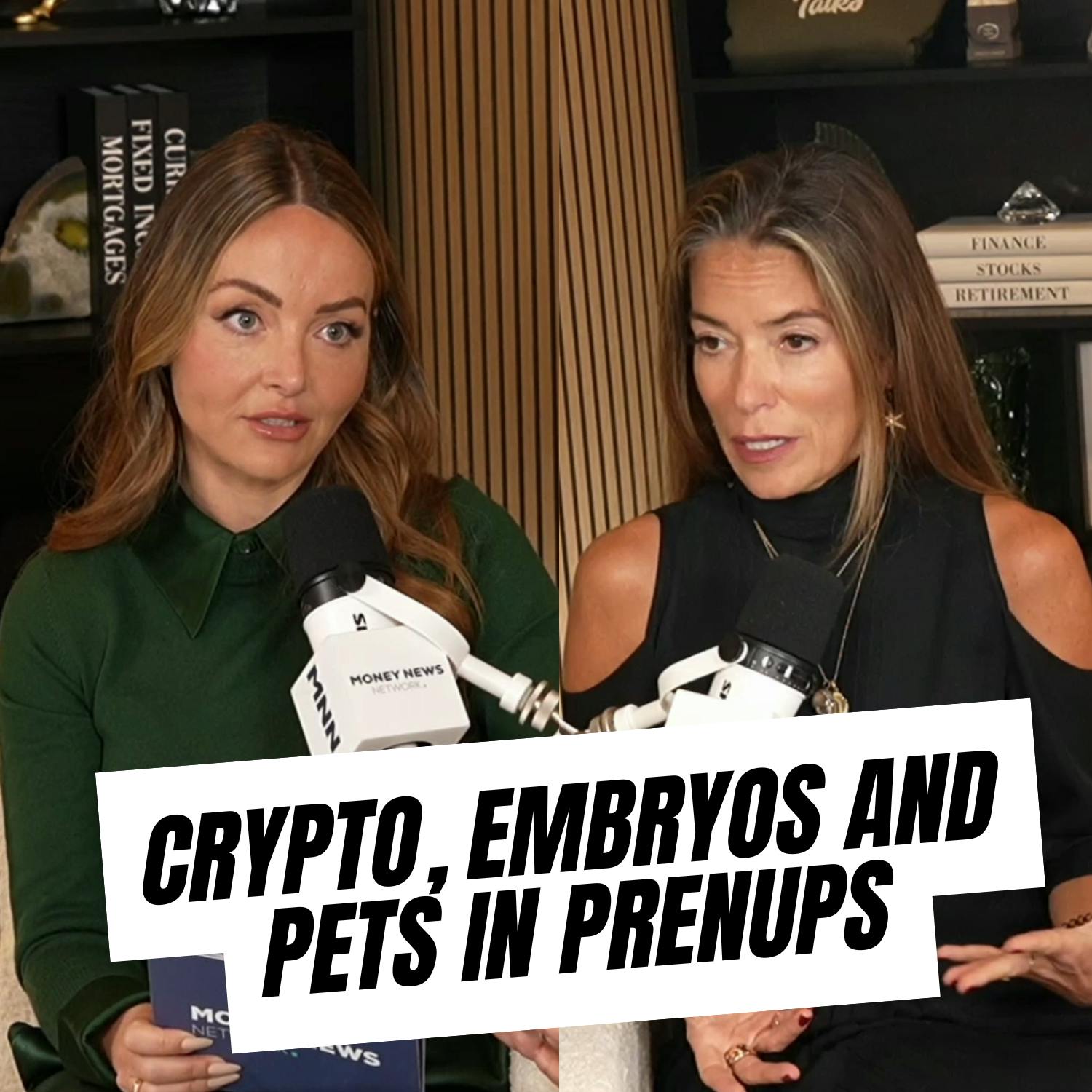
From Crypto to Embryos and Pets: What You Can and Can't Put in a Prenup with Laura Wasser
In their conversation, Nicole and Laura dive into everything from crypto and pet custody to embryos and outrageous prenup clauses—yes, including rumors like the alleged “addiction clause” in Nicole Kidman and Keith Urban’s agreement. Laura also shares some of the wildest prenup requests she’s encountered and offers a refreshingly honest take on why asking for a prenup (or postnup) isn't divorce planning, it's marriage planning.
Press play and read along
Transcript
Speaker 1 I'm Nicole Lapin, the only financial expert you don't need a dictionary to understand. It's time for some money rehab.
Speaker 1
Well, you know how I feel about prenups. Everybody should have one.
Not just celebrities, not just billionaires, everyone.
Speaker 1
And today, the GOAT of all things prenup and divorce is back on the show to make the case. Laura Wasser.
You know Laura as the go-to divorce attorney for the biggest names in Hollywood.
Speaker 1 Kim Kardashian, Johnny Depp, Britney Spears, and many, many more.
Speaker 1 And what I love about Laura and what you'll definitely hear in today's conversation is that she's not just a power player in the legal world, she's an advocate for smarter, clearer, healthier relationships.
Speaker 1 And in these relationships, good money communication is absolutely essential. From crypto, embryos, and the custody of pets, we talk about what you can and can't put in a prenup.
Speaker 1 We also talk about some very Hollywood prenup rumors, like the alleged addiction clause in Nicole Kidman and Keith Urban's agreement, and whether or not that's actually something you can enforce.
Speaker 1 But Laura has seen even weirder prenup requests, which she tells me all about. Most importantly, we talk about the big picture here.
Speaker 1 If you happen to be scared that asking for a prenup or a post-nup will make your partner think you're just planning for divorce, well, Laura has a refreshing, no BS, non-cliche answer for that too.
Speaker 1
Here's one piece of advice that I've given for years. Build an emergency fund.
Aim to stash away enough to cover at least three months of expenses in case your income suddenly drops.
Speaker 1 Sounds simple, right? But let's be honest, it's not. Saving even one month's worth of living costs can feel impossible.
Speaker 1
Just when you're making progress, that check engine light blinks on and derails your plans. Life already throws enough curveballs.
You don't need your bank adding to the chaos.
Speaker 1 That's why it's so important to choose one that makes savings easy and doesn't nibble away at your hard-earned money with ridiculous fees. QIIME understands that every dollar counts.
Speaker 1 That's why when you set up direct deposit through QIIME, you get access to fee-free features like free overdraft coverage, getting paid up to two days early with direct deposit, and more.
Speaker 1 With qualifying direct deposits, you're eligible for free overdraft up to $200 on debit card purchases and cash withdrawals. To date, QIIME has spotted members over $30 billion.
Speaker 1
Work on your financial goals through QIIME today. Open an account in just two minutes at chime.com/slash MNN.
That's chime.com/slash MNN. Chime feels like progress.
Speaker 2
Chime is a financial technology company, not a bank. Banking services and debit card provided by the Bank Corporation Bank NA or Stripe Bank NA.
Members FDIC.
Speaker 2
Spot me eligibility requirements and overdraft limits apply. Timing depends on submission of payment file.
Fees apply at AutoNetwork ATMs, bank ranking, and number of ATMs, according to U.S.
Speaker 2 News and World Report 2023. Chime, checking account required.
Speaker 3 Support for today's episode comes from Square, the easy way for business owners to take payments, book appointments, manage staff, and keep everything running in one place.
Speaker 3 On this show and in my books, I always talk about how important it is to have multiple streams of income. But how do you actually go from hobby to hustle? The answer, Square.
Speaker 3
I have seen it so many times in real life. Just this weekend at the farmer's market, there was a mom selling banana bread.
We love banana bread. And I could not resist.
Speaker 3
In the past, I might have missed out because I never carry cash, but with Square, she was able to take my cart in seconds. I got my delicious treat.
She got paid and neither of us had to stress.
Speaker 3 With Square, you can get all the tools to run your business with none of the contracts or complexity. And why wait? Right now you get up to $200 off Square hardware at square.com slash go slash MNN.
Speaker 3
That's square.com slash G-O slash MNN as in Money News Network. Run your business smarter with Square.
Get started today. I live in LA now, but lately I have been craving the seasons.
Speaker 3 Snow, hot cocoa, the whole thing. I don't even ski, but I have been daydreaming about working remotely from somewhere really cozy on the East Coast, like a cute little ski town for a little bit.
Speaker 3 And whenever I know I'm going to be gone for a while, I always remind myself that my home can actually be working for me while I'm away because I host my space on Airbnb.
Speaker 3 It is one of the easiest ways to earn passive income from something you already have, and that extra income feels particularly helpful this time of year as we approach the holidays.
Speaker 3 A lot of my friends say, that sounds amazing, but where do you find the time to manage guests and bookings? And that's when I tell them about Airbnb's co-host network.
Speaker 3 Through Airbnb, you can find a local co-host who can help you set up your listing, handle reservations, communicate with guests, provide on-site support, even help with design and styling.
Speaker 3 I like to give a personal touch when I'm hosting on Airbnb. So I make a list of my favorite restaurants in the area and I hand write a note welcoming my guests to the property.
Speaker 3 My guests love it, but I also know that some of those little personal touches can take a lot of extra time. So this is the exact kind of thing that you would want your co-host to help you with.
Speaker 3 Whether you're traveling for work or chasing the snow or escaping it, or you've got a second place that just sits there empty more often than you'd like, your home doesn't have to just sit there.
Speaker 3 You can make extra money from it without taking on extra work. Find a co-host at airbnb.com slash host.
Speaker 1
Laura Wasser, welcome back to Money Rehab. Thank you.
I'm so happy that you're here. Since you came on the show last, I got engaged, then I got married, then I had a baby.
Speaker 1 When I told my husband that you were coming, he was like,
Speaker 1 And another friend of the show, Heather Dubro, says that when you guys go to lunch together, you're like, You should not be seen with exactly.
Speaker 4 You have to tell all the waiters and everyone walking in the restaurant. We're just friends.
Speaker 1 So, we've talked about this so much on the show that you need a prenup. Can we talk about what can and can't go into a prenup? I know that you're specializing in California law and New York law.
Speaker 1 Generally, it's probably the same with some intricacies across states.
Speaker 4 Okay, it may not be a no-go for prenups, but what it can be is a no-go for enforcement. So people can agree on anything and people will put things in prenups.
Speaker 4 The problem is that if it's not enforceable, we don't like to write it up because we don't want someone coming back and going, but I have this in my prenup, and now I'm in front of a judge and I can't enforce it.
Speaker 4
So we will only put stuff in that's enforceable, but people can put other things in. You've heard of extramarital clauses.
If you cheat on me, you have to pay me more.
Speaker 4 Or if you lose your sobriety, I have to do this, whatever. That's not something I would add into one of our prenups at our firm because I don't believe it's enforceable.
Speaker 4 I don't think a judge can make you pay for something like that. And so, I mean, I've had stuff, I've had people ask, what if she doesn't lose the baby weight? Which you obviously have.
Speaker 4 Congratulations. But yeah, if she doesn't lose the baby weight within a certain period of time, and I'm like, I'm not putting it in prenup.
Speaker 1 That's insane. Okay, so basically, you can put whatever you want.
Speaker 1 The best lawyers will not write that in because a judge
Speaker 1
will be like, you're ridiculous. Right.
And if that person ever got that baby weight thing in, yeah.
Speaker 4 And I was like, But I've had requests for leaving the toilet seat up or not putting the toothpaste cap back on, all kinds of things, because people think, oh, if I can avoid this problem in my prenuptial agreement, then maybe that won't happen in my marriage.
Speaker 4 And unfortunately, there's only a few things that you can really avoid in a prenuptial agreement. And they're the important ones.
Speaker 4 But it's again, not something that you want to get down to things like losing baby weight or leaving the toilet seat up.
Speaker 1 I have seen, of course, you have too, the Nicole Nicole Kinneman, Keith Urban divorce with an addiction clause in their prenup.
Speaker 1 It's been reported that it's carved out that 600K goes to Keith for every year he remains sober. Again, not confirmed, but generally addiction clauses are those allowed.
Speaker 4 I don't think they'd be enforceable.
Speaker 4 But like I said, if you're going to reward your spouse by remaining sober and knowing that each year he or she maintains his or her sobriety, they're going to get $600,000 and that's in the agreement, have at it.
Speaker 4 The interesting thing would be if she didn't pay him that money, does that make the agreement void and unenforceable? And I don't know the answer.
Speaker 4 And also, that's a Tennessee case, so I don't know what the courts in Tennessee would do.
Speaker 1 You see in the news all the time that there are all these like infidelity clauses in particular. When you see those, what do you think?
Speaker 4 I think, oh, that's interesting. I wonder what's going to happen.
Speaker 4 Again, maybe the person who cheated feels so bad that they're willing to pay an extra half a million dollars because they cheated. And if so, God bless.
Speaker 4 But if you actually go to a a judge, and the other thing is, I don't think people like saying, okay, I signed this agreement in 2005 and now we're in 2025 and I did cheat and I'm not going to pay you the extra money.
Speaker 4
People want to be at least taken at their word. So maybe you don't have to test it out.
But I will say that in the last few years, I have seen a lot of prenuptial agreements being challenged.
Speaker 4 I think that the person that they don't benefit figures, oh, I have nothing to lose.
Speaker 4 So I'll challenge the prenup and I'll say, I was under duress or it was unconscionable or there wasn't enough time before my wedding, et cetera. Generally, those arguments don't hold up.
Speaker 4 Generally, prenuptial agreements will have what's called a prevailing party clause, meaning if you challenge the prenup and you lose, you don't get anything, or you pay the attorney's fees.
Speaker 4 So that could be a problem. It would be a deterrent to challenging the prenup.
Speaker 4 But when we draft them, we try to make sure that, and California has one of the toughest code sections, which kind of mandates what you do.
Speaker 4
It has to be seven days after the final document is agreed upon before you sign it. So you can see if it's too close to the wedding, that could be a problem.
It can't be unconscionable.
Speaker 4 You can't ask somebody to do something that's not going to, for example, if you get married and one person has zero money and the other person has tons of money and you waive spousal support, that might be unconscionable because now the person with zero money isn't following his or her work or career path and they're not making any money.
Speaker 4 So if you split up, what are you left with? Nothing. That's unconscionable.
Speaker 4 If it's, again, the day before the wedding or the invitations already went out and your dress was already being fitted and your family was all flying out here and you have to sign it, you could say you're under duress.
Speaker 4 So all of those things factor in. We try to be very careful with them.
Speaker 4 But when it comes right down to it, you're generally talking about division of assets, things that would otherwise in California be community property or joint property remaining separate and the length of time that somebody would pay and the amount they would pay for spousal support.
Speaker 4 Those are the big ticket items.
Speaker 1 Those are the two. main ones.
Speaker 4 Yeah, there's sometimes the state provisions, like if you marry someone much older and he or she passes away, you may ask if you can continue living in that home until you pass away and that would be something you'd want them to put in their estate plan keep in mind your will is always changeable your prenuptial agreement is not always changeable unless the other person agrees so that's something that people say well at least I want this floor in the prenup because you may change you may promise me everything in your will you could change it the day before and give it to your mistress I want this in my prenup damn all the things we have to think about but can you change it in a postnump you could change it in a post-nup.
Speaker 4
Post-nups are a little tricky because, again, you don't want it to be looked at as though you're divorce planning. So he cheated on me.
I'm really angry at him. And now I want a postnup.
Speaker 4 And a year after the post-nup sign, we get divorced. You don't want to be negotiating your divorce in a prenup or a post-nup.
Speaker 4 It's a lot easier to negotiate a prenuptial agreement because you're in love and you think you're going to be married forever and you just are doing this in the event you're not and you want everyone to have a clear understanding.
Speaker 4 Postnu might be because something in their relationship has changed and you want to make sure everybody has a clear understanding what that change will be but the intention is to remain married what do you say to people who think of it as divorce planning i say it's marriage planning there's a number of conversations that couples should be having before they get married and it is still 32 years into my practice is baffling to me that people don't have to get any kind of i mean you get a marriage license but that's just a formality and in some religions you will speak with a priest or a rabbi for a certain number of sessions before they'll officiate your wedding but really you don't have to do much if you want to marry somebody.
Speaker 4
You don't even have to have a lawyer to divorce somebody. You have to have a lawyer to do a prenuptial agreement.
So think about that.
Speaker 4 The reason why you need a lawyer to sign off on a prenuptial agreement is so that they can ensure that you understand the contract you're signing.
Speaker 4 But if you don't have a prenuptial agreement, you don't even know that you're signing a contract a lot of the time. So people say, oh, we're pre-negotiating our divorce.
Speaker 4 And I say, well, what's the agreement that you have in terms of your marriage? What do you mean? Well, what do you think the law is? If you did get divorced, what what would happen?
Speaker 4 Well, I don't know. I don't want to think about that.
Speaker 4 Well, you kind of need to, because if you're making $5 million a movie and you're getting married in November and you're shooting a movie in January, half of that $5 million is going to be your spouse's if you guys split up.
Speaker 4 Are you cool with that? Well, I don't know. And what about spousal support? Are you going to pay him spousal support after you guys split up?
Speaker 4 After he took half of the $5 million, but you still make more money than him? Are you cool with that? I didn't really think about that. When you get married, that's a contract.
Speaker 4 And it's a more important contract than your wedding planner, your caterer, the person who makes your dress, the florist, the band.
Speaker 4 That's a contract that's going to last, hopefully, for a pretty long time. So you better know what the terms of it are.
Speaker 4 And if you don't like those terms, you better discuss what terms sit better with you.
Speaker 1
Because everybody has a prenup. The state decides.
Exactly. If you don't have a prenup.
Speaker 4 If you don't have a prenup, you still have a prenup.
Speaker 1 In the same way as like you don't have an estate plan, you have an estate plan because it's just
Speaker 1
a probate. Exactly.
I've heard some people are doing like some zip code hunting if they're getting divorced potentially.
Speaker 1 Can you do it by the state that you live in or does it have to be the state that you got married in?
Speaker 4
So interesting question. It's called forum shopping.
I like zip code hunting.
Speaker 1 I've never heard that before.
Speaker 4 But you get divorced in the state where you live. It's the six months prior to filing for divorce or separating that matter.
Speaker 4 And you can imagine post-COVID, there's a ton of people that are living all over the place. They're bi-coastal.
Speaker 4 So it's kind of where you file your tax returns, where you have your license, where you vote. If you have kids, where are your kids in school? That's a really good test for where you live, right?
Speaker 4 And that is the state that will determine where you're getting divorced unless you have a prenup and the prenup has a choice of venue or choice of state. So I say, I live in California.
Speaker 4 We may end up moving, but I want in my prenup that California law will control with regard to this prenuptial agreement and our divorce.
Speaker 4
All things except child custody and child support, because that really is wherever you're living at the time. So I've had people come in.
We have a New York York prenup.
Speaker 4
The New York prenup controls as to all things except for child custody and child support, which the California courts do. It sounds very confusing.
It's not really that confusing.
Speaker 4 And if you do have a choice of law, it makes it much simpler to know where you're going to be and you don't have people arguing about jurisdiction or forum shopping.
Speaker 1 Zip code hunter.
Speaker 1
I did see that for dating apps too. People are like trying to narrow down by zip code.
It's weird out there. Anyway, love you, honey.
Thank you for
Speaker 1 making me go out in the world. Lately, I've seen a lot of like
Speaker 1 embryo custody. There's some weird stuff that could potentially be on the line.
Speaker 4 Yeah, I mean, no, embryo stuff really is, believe it or not, that is an asset.
Speaker 4 And all of the fertility clinics that I've had interactions with have their own contracts as to what will happen with the embryos, fertilize eggs, even just eggs versus sperm that they hold on to frozen.
Speaker 4 What happens to them if the parties get divorced? What happens to them if one party dies? They make you, when you fill those out, check certain boxes.
Speaker 4 So we just want to make sure that our prenuptial agreement matches what they've said because you don't want to have two different contracts.
Speaker 4 And a lot of times people say, I mean, if we get divorced, the embryos are destroyed. It would be weird to be like, well, if we get divorced, I still want those embryos.
Speaker 4 And the one person's like, ew, why? But generally,
Speaker 4 that's the main one. That is enforceable.
Speaker 1
So basically, when you go through it at the fertility clinic, you have to sign, okay, if one person dies, it goes here. And you just want to mirror that in a prenup.
What about pets?
Speaker 4 So, up until a couple of years ago, pets were just an asset, chattel, like a vase or a coffee table or whatever.
Speaker 4 We are now seeing in Southern California, I have seen judicial officers, and I think there's a code section that talks about if I bought the pet with my money, then it's my separate property pet.
Speaker 4
But if we bought the pet with community property dollars, then it's our pet. We need to decide.
I have now seen judges saying, Who takes care of the pet and who will the pet go to if you call the pet?
Speaker 4 And I'm like, Are we really really doing this right now but i guess that has come up i had a case a while ago now where and this is before the kind of new law came in where these people were very very wealthy and they had two gorgeous white i don't know what they're called persian cats like these really fancy cats and they would kind of share custody of them.
Speaker 4 And the cats, they had a professional person that would come every other week, put the cats in their cat cages and bring them to the husband's house and then bring them to the wife.
Speaker 4 They never had any contact with each other. And at one point, things got so acrimonious with this couple, they brought the cats to my client's house and my client called me freaking out.
Speaker 4
The cats are really sick. They're throwing up.
They have diarrhea. Everyone, she had like a gorgeous white, everything was white.
Speaker 4 These cats, she was really worried about them dying, but she also was like disgusted by the huge mess they were making.
Speaker 4 Come to find out that husband had given them each some kind of a human diuretic, which made them super sick and having them, you know, have diarrhea everywhere.
Speaker 4 He didn't realize that he could have possibly killed them. They were super, super ill, but he just wanted them to be sick all over her apartment.
Speaker 4 So, in the end, the vet was like, they were given this, was found in their bloodstream, and she was able to, like, and even then, it wasn't like, okay, ultimately, they're hers.
Speaker 4 They still shared custody of them because they didn't have that law about who's a better parent to cats. That's what happens in divorce.
Speaker 4 I'm so glad I went to Los Poll so that I could figure that stuff out.
Speaker 1 I was going to say, did you have a feline course?
Speaker 4 I don't even like cats. I was like, that's really a bummer.
Speaker 1 I gotta go.
Speaker 1 Also, a dog a person,
Speaker 1 but the calls you must get. Wow.
Speaker 1 Also, lately, we've been seeing who gets the followers.
Speaker 4 That's a very interesting question. It's not who gets the followers.
Speaker 4 What happens is, if you're that personality, you probably have some kind of a loan-out corporation, and that's owned by your loan-out corporation.
Speaker 4 So, it's not necessarily the followers, it's the entirety of the endeavor of your Instagram or your YouTube or whatever it is. Yes, those people are money to you.
Speaker 4 So you get those followers because that's part of your C Corp, S Corp, loan out, whatever it is. But you may have to share the income that those followers generate with your ex.
Speaker 1 I see. So if you're a creator, your likeness, if it's part of a separate entity,
Speaker 1
is merit of property. Correct.
Okay.
Speaker 1 So TikTok followers,
Speaker 1 you know, might not be something that everybody's thinking about, but what about just generally talking crap about the other person?
Speaker 4 Those are like non-disparagement clauses, and we do have a lot of those.
Speaker 4 We put those in almost all of our agreements, even if you're not famous these days, because all of a sudden you could become a famous influencer.
Speaker 4 And generally, it's particularly if you have kids, it's not great. So even in our most regular, both prenups and divorce judgments, we will have non-disparagement clauses.
Speaker 4 Neither party shall say anything disparaging about the other, publicly or privately within earshot of the children, but certainly not posting things.
Speaker 4 First of all, it's not in the best interest of your kids if you have them. But second of all, one of the things that you're kind of agreeing to when you do a prenup or a divorce is
Speaker 4 to do what is in the best interest of your family, even if the family is no longer living under the same roof.
Speaker 4 So talking smack about your ex is not in that best interest, even though it could be interesting. What do you guys call it?
Speaker 1 Clickbait.
Speaker 1 Yeah, but the clickbait has happened for people that aren't famous either. Like somebody's posting some text messages from her ex, and then it goes viral because
Speaker 4
it's funny and because people have shot him for it. And they, so we generally try to prevent that.
The problem, again, enforcement. Like, what are they going to do? I mean, they'll take it down.
Speaker 4
We've seen TikTok and Instagram be reluctant to limit free speech. So there's the problem of, okay, I've got this agreement.
It says you're not supposed to do that. Now what are my damages?
Speaker 1 And what about a sunset clause? The idea that this could be null and void.
Speaker 4
I see those. We don't do those either.
And here's the reason. We don't want to do anything that's going to be promotive of divorce.
That's another no-no in prenups.
Speaker 4 Duress, unconscionability, promotive of divorce. So sensitive clause is, if we stay married for 10 years, this agreement will go away.
Speaker 4 Well, doesn't that promote that in the ninth and a half year, the person who stands to lose by having no more prenup gets divorced? So we don't like to do those.
Speaker 4 Obviously, at any point, one person could say to the other, it's our 10-year anniversary, and I love you so much, and I've done so much for you, and you do continue to leave the toilet seat up, and I'd really like you to rip up our prenup.
Speaker 4 He or she can do that.
Speaker 4 You can always modify a prenuptial agreement, have an amendment to a prenuptial agreement, but putting in the agreement what's going to happen if when, that's not the greatest idea, I think, because I do think it could be promotive of divorce.
Speaker 1 Wait, I thought you said that you couldn't edit the prenup. Oh, you can't edit the prenup, but you can add later, like writers.
Speaker 4 Correct, if you guys agree.
Speaker 4 So you guys can agree to tear up the prenup or you can agree to amend the prenup, but only with regard to the amount of support.
Speaker 4 When we got married, we were living in a one-bedroom apartment and we thought we were both going to be working.
Speaker 4 Then I had a couple kids and you became a total, you know, I don't know, VC guy or crypto bro or whatever. And we have so much money now.
Speaker 4 I can't possibly survive or live my lifestyle if we got divorced on the $5,000 per month that we mutually agreed would be the cap on spousal support. Can we please modify that? Absolutely.
Speaker 4 You go to two lawyers, you write it up. Now, if we got divorced, the cap on my spousal support would be $500,000 or something like that.
Speaker 4 Totally modifiable and much more enforceable than simply writing in there what would happen if.
Speaker 1 Or what if you have more kids and alimony changes?
Speaker 4 Keep in mind, if you have more kids, you're going to be getting more child support. So yes, alimony could definitely go up if your marital lifestyle went up, and a lot of times it does.
Speaker 4 But if you have more kids, you're going to be getting a certain amount of child support for each of those kids completely regardless of your prenuptial agreement.
Speaker 1 Let's double-click on alimony for a second. Let's say that you're a stay-at-home mom and your husband is the crypto VC guy, whatever, making a lot of money.
Speaker 1 I know it can be an awkward conversation to talk about your worth as a stay-at-home mom. What do you recommend around? a conversation like that?
Speaker 4 I recommend it not being awkward because there's not going to be anyone more important than you taking care of your, meaning your and his kids.
Speaker 4
And I think even bigger picture, these conversations about prenups, yeah, they are awkward. But I've said this in other interviews about prenups.
I hope it's not too gross.
Speaker 4 If you're having babies with this person and they're in the delivery room, you know what happens in there. That's really not fun to talk about, okay?
Speaker 4 So if you're going to be able to be part of that whole situation, you should be able to say, listen, I'm not pursuing what I was going to pursue in terms of my career because I'm going to be home taking care of our kids.
Speaker 4
I need to know that we're a partnership here. You're out in the world making crypto deals and I'm here making lunches and that's important too.
And I want to have a conversation about that.
Speaker 4 And by the way, some other awkward things too, like what kind of student loans do you have? And will we be paying my student loans? And I don't ever want to sleep on a futon again.
Speaker 4 So when we go on vacations and we visit your fraternity brothers, we're staying in a hotel. We're not staying in your friend's two-bedroom apartment with a pull-out futon.
Speaker 4
And my parents are a little bit older and I don't necessarily want them to ever be living in assisted living or a home. We have a backhouse.
Can they come?
Speaker 1 Can we move all of your, can we move all of your studio out?
Speaker 4 And can they live in our back house? I want, these aren't things you'd put in a prenup.
Speaker 1 These are onwards.
Speaker 4 Conversations you should have with the person that you're hoping to be married to.
Speaker 1
Or will potentially see you poop on a table. Yes.
You said it, not me. It was actually something I thought about when dating.
Speaker 1 I was like, can I imagine this person watching all of the bodily functions, which does happen allegedly during that? Yeah, that's the most intimate. You're absolutely right.
Speaker 1 This stuff should be easy compared to that.
Speaker 4
Yeah, but people, we are, particularly women, less so now than maybe 20 years ago, but we are very uncomfortable talking about money. It's even worse when you are the breadwinner.
It's really hard.
Speaker 4
The women that I represent in prenups, they are the ones getting more protection. Marrying someone that makes less than they do.
Oh, I don't want to talk to him about it. It's so uncomfortable.
Speaker 4
I feel so bad. You have to talk about it.
And believe me, if the genders were reversed, he'd be talking about it with you.
Speaker 4 You work much too hard and you are too sharp not to have this conversation with your about-to-be spouse.
Speaker 4 And by the way, his or her reaction will be extremely telling as to how long this marriage is going to last and how it's going to be.
Speaker 4 And if you are putting it under the rug now, you're not going to be able to do that in the delivery room. So that's
Speaker 1
for sure. Well, look at us.
We're opening up the conversation. That's what it's all about.
Speaker 1 If you were to tell somebody who's trying to have a conversation about alimony or their worth, is there like a formula or is there a script that you would suggest to them?
Speaker 4 I would talk about what the law in your state is. For example, in California, we have very high alimony laws and what it's based on is your marital lifestyle.
Speaker 4 So when you first get married, you might not be having a very huge marital lifestyle. But the hope is, and you want to talk about what your hopes and dreams are.
Speaker 4 If your hope is to just work in humanitarianism and environmental stuff and not make a ton of money, okay, fine.
Speaker 4 But if your hope is to really become uber successful, then you have that conversation and say, when we do become uber successful, I want to make sure that I'm a part of this, not that everything you're earning in this company that you started and that you're working on, that you're laying awake at night in bed and talking it through with me, whatever.
Speaker 4 I want to be a part of that. I'm your spouse.
Speaker 4 And I think that you need to discuss that and say, not only do I want that to be half mine if we ever split up, because I'm in it with you too, but if you're continuing to earn money from it and I'm not, I want to make sure I'm getting spousal support.
Speaker 4 And I don't think that's an unreasonable request.
Speaker 1 No, it's not. What are some crazy clauses that I haven't covered yet?
Speaker 4 You mean beyond losing the baby weight and putting the toilet seat down? Those are next level.
Speaker 4 What I do see and what I've seen a lot lately are second generation people, this is why I know I'm getting old, people whose prenuptial agreements I did or divorces I did, their kids are now coming to me in their 20s and 30s and they're getting married and the kids don't have a lot of money yet, but their parents are going to be leaving them money.
Speaker 4 There are trusts that have been set up where the kids are living off not only what their salary is as like a young MFT or a startup, but they're also getting money every month from one of their parents.
Speaker 4 And the parents say, I want to make sure that my money isn't going to support her ex if they split up. So those are clauses.
Speaker 4 And that's not a really funny one, but it's an interesting one because if that's what they're living off of and that's the marital lifestyle, I can imagine a court saying, I don't know what to tell you.
Speaker 4 That's what you guys were living off.
Speaker 4 By the same token, though, let's say they didn't get actual money every month or year from a trust, but they would always go to the family's compound in Hawaii and they flew on the family jet to go where they went.
Speaker 4 You don't get those things anymore, you're not in the family.
Speaker 4 So sometimes a court will ask you to replicate that kind of, okay, you can't go to the family compound, but she's going to be able to go somewhere else in Hawaii, a nice place.
Speaker 4 And you can't go on their private jet, but maybe you do fly first class.
Speaker 1 Something else you probably didn't go through with the parents' parents prenup slash divorce was all of the chat GBTs of the world and the mood trackers and all these things that could potentially be used.
Speaker 1 We haven't seen the extent of it yet in court. So have you seen like the wearables that track sleep, mood, even location, digital wellness products be used in custody disputes?
Speaker 4
Only to the extent not so much sleep trackers, fitness trackers, but definitely trackers. Like he wasn't here.
As you know, infidelity, California is a no-fault state.
Speaker 4 So it doesn't matter, forgetting a prenup, it doesn't matter if you cheat. That's not going to be looked on poorly.
Speaker 4 But if you're able to show that your spouse was out several nights a week until very late, he or she did drugs. If there's a DUI, now we can actually see where those people are.
Speaker 4
Once you separate, tracking is not okay. You can't put a tracker on somebody.
You could actually get a restraining order if somebody has a tracker on you and they're trying to track you.
Speaker 4 So you're not supposed to do that after a certain point.
Speaker 4
But yes, what we do at the beginning of most cases is we send something out saying, hey, we got to lock down on all of your technological advices. Don't erase anything.
Don't erase any of your chats.
Speaker 4 Don't erase any of your, that's why people are using Signal now because it disappears as opposed to just texting.
Speaker 4 So we do ask all of those things kind of stay so that we can look at them for evidence.
Speaker 4 But again, evidence of what, I really think sometimes people get a little bit too deep into what we're trying to figure out because it's probably not relevant.
Speaker 1 Is asking somebody to use Signal a red flag? If you're dating them? Yeah.
Speaker 4
I don't know. I've never had anyone ask me to use Signal that I was dating.
I've definitely had clients say, Can we use Signal? And I'm like, Yes, we can. I don't know if it's a red flag or not.
Speaker 4 I can imagine people really not wanting stuff hanging around there.
Speaker 4 I'm probably not as careful as I should be with that, but I feel like most of my important communications, at least with clients, are not taking place via text anyway. They're probably via email.
Speaker 4 But yeah, we've seen, I said in a seminar last week, because I'm the managing partner of our firm, about what to do if your firm gets hacked and all all of that information and who to call and whatever.
Speaker 4 I mean, it's a nightmare. It's terrible.
Speaker 1 Yeah, but I had a girlfriend going through a breakup and her ex asked her to use Signal for a lot of communication.
Speaker 1 So she felt like it was sort of being planted, that all of this would go away anyway, and that it was almost like technological abuse
Speaker 1 situation. Can you subpoena some stuff from Signal? Is it
Speaker 4
Signal's gone? I think once it's gone, it's gone. And again, I don't know.
I know you can subpoena phone records, and that would also get texts. Plus, you can ask for them from the person.
Speaker 4 And if you're not somebody that erases every text every time you do it, then you should have those things. People use text messages all the time as evidence of things.
Speaker 4 What we then do is go in, see the text, and see, I forgot what the word for it is.
Speaker 1 Some forensics.
Speaker 4 Well, yeah, and you can see if it's been altered. It's really hard to make an agreement via text.
Speaker 1 It feels like a red flag to me. Somebody is doing disappearing messages.
Speaker 4 Yeah.
Speaker 4 Do you think that's maybe just because we're older? Do you think younger people? Yeah, I'm much older than you. I don't know.
Speaker 1 But the ChatGBT of it all is really interesting to me. So like people have full-on relationships with ChatGBT.
Speaker 1 I don't know what we've seen recently or what we will see when it comes to court proceedings around custody or divorce. Can you get the ChatGBT
Speaker 1 records of what you've said and all the threats and use it against somebody?
Speaker 4
Yeah, but most people use ChatGPT so that they sound more knowledgeable. I have a client that doesn't speak great English, and she's like, This is so amazing.
I did everything via ChatGPT.
Speaker 4 And I said, It actually sounds really good.
Speaker 4 Like when she's communicating with her ex, she's doing it in a way that sounds because she knows that this might be evidence of them having like peaceful communications.
Speaker 4
And she wants to sound like more American using English. So she uses it.
It's still her using her words. It's just a little bit more polished.
Speaker 4 But yes, you can, if you're sending something that you got from ChatGPT, I'm assuming that now it's out there having been sent as an email or text.
Speaker 4 And so, yeah, it's, I guess what would definitely be difficult is when you have that person on the stand and they don't sound anything like whatever their eloquence was via ChatGPT text.
Speaker 1 But I'm assuming, too, if you ask ChatGPT, like, how does one poison your husband? Oh, I see what you're saying.
Speaker 4 I don't know if you could get that information.
Speaker 1 Or, like, if I'm saying, how do I deal with my depression or my drug abuse or something like that?
Speaker 4
If you're just making inquiries, I don't know how you would actually link that. That doesn't necessarily mean I'm depressed.
I might be asking for my friend who's depressed, asking for a friend.
Speaker 4 Unless you've actually been prescribed something, which as far as I know, ChatGBT still can't do or diagnosed with something, also can't do, then it's just inquiries.
Speaker 4 And I don't know that a judicial officer would find that to be dispositive of actually mental illness. And pretty much everyone going through a divorce is depressed.
Speaker 1 Would you advise your clients to be cautious of Chat GPT?
Speaker 4 What they would say to ChatGPT? No.
Speaker 1
LeChat. Doctor.
Some of my friends call it Mr. Chat or Dr.
Speaker 4
Chat. No, I'm not worried about that.
I hope this doesn't come back and bite me, but this does it just like Google searches don't.
Speaker 4 Before we had Chat GPT, we would search Google and I haven't seen anyone come in and say, this is evidence of her, again, wanting to kill your husband.
Speaker 4 You also probably want to do that when you're getting divorced, but that doesn't necessarily mean you did.
Speaker 1 Fair.
Speaker 1 I had a celebrity on the show who talked about her ex-husband's crypto that she couldn't find during her divorce. Do you give any suggestions? You've joked about crypto, bros.
Speaker 1 I joke about them all the time. She said that the court didn't order him to show the crypto records.
Speaker 4
I find that very strange. Of course a court.
And that's an asset. Crypto is an asset.
I get a court making an order that he then
Speaker 4 wouldn't be able to follow because they get lost. I've heard of people actually losing their seed words or whatever, the passwords, and they can't get it.
Speaker 4 I still have to admit, I'm not, I don't understand how it works.
Speaker 1 I don't know if you're a true
Speaker 4
But really, yes, a court can 100% order somebody to disclose their assets. So I don't know.
There must have been another piece of that puzzle that we're not, that story that we're not getting.
Speaker 1 So is there anything that you would suggest to put in a prenup around crypto specifically?
Speaker 4
Any assets that you have have to be listed. There must be full disclosure.
So you'd have to put all assets that you have at the time you get married as an exhibit into that.
Speaker 4 And then maybe you would say something like any assets which are acquired as community property must be disclosed as they are acquired and whatever the seed codes are or whatever, given to the other person.
Speaker 4 So they can't just, oh my God, I'm so sorry. I don't know where they are.
Speaker 1 I heard that. I've heard of some sketchy folks trying to pretend or do like fake police reports that they lost it while they were going through divorce proceedings.
Speaker 4 Yeah, I don't, I have to admit that. Yeah, that's why we have forensic accountants.
Speaker 4 They will find, they'll say, okay, we can't find the crypto, but here's the date that you paid this much community money to purchase something. If it's gone, we're charging you with that money.
Speaker 1 How much is a forensic accountant?
Speaker 4 It depends. It doesn't cost a ton to retain them, but depends what they do.
Speaker 4 They gather the information, they inventory the information, and then they actually analyze the information to find out, one, what is your marital lifestyle, two, what happened to assets.
Speaker 4
These days, it's very hard to hide money. Like I said, even if the crypto is gone, the money you use to purchase the crypto is still there.
There's a record of it.
Speaker 1 People are going to be able to get it. You think they can hide?
Speaker 4 If you don't find that crypto, you're getting charged with the money you spent on it. And by the way, if it's worth more now, you're probably getting charged with that as well.
Speaker 4
You can't just take money. I've seen cases where people over time have removed cash a little bit at a time for a long time.
That might be the one thing you can do, but it would be so little.
Speaker 4
Moving a chunk of money like somewhere else and it's disappeared. Judges don't care where it is.
They're going to say, on October 15th, you took $2 million.
Speaker 4
Where is it? I don't know, Your Honor. Okay, I'm going to charge you with it and you owe the community $1 million.
You can keep your half of it. That's the one.
I don't know what you did.
Speaker 4 People that sold drugs for cash, hairdressers that generally got paid in cash, and tour managers that got paid in cash.
Speaker 4 Those are the three cash jobs in my world that judges would say, all right, so how much do you think you made on that tour? Or how many people sat in your chair that day? They will find it.
Speaker 4 Now with Venmo and everything else, people don't operate in cash as much as they used to. So it's a lot easier than it used to be, believe it or not.
Speaker 1 So not illegally hiding money, but let's say, because you're a woman's woman through and through, like a woman is thinking about getting divorced and it could be like an abusive, scary situation and she wants to protect herself and go Katie Holmes style, burn her phones, like Swift, get out of this thing.
Speaker 1 Would you suggest to keep money or have a secret account in preparation? Sure.
Speaker 4 It's not like you're going to not have to be accountable for that money, but I do know a lot of people, not just women, but usually women, that don't have access to the funds so i did know a woman whose husband was a partner in a law firm and every day when he was in the shower she would run out to the atm and she would take out the max amount 300 every morning wow and again she just wanted to have like a nest egg for herself when it came time to disclose the finances She said, oh, I have this account and it's got whatever it was at the time, $25,000 in it.
Speaker 4 But that was her money that she could use to pay her attorney or whatever she needed it for at the time.
Speaker 4 I also would say to women, and you and I have talked about this before, if you're getting married, you need to be in those meetings with the financial planners, the business managers, the tax preparers on a quarterly or annual basis.
Speaker 4 I cannot tell you, even very, very high-profile, powerful,
Speaker 4 wealthy people come in, and it is usually women because we like to abdicate financial responsibility. And they say, I have this one black card, but it's in his name.
Speaker 4
It's mine, but I use it, but it's in his name. So he could cancel it anytime.
I don't know what we earn. I don't know what we spend.
I don't know what we have. I know we go every year to St.
Speaker 4
Bart's and we go to Stad to go skiing. So our lifestyle is good.
Our kids are in private schools. I don't know what there is at all, and I'm so embarrassed.
And I say, well, here's the good news.
Speaker 4 You're never going to be in this situation again, ever, because you're going to learn everything as a result of getting divorced.
Speaker 4
And sometimes it takes getting divorced to actually get that information from a spouse who's like, you don't need to worry about this. I got this.
I'm making the money.
Speaker 4
You said you're making the lunches. Everything's good.
Don't worry about it. Well, until you need to worry about it.
Speaker 4 So you need to be in there and be a partner, not abdicate the financial responsibility, not come home with the bags from Nieman's and wait till he's like asleep to put them in your closet.
Speaker 4 Be a little bit more transparent. And by the way, those kind of partnerships are the ones that last longer.
Speaker 1
For sure. I will say, and I'm sure you won't be surprised that women who are going through a divorce are more likely to get their financial life together.
It's much harder to do it proactively.
Speaker 1 It's much easier to do it reactively, just like when you get a diagnosis or you have to do it or you'll never make those mistakes.
Speaker 4 There's another argument for having a prenuptial agreement because now you're doing it reactively, but not reactively to a divorce, reactively to a new partnership that you're entering into with somebody that you will hopefully stay with for a very long time.
Speaker 4 But if you don't, at least right from the get-go, here's the exhibit of everything he has and everything he owes. Here's the exhibit of everything I have and everything I owe.
Speaker 4
Here's the exhibit of our tax returns for the past few years. Here is our understanding of what we're going to do with our money as it's made, et cetera, et cetera.
That is such a good idea.
Speaker 4 And that will get you on the track to, hey, I just wanted you to know now I have all this information. I'd like to be part of those meetings with our business manager.
Speaker 4 And if he says no, what does that say about what's going to happen in your marriage?
Speaker 1 So if somebody is thinking potentially about divorce, is there like a little checklist that you would suggest?
Speaker 4 First of all, find out what the law in your state is.
Speaker 4 If you're thinking about getting divorced, go online the company that i work with divorce.com is a very good educational company and we'll tell you about that stuff
Speaker 4 start thinking about what the law is in your state and then start thinking about your finances and there's basically notwithstanding children custody four corners to a divorce there is what you have your assets what you owe your debts what you earn your income and what you spend, your expenses.
Speaker 4
And I would start figuring that out. What you earn might be difficult, but chances are you're signing a tax return every year.
He's probably asking you to sign time.
Speaker 4
Take a look at that and start paying attention to that. You're going to figure out what your expenses are, at least what yours are.
You're going to see your credit card bill.
Speaker 4 You know what you're paying your housekeeper, you're a nanny, you know what private school costs.
Speaker 4
And then probably the big three, which is your mortgage, your taxes, and your homeowner's insurance, ask. Maybe say, I want to be able to help.
I want some more information.
Speaker 4
Or maybe not if you're planning a divorce, I don't know. And then be thinking about, okay, I know we have this house.
I don't know how much equity we have in it. I don't know what.
Ask questions.
Speaker 4 And if asking questions is going to set somebody off, I mean, you might as well.
Speaker 4 I always think it's better to have a couple of counseling sessions, even if it's not for the purpose of reconciling, but for the purpose of, let's do this a really good way.
Speaker 4 If we're going to split up, let's do it in a way that you educate me as to what our financial situation is. So I'm not learning at the same time as people that are charging us a bunch of money.
Speaker 4
And maybe we can get this done. I don't want it to be ugly.
I just am living in fear right now because I don't know what there is.
Speaker 1 What do you think about the divorce? What are they called? Moderators, mediators? Mediators.
Speaker 1 I'm sure you've heard everything.
Speaker 1
Like everybody goes to you for therapy, but you're on the clock when. Yes.
When you get called.
Speaker 4 There's all kinds of things now. So many more than there were, like when I started practicing.
Speaker 4 There's divorce coaches, there's financial coaches, there's mediators, there's parenting plan coordinators, there's apps that help you do it online and help you figure out your calendar.
Speaker 4
There's all kinds of ways to help. There's collaborative divorce where you each have two attorneys and two financial planners and everybody collaborates.
There's all different ways of doing it.
Speaker 4
I would say educate yourself. Find out what's out there.
Think what would be the best plan for the two of you and your kids if you have them going through this and then pick that.
Speaker 4 Again, if you can do it online with a company like divorce.com, fantastic.
Speaker 4 If you've entered into the marriage with a prenep, and again, we've talked, I think, a little bit about Hello Prenep, which is an online pre-nep company, which is amazing.
Speaker 4 All things that are so much more accessible than they were 10, 15, 20 years ago that will make it easier to get divorced.
Speaker 4 And when I say easy, I don't mean it's not going to be heartbreaking and difficult and a big change, but it's not going to break the bank.
Speaker 4
And it will enable you and your ex to be friends and co-parents and move on in a way. that you're a family, even if you're not still all living together.
And that's huge for you, for your kids.
Speaker 4
I mean, both of my exes, I wasn't married to them, but they're two of my closest friends. We all have each other's backs.
We do holidays together. It's really a nice way to be.
Speaker 4 And yes, I'm sure you can think to yourself, well, that's because you're you, but I have seen it and it does work.
Speaker 4 And people do have those kind of relationships because they're not subpoenaing crypto records or whatever, because they're saying, this is everything there is.
Speaker 4 Now let's figure out how to divide it up and make it work.
Speaker 1 You'll never get married.
Speaker 4
I don't really see. I got married.
I got married in 1993. I was 25 years old.
It was a beautiful wedding that my parents paid for at the Beller Hotel. And I don't ever have to do that again.
Speaker 4
It was, we have great pictures. I had all my girlfriends as my bridesmaids.
But yeah, for me, I don't, I mean, I didn't want to get married before having kids. That wasn't important to me.
Speaker 4 So I don't know.
Speaker 1 Like all you've seen, I'm assuming, has colored the way you look at it.
Speaker 4
You've seen everything I've seen. It's not any different.
Anybody that picks up People Magazine has seen it. So it's not, that's not the reason.
I just can't think of a good reason to get married.
Speaker 4
I'm in a really great monogamous relationship right now. We've both been married before.
We both have kids. I mean, we really enjoy each other.
Speaker 4 I'm not feeling like a marriage is something that needs to be part of that situation, and neither does he.
Speaker 1 And if somebody is in the same situation as you, are there legal protections that they should still go into or look into?
Speaker 4 I think it depends. I think if you're living with someone and you're not married, one or both of you might want to have what's called a cohabitation agreement.
Speaker 4 That wouldn't be something that I would need to do or want to do. But I think anytime.
Speaker 1 Nobody's messing with you.
Speaker 1 Exactly. Sure.
Speaker 4 But I feel like, you know, if there's a, if there's an inequality in the finances, then I think that one or both people, it's something you should talk about.
Speaker 4 So if somebody's moving in with you to your home and you're paying all the expenses, you may want to say, I just want to be clear.
Speaker 4
We're not married and the money that I'm earning right now is my money. And as long as you're here, I'm happy to pay for you.
But if we split up, I'm not paying you support or alimony.
Speaker 4
Are we all good with that? And he or she goes, oh, yeah, I'm totally good with that. And you're like, okay, because we don't have any kind of an implied contract.
Okay.
Speaker 4 And unless you're worried that that person,
Speaker 4
I know. And then if we break up, the party's over, dude.
Like, I'm not paying you anymore. And I think if later they say, I thought when I moved in here, that meant that this would be forever.
Speaker 4
That's an issue. And that's why I think it needs to be discussed.
I do.
Speaker 4 I think that having communication is the most important part of any relationship, even if it's not always the the fun communication.
Speaker 1 What would you say to Taylor and Travis? They're going through prenup discussions right now, I assume.
Speaker 4 I don't know them, so I'm not sure what I would say to them, but I would say to them that I hope that they are having the kind of discussions that you should have before
Speaker 4 you have a prenup. And again, some of those other ones too, like the elderly parents, of what religion are we going to raise our kids?
Speaker 4 I don't know what religions Taylor and Travis are, but things that you don't necessarily think about when you're just dating and that you might be thinking about when you're getting married, I think are important to have.
Speaker 4 And I would do it maybe with a third party there.
Speaker 4 Do some pre-marital counseling, not because, oh God, it's difficult and things aren't working out, but let's develop the tools that we need so that when it's not all flowers and rainbows and unicorns and about to walk down the aisle, things are going to get hard in any relationship.
Speaker 4 It would be weird if they weren't. When they do, we're equipped to deal with them because we know we have these tools and we have this ability to communicate with each other.
Speaker 1 We end all of our episodes for a tip that listeners can take straight to the bank.
Speaker 1 Is there something that I missed that you would give as advice to any listeners who are thinking about making a prenup?
Speaker 4
Don't be afraid or ashamed to bring up financial things. It really is important.
It will make you feel better. It will make your partner feel better to have these kind of conversations.
Speaker 4 And if you're grown-ups and you're taking a step like getting married, you can't afford not to have grown-up, unsexy conversations.
Speaker 4 And then after you're done with the conversation, it's kind of like working out.
Speaker 4 It doesn't feel good when you're like first putting on your running shoes and getting out there, particularly if it's cold. But once you have the conversation, it feels so good.
Speaker 4 And then go get like a nice bottle of red wine and some delicious pizza and go have sex because then you will feel good.
Speaker 1
Money Rehab is a production of Money News Network. I'm your host, Nicole Lapin.
Money Rehab's executive producer is Morgan Lavoie. Our researcher is Emily Holmes.
Do you need some money rehab?
Speaker 1 And let's be honest, we all do.
Speaker 1 So email us your money questions, moneyrehab at moneynewsnetwork.com to potentially have your questions answered on the show or even have a one-on-one intervention with me.
Speaker 1
And follow us on Instagram at MoneyNews and TikTok at Money News Network for exclusive video content. And lastly, thank you.
No, seriously, thank you.
Speaker 1 Thank you for listening and for investing in yourself, which is the most important investment you can make.