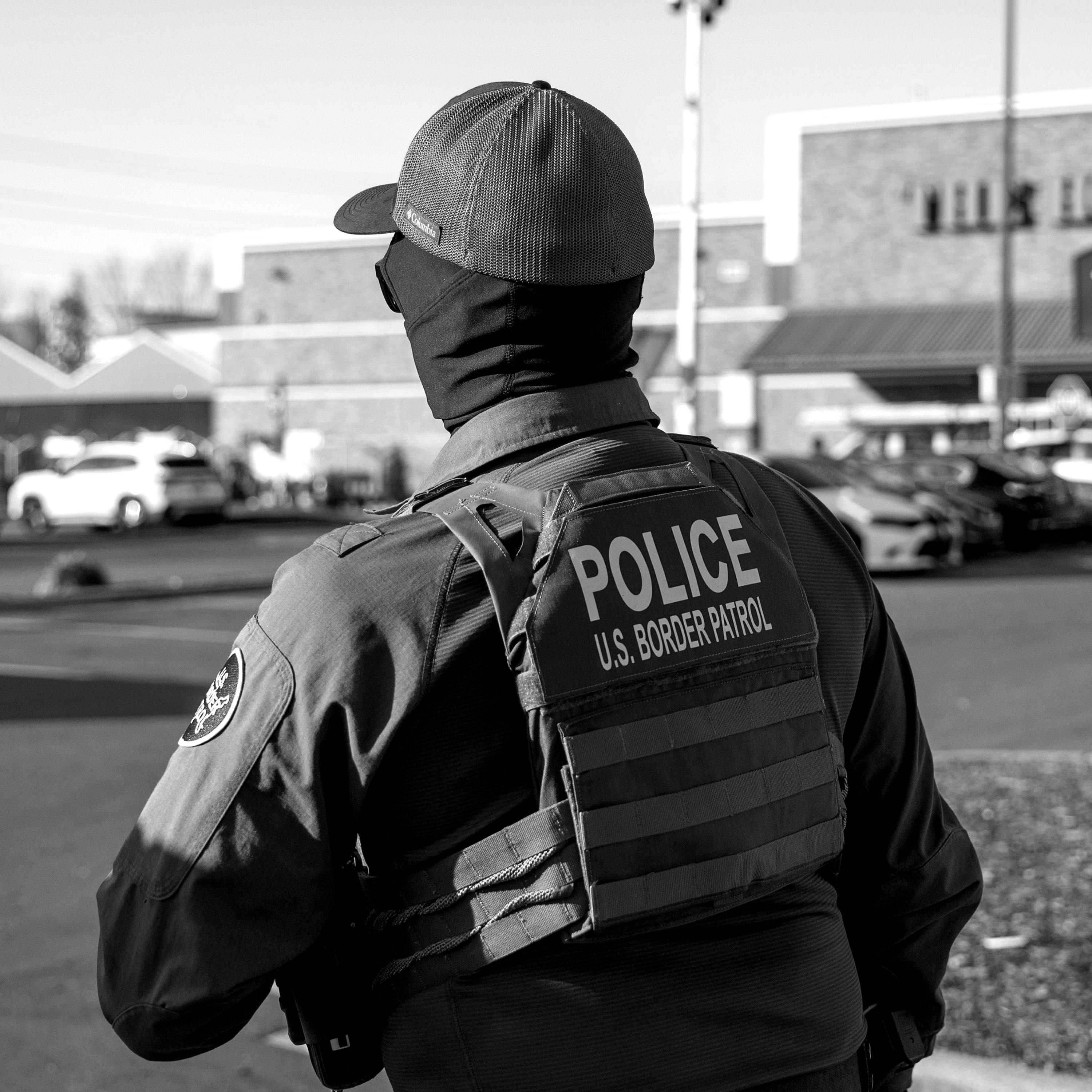
The View from the Border
Video producer Jeremy Raff has been in McAllen, Texas, attending "mass trials" of immigrants—many of whom have been separated from their children with no certainty on when, or if, they will be reunited. Raff shares what's happening along the border, then staff writer Priscilla Alvarez joins to discuss what the news in Washington means for separated families.
Links
- "Purgatory at the Border" (Jeremy Raff, June 19, 2018)
- "'So What? Maybe It Is a Concentration Camp'" (Jeremy Raff, February 23, 2018)
- "Extinguishing the Beacon of America" (Alex Wagner, June 15, 2018)
- "Trump Says He Will End the Family Separations He Imposed" (David A. Graham, June 20, 2018)
Learn more about your ad choices. Visit megaphone.fm/adchoices
Press play and read along
Transcript
Speaker 1
Bundle and safe with Expedia. You were made to follow your favorite band, and from the front row, we were made to quietly save you more.
Expedia, made to travel.
Speaker 1 Savings vary and subject to availability, flight-inclusive packages are at all protected.
Speaker 1 The forcible separation of thousands of children from their families has focused America's attention on the Trump administration's zero-tolerance approach to border control.
Speaker 1 Many families are still camping at America's borders to claim asylum, and many others are jammed up in an overloaded detention apparatus. What will be the consequences of this chaos?
Speaker 1 Have we broken some families forever? This is Radio Atlantic.
Speaker 1
Hi, I'm Matt Thompson, Executive Editor of The Atlantic. With me is my esteemed co-host, Alex Wagner.
Hello, Alex.
Speaker 3 Hello, Matt.
Speaker 1 And joining us is our colleague, Jeremy Raff, who has been covering ICE and immigrant detention for months for Atlantic Studios and is currently in McAllen, Texas, where he has been reporting on what's happening at the border.
Speaker 1 Hello, Jeremy.
Speaker 2 Hey, Matt.
Speaker 1 News is moving fast.
Speaker 1 We are in a week when we have all been hearing audio of children wailing as they have been separated from their families at the border as part of the Trump administration's approach to border control.
Speaker 1 As we tape now on Wednesday afternoon, news is developing that President Trump is signing an order to detain families together.
Speaker 1 And we're still waiting to see how the administration's policies are shaping up.
Speaker 1 But, Jeremy, just A few hours ago, you were in McAllen, Texas at a mass trial of immigrants who were detained at the border. Can you just start by telling us what you saw today?
Speaker 2
Sure. So what you can hear from the Trump administration is we do not have a policy of family separation.
And you'll hear that over and over again.
Speaker 2
And in the narrowest possible sense, that's accurate. What they have is...
a zero tolerance policy of criminally prosecuting with a misdemeanor for illegal entry, so illegally crossing the border,
Speaker 2 every
Speaker 2 person who illegally crosses the border.
Speaker 2 So what happens is if you're
Speaker 2 an adult traveling with a child and you cross the Rio Grande River illegally, Border Patrol will pick you up, take you to their holding station, which is with that chain link fence that we've been seeing so many photos circulating of, and then from there,
Speaker 2 they take the parents and refer them to prosecution where they're then charged and convicted in short order of this misdemeanor crime of illegally crossing the border. So
Speaker 2 those trials where people receive their sentence for illegally crossing the border, that's where I was today.
Speaker 2 I wasn't able to get audio from the courtroom today, but I did get audio from a very similar trial that happened yesterday.
Speaker 2
This takes place in an office building here in downtown McAllen. It's called the the Benson Tower.
It's a big, glassy building on Business 83 and Bicentennial here.
Speaker 2 And you walk in, go up to the eighth floor, and then this morning I walked into magistrate hackers courtroom. The room was full of 78 people who had very recently crossed the border.
Speaker 2 I mean, they were wearing the, you know, muddied shoes. And I mean you could see like on the you know seat of people's pants like mud from sitting on the ground next to the river and stuff like that.
Speaker 2 They had been in border patrol custody for a couple of days in that chain link fence place that I mentioned a second ago.
Speaker 2 And so what happens in that courtroom, the judge kind of very quickly apprises people of their rights.
Speaker 4 And what this charge means is that you came into the United States illegally and how you crossed that international boundary between Mexico and the United States.
Speaker 4 Our immigration officers require you to go to certain places, like our port of entry, and follow their procedures to be properly admitted into the United States.
Speaker 4 They're saying you didn't do that, instead, you bypass that process by either swimming across that river, wading through that water to get into the country, or boating or rafting across the river to come into the United States.
Speaker 2 And then points to every single person, row by row.
Speaker 4
Do each of you understand this charge to be legal entry? Please answer. Yes or no? Sorry, Mr.
Ramos Flores.
Speaker 5 Yes, see, yes.
Speaker 3 The people that are in this courtroom have all, if they had children with them, the children have been taken from them at this point, right? The children are in a separate detention facility.
Speaker 2 That's right.
Speaker 2 Yeah.
Speaker 3 I know that there are a lot of lawyers that are headed down to the border that are already there. There are advocacy groups that are trying to work to represent some of these folks.
Speaker 3 Are there any lawyers in the picture at this point when these folks are led into the courtroom?
Speaker 2
Yes. So because this is a criminal trial, so this is not immigration court.
This is just actual federal criminal court. They have a federal public defender.
Speaker 2 But what that means in practice is that each day before
Speaker 2 this happens,
Speaker 2 One of the assistant public defenders has, you know, a couple minutes, really.
Speaker 2 My understanding is that it's like four or five minutes with each person to kind of like very quickly jot down like a life story for them or whatever um it's not exactly in-depth legal representation and i'm sure they're fairly overwhelmed
Speaker 2 oh my god they are yeah they're extremely overwhelmed i mean The public defender's office is in the same building, so it's just a couple floors down.
Speaker 2 And I went down there after the trial happened, and
Speaker 2 Kyle Welch, who's the kind of the boss of the office, he's the public defender, he came out looking just weary,
Speaker 2 I guess is the word, and just saying, look,
Speaker 2
we've sort of said everything that we have to say. There's so much attention on this.
We're not really doing interviews anymore. We're overwhelmed and we really don't even have time to do interviews.
Speaker 2 So just to give you a measure of the volume right now. And
Speaker 2 another person in that office said that while six weeks ago in this courtroom where I was, you would have seen 90% of people with a criminal record, now after zero tolerance, that's flipped to where 90% of the people in the courtroom do not have a criminal record because they're all just entering the United States for the first time ever.
Speaker 4
All right. You individuals on the second row who are standing, I show, have no immigration history or only one deportation and no criminal history.
So I intend on giving you a time term sentence.
Speaker 1 So
Speaker 1 what happened then? What did you see? What was the the conclusion of the trial?
Speaker 2 So the judge asks a series of questions, right? So first he's apprising people of their rights, and then he asks some basic questions about
Speaker 2 the crime that they've committed. And everyone in this courtroom is just going to plead guilty, and they're going to get time served.
Speaker 3 And then they're going to be deported, right?
Speaker 2 So after the courtroom, they're sent back into immigration custody.
Speaker 2 And at that point, I believe that they can still make an asylum claim, which,
Speaker 2 you know, for people making that claim, I believe that at this time, they still have the right to follow that claim through. And that, you know, that can take years to be adjudicated.
Speaker 2 But other people, yes, are deported rapidly. And some people
Speaker 2 ask for that option.
Speaker 3 Well, we've heard that it's been reported that some people are accepting or asking for expedited deportations because they're being told that their children will be returned to them in an expedited fashion.
Speaker 3 But that part of it isn't necessarily happening. Did you get that sense at all while you were there?
Speaker 2 Yes. So at the end of the trial, the judge asked the Rose to stand up two by two, right? So two Rose stood up.
Speaker 2 And at this point, the public defender would say, Judge, I just want to call your attention to the fact that this defendant, this other one, this other one, and would read off a list.
Speaker 2 All of these people have been separated from minors.
Speaker 6
In the case of Mr. Cruz, Your Honor, the first gentleman, gentleman, in case of number 6491, he came here with his 11-year-old daughter and they have now been separated.
In the case of Ms.
Speaker 6
Duarte Reyes in 6493, she was here with her 16-year-old daughter. They have now been separated.
In the case of Ms. Leticia
Speaker 6
Leticia Flores in 6494, she's been separated from her 16-year-old daughter. Mr.
Ortega Mejia in 6495 has been separated from his 17-year-old daughter. Ms.
Speaker 6 Santos Ortiz in 6498 is separated from her five-year-old daughter and two nieces as well.
Speaker 2 And then he gave each person a chance to say something.
Speaker 4 You want to say something, Max?
Speaker 4 Ma'am, I plan on giving you a time-served sentence.
Speaker 5 You've turned over the immigration and corporate bill and appealed and marrying back with your child for integration.
Speaker 2 And again, I don't have the audio from today's session, but when I was there, one man from Honduras said to the judge, I came with my daughter. We were separated at the border.
Speaker 2 Judge, can you tell me, if I'm deported right now, am I going to get my daughter back so that we're deported together?
Speaker 2 And what the judge said is,
Speaker 2
I'm not in charge of that. I can't really tell you.
He said,
Speaker 2 hopefully the government has a process for that.
Speaker 2 And then what we've seen from reports is that
Speaker 2 there is no formal process for reuniting people.
Speaker 3 Could you sense anguish, anxiety? I mean, these are big questions that folks have for law enforcement. Did you get a sense of how satisfied they were with that answer?
Speaker 2
My overwhelming sense in the room was exhaustion. When you walk in there, it smells like dry sweat.
You know, people are still in their clothes from crossing the border.
Speaker 2
Everyone's wearing like headphones where they're getting translation. I got the the sense that people hardly understood what was going on.
It wasn't a wailing reaction. You know what I mean?
Speaker 2 Like people didn't have a huge reaction
Speaker 2 about their kids. No one sort of like cried out for anything in this particular session, although we have read stories where, you know, that has happened.
Speaker 1 Jeremy, part of the context here is
Speaker 1 a lot of immigrants who are trying to make asylum claims and trying to get on U.S. soil in order to claim asylum.
Speaker 1 And you this week
Speaker 1 also made a documentary about that process, immigrants waiting on the bridge. Can you take us to what you saw in immigrants who are trying to become refugees?
Speaker 2 So I arrived here last Wednesday and drove just straight from the airport to the International Bridge in Brownsville, Texas.
Speaker 2 And you can just kind of park right next to the bridge and then walk over. And then the border city on the Mexican side is called Matamoros.
Speaker 2 And
Speaker 2 on the Mexican side, right at the foot of the bridge,
Speaker 2 I met a family.
Speaker 2 First, I ran into the dad and I was asking him, you know, he looked really out of place because on this bridge, you know, in these border communities,
Speaker 2 they're linked, right? So a lot of people.
Speaker 2 you know, commute back and forth for a job or make day trips to go shopping in Brownsville and then come back to Mantamoros or the other way around.
Speaker 2 And so,
Speaker 2 within the context of the bridge traffic, you know, people holding shopping bags and whatnot, when you see like a family just loitering and looking nervous, they stuck out a lot, right?
Speaker 2 So, I walked up to this family and started talking to them. And the dad's telling me that they came from Guatemala.
Speaker 2 And he brings me over to meet his son, who's sitting at the foot of the bridge wearing like very thick sunglasses
Speaker 2 and he takes off his sunglasses and I immediately notice that you know he's missing his left eye and that side of his face is just covered in very thick scars and he was kind of like sitting wearing this sling and this whole story starts to unfold.
Speaker 2 Last year, right around Christmas, this family was attacked by a click of MS-13 there in their village in this rural area of Guatemala. The assassins were looking for someone else.
Speaker 2 And this guy who I met who lost his eye, I guess at the time he was at home and they're carpenters, right? So he was at home varnishing a chair when two guys come up on a motorcycle.
Speaker 2 His dad sees that they have a gun and so
Speaker 2 He starts running and he said they were shooting after him. They eventually shot him seven times.
Speaker 2 When they caught up to him, they sort of beat him with the butt of their gun over and over and over again.
Speaker 2 And
Speaker 2
so he had been shot through his eye socket. So he lost his eye and he spent weeks in the hospital.
And after that, the whole family scattered to different parts of Guatemala.
Speaker 2 So whereas they had all lived together in this village before,
Speaker 2 they scattered all around the country in fear until finally some members of the family made the the trek northward in the previous month right up until the point where I met them.
Speaker 3 Tell us about the scene on the bridge where folks are waiting to enter legally to the United States and pursue an asylum claim. What did you see, Jeremy?
Speaker 2 Well, let me just start by saying that what the Trump administration instructs migrants who are seeking protection in the United States, what the Trump administration instructs them to do is don't cross the river illegally because if you do, we're going to separate you from your kids.
Speaker 2 What you need to do is go to an official port of entry. So, this bridge where I'm standing right in this scene,
Speaker 2 go to an official port of entry, walk up to the officials there, and ask for protection. And if you have a legitimate fear concern, you'll be let in to make your asylum claim in the United States.
Speaker 2
That's how it's supposed to work. So, that's what the Trump administration is instructing people to do.
Now,
Speaker 2 in reality, what I observed is that United States border agents are turning asylum seekers back,
Speaker 2
saying, we don't have space for you right now. We don't have space to process you.
Come back later.
Speaker 2 So at these bridges here in the Rio Grande Valley, in recent weeks, at multiple different bridges, there
Speaker 2 have been dozens and dozens of families camping out and repeatedly just returning to these officers and making their plea again and again, saying, I fear for my life. I can't return to my country.
Speaker 2
I'm here to apply for asylum in the United States. And then the officer says, We're full up.
You know, come back at 4 p.m. or come back tomorrow morning.
Speaker 2 And then they just sleep right there on the international bridge.
Speaker 3 Jeremy, have you seen anyone actually make it through to get past the officers and make their case? Or is everybody turned away all the time?
Speaker 2 No, people do make it through eventually, it it seems.
Speaker 2 But,
Speaker 2 you know, well, I'll just start with what I did see.
Speaker 2 So this guy, Wayner, the guy who had been shot through the eye socket, I waited with him in line to ask the border guards for asylum and I observed them turn him away. And he told me.
Speaker 2 So he and his mother and his 11-year-old brother had been sleeping at the foot of the bridge, sort of on the Mexican side, outside on the ground for four days.
Speaker 2 And he told me he'd been asking multiple times a day and that the time we were waiting in line, that was his 20th time being turned back by the agents.
Speaker 2 And
Speaker 3 was he hopeful that the 21st or the 22nd or the 23rd time things would be different?
Speaker 2 I asked him that. I said, how long can you wait? I mean, when are you just going to get frustrated and cross the river?
Speaker 2 And he said, in my condition, you know, with one limp arm from this attack and my eye, I can't risk, you know, drowning in the river. And, you know, besides, he has
Speaker 2 a claim and hundreds of pages of documentation of what happened to him. So I think that this family was adamant that they would do it, you know, the legal way.
Speaker 2 And I think they were just confused about why they kept being delayed. So he said, we're just going to have to keep trying.
Speaker 3 Jeremy, where, how are they living on the street for four days? Is there any kind of resource for them? I mean, in terms of showers or water or food or even basic shelter?
Speaker 3 Or are they just completely left to the elements?
Speaker 2 So I think the main source of subsistence for them is just donations from,
Speaker 2 you know, travelers on the bridge, people stuck in their cars in the sweltering heat while they're waiting to get through customs. That's the main thing.
Speaker 2 So people would just, you know, take pity on them, basically, give them money.
Speaker 2 And they're afraid to go far from the bridge because this town, Matamoros, is the headquarters of the Gulf Cartel, which is one of the most fearsome cartels in Mexico.
Speaker 2
And so they try to stay very near to the bridge. But, you know, I walked a block with the mom and the 11-year-old and went to like a corner store and we bought little rolls.
and like a soda.
Speaker 2 And
Speaker 2 yeah, I mean, the 11-year-old said, you know, we we'd like to eat meat, but we can barely afford it. You know, so we basically eat this kind of weird bread that I'm unfamiliar with.
Speaker 1 Jeremy, from your reporting, do you know whether what we're seeing is a system overloaded by the Trump administration's policies
Speaker 1 getting harsher on immigrants, or is it from an uptick in immigrants trying to cross over to make asylum claims?
Speaker 2 Well,
Speaker 2 there's one new thing on the bridges bridges that makes me think that something larger is at play than just they don't have space.
Speaker 2 In the past on this bridge, and
Speaker 2 I grew up in this region, so I've walked across these bridges many times. And usually the way it works is you walk into Mexico, you know, do your shopping, go to the dentist, whatever.
Speaker 2 And then when you walk back, you walk over the river into the office, and that's where United States Customs and Border Protection checks your travel documents. Well, now
Speaker 2 all along the border, so not just here, but Texas, Arizona, California, agents are stationed in the precise middle of the bridge, standing right on top of the imaginary line that divides the United States and Mexico.
Speaker 2 And right where they're standing, there are two things that I,
Speaker 2 you know, that where you can tell that it's a line. So there's a plaque that says international boundary, and there's a little line on it.
Speaker 2 And then also the concrete under your feet changed on the Mexican side, it's like textured. And then right where the agents are standing, it turns to smooth, and that marks the US side of the bridge.
Speaker 2 And they've set up to where the toes of their boots are right on that line.
Speaker 2 And here's the thing about that. Here's the thing why that's worth paying attention to.
Speaker 2 Under United States law, asylum seekers have a right to seek protection here and have their case heard, you know, to seek asylum once they're on U.S. soil.
Speaker 2 Before that point,
Speaker 2 you know, international law is a lot weaker on that front. And from looking at other reports, it's clear that what they're doing is
Speaker 2 metering in a much more strict way who can make that asylum claim and when.
Speaker 3 So they're basically greeting asylum seekers before they cross over into U.S. territory and gain the right to seek asylum legally.
Speaker 2
Yeah. So they're not forced to really act on their claim at this point.
Whereas like if they walk across the bridge and they're technically on U.S. soil, then they have to pay attention.
Speaker 2 Whereas if they're still technically in Mexico, they can say come back later.
Speaker 1 I want to turn
Speaker 1 back to the detention centers for a moment. Jeremy, you
Speaker 1 made a few months ago a pretty prescient documentary, I would say, about the rapid rise in immigrant detention.
Speaker 1 First, the foundation of the immigrant detention apparatus that was laid under President Obama, and then the significant spike up in detentions that were happening under President Trump.
Speaker 1
There's been this back and forth all week. So this week has been this particular, this just...
emotional flashpoint with these images and sounds of children separated from their parents.
Speaker 1 And there's been this weird back and forth here in D.C. about the language we should be using to describe what's going on here.
Speaker 1 The Fox host, Steve Doocy, argued on Fox earlier this week that it's not accurate to say the government is keeping kids in cages, but rather facilities with walls made out of chain-link fences.
Speaker 1
And Jeremy, I keep thinking back to your documentary. and about the man that President Trump cited as a model for how to do tough border control.
control, Sheriff Joe Arpaio, who he famously pardoned.
Speaker 1 When you interviewed Arpaio, he doubled down on the language that he'd once jokingly used to describe his so-called tent city for immigrant detainees. And here's what he said.
Speaker 7
People will take one word that I said, like concentration camp. You said the tent city is a concentration camp.
Okay, I said it one time coming out of an Italian-American club, but you know what?
Speaker 7 I'm not going to back down. So what?
Speaker 7
Maybe it is a concentration camp. I don't want to make it look nice like the Hilton Hotel.
I want to say it's a tough place, so people don't want to come there.
Speaker 1 Jeremy, given how much a candidate Trump and then President Trump held up Arpaio as a model for what good, tough border control looks like, how close is the Trump administration's approach to detaining immigrants to the approach that Arpaio described as maybe being a concentration camp?
Speaker 2 Well, I think the connection between what Joe Arpaio did,
Speaker 2 you know, make his name on harsh immigration enforcement and what President Trump is now doing with the full force of the federal government behind him. I think the link there
Speaker 2 is that both are using the
Speaker 2 the same symbolic kind of gestures and the same simple rationale of locking up the problem, the problem specifically being immigrants from Latin America, and, you know, building a political base of
Speaker 2 support around that. And I think, you know, I think more than his particular tactics, I think what President Trump so admired about Joe is
Speaker 2 you know, the way that he used that image of the tough, no-nonsense sheriff who's the only person willing to lock up the problem.
Speaker 2 And I feel like that's kind of what we're seeing on a broad scale: saying, you know, we're not going to be cowed into saying there's a type of person who shouldn't be under lock and key.
Speaker 2 If it's a kid, well, they broke the law. Well, their parent was, you know, brought here illegally, or another rationalization.
Speaker 2 That's the link I see.
Speaker 2 I mean, you know, Arpaio's tents were significantly more Spartan, I think, than the conditions inside of these contractors for the federal government that are holding kids right now.
Speaker 2 But I think the link is really
Speaker 2 by any means necessary and thrilling supporters by going much further than anyone else is willing to go.
Speaker 3 It's also worth noting that Sheriff Joe Arpaio establishes tent cities without sort of federal rules and regulations. The Office of Refugee Resettlement runs a lot of the children's.
Speaker 3 They are a division of HHS and the children are under the care of HHS. And so there's a number of sort of Fed laws in place to make sure that the
Speaker 3 detention centers don't become like tent cities.
Speaker 3 Now, I think the images of children in caged areas and the, you know, the mylar blankets laying on the floor, that's been wrenching for a lot of people to see.
Speaker 3 But the truth is that, you know, and I've talked to some of the advocates for some of my reporting for the Atlantic, who are working with his children, and they say, you know, the fundamental problem here is the fact that the system is overwhelmed.
Speaker 3 That's a direct consequence of the Trump policy. But, you know, the intentions are not necessarily nefarious or in the same way that Joe Arpaios were sort of explicitly harsh.
Speaker 3 There's just not a system in place to deal with all of these children. And certainly, there's little experience with babies and toddlers in incarceration, effectively.
Speaker 3 And that also is a direct result of Donald Trump's decision-making. So,
Speaker 3 you know,
Speaker 3 there are some things that are controlled and specific, which is to say the separation of children, the incarceration of children at tender ages, the overwhelming flooding of a system that has no capacity to deal with them.
Speaker 3 Those are decisions, the specific decisions made, I would argue, not in the best interests of children.
Speaker 3 Then there are other things that are sort of consequentially bad, but not intentionally nefarious.
Speaker 3 And I think some of the aspects of of the detention center are part of the latter rather than the former.
Speaker 2 Yeah, and that's, and I mean, I agree.
Speaker 2 That's what I understand too. That's why I was, I don't think that the link is about necessarily the conditions behind bars.
Speaker 2 The link is about
Speaker 2 the broad idea that punishment works. And you know, Attorney General Sessions has said this a number of times that if people have consequences, they'll be deterred.
Speaker 2 Now, I understand that the Trump administration's kind of logic for the policy has been a moving target, but definitely the Attorney General has been pretty steady saying that this is about deterring future migrants.
Speaker 2 So, punishing this person in front of me in order to discourage another person who's 2,000 miles away.
Speaker 2 And that's a, I mean, if we're going to make a
Speaker 2 comparison to Arpaio,
Speaker 2
that's also a core value. You know, punishment works.
It's
Speaker 2 you put up a punishing symbol like a tent city, and people will stop committing crimes. That's at least what he says.
Speaker 3 That's the theory of the case, at least.
Speaker 2 Right.
Speaker 1
Stick with us. In a moment, we'll be joined by Priscilla Alvarez, who covers Immigration for the Atlantic, to talk more about how the policy is developing in the news at the moment.
Stay tuned.
Speaker 8
Hey there, I'm Claudina Bade, and I lead the audio team here at The Atlantic. I think a lot about what makes great audio journalism.
It commands your attention, but isn't noisy.
Speaker 8 It brings you closer to the subject, but leaves room for you to make up your own mind. And when you hear someone tell their story in their own voice, you understand it in a deeper way.
Speaker 8
When you subscribe to The Atlantic, you'll be supporting this kind of journalism. You'll also enjoy new benefits just for Atlantic subscribers on Apple podcasts.
Think ad-free episodes of our shows.
Speaker 8
and subscriber-only audio articles. To join us, go to theatlantic.com slash listener.
That's theatlantic.com/slash listener.
Speaker 8 If you're already a subscriber, thanks. You can head to the Atlantic's channel page on Apple Podcasts and start listening right now.
Speaker 1 And we're back and we're joined by Priscilla Alvarez, who has been, who stepped away from writing up what is happening in the news at this very moment. So Priscilla, thank you for joining us.
Speaker 9 Happy to be here, Matt.
Speaker 3 What is that? Priscilla, what's going to happen? We know the president signed an executive order, but that executive order may actually be illegal.
Speaker 9 So the president's executive order sort of
Speaker 9 contradicts itself, or at least even the way the president presented it contradicts itself.
Speaker 9 Because what the administration is saying is that families when they cross the border illegally and they are apprehended will be able to stay in custody together under the Department of Homeland Security.
Speaker 9 But at the same time, the President is saying that the zero tolerance policy will continue.
Speaker 9 That being that parents, adults, will be taken into criminal court and that required the administration to separate the children because children cannot be in federal jails.
Speaker 9 So that is where the family separation happened. And what the president is saying here is that zero tolerance policy will continue.
Speaker 9 So, we're not quite clear on how exactly this is going to look on the ground.
Speaker 9 If anything, perhaps more families may be kept in DHS custody, but there is a settlement that says that families can only be kept in that custody, children particularly for 20 days.
Speaker 9 So, there are a lot of open-ended questions, and we'll be seeking those answers from the administration, I'm sure, in the coming days.
Speaker 1 Priscilla, there has been
Speaker 1 all week the President has been calling on Congress to take action, and
Speaker 1 there is some action that is ambiguously in the cards
Speaker 1 and possibly imminent.
Speaker 1 What might happen?
Speaker 9 The Republicans are planning to vote
Speaker 9 on two bills, actually. So one is a compromise bill,
Speaker 9 and that includes some of what the President has said he wants, like a border wall or funding for a border wall, I should say.
Speaker 9
And there is also a much more conservative bill. So these two pieces of legislation are coming up for a vote.
As far as we know now,
Speaker 9 something that they were intended to address as well is the family separation. But now, with the executive order coming down, it sort of puts these bills in flux as to what will happen next.
Speaker 9 So, as far as we know,
Speaker 9 they were scheduled to vote on these two pieces of legislation as early as Thursday, and that seems to be on track for now.
Speaker 9 But it has certainly put Congress in the typical position of having to grapple with how exactly they're going to deal with these immigration issues, whether that be a policy that comes down from the administration or
Speaker 9 trying
Speaker 9 to deal with broader immigration reform in the current context.
Speaker 3 Priscilla, it's worth noting that these two immigration bills that Congress Congress is debating this week, those were on the docket independent of the family separation policy, right?
Speaker 3 That was moderates and to some degree, conservatives, pushing to tackle this issue, moderates in particular, because they felt like the president's position on the DREAMers and DACA deferred action for childhood arrivals was harmful to them ahead of the 2018 midterms.
Speaker 3 I wonder, from, you know, in your assessment, do you think that the president effectively putting a band-aid, which is, I think, the best thing we can call it, on the issue of family separations, does that do anything to help his party politically ahead of the midterms?
Speaker 3 They've certainly been feeling the heat this week.
Speaker 9 So you're correct to say that these pieces of legislation did come up prior to this executive order and prior to the outrage that we have seen with family separation.
Speaker 9 I think the Republicans continue to find themselves in a bind as to what exactly the president is going to back.
Speaker 9 We have to remember that this is an election season and that they are strategizing and thinking through where the Republican Party stands on a lot of these issues.
Speaker 9 And we saw fractures within the Republican Party on this. We had the discharge petition that had come up to force votes on immigration.
Speaker 9 Leadership sort of tamped that down by putting forth this compromise immigration bill.
Speaker 9 So this continues to sort of play out in Congress. And in fact, I want to note that in the executive order that Trump just signed, he actually actually does call out Congress.
Speaker 9 And I quote, he says, it is unfortunate that Congress's failure to act in court orders have put the administration in the position of separating alien families to effectively enforce the law, end quote.
Speaker 9 And I want to point that out because he has continued to say that, and that sort of misrepresents what's happening here, because we have to remember that this is a policy by the administration to prosecute all illegal immigrants coming across the border.
Speaker 9 But it seems as though he really is going to continue to put the onus on Congress to pass legislation.
Speaker 3 Aaron Powell, but so he's ⁇ the president is mad at Congress.
Speaker 3 Congress isn't happy with the president because he's effectively manufactured a crisis for them when they're trying to talk about the economy and hold their majorities in Congress.
Speaker 3 The president thinks this is a winning issue for his base, but clearly certain people in Congress do not think this is a winning issue for their reelection chances.
Speaker 3 What's your diagnosis on that front?
Speaker 9 So I always hesitate to speculate exactly how this is going to play out in November, but I will say this.
Speaker 9 We've already seen some primaries in the midterm, and what we've seen is candidates who have truly embraced Trumpism and embraces online immigration positions. They have done well in their primaries.
Speaker 9 Corey Stewart in Virginia is an example of that. And so
Speaker 9 if they're using that as an example of where this is headed, then sticking close to where the president stands on immigration may be the play for re-election.
Speaker 9 But that's something that we're going to continue to see.
Speaker 9 And that's why this moment in particular, this outrage from the Republican Party was noteworthy because they were positioning themselves against an administration policy in a time when
Speaker 9 they're sort of straddling supporting the president and his positions, but also their constituencies and the outrage that sort of come from all of this.
Speaker 2 I have a burning question about that that's like very related to your question, Alex, but it's just the other side, which is like who
Speaker 2 wants this and who is benefiting from this i mean i've kind of wondered because okay on the ground here the policy is zero tolerance right which means that every single person who crosses illegally gets prosecuted meaning that they get separated from their kids but in practice
Speaker 2 that's not happening it's 51 or something like that they they've they've increased the number of people who are being separated from their kids but it's not every single person So there's still a degree of arbitrariness to it, which, you know, makes the question happen in my mind, which is like, why some and why not others?
Speaker 2 And who is benefiting from this on a political level?
Speaker 9
It's a good question to ask, Jeremy. I think that this is something that the Trump administration has to an extent manufactured because we're talking about a crisis at the border now.
And previously,
Speaker 9 we've seen through statistics by the Department of Homeland Security that generally apprehension numbers are down.
Speaker 9 There has been spikes here and there depending on, you know, comparing it to the previous month or with the same timeframe the previous year.
Speaker 9 But now we're sort of looking at this as a crisis at the border that sort of happened because of a policy like this one in which you have children and you have a lot of these daunting images of children that are being separated from their parents.
Speaker 9 But if you look at reports about how the White House thinks of this, how Trump thinks of this, it is something that they see as being, and by this being the hardline position on immigration as a winning platform come 2018 and 2020.
Speaker 1 I want to come back here to the kids.
Speaker 1 Jeremy has painted for us a picture from McAllen, Texas of a system that is completely overloaded with dozens of families waiting outside of bridges, dozens of people being tried at once for crossing over the border illegally.
Speaker 1 And then there are these thousands of kids who've been separated from their parents and are now under the custody of the federal government in some way, shape, or form.
Speaker 1 One of the people that Jeremy interviewed in the documentary earlier this year, the former acting director of Immigration and Customs Enforcement, said that some of these kids may never return to their families.
Speaker 1 What is the legacy of what has been happening these past few weeks?
Speaker 9 So it's great timing that you asked me that because I actually have spent the last few days talking to to advocates and
Speaker 9 talking to a former Obama official about what exactly is going to happen with these children. And there's a few ways that this could play out.
Speaker 9 They are going to be put into the custody of Health and Human Services, specifically the Office of Refugee Resettlement. And that is where they will have to be put with a sponsor.
Speaker 9 And there's a lot of steps to get there. They are going to have to do background checks and evaluate who these sponsors are and if they can in fact safely put these children in their custody.
Speaker 9 But it's entirely possible that a lot of children will also end up in foster care.
Speaker 9 And what becomes increasingly difficult when that happens is that if their parent is deported in that time period, their parent no longer has custody of them.
Speaker 9 And so it becomes very difficult for them to gain custody. Again, being in this different country,
Speaker 9
you know, if they return, they would return undocumented. They can't do that either.
And having their children in the foster care system here in the United States.
Speaker 9 And so that is where the idea of permanent separation comes from.
Speaker 9 I talked to a former ICE official about this and he sort of explained that even if in all this time a child continues through their deportation proceedings as they would, there could be a gap of years between when they are returned to their origin country and when their parent was returned.
Speaker 3 That's the basis of the ACLU's lawsuit, which a lot of folks have been paying close attention to.
Speaker 3 The ACLU is not saying that the government doesn't have the right to separate families while the parents are facing criminal prosecution per U.S. law.
Speaker 3
The ACLU is saying the government doesn't have the right to not return the children. And that seems to be where the biggest sort of problems exist.
There is no
Speaker 3 system by which information about the children's biographies, their closest relatives, their point of origin, that's not being collected in a systematic fashion.
Speaker 3 And as you said, Priscilla, once parents are deported, that exacerbates an already difficult problem.
Speaker 3 Have we any sense of where that lawsuit is going? There was some talk about an injunction maybe being issued. Maybe that's complicated by the president's executive order.
Speaker 3 There are a lot of different moving parts as this is all concerned. But it would seem like some part of this is destined to end up at court, right?
Speaker 9 Yeah, I think we're going to continue to see lawsuits. I think what's happening right now is advocates are trying to identify where these children are being put,
Speaker 9 if there is any sort of system by which they can be reunited with a parent, particularly now that this executive order has come down.
Speaker 9 So advocates that I've sort of spoken to that are very much involved on the ground in trying to help parents track their children, there's just so many unanswered questions.
Speaker 9
They're just not sure if the right systems are in place by these departments to try to facilitate this. There's a lot of frustration.
So I would not be surprised if there are more lawsuits.
Speaker 9 And I actually want to go back to a really interesting point that in talking to a former ICE official, he mentioned was that when the Obama administration had the influx of unaccompanied minors, they were just that.
Speaker 9
They were unaccompanied minors. They did not have a parent or guardian with them.
And typically in a situation like that, he said,
Speaker 9 there is a family member that is in the United States already, and that can perhaps help, if at all,
Speaker 9
the department to sort of put them in their care. But here, we are re-designating children who have come with a parent or relative as an unaccompanied minor.
And so
Speaker 9 we're not quite sure how many relatives, if any, are in the United States. The idea was that they came with their family member.
Speaker 3 There's a really important caveat to that, which we should mention, which is the Trump administration has changed the
Speaker 3 requirements of sponsor families, which is to say if you are the extended family, an aunt or an uncle of a migrant child, and you want to take that child in, you are now subject to biometric screening, which is to say fingerprinting.
Speaker 3 Everyone in the household is going to get fingerprinted, and those documents, those records are shared with the Department of Homeland Security, which is forcing families to make a really tough choice.
Speaker 3 If you have someone that's undocumented living in your house, do you take in a migrant child who may be related to you and risk deportation or risk a family member's deportation?
Speaker 3 Or do you let that migrant child who is a relative of yours stay in the system and go to foster care? That choice is being foisted upon sponsor families by the Trump administration.
Speaker 1 Jeremy, as you've been talking to families and parents who are camped out on the border all week, do they have a sense of this chaos and of what they might be bringing their families into?
Speaker 1 And how are they thinking about that?
Speaker 2 My sense is that families seeking protection here, at least the ones I've talked to who have already made it to the U.S.-Mexico line,
Speaker 2 turning back is not an option for them and they're not making a calculated decision based on policy.
Speaker 2 The people I've talked to
Speaker 2 were fleeing for their lives, they said,
Speaker 2 and they were going to keep at it until they found a a safe place.
Speaker 1 Even if it meant that they might never see their kids again?
Speaker 2
Yes, essentially. I mean, the family that I spent time with who was seeking asylum on the bridge had confidence that the government wouldn't split them up if they went the legal route.
And then
Speaker 2 the families that I spoke to on this Texas side
Speaker 2 had been spared of having their kids split off from them. Because like I said, they're still not splitting up every single last adult and minor pair.
Speaker 2 And the people who I spoke to who had been spared from this new policy were relieved. They wore GPS ankle trackers on their leg,
Speaker 2 and they were tentatively hopeful for what comes next.
Speaker 3 What it sounds like is there's a huge amount of anguish, of confusion, of exhaustion. I think Jeremy's point about how the courtroom is a place of
Speaker 3 people who are kind of broken by the journey. I mean, in many ways, the journey itself has been the deterrent.
Speaker 3 So, if people aren't willing to make that journey, they're just focused on getting through, right?
Speaker 3 The idea that we're sort of assaulting them with various changes in policies, rhetoric, you know, all of it, I don't think anybody can be prepared for any of this, especially not at this moment.
Speaker 3 Yeah, and I guess to ask what the final kind of decision is, it's probably an ongoing question.
Speaker 1 So I guess we'll have to see what happens when zero tolerance meets desperation.
Speaker 3 And a changing executive order.
Speaker 1 With that,
Speaker 1 thank you very much for taking the time to join us, Jeremy, from McAllen.
Speaker 2 Thanks for having me on.
Speaker 3 Thanks, Jeremy.
Speaker 1 Priscilla, thank you very much for joining us in the middle of a very musy day.
Speaker 9 Thanks for having me, Matt.
Speaker 1 And Alex, thanks as always, and see you next week.
Speaker 3 Thanks to you, Matt.
Speaker 1
Everyone's on deadline, so no keepers in this week's Radio Atlantic. This episode was produced and edited by Kevin Townsend.
Katherine Wells is the executive producer for Atlantic Podcasts.
Speaker 1 Thanks, as always, to my esteemed co-host, Alex Wagner, and to our colleagues, Jeremy Rath and Priscilla Alvarez. Shouts to John Batiste for his immortal rendition of the battle hymn.
Speaker 1 What do you not want to forget? Call us at 202-266-7600 and leave us a voicemail with your contact information and your answer to that question. Feel free to tell us how we're doing.
Speaker 1 Check us out at facebook.com slash radioatlantic and theatlantic.com slash radio. Catch the show notes in the episode description.
Speaker 1 And if you like what you're hearing, rate and review us in Apple Podcasts and subscribe in your preferred podcast app. Most importantly, thank you for listening.
Speaker 1
If you have people you love around you, take a moment to remember what a blessing that is. We'll be off next Friday, but we'll be back to you before you know it.
See you then.