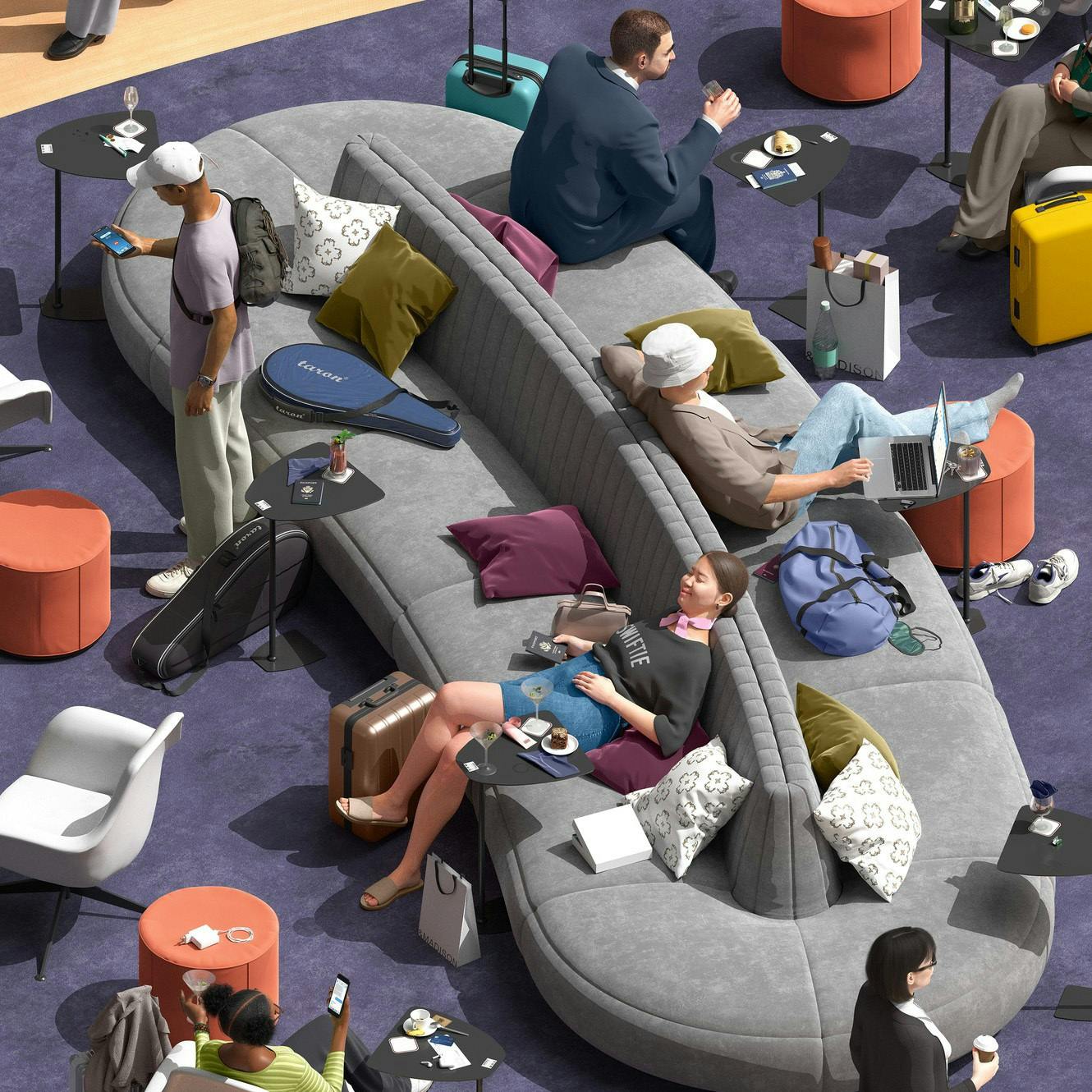
The Airport Lounge Arms Race
Amanda Mull, former Atlantic staff writer and explainer of all things consumer culture, tells the curious history behind the airport lounge and why—even if you never set foot in one—you’re still paying for them.
Learn more about your ad choices. Visit megaphone.fm/adchoices
Press play and read along
Transcript
Speaker 1 cut from a different cloth. And with Bank of America Private Bank, you have an entire team tailored to your needs with wealth and business strategies built for the biggest ambitions, like yours.
Speaker 1 Whatever your passion, unlock more powerful possibilities at privatebank.bankofamerica.com. What would you like the power to do? Bank of America, official bank of the FIFA World Cup 2026.
Speaker 1 Bank of America Private Bank is a division of Bank of America NA member FDIC and a wholly owned subsidiary of Bank of America Corporation.
Speaker 2 The holidays mean more travel, more shopping, more time online, and more personal info in more places that could expose you more to identity theft.
Speaker 2 But Life Lock monitors millions of data points per second. If your identity is stolen, our U.S.-based restoration specialists will fix it guaranteed or your money back.
Speaker 2
Don't face drained accounts, fraudulent loans, or financial losses alone. Get more holiday fun and less holiday worry with Life Lock.
Save up to 40% your first year. Visit lifelock.com/slash podcast.
Speaker 2 Terms apply.
Speaker 3 I'm not sure if this is an embarrassing or a proud confession. I have never been to an airport lounge and I don't think that in my true brain I thought they were real.
Speaker 4 They are real. I had also not been to one until like relatively recently.
Speaker 4 My first experience in an airport lounge was in 2018 when a friend who I I was going to Europe with, I had never been to Europe, never been in an airport lounge, a lot of firsts on this trip.
Speaker 4 It was a trip for his birthday
Speaker 4 and he had bought like an expensive ticket on the flight that we were all on. The rest of us were on much cheaper flights and he managed to talk all of us into the British Airways lounge in JFK.
Speaker 4
He's a very convincing guy, a good talker. So he got us all into the lounge and I was like, oh, I have information now that I can't unlearn.
I know how nice this is.
Speaker 4 I know the free drinks and the soft chairs and the lack of crowds. But the crowds have expanded since then.
Speaker 3
I'm Hannah Rosen. This is Radio Atlantic.
And that was former Atlantic staff writer Amanda Moll cluing me in about airport lounges, which apparently many other people are already clued into.
Speaker 3 I'm guessing that many of you listeners are more sophisticated than I am.
Speaker 3 For all I know, you are right now listening to this podcast while sipping champagne at whatever is the newest luxury lounge at LAX.
Speaker 3 But whose idea was it to give you that free champagne? Why are these lounges now everywhere?
Speaker 3 And even though you are technically not paying for the champagne, you must know that you're not getting it for free. Somewhere down the line, you or somebody is paying for it.
Speaker 3 Here to explain all of this is Amanda.
Speaker 4 So, as people started to return to air travel in the U.S.
Speaker 4 post-pandemic, I began both reading stories and seeing myself in airports that there was just like a huge glut of people trying to get into these lounges, that there were lines forming outside of some of them, that there had been, for some reason, this real uptick in demand among people who were like probably traveling a lot also before the pandemic, but suddenly, like a much greater proportion of those people had access to lounges and wanted into lounges.
Speaker 4 You also saw, especially in hub airports, a lot of new lounges being built, a lot of like construction sites within airports.
Speaker 4 And there was just like enough stuff sort of like going on that I began to just wonder exactly, like who is it that gets into the lounges?
Speaker 4 Why are there so many more people who suddenly have access to lounges? And like what is the value proposition, especially for credit card companies?
Speaker 4 Because traditionally airport lounges have been the province of airlines who give it out based on frequent flyer status.
Speaker 4 Like most of us sort of like understand how that works on like a like a vague level, but suddenly there were Centurion lounges and chase lounges.
Speaker 4 And it just seemed like a lot was going into creating these spaces and more and more of non-functional airport real estate out there was being used for them.
Speaker 4 And there wasn't like an obvious explanation that I could think of as to why that was happening.
Speaker 3 So once upon a time, meaning when you went into the British Airways Lounge, you thought of them as this discreet
Speaker 4 corners here and there.
Speaker 3 And then all of a sudden, it feels like they're a huge thing and they're everywhere and why.
Speaker 4
Right. And that period of change from 2018 to now is a relatively short period of time, especially for constructing things inside airports.
There's a lot of red tape.
Speaker 4
There's a lot of difficulties structurally in getting things like that built. So the pace at which they were being built suggested a real sense of urgency.
Right.
Speaker 3 This whole thing is a little bit blowing my mind because I have done a plenty of traveling and maybe naive, it never occurred to me that the airport experience could be any different than the airport experience I have had my whole life, which is like you stand in line and you pay five to seven dollars for a banana.
Speaker 3 And then you sort of like go along with the hoi polloy and like find yourself a little seat to sit in or you sit on the floor.
Speaker 3 Like it just never occurred to me that traveling could be any different than that, but I'm obviously very, very late to this game.
Speaker 4 Yeah, it really hadn't occurred to me either until like that moment because although like I had done a decent bit of traveling, especially because like I, you know, in my mid-20s, I moved away from home.
Speaker 4
I moved away from the city where I grew up. So I had to travel for holidays and things like that.
But because like, you know, I'm from Atlanta.
Speaker 4
So my home airport was always like the busiest airport in the world. And now I'm in New York City.
So all of my airline experiences up to that point have been like extremely high impact.
Speaker 4 Like
Speaker 4
you're playing the airport on hard mode in those situations. There's no pleasant airports on that itinerary.
Yeah, exactly.
Speaker 3 I mean, the last travel experiences I've had, I have the same exact memorable experience, which is such a long line at the Starbucks.
Speaker 3 And then the people behind the counter yelling that there was a 30 to 40 minute wait so that if you were in a hurry, you should just move on along.
Speaker 3
I mean, mean, just so, like, you wouldn't tolerate that like anywhere on Earth, only in an airport. Right.
Okay, so the airport lounge, where does it originate?
Speaker 4 The backstory of the airport lounge is sort of fantastic.
Speaker 4 The first one in the U.S. was opened in 1939 by American Airlines in what would become LaGuardia Airport, and it was carved out of a space in Fiorello LaGuardia's office within the airport.
Speaker 4 He was mayor at the time. He had received criticism that his office at the airport was too huge, so he let American Airlines use part of that office space as a lounge.
Speaker 4 And at the time, it was truly for VIPs. The chairman of American Airlines selected who would be allowed into the lounge personally.
Speaker 4
You know, flyers who were particularly powerful or particularly influential. So politicians, business leaders, people like that.
It was called the Admiral's Club.
Speaker 4
The people who were allowed into it were deemed admirals. And it was really sort of just like a nicer waiting room.
Like, you know, it was private.
Speaker 4 It was, you know, there weren't eyes on you at the regular terminal, but it wasn't like a full-service experience.
Speaker 4 It was a way for, you know, a very powerful executive to sort of like confer some favor on other very powerful people in a way that like ultimately probably benefited him quite a bit.
Speaker 3 That's amazing. That's the very first one.
Speaker 3 That doesn't sound anything like the ones now. So, how does it evolve?
Speaker 4 Well, it evolves like in a few steps. The first big change that came about was anti-discrimination laws meant that airlines could no longer just decide who they wanted to let into lounges.
Speaker 4 They had to develop some sort of system that would make it like theoretically more accessible to a wider swath of people. So, what they did is decide to allow people to buy memberships.
Speaker 4 Then, anybody with enough money could get in, and you couldn't plausibly be charged with discrimination in who you were allowing access to these spaces. Right.
Speaker 4 So that is where it becomes part of the business instead of just part of the sort of like clubby nature of.
Speaker 3
Right. So it's not just a social atmosphere.
Now they realize, oh, you can actually make money off of these.
Speaker 4 Right. And then during the Carter administration, you have airline deregulation.
Speaker 4 So suddenly airlines were looking for ways to compete with each other because, you know, prices on airfares were going down. Additional airlines were opening all over the place.
Speaker 4 Like you had this moment of like really intense competition within the airline industry. That's how you end up with frequent flyer programs.
Speaker 4 A lot of the things that we associate as sort of a given with air travel now were created through this process of deregulation.
Speaker 3 Interesting because culturally, I think of the era, say moving from the 60s to the 80s, when airline travel becomes less obviously glamorous.
Speaker 3 So it's interesting that at the time it's becoming less glamorous, it's also creating layers of status.
Speaker 4
Aaron Powell, Right. I think that those things are pretty deeply tied.
Before deregulation, all the fares were the same.
Speaker 4 So the way that airlines competed with each other was through, like, what could they offer you for this very high price? So you had to build in a lot of services and things like that.
Speaker 3 And then you had to-the best flight attendants, the best drinks. Like it was sort of a marketing campaign.
Speaker 4 Right. There was no price pressure in the airline industry.
Speaker 4 So you could compete to have like the most beautiful flight attendants, the best carving stations on airlines, the most comfortable seats and things like that. Right.
Speaker 4 And then once all that regulation goes away.
Speaker 4
you suddenly end up with like just a lot more types of product that are offered in the airline industry. So you have to offer like a lot more things.
You want to offer cheap tickets.
Speaker 4 You want to offer expensive tickets. You want to offer, you know, just like sort of layers or tiers of service level so that you can appeal to the widest potential population available.
Speaker 4 And then you also want to create conditions under which customers become loyal.
Speaker 4 Because if there's a lot of competition in price and there's a lot of options suddenly available, you want to create things that keep people with your airline.
Speaker 4
And that is where frequent flyer programs. begin.
And it's also where the airline lounge becomes an even more professional part of the airline industry.
Speaker 4 The issue with loyalty programs is you have to figure out more and more and more perks over time in order to keep people happy.
Speaker 4 And in order to continue bringing new people in at the bottom of the pyramid, you have to add things at the top of the pyramid to move your most long-term, most profitable customers up and up and up.
Speaker 4 You hit an issue where there's a set of perks that you offer and then
Speaker 4 you allow enough people access to those perks that they're no longer like particularly special or you can no longer guarantee like a particular level of service with those perks because you know if you offer people access to like a special space and then that space becomes crowded it's no longer like really a perk got it because as you're pulling more people into this special space you have to create a special special space and then a more special special space you have to continuously create layers of luxury yes you have to continue adding new things you have to have a few things in the first place to start to draw people in and then like once that is successful, you have to continue to add in order to continue to draw people.
Speaker 4 And airport lounges are a big part of that for airlines because the airport is like sort of a miserable place.
Speaker 4 So there's a really big premium on having like access to a space that gives you like slightly less misery.
Speaker 4 So it turns out, and this becomes more and more true over time, that giving people access to like a slightly more comfortable space and some free booze is like an incredibly potent loyalty carrot to dangle in front of people.
Speaker 3 When we come back, how the modern airport lounge came to be, why there are so many more of them every year, and why you are actually paying for them, even if you never step into one.
Speaker 5 Some tech leaders question whether we're in an AI bubble, but others say the best of what AI has to offer is yet to come.
Speaker 6 Maybe in 10,000 years, AI will be based on physics that we don't even understand right now, and we'll have many different approaches.
Speaker 7 Join us weekly starting October 15th for the most interesting thing in AI, brought to you by Rethink, the Atlantic's creative marketing studio, in collaboration with PwC, wherever you get your podcasts.
Speaker 8 Do you know why Tropicana Pure Premium Orange Juice is so delicious? It has just one ingredient, oranges. Picked at peak ripeness and squeezed within 24 hours.
Speaker 8
No extras, no fuss, just pure, joyful sunshine. Perfect for slow mornings, running errands, or watching sports.
Really anytime you're craving a fresh squeeze flavor.
Speaker 8 Tropicana Pure Premium Orange Juice.
Speaker 3
Okay, so we've moved through the 80s. Sounds like the Airport Lounge arms race is fully underway.
What happens next?
Speaker 4
Yeah, after this deregulation in the 80s, there's like a couple more things that happen that get us to where we are today. Uh-huh.
The first thing is 9-11.
Speaker 4 When 9-11 happens, you add a lot of process to the airport and you add a lot of time to the airport. Before 9-11, you could just sort of like breeze right through.
Speaker 4 I'm old enough that I remember flying a few times before 9-11, like I was a kid, but I did it.
Speaker 4 Then when that happens and you introduce TSA checkpoints, you ask people to spend a lot more time at the airport. Right.
Speaker 4 Because like you never know if it's going to take 45 minutes to get through TSA or if it's going to take five.
Speaker 4 So, you have to block out the time necessary in case it takes 45 minutes, which means you have a lot of people just spending like more time at the airport than they used to.
Speaker 4 So, you get an increased demand for spaces that you can just sit for a while and be comfortable, especially from people who travel a lot.
Speaker 4 And then, over this same period of time from 9-11 to the present, you get this like explosion in commercial air travel in the US. You have like 50% more flights taken in the US than you had in 2000.
Speaker 4 And that is a huge jump in the number of people flying.
Speaker 4 And they're largely flying through airports that are like sort of old and sort of not well equipped to handle that like enormous jump in volume that happens sort of all of a sudden.
Speaker 4 Travel is one of those things that like the user base is like really disproportionate.
Speaker 4 There's a tiny, tiny proportion of people who travel in a given year do like a massively disproportionate amount of the total travel done by Americans.
Speaker 4 Like those people are the people disproportionately at this time with like access to airport lounges because they, you know, earned the status the old-fashioned way by just flying a lot, by spending a lot of money.
Speaker 4
Right. They're road warriors, work travelers, they are in them all the time.
And so you've got those spaces.
Speaker 4 And then like slowly more people want to spend time in there because they have to spend more time at the airport. to fly at all.
Speaker 4
And then you have in 2013 an entrant to the marketplace that really changes things a lot and that helps set the stage for what we see now. And that is American Express.
American Express.
Speaker 3 That is not what I expected you to say.
Speaker 4 Yeah, American Express is like huge in the travel space. They offer a lot of perks and rewards programs that are geared particularly toward people who want to travel.
Speaker 4
And they have a longstanding relationship with Delta to issue cards that are co-branded. So like a Delta American Express.
There's like several tiers of them. They're extremely popular.
Speaker 4 And the very expensive ones will get you into the lounge.
Speaker 4 So American Express sees all this, sees how enthusiastic people are about taking out credit cards in order to get these types of travel perks specifically and decides like, oh, this is like a real spot where people who we want to do business with are willing to hop into a new credit card in order to get access to this specific thing.
Speaker 4 So what American Express does is they look around and go, like, airport lounges are pretty nice, but like they're kind of no frills relative to what they could be.
Speaker 4 We think that we can offer a better level of service in our own spaces and attach them to credit cards that aren't tied to an airline.
Speaker 4 So American Express still issues a lot of those Delta credit cards.
Speaker 4 It's still like a very successful program, but in 2013, American Express opens its first Centurion Lounge at McCarran Airport in Las Vegas, which is the first lounge that does not have an airline partner.
Speaker 4 So no matter what airline you're flying, if you have an American Express Platinum card, you can go into the Centuriad Lounge. And there's now a bunch of them in the U.S.
Speaker 4 So no matter what airline you're flying that day, no matter like what type of seat you're sitting in on that flight, you can show your American Express Platinum and go into that lounge.
Speaker 4 Okay.
Speaker 3
This is very baffling to me. So I understand why airlines, I'm following you so far.
Airlines are competing for customers. Then suddenly a credit card company gets into the business.
Speaker 4
Why? Are they profitable? Airport lounges are not straightforwardly profitable. It is very expensive to operate this type of business.
Like airport lounges require a ton of staff.
Speaker 4
They require a ton of capital investment to build something truly nice inside of an airport. You know, they're perishable food businesses, bar businesses.
You have to keep them extremely clean.
Speaker 4 You have to have staff there, you know, 20 hours a day in some of them. It is like running the most difficult restaurant in the world
Speaker 4 because you're serving a lot of people and they're people that are disproportionately used to a really high level of service. Right.
Speaker 4 So they are not straightforwardly profitable, but what they're great for is getting people to sign up for credit cards.
Speaker 4 And we know that because people sign up for airline credit cards of all types with great enthusiasm.
Speaker 4 And that is, I think, the lesson that American Express and later Chase took from that and went, well, we can make the airport lounges even nicer.
Speaker 4
We can make everything inside of them free. We can make the food better.
We can make the bar better. We can make, you know, put additional amenities inside of them.
Speaker 4 And and if people are willing to sign up for airline credit cards in order to get access to these like less good airline lounges then maybe people will sign up for just regular credit cards in order to get access to these like much better airline lounges and that has been proven true american express was absolutely correct about that you know, and they keep building more larger lounges at additional airports.
Speaker 4
They just opened one in the Atlanta airport that is like over 20,000 square feet. It features, you know, outdoor space.
There's patios that you can go out onto to get some fresh air.
Speaker 4 There is a huge living olive tree inside of it. Yeah, they're, they're like really, like some of the new ones are really nice spaces.
Speaker 3 Okay, so we've gone far beyond a high-end hotel lobby. Now it sounds like these are genuinely
Speaker 3 Zen spaces that conjure an atmosphere that's like the opposite of an airport.
Speaker 4 The nicest ones and the newest ones are really nice, genuinely comfortable, genuinely pleasant spaces. Some of them include like spa amount of these.
Speaker 4 I went to the Chase Lounge at LaGuardia, which is brand new and arguably the nicest lounge in the U.S., I think. And you get the opportunity to like book a 30-minute like skincare treatment for free
Speaker 4
if you want to while you're there. Wow.
There are some locations that have like really nice private showers.
Speaker 4 So if you are at the end of a business trip and are getting ready to take a red eye home, you can stop and like take a shower and like put on your pajamas before you get on that flight.
Speaker 4 You know, there are some real things that are like nice and like convenient about these.
Speaker 3 Now, you talked about the post-pandemic crunch of travel. Like, there's a huge number more people traveling.
Speaker 4
Well, post-pandemic travel is just a little bit different. The volume isn't that different.
Like, we are almost back to 2019 travel levels.
Speaker 4 But the thing that really changed, I think, is that post-pandemic, a lot of people signed up for these credit cards because I think a lot of people were like planning to travel.
Speaker 4 So, after people got vaccinated and felt comfortable sort of like heading back out, you had all this pent-up demand among the more affluent tier of people in the U.S. in particular.
Speaker 4 And they said, well, if I was ever going to get like a travel rewards credit card, now's the time to do it because I've got like four weddings to go to and I want to go see my family and I've got like this vacation that I've been dying to take.
Speaker 4 So you get this surge of people into these high-fee, very expensive credit cards that give you lounge access.
Speaker 4 So you've got like a tier of people who are not business travelers, who are not the traditional road warriors, who may have a little bit more flexibility at work now, who may not be back in the office full time, who may be allowed to work fully remote and from anywhere now.
Speaker 4 I sort of think of them as work-from-home travelers instead of work travelers.
Speaker 4 That sort of demand like settled, I think, at a pretty high level.
Speaker 4 You have people who are just used to sort of like living like this now, and they don't want to sit at the gate, you know, with their legs propped up on their bag if they can avoid it because like they have the resources to, you know, get a fancy credit card and maybe sneak in and get some free food and some free drinks.
Speaker 3 I feel like what you're transmitting is that this is good. Like this doesn't have any, does it have any knockoff effects on the rest of us travelers who aren't interested?
Speaker 3 The way you're describing it, it just. solves a practical problem.
Speaker 4 I think largely for travelers, I don't know if it's good, but I think it's not not bad.
Speaker 4 There's like no evidence that allowing parts of the airport to be used for these lounges prevents the airport overall from improving its infrastructure.
Speaker 4 LaGuardia Airport in New York, it just got done with like a very long-term, very comprehensive renovation that made the entire airport nicer.
Speaker 4 So the investment of private businesses into these lounges and the investment of public money into making the airport nice for everyone can and do coexist.
Speaker 4 And because airports are things that are used so disproportionately by a pretty small number of people, making things nicer that are mostly accessible to the people who are most frequently subject to the indignity of the airport doesn't really violate my sense of fairness.
Speaker 4 Like, these are the people who have to deal with the airport all the time. I'm fine with them having access to something slightly nicer because, like, I don't travel that much.
Speaker 4 I can deal with it for less expensive tickets or whatever.
Speaker 4 But then, the downsides are less travel-related. That all of these amenities are so deeply mediated by credit cards creates some things that I think are like not great in a larger sense.
Speaker 4 Because interchange fees are so important to all of these credit card companies, which are the cut of money that the credit card company takes every time that you swipe or tap your credit card.
Speaker 4 And because these lounges are accessible mostly to people who have like the very high-fee premium cards, high-fee premium cards generally have higher interchange fees than like a lower tier card or a debit card.
Speaker 4 So they make purchases more expensive. Like they add sort of like a middleman fee onto a credit card purchase.
Speaker 4 Largely what that does is then retailers and service providers end up baking those fees into prices.
Speaker 4 So even if you are not a person who has a high fee card and gets access to all of these perks, you are still a person who pays the prices that these interchange fees create.
Speaker 4 And they, the the theory goes, at least, that they help nudge prices upward in order to finance the perks that are then enjoyed by this like very small tier of people.
Speaker 3 So essentially what you're saying is it spreads the costs to everyone. Like somebody's got to pay for those airport lounges somehow.
Speaker 4 Right. The major downside of this happens like outside the realm of travel.
Speaker 4 These very high fee cards have become so popular because there's so many more of them circulating now than there was in the past.
Speaker 4 That bakes in more expenses to every purchase that everybody makes because retailers and service providers who are pricing their goods need to consider that like three or 4%
Speaker 4 maybe of these purchases might not go into their pocket at all. It's going to go directly to the card issuer.
Speaker 3
Right. So that's why me as a never lounger, I will probably remain a never lounger.
Who knows? But that's why I should care about this.
Speaker 4 I think that it is is a sort of peek inside how prices actually get made for the goods and services that you buy.
Speaker 4 There's such huge demand for lounge access and lounge space that like, I really don't see this like slowing down anytime soon.
Speaker 4 One of the only things that really could slow it down would be if financial regulators really came down heavy on interchange fees and like capped them in some way. Right.
Speaker 4 If you take away that revenue source, you take away the incentive to continue creating ever more luxurious perks for this particular tier of traveler.
Speaker 4 But otherwise, I think that we're going to see a lot more lounges. Right, right.
Speaker 3
Well, Amanda, I don't know what to say. Thank you for going to all these luxury airport lounges, so we don't have to.
That doesn't quite work. But thank you for talking about them with me.
Speaker 4 Of course. Thank you.
Speaker 3 This episode of Radio Atlantic was produced by Kevin Townsend. It was edited by Andrea Valdez, fact-checked by Yvonne Kim, and engineered by Rob Smirciak.
Speaker 3
Claudina Bade is the executive producer of Atlantic Audio, and Andrea Valdez is our managing editor. I'm Hannah Rosen.
Thank you for listening.
Speaker 5 Go beyond the lab in the new season of When Science Finds a Way, a podcast from Wellcome, a global charitable foundation supporting science to solve urgent health challenges.
Speaker 5 You'll join me, Alicia Wainwright, your host for Bold's conversations about the scientific breakthroughs changing lives lives around the globe.
Speaker 5 In this season, each episode explores how science is not just in the lab, but alive in homes, supermarkets, hospitals, schools, and communities.
Speaker 5 We'll hear from a Nigerian artist who's channeling his lived experience into creative ways to support mental health.
Speaker 5 From Brazilian researchers who are using climate data to forecast and prevent disease outbreaks.
Speaker 5 From European scientists developing new imaging technology that reveals disease in the body in unprecedented detail.
Speaker 5 We'll even explore a groundbreaking new study that's reimagining reproductive healthcare.
Speaker 5 These are all stories about how communities and researchers are working together to meet urgent health challenges with empathy and impact.
Speaker 5 Listen to When Science Finds a Way, a science podcast that tells the human story wherever you get your podcasts.