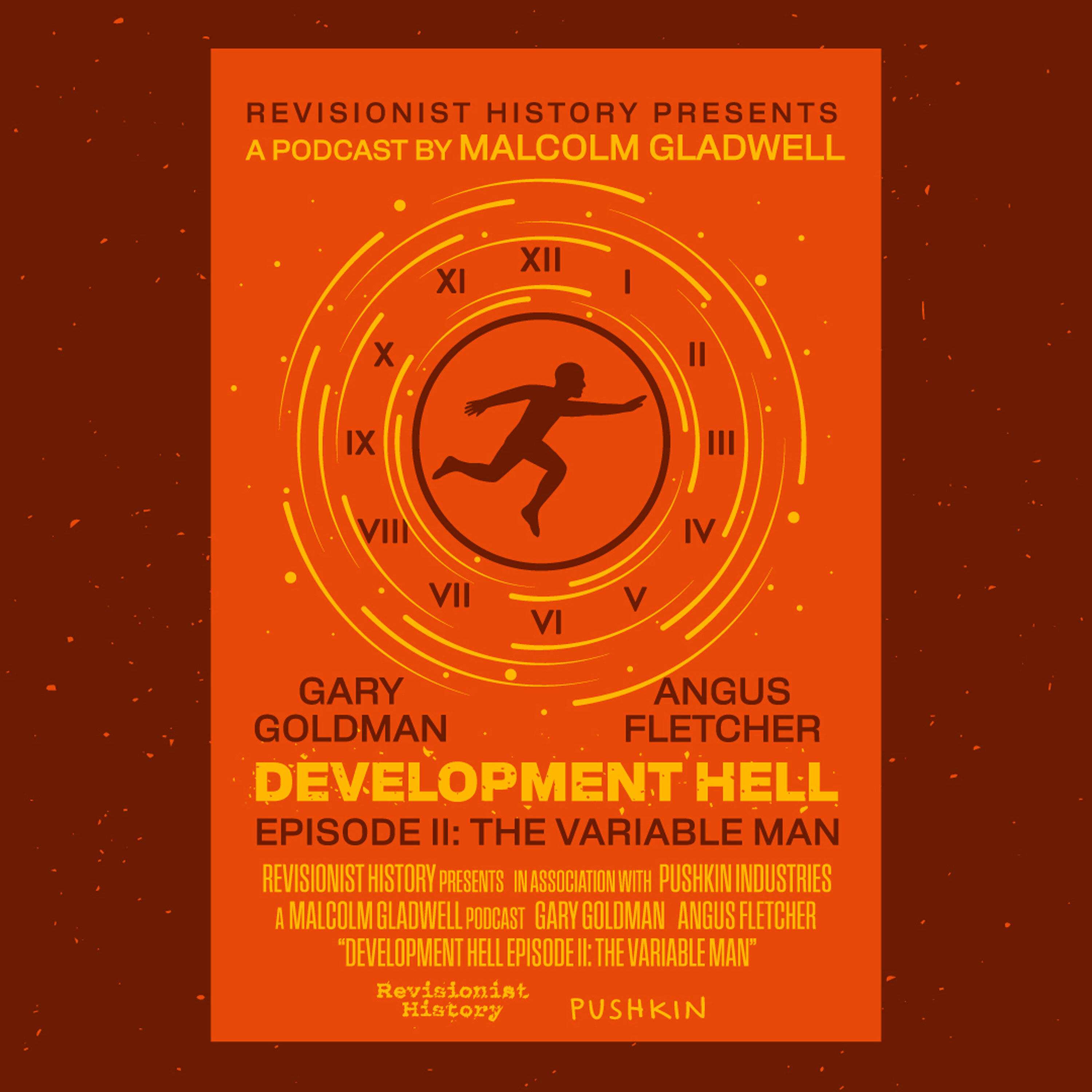
The Variable Man with Gary Goldman and Angus Fletcher | Development Hell
Gary Goldman was a writer on “Total Recall”, a Philip K. Dick adaptation directed by Paul Verhoeven and starring Arnold Schwarzeneger. It was a big hit. So why do Gary and his writing partner, Angus Fletcher, have so much trouble selling another Philip K. Dick adaptation? They tell Malcolm that it all came down to a roller coaster ride of plot twists that even A-List action actors couldn’t stomach, and an early attempt at AI that was too dumb to pick a smart script.
See omnystudio.com/listener for privacy information.
Press play and read along
Transcript
Speaker 1 Pushkin.
Speaker 2 This is an iHeart podcast.
Speaker 4 In today's super competitive business environment, the edge goes to those who push harder, move faster, and level up every tool in their arsenal.
Speaker 9 T-Mobile knows all about that.
Speaker 9 They're now the best network, according to the experts at OoClaw Speed Test, and they're using that network to launch Supermobile, the first and only business plan to combine intelligent performance, built-in security, and seamless satellite coverage.
Speaker 10 That's your business, Supercharged.
Speaker 15 Learn more at supermobile.com.
Speaker 4 Seamless coverage with compatible devices in most outdoor areas in the U.S.
Speaker 6 where you can see the sky.
Speaker 17 Best network based on analysis by OCLA of SpeedTest Intelligence Data 1H 2025.
Speaker 21 American Military University is the the number one provider of education to our military and veterans in the country.
Speaker 25 They offer something truly unique: special rates and grants for the entire family, making education affordable not just for those who serve, but also for their loved ones.
Speaker 21 If you have a military or veteran family member and are looking for affordable, high-quality education, AMU is the place for you.
Speaker 28 Visit amu.apus.edu/slash military to learn more. That's amu.apus.edu slash military.
Speaker 2 Check out the new season of Reasonable Doubt, now streaming on Hulu. LA's most successful attorney, Jack Stewart, defends a young actor accused of murder.
Speaker 2 Follow Emma Yazzie Coronaldi, Morris Chestnut, Joseph Secura, and guest stars Cash Dahl and Lori Harvey as they fight their personal battles in the spotlight of the year's most sensational trial.
Speaker 2
In the pursuit of justice, every move counts. Reasonable Doubt Season 3.
Now streaming on Hulu and Hulu on Disney Plus for bundle subscribers. Terms apply.
Speaker 34 Welcome to episode 2 of Development Hell, our revisionist history series based on the radical notion that the best Hollywood stories are the ones that never got made into movies.
Speaker 20 Last time, we kicked off the series with a story of how my book Blink failed to make it into the big screen.
Speaker 36 If you haven't haven't heard that one yet, you really, really should, because it explains why failed stories have such meaning for me.
Speaker 36 Anyway,
Speaker 39 this episode is a wildly convoluted tale full of big plot twists and huge moral questions.
Speaker 36 A story so much about right now that it's going to get a little uncomfortable.
Speaker 36 Allow me to introduce guest number one, one, Angus Fletcher.
Speaker 44 He's a screenwriter.
Speaker 45 I'm not a screenwriter and have never really wanted to be a screenwriter, have no aptitude in screenwriting.
Speaker 36 Don't listen to Angus.
Speaker 46 Angus is, in fact, a screenwriter, as you'll hear.
Speaker 30 He's also an author, researcher, and professor of story science at Ohio State, and a longtime friend of revisionist history.
Speaker 33 Some of you will remember him as the person who provided the intellectual scaffolding for our memorable revision of The Little Mermaid.
Speaker 50 Remember this?
Speaker 39 Oh, so you think we should be able to
Speaker 38 fix Ursula?
Speaker 45 Well, I think we should just stop her from doing whatever she's doing. We should have a conversation with her about maybe why this isn't helpful.
Speaker 19 Do you, Prince Eric, take Ursula to have and to hold in sickness and in health for as long as you both shall live?
Speaker 50 Eric looks deep into Ursula's eyes, hypnotized.
Speaker 51 I do.
Speaker 40 If you haven't heard that Little Mermaid series, listen to it.
Speaker 17 Anyway, back to today's story.
Speaker 45 I'm just fascinated by this problem that Hollywood has that it keeps telling the same story over and over and over again.
Speaker 45 And so, you know, back when I was actually a Shakespeare professor up at Stanford, I placed this phone called the Pixar, and I was basically like, How is it you guys are able to make stuff that's like better?
Speaker 45
This is when they're making movies like Up, which had just these totally berserk narrative structures. And so, anyway, they let me inside.
I learned all this stuff.
Speaker 45 I thought it was totally fascinating.
Speaker 45 I realized that they were making stories in a totally different way than Hollywood was. So, I went down to Hollywood to advise Hollywood.
Speaker 45 And that led to me basically trying to convince Hollywood by writing a series of screenplays, The Pixar Way, because I thought that they would then allow me to consult on movies.
Speaker 45 Instead, no, they just hired me to write screenplays. And that's how I got an agent.
Speaker 45 And then one day my agent called me up and because he knew I'm just obsessed with the original Total Recall, which had destroyed my mind when I was young.
Speaker 45 And he was like, How would you like like to work with the writer of Total Recall, Gary Goldman? And so,
Speaker 45 that's how we got together.
Speaker 31 Wait, Gary, you wrote Total Recall?
Speaker 44 Meet guest number two, Gary Goldman.
Speaker 40 He's also a screenwriter, but unlike Angus, he has no trouble admitting it.
Speaker 42 Yes, I was the last writer on Total Recall, on the first Total Recall.
Speaker 24 Total Recall, amazing movie.
Speaker 25 Arnold Schwarzenegger, Sharon Stone.
Speaker 43 Directed by Paul Verhoeven.
Speaker 42 Yeah, so it was about a milquetoast character who finds out that he's not who he thinks he is, which is that he's a kind of a super spy.
Speaker 53 But how real does it seem?
Speaker 49 As real as any memory in your head.
Speaker 53
Come on, don't bullshit me. No, I'm telling you, Doug, your brain will not know the difference, and that's guaranteed, or your money back.
What about the guy you lobotomized? Did he get the refund?
Speaker 3 Came out in 1990.
Speaker 46 Blockbuster.
Speaker 44 Tons of awards.
Speaker 42
Total Recall has a number of, I mean, it has a genealogy. It's not just me.
I mean, it has a short story. The source material is from Philip K.
Dick.
Speaker 42 And then there was a fantastic original screenplay by Dan O'Bannon and Ron Shousset that everybody loved from the beginning. And this launched the project.
Speaker 42 And in fact, this is sort of the
Speaker 42 prime example of this idea of development, hell, which is that you sell something for a lot of money and everybody's very excited about it. And they tell you it's going to be a movie right away.
Speaker 42 And then it goes into a process of
Speaker 42 development where everybody has a hand in
Speaker 42 revising it and reconceptualizing it and making it in their image.
Speaker 42 And in the middle, depending on your involvement,
Speaker 42 you can be in development hell along with the project, or you can be a bystander pushed to the outside, watching it go through the process of development hell with lots of other people, not including yourself.
Speaker 42
I mean, if you're lucky, it gets made at all. The project had been in development for almost eight or nine years when I got involved.
Yeah.
Speaker 49 Eight or nine years.
Speaker 39 Yes.
Speaker 49 So if you go back to the original screenplay, do you think that's a better
Speaker 49 movie than the final screenplay?
Speaker 42 No, not in my case.
Speaker 54 So you're saying development hell is a bad thing, except in the case where I'm involved in confix things, which, by the way, a legitimate position that I would
Speaker 33 open to agreeing with that.
Speaker 42 I mean, when I was starting out, I read the original Total Recall screenplay as a junior executive for a producer who was considering making it and acquiring it.
Speaker 42 And basically, the problem that most people felt was that it fell apart in the third act.
Speaker 43 So,
Speaker 42 and this,
Speaker 42 apparently, it fell apart so disastrously that even though it had many different stars and directors attached and people always wanted to make it, it didn't cross the finish line.
Speaker 42 And by the time it got to me, it was eight or nine years later, it had been in pre-production with
Speaker 42 Bruce Beresford and Patrick Swayze and the producer Dino DeLaurentis in Australia. And in fact, Bruce Beresford asked me to come over and do a rewrite on it.
Speaker 42
And I said I couldn't because I was working with Paul Verhoven on another project. But Dino went bankrupt.
Arnold Schwarzenegger had always loved the project and had been watching it. He went to
Speaker 42 the owners of the Coralco studio that had done the Rambo movies, and he said, you know, I want to do this. And they bought it from Dino De Laurentis out of bankruptcy for a humongous amount of money.
Speaker 42 And with the idea that Arnold was attached, Arnold wanted to work with Paul Verhoeven because Paul had just done RoboCop.
Speaker 42 I was working with Paul Verhoven on a movie called About Out of Body Travel.
Speaker 42
And Paul said he didn't think it was ready to shoot and that he was going to leave our project and go do another project. And he was apologizing to me for that.
I said, what's the other project?
Speaker 42 And he said, total recall.
Speaker 45 I said, well, that's really funny, Paul, because I turned down the chance to rewrite Total Recall because I was working with you.
Speaker 42
And he said, well, what did you think about it? And I told him my take. And he said, well, you know, that's pretty much how I see it too.
Let me see if I can get you the job to rewrite it.
Speaker 33 Gary, Gary, Gary, I'm worried.
Speaker 24 We want to talk about this other project, but now I'm thinking we can come back to Total Recall.
Speaker 34 Or is this all leading up to the other project?
Speaker 42 Well, they're connected.
Speaker 43 Yeah.
Speaker 48 So what's the connection?
Speaker 42 The connection is, I would say, Philip K. Dick.
Speaker 52 Philip K.
Speaker 55 Dick, sci-fi master.
Speaker 3 To name just a few other Philip K.
Speaker 40 Dick film adaptations, Blade Runner, Minority Report, Scanner Darkly, Philip K.
Speaker 50 Dick is probably the most important sci-fi writer ever, or at least of the last hundred years.
Speaker 40 After working on Minority Report, Gary was becoming a bit of a Philip K.
Speaker 23 Dick specialist, which is not a bad thing to be in a town that loves sci-fi adaptations.
Speaker 49 When we get back, Gary and Angus go to work on adapting another of his stories.
Speaker 4 In today's super competitive business environment, the edge goes to those who push harder, move faster, and level up every tool in their arsenal.
Speaker 12 T-Mobile T-Mobile knows all about that.
Speaker 9 They're now the best network, according to the experts at OOCLA Speed Test, and they're using that network to launch Supermobile, the first and only business plan to combine intelligent performance, built-in security, and seamless satellite coverage.
Speaker 55 With Supermobile, your performance, security, and coverage are supercharged.
Speaker 7 With a network that adapts in real time, your business stays operating at peak capacity even in times of high demand.
Speaker 9 With built-in security on the first nationwide 5G advanced network, you keep private data private for you, your team, your clients.
Speaker 17 And with seamless coverage from the world's largest satellite-to-mobile constellation, your whole team can text and stay updated even when they're off the grid.
Speaker 10 That's your business, Supercharged.
Speaker 15 Learn more at supermobile.com.
Speaker 4 Seamless coverage with compatible devices in most outdoor areas in the U.S.
Speaker 6 where you can see the sky.
Speaker 17 Best network based on analysis by UCLA of Speed Test Intelligence Data 1H 2025.
Speaker 22 The Olympic Games have come a long way since the first one in 776 BC.
Speaker 32 In fact, those Olympic Games weren't even games.
Speaker 12 It was the Olympic game, as there was only one race, a straight 630-foot sprint.
Speaker 32 By 67 AD, chariot racing had become a big event, so big that the Emperor Nero competed.
Speaker 20 And even though he was thrown from his chariot and couldn't finish, he was nonetheless declared the winner.
Speaker 57 It's good to be king.
Speaker 29 One thing that hasn't changed is the importance of quality sleep to an athlete's performance, which is why Satfa is so proud to have been named the official mattress and restorative sleep provider for the U.S.
Speaker 18 Olympic and Para-Olympic teams.
Speaker 20 No one knows more about restorative sleep than Satva.
Speaker 29 Each one of their mattresses is designed to provide the kind of sleep elite athletes need to perform at their peak.
Speaker 57 Of course, you don't have to be an elite athlete to benefit from sleeping well.
Speaker 59 Being human is the only requirement.
Speaker 3 Visit SAFA.com slash Gladwell to save up to $200 on a $1,000 or more purchase.
Speaker 29 That's S-A-A-T-V-A.com slash Gladwell.
Speaker 19 American Military University, where service members like you can access high-quality, affordable education built for your lifestyle.
Speaker 59 With online programs that fit around deployments, training, and unpredictable schedules, AMU makes it possible to earn your degree no matter where duty takes you.
Speaker 26 Their preferred military rate keeps tuition at just $250 per credit hour for undergraduate and master's tuition.
Speaker 19 And with 24-7 mental health support plus career coaching and other services, AMU is committed to your success during and after your service.
Speaker 27 Learn more at amu.apus.edu slash military to learn more.
Speaker 28 That's amu.apus.edu slash military.
Speaker 37 We're back with Angus Fletcher and Gary Goldman, who've just been set up to work together on an adaptation of a Philip K.
Speaker 3 Dick story.
Speaker 42 I've done four projects based on Philip K. Dick material.
Speaker 42 This has become my
Speaker 42 calling card in Hollywood was that I did Philip K. Dick adaptations.
Speaker 39 So, Angus, Angus, wait,
Speaker 24 did you have a particular affection for Philip K.
Speaker 47 Dick prior to this project?
Speaker 45 Well, I mean, I loved the movie Total Recall, and I'm going to acknowledge that I was such a Philistine that I had no idea that it came from Philip K. Dick.
Speaker 45 And what happened was the moment I got the call from my agent, I then went and read all of Philip K. Dick, and it's surreal.
Speaker 45 I mean, he sort of went from science fiction into religion.
Speaker 45 And I called Gary up and I was like, well, Gary, I was like, what do you think? You know, I'd love to work with you.
Speaker 45 And the main reason I wanted to work with Gary is because I believe that screenwriters have the ability to see the future, because I think this is a common power of story. I think that science fiction
Speaker 45 is always about intuiting what's going to happen next.
Speaker 45 And so I said to Gary, I said, Gary, what do you think the future is? And he said, Angus, read this story, Variable Man. And the premise of variable man is very simple.
Speaker 45 It's basically just about a future in which there are these computers who use statistics to predict everything that's going to happen.
Speaker 45 And I said, you know, Gary, this seems weirdly like the world we're accelerating into now.
Speaker 45 And he said, yeah, he said, it is.
Speaker 45 And he said, and I have a premise for a story that I'd like to pitch to you that I think will kind of be as big, if not bigger, than total recall.
Speaker 45 And that's where we got started was with his pitch to me.
Speaker 20 And is the
Speaker 31 Variable Man story was written when?
Speaker 42 Oh, I don't know, about 1950, probably.
Speaker 46 Oh, I see.
Speaker 31 Oh, it really.
Speaker 48 So imagining in 1950 a world in which computers predict everything is kind of great if you're in the 20.
Speaker 47 When did you guys work together on this project?
Speaker 33 What was that?
Speaker 45 Early 2000s.
Speaker 46 Early 2000s. So you have...
Speaker 39 And so were you being faithful to the Philip K.
Speaker 51 Dick
Speaker 49 short story, or were you changing it in useful ways?
Speaker 45 We were changing it in useful ways.
Speaker 45 And there are a couple of big things. So first of all, Gary's pitch to me was he was like, imagine a future in which
Speaker 45 computers don't just predict things like they do in the Philip K. Dick story, which is who wins this war.
Speaker 45 But he says, you know, imagine that they're able to predict exactly what food you'd like to eat right now. And then he said, and then imagine that they're able to predict a gift.
Speaker 45 that you can give to your best friend for their birthday. And that gift is so good that your friend not only loves it, but it seems perfectly like it came from you.
Speaker 45 And then he said, imagine the computers can pick your soulmate.
Speaker 45 Imagine the computers can pick the person that you love so totally and so absolutely that you know that this computer knows you better than yourself.
Speaker 45 And I said, all right.
Speaker 45 And then he said, and now imagine after you've given yourself up totally to these computers, you wake up one morning and they say to you, in 24 hours, the world is going to end because humanity is going to destroy itself.
Speaker 45 And I've crunched all the variables
Speaker 45 and there's no opportunity for you to do anything.
Speaker 45 That's the starting point for the story.
Speaker 1 Oh, my God.
Speaker 33 So, wait, how far have we traveled?
Speaker 19 We've traveled quite significantly from Philip K.
Speaker 57 Dick at this point.
Speaker 51 He was just imagining a world where there were these computers that were predicting the outcome of a war, and the computers run across a problem.
Speaker 47 That's basically the plot of it.
Speaker 1 Wow. Right?
Speaker 45 The title, Variable Man. Because the other thing that Philip K.
Speaker 45 Dick did, which he intuited, I think, at a moment of genius, was what would happen if you put a person who the computers had no information on into the middle of the statistical world.
Speaker 45 So these are all these computers that are able to see the future because they have all the data, but there's one person who they have no data on.
Speaker 45 And so the starting point for the screenplay that Gary and I did was humanity goes, oh my goodness, we're going to die tomorrow.
Speaker 45 Our only option is to bring in someone who the computer has no data on, the variable man, the person who is unpredictable, unknown. And so just like in the original Philip K.
Speaker 45 Dick story, we reach back into time, back into history before the computers, and pluck this person into the present.
Speaker 45 And that's basically the beginning of the screenplay is when the variable man arrives in this world where everything has been planned, everything has been predetermined, the computers know everything, we're all going to die.
Speaker 43 Yeah.
Speaker 36 Now, the wait, wait, there's so many, so many wonderful.
Speaker 49 Gary, tell me a little bit about your thought process in moving from the original Philip K.
Speaker 47 Dick notion to the one that Angus just described. Tell me about the leaps that you made there and why you made them.
Speaker 42 All right.
Speaker 39 So
Speaker 42 I suppose I was very interested in AI.
Speaker 42 You know, everyone's thinking about it now, but it wasn't brand new.
Speaker 42 And I saw this idea
Speaker 42 of the computer that can predict everything and that you have to give up
Speaker 42 control to the computer because
Speaker 42 it's working so fast.
Speaker 42 And I wanted to sort of imagine this sort of trajectory
Speaker 42 of
Speaker 42 going from where we are now to the point where the computer is in total control.
Speaker 42 And I was really, and I remain concerned about this question of decision-making
Speaker 42 and how do we make decisions? And if the computer can make better decisions than we do,
Speaker 42 then
Speaker 42 what is the role of free will?
Speaker 42 And if you spend a whole life just simply doing what the computer tells you to do, what is identity?
Speaker 42 So I wanted to put this hero who comes from the past and who still is accustomed to having free will and his power is to have free will. And to put him in the situation where
Speaker 42 whenever he listens to the computer, everything goes right. And whenever he trusts his own judgment, it's wrong.
Speaker 43 Oh, wait, wait, wait.
Speaker 31 So
Speaker 3 the AI is smart enough to realize that the only way to save the world is to bring someone in from outside AI.
Speaker 42 Yeah.
Speaker 46 Oh, the AI has a little bit of self-knowledge and humility in your world.
Speaker 45 Oh, yeah, that was one of our best thing.
Speaker 42 We created this wonderful AI, a wonderful character called Plato. We named him Plato.
Speaker 42 And he's, you know, he's sort of somewhere between a butler and God.
Speaker 1 Yeah.
Speaker 31 Oh, that's
Speaker 46 getting better and better.
Speaker 45 I was going to chime in there and just say that basically in this society, there are a few people that have tuned out and they're like, I'm not going to listen to this computer.
Speaker 45
Where does this computer know? And their lives are horrible. And all their decisions are bad.
And they decide to choose their own soulmates and have horrible marriages.
Speaker 45 And then everyone who listens to exactly what the computer says has this Instagram life where they are actually so happy and their kids are so perfect and everything is so amazing.
Speaker 45 And so, you know, Cole comes into this world, our hero comes into this world, and he, of course, finds it appalling and as appalling as we would find it. And he's determined to ignore Plato.
Speaker 45 He's determined to ignore the AI that has brought him into the future to save humanity from itself.
Speaker 45 So this is another kind of unfolding paradox is humanity doesn't want to save itself if it means listening to the computers on how to save itself.
Speaker 33 Wait, wait, I have so many questions.
Speaker 32 First of all, tell me a little bit about, so our variable man is called, as in the Philip K.
Speaker 40 Dick story, your variable man is called Cole.
Speaker 3 Tell me about your Cole and where does he come from?
Speaker 49 What are his, what's his personality like?
Speaker 63 Why is he so capable of standing up to AI, even if AI has all these demonstrable advantages?
Speaker 45 So basically, he's just a classic action hero. The idea is he embodies kind of our cowboy American trust in our guts.
Speaker 45 And so the opening sequence, he's sent in to stop this hacker, this hacker who's been creating chaos across the world, who's been sort of, you know, getting into all these top secret facilities and creating chaos.
Speaker 45 We think he's going to launch World War III, whatever. And so Cole goes in and he's being sort of instructed what to do.
Speaker 45 And we already had these computers at this time that are sort of running the percentages and telling him, do this, do this, do this, do this other thing.
Speaker 45 And he's listening to the computers.
Speaker 45 he's breaking in he finally gets to the heart of the lair where uh this hacker is and he kicks down the door and he points his gun and then the hacker turns around and it's a child
Speaker 45 and cole realizes oh my goodness this is the hacker this is the person who's been creating all this chaos and he gets this word on his earpiece kill the hacker And he says, I can't kill the hacker.
Speaker 45
This is a child. And there's this long pause.
And they say, look, we've run all the numbers.
Speaker 45 If you don't kill the kid, this is going to happen again.
Speaker 45
Pull the trigger. And he stands there in the moment.
Can I pull the trigger? Can I pull the trigger? And then he doesn't do it. He doesn't pull the trigger.
He drops the gun. He grabs the kid.
Speaker 45
And what essentially happens is he dies, saving the kid's life. There's a fireball that blows him up.
but the kid goes on and the kid lives.
Speaker 45 And because that fireball incinerates him, he can be brought into the future without changing time because he was essentially eliminated from the timeline.
Speaker 45 So if you reach into the exact moment just before he dies and pull him into the future, time isn't changed.
Speaker 45 And so he's the perfect person to bring back because he has demonstrated the ability to say no to the computers and also because
Speaker 45 taking him doesn't change time.
Speaker 62 Oh, I see. So
Speaker 24 when we meet Cole,
Speaker 54 he's part of the present. He's not,
Speaker 3 he's just a guy who's standing up to the tyranny of AI.
Speaker 44 He's an action hero whose AI has been corrupted by this hacker.
Speaker 54 He's brought in to solve the problem.
Speaker 51 He fails as an incident.
Speaker 24 How much time passes between that initial encounter with the hacker and then when our story's taking place?
Speaker 45 Well, this is part of the twist because when you get into the future, you think that an enormous amount of time has passed because the future is radically different from when Cole disappeared.
Speaker 45 And it's so different that he can't believe it.
Speaker 45 But we start to learn that actually a very small amount of time, much more less time than you might suspect has passed between when he died and when he was brought back, because these computers, as Gary was saying, have accelerated human decision-making to the point that our society has started to run on this utopia cycle.
Speaker 45 And everything is just going much faster and much better than anyone could have imagined in our time.
Speaker 42 And it's because of this great genius who was the kid.
Speaker 37 The kid is the thing that made the difference.
Speaker 42 Because he didn't kill him, because Cole didn't kill him, he survived and he became the great genius that ushered us into this accelerated utopia.
Speaker 3 Now, why, one thing I don't understand, if we are in accelerated utopia, why do we need saving?
Speaker 31 Why would utopia have a kind of expiry date?
Speaker 49 Isn't the definition of utopia that it keeps going in perpetuity?
Speaker 45 Well, I mean, so this is part of the great riddle at the beginning of the story is why is it exactly that we're going to die? What could possibly go wrong? Everything seems like it's perfect.
Speaker 45 What is going to to destroy the world? Well, nobody is able to identify exactly at the beginning of the movie what's going to go on.
Speaker 45 All they know is that the computers are quite insistent that it's going to happen in the next 24 hours.
Speaker 45 And what happens over the middle parts of the screenplay is various different alternatives start to emerge.
Speaker 45 We start to see all of these different moving pieces and we start to realize, oh, sure, you know, it's a utopia, but there's still humans in it. And there's still other things going on.
Speaker 45 And I don't know how many of the twists you want me to ruin, Malcolm, but one of the things that starts to become a question that haunts the hero is:
Speaker 45 is he the one who's going to destroy the world?
Speaker 45 Is what the computers saw
Speaker 45 that he would get brought back
Speaker 45 and that by not listening to the computers, he was going to be the one that blows everything up?
Speaker 31 You know what this is?
Speaker 37 If I might reduce your whole premise to an axiom, this is the cinematic version of the famous adage in the land of the blind, the one-eyed man is king, right?
Speaker 40 Your coal is your one-eyed man who is asked to be king, right?
Speaker 37 And what you're describing just there is he knows he only has one eye, right?
Speaker 31 He's wrestling with the fact that he can't see it all.
Speaker 47 It's sort of beautiful.
Speaker 52 Let me give you a little recap of where we are.
Speaker 39 There's a perfect utopia.
Speaker 37 where AI runs everything.
Speaker 38 People do what computers tell them to do and are better for it.
Speaker 47 For reasons we don't quite understand yet, this utopia is in danger.
Speaker 38 In order to save it, the AI, named Play-Doh, no less, brings back to life a guy who defied its commands in the past.
Speaker 40 After the break, Gary and Angus try to get the movie made.
Speaker 7 In today's super competitive business environment, the edge goes to those who push harder, move faster, and level up every tool in their arsenal.
Speaker 12 T-Mobile knows all about that.
Speaker 9 They're now the best network, according to the experts at OOCLA Speed Test, and they're using that network to launch Supermobile, the first and only business plan to combine intelligent performance, built-in security, and seamless satellite coverage.
Speaker 4 With Supermobile, your performance, security, and coverage are supercharged.
Speaker 7 With a network that adapts in real time, your business stays operating at peak capacity even in times of high demand.
Speaker 9 With built-in security on the first nationwide 5G advanced network, you keep private data private for you, your team, your clients.
Speaker 17 And with seamless coverage from the world's largest satellite-to-mobile constellation, your whole team can text and stay updated even when they're off the grid.
Speaker 10 That's your business, supercharged.
Speaker 15 Learn more at supermobile.com.
Speaker 4 Seamless coverage with compatible devices in most outdoor areas in the US where you can see the sky.
Speaker 17 Best network based on analysis by UCLA of Speed Test Intelligence Data 1H 2025.
Speaker 22 The Olympic Games have come a long way since the first one in 776 BC.
Speaker 32 In fact, those Olympic Games weren't even games.
Speaker 12 It was the Olympic game, as there was only one race, a straight 630-foot sprint.
Speaker 32 By 67 AD, chariot racing had become a big event, so big that the Emperor Nero competed.
Speaker 20 And even though he was thrown from his chariot and couldn't finish, he was nonetheless declared the winner.
Speaker 57 It's good to be king.
Speaker 29 One thing that hasn't changed is the importance of quality sleep to an athlete's performance, which is why Satva is so proud to have been named the official mattress and restorative sleep provider for the U.S.
Speaker 9 Olympic and Para-Olympic teams.
Speaker 12 No one knows more about restorative sleep than Satfa.
Speaker 29 Each one of their mattresses is designed to provide the kind of sleep elite athletes need to perform at their peak.
Speaker 57 Of course, you don't have to be an elite athlete to benefit from sleeping well.
Speaker 59 Being human is the only requirement.
Speaker 3 Visit SATFA.com slash Gladwell to save up to $200 on a $1,000 or more purchase.
Speaker 29 That's S-A-A-TVA.com/slash Gladwell.
Speaker 19 American Military University, where service members like you can access high-quality, affordable education built for your lifestyle.
Speaker 59 With online programs that fit around deployments, training, and unpredictable schedules, AMU makes it possible to earn your degree no matter where duty takes you.
Speaker 26 Their preferred military rate keeps tuition at just $250 per credit hour for undergraduate and master's tuition.
Speaker 27 And with 24-7 mental health support plus career coaching and other services, AMU is committed to your success during and after your service learn more at amu.apus.edu slash military to learn more that's amu.apus.edu slash military
Speaker 45 wait so tell me about your tell me more about your coal so does he who who would you imagine playing your coal so we actually we had we had quite a lot of interest we had interest from
Speaker 45 Bradley Cooper's people. We had interest from Mark Wahlberg's people.
Speaker 45 But the one thing that was always common was that people became increasingly disturbed about the paradox at the center of Pole's psyche.
Speaker 45 Because if you're going to play this part, you have to wrestle with all of these sort of profound questions.
Speaker 45 And one of the most profound questions is that what the computers are doing is they're saying, trust us.
Speaker 45 And the reason they get us to trust them is by being able to predict our most intimate choice. They're able to predict our heart.
Speaker 45
They're able to know our heart better than we know our heart. They're able to say, you're going to love this person.
And when you meet this person, your entire life is going to be changed.
Speaker 45 And the computer does this to Cole when he gets into the future.
Speaker 45 He picks the perfect person for Cole, and they fall in love immediately. In fact, they fall in love so fast that they don't even know that they were set up by the computer.
Speaker 45 They only figure it out after the fact.
Speaker 45
So now Cole knows that the computer has told him, this is who you're going to love. This is your soulmate.
And the computer has also told him the world is going to end.
Speaker 45 And so essentially the existential choice facing Cole is, is my heart wrong
Speaker 45 and I don't love this woman and the world is going to be fine. Or by following my heart and accepting that I love this woman, is everyone going to die?
Speaker 42 And And that he has to listen to the computer when the computer gives him a mission.
Speaker 42 And the computer's mission for him
Speaker 42 is to kill someone, is to kill the person who's going to trigger the singularity.
Speaker 49 Same mission as was given him before he was incinerated.
Speaker 42
That's right, but on a much bigger and more advanced scale. Yeah.
And the twist is that the person who he has to kill is, of course, the person that he saved when he was a child.
Speaker 42 And the further twist is that that person is the father of the girl he's been matched with, who he's fallen in love with, and that he's been set up to be with this girl because she's going to bring him home to daddy.
Speaker 42 And that's the only way to get through daddy's security.
Speaker 32 Oh, my God.
Speaker 48 So good. It's so good.
Speaker 3 Why, let's go back.
Speaker 47 So you had interest from these actors in playing Cole, but why did they have, when you say they had trouble with that twist, it sounds to me like this is an extraordinary opportunity for a skilled actor.
Speaker 46 What do you mean they had trouble with it?
Speaker 45 Well, so I think that when you think about why Total Recall got made, Arnold Schwarzenegger has the capacity to be himself and also be meta Arnold at the same time.
Speaker 45 So he has the capacity to kind of laugh at himself at the same time he's being himself. This part requires that ability to be yourself and be outside yourself at the same time.
Speaker 45 And
Speaker 45 it forces you also to go against the kind of core fantasy of Hollywood, which is that
Speaker 43 love
Speaker 45 saves the world.
Speaker 45
If you listen to yourself, that saves the world. And so this caused a lot of cognitive dissonance in actors.
And the same reason that Gary was talking about that
Speaker 45
the sort of AI billionaire's daughter was caused cognitive dissonance. And so that was a real emotional sticking point for a lot of actors.
And I think they were concerned about the story.
Speaker 42 Yeah, I think you're right, Angus.
Speaker 42 Ultimately, we didn't want to say, oh, yeah, trust your heart and it's all going to work out. That's a lot of Hollywood endings manufacture that ending.
Speaker 42 And it's the Hollywood answer is trust your heart.
Speaker 42 And society is producing a new answer, which is trust the AI.
Speaker 54 Can you think of a Hollywood movie
Speaker 30 previous to this where not the narrow question of don't trust your heart, but the kind of broader question of
Speaker 33 that love
Speaker 3 and the fulfillment of
Speaker 63 a real emotional need
Speaker 36 would have catastrophic consequences outside of it.
Speaker 32 Is this virgin territory is what I'm asking for a Hollywood film?
Speaker 42 One example springs to mind, Casablanca. For Humphrey Bogart and Ingrid Bergman to get together would harm the world.
Speaker 42 And so they, Humphrey Bogart makes the, Rick makes the decision not to follow his heart.
Speaker 46 I think you're right.
Speaker 42 But you will
Speaker 51 there's a crucial difference, though, and that is, do we ever really believe that Rick is madly in love with Ingrid Bergman?
Speaker 3 Not in the same way.
Speaker 44 See, what you've described is a situation where the two parties are genuinely and have powerful reason to believe that they are genuinely in love.
Speaker 39 They are soulmates.
Speaker 1 Was Ingrid Bergman Humphrey Bogart's soulmate in Casablanca?
Speaker 44 Or was it like his heart is so kind of hardened and covered in scar tissue, we kind of accept him walking away because that's what he does.
Speaker 54 He walks away, right?
Speaker 3 But you're describing something, a very different dynamic.
Speaker 39 You're talking about two people who are soulmates
Speaker 42 having to walk away.
Speaker 45 Yeah, and you know, I will say, Malcolm, by the way, that's a very iconoclastic reading that you just delivered of Casablanca, but also.
Speaker 31 Wait, wait, wait, wait, what?
Speaker 45 But they,
Speaker 33 you don't think Humphrey Bogart's heart is
Speaker 3 covered in scar tissue.
Speaker 45 I think the point is that even though it is,
Speaker 45 he realizes that the romantic thing to do is to leave.
Speaker 45 And so that's the ultimate tragedy of that movie, Malcolm, which you've just desecrated, is that he's a man who has reconnected with his heart and in doing so walked away from it.
Speaker 45
Anyway, I think that's the Hollywood Schlock reading of it. But the point is, in that movie, he walks away.
He does the heroic thing.
Speaker 45 And, you know, you're asking, is there a movie where someone has basically willingly destroyed the world for their own love?
Speaker 45 Has someone willingly made that choice? You know,
Speaker 42 and that one, that one did happen in The English Patient.
Speaker 24 Oh, tell me, tell me.
Speaker 32 My memory of that film is not strong enough.
Speaker 49 Tell me how that happens in the English patient.
Speaker 42 Well, in the end, the hero
Speaker 42 basically
Speaker 42 is a traitor to the Allies out of love for a woman.
Speaker 42 Okay. And usually Hollywood doesn't put the hero in that position.
Speaker 42 They don't decide to, I mean, what they will either do is say, there's a greater good here.
Speaker 42 I mean, in a lot of English movies, you know, even Brief Encounter, you know, people say, I'm in love, but I'm going to do this. I'm going to stay with my wife and kids.
Speaker 43 Yeah.
Speaker 33 So there is English
Speaker 3 annoying kind of aristocratic English notion of, remember in Tale of Two Cities at the end, it's a far, far better thing than I've ever done.
Speaker 43
Blah, blah, blah, blah. They love playing that role.
They never play it in real life, but they love playing it in literature.
Speaker 1 Yeah, yeah, yeah.
Speaker 52 They're like, are you kidding me?
Speaker 43 In real life, he's going to, no, he's not doing that.
Speaker 40 But,
Speaker 39 no, no, but wait, but wait, I'm still, I'm not satisfied. So
Speaker 31 it doesn't, why am I, am I wrong?
Speaker 49 Why does it seem to me like you have described in this movie a much more complicated
Speaker 49 and interesting and sort of problematic narrative scenario that exists in, say, Casablanca.
Speaker 32 Bradley Cooper's not having a problem doing a remake of Casablanca.
Speaker 43 It's fine with that.
Speaker 51 But he clearly had a problem with this.
Speaker 49 So you describe to me in your words, I can see how they're analogous, but they're not, it's not perfect. Why is it not perfect?
Speaker 45 I don't think it's perfect at all. By the way, I do want to get on record as saying that you've also desecrated Charles Dickens, who's another totemic figure of English literature.
Speaker 45 No, I mean,
Speaker 45 the reason that
Speaker 45 it's different is,
Speaker 45 I mean, imagine if
Speaker 45 the character chose his heart and the Nazis won.
Speaker 45 You choose, I mean, imagine the sound of music, right? In which he marries Julie Andrews, and the result of that is the Second World War is lost. I mean, you know, I mean,
Speaker 45
that's the kind of crisis you're setting up. And so, in order to establish free will, he has to reject Julie Andrews.
He has to reject
Speaker 45 his heart
Speaker 45 to save the world, except
Speaker 45 we haven't even told you the ending of the movie. So you don't even know what's going to happen, right?
Speaker 45 And when
Speaker 45 actors got to the end of the movie, the dissonance became so intense for them that
Speaker 45 I think that they started to say, how can I in good conscience play this part? Because I myself don't even understand exactly.
Speaker 45 the part that I'm playing.
Speaker 49 So you're in telling the story of why this movie doesn't get made,
Speaker 3 listing, we're going to go through the list of culprits, but is culprit number one that the actors themselves couldn't handle it?
Speaker 45 I think that's part of it. But I mean, I think the core of it is,
Speaker 45 do we trust ourselves? Yeah.
Speaker 45 And
Speaker 45
that's a hard place to go. in the movies because at the end of the day, the movies basically know comedy and they know tragedy.
And in a
Speaker 45 comedy, you give yourself over to a fantasy.
Speaker 45
And in tragedy, you're like, it's all over from the beginning. And it's a chance for you to kind of wallow.
So another way to say this is
Speaker 45 when we're born in our brain, there's a kind of primordial story. And that story is that I am good and that life is good.
Speaker 45 And that primordial story is so powerful that it allows us to be open to the world and to explore the world.
Speaker 45 And then what happens over time is that story runs up against our experiences of life, many of which are negative.
Speaker 45
And this other story starts to occur in our brain, which is actually life is not so good. And I'm also not so good.
And we start to believe that story more.
Speaker 45
And that story starts to become more primordial for us. And the good story starts to become more superficial and fantasy for us.
And we get into a kind of a dissociated place.
Speaker 45 And in that dissociated place, which I think most humans exist most of the time, they really believe that life is pretty bad and that they're pretty terrible, but they're always trying to actively convince themselves that life is good and that they're a nice person and this is a product of you know mindfulness positive thinking all these things which kind of infest our society now and when people go to the movies they want to indulge either the fantasy life of no i'm a good person and everything works out or they want to wallow in this negative space of no you know what this is a safe space for me to admit that everything's terrible and i'm a horrible human being and that's why we have like the dark nights and you know christopher Nolan and all this kind of stuff, you know, kind of like the dark, sludgy stuff.
Speaker 45 And this movie is constantly forcing you back and forth across the threshold.
Speaker 45
This movie is not allowing you to say, you know what, yes, everything is bad. Life is bad.
Life is awful. Nor is it saying there's a kind of simple, easy answer here.
Speaker 45 It's pushing you back and forth to kind of reconfront and can you keep going? And at the bottom of the movie is this idea
Speaker 45 that only intelligence is is going to solve things.
Speaker 45 Not emotion, not wishing, not wanting,
Speaker 45 but being smart. And are you, the audience, smart enough to solve this problem? Because if you, the audience, are not smart enough to solve this problem, the computers are going to solve it for you.
Speaker 45 And so the existential challenge for the movie essentially is, are you smart enough to keep ahead of the movie? In which case, you know what?
Speaker 45 You're smart enough to live into the future. Or are you going to submit and become passive and be drawn into the engine of the story?
Speaker 45 And then that's the future of AI, in which you no longer have any autonomy and you've given up your will to the plot and the machinery.
Speaker 45 So I think that's why people find the movie unnerving, because it really does put you in that existential place that you feel that your autonomy is being stripped.
Speaker 45 But I mean, there's also a lot of sort of funny and sort of dire studio stories that are involved. So I think ultimately the studios were also.
Speaker 45 alarmed by this story. I mean, this is a big budget movie.
Speaker 45 And the thing is, if you're going to do a big budget movie like Total Recall, like this, you need to get that actor on board to try and secure
Speaker 45 the money.
Speaker 45 And then do you want to put $120 million into something that has this premise?
Speaker 42 I think it was too demanding.
Speaker 42 But I think that our main problem here was really that we didn't get a director. We didn't get a strong director.
Speaker 42 A project like this requires a director who with a very strong vision and who the people with the money trust.
Speaker 42 And
Speaker 42 I suppose I had the hubris to think that after doing these three Philip K. Dick movies, they would trust me.
Speaker 42 But actually, that wasn't enough.
Speaker 46 The movie's fate in the real world precisely parallels its narrative on the page, in other words.
Speaker 45 That actually happens.
Speaker 45 So
Speaker 45 one of the things that happened is after we went out to all of these actors,
Speaker 45 I then was on another screenplay project, which was going well. And it was produced by Bob Shea, who did Lord of the Rings, all these big kinds of movies.
Speaker 45
And so I showed the script to Bob, and Bob was like, Oh, the script is amazing. I love the script.
We got to get the script produced. And so I said, Okay, great.
Speaker 45 But it all culminated in Bob calling me up one day and saying, Angus, we've got financing for this movie.
Speaker 45
I'm almost entirely connected. We've got financing for this movie.
I said, Oh, okay. I said, What's going on? He said, Well, there's this company in town.
Speaker 45 They have a computer that they feed all of the the scripts into
Speaker 45 and the algorithm tells them how much money the script is going to make
Speaker 45 and we've already given
Speaker 45 the script to the executives there and they love this and they're going to give it to the algorithm and i just know that this is going to work out so i said okay bob this sounds great you know and this company i should say
Speaker 45 They very wealthy, very successful. They've invested all these movies, you know, they had themselves the sort of top floor of the biggest luxury car dealership in town.
Speaker 45 So you like walked in through all these luxury cars to get in their office. I mean, sort of like typical Hollywood stuff, right?
Speaker 45
So I get a call a week or two later from Bob. He's like, Andy, he's like, unfortunately, I've got bad news for you.
And I was like, oh my God.
Speaker 45
I was like, did the computers read our script and not like it? He goes, no, no. He's like, that's not the problem.
He's like, the problem is the company just went bankrupt.
Speaker 45 And they went bankrupt because the last script their computers picked was a bomb. And so now they have no money.
Speaker 45 And so we were unable to make scripts about the infinitely intelligent computer because a stupid computer was unable to pick the right scripts to make.
Speaker 33 A stupid computer.
Speaker 32 Is it any wonder Angus has gone on to become a pioneer in story science?
Speaker 3 In fact, Angus has gone on to become a leading critic of AI.
Speaker 47 He thinks only humans will ever be able to tell good stories.
Speaker 49 One of the papers he's published is called Why Computer AI Will Never Do What We Imagine It Can.
Speaker 36 I'm reading now from the abstract.
Speaker 63 Computers contain a hardware limit that renders them permanently incapable of reading or writing narrative.
Speaker 1 This article draws upon the author's work with deep neural networks, Judea Pearl's Duke Calculus, GPT-3, and other current generation AI to logically demonstrate that no computer AI, quantum or otherwise, has ever learned or will ever learn to produce or process novels or any other kind of narrative, including scripts, short fiction, political speeches, business plans, scientific hypotheses, technology proposals, military strategies, and plots to take over the world.
Speaker 31 So what do we have here?
Speaker 24 We have a script about AI killed by an AI company that went bankrupt whose co-author goes on to write the definitive debunking of AI.
Speaker 24 Who's writing that screenplay?
Speaker 36 Guys, this has been fantastic.
Speaker 33 My vote is in
Speaker 1 to
Speaker 50 all moguls out there in our listening audience.
Speaker 33 It's clear what the people want.
Speaker 50 The people want, did you call his movie The Variable Man?
Speaker 33 Yeah.
Speaker 44 The people want The Variable Man.
Speaker 42 They do.
Speaker 36 Fingers crossed.
Speaker 38 Next week, we'll be back with another story from from the depths of Development Hell.
Speaker 3 This episode was produced by Nina Bird Lawrence with Tali Emmons and Ben Nadaf Haffrey.
Speaker 8 Editing by Sarah Nix.
Speaker 37 Original scoring by Louis Guerra.
Speaker 33 Engineering by Echo Mountain.
Speaker 36 Our executive producer is Jacob Smith.
Speaker 42 I'm Malcolm Gladwell.
Speaker 60 American Military University, where service members like you can access high-quality, affordable education built for your lifestyle.
Speaker 59 With online programs that fit around deployments, training, and unpredictable schedules, AMU makes it possible to earn your degree no matter where duty takes you.
Speaker 26 Their preferred military rate keeps tuition at just $250 per credit hour for undergraduate and master's tuition.
Speaker 34 And with 24-7 mental health support plus career coaching and other services, AMU is committed to your success during and after your service.
Speaker 27 Learn more at amu.apus.edu slash military to learn more.
Speaker 28 That's amu.apus.edu slash military.
Speaker 2 Check out the new season of Reasonable Doubt, now streaming on Hulu. LA's most successful attorney, Jack Stewart, defends a young actor accused of murder.
Speaker 2 Follow Emma Yazzie Coronaldi, Morris Chestnut, Joseph Sakura, and guest stars Cashdah and Laurie Harvey as they fight their personal battles in the spotlight of the year's most sensational trial.
Speaker 2
In the pursuit of justice, every move counts. Reasonable Doubt Season 3, now streaming on Hulu and Hulu on Disney Plus for bundle subscribers.
Terms apply.
Speaker 64
This is an ad ad by BetterHelp. We've all had that epic rideshare experience.
Halfway through your best friends, and they know your aspirations to go find yourself in Portugal. It's human.
Speaker 64
We're all looking for someone to listen. But not everyone is equipped to help.
With over a decade of experience, BetterHelp matches you with the right therapist.
Speaker 64 See why they have a 4.9 rating out of 1.7 million client session reviews. Visit betterhelp.com for 10% off your first month.
Speaker 45 This is an iHeart podcast.