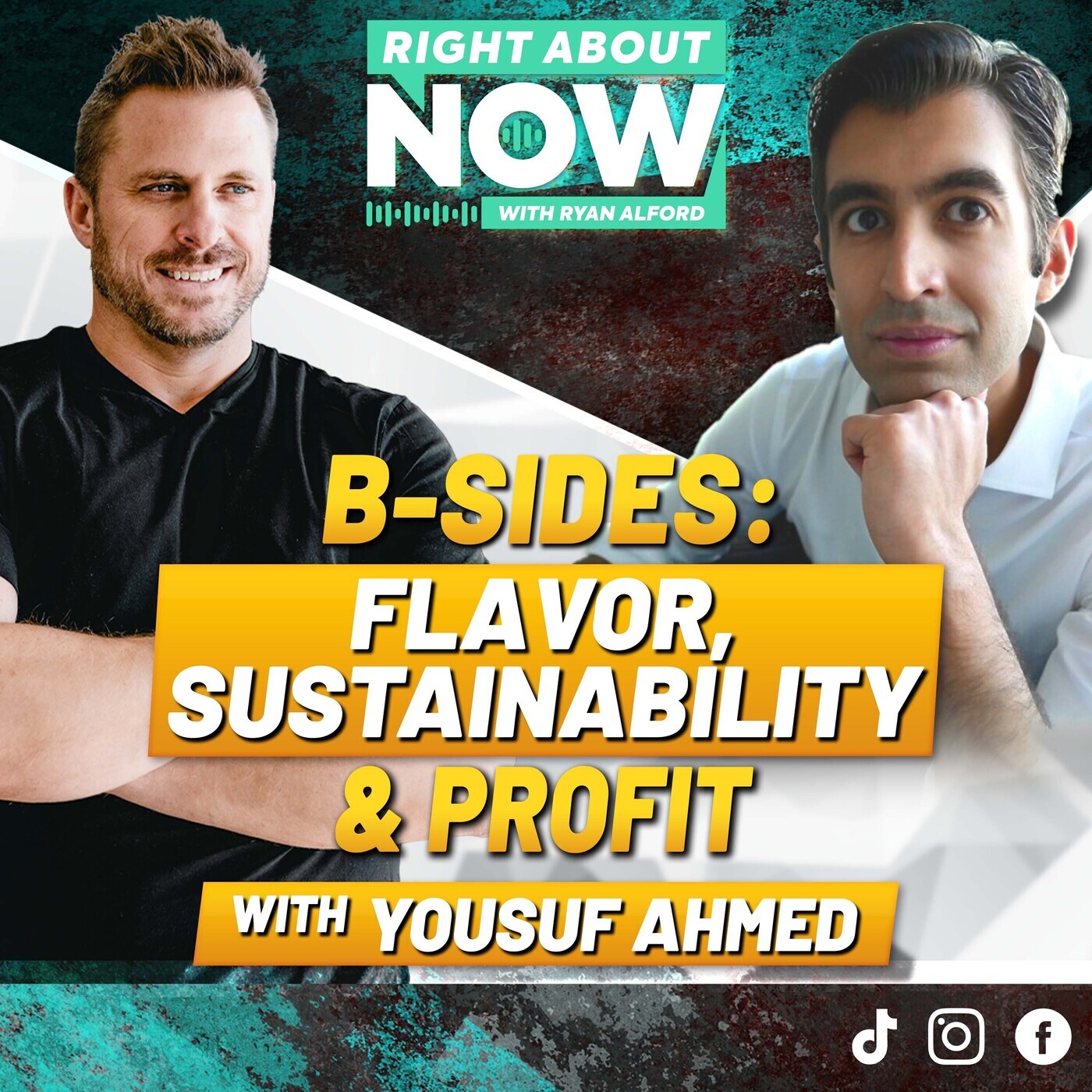
B-Sides: Flavor, Sustainability & Profit with Yousuf Ahmed
Right About Now with Ryan Alford
Join media personality and marketing expert Ryan Alford as he dives into dynamic conversations with top entrepreneurs, marketers, and influencers. "Right About Now" brings you actionable insights on business, marketing, and personal branding, helping you stay ahead in today's fast-paced digital world. Whether it's exploring how character and charisma can make millions or unveiling the strategies behind viral success, Ryan delivers a fresh perspective with every episode. Perfect for anyone looking to elevate their business game and unlock their full potential.
Resources:
Free Podcast Monetization Course
Subscribe To Our Youtube Channel
SUMMARY
In this episode of "Right About Now," host Ryan Alford interviews Yousuf Ahmed, founder of B-Sides, a sustainable snack brand. Yousuf shares his journey from Goldman Sachs to food entrepreneurship, focusing on upcycling food byproducts into tasty snacks. The discussion covers product development challenges, branding inspired by 80s/90s music, and strategies for scaling the business. Yousuf emphasizes balancing great taste with sustainability and profitability, highlighting the importance of authenticity and operational efficiency. The episode offers insights into building a purpose-driven brand and navigating the complexities of the modern snack industry.
TAKEAWAYS
- Transition from investment banking to food entrepreneurship
- Background in the music industry and its influence on career choices
- Concept of upcycling in the food industry and its sustainability benefits
- Challenges in product development using upcycled ingredients
- Importance of balancing taste and sustainability in consumer products
- Marketing strategies for authentic promotion of sustainable snacks
- Target audience for sustainable snack products and their preferences
- Omnichannel distribution strategy for reaching consumers
- Vertical integration in manufacturing to improve profit margins
- Insights on consumer awareness and cultural references in branding
See Privacy Policy at https://art19.com/privacy and California Privacy Notice at https://art19.com/privacy#do-not-sell-my-info.
Press play and read along
Transcript
Speaker 1 Look, we get it. You can hardly go anywhere or do anything these days without hearing about AI this or AI that.
Speaker 1 And if you're like most people, when it comes to AI, you're impressed, but you have a few concerns. But what if AI was used not as a tool to replace people, but as a way to help understand people
Speaker 1 better?
Speaker 1 AI from SurveyMonkey is designed to do just that, from crafting the perfect survey, which is harder than you might think, to analysis that digs deep, finds patterns, and surfaces trends quickly.
Speaker 1 SurveyMonkey's powerful suite of AI capabilities make it faster and easier than ever before to get insights from real people, helping you make confident decisions for your business.
Speaker 1 Try it today at surveymonkey.com slash Ryan.
Speaker 2 Save over $200 when you book weekly stays with Verbo. This winter, if you need to work, why not work from a chalet?
Speaker 2 If you haven't seen your college besties since, well, college, you need a week to fully catch up in a snowy cabin.
Speaker 2 And if you have to stay in a remote place with your in-laws, you should save over $200 a week. That's the least we can do.
Speaker 2 So, you might as well start digging out the Lounge, because saving over $200 on a week-long snowcation rental is in the cards. Book now at Verbo.com.
Speaker 3
Think about the app you've been wanting to build. Sell something you've created, run your community, manage your business, or launch your next idea.
Now imagine it's live.
Speaker 4 before today's over.
Speaker 3
Meet Base44, the fastest way to turn any idea into a fully functional app. No code, no waiting.
Just describe what you want and watch it come together, backend, design, and all in minutes.
Speaker 4 A real product ready to share.
Speaker 3 From idea to live app fast.
Speaker 4 Start building today at base44.com.
Speaker 5 Some things are hard to commit to, like learning how to surf or saving for a family vacation. But one commitment that's easy, switching to Fios home internet with a five-year price lock guarantee.
Speaker 5
That means five great summers of fast, reliable internet at the same low price, all with the Fios one gig internet plan. Plus no hidden fees or equipment charges.
Call 1833 Verizon to switch today.
Speaker 5 Price guarantee applies to base monthly rate only for new and existing My Home customers.
Speaker 6 Most businesses are just focused on whatever the end product is that they're making. And so trying to convince them, hey, you've got this byproduct.
Speaker 6 Why don't you invest more money to figure out what to do with the byproduct is just a really tough sell.
Speaker 6 It took me a while to figure this out because I tried doing like pizza, bagels, all sorts of stuff. And I was like, oh, this stuff is terrible.
Speaker 6 And then I started making cookies, doing plays on Pop-Tarts, and that's when everything clicked.
Speaker 6 Where I was like, oh, instead of me trying to like shoehorn this ingredient in a direction I wanted it to take it, why not like pay attention to the ingredient and formulate a product around that?
Speaker 7 This is right about now with Ryan Alford, a Radcast Network Production.
Speaker 7 We are the number one business show on the planet with over 1 million downloads a month,
Speaker 7 taking the BS out of business for over six years in over 400 episodes. You ready to start snapping necks and cashing checks? Well, it starts right about now.
Speaker 1
Right About Now. What's up, guys? Welcome to Right About Now, your number one barking a business show on Apple Podcasts.
I'm Ryan Alford, your host. We thank you for listening, watching.
Speaker 1 Hopefully you're over there on YouTube, starting to blow up there. And of course, social media.
Speaker 1 You can consume the show wherever you want to-the short, the long, the middle, but you're going to want the whole story today.
Speaker 1 Because, again, we like to bring you all the insights of what's happening now. We could talk about next year, we could talk about last year, no, it's right about now.
Speaker 1 That's why we've got the founder, he's the king of crunch of B-sides.
Speaker 1 What's up, Yousef?
Speaker 6 Hey, Ryan, how are you doing?
Speaker 1
Good. Yousuf Ahmed, the king of crunch.
I've already given him
Speaker 1
a name because he's a disruptor. He's, you know, from Goldman Socks to the king of crunch.
I mean, you got quite the story there.
Speaker 6
Oh, yeah. You know, I'm a curious guy.
I feel like
Speaker 6 if you're going to try to take a swing in this world,
Speaker 6 you got to do everything that you can.
Speaker 1
I liked everything about this package when it hit our desk. Like, okay, we've got snacks.
I'm a snack guy. Snacks.
We got crunchy things like tasty flavors, B-sides. I got the music play there.
Speaker 1 You know, so growing up in a very musical family, I love the brand, sustainable.
Speaker 1 We checked a lot of boxes, Yusuf, and
Speaker 1 things that seem interesting and disruptive, but also cool.
Speaker 6 Yeah, you know, I wanted to kind of throw everything against the wall. I thought that there are a couple of different ways that I could approach building a brand.
Speaker 6 And, you know, you hit them all in the head, right? Delicious stuff that also happens to be good for you, good for the planet. You know,
Speaker 6 what more could you want?
Speaker 1 Exactly. and look you're right down the road south carolina is where we're greenville south carolina uh born and raised in atlanta was that did i hear that right
Speaker 6 atlanta yeah born and raised in atlanta went to went to undergrad at uga oh well i mean i won't hold that against you but you know i'm i'm a clempson guy i don't know how much you're into the you got to be a college football guy right if you went to georgia you know you know it's so funny i uh i tried i tried really hard but i just i couldn't get into it i was um oh you know I, we're talking about the music background.
Speaker 6 I, uh, I started my career in the music business actually in Athens, a huge music town. And so I spent most of my time at the recording studio there, not at Sanford Stadium.
Speaker 1 Music? I mean, Goldman Socks, like, what got you to B-size? Let's give a little bit of that founder story of, you know, what got you into all this.
Speaker 6 If you look backwards, you can kind of connect the dots pretty easily.
Speaker 6 So I'm the son of a couple of immigrants who like did not want me to work in restaurants or work in food but you know food culture was kind of always top of mind for kind of
Speaker 6 based both in the US and abroad and the business manager handles everything with regards to the money both on the personal and the professional side so you get kind of a holistic picture of how the business works how artistry works how these people kind of function in their everyday lives and for a young single guy living in New York City in his early 20s like it was a dream but it's also like you're working investment banking hours for not even close to investment banking pay.
Speaker 6 So I kind of hung up that apron and like a good millennial, you know, quit my job, traveled around the world, ran out of money, came back to New York, got a job as a dog walker, and applied to business school.
Speaker 6
And then I switched over into investment management. So that's how I went to Goldman Sachs.
So I spent the next five years managing money for the top, top 1%
Speaker 6
of this country. So I was a private wealth manager.
That basically means if you had 10 million bucks or more of investable assets, you were qualified to become a Goldman Sachs private wealth client.
Speaker 6 So that category is mostly entrepreneurs and I did a lot of work in venture capital and that's the financial side.
Speaker 6 And then I wanted to basically spend 10 years managing other people's money and I wanted to do something entirely different.
Speaker 6 So I took the food out of the back pocket and said, okay, how can I plant a flag here? And that's essentially how I got to this company.
Speaker 1
The whole millennial journey there. You got the chasing the superstars and managing their money and their problems.
I would assume. And their problems.
Speaker 1 Yeah. And there are many.
Speaker 1 Any name dropping you can do?
Speaker 1 Yeah.
Speaker 6 So my biggest clients at the time were Arcade Fire, Cut Copy, Go TA, The Scissor Sisters, Vanessa Carlton, Hot Chip. So it's kind of a broad cross-section of different genres.
Speaker 6 Some of the artists had heydays, you know, in years prior, but were still living on residuals. Some of them were just coming into the forefront.
Speaker 6 And it was a fascinating time because, so this is like 2010, 2011. Spotify really, like, it had just started to percolate, but it hadn't changed kind of the music business entirely.
Speaker 6 So there was tons of money to be made in the old model. And we were just transitioning into this new kind of streaming model.
Speaker 6 So lots of personalities, lots of personality management, you know, part therapist, part accountant. It was always fun.
Speaker 1 Was it the name? I mean, obviously your own guy, I mean, probably impressed by that, like, but obviously getting to flex your kind of business management, you know, muscle.
Speaker 1 I mean, was it like the chase of, you know, the buzz of working with celebrity artists, but also getting to do the business side of what you like? Was it the combination of the two?
Speaker 6
Yeah, it was both. My very first job in the music business was at a recording studio.
I wanted to go to where the artists were.
Speaker 6 So that was like the natural kind of, okay, every artist has to record an album. Let's go do that.
Speaker 6 And then it was like, to become a recording engineer, you have to be a special kind of masochist that I just was not.
Speaker 6 And I wanted to, you know, in your words, kind of flex the business muscle of it and figure out how this, like I said, the music business was in flux back then.
Speaker 6 And I really wanted to figure out like where the money was going, how to help artists capitalize on different things.
Speaker 6 So the allure of business management was the peek behind the curtain and, you know, sitting on the same side of the table as a lot of these artists.
Speaker 6 Yeah, the names are, you know, they make the job, it gives it a sense of cachet. There are plenty of artists that you have probably never heard of that I also worked with who also need help, you know.
Speaker 6 But it's the bigger the bigger the artist, kind of the bigger the personality, and that can start to become grading over time. Yeah,
Speaker 1 I'll use the word for you, ego.
Speaker 1
Your word, not mine. Yeah, I know.
You didn't say that. You enjoyed every moment of it, but I've just heard that some of them have egos.
Speaker 1
It's a fascinating business. And that could be another episode for another day talking about the evolution of that, the music business.
But why the hell do you want to become an entrepreneur?
Speaker 1 Man, I mean, managing other people's money sounds awesome sometimes.
Speaker 1
I mean, I own five companies now, and, you know, it's, it's. I love it, and I don't, I wouldn't go back.
But at the same time, was it just you wanted to do your own thing?
Speaker 6 I think you just phrased it perfectly, right? Like, you love it, and you wouldn't go back.
Speaker 6
Once you kind of scratch the itch, there's no going back. Look, so a couple of different things.
One, I'm a super curious person.
Speaker 6 I think to be an investor, a successful investor, you have to have a sense of curiosity. And private wealth management,
Speaker 6 so the way that Goldman Sachs' model worked is here's a phone, here's a computer, go build a book of business. So it was quite entrepreneurial in that regard, right?
Speaker 6 Like I could go prospect across every sector and, you know, you're just cold calling, dialing for dollars. The dollars just happen to be like very big in size.
Speaker 6 But to become fluent in the language that a certain sector uses and how that sector is organized with regards to access to capital or how these entrepreneurs themselves became very successful and then getting to the table with the entrepreneur and meeting them and learning about their journey and their goals.
Speaker 6 All of that was so captivating to me.
Speaker 6 And it kind of just, I just kept taking it one step further, right i um basically said okay i think i figured out what traits are common to a lot of these successful entrepreneurs i think i know how the deck is stacked with regards to fundraising i have a pretty good network here what's the sector that i really want to take on that i'm really interested in and food and in particular upcycling which i'm sure we're going to touch on at some point it was a question that gnawed on me for oh man like over a decade before i actually like decided to plant my flag and say okay i'm going to figure this out and that's that's how I got into it.
Speaker 6 Now I can't imagine not doing it.
Speaker 1 If you're watching, we do have the
Speaker 1 goodness here, which I'm going to be taking my first sampling here shortly as we get used to talking about the product. But I tell you what, food innovation, like you had me a food.
Speaker 1 Then, I mean, innovating, you know, like something like a cheese pup, when I first got this package, I was thinking like back to I was a kid.
Speaker 1
You know, like the, that was like my first favorite snack was the cheese doodle. I think that's what they were called.
They called cheese doodles or Cheetos.
Speaker 1
Yeah, that favorite. They're not all Cheetos.
They're big round ones.
Speaker 6 Yeah, I know exactly what you mean. Totally.
Speaker 1 I used to love that stuff too, man.
Speaker 6 That's why I started on puffs. I feel like every American has this childhood memory, whether it's at summer camp or on road trips or whatever.
Speaker 6 And you got Cheetos, Doritos, Fritos, basically anything from the Ito family, salty, and just, you know, I'm the biggest doom snacker that there is.
Speaker 6 I'll stand at the pantry and just crush anything that's in there.
Speaker 6 And so for me, when I wanted to get into food, I knew savory snacks was going to be part of the equation just because I loved them so much.
Speaker 6 And I wanted to figure out how can we kind of push the boundaries in a admittedly overcrowded, hyper-competitive space.
Speaker 1
Upcycling. That was the first, you mentioned it a second ago.
I want you to talk about product development and what you've learned, but definitely want to go down that upcycling.
Speaker 1 I mean, I had not heard that term. Now I think I understand it, but explain to me sort of product development and what the hell upcycling is.
Speaker 6 You know, to be fair to you and all your listeners,
Speaker 6 upcycling is something that I didn't even know. That was like the catch-all phrase for the sector.
Speaker 6 And this is something that I had spent a lot of time thinking about until I really rolled up my sleeves and just got, you know, my hands dirty with this stuff.
Speaker 6 So upcycling in a nutshell is taking byproducts from food manufacturing and putting them back into the consumer food system.
Speaker 6 The easiest kind of example that I tell people is: you ever wonder what they do with the leftover oats for making oat milk? And the answer is usually they get thrown out.
Speaker 6 And I wanted to figure out what else we could make with those oats besides oat milk. And
Speaker 6 the crunch puff that you're holding is powered in part by the leftover oats for making oat milk. And this kind of example exists all throughout the food system.
Speaker 6 If you think about the leftover grounds from, you know, brewing coffee or the leftover uh
Speaker 6 pulp from juice presses or you know the leftover grains from brewing beer and distilling alcohol there are ingredients to be recaptured all throughout the food system it's literally just back solving for a supply chain problem is essentially what upcycling is you consider yourself like i get i can see you sort of like in the kitchen like were you in the i mean literally like like in the laboratory kitchen like coming up with these cheese puff formulations yeah so that's a good question i didn't actually start with the puff.
Speaker 6 Like the puff that you're seeing now is a culmination of a lot of different work. The first category that I worked in was actually with the leftover grains from brewing beer.
Speaker 6
So it's called spent grain. And so I used to live around the corner from a brewery.
They had distribution not throughout the entire state of Pennsylvania. It's kind of local.
Speaker 6
Every month, they were putting out 10,000 pounds of spent grain. So multiply that by every micro brewery.
Don't even like account for the big boys, right? That's a whole different category.
Speaker 6 And then, every microbrewery throughout the United States and just the broader kind of world, it becomes mind-boggling how much of this stuff actually gets thrown out.
Speaker 6 And so, when I started this whole path, I wanted to figure out: okay, like, what am I actually dealing with here? Like, what does this ingredient look like? What does it smell like, taste like?
Speaker 6 How can I work with it? How can I get the health department to let me work with it? How do I then scale this? And so, the cheese puff is kind of the epilogue of that journey.
Speaker 6 I actually started with a super premium line of baked goods. So if you think about breweries, like I don't know if you're a beer drinker, when I drink beer, I love salty, savory snacks, right?
Speaker 6
Like I'll eat pizza at breweries. I'll eat pretzels.
I'll eat, you know, boiled peanuts.
Speaker 6
Yeah, boom, exactly. Southern boy.
That's kind of where my mind went originally. But the problem with that is spent grain, most of the grains that are left over from brewing beer, 90% of it is barley.
Speaker 6 And barley, malted barley especially, works terribly in savory products. This is something that like Jewish deli owners have known for a really long time.
Speaker 6 The malted milkshake or malted milk bars are confections for a reason. Malt works exceptionally well in confectionery products.
Speaker 6 So it took me a while to figure this out because I tried doing like pizza, bagels, all sorts of stuff. And I was like, God, all this stuff is terrible.
Speaker 6 And then I started, you know, baking cookies, doing plays on Pop-Tarts.
Speaker 6 And that's when everything clicked where I was like, oh, instead of me trying to like shoehorn this ingredient in a direction I wanted to take it, why not like pay attention to the ingredient and formulate a product around that?
Speaker 6 And so, yeah, the first product category I worked on was, you know, high-end takes on Oreos and Pop-Tarts and Lil Debbie's oatmeal cream pies, which totally different from, you know, brome beer, but that's how we ended up there.
Speaker 1 Why do you think food waste hasn't been tackled more aggressively by legacy brands?
Speaker 6 This is the sad reality of just the way that kind of our food systems have developed. It's just not part of their business model.
Speaker 6 Let's take oat milk producers, right?
Speaker 6 If you take a company like Oatly that produces millions of gallons of oat milk on an annual basis, everything they do is around bringing oat milk to market.
Speaker 6
So all of their unit economics, all of their costing strategies, all of their production is around that end product. It has nothing to do with the byproduct.
That's actually cost of doing business.
Speaker 6
We have this thing that we produced out. We got to throw it away.
That's just built into the bottom line.
Speaker 6 And there's not a lot of incentive to get those companies to reorient around, you know, we call it byproduct valorization. Like, what do you do with all these leftovers?
Speaker 6 And so while there is ample opportunity to create additional revenue streams, most businesses are just focused on whatever the end product is that they're making, right?
Speaker 6 And so trying to convince them, hey, you've got this byproduct. Why don't you invest more money to figure out what to do with the byproduct is just a really tough sell.
Speaker 1 Yeah. So you just went straight for the solution, I guess, of the byproduct and then
Speaker 1 part of your core business model, correct?
Speaker 6 Yep, exactly.
Speaker 1 How do you balance the whole sustainability with great taste, with upcycling, with, I mean, like a lot of balls to juggle there.
Speaker 6 Yeah, you know, it's an excellent question because it's something that I've wrestled with for years and continue to wrestle with. And I always think I'm getting closer and closer to that answer.
Speaker 6
The fact of the matter is consumers, everybody is noble until they get to the cash register. And ultimately, it's about flavor and convenience.
That's just like the sad reality of
Speaker 6 humanity.
Speaker 6 If you asked 100 people, nobody's going to say, screw the environment. But when you really get down to brass tacks, trying to change consumer behavior is not a good business strategy.
Speaker 6 So you know to your point about like flavor and product like i i started with let's make a really good product and let's fold sustainability into that really good product so that way you don't have to ask a whole lot of the consumer right like you snack i snack everybody snacks to some degree here's just another really good snack why why don't you eat that snack and oh by the way all this other sustainable stuff went to power that snack.
Speaker 6 It's not really, you know, it's kind of like if you think about sustainability, the whole goal is a set of outcomes, right?
Speaker 6 Like lowering carbon, you know, emissions or reducing plastic waste or whatever. It's a set of outcomes.
Speaker 6 Now, if you can achieve those same outcomes without having, you know, beat the consumer over the head with, hey, pay more for this because we've done all these things, like, haven't you accomplished the same goals?
Speaker 6 So like the way that I view sustainability is like, just fold it into the business model, make a good product, create branding that resonates with with people, and it takes care of itself.
Speaker 1
Yeah, smart. I think two people get a little too caught up in that.
You're right, consumer behavior is very difficult
Speaker 1 and more importantly, very expensive.
Speaker 1 Very expensive.
Speaker 1 Very expensive.
Speaker 1 A lot of people have failed in that, either running out of money or running out of the ability to change consumer behavior.
Speaker 1 And, you know, I'll ask this, not being too presumptive, but you kind of answered it with how you balanced all of those three things with sustainability, with great products.
Speaker 1
I love giving gifts, but you know what? I don't love shopping. It seems impossible to find unique gifts these days.
I got four boys that seem to have it all and a wife that I want to make happy.
Speaker 1
That's why I love Uncommon Goods. They have products that are unique from some small vendors, handmade, handcrafted, made in the USA.
I love these guys.
Speaker 1 Uncommon goods makes holiday shopping stress-free and joyful with thousands of one-of-a-kind gifts you can't find anywhere else.
Speaker 1 Trust me, I know, because I couldn't find anything and uncommon goods comes to the rescue every time.
Speaker 1
Games, toys, clothes. one-of-a-kind unique things that you can't find anywhere else.
I love these guys. Let me tell you, you want to go there.
Speaker 1 You want to shop USA based, and Uncommon Goods has me and you covered.
Speaker 1
So, shop early, have fun, and cross some names off your list today. To get 15% off your next gift, go to uncommon goods.com/slash Ryan.
That's uncommon goods.com/slash Ryan for 15% off.
Speaker 1 Don't miss out on this limited-time offer. Uncommon goods were raw out of the ordinary.
Speaker 1 Hey, small business owners, let's talk about how found can help you wrangle your finances once and for all. When was the last time you felt like you had your business finances totally under control?
Speaker 1
Every expense categorized, every receipt tracked, every invoice sent. Oh, and you were prepared for tax season.
If the answer is never, you're not alone. And that's what found is for.
Speaker 1 Found is reimagining what business banking should be by putting your bookkeeping, invoicing, and tax tools directly into your business checking account.
Speaker 1 They've automated things like expense tracking, finding write-offs, and budgeting for tax time. You can even send invoices for free and pay your contractors, everything
Speaker 1 all from one app.
Speaker 1
Look. I struggle with this myself.
I pay contractors left and right, here, there, everywhere. Keeping up with all of it as a small business owner with multiple companies is next to impossible.
Speaker 1
That's what I love found. They help me with this.
They'll help you. I basically replaced three apps with just found, and I don't miss the stress at all, and neither will you.
Speaker 1
Take back control of your business today. Open a found account for free at found.com.
That's f-o-u-n-d.com. Found is a financial technology company, not a bank.
Speaker 1 Banking services are provided by Lead Bank, member FDIC.
Speaker 1 But a lot of purpose-driven brands kind of fizzle out.
Speaker 1 And so, how do you sort of scale differently? And or knowing that, I mean, really, you can almost remove a lot of businesses or brands fail, period, right?
Speaker 1 Yeah. But it just seems like the purpose-driven ones seem to maybe sizzle a little, a little fast or sizzle at first and kind of, ooh, you know, is that
Speaker 1 what are you doing to sort of avoid that?
Speaker 6 It's a great question. It's
Speaker 6 because at the end of the day, the least sustainable company is one that's not profitable.
Speaker 6 So like you can be as mission-driven as you want, but if you can't actually figure out a business model that scales based on just product or service, like what are you actually solving for?
Speaker 6 Like, what are you doing? And so for me, I wanted to lead with flavor and craveability. And sustainability is just like baked into the process, right? It's not the headline.
Speaker 8 DC politicians want to enact harmful credit card mandates that could take away your cash back and rewards points. Perks that stretch your budget and make life a little easier.
Speaker 8 Losing these benefits means less money for your family's everyday essentials, like gas and groceries. The perks you rely on could disappear, leaving you with higher costs and fewer options.
Speaker 8 Tell Congress to guard your card and oppose the Durban Marshall credit card mandates.
Speaker 1 Paid for by Electronic Payments Coalition.
Speaker 6 It's it's it's a you know a third of the minimalist small kind of type on the front of pack. It's not beating the consumer over the head.
Speaker 6 And the truth is a lot of consumers, like they can sniff this stuff out. A lot of companies, they'll just rubber stamp kind of the green, like we are green, we are purpose driven.
Speaker 6 And like, what does that really mean to a consumer, right? And so like, to your point about having sustainable companies be a flash in the pan, just make a good product.
Speaker 6 Make a product that people want.
Speaker 6 And all the change you can, you know, if you figured out how to make that product and you've backed into how to scale it sustainably from an economic perspective, then you've solved for all of the quote unquote like green outcomes that you were looking for in the first place.
Speaker 1
100%. I love that perspective, too, because you can't save the world if you go out of business.
Exactly. Exactly.
Or you got to build any impact. Who's our target for these?
Speaker 1 Because my mind was sitting here going as I I was eating. I was like, okay, well, I have four boys.
Speaker 1 I'm thinking like moms, moms to put them in like kids' lunches that healthier snack, or is it the fit people on the go that want a little, you know, want to indulge, but also be, you know, like, uh, who's the target?
Speaker 6 Yeah, it's uh, so this is also an excellent question. Basically,
Speaker 6 so the upfront answer, like the moment that I think B-Sides is built for, is kind of the 3 p.m. post-lunch slump, and you're sitting in an office.
Speaker 1 How about it's 11:45?
Speaker 1 Listen, man,
Speaker 6
to each their own, right? Like, to each their own. I eat them all the time, so we can be time-agnostic.
But to your point about like who I'm really trying to target here,
Speaker 6 yes, there are plenty of moms who are looking for better-for-use snacks. There are plenty of kind of fitness people who are doing the same.
Speaker 6 There are plenty of people who are just trying to make kind of better eating decisions throughout their lives.
Speaker 6 Here's the thing: the CPG space, consumer packaged goods, and snacks particularly, they are so overcrowded with people saying, No, I'm a better for you option. No, I'm the better for you option.
Speaker 6
Or I have a cleaner ingredient label. No, my ingredient label is cleaner or shorter.
So I think consumers today, A, they're exhausted by this, right? Like, it's just like ping-ponging back and forth.
Speaker 6
No, it should be grain-free. No, we should do a blend of grains.
People, at the end of the day, they just want a snack that
Speaker 6 they're going to be able to feel good about and that just like scratches the itch of wanting to eat a Cheeto or a Dorito without actually doing that. And so, you know, for me, the target, the 3 p.m.
Speaker 6 office slump, a lot of people they go to their office pantry and you basically have skinny pop or you've got like a cliff protein bar or you have nuts, right?
Speaker 6 Like, and how many bags of nuts do you want to eat? When really, what people start to crave, like, they want the bag of Cheetos, but they just feel like they can't have it.
Speaker 6 And the reason I'm going to the like the office space and kind of higher-end corporate pantries and hotel mini bars and angles like that are
Speaker 6 the trying to go for the like Cheetos and Frito-Lay's core consumer. They've got like 80% household penetration, so they can compete on price, right? Like they'll, they can charge 40 cents a bag.
Speaker 6 I'll go out of business if I try to charge 40 cents a bag. So I got to go for people who have a little more flex in what they can pay for.
Speaker 6 And the people who just want a good snack without feeling like they've broken the nutritional bank, that's the target consumer. They're typically wealthier.
Speaker 6 They're typically, you know, they're not so overbent on reading every single ingredient on the ingredient label, even though we've checked all those boxes. They just want a good snack.
Speaker 1 Ironically, it could be in the back room of those recording studios.
Speaker 1 Exactly. Exactly.
Speaker 6 We're looking for sponsors. So, you know, right about now is on the target list.
Speaker 1 And hey, I'll tell you what, the
Speaker 1
I own co-work space as Worby is called Social House. We're a co-work lounge.
And that was the first thing I thought actually was: there you go. These need to be in social house, you know, like as our
Speaker 1
people are working, but also it's the bar hangout crowd because we have a bar, it's kind of a sports bar meets a co-work space. And hey, perfect.
That's a great place.
Speaker 1 Yes, I know.
Speaker 1 You kind of nailed this. It's like
Speaker 1 the rise of like functional snacks. I mean, is protein still pack a punch or consumers evolving past macros?
Speaker 6 yeah you know so protein is such an interesting thing because it i think it depends on who you talk to for example i talked to a bunch of friends who um they're gym rats they they are like jacked they love going to the gym and i asked them in like a snack what is the minimum amount of protein that snack has to have for you to like buy it and they'll say like it has to have like 30 grams of protein I'm like, dude, that is, that's like a rotisserie chicken.
Speaker 6
Like, that is not a snack. And so, you know, I've got five grams of protein per serving, right? That bag that you're eating right there has 10 grams of protein.
That's 20% off.
Speaker 1
It's great to be 10 in a hurry. Boom.
Yeah. Yeah, exactly.
Speaker 6
Right. And so it's kind of like, I'm not going for the gym bros.
They want the David protein bars.
Speaker 6 Having said that, like, what you'll start to see as you eat more and more of these is like they become quite fulfilling.
Speaker 6 Like you don't feel hungry in five minutes, seven minutes, 10 minutes after the fact and just think like, Jesus, did I just like, you know, crush a whole bag of chips for nothing?
Speaker 6
Like it gave me nothing. You actually feel like pretty satisfied.
So, you know, not going after the gym bros, there's a whole market of people like myself.
Speaker 6 Like, I am not a, as I'm sure you can tell, like, I am not a gym bro, but I do want a fulfilling snack. I want to end kind of the doom snacking cycle.
Speaker 6 That's, that's kind of the whole idea behind product development.
Speaker 1 How are we scaling this? Did we start D to C? What's been that path to distribution and scaling?
Speaker 6
I took a, all of the above omni-channel approach. So, like, right now, you can find these products on amazon.com, Walmart.com.
You can get them direct to consumer e-commerce via my website.
Speaker 6 I also did a limited kind of retail footprint distribution strategy here in New York City. So I'm in 25 different retail shops.
Speaker 6 It's a mix of kind of higher end, independent, family-run grocery chains, some higher-end bodegas, some of the higher-end delis,
Speaker 6
but geographically distributed across different neighborhoods, different cross-sections of people. It's all market testing.
I wanted to figure out who's buying it. Are they repeat buying it?
Speaker 6 Where is velocity the highest?
Speaker 6 And I'm running kind of a paid ad strategy targeting the different aspects of the snack, right? Do people buy it because of sustainability? Do people buy it because of nostalgia?
Speaker 6 Do people buy it because of protein? And the punchline is all three.
Speaker 6 So, like, trying to figure out how to pick a lane has been tricky, but that's why I led this whole conversation with, you know, I I got to go to what consumers really want.
Speaker 6 Where is consumer behavior really kind of driving this? Because at the end of the day, that's where snacks become quite interesting.
Speaker 6 Snacking is personal and experiential, and people's snacking habits and their buying habits revealed preferences, like where they actually spend the dollar versus what they say that they do, two totally different things.
Speaker 6 And so, distribution strategy, how am I scaling this? I think doing this omni-channel approach is kind of table stakes in this day and age.
Speaker 6 There aren't really brands that are successful just doing retail or just doing e-commerce. You have to have a little bit of both.
Speaker 6 So I am a little bit hesitant to really go aggressively at the national retailers.
Speaker 6 So that's like the targets, the Walmarts, not Walmart.com, Walmart kind of retail, Whole Foods, et cetera, et cetera, et cetera, Costco. And the reason for that is for
Speaker 6 to make those business models work, you have to get everything right.
Speaker 6 The branding has to be right, the packaging has to be right, the brand positioning has to be right, and you have to take an all of the above kind of advertising approach.
Speaker 6 And if you get any one of those things wrong, you can't get to escape velocity before getting crushed under the reality of just scaling for retail.
Speaker 6 So I'm taking a more tepid kind of surgical approach, doing all the above with a focus on e-commerce. A lot of people are just buying more stuff online these days.
Speaker 1
Yeah, they are. And I mean, they'll buy anything direct, just about.
That genie's out of the the bottle and probably for good. You know, if they like it and they can get it straight from the source.
Speaker 1 And if you're plugged into, you know, that the immediacy of Amazon and even Walmart's got it together with one, two day shipping, all that stuff.
Speaker 1 That's where it is because, you know, I got to have that snack when I want to use it.
Speaker 1 Exactly.
Speaker 6 You can have it in prime two-day shipping.
Speaker 1
Like me right now, reaching back for this bag that I can't stop eating now. I'm doing a podcast.
It's not supposed to be good for TV, but I can't help it because they're really tasty. You,
Speaker 1 okay, I got an idea.
Speaker 1 I was thinking, okay, B-sides, you need to get a rock group and you'd get a couple of B-sides songs and you put the QR code on there and you, you know, the exclusive B-sides, B-sides.
Speaker 1 You know, Pearl Jam will do that for you, right?
Speaker 6 Oh, man, I would love it if Pearl Jam did that for me. You know, at that point, I could just hang it up and say, like, I've made it.
Speaker 6 You know, like, if Mike McCready is crushing my crunch puffs, I'd be happy as a clam.
Speaker 6 Yeah, you know, the music thing is funny because I, one of the reasons that the packaging looks the way that it does, the branding looks the way that it does, is there's like if you look at the snack aisle, there's just like this sea of sameness where you get a lot of pastels, a lot of clean-cut sans serif fonts.
Speaker 6 And I was like, you know, this is a little bit boring to me. I want to do something a little more irreverent, a little grungier, a little more in-your-face.
Speaker 6 And
Speaker 6 that, I took that from actually 80s and 90s alternative rock. That was, you know, grunge was like my, my favorite genre growing up.
Speaker 6 And, you know, lo and behold, trying to overlay that theory onto branding for a snack like just does not work. Like people just did not get it.
Speaker 6 And so, you know, we're, we're kind of, this is all market testing. We're going to update, refresh the branding for what people like.
Speaker 6 But yeah, music is a, it's a really tricky kind of angle to go after.
Speaker 1 Yeah, I'm sure. But
Speaker 1
how many people, you've done enough research. I'm sure, I mean, you're doing it, you've got it real time.
What have you learned from that? Like, I know that because I grew up in it.
Speaker 1 If you ask 10 people if they, you know, do you know what B-sides is? You know, like, I don't know, maybe more people do that I don't know.
Speaker 1 But like that and just other things you've learned from research.
Speaker 6 First question first: like, do people know what B-sides are? So I mentioned earlier that we were playing in the super premium pastry space, and that brand was actually called mixtape.
Speaker 6 It was a like a soft launch.
Speaker 6 And, you know, get this.
Speaker 6 90% of people, I would tell them the brand name. They'd be like, what is a mixtape? And I was just like, oh my God, have I gotten old? Like that people just don't know what this is?
Speaker 6 And, you know, so to switch it over to B-sides, the whole reason that I did it.
Speaker 6 So for those who don't know, a B-side of a recording is like when a band puts out an album, the album has, let's say there are 12 songs in the album. Usually they record between 15 and 17 songs.
Speaker 6
Those songs that didn't make it onto the album, those are known as the B-sides. They're usually put on a like a limited edition release.
They're for the super fans.
Speaker 6 And the beautiful thing about B-sides are when they're really, really special, they can be better than the entire album. They just, for whatever reason, didn't fit the ethos of the album.
Speaker 6 And so, you know, for me, that's the philosophy that I wanted to take to food ingredients, right like what about all the stuff that's left over how can we make that super special and make it even better than the product that was actually put out in addition to that it's kind of like the homonym right like it's it's on the back of the packaging you know what can we make with these leftover oats besides oat milk and we're also working on a couple of different marketing campaigns around like everybody has a b side you know you've got this duality of like life before you eat the snack could could be mundane kind of boring you have the snack, and it puts life in technicolor, and that's kind of your B-side.
Speaker 6 So, you know, there are multiple approaches to it in terms of like how people resonate with it.
Speaker 6
People eat with their eyes, so like they see the puff first. That's what kind of really draws them in.
And then they just treat it as like, this is just a crunchy, good snack. I just like this snack.
Speaker 6
It doesn't ultimately matter what the brand name is. You know, you've got Elizabeth's granola.
Like, nobody knows who Elizabeth is, even though she's like crushed the granola space.
Speaker 6
Or nobody knew what a Snickers was when it first comes out. It doesn't actually evoke like what the snack itself is.
And I view B-sides as a platform to rethink food waste across categories.
Speaker 6 So crunch puffs will be the first, but they're not going to be the last snack that I introduce.
Speaker 1 Where seconds come first.
Speaker 1 That one's free. You said furnace.
Speaker 1
Where do you want this plane to land? I mean, and land is an interesting thing. It's a journey to being an entrepreneur.
Where do we want to go? And what's been the like biggest surprise learning?
Speaker 1 And where do you want to take it?
Speaker 6 Where do I want the plane to land?
Speaker 6
I'll take that first. So I'm fundraising right now.
And I've been trying to angle this towards investors for a couple of years, trying a couple of different things.
Speaker 6 And ultimately, you know, originally I was so focused on the pitfall that you kind of mentioned at the top that a lot of mission-driven brands kind of fall into where you can charge this green premium, and the business will come.
Speaker 6 And like, that's just not true, especially not in snacking. And so, when I tried to lead with that with investors, it just didn't land.
Speaker 6 You know, they've got sustainability mandates, but like the business case wasn't there.
Speaker 6 So, what I started to do was say, okay, how can I like fold this into the business pitch, make this part of the value proposition?
Speaker 6 And what I found is, in a nutshell, I am kind of vertically integrating at my manufacturing facility different lines.
Speaker 6 And so, what I mean by that is like the facility that I make the puffs in also produce oat milk for independent oat milk suppliers.
Speaker 6 So, if I can redirect that oat milk off of somebody else's line into my extruder to make my puff, instead of having to kind of source it from a different location, move it to my location, and then scale it up from there, I can take my gross margins
Speaker 6 from, you know, 50% at launch to north of 80% which is like supplement margin territory and that doesn't really exist today in snack foods right so there's a business case to be had that is also
Speaker 6 the sustainability tailwind kind of drives it so my goal is because I can get these wide margins I want to grow this to a top-line revenue number at such thick margins that I can get acquired by one of the big boys way earlier on than having to grow this to a hundred million dollar brand that is internationally distributed, doing all of the things that people used to do.
Speaker 6 So that's kind of the where do I want the plane to land.
Speaker 1 Do you have a roadmap for that to happen?
Speaker 6 Yeah, so 2030 is kind of the end date. By the end of this year, we should have the vertical integration piece in play.
Speaker 6 And then starting next year is when I'll begin courting kind of those national retailers, because at that point, I'll have had enough kind of brand development, brand awareness that I can go into those conversations from a position of strength, not a, hey, I'm also another brand that makes a cool snack puff.
Speaker 6 You know, look at what I'm doing. So the next, you know, couple of years are just grow the brand, get the production so tight that, you know, those 80% margins are not a reach.
Speaker 6 They're what I'm doing on a day-to-day basis.
Speaker 1 Yeah, that if you can get there,
Speaker 1 that kind of margin is the sky's the limit. I mean, are you enjoying it?
Speaker 1 You know, like
Speaker 1 a lot of people, you know, like entrepreneurship and all this, it gets glamorized, but you got to enjoy it, right?
Speaker 6 Yeah, you know,
Speaker 6 it's that is such an interesting question because I think enjoyment means so many different things to different people.
Speaker 1 It doesn't mean it's fun. I'm not saying it's fun.
Speaker 1 It's work.
Speaker 6 You know, it is fun, though, to an extent. You have to be willing to wake up every day and get kicked in the teeth and just say, yeah, I'll do it again.
Speaker 6 And I can get better at getting kicked in the teeth every day.
Speaker 6 And, you know, as long as you're just solving for the problem in front of you, instead of trying to solve for things that are, you know, future problems, it becomes more manageable.
Speaker 6
You get really good at what you're doing. You get really creative at what you're doing.
I've met a lot of really interesting people.
Speaker 6 To your point about the brand building, there's so many different angles that you can take that just excite me. The product development, I love the product side of it.
Speaker 6
And there's so many other products that I'm very excited to bring to market, you know, within the next 18, 24 months. Like, yeah, I'm loving it, man.
But at the same time,
Speaker 6
I wish I was five years ahead of where I am today. And I wish that five years ago.
It's just, it's always a grind. But if you're, if you're built for it, you know, just, just go ahead and do it.
Speaker 6
Jump on the deep end. There's no, you know, you only get one shot at this.
Like, just go for it. Very true.
Speaker 1
You, you got to put one foot on the other. And you do need to enjoy the journey.
And because you'll look back one day, you're either
Speaker 1 You're learning something one way or another every day. And I've rushed through things and then it doesn't get where I want to go.
Speaker 1
And then, you know, we're always in a hurry, especially as entrepreneurs, like to the next thing. And hey, man, I really like the brand.
They're delicious.
Speaker 1 I've been able to put them down since I started snacking.
Speaker 1 Spent 30 minutes of eating one of my favorite snacks here. So
Speaker 1 Yusuf, where can everybody learn more about what you're doing, the brand, buying these things? We mentioned it a little earlier, but let's hit on those again.
Speaker 6
Yeah, so we're on Instagram at Enjoy B-Sides. We're online at enjoybsides.com.
Like I said, you can check us out on Amazon.com.
Speaker 6 We've got a couple of interesting kind of marketing forays towards the back half of the year. So you should follow now so you can get kind of, we'll be doing lots of different sales.
Speaker 6 We're sourcing a lot of, hey, what kind of flavors do you guys want? So if you want to be involved in, you know, building this thing together, please follow along.
Speaker 1 Love it, man. I really appreciate you coming on and really love the product.
Speaker 6 Thanks so much, Ryan. I really appreciate the opportunity.
Speaker 1 Hey, guys, you're going to find us. RyanisRight.com.
Speaker 1 We'll find the full episode from today's Get Together with you a snack snack snack episode i had to think of something i don't know what it was uh delicious and nutritious for the brain you got to go check out b-sides we'll have the highlight clips links to all of their stuff where you can get this amazing snack that will be at social house very soon and of course you know you can find me at ryan alford on tick tock instagram all those that blue check before you could buy it baby we'll see you next time right about now
Speaker 7 this has been right about now with ryan Alford, a Radcast Network production. Visit ryanisright.com for full audio and video versions of the show or to inquire about sponsorship opportunities.
Speaker 7 Thanks for listening.
Speaker 1 Look, we get it. You can hardly go anywhere or do anything these days without hearing about AI this or AI that.
Speaker 1 And if you're like most people, when it comes to AI, you're impressed, but you have a few concerns. But what if AI was used not as a tool to replace people, but as a way to help understand people
Speaker 1 better?
Speaker 1 AI from SurveyMonkey is designed to do just that, from crafting the perfect survey, which is harder than you might think, to analysis that digs deep, finds patterns, and surfaces trends quickly.
Speaker 1 SurveyMonkey's powerful suite of AI capabilities make it faster and easier than ever before to get insights from real people, helping you make confident decisions for your business.
Speaker 1 Try it today at surveymonkey.com/slash Ryan.
Speaker 2 Save over $200 when you book weekly stays with Verbo. This winter, if you need to work, why not work from a chalet?
Speaker 2 If you haven't seen your college besties since, well, college, you need a week to fully catch up in a snowy cabin.
Speaker 2
And if you have to stay in a remote place with your in-laws, you should save over $200 a week. That's the least we can do.
So, you might as well start digging out the Lawn Johns.
Speaker 2 Because saving over $200 on a week-long snowcation rental is in the cards. Book now at Verbo.com.