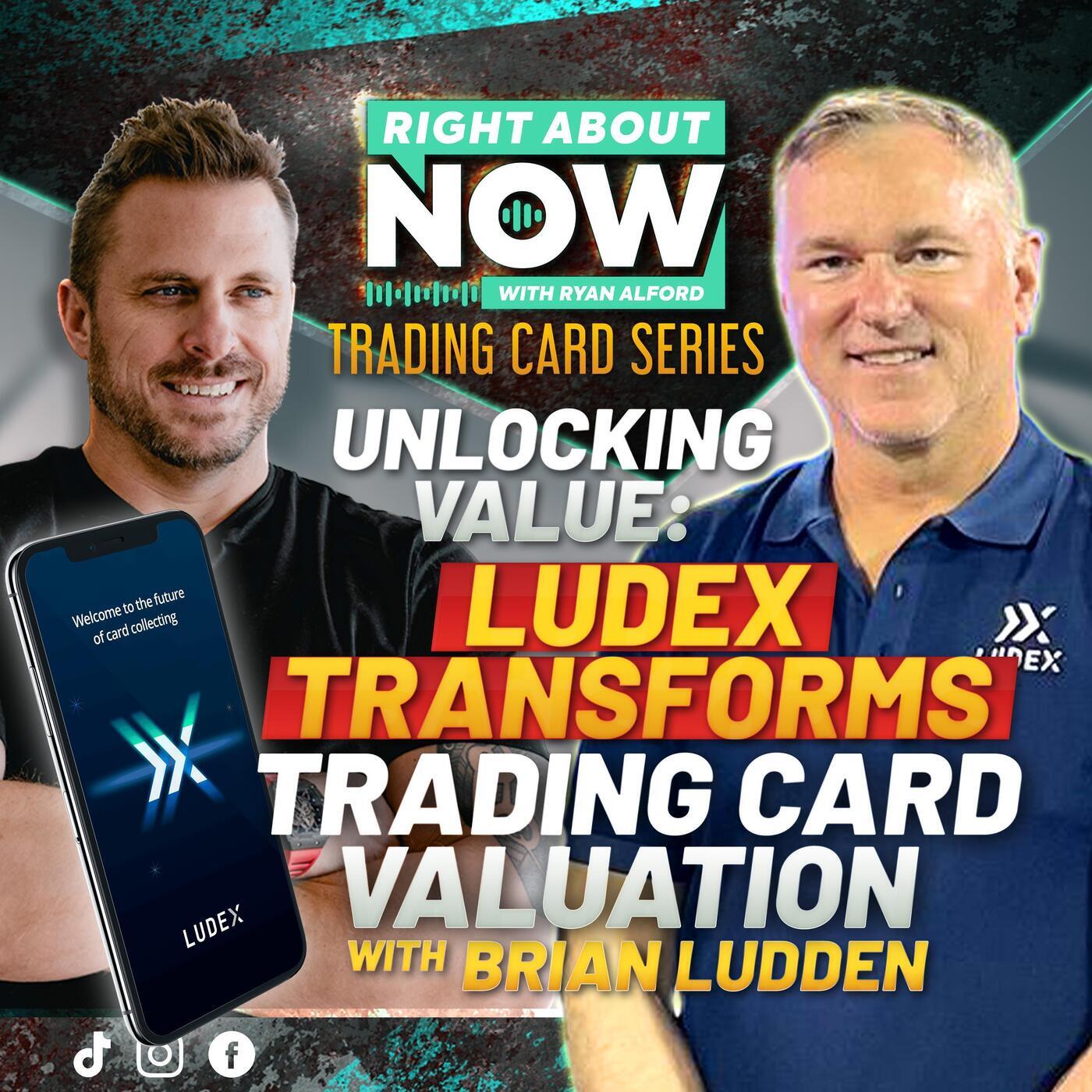
Unlocking Value: Ludex Transforms Trading Card Valuation with Brian Ludden
Right About Now with Ryan Alford
Join media personality and marketing expert Ryan Alford as he dives into dynamic conversations with top entrepreneurs, marketers, and influencers. "Right About Now" brings you actionable insights on business, marketing, and personal branding, helping you stay ahead in today's fast-paced digital world. Whether it's exploring how character and charisma can make millions or unveiling the strategies behind viral success, Ryan delivers a fresh perspective with every episode. Perfect for anyone looking to elevate their business game and unlock their full potential.
Resources:
Free Podcast Monetization Course
Subscribe To Our Youtube Channel
SUMMARY
In this episode, host Ryan Alford and guest Brian Ludden, CEO of Ludex, discuss the booming trading card industry and the transformative role of technology. Alford shares his personal experiences with trading cards, while Ludden details his journey from derivatives trading to founding Ludex, an app that scans and values trading cards. They explore the challenges of accurately pricing cards, the impact of technological advancements, and the evolving market dynamics. The episode highlights the potential for growth in the trading card sector, emphasizing Ludex's role in modernizing the industry and enhancing the collector experience.
TAKEAWAYS
- Growth and evolution of the trading card industry
- Personal experiences and nostalgia related to trading cards
- Introduction and features of the Ludex app for card valuation
- Challenges in accurately pricing trading cards
- Impact of technology on the trading card market
- Supply and demand dynamics within the trading card industry
- Community engagement and trading practices among collectors
- The role of subscription services and B2B platforms in the trading card business
- Future trends and potential for growth in the trading card market
- Importance of data-driven strategies in enhancing collector experiences
See Privacy Policy at https://art19.com/privacy and California Privacy Notice at https://art19.com/privacy#do-not-sell-my-info.
Press play and read along
Transcript
Speaker 1 Look, we get it. You can hardly go anywhere or do anything these days without hearing about AI this or AI that.
Speaker 1 And if you're like most people, when it comes to AI, you're impressed, but you have a few concerns. But what if AI was used not as a tool to replace people, but as a way to help understand people
Speaker 1 better?
Speaker 1 AI from SurveyMonkey is designed to do just that, from crafting the perfect survey, which is harder than you might think, to analysis that digs deep, finds patterns, and surfaces trends quickly.
Speaker 1 SurveyMonkey's powerful suite of AI capabilities make it faster and easier than ever before to get insights from real people, helping you make confident decisions for your business.
Speaker 1 Try it today at surveymonkey.com slash Ryan.
Speaker 1 The premise is trading card business too big to ignore and you need to know more about it. It's not the corner store anymore, it's grown up.
Speaker 1 Every collector's a sports fan, but not every sports fan's a collector.
Speaker 2 This is right about now with Ryan Alford, a Radcast Network Production.
Speaker 2 We are the number one business show on the planet with over 1 million downloads a month,
Speaker 2 taking the BS out of business for over six years in over 400 episodes. You ready to start snapping necks and cashing checks? Well, it starts right about now.
Speaker 1 Right about now. Hey, what's up, guys?
Speaker 1 I'm excited. You know,
Speaker 1 I get to do my show. And look,
Speaker 1 we make our own rules here anyway, but we talk business, we talk marketing, we talk current events and, you know, things that you need to know as a small business owner, as an investor, people trying to get ahead.
Speaker 1 And, you know, it's been interesting the last few months with my kids trying to teach them through business through the lens of trading cards.
Speaker 1 And that's why I am really excited because, you know, it is the number one app opened on Ryan Offord's phone in the last three months. And I've got the founder, Brian Ludden from Luddix.
Speaker 1
What's up, Brian? Brian, thank you so much for having me. I'm excited to launch off the Collectibles trading card podcast with you guys.
And thanks for downloading the app and using it. Yeah, man.
Speaker 1
It's fun. It's been a blast getting back into it.
Grew up doing trading cards. And, you know, it was always, I was always a little mini entrepreneur.
Speaker 1
It was definitely a little side hustle for me as a kid growing up. And, you know, like most kids, you get into other things.
I don't know, girls and cars or whatever, college.
Speaker 1
And you got the old trading cards in the closet or whatever. So it's been on the shelf for a while.
And my kids, you know, mine are 14, 13, 12, and 9, you know, four boys.
Speaker 1
And they've been late to the game. You know, I always thought they'd get into it.
I was almost somewhat glad they didn't economically, but I was sort of just waiting in the wings.
Speaker 1
And I hadn't, if they didn't get into it, I wasn't going to get back into it. And they picked it up.
And again,
Speaker 1 going down that rabbit hole early, Luddex hit the radar for all right, how are we going to keep up? How much is our cards worth?
Speaker 1 You know, when you open a pack, having the best app for the scanner of the card, that's what Ludex does. You guys will go check it out.
Speaker 1
And you probably, if you're listening in your trading cards, you know Luddex. But if you don't, you got to know how much those cards are worth when you open them.
And that's what Ludex does.
Speaker 1
I mean, talk a little bit, Brian. Let's set the table for everyone about, you know, your kind of journey into the business and what got you going with Ludex.
Yeah. Well,
Speaker 1
it was like any journey. It's a winding road.
I was a derivatives trader for 25 years down at the exchanges in Chicago. My company got acquired in 2017.
I had a three-year.
Speaker 1
I had to work with that company. I was not a great employee.
I did not win employee of the month, that's for sure.
Speaker 1 But during that time, during COVID, kind of like similar to your stuff, I had cards sitting here and like one of, and we have a place in the city, and my son and I were here, my 14-year-old son now.
Speaker 1 And I'm like, hey, let's check out these cards. They're getting more valuable and blah, blah, blah.
Speaker 1 And I was looking at it and I couldn't figure out what these cards were, what they were worth, like any comps, anything.
Speaker 1
And then I bought a new pack of cards and the new ones with all the variations and shiny and shimmer. So I'm like, this is ridiculous.
this industry, there's got to be something out there.
Speaker 1
And I looked for like, you know, 30 days. I'm like, holy crap, this industry is massive and it has not had a tech revolution yet.
And so I said, I'm going to go out and do it.
Speaker 1 And I raised $5.3 million
Speaker 1 in 45 days from all the traders on the floor. And we are on our way.
Speaker 1
I love it. I love it.
But you're so right. Like, I remember growing up, get this, Brian.
I don't know if we're the same age. Probably, I might be a little older than you.
You're a little
Speaker 1
younger. Okay, a a little younger.
All right, you look good. So, growing up, you'd have to go find the book, you know, the Beckett or whatever it is.
Like, think about what we had to do, man.
Speaker 1 The same thing with music, you know, at the MP3 player. But, like, God, think about what I had to do to find out what something was worth and trying to do trades.
Speaker 1
And, like, how did we trade as kids, not knowing what that stuff's worth? You're right, dude. Like, that's what I did.
I had a Beckett magazine I bought. I was like, this is ridiculous.
But
Speaker 1 I'm scanning through page 800. Yeah.
Speaker 1 How accurate can it be?
Speaker 1
Trading shows every day and no comps. And you know, also, Ryan, I'm new to this industry.
It's mind-blowing how difficult this industry is to learn, to transact, to trade, to buy.
Speaker 1
Like it is, it's really hard. There's friction on every single level.
And it's still a $30 billion industry and growing, you know, cager of eight. You know, so it's, I mean, it's massive.
Speaker 1
So think about when technology comes into this worldwide, globally, how big this can get. No kidding.
Oh my God. Hey, and right about now is going to help spread the word, baby.
Speaker 1 You man, we're going to get it out there.
Speaker 1 Oh, talking with Brian Ludden. He is the CEO and founder of LudX.
Speaker 1 And look, it's one of the challenges we're just talking about, okay, grading, yeah, not grading, but getting the value of your card so you know when you're trading, you're making deals, like either with friends or to sell them on eBay or something like that.
Speaker 1 Linux, you open the app, you scan it. How hard has it been with all the variations? Because you talked about it.
Speaker 1
And oh my God, that's been the biggest awakening for me: is how many of these SSPs and inserts and shiny and shimmer. And like, talk about the technology of the scan to value.
You know,
Speaker 1 is that as hard as it seems? It was harder.
Speaker 1 It was much harder.
Speaker 1
It took us like 12, it took us a year to get base cards and Pokemon and Magic at above 90% accuracy. We're like, we got this thing.
We're crushing it.
Speaker 1 And it took us two and a half years and probably $8 million to be able to get parallels in the upper 80s, low 90s because of all the variations and how people take pictures.
Speaker 1
And you have to train out like blurs and light. And so it was insanely difficult.
But there was a time when I was like, good, I'm glad this hurts.
Speaker 1 I'm glad this is difficult because there's our moat, right? And we grinded.
Speaker 1 We grinded and grinded and just stayed afloat for long enough to, you know, to de-risk it and really get to where we needed to to make this a scalable business. Yeah.
Speaker 1
I mean, it's not perfect, but it's the best and it's good. I mean, it's it great.
It's so much faster and more efficient than looking it up. Yeah.
Speaker 1 And so like, and I love the brand, you know, I love the look of the brand. It feels, it's got the, it feels like what a modern trading card company should be.
Speaker 1 That's the best compliment I could give you
Speaker 1
That's a high compliment. Thank you.
But you know what? You asked another part of that question. The most difficult thing that we've had is pricing.
There's a change in these big corporations.
Speaker 1 You could go and get their data. You could scrape around the world and get whatever you wanted.
Speaker 1 But after these, like the chat GPTs of the world, which become the greatest scrapers of all time of information, These companies are now starting to be like, hey, we're going to put this data behind a wall.
Speaker 1 And if you want it, you either have to pay us or tell us why you want your value prop.
Speaker 1 So, the comps are really hard because if you think about it, there's a comp happening at the card show, there's one happening with your boys at school, there's one happening on eBay, there's no central clearinghouse that says this card is worth $1.50.
Speaker 1 So, that pricing has been really difficult. But we are working on our own pricing algorithm coming from the options world where I priced all the options.
Speaker 1
It's going to be cool, but it's probably about six to nine months from now. But it's going to be at least consistent is what we're looking for.
There's still a lot of variation.
Speaker 1
That was one thing I was the biggest surprise of coming back. I was like, okay, surely tech's gotten better.
Oh, tech's gotten better. We got Luddux in the house.
Speaker 1 But then the variation of pricing from one to the other, and it's like, are we just summarizing eBay?
Speaker 1
It's what it seems like because it's the biggest marketplace, right, for online or what I, what we call trackable sales. Yeah, yeah.
I don't have any problem with eBay.
Speaker 1 I just don't like them taking 13% of every sale.
Speaker 1
I mean, I know they got to make money. I get it.
No, it hurts, man. You sell a hundred dollar card and you're like, you walk away like $78.
You're like, what the, you know?
Speaker 1
Yeah, I know. And eBay's a great partner to work with, but I mean, they do control it.
I mean, I'm ballparking that they're $3 billion
Speaker 1
GMV on trading cards and no one's even close. Second.
Yeah, that's it. That's their number one thing sold.
What's that? Is it their number one product on the entire platform? Got to be right.
Speaker 1
It's right behind auto parts. That makes sense.
It's crazy, the volume. We put stuff up there you get eyeballs i mean any marketplace is
Speaker 1 you know you got it you need attention to drive up the value yeah i mean you hit it like if a marketplace is going to work you need three pillars you need trust you need volume you need velocity right and so if you have those things you have a chance to succeed yeah but most people don't think about that the other thing that's super important is a funnel like how are you getting people into your marketplace are you gonna have to steal them from ebay which is a high cack and expensive and difficult or like a Luddex, we have the tool that gets people in.
Speaker 1 And when you're in the ecosystem, do you want to go grade a card? Do you want to go look at a live stream? Do you want to sell your card on eBay? That's what we want to be.
Speaker 1 We want to be the nucleus, the Huff and Scope model, and just get brokered, get a dime per listing, you know, get referrals from PSA and just really help our users experience the industry in a broader sense.
Speaker 1 Well, it starts with that slick interface and scanning the cards quickly, as accurate as any platform or more, I'd say, than the only one we use consistently, and literally getting that value.
Speaker 1 That's where it starts. It's like, okay, what do I have here? You know,
Speaker 1 and that's what Linux kind of is the gateway to that, the starting point. So it makes a ton of sense that you then lead them, you know, to these other channels or aggregate them yourself.
Speaker 1 I know a smart businessman when I see them. But again, it starts with that, because this is what happens.
Speaker 1 I pulled a gold josh town a downtown josh allen out of a 15 donrus pack two months ago and i knew it was good i mean i we'd been back in it just long enough one of 10 and it was in asheville north carolina shopping with friends and they thought i was nuts buying a trading card i did not have my kids with me this is how this is how deep it's gone brian but anyway i knew i had something and i knew even Luddex necessarily wasn't going to be the source for a one to ten and it was a new series.
Speaker 1 However, what the biggest thing is when you open those cards is, what do I have? What is that's the question? Because you know, you got something good, you know.
Speaker 1 My kids know, but they're like, they don't know how good. And Ludux is kind of the gateway to knowing what you have.
Speaker 1 Yeah, it's it's uh knowing what you have and knowing what it's worth. Those are the two pillars that, you know, we kind of go off of.
Speaker 1
And, you know, it's technology, so it's, it's never done, it's never completed. But yeah, I mean, really, that's what we want to be.
We don't want to be an authority in anything.
Speaker 1 What we want to be is we want to be an information tool to help people enjoy this industry and this hobby. And
Speaker 1
you're a great story about this because you have four boys. They're active.
I'm sure they're in sports. But you guys can bond over this.
And there's a business to be made.
Speaker 1
And you guys can buy and sell. And you can go to shows.
You come to Nashville and Chicago at the end of July. You could be our guest there with your boys.
We run the VIP lounge.
Speaker 1
Oh, that's awesome. It's awesome.
But, anyways, this industry is about that. And that's what Luddux wants to be.
Information tool, help people out and enjoy the industry.
Speaker 1 E-comm and eBay certainly enabled this 10, 15.
Speaker 1 It's been around. With these tools like Ludex and digital and all this stuff, I mean, we've moved from just the corner store, like everybody can have a store.
Speaker 1 The whole revolution of this industry is like playing out in digital form and social media and all of this.
Speaker 1
Trading cards is the perfect realization of all of this proliferation of technology. Yeah.
Is what it's come to me. Yeah, you're right.
I mean, the industry, like I said, even eBay, how big eBay got.
Speaker 1 I don't know if you list cards on eBay, I'm sure,
Speaker 1 but how painful that process is.
Speaker 1
And they still do 3 billion in GMV. Imagine, like, when Luddex puts a card on eBay, we could put it on in 30 seconds.
It takes me three minutes to put it on eBay's way.
Speaker 1 So what that does is that's going to increase people's enjoyment, right? Like, you have information, you can make money on it, go do it. And there's a lot of different people coming in this industry.
Speaker 1 I mean, the way I look at this industry is it was on pause since the mid-90s. Everyone was good in their spot.
Speaker 1 Then people started to get into it, cards started going up, and then you start seeing celebrities get into it, then you start seeing big companies, multinational companies like Fanatics buying and acquiring.
Speaker 1
And then you have massive, massive shows on massive levels. And now you're seeing venture capitalist get in.
You're seeing sports teams. We have a sports team that invested in us recently.
Speaker 1 And you'll get a press release coming out in like 30 days. But like those guys, like everyone's interested in this because sports fans love to collect.
Speaker 1 Every collector is a sports fan, but not every sports fan is a collector. So if you get them where they're at, you have all these sports fans.
Speaker 1 My collection hopes he turns into the greatest player of all time. No one has more Caleb Williams and is a private collector than probably the Alfred family.
Speaker 1 I mean, yeah, and you look at that and you're investing in someone you like, right? Yes. Like,
Speaker 1 even if you're collecting, you still like the guy, but then there's opportunities to make money on that also. So, my son, every sport, he'll be like, okay, I'm buying these signed rookie cards for
Speaker 1
these five players, undervalued. Maybe if they pop out, they go.
And when they go, Ryan, you've seen prices. I mean, um, Jaden Daniels card was trading for $100,
Speaker 1
like a prism, whatever, base or whatever. Yeah.
Yeah, base or silver or whatever. It's like 10X that right now.
Yeah. Yeah.
Speaker 1
It's crazy. It's funny how, because it's the power of media.
And obviously playing well,
Speaker 1 one of the greatest rookies I've seen play ever. And then making the run of the playoffs, like, it compounded
Speaker 1
his run. And then the card values went with it with Brian from LudX.
For our
Speaker 1 that are going, okay, Brian's talking, been talking about trading cards on the show for a few weeks now, building up to this.
Speaker 1 They know it's big. How big is this industry? And how much headroom is there? Well, we could give you, I guess we could back into it.
Speaker 1 Like, there's no number out there, really, but if you can back into it a little bit. So, Luddex has been basically 18 months to 24 months we've been out there.
Speaker 1
And we have 2.5 million downloads, which by itself is a big number. But when you're talking about the penetration of how many people know about Luddex in the industry, it's small.
It's like nothing.
Speaker 1
So I think there's 100 million Americans that collect. I think a half of them men.
When I say collect, I mean like have understand that there's an industry and you can buy and sell cards.
Speaker 1
You did that at some point in your life. But when you go global and you start talking about Pokemon, Pokemon by itself is going to produce 15 billion cards this year.
Billion. Oh, my God.
Speaker 1
And they're up 100% in the last 12 months. Oh, God.
And go to his Walmart and look, try to find a Pokemon pack. Yeah.
No, there's fights.
Speaker 1 A grown man will tackle your son to get to a Pokemon. I'd like to see it.
Speaker 1 I'll take that one, Brian. But no, yeah, you're right, though.
Speaker 1 You're right.
Speaker 1 But no, it's huge. I mean, I would speculate that it easily is in the 200 million range,
Speaker 1 globally, easy.
Speaker 1 I know that's not directly in your line, but obviously, I haven't quite got my head around how all that works: the distribution of hobby to retail to all that, you know, for like local stores versus online versus
Speaker 1
local collector. I could explain it to you, but I think you'll be just as confused.
I mean, there's so many levels of this thing.
Speaker 1 It's like if the mafia was working with like another with like the KGB, with the FBI, it's it's like yeah a card is produced right we know they get printed they get printed they go directly into a box that box goes to a distributed distributor to a wholesaler the wholesaler sells it to the local card shops or breakers and then no the no one else knows no one knows where those cards go after that but we get to follow it so when there's a new release We'll see the scans and we know who has what cards and where they live and how many were bought.
Speaker 1 Did you buy and sell any? any? But
Speaker 1 the layers to get product is insane.
Speaker 1 It's inefficient. How does one go about getting into that? I mean, because it's like just how many volume
Speaker 1 buy enough.
Speaker 1
Yeah, I mean, it's what you know or how much money you have. I mean, who you know or how much money you have.
Both, yeah. I mean, you know, Fanatics controls the
Speaker 1 baseball, the tops, and then you have Panini for another year or so with basketball and and football yeah what's gonna happen with that with licensing change i mean
Speaker 1 tops has somehow still sold football cards with not having it but yeah i mean and those cards just people just don't love non-licensed stuff you know like no i it's like it goes to show you the power of braining and logos it's like something just feels missing yeah i mean you get a caleb williams unlicensed and you're like he looks like he's in street clothes and he signed it and it's like whatever it's worth like a fifth of what panini would be yeah but i think this industry i think Panini and Fanatics, I think they should have done the deal.
Speaker 1
And the stories I heard, it just couldn't figure it out. And I think that's hurt the industry.
I think if they would have partnered earlier, this industry would be even bigger.
Speaker 1 The two behemoths are in the ring fighting. And honestly, if I was Panini, if you really want to screw Fanatics,
Speaker 1 you run these printers 24-7 and just put in as many cards in the history of the world out there. And be like, here you go, Fanatics.
Speaker 1 And if Fanatics needs to have like a war chest to just buy that stuff off the shelf and burn it.
Speaker 1 That's interesting.
Speaker 1 Flood the market with just too much product, which it almost seems like there is sometimes with the variations. Like, God, how many silver, neon, green, pink, purple, red? Like, I get it.
Speaker 1
When's the saturation point on that? It's insane. I mean, our parallel database is our most valuable piece of data that we have.
And it's in the hundreds of thousands of different variations.
Speaker 1 And every set they come out with four or five more or different insert. And, you know, we just have to keep training and training.
Speaker 1
But yeah, I mean, there might be 30 Caleb Williams, you know, variations on Prism, maybe 40. I don't even know.
It's crazy. Hard to keep up with.
I mean, that's why you got to have Ludex.
Speaker 1 You know,
Speaker 1 all roads lead back to Ludex.
Speaker 1 That's what I'm hoping, my man.
Speaker 1 I mean, how big is
Speaker 1 amongst all this? I know, and let's take out, I'm going to separate because I know it's part of it, but like eBay.
Speaker 1 You got eBay and it's behemoth, but like direct-to-consumer in this business, I mean, is it significant? No, I mean, TOPS tries to do it, but I'm not envious of their position, fanatics.
Speaker 1 They're trying to do so much, and it's so big, and they want to do it so fast to get an IPO, but it's not working, right?
Speaker 1 It's much larger than that. I think Rubin's understanding that as he gets into it, this industry is much larger than one player.
Speaker 1 But I think the important thing about that is that when you get to a point with these cards and tops and going to direct to consumer, they don't have enough product because they've got to stop the supply chain at some point.
Speaker 1 So once they fulfill like their distributor, wholesaler, local card shops, they don't have that much inventory to sell on their own site.
Speaker 1
So they would have to reel that all back in, which I think they will. and then go direct to consumer.
And then that's where it gets, I think that's what they need to do.
Speaker 1 We could sell that on Ludex and get it it out to our people, but they just don't have a lot of product at the end of the day after they fulfill stuff.
Speaker 1
First thing I was thinking is like, and you have to build a trust factor and all that, but I mean, I have an EBA account that is from 2001 with 100% perfect feedback. Like, that's awesome.
So
Speaker 1
we were primed and ready. That thing's been on the shelf.
I hadn't done this much, but we've got the branding, all that stuff. I have the best packaging of any non-actual shop in America.
Speaker 1 We own breakingrad.com.
Speaker 1
Oh, that's that's cool. All my company, Radical, the Radcast, all my stuff is under the Radical Holding Company.
So Breaking Rad fit right in. Yeah, that's awesome.
And
Speaker 1 got that.
Speaker 1 But I'm like, can we open Shopify and sell cards? I mean, I know people are the trust factor, but I think there's something there. Will people buy graded cards or raw cards off at Ecom?
Speaker 1 Yeah, I mean, there's like there's options. The biggest market that people don't know about are these Facebook groups and
Speaker 1 those groups that have 50,000 baseball guys will have their own community that they trade amongst themselves. A lot of people don't want to pay the fees at eBay.
Speaker 1 So they create these little cohorts all over the place.
Speaker 1 When you start doing breaks, we're doing like singles and stuff to start, but like you gotta have product to get the
Speaker 1 real breaks going. That's the hardest thing, isn't it? I think singles are the way it's going to go because the cards,
Speaker 1 they call it wax, the boxes of cards are getting so expensive. And the return on investment is like it's not great.
Speaker 1 So, what you're seeing now is a lot of these live streamers are just getting, you know, they're just saying, hey, we're, you know, we're doing singles 20 seconds, boom, 20 seconds, boom.
Speaker 1 And you just turn over inventory, usually graded cards, but you know,
Speaker 1 the singles are, will never die. I mean, there's legacy, there's, I think, 1.5 billion cards that have been printed
Speaker 1 in the, you know, in the
Speaker 1
whatever, and since baseball started in 1880. Oh, wow.
Like, I know. I'm sorry, trillion.
Did I say billion? Trillion. Trillion.
Oh, God, trillion. Holy moly.
Yeah.
Speaker 1 It's a lot of paper.
Speaker 1 So there's a lot of singles out there.
Speaker 1
Oh, geez, Louise. I think I had a billion myself, like, as a kid, like in boxes somewhere.
And most are worth just the cardboard to print it on. Yeah, exactly.
Speaker 1
My whole collection was that. I'm like, oh, man, look at all this stuff.
It's worth like three bucks. Oh, I grew up in the wrong years, man.
Like, I had 87 to like 93, you know, like terrible years.
Speaker 1 You know, the best thing you had was like upper deck when the Griffey came out, but even that's like a $50 card now, you know, like whatever.
Speaker 1 I mean, there's some stuff if it's grades, you know, it's worth more than that, but it's, it wasn't the best era. Yeah,
Speaker 1
that's when they figured out, like, I guess it started taking off. They started making, you know, too many of every card.
Is that what it was, essentially? Supply and demand.
Speaker 1 That's it, you know, bringing it back to the business. That's the interesting part of this is
Speaker 1 that the fine line of how much supply versus demand to keep value up, right? Yeah, I mean, if you look at it, that's a really tough thing to figure out.
Speaker 1 Especially if you're not direct-to-consumer, so you don't know who's buying them or where they go. Like,
Speaker 1 it's really hard to, like, a fanatic's raised at like a called 10 billion, somewhere around there, and a 3x to 4x to industry.
Speaker 1 But you can't 3 4x industry by producing three or four times more inventory and supply because you can also crush that. So
Speaker 1 they have to figure out a way.
Speaker 1 Fanatics has to figure out a way and partner with a company like Ludex is where you can get more people onto it, make it more accessible, make more buyers, make more eyeballs.
Speaker 1 Like that's where they need to start at ground zero and say, where do these collectors at? Let's find them and let's grow them.
Speaker 1
And then we'll be able to start producing more product or monetize them other ways. Smart.
That's what they need to do.
Speaker 1 If we're going to embrace the digital and the exposure and the tech and all that, let's go all in, right? Talk to me about how does Ludux make money? What's on the roadmap that you could talk about?
Speaker 1
Let's dive into Ludux just a little bit more here as we finish things out. Yeah, so right now, Luddex, we're making most of our money on subscription revenue.
Subscription revenue is a tough business.
Speaker 1 It's not going to be our main way that we add value to our investors. That's going to be this B2B platform we got coming out, which I can show you.
Speaker 1
You put 300 cards on eBay in an hour through Luddex web version. That should be out in a month.
We have some data. We have some interesting points.
So, Fanatics was doing Kobe Bryant night singles.
Speaker 1 So, one of their live streamers on Fanatics Live was Kobe Bryant.
Speaker 1 And I called him, I said, Do you know I can get you every single person in Luddex that has over 100 Kobe Bryant cards, and you can market to them about your show tonight? And they're like, Really?
Speaker 1 And it was like 28,610, something like that. And so, we we did an email campaign for fanatics to send out to our people and say, listen,
Speaker 1
we know you like Kobe and check this out. So there's a lot of ways to make money on that data play, user insights.
And then, you know,
Speaker 1 who knows if we're going to get into e-commerce, live breaks, you know, here's the thing I know about business.
Speaker 1 When companies try to do too much and they go horizontal, it's much harder to lift something horizontally than stick to your core, go like this, make sure the root's good, and then grow it out.
Speaker 1 And so, we're right here at this stage of just about to start branching out this way. But it took us a while.
Speaker 1 We wanted to be patient with it, but I think it's putting us in a good position, strong position, you know, heading into the future.
Speaker 1 Yeah, well, I'm going to do, I'll sub for you because, look, here's what Ludex does: I'm just going to tell you how the workflow goes for the RAD Collective, breakinggrad.com.
Speaker 1 We open the packs, we scan them with Ludex. It keeps up our entire collection because, again, you scan the card.
Speaker 1 It's good to know your value, but you need to be totaling this thing and you need to categorize it.
Speaker 1 So literally, you go in there by player, by team, by the brand, and it keeps up everything that you have and it categorizes it.
Speaker 1 And it tells you what the value is based on, and it's ever-changing based on the market data. It's going to be proprietary here soon, it sounds like, from Brian.
Speaker 1 But you keep up with your collection, you know the value, and we're about to be able to listen. 100 and eight, that's a praying point already.
Speaker 1
If we could solve that, the 100 in an hour or whatever, have 20 minutes, you know, to eBay. That's the hardest part.
It's insane.
Speaker 1 There's technology that we built that's like super impressive, but people don't know it's impressive because it looks easy, like identification.
Speaker 1 We talked about pulling pricing is difficult, but this piece of technology is, it's going to be revolutionized the industry.
Speaker 1 And when I did my study on this to figure out what people needed in this industry, it was ways to monetize. I mean, if you think about it, eBay, the average card on eBay is about $20 to $25,
Speaker 1 right?
Speaker 1 No one's putting a $4 card on eBay because it takes four minutes, right?
Speaker 1 But if you can put $34 cards on it or $100 or $200 an hour, you mail it, you can make yourself a dollar. So what Luddix is going to be able to do is just massively dump volume on marketplaces.
Speaker 1 And it's going to bring down what cards are valuable.
Speaker 1 Our dollar bins and $5 bins are bulging.
Speaker 1 Yeah, they're just sitting there. But we also have enough $20 to $100 cards that we're not even getting to the list right now.
Speaker 1 The boys are getting to it when they're not in school or we're doing stuff, but like, it's tedious and it takes a long time.
Speaker 1 Again, it goes back to, I can't believe this industry is as big as it is with all the pain points. And
Speaker 1 you had a fresh look at it like I did after many years. And you run many successful businesses in industries.
Speaker 1 And you look at this, you're like, oh my gosh, like this is insane that it's that big and it's so hard, man. I know.
Speaker 1 Like, I'm so proud of how far it's come, but I'm like, damn it, like, I'm going to kick this thing down the road a little bit.
Speaker 1 You know, that's why I'm like, all right, we're kicking off the series with someone who's clearly trying to and is pushing it down the road of technology, innovation.
Speaker 1 And ultimately, hey, our tagline is we want to make trading cards rat again.
Speaker 1 Yeah, I love that.
Speaker 1
And that's what Luddex is doing. That's Ryan.
I mean, I've really enjoyed this. I think I could talk to you for like two hours.
Speaker 1
Like it's like this both the guilty pleasure of being in a trading cards and I love what everything you guys are doing. Well, thank you, brother.
I appreciate it.
Speaker 1 Yeah, we could talk forever and this won't be our last conversation. So I definitely want Luddex involved and you and your boys some stuff.
Speaker 1
We can give out some memberships. We can figure something out, but you stay in touch with me.
Sure. Talk to me about how everyone listening can learn more more about Luddux, get to the app.
Speaker 1
We'll have all that in the show notes, but you give any updates or calls to action that you want the audience to know. It's just on the App Store, Google Play Store.
Just download it.
Speaker 1
Register. We have a really robust free version.
You can scan up to like 250 cards a month for free.
Speaker 1 So kick the tires on it and enjoy it. But
Speaker 1 we're a high-touch company and
Speaker 1 we want to be out there with the people.
Speaker 1 So if anyone in your ethos system comes to any shows uh come by luddex and say hi yeah please do and let me tell you it's the best 200 we've spent on the membership because it's more than paid for itself with knowing what those values are so uh don't cheap out go with the go for the subscription you'll thank me later i promise and hey you don't know what's up their sleeve there's lots there's stuff on the roadmap that we can't even talk about so look Keep up with Luddex.
Speaker 1 Go check out the app. And look, if you're just thinking, you're listening to the show, you're going, all right, the stock market's doing this.
Speaker 1 crypto's doing that well trading cards are blowing up brian it's been so wonderful to have you on the show look forward to staying in touch absolutely my man uh good luck with rad breaks yes go knock it out first one we are we're gonna get luddix's official sponsor or something we're gonna figure this out i know it is we got too a synergy here yeah hey guys you're gonna find me ryan is right.com you'll find links to all of this how to get to ludex how to get to brian and everything that they're doing follow along on their social media and And of course, get the app, baby.
Speaker 1
I'm telling you, save yourself some trouble. Download that thing, scan those cards, and let's go.
Hey, we're always taking the BS out of business every day, right here.
Speaker 1 We'll see you next time on Right About Now.
Speaker 2 This has been Right About Now with Ryan Alford, a Radcast Network Production. Visit ryanisright.com for full audio and video versions of the show or to inquire about sponsorship opportunities.
Speaker 2 Thanks for listening.
Speaker 1 Look, we get it. You can hardly go anywhere or do anything these days without hearing about AI this or AI that.
Speaker 1 And if you're like most people, when it comes to AI,
Speaker 1 you're impressed, but you have a few concerns. But what if AI was used not as a tool to replace people, but as a way to help understand people better?
Speaker 1 AI from SurveyMonkey is designed to do just that, from crafting the perfect survey, which is harder than you might think, to analysis that digs deep, finds patterns, and surfaces trends quickly.
Speaker 1 SurveyMonkey's powerful suite of AI capabilities make it faster and easier than ever before to get insights from real people, helping you make confident decisions for your business.
Speaker 1 Try it today at surveymonkey.com slash Ryan.
Speaker 3 With stays under $250 a night, Verbo makes it easy to celebrate sweater weather.
Speaker 3 You could book a cabin stay with leaf views for days, or a brownstone in a city where festivals are just a walk away, or a lakeside home with a fire pit for cozy nights with friends.
Speaker 3
Or, if you're not a sweater person, we can call it corduroy weather. More flexible.
And with stays under $250 a night, you can book a home that suits your exact needs. Book now at Virbo.com.