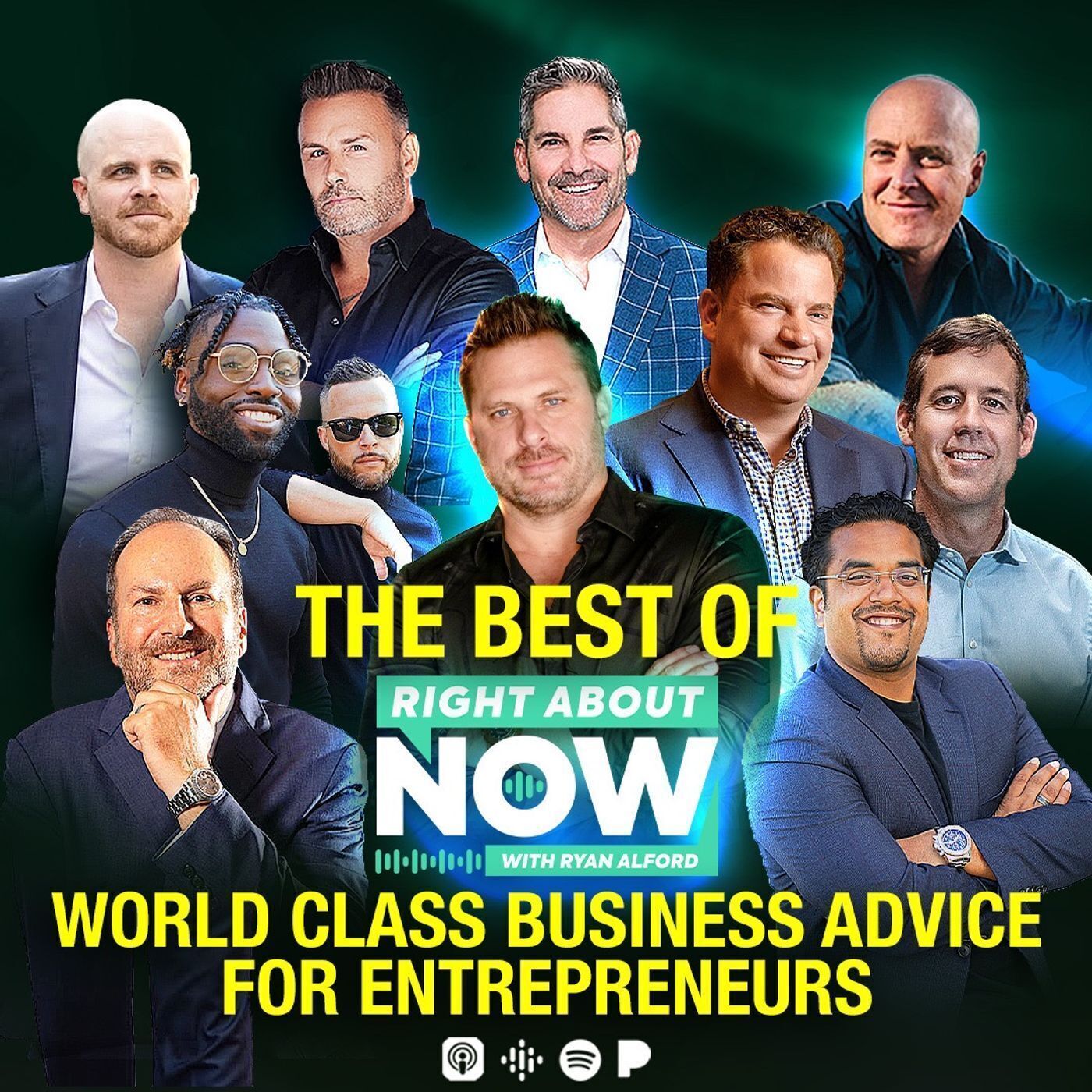
The Best of Right About Now: World class Business Advice for Entrepreneurs
Press play and read along
Transcript
Speaker 1 If you get category right,
Speaker 1 once people see something, they can't unsee it.
Speaker 2 This is Right About Now with Ryan Alford, a Radcast Network Production.
Speaker 2 We are the number one business show on the planet with over 1 million downloads a month,
Speaker 2 taking the BS out of business for over six years in over 400 episodes. You ready to start snapping necks and cashing checks? Well, it starts right about now.
Speaker 3 Right about now.
Speaker 4
What's up, guys? Welcome to Right About Now. We're always talking about what's now.
We're talking about business. We're talking about marketing.
We're talking about life.
Speaker 4 What's the balance between, you know, when you think about category design and category development?
Speaker 1 At a high level, the companies that really break through, the companies that change the future, the companies that are worth the most
Speaker 1
going forward, they really get three things right at the same time. We call it prosecute the magic triangle.
And what that means is they get company design,
Speaker 1 business model, culture, distribution, all of those things.
Speaker 1 They get product design. So do we have a truly breakthrough product that solves a unique problem in a completely differentiated way?
Speaker 1 And they get category design, right? So product, company, and category. And if you get all three of those right at the right moment in time,
Speaker 1
That's how you get Airbnb. That's how you get Zoom.
That's how you get, you know, pick your breakthrough company. And,
Speaker 1 you know, based on our research, based on our experience, based on my experience of doing this for over 30 years, it really is equal parts of those three.
Speaker 1 The one addition I'd say there, Ryan, is of those three, there's one that is a single point of failure, and that's category. Because if there's no market, there's no marketing.
Speaker 1
You can build a legendary product. You can build a legendary company business model.
uh, but if you don't have a category, there is nobody that's going to buy it, so that's kind of problem one.
Speaker 1 Problem number two is if you look at most new, whether it's a startup or an innovative new product that um is trying to pioneer an innovative new category from a, you know, an existing company, um,
Speaker 1 the same dynamics are true. If you get category right,
Speaker 1 once people see something,
Speaker 1 they can't unsee it.
Speaker 4 How do you filter? You know, like
Speaker 4 I always find this fascinating. Like,
Speaker 4
I'm the same way. Like, I breathe in a lot of the stuff.
I'm looking, observing. Like you said, you've got a lot of touch points for like talking with people, building relationships.
Speaker 4 What becomes, is it a natural instinct for, or do you test things? Like, how do you know how to filter what to try yourself or what? what you then enact or or use when there's so much stuff out there?
Speaker 5 Well, again, I think if you just focus on telling the truth and being the truth, the truth resonates higher frequency than anything else.
Speaker 5
So it's like, I keep it real. I just tell you the truth.
I don't beat around the bush. I don't use big words to try and prove that I'm smart.
Speaker 5 You know, I just talk.
Speaker 6 So, like,
Speaker 5 you know, I think, I think with that simplicity comes,
Speaker 5 better information.
Speaker 4 I think
Speaker 5 clarity in a world of chaos is gold.
Speaker 5
So I just need the light. Someone just bring me the light so I can see.
I bring the light.
Speaker 4
I know you have the 10x platform. I know you got seven of these and five of these and four of those.
But have you boiled it down
Speaker 4 for both yourself and maybe others, like what.
Speaker 8 what that success formula truly is yeah well you know i did some of that on undercover billionaire right well one is show up, say yes to it. You got to show up.
Speaker 8
Like, if you don't show up, you can't get lucky. You can't get lucky.
Nothing good happens. Nobody's going to come to your home, your sofa, your bedroom and give you anything.
Speaker 8
It's just not going to happen. Like, you have to show up.
And then once you show up, you got to show up, right?
Speaker 8
Like, you got to be available for whatever you're doing, even if you don't want to do it. So I do stuff every day.
I show up for stuff every day. I'm like, fuck, I don't want to do this.
Speaker 8 But I show up and then I act like I want to do it, right? So you got to show up and then you got to be willing to change your mind about it because something super cool might come out of the deal.
Speaker 8 So, number one, you got to show up.
Speaker 8 Number two,
Speaker 8 and while you're showing up, you got to drop your bad attitude. Like, if you, if you're negative, bad attitude, stuff's going wrong, you lost your mom, you got COVID, whatever the hell happened, bro.
Speaker 8
Nobody needs to know about that. You got to show up and be 100%.
Number two, I would tell everybody,
Speaker 8 like, I'm always looking for a 10X target.
Speaker 8
Always. I wake up every day, never satisfied where I'm at, because I'm always looking for the 10x.
I'm looking for, I got 4,000 or 12,000 units. I'm going to get 120,000.
Speaker 8 120,000 units, bro, I'll be like, I could run for president of the United States.
Speaker 8
Like, I'd be a major player on planet Earth if I could get there. I don't know if I can get there.
Today, I probably doubt that I can get there.
Speaker 8
I mean, to be honest with you, I don't like, I don't think I can do it. I don't think, I don't know that I have enough time.
I don't have enough money.
Speaker 8 But
Speaker 8 it's cool to think about it.
Speaker 4 At the end of the day, the substance is what matters,
Speaker 4 the expertise.
Speaker 4 And then, and that, and we're talking about like one-to-one information sharing, but even as a brand, you know, you've got to stand for more than just a feature set of your product.
Speaker 4 It's got to be, you know, stickier than that. And that takes time.
Speaker 10
You build brand over time and hope for sales overnight. And so it's, I'll give you this.
I learned this. I did this.
Speaker 10
I'm a byproduct of it. That which you build fast will crumble even faster.
And that which takes a long time to build will last you a lifetime. Yeah.
Speaker 10 So a brand will take you a long time to build, but it'll feed you forever.
Speaker 10 It just, and
Speaker 10 I'm standing before you today.
Speaker 10 How many people in our internet marketing circle have made it 20 plus years? I can count on probably two hands. I don't mean, I mean, I mean it, really, right?
Speaker 10 And every single one of them has a strong brand.
Speaker 10 But at the same time, learn as a company, we built it as a rocket ship.
Speaker 10 You know, there was no slow and steady 10% a month increase, optimize and, you know, do the CRO work and do the split testing and focus on one funnel and painstakingly obsess over every part of your product delivery process.
Speaker 10 That ain't me.
Speaker 9 I didn't do that.
Speaker 12 We were, you know,
Speaker 10 and
Speaker 10 look how fast it crumbled. Look, look how, look how weak the foundation ended up being, even though it was doing 40 million, it was super profitable and was about to sell.
Speaker 10 What I'm doing today, what I'm doing now, you know, we're for our software company, it's taking us anywhere from three to six months to close contracts with big enterprise companies.
Speaker 10
But those companies are closing a contract after giving two to three week demo periods. They're reviewing it.
They're having meetings with their C-levels. They're fully buying in or saying no.
Speaker 10 But when the ones who are buying in, they're going to be with us for years and they're going to pay big fees.
Speaker 10 So albeit it's really hard right now in the early stages, but come talk to me in three years when we've got a ridiculous MRR and I'm able to start every month knowing that we're not only covered, but in profit and that all I have to do day and night is obsess about that product.
Speaker 10 It's a great life. So what most marketers, unfortunately, Ryan, are not trained towards, and it's been kind of my
Speaker 10 thing now, I call it change the timeline.
Speaker 10
And that is flip it over. So many of us want to make the million in 30 days.
And now, me today,
Speaker 10 any opportunity that can make me a million in 30 days, I almost always know it's the wrong opportunity.
Speaker 10 I'd rather make it over the course of a year, but then know that next year it'll make me 1.3, 1.4. And the year after that, it'll make me, you know, two.
Speaker 10 And then I want that because I know that whatever that is, it's going to grow much, much stronger and much better. So brand is the exact same way.
Speaker 12 You can't get brand in 30 days. You just can't.
Speaker 4 It is amazing sometimes. You know, I've worked with a lot of companies, good, bad, and ugly,
Speaker 4 over the years in marketing. And it's real hard to take a, you can't make the bad companies good.
Speaker 4
It's really difficult. You can make the good companies great, but it's really difficult to make bad.
And I do think,
Speaker 4 you know, there's a lot of truth to be had and a lot of mirror to be looking in you know to really determining if your product service or what you do differentiates and stands out and can be made to be again profitable seems like there's a lot of people that you know do things that a lot of other people do and they just assume that like i mean success will be guaranteed but it just doesn't happen that way
Speaker 11
yeah no that that's why it's important early on. Like, I think it's, it's tough because a lot of times people give up too early.
So it is really, really tough to say,
Speaker 11
you know, if it's not working, you got to tweak this. But I guess you should always be tweaking.
But too many people, I would say it's a bigger error is to give up early. So you can't do that.
Speaker 11 But it's like at the beginning, you have to be smart and you got to look at your product and, you know, put have some way to measure your competitive advantage over, you know, what the market is offering.
Speaker 11
I guess I'd say it like that. Like Think deeper about your competitive advantage and even use things.
I mean, there's all kinds of online tools. You can use SurveyMonkey.
You can use your friends.
Speaker 11
You could use LinkedIn. There's ways where you can vet that.
But often what happens is as
Speaker 11 you're growing your business, you kind of naturally do that. You know what I mean? The good leaders are naturally, like, you're probably not even thinking about it, but you're learning.
Speaker 11 You're like, oh, okay, I got the sale here.
Speaker 11 What copy did I use or what pitch was I using? Oh, okay, this is what they wanted. I thought they wanted this, but they actually wanted this, right?
Speaker 11 And you're sort of iterating along the way, but if you can do that without making it accidental, like from the beginning, if you could do your basic market research and this is basic branding, right?
Speaker 11 So it's like, what is your position in the market? Okay.
Speaker 11 And can you create some sort of emotional connection? Now, not every product, a lot of people think, well, like with us, with fridges, how are we going to do that? You know, but you can do it.
Speaker 11 You can come up with fun ways to create some emotional connection because a brand is a feeling that somebody has about you. That's literally what it is.
Speaker 11 So how do you make more people feel a certain way about you?
Speaker 4
You know, you got to believe to achieve. It's really fucking easy to be a hater and to not believe and to doubt and to critique.
It brings me back to that statement.
Speaker 4 It might sound cliche, but we all hear.
Speaker 4 You know, no one who's getting shit done at a higher level than you is sitting around, you know, talking shit about you or where you are or how you do it, you you know, because they're too busy believing in what they're doing themselves.
Speaker 4 And optimism, belief, I put all that into the same thing.
Speaker 4 I think it's just, they've got a vision, they've got a belief in something, you know, like whether it's investing in something, whether it's doing their own thing, whether it's taking it forward.
Speaker 6 Like, if you're a believer, you just, you ain't got time for the bullshit.
Speaker 13
You, I always say, to make this understandable for people, I put this out on Twitter a few times, X. I never met a wildly successful pessimist.
And people will say, oh, what about short sellers?
Speaker 13 I was like, that person's optimistic.
Speaker 3 They think that they're not going to go down. They're not optimistic at anybody.
Speaker 13 They're like, they're going against the grain and they're willing to risk everything with unlimited downside because they believe that they're right. That's pretty optimistic.
Speaker 13
Pessimism is somebody who thinks the deck is stacked against them. The system is rigged, all that crap.
Like, please, like, some of that may be true from time to time.
Speaker 13 But at the end of the day, we all have the power to change our circumstances.
Speaker 13 And the reason I love why we're drilling down on this, I talk about this in this book, this one phrase to always anchor me to what I believe in and what I'm doing.
Speaker 13 Opportunity arrives before the tipping point of evidence, right? And that's a simple way of saying like lightning and thunder. You know, you always see the flash of light first.
Speaker 13
That's the opportunity. It travels.
Light travels many times faster than the speed of sound. And evidence is thunder.
It's unmistakable, but everybody hears it.
Speaker 13 And so if you want to be wildly successful, you first have to be an optimist or else you won't even believe you saw the light, right? You'd be like, ah, it's in my head, you know?
Speaker 13 And then the ability to act on it is the thing that sets winners apart.
Speaker 13 And back to your point about belief, it's why burn the boats is so important because the time to burn the boats is when the opportunity arrives before the tipping point of evidence.
Speaker 13 When you burn the boats, when everybody knows about it, it's like, well, it's, you know, it's too late.
Speaker 4 You know, that being said, if you're an innovative and dynamic and optimistic person, when you think it's too late it's still okay i have like a mentor you know i like to say i'm the mentor you know but i do have one mentor his name is christopher lockhead he said he who owns the problem becomes the solution so you frame the problem he who owns the problem becomes the solution so you don't have to you don't you know we can talk about brand and all your features all day but you got to talk about the customer's problem and own the problem so that you become the solution Because that's big.
Speaker 3 Yeah.
Speaker 16 So that's really big, bro.
Speaker 6 Yeah. Cause I mean, at the end of the day, like people, I think a lot of people struggle with selling products and they do that because of the thing that you just said, right?
Speaker 6
They're out here trying to sell their products. They don't understand that people don't care about their products.
Like listen to me right now, guys, everybody listening.
Speaker 6 No one cares about your product. No one cares about your service either, right?
Speaker 6 You think anyone comes to us and they care about Facebook ads or they care about like our logo and what RFF like no one cares at all the only thing they care about is can you help me get more customers
Speaker 6 yes or no can you help me streamline my business and automate it more so I'm not pulling my hair out every single day right can you help me with those problems and so like it's all the whole thing about you know sell the hole not the drill and the too many people are out here selling the drill selling the drill and they wonder why no one's buying their stuff well they don't want the drill the only thing they care about is the hole that the drill produces so understand that that is and then and sell that instead.
Speaker 16 And everything will change.
Speaker 7 Stop worrying about yourself and how cool you are and how you look and how amazing this product is and all the little trinkets that it has and all of that stuff.
Speaker 7
And start focusing on why these people actually want that product and add that to your messaging. You got to tie them in emotionally.
It's funny.
Speaker 7 We both recently bought new homes and I was dead set on a price, right?
Speaker 7
I told my wife, I was like, yo, we're not going above this price for the house. I don't care what this lady says when we go in here.
I am not spending more than this. Right.
And I told her that.
Speaker 7 I get in there and she's trying to get me to do an add-on and add some brick to the front and get a lake view.
Speaker 7 And I would, like, literally, before I could went in there, I'm like, I'm not doing this, babe. I'm telling you right now, no.
Speaker 3 Right.
Speaker 7 And she comes in and she's like, well, you know, it's going to look so nice on the lake when you can watch your kids just play on the lake and, you know, it's going to be all nice and breezy.
Speaker 7 And then when you walk up to the front of the house, that's such a homie she literally didn't even talk about the feature of just having the lake view she talked about the emotions that i would have by acquiring that thing and guess what i did i bought it yeah i i went above my price just because she got me emotionally tied to to the product or to the to to the product and service right so yeah it's true so be careful like by the way this stuff be careful like who you share this insight with right you start sharing this insight on how to sell with your wife or with your husband like they're gonna start selling you on stuff
Speaker 4 happy wife happy life i think stephen yeah steven
Speaker 16 got that right
Speaker 4 whether it was a realtor or not i know that was real what about like and i i know there's more risk because i have friends that that are literally knee deep in this you know buying existing business you got all the baby boomers kind of ready to sell and you got a lot of these businesses that are cash flow positive and so i have some friends that are very heavy in that side of buying, you know, businesses that are already proven.
Speaker 4 Right. What about like capital raising for ideas of business, you know, like of,
Speaker 4 okay, maybe it's within an existing industry,
Speaker 4 but sort of like
Speaker 4 the theory of the, you know, the idea of the business, but you don't necessarily have a million customers built in day one, you know, like or even a thousand or a hundred.
Speaker 4 Right.
Speaker 4 Talk to me about that evaluation. And do you counsel that side of capital raising? Yeah.
Speaker 15 Oh, absolutely. I mean, in my book, I talk about, you know, the different types of investors.
Speaker 15 When you're raising money, you have to look at kind of the avatar and where you are in the growth curve. You know, are you a startup? Are you a more mature business?
Speaker 15 Are you kind of on a trajectory where you've been around a couple of years?
Speaker 15 have a track record of prior performance.
Speaker 15 And so when you look at a true startup, you know, somebody that's got this idea that's really unfounded or unproven, you know, you're primarily looking for venture capital firms.
Speaker 15 They invest in startups, or, you know, maybe you're looking for what we call an angel investor.
Speaker 15 That's typically a very wealthy person that may have been a business owner that sold their business, you know, and now they're worth, I don't know, you know, $10, $20, $50 million.
Speaker 15 They're willing to take those types of risks because they know if they could hit a home run, you know, obviously the return on investment is going to be substantial.
Speaker 15 But when you look at the different types of investors, you know, family offices, private equity, venture capital, each one of these different groups likes to focus on different things.
Speaker 15 Private equity firm likes to buy traditionally existing cash flowing businesses. They come in, they put in some capital, they make some management tweaks, they scale the business, then they exit.
Speaker 15
The venture capital firm knows, okay, we're going to invest in five companies. Realistically, we're going to lose money on one.
We're probably going to hit singles and doubles on the other three.
Speaker 15 And then that one, boom, is the home run that makes up for the others. And that's just the investment model.
Speaker 15 And so it depends when you're a business owner and you're going out there trying to raise capital, that the first thing you do is you identify the type of investor that you want to be focusing your efforts on.
Speaker 15 Because if you're out there, you know, for example, with a startup and you're talking to investors over here that like to invest in more seasoned, more established businesses, chances are you're not going to be very successful because your message is not related to that audience.
Speaker 4 Like, as a leader of a company and doing the marketing that you did and having the growth that you had,
Speaker 4 when you reflect on the both the success and what you learned,
Speaker 4 are there like light bulbs that kind of key points or things that come to mind?
Speaker 11 Yeah, for sure.
Speaker 11 So, we ended up selling in 2001. Okay.
Speaker 11 And for me, you know, personally, that was a big thing, you know, because it's like if you sell, you created something that is proven value and then private equity is coming in and buying.
Speaker 11
And then I stayed on for a while. And then I was, and then I, and then, you know, I've got a great new CEO running it now.
And so I'm able to take time and reflect on it.
Speaker 11 And, and I would say that there are definitely a couple of things.
Speaker 11 Like the first one is when you can afford it, like as a business leader, as a business owner, is getting the best people in and getting some skin in the game for the best people. Okay.
Speaker 11 And then creating a vision and letting them know what that final outcome looks like.
Speaker 11 So, for example, you know, early on, I probably would have been, I was more tight, you know, because I'm thinking, okay, if I, you know, how much should I share?
Speaker 11 And then later on, as I, you know, kind of learned the right way to lead, and there's a lot to it that I learned, but I'm just simplifying it here.
Speaker 11
It's like, when you get good people and you say, hey, let's, let's sell in three years. And if, and if we do, this is what it looks like for you.
Like, they're going to just just run through walls.
Speaker 11 Like there's a huge, because everybody's motivated by money. Okay.
Speaker 11 It's like, sure, you want people who are just going to always do the right thing, but you got to show them that this is what it's going to look like for you.
Speaker 11 And they're going to work their asses off and get there if there's a big payday for them. And they're going to do things that you could never do on your own.
Speaker 11 So that was a big one that I learned, you know, as far as like getting the right people.
Speaker 11 I realized early on that can be hard.
Speaker 11 Like if companies don't have enough scale, like they can't hire in, you know, that CFO for 250 or 300, or they can't hire that co but you know you can still prioritize getting the best people over saving a few dollars is how i would say for most companies um and then um just another quick one is just focusing on margins you know too many companies are um they're they're churning they're churning revenue they're churning top line they're they're they're they're they're building in lots of uh expenses into their business system Okay, and they're saying one day, you know, one day I'll get scale.
Speaker 11 One day I'm going to get leverage.
Speaker 11 And that does work for some companies okay and especially people who've already done it they're really smart and they come at it round two and they really know how to get to that point but for a lot of people that doesn't it doesn't work it's like make it's like before you go build like a 10 or 20 million dollar company and then try to figure out how to make money like make money from day one because the pro the thing is that can actually
Speaker 11 basically what it's telling you is your brand is not valuable enough to the market.
Speaker 11 Like if you're not profitable when you're a couple million dollars at the transaction level, you know, there's a good chance that as you're 10, 15, 20, you still may not be that profitable because the market's telling you like, this is all we're going to pay for your brand, you know?
Speaker 11 And so you want to figure that out early on. What do I need to do with my product or service?
Speaker 9 How do I add more value?
Speaker 11
How do I, you know, stretch these margins? And so that's, that's a huge one. You know, right now I do CEO coaching and that, that's a, that's like one of my main focuses.
Like, what are your margins?
Speaker 11 Okay.
Speaker 11 What are, how can we get creative and really think about your product and big focus on the product?
Speaker 4
Money doesn't solve everything, but it sure helps. And you know, my friend Brad Lee talks about this a lot.
And I've been on his show. He's been on mine.
Speaker 4
And like, he's, he does a podcast called Dropping Bombs. And, but he talks about this, you know, and he's, he's done very well.
And he just, he's just honest about it.
Speaker 4
He's like, no, it didn't solve everything. I'm not happy every day just because I have money.
He's like, but damn. I'd rather have it than not.
Speaker 4 And he's like, and he kind of used the same analogy as used.
Speaker 4 And he's like, sometimes I just want something nice you know and I want to get my wife you know it's like for sure it uh it's sometimes it's really uh you know pretty simple but it is not just because he's trying to show off either he's way past the oh I got to show my Rolex or something you know like it's not that it's just hey he wants to take a nice trip and he doesn't have to think about it for you know 14 months and put it on layaway For sure, 100%.
Speaker 17 I think for anyone to say that, you know, wealth is not part of the equation, the motivation equation, I think you're kind of lying to yourself because of course it is, because with wealth comes freedom, and that's what we're all after at the end of the day.
Speaker 17 So to say that money doesn't matter to you is probably just you lying to others and you lying to yourself. Because at the end of the day, the finances equal the freedom.
Speaker 17 And the freedom is really what's most important.
Speaker 4
Bingo. There you have it right there.
That's what I tell people. I mean, you know, if time were money and money were time, we'd all have the same amount.
Speaker 9 Hell yeah.
Speaker 17 I mean, but, you know, and it's important to lean into those whys.
Speaker 17 And, you know, but I think for the most part you know when it comes to you know success and in any endeavor you know success kind of comes down to two things it comes down to having a plan and it comes down to sticking to that plan right and I'd say most people don't even make a plan they just kind of let life push them around and and then they die and that's it so I think for you know most people never even make that plan that really inspires them but then for a lot of people that make that plan they don't stick to it.
Speaker 17 So I think if you can do both of those things on a daily basis, put a calendar together that really inspires you, that's taking steps towards your goals, the goals that really mean something to you, and then doing your best to actually execute on everything in that calendar day by day.
Speaker 17
You can strengthen that muscle and become the type of person that makes a commitment and keeps it to themselves. But it's a day-by-day progress.
You know, it's a day-by-day process for a lot of us.
Speaker 17
I know it is for myself. You know, I know sometimes I love making plans.
I love getting at my little pencil, writing down all the cool shit I'm going to do tomorrow.
Speaker 17 And then sometimes I struggle to execute, but I just remind myself it's a muscle. You know, it's almost like you're at the gym, you know, and you're going for some hypertrophy on your chest.
Speaker 17 You're just trying to bench a little bit more every week. And I just try and ask a little bit more for myself every week as far as work ethic goes.
Speaker 17 And if I don't have a great day, I have some grace with myself. But get out there tomorrow, make an ambitious plan, and then do your best to execute on that plan.
Speaker 1 I guess the big aha is: you know, here's a simple one that
Speaker 1 I like that tends to resonate. If you want to sell Bibles, there's got to be Christians.
Speaker 1
And so what most people do is they shout, look how great my Bible is. Legends spread the religion.
And
Speaker 1 in the HBR research that I mentioned, we discovered this incredible thing.
Speaker 1 76%
Speaker 1 of the total value created as measured by market cap or valuation goes to the company that dominates the category.
Speaker 1 And so the aha here is categories make the brand. Google has a legendary brand because they dominate a category called search.
Speaker 1 When they take that legendary brand and they slap it on a category that they're not designing, aka social networking, they have their ass handed to them, in this case, by Facebook.
Speaker 1
And so most companies believe they can win by screaming their brand. Look at us, look at us.
Aren't we awesome? Aren't we awesome? Brands are about us. Categories are about about customers.
Speaker 1 And so legends actually market their category.
Speaker 1 And in so doing, there's this other interesting thing that happens.
Speaker 1 Prospects, customers, consumers, the only company they've ever seen market the category is the category queen.
Speaker 1 So when you're the one evangelizing the category, The market, people in the market assume you're the leader because that's what leaders do. Non-leaders, that is to say followers,
Speaker 1
compare themselves to others. Take the Pepsi challenge.
Pepsi tastes better than Coke, right? And when they do that, they're telling the market category, Coke's the leader.
Speaker 1 And so the only companies that consumers ever see attacking and comparing themselves are by definition, not the leaders, not the category queens and kings.
Speaker 1 And so if you want to be perceived as the company that's designing and dominating the market category, evangelize the category how did you
Speaker 5 embrace social media when did that light switch pund intended i guess it went on about four or five years ago brightly it went on a little bit maybe four or five years before that like right when it was coming out i was like hey this is interesting and man there's sure there's a lot of people here but i didn't put two and two together until until I saw other people leveraging social media to get quite the notoriety.
Speaker 5 And with attention comes opportunity.
Speaker 5 So so i wanted more opportunity so what better way than to get attention and social media is the new television man like dude literally i was walking through the airport the other day just getting back from a keynote i land in vegas i'm walking through someone rolls up they're like dude brad lee dude i listen to your podcast i'm like oh thanks man he said hey can i take your picture boom i take a picture i start walking off Someone walks up, Brad Lee, the real Brad Lee, dude, I watch you on TV.
Speaker 5 And I said, what?
Speaker 5
He said, I watch you on TV all the time. I said, I'm not on TV, bro.
He said, oh, I mean like Instagram.
Speaker 3 And I'm like, dude,
Speaker 5 that guy said TV because that is TV nowadays.
Speaker 5 So once I realized that, you know, I'm glad I did what I did. But, you know, if anybody wants to build a personal brand, in my opinion, you got to think about just content flow.
Speaker 5 I put content flow into certain categories. Number one
Speaker 5 is the source of your content.
Speaker 5
Where's the source of your content coming from? Like, for example, this podcast is a source. You know, coaching somebody is a source.
Working in your office, interacting with people is a source.
Speaker 5
You know, things that happen to you on a daily basis, keynote speeches are sources. So you just figure out what your sources are.
Then the sources lead to the creative.
Speaker 5
Someone has to chop up, drop, edit, you know, hashtag, et cetera. That's your creative.
Then you got to figure out what your outlets are.
Speaker 5 Okay, well, my outlets are Instagram, Facebook, YouTube, LinkedIn, Twitter, and used to be TikTok, but for some reason they banned my damn account when I reached a half a million in a month and a half.
Speaker 5 Those are your outlets. And then you have frequency, right? How often are you doing that? And then you have what I call boost, which means how much money are you investing into it?
Speaker 5 A lot of times people just post, but they're not investing any money to be seen.
Speaker 5 Folks, that's the key is if you literally literally paid whatever it took to get everybody that logged into facebook every day to see your face for a month you'd be famous you may not be liked by everybody but you'd be famous and you'd have a ton of opportunity coming your way so if you're taking notes the source the creative the outlet the frequency and the boost
Speaker 5 you figure those out
Speaker 5 you're going to build yourself a big ass personal brand.
Speaker 4 How much do you think it plays into, like,
Speaker 4 now that you've you've embraced it the last four to five years, like if you put a percentage on it, and I'm sure you've got data on your ads and things like that, but what percentage would you put the, you know, your success right now towards all of those channels?
Speaker 5 Well, whenever I do the boost part and advertise,
Speaker 5 right now for every dollar I put in, I end up with $9
Speaker 5 back.
Speaker 5 According to statistics, which is why I'm starting to put a whole lot more dollars in. So if you if you see me now, wait, you'll see me a lot more here pretty soon.
Speaker 5 But that's when I'm just advertising. But just the personal brand, you know, it's immeasurable.
Speaker 5 I get deals all the time because people follow me, they like me, they trust me, they hear, they hear me talking about something that has nothing to do with light speed, and they sign up for light speed because of who I am, and what I said, and what I think, and what I believe, and you know, who I'm connected with.
Speaker 5
And, you know, they see that on social media. They see me hanging out with the big wigs.
You know, they see me on my podcast. They see me, you know, with employees.
Speaker 5 And again, it's social media, not anti-social media. You ever seen these people with the private accounts?
Speaker 1 I don't understand.
Speaker 5 Why are you on social media with a private account? It's like, dude, that's the equivalent of flipping someone off when they say, how you doing?
Speaker 4 Hey, guys, you know where to find us, ryanisright.com. You'll find highlight clips, all of the episodes and our YouTube links.
Speaker 4 And of course, where to find our guests and information on everything that they're up to. We appreciate you for making us number one.
Speaker 11 We'll see see you next time on Right About Now.
Speaker 18 Listen or watch full episodes of Right About Now on the web, go to ryanisright.com or follow a Ryan Alfred on all social media platforms.