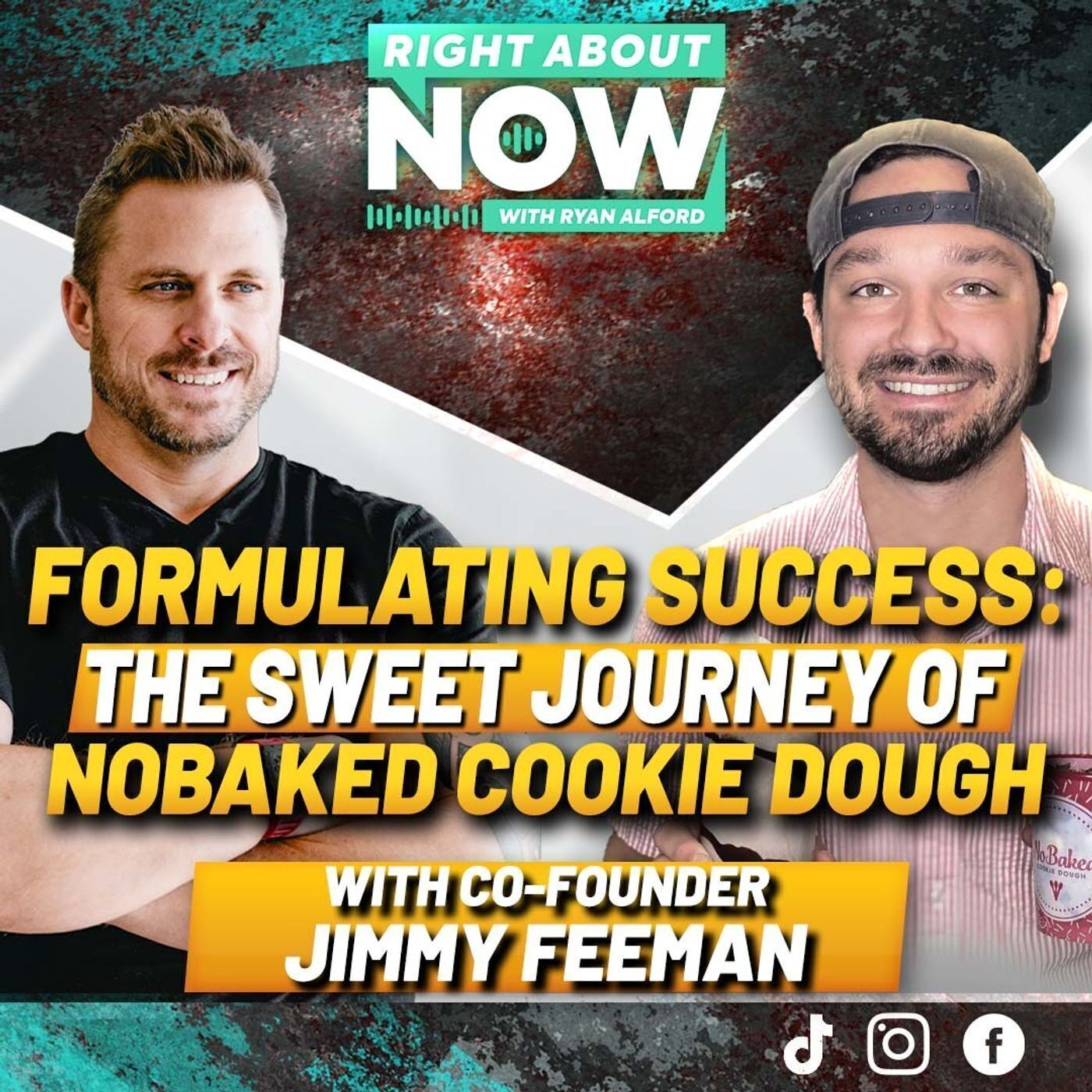
Formulating Success: The Sweet Journey of NoBaked Cookie Dough w/ Co-Founder Jimmy Feeman
Press play and read along
Transcript
Speaker 1 In our factory in Chattanooga, we produce anywhere from like 20 to 40,000 pounds of cooperative a month, which is pretty insane. Yeah, pretty insane.
Speaker 2
20 to 40,000 a month. Yeah.
Oh, wow.
Speaker 3 This is right about now with Ryan Alford, a Radcast Network Production.
Speaker 3 We are the number one business show on the planet with over 1 million downloads a month,
Speaker 3
taking the BS out of business for over six years and over 400 episodes. You ready to start snapping next and cashing checks? Well, it starts right about now.
Right about now.
Speaker 2
What's up, guys? Welcome to Right About Now. We're always talking about what's now.
We're talking about business. We're talking about marketing.
We're talking about life.
Speaker 2 And look, sometimes there's stories behind the company. And, you know, there's a certain product that kind of rang my bell when I was, you know, talking with him on LinkedIn.
Speaker 2 I was like, who's this Jimmy guy? Who's this Jimmy guy? What?
Speaker 2
Cookie dough? Hell yeah. I'm going to talk to him.
We got Jimmy Freeman. He is the co-founder of No Bake.
What's up, man?
Speaker 1 What's up, man? How are you doing?
Speaker 2 I'm great.
Speaker 2 I get to talk business stories and cookie dough. Are you fucking kidding me? Like, this is like what I do it for.
Speaker 1 Hey, I mean, if you get to eat some good stuff while you're doing the show, that's just a plus. It makes it a lot better.
Speaker 2 I know. I know, exactly.
Speaker 2 I don't have, my wife might argue with this, but I don't have too many vices.
Speaker 2 But
Speaker 2 cookie dough,
Speaker 2 you probably, since your company wouldn't call it a vice. I just call it, you know, maybe a vice to my waistline in summer when I'm trying to show that one pack,
Speaker 2 that dad pack.
Speaker 2
But hey, look, everything in moderation, Jimmy. I love some cookie dough, man.
Why is it so damn good?
Speaker 1
I don't know, man. Like, there's, there's a few things that they're like from your childhood.
There's stuff that you just do.
Speaker 1 And one of those things for me and my wife, Megan, was just eating cookie dough.
Speaker 1
I don't know what it is. My grandma always bakes cookies.
I usually ate the dough before they became cookies. That's how you end up where I am today.
But yeah, everything in moderation, right?
Speaker 1 Like, it just gives me more fuel to go work out or do whatever it is I'm going to do, I guess.
Speaker 2 But yeah, if you know what you're doing, I mean, you started young, though, man. You guys, you and Megan, I mean, how old were y'all? Like, when this started formulating 23.
Speaker 1 23. Uh, I did not have a lot of time out of college to figure out, or it didn't take a lot of time, I guess, to figure out that I was not supposed to work for someone else.
Speaker 1 Um, and it took Megan even less time to figure out she wasn't supposed to work for someone else.
Speaker 2 Um,
Speaker 1 so yeah, it's just it's one of those things I tell people now, and I've seen people post about this recently, people will talk about it.
Speaker 1 But if you're going to go for it, the best time to go for it is when you're like sub sub-25. Like, what do you have to lose? You don't have a car, you don't have a house, you have nothing.
Speaker 1
So just go for it. Worst thing that can happen, you file bankruptcy, you're back in like five years.
It's fine.
Speaker 2 My wife would agree with that.
Speaker 2 I started
Speaker 2 when I was
Speaker 2 almost 40, late 30s, and had all of those things, but still did it.
Speaker 2 I don't know if it makes me dumber.
Speaker 2 I waited, but, you know, it's
Speaker 2
everything you said is true, though. It probably added stress to the whole thing because it's not easy.
But when you're young, you do have time to, I mean, you've got time.
Speaker 2 Look, we all have time to fail. Like, it's not that you don't have time to fail, but it's usually less maybe
Speaker 2 responsibilities or other people relying on you, you know, especially you and your wife being together or a couple or, you know, we'll get to that story, but it does allow you a little bit more,
Speaker 2
I don't know, focus. Like, I can't just pull all-nighters for five nights, you know, knowing, well, I've got to coach my son's basketball.
I've got to do this or that.
Speaker 2 You know, it's like the combined part of the pressure and the amount of time you have to put into it, right?
Speaker 1
Yeah. I mean, that's everything, dude.
Like, you,
Speaker 1 your time slowly compresses until one day you wake up, you're 40, you got three, four kids, you have a mortgage, you have a bunch of responsibilities, got to coach the kids' basketball team, and you're like, dude, I got a lot of stuff on my plate.
Speaker 1 If you start, if you start the entrepreneurial journey, then, by the way, I have more respect for you because you're crazy. And I like that.
Speaker 2 Oh, I'm definitely crazy.
Speaker 2
That's another story for another day. I want to talk cookie dough.
And
Speaker 2 I will say, when you're telling that little bit there, go listen to David Tell sometime. He has a really funny but nasty version of that.
Speaker 2 Like, what happens when you wake up, you're at this, you wake up, you're at that.
Speaker 2 I like your life story. Anyway, funny and
Speaker 2 a little raunchy, but nonetheless, Jimmy, I got to know, like, obviously the nostalgia, I think you've already probably gave it a little precursor,
Speaker 2 but
Speaker 2 what in the hell made you go down the cookie dare?
Speaker 1
It's a wild, it's, I mean, I guess it's not really a wild story. Like, the beginning of the company is really us just like really hating our jobs.
So Megan came home one day.
Speaker 1
We were living together at the time. She was my girlfriend.
She was like, dude, I just can't do this anymore.
Speaker 1
Can't go to the office. Can't do the thing.
I'm going to sell my cookie dough at the farmer's market and like sell it online. I think I could probably make enough money to replace my income.
Speaker 1 I was like, great, do it. Who cares?
Speaker 1
At this point in time, we were both just like real sick of what we were doing. And I'd watched her job hop three times.
And we graduated like 14 months before that.
Speaker 1
So we're talking like a 14-month period, you job hop three times. You probably need a different job.
I have a hard time reflecting on myself.
Speaker 1 So I didn't notice that I also had job hopped three times and I also hated my job. But we had bills.
Speaker 1 By the middle of the summer, after I like spent all my time helping Megan basically make cookie dough at night, I go to my job during the day. Eventually, I was like, this job is stupid.
Speaker 1 I'm just going to sell cookie dough.
Speaker 1 And I quit my job in July,
Speaker 1
July of 2017. And it was great.
Everyone thought I was insane, insane and also stupid.
Speaker 1 My dad called me. He was like, what are you doing, man? And I was like, honestly, I would rather sit on the side of the road, sell cookie dough to people from like a back of a truck.
Speaker 1
or like a cooler than go back to that office ever again. So, I mean, it was obvious for us.
And like I alluded to, it was easy.
Speaker 1 If I look back on all the decisions I've had to make across the last eight years, the easiest one was just being like, screw it, I don't want to work for anyone else.
Speaker 1
And that, like, that took us down that path. The other thing is, Megan already had that recipe.
She'd been making nightable cookie-dough since she was like 14, same recipe.
Speaker 1
She tweaked it a little bit, and then we were off of the races. And it's one of those things where, man, looking back on it, things happened real fast.
We executed real fast.
Speaker 1
We did nothing right, but the execution is really what matters. Like if you get up, wake up, do the thing, even if you have no clue what you're doing, because we did everything wrong.
Like everything.
Speaker 1 We put it in the wrong packaging, didn't know what a health permit was, like didn't know shit about running a restaurant.
Speaker 1 But like all you have to do is be willing to learn and be willing to actually wake up and execute. So, I mean, that's kind of what made us go down that road is like Megan had a good product.
Speaker 1 We were both real sick of what we were doing.
Speaker 1 I guess that's how you build a cookie dough coven.
Speaker 2 I got to ask, though, I know we'll get to it, but
Speaker 2 do you get tired? Like, I don't feel like I'd ever, I might not eat it every day, but are you, do you still eat the cookie dough or does it eventually,
Speaker 2 do all good things come to an end?
Speaker 1 I still eat it.
Speaker 2 I lie.
Speaker 2 I don't,
Speaker 1 I'm not the guy that like sits down and eats it. I'm the guy that like snacks on it.
Speaker 2 So like it's in the fridge yeah oh god that's me i'd be snacking on that shit all day i mean you get like scoop here
Speaker 2 yeah
Speaker 1 yeah i put my glove on and get my you know whatever you got to do to make it you know clean the room is fine but like snack on it yeah i uh i i eat it throughout the day and also my kids love it so like it just kind of stays in the house but i try to limit it because i'm like guys we can't eat cookie dough every day my daughter woke up the other morning and she was like dad where's the cookie dough and i was like it's not we don't have any right now and she gave me this look how does the how does no bake i've been looking at dad like how does no bake not have cookie dough in the refrigerator come on and she was like what do you mean we don't have cookie dough and i was like there's just none in there you ate all of it i i don't know what you want
Speaker 2 oh me is so the base the base the first recipe is it is it chocolate chip cookie dough is that original yeah chocolate chip's the original okay after that Megan made confetti and brownie, and then we just took those three and like ran with it.
Speaker 1
We have a bunch of other flavors today. We've done a bunch of crazy stuff, but like those three are still like top sellers.
That's where all the stuff comes from. People like chocolate chip.
Speaker 1 Like, that's like 70% of our sales, 70% of our effort. It's which is funny because it's like you take all this time to do all this other stuff when really there's this one thing, this one recipe.
Speaker 1 You made it a long time ago when you were a kid, and that's the thing that keeps going and keeps like on paying. That's funny.
Speaker 1 But But such is the way of life, man. I mean, that's the recipe.
Speaker 2 What was it like with,
Speaker 2 you know, those first years?
Speaker 2 And how long have we been at it?
Speaker 2 What year are we in?
Speaker 1 2025.
Speaker 1 We've been at it for eight years.
Speaker 2 What? How long? How many? Eight years?
Speaker 1 Eight years next month, yeah.
Speaker 2 I mean, you and Megan must have a strong relationship to have made it through all of it.
Speaker 2 I mean, a lot of people listening probably have started business with their significant other
Speaker 2 and not made it or it been like hell and yeah, I'm not saying it was rosy. We're gonna get to some of that I'm sure but
Speaker 2 it says something about the relationship
Speaker 1 It does I also think it says something
Speaker 1 It would
Speaker 1 you don't necessarily have to go start a business with your spouse to make this happen, but you could try it to make sure but like if you start a business or something or with someone and you've probably seen this Ryan You'll go out you find a partner that person's your partner Sometimes you know that person better than you know your spouse Sometimes you know you spend more time with that person than you spend with your kids So when it was me Megan we started a business together what it did and what it forced us to do is be super transparent like you got to be up in each other's head all the time like you can't lie about stuff you can't hide things from each other you can't just be like i'll leave that at work everything follows you everywhere And so you have to be super aligned and super transparent.
Speaker 1 That does cause you to argue and fight more. But I would say that that stuff is healthy as long as you're not letting it like, you know, blow up your relationship, make you hate each other.
Speaker 1 You can argue about stuff like we'll argue about like how to allocate like a hundred grand. Like, oh, should we spend it on these ads? Should we do it on this thing?
Speaker 1 But like, we're not arguing about stupid stuff that I see my other friends argue about with their wives, which is like, I bought like skis and I didn't tell you about it. I'm sorry.
Speaker 1 Like, what are you talking? Why are you, why'd you not tell her, first of all, or like people wouldn't go like, fool, like, I've got separate bank accounts. We do our separate thing.
Speaker 1
We do our own thing. And I'm like, dude, that doesn't make any sense.
Why are you even married? Because, like, at a certain point, you have to be like all in, transparent.
Speaker 1
Like, here we are, because that's how I run it with like a business partner. And so, like, that's how you run it with like your spouse.
I guess if they are your business partner.
Speaker 1
But, I mean, I trust Megan like fully my life. So like you have situations where it's like, I'll sign on something.
We'll use my credit. My credit gets jacked up.
Speaker 1
I know that like Megan's not going to like leave me and leave me like screwed. Instead, it's like next time we're going to use yours.
We're going to like rotate it back and forth.
Speaker 1 We're going to use this to our advantage. Because honestly, you're more powerful as a team than you are as an individual.
Speaker 1 People don't see it that way usually. And I think it took like the pressure cooker and then like the shared experience of our 20s, like doing this to like make all that happen.
Speaker 1 Like, that doesn't happen overnight, and it doesn't happen like normally. And it also, to your point, could like completely destroy your relationship and probably cause you remorse.
Speaker 1 But hey, I mean, it works really well for us. I don't think it works for everybody, but it's
Speaker 1 been fun and bad, and everything in between.
Speaker 2 It's good, though, because if it works,
Speaker 2 having where you're mutually, it mutually benefits both of you pretty equally, if not, it should be, let's call it equally.
Speaker 2 And so when, and you have that built-in trust because it's, and so when you have a partner, when they're not your partner in life and your partner in business, even when you love them and you trust them, they're the mutually separate paths of gain a lot of times.
Speaker 2 And so that's where you sort of get that trouble out of the way as long as the relationship is tight, which is what you had. So that's that's a good thing.
Speaker 2 I just want to get that, you know, to the story of the bus down by the river.
Speaker 2 I heard a school bus was somewhere involved in the story of Nobake, and we're talking with Jimmy, Nobake Freeman.
Speaker 2
I give everybody a pet nickname. That's yours now, Jimmy.
I love that.
Speaker 1 Jimmy Nobake. I love it.
Speaker 2 Jimmy No Bake.
Speaker 2 yeah i uh yes
Speaker 1 the the bus like kind of came into the picture because of the way we ran the business so
Speaker 1 the first three years we ran no bake we built a dessert shop chain basically so we built a franchise system opened a bunch of shops so from october 2017 when the first shop opens to october 2019 we opened nine stores
Speaker 1 And then October 2019, you know, leads right into March of 2020, which is the first time we had to like switch up what the business did.
Speaker 1
And prior to that, you know, like I had actually gotten really burnt out. I hated going to those shops.
I hated managing all the managers.
Speaker 1 I had a manager call me from jail that was managing our Cincinnati store and be like,
Speaker 1 Yeah, man,
Speaker 1
wife called the cops on me. I have to spend the next two days in jail.
And I'm just like,
Speaker 1 what am I supposed to do?
Speaker 2 I guess he might not have been no-baked. He might have been too baked.
Speaker 2 Yeah, right?
Speaker 2 So
Speaker 2 you have like these situations right
Speaker 1 that makes that that your life you're like i don't want to do this anymore i don't want to do this thing so then march comes along retail side
Speaker 1 yeah ironically i started to like the fact that we had to pivot to d to c
Speaker 1 and then it was like all the shops are closed yeah we're under a lot of pressure but like this is working scaled up the d to c business And then we went to raise money in the beginning of 2021.
Speaker 1 And right before that, during during 2020, my pet project during the pandemic was I bought a school bus and I was going to turn it into an RV.
Speaker 1 Because, you know, everyone's sitting on like TikTok in like March of 2020, April 2020. I see the people who are living in the van and I'm like, I'm not one to let you live in the van.
Speaker 1
I don't get to live in the van. It looks cool.
I want to do it. So you go from there to, I guess I'm going to buy one.
Speaker 1 So we sold our food truck, ironically, and then I took the cash from that and went and bought this old bus from this church.
Speaker 1
Spent the whole year remodeling the bus. That was just like my, it was my side project, and I'm not that handy, but I guess now I am because it did work out.
But
Speaker 1 yeah, we moved onto that bus in March of 2021
Speaker 1 or March, April 2021. And then we lived on it for about six months.
Speaker 1 Right around that time, my daughter was one year old. So we only have one kid.
Speaker 1 It was a challenge, but it was also this thing where we had like read the four-hour work week, like really bought into the D2C thing, and we were like, we could work from anywhere.
Speaker 1
But then you're like, I'm going to be able to show up and my office can be in like Yellowstone National Park. I have news for you.
It can't. That's a terrible idea.
And it's why we actually stopped.
Speaker 1
But it was a fun six months. It was like a brand experiment.
And like, can you be fully remote? Do you actually have to have any piece of the pie?
Speaker 1 Ironically, today, we like moved all the way back toward, like, in the third pivot of the company, we moved all the way back toward, like, owning everything.
Speaker 1 Like, we do our own 3PL work, we manufacture our own product, we have a lot of like hands-on stuff going on, and I'm there for a lot of it.
Speaker 1 There's a lot now where I'm not because I've kind of learned to train people to do the things that I should be training them to do.
Speaker 1 But yeah, it was like a good solid year of us, like, really deep believing the V2C dream, which is like, I can run run my $10 million a year business from Fiji and I'll be fine.
Speaker 1 And you're in the like brand space, so you know, like, I mean, there are people that can achieve something like that, but you really got to be in the business. Be doing your thing.
Speaker 2 Yeah.
Speaker 1
And it's a full-time, it's more than a full-time job. So, I mean, it was fun.
It's a fun break if you're being, if we're being honest.
Speaker 1 But yeah.
Speaker 1 I recommend something like that to everyone. I also recommend building something that you live in, even if it's like a shed in your backyard, like to every guy.
Speaker 1
It's like it's a transformational experience. You're like, I built this thing with my bare hands, and now I'm like living in it.
It's satisfying. I don't know why.
I have no idea why it's satisfying.
Speaker 1 It just feels right.
Speaker 2 I've actually been fixing up golf carts in my spare time. I find it very,
Speaker 2
my, I grew up with a dad who's like a master craftsman, plays eight instruments. He's a master craftsman, can build anything.
And I'm the idea, the writer guy. I'm right.
Speaker 2
I'm a digital, like, true, like, that guy. I'm not that Mr.
Hammer and Nail, but I have found therapy in like fixing up golf carts.
Speaker 2 I have no idea why, but it's something about working with your hands that is rewarding and learning to be a little handy.
Speaker 2 So my dad is finally, I think, I think he was always proud of me, but there's a different level of proud now that I can, you know, turn the screwdriver and know how to wire shit. Yeah.
Speaker 1 They're like, oh, that's cool.
Speaker 1 I love that.
Speaker 2 Yeah.
Speaker 2
They offer things good. Yeah, they don't understand any of the other shit.
But digital ads, Facebook ads, what? Branding?
Speaker 2 Stop.
Speaker 2 Let's talk about the brand. You know, like, obviously, No bake,
Speaker 2
the product and what it is describes what it is. But when you think about your brand, I'm sure you guys have evolved in this.
At first, it's like, hey, we're making cookie dough.
Speaker 2
You can eat that shit. Let's go.
Let's go. But now, how has that evolved for how you do think about the company and the brand and sort of your, I don't know, customer experience?
Speaker 1
It's evolved over time and it's been really informed by the customer. Because I think when you start out, you don't necessarily know the customer.
You sort of do. And Megan would claim that she does.
Speaker 1 Her thought was always that she is the customer. I will market to myself.
Speaker 1 I totally get that. The way that it's evolved is kind of like moving away from that and then moving into like, what have we learned? And that, that's hard to do.
Speaker 1 And I think a lot of brands have to evolve that way because you're going to like build a product, right? You're going to do your thing. Like you said, you're like, hey, cookie dough, you eat it.
Speaker 1 Let's go. Like, buy it.
Speaker 2 Try it.
Speaker 1 And then what happens is you sell that to one, two, three million people. And those people help inform you, like, well, what flavors should we make?
Speaker 1 What challenges are there like around the product itself? That type of stuff. And then on the brand side, they start to inform you of like, well, what should I be marketing to?
Speaker 1 So, like, originally, No Baked was very like,
Speaker 1
I wouldn't call it like neutral, but we were very like neutral. We didn't want to offend anybody.
Like, this brand is just like, we're making cookie dough. It's our thing.
Speaker 1 And then slowly over time, we started to realize, especially once we got into CPG and to DDC into like having a packaged product, then it became obvious that there are a bunch of people out there that are like, I'm plant-based, I'm vegan, I'm a carnivore, I only eat meat, I only do this, I only eat organic food, like better for you, like worse for you, premium food, whatever.
Speaker 1 That's when we started to really like craft the brand around like what our mission is today, which is to be chef-driven, not lab-driven. So like we made the product in a scoop shop, right?
Speaker 1
Like we made it for customers fresh. We had nine of them.
That was our core business. It's what we did.
We try to stay true to that even today because it helps us stay like really centered.
Speaker 1 Like people will come to me and be like, you're going to make a sugar-free cookie dough? Are you going to make like this cookie dough, that cookie dough, like this certification, this BS?
Speaker 1
And it's like, no, I'm not. What I'm going to do is I'm going to stick to the thing that we do best, which is you make a really, really tasty treat.
like we call it like a premium indulgence.
Speaker 1 And we're going to stick to the chef driven thing, which is that Megan's going to craft these flavors as if she's serving it to you, like in your kitchen.
Speaker 1 That just made sense for us.
Speaker 1 And, like, when you stick to your guns like that, and then you craft the brand around it, you start to realize that you're going to piss off some people, and that's okay because those people aren't supposed to be eating your stuff, anyways.
Speaker 1
Like you said, you're like, dude, I love cookie dough. That was great.
Those are the people I'm marketing to. Like, someone likes cookie dough, great.
Speaker 1
And then there'll be someone that would like walk into the scoop shop or something like that. I interacted with one of these people recently.
We're in a food hall downtown in Nashville.
Speaker 1
We have a shop on Broadway. So it sees a lot of traffic.
You know, there's probably like 15 million people that walk across that corner a year.
Speaker 1 Not all of them are coming in my shop. And in fact, some do come in the shop and they're like, hey, do you know where I can get some ice cream?
Speaker 1 And I've told our employees straight up, I'm like, tell them where the ice cream shop is. It's right over there.
Speaker 1 They should go to the ice cream shop. Why would you want to serve me cookie?
Speaker 1 And they don't understand the concept that like you have to turn down people that aren't your customer. You have to send them to wherever they're supposed to be.
Speaker 1 And that way you can actually get customers that want to eat your stuff.
Speaker 1 Which that's a whole nother thing.
Speaker 1 And that's something that we to this day have like, I think grown slowly and I wouldn't say struggled to do, but like it is really, really hard to blow up a consumer brand for that reason.
Speaker 1
You do have to like get in front of everyone. That's hard.
But at the same time, like you do want to make sure you're getting in front of the right people. And you're not trying to market to everyone.
Speaker 1
You can't be everything all the time for everybody. It's not possible.
So that's kind of how it's evolved.
Speaker 1 I mean, we started with like exactly what you said, and then we moved into like, we have to take a stance on like what we are, or people try to shove random stuff down your throat all the time.
Speaker 1 Every business owner gets that, though.
Speaker 2 Like, who has not had some and you got to take a stand for what you are?
Speaker 2 You've got to define it. Like, everybody wants to define you, but you've got to define it and stick to your guns, like you said.
Speaker 1 Yeah.
Speaker 1 I mean, you're like, every business owner has always suggested like hey you thought about this you thought about that i have people ask me if i've ever thought about like food truck so the other day i posted a video of our food truck on linkedin i was like hey guys look there's a food truck it was there in 2019 i already did it don't want to do it again thanks for suggesting oh put it in my like i'm never gonna do that box um
Speaker 1 People really want to suggest stuff to you or they want to suggest stuff around your brand or your product.
Speaker 1 And it's like your job as I think a founder is to say no most of the time and like stick to your brand, your thing, like, and really go deep on whatever that thing is that you're doing.
Speaker 1
And you guys probably see that in the brand space all the time. It's like some people are really distracted, other people go really deep.
You just go deep, stay true to yourself. Usually it works out.
Speaker 1 It's just kind of hard.
Speaker 2 Talking with Jimmy, No Bank Freeman.
Speaker 2 So,
Speaker 2 Jimmy,
Speaker 2 I want to talk some numbers. Like, you know,
Speaker 2 I find fascination. Like, we did a Valentine's thing talking about how many billion of this, how many pounds of that.
Speaker 2 How much cookie dough are we making? Like,
Speaker 2 how many pounds of cookie dough we make in a year or week? Or like, what's some numbers that would surprise and delight the audience?
Speaker 1 That's actually my favorite number to, like, focus on.
Speaker 1
I made this original pitch deck a long time ago for this tangent where I was like, hey, like, for investor. And like, I had one guy tell me it was stupid.
I was like, It's not stupid, it's cool.
Speaker 1 I was like, We have made like seven elephants' worth of cookie dough.
Speaker 1 He was just like, The
Speaker 2 meat,
Speaker 2 seven elephants, dude, that's
Speaker 2 10,000 pounds, yeah.
Speaker 1
Like, it's like a 10,000-pound elephant. Let's go.
No, right now, today, in our factory in Chattanooga, we produce anywhere from like 20 to 40,000 pounds of cookie dough a month, um,
Speaker 2 which is pretty insane. Yeah, pretty insane, 20 to 40,000 a month, Yeah.
Speaker 2 Holy shit.
Speaker 1 It's wild to see.
Speaker 1 It's been growing really fast.
Speaker 2 500,000 pounds of cookie dough a year upwards. Is that what I mean? Am I doing that math somewhere in that neighborhood?
Speaker 1 Yeah, this year we'll probably break like one, two million pounds, which is insane. It's just wild to see.
Speaker 1 It also smells really good.
Speaker 2 What's
Speaker 2 yeah, does it smell like I would think that it would smell? Like,
Speaker 2 smell like
Speaker 2 when you make cookies.
Speaker 2 Yeah, that's what it is.
Speaker 2 Yeah. It's that combo of sugar and motor.
Speaker 1
It's actually kind of funny if you go into our bakery. I mean, we do our best to keep it clean.
The one thing that you have a really hard time actually like
Speaker 1
keeping, I mean, we do it by room by room. So it's really just a room where we're mixing, but there's flour everywhere.
A light coating. of flour.
Speaker 1 You clean all the surfaces, clean everything like, you know, once a day, and then deep clean it once a week.
Speaker 1 But, like, it gets in the craziest places because every time you turn the mixer on, it's flour going in there, slopping everywhere, basically, every time.
Speaker 1 Yeah, you're like, ah, we're gonna lose like a tiny bit, and it's not a lot, so you wouldn't see it or notice it, but it's over time because you're mixing over and over and over and over again.
Speaker 1 There's just a light coating of dust, but I love it.
Speaker 2 Is this a mixing bowl that I could climb into? Like, is it that size?
Speaker 2 I i wonder if you could fit inside of it that's a good question you might be able to i'm six five you're pretty you're pretty dude you'd have to crouch down yeah but you could fit in it yeah okay yeah all right so i can get in there and just start going to town you know i i on a fresh my own personal batch
Speaker 2 yeah and get like i'd like to make a batch
Speaker 2 exactly i thought i'd be thinking about like yeah
Speaker 2 it's like this is like my you talk about indulgent that's the perfect word like this is my uh like dream indulgence it's like when I really want to treat myself it's it's probably some form of cookie dough
Speaker 1 yeah man and I think that stuff's going to become a lot that's going to be a lot more important over the next like 10 years people would I'll pitch investors now and they actually ask me about GLP1 agonists like immediately That's like a big question.
Speaker 1 Big question for the food industry in general.
Speaker 1 But if you're going to to treat yourself and you're not eating a ton of stuff, like random stuff all the time, don't you want to eat like better food, like better tasting food?
Speaker 1
It's like, that's what that's where I'm at. I'm like, if I'm going to like go out to eat, I want to go to like a nice restaurant.
I don't want to go to like random restaurant.
Speaker 1
So like, that's, that's the thing. Like, you want it to be good.
Like, you want it to be that indulgence, like you said, where it's like, I'm going to eat this
Speaker 1
when I want to. And like, this is the thing I want to eat.
Like, feed that. at.
Speaker 2
Yeah, I don't want it in between. I don't want it like kind of at all.
Like, there, I, my wife and I joke, you know, we're both watch what we eat, but not anal about it.
Speaker 2 I mean, but we're probably, I don't know, more fit than maybe the average couples our age. But we always will say, is it worth the calories? That's kind of the thing.
Speaker 2 And we'll always, like, we take a bite of something, we'll kind of look at each other and go, if, like, if she takes a bite of bite, is it worth it? It's not, it's not worth it.
Speaker 2
It's not worth the calories, you know? So I just don't mess with that in between stuff. It's got to be all the way.
Yeah.
Speaker 1
No, it does have to be all the way. Like, that's just the way it is, man.
Like, it's like that for me with like every food. I'm like, if I'm going to eat it, I want it to be good.
Speaker 1 Like, worth the calories actually matters. Like, if you eating something you actually like, you just eating it because you're bored.
Speaker 2 What's the biggest thing that surprised you, Jimmy?
Speaker 2
Jimmy Nobank. Jimmy, with this whole experience and running the company.
Like, you know, there's always surprises.
Speaker 2 Everybody's, any entrepreneurs who got their ups and downs, the bus story is obviously great. But like,
Speaker 2 what's been like the 180 for maybe what you thought or expected? The biggest surprise?
Speaker 1 There have been two. One of them.
Speaker 1 The first one, the first one's more fun.
Speaker 1 So like surprise in the good direction is we started the thing in March of 2017, right?
Speaker 1 Out of our apartment, which is, you're at that point, you're just like, I'm in an apartment selling cookie dough.
Speaker 1 How good could it possibly get?
Speaker 1 You fast forward all the way to March of 2018.
Speaker 1 That month we made like 130 grand in profit,
Speaker 1 which was like,
Speaker 1 what is happening? Whoa.
Speaker 2 And really, what had happened is
Speaker 1 a lot of money for like a small, for like a kid, basically, for someone that's like not all figuring it out at all.
Speaker 1 like we were doing everything wrong we just nailed the product and nailed the brand um
Speaker 1 it was basically like the thing that surprised me was like oh wait you can make a lot happen when you have no clue what's going on which is really great if you just show up every day and like do the thing you know works don't complicate it keep it really simple just do your thing and for us that was like build scoop shop do pop-up events build brand like and at the time it was like gather facebook and instagram followers and then drive them to Facebook events is ironically the thing that we were doing.
Speaker 1 That's how we were making so much money. It's how we were doing the whole thing.
Speaker 1 And then you would do like press and you would do brand stuff and you would do Instagram ads and it would all build and build into this thing where it was like driving people to a Facebook event.
Speaker 1 This is all you're doing.
Speaker 1 Very, it was a solid strategy for like 2017, 18, 19.
Speaker 1 Worked really well.
Speaker 1 And I blew my mind that, like, this is so easy. Why do not more people do this? And then I found out why more people don't do it.
Speaker 1 So, like, the thing that happens is you're going to get surprised like that.
Speaker 1 And then you're going to get surprised in the complete opposite direction, which is that I was surprised it was really easy to make a million dollars.
Speaker 1 I was really, really surprised that it's incredibly hard. to make 10 million dollars.
Speaker 1 Like, if you're going to go from running like a small business, which is highly profitable, and like you have no overhead, like you've just blown this thing up and like it's working, and you say to yourself, I'm going to scale.
Speaker 1 Because this is the surprise, right? Like, I was so locked in on the small thing that I was like, we can kick it. And, like, me and Megan,
Speaker 1
I mean, we went to the moon quickly. Like, with a retail business, it's hard.
But it was like all these different pieces coming together.
Speaker 1 And then we went to scale, even though it was through like franchising and then it was D to C and then it was grocery, whatever it's become.
Speaker 1 Every time we've gone to scale, it has blown my mind how hard it is to go from like, hey, we are like clicking, we have like an MVP, we have a thing that's working to like, let's sell $10 million of that thing.
Speaker 1
And consumer, that seems to be the number. It seems to be the thing where it's like, if you could like fast 10 million sales.
on like a small item that costs less than $20,
Speaker 1
like you can break that down to like customers, but like it's a lot of customers. It's shit done.
If it's $10, it's like you have to sell it to a million people a year. That's incredibly hard to do.
Speaker 1
And our pint jar in retail is around $10 on shelf. We make like five bucks on it.
I'd have to sell 2 million pounds, 2 million pint jars of our cookie dough
Speaker 1 a year to break the $10 million market. It's very hard.
Speaker 2 But
Speaker 1 you realize that there are all these things in between
Speaker 1
the product and then getting to that point. Because in there, the pieces get complicated.
Everything gets complicated. Your life gets complicated.
You over-complicate it.
Speaker 1
You get debt that you shouldn't have gotten. You raise money from people that suck.
The whole thing blows up in your face. And that
Speaker 1 has been the most surprising thing.
Speaker 1 Because I had this plan that I wrote down on a napkin, a shit you not, to Megan, where I was like, we're going to build a brand, we're going to open a store, and then we're going to franchise it and sell like we're going to exit to pe whatever the whole like between build store and like exit and sell it's like that was my it was step b to c
Speaker 1 that's step like b to z dude
Speaker 1 there's so many things in the yeah there's a lot of steps in there you left out yeah yeah i left out all the other steps i was like oh once the first store works we're clicking And then we just have to scale.
Speaker 1 And I always find it fascinating that I'm like, everyone talks about like, I'm going to scale this, scale that.
Speaker 1 No one is scaling jack shit.
Speaker 1 And it seems to me that it's just really hard.
Speaker 1
That's just how it is. And I mean, I find it fun because it's like a game.
And I've tried to like equate this to like a game that we're playing.
Speaker 1 Why would you try to make it complicated or boring when it should be like
Speaker 1 interesting?
Speaker 1 So yeah, that's surprising. It's weird.
Speaker 2
I wish it wasn't weird. Both ends of it.
Surprising to get to 1 million and surprising how hard it is to get to 10. That's what I condensed that down to.
Both ends. And it's true.
It is.
Speaker 2 Scaling is
Speaker 2 harder than people recognize,
Speaker 2 even when you've got it sort of figured out.
Speaker 2
Where are we headed, Jimmy? Like, you know, what's going on? I think you're in a capital raise, maybe, doing some stuff, looking for some investment. We're in capital raise right now.
Where are we at?
Speaker 2 Yeah. Yeah.
Speaker 1
So we're in capital raise right now. We have a reg CF round on Start Engine going, which is great.
That means that anyone out there, 250 bucks, you can buy shares with No Bix. Super cool opportunity.
Speaker 1 I'll tell you why. So plans for the company actually right now are over the last three years, we had to grow slow, we had to get profitable, we had to build something that actually worked.
Speaker 1 And that meant that we now have a 3PL, a manufacturing facility, a cookie dough line where we make millions of pounds of cookie dough,
Speaker 1
all this stuff that's like been built as infrastructure for the brand. And so we're actually raising money so we can go out and acquire other brands.
Real pumped about this.
Speaker 1 I think that it's going to allow us to go out there and right now, like help a lot of people who have been in my shoes or are in our shoes, you know, a few years ago currently.
Speaker 1
figure out how to get themselves profitable inside of like the umbrella that we're creating. So like the goal is to go out, find find a brand.
Maybe they're doing really well.
Speaker 1 They have a great product, a great brand, they know what they're doing, but they just cannot make money, which seems to be the curse in consumer.
Speaker 1 And our goal is to fix that. Same way we fixed it for Novix.
Speaker 1 I
Speaker 1 busted my ass for the last three years figuring out like how do we get profitable?
Speaker 1 And how do we make sure that like we're doing the right things, spending money in the right places, and then growing because that's still incredibly key to being able to actually like survive.
Speaker 1 We were able to do that, and now I'm like, okay, the first time that we've had the opportunity to raise, like, this is the way to go.
Speaker 1 And so, we're raising that money, trying to go out there and make some acquisitions.
Speaker 1 We have a really exciting one that's coming up that I wish had already happened so I can announce it, but I'll announce it soon. And
Speaker 1 that's going to be the first of many.
Speaker 2 Super
Speaker 2 excited. Are we acquiring other
Speaker 2 cookie dough brands or is it broader than that?
Speaker 1 It's going to be slightly broader. So the first acquisition is actually another cookie dough brand
Speaker 1 that probably not a lot of people have heard of. They're actually much older than us and been around a long time.
Speaker 1 It was a really, it's a very synergistic acquisition because we already make cookie dough. They sell cookie dough.
Speaker 1 But then in the future, the hope is like cookies, brownies, bars, all the things that we have the ability to make in our facility, we're going to go through those.
Speaker 1 And like I said, like the thing that I'm telling investors, the thing that I'm telling our team, the thing that we're talking about every day, just like between me and Megan, is like, we have to identify good brands, good products.
Speaker 1
Like I said earlier, like on this podcast, that's everything. And it's going to become so much more important, especially flavor, taste.
Like, do you actually like eating this stuff?
Speaker 1 Like, because there's no reason to like go buy like a $10
Speaker 1 plant-based, better afford you snack if you don't even like eating it and and you're on trizepatide and you don't even want to eat anyways, like, what are you doing?
Speaker 1 Go eat whatever the heck it is you want to eat
Speaker 1 because you're not going to eat a lot, anyways.
Speaker 1 Like, I think there's a huge opening for brands like that and a huge opening for people to like aggregate power like we're going to and then be able to build something that's profitable.
Speaker 1 Um, hopefully, help a lot of other brand owners like figure out how to thrive, which is our hope.
Speaker 2 I got a new name: no breaks, no bake.
Speaker 2 No breaks, no bake. Let's go.
Speaker 2
You got to go fast. You got to keep moving.
You got to keep growing. No breaks, no bake.
That might be the title of the episode.
Speaker 2 It's fun, man. I love it.
Speaker 2 Where can everybody find, how many places are we like? I'm sure distribution is crazy if you're selling that much cookie dough. But where are we located? Where's everywhere we can buy a no bag?
Speaker 1
Good question. So you actually can buy it nationwide, just in a few different places.
So we ironically have kept our distribution.
Speaker 1 Our distribution is pretty big, but it's also small compared to other brands.
Speaker 1
DoorDash, GoPuff are both really great, like instant delivery options. You guys order stuff on DoorDash or GoPuff, look up our brand.
It's probably in your area. And then,
Speaker 1 and you'd find that through Dash Smart on DoorDash.
Speaker 1 And then the fresh market down in your neck of the woods, my neck of the woods, really anyone on the East Coast, you can find us at the Fresh Market.
Speaker 1 And then we're sold at a bunch of independent and natural grocery stores all over the East Coast. Some on the West Coast, you can go on the website and look it up.
Speaker 1 We have a really great store finder, and it's very up-to-date.
Speaker 1 But my favorite stores to buy it in are, or honestly, my favorite place to buy it in general is the Fresh Market. Because I just like that store.
Speaker 1 They'd be the first grocery store to ever take a chance on us.
Speaker 1 And I love that place.
Speaker 1 They have like, if you're like the type of person like me that likes to go grocery shopping and find new stuff, they do a really good job of that. So I'm a real big fan of that store.
Speaker 1 Real big fan of Sprouts too. Hopefully they hear this and,
Speaker 1 you know, it works out this year. But
Speaker 2 yeah,
Speaker 1 we're trying to like keep our distribution very, it's similar to our whole strategy.
Speaker 1 very very deep and very like definitely nationwide but like very deep on like channels we know work So it's like that, that DoorDash location, that GoPuff location, like, that's where everyone's ordering.
Speaker 1 And I love that. And I love that they're having a good experience.
Speaker 2 So intentionally staying out of big box or big retailers.
Speaker 1 Yeah. I mean, there's one big retailer that we might launch in this year that I like a lot, but we're trying to keep it to places where we think the brand belongs.
Speaker 2 Yep.
Speaker 2 Makes sense. Indulge where you indulge.
Speaker 2 Smart.
Speaker 2
It's true, though. It is.
I indulge when I go to the fresh market. I think of that as an indulgent place, so it aligns with the brand.
Hey, look.
Speaker 2 On brand, on time, no breaks, no bake. Jimmy, where can everybody keep up with the brand specifically yourself and everything that you've got going with the capital raise?
Speaker 1
Yeah, so you can find the capital raise start engine. Go on start engine's website and just type in no baked.
You'll find it.
Speaker 1
If you want to keep up with the brands, you can find us at no baked on basically every social media. That's our handle.
So Instagram, TikTok, Facebook, all the places you see stuff.
Speaker 1 And then if you want to follow me, follow me on X or LinkedIn, and you can see and hear all of the ridiculous stuff I say. And you might like that.
Speaker 1 So I hope you come and follow me because Megan and I are both very transparent and partially insane. So I hope people like it.
Speaker 2 Yeah, I think you have to be to stick it through together
Speaker 2
an entrepreneurial journey and just be an entrepreneur in general. You got to have a little bit of a crazy gene.
I'm determined that that's true.
Speaker 1 Yeah, there's a small bit of it.
Speaker 1 Small bit of it.
Speaker 2
Jimmy, it's been fun. I appreciate you coming on.
Let's stay in touch, brother.
Speaker 1 For sure, man. I'm pumped that it let me on the show, and
Speaker 1 I really enjoyed it. So let's do it again, man.
Speaker 2
Yeah, we'll stay in touch. Maybe it'll be on, but I got to get, we got to line up that delivery, though.
I'm sitting here like, all I want to do is eat this can.
Speaker 2
And it's like, it's not cookie dough, though. You know, so you got to work that out.
You got to get down to this fresh market.
Speaker 1 You got to get down to the fresh market.
Speaker 2
Oh, it's close. Yeah.
I will.
Speaker 2
Hey, guys, you know where to find us. RyanisRight.com.
We'll find highlight clips from today's episode, the full YouTube video, and of course, all the links to to No Bank,
Speaker 2 No Breaks, No Bank,
Speaker 2
and Jimmy Freeman, all his stuff. We appreciate Jimmy for coming on, and we appreciate you for making us number one.
We know you've got a choice, but you got to keep it right here on right about
Speaker 2 now.
Speaker 3 This has been Right About Now with Ryan Alford, a Radcast Network Production. Visit ryanisright.com for full audio and video versions of the show or to inquire about sponsorship opportunities.
Speaker 3 Thanks for listening. listening.