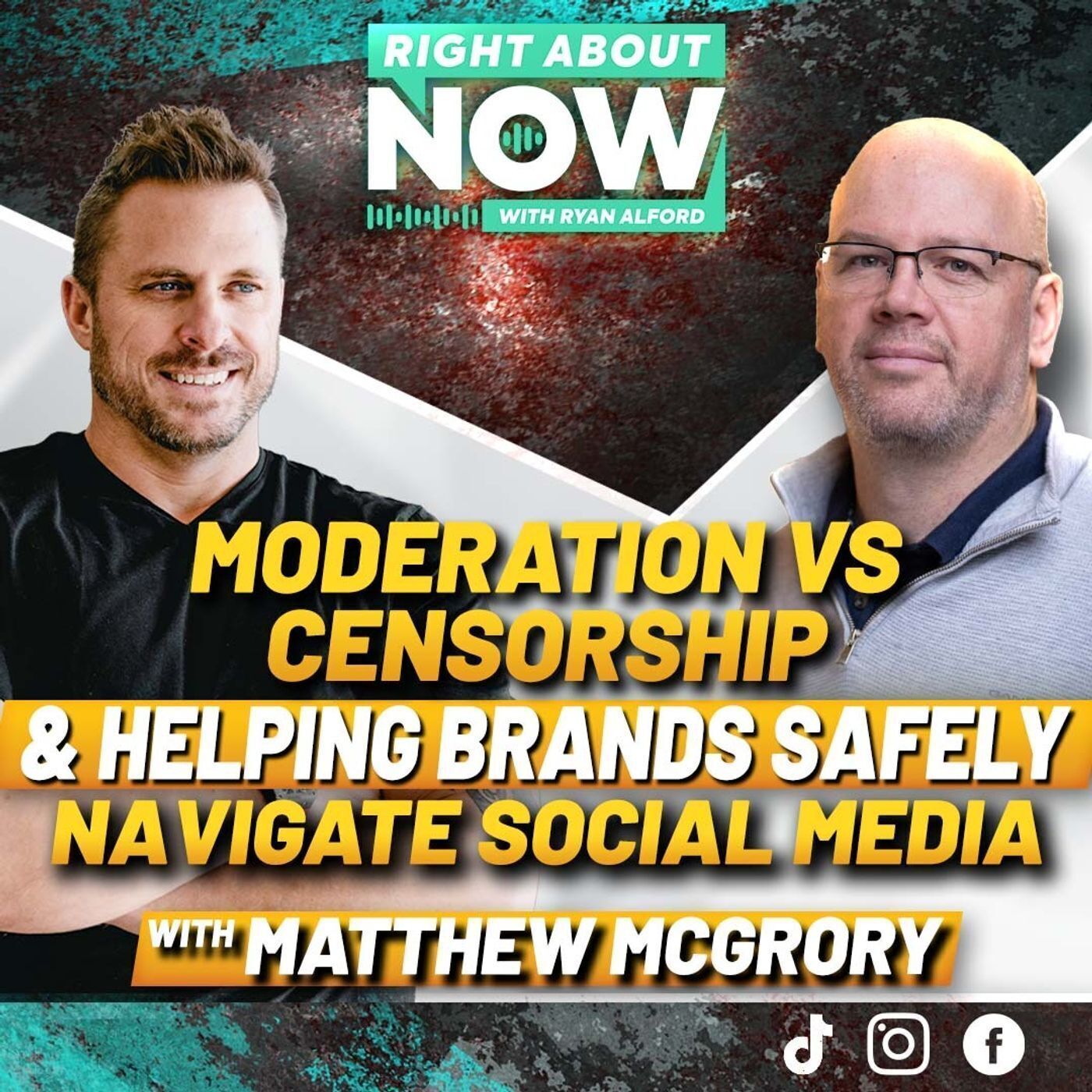
Moderation vs Censorship & Helping Brands Safely Navigate Social Media w/ Matthew McGrory
Press play and read along
Transcript
Speaker 1 If someone was to ask me why did Elon buy Twitter, one of the reasons I think is because he's got this kind of idea in his head of turning X into this kind of massive platform like they have in China with Weibo, where it's got a payment platform, it's got advertising in it, it's got the products in it, it's linked into Alibaba, all these different things all in one place.
Speaker 1 Yeah, that's the futuristic vision of social media.
Speaker 2 This is right about now with Ryan Alford, a Radcast Network Production.
Speaker 2 We are the number one business show on the planet with over 1 million downloads a month,
Speaker 2
taking the BS out of business for over six years in over 400 episodes. You ready to start snapping next and cashing checks? Well, it starts right about now.
Right about now.
Speaker 3
Hey guys, what's up? Welcome to Right About Now. We're always talking about what's now.
And you know it's right, baby. You know it's right because we're talking about it.
Speaker 3
Hey, at least we think it is in our own heads to your minds. I'm excited.
You know, we're going to talk one of my favorite topics: social media.
Speaker 3 And, you know, being a marketing guy, if you're not into social media, then you're probably not really into marketing because it is the way to market these days.
Speaker 3
But there's a lot of talk about what it is, what it isn't, about what flows through social media. So, no better person to come on than the CEO of Arwen.ai.
He is Matthew McCrory. What's up, Matthew?
Speaker 1 Hey,
Speaker 1 nice to be on the show. Thanks for having me.
Speaker 3 Yeah, man.
Speaker 3 I was excited to have you guys reached out. And we had to schedule a couple of little blips here and there, but
Speaker 3
I was pumped. You know, the news has been in your space, which I know, I know marketing well enough with PR.
Hey, that's free rising to the top. You want it to be top of mind, right?
Speaker 1 Yeah, absolutely. There's been lots of news
Speaker 1 in the social media space.
Speaker 1 The first inception of Arwen was as a moderation tool. So there's been lots of talk about moderation, free speech, censorship, both in the US since you had your great election in November and
Speaker 1 your vice president was over in Germany last week talking about free speech, telling the leaders of Europe what they should be doing.
Speaker 1 So
Speaker 1 it's a very topical discussion point at the minute.
Speaker 3 Yeah.
Speaker 3 I'm going to ask you, Matthew,
Speaker 3 since you brought that up, I'm just curious, you know, and this is less your opinion, but you can certainly share it. More, what is the sentiment overseas? I know you're just south of London.
Speaker 3 What is the sentiment overseas of what
Speaker 3 has both transpired with the election and, you know, the vice president was there. Like, is there a general sentiment, or is it just like us? It's like 50-50?
Speaker 1 I think generally it's probably
Speaker 1 more 60-40 left-leaning, I would have said, is the sentiment. And I think that's partly driven by
Speaker 1 one of Trump's targets is kind of the media and the kind of traditional mass media, and that they tend to take traditional approaches.
Speaker 1 And if you look at employees in that space, they tend to be slightly left-leaning in their opinion.
Speaker 1 So,
Speaker 1 yeah, I would say we're definitely leaning left. We've got a Labour government in here,
Speaker 1 which was probably elected more about the ineptitude of
Speaker 1 the right-leaning government that preceded it rather than Labour's good points. But a lot of Germany is seeing kind of rise of right-leaning parties getting votes.
Speaker 1
Very much on the topical points of immigration. Yeah, economy still comes out first.
Everyone wants a job first and foremost. They want to make money.
Speaker 1
They want a good platform for that. That's the same, I think, in the US and all across Europe.
But yeah, immigration, massive topic here.
Speaker 1 With it's just kind of the levels we've had over the last 15 years across Europe have meant that it's caused problems. And I think you've had your share of those in the US.
Speaker 1 And that's created some of the divide.
Speaker 1 Um, that I think politicians, instead of closing their eyes or putting the blindfold on and running around and pretending it's not there, they people need to start addressing it, unfortunately.
Speaker 3 Yeah, yeah, it's unavoidable at some point. It's a, you know, like, I mean, I always tell people, like, caution a little bit, like, you know, we're a country of immigrants, you know, like,
Speaker 3 but at a certain, we're at a scale now where you do have to have laws in place and measures. It's been a little bit of the wild, wild west for sure in that regard.
Speaker 3 But I do want to get down, right down, you know, the pike here, I think, with our, you know, audience. We got that treadmill crowd.
Speaker 3 I hope whoever's, if you're listening wherever, whenever you are, I hope you get that heart level up. You know, if we got to be about 85 right now, okay.
Speaker 3 Then I want to take you to 115 because we're going to, you know, talk about moderation. And look, one of my favorite quotes, Matthew, is everything in moderation especially moderation
Speaker 3 yeah
Speaker 1 well and there's and there's a well-known blog in the trust and safety sector called everything in moderation which talks about everything in the space um and i think um
Speaker 1 for me this is about um
Speaker 1 like brand safety you know we we we typically our clients are brands uh we we like formula one's a client atp Tennis are a client.
Speaker 1 And this is about individual choices of individuals to protect themselves
Speaker 1 in cases where
Speaker 1 they have to kind of be subjected to things that probably most of us wouldn't really like.
Speaker 1 I think
Speaker 1 the tipping point here is where people are removing content completely off social media channels.
Speaker 1
The way Elon Musk has set up X means that if you want to say your opinion, that's fine. And if I choose not to listen to your opinion, I can shut you up.
You can carry on saying what you want to say.
Speaker 1
I just decided that I don't want to listen to it anymore. And I don't want my followers to listen to it.
So, very often, where it becomes a bit of a sensitive point is
Speaker 1 we have elite sports clients, and them as individuals, they have tens of millions of followers that they would say, My hard work has brought me these followers.
Speaker 1 So if I don't want my followers to hear what
Speaker 1 this person over here is going to say,
Speaker 1 I don't want them on my channel. Whereas
Speaker 1 I think where Elon's going is Elon's saying, but that person still should be allowed to shout out whatever they want to say on their channel.
Speaker 1 And I think this is where the kind of the Facebook, the meta U-turn that happened just after the election, when Zuckerberg
Speaker 1 kind kind of realized that to get into good books, they were going to have to make some policy changes.
Speaker 1 There's been some interesting stuff released about what the Biden administration was asking Meta to do during the pandemic,
Speaker 1
which again, I haven't seen. I've just seen kind of rumor and speculation.
I haven't seen kind of cold, hard facts yet.
Speaker 1 But if that was the case, then yeah, I just that that shouldn't be a place where we're going. You know,
Speaker 1 things should be allowed to disseminate.
Speaker 1 We draw a line on what we call illegal stuff, which is kind of below the line, which is child
Speaker 1 sexual exploitation,
Speaker 1 where
Speaker 1 people are doing
Speaker 1
death threats, things like that. Things that are at the extreme end of the toxicity scale.
And then we draw the line at what we call the lawful but awful.
Speaker 1 So lawful but awful should be absolutely fine. That stuff is allowed.
Speaker 1 But it should be up to individuals in the community whether they want to listen to it. The analogy I generally use on demos with clients is
Speaker 1
Patrick Swayze in Roadhouse. So he's the bouncer.
He's brought in by the owner of the bar to clean it up because people are smashing the bar up. And the owner wants a nice, hospitable place.
Speaker 1 He doesn't want the band to get smashed with beer bottles every night. And we're very much much trying to create a world like that, that it's based on choice.
Speaker 1
There are bars that still exist like that, and that's fine. You can go in and you can throw beer bottles, and the bars are protected with a cage.
And there are other bars that
Speaker 1 they're suitable for your family, and you come in and you have a nice, polite conversation, and we welcome everyone. So, and it's kind of free choice.
Speaker 1 And yeah, I live near the home of the British Army. So, round me, there are loads of bars that are like what we would call swatty bars, where the where the
Speaker 1 army folk will go. And you can go down there on a Friday night and they'll be a bit fruity and
Speaker 1
it'll get a bit exciting. Or you can go the other way and you go to your bar where you have your Sunday race.
Now, digital channels are exactly the same.
Speaker 1 It's like you want to create spaces for your audiences where they want to come and have meaningful conversations. And that's what we're really trying to do.
Speaker 1 And we're really policing that for the brands themselves.
Speaker 1 We don't do that for the social media organizations.
Speaker 3 And so I do want to add one point. You know, you mentioned the Biden administration and not, you know,
Speaker 3
you're overseas. It's not your job to know the everything.
But I am going to quote exactly what they did
Speaker 3 because Zuckerberg said it in front of Congress under testimony
Speaker 3
that he was pressured. to censor and they did censor COVID information on Facebook, which is bullshit.
And exactly what happened.
Speaker 3 And Zuckerberg's both, you know, had a coming to Jesus, so to speak, for his own platforms, and also, you know, gotten a little bit of chutzfu behind him because the guys like doing UFC now.
Speaker 3
I don't know if it's all related. You know, some people would call that toxic masculinity.
I would just call it
Speaker 3 seeing the world as it should be, which is you can do what, look, 100% agree. No hate,
Speaker 3
threats of violence. Nobody, that bullshit needs to be taken out.
And so I think we can all align on that stuff.
Speaker 3 But political-based,
Speaker 3 you know, pressuring on these platforms that's been taking place in the U.S., and Zuckerberg's just the only one that got up there and admitted it,
Speaker 3
has been happening. And that's the stuff that just drives.
And I think part of the reason Trump got elected. You know, people
Speaker 3 like or love him, hate him. It's just that there's just not room for that kind of political,
Speaker 3 like not only censorship, but freaking,
Speaker 3 you know, they want to call everything disinformation, misinformation. You know, it's all
Speaker 3 truth is in the eye of the beholder.
Speaker 1 Yeah,
Speaker 1 it's a very convenient catch-all, disinformation, misinformation. We've been very careful to try and avoid it.
Speaker 1 We do get rid of a lot of spam, but that's typically around the subject of it might be financial scamming, those types of things, or come to my dating site.
Speaker 1 There's stuff that, like, if you're trying to read an article, you really don't want that in the way. It kind of is poor form for content.
Speaker 3 I think we can, I'll agree with that. Yeah, yeah.
Speaker 1 I think there's another hundred miles of this road to travel, if I'm honest. Um, and
Speaker 1 you know, I wouldn't say I admire is probably too strong a word, but I would certainly respect Zuckerberg for doing what he did and
Speaker 1 almost U-turning it and actually shedding
Speaker 1 some light on the topic that
Speaker 1 is normally the best tonic for these things.
Speaker 1 Shed some light on the truth.
Speaker 1 I think you're going to find that Europe were not particularly well behaved during the pandemic.
Speaker 1 And I think you're going to find that European governments are going to be held to account over the next five to ten years as we go through all our kind of our own little
Speaker 1 post-mortems of how people behaved during the pandemic.
Speaker 3 And, you know,
Speaker 1 there are a lot of things that shouldn't have happened. And there are a lot of views that were pushed on us.
Speaker 1
Propaganda is what it would have been called sort of 60, 70 years ago. in my own personal opinion.
No, you're right.
Speaker 3 We as Americans go through what's called audits with our taxes. We get audited, you know?
Speaker 3 I think there needs to be an accounting.
Speaker 3
And look, I don't really want to drudge up this shit. I don't have a, I'm a guy that doesn't have a rearview mirror.
You know, like, let's go forward.
Speaker 3 But I do think we got to make sure we learn from the past so we don't repeat it the future is the biggest thing that I would take away.
Speaker 3 And that's, I will say, that's what I love about what you're doing is it seems to be
Speaker 3 you guys are headed down the road of the right moderation with the stuff that we can all universally agree and as a brand and as a company that you don't want in your content and you don't want your customers you know get subjected to that that's why I really like what you guys are doing with our work
Speaker 1 and the the the the flip side of all this is the good stuff right so yeah the whole point of social media is so that I mean so that we can all have a conversation but it's monetized by the brands who want to have a conversation with their clients with their customers right so uh what we worked out is as well as detecting the bad stuff we call it your um
Speaker 1 your sort of golden tickets in your comment mountain because most brands have got a comment mountain of what people are saying to them and most of them aren't listening to it they're not listening to their customers they're not listening to buying signals from their clients and that's where the commercial imperative is that's That's where, you know, I use the example, I sort of name and shame brands when I talk to them and say, Here are some comments that were on your social media channels in the last two weeks and you haven't replied to.
Speaker 1 And they will be really obvious things like, Where can I buy this? Can I get this in blue instead of red, as it's shown on the Instagram channel?
Speaker 1 So, really obvious things that people aren't responding to.
Speaker 1 So, I think we're moving into a monetization phase on social media that isn't just as it is today, which is just kind of billboard advertising, which is kind of where we've been stuck in on this stuff for the last few years.
Speaker 1 I think it's much more interactive.
Speaker 1 And I think that's, if someone was to ask me why did Elon buy Twitter, one of the reasons, I think, is because he's got this kind of idea in his head of turning X into this kind of massive platform like they have in China with Weibo and the other ones where it's got a payment platform, it's got advertising in it, it's got the products in it, it's linked into Alibaba, all these different things all in one place.
Speaker 1
Yeah, that's the futuristic vision of social media. So, which I, which I think is where Elon wants to take it.
He's just, I think he's being held up on the road
Speaker 1 of that journey at the minute.
Speaker 3 Yeah.
Speaker 3 He's like any good entrepreneur, distracted sometimes, But he's,
Speaker 3
it's interesting that you brought up the Weibo thing. And it's funny.
I was walking around the mall on Sunday, and I don't go to the mall very often here in the States.
Speaker 3 But I was thinking in terms of like social media, and when I think of what you're talking about with building, it's almost, it's like this.
Speaker 3 There's a place that I'm now seeing more clearly than I did. I kind of panned the whole metaverse bullshit like four or five years ago because I thought we were ahead of it.
Speaker 3 And it was just so, I don't know, ethereal that it wasn't like real yet. Hey, I'm going to get into space.
Speaker 3 And I'm, yeah, I know that I care what my skin is and that my shirts are, but it wasn't quite there. But now I can sort of see this interplay of transactional merchandise.
Speaker 3 So that you're talking about meets digital, meets social, like the digital mall.
Speaker 3 Because when you look around the mall, it's a bunch, it is like this combination of social because people are having conversations or walking around in these courts and things.
Speaker 3 And I almost have this vision now that I see what you're saying with like
Speaker 3 X becoming that digital place of social plus shopping plus interaction, right? I think that's where you're, what you're kind of painting, right?
Speaker 1 Yeah, yeah, absolutely.
Speaker 1 I think there's this like meta release, this kind of metaverse world,
Speaker 1 and
Speaker 1 this kind of this platform concept of everything being in the same same place, making it really convenient. I don't have to set up an account to check out.
Speaker 1 I don't have to put my credit card details because they're all kind of stored somewhere. So the whole pain of selection and transaction and buying, all that pain is very much taken care of.
Speaker 1 And yeah,
Speaker 1 I think we're headed for
Speaker 1 these platforms getting even stronger than they are because they're going to eke onto the high street.
Speaker 1 Certainly the high street here in the UK is becoming smaller and smaller. We've got less
Speaker 1
retail outlets and certainly more like restaurants. You know, we joke in the UK about the proliferation of charity shops.
You know, all our kind of market towns are filled with
Speaker 1 seven or eight charity shops. Where if we went back 10, 15 years, there might be one or two.
Speaker 1 Yes, great for the charities. They're getting free retail store, but it's,
Speaker 1 I think it's
Speaker 1 a product of the fact that a lot of this stuff is moving online. A lot of the experience of how do I buy things, how do I interact, how do I ask questions, it's becoming a little bit more real.
Speaker 1 And certainly the AI revolution is playing into that because I can experience things with AI that I couldn't do before.
Speaker 1 I can talk to an avatar in a way that I couldn't do before and it will respond in a slightly more human-like way.
Speaker 1 I mean, we're still at base one, but hopefully, we're going to get to base two and base three fairly quickly.
Speaker 1 It would appear.
Speaker 3 Yeah.
Speaker 3 That train is moving fast. I mean, you can see it with machine learning and everything like it.
Speaker 3 It's both exciting and scary sometimes. The
Speaker 3 talking with Matthew McCrory, he is the CEO of Arwen.ai. Matthew, I mean,
Speaker 3 it's interesting. I'm hearing you talk.
Speaker 3 I'm sort of like looking at the R1 platform and it makes me think of this world that we live in where you have all this content being pushed out, words, pictures, type, all that.
Speaker 3 And like you said, you're helping brands engage because finding this... the nuggets that could be transactional opportunities or brand opportunities, which is what I'm hearing.
Speaker 3 And it goes to show that like, there's so much data and so much, so many micro-conversations happening on social media that there's power in the intelligence that those that can provide when it is rolled up for you and gives you these signals.
Speaker 3 And at its core, I feel like that's what you guys are doing with Engage, particularly, right?
Speaker 1 Yeah, that's exactly it.
Speaker 1 We've got a retail, like a hospitality chain here that owns about 2,400 2,400 bars across the UK, and they want to do things like: Can you?
Speaker 1 We've just launched our new menu in one of our brands that might be 200 bars.
Speaker 1 How did people feel about that? What was the sentiment? What was the most talked about thing? Did they like the burgers? Did they like the new ribs that we released? Did that we've changed the chips?
Speaker 1 Did anyone complain about the
Speaker 1 fries? Sorry, they're not chips, fries in your world.
Speaker 3 French fries.
Speaker 1 The French fries, yeah, yeah, yeah.
Speaker 3 In America.
Speaker 3 I'm in America, yeah, yeah.
Speaker 1 So, so, like, that's really where, where people want, they want that intelligence of what people are saying so they can react to it, that could inform product decisions that they're making
Speaker 1 and help them respond to people in a more informed and grown-up way.
Speaker 1 You've also got, uh, we work with some sports teams in Formula One, and one of them came, one of the teams came to us and said, Well, we want to know what people are saying every 15 minutes throughout the race because we want to react to it as the race happens.
Speaker 1
It's a two-hour race, you know. In hour three, the story's dead, but we want to react to it.
You know, 30 minutes in, something happens, there's a pit stop,
Speaker 1 the lead changes, there's a safety flag, that type of stuff. So, that's really people want to, the creators want to react more quickly in a more authentic way to what the audience is talking about.
Speaker 1 Some of those channels get 200,000, 250,000 comments over a race weekend. So it's a lot of stuff.
Speaker 1 So bringing those, boiling those things to the surface is really important so that they can authentically dive into the right conversations
Speaker 1 that kind of generate more excitement.
Speaker 1 They can use it to kind of think about how the press conference is good. They can lead the drivers to say certain things at the press conference.
Speaker 1 That could be both to promote good stuff, it could also be to stop bad things from happening.
Speaker 1 Yeah, so it's a little really interesting, Let, really interesting how people are using the tech, the AI tech, in lots of different ways to pick up different signals on social media.
Speaker 3 What
Speaker 3 Matthew,
Speaker 3 I mean, I worked on one of the first
Speaker 3
visualizations of social media for Verizon Wireless in 2010. We did a gigantic Twitter sentiment board.
It was live at like an NFL game, and it would light up and do things.
Speaker 3
It was based on sentiment and things like that. It was very rudimentary.
This is 14 years ago. But
Speaker 3 I want to just clearly, for our audience, though,
Speaker 3 talk about specifically with you know the advancements in how you're using AI of how this isn't just a sentiment type thing, how it is actionable
Speaker 3 and really like comes to life for people and brands.
Speaker 3 Yeah.
Speaker 1 So, so the way we approach this is like you've got to really understand your client, your customer, what they're looking for.
Speaker 1 So
Speaker 1 it typically might be very often it's kind of a PR-related message.
Speaker 1 Yeah, a good example is
Speaker 1 I interviewed someone from a very well-known drinks, global drinks brand, and they're very sensitive about
Speaker 1 people
Speaker 1 talking about them polluting the oceans with plastic. So you may or may not be able to guess who I'm talking about.
Speaker 1 And they spend an awful lot of money
Speaker 1 cleaning the oceans of very, you know, hundreds of tons of plastic. They have a whale preservation program a dog and they want to tell people about that so so
Speaker 1 what we're what we're able to do is we're able to take the messages that they're looking for and with the advancements in ai specifically large language models we're able to create synthetic data sets so the client gives us 10 source comments and they kind of say we're looking for stuff that sounds like this and whenever we whenever that gets posted, we want to lean into that conversation and we want to tell them, look, we're not polluting the oceans.
Speaker 1 We're actually, we're saving the whales, we're saving the dolphins, and we remove this. So PR and kind of crisis people are using these things to get to very specific content in very specific ways.
Speaker 1 More generalistic, people are using those large language models techniques. So we use, it's a bit techie, and I'm not going to profess to be an expert on this.
Speaker 1 but there's a technique called RAG, which is developed by Facebook, which takes a customer's
Speaker 1 own data, so their own voice, their brand guidelines, their brand voice, their kind of the responses that they give to their call center to talk to their clients, pulls that all together.
Speaker 1
They couple that with the large language model to generate authentic, you know, on-brand voice responses for clients. So they use it inbound.
How can we detect specific messages?
Speaker 1 And they're using it outbound for we want the suggested replies. Normally it's suggested to a human agent and they kind of have the last call and edit it of how we respond to that.
Speaker 1 That's really come about in the last, I would say, 18 months to two years with where kind of open AI and the whole kind of large language model movement has gone and been able to take that because we can do lots more than we used to.
Speaker 3 Yeah. I mean, it could just process so much more data quickly and then not only process it, it can interpret, right?
Speaker 3 It's like it's the interpretation probably that's the, you know, the stuff that'll blow your mind. It feels like.
Speaker 1 Yeah, I mean, it's pick, it's picking up on these,
Speaker 1 like for brands, it's picking up on specific messages normally that they're looking for, but they're also after the intelligence that they kind of don't know that's there.
Speaker 1 But yeah, find I wouldn't say finding it is easy yet, but it's it's democratizing access to the data because
Speaker 1 we've got a development we're doing at the minute, and it's a bit cheesily named in its prototype. It's called AskRwen,
Speaker 1 and Ask Rwen is really aimed at the kind of the non-technical person within a marketing team or a social media team who wants to ask a question of their data.
Speaker 1 So it might be, what was the most positive 10 comments made on my social media?
Speaker 1 What was the most talked about, top three talked about topics on my social media? So the idea is you can use, like, have a conversation with your social media channel and ask it questions.
Speaker 1 On TikTok, what was my most talked about event? Which channel did the most?
Speaker 1 So you're pulling all this data out in the way humans like to do it, which is, I want to ask a question and I want to get an answer that isn't deeply technical.
Speaker 1 So, bad news for sort of some of the data analysts who spend their days kind of translating what a marketing director might give them and then turning it into like a SQL query to interrogate data.
Speaker 1 So, this is this will be really game-changing because it'll allow businesses to make quick, rapid decisions, like in the moment. I think that when we get to that point,
Speaker 1 yeah, we're going to see it's going to create make creativity within ad campaigns really, really exciting.
Speaker 3 Is this a product? And you know, what the development that goes into this that's for large brands only? Like, is this,
Speaker 3 you know, how scalable is this? I mean, obviously, I get that, you know, a mom-and-pop coffee shop doesn't need to scan million pieces of data.
Speaker 3 But,
Speaker 3 but there's, but there's i don't know e-commerce brands that might be smaller but they serve a large wide audience or they'd like to and yeah you know intent data would be very valuable to them but is this a attainable or reachable or scalable you know where does that start and stop with our one yeah well i mean our model is really to address that part of the market is to do it through partners So there are lots there are a lot of organizations that already have partners that are helping them, they're doing these types of things.
Speaker 1 So we partner with both kind of traditional outsourcers that are providing kind of people services, customer experience type services, and also with marketing agencies.
Speaker 1 So kind of there are two kind of go-to-markets from partners.
Speaker 1 Most of those organizations are providing insights, client intelligence, all these types of things. So what we're trying to do is our go-to-market.
Speaker 1 We are going direct as well, but we're kind of layering that into the services that
Speaker 1 they're providing. So, it becomes intrinsic when people are doing campaigns.
Speaker 1 Further down than that, like you say, kind of e-combos, yeah, we're working with partners that go into the SME marketplace. So,
Speaker 1 we're able to give it to them and they're able to give it to their kind of sector.
Speaker 1 A lot of these insights are very often sector-specific. So, So, once you understand the sector or work with a sector specialist partner,
Speaker 1 you can drive real good economies of scales and therefore make the products available to lots of people.
Speaker 1 So, we're early stages, but I definitely think we're not far from this being very affordable very quickly. You know, we're not talking five years, we're talking 12 months.
Speaker 1 Yeah, lots of and lots of startups are building this into their kind of
Speaker 1 their kind of strategy about how they target that mass market of businesses that
Speaker 1 aren't enterprises.
Speaker 3 This strikes you could really
Speaker 3 build
Speaker 3 essentially, you might have a target market in mind, but tools like this could help you pivot and or adapt target markets that are maybe larger or different than what you anticipated.
Speaker 3 Like if suddenly your product has a use case or is gaining steam with soccer bombs for some reason, you know, like you could build, you know, niche target markets from this data that might not have been your first inclination.
Speaker 1 Yeah,
Speaker 1 definitely. And the other thing, the other thing that's coming in, again, in Europe, we're beholden to GDPR regulations in probably a slightly stricter way than in the US.
Speaker 1 But some of those demographic overlays are quite important. And
Speaker 1
there are lots of businesses now kind of stepping into that fray. So you can get alongside the insights data, you can get a demographic overlay.
So we were able to
Speaker 1 tell a sports governing body that
Speaker 1 we said, 20% of your audience, of your followers is women, but they provide 60% of the positive sentiment on your channels. So go and recruit more women because they're good,
Speaker 1 they send a great message out. So those types of nuggets are, they're quite, you know, you have to think through how to write the reports.
Speaker 1 But yeah, I think we're, the large language model kind of product is really changing that and allowing you to kind of discover, discover exactly as you're talking about, different demographics,
Speaker 1 different target markets within what you're doing. The key is you have to have a conversation to start with.
Speaker 1
So at the heart is the creativity around the story you're telling. You've got to excite people with your ads or your message or your content.
So you kind of got to have a conversation to start with.
Speaker 1 Otherwise,
Speaker 1 no one's commenting on your socials and you've kind of got nothing to analyze in in the first place.
Speaker 3 Yeah.
Speaker 3 Yeah. Well, I mean, in theory,
Speaker 3 how does it work, Matthew? I mean, as far as like just industry aggregation of data. Like, okay, it's one thing for Coca-Cola that wants to know their billion customers how they're talking about it.
Speaker 3 It's another for
Speaker 3 Coca-Cola startup
Speaker 3 that wants to,
Speaker 3 you know, want sentiment data for the industry. So, I mean, do I assume you might work with both, correct?
Speaker 3 I mean I know that going straight to brands or an agency or the brand might be, but you can also roll up, I guess, categorically, right?
Speaker 1 Yeah, you can do a bit of that, but a lot of that data is
Speaker 1 a lot of that data is tied up, certainly on Meta. So the way
Speaker 1 because of the, I don't know if it was big news in the US, but the Cambridge Analytica scandal over here, which was really the UK company that was targeting individuals as part of the election campaigns, we're going back 10 years now,
Speaker 1 and meant that
Speaker 1 Meta had to reapply kind of all its data privacy policies and laws. So now, getting any permissions to access data, you know, for us to do that, we have to go through a complete app review process.
Speaker 1
It takes at least two weeks every time we tweak a change. It's a real kind of lengthy process.
So,
Speaker 1 a lot of the data is tied up in those data pools. So, is actually only accessible to
Speaker 1 the kind of base companies. Some sell it, like X,
Speaker 1 you can sign up to their
Speaker 1 data, or you can sign up to one of the kind of big social listening platforms that are kind of they're listening to the kind of 10% social media sentiment that's going around the the you know sprinkler brand watch these are the kind of big players in those sectors
Speaker 1 but they're spending a lot of money to get hold of that data and put it in these vast data pools
Speaker 1 the only way you can do it affordably is to know exactly where you're looking so
Speaker 1 so you have to have a kind of use case in order to do that doing it generally is quite expensive
Speaker 3 at the moment yeah interesting distinction.
Speaker 3 And I can understand if you're wanting personalized data, I guess it's actually the roll-up of that data and what it tells you, not necessarily so that I can target Jane Smith because I know she wants to buy it, but more that
Speaker 3 the aggregation of that knowledge, because you would think,
Speaker 3 I mean, and I'm not suggesting anything nefarious here, Matthew, but scraping what is public information,
Speaker 3 for posts that are public and not necessarily made to only specific people or whatever, that that information could be aggregated in a way that could tell you things.
Speaker 3 And I'm not saying that's what Arwen does, but I don't know where the line gets drawn with publicly available data versus your personal profile and then targeting you with
Speaker 3 leather shoes because
Speaker 3 we know you like that.
Speaker 1 Yeah, yeah. Well, I mean, you can certainly do that within the
Speaker 1
within the ad platforms, within social media. So, so we do do kind of retargeting lists for clients.
So, they run a meta ad, we analyze who looked at it, who responded it within the meta
Speaker 1 ecosystem. And then we tell them, the next time you run the ad, don't run it against this audience because they don't like you, but run it against this audience, because they do like you.
Speaker 1 So, we yeah, we find that happens in
Speaker 1 lots of different micro-communities. So you can definitely do it within your own data set,
Speaker 1 but kind of
Speaker 1 aggregating up is more challenging. Yeah,
Speaker 1 there are definitely businesses out there that will do scraping.
Speaker 1 They will,
Speaker 1 and there's nothing illegal to doing that. It's, as you say, it's totally publicly available information.
Speaker 1 Arwen doesn't do it because we've signed a T's and C's agreement with Meta that says we won't do that. So we only do it on kind of information that's in the box.
Speaker 1 But there are businesses that do that and they aggregate data up. And yeah, I think that's useful.
Speaker 1 We can access it and anyone can access it via X, but you have to pay to access the X API.
Speaker 1 But then you obviously only get an X view of the world, then you don't get an X Facebook kind of Instagram view of the world, which or and TikTok, which a lot of marketing professionals will want that kind of full view of what's going on.
Speaker 3 Do you guys enrich, you know, that is that, you know, does Arwen enrich those, you know, again, the data that you have access to within the box of the brand?
Speaker 3 Are you enriching that data, you know, for targeting on digital channels?
Speaker 1 Well, we only, only so far as, like, like I said before, we'll partner with demographic type organizations.
Speaker 1 We'll We'll take an audience that reacted positively to maybe an ad or to an organic campaign. We'll take all those people and then we'll say, can you find me more people like this?
Speaker 1 We'll do a demographic analysis, exactly as you were saying.
Speaker 1 They're soccer mums, they're on the East Coast,
Speaker 1 they kind of look like this,
Speaker 1 so that the client could then run another look-alike campaign to target more people that look like those people. So,
Speaker 1 yeah, so we can enrich it in that sense of the word, but it's very difficult without doing it manually in this kind of
Speaker 1 data private world to kind of do that in an automated fashion anymore.
Speaker 1 Going back 10 years, you'd have great pools filled of people doing that data enrichment.
Speaker 3 Matthew, as we close out
Speaker 3 the episode here,
Speaker 3 where is it all headed for Arwen?
Speaker 3 And what's sort of your
Speaker 3 future vision where this world of moderation on social media is headed?
Speaker 3 And
Speaker 3 how you see Arwen being a part of it?
Speaker 1 Well, with everything that's happened in the last sort of six months, we're definitely headed to
Speaker 1 a much, from our perspective,
Speaker 1 probably on the main channels, a much more kind of generally toxic environment.
Speaker 1 I think the pendulum swung one way, it went too far, it's going to swing back the other way, it'll swing past the middle and go to the other side.
Speaker 3 Yeah, we know it will.
Speaker 1 That's what always happens in these cases,
Speaker 1 which is which is unfortunately good for us because
Speaker 1 we'll be standing there waiting to help people to protect people's brands. So, that's
Speaker 1 that's the sort of uh the the
Speaker 1 the kind of me too bit of the job the the moderation side uh what where we hope things are heading is they're heading the what we call our kind of insights intelligence we think that's a little bit more exciting it's about creating more engagement yeah that's where um
Speaker 1 that's where we think the future is on social media it's kind of like giving people exactly what they want not hammering them with loads of ads that they don't really want to see getting in the way of their kind of user journey uh that they want that yeah they're accessing news and leisure and all sorts of uh their hobbies etc on these social media channels um
Speaker 1 so don't give them don't get in their way give them exactly what what what people want and i think that that uh
Speaker 1 giving people that intelligence as to how people behave online and what they respond to and what their interests are I think that that should help brands give people the content they want.
Speaker 1 So, you know, I see that becoming more affordable to more businesses and being able to do it much quicker. And you don't need as big a skill set as you used to technically in order to deliver it.
Speaker 3 I love it. Where can everyone keep up with everything that you're doing, Matthew, with Arwen?
Speaker 1 We are, you can look at our website, arwen.ai. We post all our news on there.
Speaker 1
And that's kind of the main channel. I'm a linked for the CEO of a social media company.
I haven't got the biggest social media preference. LinkedIn is my network of choice.
Speaker 1 That's I kind of live and breathe and post stuff.
Speaker 1 I'm on all the other social medias because I have teenage children and I have to check up on them occasionally.
Speaker 3
Yes, I live in that world myself. And hey, if Arwen can help protect them from some of the bad guys, I'm all for it.
I just want it to be done in a world where we're not moderating
Speaker 3 opinion.
Speaker 3 Yeah, I totally agree with you.
Speaker 1 Totally agree with you.
Speaker 3 Matthew, it's a pleasure having you on. I really appreciate it.
Speaker 1 And I appreciate it. Thanks, Ryan, for having me.
Speaker 3
Hey, guys, you're going to find us. RyanisRight.com.
You'll find highlight clips from today's episode, the full YouTube video and audio.
Speaker 3
And of course, all the links to social media for Arwen and myself and the show. We appreciate you.
We know you have a choice in podcasting. Thank you for making us number one.
Speaker 3 We'll see you next time on right about now.
Speaker 2 This has been Right About Now with Ryan Alford, a Radcast Network production. Visit ryanisright.com for full audio and video versions of the show or to inquire about sponsorship opportunities.
Speaker 2 Thanks for listening.