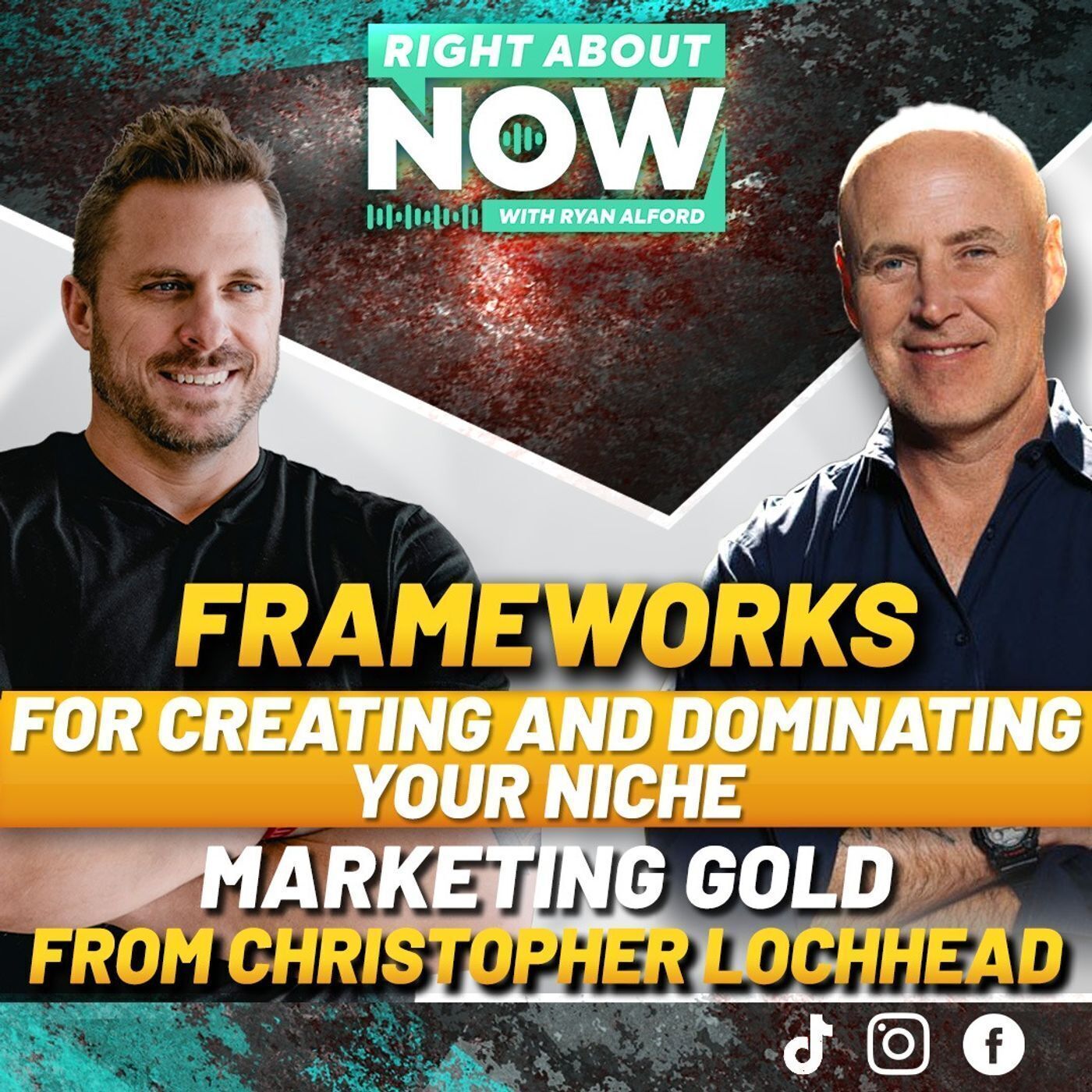
Frameworks for Creating and Dominating your Niche Marketing Gold from Christopher Lochhead
They discuss innovative strategies, the power of language in shaping consumer perceptions, and the need to address customer problems rather than just promoting solutions. Christopher also highlights the generational shift with "native digitals," the risks of lazy marketing language, and the importance of differentiation to drive meaningful results.
A must-listen for marketers seeking fresh, impactful insights.
Christopher shares compelling advice on the importance of solving real customer problems rather than simply promoting solutions, challenging traditional marketing norms. The discussion delves deep into the value of reflective thinking, the rise of "native digitals" in a rapidly evolving landscape, and the dangers of falling into the trap of lazy marketing language.
This episode is a masterclass in differentiation, offering valuable lessons for marketers looking to set themselves apart and foster authentic, meaningful connections. Whether you're revisiting this classic or hearing it for the first time, it’s an episode that continues to resonate and inspire.
Press play and read along
Transcript
Speaker 1
Hey guys, another special edition of Right About Now. I'm Ryan Alford, your host.
And look, it is the new year. I've promised you we're going to bring it.
Speaker 1
And I was going back through some episodes and literally this guy's right over my shoulder. Got my wall of fame here in the studio.
Christopher Lockhead. He's the master, man.
Speaker 1
The master of category design, the master of telling you like it is. And he's not afraid to tell you your baby's ugly.
You know why?
Speaker 1 Because it helps you get ahead, and that's what we're here today to do.
Speaker 1
Talk to you about how to get ahead with your marketing strategies because it's not time to play safe, it's time to play different. Own your different.
Christopher's going to tell you like it is.
Speaker 1
This is the most action-packed episode we have had in years. Listen, heed his advice.
Own your different,
Speaker 1
own your category, and own the market. Enjoy.
Appreciate you on Right About Now.
Speaker 3 This is Right About Now with Ryan Alford, a Radcast Network Production.
Speaker 3 We are the number one business show on the planet with over 1 million downloads a month,
Speaker 3
taking the BS out of business for over six years in over 400 episodes. You ready to start snapping necks and cashing checks? Well, it starts right about now.
Right about now.
Speaker 1 I'm excited, man.
Speaker 1
We do a lot of interviews. I get to do a pick and choose.
We're getting to do whatever the hell we want on the Radcast these days.
Speaker 1 And when I can have Christopher Lockhead on my fucking show, I am having him on. Christopher, what's up, brother?
Speaker 2 It's great to see you, big sexy man.
Speaker 1 Dude, I mean, it's funny. I mean, I've been in the business, and people go, well, who do you listen to? What do you read? What do you do?
Speaker 1 I'm kind of like, I drown a lot of it out, but there's one voice, one voice that literally 9.5 out of 10 is the closest thing to 100% there is in life.
Speaker 1
I said, you need to fucking go follow Christopher Lockheed on LinkedIn. You need to fucking go subscribe to Category Pirates.
And you know what? Send me $100 and thank me later.
Speaker 2 Thank you, Ryan.
Speaker 2 Very kind of you to say.
Speaker 1
I know, but people know I don't blow smoke. I'm a nice guy.
I got southern charm, but I kind of tell it like it is in my own way, and it's the truth. 13-time bestseller, probably more than that now.
Speaker 1 Apple podcaster of the universe and the most legendary category designer I've ever fucking met.
Speaker 1 I could go on and on of the titles. I'm going to stop blowing smoke because I want people to hear some of your brilliance.
Speaker 1 I really, you know, we've been talking and, you know, I nod my head every day at the daily, you know, Bible verses I get from Lockhead on
Speaker 1 LinkedIn. But
Speaker 1
there's been a few topics of late. I want to get into them.
But I do want to just first, Christopher, I mean, let's set the table.
Speaker 1 You know, what's been just gathering your attention, you know, with the newsletter and with your team?
Speaker 1 And I don't know, I wouldn't mind maybe just getting a preamble of where you're at and the state of the world of business in general.
Speaker 2 Well, you know, our little business is doing great, so we're very fortunate about that.
Speaker 2 The big topics on our minds right now
Speaker 2 really start with our inability in America and in a lot of the world now to dialogue with each other.
Speaker 2 And there's never been a point in history where Americans hate other Americans like they do now.
Speaker 2 And so, on our mind a lot is the power of dialogue and is getting people to understand that just because somebody disagrees with you doesn't mean you need to hate them.
Speaker 2 And we need more conversation.
Speaker 2 And what most people call a dialogue in our country today is actually just called waiting talk.
Speaker 2 Or even worse, waiting to yell.
Speaker 2 So, you know, that's on our mind a lot. That's a big one.
Speaker 2 We think there's implications. You know, the way our politics are in this country right now, I find very terrifying.
Speaker 2 Not because of, you know, a left direction or a right direction or any of that.
Speaker 2 It really comes down to an inability to have a conversation about anything of substance with almost anybody anytime.
Speaker 2 You can pick a topic, guns,
Speaker 2
people are going to lose their minds. Abortions, people are going to lose their mind.
Immigration, people are going to,
Speaker 2 you know, we can't have a thoughtful discussion. And more, even in addition to that, is
Speaker 2 we all need to understand steel sharpens steel.
Speaker 2 I don't want to live in a world where everybody agrees with me. You know what? I'm not always right.
Speaker 2 Really?
Speaker 2 And
Speaker 2 I have changed my mind or I have changed my positions.
Speaker 2 You know, people today call that flip-flopping. It used to be called learning.
Speaker 2 So that's a big one.
Speaker 2 The other one, the sort of the biggest hiding in plain sight that nobody's talking about, of course, is the shift to a whole new category of human, the emergence of native digitals, and the fact that
Speaker 2 those of us who are 35 or older are native analogs, and we are the last native analogs that will ever live.
Speaker 2 And it has profound implications for us in marketing, but really it has profound implications for everything about the way we live, work, and play.
Speaker 1 Chris, let me ask you this, you know, because I can't wait to dive into that last one. And I know that's going to be a lot of the meat of what we talk about today.
Speaker 1 But, you know, we live in such a world where
Speaker 1 there's a lot of damn gray, you know, like,
Speaker 1
and we've gotten to this point of drawing these hard lines, like you said. And it couldn't couldn't be more polar opposite than what reality is, which is there's nuance to everything.
And
Speaker 1 how the hell did we get? I mean, I know we could, there's been this firebrand of politics and other things, and I'm sure we can have a whole episode on this, but I just, I really value your mind.
Speaker 1 And so I like to
Speaker 1 pick at it when I have you here. But like, how the hell did we get here? Like, when we all know, like, I think if you have and you can, like,
Speaker 1 get someone discharged for half a second, they'll agree with what I just said, you know, but
Speaker 1 it's everything's charged, everything's fired up. Like, how did we,
Speaker 1 are we just compounding? Is that what, I don't know, what's your, why did we, how did we get here?
Speaker 2 Well, I think, and this may sound more trite than I mean it, in a very real way, we don't know how to think.
Speaker 2 And so, um a lack of learning about thinking
Speaker 2 causes this.
Speaker 2 And Roger Martin, who's considered to be the number one business management thinker in the world, the quote-unquote new Peter Drucker, he's got a book out that's fairly recent called A New Way to Think.
Speaker 2 We were lucky enough to have him on the podcast.
Speaker 2 And he makes a very important
Speaker 2 assessment, which is he delineates two types of thinking. reflexive and reflective.
Speaker 2 And as the name suggests, reflexive is from a reflex. So if you go to the doctor and she bangs your knee, your knee's going to do that, and she's going to say your reflexes are good.
Speaker 2 And there are many points in our life where reflexive thinking and action associated with that reflex are very, very important.
Speaker 2 If you and I are driving and somebody cuts us off or something, you know, an animal jumps out into the road or something like that, we're going to hit the brakes, we're going to swerve, and we will take a reflexive action based on a reflexive thought that might save our life or the lives of others.
Speaker 2
And so that's very powerful. Reflexes are a very powerful thing.
We train ourselves to become unconsciously competent to things, and you could argue much of that is reflexive.
Speaker 2 However, and then reflective, as the name suggests, is you say, okay, well, wait a minute, what do I really fucking think about this?
Speaker 2 Not what have I heard or what got tweeted yesterday or any of that. And when you stop and think, it takes some work.
Speaker 2 And around here, one of our expressions is, one of our favorite expressions is thinking about thinking is the most important kind of thinking.
Speaker 2 And in business, some of us got taught early, if we want to really think, ask why
Speaker 2 five to seven times.
Speaker 2 So now if you bring that to our world,
Speaker 2 you say, okay,
Speaker 2
guns. I bet you have a position on guns, right? Yes, I do.
Yes, I do. And I have a position on
Speaker 2 And if we wanted to get to the heart of why you think what you do about guns, maybe we don't have to ask why seven times, but we for sure have to ask why three or four times.
Speaker 2 And here's the incredible thing: when you ask a lot of people, and do it in a friendly way, not in a confronting way,
Speaker 2 why
Speaker 2 five to seven times on a belief that they hold, most people can't get past two or three whys.
Speaker 2 Right? So, you know, if you use guns as an example, you say, well, what's your position on guns? I support the Second Amendment. Okay, great.
Speaker 2 Why?
Speaker 2 Well, I believe that we have the right to defend ourselves. Okay, great.
Speaker 2 Why?
Speaker 2 Well,
Speaker 2 and then they start to break down. Yeah.
Speaker 1 Somebody told me I should care about it.
Speaker 2 Yeah.
Speaker 2 Yeah.
Speaker 2
And then you say, okay, well, we have the right to defend ourselves. Are we going to draw a line there somewhere? So, for example, nobody can stop me from taking boxing classes.
That's self-defense.
Speaker 2 Nobody can stop me from going to a Krav Magaw class. That's self-defense.
Speaker 2 But we as a society have decided that regular citizens can't own tanks.
Speaker 2 So we've already drawn some lines, right? We're allowed to go boxing. In most of the country, you're allowed to buy a handgun or a shotgun or a rifle.
Speaker 2 And there's different bars you have to get over in different parts of the country.
Speaker 2 but to the best of my knowledge there's no part of the country where you can legally acquire a tank so so we've there's some spots in south carolina where there might be one in the backyard
Speaker 2 maybe in arizona yeah maybe parts of nevada
Speaker 2 on the whole i think you're right
Speaker 2 yeah and so my point my point is at some stage of the game as it relates to guns collectively we decided there was going to be some rules and there was going to be some lines that we were going to draw around what citizens can and can't do.
Speaker 2 Well, we're no longer able to have a discussion about that
Speaker 2 in any level of detail without people yelling. Pick another one, abortion.
Speaker 2 Well, people immediately, and this is the other interesting thing, people immediately start conflating things.
Speaker 2 So you ask somebody about abortion. You say, well, what do you think about abortion? And they give you their opinion.
Speaker 2 And then let's say they say, oh,
Speaker 2
I think abortion's fine up until the 20th week. I'm just making shit up.
And you say, okay, why do you believe that?
Speaker 2 Well, because at week 23, or whatever, I'm not an expert, so I'm guessing, that's when the fetus becomes, quote unquote, viable or likely to be viable outside the womb. And
Speaker 2 that's the cutoff point.
Speaker 2 Okay, well, why do you think viability is the cutoff point?
Speaker 2 Well, most people don't answer that question.
Speaker 2 And then people who are pro-choice
Speaker 2 say, well, it's fine up until viability because it couldn't survive on its own.
Speaker 2 Okay, well why is that the line?
Speaker 2 I'm not agreeing or disagreeing. I just want to understand.
Speaker 2 And they say, well, you know,
Speaker 2 here's the other one I love.
Speaker 2 I don't believe that life begins at conception.
Speaker 2 Okay, well, then you're a moron.
Speaker 2 Because what the science tells us is when the sperm gets to the egg and does its thing, thing, or the two do their thing,
Speaker 2 if it plays out over nine months, it's going to be a person.
Speaker 2 And I'm no doctor or scientist, but best I could tell, that is when life begins.
Speaker 2 Now, you can say that viability is the line, and you could argue for why you think that's the line if that's what you think. But don't say, you know, so somebody says, yeah, but
Speaker 2 life doesn't begin at conception.
Speaker 2 Okay, well, come on.
Speaker 2
We have to have some intellectual honesty in our discussion. I understand that you're pro-choice.
I'm pro-choice too, for the record. But I'm not an idiot.
Speaker 2 Life begins at fucking conception because when conception happens, barring something horrible,
Speaker 2
if the pregnancy goes relatively well, we're going to have a person. So life begins at conception.
And just because you're pro-choice doesn't mean you have to say dumb shit.
Speaker 2 Because
Speaker 2 most people who are smart understand
Speaker 2
that life basically begins at fucking conception. Or another one I really love, just to you know, get on all the tough topics.
They say, well, what we need is an assault weapons ban.
Speaker 2 Okay,
Speaker 2 well,
Speaker 2 you do know the minute you say that, you've exposed the fact that you don't know what you're talking about.
Speaker 2 And people say, well, what do you mean? There's assault weapons, AR-15s, and that's what all these school shootings happen with, and we need to get rid of the AR-15.
Speaker 2 Okay, well, do you know there's only three kinds of guns? There's handguns, there's shotguns, and there's rifles.
Speaker 2
There's no such thing as an assault weapon. All an AR-15 is, is a scary-looking semi-automatic rifle.
Technically, that's what it is.
Speaker 2 So when you say you want to get rid of the AR-15, what you're saying is, well, black cars kill more people than any other color of car, and they're the scariest kind of car, so we need to get rid of the black cars.
Speaker 2 Okay, well, a rifle is a rifle, and yes, they have different features, and some of them are this, and some of them are that.
Speaker 2 But
Speaker 2 if you say we want to get rid of the AR-15, essentially, what you're saying is we're going to make rifles illegal in the United States. Is that what you're saying?
Speaker 2 Oh, well, no, we don't. We just,
Speaker 2 well, okay, so my point is: the minute they say something like that, and you say, Well, why?
Speaker 2 They don't even understand what they're fucking talking about. Now, maybe we should outlaw rifles.
Speaker 2 If that's what you mean, let's have that conversation.
Speaker 2 All I'm saying is
Speaker 2 we accept
Speaker 2 reflexive thinking that makes us feel good
Speaker 2 as thinking.
Speaker 2 And it's not.
Speaker 2 And when I say to people on the pro-choice, on the abortion issue, you know, part of the reason we're having the problem that we're having in America is because of the pro-choice movement.
Speaker 2 They lose their fucking minds.
Speaker 2 Or when I say to the people who want more gun control, of which I am one,
Speaker 2 you realize the anti-gun people are the reason that there's no movement on guns.
Speaker 2
Well, they lose their fucking minds. Well, no, no, no, it's the gun owners, it's the NRA.
Yeah, I understand their position, but you know that every time you say you want to ban something,
Speaker 2 it's going to cause people who believe in it to dig their heels in.
Speaker 2 So the more you say it, every action has an opposite and equal reaction. And so when you present a case to the
Speaker 2 groups in our country who want more what they call quote-unquote responsible gun laws, which I want,
Speaker 2 well,
Speaker 2 they don't know what they're talking about because they say what they want an assault weapons ban.
Speaker 2 And when I say to them, when you say that, you make, quote, the other side crazy and go, we're not going to give you an inch, because if we do, we're going to give you a mile.
Speaker 2 The reason they say that is when you say assault weapons ban, gun owners look at you and go, you don't even know what the fuck you're talking about.
Speaker 2 And so my point is, whether it's those topics or others, if we want to have a three to five to seven wise conversation about any topic, most
Speaker 2 people stop listening and they immediately have reflexive thoughts.
Speaker 2 And those reflexive thoughts calcify over time. And that's, of course, what's happened on the internet.
Speaker 2 We can now, what an echo chamber is, is people passing back and forth reflective or excuse me, reflexive thoughts.
Speaker 2 And there's almost no reflective thinking happening at scale, either on the internet or off the internet, which is what makes
Speaker 2 radical dialogue so powerful.
Speaker 1 That's why I'm reflecting on what you just said, literally. And I think this is where a lot of
Speaker 1 your practical ability to, and we're going to talk about business and marketing, but I think this is what really, I think, encapsulates the brilliance of a lot of your approach and what you do.
Speaker 1 You talked about just some firebrand topics right there, some super,
Speaker 1 but
Speaker 1 the thinking part of it and the reflective, refractive, all of those, that aspect is the problem that channels through everything that drills down into business and marketing eventually.
Speaker 1 And I think people can understand that because of how you just encapsulated it.
Speaker 2 Thank you. And a core tenant in category design is: listen to the words.
Speaker 2 Listen to the words.
Speaker 2 You know,
Speaker 2 I assume this is going to come out after the midterms, right? Yep. Yep.
Speaker 2 So
Speaker 2 the Democrats have been painted by the Republicans as weak on crime.
Speaker 2 And
Speaker 2 the Democrats don't understand why they're weak on crime. They point to all these facts that show that crime is moving in the right direction in a lot of the country and so forth and so on.
Speaker 2 And look, we can argue about where the data is and where it isn't and so forth and so on. But here's the bottom line.
Speaker 2 Your party, and by the way, I'm a radical independent, so I'm neither Republican or Democrat.
Speaker 2 And in the current midterms, I voted for both Republicans and Democrats on the same fucking ballot, as I often do.
Speaker 2 But what they realize is
Speaker 2 you can't have a thoughtful discussion with these folks at any kind of a detailed level. And when the Democrats say, defund the police,
Speaker 2 when that was going on,
Speaker 2
I was pretty vocal about how stupid I thought that was. One of my best friends was murdered.
And I'll tell you, when you sit there in front of the sheriff and the coroner,
Speaker 2 in this case with my friend's family, his mother on one side and his sister on the other,
Speaker 2 and the sheriff confirms
Speaker 2 that it's him.
Speaker 2 In our case, Sheriff Jim Hart in Santa Cruz, California said
Speaker 2 the one thing you want to hear in that moment. After you've heard the most horrible thing you could possibly imagine, which is the confirmation that one of your closest friends is dead, murdered.
Speaker 2 Sheriff Jim Hart said, we will stop at nothing until we get them.
Speaker 2 And they did.
Speaker 2 And it was a very large, very costly investigation
Speaker 2 that had great old-fashioned police work and technology. And it was a massive project.
Speaker 2 You know, if you had to hire a startup to solve this and do what has been done here in this murder case, it would have been over $10 million.
Speaker 2 Okay, why do I bring that up? Defund the police? Go fuck yourself.
Speaker 2 Because I know what you want to hear the cops say in that situation.
Speaker 2 Well, at the time, people on the left were saying, oh, we don't mean defund the police. What we mean is we know
Speaker 2
they go into all this stuff. Some of the stuff was valuable.
Some of the stuff is right.
Speaker 2 Do we use police for things that we shouldn't maybe use police for? Maybe we do. Is there evidence around that? What are are the experts?
Speaker 2 Okay, do we need more health care worker? Do we need more homeless programs?
Speaker 2 I'm not an expert. Let's fucking have the conversation called maybe we're asking too much of the police.
Speaker 2 But listen to the words.
Speaker 2 If you don't mean defund the police, if what you mean is we need more social services or whatever the fuck it was you think you meant, don't fucking say defund the police because I'm going to take you at your word.
Speaker 2
And so this becomes the stupidity. So one of the keys to thinking is language.
Why aren't they wrong language? Because words create thinking. That's why we invented them, so we could share ideas.
Speaker 2 Because if you and I don't have language, we grunt and point. That's what we got.
Speaker 2
Yes, yes. Right? So language was literally created as a way of sharing thinking.
That's why we invented it as human beings. So
Speaker 2 listen to the fucking words. If I say to you, hey, Ryan, I'm stoked to be on your podcast, take me at my word.
Speaker 2 And if I'm a Democrat who says, defund the police, or if I'm a Republican who says I want to outlaw
Speaker 2 abortion in the country, I take them at their word.
Speaker 1 Words matter.
Speaker 2 Words matter. And words in marketing and words in category design change the future.
Speaker 1 Yep. And you know what?
Speaker 1 I gave myself because I don't even have to take notes anymore, anymore, but for when Christopher Lockheed comes on my shows, I give myself a few things because I don't want to, I can't, you know why?
Speaker 1
It's selfish because I want to get stuff out of you. I want people to hear what you have to share.
And literally, you've gone down like the fucking, I have this word.
Speaker 1 It says languaging on my sheet of paper in order, which is right down the path of what you're talking about. And I want to get in.
Speaker 1 to our digital, our native digitals, native analogs, but I want you to go a little further down the languaging path because I think it's spot on right where you left it.
Speaker 2 So, a demarcation point. So, languaging is the strategic use of language to change thinking.
Speaker 2 And most people in business, in marketing, are lazy about their language. I'll give you a simple example.
Speaker 2 How many companies do you know who talk about what they sell and market as a solution or solutions?
Speaker 2 Too many.
Speaker 2 Right.
Speaker 2 Okay, well, here's an aha for you. Just listen to the word, solution.
Speaker 2 If somebody's going to buy a solution,
Speaker 2 they need to have a problem.
Speaker 2 And one of the biggest unlocks in category design, as distinct from idiotic marketing, is don't market your product.
Speaker 2 Market your problem.
Speaker 2 Because the bigger, more urgent, and more strategic the problem, the more time, money, and energy people will invest in solving solving the problem.
Speaker 2
So, but we don't do that, do we? We don't, marketing is not focused on customers. It's focused on us.
Branding is about us branding our name in their head. That's what it's about.
Speaker 2 Well, that's a big mistake.
Speaker 2
Branding is terrible the way it's practiced today. Even the word is terrible.
Most people don't even realize where the word comes from.
Speaker 2 It comes from putting a stamp on animals to prove that you own them. And it's painful and horrible to the animal.
Speaker 2 And a bunch of marketing idiots got together and said, oh, let's call it what we do that.
Speaker 2 We want to fireburn our logo into our customers' heads.
Speaker 2 Really?
Speaker 2 Don't market your brand or your product. Market the problem.
Speaker 2 Because without a problem, nobody buys a solution. And so I guess my point is, on a lot of things, if all you do is take a step back and go, listen to the words.
Speaker 2 What do the words mean?
Speaker 2 And let's be thoughtful about, well, why are we using those words?
Speaker 1 How about this word? Amen. Praise the Lord.
Speaker 2 Because I came, I grew up, I grew up in Southern Baptist Church.
Speaker 1 And you know, when the preacher would say something, you're like,
Speaker 1 you know, you're wanting to support them, you go, Amen.
Speaker 1 The deacons are going, hallelujah.
Speaker 2 That's me when I hear you talk about it.
Speaker 1 It's so true. And look,
Speaker 1
I'm going to call myself out like I do. I use these terms even more and I have Christopher Lockheed in my head.
I'm like using them and I say them.
Speaker 1
And it's because I'm being lazy because I know people know what they think it means. And so I'm lazy and I use it.
But in the back of my head, I'm going, I got to think of a different way to say this.
Speaker 1 I got to language this better, you know, but then people are conditioned to know what they know. And so
Speaker 1 I guess I'm lazy in that regard, but I find myself doing it sometimes.
Speaker 2 Sure, it's easy to be a little bit lulled to sleep. I'll give you another great one.
Speaker 2
In the agency world, we hear this a lot. Full service.
We're a full service marketing agency.
Speaker 2 Okay. Have you ever, once, have you ever once heard anybody say they're a half
Speaker 2 service agency?
Speaker 2 We're a quarter service
Speaker 2 PR agency.
Speaker 2 You know,
Speaker 2 this guy was telling me about full stack. We're a full stack developer.
Speaker 2
We train full stack developers. Yeah, but sometimes when I go to have breakfast, I like a half stack.
I can't eat a full stack.
Speaker 2 What the fuck's a full stack developer? Now, you know, if you're in that world, you know what that means, but outside that nichey little world, it's meaningless.
Speaker 2
And so there are all of these throwaway things that we say. Here's another stupid one that never gets thought of in marketing.
I always love this one. Don't take our word for it.
Speaker 2 So let me understand this. You are paying to put an ad in the world
Speaker 2 where you tell people to not take your word for it.
Speaker 2
You're telling people, you're paying to tell people not to listen to you. Fuck, that's dumb.
Don't take our word for it. Here's what the customer says, or here's what Gartner says.
Speaker 2 Are you out of your mind? You're undermining yourself.
Speaker 2 And so my point is, there are all of these lazy uses of language that go unquestioned. And A, it can be damaging to our businesses because it's not differentiating.
Speaker 2 When we say the same things as everyone else,
Speaker 2 we create the impression we are the same as everyone else. And being the same as everyone else is the core of not being differentiated.
Speaker 2 So, if you're going to be differentiated, you have to fucking be different. If you're going to be different, you have to say something fucking different.
Speaker 2 Exactly right.
Speaker 1 And there's, I mean, I grew up in the nucleus of the ad business, but is there a more self-absorbent
Speaker 1 bunch
Speaker 2 in the whole world?
Speaker 2 I don't know. And I'm
Speaker 2 not sure.
Speaker 2 One of the things I love about the ad business is the ad business gives itself awards for creativity.
Speaker 2 Yes. Now, if you're in the movie making business and you want to evaluate a piece of art and give it an award, which I think is sort of dumb, but whatever, do whatever you like.
Speaker 2 You want to give certain movies an Academy Award, have at it based on artistic merit as decided by some group. But in the ad industry, it's really do other ad industry people think it's cool?
Speaker 2 Here's what's rarely part of the discussion. Did it sell anything?
Speaker 1 Don't ask that.
Speaker 2 Did it increase the market cap of the company that put out the ad?
Speaker 2 No, but it really used this awesome hue of purple in it.
Speaker 1 I can listen to you talk about that all day.
Speaker 1
It's just so true. The words matter.
And, you know, I'm going to encapsulate for everybody listening because, you know, Chris is,
Speaker 1
you know, brilliant, smart, and you're going to go follow all his shit anyway. And hopefully you already did from me talking about him all the time.
But encapsulating it all, he just did it there.
Speaker 1 You know, embrace your different, find different, you know, challenge the norm. I mean, that's,
Speaker 1 at the end of the day, like I like to distill like potentially complicated things down.
Speaker 1 Like, and I, sometimes I, with you and like other things in the categories and all that, it's just like fucking embrace your.
Speaker 1 And the thinking part, I just think we've got to, I don't know what the renaissance is going to be in that, but I hope we can bring it about. Maybe just talking about it is what will help.
Speaker 2 I hope so. I mean, around here, we're on a mission to do that.
Speaker 2 And on the political front,
Speaker 2 I make it very clear, A, I'm an independent. And B, I love people on both sides of the aisle deeply who I disagree with deeply.
Speaker 2 And that's why I don't hate them. Because I have friends on the far right who have ideas that I think are absolutely fucking off the chart wrong
Speaker 2 and
Speaker 2 I have the same on the left and what I know is they're very good people who do very good things in the world who care deeply about themselves others and our country You know, it's when I get into the abortion debate with everybody, well, my pro-choice friends are furious about what's going on.
Speaker 2
And I say, well, can we at least find some common ground to start? And they're like, there is no common ground. They want to outlaw abortion.
We think that's terrible. It's taking away women's rights.
Speaker 2 Okay, I get that.
Speaker 2 But can we start somewhere? How would we start here? Nobody wants one abortion.
Speaker 2 Everybody's anti-abortion. Aren't they?
Speaker 1 Yeah.
Speaker 2
I don't want one abortion. I don't want one woman to have to go through that.
I don't want one potential life
Speaker 2 to be lost.
Speaker 2
I don't want any of that. So let's all start with we care about women, we care about children, and we'd rather these horrible things don't happen.
Okay, great. We can at least agree there, can't we?
Speaker 2
Yes, yes. Now, we may disagree that when it happens, how we deal with it, okay, fine, then let's have the disagreement.
But my point is, if we look,
Speaker 2 can't we at least, we can come to a place where we understand
Speaker 2 that the other person, despite the fact that they have a different opinion, and isn't an evil person, even if we ascribe that to them and oh by the way if you treat them and speak about them like they're evil people they're never going to come and talk to you
Speaker 1 chris do we just want to jump to the end is that what it is you know like because i heard you talk right there and i'm like trying to distill it like how people are like we just want to get to the end point instead of the journey that it takes to find common ground.
Speaker 1 We just want to get to the nth point of, again, like you said, the actual negative thing that has all the polarization around it. But there's like 30 steps before it, right?
Speaker 1 We just want to jump to the final conclusion that is so divisive, right?
Speaker 2 Well, and we're committed, here's the truth, we're committed to being divisive. Yeah.
Speaker 2 I was listening to a very popular political podcast recently.
Speaker 2 And
Speaker 2 the gal providing the analysis was talking about how the amount of vitriol in our politics has never been higher and what a problem this is, et cetera, et cetera.
Speaker 2 And then she went on to talk about and why it's all Republicans' fault.
Speaker 2 And I said, like, I'm yelling at my phone because I'm listening to a podcast going,
Speaker 2 you don't,
Speaker 2 you don't fucking, you're so dumb that this is a very smart person, supposedly.
Speaker 2 You're so dumb that you don't realize that you're now doing two seconds after you said it was the thing that needed to be not done, you're now doing exactly it.
Speaker 2 You just like being divisive in a Democratic outfit as opposed to a Republican outfit. And you just think the Republicans are more blatant about it or whatever you think.
Speaker 2 Well, you just, you're doing the fucking same thing.
Speaker 2 So you're not going to make friends, in this case with Republicans, by calling them assholes.
Speaker 2 It's not going to work. I don't understand why President Biden doesn't come out and say to every MAGA person,
Speaker 2 we love you. We want to work with you.
Speaker 2 We want to understand you.
Speaker 2 Why wouldn't you say that?
Speaker 2 Look, I disagree with some things on the far left.
Speaker 2 You know,
Speaker 2 I'll happily have a debate with AOC about whether or not we need universal basic income.
Speaker 2 But I'm not going to call her names because she says that we need that and I think it's nuts. Let's talk about it.
Speaker 2
I don't hate her because of it. I might not like her position.
I might not like her style. I might not, whatever.
Speaker 2 But Americans hating Americans because we have different opinions, really? That's what we're doing.
Speaker 1 And that's the key. Americans hating Americans isn't good for anybody if you're an American.
Speaker 2
Well, no. And look, why would you? Have you ever sat down and talked to an American? You know, I live in a very Democrat area.
Well, have you ever been to the middle of the the country?
Speaker 2
No, I mean, really. I was just in Arizona.
I asked people how they think about the election. I want to hear what they say.
Speaker 2
I might not agree with everything. And oh, by the way, just because I'm from California doesn't mean anything.
You know, people can paint anybody with any kind of brush that they want, right? Yeah.
Speaker 2 And so
Speaker 2 I personally believe we need a breakthrough in listening and a breakthrough in real dialogue, the ability to ask five to seven whys and have a thoughtful conversation about
Speaker 2 And in marketing, it's everything because
Speaker 2 roughly 90% of the marketing that we see is
Speaker 2 not something that somebody thought was legendary.
Speaker 2 It's something a committee could agree on.
Speaker 1
You've made my life harder, my friend. I just want you to know that.
Because
Speaker 1 I joked earlier, and I know I'm going to keep saying it, but like literally, every time I'm in a meeting with a client now, and we look, I named my agency fucking radical.
Speaker 1 I didn't name it radical because
Speaker 1 I gave everyone in my agency license to call bullshit and to push the envelope when you name your agency radical. So there was some thought in that.
Speaker 1 However, I said in every meeting now, and your voice is in my head, and I'm going, are we really
Speaker 1 pushing it? Are we trying to,
Speaker 1 you know, are we speeds and feeds? Are we trying to be better than the competition?
Speaker 1 Or are we trying to completely damn demand and fucking, you know, like literally and that practical thought though I think there's not enough of it and it's hard it makes you think it makes you work harder but it's not all supposed to be easy yes and in category design one of the thing one of our core tenants another one of the core tenants is reject the premise so whenever we go to do thinking work creative work strategic work
Speaker 2 We start with reject the premise. So we look at well, what's the premise for this?
Speaker 2 Right? What does everyone else say about this topic or about this market or about this type of product or service? Or what does everybody say?
Speaker 2 Write that shit out and look at it and go, okay, let's reject all of it.
Speaker 2 Let's start with, it's all wrong.
Speaker 2 Now, look, you might reject the premise, do some real thinking about thinking, and come back and fully accept
Speaker 2 the premise after you've gone through that exercise. That's fine.
Speaker 2 If you really go through the exercise.
Speaker 2 Because the only way we know to open the aperture of our minds and consider something radically different, I say those words on purpose, is to start by rejecting our own premise.
Speaker 2
And now we're free. And my friend, the legendary designer John Bielenberg, says, start by doing the opposite.
That's his way of rejecting the premise.
Speaker 2 So he teaches university courses on innovation and creativity and all this good stuff. And one of the exercises he does with university students, Ryan, is he gets them to build a bike.
Speaker 2
And the bike only has one design point. They can do anything they want with the bike, except there's one thing that the bike's got to do.
It cannot be ridable.
Speaker 2
Go. And the reason he does that is to have them go through an exercise that is 100% reject the premise.
I love that, man.
Speaker 1
I love it. And all right, I've got to talk.
I got to get the native digitals and native analogs.
Speaker 1 But last thing, one of the first exercises I went through when I was in the ad game, this was in like 2000, 2001, and literally was worked on Verizon.
Speaker 1
And, you know, we talked one of our first campaigns. And there used to be this thing.
I don't see it as much anymore.
Speaker 1
And maybe because I'm, you know, we work with medium-sized companies. I'm not working, you know, with, you know, Fortune 10 companies like I do in the past.
BDI and CDI. You remember that exercise?
Speaker 1 Brand development index and category development index. And
Speaker 1 I want you to hammer this home for me, but I thought I had, I had this thinking back because when Verizon, when we were kind of kicking everybody's ass in 2000, 2001, and Can You Hear Me Now was one of the first campaigns I worked on.
Speaker 1 It was the premise was we had to develop the category, which was walking around with a cell phone that actually worked, you know, because, and we didn't, they did talk about their network and it became chest.
Speaker 1 It got worse and worse on the chest beating, but it was all about category design at the beginning with wireless, right? Because no one had fucking known what do I do with cell phone?
Speaker 1 Why do I need that? And so it was all category design. In your mind,
Speaker 1 should it just always be 100? Is it 100 to zero category design versus our category development versus brand development?
Speaker 2 I'm going to say yes, but not 100% mean it.
Speaker 2
But here's why I'm going to say yes with a little bit of an asterisk. All right.
Let's pretend I 100% mean it for a second.
Speaker 2 Here's the big aha.
Speaker 2 And very few marketers understand or can understand this. And the minute you do, it changes everything.
Speaker 2 When you're the company evangelizing the category, that is to say, evangelizing the problem, that is to say, talking about legendary marketing creates a different future.
Speaker 2 It moves the world from one place to a new and different place, right? So you're evangelizing, we call them Frodos, those from tos, right? It doesn't have to be this way.
Speaker 2 It could be a lot different, right?
Speaker 2 When you're the company and or the person doing that,
Speaker 2 here's the interesting thing.
Speaker 2 The consumers of that message
Speaker 2 assume you're the category leader.
Speaker 2 Because the only person, end or company, they've ever heard evangelize a category in a, and I'm going to use these words very purposefully, missionary way like that, is the company and/or person
Speaker 2 bringing the idea to life.
Speaker 2 And so here's the irony.
Speaker 2 When you evangelize your category, people assume you're the category queen or king.
Speaker 2 And so you get brand for free
Speaker 2 because you watch. No one else in your space is evangelizing the category.
Speaker 2 You know, I just spent the better part of 20 minutes or whatever it was
Speaker 2 going off on our need for real dialogue.
Speaker 2 Well,
Speaker 2 Folly or Different is a real dialogue podcast. How could the guy who has a real dialogue podcast not be an ambassador, an evangelist for fucking dialogue?
Speaker 2 And oh, by the way, when you do that, I happen to believe it, it's not just a technique, but when you do that and you go, oh, yes, and he's a dialogue podcaster in the business and marketing space, well, yeah.
Speaker 2 And then people go, well, shit, he must be one of the leaders, at least, because he's just spent 20 minutes talking about how important real dialogue is and making me think about topics that I don't normally like to think about and probably slightly pissing me off.
Speaker 2 And so my point is, when you evangelize the category, you don't have to say to people, oh, and by the way, I'm one of the leaders in business dialogue podcasts.
Speaker 2 You get it for free.
Speaker 2 And it's more powerful than if you actually promote yourself or your product or your brand. You're promoting an idea, you're promoting what's possible in the future for your prospect or customer.
Speaker 2 That's a way more powerful thing to talk about than, hey, isn't my fucking carbodingulator at them?
Speaker 1 I fucking love you, man.
Speaker 1 All right, man.
Speaker 1 It's been plain sight, and it's hitting us, it's smacking us in the face every day.
Speaker 1 And it never, and I was like, I'd been getting smacked, I was getting smacked around like the last few years, like in certain meetings.
Speaker 1
And I didn't know what it was, but it was like ringing in the back of my head. And then you distilled it so eloquently in the last year, 18 months.
I don't know.
Speaker 1 I know you've been talking about it for a bit now, but.
Speaker 1 What's this wave, man? We got native digitals and native analogs.
Speaker 1 There's so many implications.
Speaker 1 Let's hit it.
Speaker 2 All right.
Speaker 2 So let's start basic principles.
Speaker 2 The aha for me came a few years ago. I had my friend Paul was visiting from the UK with his family, his wife and his two kids.
Speaker 2 And the kids were teenagers at the time, you know, 13, 16, kind of sort of in that ballpark where some of your rug rats are.
Speaker 2
And we just live a couple blocks from the beach. It's very beautiful here.
And so my wife Carrie, being the amazing person that she is, says, let's do a wonderful beach dinner.
Speaker 2 We can have fires on our beach here, so we're going to roast some weenies and we're going to do some s'mores and we're going to watch the sunset and we're going to have a great old time on the beach.
Speaker 2 So that's exactly what we do.
Speaker 2 So we go out there and we're looking at the sunset and we're enjoying the beach and we're enjoying the waves and we're getting dinner ready and we're having a nice conversation.
Speaker 2 What are the kids doing?
Speaker 2 They're on their phones. Yeah.
Speaker 2 So me being their unwanted
Speaker 2 unwanted uncle, say to them, hey,
Speaker 2
you might look over there. There's this big orangey, pinky, red, ready thing in the sky.
It's looking pretty cool right now.
Speaker 2 They look up. Maybe they take a picture of it, and then they go back to the phones.
Speaker 2 And a few minutes later, I'll slap them on the shoulder and say, hey, there's this amazing greeny-bluey thing right there, flip-flopping on the sand. It's called the Pacific Ocean.
Speaker 2 You don't have one of those in London. You might want to take a look at it.
Speaker 2
And then go back to their phones. So we do this for a bit of the night, and that's that.
And here was the aha.
Speaker 2 I said to myself the next morning, I said, why is it
Speaker 2 one of the most beautiful things that happens ever, a beach sunset,
Speaker 2 is not powerful enough to pull them away from their device for more than a few seconds?
Speaker 2 How can that be true?
Speaker 2 And the aha is
Speaker 2 because that's where their life is.
Speaker 2 And that unlock unlocks everything. And so the big difference between native analogs, that is to say, people who are plus or minus over 35, and people who are under 35, is not an age thing.
Speaker 2 It's a where you experience life thing.
Speaker 2 And what you'll notice, and look, there's always outliers and exceptions, and I get all that, but what you'll notice is there's a 180-degree difference. For those of us native analogs,
Speaker 2
we would always prefer to be in person. We're always going to watch the sunset.
Maybe we'll take a picture and a video of it too. But our primary experience is an analog experience.
Speaker 2 You go to a rock concert today
Speaker 2 and young people are watching the concert through their phone as they tape it.
Speaker 1 It's there.
Speaker 2 They're right there. They're right fucking there.
Speaker 2 And you're watching them through your fucking phone. Why?
Speaker 2
Because their primary life experience is on a screen. They came of age with these things.
And so the aha is
Speaker 2 if you came of age with the primarily the smartphone and the cloud, you are a native digital.
Speaker 2 You're the first generation of humans whose primary life experience is digital and secondary life experience is analog.
Speaker 2 And if you're older than that,
Speaker 2 you're the last native analogs to live on planet Earth.
Speaker 2 And once you realize
Speaker 2
how different that is, I'll give you a simple example why this matters. So we did a little bit of work.
It turns out in the SP 500 companies, there's 500 companies.
Speaker 2 And the average age of the average SP 500 CEO is 58.
Speaker 2 Now, most 58 years old, and by the way, I'm 54, so I'm a radical native analog, so, you know, I can throw all of us under the bus you can throw shade throw shade yeah exactly
Speaker 2 most native analogs don't understand this is happening
Speaker 2 well that's a problem for two reasons number one you can't hire
Speaker 2 and number two you can't market Because you can't get to anybody under 35 if you
Speaker 2 don't understand this.
Speaker 2
now it's interesting to me how small business owners adapt so much more quickly than bigger and big business owners. I'll give you a favorite example of this.
It was during the pandemic. I talked to a
Speaker 2 as the pandemic was ending, and I talked to a restaurant owner who was having a very hard time hiring people.
Speaker 2 And he was telling me he used all these job sites and this and that and the other, and he said it wasn't working. So you know what he did?
Speaker 2 He and his management team set up Tinder profiles
Speaker 2 so they could meet young people.
Speaker 2 And they used Tinder to recruit employees. And they made it very clear that's what they were doing.
Speaker 2 But, well,
Speaker 2 how many hiring managers in the S ⁇ P 500 are doing anything like that? Zero.
Speaker 2 Now the reason small business owners, restaurant owner in this case, does it is he realizes he can't get to them because they're nowhere he usually used to go in the past.
Speaker 2
So you must go to where they are. And this is a massive unlock for people.
If you have young people that you love in your life, you have to meet them in the digital world.
Speaker 2 They won't come to you.
Speaker 2 You have to go to them.
Speaker 2 And if you have young people in your life and you discipline them by taking away their screens, which may or may not be a bad thing, I'm not going to, you decide whatever you want to do.
Speaker 2 My point, though, is when you take a screen away from a younger person, you're taking them out of their regular world.
Speaker 2 Now, this unlock is everything because every time you see a television ad,
Speaker 2 what you're seeing is either A,
Speaker 2 a category of product or service that's not targeted to anybody over
Speaker 2 younger than 35, or B, wasted marketing dollars.
Speaker 2 Because nobody over 35 watches any fucking TV.
Speaker 2 And so,
Speaker 2 once you understand
Speaker 2 that the way they live life is different, once you understand that if you're native digital, you got to have digital game to meet a significant other.
Speaker 2 When you and I were kids,
Speaker 2
we had to have analog game. You had to figure out how to go ask the girl to dance.
That's right. Or whatever.
Speaker 2 Today
Speaker 2 you got to have emoji game.
Speaker 2
Yes, yes. Really good emoji game, emoji game.
Right, and emojis, emojis are the fastest-growing language on planet Earth and might be the fastest-growing language ever.
Speaker 2 And I just found this out as a native analog. Do you know that if you give somebody a thumbs up and they're a native digital, you just insulted them?
Speaker 2 I've heard that.
Speaker 2
I've heard that. They think it's a passive-aggressive kind of pat on the head.
Yeah, yeah.
Speaker 2
Right. Yeah.
Well, if you don't know that and you're managing a team with native digitals on it and you send them a thumbs up they're gonna think you're a donkey
Speaker 2 and so that's how big the difference is and so the big aha is if we want to build legendary categories companies and products into the future we must realize the following we are now in a native digital first
Speaker 2 world
Speaker 2 And you can't recruit people and you can't market and sell to people who are native digitals using analog approaches.
Speaker 1 And
Speaker 1 it's so apparent. You know, like people probably just, you know, anyone listening now was listening to you talk and they're going,
Speaker 1 mm-hmm.
Speaker 1 And it's been in plain sight.
Speaker 1 But the brands are so freaking,
Speaker 1 they're not agile, man. And they're not.
Speaker 1 They don't get it. So unless they've got someone on their team like feeding it and they think, well, let's just run some more organic Facebook posts.
Speaker 2 That's the solve.
Speaker 1
It's just so bigger than that. I mean, like, correct.
So, like, if you're counseling, I'm going to get, I'm going to get nitty-gritty, Christopher.
Speaker 1 So, you know, we have some executives listening to this, I know.
Speaker 1 So, we're going to, we're going to take them to school.
Speaker 2 Like,
Speaker 1 what do we, you're counseling, brands, beyond, okay, I need to run more Facebook ads.
Speaker 1 Take it a level deeper of implication, maybe
Speaker 1 or opportunity.
Speaker 2 Yeah, so I think running more Facebook ads
Speaker 2 is often a very big mistake.
Speaker 2 Having spent 35 years in the Silicon Valley tech ecosystem, startup ecosystem, there are startups over the last couple of years who have spent approximately half their venture funding on Facebook and Google ads.
Speaker 2 And so we need to understand when we do that, we're playing a game called demand capture.
Speaker 2 And
Speaker 2 she who creates the demand wins.
Speaker 2 And so
Speaker 2 here's the first aha.
Speaker 2 Marketing's, the number one form of marketing was, is, and always will be word of mouth.
Speaker 2 And nobody in marketing talks about it because your brethren in the agency business don't think they can make money on word of mouth. They make money placing ads and doing all that shit.
Speaker 2 Well,
Speaker 2 it turns out marketing can help tremendously with word of mouth. And when you realize that it's all about word of mouth, then you realize a couple things.
Speaker 2 Marketing's job is to put the right words in the right mouths.
Speaker 2 Marketing's job is to use marketing campaigns and strategies
Speaker 2 to create and multiply WAM, word of mouth.
Speaker 2 And here's the beauty.
Speaker 2 WAM scales in the digital world in a way that it never could scale in the analog world.
Speaker 2 And so, if you understand that what we need to do is find who our ideal customer is, we call them in category design, super consumers, they're typically 8 to 10% of the category who are most forward-leaning, most progressive in their thinking, most willing to experiment with new ideas and new things.
Speaker 2 You find who those people are, and you deliver them, and I'm going to say these words very much on purpose, content that is based on a different point of view
Speaker 2 and you interact with them digitally where they live in the digital world
Speaker 2 and you get a small percentage of them talking and buying
Speaker 2 you can create radical rapid digital whom in digital communities
Speaker 2 And then when you get a certain community to tip,
Speaker 2 away you go. We're working right now with with
Speaker 2 a company called Lomi. And Lomi is,
Speaker 2 in my opinion, the most important new home appliance in more than a decade. It's the first smart home composter.
Speaker 2 You take your food waste, you put it in this thing, you press a button, and three to four hours later, you get some of the most nutrient-dense dirt on planet Earth, as opposed to creating more waste and more CO2 and more bad shit.
Speaker 1 I thought you were going to say Doc Brown, like turning it into a time machine. But, you know, like
Speaker 1 Impact of the Future 3 comes back with, you know, you just pour trash down in it and it like turn it. But that's cool, too.
Speaker 2 Well, and the reason I bring them up is because Matt and Brad, the founders of the company, CEO and chairman, are really legendary at direct digital marketing.
Speaker 2 And
Speaker 2 they're now at a point where their level of precision in being able to measure how much digital WAM they need to create to get it to a certain point that a certain area will tip,
Speaker 2 they almost have it down to the penny.
Speaker 2 And so when you know that, when you know who your perfect super consumer is, and you know how to get to them through digital channels and be part of their digital community, and you take an education-oriented approach with a point of view that is thoughtful and capture their attention and imagination, all of a sudden they will interact with your content and your company.
Speaker 2 And then
Speaker 2 you open the aperture to them trying something different. And when you get very good at this,
Speaker 2 the amount of precision that you have in your marketing is extraordinary and your
Speaker 2 cost of acquisition goes down exponentially because the more WAM you drive, the more you have customers
Speaker 2 doing your marketing for you. And so the folks at Lomi are getting to a point where we call it category science.
Speaker 2 The category science analysis is so tight that we know if we spend a certain amount of money in a certain amount, in a certain type of digital community over a certain amount of time, we will drive revenue.
Speaker 2 And once revenue in that digital community gets to a certain point, we don't have to invest anymore because the WAM will do the rest of the work for us. That
Speaker 2 is the most legendarily powerful kind of marketing that I've ever been associated with. And so the aha here is:
Speaker 2 if you understand
Speaker 2 category design, if you understand super consumers, if you understand digital communities, if you understand native digital versus native analog, and that you can't get to native digitals in other ways, this is the way to get to them.
Speaker 2 And that native digitals, more than ever,
Speaker 2 more than any kind of human being ever,
Speaker 2 they're not going to go to
Speaker 2 some unknown source for information. they're going to ask a friend.
Speaker 2 They're going to be part of a digital community, and they'll ask that digital community if they don't have a specific friend to ask.
Speaker 2
And so today, success is very clear, but it has to be digital first. It has to be focused on supers.
It has to have a thoughtful, education-oriented point of view, aka legendary content.
Speaker 2 One of the things we like to say today is: the content is the marketing. The content is the marketing.
Speaker 2 And people engage with your content,
Speaker 2 it's going to create affinity. It's going to create scalability of that WAM.
Speaker 2 If you're creating new languaging to get back to that, the new languaging that you're creating will have some real lift to it because of the WAM.
Speaker 2 And because digital WAM happens at scale around the world,
Speaker 2 you can really do something legendary in a fairly short period of time if you understand some of these core principles.
Speaker 1
Big, man, and the implications are so big. And I'm going to even, I'm going to distill it.
Not Facebook ads, Facebook groups or Discord groups, and or,
Speaker 1
and you know what? There was a second thing that I took away there. I'm a fucking Christopher Lockheed super consumer.
I mean,
Speaker 2 you know, like, who knew?
Speaker 2 I am.
Speaker 1 I'm the living, breathing, you know, like super consumer for Christopher Lockhead and Category Pirates.
Speaker 2 Well, and here's the interesting thing you tell me: as one of our supers,
Speaker 2
here's the other thing most people don't realize about supers: supers will spend a giant amount of money with you if you let them. Yeah, yeah, you're right.
You think about music.
Speaker 2 People want to go to the shows, they want to buy the t-shirts, they want to get the DVD,
Speaker 2 or not DVD, the streaming video of the fucking concert back behind the scenes, and you know,
Speaker 2 the biography store. Like,
Speaker 2 if you think that
Speaker 2 Lizzo is unbelievable, you want to consume all things Lizzo. Yes.
Speaker 2
And so most people leave a tremendous amount on the table. That is to say, they don't give their supers enough to buy from them.
Yeah. That's why you leave pirate sauce.
Speaker 2
This is why so many of these digital creators are being so successful. Mr.
Beast is a legendary example.
Speaker 2 You become a fan, you'll buy almost anything from the guy. Yep.
Speaker 1 My kids would. That's why when you get pirate sauce, I'm going to be the first one in line.
Speaker 2
You heard it here first. We're launching pirate sauce bourbon.
Yes.
Speaker 1 Brought to you by Radical. Oh, man.
Speaker 2 Get sauced on the Pirate Sauce.
Speaker 1
It's so good, man. I know I've taken you every time.
You've been very generous. And I know we could talk forever, but I think you unlocked a lot for our listeners there.
Speaker 1 And the great thing is, you're one quick ale to for them to get more, I know. So let's tell everybody where to do that.
Speaker 2 The simplest thing is just go to lockhead.com.
Speaker 1 Lockhead.com.
Speaker 2 We'll have that and all.
Speaker 1 Yeah.
Speaker 1 And do yourself a favor, go follow this guy on LinkedIn. It'll be the smartest move you make.
Speaker 1
Look, you might be listening. We have people all over the place.
We're kind of the mainstream marketing and business podcast. We got people all over the map.
Speaker 1 But the thing is, you'll learn from this guy. Like, as you heard on today's show, the passion, the energy, the knowledge, it just transcends the marketing and the business, which is why I love Chris.
Speaker 1 And I'm going to keep asking on my show, and hopefully, you'll be lucky enough and he'll say yes.
Speaker 2 I'll come back anytime, right?
Speaker 1
Yeah, man. You know where to find him, lockhead.com.
Search Category Pirates. You can find him anywhere on that.
And if you look, if you follow me, you'll hear it one way or another.
Speaker 1 You'll also see the highlight clips from all of these shows. RyanisRight.com.
Speaker 1 You know where I'm at at Ryan Alfred on Instagram, on TikTok, on LinkedIn, trying to break category design with Christopher in my head every day.
Speaker 1 Thanks for all you do, Christopher. Really appreciate you coming on.
Speaker 2 Thank you, Ryan. I deeply appreciate it, brother.
Speaker 1 We'll see you next time.
Speaker 3 This has been Right About Now with Ryan Alford, a Radcast Network Production. Visit ryanisright.com for full audio and video versions of the show or to inquire about sponsorship opportunities.
Speaker 3 Thanks for listening.