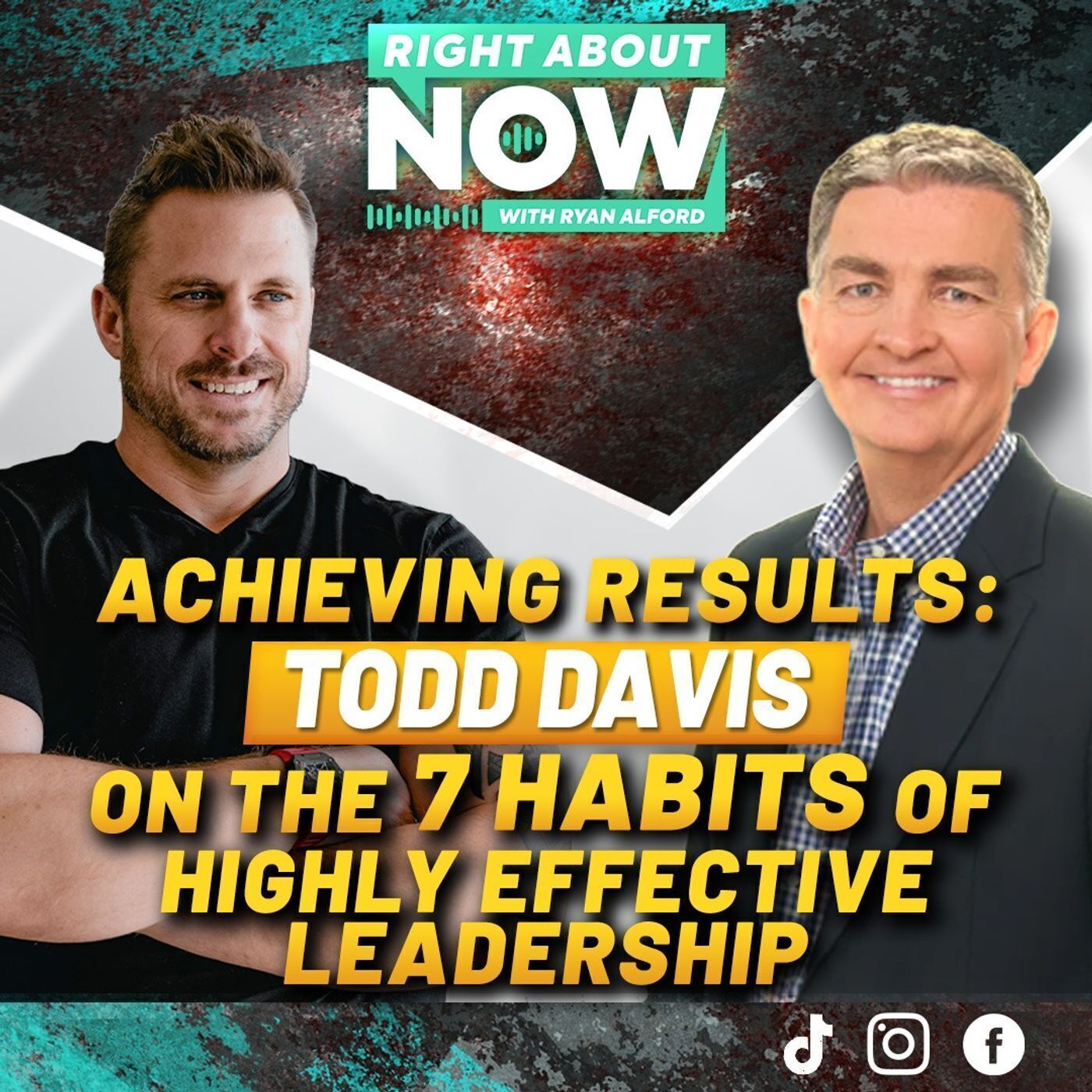
Achieving Results: Todd Davis on the 7 Habits of Highly Effective Leadership
Press play and read along
Transcript
Speaker 1 What I have found, Ryan, is once everyone understands the mission of your company, it's easier to get them excited and highly engaged in doing whatever part they have to move that mission forward.
Speaker 2 This is right about now with Ryan Alford, a Radcast Network Production.
Speaker 2 We are the number one business show on the planet with over 1 million downloads a month,
Speaker 2 taking the BS out of business for over six years in over 400 episodes. You ready to start snapping necks and cashing checks? Well, it starts right about now.
Speaker 3 What's up, guys? Welcome to Right About Now.
Speaker 3
We're always talking about what's important now. Hey, you know, we're always right too.
Well, at least our guests can be.
Speaker 3
I don't know if I'm always right, but I've always got an opinion. And you know, here's what I know.
There are some things that are tried and true. And I really like effectiveness.
Speaker 3
I love it because I own business. I love for me to be effective.
I like for my listeners to be effective because that's us helping you. And that's why I've got leadership consultant.
Speaker 3
And he's, you know, been a part of a book and a guide and coaching. You've probably heard of this, the seven habits of highly effective people.
He is Todd Davis. What's up, Todd?
Speaker 1 Hey, how are you, Ryan? Thank you for the invitation.
Speaker 3
Yes. Hey.
I like effectiveness.
Speaker 3 You know, I mean, anybody that's been with the company as long as you have has to know a thing or or two about that, if nothing else, right?
Speaker 1 Exactly.
Speaker 1 I'm not perfect at it, but I at least have the instruction manual.
Speaker 3 I know. If we all, you know, well, what do they say? But doctors sometimes have the words health habits, but
Speaker 3 you know, but something tells me
Speaker 3 you've got, as being, you know, the chief people officer for the number of years that you've been
Speaker 3 or were, and now, you know, leadership consulting, you know, I'm sure you apply a lot of what you teach, if I had to guess.
Speaker 1 I do, I do.
Speaker 3 Seven habits of highly effective people. I think myself, I'm 47, and I think our audience, we skew, we have it all over the 25 to 50, you know, skews male.
Speaker 3 I think if you're anywhere in the last, in my range or around there, that book rings familiar, if not been on the reading list.
Speaker 3 I mean, it's just, it's really stood the test of time hasn't it Todd really has it was dr.
Speaker 1 Steven Marky wrote the book about 35 years ago it has sold over 40 million copies to date and continues to to sell thousands of copies every month and I and I had this real quick here I had an interesting experience two weeks ago I was in a I was in another state and
Speaker 1 working with a client and a gentleman came up to me after and said his and this gentleman was probably mid-50s said his son who had just graduated college in Portland, called him the night before and said, Very seriously, hey, dad, I just read the greatest book I'm going to send it to you.
Speaker 1 It's called The Seven Habits of Highly Effective People.
Speaker 1
And we both started laughing because, to your point, the book's been around forever. But this young college grad was just finding it so empowering and so useful today.
And so, yeah,
Speaker 1 it's a timeless classic, if you will, because it's based on principles of effectiveness.
Speaker 3 Yes, exactly. And I do think
Speaker 3 in a world where, you know, with YouTube, the proliferation of new media, we have all these tactics at hand, right? You know, there's all these things to do and lots of people coaching what to do.
Speaker 3 But it's, you can do a lot of things and not be effective.
Speaker 3 It's, it's, uh, it's a really key component because I think sometimes we get in the, in the tactics habit and the, the check in the box, but it's like, what was the outcome of all those tactics?
Speaker 3 That's what I've always loved about the book is the effectiveness.
Speaker 1 So true. I like to explain it as it's the,
Speaker 1 if you, if you visualize the compass over the clock is how we get effectiveness.
Speaker 1 In other words, yes, important to get a lot of things done, and it's important to get things done within a timely manner, but what are the things we're getting done?
Speaker 1 Are we getting those things that are really going to move our lives or the lives of our team or our organization forward? And
Speaker 1 so it's the compass first, you know, the direction we're headed over the clock. Clock's important.
Speaker 1 Got to get, you know, got to have deadlines, but let's make sure we're heading in the right direction first. And that's, that's how I think of it and how we define effectiveness at Franklin Covey.
Speaker 3 I think, you know, sometimes numbers get glossed over. I can be guilty of this, a hundred thousand of this, 50,000 of that, 40 million
Speaker 3 sold. I mean,
Speaker 3 go get a room with 100 or 200 people and like look around and remind yourself how many people that is. And then think about 40 million.
Speaker 3 What an accomplishment.
Speaker 1 Yeah. It's
Speaker 1 another quick story, just because these happened in the last couple of weeks. We are just launching, you know, we update the content or the course,
Speaker 1 not the book itself. We don't change how many habits there are, but the application of those we update in the courses we teach about every 10 years.
Speaker 1 And we just launched our new reimagined seven habits. And I was in another city in a hotel delivering
Speaker 1 an overview of it. And this woman, who is her name is Sylvia, a worker in the hotel, she came up when she learned we were for Franklin Covey and she said, I'll be right back.
Speaker 1 And I thought, okay, did we not pay our bill last time we were here? What's going on? And then she came back with
Speaker 1
the Spanish version of the Seven Habits highly effective people. It had been weathered and used up.
And she carried it around in her purse. And she went on for, I'll tell you, 10 minutes, telling us,
Speaker 1 my colleague and I, how this book had changed her life and how she led her family with it and how it helped her in her career. And it was just, it was inspiring.
Speaker 1 I almost thought it was being set up for a minute. It was so inspiring.
Speaker 3 I'm sure.
Speaker 3 And I know there's probably countless stories of people, you know, and I've seen some on your website doing research for this pro, you know, this interview and reminding myself, you know, of even some of those tenets.
Speaker 3 But Todd, let's set the table, you know, as we get into the here and the now, but talk about, I mean, you've been with Franklin Covey, what, 35 plus years? Is that what? No, no, not, not quite.
Speaker 1 I'm starting my 29th year. I started my 29th,
Speaker 3 29th, but still almost 30 years with Franklin Covey. You know, maybe talk about the trajectory of your career and how it, you know, just has paralleled with everything that's happened.
Speaker 1
Yeah, you brought thanks for thanks for asking that. So I was in the medical industry for many years.
I was in a recruiting role. I recruited physicians and medical personnel for about 10 years.
Speaker 1 And then
Speaker 1 some friends and I formed a small human resource outsourcing group. So we would contract with companies out here in Utah where I live to provide their human resource services.
Speaker 1 Now, I didn't have human resource experience, but I had recruiting experience. And then we had another friend who had done employment law, who was an attorney.
Speaker 1
We had another friend who had done benefits. And so we would contract.
And what was then called the Covey Leadership Center
Speaker 1
was one of our clients. And so I would recruit for them and find them consultants and salespeople and things like that.
And they said one day, hey, we want to bring recruiting in-house.
Speaker 1
And I thought, and I had recently read The Seven Haven't Shighly Affected People. This is like 30, you know, 30 years ago.
And I thought, well, dang, I think I might want to look into that.
Speaker 1 So I joined Covey Leadership Center as their recruiter or their recruitment manager.
Speaker 1 And then we, long story short, we merged with Franklin Quest, which was the beginnings of the Franklin Day Planner that some people might remember your parents having or whatever.
Speaker 1 And we merged those two companies about 28 years ago, 27 years ago which became Franklin Covey and I was in various positions and then
Speaker 1 shorten this up our CEO came to me about 20 years ago and and the head of
Speaker 1 people services or or human resources had left said we'd like you to apply for this position I said well that's great I don't have any HR background.
Speaker 1
I've recruited, but that's, he said, I know, we think you're really good with people. And so they didn't give me the position, but they had me apply.
And I applied with several other candidates.
Speaker 1 And I was really honored to be selected. And so I surrounded myself with really talented HR people and for 18 years ran the human resource structure of the company.
Speaker 1 And then the last couple of years now, I've been out teaching others how to implement all of these things that I had seen work so well for our clients and for our department and for other clients that I'd worked with.
Speaker 3 You know.
Speaker 3 We'll talk and I want to dig into, you know, how Seven Habits has, what stayed the same, what's changed. Like you said, the application.
Speaker 3 But, you know, I'd love to get your perspective, chief people officer. You know, like to me, that's an interesting
Speaker 3 people hear that term now and then I think they know, you know, like the, I'll just call you since you're a man, you know, the king of HR
Speaker 3 in some ways.
Speaker 3 You know, and so to frame, I love the marketing spin, we've put on all the titles as a marketer.
Speaker 3 But at the end of the day,
Speaker 3 what has that position been like for you? Like, what what makes you a people person and
Speaker 3 what
Speaker 1 i don't know what's been like your guiding principle in making that successful yeah that that is great that's great context setting you you should do this for a living ryan you're really good at this
Speaker 1 no to your point so so a few years ago uh when i was still in the chief people officer role our one of our um
Speaker 1 our publisher, Simon Schuster, who published Seven House, they thought it would be a really cool idea to have the chief people officer of the people company write a book.
Speaker 1 So I wrote a book, became a bestseller, not because anybody knows who Todd Davis is, but because this topic was so profound. It's the question you asked.
Speaker 1 The book is called Get Better, 15 Proven Practices to Build Effective Relationships at Work.
Speaker 1 And my whole premise in the years that I had almost two decades experience as the chief people officer was that as Jim Collins, the leadership guru says, you got to have the right people on the bus.
Speaker 1 That's true.
Speaker 1 But it's actually, or and I should say, not but, and it's actually the nature of the relationships between those people that makes teams and organizations effective and so in my role as chief people officer and anybody who's head of their human resource function I view this as you're you're more or less sorry for the sports analogy but you're more or less the quarterback of the culture everybody it takes everyone to form the culture but you're the person who really reminds people helps to set the vision for where you want the culture to go including what we call things you know like you said we can we can put a marketing spin on things, but I was adamant that we not call it human resources, that we call it people services, because I wanted the team that I led to be reminded every day as they came to work, they were in the business of serving the people at Franklin Company.
Speaker 1 Their clients were all of our associates.
Speaker 1 And then I wanted the role to be chief people, sorry, not because I wanted to be the grand poo-bah, but because
Speaker 1 I wanted to remind myself, is this about the people?
Speaker 1 Sometimes people equate the term human resources with kind of the policy wonks or the, you know, the unnecessary or the necessary evil we have to have to keep all the human resource laws and guidances and all that.
Speaker 1 And those things are important, but it's really about partnering with your team, your colleagues to move or grow the business and be, as you started out, be effective in what you're doing.
Speaker 3 Yeah.
Speaker 3 And it is supremely important. And, you know,
Speaker 3 one question I want to have for you, Ty, that it may not be expected,
Speaker 3 but
Speaker 3 because I want to transition to kind of, you know, back to the effect of, we'll get into all, but it's, when I think about a chief people officer and me being, you know, CEO and owner of multiple companies, right?
Speaker 3 I see what's sort of happened.
Speaker 3 And I've seen interesting comments from even like, you know, top Google executives, like the pendulum, like if you own a, when you own a company, you serve clients, right?
Speaker 3 But when you have a company, you need your people and you need to serve them to help you serve the clients.
Speaker 3 And I've seen even a few of the executives that have come out that said, maybe it swung too far to serving the people versus the client.
Speaker 3 And talk to me about the balance of those two things.
Speaker 3 And I think it was through the lens of things that happened with COVID, the work from home, the not work from home, the benefits, the nap pods, to use like a Google thing, you know, where you want to take care of your people.
Speaker 3 You know, you have to take care of your people. Yeah.
Speaker 3 But at the end of the day, we got to serve the client or we don't have no people.
Speaker 3
You're exactly right. No, it couldn't have been more.
But coming from sitting in your shoes, though, I can understand the delicate balance of those things.
Speaker 3 And maybe it's just a broad question, you know, your perspective on that pendulum.
Speaker 1 Yeah, no, I appreciate the question.
Speaker 1 I think you just nailed it. And so in my experience, what I have viewed is
Speaker 1 that
Speaker 1 first and foremost, deciding what, you know,
Speaker 1 you've headed up many companies. What is the mission of that organization? What is the mission of your organization? I think it starts there.
Speaker 1 Is it worthy? Are we doing something that's adding value to the client, to the world,
Speaker 1 to our society?
Speaker 3 And
Speaker 1
most companies are. I haven't met a company that isn't.
But
Speaker 1 it's then refining that mission statement and that mission and vision for the company so that our associates, these employees that we want to serve as well, that they're as excited and as on board as you are as the CEO or as the leader.
Speaker 1 So what I have found, Ryan, is once everyone understands the mission of your company,
Speaker 1 you still have to do a lot of other things, but it's easier to get them excited and highly engaged in doing whatever part they have to move that mission forward.
Speaker 1 And so it really isn't, doesn't become, in my experience, a question for the leader of of do I serve the client? Do we focus on the client or do we focus on our employees?
Speaker 1 No, we are all focusing on the client because our employees are so excited to know, hey, I'm a piece of this. Whatever I do, I see how it links to that bigger mission of the company.
Speaker 1 And so I make a difference. And when leaders can focus on
Speaker 1 communicating to
Speaker 1 their...
Speaker 1 associates their worth and potential so clearly that they come to see it in themselves, then we have one focus and that's serving the client.
Speaker 1 my team and the associates know they are a critical component of that, and they find value in that. They find excitement in that.
Speaker 1 And yes, they have to be paid well, and they have to have the right working conditions and have the right benefits, but their incentive and their motivation is to be a part of something that matters.
Speaker 3
Yeah. I think that is a big part of it.
And I think that clarity, because I've even known and had a lot of moments where that wasn't clear enough. And
Speaker 3 that's been ineffective.
Speaker 3 And I see it and know it. I guess just to close the book on that question, Todd, is would be like
Speaker 3 what you said is absolutely right. What do you make of those that say, though, the pendulum swung too far? That, you know, like, what, what do you think has triggered that?
Speaker 3
Because I have sensed not with really about my own organization. We have a small company.
Like, I'm not saying this didn't exist or something, but it just, what I see, what I hear is,
Speaker 3 um
Speaker 1 you know it's like uh maybe the employees feel like what can the company do for me versus what can i do for the client yeah yeah and i and so i guess just to close the book on that i'd just love to know your perspective no i i i think that's that's a great question and i know what i'm going to suggest takes time but this is what we work with our clients with and i've seen it produce amazing results over and over again we have a client or a situation where in their minds the pendulum has swung too far and they've got a group group of people good people but who are more focused on what's in it for me than than what what do I need to do to serve it's taking the time to understand those people it's moving as a leader it's moving your mindset from I bet
Speaker 1 or I bet they just want an increase because they've been giving awards their whole life and they're this you know explore a little get whatever to I wonder I wonder why they're I wonder why they're not more engaged in the business that we do and the work that we do.
Speaker 1 I wonder why they're not more inspired.
Speaker 1 And so it's taking the time and a lot of leaders, I don't say don't like this answer, but they realize, okay, I got to slow down and I've got to get to know my people. What's important to you, Jim?
Speaker 1 What's important to you, Sam? What's important to you, you know, what motivates you?
Speaker 1 And if, honestly, if I talk to a Jen or a Sam and they say, all I care about is money, making money, well, they're probably not the person for my team because I want to find out what part of what we do excites them and make sure that they understand how critical they are to that.
Speaker 1
So I'm kind of going back to what I said a minute ago. But when the pendulum is way over there, to your point, I think you have to slow down.
Dr.
Speaker 1 Covey used to say, with people, fast is slow and slow is fast.
Speaker 1 Take time, understand what excites them, what motivates them, what energizes them about the business, and then make sure that they have enough of that going on so that they feel this ongoing connection with the work that you're all trying to do to move your organization forward.
Speaker 3 Yep, and I think that's fair. And I do, I love the it's actually very tactical advice
Speaker 3 of the mindset of figuring,
Speaker 3 not making assumptions.
Speaker 3 And that, that one little trigger of, you know, not making the assumption. But if you presume something, you tend to make it true, you know?
Speaker 3 Absolutely.
Speaker 3 Presumptions are effective for one thing, and that's, you know, verifying what you already think, but not necessarily getting to the bottom of something.
Speaker 1 No, you're, that is what you just shared, Ryan, that that is the foundation for the seven habits. Before we even get into the habits, we talk about our paradigms or our mindsets.
Speaker 1 And if I, for example, if I'm a micromanager, okay, everybody can write to that.
Speaker 1
They've either been one or they've worked for one. But if I'm a micromanager, how do I see my team? We call this the C2GETE model.
Well, if I'm a micromanager, I see my team as incompetent.
Speaker 1 And to your point, it's a self-fulfilling prophecy. If I see my team as incompetent, well, then what do I do?
Speaker 1 I do everything myself, or I hover over and and criticize everything they do and if that's what I do what kind of results do we get well we get pretty poor mediocre results at best and then what do I say to myself as the micromanager see they are incompetent I got to micromanage even more and to your point it just becomes this self-fulfilling prophecy of what I'm seeing versus if I see people as capable and talented well then what do I do well then I take time to get to know them and what's important to them and what inspires them and how do I motivate them and make sure that they connect with our larger mission and then it goes on and and we get greater results so sorry i'm passionate about this i can break oh no i love c do yet i'm gonna i i'm gonna that that will stick with me see i remember different frameworks you know like certain things but i will uh the sdg will be with me
Speaker 3 yeah yeah
Speaker 3 talking with todd davis he is
Speaker 3 let's just call him the forever chief people officer, but he's a
Speaker 3 senior leadership consultant. I don't know if the current chief people officer was sure about that, but yes, thank you.
Speaker 3 Chief people guy, you know, is what we'll call him.
Speaker 3 Todd, talk to me about what you guys are up to now with seven habits, how it's evolved, the trainings, leadership, and all that, how you're working with people.
Speaker 1
Thank you. Well, the seven habits have been around for 35 years, like we mentioned, since Stephen first wrote about them.
They are all based on principles of effectiveness.
Speaker 1 For example, habit one is to be proactive, and it's based on the principle of choice. You know, and going back to your CD, you're never going to forget now.
Speaker 1
One way to see it is, hey, I can't predict how things are going to turn out, so I'm just going to kind of go with the flow. That's a common paradigm.
But a more effective paradigm is, wait a minute.
Speaker 1
I can choose and I'm actually responsible for my own choices. So I can choose the life that I want.
I can choose the career that I want. I can choose the outcome that I want.
Speaker 1 And I'm responsible for those choices. Now, there's a lot of things I don't have control over, but there are things, many things I can influence.
Speaker 1 And most importantly, we learn in this habit, I can choose my response to any situation.
Speaker 1 And that, I remember, Ryan, when I first read The Seven Habits 30 years ago, I can still see that sentence on the page. You can choose your response to any situation.
Speaker 1 In a world when there's so much we can't influence or control, to know that we can choose our response. So habit one is a
Speaker 1 habit one for a reason, because it's up to us to decide if we want to take control of our lives or if we want the outside world or influences to control our lives.
Speaker 1
And then I won't go deep into each habit, but the habits two and three work together with that. Habit two is begin with the end in mind.
It's based on the principle of purpose.
Speaker 1 So if I'm going to take charge of my life, well then what do I want to do with my life? And then habit three, put first things first, is based on the principle of focus.
Speaker 1 Okay, if I've decided what I'm going to do with my life, well I've got to start prioritizing what do I got to be first, second, and third.
Speaker 1 And these first three habits surround what's called the private victory it's where we become trustworthy if you know people and I'm sure you do that that take responsibility for their their lives they know where they're going and they prioritize and focus on the most important things they're pretty trustworthy people and it helps move us to being independent we're independent and then and ready now to collaborate with others and then that's where the next three habits come in habit four is to think win-win it's a mindset based on the principle of abundance habit five is to seek first to understand.
Speaker 1
That's based on the principle of respect. And then habit six is to synergize based on the habit of creative collaboration.
And those are where we build trust with others.
Speaker 1
And those move us to what we call interdependence. And then the seventh habit surrounding all those habits is habit seven, sharpen the saw.
based on the on the principle of renewal.
Speaker 1 It's where we take time to invest in ourselves. Your listeners that are taking time out of their busy schedules to learn because they learn from learning all the time.
Speaker 1 They're investing in themselves, not because they're selfish, but because by doing so, they can do that much more for everybody else.
Speaker 1 So, that was the reader's digest condensed version of the seven habits.
Speaker 1 And each decade or so that we reimagine it, we don't change the habits or the principles, but we the applications we update them based on life's current situations.
Speaker 1 Sorry to take so much time, but that's that was perfect.
Speaker 3 And you know what? It made me think,
Speaker 3 Todd, it was, you know, I'm on social media a lot, and you know, thinking like leadership coaches that I see and variations of quotes and principles,
Speaker 3 80% of it has spun out of that book, I think, because, and those top line thoughts. Now, now I'm not saying people are copycats.
Speaker 3 They've added their sauce on top of it or whatever, but those core principles
Speaker 3 capture a lot of the overall sentiment of what drives sort of effective behavior.
Speaker 1
Well, you know what, Ryan, that's a really good point. And they are copycats, but Stephen said he was a copycat.
And let me clarify. Stephen made the point all the time.
Speaker 1 He did not invent the seven habits. What he did,
Speaker 1 and I had the great honor of working with him for many years before he passed away about 12 years ago, but he clarified what he did was he identified those people and those teams and those organizations that seemed to continually be getting...
Speaker 1 ahead in a good way, getting the results they sought to get. And he studied what they did on a consistent basis.
Speaker 1 And then he identified those principles that had always been at work, but that you know, he just identified them, named them as habits, and put them in a construct that we could talk about them and start to implement them in our lives.
Speaker 1 So, he even made the comment that he didn't invent them, he discovered them.
Speaker 1 And so, I think all of the iterations that different people use are just yet different ways to look at these lifelong principles that will always be in effect.
Speaker 3 Yeah, and I just think
Speaker 3 it's you know,
Speaker 3 you can choose the response to any situation.
Speaker 3
I think it's so powerful. Like all of those ring true, but I come back to that one because I think about, I think about myself at times.
I think about like what I see, you know, like we, we have,
Speaker 3 we've empowered a lot of things but ourselves at times. And, you know, we
Speaker 3 give power, apply power when we don't realize that we get to choose, you know, whether you're biblical or not, believing in free will, you know, the power to choose. And
Speaker 3 I think we've
Speaker 3 conditioned, we've been conditioned or it's at times maybe that, you know, it's out of your control, but man, it's empowerful. It's the way we empower people is for them to understand that statement.
Speaker 1
I couldn't agree more. I will be asked often in the leadership space we've been in for 40 years now.
Frankly Cuffy's been around for 40 years.
Speaker 1 And I will be asked often, so what habits habits are most critical for a leader? Well, after saying all of them,
Speaker 1 for me, if I had to whittle it down, it would be habit one, for all the reasons you just said, coupled with habit five. Habit five is to seek first to understand, then to be understood.
Speaker 1 And it's not just about being a nice person, but it is truly, and
Speaker 1 I'm sure you've experienced this. I have so much greater influence, not power, but influence with someone if I take time to understand them first.
Speaker 1 Seek first to understand.
Speaker 1 Going back to the earlier example when we were talking about the pendulum being swung too far sometimes.
Speaker 1 So first of all, if I realize I have a choice, okay, I can tell myself I'm a busy CEO or busy, I don't have time to meet with people, or I can say, well, wait a minute, people are my business.
Speaker 1
Our organization is made up of great people. So, all right, that's my choice.
And now, Habit Five, I'm going to take time to sit down with Joe or Susan and say, hey, tell me what's important to you.
Speaker 1
Tell me why you do things this way or that way. And then really listen.
Don't listen with the intent to reply. We teach this and have it fly because we are all programmed.
Speaker 1
And you might be doing that right now. Maybe you're nodding and looking at me.
You're really thinking about what you're going to say next. I'm teasing you.
But that's how we all are.
Speaker 1
We listen, but we're already, in most cases, formulating a response. And I don't think it comes from a bad place.
I think we're fixers. We're helpers.
Speaker 1
And so we hear just enough of the conversation to think, oh, I know what to say. I know how to fix this.
I know how to help. And the deepest need of the human heart is to feel understood.
Dr.
Speaker 1
Kevy said that, and I couldn't agree more. The deepest need of the human heart is to feel understood.
So when you're truly trying to understand someone, just suspend your opinion. Don't throw it away.
Speaker 1 Suspend your opinion long enough to just hear the other person, really understand where they're coming from. And leaders who do that,
Speaker 1 they have so much more information now to help move their teams, their organizations forward. So habit one,
Speaker 1 be be proactive, and then habit, habit five, seek first to understand, then to be understood. I, there, there's no stopping a leader who models those habits really well.
Speaker 3 No, and
Speaker 3 I added, like, I've been writing down notes. I take you know, notes when I have the interviews for like to go back to highlight clips and different things like that.
Speaker 3 But I added a spin, you know, I would almost argue if
Speaker 3 if you seek first to understand,
Speaker 3 you won't even have to explain to be understood.
Speaker 3 Like you'll then be understood, you know, like it's to go to love or deeper because, and it applies to the whole, you know, listen with the intent to just listen. Yeah.
Speaker 1 But, Ryan, you know what, you, you, I think about countless times when I would be meeting with a leader or an employee who was upset about something in my office. And I'm not, I'm not kidding.
Speaker 1
They'd be there for an hour. I probably spoke.
Out of that hour, I probably spoke 10 minutes at most. They spoke the rest of the time.
Speaker 1 And then they would get up and they would say, Todd, this has been so helpful. Thank you so much.
Speaker 1 And I'm thinking, well, I didn't do much, but to your point, if you really take the time to understand, people are pretty good at solving their own problems if they have a sounding board, if they have someone who will really listen.
Speaker 1 It's so rare that when we find someone who will do that, we can kind of come to our own conclusions, including the person, the employee who has kind of been in it for themselves, you know, with that pendulum swung too far.
Speaker 1 If you really listen to them, they will start realizing on their own, oh, I've i've kind of been all about me and what's in it for me and i haven't really been thinking about how do i contribute to to the organization i'm a part of and so you're you couldn't be more right in my opinion in my experience i love that is talk to me
Speaker 3 what are some of the nuances maybe uh that have changed as far as application that maybe people wouldn't be familiar with Yeah, so just the practicality.
Speaker 1 It's always been in our courses, they've always been practical, but even more so, this development team that put this together, they have focused intently on, okay, you learn this fire hose of information in two days, and it can be spread out.
Speaker 1
They're only spread out, or it can be taught concentrated. But regardless, you have all this information.
It's so amazing. What do I do with it? What do I do with it?
Speaker 1 And so just the practicality, this seven habits 5.0, they're things that I can take away that afternoon or that day and start applying them.
Speaker 1 This may sound
Speaker 1 too simplistic, but there's an activity we do in Habit One, you know, be proactive. I can choose my response.
Speaker 1 And they take these statements around, they think of a situation in their life that is challenging right now. Maybe it's a relationship, maybe it's a project, and they write a statement,
Speaker 1 while I can't, dot, dot, dot,
Speaker 1 I can, dot, dot, dot. So while I can't change the project that I've been assigned, I can look for some additional resources that have expertise in this area to help me.
Speaker 1 So it just tries to start training our mind to think of, yeah,
Speaker 1 there are things I can't change, but there's always something I can do or I can influence. So that's just one example of the practical nature of the activities that they're doing.
Speaker 1 And I've had, I've been teaching this for a couple of weeks now. It just launched October 28th.
Speaker 1 I've already had email upon email from participants coming back saying, I cannot believe how helpful this was. I was able to overcome this big obstacle.
Speaker 1 I was able to get the team thinking about this differently. So
Speaker 1 it's just the practicality, I would say, is the most insightful thing of this newest version, just the relevant application and how I can use it in the challenges I'm dealing with today.
Speaker 3 Todd, as we finish up here, talk to me about the types of companies that you're helping, you're working with. What's that ideal profile?
Speaker 3 You know, what, you know, for someone listening that, you know, could benefit from your services. I mean, if nothing else, we better have sold another, you know, million books.
Speaker 3 But, you know, go back and read.
Speaker 3 I circled. i think i got an old copy somewhere i know i do i'm like dang and i have four boys it's gonna be mandatory reading for them uh
Speaker 3 but uh talk to me about that profile and what you're doing and how you're helping them i i don't want this to be a uh flippant answer but
Speaker 1 we're not we're not industry specific by any means i said my flippant answer would be any organization that has people
Speaker 1 right yeah we have i mean we we and we do work i was gonna say we don't work with really small companies but we actually do but we we tend to work with those organizations that have 500 or more employees.
Speaker 1 But I'm thinking of some examples right now of some organizations that have less than that. So I don't want to rule them out.
Speaker 1
People, I guess I would sum it as this. Organizations, and then I just did a keynote for an organization last week that has 20,000 employees.
So organizations of all sizes, but...
Speaker 1
but I would sum it up as this. Organizations whose top leadership realizes that it starts with the people.
And if you're a CEO listening or a senior executive listening and
Speaker 3 you
Speaker 1 totally buy into, because it's true, that it all starts with the people, regardless of what your organization does, you know, interesting, AI,
Speaker 1 you know, which is taking over our jobs.
Speaker 1 We just looked at a survey, 290 large businesses around the world, not just the nation, around the world, that use AI on a regular basis.
Speaker 1 They still had in their top three needed skills that they didn't have, interpersonal skills, emotional intelligence.
Speaker 1 AI doesn't teach emotional intelligence now Franklin Covey seven habits the seven we call it the seven habits effect if I had to summarize okay what Todd what skill does it develop more than anything else if people apply it it is emotional intelligence it's interpersonal skills and those are everything we've been talking about here so so organizations that recognize that are the organizations that we work with
Speaker 3 Todd I I vaguely remember that maybe you guys had a sub-segment of sub hat of seven habits that did this but But whether you did or didn't, it could be applied to marriage.
Speaker 1 We used to have seven habits for home and family.
Speaker 3 I feel like these seven habits, I was thinking here going like, you know, any spouse, you know, working with one another could learn a lot from this.
Speaker 1 I'll tell you. Well, my fifth wife, she told me that I had begun, no, I'm kidding.
Speaker 3 But you're right.
Speaker 1 We have the home and family division. But even without that, and this is selfish on my part, I've been here 29 years and I've got a long ways to go.
Speaker 1 I'm a working project, but the way the seven habits has impacted me personally as a partner or a husband, as a parent, as a grandfather, as a neighbor, as a friend, as a son, as a sibling, it's profound.
Speaker 1 And so I say that when I say selfishly, you know, I've been paying.
Speaker 1 I have these great positions, I've had these great roles, but the personal development, just being around this content, and I obviously I work for seven hats or for Franklin Coffee, so I'm proud of this, but I would tell you this, even if I didn't work for them, it has had and continues to have a profound effect.
Speaker 1 And And I've got a long ways to go, but to your point, absolutely, it impacts every part of your life, both personal and interpersonal, and organizational.
Speaker 3 I've listened with the intent to just listen to it, and hopefully, our
Speaker 3 audience has as well.
Speaker 3 Where can everybody learn more about what you guys are doing? The programs, the book. Obviously, the book's easy to find, easy to Google, but
Speaker 3 give me some links or wherever we can lead people.
Speaker 1
Easy to remember. If they'll just go to www.franklincovi.com.
That's C-O-V-E-Y, V is in Victor. FranklinCovey.com.
They can find, there's a search engine there.
Speaker 1 They can find anything they want there, including more of me if they're a glutton for punishment.
Speaker 3 FranklinCovey.com, Seven Habits of Highly Effective People coming from the Chief People Guy, Todd Davis. Todd, pleasure having you on.
Speaker 1
Thank you so much. I appreciate it.
Again, I appreciate the invitation.
Speaker 3 Hey guys, you know to find us, ryanisright.com. We'll have links to seven habits there, the franklincovey.com website, and all the highlight clips, full episode of the video.
Speaker 3
Go check it out on YouTube, fastest growing YouTube podcast, business podcast on the planet over there. Let's do it.
We'll see you next time. All right about now.
Speaker 2 This has been Right About Now with Ryan Alford, a Radcast Network production. Visit ryanisright.com for full audio and video versions of the show or to inquire about sponsorship opportunities.
Speaker 2 Thanks for listening.