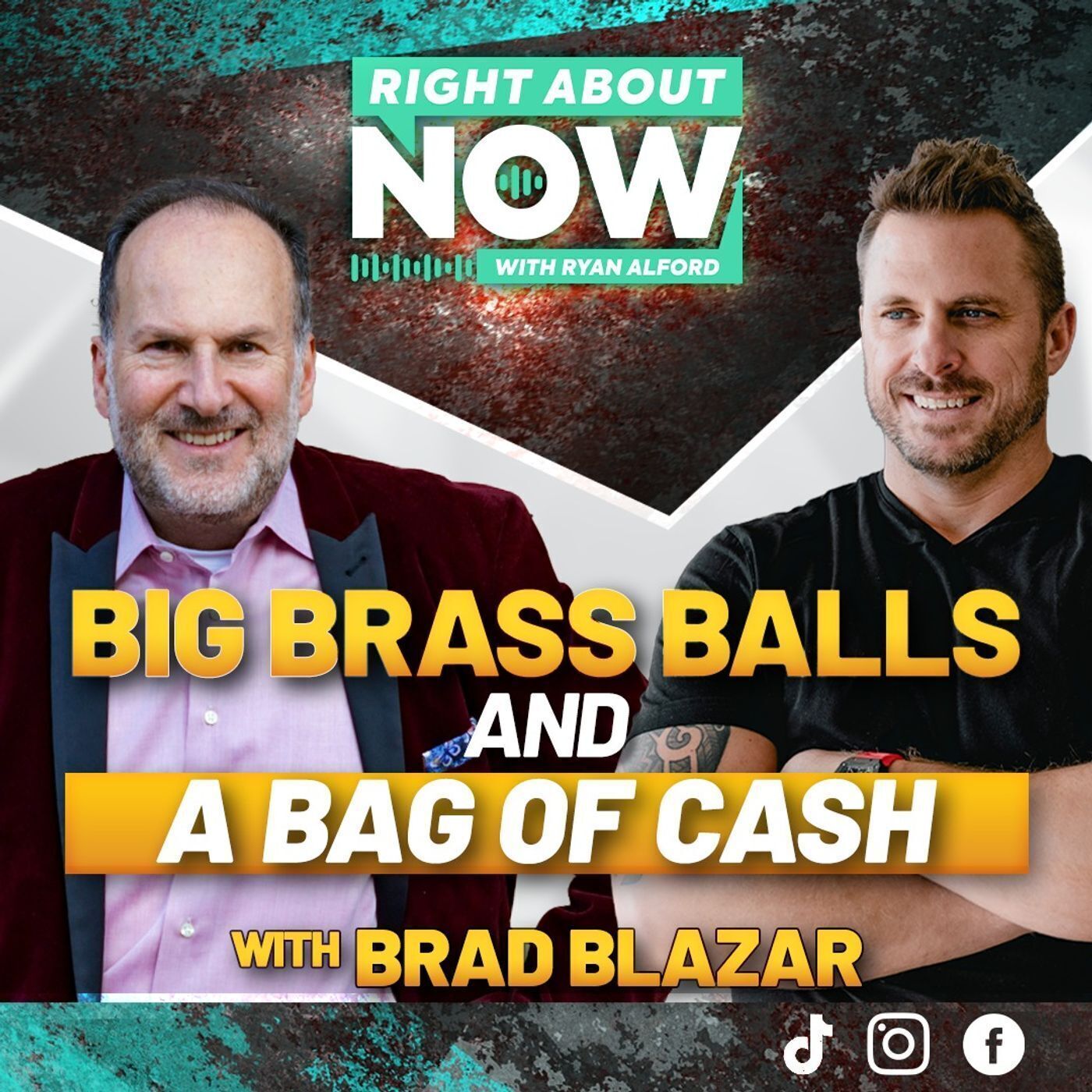
Big Brass Balls and a Bag of Cash with Brad Blazar
Press play and read along
Transcript
Speaker 1 A lot of times, you know, people are willing to take those calculated risks,
Speaker 1 but at the end of the day, you got to do due diligence on the people you're getting in bed with, the people that you're investing with.
Speaker 1 You know, I see so many people out there doing stuff, and I look at people that are investing with them, and I just smile and I said, Man, this shit's gonna blow up.
Speaker 2 This is right about now with Ryan Alford, a Radcast Network Production.
Speaker 2 We are the number one business show on the planet with over 1 million downloads a month,
Speaker 2
Taking the BS out of business for over six years and over 400 episodes. You ready to start snapping necks and cashing checks? Well, it starts right about now.
Right about now.
Speaker 3
What's up, guys? Welcome to Right About Now. We're always getting right, and it's always about what is important today and now in business and marketing.
And look. We're all about trailblazing.
Speaker 3
That's what we got. Brad Blazer here today.
What's up, Brad?
Speaker 1 How you doing there, Ryan? It's great to be here with you.
Speaker 3 Yeah, man. It's good to have you.
Speaker 3 I'm ready to talk about how to raise some capital.
Speaker 3 You know, we always need it. People don't, you don't ever know when you got,
Speaker 3 until you start owning businesses, you never know when you have to raise some money. You know,
Speaker 3 it's a good, good skill to have in the entrepreneur tool bag.
Speaker 3 Whether you end up using it or not, it's important that you understand it because you'll probably get involved with something even even if you're not like the primary owners that capital raises happen and understanding the dynamics of all that, it should definitely sort of be in every entrepreneur's toolkit.
Speaker 3 And even if you're not an entrepreneur, understanding how business work, how money exchanges hands for some of these deals happening, I'm sure you could talk about that quite a bit. Brad.
Speaker 1
Absolutely. Absolutely.
You know, it's funny. I've been doing it for so long.
It's one of those things I can almost do naturally in my sleep.
Speaker 1 But I think it's one of the skills that a lot of people just overlook.
Speaker 1 You know, so many entrepreneurs, business owners, they want to do something big, they go to the bank, they don't get approved, they either don't have credit or they don't have experience, and they kind of give up on those dreams and, you know, never pursue the things that they're capable of.
Speaker 1 And they never really realize that every day when we get out of bed, we're pretty much surrounded by all the money we need. We just call these other people investors.
Speaker 1 And most people just don't understand how to build the interest, how to talk to people. you know, the things they need to have, obviously, to do it successfully.
Speaker 1 And, you know, having literally coached thousands of people and raised over $2 billion,
Speaker 1 it's just one of those skills where I tell people, look, my past helps build your future, man. You want to learn how to do this? Let's have a conversation about it.
Speaker 3 Knowledge is power, and wisdom is at the king of the castle. So,
Speaker 3 Brad, let's sit the table at least for a minute for our audience to talk about where some of that wisdom came from. I know you're in Texas, ex-oil guy.
Speaker 3 Are you ever an ex-oil guy? Are you always an old guy?
Speaker 1 You're always an oil guy, man. I'll tell you, I love the business.
Speaker 1
I still love getting out there in the oil patch and still invest in it. Got a lot of friends that are doing really well.
And I think, you know, once it gets under your skin, it's always there.
Speaker 3 Is
Speaker 3 I, you know, I'm going to give you, I'm going to age myself a little bit and talk about like growing up, the Beverly Hillbillies.
Speaker 3 Texas T.
Speaker 3 Texas T. Growing up in
Speaker 3
Old Gritty. You know, old Jethro shooting or whatever, doing whatever they're doing.
But no, the oil boom, I can just, I think this of, you know, I know that's not how it works, but like
Speaker 1 where my mind goes, thinking, you're going to shoot your shotgun down there at the earth and oil just comes out of the ground.
Speaker 3
I wish it was that easy, you know. Like, I think as a kid, you're going, oh, yeah, buy some land and find some oil on it.
It's just not that
Speaker 3 easy. What is that? I know we're going to talk a lot about capital, but what is the state of the oil business?
Speaker 1 It's actually pretty damn good right now. You know, I think that you look at kind of what's going on over there in the Middle East.
Speaker 1 There's a lot of people obviously thinking that if Israel does go in there and kind of bomb the Iranian oil fields or at least take out some of the distribution there, that oil prices are definitely going to spike.
Speaker 1
And, you know, you kind of have seen that a little bit in some of the stocks and some of the ETFs that track oil prices. But overall, it's doing real well.
And here's the thing.
Speaker 1 I keep telling people, yeah, you know, we get Tesla, we get Rivian, you know, everyone's kind of going in that direction. We're never, ever going to get rid of fossil fuels in our lifetime.
Speaker 1 Like we always, always, you know, have a need to have oil, you know, and up there in New England or wherever the hell you are, they'll be doing coal or whatever it is they do.
Speaker 1 There'll always be, you know, people that are doing coal. But we will always have a need for fossilized fuels around the world.
Speaker 1 And so, you know, as they say, you know, in real estate, there's only so much.
Speaker 1 Obviously, in oil, there's only so much oil in the ground.
Speaker 1 And it's a depleting resource. So, you know, I think that the future outlook for the energy space is pretty healthy.
Speaker 1 Obviously, a lot of it is tied politically to, you know, who obviously wins the election. But overall, the people that are in it, let's just say they ain't complaining.
Speaker 3 Yeah,
Speaker 3
I haven't met too many old people that are hurting. I'll just say that.
But also
Speaker 3 those.
Speaker 3 I was on some of those Jets before.
Speaker 3 Yeah.
Speaker 3 Look around. Oh, it's oil money.
Speaker 3 That's it, man.
Speaker 1 You got to have that gold Rolex, that big old Stetson hat and the fancy ostrich boots.
Speaker 3 Yeah.
Speaker 3 Exactly.
Speaker 3 Now, are we a Cowboys fan or a Houston fan?
Speaker 1 More on the Houston side. I actually knew Bud Adams fairly well before he passed away.
Speaker 1
Bud was a good guy. You know, he made his fortune in the oil field.
And, you know, obviously, of course, owned the Oilers.
Speaker 1 And, you know, that was a whole big issue with the city of Houston not wanting to build him a new stadium.
Speaker 1
And he just kind of stuck up the middle finger and said, I'll just take my team someplace else. And the Oilers became the Tennessee Titans.
And, you know, great guy. But,
Speaker 1 you know, I'm more on the football side.
Speaker 1 I follow football more.
Speaker 3 Yeah, for sure, for sure.
Speaker 1
I used to watch, no, I'll tell you, I used to watch the Cowboys back in the old Aikman and Landry days. Oh, yeah.
You know,
Speaker 1 when you look at coaches and you look at the greats, you know, the guys like Landry that used to be always out there in a suit coat and he'd always have the hat. He'd have
Speaker 1
Phil Jackson, you know, running up and down the sidelines of the Lakers. He'd have on his, you know, jacket and stuff like that.
You know, I kind of missed those guys.
Speaker 1
You know, those were the good old boys. You know, you see guys today like Nick Sabin.
some of the greats, but
Speaker 1 old Phil Jackson always had on that double-breasted and of course Landry with his hat that's when i liked the cowboys back in those days but they've changed a lot since then
Speaker 3 yeah they have old jerry jones sometimes you know he doesn't know he kind of get out of his way sometimes but i mean he's been successful so who uh who am i to judge the uh but i will say he has gotten more casual on the sidelines with the warm-up suits and whatever else they're wearing you know
Speaker 3 uh but houston looks like they got a winner this year they got they got a good quarterback and they got a good coach there in Ryan's. So
Speaker 3 it might be a good time to be a Houston fan.
Speaker 1 Yep, I think so.
Speaker 3 Let's talk about some capital. Like, where did your passion for, you know, sharing knowledge around this come from? And, you know, like some of your own endeavors that led to all this wisdom.
Speaker 1 You know, it's really funny.
Speaker 1
I went to school not to be in the oil business. I actually was studying architecture.
And had I not stumbled into the oil industry, I'd probably be designing buildings and houses and stuff like that.
Speaker 1 But, you know, just one day responded to an ad and went to work in the oil field. And the CEO of the company kind of took a liking to me and showed me how to raise capital from investors.
Speaker 1 And so that's what I did. And after a couple of years, just kind of decided to bet on myself and took some money, started an oil company, built it up over the course of about a decade.
Speaker 1
Great business to be in. And then, you know, as I say, the shit hit the fan, man.
Oil prices plummeted. The tax laws dramatically changed.
And so investment capital dried up.
Speaker 1 And that's when I went back to school and I came out. And
Speaker 1 I realized that my primary skill, what I was really good at, was knowing how to raise capital.
Speaker 1
And so I just kind of said to myself, I bet that's a skill that a lot of people pay a lot of good money for. And it's been great.
I work for some of the biggest financial services firms in the world.
Speaker 1 Some of the largest multi-billion dollar real estate sponsors have raised $2 billion and today even raised money for deals of my own.
Speaker 1 We just put an offer in yesterday on a 252-unit self-storage property just north of Houston here.
Speaker 1 Kind of keep my fingers crossed that the seller likes the offer and we get to raise some capital and take down that deal.
Speaker 1 But, you know, the whole thing about raising capital, and this is actually in the book Rich Dad Poor did, Robert Kiyosaki says the key to really building sizable wealth is not to try to do it on your own because, you know, it'll take you such a much longer time.
Speaker 1 It's to understand the principle of OPM, other people's money. And when you understand that fundamental principle, like we were talking earlier, right? You know,
Speaker 1 there's wealth is knowledge or there's knowledge is power. You know, once you understand that, and then more importantly, you know how to do that, Ryan, the sky's the limit.
Speaker 1 I mean, I know guys literally that are in their 30s, 40s that are sitting there with companies where, you know, they have multiple hundreds of millions of dollars that they own and control.
Speaker 1 And, you know, they're set.
Speaker 3 Yeah.
Speaker 3
It's always interesting to me. I'm an entrepreneur.
I own multiple businesses and none of them with anyone else. And
Speaker 3
I will both be a great lesson for this episode, probably. I mean, I've built eight-figure companies.
I'm doing well.
Speaker 3 But I can't sit here and deny some of what you're saying that
Speaker 3 if I could let go of some control and think about it to a degree, you'll probably give me a lesson on that as well, that maybe, you know, things could go faster.
Speaker 3 And I think for a lot of people, it's not just control.
Speaker 3 I don't even consider myself necessarily a control freak as much as just I like my own freedom, like controlling my own time and no one telling me otherwise.
Speaker 3 And the moment I, you know, I think the notion for me is always the moment you have someone else's money in the deal, you don't control your own time. I don't know if that's true either, but
Speaker 3 enlighten me.
Speaker 1 Well, you got to realize that, you know, most of these guys that are doing stuff that are, you know, real estate entrepreneurs or they're raising money to buy businesses, they're not giving up control.
Speaker 1 You know, the investors are all passive. So they have absolutely no say in the business.
Speaker 1 They really don't have any ownership in the business. Think of it this way.
Speaker 1 Your company is the sponsor of a fund or another entity that's raising money to do something else so if your company is up here this is not what people are investing in they're investing in what your company is sponsoring that they invest in and so you know if i've got a real estate investment firm and i want to go out and buy this apartment building I'll syndicate that building and I'll bring investors in to go out and buy that.
Speaker 1 And now my company owns an interest in that building alongside the investors.
Speaker 1 Or if we're going to buy a business, my company owns an interest alongside investors that now own and operate that business. And I get my proportionate share for putting the deal together.
Speaker 1
But the investors themselves don't have any control of my parent company. They don't have any say in really what it is we're doing.
They're totally passive.
Speaker 1 And what they're essentially doing is they're relying on my expertise, my track record, the team of people that we've put together and assembled.
Speaker 1 And so it's a beautiful thing.
Speaker 3 What's the, so to find the difference, you know, something like with real estate where you're buying an asset, you know, versus
Speaker 3
the idea of a business or, or like, okay, I use my own businesses. I own a digital ad agency.
I own a media network. I own a co-working.
soon-to-be franchise.
Speaker 3
You know, like there's a few different things. So those don't have necessarily the asset at the center of it, i.e.
land or something like that.
Speaker 3 Walk me through that path, you know, the idea of business versus the tangible, you know, of real estate.
Speaker 1 Well, I mean, let's agree that if I'm going out and I'm buying something like an apartment building, At the end of the day, that is a tangible asset, but it's a business, right?
Speaker 1 The tenants that live there are my customers. So much like your business, where you have customers that you've got to keep happy, I got to keep them happy.
Speaker 1
So they keep paying rent and they want to continue living there. So I look at real estate assets as a business.
I'm buying a business.
Speaker 1 It cash flows, you know, and all the other reasons, expenses, things like that.
Speaker 1 When you look at raising money from investors to buy businesses and then maybe buy another business that's complementary, you start building something very similar to maybe like a private equity firm, right?
Speaker 1 Like when you look at a private equity firm, what do private equity firms ultimately own?
Speaker 1 They own businesses and they scale those businesses. There's a lot of synergy where businesses are complementary to one another.
Speaker 1 And we see a lot of people that will do that. They'll go out, for example, and they'll start a company and they're like, I just want to raise money and buy cash flowing businesses.
Speaker 1 You know, things that are boring, but cash flow, make profit like laundromats, HVAC companies, car washes.
Speaker 1 And so imagine if you've got this company and over a couple of years, you now own and operate eight, 10, 12 cash flowing businesses.
Speaker 1 You know, you're doing pretty good.
Speaker 1 So there's really no difference in raising money from investors to buy cash flowing businesses or buy real estate assets because at the end of the day, really, real estate is a business.
Speaker 1 Um, just you know, you look at it a little differently.
Speaker 3 What about, like, and I know there's more risk because I have friends that are literally knee-deep in this, you know, buying existing business.
Speaker 3 You got all the baby boomers kind of ready to sell, and you got a lot of these businesses that are cash flow positive.
Speaker 3
And so, I have some friends that are very heavy in that side of buying, you know, businesses that are already proven. Right.
What about like capital raising for ideas of business? You know, like of,
Speaker 3 okay, maybe it's within an existing industry,
Speaker 3 but sort of like
Speaker 3 the theory of the, you know, the idea of the business, but you don't necessarily have a million customers built in day one, you know, like or even a thousand or a hundred.
Speaker 3 Right.
Speaker 3 Talk to me about that evaluation and do you counsel that side of capital raising?
Speaker 1
Yeah. Oh, absolutely.
I mean, in my book, I talk about, you know, the different types of investors.
Speaker 1 When you're raising money, you have to look at kind of the avatar and where you are in the growth curve. You know, are you a startup? Are you a more mature business?
Speaker 1 Are you kind of on a trajectory where you've been around a couple of years and have a track record of prior performance? And so when you look at a true startup, somebody that's got this idea.
Speaker 1 that's really unfounded or unproven, you know, you're primarily looking for venture capital firms. They invest in startups or, you know, maybe you're looking for what we call an angel investor.
Speaker 1 That's typically a very wealthy person that may have been a business owner that sold their business, you know, and now they're worth, I don't know, you know, $10, $20, $50 million.
Speaker 1 They're willing to take those types of risks because they know if they could hit a home run,
Speaker 1 obviously the return on investment is going to be substantial.
Speaker 1 But when you look at the different types of investors, you know, family offices, private equity, venture capital, each one of these different groups likes likes to focus on different things.
Speaker 1 Private equity firm likes to buy traditionally existing cash flowing businesses. They come in, they put in some capital, they make some management tweaks, they scale the business, then they exit.
Speaker 1
The venture capital firm knows, okay, we're going to invest in five companies. Realistically, we're going to lose money on one.
We're probably going to hit singles and doubles on the other three.
Speaker 1 And then that one, boom, is the home run that makes up for the others. And that's just the investment model.
Speaker 1 And so, it depends when you're a business owner and you're going out there trying to raise capital.
Speaker 1 That the first thing you do is you identify the type of investor that you want to be focusing your efforts on.
Speaker 1 Because if you're out there, you know, for example, with a startup and you're talking to investors over here that like to invest in more seasoned, more established businesses, chances are you're not going to be very successful because your message is not related to that audience.
Speaker 3 Yeah.
Speaker 3 And
Speaker 3 to that end, and I think that's important that people might be listening.
Speaker 3 So identifying the right people to target, but even more so,
Speaker 3 should people when raising capital have different expectations for kind of back to what I said, be it control, be it, you know, whatever it might be, depending on the stage of the business, whether it's startup, established, but unrealized, and then maybe, you know, towards the end of the cycle, but steady.
Speaker 1 Absolutely. I think that if you're coming in more on the earlier stage and you're taking on more risk, right, you definitely want a higher return because there's more risk.
Speaker 1 If you're investing in something that's a little bit more mature, that's a little bit more proven,
Speaker 1 the host or the sponsor, the person that is offering that investment doesn't have to give up as much or offer as significant a return because they're like, look, man, you know, this is not nearly as risky as investing in a startup.
Speaker 1
That's not yet proven. So when you look at investing, there's, you know, this theory, we call it the risk adjusted rate of return.
More risk, more return.
Speaker 1 And obviously, as people get older, as they mature, their risk profile changes.
Speaker 1 You know, people that are in their late 20s, 30s, some degree in their early 40s, they can afford to take risks early in life. Their attitude is like, look, man, I'm making great money.
Speaker 1
If I lose 50, 100 grand, I can earn that back over the next couple of years, or my other investments will replenish that. But when I get up into my late 50s and 60s, I'm much more conservative.
Why?
Speaker 1
Because I'm beyond my peak earning years, or maybe I'm a couple of years away from retirement. So I got to play it a lot safer, and I got to go into things that don't have that same risk profile.
Yep.
Speaker 3 Yep. It's a higher risk, the higher reward.
Speaker 3 That's it.
Speaker 1 And a lot of times, you know, people are willing to take those those calculated risks.
Speaker 1 But at the end of the day, you really got to vet and you got to do due diligence on the people you're getting in bed with, the people that you're investing with.
Speaker 1 You know, I see so many people out there doing stuff, and I look at people that are investing with them, and I just smile and I said, man, this shit's going to blow up.
Speaker 1 It has to, because they don't have really a foundation. for some of the things in place that a guy like me knows has been doing this so long, they need to have in place.
Speaker 1 And so, know, the most important thing really is the regulatory and the compliance side.
Speaker 1 When you take somebody else's money and you do something with that to create a return on investment for them, you're in the securities business, bottom line.
Speaker 1 I don't care if it's two investors or whether it's 100 investors. And so, you know, you get state regulators, you got, of course, the SEC.
Speaker 1 And you don't want to get on their bad side because that can get real ugly real fast. Yeah.
Speaker 3 What's the
Speaker 3 maybe tell me, everybody likes stories
Speaker 3 talking with Brad Blazer.
Speaker 3
I know you do, brother. That's why I wanted to go here.
Tell me, you know, both maybe a good one and a bad one. And maybe
Speaker 3
and maybe a bad one just because it's boring, but it made a lot of money. But a good one might be a blow up.
I don't know. But tell me something.
Speaker 3 Tell us some good stories of some stuff you've done on the capital side or things you've seen that, you know, would be interesting. Yeah.
Speaker 1 So, you know, back when I was about a 26, 27-year-old cocky little kid in the oil business, you know, living high on the hog, you know, had the Porsche, had the nice watch, had a nice house.
Speaker 1
I had this very wealthy doctor. Okay.
The guy was a retired neurosurgeon. He told me that he was a business partner of Sheldon Adelson, right?
Speaker 1 And that's the guy, of course, that just passed away that owned the Sands Corporation.
Speaker 1
But for whatever reason, the guy would just not invest with us. You know, I don't know what it was.
I think it might have been the fear of investing in a dry hole and just losing the whole investment.
Speaker 1 So I'm like, look, you know, doctor, come on out here, you know, meet me, go out in the field with us. We'll show you the whole operation.
Speaker 1
We'll get you to a place of comfort where hopefully you can make a better decision. And so I said, you know, one airlines.
He said, oh, no, no, man, I got a private jet. I'll come out on my own jet.
Speaker 1
I'm like, okay, cool. So I knew this guy was a major player.
You know, I come into the airport. You know, his plane lands, he taxis in, gets out, introduces himself.
Speaker 1 You know, I get him in my nice suburban, go out to the oil field, we spend the day, treat him to lunch, goes home. And again, just would not invest.
Speaker 1 And so I had my sales team that worked for him, and I always told my sales team, you remember the first time you climbed up the ladder to the high dive at that neighborhood pool and you crawled out to the end and you're like, whoa,
Speaker 1 you know, you look back and there's a line of kids going, jump, you pussy. It ain't that high.
Speaker 1 So finally, you know, it's about 5:30, 6 o'clock. And, you know, what I used to do, Ryan, is I used to let my guys go home at three.
Speaker 1 A couple of days we'd come in, we'd get some beers, we get some pizzas, and we sit there dialing out to the West Coast or dialing to Hawaii because there's a five-hour time difference.
Speaker 1 And I just said, Dr. Snack, it just takes two things to invest in an oil well.
Speaker 1 Then he said, What? I said, big brass balls and lots of money, dude. Which of the two don't you have?
Speaker 3 And I just didn't have.
Speaker 1 And I'm sitting there
Speaker 1
and there's silence. And he goes, he goes, tell me again, Brad, how much are three units in your drilling field? I said, doctor, go get your checkbook.
Welcome aboard.
Speaker 1 And the dude became one of my best investors, Ryan. But, you know, I rang the bell and I got my sales team together and I told him, man, you guys have my permission.
Speaker 1 to use this closing line anytime you choose to because it will absolutely work. And he became one of my best investors, really great guy.
Speaker 1 But, you know, the whole thing about getting people to make a buying decision, sometimes, you know, you got to squeeze the cojonus a little bit and kick them where it hurts.
Speaker 3 No, people think with their head and they buy with their heart. And
Speaker 3 Brianna, I'm telling you right now to make some show notes: the name of this episode is Big Brass Balls and a Bag of Cash.
Speaker 1 Big Brass Balls and the Brad Blazer.
Speaker 1
That's a really good one. And, you know, the funny one, too, is I had a guy that came to work with me.
I was looking to hire some closers and get them on my team.
Speaker 1 And, you know, my office at the time was in a huge, very prestigious office building. Like we had the whole third floor of a nice building of downtown Austin.
Speaker 1
And everybody in the building is pretty much suits. You know, we have firms like Credential-based securities, big law firms, et cetera.
So everyone's all dressed up.
Speaker 1 So this guy, probably in his mid-30s, shows up for an interview and he looks like Joe Dirt.
Speaker 1 Man, he had on jeans with holes in the knees, workbooks that were covered in dust and mud, a Fu Man Chu mustache, the mullet. I mean, he was a train wreck.
Speaker 1 And for most people, the interview never would have just taken place.
Speaker 1 But, you know, I started interviewing him, got him some coffee, and I finally just said, you know, hey, Jack, why do you want to come to work for me?
Speaker 1 And his answer was probably the best answer I've ever heard. He just said, look, Mr.
Speaker 1 Blazer, you know, I'm real humble, real simple, but my wife and my daughter have real big dreams and real big visions, and I just want to give them everything in life that they deserve.
Speaker 1 And I was like, wow, like this guy will do just about anything for his wife and his daughter, who he loves.
Speaker 1 So I said, man, I'll tell you what, I'm going to take a big chance because, you know, you don't look the part, but if you can come back here come Monday morning, I'll put you to work.
Speaker 1 So after being in the office and seeing where he'd be working, you'd think he'd show up better.
Speaker 1 He showed up the same way.
Speaker 1 So here I am Monday morning and I'm looking at Joe Dirt going, how in the hell is this guy going to get on the phone and convince people to send him 100,000, 200,000 looking like a train wreck?
Speaker 1
And he's sitting there going, man, teach me something. I'm ready to go.
I'm ready to do this. And so I said, come with me.
Speaker 1 We got downstairs, put him in my sports car, took him to the department store. treated him to two suits, took him to my barber and I said, hey, man, clean this guy.
Speaker 1 We literally gave him a Hollywood makeover
Speaker 1 on TV.
Speaker 1 So, you know, next day he comes in and, you know, if you know what the expression means, swag, he has some swag. He was feeling pretty good about himself, you know.
Speaker 1 And literally, I taught him everything I teach people. And that year, he raised $25 million, earned a quarter of a million dollars in commission.
Speaker 1 And, you know, was sporting a nice little stainless and gold Rolex and the big old Texas belt buckle that, you know, you see all the guys with.
Speaker 1
And we're still great friends. Really, really good guy.
Definitely changed his life for the better.
Speaker 3 Hey, man. You know, dress for success and
Speaker 3 but but really it's really less about dressing for success and more about changing his mindset i think it sounds like you had to get in his head that he needed to think of himself in a different way you know elevate elevate the game and give him some confidence you know that's good and and look you know knowledge is power knowledge is power you know back in those days you know i don't know if you remember but you know old dallas was the biggest show on tv man everybody wanted to be old jr old
Speaker 1
He'd be sitting there chopping on his cigar. You know, he'd have on his little hat, he'd be on the telephone pitching oil deals.
And I think in his mind, he just saw himself as Bobby Ewing or J.R.
Speaker 1 Ewing. And, you know,
Speaker 1
that was the guy he actually became. I mean, $25 million for a guy to raise that kind of money coming from his past, that's a major accomplishment.
But the guy worked hard.
Speaker 1 He did everything I told him to do.
Speaker 1 So I tell people, if I can teach old Joe Dirt how to raise $25 million, I can teach just about anybody.
Speaker 3
Oh, talking with Brad Blazer. He is the capital catalyst.
It's his show. He's got a podcast and capital school, which we're going to talk about here shortly.
Speaker 3 What's the...
Speaker 3 Can you make money just raising?
Speaker 3
You just kind of answered the question with old Joe Dirt. I remember several things from this episode.
Brass balls, bags of cash, and Joe Dirt. But
Speaker 3 you can make some money just raising capital if you don't have your own, it sounds like, if you're good at it.
Speaker 1
Oh, absolutely. Yeah.
I mean, a lot of people do that, Ryan. You know, you can become what we call the co-GP
Speaker 1
in other people's deals. You know, just say, look, man, I just want to raise capital for you.
You're experienced. You're the operator.
Speaker 1 And, you know, what we do is we give up some of the deal, give it to that person that brings some of the capital.
Speaker 1 Of course, the other thing you can do is, you know, you can study and get your securities licenses, and then you can get paid a commission on what you raise. And so a lot of people do that as well.
Speaker 1 They become what we call placement agents.
Speaker 1 But yeah, you can make a really, really good living depending on, of course, how much money you could raise and the ability to do that and then bring that capital to somebody else's deal as a co-GP.
Speaker 1
You know, now you're participating in the deal. You're getting passive income.
You know, you're getting the upside appreciation of that business or that piece of real estate.
Speaker 1
And, you know, that's really attractive to the right people. You can really do well.
And we know know a lot of people that actually do exactly that.
Speaker 3 What's the biggest misconception in raising capital, perhaps? You know, like that people assume, like,
Speaker 3 what bugs are you squashing, you know, like every day, like of misconceptions?
Speaker 1 Well, I mean, I think a lot of people think, oh, I got to have gray hair or I've got to have a track record or, you know, I've got to have done this and I've got to have done that.
Speaker 1 And, you know, I say bullshit to all of that.
Speaker 1 You know, here I was, a little 23-year-old cocky kid that didn't know the first thing about drilling an oil well, didn't know the first thing about building multi-million dollar business.
Speaker 1 All I knew how to do was just raise capital. And I knew that I could find the team, right? You get a CPA, you get an attorney, you build a team of people.
Speaker 1 Capital raising is a team sport.
Speaker 1 Most investors are going to look at somebody. And if you're doing everything in the business, there's going to be doubt.
Speaker 1 And, you know, I've established some pretty good relationships with some of the sharks. And, you know, I've talked to Kevin Harrington about this and Robert Hirchuebeck.
Speaker 1
And they said, look, man, you know, as we all know, a lot of great people come into the Shark Tank. They're PhDs, they're doctors, and they don't get a deal.
And it's not because of them.
Speaker 1
It's because of one word. It comes down to execution.
Can you execute on what you're trying to do? And if we see doubt in that, naturally, why would we want to invest?
Speaker 1 And so when you're talking to an investor, What you have to be able to communicate is, hey, the collective experience of my team is this.
Speaker 1
We've done these things. Our track record is this.
And so you eliminate the uncertainty that allows an investor potentially to move forward.
Speaker 1 Because at the end of the day, kind of like you said earlier, you know, people invest emotionally. They invest in people they know, like, and trust.
Speaker 1 And so if you're good at building relationships and understand how to do that, the world becomes your oyster. But I think it really comes down to that.
Speaker 1
I mean, we have a lot of people literally that are in their 20s. that are raising millions of dollars.
And these people are financially set. They're not even 30 yet.
Speaker 1 Like I was at an event speaking a couple of years ago when the host of the event said, hey, I want to point out a kid here in this audience. He said, Avis, where the hell are you?
Speaker 1
And this little Middle Eastern dude popped up. He said, tell the audience how much real estate you owe.
He said, about $140 million. He said, how old are you? 28.
And I was just like,
Speaker 1
my kid, I was like, shit. Get it even 30 yet.
And he's already sitting there with $140 million real estate portfolio, you know, with investors, obviously.
Speaker 1 You know, he's got a network of investors because he's been doing it for a couple of years. But, you know, here's the the problem.
Speaker 1 I'm so pissed off at our educational system because we don't teach people how to become financially independent.
Speaker 1 What we do is we teach people how to assimilate and fit in with the rest of society, which is get your ass a job, work your 40 to 50 years, script and save, and hopefully you'll have a decent retirement.
Speaker 1 The option, which a lot of my buddies, you know, you probably know many of them, like the Carlos Reyes and, you know, basically, you know, the Nick Perrys in the world, they're like, no, screw that shit, man.
Speaker 1
Work your ass off for three to five years, and I'll show you can be done in five to seven years. Boom.
Yeah.
Speaker 1 You just go out and wholesale, or you're getting some real estate deals like we do, and you get some passive income.
Speaker 1 Then you can double down and start focusing on the wealth creation, or like you're doing, you just start building some businesses.
Speaker 1 You get one business to multiple seven figures, and you focus on another, then another, and you just, you know, keep doing that. And that's that's the answer.
Speaker 1 We don't teach people in our country how to be entrepreneurs.
Speaker 3 No.
Speaker 3 And I have four boys that are young. And I
Speaker 3 look, the education
Speaker 3
system is set up to make you average. That's it.
Average. It's and it's set up on memorizing knowledge that now, yeah, I mean, we had,
Speaker 3 yeah, it's like, I get it. I, they, they need the discipline of memory and, and the lessons.
Speaker 3 Like, I believe in some of the lessons of school, you know, like that it teaches you, the discipline the going to class the structure of it but the content of it is outdated and i have a wife that's in the education system a principal at a middle school uh god bless her you know like
Speaker 3 and uh i think she's crazy because she doesn't have to do it but she does it and uh but
Speaker 3
I just think it's so outdated because we're learning things and I get it. Oh, we had calculators 30 years ago, but we still learn math.
Yeah. But now the knowledge is so there.
Speaker 3 And I'm not saying you shouldn't have a core level of understanding of certain, like,
Speaker 3 I don't know,
Speaker 3 education that is classical education, but it, it, that,
Speaker 3
that switch needs to be happening a lot faster to how you make an above average life in 2025 with this education and not, you know, how you learn to be average in 1984. Right.
No, they agree.
Speaker 1 You know, I mean, I could literally see a bunch of ballers all partnering up.
Speaker 1 You know, you get the Patrick Bett Davids, you got the Milettes, the Cardone's, the Bradley's, the you, me, and we create something called the Wealth Academy.
Speaker 1
And it just becomes basically a two-year university. We charge people basically 30, 40 grand.
They pay tuition. They come out the other end and boom, man, you know, they're doing stuff.
Speaker 1
They're investing in real estate. They're buying businesses.
They know how to raise capital. I mean, literally, we could change a lot of people's lives.
Speaker 1
And I think that's one of the reasons that coaching and mentoring is such a big business today. A lot of people out there are starting to realize, man, I don't need to go to college.
Screw that shit.
Speaker 1
That ain't been working for most people. I'm going to get on YouTube.
I'm going to start listening to podcasts.
Speaker 1 I'm going to start getting in proximity to some of these guys that have already been there, done it.
Speaker 1 And it gets down to basically this concept is, you know, let's break down the barriers and turn them into breakthroughs.
Speaker 1 And let's use people's past that have done a lot of stuff and allow that to build people's futures. And, you know, that's what I'm all about.
Speaker 1 I tell people, man, you know, you're paying me a lot of money for my past. Like, I've raised $2 billion.
Speaker 1 You know, I know how to do this a little bit.
Speaker 3 Yeah, exactly. And you've been through the, you know, I tell people like,
Speaker 3 you're paying more for my failures than my successes because I'm going to teach you what not to do. Exactly.
Speaker 3 Unintended consequences of mistakes. And
Speaker 3 talking with Brad Blazer,
Speaker 3
talk to me about capital school. I know we've been talking and dancing all around it, but let's get to some specifics.
Yeah.
Speaker 1
No, I love it. Yeah.
We got people all around the globe. You know, if you had told me when we started this thing that I'd be sharing stages with some of the most famous people and, you know,
Speaker 1 building multiple seven-figure businesses, I would have said, yeah, right. But, you know, here we are three books later, you know, pop follow podcast, you know, speaking all over the place.
Speaker 1
And we got students all around the globe. You know, it's not just here in the U.S.
We got people in Australia, New Zealand, over in the UK, Canada, Middle East.
Speaker 1 It's pretty cool because when we get on Zoom in the day, you know, I'll be talking to someone that it's already the next day in the morning over in the UK or New Zealand.
Speaker 1 And so it really gives us kind of this global perspective of what's going on around the world. And, you know, I kind of hate to say it, but we have become the laughingstock of the globe.
Speaker 1 You know, people around the world are just laughing at all this political bullshit. between Harris and Trump and just how our country is just kind of at war domestically.
Speaker 1
And And then we see all the other stuff going on around the world as well. But, you know, it's really just kind of this global perspective.
But the cool thing about it is there is a need, I believe,
Speaker 1 to raise capital. And here's why.
Speaker 1 I don't know if you follow or you know my good buddy Coach Michael Burt, who talks about activating people's prey drive and really inspiring people.
Speaker 1 But I believe that most people have a dream or desire to do more in life. Like you got this big goal.
Speaker 1 There's something inside you where you know there's this another gear that you're capable of doing so much more. And I talk to people, I'm like, like, like, like, what's your big thing, man?
Speaker 1 Like, what would you really prefer to be doing if you weren't doing this? Oh, man, I'd love to start a restaurant or I'd love to buy business or I'd love to go out and buy real estate.
Speaker 1
I'm like, well, what's holding you back? Here's the funny thing, Ryan. It's not the fear.
Nine out of 10 times, they don't have fucking two nickels to wrap together.
Speaker 1 And I'm like, you're letting the fact you don't have money hold you back from your dreams. Like, do you not realize just go out there and raise the money from investors?
Speaker 1
That's something something I can teach you how to do in a matter of a couple of months. And then when we do it, boom, there they go.
They buy that restaurant or they start that business.
Speaker 1 And so the whole premise of our platform is really geared about this transformational change that we can bring about to help people's big goals or big dreams become a reality because It's not the fear, it's that those goals kind of get diminished and you acquiesce, like you said earlier, to a place of average.
Speaker 1
You just like give up. This is all life's going to give me.
This is like, you know, God's dream or whatever you want to call it.
Speaker 1 If you, you know, believe in that kind of stuff, it's my predestined future. Bullshit, it is.
Speaker 1 Go out and create the future that you define and go out there and do the big things in life that you dream of. And there are investors out there that are willing to help you get there.
Speaker 3 I'll tell you this, Brad.
Speaker 3 That, what you just said, and like back to what you said earlier about execution,
Speaker 3 because let's not, for anyone listening, let's not, let's not not like hide any punches here. Like, it's not easy to do anything.
Speaker 3 And, and ideas are cheap.
Speaker 1 Yeah.
Speaker 3 Like, everybody's got an idea, but not everybody wants to build the execution plan and the confidence plan if it's something new to sell.
Speaker 3
Or if you've got an existing business, you know, building the structure. and having the true execution plan for how that growth would take place.
Again, it's selling and trying to raise capital.
Speaker 3 Because I think I think the misconception, because I get this a lot, I'll get, hey, how many DMs or techs or, you know, being what I'm in and what I do and exposure.
Speaker 3 I get a lot of people telling me ideas.
Speaker 3
And I'm like, you know, that's a great idea, you know, but there's no real substance behind how to, like, I'm like, I had that idea like in the shower two years ago. Like, I love it.
I'm with you.
Speaker 3 It's an amazing idea. But, but having owned and operated multiple businesses now, like ideas,
Speaker 3 most of them are cheap.
Speaker 1 Right. Well, I think the other big issue, and I was having this conversation the other day with a good buddy of mine, everybody today is looking for the easy way out, man.
Speaker 1
You know, we're on a digital society. Everyone's connected around the world to their damn phones, the internet.
And everybody wants it done for themselves. They want someone else to do it.
Speaker 1
Most people are just not willing to put in the work. Let's face it, you know, raising capital is hard work.
Building a business like you you have is hard work.
Speaker 1 Most people just don't want to do the work. And, you know, it's just that little effort, that little extra that makes all the big difference.
Speaker 1 It's not that it's harder, it's just you show up more frequently, you put in more effort.
Speaker 1 And, you know, I tell people, like, when I see someone walking down the damn beach with a six-pack, man, I really admire that person because I know they busted their ass. I know it's hard work.
Speaker 1 I know their discipline. I know, you know, what it takes to be of that level of fitness.
Speaker 1 You know, and I'm kind of okay with my dad, Bod, but
Speaker 1 the funny thing is, it's in everything. It's business, you know, and it's in fitness, it's in sports, it's in, you know,
Speaker 1 any decision we make. And this is, of course, Tim Grover that's coached some of the best out there.
Speaker 1 He said, the one thing that separated the guys like the Jordans, the Cobees, the Shaqs was just one decision.
Speaker 1 They just looked at themselves in the mirror one day and they said, I'm going to put my amateurish ways aside and I'm going to go pro in every area of my life. And they did.
Speaker 1 And if you ever read the book, The Seven Habits of Highly Successful People, where Covey talks about this thing called the whole person theory, where we're made up of a mind, a body, a spirit, and our soul, those dudes became pros at all four of them.
Speaker 1
Like they were great at the game. They were great in how they taught and interacted with other people.
And so, you know, they became superhuman, but it was just because of one decision.
Speaker 1
And, you know, sometimes you have to get to a low place in your life for you to emotionally snap. And, you know, Tony Robbins talks about this in his book.
He's like, man, I just got to a low point.
Speaker 1
You know, I mean, I was eating mac and cheese and my life sucked. And I just snapped.
And I said, no more. And look who the dude is today.
Speaker 1
Hopefully, most people don't have to get that low. But, you know, again, here's the funny thing.
And we've all, if we've been super successful, have dealt with this.
Speaker 1
I mean, I see it all the time in social media. We always have the naysayers.
We always have the haters.
Speaker 1 We always have the people that comment on our post, oh, this is a scam or this is a bunch of bullshit or don't, you know, dump in my whatever.
Speaker 1 And I just smile and I said, man, you must be at a really low point in your life to have to take a second comment on something like that.
Speaker 1
And it was actually at my lap that said, hurt people, hurt other people. Think about that for a moment.
I've never seen anybody that's a baller or that's doing great in life.
Speaker 1
belittle somebody else for doing something. Never.
You never see that. Never.
Speaker 1 But you see all these little people people that have a sucky ass life that are doing just jack shit, nothing, and they're the ones that say, Oh, you know, you're a scammer or hey, this don't work.
Speaker 1 And I'm like, dude, man, I got so many testimonials to disprove that. Like, why don't you do your research and do your fact check?
Speaker 3 Yeah,
Speaker 3 because that takes work too.
Speaker 3 They're not willing to do that.
Speaker 3 That's why.
Speaker 3 But no,
Speaker 3
you know. I mean, it's like, and I get, I'll get on shows and you get the success question and all that.
And I don't even think I've made it. I mean, because I even hit my goals.
Speaker 3 You know, like, I'm still.
Speaker 1 I'm going to be doing more.
Speaker 3
Yeah. But I, but I'm going to answer that question similar to what you just said.
Like, one day you just got to look in the mirror and go, this ain't good enough. Like, I want more.
Like, you,
Speaker 3 and we want to make it about this and about that, make it complicated. And it, you need to either, that either happens for you or it doesn't.
Speaker 3 And it doesn't mean you won't be happy in life if it doesn't.
Speaker 3 I'm not, who am I to judge happiness? But man, just to look back and not think you maximized potential.
Speaker 1 Well, I mean, I think the big reality that people have to realize is, and I always hear this, you know, it's, oh, I don't have time for that. And that is the biggest bullshit cop out.
Speaker 1 I tell people, if it's important to you, you will find the time. See, most people that, you know, are ballers and doing big things, you know, they're up at 4, 4, 30, 5 o'clock.
Speaker 1 Like they've got more shit done by noon than some people will do all damn day long you know you get your fitness symbol how you just wake up an hour earlier and now you found an hour to go out there and walk or go to the fitness center or you know you work an extra hour you change your schedule up you can always find time for the shit that's important to you so when people tell me oh i don't have time i say that's the biggest compound i've ever heard because if you really are interested in doing this you will definitely find the time Same thing with money.
Speaker 1 You know, price is always an issue in the absence of value. You will pay for something if you perceive the value you're going to get out of that to have a major impact in your life.
Speaker 1 And so a lot of it is just, you know, it's mindset.
Speaker 1 You know, it's getting around the right people, you know, and by being exposed or creating proximity to a network and listening to the right shows and reading the right books, you can definitely get on that trajectory.
Speaker 1 And the sad thing, unfortunately, is that, you know, you kind of say goodbye to a lot of the people in your past. If they don't want to come along for that ride with you, that's fine.
Speaker 1
I still have friends. But what I find is I have a different group of friends because we've all heard this.
You become the average of the five to seven people you spend most of your time with.
Speaker 1 You start talking about big ideas, you start talking about the execution of those ideas. Now, what I've always found is little people they talk about other people.
Speaker 1 Ryan, did you hear what so-and-so did last week? Did you hear about this? And they start, you know, basically gossiping. I'm so done with gossip.
Speaker 3 Oh, God.
Speaker 1 I just turned out my whole life, man.
Speaker 3
Yeah, you know, I don't have time for that shit. I'm most like, no, it's always hard down that road.
I'm like, okay, I'm this.
Speaker 3 Let's talk about what we're going to do.
Speaker 3 What we got. And then
Speaker 3 it's really quickly like how we're going to get it done.
Speaker 3
The execution word can't be more, hit my button more than anything. Cause I'm like, and even to a fault sometimes, I'm like, let's get to work.
Let's get it. Like, let's stop talking about it.
Speaker 3 Let's get there.
Speaker 1
Exactly. I'm 100% there.
Absolutely. You bet.
Speaker 3 Brad.
Speaker 3 Talk to me about where everybody can learn more about Capital School, keep up with you, and
Speaker 3 anything else you got going on there.
Speaker 1
Well, I mean, I'm easy to find. If you just Google me, I pop up all over the internet.
You know, there's a couple pages there.
Speaker 3 Yep.
Speaker 1
Podcast episodes, books, of course, information about our program. You know, the easiest thing is just follow me on the website.
It's just my first and last name, you know, Bradblazar.com.
Speaker 1
There are no E's in the spelling of my name. It's just Brad Blazar, B-L-A-Z-A-R.
So go there, check it out. You know, follow me on Instagram.
Speaker 1
Just look for that little blue check or whatever that says you're following the right dude because we've had a couple of imposters. And, you know, shoot me a DM.
You know, I'd love to get on a call.
Speaker 1
I'd love to invite you to some of the events that we do throughout the year. We do some big, cool events.
We do some masterminds. And we just love connecting with people.
Speaker 3 I love it, brother. I'd love to connect some more, maybe come to some of those events and get involved with you.
Speaker 1
We have a blast, man. It's a lot of fun.
We do a lot of really, really cool stuff. We bring in some unbelievable.
I was just at at an event out in Beverly Hills. We had William Shatner there.
Speaker 1 I mean, how cool is it to hang out with Cat Kirk?
Speaker 3 Yes.
Speaker 1 We had Ron Artest, Meta, you know, used to play for the Lakers. You know, and of course, in the world of raising capital, we've had some pretty cool people.
Speaker 1 We've had Nicole Buffett, you know, Warren Buffett's granddaughter. We've had John Najarian, you know, the Najarian brothers who are down in Puerto Rico.
Speaker 1 They're the big option guys, you know, he's got the beard. always wears that beanie real cool dude so we just hang out with a bunch of really cool cats man because that's what it's all about.
Speaker 3
I love it, man. I really appreciate you coming on and dropping all the knowledge.
And look forward to staying in touch.
Speaker 1
Yeah. Well, let's get y'all, you know, at one of our events.
And let's, like I said, figure out what we can do together. You know, maybe go out and buy a piece of real estate or get a big deal.
Speaker 3 We'll get this education idea.
Speaker 3 I've got an idea around that myself.
Speaker 1 I know Brad Lee and Andy Elliott now are partnered up. You know, these guys are some of the top sales coaches.
Speaker 1 They're some of the top real estate coaches because they've been hanging around guys like Carlos Reyes and Nick Perry and you know all these guys that have a lifestyle of passive income because the tenants pay rent and they live off the excess and they're like man you guys never work it's like dude we don't have a need to work
Speaker 1 and you know my buddy bobby castro if you know bobby and sophie you know shit they make probably 60, 90,000 a month, just all passive, just off their multifamily.
Speaker 1
You know, they're jet-setting around, traveling all the time. You know, that's the life you can lead when you understand this OPM game.
And, you know, it's really funny. I said, man,
Speaker 1 to a lot of people that are not doing big things in life or that are the dreamers, I said, man, you're on a big, powerful drug.
Speaker 1
And they're like, I don't do drugs. And I'm like, no, no, you're on a big, powerful drug, dude.
It's called hopium.
Speaker 3 You ever heard that before? Oh, yeah. Yeah.
Speaker 3 Hopium is not a strategy.
Speaker 1 You got to learn the better one, which is opium. It's the same thing without the H, and that's learning how to use other people's money to go fulfill your dreams, do something big in life.
Speaker 1
But no, man, it's been a great show. Thank you so much for hosting me.
It's been a pleasure. We dropped some great nuggets here and shared some really, really good funny stories.
Speaker 1 Hopefully everybody gets a chuckle and really enjoys the episode.
Speaker 3 Five B's, baby. Big brass balls and blad blazer.
Speaker 3
Appreciate you, brother. Hey, guys, you know to find us, RyanisRight.com.
Because we're always right. We're always now.
We're always here for you. Thank you for making us number one.
Speaker 3 We'll see you next time right about now.
Speaker 2 This has been Right About Now with Ryan Alford, a Radcast Network Production. Visit RyanisRight.com for full audio and video versions of the show or to inquire about sponsorship opportunities.
Speaker 2 Thanks for listening.