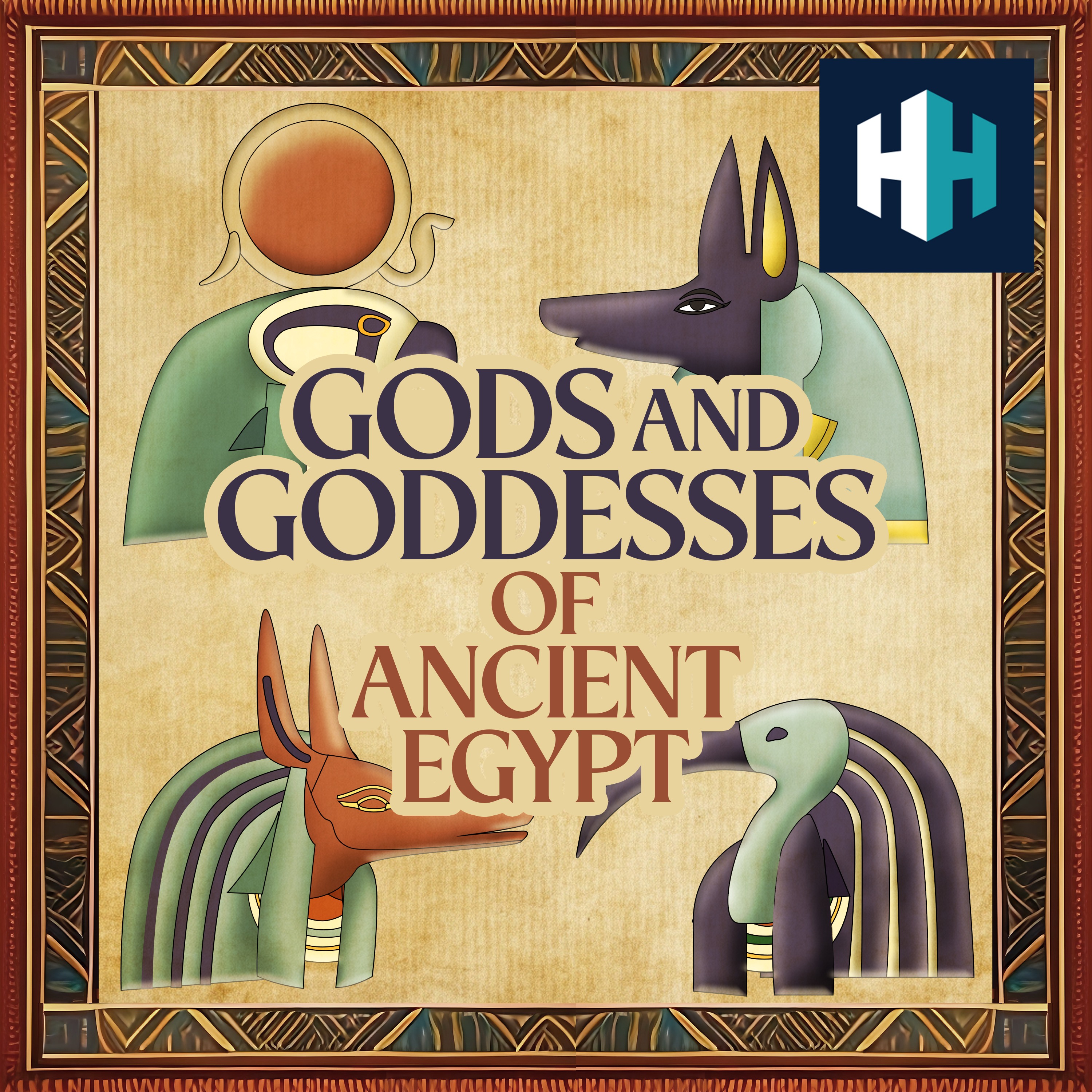
Anubis and the Underworld
Tristan Hughes and his guest Dr. Joyce Tyldesley OBE are heading to the Underworld for the final installation of The Ancients exploration of the Gods and Goddesses of Ancient Egypt. They encounter the infamous jackal-headed deity Anubis, analyse Egyptian archaeology and discuss the origins of mummification, the Book of the Dead and the weighing of hearts.
Presented by Tristan Hughes. Edited and produced by Joseph Knight, the senior producer is Anne-Marie Luff. Scriptwriter is Andrew Hulse. Voice Actor is Menna Elbezawy.
The Ancients is a History Hit podcast.
Enjoy unlimited access to award-winning original TV documentaries that are released weekly and AD-FREE podcasts. Sign up HERE for 50% off your first 3 months using code ‘ANCIENTS’. https://historyhit.com/subscription
You can take part in our listener survey here.
Press play and read along
Transcript
Speaker 1 Ever wondered why the Romans were defeated in the Tudorberg Forest? What secrets lie buried in prehistoric Ireland? Or what made Alexander truly great?
Speaker 1 With a subscription to History Hit, you can explore our ancient past alongside the world's leading historians and archaeologists.
Speaker 1 You'll also unlock hundreds of hours of original documentaries with a brand new release every single week covering everything from the ancient world to World War II.
Speaker 1 Just visit historyhit.com/slash subscribe.
Speaker 2 This holiday, Verizon is helping you bundle up incredible gifts and savings.
Speaker 4 You'll get the latest phone with a new line on my plan and a brand new smartwatch and tablet.
Speaker 5 No trade-in needed, even on our lowest price plan.
Speaker 3 That's two gifts for your family and one for you.
Speaker 5 Or two for you and one for someone else.
Speaker 3 Or three gifts for you and only you.
Speaker 2
Either way, you save big on three amazing gifts at Verizon. All on the best 5G network.
Visit Verizon today.
Speaker 6 Rankings based on root metrics root score report dated 1 each 2025. Your results may vary.
Speaker 7 Service plan required for watch and tablet. Additional terms apply.
Speaker 8 Dashing through the store.
Speaker 9 Dave's looking for a gift.
Speaker 10 One you can't ignore. But not the socks he picks.
Speaker 11 I know, I'm putting them back.
Speaker 12 Hey, Dave, here's a tip.
Speaker 13 Put scratchers on your list.
Speaker 14 Oh, scratchers? Good idea.
Speaker 16 It's an easy shopping trip.
Speaker 9 We're glad we could assist.
Speaker 17 Thanks, random singing people.
Speaker 19 So be like Dave this holiday and give the gift of play.
Speaker 20 Scratchers from the California lottery.
Speaker 18 A little play can make your day.
Speaker 21 Please play responsibly. Must be 18 years or older to purchase play or claim.
Speaker 22 Hi, folks. It's Mark Bittman from the podcast Food with Mark Bittman.
Speaker 22 You know, whether you are doing traditional Thanksgiving, a friend's giving, or something in between, Whole Foods Market has great everyday prices on all the things you need for Thanksgiving.
Speaker 22 No way antibiotics ever birds bring quality to your table at a great price. You can enjoy so many ways to save on your Thanksgiving spread at Whole Foods Market.
Speaker 22 And remember, Prime gives you shop online and delivery or pickup as you like.
Speaker 23 Out there in the deep desert, Among the parched red earth, something is howling, mewing, whimpering.
Speaker 23 It's dark, a cool night so black, you'd be picking your way across the dunes by starlight alone.
Speaker 23 But if you followed that horrible crying sound, eventually you would find it, an animal lying in a pool of blood.
Speaker 23 It has gleaming cat eyes, whiskers sharp as needles, fans curved and keen as a waxing moon.
Speaker 23 But those are not what you would notice first.
Speaker 23 You would notice the red ruin of its flesh. The creature has been flayed, its skin stripped away to show the muscle and bone beneath.
Speaker 23 It will recover. The creature is a god after all.
Speaker 23 Set the god of chaos in the form of an animal, some big cat.
Speaker 23 But he will never forget this mutilation.
Speaker 23 He will never again cross the god Anubis.
Speaker 23 What is Seth's crime? What has led to this punishment?
Speaker 23 He has not merely betrayed his brother, the Pharaoh god Osiris. He has not merely killed his brother.
Speaker 23 Seth has dismembered the Pharaoh's body, cut it into 14 pieces and scattered them far and wide across Egypt. But gods are not so easy to destroy.
Speaker 1
It's the ancients on history hit. I'm Tristan Hughes, your host.
And welcome to the fifth and final episode of our Egyptian gods and goddesses miniseries.
Speaker 1 We've covered the origins of the Egyptian gods. We've done the sun gods like Ra, great goddesses like Isis and the popular legend of Osiris.
Speaker 1 And now, to finish off this series, we're heading to the underworld, to death in ancient Egyptian religion and the infamous jackal-headed deity Anubis.
Speaker 1 There's lots of mentions of death in surviving Egyptian archaeology, whether it's the Book of the Dead, the Weighing of the Heart, or the many different creatures that existed in the underworld.
Speaker 1
So naturally, there's a lot to unpack. Fortunately, we have Dr.
Joyce Tildsley, OBE from the University of Manchester, on hand to tackle this topic in this finale.
Speaker 1 Now before our interview with Joyce, as with all of our episodes in this mini-series, we have a retelling of a myth. Today it's the myth of Anubis and his mummifying of Osiris, the king of the dead.
Speaker 23 Osiris' wife, Isis, has taken to the wing as a kite and gone in search for her husband's remains.
Speaker 23 With each new part, she makes a stitch. With each new piece, a bind, she begins to reconstruct Osiris' body.
Speaker 23 However, However, to find the last of his limbs, the last of his organs, she must range farther and farther.
Speaker 23 She must be going for longer and longer, weathering distant storms, riding foreign winds, and all the while Osiris's remains are unguarded, unprotected.
Speaker 23 Set sees his chance to stop this resurrection once and for all.
Speaker 23 He begins to work, to bend and twist,
Speaker 23 until he takes the form of a predator, a hunter with gleaming cat eyes, whiskers sharp as needles, fangs curved and keen as a waxing moon.
Speaker 23 He heads into the deep desert following a sweet drotting scent.
Speaker 23 But Seth is wrong to think he is the only creature that skulks and stalks the parched red earth.
Speaker 23 Another has smelt that scent, another god.
Speaker 23 His name is Anubis.
Speaker 23 A snout, a snarl curling over yellowing teeth. Anubis' head is that of a black jacket.
Speaker 23
His is the bark that echoes about tombs and crypts. His is the howl in the night that sends grave robbers running.
He is the protector of the dead.
Speaker 23 And so, when Anubis sees Seth tearing at the remains of Osiris' body,
Speaker 23 he takes two forelegs and chases him off.
Speaker 23
Seth is faster. The god has taken the form of a big cat, a sprinting creature.
But every dog has its day and Anabee's is relentless.
Speaker 23 Every time Seth thinks he has outrun him, every time he stops to pant and gasp, the jackal is there upon him.
Speaker 23
And the chase continues. Minutes, hours, the whole night and beyond.
Hepro, the god of dawn, notices the pursuit at daybreak and Aton, the god of dusk, is still watching at sunset.
Speaker 23 Until finally, in darkness, a cool night so black you'd be picking your way across the dunes by starlight alone. Seth can flee no longer.
Speaker 23 Their fight then is quick, but the truth is, Seth is exhausted.
Speaker 23 His every muscle is pulled, his breath are shallow.
Speaker 23 And when Anubis' jaws close around his throat, the big cat goes limp.
Speaker 23 His tail ceases to thrash. Seth can only plead then, only beg.
Speaker 23
But Anubis is determined. An eye for an eye is the rule of the gods.
And so, there can only be one punishment for Seth's crime, a mutilation.
Speaker 23 Anubis plays him alive, but not before branding his height over and over again with burning iron.
Speaker 23 Those scorched spots, ink black, they are marks of shame on old leopards, for allowing Set to take their form for his savagery, for his barbarity.
Speaker 23 When Isis returns from her search, another of Osiris' limbs held in her talons. She finds Anoes at guard over her husband's body, a faithful hound.
Speaker 23 Together they stitch, together they bind, and when Anues wraps Osiris' body in linens,
Speaker 23 these last rites of a pharaoh, he does it with the utmost care, the utmost precision. His fingers do not shiver in that cool night so black.
Speaker 23 No,
Speaker 23 he has a new cloak to keep him warm. It is a leopard's heart.
Speaker 23 So fresh, the blood still drips onto the sand.
Speaker 1 Joyce, pleasure. Great to have you back on the podcast.
Speaker 25 Thank you.
Speaker 1 And I think we can say we've saved for the best till last because you have been a stalwart of this gods and goddesses of ancient Egypt mini-series.
Speaker 1 And this last episode, can we say that this particular god, Anubis, he is the most famous, the most well-known of all Egyptian deities?
Speaker 25 Oh, that's a good question. I'm not so sure that that's true.
Speaker 9 Do you own that?
Speaker 25 He has definitely got a fan base.
Speaker 25 I mean, again, he hasn't got a great deal of mythology, but he's very recognizable, isn't he? And you see pictures of him all over the place.
Speaker 25 Whenever people are talking about mummification, he'll be there, or Tutankhamun, there's a statue of him in the tomb, and so on. So people are familiar.
Speaker 1 I think in popular media today, isn't it? It's like the mummy, the movie, the mummy, and all of that.
Speaker 1 The depictions of this jackal-headed mythological creature and the name Anubis comes up and up over and over again.
Speaker 25 It does, it does. It's definitely, I think, a name people will be familiar with.
Speaker 1 And before we get into Anubis, and then we're also going to explore the whole process of mummification and the underworld in the Egyptian belief, I'd like to ask a bit about the archaeology we have.
Speaker 1 Because when looking at gods and goddesses and mythology, I remember you saying in an earlier episode how
Speaker 1 the bias is almost towards the dead, towards temples and rituals, that the majority of archaeology we have for this surrounds the afterlife.
Speaker 1 And is that almost kind of a bit of a misconception that the Egyptians are obsessed with death?
Speaker 25 Yes, I think it is. I mean, they're certainly interested in it and they certainly prepare for it.
Speaker 25 At least the ones that we can see who are the elite Egyptians, the ones who can afford tombs or really elaborate graves and mummification and grave goods.
Speaker 25 But first of all, they're not even the majority of the population. A lot of people are just buried in fairly simple pit graves in the desert, unmummified, and always have been.
Speaker 25 It happens throughout the dynastic period.
Speaker 25 But what's happened to draw the other tombs to our attention is that the housing and the palaces are all made of mud brick and they're all situated on the edge of the cultivated land where it's quite damp and where it's also quite desirable farming land.
Speaker 25
So they've either dissolved or they've been flattened and built over because they're mud brick, it's really easy to do that. They make a fertile soil if you flatten it.
They're gone.
Speaker 25 We don't really have as many. Whereas the tombs and the temples, well, the temples are made of stone and the tombs are cut either into the desert or built of stone again.
Speaker 25 So they've survived because they're away from the floodwaters, if they're the tombs. They're also packed full of goods.
Speaker 25 And you have to remember that the early Egyptologists were looking for, I don't want to say the word treasures, but that basically is what they were doing. They were looking for objects to find.
Speaker 25 They weren't so much interested in daily life, or they were, but they also were interested in artifacts.
Speaker 25 interested them greatly and of course in those days it doesn't happen these days but they could bring artefacts back if they were from the west and they could give them to their sponsors and so on so it made a lot of sense for them to focus on cemeteries and the dead rather than on the living so even if there were settlement sites around they didn't particularly want to excavate them it's a sort of whole combination of circumstances better preservation and more focus but it does yeah you're right it gives us that impression that the egyptians themselves were obsessed with death and i think it'd be better to say they're obsessed with life and they wanted to make sure their life would continue because they loved life they wanted their life in egypt to continue as much as it could do as it had done during their actual life and do we have much evidence much source material from these contexts from archaeological work in cemeteries and so on for the figure of anubis himself we know that anubis or better to say jackals i think because sometimes they're unnamed and it's difficult to know who they are we find jackals in association with elaborate burials from the pre-dynastic period onwards.
Speaker 25 So the jackal is an important animal animal, and we've already talked about bulls, but jackals also appear later on.
Speaker 25 It becomes associated with Anubis, but this jackal figure is difficult for us to name because there are several jackal gods, is there right from the very, very beginning.
Speaker 25 Why the association with cemeteries? It's not quite clear. It's often said that it's because dogs dig things up.
Speaker 1 Scavenging kind of thing.
Speaker 25 Yeah, but dogs also bury things, don't they? So it could be that. And also, having been to Egypt and other places, sometimes just packs of dogs will congregate on the edge of a town or a settlement.
Speaker 25
And you know, maybe there are also packs of dogs were found in the cemeteries. And so they could be digging things up or they could be burying things.
It's difficult to know.
Speaker 1 So the characteristics of Anubis, at least in his appearance, almost like as you were talking about with Hathor in a previous episode, the characteristics of a jackal head that actually might predate the figure of Anubis himself.
Speaker 26 Yes.
Speaker 25
You put it in much better than I did. Yes.
We have definite signs that dogs or jackals are of importance during the pre-dynastic time, but there's no writing then. We've no idea what's going on.
Speaker 25 We've no idea what the ideas of the afterlife are.
Speaker 1 Sorry, pre-dynastic times, how far back are we going with that?
Speaker 25 I would go back about a thousand years before the unification of Egypt.
Speaker 1 And when is that?
Speaker 25 Unification of Egypt is about 3,100.
Speaker 9 Oh, okay. So wow, 3,000.
Speaker 1 Wow, that's really far back.
Speaker 25 I mean, it's not a lot of evidence because there isn't a lot of evidence from that period, but the little bits here and there we see the importance of the the bull, the importance of the cow, dogs become important.
Speaker 25 I think the thing to remember is that we can't just start studying Egyptian tombs and art and beliefs at the beginning of the dynastic age because it's very much a continuation.
Speaker 25 The only difference is now that it's being ruled by a king and it becomes a unified land. I mean, it's a pretty big difference, I agree, but it's still the same people.
Speaker 25 So we have to assume, I think, that the same beliefs are there already and they just they will develop further.
Speaker 1 And so we've kind of talked about, you know, one of these main attributes of Anubis, you know, this jackal-headed figure, which we'll explore more as we go on. But, Joyce, who exactly was Anubis?
Speaker 1 What did the ancient Egyptians think Anubis was?
Speaker 25 Anubis starts out as being very much, I was saying, control of the cemetery.
Speaker 25 I wouldn't say he was the king of the dead because before Osiris, there isn't a land of the dead really for the dead to go to.
Speaker 25 At this point, we sort of need to slightly understand the changing funerary beliefs.
Speaker 25 We can see from the evidence that we have that in the old kingdom, the beginning of the dynastic period, the idea is that the king has a spirit strong enough to leave the tomb.
Speaker 25 So the king and maybe people associated with him will benefit a bit from his strong spirit being buried near him. But most of the elite who are buried in tombs are not expecting to go to an afterlife.
Speaker 25 They're expecting to stay in that tomb, but they will live in that tomb forever.
Speaker 25 And that's why they take lots of graves good to the graves with them because they don't want to be caught without food and drink and even toilets. And they take everything they can.
Speaker 25 It's very impractical because they have to take things till the end of time.
Speaker 1 Underpants in the tomb of Tutankhamun.
Speaker 25 Yes, he's later though.
Speaker 26 He does leave.
Speaker 25
That's another interesting question because he does expect to leave. And yet, yes, he's taking his clothes with him.
So that's another mystery.
Speaker 25
And it makes you wonder whether he actually can't throw them away, whether having become a king. There's something sacred about his clothes.
I don't know.
Speaker 25 So we have the king at the beginning of the dynastic period, and he knows that he will be able to leave the the tomb if he does everything right.
Speaker 25 The elite who will be buried in what we call mastaba tombs, like rectangular tombs near the king's burial,
Speaker 25 will live to an extent after death, but won't leave the tomb. And then the ordinary people, we don't really know what they believe.
Speaker 25 They're buried in the pit graves in the cemetery, and they don't leave us any indication of what they're believing at all. Then you get to the end of the old kingdom, and suddenly everything changes.
Speaker 25 Osiris comes to the fore, becomes really important, and his afterlife sort of develops.
Speaker 25 And now people who have the right rituals and the right information, the right knowledge are able to go to the land of Osiris. And so he becomes king of the dead.
Speaker 25 Now, the time when you could say that Anubis is in charge of the cemeteries is the time before Osiris stepped forward to become king of the dead.
Speaker 25
So he's the ancient god of the cemeteries, if you like. And as Osiris comes to the fore, he becomes almost like his assistant.
He becomes an undertaker.
Speaker 1 There's the evolution of Anubis's role as time goes on.
Speaker 25
Yes, exactly. His role evolves.
So he's still really important. And we see him in pictures mummifying people, but he's no longer in charge.
Osiris is in charge.
Speaker 25 See, so he's lost some of his power there.
Speaker 25 And I've just said we can see him mummifying people, but actually, we know because we have some surviving masks that people during the ceremonies of a mummification probably wore an Anubis-shaped mask.
Speaker 25 So when we see someone bending over a body in a picture, it's either Anubis or it's a priest or an undertaker, probably the same thing, dressed as Anubis, even wearing a mask.
Speaker 25 We just don't know exactly what we're looking at.
Speaker 1 Performing Anubis's role in the mortal world almost.
Speaker 24 Yes. Yes.
Speaker 1 So, with Anubis, I mean, did he have an origin story that we know of, or at least is there one version of an origin story that we know of with Anubis?
Speaker 25
He's got several origins. Several.
Quite similar. Some stories will say that he's the child born to Isis and Osiris.
Speaker 25 Others would tell us that he was the child born to Nephthys, that Osiris mistook Nephthys for his wife Isis and slept with her.
Speaker 1 And just to make the situation a bit worse, they are both sisters.
Speaker 15 Yes, they're both.
Speaker 25 They're all brothers and sisters. Because he's married, it's a bad thing to do.
Speaker 25 So she becomes pregnant and has a baby, but because she's scared of what Seth, her husband, will say, she exposes the baby. Isis finds the baby and brings it up as her adoptive son.
Speaker 25 And we have stories of Anubis helping Isis when she herself helps to preserve the body of her husband Osiris.
Speaker 25 But I have to say that the story of exposing a child, we don't get that in Egyptian tradition at all.
Speaker 25 It's very much a classical thing, which suggests that that part of his mythology is put in much, much later to the original creation story.
Speaker 1 Because is this the catalyst?
Speaker 1 I mean, that whole story for Anubis then becoming associated rather than with anything in the Overland world almost or in the skies, but instead with Osiris and in the underworld, as you say, almost as this undertaker figure.
Speaker 25 Well, I think he always has been, but it gives him a more definite role. It connects him more closely to the more, if you like, more famous gods.
Speaker 25 So he's got a role now in their story, which presumably his priests would be happy with that happen because it boosts him up as well being connected to them.
Speaker 25
But he really always has been connected with cemeteries. and with mummification, but not, I would never call him a king of the dead.
It's not quite like that.
Speaker 1 But it's also interesting with his origin story and, you know, potentially his parents being Osiris and Nephthys.
Speaker 1 he's almost the next level down from that Aeneid that we talked about right at the beginning of this mini-series. So he is still right near there at the beginning, at least in their beliefs.
Speaker 25 Yes, well he's there at the beginning of the gods who are there at the beginning of the world sense, but he's not there at the beginning of Egyptian history. This is much later in it.
Speaker 25 So if you were talking about this in 3100 BCE, you probably wouldn't know that part of the story. You'd regard them as completely separate.
Speaker 25 But if you were talking about it at the the end, maybe you know, with the time of Cleopatra, then yes, you would consider them to be part of a story.
Speaker 25 But it's obviously, he's a powerful individual with staying power because he lasts out the entire dynastic age. And as you say, he's really well known today.
Speaker 1 And you've already talked about how the jackal becomes closely associated with cemeteries, like digging, potentially scavenging as well.
Speaker 1 I mean, does this evolve at all into the dog, the domestic dog generally just becoming associated with the dead in ancient Egypt?
Speaker 25 I I don't think dogs are particularly associated with the dead, but it can be very difficult sometimes to decide what you're looking at if you see a picture of a dog. Are you looking at a nubis?
Speaker 25 Are you looking at a dog? It's quite interesting that the Egyptians are definitely more cat people, I would say, than dog people. So we see cats.
Speaker 1 You can be both, but okay,
Speaker 15 you can, yeah.
Speaker 25 You see cats being taken hunting, for example, which seems a bit strange to us. I mean, obviously not hunting big game, but you know, in scenes on tomb walls, you can see cats there rather than dogs.
Speaker 25 dogs but they did like their dogs now we earlier talked about the kind of this mythical origin story of anubis and association with the likes of osiris and nephthys but he also seems to play a significant role in the osiris myth now what role does he play in some versions of it he plays a role that he helps isis when she brings osiris back to life and effectively mummifies him so he's there again in the role of an undertaker and he helps her and can be taken as her guide But he's not in all versions of the story.
Speaker 25 So it's quite interesting as to which version that you're looking at. But definitely as an undertaker, he would be very much at home doing that.
Speaker 1 And in the whole kind of process of mummification and Osiris becoming the first mummy.
Speaker 25 Yes, which again is very interesting because Osiris becoming the first mummy, again, that story presumably is not what inspired mummification.
Speaker 25 Mummification was there and it inspired the story of Osiris becoming the first mummy. It's kind of the other way around.
Speaker 25 But we don't really get that story until the point where mummification is becoming more and more popular with the elite.
Speaker 1 Do you often therefore see in depictions on wall paintings, let's say in tombs or elsewhere, depictions of Osiris, but also Anubis being depicted nearby, almost, you know, kind of as the undertaker, but aiding Osiris?
Speaker 25
He can be aiding. For example, he can lead the deceased to the court of judgment.
So we can see the two of them together, but you don't see them in a way working together.
Speaker 25 They're working independently, but they are together.
Speaker 1 They're working together in the underworld in the passage of souls to the underworld, but they have different roles within that.
Speaker 25 Thank you. Yes.
Speaker 1 I mean, you saw about guiding kind of people into the underworld. That almost made me think of Charon and crossing the river Styx, the ferryman.
Speaker 1 I mean, so does Anubis also have that kind of role where he is bringing people into the underworld?
Speaker 25 Again, not always.
Speaker 25 But then it varies from time to time. I'm sorry, I keep saying that.
Speaker 25 But obviously in the old kingdom, you've got people not being guided to the underworld because they're expected to stay in the tomb.
Speaker 25 In the middle kingdom, it becomes open to the ordinary people, so then you have got the potential of going there.
Speaker 25 But they have things called the coffin texts, which are developed from the pyramid texts, which were inside some of the pyramids.
Speaker 25 And they're primarily written on their own coffins, box-shaped coffins we call them, but they're rectangular, they're not square. And they're sort of a map and a guide to what will happen.
Speaker 25 So you can get there by yourself, but it could be that Anubis could help you.
Speaker 25 You get to the New Kingdom and it's become far more complicated a way of getting there and you're going to go for quite a grand trial when you get there and that's more when he comes to the fore to help out with things.
Speaker 1 This episode is sponsored by Ruler.
Speaker 1 Finding a therapist who not only has time for new clients, but also actually takes your insurance can feel impossible. Deciding to reach out and ask for help is huge.
Speaker 1 To then be hit by wall after wall can be so demoralizing.
Speaker 1 Many therapists don't take insurance packages at all, which means that you're stuck paying the full cost out of pocket or paying for an expensive monthly subscription. That's where Ruler comes in.
Speaker 1 They partner with over 100 insurance plans, making the average co-pay just $15 per session.
Speaker 1 Now that's real therapy from licensed professionals chosen based on your particular particular situation at a price that actually makes sense.
Speaker 1 You use your insurance benefits to maintain your physical health, so why wouldn't you do the same for your mental health?
Speaker 1 Thousands of people are already using Ruler to get affordable, high-quality therapy that's actually covered by insurance. Visit ruler.com slash ancients to get started.
Speaker 1
After you sign up, you'll be asked how you heard about them. Please support our show and let them know we sent you.
That's rula.com slash ancients.
Speaker 1 You deserve mental health care that works with you, not against your budget.
Speaker 2 This holiday, Verizon is helping you bundle up incredible gifts and savings.
Speaker 4 You'll get the latest phone with a new line on my plan and a brand new smartwatch and tablet.
Speaker 5 No trade-in needed, even on our lowest price plan.
Speaker 3 That's two gifts for your family and one for you.
Speaker 5 Or two for you and one for someone else.
Speaker 3 Or three gifts for you and only you.
Speaker 2
Either way, you save big on three amazing gifts at Verizon. All on the best 5G network.
Visit Verizon today.
Speaker 6 Rankings based on Root Metric Root Score Report dated 1 each 2025. Your results may vary.
Speaker 7 Service plan required for watch and tablet. Additional terms apply.
Speaker 8 Dashing through the store, Dave's looking for a gift.
Speaker 10 One you can't ignore. Run out the socks he picks.
Speaker 11 I know, I'm putting them back.
Speaker 12 Hey, Dave, here's a tip.
Speaker 13 Put scratchers on your list.
Speaker 14 Oh, scratchers, good idea.
Speaker 16 It's an easy shopping trip.
Speaker 9 We're glad we could assist.
Speaker 17 Thanks, random singing people.
Speaker 19 So be like Dave this holiday and give the gift of play.
Speaker 20 Scratchers from the California lottery.
Speaker 18 A little play can make your day.
Speaker 21 Please play responsibly. Must be 18 years or older to purchase play or claim.
Speaker 27 If you're a custodial supervisor at a local high school, you know that cleanliness is key and that the best place to get cleaning supplies is from Granger.
Speaker 27 Granger helps you stay fully stocked on the products you trust, from paper towels and disinfectants to floor scrubbers.
Speaker 27
Plus, you can rely on Granger for easy reordering so you never run run out of what you need. Call 1-800GRanger, clickgrainger.com or just stop by.
Granger for the ones who get it done.
Speaker 1
Well, we talked about Anubis and let's go on to mummification. I mean, first of all, no such thing as a silly question.
I mean, Jurious, how did the ancient Egyptians, how did they mummify their dead?
Speaker 25
Well, it's an interesting question. How they did it, we're quite confident that we know how they did it.
Don't try this at home anybody.
Speaker 25 But basically, you take the body, they would take the body as soon as they could, really, as soon as they showed it was dead, which isn't always easy to know when people are dead or not.
Speaker 25 But as soon as they showed that people were dead, take the body, they would wash it. They would extract the brain from the head because they didn't think the brain really had much of a function.
Speaker 25 Even though they knew from the medical papyri that if you got damaged to the head, you would start to not function correctly.
Speaker 25 So they kind of knew but anyway they took the brain out and threw it away and did they take it out through the nose as we as sometimes said yes yes that was one of the easier ways of doing it actually to just well basically shove a hookup and then whisk a bit and you could get encourage it to trickle down the nose would be the easiest way of doing it there are other ways of doing it as well but that was probably the easiest way of doing it And then you would remove the internal organs, which would decay, which they would know because they were cooking and they live in a hot climate.
Speaker 25 It's going to be very obvious to them. And then you would dry the body out and you would also dry out the organs that you want to keep.
Speaker 25 When it had been dried out for somewhere between 40 and 70 days, you would wash it again and oil it to make it a bit more supple and pad it and bandage it.
Speaker 25 And you would also preserve some of the organs that you'd taken away.
Speaker 25 The heart would be put back into the body, but the other organs would either be put in canopic jars or packaged up as little packages separately or might be packaged up and put back into the body because they would be needed in the afterlife.
Speaker 25 And then you bandage the whole thing up, and that is your mummy. But that is just the practical side of it.
Speaker 25 There's a whole aspect of it, which is the religious side of it, because it's like the medical recipes that I talked about before. It wouldn't work if you just did that.
Speaker 25 We could try mummifying people, and it would, yes, you'd have a preserved body, but it wouldn't be a latent human being because you need to have the prayer aspect of it as well.
Speaker 25
And this is where we find the priest taking the role of a nubis as as they do the mummification. And it's a sacred ritual.
It's not just a way of disposing of the bodies. So it's a long process.
Speaker 25
It's a process they don't tell us a great deal about. That's not surprising.
They don't tell us about things that might be dangerous or might be bad luck or that they just don't want us to know.
Speaker 25 So it's not sinister that we don't know about it, but it's something that they don't really write about the whole process.
Speaker 25 So we're having to use a bit of imagination, but we know from the bodies we have the practicalities. As I say, it's the prayers and the whole process of it that we're less certain of.
Speaker 1 Do we have any potential glimpses from surviving archaeology, maybe a text or something, about any details about some of these funeral rites that you've just mentioned?
Speaker 25
We can see funerals going on on tomb walls. I should stress again this is really later in the dynastic period.
Earlier they weren't mummified and they were sort of preserved in shorter coffins.
Speaker 25 They were curled up. But when they started to mummify, they get the longer, the longer full-length coffin because it's not so easy to mummify a curled-up body.
Speaker 25 We can see funeral processions, we can see what happens at the tomb where the mummy is propped up and the priest does what we call the opening of the mouth ceremony, which will make the latent being, which is the mummy, receptive to becoming animate.
Speaker 25 Very interesting that the opening of the mouth ceremony is not just for the dead body. It's also applied to statues and art, anything that has the potential to come alive,
Speaker 25 probably not quite the right way of putting it, but to reanimate or to even host the spirit of a dead person. You can do the opening of the mouth ceremony on.
Speaker 25
It's done by a priest, but that priest might also be an undertaker or a relation. They're going to the tomb.
We can see the unguents from Tutankhamun are poured over elite bodies.
Speaker 25 We assume that there's a funerary meal and then the body is left in the tomb. and overnight it will start to prepare for its journey to the afterlife.
Speaker 1
So this is the next next step in the belief, in Egyptian belief, of what happens to these people after death. Yes.
It's the journey to the afterlife.
Speaker 25
They have the belief that it is possible to achieve an afterlife, but you can only do that if your body survives. And your body has to survive in a recognizable form.
So a skeleton won't count.
Speaker 9 Oh, interesting.
Speaker 25 And they know that this is possible because presumably they have seen in the desert that bodies will come out of the sand very well preserved because the sand is hot, it's sterile, and it allows fluids to drain away from the body.
Speaker 25 So they know it's achievable.
Speaker 25 The very interesting thing, I think, to many of us is why they decide to go the route of mummification because they could easily, or more easily, bury the bodies in the desert and they would be naturally mummified.
Speaker 25 If keeping the shape of the body and the appearance of it mattered, that would be much cheaper, but they don't. They replicate what they could have done naturally.
Speaker 25 and develop an entire industry around it. But the aim always is to preserve this body so that the spirits that are released when the person dies can recognise the body and come back to it.
Speaker 25 If the body decays, then the person will die a second death and won't be able to have an afterlife. So that's what you're trying to prevent.
Speaker 1 And on a quick tangent, I mean, economically, it's also much, much more expensive to do, isn't it?
Speaker 1 I mean, like materials, I remember going to the Dead Sea recently, and like bitumen from the Dead Sea seems to be an important ingredient with mummy wrapping and things like that.
Speaker 1 So getting the the materials for the mummy wrapping and the whole process which you've described earlier, it takes a long time. It must have cost a bit of money as well if you wanted to be mummified.
Speaker 25
Yes, I mean, they're not necessarily using bitumen, certainly not in the New Kingdom. But, yes, you're absolutely right.
The bandaging alone, the amount of linen that would be needed, it's exorbitant.
Speaker 25 And if you say for a family and suddenly, I don't know, someone gets measles or something and everybody dies, you're providing miles and miles, literally, of bandaging, hugely, hugely expensive.
Speaker 25 We get Egyptians being mummified in old towels and old sheets, and there's a famous one that's mummified in an old sale because, presumably, of the expense of doing this. But it's not for everybody.
Speaker 25
It's for the elites, those who can afford it. But as the dynastic age goes on, more and more people are mummified.
But standards of mummification, they peak and then they go slightly downhill.
Speaker 25 So by the end, by around about the time of Cleopatra, the mummies actually look quite beautiful because they're beautifully, intricately patterned.
Speaker 25 but inside the mummy, the body is not as well preserved as it would have been from an earlier mummy.
Speaker 1 So let's say we're back some 3,000 to 4,000 years ago, and this elite figure, recently deceased, they've just been mummified and that the whole rituals, the rituals have been done.
Speaker 1 And now the people of the time, they believe that the deceased is now on their journey to the afterlife.
Speaker 25 Bits of the deceased are.
Speaker 1 Bits of the deceased are.
Speaker 25 The deceased has released several spirits. One of them, the car, has to stay near to the body.
Speaker 25 So it will be important that people make offerings to the deceased forever, if possible, because those offerings will support the car.
Speaker 25 The car needs to eat and drink and be treated kind of like a human. So it's important that that aspect isn't forgotten.
Speaker 25 So there will be offerings made, or if you can't guarantee to do offerings forever, which nobody can because after a few generations, people aren't going to do it for their great-great-grandparents.
Speaker 25
They won't have known them. You can put images on the wall.
That magically will also help with that. And there's another spirit, the bar, which is also flies around on the earth.
Speaker 25
But another part of the spirit will leave the tomb and will set up on this journey. And they all have to be accommodated.
So all three of them have to be happy. But yet, we have the spirit
Speaker 25 who will leave, will use the information that's been provided either if they're in the middle kingdom on the coffin texts written on their coffin, sometimes as a map, or in the Book of the Dead, if they're in the New Kingdom that they've been buried with, which will give them very explicit details as to what's to come, where they're going, any questions that they asked.
Speaker 25 It's like a crib sheet, they have the answers, they know what's coming up. And if they're prepared for it by having this information with them, they will sail through it.
Speaker 25 So, if it's the New Kingdom, you will turn up at the court judged by Osiris, and Nubis will be there, Thoth will be there.
Speaker 25 And your heart, because I said the heart was important, will be weighed in a scale against the feather of truth or the feather of Mart to see if you're light-hearted or not.
Speaker 25 And you will also tell people that you've done no wrong. And if you pass all this test, then you will progress into the field of reeds to work for Osiris.
Speaker 25 But if you fail, you'll be eaten by Amit, or there's a danger you'll be eaten by Amit, which is a fearsome monster which, like Tawarit, but in a different configuration, is part crocodile, part lion, and part hippopotamus.
Speaker 25 And if you're if you're eaten by Amet or your heart is eaten by Amit, then there's no way back from that either.
Speaker 25 So if you are going to have an elite funeral, it's absolutely crucial that you have the right equipment to get you through this test that's going to come.
Speaker 28
Stop! Before you drag yourself to that coffee pot tomorrow morning, try this instead. Tonight, fill a shaker with water.
Add one scoop of Early Bird and put it on your nightstand.
Speaker 28
When your alarm screams at 5 a.m., drink it first. What happens next will shock you.
Your brain doesn't gradually wake up, it switches on. The fog vanishes.
You're not surviving your morning.
Speaker 28
You're conquering it. This blood-orange mimosa ritual turned more than a thousand night owls into morning warriors this week alone.
Get yours at clubearlybird.com and use code NEVERSNOOSE for 20% off.
Speaker 9 Dashing through the store, Dave's looking for a gift.
Speaker 10 One you can't ignore, but not the socks he paints.
Speaker 11 I know, I'm putting them back.
Speaker 12 Hey, Dave, here's a tip.
Speaker 13 Put scratchers on your list.
Speaker 14 Oh, scratchers, good idea.
Speaker 16 It's an easy shopping trip.
Speaker 9 We're glad we could assist.
Speaker 17 Thanks, random singing people.
Speaker 19 So be like Dave this holiday and give the gift of play.
Speaker 20 Scratchers from the California lottery.
Speaker 18 A little play can make your day.
Speaker 21 Please play responsibly. Must be 18 years or older to purchase play or claim.
Speaker 1 It's fascinating that we have so many of these details surviving.
Speaker 1 So, this book of the dead that you mentioned earlier, is this a key, almost a literary, but archaeological source for learning more about their beliefs about the whole sailing into the Arctic?
Speaker 26 Yes, yes.
Speaker 25 It's interesting because it's not really a test, is it? Because you're taking the answers with you, so you only have to read them out. So, basically, the rich will always get in.
Speaker 25 But if you're not rich, if you don't have that,
Speaker 25
you haven't got a chance. But then you've not got a a mummified body either.
If you're the majority of the population, you're being buried in a desert cemetery without mummifications.
Speaker 25 What do you believe about the afterlife? We don't know because they can't tell us they're illiterate. We don't have the information.
Speaker 25 So it might well be that different sectors of the community believe different afterlife. It's very difficult to tell.
Speaker 1
And one thing you also mentioned there, Joyce, was sailing. And of course, the River Nile is so important to ancient Egyptian civilization.
Do you think we're seeing the importance of that river?
Speaker 1 And I remember you mentioning on a previous episode how the Egyptians almost couldn't believe of a civilization that didn't live with an important river.
Speaker 1 That the river is so important to the way they think, that of course there's going to be a river to take them into the afternoon.
Speaker 25
Absolutely. Absolutely.
It's important. But also the river seems to be connected and boats connected with funerals anyway.
Speaker 25 Again, if we go right the way back to before Egypt becomes one land, we see pottery that's put in graves and there are pictures of boats on it.
Speaker 25 And the boats have got lots and lots of oars and they're quite clearly very important and there are mysterious figures male and female associated with the boats who we interpret as either gods and goddesses or people performing rituals to do with the funeral and then later on we find boats beside the pyramids we find people taking model boats into the tombs with them so that they can use them in in the afterlife the idea that you probably have to sail to a cemetery because it's you're probably living on one bank and the cemetery will be on the other bank the cemeteries are in the west this had become an important part of the funeral even for people who don't actually have to technically sail so so one side of the bank of the river narrow was almost seen as the side of life and the other the side of death was it yes yes i'm i'm again i'm being cautious because that's possibly more how we see it than they do and there are cemeteries on both sides there are settlements on both sides but ideally you would cross the river going towards the west the land of the setting sun and that's where you would be buried so that is where they tend to be and settlements tend to be but are not always, on the East Bank.
Speaker 1 One other question on the Book of the Dead. I mean, can you clarify? I mean, what does the Book of the Dead look like?
Speaker 1 Are we actually thinking, do they leave them with a book or what is the Book of the Dead? It's a scroll. It's a scroll.
Speaker 25
But it's got pictures in it. It shows what's happening.
And it's got chapters in it. A chapter being just a short selection of spells and descriptions as to what is happening.
Speaker 25 So they do know what is going to come up.
Speaker 1 And they are normally found in certain tombs dating to certain periods of Egyptian history.
Speaker 25 Yes, New Kingdom. First of all, we have the pyramid texts, which are found in pyramids for the kings and some queens.
Speaker 25 And then it becomes much more democratic. So you've got coffin texts, they're written on coffins, but again, for the elites, it's never very democratic.
Speaker 25 And now we have people taking this information in the form of a scroll into the tomb. They could buy them.
Speaker 25 You could either have them custom done so that it's made purely for you, or you could buy an off-the-peg one and your name would be inserted.
Speaker 25 But it's just fascinating seeing over hundreds of years, we've already talked about the evolution of certain gods and goddesses in our chats but also the evolution of mortuary of funerary texts yes well everything evolves and sometimes we talk about ancient egypt as if it's one thing and people don't realize but tutankaman wasn't buried under a pyramid he was buried in a rock-cut tomb because that had evolved you know there's their changes the whole time but they're quite gradual but there's so much of their civilization that looks consistent like their art at first glance it looks the same from beginning to end so you can tell it's ancient egyptian but when you look closely, everything is evolving the whole time.
Speaker 25 That includes funerary practices and includes mythology.
Speaker 1 Which also leads on to the point that, of course, with the various dynasties that rule ancient Egypt and sometimes dynasties not from Egypt coming into Egypt, over time, will there have been different funeral rites that these different dynasties and different people, different elites would have performed?
Speaker 25 I think it's an evolving situation the whole time.
Speaker 25 Slightly funny thing is that when you've got Nubian kings ruling Egypt, from the south,
Speaker 25 from the far south, they were actually far stricter in the rules that they applied to things than the Egyptians were themselves.
Speaker 25 But then they returned home for burial, so we can't talk about their burials in Egypt.
Speaker 25
But it's not always that the foreigners are doing it differently, it's that they're more adhering to the tradition. But yes, it changes the whole time.
A mummification changes.
Speaker 25 So an expert can tell by looking at a mummy, obviously by dating it, but also just looking at the style of the bandage and so on, how old it is.
Speaker 25 And it will also reflect to a a certain extent the expectations of that person whether they expect to stay in the tomb whether they expect to to be able to leave and you were talking earlier how on this journey into the afterlife there's the weighing of the heart and you know you get the good ending or the really bad ending with the hippo because yeah nobody expects to have the bad ending that's the thing because we get this information from the book of the dead so we can see amit the destroyer lurking near the scales but you never see amit eating anybody because of course if you've got that book it would never happen to you because you've got the the book, so you are going to pass it.
Speaker 25 But also, they wouldn't write it down or draw it anyway because it'd be incredibly bad luck to take this to your tomb because it might actually happen.
Speaker 25 So, we know about it, but we don't see the bad outcome because nobody expects that to happen to them.
Speaker 1 And do these pictures, I mean, do they also give us a sense of what the ancient Egyptians believes the underworld looks like? Does it look outdoors or dark?
Speaker 1 Do we get any sense of what they thought the underworld looks like?
Speaker 25
Well, there's a lot of discussion about that. If you look at quite a few tomb walls from the New Kingdom you can see people doing things like working in the fields.
That's not their daily life.
Speaker 25 That is the afterlife and it looks very much like Egypt.
Speaker 25
But it's sort of better Egypt. You know the sun is always shining.
Everyone's wearing lovely clothes and so on. Everyone seems fairly happy.
Speaker 25 But if you read about it, it seems not quite so certain that it's such a brilliant place to be.
Speaker 25 It seems to be quite a personal afterlife to everybody and that it might be sort of different for different people but it's not a paradise you have to work it's not necessarily comfortable and it's not necessarily that people want to be dead they don't necessarily look forward to it what they do is to try and prepare to make the best of what's going to come they definitely want to make sure that they're going to live again rather than dying forever but they're not looking forward to a paradise experience i would say And even having to work in the fields for Osiris to the end of time is quite hard work.
Speaker 25 It's not something that you necessarily want to have to do.
Speaker 1 Yeah, can you talk to us a bit more about this whole field of reeds idea, which is quite interesting? And also you're working alongside the king of the dead.
Speaker 25 You are, although he's probably just directing things. He's not actually working because kings don't expect to work in the field of reeds.
Speaker 25 They expect to, well, they've got several expectations of what will happen to them.
Speaker 25 But the principal ones is either they will become one with Osiris, because if you think about it, Osiris has been king of Egypt before he died. So he is sort of them.
Speaker 25 If you can see all the kings of Egypt as being part of a repeating cycle, then they are one. So they become one with Osiris.
Speaker 25 And the living king, their son, usually, who's on the throne, is one with Horus, who succeeded Cyrus eventually. Or they will help the sun god Rei sail in his solar boat.
Speaker 25
Or they could expect to do both. You know, it's not either or.
In Tutankhamun's tomb, for example, most of the images on the burial chamber are reflecting Osiris tradition.
Speaker 25 So you see Osiris greeting Tutankhamun and so on. And Hathor's in there helping out.
Speaker 25 But on one wall, you've got monkeys who are greeting the sun, which is a solar tradition, different tradition in the same room. So, you know, he's got two expectations there.
Speaker 25 We would see them as conflicting, but he obviously didn't, or his artist didn't. There was also an expectation that a dead king could become a star, an undying star in the sky.
Speaker 25 So they've got all those expectations. So they're not expecting to work, which is really interesting because you've already mentioned that Tutankhamun took his underpants with him, which he did.
Speaker 25 But why? Because he didn't expect, he didn't expect to be trapped in his tomb, and he didn't expect after work either. He expected to become a god.
Speaker 25 So, why is he taking all that stuff with him if he didn't need it? Is he just being like belt and braces?
Speaker 1 I'll take them because, just in case, no, as my mum says, you can never have enough underpants
Speaker 1 on your trips and all of that. So, but it was also interesting what you mentioned there before we completely wrap up, Joyce, about Ray, the sun god, also being involved in the underworld.
Speaker 1 Because you think, Ray, okay, sun gods, celestial god living above, but there's no kind of almost divide where it's just the gods in the underworld, like Anubis and Osiris, and then the gods above, like, I mean, Hathor and Rey and so on.
Speaker 1 They can go between realms.
Speaker 25
Yes, well, he is on a cycle. He's the sun.
So during the day, he sails across the sky. But at night, he sails the other way through the underworld and emerges again at dawn.
So he's constantly cycle.
Speaker 25 In some versions of mythology, he's being born from Newt every day. So he has exciting nighttime adventures when he's in the underworld.
Speaker 25 He has to fight his way through and he comes across the body of Osiris while he's down there and he defeats all the enemies who try and stop the sun rising and he always wins because the next day the sun comes up again and he has quite a peaceful sail across the sky.
Speaker 25 during the day but at night time he changes boats and he gets into one and he's got a crew and seth is with him and people support him and he has to really fight his way through the underworld every night to get out.
Speaker 25
Another indication that perhaps it's not as nice down there. But again, we see we've got two traditions here as well.
We've got the tradition of the actual literal underworld that is underground.
Speaker 25 And we've also got the idea of it being somewhere in the West. You know, it's not, we're not even sure where it is.
Speaker 1 Well, last thing, a bit of an apocalyptic question to end on. I mean,
Speaker 1 were there ancient Egyptian astus? I mean, were there any towards the end of the world? Did he have any thoughts about an apocalypse potentially on the horizon?
Speaker 25 I think again, I thought about this quite a bit.
Speaker 25 That's not the sort of thing they would tell you, even if they thought it, because if they wrote it down, so magical are words, particularly if they put it in a tomb, that it might cause it to happen.
Speaker 25 But we do know that the gods can die, and obviously they know that people can die. I mean, for Osiris can die, and even though he's brought back to life, he's only partially brought back to life.
Speaker 25
He's not really alive. He can't join the gods, and it wasn't as it was before.
We know when we talked about the eight gods of Amopolis Magna, some of those died in the end.
Speaker 25 But there are references to what will happen at the end of all time.
Speaker 25 And what seems to be suggested for happening at the end of time is that Autumn and Osiris will survive, but they will survive in the form of snakes and they will go back into the waters of chaos.
Speaker 25
They love cyclical nature. They regard everything as cycles.
So years start again after a king...
Speaker 25 dies the year counting starts again so maybe if that happens those two will then somehow generate life and life life will come back again. But we're not told that.
Speaker 1 And it's interesting that it's snakes as well.
Speaker 1 Snakes associated with the dead or just.
Speaker 25 There's lots of snakes in the underworld.
Speaker 25 There are some like proper feature snakes
Speaker 25
who we know the names of and they do things like this. Apophis is a really evil snake.
And there's mehen, who's a good snake.
Speaker 25 But there are also lots of weird snakes with legs and two heads and so on in there as well, sort of really odd creatures.
Speaker 25 They have a very love-hate relationship with snakes because on the one hand, they're dangerous and they know that they can bite you and possibly kill you.
Speaker 25
So on the other hand, we have snakes like Reninutert, who's regarded as a very good mother. So if you've got Reninutert, you know, people worship snakes as well.
Snake goddesses.
Speaker 25 So, you know, the two sides of the snake. But in the underworld, definitely there are snakes.
Speaker 1 So you have snakes, you have snakes with legs, you have that hippo-lion
Speaker 1
crocodile mix. I can't remember the name.
What's the name of that? Amit. Amit.
Speaker 1 Were there many other creatures that we hear about in the underworld or do we not know?
Speaker 24 There are odd things that we don't even know what they are.
Speaker 25 I mean, we don't know the names of all these snakes that are looking odd. But yes, that's one of the things that makes us think that it's not the paradise that maybe we imagine it would be.
Speaker 25 It's just better than being dead.
Speaker 1
Well, there you go. Joyce, this has been absolutely fantastic.
You have been a superstar for us as one of our stalwarts in this ancient Egypt gods and goddesses mini-series.
Speaker 1 It just goes for me to say thank you so much for being such a key contributor for this series.
Speaker 25 Thank you.
Speaker 1 Well, there you go. There was Professor Joyce Tildsley, OBE, wrapping up our Egyptian gods and goddesses mini-series talking all things Anubis, Mummification and the Underworld.
Speaker 1
I hope you enjoyed today's episode. My huge thanks to Joyce for being one of the great stalwarts of this series alongside Dr.
Campbell Price.
Speaker 1 Such a pleasure to interview them both for multiple episodes in this mini-series. Now I must also send my thanks to everyone else involved in creating this mini-series.
Speaker 1 The scripts at the beginning of every episode for the myth retelling, they were written by Andrew Hulse. They were narrated by Mena El-Bazawi.
Speaker 1 The assistant producer for this series and the man who also edited the last couple of episodes was Joseph Knight. Our lead producer who made this possible was Anne-Marie Luff.
Speaker 1 And our main editor for the first three episodes who is now on holiday was Aidan Lonaghan. Thank you to you all for making this series possible and so special.
Speaker 1 And also of course thank you for listening to this episode of the Ancients.
Speaker 1 Do let us know your thoughts, what you thought of this mini-series and of course what you'd like to see next on the ancients. What special series should we do next?
Speaker 1 It's really exciting to always kind of go from one to the next to the next and do this great variety of different topics.
Speaker 1 And of course please follow this show on Spotify or wherever you get your podcasts. It really helps us and you'll be doing us a big favor.
Speaker 1 Tell you what, we'll put a poll-up with some ideas of future special mini-series that we could do and we'll see which one ranks the best.
Speaker 1 Don't forget, you can also listen to us and all of History Hit's podcasts ad-free and watch hundreds of TV documentaries when you subscribe at historyhit.com slash subscribe.
Speaker 1 As a special gift, you can also get 50% off your first three months when you use CodeAncients at checkout. That's enough from me, signing off our special Egyptian gods and goddesses miniseries.
Speaker 2 This holiday, Verizon is helping you bundle up incredible gifts and savings.
Speaker 4 You'll get the latest phone with a new line on my plan and a brand new smartwatch and tablet.
Speaker 5 No trade-in needed, even on our lowest-price plan.
Speaker 3 That's two gifts for your family and one for you, or two for you and one for someone else, or three gifts for you and only you.
Speaker 2 Either way, you save big on three amazing gifts at Verizon, all on the best 5G network. Visit Verizon today.
Speaker 6 Rankings based on Root Metric Root Score Report dated 1 each 2025. Your results may vary.
Speaker 7 Service plan required for watch and tablet. Additional terms apply.
Speaker 8 Dashing through the store, Dave's looking for a gift.
Speaker 10 One you can't ignore, but not the socks he paid for.
Speaker 11 I know, I'm putting them back.
Speaker 12 Hey, Dave, here's a tip.
Speaker 13 Put scratchers on your list.
Speaker 14 Oh, scratchers? Good idea.
Speaker 16 It's an easy shopping trip.
Speaker 9 We're glad we could assist.
Speaker 17 Thanks, random singing people.
Speaker 19 So be like Dave this holiday and give the gift of play.
Speaker 20 Scratchers from the California lottery.
Speaker 18 A little play can make your day.
Speaker 21 Please play responsibly. Must be 18 years or older to purchase play or claim.