Brian Klaas: Why Everything We Do Matters
show notes:
Fluke: Chance, Chaos, and Why Everything We Do Matters
Press play and read along
Transcript
Speaker 1 Get ready for Malice, a twisted new drama starring Jack Whitehall, David DeCovny, and Carise Van Houten.
Speaker 1 Jack Whitehall plays Adam, a charming manny infiltrates the wealthy Tanner family with a hidden motive to destroy them.
Speaker 1 This edge-of-your-seat revenge thriller unravels a deliciously dark mystery in a world full of wealth, secrets, and betrayal. Malice will constantly keep you on your toes.
Speaker 1 Why is Adam after the Tanner family? What lengths will he go to? One thing's for sure, the past never stays buried, so keep your enemies close.
Speaker 1 Watch Malice, all episodes now streaming exclusively on Prime Video.
Speaker 2 Even though severe cases can be rare, respiratory syncytial virus, or RSV, is still the leading cause of hospitalization in babies under one.
Speaker 2 RSV often begins like a cold or the flu, but can quickly spread to your baby's lungs. Ask your doctor about preventative antibodies for your baby this season and visit protectagainstrsv.com.
Speaker 2 The information presented is for general educational purposes only.
Speaker 3 Please ask your healthcare provider about any questions regarding your health or your baby's health.
Speaker 4
Welcome to the Bull Work Podcast. I'm Charlie Sykes.
We are almost all the way through January and we have a lot of ground to cover today.
Speaker 4 We're joined once again by Brian Kloss, professor of global politics at the University College London, where he focuses on democracy, authoritarianism, and American politics and foreign policy.
Speaker 4 So welcome back, Brian. Welcome from England.
Speaker 5 Thanks for having me on the show.
Speaker 4 I want to talk about your new mind-bending book, Fluke, Chance, Chaos, and Why Everything We Do Matters, which I found a little bit alarming and scary, but you claim is uplifting.
Speaker 4 We're going to get to that in a moment. Also, I want to talk to you about the banality of Crazy.
Speaker 4 But I blame you for this because you called attention to an amazing exchange that took place on a local CBS affiliate television station down in Miami.
Speaker 4 And just to set the scene for this, there is a congresswoman from South Florida named Maria Salazar, who on her Twitter biography describes herself as a five-time Emmy Award-winning journalist.
Speaker 4 I'm not sure what that's all about. Okay.
Speaker 4 So she's sitting down with one of the local legends of journalism, a guy named Jim DeFiti. And she's bragging about all the money that she's brought into South Florida.
Speaker 4 She's bragging specifically about, I got you $40 million.
Speaker 4 What I think is interesting is, listen how the reporter here, Jim DeFiti, does not let this go, pointing out that, wait, you voted against the bills that provided that money.
Speaker 4
You voted against the infrastructure bill. You voted against the CHIPS Act.
And it goes back and forth.
Speaker 4 But in some ways, I think, and I think you highlighted this, Brian, this is the kind of hold your feet to the fire journalism we just don't see every day. And it is a thing of beauty.
Speaker 4 So let's just play this. This is, again, local CBS reporter named Jim DeFiti questioning Republican Congresswoman Maria Salazar.
Speaker 6 Last month you were at FIU and you presented a check for $650,000 to help small businesses at FIU.
Speaker 6 But you voted against the bill that gave the money that you then signed a check for and handed and had a photo op, the Consolidated Appropriations Act of 2023, right?
Speaker 7 You voted against that bill.
Speaker 8 Right now, you have to give me more details, but I do know that every time I have an opportunity to bring money to my constituents, I do so. I do.
Speaker 8 I just did $400,000. But look,
Speaker 7 but
Speaker 6 you voted against the Chips and Science Act, right?
Speaker 8 Listen, right now
Speaker 8 I need to ask my staff, but what are we looking at the $40 million that I have brought to this community?
Speaker 8 Aren't you proud of me? Aren't you proud of the $40 million?
Speaker 7 How are you proud that I wrote the Dignity Act?
Speaker 5 Haven't I?
Speaker 8 Let's talk about the Americas Act.
Speaker 7 Wait, wait, wait a second.
Speaker 7 One second.
Speaker 8 Tell me.
Speaker 6 The money that you talk about, the $40 million that you bring back to the district, sometimes that money comes from bills that you voted against.
Speaker 6 You voted against the CHIPS Act, and yet you praise the fact that the South Florida Climate Resilience Tech Hub is going to to be started in Miami, right?
Speaker 6 You voted against the infrastructure bill, and you talk about all the money that comes back to the airport.
Speaker 6 So at the same time that you're taking credit for the money that you bring back to the district, in Washington, you're voting against these projects on party-line votes.
Speaker 8 Listen, that was, I think, last cycle. I cannot really remember right now, but just
Speaker 8 look at the Americas Act, which is what I'm going to vote to do.
Speaker 7 You don't want to explain why you introduced me to the bank.
Speaker 8 I mean, right now, and I'm not trying to be a politician, there's so many bills that I've introduced that I know that many of them.
Speaker 7 I think that's the only thing that you voted against. That I understand.
Speaker 8
But it's okay. Sometimes I vote and sometimes I don't.
But let's look at the positive. Let's look at the $40 million that I brought.
Speaker 4
Okay. Wow, Brian.
What struck you about that?
Speaker 5 Well, you know, I think there's a few things. One is how rare that is in American media, which I think is a really depressing aspect of this because it's just so basic.
Speaker 5 I mean, he's not doing anything, you know, groundbreaking as a journalist. He's just insisting on the facts, and he's not moving on, which I think is really important.
Speaker 5
It's, by the way, a very strong feature of British journalism. And the way that press interviews hand told here are extremely confrontational and adversarial.
And I don't think we have that culture.
Speaker 4 And they make the follow-ups, right? Yes.
Speaker 5 Of follow-ups and sort of fact-checking and real time and so on.
Speaker 5 What was amazing, though, about that clip is at the end, at the end, she still says, you're not talking about the positives of what I brought here.
Speaker 5 And so even at the end of it, she's claiming credit as though she's responsible for it. Whereas if everybody was like her in Congress, the money once have been appropriated.
Speaker 5 I mean, the brazen shamelessness of it is just off the charts.
Speaker 4 That was the word that I was looking for. Just the pure shamelessness.
Speaker 4 She's confronted with it and just does not even blink, just keeps going with the same talking point, even though it's been blown up.
Speaker 4 And of course, that, you know, really cringeworthy awkwardness where she just can't remember how she voted on two of the biggest pieces of legislation in front of Congress because there are just so many bills, you know, Brian.
Speaker 4 I'm just going to have to check with my staff because I forget that I voted against this bill that I'm on your show touting.
Speaker 4 It's kind of a classic moment.
Speaker 5 But that's, I mean, that's the thing.
Speaker 5 It's like she should not be in Congress if she can't know how she voted on like two of the most important flagship pieces of legislation in that congressional cycle.
Speaker 5 I mean, it's like everything about that interview is just like the indication of how unfit for office some of these people are and how, as I said, brazen they are about claiming credit for things that they tried to kill.
Speaker 5 I mean, it's like, it's just amazing. And of course, the Democrats are all to blame when they have the talking points.
Speaker 5
Oh, it's this big government stuff, but they're very happy to cut the ribbon or sign the check. I mean, it's just amazing.
It's just really depressing.
Speaker 4 So, before we get into your new book, your very provocative new book, I want to talk about something you wrote a couple of months ago that you described as the banality of crazy.
Speaker 4 You wrote this back in October on Substack.
Speaker 4 Only a few Americans just recognize just how deranged, delusional, and dangerous Trump is because the press has gotten kind of bored with the routine insanity.
Speaker 4 So talk to me about this, about the banality of crazy, sort of obviously somewhat inspired by Hannah Arendt's The Banality of Evil. But there is a problem.
Speaker 4 When Donald Trump says something crazy 86 times a day, it becomes kind of difficult to focus in on it.
Speaker 5 Yeah, so this was boiling inside of me for a long time, but there was a trigger for it as well.
Speaker 5 So the boiling came from the fact that in the UK where I live, when Trump tweeted anything in 2017, my phone would blow up with people wanting to ask me about it in the British news, right?
Speaker 5 And it just stopped, right? It's like, it's just completely dried up.
Speaker 5 Like the stuff that he says does not make international news, and a lot of it does not make the press in the United States even because there's just such a flow of it.
Speaker 5 And the trigger for the piece was when I saw him call to execute Mark Milley or floated the idea of the possibility of executing Mark Milley, America's top general at the time.
Speaker 5
And I looked at the New York Times, no headline. I looked at the Washington Post, no headline.
Looked at the Wall Street Journal, no headline.
Speaker 5 The New York Times did cover that story three days after Trump said it on page 14.
Speaker 5 And I'm thinking to myself, okay, when else in American history as a president said that we should literally execute the top general and it's not generated any press, I mean, let alone ever even said it, right?
Speaker 5 Around that same time, he called to execute shoplifters, right? He said that we should shoot shoplifters on site.
Speaker 5 And, you know, I'm not on the side of shoplifters, but like, this is an extreme set of punitive, you know, like just extrajudicial killings for people who steal like a TV, right?
Speaker 4 Big story.
Speaker 5 Or even like, you know, a bar of soap. And I looked at that and I was like, okay, I want to look at some data on this.
Speaker 5 And so I looked at Google news kits, how many times something was covered in the news.
Speaker 5 And I looked at the shoplifters thing and then I compared it to how many stories were about, not Hunter Biden, about Commander Biden, Joe Biden's dog, biting a Secret Service agent.
Speaker 4 The dog.
Speaker 5 And there were more stories about the dog than there were about the leading presidential contender in the country, right?
Speaker 5 He was leading the polls saying that we should execute shoplifters and kill America's top general. And I'm just thinking to myself, like, how is this possible?
Speaker 5 So the dynamic I'm describing is that the fire hose of insane things that Trump says on a regular basis is so overwhelming that the way the press deals with it is by focusing on novelty rather than magnitude.
Speaker 5
So like John Fetterman's hoodie is a new story. It's an interesting story.
It's totally unimportant, right?
Speaker 5 Whereas Trump going up in front of a bunch of people in a baying crowd and calling to execute various enemies or saying racist stuff just doesn't register anymore.
Speaker 5 But like if you made a list of the 10 craziest things that a president has said in the last 50 years, all of them would be Trump.
Speaker 5 And a lot of them would be replaced by Trump in the next three months, right? Because he's getting crazier over time. But the press just doesn't have the capacity to chase stories.
Speaker 5 endlessly when they are not new, but they are important.
Speaker 5 And I think that's the thing that Trump has exposed in the way that the journalism in the United States works is it's all fixated on novelty and not fixated on magnitude.
Speaker 4 Yeah, and in that way, he's kind of broken the model of journalism.
Speaker 4 Now, you wrote at the time, bombarded by a constant stream of deranged authoritarian extremism from a man who might soon return to the presidency, we've lost all sense of scale and perspective.
Speaker 4 But neither the American press nor the public can afford to be lulled. The man who is president incited a violent attack on the U.S.
Speaker 4 Capitol in order to overturn an election, is again openly fomenting political violence while explicitly endorsing authoritarian strategies. Should he return to power?
Speaker 4
That is the story of the 2024 election. Everything else is just window dressing.
So since then, there have been so many illustrations of what you're describing.
Speaker 4 He will come out with, you know, not just one or two, but, you know, three or four utterly deranged tweets, dangerous tweets, hold my beer.
Speaker 4
This is what I'm going to do if I am restored to power tweets. And they are shrugged off.
We have become numbed. I very rarely watch the evening news.
Speaker 4 I was watching last night, one of the major networks talking about the border thing.
Speaker 4 And honestly, watching that, you would think that Donald Trump is a completely normal candidate in the completely normal political year. So what's the answer? How do you fix that?
Speaker 4 Because news is by definition addicted to novelty. And after eight years, how can we continue to cover it as if we're still shocked by it?
Speaker 5 Yeah, so I think there's a few things there. I mean, one, just to do a thought experiment here.
Speaker 5 Do you think that if Joe Biden said that we should kill the chairman of the Joint Chiefs of Staff, that that would be the front page story in the New York Times?
Speaker 5 I mean, I definitely think that would happen, right?
Speaker 4 I'd put the money down on that, yeah? Yeah.
Speaker 5 So, you know, I think the standard the press has to have is that it should cover statements from people who may be president or are president the same way, regardless of who's saying them.
Speaker 5 That's the first thing, right? The second thing that I think is important, you don't bake in the crazy and then discount it.
Speaker 5
I think that's what basically happened with Trump is it's like baked in, like, oh, yeah, he's crazy and authoritarian. So, like, let's not cover it.
Right.
Speaker 5 I think the second thing that's important is that the press has an obligation to not chase clicks in this election and to instead focus on what's important.
Speaker 5 And I think, you know, if there's ever a time to do this, I understand that journalism is just getting obliterated by, you know, layoffs and cost pressures and so on.
Speaker 5 But like, this is what journalism exists for. The reason it exists is to inform the public when there are high-stakes elections.
Speaker 5 And this is the highest stakes elections that's existed in my lifetime and arguably in modern American history.
Speaker 5 And I think when you have a pro-democracy party going up against an anti-democracy party, it's an existential risk to democracy, right? And this wasn't the case in the past.
Speaker 5
Like if Mitt Romney won in 2012, it would have been fine. There would have been no problem.
You know, people would have partisan disagreements, but like he wouldn't have torpedoed the system.
Speaker 5 And once the system goes away, you know, everything's lost. So this is where I just hope, you know, I hope there are conversations in newsrooms that are like, why are we doing this?
Speaker 5
Like, what is our job for? And the answer is to inform people about the stakes, not about the horse race. And so much coverage is just about horse race novelty.
And it makes the country stupider.
Speaker 5 And it also makes the country poorly informed when they're heading into a really, really consequential election.
Speaker 4 Well, I agree with you completely, but let's just step back for a moment.
Speaker 4 I mean, even here in the bulwark, which is a, I think, you know, pretty clearly anti-Trump site, we will get comments from people saying, you know, why do you spend so much time talking about Trump?
Speaker 4 Why don't we just ignore him? Why don't we just not give him, you know, the oxygen? If we didn't cover him, it wouldn't be so dangerous.
Speaker 4 You know, some of this, I think, is political, but some of it is just the psychological grind of numbness, which is that people cannot take it. They cannot take psychologically.
Speaker 4 You can't be told, you know, the sky is falling, the sun is going to, you know, obliterate you every single day, 24-7 before you shut down.
Speaker 4 So there's a psychological component, which then goes back to these conversations in the newsroom, you know, in a news media that is, shall we say, you know, going through some challenging times.
Speaker 4
And they go, okay, you know, we could do this, but we're going to burn people out. Secondly, we're going to burn our staff out.
We're going to burn out the audience,
Speaker 4
And it's just going to accelerate the bubblization of the media. Pro-Trump people are just going to turn us off.
They're going to say they're biased.
Speaker 4 I mean, it does seem like an almost a insoluble Rubik's cube unless you really reimagine journalism, which I think is what you're talking about.
Speaker 5 Yeah, I mean, I think that
Speaker 5 there's a few things that I would say there. The first is that I'm completely sympathetic to this point of view.
Speaker 5 I mean, I don't want to know how many of my brain cells are devoted to all the crazy stuff that Donald Trump has said. Like, I wrote a book about him at one point.
Speaker 5 I have a very detailed knowledge of Donald Trump's public statements and behavior, and I wish I didn't, right? Like, I would love to reclaim those brain cells. And I hate writing about him.
Speaker 5 I hate talking about him, but it's important, right? And I think this is the kind of stuff where a lot of people who do produce the news and who do...
Speaker 5 punditry and so on feel exactly the same way I do. They think, I would love to wake up and never think about Donald Trump again.
Speaker 4 Raise my hand.
Speaker 5 But the country has to because he might be in power.
Speaker 5 So, you know, and he might affect the fate of the democratic system for a generation. So we've got to deal with this.
Speaker 5 I think the aspects around, you know, how you cover him, what I would say is that the problem is the bubblization has already happened. Right.
Speaker 5 And this is what I worry about is that if you turn on like the normal nightly news, as you say, he looks like a normal guy.
Speaker 5 Oh, maybe he's gone to court because he's been sued, but they don't like show his crazy statements in front of the rallies anymore.
Speaker 5 Whereas his base is getting the crazy piped into their veins, you know, injected straight into their veins, and they're radicalizing.
Speaker 5 The dynamic that I was trying to highlight is that like, like, look, all the people who already believe in Trumpism, they're getting this information and they're becoming more dangerous.
Speaker 5 They're becoming more authoritarian, more potentially violent. The rest of the people who are sort of apathetic mainstream voters are forgetting how crazy he was.
Speaker 5 And so, that dynamic is a really big recipe. And I think that's where the polls were showing that he was surging because there's this amnesia where it's like, yeah, it wasn't so bad, right?
Speaker 5 And I think that's the issue that I think needs to be directly addressed.
Speaker 1 Get Ready for Malice, a twisted new drama starring Jack Whitehall, David DeCovney, and Carice Van Houten.
Speaker 1 Jack Whitehall plays Adam, a charming manny infiltrates the wealthy Tanner family with a hidden motive to destroy them.
Speaker 1 This edge-of-your-seat revenge thriller unravels a deliciously dark mystery in a world full of wealth, secrets, and betrayal. Malice will constantly keep you on your toes.
Speaker 1 Why is Adam after the Tanner family? What lengths will he go to? One thing's for sure, the past never stays buried, so keep your enemies close.
Speaker 1 Watch Malice, all episodes now streaming exclusively on Prime Video.
Speaker 9 Even when you're playing music,
Speaker 9 you're always listening to your baby, especially when RSV is on your mind.
Speaker 9 Bifortis, Nursevimab ALIP, is the first and only long-acting preventative antibody that gives babies the RSV antibodies they lack.
Speaker 9 Baphortis is a prescription medicine used to help prevent serious lung disease caused by RSV or respiratory syncytial virus in babies under age one born during or entering their first RSV season and children up to 24 months who remain at risk of severe RSV disease through their second RSV season.
Speaker 9 Your baby shouldn't receive Baportis if they have a history of serious allergic reactions to Bifortis, nursevimab ALIP, or any of its ingredients.
Speaker 9 Tell your baby's doctor about any medicines they're taking and all their medical conditions, including bleeding or bruising problems. Serious allergic reactions have happened.
Speaker 9 Get medical help right away if your child has any of the following signs or symptoms of a serious allergic reaction, such as swelling of the face, mouth, or tongue, difficulty swallowing or breathing, unresponsiveness, bluish color of skin, lips, or underfingernails, muscle weakness, severe rash, hives, or itching.
Speaker 9 Most common side effects include rash and pain, swelling, or hardness at their injection site. Individual results may vary.
Speaker 2 Ask your baby's doctor about Bayfortis.
Speaker 9 Visit Bayfortis.com or call 1-855-BEFORTIS.
Speaker 4 So I want to talk about your book because it feels like at least temporarily a step back from the horse race, the daily flow of all this fluke, chance, chaos, and why everything we do matters.
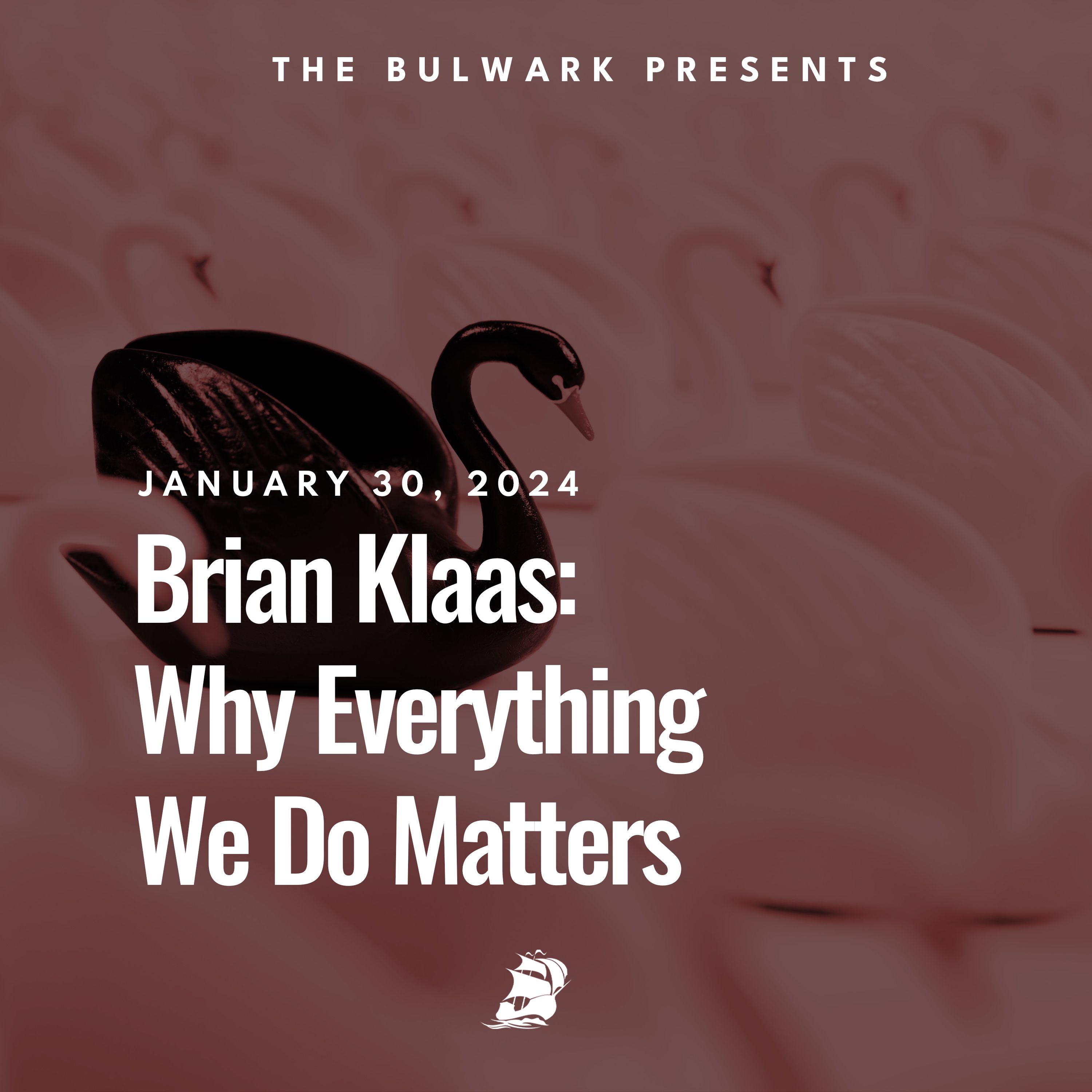
Speaker 4 Now, you talk about chaos theory and what chaos theory teaches us about human events and that in the 21st century, we live in a time defined by, you know, one unexpected shock after another, these black swan style events.
Speaker 4 So first of all, talk to me about chaos theory and then about these black swan events and why we are so vulnerable right now at this point in history.
Speaker 5 Okay, so the way that I describe chaos theory, the formal definition is basically it's called sensitivity on initial conditions, which is an academic way of saying that small changes can have really big effects over time.
Speaker 5 And the way I illustrate this in the opening story of the book is with a vacation that a couple takes in 1926, Japan, to Kyoto.
Speaker 5 An American couple goes to Kyoto, Japan, falls in love with the city, and develops a soft spot for it.
Speaker 5 Now, this shouldn't matter that much in the grand scheme of history, but it does, because 19 years later, the husband is Henry Stimson, and he's America's Secretary of War.
Speaker 5 And the target committee, which decides where to drop the first atomic bomb, picks Kyoto.
Speaker 5 And so Stimson twice meets with President Truman, gets Kyoto taken off the targeting list because he liked the city when he vacationed there with his wife.
Speaker 5 And the first atomic bomb goes to Hiroshima instead, right? And the second atomic bomb is supposed to go to Kokura, another city, but there's briefly cloud cover over the city.
Speaker 5 And so 100,000 people get incinerated in Nagasaki instead, the secondary target that day.
Speaker 5 Now, the idea that you know a vacation 19 years earlier can cause this massive shift in who lives and who dies in World War II is the way that the world actually works.
Speaker 5 It's part of chaos theory and it's how cause and effect actually operates. What we have done is we've ignored that a lot in how we understand the world.
Speaker 5 And I think it's created this hubris, which leads into the second part of your question about the black swans, where I think we have engineered a world that is extremely prone to chaos and prone to being shocked because of chaotic events.
Speaker 5 So the way I describe this is you imagine that you have a sort of sand pile, right? So you add a grain of sand one after another onto this pile.
Speaker 5 Eventually the sandpile gets so tall that a single grain of sand can cause an avalanche and the whole thing can collapse. What modern society does is it builds the sandpile to the absolute limit.
Speaker 5 And this is where, you know, you have the Arab Spring, for example, getting triggered by a guy letting himself in fire in Tunisia in late 2010, and it causes a civil war and the collapse of multiple regimes.
Speaker 5 Or you have, you know, in 2021, the Suez Canal, where there's a boat that gets twisted sideways and it wipes out $54 billion in economic productivity because the just-in-time manufacturing that we run on has no slack, right?
Speaker 5 Basically, what I'm arguing is that chaos theory always changes the way that our lives and our societies unfold. We almost never think about it.
Speaker 5 But today, it's particularly important because we've embedded systemic risk in our societies by thinking that we can control an uncontrollable world and therefore making it so the sand pile in that analogy is as absolutely high as it can be.
Speaker 5 One grain of sand falls in the wrong place and the cascade wipes us out. And that was the pandemic or the Suez Canal or whatever it is.
Speaker 4 Or, you know, some individual in Wuhan, China who had COVID-19, you know, coughs in the wrong place or it gets out of a lab.
Speaker 4 Or as you point out, you know, Obama humiliating Donald Trump at the White House correspondence dinner in 2011, which may have prompted him to decide to run. We know where all of that is at.
Speaker 4 So the significance of this, as you point out, though, is that we want to believe that the world is a comprehensible place, right?
Speaker 4 That there are no coincidences, that there are narratives that tie all this together. So we think of them as black swan events, and they are increasing in frequency.
Speaker 4 It's not just our imagination, right? That these huge things like what's happening in the Middle East, but you're right.
Speaker 4 Most people like to imagine that we can understand, predict, and control the world. Humans crave a rational explanation to make sense of the chaos of life.
Speaker 4 You know, this is not supposed to be a world where hundreds of thousands of people just die or because Henry Stimson
Speaker 4 has great sex in Kyoto or the clouds are that hundreds of thousands of people die.
Speaker 4 I mean, so this whole idea that we've just amplified all the contingency, which means that we live in a world where really insignificant events are more likely to just blow everything up.
Speaker 4 So how does that relate to the craziness of our politics? I mean, you said this was uplifting.
Speaker 4 I'm thinking like, oh shit, you know, there's a butterfly out there with indigestion who's going to do something today that's going to wipe out half the planet and there's nothing we can do about it.
Speaker 4 So
Speaker 4 how does this affect our politics now?
Speaker 5 Yeah, so I think there are worrying things that are depressing about the political implications in the short term, but they can be uplifting in the long term.
Speaker 5 I think the uplifting stuff is more for our individual lives, which I write a lot about how this affects the way we think about our own lives.
Speaker 5 But in the short term, yes, I think we've embedded systemic risk into our societies in a way that's really dangerous.
Speaker 5 And the way I describe this is if you think about the vast stretch of humanity, the 9,500 generations or so of modern humans that have existed, like 9,100 of them were hunter-gatherers, where basically they had no idea what was going to happen in their day-to-day life.
Speaker 5 Like they might starve, they might get eaten by an animal or whatever. But like their world never changed that much, right?
Speaker 5
The kids and the parents lived in the same world generation after generation. So they had what I call local instability, but global stability.
We've completely flipped that world around.
Speaker 5 So we now have a world in which our day-to-day lives are incredibly regular and ordered, right? Starbucks is always the same, but our democracies are collapsing and our rivers are drying up.
Speaker 5
And our world is constantly changing. And of course, AI is going to accelerate that and so on.
So what I say is that the lesson here is not that we're just screwed, right?
Speaker 5 This is what you're taking through this.
Speaker 4 Okay, yeah, good.
Speaker 5 This is not true. The lesson is we don't have to be screwed, but that's because we have to acknowledge that we don't have control in the way that we think we do.
Speaker 5 And if we think differently about this, then we'll have a slightly less of a premium put on optimization and efficiency to the absolute maximum, right?
Speaker 5 We make the sand pile a little bit smaller and it's resilient.
Speaker 5 And the resilience point is one, you know, there's a great example of this in Latin America where the power grid was failing all the time.
Speaker 5 And they had a new power grid they were going to set up, electricity grid.
Speaker 5 And it was more expensive and also less efficient efficient to compartmentalize the power grid with all these regional hubs, right? But they did it.
Speaker 5 And then there was a massive blackout, but it only affected a tiny part of the country because they had built resilience rather than optimization and efficiency as their core sort of driver.
Speaker 5 And it was overall, it paid for itself because the potential lost economic damage that they would have had if it had been a national grid was immediately paid for by the fact that they compartmentalized the damage.
Speaker 5 So the lesson here, I think, is one that says, look, yeah, like if we keep on the same path that we are now, we we are screwed. I think.
Speaker 5 I think that we're going to have catastrophic risk just define the rest of the 21st century and potentially in worse ways than we have already.
Speaker 5 I think the question is, you know, can we engineer a system that's more resilient? And I think the answer is yes.
Speaker 5 But, you know, we have to change our mentality that, like, I have a hard time when I talk to people about this because I say, hold on, you're going to tell me that optimization and efficiency are bad?
Speaker 5 It's like, no.
Speaker 5 I think that if we had 5% less efficiency and that created 25% more resilience, that would be a good trade, right? So that's what I'm talking about.
Speaker 5 It's sort of this trade-off between systemic risk and stability and resilience for the long term.
Speaker 1 Get ready for Malice, a twisted new drama starring Jack Whitehall, David DeCovney, and Carice Van Houten.
Speaker 1 Jack Whitehall plays Adam, a charming manny infiltrates the wealthy Tanner family with a hidden motive to destroy them.
Speaker 1 This edge-of-your-seat revenge thriller unravels a deliciously dark mystery in a world full of wealth, secrets, and betrayal. Malice will constantly keep you on your toes.
Speaker 1 Why is Adam after the Tanner family? What lengths will he go to? One thing's for sure, the past never stays buried, so keep your enemies close.
Speaker 1 Watch Malice, all episodes now streaming exclusively on Prime Video.
Speaker 4 At Arizona State University, we've made online education better, smarter, and more personalized so you can go further in your aspiring field.
Speaker 3 I decided to pursue medicine once I realized that ASU did have the online program for biological sciences. You're still required to learn the same curriculum.
Speaker 3 You're still being tested on the same content that anyone would be tested on in person. The comprehensiveness of the program prepared me so well for medical school.
Speaker 4 Explore over 350 plus programs at ASUonline.asu.edu.
Speaker 4 Okay, well, let's just go back, though, to the stories that we tell ourselves and why this always comes as a shock.
Speaker 4 As you point out, forecasters, pundits, policymakers have developed what you call this dangerous hubris about their ability to control the world.
Speaker 4 So, you know, despite all of this, this chaos and this contingency, the voices in our heads tell us, no, everything is orderly. If it's not orderly,
Speaker 4
it's for some explainable reason. And you link this to the prevalence of conspiracy thinking.
You know, how the brain wants to detect patterns, right?
Speaker 4 So when these random events occur, occur we want a story we want it to make sense right so the conspiracy theorist has this massive weapon because they always have a great story your point is there's not necessarily a story here this just happened right but as we live through these shocks and these black swan events conspiracy theories seem to be spreading you see a connection a causal relationship there talk to me about that Yeah, so there's two really important biases that are behind conspiratorial thinking.
Speaker 5 One of them is called magnitude bias and the other one is called narrative bias. So magnitude bias is the human belief that big events must have big causes.
Speaker 5 So the best example of this is, you know, Princess Diana dies in a car accident.
Speaker 5 If you ask people about the origins of why this happened, the conspiratorial thinkers will simultaneously say that they believe that she is alive and that she was killed by the British government.
Speaker 5 And those are mutually contradictory statements, right? You'd think. Yeah, but they're more satisfying than this idea of a small accident causing this, what they see as a profound event, right?
Speaker 5
A very big thing in British history. So that's magnitude bias.
And a lot of times small accidents do cause big effects.
Speaker 5 I mean, this is something where World War I started with an assassination where the guy, you know, accidentally stops his car in front of the assassin and World War I's triggered by it and so on.
Speaker 5
So magnitude bias is one part of it. The other one, which you mentioned, is the narrative bias aspect.
And human brains are pattern detection machines that make sense of the world through stories.
Speaker 5 And the point that Jonathan Gottschall, who I riff on in the book a lot, he has this book called The Storytelling Animal, what he talks about is he's like, look, what you've got here is you've got a brain that is basically designed to latch onto stories.
Speaker 5
And then the conspiracy theorists give you one hell of a good story. Now, I think QAnon is like totally insane.
It's an insane set of ideas.
Speaker 5 It would be a thriller if it was just a film and not an actual part of our politics, right?
Speaker 5 This would not be a boring movie.
Speaker 5 And so the thing is, what you have is you have journalists or like people like who say there is no story to the storytelling animal.
Speaker 5 And on the other side, you've got these people saying, Hey, this is one hell of a good story. You want to be, you want to be part of this?
Speaker 5 And on top of that, you know, why don't you fuse your identity with belief in this? And then you can become part of this really elite club of people who know the real truth and the secret pattern.
Speaker 5 Right. So, you know, I think there's stuff like this where we have all these aspects of conspiratorial thinking we try to explain in the modern world.
Speaker 5 I think some of it is just it's storytelling versus explanations that are either small accidents accidents or randomness. And people are allergic to that when big things happen in their world.
Speaker 4 Yeah, I mean, it's one thing to say, hey, what was that about? Well, shit happens. And then somebody else has a much, much more compelling story.
Speaker 4 This is what you wrote at one point, which I thought was really profound. Conspiracy theories take a bewildering series of seemingly unconnected data points and they put them into a coherent story.
Speaker 4 It's usually a hell of a good story to complete with cover-ups, shadowy cabals orchestrated by cartoon villains who are hoping that you, the blindfolded chump, will not discover the truth.
Speaker 4
And the debunkers have this impossible task. It's a battle that's already lost.
Evolution determined the winner.
Speaker 4 When forced to choose between a good story or none at all, we grab the popcorn, mesmerized by a hidden plot.
Speaker 4 That is one of the best explanations I've heard for the prevalence of conspiracy theories right now. And also, it's that secret knowledge, right?
Speaker 4 Which is not necessarily a new thing, is that you're led into this is what they don't want you to know. This is the secret knowledge.
Speaker 4 And the people who are saying shit happens are trying to bamboozle you. You're the blindfolded chunk.
Speaker 5 Well, and this is also where, you know, the other factors that we do know correlate with conspiracy theories of boredom and loneliness are things that feed into this, right?
Speaker 5 I mean, if you're going to be inducted into the secret society of people who know the real pattern and it's a really good story, and your life is a little bit boring, or you're just lonely, that's the glue that solidifies this aspect of the storytelling.
Speaker 5 So I think, you know, when you think about it that way, it's a bit demystified why people latch onto these things because it's exciting.
Speaker 5 I mean, you know, you can press people on it and they'll say, oh, maybe it's not completely true, but they don't want to leave the tribe.
Speaker 5
And they also don't like the idea that like, you know, this was just something that happened. It just, sometimes stuff happens.
So I think there are other reasons.
Speaker 5 I'm not trying to say this is the only explanation for the rise of conspiratorial thinking, but it is something that does make a lot of sense in terms of the way that our brains process information.
Speaker 5 I think stories are so central to the way humans make decisions and behave. And, you know, we have narratives about our own lives, we have narratives about the economy, and they drive us to act.
Speaker 5 And I think, unfortunately, a lot of people are driven to act by things like QAnon.
Speaker 4 You say that this is the way we've evolved.
Speaker 4 So that, you know, the battle was already, you know, lost in the beginning because this is what evolution has done to us, which implies, okay, it's going to be very, very hard to fix.
Speaker 4 And then, of course, we actually have an entertainment complex, which puts us all on steroids, because as I was listening to you, I was thinking about what was I watching on television last night?
Speaker 4 I was watching a very, very elaborate show in which the conspiracy theorists were right right the cabals were cartoon villains they really were keeping the secret knowledge from you and we have developed a really robust entertainment industry where you sit down and you go anything is possible there are conspiracies everywhere and the people that you know are often dismissed as nuts are really the heroes of the movie and then these people you know step out of their basements and go into the real life and they think hey i'm looking for the same kind of story.
Speaker 4 So putting together evolution and then evolution on steroids from the entertainment industry that you've described, how are we not totally screwed, Brian?
Speaker 5 Well, I think this is going to be hard to counteract.
Speaker 5 Your point about the entertainment, by the way, is totally apt because there's loads of studies that look at this with like Nielsen ratings, TV ratings.
Speaker 5 And anything that concludes without like a neat and tidy explanation where like all of a sudden everything comes into view and makes complete sense, it flops. It doesn't work.
Speaker 5 And Jonathan Gotchell, again, I quote him in Fluke and he has this great quote where he says, you know, we don't know how Harry Potter and Voldemort is going to end, but we know that Voldemort is not going to die by slipping on a banana peel, right?
Speaker 5 Like, you know, it's like, it's really obvious this is not going to be how the book ends. There's this aspect we embed into our culture.
Speaker 5 I think the thing that I would say is that if you understand this mentality, you're better equipped to debunk them. Because you can tell someone who's just, you know, who's drawn to the story.
Speaker 5
Maybe it's a bad story. Maybe it's a story that's uninspiring.
But at least let me be able to figure out how I can meet you in the narrative, right?
Speaker 5 And sort of explain why the narrative doesn't make sense, as opposed to just saying you're a crazy person. And I think that's where, you know, you have to show that there's cracks in the story.
Speaker 5 Like when we have entertainment and you have a film or whatever, people dislike the film when they are like, wait a minute, this doesn't make sense because like that bit contradicted that bit, right?
Speaker 5 So what you have to do is you have to meet the storytelling animal. where its mind already is, which is to say humans have to think about these things from narratives.
Speaker 5 And, you know, it's not always going to work. I think we've got a really uphill battle in the United States.
Speaker 5 I've lived in the UK for 13 years almost, and the level of conspiracism around politics, it's an American outlier. Of course, there are people who believe this stuff everywhere else, but the U.S.
Speaker 5 is so, so different on this, especially with the mainstream politicians pumping this stuff. It just doesn't happen here.
Speaker 5 It's eye-opening to see American politics from the outside and see how much of an outlier it is to other rich, developed democracies.
Speaker 4
Okay, so we're an outlier from Britain, but conspiracy theories have a long history all over the world. Of course, there's no bizarre world.
So what is it about America that you see as distinctive?
Speaker 5 I think the main thing is the supply. In the past, right, like every form of technology in terms of media expanded the number of people who could consume information.
Speaker 5 So it could be the printing press or the radio, mass media TV, and so on. But it didn't ever expand the number of people who could create information.
Speaker 5 And what's happened in the modern world is that with the internet, for the first time ever, it's gone from few to many communication to many to many communication.
Speaker 5 So a totally random crank can now influence millions of people with a tweet, right?
Speaker 5 But the difference in the US, and this is why the uptake is so much higher, is that the politicians are engaging in this. And so it becomes mainstream in a much easier way.
Speaker 5 And the sort of structures of, oh, wait, you know, it's not a crackpot who's in a tinfoil hat. It's a person I voted for who's saying this, right?
Speaker 5 That's the kind of stuff that solidifies the belief and makes it socially acceptable to say these things.
Speaker 5 I mean, QAnon belief does exist in the UK, but if you were to say it in a mainstream situation, you would be ostracized from the political world and you would be ridiculed endlessly on TV, right?
Speaker 5 Additionally, I think some of this is also the media silos.
Speaker 5 I mean, so in the US, for example, you can go on Newsmax or OAN and like talk about all these crazy conspiracy theories and like you'll never get challenged.
Speaker 5 60% of the British public gets their media from the BBC.
Speaker 5 So this centralization of news, for good or bad, creates a sort of shared reality where conspiracism just doesn't thrive the same way that it does in the United States.
Speaker 4 Well, and we started off by talking about how the British media is very, very different.
Speaker 4 In a BBC interview, a politician or a conspiracy theorist would not be able to simply filibuster, and the interviewer is not going to sit there and just nod their head.
Speaker 4 They're going to challenge them and challenge them and challenge them, and they're going to be amazingly well prepared.
Speaker 4 So, you mentioned before the problem of supply, and I was thinking about your analogy of the sand pile.
Speaker 4 When you have 100,000 grains of sand out there, the task ahead seems really daunting, particularly because we don't have forever.
Speaker 4 And all of this that you describe seems to me, and I think it seems to you too, to be accelerating.
Speaker 4
This is not a flat line. This is not in decline.
This is not something we've got a handle on. This is getting worse exponentially, and AI is just around the corner.
Speaker 5 Yeah, I mean, I think it's, as I say, it's a very thorny problem.
Speaker 5 One of the things that does feed back to our earlier discussion about the American media and the banality of crazy a little bit, that the media is not well equipped to deal with big picture ideas that persist for a long time, but don't create news.
Speaker 5
So QAnon doesn't really create news. It's not like, it's like, oh, a new person believes QAnon.
Here's a story on the 10 o'clock news, right?
Speaker 5 It's just this thing that's like, as you say, metastasizing throughout the body politique. And it's something where like you have a really poisonous aspect of delusional ideas, but it's not novel.
Speaker 5 It's just something that's there. And so I think the press has to reimagine some of the ways that it does stories.
Speaker 5 I think it would be a service to the United States to have some debunking that's done on the nightly news where they say, you know, tonight we're going to look at this thing. You can make it novel.
Speaker 5 So you say a new poll has come out showing that 50% of Republicans believe at least one idea associated with QAnon, which, by the way, this poll exists and it's true.
Speaker 5 50% of the Republican Party believes at least one plank of QAnon.
Speaker 5 So then you say, okay, we're going to devote today's episode episode of our nightly news broadcast to explaining why it's not true.
Speaker 5 You know, that's the kind of stuff that starts to move the needle a little bit. I mean, of course, there are people who are not going to get out of the rabbit hole.
Speaker 5 That's always the case with conspiracists thinking it's very difficult to counteract because they say, oh, of course the media would tell you this, right?
Speaker 5
They're part of the cabal. But, you know, you have to start somewhere.
And I think that is the short-term solution.
Speaker 5 The long-term solution, you know, I think things like social isolation is really important for this.
Speaker 5 I think American society, especially accelerated through the pandemic, has a lot of people who feel very atomized, very separate from other people.
Speaker 5 And they're highly susceptible to this, especially where Trumpism taps into it perfectly because you're a member of a group, right?
Speaker 5 Like you put the hat on and it becomes part of your identity in a way that is totally not true for Bidenism, right?
Speaker 5 I mean, there's no such thing as Bidenism, really, anyway.
Speaker 5 The fact that there's no like eagles with Biden riding them, like slapped onto Toyota Priuses, tells you that there's less of a fusion of like individual identity with political movements on the left in the in the in the United States at the moment there's plenty of conspiracy thinking on the left as well I'm not trying to suggest otherwise but I do think that fusion of identity with the theory is what's so dangerous on the political right so Part is the long-term isolation, part is the sort of debunking needs to get better.
Speaker 5 But there's no silver bullet. It's going to infect our societies for a long time.
Speaker 5 If I had to explain the number one thing that is behind Trump's enduring popularity, I think it's information pipelines.
Speaker 5 And I think it's the way that people get information about what's going on in the world. And I think that system in the United States is just utterly broken.
Speaker 5 So that I think helps explain why they accept him so much.
Speaker 4 Well, I mean, that's the problem, of course, is that the systems are broken. So you have the, you know, let's take two models here.
Speaker 4 You have the debunking over here, and you have the really, really interesting conspiracy narrative over here.
Speaker 4 All of the incentives right now in the media, the clicks, the memberships, the ratings and everything, I mean, this has been documented. People like the conspiracy theory, right?
Speaker 4 You know, that's going to get 10, 100 times the eyeballs than the ABC news debunking on the evening news.
Speaker 4 So, okay, so you promised that you were going to make this uplifting at the end, that this was uplifting for personal lives.
Speaker 4 So I might have missed that part, but I need to end on this because otherwise it's like chaos and shit's going to happen, and I'm going to walk out of the house and a branch is going to fall and it's going to kill me.
Speaker 4 And it's not a conspiracy. It's like, so what's the uplifting part?
Speaker 5
Yeah. So there's, there's sort of two sides I would point to.
One is the subtitle of Fluke, the third part of it is why everything we do matters.
Speaker 5 And I think one of the things that's really cool about chaos theory, and I think this is demonstrable scientific fact, not just some, you know, new age theory or anything, is that because of the ripple effects of all the things that we do, it is totally wrong to say that we're unimportant.
Speaker 5 And I think one of the great males, you know, drivers of sort of modern life is this feeling of interchangeability.
Speaker 5 You know, a robot's going to come and replace my job, or like, who cares if I go to work today? It won't matter anyway.
Speaker 5 Like, that feeling is totally not rooted in the way that the world works because there's all these things that are constantly shifting based on how we behave.
Speaker 5 And I find that really empowering personally, the idea that we are reshaping the future, quite literally, with what we do. And I think that has implications for politics as well.
Speaker 5 I mean, small changes and small activism can add up to lots of things.
Speaker 4 But we have no idea what it is, right? Yes.
Speaker 4 We have no idea which narrative we think we're in one movie, but maybe we are a bit character in another movie and something we have done will have tremendous impact that we may not know about, we may not understand, and we may never know about, right?
Speaker 5 You're right about this. And for people who are interested in the personal side of my story, there's a story about a mass murder in the opening of Fluke that is the origin story of my existence.
Speaker 5 So yes, I mean, we don't know the ripple effects of how these things can play out.
Speaker 5 But the other aspect of this that's slightly less abstract is I think that when you accept the narrative that I'm giving you about how chaos theory actually plays a much bigger role in our lives than you imagine, you should live differently, right?
Speaker 5 I mean, so one of the lessons is, for example, to experiment more, to also blame yourself a little bit less for your failures, because, you know, there's a little bit less control that you have.
Speaker 5 I have this, you know, saying of we control nothing, but we influence everything. And I think this aspect of sort of letting go a little bit is like really useful.
Speaker 5 I found this personally very useful to think, I believe I'm a cosmic accident. I believe that about humanity.
Speaker 5 I think there's lots of things that could have happened in evolution that would not have led to humans.
Speaker 5 My life being derived from this tragic mass murder in 1905 that I write about in the book, I feel like an accident.
Speaker 5 And I'm okay with that because when you feel like an accident, you sort of just enjoy life a bit more. You know, there's not a cosmic purpose to my existence.
Speaker 5 So I can feel like what I'm doing is, you know, affecting the future and sort of just doing things that I enjoy, trying to make the world a little bit better for other people.
Speaker 5 And, you know, spending time with people who are interesting and nice and you derive pleasure from and so on.
Speaker 5 And I think that's the kind of thing where the flip side of this, this top-down control mentality, tells you if you don't have the exact life that you think you should have, you are a failure and you should be sad about it.
Speaker 5 And so to me, the worldview of some of these stuff that I'm talking about that is tied to systemic risk in society is also, to me, is a way of unlocking some of those sort of different patterns of thinking that I personally find actually much more uplifting than the alternative.
Speaker 4 Conversations like this are interesting because I agree with you completely, but I think you and I come up with this from completely opposite ends of the spectrum because I don't think it's all random.
Speaker 4 I think a lot of it is providential, but I am also really struck by the fact that we don't know what that providence is.
Speaker 4 So, for example, it's possible that this podcast that we are recording right now will be seen by somebody who will think it's vaguely interesting, but will forward it to somebody else who will listen to it, take something from it, and then I don't have any idea what.
Speaker 4
I don't know what happens. It's something that we say, something that we write, something that sticks in somebody's mind and it may play out in a way that we have no idea.
It may be that
Speaker 4
this real significance won't take place for a decade and a half. Maybe somebody's going to go through the archives and everything.
Now, you could say that that's completely chance and everything.
Speaker 4 I could say it's the hidden hand of providence. But in some ways, it's the same existential choice to act like what you do might make a difference, right?
Speaker 5 I love that you said that because I think this is the stuff where I have my own set of views. I I mean, personally, I don't believe in God, for example.
Speaker 5 So that aspect of that, you know, does create a different viewpoint.
Speaker 5 But you're completely right that you end up having the same philosophical implications if you think that there is sort of a larger plan to things that you have less control over.
Speaker 5 You end up at the same point, right?
Speaker 5 So if Providence is sort of diverting your trajectories through life rather than randomness or evolutionary pathways or whatever, like you still have to give up a little bit of control.
Speaker 5 And I think I grew up in Minnesota. I spent my whole childhood and early adult life there and so on.
Speaker 5
And, you know, the modern world in the United States is a world I think that is obsessed with control. It's like, you know, life hacks, optimization, checklists.
It's how we navigate the world.
Speaker 5 And I think there's some of this stuff where like I've realized, and it's part of how I live my life a little differently from writing fluke is that
Speaker 5
just like do a little bit less of that and actually you end up a lot happier. And that's for me, it worked.
If it works for someone in the audience, I'd be delighted.
Speaker 5
But I think it's something where there's a lot of people who don't understand the origin of why why these things are happening. I think it's randomness.
I think there's a lot of chaos involved.
Speaker 5 I've talked to people who are, you know, really hardcore believers and they have a totally different viewpoint, but they actually sort of accept the philosophy a bit more.
Speaker 5 And everybody makes their own sense of the world, which is one of the beautiful things about humanity. You've got 8 billion people dealing with the most complex system in the universe.
Speaker 5 And everybody has their own answer to these questions. And that's what Fluke is trying to challenge people to think about them a little bit differently.
Speaker 4
Well, I think in the Venn diagram, where we agree is that, you know, you don't believe in God. I do believe in God.
But I really have the humility to say I have no idea what God's thinking.
Speaker 4
I have no idea what his intention is. He does not talk to me all the time.
In fact, you know, I may think that the story of my life is X, Y, and Z.
Speaker 4 It may turn out to be something completely different. It may be, you know, I may be the butterfly that will influence somebody
Speaker 4 or not. Who knows? I just have no idea.
Speaker 4 So it's funny because my cousin, who's a very bright and interesting guy, very, very active in politics, said that his goal for 2024 was to care less and do more.
Speaker 4
And, you know, I've been thinking about that. And I think what he meant was, don't be so obsessed about control.
Do not let it overwhelm you.
Speaker 4 Do what you can do, but also sort of understand, you know, be at peace with sort of the limitations of it all.
Speaker 4 And I think that that's one of the takeaways that I think people might have when they begin thinking about it this way.
Speaker 4 But this is an immensely thought-provoking book, and I really appreciate you joining me, Brian. The book is Fluke, Chance, Chaos, and Why Everything We Do Matters.
Speaker 4 Brian Kloss, thank you so much for coming back on the podcast, Brian.
Speaker 5 Thanks for having me on. It was a great conversation.
Speaker 4
And thank you all for listening to the Bulwark Podcast. I'm Charlie Sykes.
We'll be back tomorrow, and we'll do this all over again.
Speaker 4 The Bulwark Podcast is produced by Katie Cooper and engineered and edited by Jason Brown. Brown.
Speaker 5 This is Matt Rogers from Lost Culture Eastas with Matt Rogers and Bowen Yang.
Speaker 4 This is Bowen Yang from Lost Culture East with Matt Rogers and Bowen Yang.
Speaker 5 Hey, Bowen, it's gift season. Ugh, stressing me out.
Speaker 4 Why are the people I love so hard to shop for?
Speaker 5 Probably because they only make boring gift guides that are totally uninspired.
Speaker 4 Except for the guide we made. In partnership with Marshalls, where premium gifts meet incredible value, it's giving gifts.
Speaker 5 With categories like best gifts for the mom whose idea of a sensible walking shoe is a stiletto, or best gifts for me that were so thoughtful I really shouldn't have.
Speaker 5 Check out the guide on marshalls.com and gift the good stuff at Marshalls.
Speaker 10 California has millions of homes that could be damaged in a strong earthquake. Older homes are especially vulnerable to quake damage, so you may need to take steps to strengthen yours.
Speaker 10 Visit strengthenyourhouse.com to learn how to strengthen your home and help protect it from damage. The work may cost less than you think and can often be done in just a few days.
Speaker 10 Strengthen your home and help protect your family. Get prepared today and worry less tomorrow.
Speaker 9 Visit strengthenyourhouse.com.
Speaker 11 At CVS, it matters that we're not just in your community, but that we're part of it. It matters that we're there for you when you need us, day or night.
Speaker 11 And we want everyone to feel welcomed and rewarded. It matters that CVS is here to fill your prescriptions and here to fill your craving for a tasty and yeah, healthy snack.
Speaker 11
At CVS, we're proud to serve your community because we believe where you get your medicine matters. So visit us at cvs.com or just come by our store.
We can't wait to meet you.
Speaker 11 Store hours vary by location.