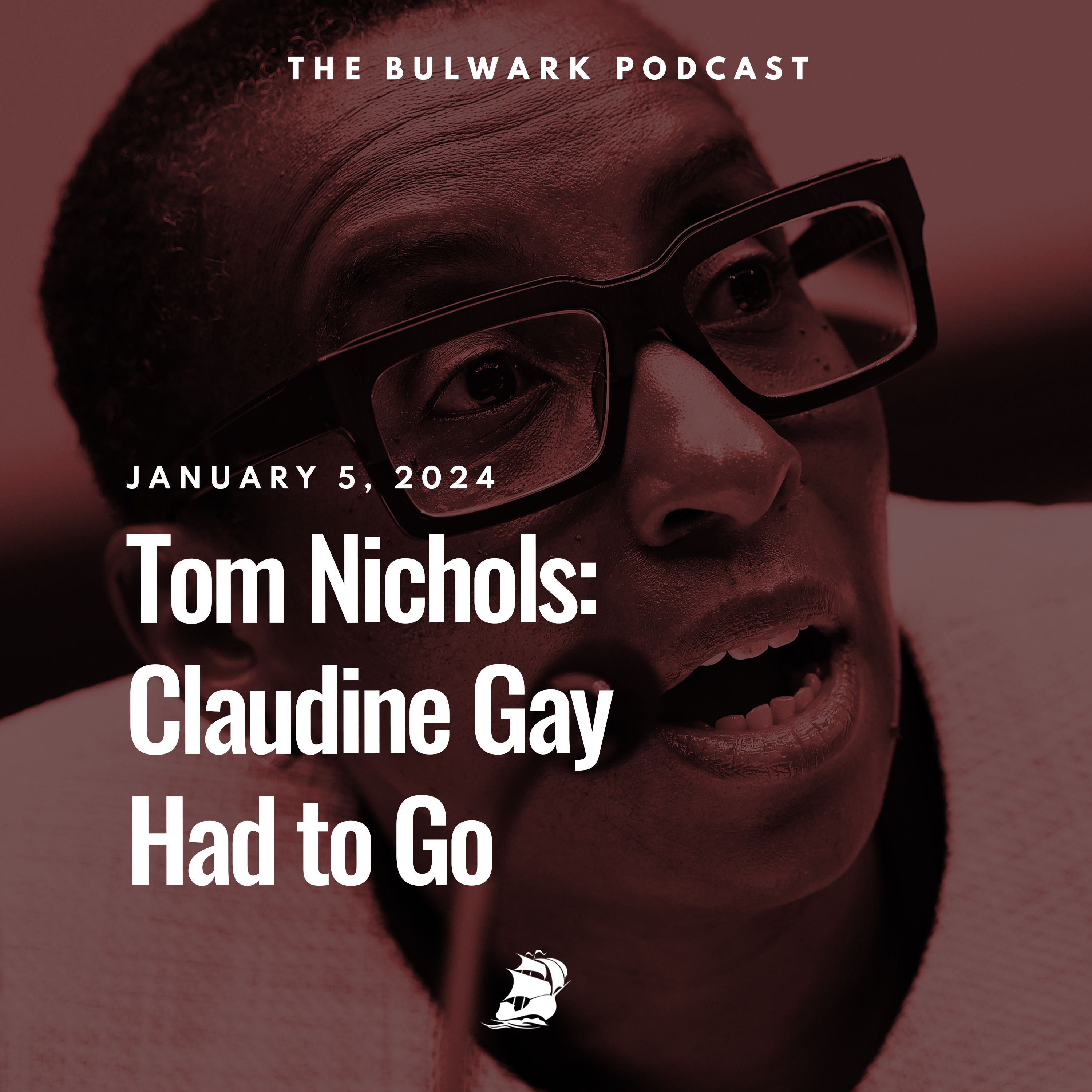
Tom Nichols: Claudine Gay Had to Go
Press play and read along
Transcript
Speaker 1
is Martha Stewart from the Martha Stewart podcast. Hi, darlings.
I have a little seasonal secret to share. It's the new Kahua Duncan Caramel Swirl.
Speaker 2
Kahlua, the beloved coffee liqueur, and Duncan, the beloved coffee destination, paired up to create a treat that is perfect for the holidays. So, go ahead, treat yourself.
Cheers, my dears.
Speaker 3
Must be 21 or older to purchase. Drink responsibly.
Kahlua Caramel Swirl Cream Liqueur, 16% Alcohol by volume, 32 proof. Copyright 2025 imported by the Kahlua Company, New York, New York.
Speaker 3 Duncan trademarks owned by DDIP Holder LLC, used under license. Copyright 2025, DDIP Holder LLC.
Speaker 4
Time for a sofa upgrade. Introducing Anibay sofas, where designer style meets budget-friendly prices.
Every Anibay sofa is modular, allowing you to rearrange your space effortlessly.
Speaker 4 Perfect for both small and large spaces, Anibay is the only machine-washable sofa inside and out. Say goodbye to stains and messes with liquid and stain resistant fabrics that make cleaning easy.
Speaker 4 Liquids simply slide right off. Designed for custom comfort, our high resilience foam lets you choose between a sink and feel or a supportive memory foam blend.
Speaker 4
Plus, our pet-friendly, stain-resistant fabrics ensure your sofa stays beautiful for years. Don't compromise quality for price.
Visit washable sofas.com to upgrade your living space today.
Speaker 4
Sofas start at just $699 with no risk returns and a 30-day money-back guarantee. Get early access to Black Friday now.
The biggest sale of the year can save you up to 60% off.
Speaker 4
Plus, free shipping and free returns. Shop now at washable sofas.com.
Offers are subject to change and certain restrictions may apply.
Speaker 1
Welcome to the Bullwork podcast. I'm Charlie Seitz.
It is January 5th, 2024. We are five days into January, one day short of the third anniversary of the insurrection.
Speaker 1 Boy, that is a weird thing, isn't it? We're joined, of course, by Tom Nichols, Professor Tom Nichols from the Atlantic.
Speaker 1 So, I mean, three years ago, you remember where you were, what you were thinking was going to happen three years ago?
Speaker 2 Yeah, I remember this kind of
Speaker 2 feeling of unreality that this could not be my country. These are not my fellow citizens doing this.
Speaker 1
No, I remember I was actually looking at my newsletter from January 5th, and it was like, people, stuff's coming. This is going to be really, really bad.
I mean, every single light is blinking here.
Speaker 1 And yet, even with all the warnings, even with all of the, hey, we should be really alarmed about this, the reality was so much worse. And of course,
Speaker 1 here we are three years later.
Speaker 1 so hey listen i want to talk about a lot of things you know that that are not involving trump necessarily if that's okay with you tom how is that possible we will get to it but i do want to talk about some others can we just start off by just going through some headlines that kind of are sticking with me this morning i mean it's friday it's the day for it And
Speaker 1
it's the weekend. So, you know, we start off the day with this report that the U.S.
economy created 216,000 jobs, which blew past expectations unexpectedly, wages up.
Speaker 1 So pretty good news for for people wondering whether you know how the economy would play out in 2024 it's hard to see this as bad news we also got the uh grift in plain sight story the least surprising story of the day that trump received millions of dollars from foreign governments as president report fines like wow because of course he did of course he did my shocked face we knew this
Speaker 1 This is one of those times when you feel like you're taking your crazy pills.
Speaker 1 So you have Republicans running around pretending that they're going to impeach impeach Joe Biden because of the money that he got from China, which they can't actually connect the dots.
Speaker 2 And here's, here's Donald Trump over there, you know, pocketing money from the Chinese government.
Speaker 1 Okay, so hypocrisy, none of this matters, right?
Speaker 2 I wonder, though, there's a part of me that says, did the Republicans really, were they clever enough to say, you know, at some point, because I mean, Trump taking money from foreign governments was like the worst kept secret in Washington all those years, right?
Speaker 2
I mean, everybody knew it was happening. Right.
All that this report did was simply kind of towed up, you know, the bill.
Speaker 1 Here's the receipts.
Speaker 2
Yeah, the receipts, exactly. Just kind of adding up the receipts.
But everybody knew this was happening.
Speaker 2 You almost have to wonder, were the Republicans clever enough to say, hey, let's kludge up some kind of bullshit.
Speaker 2 Joe Biden takes money from China story so that when it breaks about how much money Donald Trump took from China, we can either say, you know, what about isn't it?
Speaker 2 What about, yeah, well, your guy did it too, or everybody does it, or that's not the real story.
Speaker 2 I mean, you don't want to think that somebody like Jim Comer is actually clever, but there almost seems like a kind of beautifully planned sort of, we know this is coming. Let's accuse Biden of it.
Speaker 2 Let's set up that whole hearing so that when it does come out, everybody shrugs and goes, eh, what are you going to do? Everybody does it.
Speaker 1 I think anytime you attribute, you know, deeply laid plans to any of these guys is probably a little bit
Speaker 2 more. That's my problem with the theory.
Speaker 1 But no, no, no. But I think that theory is valid in the sense that this is part of the playbook of projection, that whatever you have done, you accuse the other guy of doing.
Speaker 1
So, yeah, there was a certain inevitability about all of this. Okay, so that story, which I think should be a very, very big deal.
I think that everybody should be talking about it.
Speaker 1 You know, go into your swing voter blue-collar areas and say, you know, you know, who actually got money from China?
Speaker 2 Listen to this. Okay, I don't know.
Speaker 1 It makes a difference. One of my New Year's resolutions, do you make New Year's resolutions, by the way, Tom?
Speaker 2 You know, as we were talking just before we went on, Charlie, I'm too old for any of that now. My New Year's resolution is to see another New Year's.
Speaker 1 Well, okay, I see. I'm actually older than you.
Speaker 2
I don't make them anymore. I just can't.
I'm other than the general, you know, I go to church at Christmas and I make the general Christian pledge to be a better person next year.
Speaker 2 But no, I didn't make any resolutions.
Speaker 1 Are you doing dry January or anything like that?
Speaker 2 Oh, don't talk crazy.
Speaker 1 One of my New Year's resolutions was to use the word gormless more.
Speaker 2 Okay, Okay, gormless.
Speaker 2 It's a great way to say an intelligence. It's a perfectly cromulant word.
Speaker 1 It is. It's a wonderful word.
Speaker 1 In Morning Shots this morning, I have an update on the gormless GOP, how they're all falling into line, the gormless GOP leadership, all falling into line behind Donald Trump.
Speaker 1 And again, this is one of those stories where you go, yeah, of course, but you go, wait, no, no, no.
Speaker 1
This is the third anniversary of when Donald Trump put those people, you know, their lives at risk under attack. And every one of them.
So what I linked to was was the headline from Business Insider.
Speaker 1
Trump gloated about Tom Emmer's endorsement after he derailed the top Republican speakership bid. They always bend the knee.
There's the cravenness, and then there's the humiliation.
Speaker 1
And Trump doesn't even pretend. It's like, yeah, Tom Emmer, you could have been speaker.
I kneecap you a month ago, and here you are on your knees, kissing the ring.
Speaker 2 I think the one thing people always have to to bear in mind is that when guys like Tom Emmer kiss the ring or any warmer parts of Donald Trump, they're not really sucking up to Trump.
Speaker 2 They're sucking up to a very small number of their own primary voters and saying, please, please, please don't kick me out of my job.
Speaker 2 Yeah, don't hurt me.
Speaker 1
Please just don't hurt me again. Okay, there's a lot of other things.
Here's the My Head is Going to Explode story of the day. You saw this out of Utah.
Speaker 1 The Deseret News did a survey about who was a person of faith and they found that
Speaker 1 you had to do it. I mean, you know, and again, I'm not sure that the word means what people think it means, but most Republicans think that Donald Trump is a person of faith and they went into it.
Speaker 1
But you look at these numbers. Republicans, who is a person of faith? 64% say Donald Trump.
13% say Joe Biden.
Speaker 1 34%,
Speaker 1 only 34% say Mitt Romney.
Speaker 2
That's mass psychosis. I'm sorry.
That's just, you know, that is head-explodingly ridiculous.
Speaker 2 I mean, first of all, you know, whatever your other criticisms of Joe Biden, the guy is probably one of the most church-going presidents we've had since maybe Jimmy Carter or Bush 43 anyway.
Speaker 2 But to say that Donald Trump is somehow more a man of faith than Mitt freaking Romney.
Speaker 2 With these polls, I just wonder if sometimes people answer these polls and they say, this is basically a proxy for asking me whether or not I like Donald Trump and I'll vote for him.
Speaker 1 Yeah, I think so. It is mass psychosis.
Speaker 2 Otherwise, you're required to believe that a lot of very sensible people in, you know, across the country, let's say otherwise sensible people, genuinely are, you know, so detached from reality that they need to have like, you know, be put into guardianship or something.
Speaker 1 Again, the whole what is faith, and, you know, this is part of the, look, I'm, we're not breaking any new ground to say there's a little bit of a, you know, cult here. Have you seen this video?
Speaker 1 God created Trump.
Speaker 2 God brought Trump.
Speaker 1 But I mean, part of this is when you look at Mitt Romney and you look at Donald Trump and realize that far more Republicans think that Donald Trump is a man of faith than Mitt Romney.
Speaker 1 I mean, that it may be a stand-in for, I like this guy, I don't like this guy. There's obviously also a little bit of an element that I think I underestimated back in 2012, the antipathy to Mormonism.
Speaker 1 So, I mean, there is that element there.
Speaker 2 Even if there were nobody to compare him to, this, you know, thrice married, lecherous, adulterous
Speaker 2 serial liar guy who doesn't you know pay his debts doesn't pay his workers the i the idea that anybody would say this is a i mean i get the people who i get i don't agree with but i get the people say well he's our cyrus he's this evil guy that is somehow going to be the vessel of things that are you know that the lord works in mysterious ways and this creepy guy is nonetheless somehow an instrument of god but to say that he is a man of faith I really think that's almost like...
Speaker 1 Who turns the other cheek? A man of mercy and forgiveness, right?
Speaker 2 It's just too much. But I wonder, too, if it's not just a proxy for I like Donald Trump, but a screw you to holsters.
Speaker 1 Yeah, I think there's a lot of.
Speaker 2
I know what you're really asking me, so screw you. Yes, fine.
He's a man of faith.
Speaker 1 I don't underestimate that as a factor. Okay, so I want to talk about one of our big culture war issues of the week.
Speaker 1 I don't know if it's culture war, but let's talk about what happened at Harvard and Claudine Gay. You had a piece about this.
Speaker 1 You know, this is one of those things that has assumed a role in American politics and culture, you know, way out of proportion to the significance of the job of president of Harvard.
Speaker 1 I'm not saying it's not important, but this has become kind of a proxy fight. Now, I come to this as somebody that has been writing about higher education for
Speaker 1 more than 30 years.
Speaker 1 And it does feel as if, you know, this is a continuation of fights that we've had for many decades. However, and I want to get your take on this as a recovering academic.
Speaker 1 It feels like there is a crisis in higher education that's coming to a head right now.
Speaker 1 I mean, just in the last month, you've had the resignation of the president of the University of Pennsylvania, the president of Harvard, the president of Stanford was forced out.
Speaker 1
You have the activism among the donors. You have activism on the boards.
A lot of pressure from conservative activists.
Speaker 1 So let's talk about the defenestration of Claudine Gay, because as you know, there are a lot of folks who believe that this was part of a right-wing anti-DEI plot by racists who targeted her because she is a black woman.
Speaker 1 So, Tom, give me your take on the forced resignation of Claudine Gay from Harvard.
Speaker 2 This was part of a targeted campaign. by the right wing against a hated sort of, you know, icon of DEI issues.
Speaker 2 But that doesn't change the reality that what those guys discovered was actual academic misconduct.
Speaker 2 And it shows you how much we've all been overtaken by the brain worms that we can't seem to hold those two realities in our head at the same time.
Speaker 1
There's a social media meme like, when the worst person in the world is right. Yes.
This is one of these moments, the worst person in the world was behind this,
Speaker 1 but they were right.
Speaker 2 And that's hard, I think, sometimes to swallow it's very hard it's very hard because you feel like you're giving a really terrible person a win we're talking about christopher ruffo here right and the release stefanic and all the other part of the the bad faith involved here is that the rufos and stefanics of the world they don't have any issue with elitism and ivy league schools ruffo constantly says hey i went to harvard but he didn't he actually went to the harvard extension school where i taught for 18 years by the way i love extension I always made it a point.
Speaker 2 When I wear my Harvard swag, it says Extension on it.
Speaker 2 It does not say, you know, Harvard, because Extension, for those folks, and I, Charlie, I hope you'll forgive me for 10 seconds on this, but Harvard Extension is the open enrollment, continuing education branch of Harvard.
Speaker 2 It's the oldest, of course, like everything in Harvard, it's the oldest and best, right? And I taught there and I was. deeply proud of teaching there.
Speaker 2 People who go to extension say, I went to extension because they're very proud of that. They usually don't say, Oh, I went to Harvard.
Speaker 2 You know, you didn't go through the admission process, you weren't a day student, it wasn't the same.
Speaker 2 It's a part of Harvard University, but it's not the part of Harvard that most people understand as saying, I went to Harvard.
Speaker 2 So, with all that said, you know, guys like Ruffo have no problem with Harvard being Harvard, they just don't happen to like the current elites who are in charge and think they should be the new elites in charge.
Speaker 2 So, there's this kind of ugly resentment and status envy, and yes, racism, and sexism, and all that.
Speaker 2 None of that that changes the reality that when they dredged up Gay's work, there were things in it that by any standard and certainly by Harvard standards would have qualified as academic misconduct and likely plagiarism.
Speaker 1 Well, this is what you wrote. You wrote that, you know, Gay's resignation was overdue because she had, in fact, engaged in academic misconduct.
Speaker 1 And you wrote everything else about her case is irrelevant, including the silly claims of her right-wing opponents.
Speaker 2 You know, when they say, well, she was kicked out because of what she said about Israel. They managed to, you know, put her head as a trophy on their wall because of DEI, you know, her scout.
Speaker 2 None of that is true.
Speaker 2 The thing that I think, you know, was that finally got to that point is he said, you know, this is enough of a problem with your academic record that you cannot continue as the public face of the most prestigious university in the world.
Speaker 2
I mean, this is, I think, very different from the Liz McGill resignation, where donors just said, listen, you screwed the pooch. That was a stupid thing to say.
We don't want you as president anymore.
Speaker 2
Fine. Universities are self-governing institutions and should be.
Stanford, and I wrote about this look out book plug coming in the new edition of the Death of Expertise.
Speaker 2 I wrote about Tessier Levine in the president of Stanford. Again, a serious
Speaker 2 record after a long investigation. Now, people say, why did Tessier Levine get along, this long investigation and Gay got the boot? Tessier Levine, his stuff was science.
Speaker 2 And that takes a lot of kind of specialized digging about the data and which things were properly cited and which site, because he had 14 co-authors and all that stuff.
Speaker 2 But in the end, he had to step down because you can't lead Stanford University after piling up a record of academic misconduct.
Speaker 2 And I think the inability, you know, you and I were joking just before the show that, you know, apparently I've been re-blued as a conservative in the eyes of many people on the left because of saying this.
Speaker 2 But what I'm really saying is that I spent 35 years teaching 18 of those at Harvard Extension, a school for which I have immense affection. You know, in the end,
Speaker 2 yeah, it may be that the worst person in the world that you know discovered this, but it doesn't change the fact that there's a there there. It doesn't change the fact that there's a real issue here.
Speaker 1 And also the stakes for Harvard were, I think, high. And for academia, I mean, you've written about the death of expertise.
Speaker 1 If these institutions decide that they're going to die on this hill, then they are putting their own reputations on the line. They're putting their credibility on the line.
Speaker 1 Are they willing to torch their credibility on the altar of either identity politics or we're never going to concede that right-wing news outlets or people like Christopher Ruffo might have come up with something?
Speaker 2 Well, and what are you saying to your students?
Speaker 2 There was a guy, one of the people that she lifted stuff from or borrowed or cited without attribution, you know, depending on what camp you're in, however you want to use it.
Speaker 2
He said, well, I don't think that's plagiarism. I don't have any problem with with it.
And, you know, the first thing I thought was, is that what you're going to say to your students?
Speaker 2
Hey, Prof, here's a couple of paragraphs. No attribution, no question mark, no quotation marks, no footnote.
You know, I'm not in trouble, am I? Because, you know, you said this is okay.
Speaker 1 This is a key point. And you made it in your piece that, you know, you had been a professor for 35 years and you would have referred students for similar misconduct and for varying punishment.
Speaker 1 So there's no doubt in your mind as an academic.
Speaker 1 And I think it's pretty clear, even from some of her defenders at Harvard, that if a Harvard Harvard student had done what she did, they would be in trouble. That becomes kind of a bright line.
Speaker 2 I have been involved in cases at least twice where I referred behavior like this and a student was expelled from two different institutions.
Speaker 2 So, you know, maybe I'm just, you know, old and cranky and hard in line, but someone asked me on social media, oh, so she should be fired now from Harvard entirely.
Speaker 2 My answer to that is that's an internal departmental decision that will take a lot longer to figure out.
Speaker 2 But as the public face of a major teaching and research institution, one of my colleagues made in The Atlantic made the point that college presidents have to be either, in the best case, both, but either politicians or scholars of serious note.
Speaker 2 They have to be excellent politicians or major scholars. And the point was, you know, gay right now is neither, you know, not able to make the case for being either of those.
Speaker 2 And as you said, that's an institutional problem for Harvard. And I think it was the right decision all around for her, for Harvard, for everybody.
Speaker 2 But we have become so tribal and so unwilling to think about, again, that the worst person you can think of could say something that could actually be true.
Speaker 2 I actually think that people like Stefanik and Rufo, when it comes to all this DEI stuff, they've peaked. I mean, maybe I'm being overly optimistic about this, but...
Speaker 2 you know, Rufo's big thing was to hitch his star to Ron DeSantis. So, you know, how's that going?
Speaker 2 They've managed to ruin some institutions in Florida, but they're still going to be a Harvard and it's still going to be one of the greatest universities on the planet,
Speaker 2 you know, long after people have forgotten who Elise Defanik or Chris Ruffo are.
Speaker 1 Well, I think that's true, but I don't think that this tide has, in fact, peaked because there's a larger problem. I mean, you do have the politicization of higher education, it's not a myth.
Speaker 1
It is true. It has been accelerating.
The illiberalism in academia is a real problem. And I think it's increasingly intention with where the country is.
Speaker 2 Let me make one point about the DEI thing, Chris thing.
Speaker 2 You know, in a way, I think what happened at Gay is almost a lagging indicator because it seems to me, you know, following this stuff, and remember, I only retired from teaching a year and a half ago.
Speaker 2 It seemed to me like a lot of the universities themselves had realized that things were out of control. I think back all the way to
Speaker 2 the incident back, it's got to be seven or eight years now, you know, with a bunch of kids screaming at Nicholas Christakis.
Speaker 2 Remember that, you know?
Speaker 1 Oh, I remember that, yeah.
Speaker 2 Wrote about that.
Speaker 2 This is supposed to be a safe home for me, you know, not a place. And of course, poor Christakis, you know, is saying, no, I don't agree with that.
Speaker 2 I almost feel like that was the high watermark of the insanity about a lot of this stuff and that a lot of the programs and a lot of the
Speaker 2 kind of the gobbledygook around this had started to recede back then because I think there were a lot of adults saying hey this is not a good idea this is not the environment we try to create so in a sense i almost feel like what you know the la faire guer i could be wrong and maybe i am just wish casting here but it seems to me like all this is kind of tail-ending a lot of stuff that to me seemed a lot worse the one place where i do think i'm wrong is when it comes to this sudden outpouring of completely lunatic anti-semitism on campuses.
Speaker 2 That reignited a lot of this, but I also think it's a different thing.
Speaker 1 Well, if you're like me, you've made some New Year's resolutions. And if you want to get a start on your resolution to eat better this year, start with Factor.
Speaker 1 Factor's ready-to-eat meal delivery takes the stress out of meal planning and sets you up for success in the new year. You can skip the grocery stores, the prep work, and the cooking fatigue.
Speaker 1 Instead, get chef-crafted, dietitian-approved meals delivered right to your door.
Speaker 1 With more than 35 meals to choose from per week, including options like Keto, calorie smart vegan plus veggie and more plus over 55 weekly add-ons and you'll have a ton of nutritious and flavorful options to kickstart your resolutions forget frantic lunch preparations and rush dinners factor's two-minute meals are your secret weapon in the new year fuel up fast with restaurant quality meals all delivered right to your door Factor now offers loads of snack options like breakfast, smoothies, juices, snacks, and more to keep me going no matter what's on the schedule.
Speaker 1
Skip the overpriced takeout trap. Factor is cheaper and way more delicious than a takeout.
Get chef-crafted restaurant quality meals delivered right to your door.
Speaker 1
They're ready to heat and eat in just two minutes, which means more time for you. And by the way, that's literally true.
Two minutes. You put them in and you'll be eating in two minutes.
Speaker 1 Need a special occasion meal? Gourmet Plus is the perfect solution if you're looking for fast upscale options done easily. So when things get hectic, Factor is flexible.
Speaker 1 Change your order up every week with plans from 4 to 18 meals per week or pause or reschedule your deliveries anytime. Stress less over mealtimes in the new year.
Speaker 1 Factor's no prep, no mess meals, free up time that's otherwise you're going to spend shopping, cooking, and cleaning up. Factor has everything that I need for a week of flavorful, nutritious eats.
Speaker 1 In addition to ready-to-eat meals, they have cold-pressed juices, smoothies, energy bites, extra protein, veggie sides, and more to keep me energized during frantic times.
Speaker 1 And boy, they're going to be some frantic times. Head to factormeals.com/slash thebulwark50 and use code thebulwark50 to get 50% off.
Speaker 1 That's code thebulwark50 at factormeals.com slash thebulwark5050 to get 50% off.
Speaker 1 You and I know about what happened at Yale in that particular incident. I don't disagree with you, except that I don't think that penetrated into the larger public consciousness.
Speaker 1
I don't think it triggered the donor class and the action by boards of trustees. There were not the kinds of consequences that we're seeing now.
And I think you're going to see more consequences here.
Speaker 1 You know, let's go back to that, what lit the bonfire, the immediate bonfire. I mean, two things.
Speaker 1 You know, obviously, this explosion of anti-Semitism, this, the shock that I think a lot of liberals felt, you know, when they saw some of the things happening on university campuses and how, you know, after years of saying we need to make these safe spaces that nobody's feelings should be hurt, suddenly we have these assaults on Jewish students and it was like kind of shrugged off a little bit.
Speaker 1
So it was the inconsistency. So Claudine Gay and the other presidents go in and they are politically tone deaf at the hearing.
What I think this really turned the spotlight on was the inconsistency.
Speaker 1 And our friends at FIRE, the free speech organization, rank Harvard, I believe, what is it, 238th out of major universities and dead last.
Speaker 1 And it's because people like Claudine Gay have a, I mean, let's be honest about this, a terrible track record of defending diversity of thought.
Speaker 1 They have canceled scholars who said and did things that were politically unpalatable. There have been, you know, instances of intolerance and illiberalism.
Speaker 1 So when suddenly they tried to pose for holy pictures about tolerance of, you know, anti-Jewish anti-Semitism, it rang hollow.
Speaker 1 I don't know, have you had a chance to see the Washington Post editorial on all of this? They make some good points. I want to get your reaction to it.
Speaker 1 They write, the resignation of Harvard's president is a chance chance for schools to learn, and they point out this inconsistency.
Speaker 1
Harvard's failing and that of its peer institutions can be summarized in a single word. Inconsistency.
Ms.
Speaker 1 Gay assumed leadership of Harvard in a post-George Floyd climate of racial reckoning as its first black president.
Speaker 1 A champion of diversity, equity, and inclusion efforts, she made racial justice on campus a cornerstone of her efforts at Harvard.
Speaker 1 The institution's leaders spoke clearly and passionately against Russia's full-scale invasion of Ukraine and police abuse after Floyd's death.
Speaker 1 But when Hamas launched its horrific October 7th massacre of Jews and others in Israel, Ms. Gay and other university presidents did not immediately and forcefully condemn it.
Speaker 1 To outraged alumni and other critics, Harvard had no explanation because if you're going to weigh in on all of these issues, why the silence there? And they come to the conclusion.
Speaker 1 The lesson here for Harvard and for other universities is that it's a mistake to create the expectation that university presidents have to weigh in on all the great issues of the day.
Speaker 1 If administrators, as a matter of principle, avoided pandering to left-wing activists on campus, they would be on firmer ground resisting activist right-wing or otherwise voices off campus.
Speaker 1 And their claims to respect all speech within uniformly applied time, manner, and place limitations would have more credibility.
Speaker 1 The business of a great university is not to take sides in America's culture wars. Now, I imagine people will say, well, there are some parts of the culture war you should take sides on.
Speaker 1 The reason why I think this is not the tail end is that there has not really been a reckoning of the fact about how illiberal some of these institutions have been, how thoroughly politicized they have been, and how really kind of hermetically sealed the university politics has been to the rest of the world.
Speaker 1 You step on a university campus, and I'm talking to a veteran professor, but you were at the war college, which would be a little bit different, and you're in a completely different intellectual environment.
Speaker 1 And I think they're paying a price for the fact that centrist conservative scholars have opted out and don't feel that that is a safe place. So you have that uniformity of thought.
Speaker 1
And I think that's being challenged. I mean, there was going to be a reckoning at some point.
And I feel it's hitting now,
Speaker 1 maybe at the behest of the worst people in the world. But it's not because it's without some reality underlying it.
Speaker 2 You've piled up a bunch of issues. And one of them is, let me go back before we leave aside the extra role, Chris Ruffo.
Speaker 2 The one thing that they did that was very clever, I don't really think they cared that much about Claudine Gay
Speaker 2 or her academic record.
Speaker 2 What they were trying to do with this whole business, because this goes back to your point about hypocrisy, Charlie, they were trying to bait the institution into openly defending a double standard.
Speaker 2 Yeah.
Speaker 2 Instead of being able to kind of elide that, they were trying to bait the school school into being openly hypocritical and saying, yes, yes, we defend all of these issues of academic rigor, but not if it's a problem with our people, because our people get a pass.
Speaker 2 And I hate to say that, you know, for a time, they succeeded, that Harvard, you know, they played, I said this last night on PBS, they played Ropa Dope with Harvard because they put a little bit out there and got Harvard to defend it as just a nothing burger.
Speaker 2 And then they put a little more out there and they got, you know, the the academic community to start yelling about this is racism.
Speaker 2 And then they really dropped the big trench of, here's the stuff, you know, unattributed, unattributed plagiarism, et cetera, et cetera. And then everybody had to go quiet and say, oh, crap.
Speaker 2
But the damage was done. With that said, let me say something about kind of the bubble nature.
Yes, I was at the war college for a lot of years.
Speaker 2 Remember, I was at Harvard every week and I taught at Georgetown and Dartmouth in my career and I gave lectures during the past seven, eight years. I've been lecturing campuses all across the country.
Speaker 2 When you say you walk into a bubble when you walk onto a campus, that's truer if you say when you walk into a campus department or faculty meeting.
Speaker 2 Because, you know, one of the things that's always striking, most of the kids, I mean, obviously not the ones you see, you know, chanting from the river to the sea, but you know, most of the kids in my experience in 35 years, they're pretty sensible.
Speaker 2
Fair. They're a lot more sensible than some of their faculty.
I'm going to tell tell this story from the 90s because I just love it so much.
Speaker 2
I had a student, really bright kid, one of my advisees at a certain Ivy League school that I won't name, but it rhymes with Schmartmouth. All right, fine.
So it was when I was in Dartmouth.
Speaker 2
And this, this advisee said to me, you know, came in and she was doing really poorly in a particular class. And I said, I don't understand this.
You know, you're a good student.
Speaker 2 You get blah, blah, blah.
Speaker 2
So she went back. comes back to me, you know, for her check-in a few months later.
All her grades are fine. And she said, yeah, I'm doing great in the class.
Speaker 2 And I said, good, what happened did you talk to professor so-and-so did you get she said no i just came i just realized on every quiz or exam i had to say something bad about reagent and i would get an a
Speaker 2 and you know i i laughed i mean that's kind of a sad story but i laughed because she was a sensible young woman who figured it out And she got a perfectly good education and kind of worked her way around this very radical member of the faculty and sort of she learned stuff.
Speaker 2
You know, this faculty member taught decent classes, but just had this particular pebbling issue. The kids are like that.
They figure stuff out. And they're actually, I would say, again,
Speaker 2
mostly pretty sensible. I think where the Claudine Gay business comes from was this kind of bubble sensibility.
And I think you're absolutely right about the post-George Floyd environment.
Speaker 2
But again, I would say the George Floyd thing, the George Floyd environment, not the George Floyd thing. The murder was a...
ghastly national sin that we're going to talk about for years.
Speaker 2 But you notice that how quickly things fizzled out.
Speaker 2 Police reform gone. Defund the police movements dead.
Speaker 2 Police violence, not curbed.
Speaker 2 And I think in that environment, there were nonetheless people in the bubble who said, hey, let's do this thing. And nobody will question
Speaker 2 that this president of Harvard has this track record that you talked about, that
Speaker 2
there might be problems in our CV. They just said, of course, we can do this and nobody will question it.
And that led to this attack. And it was a bad faith, nasty, you know, yes, everything
Speaker 2 she said. And I think she wrote a really unfortunate op-ed after she stepped down.
Speaker 1 Playing the victim card, basically making it all about diversity and race, which certainly did not
Speaker 1 acknowledge the scope of her academic misconduct or the double standards or what it would have meant for Harvard if they would have stuck with her. Yeah.
Speaker 2 Chris Ruffo could not have hoped for a better op-ed because because it played right into every trap laid for her.
Speaker 1 The reason why I don't think this issue is going to go away is because I think that this is just one aspect of the crisis of higher education.
Speaker 1 I think that it's not just political, it's also about the cost,
Speaker 1
all of the questions about it. This had been bubbling for a very, very long time.
I should remind people that William F., I believe it was William F. Buckley's first book ever was God and Man at Yale.
Speaker 1 So the conservative critique of higher higher education has been going on for a long time. And even before, you know, in the before times, people were raising questions
Speaker 1
about higher education and about universities here. And in case anybody wants to, this is actually still in print.
Fail you, the false promise of higher education from the author of Prof Scam.
Speaker 1 and dumbing down our kids.
Speaker 2 So there's a lot going on.
Speaker 1 Some of us have been writing about it for a very, very long time.
Speaker 1 And so I look at this going like, wow, this fire has been smoldering and somebody just came and they threw kerosene on it and then somebody threw a stick of dynamite on it. So we're not done yet.
Speaker 2 I wish there was as much debate about those issues as there are. And, you know, this is where I think the right wing has completely stumbled.
Speaker 2 for short-term tactical gains rather than, you know, making the country a better place.
Speaker 2 Because as a conservative professor in the liberal academy, I was very concerned about the fact that, for example, standards in general, everywhere have fallen.
Speaker 2 I mean, it is just easier to get through college now than even in my, you know, I went in the 70s and the 80s. And I could tell you that in the 40 years, you know, what now? Oh, crap.
Speaker 2 I don't even want to say this out loud. The 45 years since I started college,
Speaker 2
students can't read as much. They just won't.
They don't have the patience for it. Grade inflation is rampant.
I talk about this since we're plugging books again.
Speaker 2 I talk about this in the death of expertise that students graduate from college saying, well, I had an A-minus average at a university. Well, which may not mean very much anymore.
Speaker 2 And I think this obsession with DEI, which is a tiny corner, of what happens at most universities has really let the universities off the hook for the fact, for example, the foreign language training has collapsed.
Speaker 2 I would argue this is one of the most gigantic stories, one of the most gigantic unreported stories. I guess now that I write for a magazine, I should probably write about it, but I've been busy.
Speaker 2 But the collapse of language training is a huge part of what's happened at universities.
Speaker 1 You're triggering me here because for 30 years, It has struck me as one of the great ironies is that at the very moment when we decided as a country that we were, you know, needed to embrace multiculturalism and was important that multiculturalism be part of education.
Speaker 1 We stopped requiring kids to learn foreign languages. You want to talk about multiculturalism.
Speaker 1 How about teaching people about not just about other cultures, but how to speak the language and everything?
Speaker 1 I mean, it just seemed bizarre, but of course, you know, that would be true of so many different fields.
Speaker 2 But there is one other thing that you raised about the Washington Post editorial where they said, you know, universities and their presidents, you know, they don't need to take big stands on the issues of the day.
Speaker 2 But Charlie, you made the point that they do need to take some sides in the culture war.
Speaker 2 And I go back to thinking when I was in college, when you and I were in school, back when you know Tyrannosauruses roamed the earth, there was no place in America that was really like neutral on the Cold War, right?
Speaker 2 You didn't have school saying, Hey, um, a Soviet communism, a democracy. Yeah, we don't really take positions on these things.
Speaker 2 There was this sense that you educate people for citizenship and duty in a democracy to be educated participants in the democratic, you know, and I think this is one of the reasons why the October 7th, you know, the Hamas outpouring on some of these campuses is really upsetting because these are not students that, you know, it's bad enough that the universities just stood back and said, well, you know, Jew hatred is just one of many things we tolerate, but that these students are not equipped to be participants.
Speaker 2 in a deliberative,
Speaker 2
tolerant, secular, liberal democracy. They're just not.
Now, maybe they'll grow out of it.
Speaker 2 That's the other thing I will just, well, we can move on from this, but I will say, having taught for 35 years, one of the things I think I've come to realize about America is that young people grow out of their radicalism, old people grow into their radicalism.
Speaker 1 Right.
Speaker 2 And, you know, the way America is structured now, there's a kind of a big, sensible middle of people that they kind of grow out of this juvenile.
Speaker 2 When I wrote about the anti-Semitism, I called it the juvenile viciousness of campus anti-Semitism. And a lot of those kids will outgrow it, and they may even feel some shame later.
Speaker 2
God willing, they will. But I think they're mostly the kids are going to be all right.
But some of them are not going to be equipped for participation in a global democracy. They're just not.
Speaker 1 I have one last comment on all of this, because I have written several books about higher education.
Speaker 1 And each one of them, and I am at pains to make this case, each one of them is a defense of liberal education,
Speaker 1 the humanities, and academic freedom, which is not a conservative position.
Speaker 1 And I think that that's one of the key points here is that liberal education means that people should come to campus going, hey, there are all these ideas out there. I need to keep my mind open.
Speaker 1 I'm going to be exposed to ideas that I've never seen before, that challenge my priors, that make me think.
Speaker 1 The moment you begin to say, no, wait, I am triggered by ideas that I don't like, that I've never heard before, that make me feel unsafe, you have attacked the fundamental foundations of liberal education.
Speaker 1 You know, if you want a place where you will never hear anything you disagree with, a university campus should be the last place you should stay home or go into a monastery or something.
Speaker 1 You should avoid public transportation and higher education because higher education should be about reading books that go, wow, I never thought that, or here's a completely different point of view.
Speaker 1 You know, when you create a culture in which you say, you cannot say that, or I'm going to judge you by your identity rather than by your ideas, then again, that is illiberal.
Speaker 2 I have to fight you on this about being conservative, because I think one of the things that came after the 1960s, that's why when you say liberal education, I say small L, because I think that
Speaker 2 in the 360s, liberals and conservatives were just two siblings in the same family of Western Enlightenment. Correct.
Speaker 2 And what happened, I think, on a lot of campuses, and what we've been trying to get our arms around now, when I think of the conservative approach to education, the small C, virtuous conservatives that used to exist before the Rufos and the activists and all these other nitwits, philosophy, right?
Speaker 2 Lovers of truth. What is true? You go to college and what you're trying to sort out is, what do people believe? What does the world look like? And what are things that are true or not true?
Speaker 2 And how do I think about great truths? How do I engage in moral reasoning? How do I, you know, square the circles of what I believe with what other people believe? And so on.
Speaker 2 I think where the progressives went off the rails was to say, first of all, truth is whatever you think it is. There's this kind of postmodern derailing of truth, right?
Speaker 2 That says, well, you know, the text is what you bring to the text because everything's about you. But more importantly, more importantly, what's true is less important than what serves causes.
Speaker 2 You know, there are things that are just true, whether you like them or not.
Speaker 2 And I think for a lot of people
Speaker 2 after the 60s or early 70s, was yeah, there are things that are true, but remember, we have a duty here to progress, to history, to the cause, to move.
Speaker 2 You know, and I think conservatives are the ones who said, listen, I don't, at least this was my experience as a younger person, like, look, I don't care what serves history or your cause or this or that.
Speaker 2 I just care about what's empirically true.
Speaker 2 And of course, that became known as, I remember somebody, one of my colleagues, when I was a younger scholar, saying, well, you're a total positivist, like it was an insult, you know, like to be somebody who kind of, you know, believes in empirical reality and so on.
Speaker 2 But again, 90% of that stuff in the end ends up not touching the kids.
Speaker 2 I think the bigger problem with the, for the students, and then, you know, we can both get off our pedestal here because we're in heated agreement, is that they're just not challenged enough.
Speaker 2 They're not made to think. They're not made to work.
Speaker 2 When I taught all those years at Dartmouth and realized that, wow, you can graduate from an Ivy school and never read the Constitution, never read Shakespeare, you know, I mean,
Speaker 2 it was insane.
Speaker 1 It is insane. And I was saying that back in the 1980s.
Speaker 1 What I don't think that we all anticipated was the degree to which, you know, many of those attitudes would seep out and dominate the rest of the culture, the wider culture.
Speaker 1 So we were having this debate about what was happening on university campuses. And now those same debates are taking place in businesses and boardrooms throughout society.
Speaker 1 This idea that you shouldn't be challenged or that you are looking for safe spaces has in fact seeped out into the culture.
Speaker 5 Some moments in your life stay with you forever.
Speaker 5 In a special segment of On Purpose, I share a story about a book that changed my life early in my journey and how I was able to find the exact same edition on eBay years later.
Speaker 5 There are certain books that don't just give you information, they shift the way you see the world. I remember reading one when I was younger that completely changed me.
Speaker 5
Years later, I found myself thinking about that book again. I wanted the same edition back.
Not a reprint, not a different cover, that exact one. So I started searching.
Speaker 5
And that's when I found it on eBay. That's what I love about eBay.
It's not just a marketplace. It's a place where stories live.
Shop eBay for millions of finds, each with a story.
Speaker 2 eBay.
Speaker 5 Things people love.
Speaker 5 Listen to on purpose on the iHeartRadio app, Apple Podcasts, or wherever you listen to podcasts.
Speaker 4
Time for a sofa upgrade. Introducing Anibay sofas, where designer style meets budget-friendly prices.
Every Anibay sofa is modular, allowing you to rearrange your space effortlessly.
Speaker 4 Perfect for both small and large spaces, Anibay is the only machine-washable sofa inside and out. Say goodbye to stains and messes with liquid and stain-resistant fabrics that make cleaning easy.
Speaker 4 Liquids simply slide right off. Designed for custom comfort, our high-resilience foam lets you choose between a sink and feel or a supportive memory foam blend.
Speaker 4
Plus, our pet-friendly, stain-resistant fabrics ensure your sofa stays beautiful for years. Don't compromise quality for price.
Visit washablesofas.com to upgrade your living space today.
Speaker 4
Sofas start at just $699 with no risk returns and a 30-day money-back guarantee. Get early access to Black Friday now.
The biggest sale of the year can save you up to 60% off.
Speaker 4
Plus free shipping and free returns. Shop now at washable sofas.com.
Offers are subject to change, and certain restrictions may apply.
Speaker 1 I'm going to take a beat here because I think there's another sort of big orange elephant in the room here that some of my colleagues, some of our colleagues at the bulwark, have made, and I think it is an important point.
Speaker 1 We're talking about Harvard saying at some point, look, even if this allegation comes from the worst people in the world, the academic conduct is real.
Speaker 1 We have standards and we are going to enforce those standards because otherwise, what are we if we don't have high standards?
Speaker 1 And I keep coming back to the fact now we're going to make a complete political switch even though i said we weren't going to do this you know it is interesting that once again this does serve to highlight the fact that in our culture every institution has a standard that it enforces with the exception of the presidency of the united states millions of americans including many of the people who are crowing over the defenestration of claudine gay have no problem taking someone like donald trump with donald Trump's character and misconduct and making him not the president of Harvard, but the president of the United States.
Speaker 1 And I keep coming back to this: Donald Trump, you know, no branch of the military would trust him with a position of power and trust. No university would hire him.
Speaker 1
No corporation would put him on the board. Nobody would hire him to teach your schools.
You wouldn't hire him to run.
Speaker 1 I mean, this disconnect here, and I wrote for your publication about this: how you try to put donald trump into any other part of life would people even conservatives in red state would they want donald trump to be the coach of their kids soccer team would they want them
Speaker 1 people would not trust donald trump with their car keys if he were the valet in front of a restaurant so this is this is part of the problem and it's sort of that double standard and jvl made this point you know that you can't take someone seriously who says yes this is great that claudine gay you know has been removed because of her misconduct.
Speaker 1 And if those same people then turn around and say, but I'm supporting Donald Trump to be president of the United States, then don't talk to me about standards or morality or right and wrong or virtue.
Speaker 1 None of that really matters to you, right? None of it.
Speaker 2 This is why I was so hard over because I think people like Stefanik, like at least Stefanik, were desperate to get the Academy, to get the elites, right?
Speaker 2 To get the beyond penissance, to get the editorial pages of the papers to double and triple and quadruple down on Claudine Gay so that then she could say, aha,
Speaker 2 what about ism is a real thing and none of you have the moral standing to ever criticize Donald Trump again
Speaker 2 because nothing really matters and because everybody is corrupt and we're all, you know, terrible people, you, me, and everybody else.
Speaker 2 And I think that was why I was kind of banging the desk here about don't take this bait. The way that you defend standards is to defend standards.
Speaker 2 The way that you defend the rule of law is to observe the rule of law. The way that you defend the Constitution is to observe the Constitution.
Speaker 2 And our friends on the left, you've taken these face shots before. Why do we always have to be the good ones? Why do we have to be the people who obey the rules? Because that's how it works.
Speaker 2 That's why. Because that's how it happens.
Speaker 1 Otherwise, the nihilists win. Win.
Speaker 2 Exactly.
Speaker 1 Once you've basically invested in Donald Trump, it's not just Trump. You have to destroy.
Speaker 1
You have to have this long march through all of the standards, all of the norms, all of the institutions to say that, well, everyone is corrupt. Nothing matters.
Everyone's a liar.
Speaker 1
Everybody is a crook. Everybody violates the Espionage Act.
Everybody engages in racketeering, right? Because once it's everybody does it, then you can rationalize your support for Donald Trump.
Speaker 1 So the support for Donald Trump has had this incredible impact on the culture and character, not just of presidential politics, but everywhere. What does Elise Stephaniek want to do?
Speaker 1 Lise Stephaniek wants to discredit any pocket that might say we actually represent integrity or standards. You have to burn them all down.
Speaker 2
Elise Defanek wants to stay in Washington. She wants to live in the Emerald City.
And if that means that saying everybody in America is basically a liar and a cheat and a double dealer, then so be it.
Speaker 2 If the way to do that is to say that that America's culture is one big sewer and I'm no worse than any other floating piece of garbage in that sewer, then so be it.
Speaker 2 And Americans should absolutely reject that kind of nihilist, lowest common denominator leveling. But that is what's behind a lot of this stuff.
Speaker 2 People are getting sucked into inane arguments about DEI and about is what Gay did worse than what so-and-so did.
Speaker 2 You know, it's like, if I can prove that that you didn't stand on principle, I can prove that no one stands on principle, and therefore nothing matters. I'm not such a bad guy.
Speaker 2 And if Donald Trump wins, that's just the way it goes. And I think people need to be aggressive in rejecting that and saying, look, none of us are completely consistent in our views.
Speaker 2 We are human beings.
Speaker 2 We think, we reconsider, we change our minds, but in the end, I will not defend the behavior of someone like Trump in one of my guys just because it's my my guy, you know, no matter what politician it is.
Speaker 2 Bob Menendez, right? I mean, you know, like I haven't written my Bob Menendez must stay piece, you know, I mean, Bob Menendez, anybody else would have quit by now.
Speaker 2
And this is, you know, an ongoing tragedy for the Democrats. I mean, I shouldn't even call it a tragedy.
It's an ongoing embarrassment.
Speaker 2 But, you know, again, to get baited into, well, what about Trump? What about what they did?
Speaker 2 What about the whole point of standards is that they are not amenable to whataboutist arguments, which is why Trumpists make the what-about arguments every 10 seconds.
Speaker 1 See, you know, I'm glad you brought up the Menendez case because, you know, Menendez and others, and this is not personal about him, but you can tell that there's an entire political class now that is sort of
Speaker 1 testing the winds. You know, have all of the rules of politics, have all of the rules of moral gravity been repealed now because of Trump.
Speaker 1 Can I get away with things that would have been disqualifying a few years ago? And you can just see this with people like Matt Gates and others. And they're right.
Speaker 1 Well, we're going to find out because sometimes we find out that the rules only apply to Donald Trump. They don't apply to anybody else.
Speaker 1 But you can just tell that there is a class of politicians that just thinks, first of all, in the old days, if the local newspaper exposed my corruption, I would be done.
Speaker 1 Now, I can simply attack the newspaper, figure that people will never hear this information, and brazen, and I can play the victim card.
Speaker 1 So, one of the things that we are testing now is what is the blast radius of this nothing matters? It's Trump and other people.
Speaker 1 And you know, there's one of the reasons why the worst people in the world try to shelter under the wings of Donald Trump's amorality because they think this also gives them a lifetime hall pass from accountability.
Speaker 1 And it's kind of exciting for many of them.
Speaker 2 They've learned from Trump that it won't always work, but it's at least worth a shot to tough it out.
Speaker 1 Right.
Speaker 2 Because what's the worst that could happen? And that's the kind of reasoning that you can only engage in if you don't feel shame. I was watching an episode of Mad Men the other day.
Speaker 2
I've been re-binging madmen. You know, like I've been taking refuge in the past from our unpleasant present right now.
They made reference to the Profumo scandal.
Speaker 2 And for you young'ins out there, the minister of defense got caught
Speaker 2 sleeping with a call girl who was also,
Speaker 2 shall we say, boinking somebody at the Soviet embassy.
Speaker 1 Will it shock you that I know her name, Christine Keiller?
Speaker 2 Christine Keiller. They made a movie about her.
Speaker 1
Which, by the way, dates both of us here. Yes.
Okay, go on. Yes.
Speaker 2
And with the lovely Joanne Wally in it, but we digress. Profumo, when he was discovered, said this was a terrible error in judgment.
I resign.
Speaker 2 And then he spent the rest of his life in charitable work. You know, he was a peer,
Speaker 2 but when he died, people spoke incredibly well of him because he had spent 50 years basically doing good
Speaker 2
in part as a penance for this gigantic screw-up that embarrassed his country and hurt his family and all of this other stuff. Nobody does that anymore.
But it's like, so
Speaker 2 I got caught doing bad things. I'll just say, so what? And what about? What about the other people who did it?
Speaker 1 Maybe I'll end up as an anchor on Newsmax or One America Now, if that's still a thing.
Speaker 2 Or maybe as a maybe as a member of Congress.
Speaker 1 Or a member of the cabinet because
Speaker 2 President of the United States.
Speaker 1
Oh, so on that note, our first podcast of the first weekend of 2024, Tom. Wow.
With all of that hope and good cheer.
Speaker 2
Too much of a bum out, Charlie. Let's go back to the good economic news.
At least there's that.
Speaker 1 Well, that is extraordinary because, you know, among the, you know, all the doomcasting of 2023, the center of that was always you know how terrible the economy was and how we were headed into a recession and how low the chances of a soft landing were oh yeah soft recovery couldn't do it couldn't do it the experts can't pull that off well is this a reason time to be skeptical of experts i think that the problem was that you know the experts said
Speaker 2 with enough discipline at the Fed and, you know, stay the course, right?
Speaker 2 This whole last period has been very, you know, you'll appreciate this because I kept thinking, this is a kind of a Reaganite moment. Stay the course, stay the course.
Speaker 2
You know, they're hurting the market, but they're keeping the interest rates low. And there were experts who said, this is possible.
It's unlikely.
Speaker 2 And the cards all have to kind of fall into the right place. And for political reasons, there were a lot of people who said, no, no, the economy is going to be horrible forever.
Speaker 2
Look, there are still problems, right? The housing market hasn't cooled off. There's still that kind of lock with people that don't want to sell houses.
There's not enough housing stock. stock.
Speaker 2 But by and large, the things that we would have once called the misery index, how many people are unemployed? How high are interest rates? How bad is inflation?
Speaker 2 This is as good an economy. You know, I keep wanting to say, and therefore Biden's doomed, you know, like the New York Times might say, but it is great economic news.
Speaker 2 I'm sorry, when did we start thinking that, you know, 3% inflation and 3.5%, 4% unemployment, because anything lower, we get a labor shortage, 6.5%, 7% mortgages, and
Speaker 2 the stock market crashing through new highs. When did that become bad news?
Speaker 2 And I think it's just this kind of, I wrote a piece, I called it political and economic hypochondria.
Speaker 1 Well, I mean, there are some people concerned about the interest rates, but I agree with you. And I think that's why today's numbers were so significant, because I think there's a lag.
Speaker 1 There's a lag time from the economic numbers to when the public actually begins to internalize it. And it doesn't take one month or two months.
Speaker 1 It takes a period. I think it was Josh Crash Hauer who said, these are very good numbers going into the first quarter of 2024.
Speaker 1 And the first quarter is when people's attitudes towards the economy get baked in. They're not baked in yet.
Speaker 1 But if you have more months like this, people go, yeah, this is pretty remarkable that we have this kind of, because in my lifetime, it's hard to imagine thinking that this low an unemployment rate is bad.
Speaker 1
Inflation is a huge problem, but it appears to be moderating. The fact that we're doing this at the same time is rather extraordinary.
Okay, so we did end on a positive note after all, Tom.
Speaker 2 We had to say something positive. It's the beginning of the year.
Speaker 1
Rolling into the weekend. So, Tom, thank you for coming back on the podcast and welcome to 2024.
Thanks, Charlie. Happy New Year.
And thank you all for listening to this weekend's Bullwork podcast.
Speaker 1 I'm Charlie Sykes. We will be back on Monday and we will do this all over again.
Speaker 1 The Bulwark podcast is produced by Katie Cooper and engineered and edited by Jason Brown.
Speaker 4 Life with CIDP can be tough, but the Thrive Team, a specialized squad of experts, helps people living with CIDP make more room in their lives for joy. Watch Rare, Well Done.
Speaker 1 An all-new reality series, Rare Well Done offers help and hope to people across the country who live with the rare disease CIDP. Watch the latest episode now, exclusively on rarewelldone.com.
Speaker 6 Master distiller Jimmy Russell knew Wild Turkey Bourbon got it right the first time. So for over 70 years, he hasn't changed a damn thing.
Speaker 6 Our pre-prohibition style bourbons are aged longer and never watered down. So you know it's right too.
Speaker 6 For whatever you do with it, wild turkey 101 bourbon makes an old fashion a bold fashion for bold nights out or at home wild turkey bourbon aged longer never watered down to create one bold flavor copyright 2025 of hari america new york new york never compromised drink responsibly
Speaker 4 exciting things are happening at your local cvs the holidays are here and cvs has everything you need to make them bright from festive decor and personalized photo gifts to candy toys and beauty favorites you'll find joyful surprises for everyone on your list, all in one easy stop.
Speaker 4 And don't forget to use your extra care card to unlock savings every time you shop. Visit your local CVS store or cvs.com/slash holiday to see this week's deals.