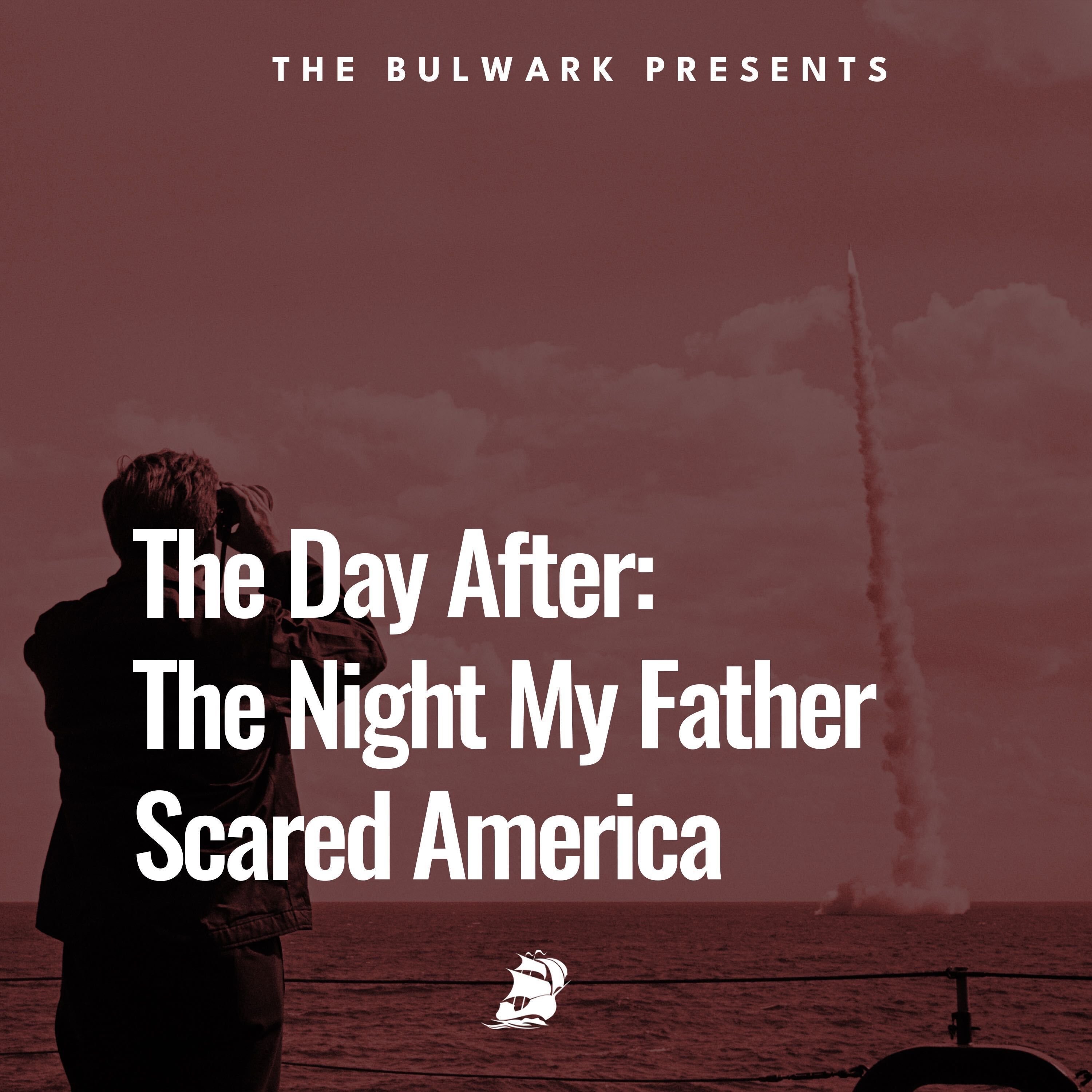
The Day After: The Night My Father Scared America
show notes:
A.B.'s article from November
Press play and read along
Transcript
Speaker 1
is Martha Stewart from the Martha Stewart Podcast. Hi, darlings.
I have a little seasonal secret to share. It's the new Kahua Duncan Caramel Swirl.
Speaker 1
Kahlua, the beloved coffee liqueur, and Duncan, the beloved coffee destination, paired up to create a treat that is perfect for the holidays. So, go ahead, treat yourself.
Cheers, my dears.
Speaker 2
Must be 21 or older to purchase. Drink responsibly.
Kahlua Caramel Swirl Cream Liqueur, 16% Alcohol by volume, 32 proof. Copyright 2025 imported by the Kahlua Company, New York, New York.
Speaker 2 Duncan trademarks owned by DDIP Holder LLC used under license. Copyright 2025 DDIP holder LLC.
Speaker 3 Get ready for Malice, a twisted new drama starring Jack Whitehall, David DeCovney, and Carice Van Houghton. Jack Whitehall plays Adam, a charming manny infiltrates the wealthy Tanner family.
Speaker 3 with a hidden motive to destroy them. This edge-of-your-seat revenge thriller unravels a deliciously dark mystery in a world full of wealth, secrets, and betrayal.
Speaker 3 Malice will constantly keep you on your toes. Why is Adam after the Tanner family? What lengths will he go to? One thing's for sure, the past never stays buried, so keep your enemies close.
Speaker 3 Watch Malice, all episodes now streaming exclusively on Prime Video.
Speaker 4 I'm A.B. Stoddard, columnist at the Bulwark.
Speaker 4 Americans used to live in fear of an imminent nuclear war.
Speaker 4 Many families had bomb shelters, and the word fallout was part of our vocabulary.
Speaker 4 But in 1983, my dad helped change the course of history with a television movie about a nuclear attack on the United States.
Speaker 4 This is the day after the night my father scared America, presented by the Bulwark podcast.
Speaker 6 Like a test, sort of.
Speaker 7 Like a warning?
Speaker 5 They're on their way to Russia.
Speaker 5 They take about thirty minutes to reach their target.
Speaker 5 So do theirs.
Speaker 8 Right?
Speaker 9
Missile warning, this is me, all. Confidence is high.
I repeat. confidence is high.
Speaker 9 Roger, we've got 32 targets in track and 10 impacting parts.
Speaker 9 I want to confirm: is this an exercise?
Speaker 9 Roger, copy. This is not an exercise.
Speaker 8
Roger, understand. Major Reinhardt, we have a massive attack against the U.S.
mission at this time. ICPMs.
Numerous ICPMs.
Speaker 8 Roger, understand. Over 300 missiles inbound now.
Speaker 4 My father had a story to tell that no one wanted to hear. He was repeatedly warned not to, even by the White House.
Speaker 4 But he wouldn't retreat until he had dragged President Reagan and the whole country through the simulation of nuclear war.
Speaker 4 40 years ago, 100 million viewers out of roughly 234 million Americans tuned into The Day After on ABC, making it the most watched movie in television history.
Speaker 4 The Nielsen rating showed that 62% of TVs in use on the night of Sunday, November 20, 1983, were tuned into the movie, and nearly every American had heard about it.
Speaker 4 The day after was inescapable.
Speaker 4 There was a loud, long run-up to the broadcast with advanced screenings, bootleg copies, or what was referred to back then as pirated cassettes, as well as abundant publicity and panic.
Speaker 4 Agonizing debates preceded the film's airing, which hung in the balance until the final hours, as pressure accumulated from the Reagan administration, the conservative right, and multiple departments within ABC itself.
Speaker 4 Psychiatrists warned the film would produce a suicide surge.
Speaker 4 Schools across the country braced for the provocation, and while some assigned viewing, most cautioned parents and students.
Speaker 4 In promoting the movie, ABC warned of the coming horror, set up a toll-free phone line for counseling, and advised that children under the age of 12 should not watch the film.
Speaker 4 The prospect of nuclear war was very real in the public mind in 1983.
Speaker 4 A Gallup poll conducted just as the movie came out found that 40% of Americans believed a nuclear war was likely in the next decade, and 69% of Americans believed they had a poor chance of surviving such a war.
Speaker 4 Nearly half of the respondents, 47%,
Speaker 4 felt the Reagan administration had brought the country closer to war.
Speaker 4 The idea for the day after came from my father, Brandon Stoddard, who was then president of ABC Motion Pictures. He wanted Americans, not politicians, to grapple with what nuclear war would mean.
Speaker 4 And he felt, quote, fear had really paralyzed people. So the movie was meant to force the issue.
Speaker 4 The intent of the day after was to bring this forward, make them talk about it, make them think about it. and decide what they were going to do about it, he said years later in an interview.
Speaker 4 The day after ignited ignited a political firestorm long before it saw the light of day.
Speaker 4 One week before the movie aired, my father argued in a 60 Minutes interview that the movie took no political position.
Speaker 7 I'll say again and again and again that it's not.
Speaker 10 It was never intended to be and it isn't.
Speaker 7 It is a movie that says
Speaker 7 nuclear war is horrible.
Speaker 4 Moral Majority Leader Jerry Falwell actually agreed with that in his interview on the same 60 Minutes segment.
Speaker 10
I sat there and I was moved. No one can watch flesh peeling off human beings, millions of people destroyed, if they're human, without being wiped out themselves.
I came out drained.
Speaker 4 But he accused ABC of broadcasting propaganda.
Speaker 10 ABC has, in essence,
Speaker 10 shut down the debate.
Speaker 10
They've said, this is the way it is. Deterrences fail.
The U.S. is going to cause World War III.
The debate should be closed and we should disarm.
Speaker 7 I don't like that.
Speaker 4 Senator Ed Markey, who was then a congressman and a nuclear freeze advocate, told 60 Minutes he was grateful to ABC.
Speaker 10 This movie will help to make it more possible for us to move the political process.
Speaker 4 Markey also said the day after, quote, put the lie to the whole notion of limited nuclear war and that people would never again think of fallout shelters as a way of protecting themselves in a nuclear war.
Speaker 4 The Reagan administration feared the reaction from the public, as did did ABC, which was why pressure against the day after was building by the hour.
Speaker 4 My father recalled becoming physically sick and left largely to fight the battle alone.
Speaker 11 Just no one would talk to me. The management didn't talk to me.
Speaker 11
My staff didn't talk to me. I was totally isolated.
It was a very weird feeling.
Speaker 4 When 60 Minutes producer Henry Moses asked him if he was willing to air the film no matter what, My father said yes.
Speaker 10 If there was not a spot sold in this, would you go ahead and air?
Speaker 7 Absolutely.
Speaker 7 Absolutely. It's going to go in the air.
Speaker 10 Swallow the $7 million.
Speaker 4 It's going to go in the air.
Speaker 4 Several days later, the Washington Post reported on growing tension in the White House over the day after.
Speaker 4 The Post's White House correspondents wrote that officials were apprehensive that the two-hour broadcast could heighten fears about Reagan's hand on the nuclear trigger, if not answered by the administration.
Speaker 4 That day, November 18th, 1983, was quite a Friday for my dad.
Speaker 11
The White House had issued instructions to ABC to say we want the following edits. And they called me and the West Coast.
This is a Friday night before we are here on Sunday.
Speaker 11 And I said, tell them to fuck off. We're not touching the film.
Speaker 3 Get Ready for Malice, a twisted new drama starring Jack Whitehall, David DeCovney, and Carice Van Houten.
Speaker 3 Jack Whitehall plays Adam, a charming manny infiltrates the wealthy Tanner family with a hidden motive to destroy them.
Speaker 3 This edge-of-your-seat revenge thriller unravels a deliciously dark mystery in a world full of wealth, secrets, and betrayal. Malice will constantly keep you on your toes.
Speaker 3 Why is Adam after the Tanner family? What lengths will he go to? One thing's for sure, the past never stays buried, so keep your enemies close.
Speaker 3 Watch Malice, all episodes now streaming exclusively on Prime Video.
Speaker 13 She is your once-in-a-lifetime. The quiet in your chaos, the warmth in your winter, the light you never saw coming.
Speaker 13 And deep within the earth, where time and fire do their slow, sacred work, a diamond is born. It shines like she does, brilliant, rare, unforgettable.
Speaker 13
When words fall short, let a diamond speak for you. Shreve and Company, Extraordinary Jewelry and Timepieces.
Stanford Shopping Center, Palo Alto.
Speaker 4 On Sunday, November 20, 1983, the film did indeed make air.
Speaker 4 The day after portrays calm daily life in the Midwest during a buildup of tension between the United States and the Soviet Union.
Speaker 4 And then, one afternoon, a Soviet intercontinental ballistic missile striking Kansas City, Missouri at 3:38 p.m. Central Time.
Speaker 7 I hope so.
Speaker 10 But first, we got to get some things into the cellar.
Speaker 10 I think there's a tornado coming.
Speaker 14 Daddy, a man on the radio said there might be a war. He's saying how we should unplug all our radio and TV and stuff.
Speaker 14 There's not going to be a war, is there?
Speaker 8 Third, we need access to the keys and the authentication documents at this time.
Speaker 8 Yes, sir.
Speaker 7 Adam Baker's now.
Speaker 7 Can I get a reading please go ahead and talk about it?
Speaker 4 Then in the days following, zombified survivors in Lawrence, Kansas with radiation poisoning attempt to put off the inevitable.
Speaker 6 You can't see it.
Speaker 6 You can't feel it.
Speaker 6 And you can't taste it.
Speaker 6 But it's here.
Speaker 6 Right now.
Speaker 6 All around us.
Speaker 6 It's going through you like an x-ray
Speaker 4 right into your cells.
Speaker 6 What do you think killed all these animals?
Speaker 4 All of it was designed and produced to be as realistic as possible. The Day After intentionally never makes clear which nation launched the first strike.
Speaker 4 It closes with a note that reads, The catastrophic events you have just witnessed are, in all likelihood, less severe.
Speaker 4 than the destruction that would actually occur in the event of a full nuclear strike on the United States.
Speaker 4 It is hoped that the images of this film will inspire the nations of this earth, their peoples, and leaders, to find the means to avert the fateful day.
Speaker 4 Because no corporation wanted to advertise during the portrayal of bombings and death and painful fallout, the last 45 minutes of the movie ran without commercials.
Speaker 4 The day after left millions of Americans completely terrified. For many, the visceral fear the film's images inspired would visit their nightmares for years.
Speaker 4 Immediately after the end of the movie, ABC broadcast a special version of its occasional program, Viewpoint, a panel discussion the White House and ABC had agreed would provide some necessary discussion and context.
Speaker 4 in the aftermath of the most traumatic television show in history.
Speaker 4 The live program kicked off with remarks by Secretary of State George Schultz, who was dispatched to make the case that the Reagan administration's policy of balance and deterrence was also focused on reductions in nuclear weapons.
Speaker 4 After Schultz came the panel, Carl Sagan, William F. Buckley Jr., Brent Scowcroft, Elie Wiesel, Henry Kissinger, and Robert McNamara.
Speaker 4 It was moderated by ABC's Ted Koppel, who insisted on a discussion and not a debate, and whose request was respected by his guests.
Speaker 4 The Viewpoint special is well worth the time to see a dignified and substantive conversation devoid of partisanship.
Speaker 4 Instead of the movie being a one-sided political statement that really defames the president's peace through strength initiative, as Jerry Falwell had said, Schultz said the day after should make Americans more supportive of Reagan's arms reduction efforts.
Speaker 4 Mr.
Speaker 15 Secretary, let me focus for a couple of minutes at least before we go to our panel here on the movie, which became, in a sense, much more than a movie. It's become a national event.
Speaker 15 And your presence here this evening is, I think, some testimony to that. Is the movie going to be useful?
Speaker 15 Well, the movie certainly dramatizes the unacceptability of nuclear warfare.
Speaker 15 And from my standpoint, it says to those who have criticized the president for seeking reductions that really that's the sensible course to take.
Speaker 15 And what we should be doing is rallying around and supporting, as I think people, by and large, more and more are,
Speaker 15 the idea that we should be trying to reduce the numbers of these weapons.
Speaker 4 The critics on the panel talked around the forceful impact of the film and the glaring lack of any solution.
Speaker 4 Kissinger, a former Secretary of State, dismissed the movie as indulgent and warned that the challenge of the United States, quote, requires that we do not scare ourselves to death because if the Soviet Union gets the idea that the United States has morally disarmed itself and psychologically disarmed itself, then the precise consequences we are describing here will happen.
Speaker 4 Kissinger thought the day after was gratuitous, basically pointless.
Speaker 4 Because the film didn't weigh in on policy, he said it was essentially rehashing what had long been established, just the grisly reality of nuclear war.
Speaker 4 Listen here,
Speaker 4 as I think he makes the movie's point.
Speaker 15 I think that this film presents a very simple-minded notion of the nuclear problem.
Speaker 15 And
Speaker 15 it deals with the most obvious question that a general nuclear war aimed at cities is a disaster and a catastrophe. I wrote a book on this subject 30 years ago when the notion of general nuclear war
Speaker 15 first arose.
Speaker 15 The problem of our period, the problem we have to grapple with is how to avoid such a war, how to preserve freedom while seeking to avoid such a war.
Speaker 15 how to establish, how to create a military establishment that reduces the dangers of such a war, what arms control policies are
Speaker 15 compatible
Speaker 15 with this policy, how we handle crises, those are serious questions. To engage in
Speaker 15 an orgy of
Speaker 15 demonstrating how terrible the casualties of a nuclear war are and translating into pictures the statistics that have been known for three decades and then to have Mr.
Speaker 15 Sagan say it's even worse than this,
Speaker 15 I I would say,
Speaker 15 what are we to do about this?
Speaker 15 Are we supposed to make policy by scaring ourselves to death or is somebody going to make some proposals of where we are supposed to go?
Speaker 15
And if people don't make that, then I do not believe we are making any contribution. That's my objection to this film.
It took this most simple-minded problem that everybody will agree upon.
Speaker 15 There's nobody in this room who disagrees with the fact that this must not happen. It's how to avoid it it that we should be discussing.
Speaker 4
Dr. Kissinger.
Of course the movie was prompting that very discussion. McNamara, a former Secretary of Defense, noted that
Speaker 4 and disagreed with Kissinger.
Speaker 15 I totally disagree with those who say it's
Speaker 15
a disservice to the nation to show the film. Not at all.
It's stimulating discussion on exactly the issue we ought to be discussing. There is a million times the Hiroshima destruction power out there.
Speaker 15 We must ensure it not be used.
Speaker 3 Get ready for Malice, a twisted new drama starring Jack Whitehall, David DeCovney, and Carice Van Houten.
Speaker 3 Jack Whitehall plays Adam, a charming manny infiltrates the wealthy Tanner family with a hidden motive to destroy them.
Speaker 3 This edge-of-your-seat revenge thriller unravels a deliciously dark mystery in a world full of wealth, secrets, and betrayal. Malice will constantly keep you on your toes.
Speaker 3 Why is Adam after the Tanner family? What lengths will he go to? One thing's for sure, the past never stays buried, so keep your enemies close.
Speaker 3 Watch Malice, all episodes now streaming exclusively on Prime Video.
Speaker 13 She is your once-in-a-lifetime. The quiet in your chaos, the warmth in your winter, the light you never saw coming.
Speaker 13 And deep within the earth, where time and fire do their slow, sacred work, a diamond is born. It It shines like she does, brilliant, rare, unforgettable.
Speaker 13 When words fall short, let a diamond speak for you. Shreeve and Company, Extraordinary Jewelry and Timepieces, Stanford Shopping Center, Palo Alto.
Speaker 4 Reagan was no doubt watching Viewpoint that night. but he had not watched the day after live with the rest of the nation.
Speaker 4 The president screened the day after with Nancy Reagan at Camp David on Columbus Day weekend, more than a month before it aired. He wrote in his diary how it profoundly affected him.
Speaker 4
It has powerfully done, all $7 million worth. It's very effective and left me greatly depressed.
Whether it will be of help to the anti-nukes or not, I can't say.
Speaker 4 My own reaction was one of our having to do all we can to have a deterrent and to see there is never a nuclear war.
Speaker 4 Ronald Reagan was, of course, a man of the movies himself.
Speaker 4 He took the movies seriously in terms of both politics and policy. And in 1983, his national security policy kept strangely intersecting with movies.
Speaker 4 First, the missile defense program he announced in a March 1983 speech was instantly mocked with the nickname Star Wars after the movie.
Speaker 4 In June 1983, Reagan screened War Games, in which a nuclear war is barely averted, at Camp David on the same weekend that it opened.
Speaker 4 After watching it, he asked his top national security officials how realistic the computer hacking scenario it depicted actually was.
Speaker 4 The chairman of the Joint Chiefs of Staff got back to him a few days later with a disturbing reply:
Speaker 4 Mr. President, the problem is much worse than you think.
Speaker 4 Reagan would acknowledge years later in his autobiography that the day after put him on the path to cooperation with Mikhail Gorbachev that resulted in them signing the Intermediate Range and Nuclear Forces Treaty several years later.
Speaker 4 The Day After director Nicholas Meyer, who is now executive producing a documentary based on the book Doomsday Machine, Confessions of a Nuclear War Planner by the late Daniel Ellsberg summed up the accomplishment of the day after this way.
Speaker 4 I did something more than foil Ronald Reagan's re-election bid. I changed his mind.
Speaker 4
My father and Meyer worked in an age of television that doesn't exist anymore. One in which TV could still unite the culture and sometimes even enlighten it.
That era feels terribly remote.
Speaker 4 In 2023, we don't know what could unite us again.
Speaker 4 We failed to come together in a global pandemic in 2020.
Speaker 4 And not even a year later, the United States would experience an attack on our government, an attempt to steal an election by our own president and not collectively condemn it.
Speaker 4 The willingness to whitewash January 6th, to refuse to draw that line, was a betrayal that 1983 America could not fathom.
Speaker 4 Nine months later, in the shadow of the insurrection, we honored the 20th anniversary of the 9-11 attacks, aware that the unity we saw two decades ago is not something most of us will see again in our lifetimes.
Speaker 4 We will likely never again come together to watch a television show or movie in the way we did the day after.
Speaker 4 But no urgent matter creates cohesion. Our two sides evaluate every political, cultural, and even scientific occurrence through the prism of tribal exigencies.
Speaker 4 Everything is an occasion for division, and no matter what befalls us, One side will always declare it's the fault of a political enemy or that it simply doesn't matter.
Speaker 4 And of course the nuclear threat remains.
Speaker 4 Today, many more nations are armed with nuclear weapons.
Speaker 4 We face the threat of loose nukes and the Russians, having failed to rapidly overtake Ukraine after invading in February 2022, have threatened to use them as a result of the severe degradation of their military capacity in that ongoing ground war.
Speaker 4 Koppel, who called the day after a national event, concluded the viewpoint panel by saying that in frightening the public so intensely,
Speaker 4 perhaps the movie was, quote, less than useful.
Speaker 4 But he also said this.
Speaker 15 But if the film has shed
Speaker 15 something of a national tendency toward complacence, then that is good. We need to talk about the problem.
Speaker 15 We need to examine not only as a nation, but as members of an endangered species means toward a solution.
Speaker 15 We cannot succeed in that goal if we are rigid and doctrinaire in our approach to those with whom we disagree. What is at stake this time is much more than simply winning an argument.
Speaker 4 Arguably the biggest threat to our national security in 2023 is our division and inability to cooperate.
Speaker 4 In the United States, we don't want to think we are already in our day after.
Speaker 4 But the assumption we can survive as a country while mired in our political wars is itself a dangerous complacency.
Speaker 4 This audio adaptation of an original article which was published in the Bulwark on November 21, 2023 was written by me and edited by Adam Kuyper. Audio production and sound design by Jason Brown.
Speaker 4 It was produced by Katie Cooper. Special thanks to Charlie Sykes and Catherine Lowe.
Speaker 12 The kind of fishing hackers do online is a lot like this kind of fishing. They cast their lines, bogus emails, fake websites, deceptive login screens, hoping you'll take the bait.
Speaker 12 With online fishing, there's no calm, no peace.
Speaker 12 Well, until now. With Cisco Duo, fishing season is over.
Speaker 12 Duo goes beyond multi-factor authentication, delivering end-to-end fishing resistance built on passwordless authentication, session theft protection, and help desk verification, all at half the cost of traditional solutions.
Speaker 12 So when fishers cast their lines, they come back with nothing at all. That's why attackers hate us and users love us.
Speaker 12
Learn more at duo.com. Cisco Duo.
Fishing season is over.
Speaker 1
This is Martha Stewart from the Martha Stewart podcast. Hi darlings.
I have a little seasonal secret to share. It's the new Kalua Duncan caramel Swirl.
Speaker 1
Kahlua, the beloved coffee liqueur, and Duncan, the beloved coffee destination, paired up to create a treat that is perfect for the holidays. So, go ahead, treat yourself.
Cheers, my dears.
Speaker 2
Must be 21 or older to purchase. Drink responsibly.
Kahua Caramel Swirl Cream Liqueur, 16% Alcohol by Volume 32 Proof. Copyright 2025, imported by the Kahlua Company, New York, New York.
Speaker 2 Dunkin' trademarks owned by DDIP Holder LLC, used under license. Copyright 2025 DDIP holder LLC.
Speaker 16 What does Zinn really give you?
Speaker 17 Not just smoke-free nicotine satisfaction, but also real freedom to do more of what you love, when and where you want to do it.
Speaker 16 Why bring Zen along for the ride? Because America's number one nicotine pouch opens up all the possibilities of right now.
Speaker 17 With Zinn, you don't just find freedom, you keep finding it. Find your Zen.
Speaker 16 Learn more at Zinn.com.
Speaker 17 Warning, this product contains nicotine.
Speaker 16 Nicotine is an addictive chemical.