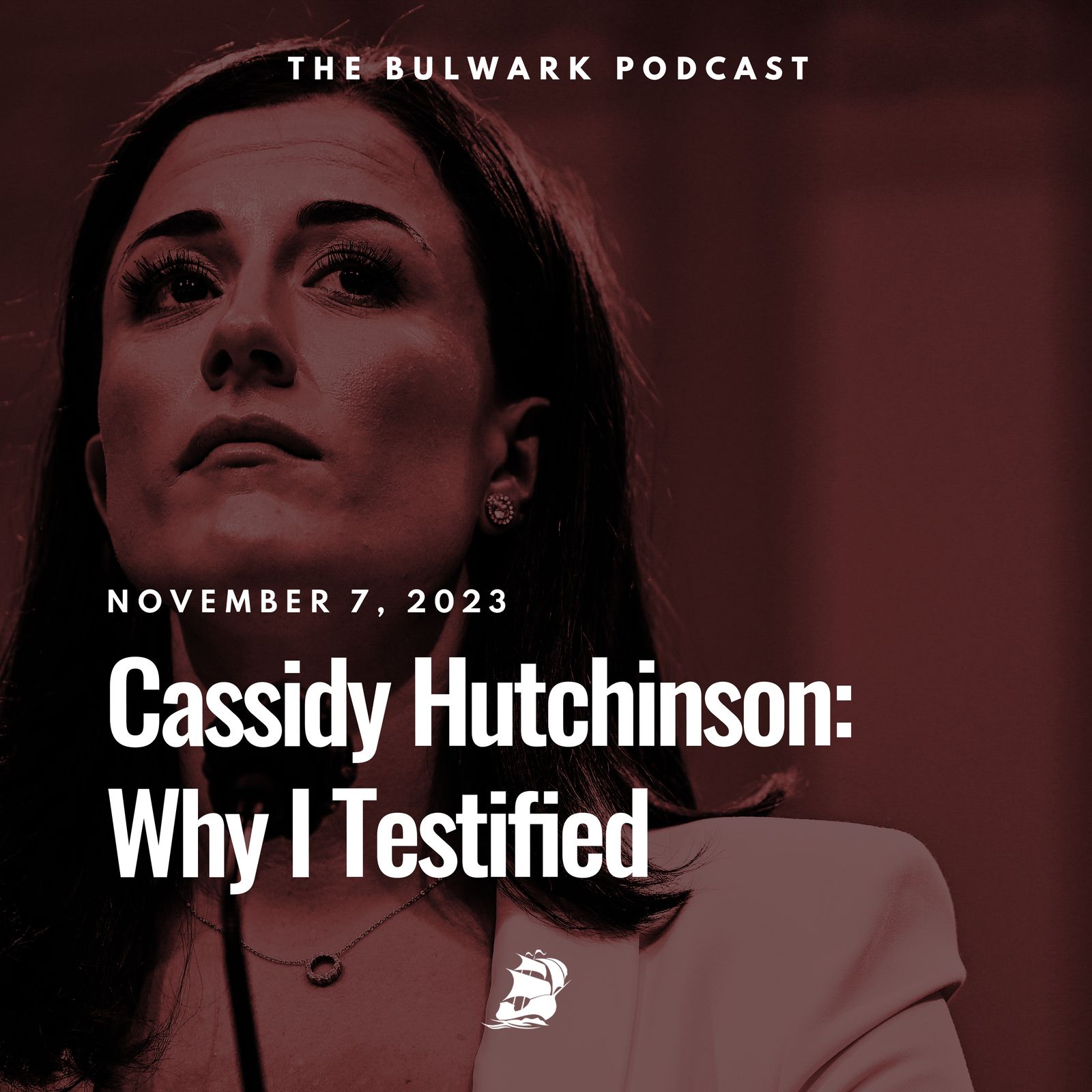
Cassidy Hutchinson: Why I Testified
show notes:
https://www.simonandschuster.com/books/Enough/Cassidy-Hutchinson/9781668028285
Press play and read along
Transcript
Speaker 1 Get ready for Malice, a twisted new drama starring Jack Whitehall, David DeCovny, and Carise Van Houten.
Speaker 1 Jack Whitehall plays Adam, a charming manny, infiltrates the wealthy Tanner family with a hidden motive to destroy them.
Speaker 1 This edge-of-your-seat revenge thriller unravels a deliciously dark mystery in a world full of wealth, secrets, and betrayal. Malice will constantly keep you on your toes.
Speaker 1 Why is Adam after the Tanner family? What lengths will he go to? One thing's for sure, the past never stays buried, so keep your enemies close.
Speaker 1 Watch Malice, all episodes now streaming exclusively on Prime Video.
Speaker 3 Even though severe cases can be rare, respiratory syncytial virus, or RSV, is still the leading cause of hospitalization in babies under one.
Speaker 3 RSV often begins like a cold or the flu, but can quickly spread to your baby's lungs. Ask your doctor about preventative antibodies for your baby this season and visit protectagainstrsv.com.
Speaker 3 The information presented is for general educational purposes only.
Speaker 4 Please ask your healthcare provider about any questions regarding your health or your baby's health.
Speaker 5 Welcome to the Bullworth Podcast. I'm Charlie Sykes.
Speaker 5 I think you all remember what happened in June 2022 when a little-known White House aide named Cassidy Hutchinson went before the January 6th Committee and delivered some of the most riveting and important testimony of that entire investigation.
Speaker 6 He looked at me and said something to the effect of, Cassidy, are you excited for the 6th? It's going to be a great day.
Speaker 6 I remember looking at him and saying, Rudy, could you explain what's happening on the 6th?
Speaker 6
And he had responded something to the effect of, we're going to the Capitol. It's going to be great.
The president's going to be there. He's going to look powerful.
He's going to be with the members.
Speaker 6
He's going to be with the senators. Talk to the chief about it.
Talk to the chief about it. He knows about it.
Speaker 7
And did you go back then up to the West Wing and tell Mr. Meadows about your conversation with Mr.
Giuliani?
Speaker 6
I did. After Mr.
Giuliani had left the campus that evening, I went back up to our office. And I found Mr.
Meadows in his office on the couch. He was scrolling through his phone.
Speaker 6 I remember leaning against the doorway and saying, I had an interesting conversation with Brudy. Mark, sounds like we're going to go to the Capitol.
Speaker 6 He didn't look up from his phone and said something to the effect of, there's a lot going on, Cass,
Speaker 6 but I don't know.
Speaker 6 Things might get real, real bad on January 6th.
Speaker 5 And things did get real, real bad on January 6th. Joining me on the podcast today, Cassidy Hutchinson, who is out with a new best-selling memoir, Enough.
Speaker 5 First of all, thanks for coming on the podcast, Cassidy.
Speaker 8 Thank you for having me, Charlie. I'm happy to be here.
Speaker 5 So the basic question is that with all of the president's men, all of these grown-ass presidential aides,
Speaker 5 why was it you? Why was it a 26-year-old aide who made the decision to come out and tell that story?
Speaker 5 to give that first-hand account of being in the room, the lead up to January 6th, what happened on January 6th. So why do you think it was you?
Speaker 5 Why didn't the guys step up and do what you did, Cassidy?
Speaker 8 You know, this question, I've thought a lot about this, and
Speaker 8 it never gets easier to answer because I don't like to speculate about other people's mindsets or intentions.
Speaker 8 And, you know, I would also like to give credit to the Department of Justice, who has an ongoing investigation. And I do think a lot of investigation should go on behind closed doors.
Speaker 8 I think back to where we were at in the summer of 2022.
Speaker 8 And in my opinion there has not been a massive mentality shift but there has been a slight mentality shift away from this cult like Trumpism at least I guess in my experience but maybe it's because I'm on the other side of it now.
Speaker 8 In terms of why it was me,
Speaker 8 I can only answer for myself and I know that I've reached a moral crossroads in April of 2022 where I felt that not only did I have the moral obligation to come forward with more information and to be more forthcoming with the committee, but I had betrayed the oath that I swore to protect and defend our country and our Constitution.
Speaker 8 And I saw a slight window of time where I could potentially correct course and I wasn't doing it in any way to try to have a revisionist history.
Speaker 8 I think in the book it's abundantly clear that I try not to, you know, I take full accountability for all of my missteps and the actions that I wish I had changed.
Speaker 8 But I do hope that by me coming forward, it either helped inspire or give others the courage to come forward, or it helped at least open up a roadmap.
Speaker 8 Because I came forward because I thought that it was important to hold these people also under the court of public opinion.
Speaker 5
Okay, so let's go back to that, that April. That April was that moment when you had that moment of moral clarity.
Let's walk through that.
Speaker 5 You had been a loyal White House aide, and loyalty is a very important value for you. You watched what happened on January 6th.
Speaker 5 So tell me what happened in April where you decided that you were going to take this radical path of coming out and telling the truth.
Speaker 8 I wish that we didn't have to say it was a radical path. And I think this is a total sidebar.
Speaker 8 You know, this is also, I guess, relating to the question you asked before, because in my opinion, this shouldn't be seen as some radical path.
Speaker 8 We're just in this unfortunate state of our democracy and in our history where speaking the truth about things that actually happened when you swore an oath to do so is seen as some radical transition.
Speaker 8 You know, And I also say, like, it shouldn't have been me sitting there that day. It should have been a lot of other people that have more information than I do.
Speaker 8 But anyway, sorry, I said that you said radical path and it just made me think of that because it's just sad to me.
Speaker 5 Fair point.
Speaker 8 But
Speaker 8 so April of 2022, I was working with Trump-affiliated counsel at that point. I had underwent two recorded depositions with the committee in February and March.
Speaker 8 And after each deposition, you know, I went into my depositions with the committee. I'd searched for my own counsel that I could pay for or afford on my own or that would put me on a payment plan.
Speaker 8 And I didn't have any luck with that. So I turned to Trump World for counseling.
Speaker 5
You're not from a wealthy family. This is very, very expensive, right? And so, right.
Yet a Trump paid for attorney.
Speaker 8 I think that's also often overlooked and something that is deserving of more attention is not necessarily the Trump world issues are large and they're prevalent, especially going into this next election year, but also just the general cost of all of this to bring perspective perspective to the American people about that.
Speaker 8 But after each deposition, I went into them wanting to be forthcoming, but I didn't feel empowered to be forthcoming.
Speaker 8 And I tried to bury the guilt that I felt after each deposition until I reached the point in April of 2022 when there were a few pages of my transcripts that were publicized.
Speaker 8 And I remember reading through the transcripts, and it was sort of like this out-of-body experience for me, but also just this like
Speaker 8 really dark moment in my life where I had
Speaker 8 tangible evidence in front of me that I couldn't, I could no longer live in denial. I could no longer live in the state of denial.
Speaker 8 Not only that I had betrayed my country and the oath that I swore, but I had betrayed the person that I thought I wanted to become when I entered public service.
Speaker 5 How had you done that? What was the betrayal?
Speaker 8 In my opinion, the betrayal happened when I lost sight of the fact that I went into public service to serve the principal, the PLE principal.
Speaker 8 And I grew to have a very strong loyalty to Donald Trump and to Mark Meadows.
Speaker 8 You know, again, it's not necessarily a negative thing,
Speaker 8
loyalty, but it's when you begin to prioritize your loyalties to an individual over the greater cause. And I did do that.
And I had lost sight of who I was, and I had lost myself for a while.
Speaker 8 And I don't look back on that or say that with
Speaker 8 any ounce of pride. It's a very shameful thing for me to admit, but I was complicit in a lot of this.
Speaker 5 So did you tell your Trump paid-for lawyer that you wanted to be more forthcoming? What were they telling you to do? And how did you end up getting a new lawyer?
Speaker 5 Because this obviously was one of the crucial turning points in this whole story.
Speaker 8 Yeah, so I, when I received my Trump world counsel, we met one time before my first deposition, and I went in fairly forthcoming to him about how I wanted to conduct myself in the interview.
Speaker 8 But I also felt sort of the split between two worlds. And I, you know, I had been in the Trump world.
Speaker 8 I knew the strings, invisible strings, I guess I should say, that come attached with accepting counsel from Donald Trump.
Speaker 8 And that was something that I wanted to avoid, but I also knew that I didn't want to have a target on my back.
Speaker 8 So I wasn't completely explicit about everything, but I was forthcoming about things that I knew that I thought I should share, tactics that I wanted to learn. I had never done a deposition before.
Speaker 8 It was my first time ever needing an attorney too.
Speaker 8 So I had been fairly forthcoming with my counsel, and I was encouraged to say as little as possible. And
Speaker 8 I go into a lot of detail about it both in my interviews with the committee, which are all in the public record, specifically the September ones addressed this issue.
Speaker 8 There's over 900 pages in case anybody ever is interested, but I also go into detail about it in the book.
Speaker 8
So fast forward to April. I have this moral crisis or this sense of clarity where I'm trying to reach.
A few things happen.
Speaker 8 I reached out to a member of Congress that did not serve on the January 6th committee and is a Republican, and they encouraged me to go look in the mirror and tell if I could pass the mirror test for the rest of my life, knowing how I had conducted myself and what I had wanted to share.
Speaker 8 I decided no. So I reached out to my best friend Alyssa Farrakh Griffin and I also actually read The Last of the President's Men by Bob Woodward, which featured Alex Butterfield.
Speaker 8 Went through one more interview with the committee, and they were still interested in talking to me more throughout the month of June.
Speaker 8 So at that point, I realized that I needed to make a break with my Trump-affiliated council and find my own.
Speaker 5 So let's talk about what happened in June and your conversations with Liz Cheney and others. You decided that you were going to testify in public.
Speaker 5 You knew that that was going to be a life-changing event.
Speaker 5 So how did Liz Cheney or whoever it was talk you into going out in public, being on camera, being in front of the entire nation and saying these things?
Speaker 8 I don't want to say anybody talked me into it.
Speaker 8 I would say people opened my eyes to the gravity of the moment that we were facing and how important it was to have my voice and my physical presence testify to all of this live.
Speaker 8 I didn't want to testify live up until the moment I walked out. I did not want to have to do it, but I recognized that there was an importance to it.
Speaker 8 Liz Cheney has been an absolute, I mean, she's an incredible force. She is an American patriot.
Speaker 8 I think she, no matter what your political affiliation is, she's somebody that we should all strive to be like. She has the heart of a founding father, and she cares about this nation.
Speaker 8 And I think to see somebody like Liz Cheney, who is more conservative than a lot of current members of Congress,
Speaker 8 sit on the dais next to Democrats with Adam Kinzinger, who's also an American patriot. And to have have that image is so striking in this day and age.
Speaker 8 And I've been profoundly inspired by Liz throughout this journey, although this sort of diminishes and makes it sound like it's a bachelor.
Speaker 8 So after I retained my new counsel, I went in for another interview. And at that point, I felt that I was welcomed or I was being welcomed more back onto the right side of history.
Speaker 8 And between Liz and my lawyers and the committee members and the committee staff, after meeting with them and discussing the prospect of a live hearing, I realized that it was important not only for the American people, but for women and for little girls to see that
Speaker 8 one person is enough to create change in this country. And it only has to start with one person.
Speaker 8 But that it's also important to have somebody that is willing to speak truth to power.
Speaker 5
So let's talk about the timing, which you discuss. The timing of this was very, very unexpected at the time.
It was a special session. There was concern that you might be pressured, threatened.
Speaker 8 Yeah, and I would refer to the committee on some of those items too, or members of the committee that had served or staffers, just because they had more intel than I was receiving. At some points,
Speaker 8 I had to focus on certain things I didn't necessarily want to know about the prospective threats that they were gathering. But, no, I knew the day that I decided to formally switch counsel that
Speaker 8 no matter what I did going forward, I'd be subjected to the vitriolic threats from Trump World and
Speaker 8 the character bashing and the character assassinations. I was in that world.
Speaker 5 You knew all that was coming, right? You knew all that was coming.
Speaker 8
I knew it was coming. I couldn't, I would be doing myself a massive disservice.
I didn't admit that to myself. So I knew it was coming.
Speaker 8 I had prepared for it as much as I possibly could, but I also constantly found myself thinking about the fact that I had once been part of that process and I know what was going to go on inside Trump World in those days following the hearing.
Speaker 8 And that was something that I had made peace with.
Speaker 8 It's different, though, when you're on the other side of it and actually experiencing it because I, you know, I didn't want to fuel any of what they're saying because I spoke the truth.
Speaker 8 And anybody that has other things to say should go under oath and testify themselves. But it was a very jarring experience to experience it firsthand.
Speaker 1 Get Ready for Malice, a twisted new drama starring Jack Whitehall, David DeCovney, and Carice Van Houten.
Speaker 1 Jack Whitehall plays Adam, a charming Manny infiltrates the wealthy Tanner family with a hidden motive to destroy them.
Speaker 1 This edge-of-your-seat revenge thriller unravels a deliciously dark mystery in a world full of wealth, secrets, and betrayal. Malice will constantly keep you on your toes.
Speaker 1 Why is Adam after the Tanner family? What lengths will he go to? One thing's for sure, the past never stays buried, so keep your enemies close.
Speaker 1 Watch Malice, all episodes now streaming exclusively on Prime Video.
Speaker 9 Even when you're playing music,
Speaker 9 you're always listening to your baby, especially when RSV is on your mind.
Speaker 9 Baphortis, Nursevimab ALIP, is the first and only long-acting preventative antibody that gives babies the RSV antibodies they lack.
Speaker 9 Baphortis is a prescription medicine used to help prevent serious lung disease caused by RSV or respiratory syncytial virus in babies under age one born during or entering their first RSV season and children up to 24 months who remain at risk of severe RSV disease through their second RSV season.
Speaker 9 Your baby shouldn't receive Baportis if they have a history of serious allergic reactions to Bifortis, nursevimab ALIP, or any of its ingredients.
Speaker 9 Tell your baby's doctor about any medicines they're taking and all their medical conditions, including bleeding or bruising problems. Serious allergic reactions have happened.
Speaker 9 Get medical help right away if your child has any of the following signs or symptoms of a serious allergic reaction, such as swelling of the face, mouth, or tongue, difficulty swallowing or breathing, unresponsiveness, bluish color of skin, lips, or underfingernails, muscle weakness, severe rash, hives, or itching.
Speaker 9 Most common side effects include rash and pain, swelling, or hardness at their injection site. Individual results may vary.
Speaker 2 Ask your baby's doctor about Bayfortis.
Speaker 9 Visit Bayfortis.com or call 1-855-BEFORTIS.
Speaker 5 One of the things I was hoping for from your book, which you did deliver, was the answer to the question I think a lot of people had after your testimony, which was, who is this person?
Speaker 5 Where did she come from? How did she end up working for Donald Trump? How does a 26-year-old young woman have this kind of
Speaker 5 willingness to do what she has done and the role that you played? And you do describe this. So, you know, you talk a lot in the book about your family and what inspired you.
Speaker 5 And I remember I was watching you.
Speaker 5 I was in a hotel room in Colorado watching this thinking, okay, I want to know more about her parents, how she got to be at this particular point. You were kind of an old soul, weren't you?
Speaker 5 You got interested in politics very young. You described going to Washington, D.C.
Speaker 5 in second grade and deciding that that's where you want to be. So, I mean, this goes back a long way.
Speaker 5 Your story, the trajectory of Cassidy Hutchinson into the White House began pretty young, didn't it?
Speaker 8
It sort of did. And I look back on that now too, and with the hindsight that I have.
And I think about that first D.C.
Speaker 8
trip, and I knew fairly, I moved around a lot too as a child up until I graduated high school. And that was just something that was normal to me.
I grew up in a working-class family.
Speaker 8
My parents divorced when I was 10. My mom had primary custody of both my brother and I, but they did have a messy divorce.
And I was the intermediary between my parents.
Speaker 5 It sounds like that's where you got some of your diplomatic skills.
Speaker 8 Well, I'm trying to address your question in pieces here.
Speaker 8 But
Speaker 8 my father, my biological father, I don't remember him ever being anything but completely hostile towards the government. So when I went to D.C.
Speaker 8 that first time, we went and visited my aunt and uncle, who had just moved to D.C.
Speaker 8
And he's in the military, and he was, my uncle is a force in my life and has been one of the biggest inspirations. Yeah, my uncle Joe.
Yeah, it was that first trip.
Speaker 8 And I look back on it now and I sort of chalk it up to almost probably a sense of premonition. But I remember crying when I left DC that trip because I didn't want to go back to Jersey.
Speaker 8 I wanted to be in DC. At that point, I didn't really understand why, or, you know, maybe it was just because my aunt and uncle were there, but I felt this inexplicable draw to Washington.
Speaker 8 And then as I grew older and developed this almost a sense of calling towards public service and then trying to learn how to navigate that in a family that was openly hostile toward the government, and it was really the 2012 election, I think, that sort of solidified for me that I was going to enter.
Speaker 8 public service in the realm of politics. It just sort of is what felt the most natural at that time.
Speaker 5 One other anecdote you talked about was, it sounds like you were like, when you were about 10 years old, or you were in fourth grade, you remember sitting with your dad, and your dad was, your biological father, was watching Donald Trump on The Apprentice.
Speaker 5 Apparently, he was a big fan of the show.
Speaker 5 And you actually had an exchange that you wished, I don't want to put words in your mouth, that you wish he would spend as much time with you as he did watching The Apprentice.
Speaker 5 So that was your introduction to Donald Trump and maybe the role that Donald Trump had in people's lives?
Speaker 8 Potentially. And I intentionally included that scene to, one, to shed light on how I grew up and where I came from.
Speaker 8 But two, you know, I think that there is an element of my story that
Speaker 8 if these people were to read it, like they will be able to find something in it. And I think
Speaker 8 for me,
Speaker 8 and I think about all of this, I think about my family. And I think, you know, I did vote for Donald Trump in 2016 and I did see something in him where,
Speaker 8 you know, at first I voted for him in 2016 not thinking that he would win and then I went to my first Trump rally and I remember standing in the crowd and it's this incredible moment to look back on now but I'm standing in the crowd at my first Trump rally I supported him but very loosely and I was getting ready to have my first internship on Capitol Hill that summer and I'm about six rows behind the stage six to ten rows behind the stage and He walks out.
Speaker 8 You just have this electrifying feeling. And I remember looking around
Speaker 8 and most, if not all, the people who I was immediately surrounded by were people that I felt like I recognized, not because I knew them, but because I had grown up around people like them.
Speaker 8 It was a lot of working class people, a lot of people who
Speaker 8 looked very moved and looked like they actually saw something in Donald Trump. And they were like first-time voters, people that they felt that he actually represented them and their interests.
Speaker 8 And that's the moment for me that I really think that I was pulled into into the Donald Trump movement where I felt for the first time that electrifying and drawing, the draw of Donald Trump, where he was potentially there to represent people like my family.
Speaker 8 And I
Speaker 8 say that about my father too, because my father was a very and is a very hardworking man. And we do have a strained relationship, but I don't look back on anything with him as a negative.
Speaker 8 I think all of it was foundational to who I ended up becoming.
Speaker 5 But you were not a natural Trumpist. You were describing, you know, the 2012 campaign as being kind of a turning point.
Speaker 5
And you describe how, again, you're 14 or 15 and you're watching the Obama-Romney debates. And that's what got you interested in politics.
There was something about Mitt Romney that you liked.
Speaker 5 I mean, so in your formative years, you became a Romney Republican, which is the cardinal sin in Trump's world.
Speaker 8
I can't ever say that. No, but I, I mean, Mitt Romney was my hero through high school.
And I still think Mitt Romney is a hero. I never wavered from that.
Speaker 8 Although I did participate in the partisan gameship around it.
Speaker 5 Does Mitt Romney know you feel this way about him?
Speaker 8 I don't think he does, but I would really actually like the opportunity to meet him.
Speaker 8 I'll know if you'd say the same, but I wasn't the natural Trump supporter, but I think I was a natural fit in the administration. And that might be getting too deep for the limited time that we have.
Speaker 8 But I will say, just to touch on that really quickly, though,
Speaker 8
I didn't set out to work in the Trump administration intentionally. It's something that happened.
I used to say I was at the right place at the right time.
Speaker 8 Whether it was the right place at the wrong time or wrong place at the wrong time, I don't know. When I set out to work, I really wanted to work on Capitol Hill.
Speaker 8 And it was an incredible opportunity to work at the White House. And I'm very glad that I had that opportunity, but it wasn't something that I intentionally sought to have straight away.
Speaker 5 Obviously, this is the question that people have is, you know, that given the person that we saw in the testimony and since then in your book, how did you end up in this dysfunctional place working for someone like Donald Trump?
Speaker 5 And I'm going to leave out all of the adjectives that I would normally use here.
Speaker 5 On the other hand, I think that people do need to understand that, you know, being in Washington, D.C., having an opportunity to work at the White House,
Speaker 5 that's hard to turn down.
Speaker 8 Yes, and no. It would be very easy for me to turn down if there were an opportunity extended a second time, although there never would be, but hypothetically speaking.
Speaker 8 You know, and I think in writing this this book, I've been able to process a lot of
Speaker 8 what actually happened from 2016 through my testimony in this past year that I never would have thought about in this light. So, I'm very grateful for this time.
Speaker 8 Donald Trump showed us who he was, has shown us who he was throughout his entire life. He showed us who he was in 2015 and in 2016, leading up to the first election.
Speaker 8
Unfortunately, eyes like mine weren't opened to that. that.
And I did vote for him and I did work for him. I say all this because 2020 had a different election outcome.
Thank God.
Speaker 8 But we're looking down the barrel at potentially a second Trump term now. And I think that we need to spend a lot of time right now opening people's eyes.
Speaker 5 Well, I mean, one of the themes of this podcast is, you know, soul-crushing disillusionment, regrets, and, you know, possible redemption. So what was the moment? You're in the White House.
Speaker 5
You obviously got a great deal of responsibility because there was so much infighting between the various aids. You saw these folks.
You saw Rudy Giuliani. You saw Mark Meadows.
Speaker 5 Was there any moment where you're looking around and going, who are these guys?
Speaker 5 Why am I here? Was it December? Was it November? Was it during the campaign? When did the scales begin to fall, Cassidy?
Speaker 8 I would say the scales really began to fall after the end of the administration. Only then.
Speaker 8 I go back because there were a lot of moments, both during the campaign, more so in late December through January of 2021,
Speaker 8 where I had that awakening moment of, you know, this is wrong.
Speaker 8 These things shouldn't be happening. This is not normal.
Speaker 8 But when you're in that environment, and I'm not excusing, but when you're in that environment, the communications machine is so powerful and you're surrounded by people.
Speaker 8 If you deter from what they think, not that civil conversation isn't encouraged, but if you point things out like that, you're seen as a traitor, you're seen as disloyal.
Speaker 8 It's this very odd concept to sort of describe it, this warped mindset of
Speaker 8 convincing myself, you know, either don't think about it like this, don't think about the craziness, don't think about the dangers of all this, or it's not your role to think about it like this.
Speaker 8 You're here to do a job.
Speaker 8 I, especially the days leading up to January 6th, on January 6th, after January 6th, I'm careful to say that the skills had fallen because I think I really started to process a lot of this after the end of the administration, but I was very firm in the belief that before January 6th, that we were at fault for what was potentially going to happen.
Speaker 1 Get Ready for Malice, a twisted new drama starring Jack Whitehall, David DeCovney, and Carice Van Houten.
Speaker 1 Jack Whitehall plays Adam, a charming manny infiltrates the wealthy Tanner family with a hidden motive to to destroy them.
Speaker 1 This edge-of-your-seat revenge thriller unravels a deliciously dark mystery in a world full of wealth, secrets, and betrayal. Malice will constantly keep you on your toes.
Speaker 1 Why is Adam after the Tanner family? What lengths will he go to? One thing's for sure, the past never stays buried, so keep your enemies close.
Speaker 1 Watch Malice, all episodes now streaming exclusively on Prime Video.
Speaker 3 Even though severe cases can be rare, respiratory syncytial virus, or RSV, is still the leading cause of hospitalization in babies under one.
Speaker 3 RSV often begins like a cold or the flu, but can quickly spread to your baby's lungs. Ask your doctor about preventative antibodies for your baby this season and visit protectagainstrsv.com.
Speaker 3 The information presented is for general educational purposes only.
Speaker 4 Please ask your healthcare provider about any questions regarding your health or your baby's health.
Speaker 5 You described that December 18th, 2020 was the real turning point. You know, this was the day that crazy White House meeting with Michael Flynn, Sidney Powell, Patrick Byrne, the guy from Overstock.
Speaker 5 This is at one point in the meeting, you write that you heard Trump scream, I don't care what you do, just get it fucking done.
Speaker 5 And it was after that six-hour meeting that Trump tweeted out big protest in D.C. on January 6th, be there, be wild, everything happened.
Speaker 5
Okay, let's go up to January 6th because your account is really extraordinary. And again, you were there watching as the chaos unfolded.
So talk to me about that.
Speaker 5 When you realize that things were dangerous, when they were really running off the rails.
Speaker 8 Partially, it's difficult to pinpoint one moment. In the days leading up to January 6th, so in early January, I
Speaker 8
began... to become afraid of what could happen on the 6th.
And my mom actually had been reaching out to me a lot too. Like she didn't want me to go to work and I wasn't fully processing all of it.
Speaker 8 The morning of January 6th, I remember driving to work that day, and it just felt bleak and dark. And there was like, I had this sense that something bad was going to happen.
Speaker 8 So, as you know, as the day progresses and we progressively see things getting worse, you know, I felt that something very bad was going to happen.
Speaker 8 I think the first moment where that really hit me was when we learned that rioters had actually breached into the Capitol.
Speaker 5 I mean, you knew how vulnerable the congressmen would be,
Speaker 5
journalists might be. These rioters did not know who the people were.
They were chanting, hang Mike Pence. It was a dangerous situation.
Speaker 8
Yeah, precisely. And it wasn't just a dangerous situation because they had gotten into the Capitol.
It's exactly what you said.
Speaker 8 The president had sent them there using his violent rhetoric. He had drawn this crowd to Washington, D.C.
Speaker 8 They had overrun Capitol police and they had bludgeoned their way into the Capitol.
Speaker 8 And I, in that moment, I'm thinking about, like you said, the journalists, the members of Congress, the staffers, both career and political, that I know that work in that building and they're there for hopefully the right reasons.
Speaker 8 But it was also just an egregious assault on our democracy by the man who was sitting just steps down the hall from me, who wasn't doing anything to stop this.
Speaker 5 Well, let's talk about that because your testimony had some just dazzling moments where, you know, for example, when Trump was upset that the rally space wasn't full enough, and he said, you know,
Speaker 5
take the fucking mags away. They're not going to hurt me.
And take away the magnetometers that were screening for knives and guns.
Speaker 5 And then, of course, there was the most jaw-dropping part of your testimony. Can I just play this one little clip? Because it really captures how close to being completely out of control that day was.
Speaker 5 Let's play that.
Speaker 11 The president said something to the effect of, I'm the FM president, take me up to the Capitol now,
Speaker 11 to which Bobby responded, sir, we have to go back to the West Wing.
Speaker 11 The president reached up towards the front of the vehicle to grab at the steering wheel.
Speaker 8 Mr.
Speaker 11
Engel grabbed his arm, said, sir, you need to take your hand off the steering wheel. We're going back to the West Wing.
We're not going to the Capitol.
Speaker 11 Mr.
Speaker 1 Trump then used his free hand to lunge towards Bobby Angle.
Speaker 11 And when Mr. Renato had recounted this story to me, he had motioned towards his clavicles.
Speaker 5 Of course, you know, there was a lot of attempt to discredit that testimony.
Speaker 5 They tried to focus on all of that, but you were relying on people you had worked with who told you what you thought was the true story.
Speaker 8
Exactly. And I, you know, I never testified that I was there or knew it firsthand.
I simply recounted what had been recounted to me.
Speaker 8 There are people that were in the vehicle with him that day that could truthfully answer those questions. I think that what is important about that exchange too
Speaker 8
is really two things. One, specifically related to January 6th, is the fact that Donald Trump wanted to go to the Capitol.
For what reason, I don't know. I could speculate.
I don't know for certain.
Speaker 8 If he had gone to the Capitol that day,
Speaker 8 I would really think that things would have gotten a lot more out of hand. And he had been warned in the days prior to January 6th that he could not go to the Capitol.
Speaker 8 We did not have the security assets to do so with the crowd size that we were expecting.
Speaker 8 And the second thing that I think is important from that specific exchange, whether people testify and completely corroborate it under oath or they have their own stories, there is a lot of corroboration that he was very angry in.
Speaker 8 the presidential vehicle that day, that he had wanted to go to the Capitol.
Speaker 8 And there are a lot of scenes like that that have emerged from the Trump administration that speak to Donald Trump's character and his character and lack thereof.
Speaker 8 And he is a volatile, dangerous man who
Speaker 8 is willing to go to extreme lengths to achieve his end where he sees fit for himself.
Speaker 8 And I think the question we have to ask ourselves in this next year, and which you have done a phenomenal job and everybody at the board because I'm a phenomenal job at doing, and where I could see me hopefully being a positive contribution to this, is I have been on the inside.
Speaker 8 I've seen the dangers that he is capable of posing firsthand. I know the dangers that he continues to want to pose to the American people.
Speaker 8 And we really need to come together to educate people, not only about his policies, but about his character too, and the dangers of his character.
Speaker 5 I think that's the heart of the whole thing.
Speaker 5 But as you watch so many other Republicans who were there on January 6th, who understood that he was responsible for what happened on January 6th, as you watch them one by one find a way to rationalize it, to look the other way.
Speaker 5 Just give me your thoughts about all of this, that do you now have an an election denier who is the speaker.
Speaker 5 You work with people like Kevin McCarthy in the past who clearly understood, as you did, the role that Donald Trump played on January 6th, and yet are okay with it.
Speaker 5
Your book basically is a warning about, look, this is who this guy was. This is what another term would mean.
And yet, one after another, we are watching Republicans. get in line behind him.
Speaker 5 I mean, you know these people.
Speaker 5 Because one thing you were very consistent, I may have taken you a while to break and decide to testify, but you were very outspoken in the White House in the days after January 6th that Donald Trump was responsible for this.
Speaker 5 Almost every Republican seemed to understand that on January 7th, and yet here we are.
Speaker 8 Right. The Republican Party right now is completely devoid of actual leadership, and it's disappointing to see, but it's a symptom of this Trumpism that has taken over our country.
Speaker 8 I know I'm not telling you anything you don't know here, but in my opinion, most of the Republican Conference, the vast majority of the Republican Conference, has
Speaker 8 taken the route of appeasing Donald Trump and not, you know, they're the people that have the power potentially, or at least could be powerful voices in this atmosphere about how he is so dangerous, not only for the party, but for the country.
Speaker 8 And I think that's what kind of blows my mind the most out of all of this is even if you are a hard-right Republican, you still care about the country and Donald Trump is not the best person for this country by any means.
Speaker 8 I mean, he is frankly just completely undemocratic.
Speaker 8
But I don't want to go as far to say that they don't have time to course correct. They do.
I am a firm believer that everybody can. It takes a lot of work and it doesn't happen overnight.
Speaker 8 But I think moving forward, it's not only that we have to focus on making sure that Donald Trump's name is either not on the Republican ticket next summer or on the general election ticket next November, but making sure that we're actually talking to constituents of people that live in Republican-leaning districts or swing districts.
Speaker 8 Because change starts with a foundation and we need a strong foundation of people who actually care about the survival of our democracy and about our country.
Speaker 8 And right now we don't have that within the Republican Party.
Speaker 8 And we can't rely on the people that have been elected to serve in the House and some in the Senate, the Republicans that have been at least, to preserve our democracy.
Speaker 8 It's up to the people, and the people need to remember their power.
Speaker 5
And that's why your testimony and others should be so important because you're not a Liberal Democrat. You are not a rhino.
You were not even a never-Trumper originally.
Speaker 5 And I'm sure you've given a lot of thought to this.
Speaker 5 The extraordinary thing about the Trump presidency are the number of voices from inside the room, people who work with him, whether it's the Attorney General or the Secretary of State or the Secretary of Defense or his National Security Advisor or his own chief of staff, all of whom are warning about the dangers of a second Trump term.
Speaker 5
You were there in the room. You watched him.
You are saying, the American people, you know, there's something fundamental at stake here. And yet, so far, it hasn't seemed to move.
Speaker 5
I'm sorry to use the phrase, move the needle among Republican voters. And again, it's one thing for Democrats.
or people who have been Andy Trump all along.
Speaker 5
It's one thing for Jamie Raskin, you know, to rail about Donald Trump or Nancy Pelosi. But you folks were in the Trump administration.
You were in the Trump White House.
Speaker 5
And your testimony is very graphic. It's very powerful.
Why isn't it affecting the Republican primary race?
Speaker 8
Because I don't think my testimony alone is enough to change the outcome or change at least the people who have been in power. You're not alone.
No, I'm not.
Speaker 8
But I say all that because my voice isn't enough to change everything. My voice is an important step to creating that change.
And And I say all of that
Speaker 8 because
Speaker 8 you know I guess the way that I'm trying to approach this chapter of my life is there are a lot of people with a lot of credibility who have spoken out against Donald Trump.
Speaker 8 Like you mentioned, several of the former actual senior staffers from the administration, from different eras of the Trump administration.
Speaker 8 But telling people and explaining it to people are two different things. And telling people and actually engaging in a productive national conversation are two different things.
Speaker 8 And I think I'm not speaking foully about how anybody else has approached this.
Speaker 8
I'm trying to learn how to approach this differently for myself because I have seen and witnessed the way that we have communicated with people hasn't worked. It didn't work in 2016.
He was elected.
Speaker 8 It did work sort of in 2020, but by the skin of our teeth, he lost.
Speaker 8 And I think in this next year, we need to figure out how to engage people in an actual productive conversation because we need to create an inclusive environment and one where it's people aren't just being talked at.
Speaker 8 They need to feel that they can have a conversation with people like us, whether it's a literal conversation or we're communicating these dangers to them in a way where they actually understand it.
Speaker 5
So what is your life like now? You had known pretty much everybody. in the Republican Conference.
You knew everybody in the White House. Do you have communications with them?
Speaker 5 Have they reached out to you? Have you reached out to them? What do they think about what's happening now? What you have done?
Speaker 8 A very few people from the Trump administration. Several members of Congress in both parties I still communicate with and some new, which is very nice to have new faces too.
Speaker 8 You know, I'd be doing a disservice to your listeners and to myself and to you if I said this chapter in this part of my life has been easy. It has not been.
Speaker 8 You know, I wouldn't expect it to be, and I think there's more reward to be reaped from that.
Speaker 8 Because if it was easy, I think that we would have a lot better of a chance at solving this problem if all this is going to be easy.
Speaker 8 Some days are still difficult because I, again, I recognize that I was complicit, but I also recognize the power of this moment.
Speaker 8
And if I could change one person's mind or open one person's mind in this next year, you know, I've never asked for people. to believe me.
And I say that lightly because I want people to listen.
Speaker 8 And I think so often we communicate with people in a way where it's almost we're talking at them factually and we just expect them to believe us.
Speaker 8 I feel like creating a conversation for me where people are willing to listen, I think that will help lead to positive change.
Speaker 8 So sort of trying to figure out how to do that is tricky, but it's, you know, there, it's rewarding being in this position and having the perspective that I have.
Speaker 8 And it's important for nothing else just to move forward as a country and know that there are, to have my values sort of restored and there is a bright future to be had.
Speaker 8 You just need to engage the right people.
Speaker 5 What would a second Trump presidency be like?
Speaker 8 You're asking me to catastrophize.
Speaker 5 Well, okay, but I mean, the Trump 2.0 would be fundamentally worse than Trump 1.0 because he wouldn't have the grown-ups in the room surrounding him.
Speaker 5
He wouldn't have the people who would tell him what he cannot do. He has figured out perhaps how to use the levers of power.
So just briefly talk to me about what you're trying to warn against.
Speaker 5 What is at stake in 2024?
Speaker 8
At this juncture, I look beyond the partisan politics of this moment. You know, we could sit here and debate what policies he would enact in his first day.
You know,
Speaker 8 I think it's important to point out, honestly, on that, though, is this whole thing with the Schedule F, where he would essentially, allegedly, I guess I should say, has an executive order ready to sign to be able to fire civil servants in the federal government, which was also a big push at the end of his first term in office.
Speaker 8 Incredibly dangerous. Playing into the larger point of if Donald Trump is the nominee on the ticket next year, we are not voting for a Republican platform or a Democratic platform.
Speaker 8 We are voting for the survival of our nation.
Speaker 8 And I will do whatever it takes to make sure that Donald Trump is nowhere near the Oval Office again, because again, we are not voting for a Republican platform.
Speaker 8 People would be voting for a fundamentally undemocratic and dangerous man who has shown us time and time again that he does not have any regard for the Constitution and would go in with the mindset of a revenge presidency and surround himself by by people who enabled him to achieve those ends.
Speaker 5 Okay, so one last question.
Speaker 5 Let's play the catastrophizing scenario.
Speaker 5 And there is a second Trump term, and there's a 24-year-old young woman from Indiana who is thinking about going to work in the White House because she thinks that it's an honor and that she can make a difference.
Speaker 5 What would you recommend to her if you were sitting down with that young woman who you would understand completely?
Speaker 5 What would you advise her to do about going to work in this second Trump White House?
Speaker 8 That's a hard question.
Speaker 5 I intended it to be.
Speaker 8 I would never want to discourage people from going into public service. And I think I'd be doing a disservice to people if I did that.
Speaker 5
You wouldn't say, run away, run away. You're not going to be able to make a difference.
You are not going to be the grown-up in the room.
Speaker 8 But, you know, I don't like to have that mindset because even if I don't, you know, testimony aside, there are more ways that we can create a difference than just by being there.
Speaker 8 She wouldn't have to witness something so egregious, like an assault on our democracy and on our capital, to recognize how fragile our democracy is.
Speaker 8 And I would hope to God that that wouldn't be the case for her. I hope that she would have a great experience, but I don't think that would be the case.
Speaker 8 I wouldn't encourage her to do it. I would give her all the information that I knew and give her my story and help her make an educated guess on her own.
Speaker 8 But I think what would be important to relay to her is keep your eyes open and your guard up and know that if push comes to shove, your voice is enough to come forward and not to feel ostracized in a tight little corner.
Speaker 8 And I think for me, at least being in that environment and working to break out of Trump world for almost a year and then being brought back into Trump world, it's a really difficult place to leave and you don't feel welcomed, or at least I feared not being welcomed once I was on the other side by Republicans or by Democrats.
Speaker 8 And having the validation from Liz Cheney and from Alyssa Farah that not only was my voice enough, but that I would be welcomed by people.
Speaker 8 And I would have to answer hard questions, but I should be expected to. And I was complicit in this and it's something that I owe the country as a duty to my nation.
Speaker 5 Well, I was remembering, I was thinking about when you were talking about that moment of moral clarity where you felt that you kind of betrayed your own values, that you were remembering why you went into public service in the first place.
Speaker 5 And I think that would be good advice to say, just whatever you do, just remember why you want to serve your country, why you are a patriot, what you actually believe in.
Speaker 5
Because as you saw, it's easy to get caught up in the fight. It's easy to get caught up in the glamour of it and the power and just doing your job.
And I think that that's one thing that
Speaker 5 I think it's human nature sometimes that you, in fact, are dazzled for a while and you kind of forget why you were there.
Speaker 5 And I'm looking at all the congressmen and all the senators and all these important people and everything making the compromises.
Speaker 5 And I do wonder whether or not at some point they do, you know, look in the mirror and go, remember what I thought I was going to do when I came to Congress?
Speaker 5 Remember what I thought I was going to do when I did all of this? And what have I actually become? And it's not a comfortable conversation.
Speaker 5 Cassidy, thank you so much for writing the book because I think it was
Speaker 5
important. It answered a lot of questions.
And I think it's a difficult thing to write about because you do acknowledge your regrets and you do acknowledge your complicity.
Speaker 5 And I think a lot of us have gone through this process of saying, why didn't I see that earlier? Why did I make that compromise? What was I thinking when I did this? What took me so long?
Speaker 5
So you're not alone in that respect at all. So Cassidy Hutchinson, again, the book is enough.
New York Times bestseller. Thank you so much for coming on the podcast today.
Speaker 8 Thank you for having me.
Speaker 5
And thank you all for listening to the Bulwark Podcast. I'm Charlie Sykes.
We'll be back tomorrow. We'll do this all over again.
Speaker 5 The Bulwark podcast is produced by Katie Cooper and engineered and edited by Jason Brown.
Speaker 5 With so many options, why choose Arizona State University?
Speaker 10 For me, the only online option was ASU because of the quality. Their faculty was really involved with their students and care about your personal journey.
Speaker 10 The dedication to my personal development from my professors, that's been extremely valuable to me.
Speaker 5
Earn your degree from the nation's most innovative university online. That's a degree better.
Explore more than 350-plus undergraduate, graduate, and certificate programs at asuonline.asu.edu.
Speaker 12 California has millions of homes that could be damaged in a strong earthquake. Older homes are especially vulnerable to quake damage, so you may need to take steps to strengthen yours.
Speaker 12 Visit strengthenyourhouse.com to learn how to strengthen your home and help protect it from damage. The work may cost less than you think and can often be done in just a few days.
Speaker 12 Strengthen your home and help protect your family. Get prepared today and worry less tomorrow.
Speaker 2 Visit strengthenyourhouse.com.
Speaker 5
AI agents are everywhere, automating tasks and making decisions at machine speed. But agents make mistakes.
Just one rogue agent can do big damage before you you even notice.
Speaker 5 Rubrik Agent Cloud is the only platform that helps you monitor agents, set guardrails, and rewind mistakes so you can unleash agents, not risk. Accelerate your AI transformation at rubrik.com.
Speaker 5 That's r-u-b-r-i-k.com.