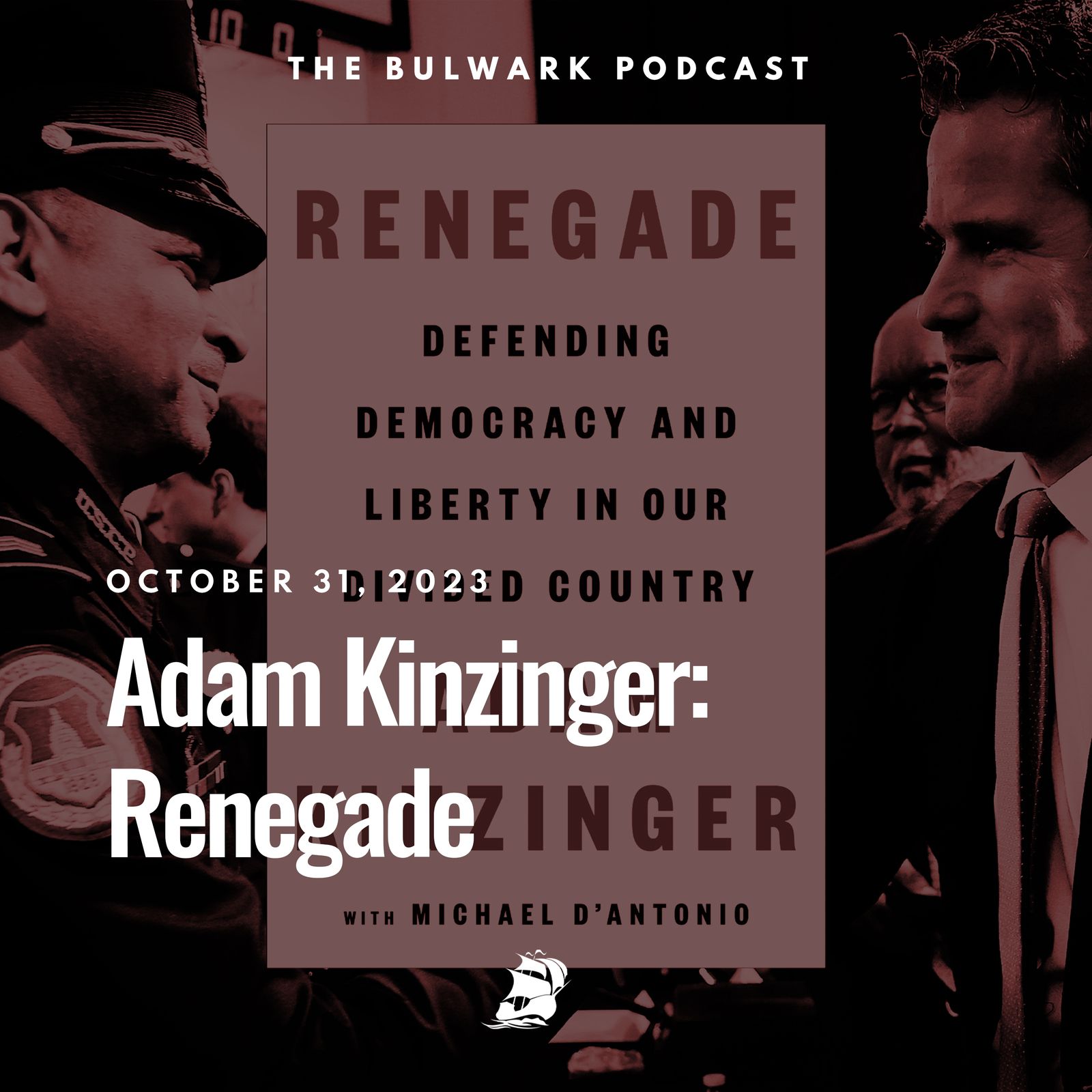
Adam Kinzinger: Renegade
show notes:
https://www.penguinrandomhouse.com/books/723495/renegade-by-adam-kinzinger-with-michael-dantonio/
Press play and read along
Transcript
Speaker 4 Get ready for Malice, a twisted new drama starring Jack Whitehall, David DeCovny, and Carise Van Houten.
Speaker 7 Jack Whitehall plays Adam, a charming manny, infiltrates the wealthy Tanner family with a hidden motive to destroy them.
Speaker 3 This edge-of-your-seat revenge thriller unravels a deliciously dark mystery in a world full of wealth, secrets, and betrayal. Malice will constantly keep you on your toes.
Speaker 1 Why is Adam after the Tanner family?
Speaker 9 What lengths will he go to?
Speaker 10 One thing's for sure, the past never stays buried, so keep your enemies close.
Speaker 7 Watch Malice, all episodes now streaming exclusively on Prime Video.
Speaker 12 What does Zinn really give you? Not just smoke-free nicotine satisfaction, but also real freedom to do more of what you love, when and where you want to do it. Why bring Zinn along for the ride?
Speaker 12 Because America's number one nicotine pouch opens up all the possibilities of right now.
Speaker 12
With Zinn, you don't just find freedom, you keep finding it. Find your Zen.
Learn more at Zinn.com.
Speaker 12 Warning, this product contains nicotine. Nicotine is an addictive chemical.
Speaker 12 Welcome to the Bullwork Podcast. It is Halloween, and you don't need me to tell you that it's pretty scary out there.
Speaker 12 So we are joined by Adam Kinziger, former congressman from Illinois, whose new book, Renegade, Defending Democracy and Liberty in Our Divided Country, is out today.
Speaker 12 So first of all, Adam, thank you for making the time to be with us because I see that you're pretty much everywhere this week.
Speaker 13 Yeah, but you know what? The Bulwark podcast with Charlie Seis, I mean, who couldn't be there?
Speaker 13 Plus, now that I get to see you, it's like it's handsome, overwhelming.
Speaker 12
Well, there's a lot of things we need to talk. We need to talk about the new fifth string speaker.
We need to talk about the war in the Middle East. We need to talk about your critique of politics.
Speaker 12 But what I really was struck by about your book, let me give you my short review. What I really appreciated was how raw it was, how personal it was, and how open you were about the transition.
Speaker 12
You had bought into a lot of this and are admitting that you were part of this as I was. And you had a very interesting soundbite yesterday.
I want to just play this.
Speaker 12 You were on CNN, where you're a contributor now, with Anderson Cooper, and you told this little story. Listen to this.
Speaker 13
So I had family that sent a certified letter disowning me. They said, I've lost the trust of great men like Sean Hannity.
Just funny, but they believe that.
Speaker 12 Okay, so talk to me about that, Adam, because I think what a lot of people forget is that people who became renegades in the Republican Party, it wasn't just a political matter.
Speaker 12 There was a personal cost. And you had your own...
Speaker 12 Tell me about this. You had your own family send you a certified letter.
Speaker 13 Yeah, I mean,
Speaker 13 we we talk about brainworms this is brainworms so like you know i lived in shanahan illinois and i would go down to visit my folks in bloomington maybe once a month right so i i go down on this once a month journey and it happens to be the time that my dad's basically his kind of cousins big a big group of them this certified letter shows up to me to my parents house i'm like oh okay well interesting good time and i start reading it and the first two words were oh my and i was you know naive enough to think they were going to be like oh my how brave you have been and it says oh my what a disappointment you are to us and to god that was how it opened and then it just went on you've lost the trust of great men like sean hannity mark levin and like a few others in there and i'm like you know if you ever wonder if it's a cult All you have to do is just look at what is the thing that they are upset at me about.
Speaker 13
And it wasn't much about principle. It was all about losing the trust of great men like Sean Hannity.
And yeah, you know, I laugh about it because to me it is just so ridiculous.
Speaker 13
But since I got out of Congress, you know, I use the analogy of nobody has PTSD while they're in combat. It's when you're out.
And it's been kind of coming to grips with the impact that's had.
Speaker 13 And, you know, things like my co-pilot in Iraq, you know, one of the guys I should be the closest with senting me a text a year ago that says he's ashamed to have ever flown with me and ever served with me.
Speaker 12 Really?
Speaker 13
Yeah. Why? Because I don't know, because I told him the truth about January 6th or I'm not in this cult.
And yeah, I mean,
Speaker 13
it's a real impact. So I wasn't even the one that released that letter, by the way.
She's so crazy that the one that led that, that she released it, somehow thinking it would turn people.
Speaker 13 But I say that because everybody's got a story like this. And I'm sure Thanksgiving is going to have even more.
Speaker 12
Yeah, exactly. Let me read you a passage from your book.
This is actually from the introduction when I was talking about that it was kind of raw.
Speaker 12 This is what I was thinking of when I first read the book.
Speaker 12 You write, I feel some responsibility for January 6th and the rise of Marjorie Taylor Greene and her ilk, if only because I was a participant in and witness to the GOP's gradual descent into a dysfunctional and destructive force in our politics.
Speaker 12 Intoxicated by my status and addicted to the level of attention, I made compromises to, let's face it, feed my ego and sense of importance.
Speaker 12 The correction I made as I embraced my inner renegade and voted to impeach a president of my own party came late, but it did arrive.
Speaker 12 Now, this is one of the things about politics that I think people don't fully understand, which is just the role of status and ego.
Speaker 12 I mean, I remember years ago reading John Dean's book, where he was talking about how, you know, in the Nixon White House, how he, you know, got sucked in.
Speaker 12
And he tells the story of being on an airplane. And when the airplane lands, the Secret Service or the Marshals come on.
They say, Mr.
Speaker 12 Dean, you know, we want to have you come out first because you're such an important guy. And that goes to your head.
Speaker 12 So this is part of it because as people are trying to figure out why do people make these compromises, so talk to me about that passage because that's pretty personal, that you actually say, I was part of this and I made these compromises because I wanted to stay important.
Speaker 13 I think it's essential because if you look at, let's take somebody like Elise Stefanik, okay, who was this paragon of normalcy, this
Speaker 13
icon in the ilk of Paul Ryan. And literally, she wasn't one of those that took a few years to change.
She literally owned a dime.
Speaker 13 And I think it was the impeachment, the first impeachment or something. She came out in defense of Donald Trump.
Speaker 13 And I think she legitimately believed her defense, but then she got all kinds of accolades from the people she desperately wanted it from and realized all of a sudden, oh, I can be famous this way.
Speaker 13
And she is. I mean, she's arguably considered for vice president.
And so, you know, from my experience, it was like, so 2011, you know, I go on, I'm on Face the Nation as a freshman. My goodness.
Speaker 13
I go on Fox News. I was on Greta Van Susserin's show every Monday for, I think, a period of about six months to a year.
And every time you, you know, take your earpiece off, take the mic.
Speaker 13 shake the hand of the host and walk out, the first thing you do is pull out your cell phone because it's been buzzing the whole time.
Speaker 13 And it's all your friends telling you how great you are and how awesome it was to see you.
Speaker 13 And then the first time you get recognized at the airport and somebody wants to get their picture taken with you, it's all very intoxicating. It's like a drug, right? It's like, it's like nicotine.
Speaker 13 You want, you take a little, you want more, you want more.
Speaker 13 And it's only when you can recognize that and break with it and all of a sudden say that your soul is more important and your legacy is more important than that, can you recognize it?
Speaker 13 But I think too many people have instead said, my legacy has to be the fame and I can't think of myself without it.
Speaker 13 So it's, yeah, it's a very raw and very human admission, but I think it's one that frankly affects almost anybody in politics, whether they admit it or not.
Speaker 12 And yet you're more famous now than ever.
Speaker 13 Yeah, kind of unintentionally, yeah.
Speaker 12 Unintentionally, having lost, you know, members of your family and the respect of...
Speaker 12 So what was the breaking point for you? You were a conservative Christian who ran because you were inspired by Ronald Reagan. You were
Speaker 12 very much in that tradition. I mean, you go back to 2011 and you were one of that class of 2010, right? I mean, you were comfortable with the Tea Party.
Speaker 12
You were comfortable with Christian conservatives. You thought of yourself as being being very much part of the mainstream.
What was the moment you said, I'm willing to break with that.
Speaker 12 I'm not going to be part of that. I'm going to give all that up.
Speaker 13 So it was interesting.
Speaker 13 So throughout kind of the whole, let's say, 2011 or I guess 2010, including the campaign to 2016, you know, I was always fighting the fight against the, what Boehner called the exotics.
Speaker 13 Like, you know, at the time, it was like Steve King and, you know, the few people. But we were, we were generally winning that battle, right? So I was engaged in that battle.
Speaker 13
It was when Donald Trump came along. It's something I actually just realized today.
And I talk about in the book how I went to this Republican retreat and got pretty hammered one night.
Speaker 13 And I came to realize the reason mainly that that happened is,
Speaker 13 I guess this is when I started the break and I'll get to the full break.
Speaker 13 You know, Donald Trump gets elected. We all go to Philadelphia as Republican members of Congress for this like retreat.
Speaker 13 And I start seeing my friends and people that I respected that went from a week ago being really concerned with Donald Trump being president to being enthused that he was president.
Speaker 13
Oh my gosh, this is great. We can do this.
He's awesome.
Speaker 12
Genuinely enthused, not just pretending to be enthused. I mean, they internalized it.
Okay.
Speaker 13 Yes, they internalized it. And they, you know, they came to grips with he's there and now we can do all this big stuff and I may have a chance at power.
Speaker 13 That's when I started to realize like this is going to be dangerous.
Speaker 13 Now, I don't think, by the way, any of those actually believe, for instance, the election was truly stolen, but some of them got really deep.
Speaker 13 I mean, you look at somebody like a Billy Long, for instance, who was pretty moderate that ended up, you know, being one of Donald Trump's biggest fans begging for his support.
Speaker 13
But the official break, you know, I didn't vote for Trump in 16. I voted for him in 20, which is weird.
I'm the only person in the country that did that.
Speaker 13 And the big break, obviously, was January 6th, or actually it was that election and that night. when Donald Trump tweeted something like, stop the vote, stop the voting, this is being stolen.
Speaker 13 And he said that night, frankly, this is being stolen. Because the thing that struck me is I realize how fragile democracies are.
Speaker 12 and the only thing you need for it to survive is just like a basic level of trust in the electoral system that's it everything else you can disagree on when you destroy that it's gone yeah but you knew who donald trump was before that right so you had voted against him in 2016 you took a lot of shit for that a lot you voted against the first impeachment so all along you knew who donald trump was so talk to me about the compromises you had to make.
Speaker 12 What was going on in your mind? You're thinking this guy is a complete disaster, and yet this is my team. Yeah.
Speaker 12 You say at one point you had gotten so much crap for voting against him in 2016, you didn't want to go through that again.
Speaker 13 Yeah, that's the whole reason I voted for him in 2020 was I didn't think he'd be a good president. You know, I obviously knew he wasn't a good president.
Speaker 13 I knew what he had done with Vladimir Putin and I could kind of put salve on that wound a little bit to myself by saying, well, you know, when he said Putin was great, I spoke out against it.
Speaker 13 I spoke out when he retweeted, you know, Pastor Jeffries about Civil War.
Speaker 13 But I have to come to grips with the fact that, yeah, speaking out's important, but ultimately I did enable him, you know, to a certain point. And how do you justify it?
Speaker 13
Well, again, you look back and say, well, I did speak out against him. This is my team.
If I do something too big now, I'm not going to win. Somebody worse is going to replace me.
Speaker 13
You go through all of that stuff. And then ultimately, it comes down to, I still wanted to be a U.S.
Congressman. And I knew what it took.
Speaker 13 I knew that I had to win a Republican primary in Illinois' 16th district.
Speaker 13 But there was definitely that point then when it's like, you know, when I got back from Iraq and started to run, I said, if we're going to ask young people to be willing to die for this country, I have to be willing to give my life, you know, for existential things too.
Speaker 13 And I jokingly said I thought it would be like a vote on social security reform, not necessarily democracy. But it got to that point where I just said, I cannot be.
Speaker 13
Because I don't make a commitment to any of the 700,000 people I represent. The only commitment I make is to the Constitution.
That's it.
Speaker 12 Let's just stick with this period of time. So you vote for him in 2020, but by January, February of 2021, you are voting to impeach him.
Speaker 12 And you were one of 10 Republicans in the House, along with Liz Cheney and others, who voted to impeach him. Did you think that vote was going to cost you your seat?
Speaker 12 Did you like wake up and you say, okay, I'm going to strap this on me and I'm going to blow myself up or not?
Speaker 13 What did you think? I guess I didn't fully know yet if it would cost my seat because I, you know, I guess I was still optimistic enough to believe that a January 6th would take this guy down, right?
Speaker 13 I mean, there was a part of me that thought, you know, maybe I'm kind of leading this new Republican Party now, leading the charge against, you know, what we used to be.
Speaker 13 But I also knew that this was not the safe thing to do. But I knew this was the thing that was worth it.
Speaker 13 And I think I've said with you before, the day before the impeachment vote, I thought we'd hit 25. You know, people like Mike Gallagher, who were...
Speaker 12 Wisconsin.
Speaker 13 Yeah, Mike Gallagher from Wisconsin, even Nancy Mace was going to be a yes. And then they started to express to me their concern about re-election.
Speaker 13 And that's when I knew I was excited to get 10 at that point. So I guess in a way, I did know it would cost me.
Speaker 13
But I remember Fred Upton once telling me shortly after that that he thought Trump was going to run again. And I thought he was insane.
I'm like, there's no way he's going to. I mean, come on.
Speaker 13 You know, this guy did a January 6th.
Speaker 12 This is interesting because every once in a while we encounter people on the other side of the aisle who will say, well, well, this was all inevitable. Nothing surprising about this at all.
Speaker 12 But the reality is that for a lot of Republicans, they did think maybe they didn't have to vote for impeachment because surely this was it for Donald Trump, right? So
Speaker 12 how surprising is it? I mean, you watched Up Close and Personal. How surprising is it to have watched what has happened?
Speaker 12 We could go back to 2015, what's happened to the conservative movement and the Republican Party, but let's just focus on this.
Speaker 12 Since January 7th, 2021, the decision that Kevin McCarthy made, the decision that Elise Stefanik made, the decision that one Republican after another has made, the fact that Mike Pence was dead on arrival because the one courageous thing that he did became the unforgivable sin.
Speaker 12 Because I think that even the Ron DeSantises of the world are kind of looking around going, are you kidding me?
Speaker 12
After January 6th, after all of the indictments, the guy is still dominant in this party. He is still the apex predator.
I mean, how amazing is this?
Speaker 13 It is amazing. And I think, look, it's amazing because I know these people.
Speaker 13
You know, let's take Mitch McConnell, who I think in his heart is a decent guy. I think he means well.
He's a tactician.
Speaker 13 And I think he thought, boy, the best thing I can do is not remove Donald Trump because he's gone anyway.
Speaker 12 I can preserve my majority.
Speaker 13 He's dead anyway.
Speaker 13 But he's the reason that Donald Trump didn't get removed, right? It's all these decisions that were made.
Speaker 13 The person that surprised me the most, Charlie, is still Kevin McCarthy because, I mean, his big thing was he wanted to put the Republican Party on the map for climate change he wanted the Republican Party to be the party of Silicon Valley like he had all these like kind of you know progressive politically not actually progressive but progressive politically ideas and then he sold it all out for Trump and the biggest surprise of course was when he showed up to Mar-a-Lago and resurrected him yeah like on the Ron DeSantis side when he started running I think he said I'm gonna be Donald Trump because Donald Trump's gonna be gone but I can maintain that thing people love about him right Right.
Speaker 13 But he doesn't go away.
Speaker 13 And part of the reason, Charlie, is because the second-tier influencers, which is everybody that's on the stage running for president of the United States, is who people also look to for opinions.
Speaker 13 And when every one of them, including Mike Pence, by the way, says that this is a witch hunt against Donald Trump and the DOJ is a two-tiered system of justice with the exception of Chris Christie saying that, there's no doubt people are going to believe it then because everybody else they trust is saying the same thing Trump is.
Speaker 12 Ah,
Speaker 12 greetings from my bath, festive friends. The holidays are overwhelming, but I'm tackling this season with PayPal and making the most of my money, getting 5% cash back when I pay in four.
Speaker 12 No fees, no interest.
Speaker 12
I used it to get this portable spa with jets. Now the bubbles can cling to my sculpted but pruny body.
Make the most of your money this holiday with PayPal. Save the offer in the app.
Speaker 12
N1231, see PayPal.com slash promo terms. Points, give your renee for cash and more pay in for subject to terms and approval.
PayPal Inc. and MLS 910-457.
Speaker 4 Get ready for Malice, a twisted new drama starring Jack Whitehall, David DeCovney, and Carice Van Houten.
Speaker 11 Jack Whitehall plays Adam, a charming manny infiltrates the wealthy Tanner family with a hidden motive to destroy them.
Speaker 3 This edge-of-your-seat revenge thriller unravels a deliciously dark mystery in a world full of wealth, secrets, and betrayal. Malice will constantly keep you on your toes.
Speaker 1 Why is Adam after the Tanner family?
Speaker 9 What lengths will he go to?
Speaker 10 One thing's for sure, the past never stays buried.
Speaker 3 So keep your enemies close.
Speaker 7 Watch Malice, all episodes now streaming exclusively on Prime Video.
Speaker 12 You opened the book in the introduction with the fiasco of Kevin McCarthy's rise to the speakership, the fact that it took the 15 votes, the fact that he may have to make these compromises with all of the crazies.
Speaker 12 And between the time you wrote that and now, of course, we've seen the spectacular fall of Kevin McCarthy, which in so many ways was foreordained, right? I mean, it was predictable from the weakness.
Speaker 12 So you watched Kevin McCarthy make those compromises, decide to go down and kiss the ring at Mar-a-Lago because he thought that was going to save him. That was going to give him the majority.
Speaker 12 And here we are today.
Speaker 12 I mean, we've gone from what we thought was the dysfunction of the 15 ballots for Kevin McCarthy, and now we have the fifth string speaker who you've described as Jim Jordan and drag, who is clearly still Matt Gates' bitch, right?
Speaker 12
A full-throated election denier. Somebody, I mean, you sat on the January 6th committee.
Here is somebody who was right front and center in Donald Trump's attempts to overthrow the election.
Speaker 12
So we thought things were bad and the Kevin McCarthy was weak. And now we've gone to the fifth string Mike Johnson.
How did we get here?
Speaker 13
Who's the most powerful person in the room? So let's say you put 10 of us in a room. Everybody has a hand grenade.
Okay. We're all equally powerful.
Speaker 13 If one person is willing to pull the pin and drop the grenade they're the most powerful person in the room right doesn't matter how tall you are it doesn't matter how much political power you have and that's what we have enabled in the Republican Party for a long time the stuff that we saw with this battle for speaker none of it was new none of the dynamics were new there were always kind of the we'll call them the moderates they're not moderate but they're moderate in in tone the moderates there was always the crazy caucus and then the kind of 80 that just wanted to just survive that's always existed the difference now it was put out in public.
Speaker 13
When Kevin had to cut, because he had such a narrow majority, he had to cut all those things. He basically got in a room with everybody that pulled the pin on a grenade.
Yeah.
Speaker 12 And they all had different goals.
Speaker 13
And he said, okay, if you put the pins back, you know, whatever. And then, so his political death was inevitable.
Then
Speaker 13 the fact that we got to a point where the only way you would be a even viable candidate for speaker was to deny the election.
Speaker 13 And that was split screen on the news with Ginna Ellis tearfully speaking the fact that she lied to the American people about the very same thing, the fact that there were like four people that have already taken plea agreements, the fact that everybody knows Donald Trump is guilty, but yet the thing, the only thing that could qualify you for speaker to start is that you basically were contradicting what these people were confessing to.
Speaker 13 That's the moment we're in. So Mike Johnson, and this is like, I think I kind of predicted this when when his name was floated.
Speaker 13 I was very impressed the moderates pushed back against Jordan because I thought they would capitulate. They held, but I knew they couldn't do it.
Speaker 12 For five minutes. Yeah.
Speaker 13 They held for five minutes. You couldn't do it twice.
Speaker 13 Mike Johnson, by the way, I remember, I didn't know him well, but I remember him coming up to me trying to get me to sign on to this lawsuit, you know, for Texas. And I'm just like, Mike.
Speaker 12 The totally bogus Texas lawsuit that would have thrown out all of the votes of everybody in Wisconsin, for example.
Speaker 13
Yeah. And by the way, a little known fact about that, Kevin McCarthy and Liz Cheney had a conversation, and Liz is like, Kevin, you're not signing that right.
And he's like, Oh, of course not, Liz.
Speaker 13
That's crazy. So the next day, the list comes out.
Kevin's not on it, and he puts out a press release that says, I was inadvertently left off.
Speaker 13 That's the kind of courage Kevin McCarthy had, by the way.
Speaker 12
Yeah, I am their leader. Those are my people.
I need to go after them.
Speaker 12 So, Mike Johnson's one of his first things that he's doing is, and I want to get back to the bigger picture, but I know you had some thoughts on this.
Speaker 12 So, the question is: what kind of a speaker he would be. He's made it clear that he he will not vote on Ukraine aid and the Israel aid package.
Speaker 12 He's decoupling those two aid packages, but he's also playing this stupid game now with the Israel aid package, at least this morning, saying that he wants to offset the cost by slashing IRS enforcement, which would actually increase the deficit.
Speaker 12 What do you think about that?
Speaker 13 So first off, on just the splitting the aid, it's dumb. And I think Mike is trying to figure out how to lead now at the same time because he's kind of given multiple feelings on this.
Speaker 13 But on the Israel stuff, he's actually tactically, I think this is dumb, just tactically, because it's going to give an excuse for the Senate to vote no.
Speaker 13 And I would have voted no on this package, by the way. Really? They'll vote no, and now they'll be able to jam the house with, you know, what frankly needs to be done, which is Ukraine and Israel.
Speaker 13 And this is just, this is par for the course. It actually does surprise me, though, a little bit, because I would have thought that they would have done at least Israel aid without any offsets.
Speaker 13 The fact that they're offsetting with the IRS, what it goes to show, Charlie, is how unserious they are. Because why?
Speaker 13 It's the IRS, of course, because you can go on Fox News and attack the IRS. That's why they're using
Speaker 12
point. That's all it is.
And I wrote about this in my newsletter. The unseriousness is that it's a great talking point for the base, but it doesn't actually offset the cost.
Speaker 12 They picked the one spending cut that will actually blow up the deficit by $30 billion.
Speaker 12
Okay. Yeah.
So let's take a deep breath and go back because your book is a memoir of how you got here, your personal story. It is a great read.
Speaker 12 But what I think is also interesting, as I said right at the beginning, is the confessional.
Speaker 12 And of course, you know, you know that there are people, the progressives, who say, you know, well, where's the apology? Where's the acknowledgement of complicity? Well, you do that.
Speaker 12 In the book, you do write that you feel some responsibility for people like Marjorie Taylor Greene because you didn't fight the good fight the whole time.
Speaker 12 You write that you didn't traffic in hate, but you do say that you were part of the system that did.
Speaker 12 Talk to me about about that because I think a lot of people, and I would certainly put myself in this category, you knew this stuff was going on over there, but you figured, eh, you know, why make an issue of it?
Speaker 12
They're allies. That's the crazy uncle in the corner.
And we didn't confront the extremists and the bigots.
Speaker 13
Yeah, that's exactly right. Because, you know, to an extent, it was this idea of it's coalition, right? Yeah, we're going to have the crazies, the bigots, the extremists.
They're voting Republican.
Speaker 13 They're going to vote for me in the primary, maybe, and they're going to vote for me in the general election.
Speaker 13 So, you know, if if somebody says something that's, I don't know, racist or insane, instead of pushing back like John McCain did, for instance, when the lady called Obama a Muslim, you just kind of chuckle or shake your head or just say, like, I'll look into that.
Speaker 13
I mean, that was the favorite one. It's like, hey, did you know that, you know, the UN is going to kill all Christians? It's like, oh, really? I didn't know.
I'll look into that. Right.
Speaker 13 And you look at like.
Speaker 13 Do I consider myself pushing those theories? No. But could I have pushed back harder? Yes.
Speaker 13 Could I have, you know, gone on Fox News specifically for a hit saying that Jade Helm, which was this conspiracy theory in 2015 that Obama was going to take over Texas, that it was false?
Speaker 13 I could have.
Speaker 12 Did I do that?
Speaker 13 No, because I only wanted to go on Fox News for hits that actually the Fox News viewers would like. And so, yeah, all of that comes into play.
Speaker 12
Yeah, no, I mean, I remember that as well. We laughed at it.
We rolled our eyes, but they're like, why spend any time? Because you don't have to worry about that, right?
Speaker 12 And we want to come back to this, because I keep thinking about all the times that we should have pushed back against that, but we rationalized not doing it.
Speaker 12 We would tell ourselves it's just a small number of people, it's not that important. And so, you spent a lot of your time growing up in rural Illinois.
Speaker 12 And one of the great stories of our time has been this dramatic shift of rural voters from the Democratic Party to the Republican Party, or more Republican.
Speaker 13 Give me some sense of what is going on because you write about this in the book, that you know, across the Midwest, places like West Virginia, what happened after 2008 during the the great recession the opioid epidemic what happened you know first off you can start with the 90s with the disappearance of manufacturing right and of course the midwest where you and i are from heavy manufacturing area and it's actually made a pretty significant comeback but still you know it's it's taken some damage compared to what it was and and you have a lot of people in their 50s that were trained in the manufacturing that you know lose their jobs and they're they're almost too old to go retrained or they think they're too old to go retrain.
Speaker 13
And society seems to kind of push them aside. And, yeah, we can give them unemployment benefits.
And but that doesn't make you feel like a useful person. And so people were turning to drugs, right?
Speaker 13 That's why you had a huge opioid epidemic, particularly in places like West Virginia and the Midwest. And then all of a sudden, the economy collapses.
Speaker 13 probably rightfully, you know, that you had to bail out the banks to keep the financial institution alive.
Speaker 13 But the perception, also rightfully, was that, you know, Washington only cared about the big banks and not the little person.
Speaker 13 And so there was this growing resentment, plus the fact that any of the media you watched portrayed Christians, for instance, as crazy people or out of touch or superstitious.
Speaker 13 It betrayed the, you know, the values of San Francisco or New York City. And so Donald Trump comes along, and I guess the saddest thing is he's the biggest con artist of all of them, of anything.
Speaker 13 But he comes along and he knows enough, in your words, in his lizard brain, to put words to that angst people are feeling.
Speaker 13
So he tells West Virginia, we're going to put you back in the coal business, which of course he never did. We're going to return your factories.
These people over there, they suck.
Speaker 13
And he put a voice to that. And that's why I think you've seen this massive shift.
I mean, I have an uncle that used to kind of brag that he would vote Democratic sometimes.
Speaker 13 It's now one of Trump's biggest supporters because he just put voice to that. And that's what I think a big thing is that happened.
Speaker 12
This is an important point because, you know, and again, you're right about this. You know, these people felt unheard.
They didn't see themselves portrayed.
Speaker 12 They thought they were being looked down upon. And the people were looking for somebody with an inspirational message.
Speaker 12
So these were people who looked at Ronald Reagan, looked at Barack Obama, who addressed their isolation. They felt they were heard by them.
But you're right.
Speaker 12 What they got was a person who turned that isolation into hate. And Trump gave people a license to say racist things, anti-immigrant things, anti-Semitic things.
Speaker 12
He basically also said, you are not responsible for this. He came up with, and again, this is there's a long history of this saying, you know, blame these people.
It's the immigrants.
Speaker 12 It's those people.
Speaker 12 And somehow that connected. The Democrats look at this and they go, well, hold up, hold up.
Speaker 12
These are people who, you know, voted for, you know, FDR, who voted for Lyndon Johnson, who voted for John F. Kennedy and Harry Truman.
They voted for Barack Obama.
Speaker 12 Why are they not listening to us right now? We are the party of the working class and the little man. And yet that's not the way it played out in the Midwest.
Speaker 12 And my sense is there are still a lot of Democrats that don't understand this.
Speaker 13 There are.
Speaker 13 There are because, and I don't know where the shift happened, but at some point the Democrats went from think of like a Bill Clinton, who basically spoke blue-collar language, to where we are today.
Speaker 13 And look, Democrats get upset at me for saying this if you want. You don't speak blue-collar.
Speaker 12 Joe Biden speaks blue-collar, right?
Speaker 13
Yeah, he does. He does.
And, you know,
Speaker 13 he's up against the fact that, again, some people are willing to use the fire of anger that he's not willing to use.
Speaker 13 And if Joe Biden decided, which he wouldn't, because I don't think his soul would allow it to become anti-immigrant and blame the Mexicans, maybe he'd gain some ground among this.
Speaker 13 Or if he had the ability, which I think is tough for him, maybe it's an advanced age, maybe it's just not natural, to basically inspire and saying a different thing, then that's possible.
Speaker 13 But when you have a party that they don't necessarily embrace it, but they tolerate. Talib, for instance, blaming Israel for bombing in Gaza when it's completely untrue,
Speaker 13
this defund the police, get mad at me for it, but there still is a perception that the Democratic Party is against funding the police. That's not my problem.
That's a Democratic problem.
Speaker 13 That's something that's very important to the middle-class voters in areas where you and I come from.
Speaker 13 And the other thing is, just look, everybody in their heart has a battle daily between like light and dark, right? And it's easy to let darkness overtake you.
Speaker 13 And when a man stands in front of you and whispers the dark parts of your heart and gives you permission to use those dark parts of your heart, it overtakes. And that's what's happening.
Speaker 12
Ah, greetings for my bath, festive friends. The holidays are overwhelming, but I'm tackling this season with PayPal and making the most of my money.
Getting 5% cash back when I pay in four.
Speaker 12
No fees, no interest. I used it to get this portable spa with jets.
Now the bubbles can cling to my sculpted but pruny body. Make the most of your money this holiday with PayPal.
Speaker 12
Save the offer in the app. NS1231, see paypal.com/slash promo terms.
Points can be renewed for cash and more paying for subject to terms and approval. PayPal Inc.
and MLS 910-457.
Speaker 4 Get ready for Malice, a twisted new drama starring Jack Whitehall, David DeCovney, and Carice Van Houten.
Speaker 11 Jack Whitehall plays Adam, a charming manny infiltrates the wealthy Tanner family with a hidden motive to destroy them.
Speaker 3 This edge-of-your-seat revenge thriller unravels a deliciously dark mystery in a world full of wealth, secrets, and betrayal. Malice will constantly keep you on your toes.
Speaker 2 Why is Adam after the Tanner family?
Speaker 9 What lengths will he go to?
Speaker 10 One thing's for sure, the past never stays buried.
Speaker 3 So keep your enemies close.
Speaker 7 Watch Malice, all episodes now streaming exclusively on Prime Video.
Speaker 12
So you had an event in New York and you're there. And by the way, you're a family man.
This is great. This is reality, by the way.
This is reality podcast. I have a dog here.
Speaker 12 You have, you know, because you're a young dad.
Speaker 12 So let's talk about the tea party because this is fascinating to me the way the tea party has morphed and the role that it played you said in New York the Tea Party had been the weird table at GOP events but now the more extreme you can be has become the essence of how Republicans show themselves to be conservative now it's not what you believe It's become about being the craziest person in the room, the most extreme person in the room.
Speaker 12 So, for example, on the abortion issue, well, you know, an abortion ban at 15 weeks. No, you have to say an abortion ban at six weeks.
Speaker 12 So the Tea Party, I thought the Tea Party was a legit thing in the beginning.
Speaker 12 It was interesting to watch how it became a grift, how it became extreme, and it became about something completely different than we thought it was about, right?
Speaker 13
It did. So, you know, the first Tea Party event I went to was in New Lenox, Illinois, and there were 8 or 10,000 people that showed up.
So you think about that. What were those 8 or 10,000 people?
Speaker 13
They were folks that were upset with Obamacare. They were upset with government spending.
They were basically Republicans.
Speaker 13 I mean, that's just what they, it was just a large group of Republicans that were having their voice heard.
Speaker 13 And when the GOP won the majority, the vast majority of them said, okay, we did our job and they went home. The problem is these organizations that were formed continued.
Speaker 13 And so I would go to tea party meetings after that that would have a thousand and then 500 and then it would end up with like 20 people there.
Speaker 13 And what you had was this paring down of the normals to the extremes that finally for the first time had a, you you know, what they felt like people were paying attention to them and their crazy ideas.
Speaker 13
And that became the Tea Party. Look, I was considered a Tea Party darling in 2010.
I never once, and I even proactively pushed back against the idea of voting against increasing the debt limit.
Speaker 13
I said, no, of course you have to increase the debt limit. Everybody's like, oh, okay, yeah, that makes sense.
Can you imagine saying that in front of a Tea Party now?
Speaker 13 And it just goes to show how it evolved from just normal kind of upset conservatives to what it is today.
Speaker 12 I remember just in real time watching this, and I know there'll be listeners who will say, Oh, this was all astro-turfing, it was all the Koch brothers or whatever.
Speaker 12 Maybe eventually it became that, but it starts off as a movement, and then it becomes this racket.
Speaker 12 I think there's a famous quote about this, and it became this organized grift that was dominated by the extremists, which in many ways followed the trajectory of the Republican Party.
Speaker 12 I mean, I remember how the Tea Party Express for about five minutes was actually anti-Donald Trump because they kind of recognized that he had nothing to do with what they were talking about.
Speaker 12
He was not interested in fiscal responsibility. He was the king of debt and everything.
But of course, like everybody else, they flipped. They flipped the switch.
Speaker 12 They became something else because the script demanded, we don't actually care about entitlements or about deficits or about debt. We care about who's going to give us these dopamine hits.
Speaker 12 And so much of the media and so much of the organized Republican Party and the ecosystem around it became, right? It became more and more intense, more performative.
Speaker 13 And by the way, with dopamine hits comes money, right? Because if you can tickle that zone, people will write you a check. If you can make them fear for the life, they'll write you a check.
Speaker 13 And politics has become Hollywood, not just in the fact that people can become famous now and well-known. It's become Hollywood in that it is a high-profit business.
Speaker 13 You know, it used to be you'd raise enough money. I think my first campaign, I raised and spent a million and a half bucks.
Speaker 13 That wouldn't get you through a state house race in Illinois now because money has become.
Speaker 12 That was a lot of money.
Speaker 13 Yeah, it was a lot of money then.
Speaker 13 And and so with the tea party they claim that they're about fiscal conservatism and then all of a sudden everybody's getting into this cult and loving what this guy is saying and then it's like oh that's how we can raise the cash i sat in the oval office and heard donald trump say yeah we have to you know reform entitlements and reform social security next term and i remember thinking to myself that's going to last to his very first speech when he sees the blue hairs in the crowd and just says to them, oh, I'm never going to touch your social security.
Speaker 13 And Charlie, that's exactly what happened because he he didn't care about ideas.
Speaker 12 Let's look ahead. Is our system prepared for what's going to happen in 2024? I know you've given a lot of thought to this.
Speaker 12 We now know that Speaker Mike Johnson is going to be presiding over the certification of the 2024 election.
Speaker 12 We know what the passions are going to be, the trials, everything.
Speaker 12 You know, this is the ultimate stress test for democracy, isn't it?
Speaker 13
It is. I look forward to 2028 2028 and say I think it's going to be an amazing election cycle because there's going to have all new faces and all new energy.
This one I worry about.
Speaker 13 And, you know, we can have these guardrails in democracy, you know, like off in interstate, for instance, and your car can hit guardrails and stay on the bridge and not fall into the river.
Speaker 13 If a second car comes along and hits that same guardrail, it's going to take it off the road and you're going to fall into the river.
Speaker 13 And the problem is, is now Trump and the Trump-type folks have learned where the weaknesses are in the the system.
Speaker 13 They accidentally tested the system, I think intentionally tested it, but accidentally tested the weak points in 2020. And I think now they're going to know exactly where the weak points are.
Speaker 13 And you know, Charlie, if anybody thinks that Donald Trump can't win, I've heard a lot of people that just kind of scoff when I say, take him seriously.
Speaker 13 If they think he can't win, listen, he can win again. Nobody thought he could win in 2016.
Speaker 13 And I'm going to tell you, if he does get through and he wins this time, he's going to interview 100 candidates for Attorney General and only take the one that says, like, Mr.
Speaker 13 President, in essence, I don't care what the Constitution is. I'm going to do whatever you want as your servant in the Department of Justice.
Speaker 13 That person is going to get selected to be attorney general. And we're going to find a system that is stressed beyond what even the founding fathers imagined it could be stressed to.
Speaker 12 Who's he going to pick for a vice president, do you think?
Speaker 13 You know, it's going to be somebody like Christy Noam or Nelise Stefanik, I think.
Speaker 13 I think Nancy Mace is auditioning for it.
Speaker 12 Yeah, she's too.
Speaker 13 Yeah, I think it's going to be somebody that probably female and somebody that shows an absolute loyalty to him no matter what. And unfortunately, there's a huge list of people.
Speaker 12
Yeah, I wouldn't be shocked if it was Elise Stefanik. Okay, so where are you now, Adam? You spent your whole political career as a conservative Republican.
You've broken with your party.
Speaker 12 Talk to me about being out in the political wilderness because there are some folks who feel that, okay, if you break with Trump, you now must become a liberal Democrat. Where are you?
Speaker 12 How do you describe yourself?
Speaker 13 Well, I would consider myself politically the same kind of, I'd say, center-right, you know, moderate on some things, conservative on others that I've always been.
Speaker 13 I've had to come to peace with the fact that I don't need to be a member of a tribe because neither tribe I feel like I'm fully represented by.
Speaker 13 I've found new allies in the Democratic Party on the issue of democracy, but I also recognize that Democrats have to fight that fight within their party too because there are some illiberal elements within it.
Speaker 13
So I don't know. I just consider myself homeless.
I'm maintaining the label of Republican because to me, I don't want to lose it. I don't want to give it up.
Speaker 13
I think it's important to maintain and to fight for. But I voted Democratic last election cycle.
And if it's Trump against Biden, I intend to vote Democratic again.
Speaker 13 Because Charlie, I think there's only one thing on the ballot, at least in my mind, which is do you support authoritarianism or democracy?
Speaker 13 And there's only one party that supports democracy at the moment.
Speaker 12 So tell me a little bit about Country First, the organization you founded, which backs pro-democracy candidates. You back pro-democracy candidates who are both Republicans and Democrats at this point.
Speaker 12 How complicated is that?
Speaker 13 It is complicated, but you know, because it violates how everybody's thought of politics.
Speaker 13 But our only requirement is that you put the country above the party, particularly if you're called to do so at the cost of your own career.
Speaker 13 We've started an academy that basically, because I get, you probably get this too. A lot of people come up and say, like, how do I start into journalism or how do I start into politics?
Speaker 13
I get that a lot. How do I run for office? And so we're trying to teach people, here's what you have to do to run for office.
Here's Here's the considerations.
Speaker 13 We do really good at institutional democracy building overseas. And I've come to now realize we have to do that at home.
Speaker 13 So that's what Country First is trying to do is to be a democracy building organization at home.
Speaker 13 And I'd encourage people to go to country1sp.com, the number1sp.com, and take a look at what we're doing.
Speaker 12 One last question of his, I put this in my newsletter today, and I expect to get a lot of reaction to it. You have your own Substack newsletter, which you devoted today to a warning to Democrats.
Speaker 12 You said that you have a problem, and it is the number of radicals who are pro-Hamas.
Speaker 12 Now, talk to me about this because this is kind of circling back, because my sense is reading that is that you're remembering what we talked about earlier, which is our failure on the right to police our whack jobs, the extremists, the way we rationalize they're part of the coalition, they are our allies, they're not that important.
Speaker 12
And, you know, as a result, look where we're at now. So tell me why you decided that you were going to warn the Democrats.
How serious a problem do they have with this?
Speaker 12
Because they will say, there's no problem. There's no problem.
We're all behind Joe Biden on Israel.
Speaker 13 You know, the number of Democratic Jewish friends I have that I have sent some of these things that have been said by other Democrats to, they're surprised. They're not seeing this for some reason.
Speaker 13 And, you know, what we lived through, I remember being in Congress and having, you know, Dana Rohrbacher be pro-Russia and thinking that was insane.
Speaker 13 And people like, oh, well, that's just Dana Rohrbacher. And then, you know, some people come along and you get a, you know, Matt Gates kind of says something pro-Russian and like, ah,
Speaker 13 and now I'd say over 50% of the party is at least Russian adjacent, sympathetic. That happened very quickly.
Speaker 13 And when under 30 years old of the self-identified Democrats are expressing more support for Palestinians and Hamas than they are in Israel, that's a problem. That's a ticking time bomb, literally.
Speaker 13 And I think Democrats have to take it seriously. This is not an attack by a Republican against Democrats.
Speaker 13 This is a warning from a Republican that has seen what's happened in his own party to Democrats to say, we've got to have one healthy party and you guys are starting to cough a little bit and you need to go take your zinc or whatever and prevent this from happening.
Speaker 12 What do they have to do about these extremes who right now seem like they're isolated in the fever swamps?
Speaker 13 I think keep them isolated and speak out.
Speaker 13 When Rashida Tlaib, you know, for instance, blames Israel for bombing something that is quite obvious later they didn't bomb, the Democrats, just like they called on every Republican to do every time Donald Trump said something, the Democrats have to disavow that and say, you know, we can't stop somebody.
Speaker 13 We had an open Nazi that would run as a Republican in Illinois every year. We couldn't stop that because all you have to do is get on the ballot.
Speaker 13 Democrats can't stop somebody from being a Democrat, but they can say that doesn't represent our values.
Speaker 13 And particularly pushing back in these colleges and universities that are poisoning the mind of young people to believe that it's okay to murder 1,400 people as long as it's in the name of anti-colonialism.
Speaker 13 If they speak out to that, I can't guarantee you're going to win that fight, but I guarantee you're going to do everything you can to win it, unlike what we've done.
Speaker 12 Adam Kinziger's new book is Renegade Defending Democracy and Liberty in Our Divided Country. It is out today.
Speaker 12 Adam is also a senior political commentator for CNN and, as we just discussed, founded Country First, which backs pro-democracy candidates. So, Adam, congratulations on the book and best of luck.
Speaker 13 Thanks, I appreciate it. Good to be with you.
Speaker 12
And thank you all for listening to today's Bullwork Podcast. I'm Charlie Sykes.
We will be back tomorrow, and we will do this all over again.
Speaker 12 The Bulwark Podcast is produced by Katie Cooper and engineered and edited by Jason Brown.
Speaker 12
Imagine fishing all day and not catching a single thing. That's what the other kind of fishing is like.
When hackers face Cisco Duo, nothing breaks through Duo's end-to-end fishing resistance.
Speaker 12
Cisco Duo, fishing season is over. Learn more at duo.com.
This is Matt Rogers from Lost Culture East. This is with Matt Rogers and Bowen Yang.
Get ready for your next TV obsession, All's Fair.
Speaker 12 Starring Kim Kardashian, Naomi Watts, Nisi Nash Betts, Tayana Taylor, with Sarah Paulson, and Glenn Close. A team of fierce female divorce attorneys leave a male-dominated firm to start their own.
Speaker 12 Filled with scandalous secrets and shifting allegiances both in the courtroom and within their own ranks, these ladies know that lawyers are a girl's best friend.
Speaker 12 Don't miss All's Fair, now streaming on Hulu and Hulu on Disney Plus for bundle subscribers. Terms apply.
Speaker 14 Even though severe cases can be rare, respiratory syncytial virus, or RSV, is still the leading cause of hospitalization in babies under one.
Speaker 14 RSV often begins like a cold or the flu, but can quickly spread to your baby's lungs. Ask your doctor about preventative antibodies for your baby this season and visit protectagainstrsv.com.
Speaker 14 The information presented is for general educational purposes only. Please ask your healthcare provider about any questions regarding your health or your baby's health.