Steve Inskeep: Kevin Is No Lincoln
show notes:
https://www.penguinrandomhouse.com/books/670070/differ-we-must-by-steve-inskeep/
Press play and read along
Transcript
Speaker 1 Get ready for Malice, a twisted new drama starring Jack Whitehall, David DeCovny, and Carise Van Houten.
Speaker 1 Jack Whitehall plays Adam, a charming manny infiltrates the wealthy Tanner family with a hidden motive to destroy them.
Speaker 1 This edge-of-your-seat revenge thriller unravels a deliciously dark mystery in a world full of wealth, secrets, and betrayal. Malice will constantly keep you on your toes.
Speaker 1 Why is Adam after the Tanner family? What lengths will he go to? One thing's for sure, the past never stays buried, so keep your enemies close.
Speaker 1 Watch Malice, all episodes now streaming exclusively on Prime Video.
Speaker 2 California has millions of homes that could be damaged in a strong earthquake.
Speaker 4 Older homes are especially vulnerable to quake damage, so you may need to take steps to strengthen yours.
Speaker 5 Visit strengthenyourhouse.com to learn how to strengthen your home and help protect it from damage.
Speaker 8 The work may cost less than you think and can often be done in just a few days.
Speaker 6 Strengthen your home and help protect your family.
Speaker 9 Get prepared today and worry less tomorrow.
Speaker 5 Visit strengthenyourhouse.com.
Speaker 11 Welcome to the Bull Work Podcast. It is October 10th, 2023, and we are continuing to get our heads around around the fact that the world has changed in so many dramatic ways.
Speaker 11 In my Morning Shots newsletter, I quote Ann Applebaum writing in The Atlantic saying, Don't be fooled into thinking that this is just a continuation of the same old cycle.
Speaker 11
This is something much worse. It is something uglier.
It is as if ISIS has been reborn. And so we're going to be talking about that at great length.
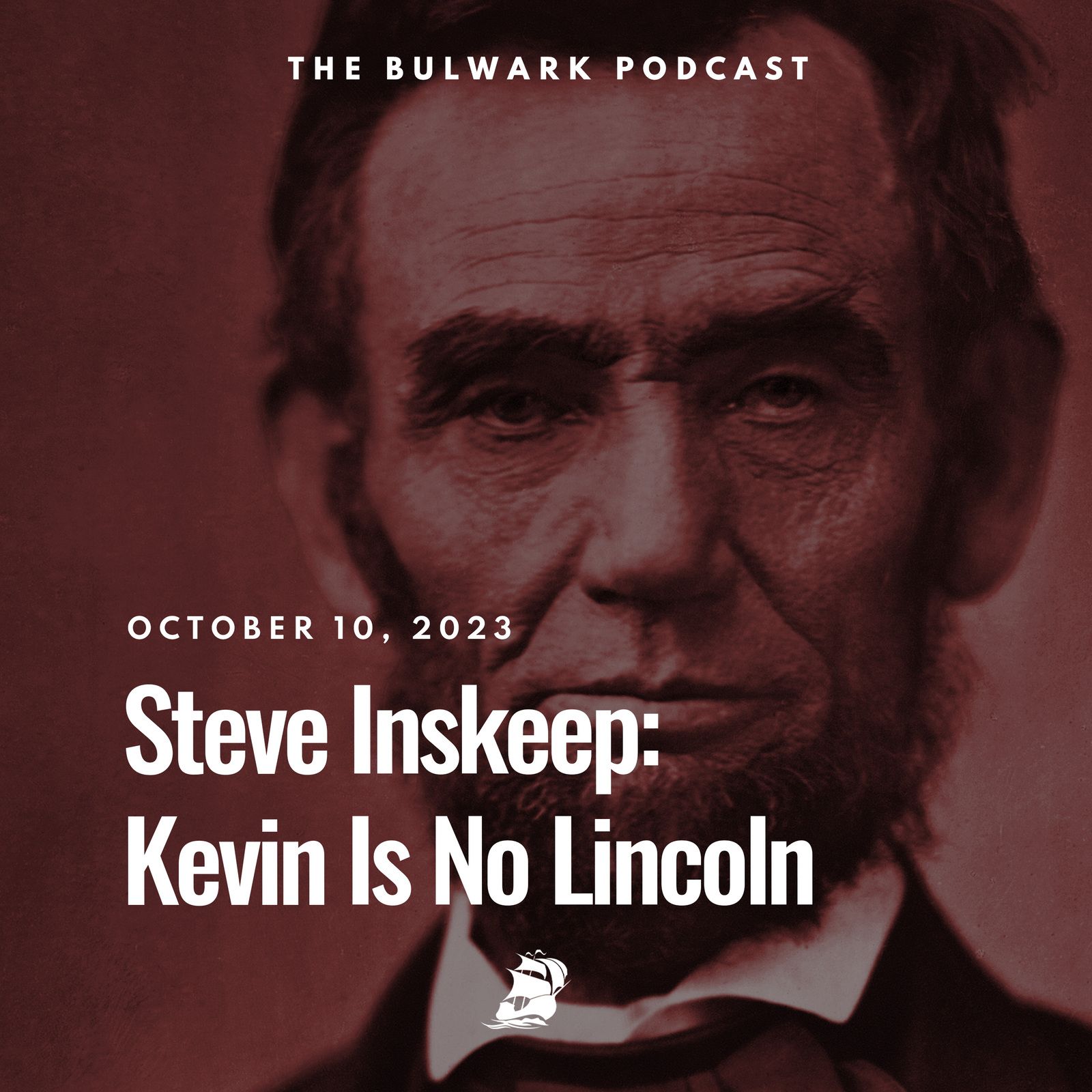
Speaker 11 We are joined today by Steve Inskeep, co-host of NPR's Morning Edition and the author of a new book out just last week, Differ We Must, How Lincoln Succeeded in a Divided America.
Speaker 11 And I have questions about that, Steve. I have questions about Lincoln succeeding in a divided America because there was that whole Civil War thing.
Speaker 10 There was a little Civil War thing.
Speaker 11 There was like 800,000 Americans that died during that Civil War.
Speaker 10 Yeah, it's pretty bad. Yeah.
Speaker 10 If you want to talk about this now, I am happy to have that raised because I am not saying in this book that Abraham Lincoln was a can we all get along guy or kiss and make up guy or peace at any price or compromise at any price.
Speaker 10 What Lincoln did, though, was when the South made war on the United States, on the Union, when the South rose in rebellion, he worked to build as broad up as possible a coalition to uphold the Constitution.
Speaker 10 He didn't try to get along with everybody, but he talked with everybody. He listened to everybody.
Speaker 10 He empathized and understood everybody he could, and he made all the allies he could, which is what democracy is about.
Speaker 11 You make the observation, I think it's the first line of the book, that Abraham Lincoln was a politician. And being a politician has become a dirty word these days.
Speaker 11 And obviously, we're thinking a lot these days about, you know, what is statesmanship? What are politics? What are we looking for?
Speaker 11 And so you emphasize the fact that Abraham Lincoln was a politician and was willing to get into the messy business of politics.
Speaker 11 He didn't mind sitting in a room and cutting deals that might have been a little sketchy in
Speaker 11 different contexts.
Speaker 10 Yeah, a little sketchy dealing with people that can feel morally perilous to deal with. We do have a very negative image of politicians.
Speaker 10 We have certain politicians whose behavior encourages us to have a very negative image of the profession. But I think sometimes we disrespect the wrong things about politics.
Speaker 10 We have this view, and I think this is true on the left and the right in somewhat different ways.
Speaker 10 The parties are not the same, but they each have a variation on this, a feeling that if you talk with the other side, if you deal with someone who differs with you at all, you are weak, you are naive because they're never going to change their mind, you are even morally tainted by the association with the other person.
Speaker 10 But the reality is that in a democracy, that other person who is wrong still has a vote, which is the way it ought to be as long as we're going to have a democracy.
Speaker 10 And so you have to deal with them because they are a person with power, a little fragment of power perhaps, but you have to deal with them on some level or outnumber them, defeat them.
Speaker 10 And outnumbering them may call upon you to make allies that you may not consider to be perfect. And I think Lincoln definitely understood that.
Speaker 10 He needed allies that he didn't agree with on everything, but maybe even just one out of 10 things they could work together.
Speaker 11 Well, he also understood that politics and government were deadly serious things.
Speaker 11 And we live in this very unserious time where, you know, you think about the things that we have been debating, the kind of, you know, food fights we've been having.
Speaker 10 Are you suggesting that it's unserious to overturn, say, the Speaker of the House of Representatives without anybody lined up to be the replacement? Is that the kind of thing?
Speaker 11
It's a radical thought. But, I mean, we have an entire class of politicians that don't think that politics is about actually doing anything.
It's all about performance. It's all about the clicks.
Speaker 11 It's all about the dopamine hits. And, you know, you go through all of the ephemera and the trivia and just the personal back and forth.
Speaker 11
And you would think that this week would be one of those massive reality checks. Look, the world is a deeply dangerous place.
You know, we are seeing this axis of evil rising up.
Speaker 11 And that maybe we have been feeling that we could indulge this kind of politics of performative demagoguery because we've been so complacent, right? That we can burn things down without consequences.
Speaker 11 What's interesting about this book is the contrast between the politics of someone like Abraham Lincoln and the politics that we are unfortunately having to endure right now.
Speaker 11 Because he understood that there were deadly consequences. It was not just a show.
Speaker 11 He just couldn't say something, you know, throw some shit up against the wall and then go on cable television that night, you know, to try to raise funds off of it. That was not what government was.
Speaker 10 I mean, I've been very interested in the course of Kevin McCarthy, the former House Speaker, because there have been a couple of moments this year where he acknowledged the seriousness of events.
Speaker 10 There was a period in which he was trying to accommodate his right wing and accommodate his right wing and keep his job and saying things that appeared to be untrue and on and on and on.
Speaker 10 But then the debt ceiling approached and he made a deal, which is what is necessary. It is the system we have in politics.
Speaker 10 I won't even say, because I'm a journalist, that it was the right thing or the wrong thing, but it is the normal and expected thing. It is the way the system is supposed to work.
Speaker 10
This happened again on September 30th. The government is supposed to stay open.
There are serious things to deal with.
Speaker 10 He could not get agreement on his own side, so he made a deal with the other side, which is the kind of thing that you do, that is the normal and expected thing in a democracy.
Speaker 10 It's recognizing the seriousness of the situation.
Speaker 10 But the second of those times, he had just enough of his colleagues in the House who had a different idea of things, that you should never compromise, that you should never make a deal, that there's never a moment that the overriding needs of the country are greater than my personal view of what my party should do, even if I can't really express what that is.
Speaker 11 And here we are. This is the moment that has been coming for so long and it's probably going to get worse.
Speaker 11 Interesting, we bring up Kevin McCarthy today because Kevin McCarthy is not willing to let this particular crisis pass. And I'm not a betting man on these things anymore.
Speaker 11 My prediction skills are quite limited.
Speaker 11 A week after he becomes the first speaker in history who's to be ousted, he's essentially saying he's willing to come back because there's a crisis in the Middle East and I'm still here, which, by the way, is, I would say, unlikely, but not impossible because right now nothing is impossible, right?
Speaker 10 Yeah, yeah.
Speaker 10 I mean, this morning, on the day that we're talking here, we spoke with Susan Davis, our excellent congressional correspondent, who sounded skeptical that McCarthy could round up the votes.
Speaker 10 There's still that hardcore that dethroned him once, who could dethrone him again. But there are also a few lawmakers who are saying, I'm not going to vote for anybody but Kevin McCarthy.
Speaker 10 And who knows what could happen? We have no idea.
Speaker 11
Yeah, I mean, the key is how do you get to 218 or 217? I lose track of how many votes you need, given the vacancies. Nobody is really close to that.
So let's come back to that just a little bit later.
Speaker 11 And I also want to come back to Lincoln a little bit later because this moment that we're in right now, where we are watching the world order be, I would say, certainly transformed.
Speaker 11 Any hope that the Middle East was going to become peaceful, that there were going to be new accords, that were going to usher in a new era of kumbaya completely destroyed.
Speaker 11 The world seems to be lining up behind Israel for the moment. We know that the retribution is going to happen.
Speaker 11 On Monday, you spoke with Ron Dermer, the former Israeli ambassador to the United States, and he put this in the context of it being Israel's 9-11, which we discussed on the podcast yesterday.
Speaker 11 So tell me what he said.
Speaker 10 Yeah, yeah, I've had an opportunity to visit Israel and the West Bank and Gaza over the years, and have interviewed Netanyahu over the years a number of times.
Speaker 10
I've tried to pay attention to that story. It really is striking what we learned about Hamas over the weekend.
I was last there in 2018, which was an occasion, you may recall this.
Speaker 10 There were Hamas people lashing out then, and their efforts were so pathetic compared to Israel's power that it was almost sad.
Speaker 10 There were random unarmed civilians effectively marching into machine guns. There were people sending kites over the Israeli lines, hoping some kind of incendiary device would set a fire.
Speaker 10 I mean, really, really weak ways to lash out at Israel.
Speaker 10 And we discovered over the weekend that they were far more capable, I think, than anybody thought, that they they had developed more capability over the last couple of years.
Speaker 10
The brutality of this is hard to get your mind around. The targeting of civilians is hard to get your mind around.
And I mean, I've been around.
Speaker 10 I covered the Pentagon on 9-11. I get that people do what people do, but it's still, I never get used to it.
Speaker 10 I never am unsurprised that someone would kill women and children or take hostages in the way that Hamas has done.
Speaker 10 And then, yes, on Monday, we interviewed Ron Dermer, who's a close advisor to Netanyahu, was the ambassador to the United States, is now their Minister for Strategic Affairs.
Speaker 10 And one of the questions in my mind, going into this interview, Charlie, as it would have been yours, I'm sure, is, what about civilian casualties?
Speaker 10 How are you going to strike this densely populated area without killing a lot of innocent civilians?
Speaker 10 And he effectively preempted my question by saying, we're going to do something very, very forceful, and we're going to kill civilians, and it's just going to happen, and you better deal with it.
Speaker 10 You better accept it. And he demanded the support of the world in spite of his expectation that civilians will be killed.
Speaker 10 I'm heart-pressed to think of another interview where someone has been that frank about the reality of damage to civilians.
Speaker 10 And of course, the Israeli defense minister has said we're cutting off food, we're cutting off water, we're cutting off electricity to a couple million people.
Speaker 10 It is an excruciating situation, the solution to which I certainly don't know.
Speaker 11 And there are hostages.
Speaker 11 There are hostages in Hamas's hands, which obviously complicate this tremendously. You know, there was once a time when it was the Israeli policy that we do not negotiate with terrorists at all.
Speaker 11
And I'm hearing a lot of that. Again, that if we negotiate for these hostages, we will simply have more hostages.
So what do they do? What happens now?
Speaker 11 What are the prospects you can rescue these people? I mean, this has been horrible, but it seems likely with your description that it's going to become even more horrible.
Speaker 10 Yeah, I mean, one possibility is that they do attempt a rescue, right? And again, I have no inside information. And if I did, it would be probably wrong of me to talk about it in public.
Speaker 10
And I don't have inside information. But we know that the Israeli military has a lot of capabilities.
They, in fact, have a history of rescuing hostages on more than one occasion. Netanyahu himself.
Speaker 10 Part of his life story is rescuing hostages who were held on a plane, being involved in that operation.
Speaker 10 It's the opening of his biography, which I got a chance to talk with him about last year when that was published. His autobiography.
Speaker 11 The Entebbe memoir.
Speaker 10
Yes, exactly. The Entebbe Raid.
And that was a long time ago, but there have been other occasions over the years.
Speaker 10 So I don't regard it as impossible that the Israelis would go in and try to get anybody they can, but it's going to be very difficult.
Speaker 10
for the very reason that Dermer was forecasting civilian casualties because it is a crowded urban area. It's not an airplane alone on a tarmac.
You have no idea what situation you may be going into.
Speaker 10 But that's one way this gets solved is a rescue. But if it doesn't get everybody, if that fails, then you have excruciating decisions to make if you were the prime minister of Israel.
Speaker 11 Okay, let's talk about the prime minister of Israel. Benjamin Netanyahu, who's been around a very, very long time, a veteran politician, has had his challenges at the moment.
Speaker 11 You know, he obviously is trying to rally the world around his support, but the failure of intelligence, the failure to stop this attack is really extraordinary.
Speaker 11 And it would be extraordinary for anyone, but especially for someone who's been around as long as Benjamin Netanyahu. So what is your sense in Israel?
Speaker 11 Are they looking at Likud and saying, you had one job? You had one job, which was to protect us. And, well, what do you think?
Speaker 10
That is one of the reactions. And I'll just report here.
Our correspondent, Daniel Estrin, is on the ground in Israel. Really, really excellent reporter.
Speaker 10 And he immediately, in talking with people who lost relatives and talking with people who have hostages now in Gaza, has found extreme anger with the government. Why would they allow this failure?
Speaker 10
I'm trying to remember back to the fog of 9-11 in the United States. And there certainly was anger at the U.S.
government for this failure. And why was George W.
Bush reading to a kindergarten class?
Speaker 10 Or whatever questions people asked. But I remember a very wise statement by Tom Ricks.
Speaker 10 Maybe he's been on this program at some point, the writer about military affairs and now historian, friend of mine, wonderful guy, he came on our air after 9-11 and he said, I'm not sure that I would want to live in a country that was ready for 9-11, meaning that the security that would have been necessary to prevent that and foresee this very creative and horrible attack would have made it almost a totalitarian state.
Speaker 10
That was his view. He would rather live in a free country and face the risk than live in an unfree country and not face the risk.
I think there were people who had that perspective.
Speaker 10
And there were also people, of course, who supported George W. Bush's response to the attacks.
His approval ratings were like 90% and remained that way for a year or two.
Speaker 10 This seems to be a different immediate reaction.
Speaker 10 Netanyahu's own government had divided the country, was pursuing an agenda that a very large number of Israelis opposed, that they were in the streets over for months and months and months, which he modified somewhat but would not abandon.
Speaker 10 And that led to anger against Netanyahu. And also,
Speaker 10
the idea of an attack out of Gaza is not a surprise. The scale and ferocity is a surprise.
At least it surprised me. I did not realize they had that kind of capability.
Speaker 10
But if you're the Israeli military, that's what you're paid to know. And they knew just where the enemy was.
And so there is some anger.
Speaker 11 It is incomprehensible. Now, there's a long and complicated history, which I don't want to go deep down the rabbit hole.
Speaker 11 But Israel has, in many ways, well, encouraged Hamas in the past, that they saw Hamas as a counterweight to the Palestinian Authority, which has been weak.
Speaker 11 And as a result, there's been a little bit of pussyfooting around with Hamas, a little bit of appeasement of Hamas. So that policy now has been utterly discredited.
Speaker 11 Obviously, a certain amount of naivete on the part of the Netanyahu administration, that they thought that Hamas was not posing an immediate threat, that they gave work permits to people in Gaza somehow, that that would lessen the pressure.
Speaker 11 So they obviously did not understand what was about to happen in terms of the logistics of this attack, the missiles, the hang gliders, the bulldozers, all of that.
Speaker 11 But they also completely misread the mood of Hamas. I mean, so this is like a multiple cascading series of failures, isn't it?
Speaker 10
Yeah, yeah. I mean, I don't want to comment too thoroughly on the history.
I mean, there are people who will say Israel created Hamas. I just can't verify that sitting here.
Speaker 10
But in any case, Israel has dealt with Hamas. There's an argument to be made that Israel needed to deal with Hamas because it's just a reality.
They were there. They controlled some territory.
Speaker 10 It's territory that Israel withdrew from in 2005 and did not find it in its continuing interest to have a troop presence literally inside of Gaza. And so they pulled away and built their walls.
Speaker 10 And Hamas is there, and you have to deal with them in the same way that you would have to deal with any group of people or just realities like the weather.
Speaker 10 I mean, it's a reality that there are these people who live there and feel that Israel is, or many of them feel that Israel is an illegitimate state, and also know, as just a matter of literal fact, that they don't have equal rights, don't have freedom of travel, don't have a very free economy, and are surrounded by walls.
Speaker 10 So you have this group that you need to deal with. And they did make an effort when possible to deal with Hamas and to deal with Palestinians in the West Bank, at least economically.
Speaker 10 This was part of Netanyahu's policy during his prior prime ministerships and part of what he's at least spoke for in the present one, that he was happy to encourage prosperity for Palestinians, but less and less willing to allow anything that looked even remotely like independence for Palestinians.
Speaker 10 I don't blame them for trying to deal with Hamas just as a reality, but they did not see the attack coming, that's for sure.
Speaker 11 So this is a far-right government.
Speaker 11 And since we're going to be talking about politics and the messy business of politics, Netanyahu presides over a far-right government that has engaged in, you know, has pushed policies that have really torn this country apart.
Speaker 11 I mean, there was actually talk about the possibility of maybe metaphorical civil war, but you had people in the security services, people in the military who were saying that, look, this is weakening the country.
Speaker 11
This is making the country more vulnerable. This was as divided a country as we have seen since, I think, 1948.
You may have a different impression.
Speaker 11 So to what extent did that contribute either to Hamas's perception that Israel was weak and divided, or to the reality that, in fact, Detanyahu and his small circle had become so isolated from the security services or people in the military that they weren't listening, that they weren't paying attention, that they had become disconnected from this apparatus.
Speaker 11 What do you think?
Speaker 10 I am reluctant to draw that conclusion, as many people instantly did, because you want to report, you want to be based on facts. But the reality is that the government did have a giant distraction.
Speaker 10
a very divisive distraction. I think about this often in terms of the United States.
I even think of it in terms of the story of Lincoln.
Speaker 10 We create these giant distractions for ourselves, and we really need to be worrying about other things.
Speaker 10 Why did we spend the spring in a pointless debate over the debt ceiling when we needed to be paying attention to China?
Speaker 10 Why did we almost have a government shutdown when we needed to be paying attention to things?
Speaker 10 Why did we then have a deposing the Speaker of the House and freezing the House of Representatives when there might be a crisis any minute and suddenly there was one?
Speaker 10 Why are we having a lot of the arguments that we have over cultural memes and social media messages when there are other more serious things to argue about? This is a question that I have.
Speaker 10
My research about Lincoln makes me think about this too, because Lincoln tried to focus on one central goal. He's the president of the United States.
There was a rebellion. He wanted to focus on that.
Speaker 10 He wanted to keep people united on that one goal, preserving the Union. He tried to shove other controversies to the side, not always successfully, but he was trying for the one big goal.
Speaker 10 And while I am reluctant, as I said, to say the distraction in Israeli society made them more vulnerable, it is no doubt, though, a distraction from serious threats that they were aware were in the neighborhood.
Speaker 11 I thought it was interesting what Ambassador Dermer told you when he was describing this forceful response. He said, The last time we saw something like this was when ISIS came out on the stage.
Speaker 11 You saw that in the trucks with these fighters wearing the jihadi banners going in indiscriminately mowing down people.
Speaker 11 This is an interesting analogy that what we are seeing is kind of ISIS writ large. We're seeing this new style of just pure raw terror, aren't we?
Speaker 10 I don't know what to make of the civilian casualties here. Like I said, no matter how often it happens, I never get used to it.
Speaker 10 And there is a bit of an analogy here as well, because we're talking about a group that has an identifiable strip of territory that they control. And that complicates the challenge of addressing it.
Speaker 1 Get Ready for Malice, a twisted new drama starring Jack Whitehall, David DeCovney, and Carice Van Houten.
Speaker 1 Jack Whitehall plays Adam, a charming manny infiltrates the wealthy Tanner family with a hidden motive to destroy them.
Speaker 1 This edge-of-your-seat revenge thriller unravels a deliciously dark mystery in a world full of wealth, secrets, and betrayal. Malice will constantly keep you on your toes.
Speaker 1 Why is Adam after the Tanner family? What lengths will he go to? One thing's for sure, the past never stays buried, so keep your enemies close.
Speaker 1 Watch Malice, all episodes now streaming exclusively on Prime Video.
Speaker 2 California has millions of homes that could be damaged in a strong earthquake.
Speaker 4 Older homes are especially vulnerable to quake damage, so you may need to take steps to strengthen yours.
Speaker 5 Visit strengthenyourhouse.com to learn how to strengthen your home and help protect it from damage.
Speaker 7 The work may cost less than you think.
Speaker 8 and can often be done in just a few days.
Speaker 6 Strengthen your home and help protect your family.
Speaker 9 Get prepared today and worry less tomorrow.
Speaker 5 Visit strengthenyourhouse.com.
Speaker 11 Let's talk about Lincoln. What I find fascinating about this is, of course, we feel that we live in these incredibly divisive, dangerous times, which I think is true.
Speaker 11 I do think that there's a challenge to a national unity that is as great as anything we've seen in decades.
Speaker 11 And so I think it's very valuable to look back at other moments of crisis and division in American history and how we got through it, it often does feel that the decade that seems most parallel to what we're going through right now might be the 1850s.
Speaker 11 What do you think of that analogy? This is the country bubbling, bubbling, bubbling, and the divisions becoming
Speaker 11 more and more raw.
Speaker 10 I think there's a little something to that analogy. I mean, this is the third book I've written on 19th century America.
Speaker 10
I wrote a thing about Andrew Jackson, the Cherokees, John Ross, the Cherokee chief. I wrote a thing about an 1850s presidential candidate, John John C.
Fremont, and his wife, Jesse.
Speaker 10 And now I've written this Lincoln book where a lot of the action takes place in the 1850s.
Speaker 10 And maybe one of the reasons I've come to dwell on that part of history is because I feel the parallels as a news reporter covering the news today.
Speaker 10 It was an increasingly divided time, an ideologically divided time, a culturally divided time, an economically divided time, and a time when people were arguing over questions like equality and who belongs in America and who does not.
Speaker 10 And you can feel the similarities to today when you read the rhetoric that people use. The issues are different, but somehow the approaches and appeals to other human beings are the same.
Speaker 10 I want to do one caveat before we go on. And that is people say, well, you think we're heading for a new civil war? And at this time, I do not.
Speaker 10
Because I feel that so many of our disputes are almost about nothing. They're pointless.
They're performative, to use your excellently chosen word.
Speaker 10 And it's just hard to see people going to civil war over whose house speaker or, you know, over the debt ceiling.
Speaker 10
It's just hard to see some of these things being as gigantic and cutting through society as slavery. But political violence, I think, is very possible.
Just not a civil war, civil war.
Speaker 11 So it may not be a civil war between states, but among within the states, between red and blue. I mean, so what is the context of January 6th? Because that was a violent uprising.
Speaker 11 And we do have this buzz about secession.
Speaker 10 Yeah, yeah, no, I mean, I think the idea of some political violence is very possible because that's really a lot of American history.
Speaker 10 Even if you set aside the giant Civil War where people raised armies and sent armies against one another, the more than a decade after the Civil War included tremendous political violence across the southern United States as black people gained the right to vote and then progressively lost the right to vote and got to serve in office and then progressively were kicked out of office, often through various kinds of violent uprisings and terror campaigns.
Speaker 10 And we could go all through history, I mean, labor disputes that become violent, the civil rights movement, tremendous violence in the 19th century. We could just go on and on.
Speaker 10
There's a lot of political violence in this country. I think that more of it is to be expected because of that history and because of January 6th.
I'm not saying it's all going to be peaceful.
Speaker 10
and all going to work out. I'm just making that limited claim that it's hard to see.
I do not at this time foresee the events that would break the country apart.
Speaker 10 Check back with me in a year and I'll let you know.
Speaker 11 Okay, so we started off talking about Lincoln's political skills because, and I want to talk about in terms of, you know, that he was a politician.
Speaker 11 And this is something that I think is, that's what's interesting about your book, that you focus in on that at a time when politics is in very, very bad order. So what were Lincoln's political skills?
Speaker 11 I mean, you talk about how he wouldn't ostracize people.
Speaker 11 He didn't have this puritanical approach to politics where he thought that we, you know, he should separate himself from people that he disagreed with.
Speaker 11 So talk to me a little bit about that because the flip side, of course, is that this is the man that presided over the absolute division of the country in which we killed hundreds of thousands of one another.
Speaker 11 So how do we reconcile those two things?
Speaker 10
Absolutely. I mean, he did not virtue signal.
He was not about showing that he was the most proper person with the most progressive views.
Speaker 10 He did not demonize people.
Speaker 10 He was arguing over the greatest moral issue, arguably, that the country has ever faced, slavery, and he considered slavery a moral outrage, but he didn't act like he was morally superior to other people or even tell his supporters to.
Speaker 10 There's a quote from a speech in 1854.
Speaker 10 He's in the free state of Illinois, so he's talking to an audience that at least notionally opposes slavery, but they probably got relatives and cousins back in Kentucky and other places that practice slavery.
Speaker 10 And he actually says, if we were in the place of slave owners, we might do exactly as they do. And if they were in our place, they might do exactly as we do.
Speaker 10 Essentially, he was saying people are shaped by their environment. They're shaped by their circumstances and their interests.
Speaker 10 And slaveholders had, in many cases, inherited a centuries-old system, which they naturally defended out of self-interest. So I think there's something really powerful in that that's really useful.
Speaker 10 I mean, I got a chance to talk just the other day about this book in a church.
Speaker 10 And I was thinking about that idea of all of us as being flawed, none of us being perfect, all of us having imperfect beliefs on race or anything else that probably will be outdated in 10 years anyway, whatever is we think is proper now.
Speaker 10 But what Lincoln was willing to focus on, rather than the individuals, was a system that degraded human beings and corrupted human beings and had to change. So that was one thing.
Speaker 10 I'll mention another thing. Having taken this kind of modest view that he wasn't like morally superior to everybody, he thought about who he was speaking with.
Speaker 10 He empathized with them and he considered their interests, their self-interest in many cases.
Speaker 10 He had this view of humanity that everybody is guided in some sense by self-interest, which sounds really grim, but it's also understandable because if we don't look after our interests, then somebody has to.
Speaker 10 And so he would shape his arguments to appeal to that.
Speaker 11 No, that's interesting. I mean, you point out that he spoke carefully.
Speaker 11 He did not demonize his opponents and he shied away from the most radical responses to slavery because he had this, you know, this is their self-interest. This is our self-interest.
Speaker 11 He had the moral principle, but he was careful not to do that.
Speaker 11 In practical terms, I could certainly imagine him today, you know, being accused of being too squishy, too soft, too willing to not, you know, because he was an incrementalist.
Speaker 11 He wanted to abolish slavery, but he was very pragmatic and in some ways kind of conservative in his approach to it.
Speaker 10 People used the word conservative, and I don't think they used the word squish, but people talked about him that way at the time.
Speaker 10 If you were a radical abolitionist, you might be suspicious of Abraham Lincoln and what he really stood for, and the fact that he would also be like friends with slaveholders.
Speaker 10 And he also had views that we would consider objectionable, like maybe black people should move to some other country and be free there.
Speaker 10 There's a lot there to object to, but he was also a constitutionalist. He believed in the Constitution.
Speaker 10 He believed the Constitution limited what he could get away with in terms of attacking slavery in states that practiced it.
Speaker 10 So he wanted to do the maximum that was politically and legally possible with a hope that slavery would someday end.
Speaker 1 Get Ready for Malice, a twisted new drama starring Jack Whitehall, David DeCovney, and Carice Van Houten.
Speaker 1 Jack Whitehall plays Adam, a charming manny infiltrates the wealthy Tanner family with a hidden motive to destroy them.
Speaker 1 This edge-of-your-seat revenge thriller unravels a deliciously dark mystery in a world full of wealth, secrets, and betrayal. Malice will constantly keep you on your toes.
Speaker 1 Why is Adam after the Tanner family? What lengths will he go to? One thing's for sure, the past never stays buried, so keep your enemies close.
Speaker 1 Watch Malice, all episodes now streaming exclusively on Prime Video.
Speaker 2 California has millions of homes that could be damaged in a strong earthquake. Older homes are especially vulnerable to quake damage, so you may need to take steps to strengthen yours.
Speaker 5 Visit strengthenyourhouse.com to learn how to strengthen your home and help protect it from damage.
Speaker 8 The work may cost less than you think and can often be done in just a few days.
Speaker 6 Strengthen your home and help protect your family.
Speaker 9 Get prepared today and worry less tomorrow.
Speaker 5 Visit strengthenyourhouse.com.
Speaker 11
So the stories in the book. I mean, the book is, you know, differ, we must.
And you use 16 encounters with 16 different people that he disagreed with, that he was willing to sit down with.
Speaker 11
So let's talk about some of these 16. You talked about Joshua Speed years before the war.
Another one of these face-to-face encounters was Frederick Douglass in August 1863.
Speaker 11 So what were they differing about? How did that go? Abraham Lincoln and Frederick Douglass in the midst of the Civil War.
Speaker 10 Yeah, yeah this is one of my favorite encounters uh douglas uh and i guess we should clarify because people get confused there's stephen douglas a senator that lincoln debated and the lincoln not to be confused yeah exactly really not not good views on slavery and frederick douglas who escaped from slavery and became a writer and orator and had an extra s on his name and was just an amazing figure because he was working both the inside and the outside.
Speaker 10 On the outside, he was very critical of Lincoln for the reasons we just said. Why are you so slow to abolish slavery? Why are you not doing more?
Speaker 10 Why do you not understand what obviously is necessary as the South goes to war?
Speaker 10 But on the inside, he supported Lincoln's Republican Party, which he knew was anti-slavery, not as radical as he wanted it to be, but he was pragmatic too and said, this party has a chance to win, which they did win.
Speaker 10 And this party is in power, and so they can do things, and I support them.
Speaker 10 And when Lincoln did finally issue the Emancipation Proclamation, Douglas took part in helping to recruit black men for the United States Army.
Speaker 10 He then felt that Lincoln's administration was failing to provide equal treatment, equal pay, and other things to those black soldiers.
Speaker 11 So the black soldiers were not being paid the same as the white soldiers?
Speaker 10 Barely more than half, and they couldn't be promoted as officers the way that white men could, and they had other disadvantages.
Speaker 10 Douglass went to Lincoln at the White House to protest, to tell Lincoln off. And they ended up having a really remarkable discussion that Lincoln handled in a very effective way.
Speaker 11
Okay, so he basically explained the politics. He said he would fix it, which he eventually did.
How do we know about that conversation? It's a private conversation.
Speaker 10
It's a private conversation. This is true with all of these.
And in fact, I might have chosen other meetings had there been better records of just what was said.
Speaker 10 In this case, there's a documentary record that includes several accounts by Frederick Douglass himself.
Speaker 10 He wrote a contemporaneous letter like a day or two afterward to the head of military recruiting, the guy who was basically his boss as a recruiter.
Speaker 10
And so that seems like a fairly reliable source that has a lot of really fascinating detail. And then he spoke about it other times.
He talked about it in speeches a few months later.
Speaker 10 He wrote an article about this decades later in the 1880s, I believe.
Speaker 10 So there are differing accounts that give different details and you have to sift it a little bit and you have to be a little bit careful.
Speaker 10
There are other things as well, documents that came out of that meeting that can be used to produce the context. But that was a challenge with all of these 16 meetings.
How much do I believe?
Speaker 10 How long after the meeting did somebody write down an account of it? How do I reconstruct Lincoln's view of it?
Speaker 10 Sometimes Lincoln left an account of it, but of course, Lincoln did not live to write a memoir. So some of these meetings, we don't have Lincoln's side at all.
Speaker 10 I try to do this with all my history. I try to choose occasions where I can document things that happened reasonably well so that we can have a fact-based discussion rather than speculating.
Speaker 11 So, speaking of speculation, and this, of course, is a hypothetical that we've wondered about for a very, very long time.
Speaker 11 If Lincoln had lived,
Speaker 11
would Reconstruction have played out differently? And how would it? Because that was such a disaster. The country was one of the ugliest periods in American history.
I know we try to gloss over it.
Speaker 11 There's a big debate about how we teach it in schools, but the degree of political violence, the backsliding on racial equality, it was horrific.
Speaker 11 Just give me your thoughts about if Lincoln had lived, which, of course, we don't know the answer definitively.
Speaker 10 Yeah, I guess I should spend just a few seconds explaining the thing that was wrong with Lincoln being killed, aside from him being killed.
Speaker 10 He was replaced by a vice president who turned out to be politically very different than him, Andrew Johnson of Tennessee. W.E.B.
Speaker 10 Dubois has this great history of what he calls Black Reconstruction that has a very long and sympathetic chapter about Andrew Johnson that ultimately scourges him because he deserved it.
Speaker 10
But Johnson was an interesting guy. He was a poor white man.
He was in favor of the poor.
Speaker 10 He had a very populist mindset and was pro-union at a time when it was very hard and a state tried to leave the union.
Speaker 10 But at the end of the Civil War, when he became president, he was turned away from all of that and was played upon by Southern sympathizers essentially to put his prejudice first.
Speaker 10 His prejudice against black people first.
Speaker 11 And he was a deeply racist figure, right? I mean, he was... He was
Speaker 10 fantastically racist. And
Speaker 10 honestly, a lot of people, even the so-called good people in this era, are often racist by our standards, but he was a particularly bad one.
Speaker 10 And he wanted the South to remain as close to the past as it had been without technically slavery. But he was not willing, for example, to allow black men the vote.
Speaker 10 It seems clear to me that Lincoln, as a president, would have approached things differently.
Speaker 10 He also, as we noted, said things that just by definition are racist to us, but was in favor of equality, was in favor of all the equality that you could get away with politically at any given time, was talking about getting black men the vote in the very last speech of his life, and had committed to people like Frederick Douglass that having staked out a position, he was not going to back up.
Speaker 10 It might still have been a disappointing and violent period that might have turned out about as it did because Lincoln would not have been president forever.
Speaker 10 But he definitely would have taken a different approach and a more supportive approach to equality in those almost four years that he should have had left as president.
Speaker 11 Aaron Powell, Jr.: And circling back to the fact that he was a very, very skilled politician.
Speaker 11 And I know you gave an interview to a Boston NPR affiliate and talked about the central understandings that Lincoln had about politics was that you needed a majority.
Speaker 11 You needed to actually win elections.
Speaker 11 And you brought this around with the interviewer to talk about what's happening with the House of Representatives that House Republicans seem to have lost the narrative, right?
Speaker 11 Yeah, I mean, it's they don't seem to understand that you need a majority to get anything done. And that means you need to make some compromises you might not like.
Speaker 10 Yeah, I feel that they blew it three times here, really, Charlie. And the first is the way they ran in 2022.
Speaker 10 They expected a much bigger majority, but didn't run the right kind of candidates and the right kind of campaign to get that. So they had a very small and vulnerable majority.
Speaker 10 McCarthy ended up getting a majority for the speakership, but not, it turns out, in a stable or lasting way.
Speaker 10
And then that's two. And then the third is Matt Gates.
I mean, congratulations to him.
Speaker 10 He achieved his objective, but he doesn't have a majority either, which is why nobody knows what's going to happen here.
Speaker 11 Matt Gates may not care about having a majority.
Speaker 11 So in the same interview that, and I was very interested in your comments, you know, one of the dilemmas these days covering American politics is, and I'm going to ask you as a prominent member of the media, how do we cover Donald Trump?
Speaker 11 It is a unique problem.
Speaker 11 I mean, you said you're happy to say the former president is alleged to have committed a crime, but I'm not going to try to pretend that I don't already know that he tried to overturn the election that he lost.
Speaker 11
I know how difficult it is to deal with someone who lies as aggressively and consistently as Donald Trump does. But do you think, and I'm asking you to put your media critic hat on now.
Sure.
Speaker 11 Has the media figured out how to cover Donald Trump? Have they learned anything from 2016? Because I'm not convinced they have.
Speaker 10
Well, I mean, you may be right about that. I mean, Trump drives a lot of clicks and a lot of attention, and it's very tempting to go into that.
I think that first you need to cover Trump.
Speaker 10 And there are some people who will say, don't cover him, don't pay attention to him.
Speaker 10 We got some criticism when I interviewed Donald Trump in 2022, and I asked him some hard questions, and he hung up on me. But I think it was right to cover Trump.
Speaker 10
I think it was right to talk to Trump because, I mean, think about this for a minute. Like, we were just talking about Israel and Hamas.
I'm going to cover Hamas. I've been to Gaza.
Speaker 10 I've talked to Hamas guys. Why would I not talk to them? They are doing things that we need to pay attention to with lives at stake.
Speaker 10 That doesn't mean I'm carrying their propaganda, but I want to understand what's going on over there in every way that I possibly can.
Speaker 10 And in the same way, of course, I'm also going to talk to an American political figure, even if he attempted to overturn his 2020 defeat, which he obviously did. And I'm going to cover him.
Speaker 10
But I want to cover him and anybody. This goes for Joe Biden.
It goes for anybody. I want to cover them in context.
I want to pay attention to what they're saying and failing to say.
Speaker 10 I want to pay attention to what's true and false.
Speaker 10 And when I present all of that on the air, I want to make sure that it comes with enough information and enough context that anybody listening can understand who's lying and who's telling the truth and they can make their own judgment about who makes sense.
Speaker 11 Okay, so I should remember this, but what did you say to him that made him hang up on you?
Speaker 10 It was a series of questions having to do with the 2020 election.
Speaker 10 I don't know that it was any one question particularly, but he made a number of false statements and I kept correcting him and then asking further questions and he didn't like that and we were scheduled for 15 minutes and he hung up after a little less than 10.
Speaker 10 okay i just wanted to play a little bit of that how come when he went to speak in different locations nobody came to watch but all of a sudden he got 80 million votes if you believe if you'll forgive me maybe because the election was about you if i can just move on to ask are you telling republicans in 2022 that they must press your case on the past election in order to get your endorsement is that an absolute
Speaker 12 whatever they want to do. Whatever they have to do, they're going to do.
Speaker 12
But the ones that are smart, the ones that know, you take a look at, again, you take a look at how Carrie Lake is doing running for governor. She's very big on this issue.
She's leading by a lot.
Speaker 12 People have no idea how big this issue is, and they don't want it to happen again. It shouldn't be allowed to happen, and they don't want it to happen again.
Speaker 12 And the only way it's not going to happen again is you have to solve the problem of the presidential rigged election of 2020.
Speaker 10 Mr. President,
Speaker 10
one more question. I want to ask about a court hearing yesterday on January 6th.
Judge Amit Mehta, he's gone. Okay.
Speaker 11 So interestingly, Steve, my one and only time that I interviewed Donald Trump, he didn't hang up on me, weirdly enough, back in 2016.
Speaker 11 But one of the points that I tried to make with him, and I was trying to get my head around, you know, this was when he was making fun of Ted Cruz's wife and how she was ugly.
Speaker 11 And the thought that came to my mind was that, and I asked him about this, I said, you're running for the the office that Abraham Lincoln once held, because in that moment, I had the contrast, and this is how that exchange went.
Speaker 11 Is this your standard that if a supporter of another candidate, not the candidate himself, does something despicable, that it's okay for you personally, a candidate for president of the United States, to behave in that same way?
Speaker 11 I mean, I expect that from a 12-year-old bully on the playground, not somebody who wants the office held by Abraham Lincoln. So we both had our Trump encounters, our Trump-Lincoln encounters here.
Speaker 11 So, Steve, having studied all of this and immersed yourself so deeply in the 19th century American history, while you're covering what we're going through right now,
Speaker 11 how optimistic/slash hopeful are you? What will it take to get out of this moment? For Abraham Lincoln, it took a horrific civil war. What's it going to take for us? What do you think?
Speaker 10
I think that it requires persistent application of the principles of democracy. Lots of people walk around saying they're worried about democracy.
We don't need everybody to be an ally in that cause.
Speaker 10 We do need a majority to be an ally in that cause. And that may call for difficult compromises or reaching across to make allies.
Speaker 10 I mean, I think about someone like Liz Cheney, who ultimately lost her job over this,
Speaker 10 but worked with the committee that was investigating January 6th and produced a voluminous public record of it on a bipartisan basis, even though she was dealing with people who, if the issue were different, they'd be profoundly on different pages.
Speaker 10 And I think there were even people who kind of despised Cheney for things that she had said on various issues over the years. You need to build a majority.
Speaker 10 That means reaching out to lots of different kinds of people.
Speaker 10 If you think about this from a Democratic perspective, in 2024, Democrats are going to lose the Senate unless they do reasonably well in a number of states that are more conservative and even support senators who progressives can't stand.
Speaker 10 And if you think about it from a Republican perspective, Republicans are likely to lose the presidential election unless they can persuade suburban voters who used to be Republicans that they're not way too extreme.
Speaker 10 And so each party really has a coalition building problem, and whoever's the better coalition builder is likely to win.
Speaker 11 But when we talk about democracy, we're not just talking about majorities, are we? We're also talking about the rule of law. We are a liberal constitutional democracy.
Speaker 11 And one of the key things that I took from your book about Abraham Lincoln was he was a very good politician, understood the need for majorities, but he was also, as you point out, a constitutionalist.
Speaker 11 And we're going to be stress testing the rule of law and whether or not the Constitution does have the guardrails that the founders thought they were putting in place to deal with someone like a Donald Trump.
Speaker 10
Yeah, and honestly, I mean, ultimately, Charlie, I think you know this really well. The guardrails are great.
We have lots of them. But ultimately, the guardrails are people.
Speaker 10
We need people in institutions to support support the institutions. We need a public that broadly understands that we have constitutional institutions.
We may have to swallow things that we hate.
Speaker 10
I mean, Lincoln even said the Fugitive Slave Act of 1850, a horrible law. He said, okay, I hate it, but it's the law.
It's constitutional. I'm not going to argue about it.
It is the law.
Speaker 10 Lincoln said another thing, though, that I think is kind of inspirational when he was elected and before he was inaugurated and southern states were beginning to claim that they they had left the union, he said, there's no way that I can accept this because my job, my constitutional responsibility is to, quote, run the machine as it is.
Speaker 10
That is our first obligation as citizens. We have inherited this machine.
It's worked up to now. And our first job is to run that machine as it is.
Speaker 11 The book is Differ We Must, How Lincoln Succeeded in a Divided America. Steve Inskeep, of course, is co-host of NPR's Morning Edition and its up first podcast.
Speaker 11 Thank you so much for joining us on the Bullwork Podcast today, Steve.
Speaker 10 It's an honor, Charlie. Thank you so much.
Speaker 11
And thank you all for listening to today's Bullwork Podcast. I'm Charlie Sykes.
We'll be back tomorrow, and we'll do this all over again.
Speaker 11 The Bullwork Podcast is produced by Katie Cooper and engineered and edited by Jason Brown.
Speaker 11
This is Matt Rogers from Lost Culture Eastas with Matt Rogers and Bowen Yang. This is Bowen Yang from Lost Culture East with Matt Rogers and Bowen Yang.
Hey, Bowen, it's gift season.
Speaker 11
Ugh, stressing me out. Why are the people I love so hard to shop for? Probably because they only make boring gift guides that are totally uninspired.
Except for the guide we made.
Speaker 11 In partnership with Marshalls, where premium gifts meet incredible value, it's giving gifts.
Speaker 11 With categories like best gifts for the mom whose idea of a sensible walking shoe is a stiletto or best gifts for me that were so thoughtful I really shouldn't have.
Speaker 11 Check out the guide on marshalls.com and gift the good stuff at Marshalls.
Speaker 2 California has millions of homes that could be damaged in a strong earthquake.
Speaker 4 Older homes are especially vulnerable to quake damage, so you may need to take steps to strengthen yours.
Speaker 5 Visit strengthenyourhouse.com to learn how to strengthen your home and help protect it from damage.
Speaker 8 The work may cost less than you think and can often be done in just a few days.
Speaker 6 Strengthen your home and help protect your family.
Speaker 9 Get prepared today and worry less tomorrow.
Speaker 5 Visit strengthenyourhouse.com.
Speaker 11 At CVS, it matters that we're not just in your community, but that we're part of it. It matters that we're there for you when you need us, day or night.
Speaker 11 And we want everyone to feel welcomed and rewarded. It matters that CVS is here to fill your prescriptions and here to fill your craving for a tasty and yeah, healthy snack.
Speaker 11
At CVS, we're proud to serve your community because we believe where you get your medicine matters. So visit us at cvs.com or just come by our store.
We can't wait to meet you.
Speaker 11 Store hours vary by location.