Ruy Teixeira: Biden’s Working Class Blues
Press play and read along
Transcript
Speaker 1 Master distiller Jimmy Russell knew Wild Turkey Bourbon got it right the first time. Mellowed an American oak with the darkest char.
Speaker 1 Our pre-prohibition style bourbons are aged longer and never watered down, so you know it's right too for whatever you do with it.
Speaker 1 Wild Turkey 101 bourbon makes an old-fashioned or bold fashion for bold nights out or at home. Wild Turkey bourbon aged longer, never watered down to create one bold flavor.
Speaker 1 Copyright 2020 Black Capital American, the York New York, never compromised drink responsibly.
Speaker 3 Even though severe cases can be rare, respiratory syncytial virus, or RSV, is still the leading cause of hospitalization in babies under one.
Speaker 3 RSV often begins like a cold or the flu, but can quickly spread to your baby's lungs. Ask your doctor about preventative antibodies for your baby this season and visit protectagainstrsv.com.
Speaker 3 The information presented is for general educational purposes only. Please ask your healthcare provider about any questions regarding your health or your baby's health.
Speaker 5
Welcome to the Bulwark Podcast. I'm Charlie Sykes.
Okay, it is time for tough love. I know you didn't wake up today saying, hey, I hope the Bulwark podcast has some tough love.
Speaker 5
You know, I want more fan service. I want you to tell me that everything is going to be okay.
Well, I'm sorry. to tell you you've probably come to the wrong place.
Speaker 5 We are joined by my good friend, Rui Tushera, senior fellow at the American Enterprise Institute, where he focuses on the transformation of party coalitions.
Speaker 5 Rui, you have been in progressive politics for a very, very long time. You bring a lot of street cred to this.
Speaker 5 But as I was mentioning to you right before we started, there's a lot of resistance, isn't there, to the tough love trying to explain to Democrats why you have a problem on economics, why you have a problem when it comes to the working class.
Speaker 5 I just sense that there is this sense of denialism that's kind of, you know, built in, and we're going to get lots of comments saying, well, I don't want to listen to all of this because if we just put our heads in the sand, apparently the argument is, if we just put our heads in the sand about these difficulties, they will just go away.
Speaker 5 They will magically go away. But you're sounding the alarm for a reason, right?
Speaker 6 Yeah, I'm sounding the alarm for a very good reason, which is, you know, the Democrats are in a heap of trouble.
Speaker 6 Anyone who pays the remotest attention to the polls must realize that we are in this extraordinary situation where donald j trump appears likely to be the nominee of the republican party and donald j trump also appears like he could
Speaker 6 he could very very much uh possibility he could beat joe biden the current maximum leader of the united states and you know this this should be frightening to people people should be asking themselves anyone who's a democrat should ask themselves well if he's so bad,
Speaker 6 he was such a bad president, he's such a bad man, there's so many things wrong with him and his party, why
Speaker 6 at this point are the Democrats at best kind of in this stalemate with him? I mean, if he's this apotheosis of evil, why is that happening?
Speaker 6
And I think the most parsimonious explanation is people don't much like the Democratic Party. that much either.
And then you have to ask yourself, well, why is that?
Speaker 6 And why are working class voters in particular unenthusiastic about the Democrats and giving Trump the majority of their votes?
Speaker 6 And why are the Democrats even losing votes among non-white working class voters? Something's going on here.
Speaker 7 Right, right.
Speaker 5 Something is going on here.
Speaker 5 And I think there's been a lot of analysis of
Speaker 5 what's happened to the working class vote. But I don't think there's been sufficient introspection.
Speaker 5 on the part of Democrats saying, okay, so why is it that millions of voters from the Democratic coalition have left? It leads us to this moment.
Speaker 5 Okay, Okay, let me just take a step back because we are in the midst of a Democratic freak out. Now, I want to sort of break out the legitimate concerns versus just the bedwetting, right?
Speaker 5 So, the big headline in the Washington Post today that everybody's talking about that's leading the Drudge Report is the headline is, Anxiety ripples through the Democratic Party over Biden.
Speaker 5 A growing number of polls are showing voters concerned about President Biden's age and energy. Democratic lawmakers have hesitated to offer full-throated endorsements of his running mate.
Speaker 5 Prominent commentators have ruminated on whether he should drop out of the presidential race.
Speaker 5 This series of political vulnerabilities, along with House Republicans announcing an impeachment inquiry and the Justice Department indicting Biden's son on gun charges, is now sending waves of anxiety through parts of the Democratic Party as some fret about whether the man who helped oust Donald Trump from the White House may not have the vitality at 80 to successfully prevent a return.
Speaker 5 So now there's the moment people are going, how could we possibly lose to this guy? And I want to leave the age issue aside because I think we've done that.
Speaker 5 Let's talk about what you just mentioned, Bidenomics and the working class voters.
Speaker 5 I mean, you, you've written that it is important for Democrats to understand just how poorly the Biden economy has played with working class voters so far.
Speaker 5 I mean, and you cite this Quinnipiac poll, found that Joe Biden has a 25% approval rating on the economy among white working class non-college voters versus 52% approval on the economy among white college grad voters.
Speaker 5
Now, there are some people who will say, well, that's just because they're dumb. They don't know what's understated.
They can't read the numbers. They're missing this.
So tell me what's happening.
Speaker 5 And it's not just Joe Biden, is it? You've been tracking this now for years, this long erosion of support among the working class. So how does the white working class look at Bidenomics right now?
Speaker 6 They look at Bidenomics from the standpoint of what I might waggishly call their lived experience.
Speaker 6 And their lived experience of Bidenomics
Speaker 6 has been, the real world has not been great. Now, I know that the standard democratic take on this tends to be, well, you know, it's misinformation, the media is not covering this stuff right.
Speaker 6 Look, unemployment's down, inflation is abating, you know, all this cool stuff is happening.
Speaker 6 You know, they're they're building battery plants you know and and why aren't people suitably grateful for that well the fact of the matter is that they experienced a spike in inflation that is greater than most of these voters have ever experienced and if you look at their actual you know family incomes if you look at their wages they've really gotten nowhere under Biden.
Speaker 6 In fact, they went down for a while because the real purchasing power went down because of inflation.
Speaker 6 Inflation is still running a bit hotter than normal, and gas gas prices are starting to go up again.
Speaker 6 And it's a little bit much to ask people to forget about all that just because, relatively speaking, things have gotten better. And yes, it is a very tight labor market, and that's good.
Speaker 6 If you actually compare the performance of household income under Trump to household income under Biden, it was like way better.
Speaker 6 under Trump. It went up 10% before the pandemic hit.
Speaker 6 And since Biden's been in office, according to the latest data, it's gone down. Now, once we get the final data from 23, it'll look a little bit better.
Speaker 6 But the fact of the matter is, as most people, particularly working-class people, are concerned, the economy functioned better under Trump than Biden.
Speaker 6 In fact, in one post-poll where they asked about, well, who did a better job with the economy? Donald Trump when he was in office or Biden so far? Two to one.
Speaker 6 among working class voters, non-college voters as a whole, they said Trump was better.
Speaker 6 And this is consistent with a number of other polls.
Speaker 6 So you're asking working-class voters who are already uncomfortable about a lot of the apparent priorities of Democrats in the socio-cultural area, where Democrats are significantly to the left of where most of these voters are and are sort of determined to implement this brave new world, whether working-class voters are for it or not.
Speaker 6 If you pile on top of that, that people, well, I guess maybe I'd give you a pass if things were friggin' great, but they're not.
Speaker 5 This is my question.
Speaker 5 Is it just the economics stupid?
Speaker 5 Because you also point out that this interacts with that general sense among these voters that Democrats don't much like them and their uneducated, uncouth manner of speaking and thinking.
Speaker 5 They pick up on the disdain, right? So that's more, you're willing to cut somebody some slack if you think you like them and they like you. But that's not the moment we're in right now.
Speaker 6
Right. Well, that's part of Donald Trump's secret power.
A lot of these voters feel he likes them. He may be, you know, kind of a loose cannon, but at least he likes him.
Speaker 6 I think they feel Democrats do not, in fact, feel all that great about him. And I wrote this recent piece, which you saw, about the Democrats' Oliver Anthony problem.
Speaker 5 The country western singer.
Speaker 6 Yes, I retelled some of the reactions to his famous song, Richman North of Richmond. Because there's a line in it, which seems to be critical of people who are on welfare.
Speaker 6
and are like eating a lot and really aren't actually, you know, disabled. This was piled on like a ton of bricks by a lot of of Democratic commentators.
It just shows he's a bigot.
Speaker 6 It just shows he doesn't have the correct attitude toward safety net programs.
Speaker 6 And just in various ways, I mean, despite the fact, anyone who's listened to the song realizes it's fundamentally crie de cur against the way rich people are ripping off the working class.
Speaker 6
And they're controlling the country and they get what they want and we don't get what we want. And that sucks.
My job sucks. I'm not going to be paid enough.
Speaker 6 I mean, you'd think Democrats would, yay, great.
Speaker 6 You know, this is like a working proletarian is waking up and realizing that, you know, we need action against the rich and the people who control the economic levers of power.
Speaker 6 But Eau Contrerer, as I said, they mostly denounced him for not having the correct point of view on some of these things and for not expressing it in the right kind of way.
Speaker 6 So when you have that kind of reaction to like this massively popular hit by this populist working class guy who incidentally says, you know, I am not on the right. I'm not on the left.
Speaker 6
I'm in the middle, man. I say that afterwards, I just think things are screwed up.
You know, I'm not here witnessing for the Republican Party of the right.
Speaker 6 And so, you know, this, to me, this was remarkable and emblematic.
Speaker 5 A small digression here, because in the before times, I knew a Republican politician from Wisconsin who, strange guy who's gone really to the dark side, but had a visceral understanding of what blue-collar rural voters were concerned about.
Speaker 5 And one of the things that he was pointing pointing out was the tremendous amount of resentment of, okay, let me just back up here.
Speaker 5 That many of these voters, he says, you go into communities and the average salary is about $38,000 a year or $40,000 a year. These are not rich people.
Speaker 5 These are people who are right on the margin, who work 40 hours, who are struggling, who are fearful of their job. These are not the rich people, but they look over at their brother-in-law.
Speaker 5
who's on social security disability or getting food stamps or something. And the resentment is tremendous.
It's not rich people who resent the welfare class.
Speaker 5
It's this blue-collar sense, I am working, I am playing by the rules. And we've created this vast system of people who are mooching off of it.
I actually wrote a book about this at one point.
Speaker 5 And one of the things that we've seen in places like Wisconsin has been this incredible shift of white working class rural voters away from the Democratic Party because they don't feel that they are supporting them as the working class.
Speaker 5 They feel that they've created this vast safety net that plays them for suckers. Is this something that you see that you recognize or is this unfair?
Speaker 6 No, this is completely fair.
Speaker 6 I mean, yeah, the Democrats want to give them stuff and they'll give people like us stuff whether we're working or not or whether we're like, you know, playing by the rules or not.
Speaker 6 And that doesn't make them feel good. It makes them feel like they're being patronized and looked down on.
Speaker 6 I mean, a very important point, Charlie, and it relates to this Oliver Anthony issue, is that a lot of the blowback for him came because he seemed to be critical of people who are on welfare and disability.
Speaker 6 And what people missed is, no, he's not talking about some black mother in the inner city. He's talking about people he knows, people in his community, people who are like, you know, who are like
Speaker 6
duff and not doing anything. And they actually know these people.
And to them, that's wrong. That's not the American way.
That's not what it should be about.
Speaker 6 And if they feel Democrats are enabling that, then they're quite quite resentful. But there's no understanding of this among, I think, the Democratic elite.
Speaker 5 Two cosmic questions here. I mean, you know that when you bring these kinds of issues up, people will say, well, what's happening with rural, white, working-class voters? It's about race.
Speaker 5 It's fundamentally about race and, you know, racial animus.
Speaker 5 I mean, obviously, there's a component there, but I have a problem, particularly when you look at Wisconsin, the number of voters that voted for Obama twice and then voted for Donald Trump.
Speaker 5 Many of the dependents that they are describing, the people who are, you know, at the public trial, these are not inner-city African Americans.
Speaker 5
These are, you know, the white cletuses down the road who are doing all this. But give me your sense, though.
What role does race play in the alienation of the white and rural working class?
Speaker 6 Right. Well, my view is that race has something to do with it, but it's vastly exaggerated.
Speaker 6 And I think in sort of big picture terms, what people typically miss about this on the liberal side of the the spectrum is they may not be completely delighted with people who have a different skin color than they do or live in a different place or come from a different country but much more than that they hate us they hate you know the elites educated elites in the big cities who they feel look down on them and are doing great and they're they're doing crappy and they're and their communities are falling apart and they feel like systems rigged against them and it's in the interests of a lot of these these type of people so i mean catherine kramer wrote a good book about Wisconsin, the politics of resentment, where you really see exactly that.
Speaker 6 I think at one point in the book, she said, you know, it's like, wow, they really hate me more than they hate anybody else because I'm a Wisconsin professor of medicine.
Speaker 6 So I think that that's really important to keep in mind.
Speaker 6 There's this bitter resentment at the way the country has evolved, the way certain parts of the country have done better than others, about the educated elites who seem to control everything, including the very culture that they are expected to consume.
Speaker 6 And they hate that. And sort of involved in that may be
Speaker 6 some animus toward, you know, people who are black or brown or whatever.
Speaker 6 I mean, this is really sort of the working assumption of most, I think, liberal Democrats at this point, is what a lot of this resentment is fundamentally and basically only about resentment about
Speaker 6 the rising multiculture, multiracial America and how, you know, it's a threat to their status.
Speaker 5 And this now becomes the spiral because if that is your attitude, that is disdain.
Speaker 5 That is a certain amount of contempt which then feeds that sense well you people don't like me yeah you're not a complicated person you're a hateful bigot that that's the deal the other conventional wisdom now among democrats is okay well maybe these voters are just lost they're lost forever we need to stop talking about them because essentially our coalition has shifted and we're going to replace the working class voters with the suburban educated voters, the college educated voters who may have voted for Republicans in the past.
Speaker 6 I mean, first of all, are they gone forever?
Speaker 5 Are those white working class non-college voters gone forever for the Democratic Party?
Speaker 6 I don't think so. I mean, looking specifically at that question, I mean, we know that the Democrats actually did slightly better among white working class voters in 2020 than in 2016.
Speaker 6
And we know how well Obama did among them. You know, this black guy ran for president.
Remember that? So, no, I don't think these voters are gone forever.
Speaker 6 The only reason you'd think they're gone forever is if you bought into the idea that their only motivating factor, the only thing that's salient for them, is that they're a hateful bigot and they want to vote against the party that's for black and brown people.
Speaker 6
I don't think that's the way it is. I think it's much more complicated than that.
I think what they're really looking for is a better life and a party that doesn't treat them like crap.
Speaker 6 And, you know, they're not that enthusiastic about the Republican Party either.
Speaker 6 Now, you know, I mean, Charlie, this whole thing would make more sense if these voters all loved the Republican Party and think there's nothing wrong with it, but that's not true either.
Speaker 6 They're dissatisfied with both parties. And fundamentally, as I say, they want a better life.
Speaker 6 So you deliver for them and they don't feel like you're looking down on them and you will get a bigger share of those voters. Does it mean you'll carry suddenly the white working class?
Speaker 6 No, but you can do three, four, five points better, which makes all the difference. And we could also look at what's happening with non-white working class voters.
Speaker 6 If the Democrats, if this was all about race and not to some extent about class, why are non-white working class voters bailing out of the Democratic Party?
Speaker 6 There's something going on here that you really have to look at in class terms.
Speaker 6 And if you look at it in class terms, the Democratic Party as a party that supposedly stands for the interests of the working class and can advance those interests should be able to get a bigger share of these voters.
Speaker 5 Okay, so talk to me about that because you crunched the numbers on all of this. And this does seem to be at least a warning flag up here that it's not just the white working class.
Speaker 5 You're seeing erosion of the black working class among Hispanics.
Speaker 5 There has been a school of thought among Democrats that demography is destiny, that eventually there will be this tsunami of young people and women and minorities who will all vote for Democrats.
Speaker 5
But there are some warning signs there. So let's talk about Hispanics for a moment.
This was the big shock, right? That Hispanics in South Texas were suddenly voting for Republicans.
Speaker 5 So how does this relate to this? Why would Hispanic working class, black working class voters vote for the party headed by Donald Trump?
Speaker 5 You understand the cognitive dissonance of that is really, really powerful. A lot of Democrats having a hard time with this.
Speaker 6 Back to something we were talking about earlier.
Speaker 6 If you look at the performance of the Trump economy compared to the Biden economy or compared to, I mean, they basically, even in 2020, there was no Biden economy to compare to, of course, but a lot of Hispanics were pretty happy with how the economy had gone under Trump.
Speaker 5 They just kind of forget the crash of the Trump economy in that last year. I mean, that was pretty awful.
Speaker 6 COVID, man. Yeah.
Speaker 6
He got a bit of a pass for that. They remembered what had happened prior to that.
And I think, you you know, that's not unreasonable on their part.
Speaker 6 And they also felt that Trump, you know, in a cultural sense, may have been closer to them than the Democratic Party as it's evolving, was.
Speaker 6 I mean, the Democratic Party became associated with everything from defunding the police to trans issues to even border stuff. I mean, a lot of voters who voted for the Republicans and Trump in 2020
Speaker 6 were actually not really down with this idea that borders should be basically quasi-open. They actually believe that there's a necessity for border security and very strong border security.
Speaker 6 And the fact that Trump stood for that, and a lot of these people were border guards themselves.
Speaker 6 I mean, don't get me started on all the ways in which the Democratic Party, you know, and its association with a certain set of issues, was actually not considered to be in the wheelhouse of these voters who fundamentally were patriotic, upwardly mobile, hardworking,
Speaker 6 believed in their communities and believed in the American dream.
Speaker 6 They felt the Democrats were not actually having their back on all this stuff and didn't really believe the same things they did about their culture and their country and the route to upward mobility.
Speaker 6 I mean, it goes even to like, where do some of these people, if you're talking about South Texas, look at how many people looking resources track, right?
Speaker 6 I mean, the Democrats are associated with basically getting rid of fossil fuels. You know, why on earth would you not expect that to have some effect on some Hispanic voters?
Speaker 6 But I mean, we should be careful about this particular demographic, Charlie. If we look at the trends that are affecting Hispanics, it's not just in South Texas, and it's not just in South Florida.
Speaker 6
And that's what I think connects it to these cultural and other issues we've been talking about. It was all over the country.
It was in Philadelphia. It was in Detroit.
It was in California.
Speaker 6 It was in New York. It was everywhere.
Speaker 6 The Democrats fell off a cliff among Hispanic voters, which didn't mean they didn't carry them, but it did mean they lost 10, 15, 20 margin points all over the country, which is a huge amount.
Speaker 5 So, I mean, when you say that they have more in common culturally with Donald Trump, of of course, you know, a lot of us go, how do you look at the guy with the golden toilets and, you know, all of this stuff and think you're culturally attuned?
Speaker 5 But what you're talking about is these cultural wedge issues, and you've gone through them. What does the bundle look like?
Speaker 6
The border, crime, gender issues, and race. And race.
And race. I mean, one of the great mistakes of the Democrats has been to think of Hispanics as so-called people of color, right?
Speaker 6 They're all sort of part of this big bundle.
Speaker 6 You know, Asians, blacks, Hispanics.
Speaker 6 So everybody who's non-white, you know, must be absolutely outraged about this white supremacist society we live in and will vote on that basis if they are forcibly reminded about how racist the other side is.
Speaker 6 But that's not true, actually. A lot of Hispanics don't really look at America as a white supremate society at all.
Speaker 6 They believe racism comes from individuals, not structures, not society as a whole, which of course is the current democratic mantra. This has been tested a number of times.
Speaker 6 And if you ask people, well, do you think racism fundamentally comes basically from individuals hold racist views? Or do you think it's baked into the structure of our society
Speaker 6
and the structures of the society? Whatever. I mean, that's not the exact wording.
But Hispanics by and large endorse the idea. It comes from individuals.
And they don't like that.
Speaker 6
Of course, nobody likes racism. It's directed at them.
But they don't feel like that is the fundamental nature of American society. They like America.
They're patriotic.
Speaker 6 They think there's plenty of opportunity for upper mobility.
Speaker 6 They want their barriers taken out of the way and they want opportunities, but they don't look at it as, you know, we're part of this benighted mass of non-white people who are being ground under the heel of the white supremacist rulers of our country and the society, you know, that has all these structures that are fundamentally racist.
Speaker 6 So, you know, I think race is very important.
Speaker 6 And you have to understand that this is not a plus factor for the Democrats now among a lot of Hispanic voters, especially working class voters who don't look at the world the way Democratic liberals do, right?
Speaker 6 I mean, there's a lot of data that shows that liberal college-educated whites now have the most, you know, sort of anti-racist, quote-unquote, views of any constituency in the country, right?
Speaker 6 That Hispanics are far less likely to endorse aggressive, anti-racist statements than liberal whites are.
Speaker 7 This is Matt Rogers from Las Culturistas with Matt Rogers and Bowen Yang.
Speaker 8 This is Bowen Yang from Los Culture East with Matt Rogers and Bowen Yang.
Speaker 7 Hey, Bowen, it's gift season.
Speaker 8 Oh, stressing me out.
Speaker 9 Why are all the people I love so hard to shop for?
Speaker 6 Like me? Exactly.
Speaker 7 Honey, I'm easy.
Speaker 6 But you're right.
Speaker 7 Holiday gifting is stressful.
Speaker 8 And all the gift guides out there are boring and uninspired. Wait, what about the guide we made? In partnership with Marshalls, where premium gifts mean incredible value?
Speaker 6 It's giving gifts!
Speaker 7 A series of guides filled with premium gifts at great value for everyone on your list.
Speaker 8 Yeah, because if I see one more for the dad who likes golf list, I'm out.
Speaker 7 Right? How about something for the people who actually surprise you?
Speaker 8 With categories like best gifts for the mom whose idea of a sensible walking shoe is a stiletto, ps, she wants a pair of stilettos.
Speaker 7 Or best gifts for me that were so thoughtful I really shouldn't have.
Speaker 8 Dying to see what those are.
Speaker 7 And you won't believe their prices.
Speaker 8 Just wait till you see what else is in there. It's basically a one-stop shop for everyone you know.
Speaker 7 I started bookmarking half the list for myself, honestly.
Speaker 8 This is the guy for the 2025 holiday gifting season.
Speaker 7 Check out the guide on marshalls.com.
Speaker 6 It's giving gifts. Gift the good stuff at Marshalls.
Speaker 10 Even when you're playing music,
Speaker 10 you're always listening to your baby, especially when RSV is on your mind.
Speaker 10 Baphoritis, Nursevimab ALIP, is the first and only long-acting preventative antibody that gives babies the RSV antibodies they lack.
Speaker 10 Baphortis is a prescription medicine used to help prevent serious lung disease caused by RSV or respiratory syncytial virus in babies under age age one born during or entering their first RSV season and children up to 24 months who remain at risk of severe RSV disease through their second RSV season.
Speaker 10 Your baby shouldn't receive Bifortis if they have a history of serious allergic reactions to Bifortis, nursevimab ALIP, or any of its ingredients.
Speaker 10 Tell your baby's doctor about any medicines they're taking and all their medical conditions, including bleeding or bruising problems. Serious allergic reactions have happened.
Speaker 10 Get medical help right away if your child has any of the following signs or symptoms of a serious allergic reaction, such as swelling of the face, mouth, or tongue, difficulty swallowing or breathing, unresponsiveness, bluish color of skin, lips, or underfingernails, muscle weakness, severe rash, hives, or itching.
Speaker 10
Most common side effects include rash and pain, swelling, or hardness at their injection site. Individual results may vary.
Ask your baby's doctor about Bayfortis.
Speaker 10 Visit Bayfortis.com or call 1-855-BEFORTIS.
Speaker 5 Okay, so you've written about how the Democrats have, you know, as their coalition changes, have become more influenced by the highly educated elites, the much more progressive elites who have an outsized role in determining where the party is.
Speaker 5 It does seem as if the average Democratic primary voter is far more centrist. And we've seen this in election after election, which is, again, is why one of the reasons to have this conversation.
Speaker 5 But Joe Biden himself,
Speaker 5 how do you evaluate the Biden presidency? Did he govern as a centrist or did he move move too far to the left under the influence of this progressive elite? What is your analysis of Joe Biden?
Speaker 5 Because to me, Joe Biden's, I look at him and there are moments when I go, this is going to be the last centrist because he actually has a lot of instincts about the issues you're describing, right?
Speaker 5 I mean, in terms of the working class and kitchen table stuff. And so why is a lot of this hitting him?
Speaker 6 Well, I think you have to look at how he has governed rather than sort of what his instincts are. And I agree with you, Charlie.
Speaker 6 I think his instincts are basically as a centrist and as a sort of, you know, old-style working-class-oriented Democrat. But I think as he's governed, it's been quite different.
Speaker 6 I think he basically has taken on board a lot of the priorities and even language of the progressive wing of the party.
Speaker 5 Give me an example of that.
Speaker 6 Well, I mean, there are so many examples. I mean, he's talked about the structural racism and all that kind of stuff.
Speaker 6 Remember when he went to Georgia and talked about, you know, this is Jim Crow 2.0 and like Bull Conner because
Speaker 6
of the voting bill they passed, which is actually relatively anodyne. It wasn't that big a deal.
But he's willing to ramp his rhetoric up to 11. Look at his stance on trans issues, right?
Speaker 6 I mean, I grant you this is not the determining voting issue, but it does say a bit about where Biden has taken on the views of the left wing of the party.
Speaker 6 I mean, look, he invited Dylan Mulvaney, the famous Bud Light influencer, to the White House for a chat.
Speaker 6 I mean, this is the same guy who, you know, woke up one day, decided he was a woman, and did a series of famous TikTok videos on, you know, reliving his girlhood, right? I mean, this is pretty weird.
Speaker 6 But, you know, Biden has said that the trans issue is the civil rights issue of our time, which to my mind really you know, is not
Speaker 6 appropriate to compare the civil rights movement to what this particular set of of issues is all about.
Speaker 6 And the administration has been four square in favor of all this stuff, which is massively unpopular among a lot of the working class voters we're talking about.
Speaker 6 I mean, look at the whole issue of clean energy, too. I think this is a long discussion, but Biden is certainly down with the whole idea we're in this massive climate emergency.
Speaker 6 We must have this extremely rapid transition to renewables, and everybody must get an electric car. Maybe you should think twice about having a gas stove.
Speaker 6 So he has said nothing in his time in office that would lead one away from the view that he basically endorses a whole Democratic view on the transition to clean energy.
Speaker 6 Now, he's done a few things that are more sensible as
Speaker 6 his presidency has gone on, like the drilling arrangements in Willow.
Speaker 6 But he gets this enormous blowback from parts of the Democratic Party whenever he says anything remotely accommodating, even, about fossil fuels.
Speaker 5
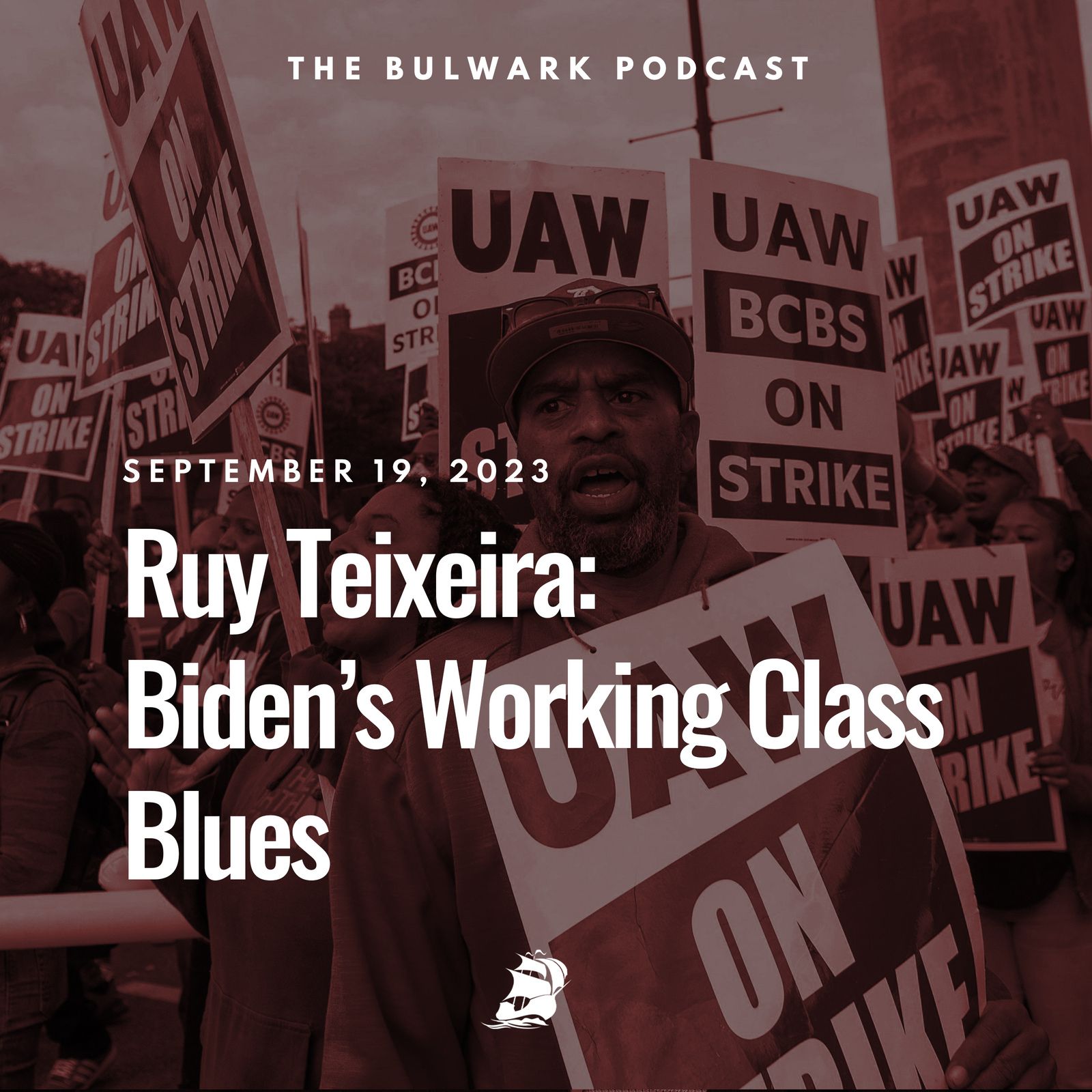
How is the UAW strike going to play in? I mean, this seems like one of the issues. Great example.
I mean, a perfect example because Trump is parachuting in right today because he sees an opening.
Speaker 5 And he's saying they're going to make these electric cars in China, which is not true.
Speaker 5 But I remember the impact that Hillary Clinton's comments had in 2016 when she was talking about, we're going to put all the coal miners out of work.
Speaker 5 Now, she had a longer explanation, but that was the sound by
Speaker 5 Trump and the Republicans are really looking to have a wedge here with the auto workers. So how is this going to play?
Speaker 6 It is a great example because
Speaker 6 the Democrats back in 2019, when the Green New Deal was first being talked about, Lancy Pelosi famously referred to it as, well, this green dream or whatever they call it.
Speaker 6 You know, she wasn't particularly excited about it. But in the process,
Speaker 6 since then, the Democrats have really taken on the whole Green New Deal approach. And really, the Inflation Reduction Act, or IRA, is essentially a soft, scaled-down version of the Green New Deal.
Speaker 6 And the theory of the Green New Deal has been, you know, we're going to basically throw a lot of money at this rapid transition, renewables and electric vehicles.
Speaker 6
And as we implement this Green New Deal, there will be great jobs for everybody. Everybody will be happy.
Prices of energy will go down and it will be, you know, heaven on earth.
Speaker 6 But the problem is that the actual implementation of this quasi-Green New Deal, this IRA, actually raises a lot of very thorny questions, particularly for members of the working class, whether they really will benefit from it.
Speaker 6 And I think a lot of UAW workers are worried that, A, you know, a lot of these EV plants are going to other places that are not, you know, going to be staffed by union workers because of the very nature of the states they're going to.
Speaker 6 And it has not escaped the notice of the UAW and its leadership that a transition to electric vehicles will probably at the end mean just fewer auto workers, at least less of them, because it takes less workers to make these EVs.
Speaker 6 And you know, sort of there's bubbling underlying resentment among many working class voters in general about, well, what if I don't want an EV? You know,
Speaker 6 I like my car.
Speaker 6 The idea that we're going to have this super rapid transition to electric vehicles, I think, flies in the face of the reality of what consumer behavior is.
Speaker 5 I mean, this is the problem of rapid change, right? Is that it creates anxiety. And particularly if you are a blue-collar worker in America, you have been feeling under siege.
Speaker 5 You've been feeling vulnerable for a long time. So somebody comes in and says, we're going to upend your entire industry, trust us, people shouldn't be surprised.
Speaker 5 So far, the UAW leadership doesn't seem to be buying into this.
Speaker 6
And I think this is just the tip of the iceberg, Charlie. I think there's more coming along this line.
Like what?
Speaker 6 Oh, I just think, you know, working-class resentment toward the spillovers from the energy transition that the Biden administration and Democrats are trying to push forward is just beginning.
Speaker 6 I mean, look in New York State.
Speaker 6 They just had to raise the rates of a lot of basically electricity people buy because the increased subsidies that have to go to the the people implementing the clean energy stuff.
Speaker 6
And so, I mean, and look at all the gas stove bans that are now being implemented in a lot of places. And look at, you know, you're supposed to get a heat pump.
People hate that stuff.
Speaker 5 This is an important point because people make, I know a lot of people on the left, and including some of my colleagues, make fun of the whole issue of the gas stoves.
Speaker 5 But this becomes very symbolic for a lot of people, which is like, wait, don't I get to choose? You know, we talk about tolerance and diversity. I would like to have my gas stove.
Speaker 5 And when the suggestion is out there that the government is going to come in in and tell you what kind of stove you can have, again, it's not the end of the world, but it's symbolic.
Speaker 6 Absolutely.
Speaker 5 The reaction is far greater than the actual substance there, but it does become a stand-in for a lot of what you're describing.
Speaker 6 Look, I mean, if electric stoves are so great, if heat pumps are so great, if electric vehicles are so great, well, let consumers decide.
Speaker 6 You know, let the market speak. And over time, if these things are as great as people say they are, then people will purchase them and get rid of their old stuff.
Speaker 6 But the idea that you're not going to have a choice, you're essentially going to be dragooned into
Speaker 6 getting these devices or vehicles, I think, sits very poorly with people. And we shouldn't forget about the issue of energy prices, Charlie.
Speaker 6 Again, this is an example of something Biden has bought into and
Speaker 6
sort of has this whole talking point. Solar.
energy is so cheap they're giving it away.
Speaker 6 But the fact of the matter is, basically, the higher the density of renewable energy and grids, the more energy prices have tended to go up for a variety of reasons, which we can't really get into now too complicated.
Speaker 6
But that's the empirical reality. So the empirical reality is energy prices haven't gone down.
They've gone up. It's not abundant and cheap.
It's less abundant and more expensive.
Speaker 6
And then they're telling you, you've got to buy an electric vehicle. You got to get a heat pump.
You've got to get an electric stove. I mean, this is just...
Speaker 6 tailor-made for, as you say, for someone like Donald Trump to parachute into it. Maybe he doesn't have the solution, but boy, he knows how to take advantage of resentment among their people.
Speaker 6 So, and I just want to connect it to this whole thing about the climate emergency.
Speaker 6 If it wasn't for this conceit that we are in this massive climate emergency, we have to press the accelerator on this stuff, and we must move this forward as fast as possible, otherwise Armageddon is lurking, this wouldn't be such a problem because you could roll out this stuff gradually.
Speaker 6 You could let
Speaker 6 this energy transition take place, as indeed it will in the end over a fairly long period of time, and where people don't have to be forced to do X, Y, and Z, where you can gradually remake the nature of the grid and include nuclear, I might add, which is yet another discussion.
Speaker 6 So what's the hurry? The hurry is that people have convinced themselves that this must be done and must be done fast. And anybody who stands in the way of progress,
Speaker 6 let's just run them over.
Speaker 6 So the UAW is saying, no, don't run me over.
Speaker 6 I'm not in.
Speaker 5 This hits different groups in different ways.
Speaker 5 I mean, you know, you quote some recent reporting by Ron Brownstein, you know, to explain how people look at the economy so differently, a big, you know, chasm between attitudes between the working class and college graduates.
Speaker 5 And you quote him saying, frustration over higher prices is especially acute among voters with fewer resources and less financial cushion, which generally include those with less education.
Speaker 5 Nobody likes spending more, but the degree to which you can absorb inflation. Those at the higher end of the economic scale have less difficulty doing so.
Speaker 5 And, you know, you also quote from a British journalist in the Financial Times who writes that Biden may have over-interpreted his mandate when he won.
Speaker 5 He was supposed to end the dark carnival of Trump and lead the country out of the pandemic, but the spending and the subsidies has allowed Republicans to draw this circumstantially plausible, even if you think ultimately false link between the administration and rising consumer prices.
Speaker 5 Okay, so let's get to, again, the politics of this.
Speaker 5 As you point out, it's not surprising that Biden is losing working class voters by 14 points in recent polls, but he's carrying college graduates by 18 points.
Speaker 5
Biden lost working-class voters by just four points in 2020. So this is bad.
He's losing more of the working class.
Speaker 6 Yes, I think the word bad is appropriate.
Speaker 5 Right, really bad. So, as Brownstein pointed out in his piece for CNN, middle-class Joe looks like he's going to end up relying on upscale voters more than he did in 2020.
Speaker 5
And what I hear from a lot of folks is, okay, so we've lost the working class vote. They're all bigots.
They're all cletuses. And, you know, let's write them off.
But it doesn't matter.
Speaker 5
This is the Democrats' replacement theory. We're replacing them with upscale college-educated voters.
So it's a wash,
Speaker 5 is it, Rui? Can they just replace them?
Speaker 6 Well, I mean, by definition, it's not a wash in the sense that if you lose X amount of working class voters and you gain X amount of college educated voters, X percentage, you will lose because there are more working class voters than our college educated voters.
Speaker 6 For every point or two you lose among working class voters, you got to get two or three points improvement among college educated voters. Now, that's mathematically possible, but is it easy?
Speaker 6 No, and in fact, it's quite difficult and it may not work. Most voters in this country are working class, defined in terms of college education.
Speaker 6 So if you're losing ground steadily among those voters, you really are putting yourself in a very difficult situation in terms of jacking up your percentages among college educated voters.
Speaker 6 And let's not forget, there are a lot of actually vulnerable points for the Democrats themselves among college educated voters.
Speaker 6 I did a piece for the Washington Post the other day when I analyzed the votes and inclinations of white college educated moderates, which is most of white college voters.
Speaker 6 And they are not very enthusiastic about the Democrats.
Speaker 6 The Democrats really have to run up the score among these voters to actually carry the white college educated population by the margins they're increasingly looks like they're going to need.
Speaker 6 So even that's not an easy lift, right?
Speaker 6 I mean, you know, I don't want to rehearse a lot of polling data here, but trust me on this, they are not enthusiastic about Biden, about the job he's done in the economy and a variety of other things.
Speaker 6 They don't like the Democratic Party that much, even though they don't like the, to some extent, they like the Republican Party even less, which, of course, is the Democrats' secret
Speaker 6
superpower these days. It isn't that everybody loves them as they hate the other guys even more.
So this is not a good calculus. This is not good political arithmetic.
Speaker 6
It's not to say it might not work. And who knows? Maybe it'll even work in 2024.
Maybe Biden will squeak out another. But is this the way we want to live our political life forever?
Speaker 6 No, I don't think so. I think that the party that really consolidates the working class vote
Speaker 6
will have the American political future. And I just don't see the Democrats doing that at this point.
And as you're pointing out, Charlie, they're even making this argument, well, who cares?
Speaker 6 Everything's fine. It's like that dog with a coffee cup and the flames of hell.
Speaker 6 Everything's fine.
Speaker 5 Yeah, it's fine. This is fine.
Speaker 7 This is Matt Rogers from Lost Culture Eastas with Matt Rogers and Bowen Yang.
Speaker 8 This is Bowen Yang from Lost Culturalists with Matt Rogers and Bowen Yang.
Speaker 7 Hey, Bowen, it's gift season.
Speaker 8 Ugh, stressing me out.
Speaker 9 Why are all the people I love so hard to shop for?
Speaker 6 Like me? Exactly.
Speaker 7
Honey, I'm easy. But you're right.
Holiday gifting is stressful.
Speaker 8 And all the gift guides out there are boring and uninspired. Wait, what about the guide we made? In partnership with Marshalls, where premium gifts mean incredible value?
Speaker 6 It's giving gifts!
Speaker 7 A series of guides filled with premium gifts at great value for everyone on your list.
Speaker 8 Yeah, because if I see one more for the dad who likes golf list, I'm out.
Speaker 7 Right? How about something for the people who actually surprise you?
Speaker 8 With categories like best gifts for the mom whose idea of a sensible walking shoe is a stiletto, ps, she wants a pair of stilettos.
Speaker 7 Or best gifts for me that were so thoughtful I really shouldn't have.
Speaker 8 Dying to see what those are.
Speaker 7 And you won't believe their prices.
Speaker 8 Just wait till you see what else is in there. It's basically a one-stop shop for everyone you know.
Speaker 7 I started bookmarking half the list for myself, honestly.
Speaker 8 This is the guide for the 2025 holiday gifting season.
Speaker 7 Check out the guide on marshalls.com.
Speaker 6 It's giving gifts. Gift the good stuff at Marshalls.
Speaker 3 Even though severe cases can be rare, respiratory syncytial virus, or RSV, is still the leading cause of hospitalization in babies under one.
Speaker 3 RSV often begins like a cold or the flu, but can quickly spread to your baby's lungs. Ask your doctor about preventative antibodies for your baby this season and visit protectagainstrsb.com.
Speaker 3 The information presented is for general educational purposes only. Please ask your healthcare provider about any questions regarding your health or your baby's health.
Speaker 5 Okay, so let's transition. You're a progressive, you're a Democrat, you want Democrats to win, right? I mean, people need to understand this is in the context of wanting Democrats to fix this problem.
Speaker 5 Correct, correct? You are a lifelong Democratic progressive. I want to remind people registered about voting.
Speaker 6 The whole shtick.
Speaker 5 So what should Democrats do? What should Joe Biden do in the next 12 months to win these voters back to change this dynamic?
Speaker 5 Pretending none of these things are a problem, pretending that nobody should care about inflation, pretending that none of these things are out of the mainstream.
Speaker 5 None of that, I think, is going to change the dynamic. So what is the agenda? What is the prosperity agenda that you recommend?
Speaker 6 I think it's very difficult at this point. I mean, I really have a hard time seeing Biden changing course on practically anything at this point.
Speaker 6 But if he did, you know, I think that the whole pitch around biodynamics needs some work.
Speaker 6 Maybe you don't even want to call it bidenomics.
Speaker 6 I mean, I really, I think there's like some dazzling chutzpah to deciding you're going to embrace the sobriquet of biodynamics in a situation where people basically detest the job Biden has done on the economy.
Speaker 6 I mean, it's, you know, it's it's impressive. I mean, I guess they're assuming things will turn around by the election time.
Speaker 5 When I hear people talk about this on, say, on MSNBC, they talk about the messaging problem and what Democrats have to message.
Speaker 5 You are suggesting that there's a messaging problem, but there's also a substance problem.
Speaker 6 Well, given the substance problem, I think that the messaging problem does not devolve down to figuring out how to convey all the great achievements of Bidenomics more effectively.
Speaker 6 I think you have to some extent admit, yeah, look, I mean, it hasn't gone quite as we wanted.
Speaker 6 Inflation is a problem, but we're really going to get it under control, and we're going to make sure that we mostly have the backs of working-class voters.
Speaker 6 If that means we've got to take our foot off the accelerator on some of the stuff that we've been doing,
Speaker 6 that's fine. We're laser-focused on
Speaker 6 the actual lives, you know, most people in this country lead and how they're doing economically.
Speaker 6 And we're really going to get inflation under control, and maybe we're going to cut back on some of the things we were going to do because of that. You know, we understand, we get it.
Speaker 5 Who are the Democrats who are getting this?
Speaker 6 I think some of the governors are a little bit more in touch with this than the Biden administration. John Fetterman, Sherrod Brown, yeah, Josh Shapiro, people like Gretchen Whitmer, maybe.
Speaker 6 I mean, I think they're a little bit more circumspect about some of this stuff.
Speaker 6 Now, Whitmer, I mean, this is like the worst thing to happen to her, you know, the UAW strike and all that, and I Michigan politics in general.
Speaker 6 But I think they're more sensitive to, you know, sort of to put it gently, the mixed nature of the Biden economy and how things have gone under Biden.
Speaker 6 How you craft an economic-oriented message that speaks to people's discontent about the way things are and that's realistic about what people have experienced, I think that's a big problem.
Speaker 6 But I think you at least have to try to do that and not assume that your big messaging problem is you haven't been able to deliver the good news
Speaker 6
with as much hanash. you know, or the right magic words.
I mean, I think that's ridiculous. But I think you also should do some things to signal you are moving to the center and cultural issues.
Speaker 6 You are going to tighten up the border. You're going to radically reform the asylum system.
Speaker 6 You know, you're going to, you know, maybe make some sort of signals on the trans issue that you're not totally down with the medicalization of minors. And, you know, we need a compromise.
Speaker 6 You need a compromise on these kinds of issues. And on crime, you're really concerned about crime.
Speaker 6 I mean, one of my favorite little tropes and one of yours, Charlie, has been the Democrats could use a Sister Soldier moment on some of the issues about crime, which are not going away.
Speaker 6 And there are like sacrificial lambs out there in the Democratic universe who would make an excellent sister soldier.
Speaker 6 And that would actually capture people's attention, you know, so people don't think your main concern about, you know, crime is we've got to make sure we treat criminals fairly.
Speaker 6 And, you know, maybe like open drug use is like part of our harm reduction strategy. and all this.
Speaker 6 There's a lot of low-hanging fruit there for the Democrats to cut a somewhat different cultural profile than the Democrats currently cut. Do I believe they'll do any of this? No.
Speaker 6 That's why I think it's going to be a dogfight right through November 2024.
Speaker 5 So the larger question is, can Democrats seize back the populist message that we are for the little guy?
Speaker 5 Because I think this is one of those moments where people are looking around and going, okay, the system is rigged. It is rigged for the rich, the billionaires, the millionaires, the oligarchs.
Speaker 5 There's an asymmetry of power that people at pretty much every level of life experience.
Speaker 5 And yet somehow Donald Trump has convinced millions of Americans that he of the golden toilets and of Mar-a-Lago somehow is the voice of the little guy. Can Democrats turn that around?
Speaker 5 I mean, they're running against a billionaire who doesn't pay any taxes.
Speaker 5 I think the inability to turn this around that we don't need a society that is run without necessarily buying into the Bernie Sanders line. But, I mean, Bernie Sanders tapped into something.
Speaker 5 Donald Trump tapped into something. So, can Joe Biden tap into that, middle-class Joe? Or is it too late?
Speaker 6 It is my regretful duty to inform you, I think it's too late.
Speaker 6 I mean, I think we should be talking about, you know, a few years down the line, let's think a few moves ahead in the chess game. I think the Democrats can totally recover from where they are now.
Speaker 6 And as I say, I think it's, you know, maybe a slightly better than even bet that Biden does does manage to get reelected.
Speaker 6 But I think that, you know, we're really talking about trying to change the image and approach of the Democratic Party in 2024 and beyond. I mean, I'd be very happy if they did it before then.
Speaker 6 I do think, as you point out, that the populist feelings roiling the population are out there, particularly working-class voters. The Democrats should be able to take advantage of them.
Speaker 6
But back to Oliver Anthony. If your reaction to Oliver Anthony's song is, you know, that racist son of a sea cook, I mean, this is not a good sign.
I know. Not a good sign.
Speaker 6 So I think Democrats have to, you know, sort of get back in touch with their inner centrist or something or their inner Bill Clinton or their inner Barack Obama for crying out loud and figure out how to take a different approach.
Speaker 5
It does strike me that, you know, in 2016, in retrospect, all of the flares were going up. The lights were that the voters did not want same old, same old.
They did not want the status quo.
Speaker 5
They did not want another Clinton. They wanted change desperately.
And all the elites ignored all of that. And the elites were, you know, like, let's have Bush versus Clinton.
Speaker 5
And the voters said, to hell with that. We want something new and we got something new.
And my gut tells me that 2024 is the populist red lights are flashing.
Speaker 5 And if, you know, the Democrats do not figure out a way to show that they don't despise, they don't think that the voters are stupid, that bad things are going to happen.
Speaker 5
Rui Teixeira, thank you so much for joining me on the podcast today. Rui is senior fellow at the American Enterprise Institute.
And you can read his work on the the liberal patriot on Substack.
Speaker 5
He's also co-author of the forthcoming book, Where Have All the Democrats Gone? Rui, thank you so much. And thank you all for listening to today's Bulwark podcast.
I'm Charlie Sykes.
Speaker 5 We will be back tomorrow and we'll do this all over again.
Speaker 5 The Bulwark Podcast is produced by Katie Cooper and engineered and edited by Jason Brown.
Speaker 7 This is Matt Rogers from Lost Culture Eastas with Matt Rogers and Bowen Yang. Get ready for your next TV obsession, All's Fair.
Speaker 7 Starring Kim Kardashian, Naomi Watts, Nisi Nash-Betts, Tayana Taylor, with Sarah Poulson, and Glenn Close. A team of fierce female divorce attorneys leave a male-dominated firm to start their own.
Speaker 7 Filled with scandalous secrets and shifting allegiances both in the courtroom and within their own ranks, these ladies know that lawyers are a girl's best friend.
Speaker 7 Don't miss All's Fair, now streaming on Hulu and Hulu on Disney Plus for bundle subscribers. Terms apply.
Speaker 11 We know no one's journey is the same. That's why Delta Sky Miles moves with you.
Speaker 11 From earning miles on reloads for coffee runs, shopping, and things you do every day to connecting you to new experiences.
Speaker 11
A Sky Miles membership fits into your lifestyle, letting you do more of what makes you, you. It's more than travel.
It's the membership that flies, dines, streams, rides, and arrives with you.
Speaker 11 Because when you have a membership that's as unique as you are, there's no telling where your journey will take you next. Learn more at delta.com slash skymiles.
Speaker 12 At Arizona State University, we've made online education better, smarter, and more personalized so you can go further in your aspiring field.
Speaker 4 I decided to pursue medicine once I realized that ASU did have the online program for biological sciences. You're still required to learn the same curriculum.
Speaker 4 You're still being tested on the same content that anyone would be tested on in person. The comprehensiveness of the program prepared me so well for medical school.
Speaker 12 Explore over 350 plus programs at ASUonline.asu.edu.