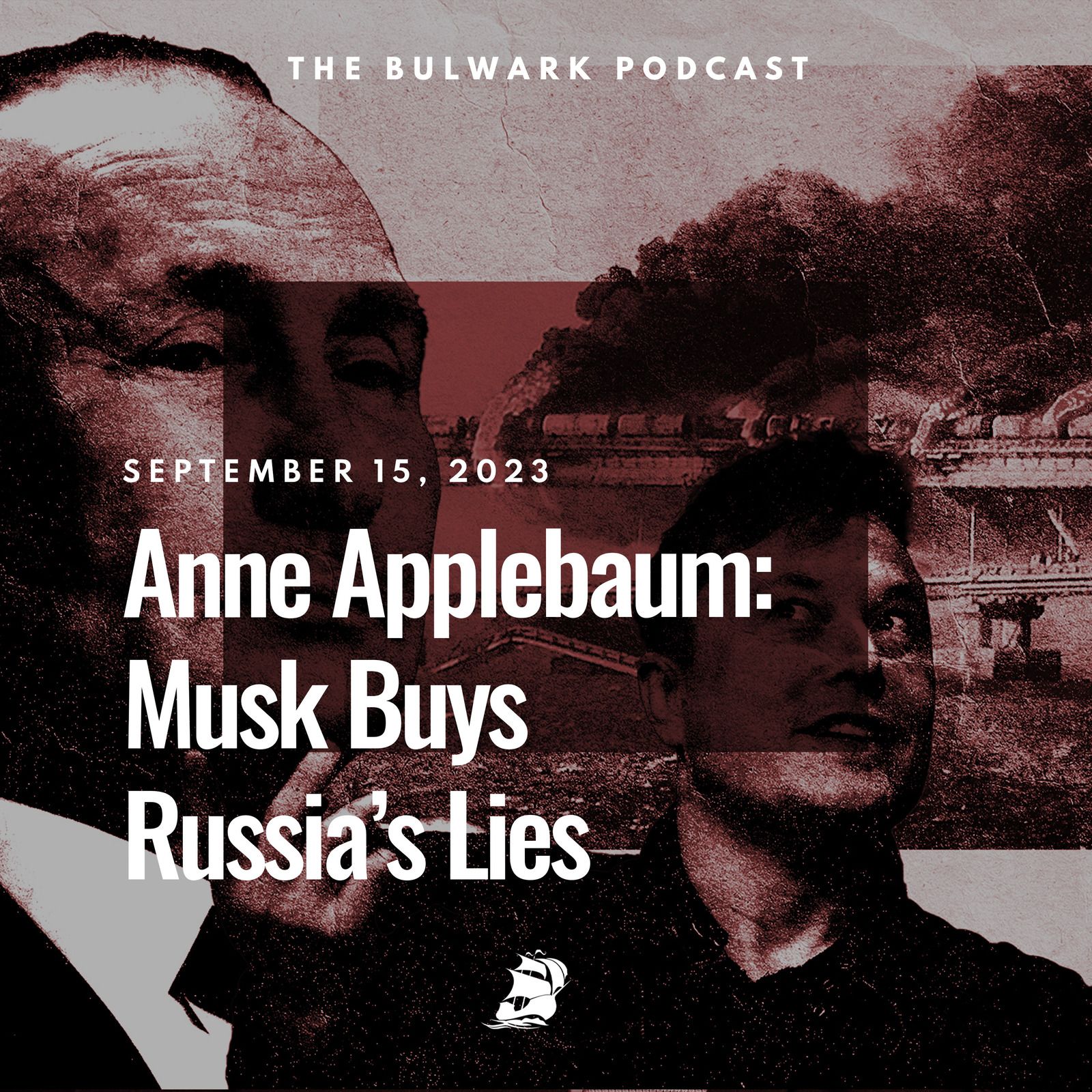
Anne Applebaum: Musk Buys Russia’s Lies
show notes:
https://www.theatlantic.com/ideas/archive/2023/09/elon-musk-let-russia-scare-him/675282/
Press play and read along
Transcript
Speaker 1
is Martha Stewart from the Martha Stewart podcast. Hi, darlings.
I have a little seasonal secret to share. It's the new Kahua Duncan Caramel Swirl.
Speaker 1
Kahlua, the beloved coffee liqueur, and Duncan, the beloved coffee destination, paired up to create a treat that is perfect for the holidays. So, go ahead, treat yourself.
Cheers, my dears.
Speaker 3
Must be 21 or older to purchase. Drink responsibly.
Kahlua Caramel Swirl Cream Liqueur, 16% Alcohol by volume, 32 proof. Copyright 2025 imported by the Kahlua Company, New York, New York.
Speaker 3 Duncan trademarks owned by DDIP Holder LLC, used under license. Copyright 2025, DDIP Holder LLC.
Speaker 4
Dude, this new bacon, egg, and chicken biscuit from AMPM, total winner-winner chicken breakfast. Chicken breakfast? Come on, I think you mean chicken dinner, bro.
Nah, brother.
Speaker 4 Crispy bacon, fluffy eggs, juicy chicken, and a buttery biscuit? That's the perfect breakfast. All right, let me try it.
Speaker 2 Hmm, okay, yeah.
Speaker 4 Totally winner-winner chicken chicken breakfast. I'm gonna have to keep this right here.
Speaker 5 Make sure every breakfast is a winner with the delicious new bacon, egg, and chicken biscuit from AMPM. AMPM, too much good stuff.
Speaker 2
Welcome to the Bullwork podcast. I'm Charlie Sykes.
It is September 15th, 2023. It is Friday.
We have almost made it to the weekend. A lot going on.
Obviously, we have a major UAW strike.
Speaker 2
We have the indictment of Hunter Biden by the deep state Biden Department of Justice. That won't change the narrative at all.
Apparently, Kevin McCarthy's week is not going well.
Speaker 2 He's dropping F-bombs, daring members of his own conference to, you know, file that motion to vacate. Just file the effing motion.
Speaker 2 And meanwhile, back in my home state of Wisconsin, We continue to have this,
Speaker 2 I would say, rather complicated situation.
Speaker 2 The Republicans in the state Senate just voted to fire the nonpartisan election chief, a woman named Megan Wolfe, who's apparently, as far as I can tell, respected by everyone, has bipartisan support.
Speaker 2
But she got caught up in the whole big lie. And apparently, MAGA demanded a head on a spike, and it turned out to be Megan Wolfe.
This goes to court. There will be litigation about all of this.
Speaker 2 And that could get even messier because, as we know, Republicans are still flirting with the idea of actually impeaching a state Supreme Court justice before she's even ruled on a major case.
Speaker 2 Now, if you subscribe to my daily newsletter, Morning Shots, you'll see the headline, which is why Wisconsin Republicans might blink, but why they might not.
Speaker 2
I think they're beginning to realize what a disaster this will be for them politically. The ads right themselves.
There will be an absolute firestorm of reaction, followed by lots of outside money.
Speaker 2 And of course, money marvelously focuses the mind of Wisconsin Republicans, including the Speaker of the State Assembly, Robin Voss, who earlier this week seemed to back away from the impeachment and proposing a compromise, which was promptly shot down.
Speaker 2 So he's now appointing a, I don't know, I'll get too deep into this, sort of a blue ribbon task force, which is, you know, when politicians don't want to actually do something, they appoint a blue ribbon task force.
Speaker 2 He says he's asking former Supreme Court justices for guidelines on impeachment. So stay tuned for all of that.
Speaker 2 Meanwhile, we have the ongoing saga of Elon Musk and Russia, and we are extremely lucky this weekend to be joined by Ann Applebaum, staff, writer at The Atlantic, whose books include Red Famine, Stalin's War in Ukraine, The Pulitzer Prize, winning Gulag History, and most recently, Twilight of Democracy, The Seductive Lure of Authoritarianism, and recently wrote just a mind-blowing piece in The Atlantic, What Russia Got by Scaring Elon Musk.
Speaker 2 And welcome back to the podcast.
Speaker 6 Thanks for having me.
Speaker 2 You know, this whole Elon Musk story, I don't know whether it's farce or tragedy or just, you know, a terrifying morality play, but the fact that this narcissistic oligarch has so much power, it's one thing for him to be the czar of social media.
Speaker 2 It's something else for Elon Musk to have the power of life and death, to tell our allies how they can fight and how not to fight, the role that he's playing.
Speaker 2 I mean, it's like, how did we get to the point where someone like Elon Musk wields this much,
Speaker 2 apparently unaccountable power?
Speaker 6
So I think it started as an accident, as so many things do. The war began in February of last year.
One of the first things that happened was the Russians took down the Ukrainian internet.
Speaker 6 Some guys in Silicon Valley and some guys in Kiev said, let's get something else as fast as possible. Somebody thought about Starlink.
Speaker 6
And to quote, I think it comes from Ronan Farrow's article in New York, someone just said, okay, let's fucking go. People are dying.
And they set it up really fast.
Speaker 6
And nobody thought about what role Elon Musk would play. No one thought he would have a role.
So it wasn't as if this was planned in advance. And, you know, Starlink went up.
Speaker 6
And it's true, when you're in Ukraine, you connect to the internet via Starlink. And that's how it works.
And nobody, as I said, didn't occur to anyone that this was important.
Speaker 6 I mean, normally it's true if there's a, if Musk had had a relationship with the Pentagon, and he does have some relationships with the Pentagon now, even more so.
Speaker 6 You know, the contractor sells something to the Pentagon, and then the Pentagon decides what to do with it. So it's not like Lockheed Martin gets to decide how their planes are used, right?
Speaker 6 Once they sell them as a party. This was a much more ad hoc arrangement, right?
Speaker 6 So no one thought about Musk being able to decide anything, but it was a direct relationship with, you know, Ukraine and some backers of Ukraine. It wasn't a relationship with the Pentagon.
Speaker 6
Then what happened in September of 2022, the Ukrainians had been working for many months to create sea drones. By sea, I mean SEA, so water drones.
I've seen them. They're very cool.
Speaker 6
They're little black. boats.
I can say that because photographs of them have been published.
Speaker 6 And they're packed with explosives and amazing high-tech stuff that makes it possible to direct them and hide them and so on. And Ukraine has no navy, but this is what it has instead.
Speaker 6 Their first use of these seed drones was supposed to be in September of 2022, and they launched them and on the way to Crimea, which is where they were heading because the Russian fleet, Black Sea Fleet, is based in Sevastopol, which is in Crimea.
Speaker 6 Suddenly, the internet stopped working. And so their navigation system stopped working.
Speaker 6 And as I understand it, there were massive numbers of phone calls, some from California, some from Ukraine, asking Musk to turn it on.
Speaker 6 And there's a discrepancy whether he had actually turned it off or whether it was off and they didn't know it.
Speaker 6 I don't know which is true, actually, but it is true that people called him and they asked him to turn it on.
Speaker 6 And it's true that at that moment he called Walter Isaacson, according to Isaacson, and he said, I've just spoken to the Russian ambassador, and he says that if I turn this on and if those drones hit the fleet, then the Russians will nuke Ukraine and it will be World War III.
Speaker 2 Okay.
Speaker 6
So he didn't turn it on. He was persuaded by the Russian ambassador not to do it.
He's not the only one who's been persuaded by Russian nuclear propaganda not to do something, to be fair.
Speaker 6
But he had the power to switch on or switch off the system. In any case, the operation was aborted.
Didn't happen. Some of the drones came back.
Speaker 6 I'm not allowed to tell you how many because they didn't want you to know.
Speaker 6 But the important point that I had not realized until last weekend when I was in Ukraine is that they ran the operation again.
Speaker 6 A month later in October, the same team with some of the same drones ran the same operation. They sent a fleet of drones, they sent them to Crimea to hit the Black Sea Fleet, and they did.
Speaker 6 They hit one very large ship, a few other ships, they hit a submarine, they took several ships out of operation.
Speaker 6 And more importantly, they scared the Russian Navy so much that it stayed in port for the following month. And understand that the missiles that hit Ukrainian cities sometimes come from Russian ships.
Speaker 6
So this is a big deal. If you can get the Black Sea Fleet to stay home, then you save lives in Ukraine.
So the point is, there was no nuclear war. There was no World War III.
Speaker 6
The Russians scared Musk. They prevented him from launching this operation.
The Ukrainians launched it a month later using a different communication system, I should say.
Speaker 6 And it was a huge success, and lives were saved. And so the question now, which I'm sure is the one you're interested in, is why did Musk get to make this decision, you know, which was wrong?
Speaker 2
And he continues to defend it. I know that you commented on this a couple of days ago.
He's created a little video where he's defending his refusal to turn on the Starlink for the Ukrainians, saying,
Speaker 2 we figured out that this was kind of like a Pearl Harbor-like attack. So they really asked us to proactively take part in a major act of war.
Speaker 2 I find it kind of breathtaking that he's comparing this to Pearl Harbor. The analogy doesn't really hold up, does it, Anne?
Speaker 6
It really, truly doesn't. I mean, the Ukrainians are fighting to take back their territory.
So the goal of this war is to persuade the Russians to leave.
Speaker 6
It is not an unprovoked attack on a non-combatant, you know, as Pearl Harbor was. You know, they don't have the ability or the will to kill lots of civilians.
You know, that's not what they're doing.
Speaker 6 They're trying to take Russian ships and tanks out of commission so that they won't kill Ukrainians. This was nothing like Pearl Harbor.
Speaker 6
And, you know, as I said, the same attack happened a month later, and we don't have World War III. So this is simply wrong.
And the fact that he continues to defend it, I think.
Speaker 2 It's obscenely wrong.
Speaker 6 It's almost as if he doesn't understand what the war is about.
Speaker 6 I mean, you know, there's some other quotes from him saying things like, I thought, you know, I was turning on Starlink so people could get Netflix and, you know, do their online shopping.
Speaker 6 I mean, okay, I'm sure there are some people in Ukraine who are happy to have Netflix and, you know, do their online shopping, but the internet is really important to be able in this kind of war to be able to defend yourself, to be able to take back your territory.
Speaker 6 It's not as if they're conquering Russia.
Speaker 6 They're taking back their own land.
Speaker 2 A rather important distinction.
Speaker 6 Huge distinction. Remember, the war is over when Russians go home.
Speaker 6
That's all that the war is about. It's not nobody's trying to conquer Moscow.
Nobody's trying to
Speaker 6 have Putin sign a surrender in a train car.
Speaker 6
Famously, that's how World War I ended. So none of that.
We just need them to leave. Everything that they're doing is designed to make them leave.
And the fact that Musk didn't see that is astounding.
Speaker 2 It's also astounding that he's fallen for this propaganda campaign that the Russians have been waging. Again, as you point out, he's not the only one.
Speaker 2 But your article goes through all the examples how Russia has used this nuclear propaganda since 2014 to persuade us not to help Ukraine.
Speaker 2 I mean, this has really been kind of a central part of Vladimir Putin's strategy that if we do anything well, it's going to lead to a nuclear war. Absolutely.
Speaker 6 They've been saying it repetitively since 2014. It's why we told the Ukrainians not to defend Crimea in 2014, which was a mistake because it persuaded the Russians to invade again.
Speaker 6 They then invaded eastern Ukraine and then the Ukrainians fought back and then they stopped.
Speaker 6 It's why Ukraine wasn't really armed in between 2014 and 2022 because people were afraid, you know, if we give them too many weapons, then, you know, that might be provocative.
Speaker 6 It's why we didn't give them different weapon systems at different, you know, we didn't give them long-range missiles at first, we didn't give them tanks, you know, and then eventually we changed our mind, you know, and did.
Speaker 6 But one of the reasons the war has lasted as long and one of the reasons the Russians were able to build up this vast minefield and sort of system of tank traps they've now built in southern Ukraine.
Speaker 6 One of the reasons they were able to do that is because we spent so much time worrying about how we would provoke the Russians that we failed failed to arm the Ukrainians.
Speaker 6 And what's become clear over the last two years, if it wasn't clear before, is that what stops the Russians is counter-force. Like when you push back against them, they move back.
Speaker 6 So when you hit the Black Sea fleet, they stay in their port.
Speaker 6 You know, one of the things the Ukrainians thought might happen, they've had a few ships with grain have been leaving their ports, and they thought maybe Russian warships would try and block them.
Speaker 6 They haven't done that. And one of the reasons why is because the, you know, the sea drone guys are pretty clear that if you try and block a grain ship, we're going to hit you with a sea drone.
Speaker 6
So it works. So pushing back against the Russians is how you get the Russians to take a step back.
What causes escalation is the perception of weakness.
Speaker 6 If you don't fight back, then they say, right, we're going farther.
Speaker 2
This was a lesson that I think people at one time understood. Certainly Republicans understood it.
But as you point out, it seems obvious. I mean, the Russians do this.
Speaker 2
They make these threats because, you know, for a reason. It works, right? It deters people.
And, you know, back in 2014, you know, Western leaders basically let him take Crimea, as you point out.
Speaker 2 And this obviously, you know, this sense that you can cow the West also, you know, led Russia to, you know, continue their invasion of eastern Ukraine.
Speaker 2 As you point out, all of this buying into that nuclear propaganda was a terrible mistake because if the Russians had been afraid of the Ukrainians, they might never have launched the full-scale invasion at all, right?
Speaker 2 So this propaganda stopped the West from providing the weapons that Ukraine needed. Had they given them those weapons, we might not have had a war at all.
Speaker 6
Absolutely. The Russians wouldn't have invaded.
The Russians thought the war was going to be over. Kiev would be captured in three days and the war would be over in six weeks.
Speaker 6 They thought we would not help Ukraine. They thought the Ukrainian army would collapse.
Speaker 6 They didn't expect anything like this year and a half struggle, which has cost them tens of thousands of lives and untold amounts of equipment and money.
Speaker 6 They would have at least thought twice about this invasion if they had expected a response like this.
Speaker 6 The point is that to deter a bully, what you do is you build up your own forces and you say, if you hit us, we'll hit you back. I mean, that's how nuclear deterrence has always worked.
Speaker 6 In fact, that's still how it works. You know, why haven't the Russians used nuclear weapons?
Speaker 6 Because they're afraid someone would nuke them back or they're afraid of some massive conventional response. I mean, it's not because of, you know, it's not because of anything else.
Speaker 6 It's through strength that you counter strength.
Speaker 6 And as I said, it's not a very complicated strategy and it's one that we have actually followed pretty successfully for several decades regarding nuclear competition with what used to be the Soviet Union and is now Russia.
Speaker 6 It's just that, you know, in the last few years, we've forgotten.
Speaker 6 And especially, you know, a lot of people on the right, the far right, as well as the far left, have really fallen for this Russian nuclear language.
Speaker 6
You know, World War III, you're going to cause World War III. You know, this is a, this is a Trump uses this all the time.
And actually, he's been doing it for years. He did it in the 2016 campaign.
Speaker 6 And I heard him do it at the time and was convinced that he was either getting it directly from the Russians or from, you know, far-right media that is, you know, influenced by Russian propaganda.
Speaker 6
Because it's that, you know, he was literally using the same language that was being used on Russian TV. He would just then use it.
He would say, Hillary Clinton's going to start World War III.
Speaker 2 This is obviously what Vladimir Putin wants people in the West to think.
Speaker 2 You also, though, note that we started off with Elon Musk doing this and how Elon Musk was scared and the West had been deterred. But this is really continued post-invasion.
Speaker 2 And I guess this is one of the more troubling aspects of all of this: that the West and the United States, the Biden administration, has been holding back on these long-range weapons.
Speaker 2 We've had these arguments:
Speaker 2 should we send them F-16? Should we send them the ATAC them ballistic missile system?
Speaker 2
And at each point, it sounds like there was somebody within the administration who was saying, well, that will escalate things. That might be dangerous.
We don't want to make the Russians too edgy.
Speaker 2 So all of this nuclear propaganda has slowed the role of the West even post-invasion, hasn't it?
Speaker 6 That's definitely true.
Speaker 6 I mean, it was certainly true of long-range missiles because we were afraid that Ukrainians would use them to hit Russia, Russia proper, which to some degree they have to do because that's where the Russian logistics systems are.
Speaker 6
Then it turned out that the Ukrainians were able to do it without our weapons. They can do it with drones and with other things.
And they did it. And again, there was was no World War III.
Speaker 6 Same thing with tanks. You know, the Germans had this particular paranoia because the Germans have a lot of tanks that are unused, modern ones.
Speaker 6 You know, I went to Germany a few months ago, just before they made this decision, and people were saying, well, you know, what if a German tank appears on Ukraine and it'll be like World War II and people remember Stalingrad or something like that?
Speaker 6
And actually, you know, what happened was the tanks were painted over with the Ukrainian flag. They're being driven by Ukrainians.
And whether they're German tanks makes no difference at all.
Speaker 6 So people had this imagination about what each weapon system would mean that turned out to be untrue.
Speaker 6 And as I said, the result is, you know, we are now slowly, the Europeans are giving the Ukrainians some F-16s, but they weren't there in time for this summer's offensive.
Speaker 6 We are probably going to give them some even longer range missiles, these ATACOMs, but those also haven't been there for the summer. So
Speaker 6 each time we're late and the delays have meant,
Speaker 6 have worked to Russia's advantage.
Speaker 2
Yeah, I mean, so these delays have cost lives. I mean, maybe tens of thousands of lives, right? And they've contributed to the loss of Ukrainian momentum.
It's had real consequences.
Speaker 6 Yeah, the war is over when Russia leaves. You know, so the whole point of the war is to persuade them to leave.
Speaker 6 And the longer they're there, the more people die, because people die both because the Russians are fighting, but also because the nature of the Russian occupation of Ukraine is so horrific.
Speaker 6 As soon as they occupied any territory, they rounded up the mayors and the police chief and the local headmistress of the school. People have disappeared into concentration camps.
Speaker 6 They've disappeared into prisons. There have been mass and random murders.
Speaker 6
We know about some of them. We know about Bucha.
We know about a few others, but it seems to be true in every single place that they've occupied. So
Speaker 6 each of those occupied territories has become a kind of mini police state.
Speaker 6 And so literally, the longer the Russians are there, the more people die just on those territories, leaving out the story of the soldiers.
Speaker 2 Let me just read you one paragraph that you wrote that sums this up. Think about what the world might look like if Putin's nuclear threats had not influenced our imagination so profoundly.
Speaker 2 If Elon Musk had not been spooked by Russian propaganda, then some of Russia's fleet might have been disabled a month earlier.
Speaker 2 If Washington, London, Paris, and Berlin had not been spooked by Russian propaganda, then the Ukrainians might have expelled the Russians earlier and the war might be over.
Speaker 2 Death, horror, and terror have been the result every time outsiders hesitated to aid Ukraine, which is just a devastating conclusion when you think about this. Devastating conclusion.
Speaker 6 It is. And I want to say something in favor of the Biden administration, which has overcome a lot of this.
Speaker 6 I mean, and has done much more than many people expected at the start of the war and has been very has been quite loyal to Ukraine.
Speaker 6 And I'm grateful to Biden that he was a president who remembered enough about the Cold War era and enough about grand strategy to understand the importance of this war, which is really significant, not just in Europe, but internationally, as a, you know, finally the democracies standing up to autocratic bullying.
Speaker 6 You know, I don't want to criticize Tuitt, but it is true that our imaginations were shaped by, you know, a decades worth of Russian propaganda about what they would do.
Speaker 6 And it turned out that if you just pushed back, they didn't do it.
Speaker 2 Hey, folks, this is Charlie Sykes, host of the Bulwark podcast.
Speaker 2 We created the Bulwark to provide a platform for pro-democracy voices on the center right and the center left for people who are tired of tribalism and who value truth and vigorous yet civil debate about politics and a lot more.
Speaker 2 And every day we remind you folks, you are not the crazy ones. So why not head over to thebulwark.com and take a look around?
Speaker 2 Every day we produce newsletters and podcasts that will help you make sense of our politics and keep your sanity intact.
Speaker 2 To get a daily dose of sanity in your inbox, why not try a Bulwark Plus membership free for the next 30 days? To claim this offer, go to thebullwork.com/slash Charlie.
Speaker 2 That's thebullwork.com forward slash Charlie. We're going to get through this together, I promise.
Speaker 7 Degree Advanced, the world's number one antiperspirant, provides up to 72 hours of protection against the sweat and odor that comes with life.
Speaker 7 Degree is the getting a walk before work, getting dressed in the car, running from the parking lot, antiperspirant. The deadlines approaching crunch time, hustle hard, play hard, antiperspirant.
Speaker 7 The sweating, working, maximum exerting antiperspirant for when the heat is on. So you can do what you need to do and work how you need to work.
Speaker 8 Sweat moves you forward.
Speaker 7 Degree is here to make sure it doesn't hold you back.
Speaker 8 Degree, here for sweat.
Speaker 9 There's nothing like sinking into luxury. Anibay sofas combine ultimate comfort and design at an affordable price.
Speaker 9 Anibay has designed the only fully machine washable sofa from top to bottom. The stain-resistant performance fabric slip covers and cloud-like frame duvet can go straight into your wash.
Speaker 9 Perfect for anyone with kids, pets, or anyone who loves an easy-to-clean, spotless sofa. With a modular design and changeable slip covers, you can customize your sofa to fit any space and style.
Speaker 9 Whether you need a single chair, love seat, or a luxuriously large sectional, Anabay has you covered. Visit washable sofas.com to upgrade your home.
Speaker 9 Sofas started just $699 and right now, get early access to Black Friday savings up to 60% off store-wide with a 30-day money-back guarantee. Shop now at washable sofas.com.
Speaker 6 Add a little
Speaker 9 to your life. Offers are subject to change and certain restrictions may apply.
Speaker 2 Now, maybe this is an old story by now, but I'm really struck by the fact that, you know, Elon Musk, as a lot of others, you know, might have run into this propaganda in Russian-influenced far-right echo chambers, the ones he's been hanging out in.
Speaker 2 So let's talk a little bit about why the far right, I know we've talked about this before, but what a strange twist in our history that you have the far right align with someone like a Vladimir Putin.
Speaker 2
Because I mean, clearly, we know where Elon Musk has been spending his time. We know where Donald Trump spends his time, where his headspace is.
And this has become a real theme.
Speaker 2 So how did Vladimir Putin manage to co-opt the right wing, not just in the United States, but globally?
Speaker 6 So without being remotely conspiratorial about it,
Speaker 2 no,
Speaker 6 the opinion is, no,
Speaker 6 I think he helped create it. I mean, I think the creation of a far-right echo chamber has been a Russian project for 15 years.
Speaker 6 So the idea that they would seek to promote extremism and promote extremist ideas and slogans and memes and so on. I mean, I think they've been doing that for years.
Speaker 6 In fact, I know they've been doing it for years.
Speaker 6 I mean, you can argue about to what degree it was them and what degree it was a kind of mind-meld of them and the existing far-right and to what degree it was just, you know, people were ready for that kind of stuff for other reasons.
Speaker 6 I mean, I'm not giving them credit for, it's not as if they created this thing, but I mean, they did help.
Speaker 6 The idea that Western civilization is collapsing, that democracy is a disaster, and that the only thing that can save it is an autocratic or dictatorial power or regime is an idea that's very comfortable for the Russians because it's in their interest for democracies to be weakened and to fall apart, you know, because then they have free run of whatever they want to do.
Speaker 6 And it's also appealing to a certain group of, as it turns out, Americans, but also Europeans who dislike their own societies for other reasons, you know, whatever, they dislike modernity, they dislike feminism, they dislike too many refugees, immigrants, whatever it is they don't like about modernity and whatever they dislike about their systems, you know, they have this alternative and the alternative is an autocratic one.
Speaker 6 That is the appeal of Putin and Putin understood that appeal or the people who work for him did. And they've sought to feed that and nourish it.
Speaker 6 I mean there's an additional thing which is the Russia has been very good at selling a completely fake image of itself as a white Christian country defending the world from Islam.
Speaker 6 Actually Russia is 12% Muslim, something like that, and we're not sure of the real numbers. There's a province of Russia, this Chechnya, which is actually run by Sharia law.
Speaker 6
I mean, literally, it's Sharia law. It's not that fake thing.
Oh, Sweden is run by by Sharia law. That's not true.
And, you know, nobody goes to church there.
Speaker 6 And something like 5% of Russians have ever seen a Bible. So it's an absolutely made-up story, but it works on the far right in the way I think that the ideal of communism once worked on the far left.
Speaker 6 You know, look, our society is terrible, and there's this other alternative society that's better. And there's something like that going on.
Speaker 6 And the Russians understood that because they have been doing that kind of propaganda for a century and they encouraged it.
Speaker 2 Where do you think the arc is bending right now?
Speaker 2 Because there was a time not many months ago, I think that you had been writing about the fact that, you know, we were seeing liberal democracy in retreat.
Speaker 2 We were seeing authoritarianism picking up momentum. But I guess, you know, since we're on this subject, as the rest of the world is watching what's happening in the United States,
Speaker 2 give me your sense of the danger of this feeding into the narrative that liberal democracy just doesn't work. It doesn't get things done, that it has failed.
Speaker 2 I mean, I hear this narrative all of the time about, you know, that the democracy is under siege, but then some of the defenders of democracy will say, well, yes, but, you know, the voters are too stupid to be trusted.
Speaker 2 I mean, if you actually come to the point where you believe that we are incapable of self-government, that I don't know how you support democracy or liberal constitutional order.
Speaker 2 If the United States turns into this shambolic mess, doesn't that really provide a certain amount of credibility to people who say, okay, we tried that, let's try something different?
Speaker 6 I mean, of course it does.
Speaker 6 You know, the undermining of the United States is like the dream outcome for not just the Russians, but the Chinese, you know, the Iranians, the Venezuelans, you know, everybody who has a democracy movement in their country that they want to crush, those groups all look up to the United States.
Speaker 6 They talk about democracy as a real alternative to their systems or freedom or some other system in which they don't have rule of law.
Speaker 6 And the demise of the United States or the United States kind of crumbling into incoherent, semi-catastrophic morass would be an enormous boost to autocracies around the world.
Speaker 6 So it's almost like, you know, one of the front lines is the war in Ukraine, where we see a democracy clashing with an autocracy.
Speaker 6 And, you know, another front line runs somewhere through the United States, where people who want to preserve our system or fix it or bring out what they can of it are in direct conflict with people who no longer care about these things.
Speaker 6 And they'd rather, as you said in your introduction, they'd rather just suspend the officials, elected officials who they don't like and use minority rule and legal tricks to impose whatever they want.
Speaker 6
And that battle is, it's a kind of different version of the same thing that we see in Ukraine. And some of the same people are fighting it.
I mean, you know, Elon Musk is playing a role in
Speaker 6
spreading vile conspiracy theories, in undermining institutions, in encouraging some of the worst features of online conversation. And he's doing that there.
And
Speaker 6 it's not surprising that someone like that fell for Russian propaganda because he already lives in a world where all around him people are advocates of autocracy.
Speaker 6 It's just that most of the people he sees are Americans, not Russians.
Speaker 2 I don't know that anybody can answer this question, but what has happened to Elon Musk?
Speaker 2 It wasn't that long ago that he was Time magazine's man of the year, you know, this colossus astride the globe who was, you know, sending rockets into space and doing all these amazing things, you know, transforming the way we drove cars.
Speaker 2 And now he increasingly sounds like someone who is spending time like the troll in the basement, you know, reading these right-wing sites, spreading the most viol.
Speaker 2 I mean, we're not just talking about he's become more conservative. I mean, he is in what we used to call the alt-right world here.
Speaker 2 So I guess this this keeps coming back to the question is, was he always like this and the media only just figured it out that we just now are exposing him? Or has something broken in this guy?
Speaker 2 I haven't read Walter Isaacson's book, but which is, by the way, not getting great reviews.
Speaker 2 I think that we're now seeing the Elon Musk phenomenon that everything Elon touches, you know, turns to crap as well. And what is your sense? I mean, was Elon Musk always like this?
Speaker 2 Has he just been exposed? Is this just a sign of the times?
Speaker 6
I was not in the Musk fan club before. I didn't pay a huge amount of attention to him.
I didn't, you know, sort of was off my issues. And I'm not very interested in space.
Speaker 6 You know, I just, to me, it's cold and dark out there. And I don't want to go to Mars, you know, so, and I know
Speaker 6 my children, for example, think this is awful and they disagree with me and so on. But I, you know, it's just not my
Speaker 6
thing. Maybe he was like this all the time and we didn't notice.
Maybe there's another theory that he's, you know, he does a lot of ketamine or some other drugs and something's gone wrong with him.
Speaker 6 Or maybe it seems like Isaacson's theory, and I also haven't read the book yet, but it seems that Isaacson's theory is, you know, he was bullied as a child and now he's, you know, on Twitter, he's striking back at, you know, now he's the bully himself.
Speaker 6 I mean, the only thing to me that's really odd about him is that if you were the richest person in the world and you could do anything you wanted with all that money, would you spend all your time on Twitter?
Speaker 6 That to me is the deepest mystery. There's so many other things to do, you know, that you could do.
Speaker 2 If I had an infinite amount of money, what would I spend my time doing? It would not be Twitter.
Speaker 7 Degree Advanced, the world's number one antiperspirant, provides up to 72 hours of protection against the sweat and odor that comes with life.
Speaker 7 Degree is the wake up, work out, make a fully family breakfast antiperspirant, the dashing, darting, carpool honking, get the kids off the school antiperspirant, the work from home and do the laundry, grocery shop on your lunch hour, never take a break antiperspirant.
Speaker 8 So you can do what you need to do and work how you need to work. Sweat moves you forward.
Speaker 7 Degree is here to make sure it doesn't hold you back.
Speaker 8 Degree, here for sweat.
Speaker 9 There's nothing like sinking into luxury. Anibay sofas combine ultimate comfort and design at an affordable price.
Speaker 9 Anibay has designed the only fully machine washable sofa from top to bottom. The stain-resistant performance fabric slip covers and cloud-like frame duvet can go straight into your wash.
Speaker 9 Perfect for anyone with kids, pets, or anyone who loves an easy-to-clean, spotless sofa. With a modular design and changeable slip covers, you can customize your sofa to fit any space and style.
Speaker 9 Whether you need a single chair, love seat, or a luxuriously large sectional, Annabay has you covered. Visit washable sofas.com to upgrade your home.
Speaker 9 Sofas started just $699 and right now, get early access to Black Friday savings, up to 60% off store-wide, with a 30-day money-back guarantee. Shop now at washablesofas.com.
Speaker 6 Add a little
Speaker 9 to your life. Offers are subject to change and certain restrictions may apply.
Speaker 2 Since we're still on Ukraine, what do you make of the rather surprised announcement yesterday that Vladimir Zelensky is coming here?
Speaker 2 And he's going to be meeting with Joe Biden and he's going to be meeting with members of Congress. What does that tell you? Why is this happening?
Speaker 6 So I actually knew he was coming. He's coming to the UN General Assembly.
Speaker 6 And that he's doing because the Ukrainians, who didn't have much of a diplomatic service around the world before the war, because they didn't really think they needed it, belatedly realized that they need lots of relationships with countries in Asia and Africa who are ambivalent about the war and inclined to be nice to Russia.
Speaker 6 And so they have been thinking hard about how to make their case in, I don't know, South Africa and India and even China. And I think the reason why he's coming to the UN is that.
Speaker 6 Washington, probably he's coming in order to meet with members of Congress to make sure that support for the Ukrainian effort is maintained.
Speaker 6 As far as I can tell, I mean, I might be proven wrong, you know, in the next few weeks, but as far as I can tell, it will be maintained because despite Trump and despite the right-wing echo chamber we've just been talking about and despite Musk and so on, most of the elected Republicans in Congress continue to understand the reasoning of this war.
Speaker 6
They support Ukraine. Some of them have been to Ukraine.
The chairman of the House Armed Services Committee has been to Ukraine, who's a Republican. So
Speaker 6 there seems to be
Speaker 6 continued commitment, but Zelensky may want to meet with people and ensure that
Speaker 6 that goes on being the case. I mean,
Speaker 6 for him, these international relationships are pretty existential. It's not just
Speaker 6 a shopping trip to Manhattan.
Speaker 2 Well, and this is a live issue, obviously, in Congress as well, and including within the Republican Party, where there is a significant, it's still a minority, but an anti-Ukraine caucus.
Speaker 2 There are still some strong voices in support, but nothing is certain going into 2024. So since we're talking about the arc of history, I do think it's interesting.
Speaker 2 One of the things that really struck me about McKay Coppin's excerpt from his book about Mitt Romney was the fact that Mitt Romney is thinking in terms of this historical arc when most of his colleagues are thinking about, how do I win the news cycle next Thursday?
Speaker 2 Or Kevin McCarthy is thinking, how do I get through today?
Speaker 2 And Mitt Romney apparently has a histo map up on the wall, which charts the rise and fall of civilizations over the last 4,000 years and the role of dictators and
Speaker 2 autocracy.
Speaker 2 And he looks at that and he sees how strong many of these empires were, but what caused them to fail and how this American experiment, which was kind of a cliché for a while and now we're sort of realizing, no, it really is an experiment, how fragile it is.
Speaker 2 And
Speaker 2
this is interesting that Mitt Romney thinking about this in contrast to say the you know the Josh Hawley's and the Ted Cruzes and the J.D. Vances of the world.
And yet, Mitt Romney is leaving.
Speaker 2 He's going off into exile. So I know you've written about Mitt Romney.
Speaker 6
So I agree. It's fascinating.
I wrote a piece a couple of years ago about what makes people collaborate and what makes people protest. Only the Atlantic would have let me do this.
Speaker 6
The first thousand words were about two East Germans you never heard of. And there's a famous, they were brought up together.
They were both communists. They both went to East Germany.
Speaker 6 One of them wound up being the head of their version of the KGB, of the spy service, and the other one was disgusted by the reality of the East German regime, became his dissident, escaped the country, anyway, and wound up years later teaching in the United States.
Speaker 6 But the point was, is that here are people who are similar, they have similar backgrounds, and yet they made these totally different moral choices. And so what makes people do these different things?
Speaker 6 And then the second example I used was Lindsey Graham.
Speaker 2 I'm fascinated by this question, by the way.
Speaker 6 So it's completely fascinating because there isn't anything that predicts it. You know, if you look at the biography of Lindsey Graham and Mitt Romney, you know, Graham was in the Army.
Speaker 6
He comes from a small town in South Carolina. You know, he has this patriotic upbringing.
You know, you would say, you know, whereas Mitt Romney, you know, he comes from a sort of elite family.
Speaker 6 His father was a politician. He was involved in international finance or, you know, Maine, you know, he was a, you know, he was a rich person, could have had lots of allegiances all over the world.
Speaker 6 So, you know, if you were going to just guess which one of them was going to be, you know, the suck-up Trumpist and which one of them was going to be the brave you know person who tells the truth you might have guessed the other way around and yet no you know as i said there's no rule or prediction i mean but maybe it is something as you just said maybe it's romney's interest in history his ability to step away from the present to look at his role you know in a bigger picture maybe that's what enables him to do it whatever it is his personality made it impossible for him, even though as that one reasons that article was brilliant, this is the extract from Makai Koppins' book, And I'm, you know, I plan to get the book as soon as possible.
Speaker 6 But the extract was interesting because it also made clear that a lot of the people around Romney, including his staff, you know, all thought that, for example, he should not vote to impeach Trump.
Speaker 6 And they were upset when he did. So even his inner circle wanted him to.
Speaker 2 Paul Ryan called him and lobbied him, said how terrible it would be if he did this. Yep.
Speaker 6 Yep. And so even so, he had this other impulse that, as I said, maybe it was hidden thinking about his place in history.
Speaker 6 maybe it's because he's you know religious who knows and maybe it's his wife i mean there you know there's there's a comment in the piece about how his wife didn't say anything but was clearly not happy with the idea of him not voting to impeach trumps i don't know you know what makes up a human brain and what influences people to make any decision there's usually five or six different reasons right it's not there's a moral core to the man he has a moral you're right i mean i i was thinking about this as well over the last couple of days that this was not inevitable he was a mild-mannered mitt Romney, who was never that comfortable in his skin.
Speaker 2 I talked about this with Ben Wittis on the podcast yesterday. He would put on certain personas when he was severely conservative.
Speaker 2 And then, again, again, I got some pushback when I said this guy, you know, maybe part of this is that Mormon core.
Speaker 2 It's a moral core that obviously, I mean, Mike Lee's also Mormon, so we see that that's obviously not, it may be necessary, but not sufficient in this particular case.
Speaker 2 But there was something about Mitt Romney in terms of his character, in terms of his perspective. And I do wonder, you know, what makes people go MAGA and what makes people break for them.
Speaker 2 And I do think that at least one of the through lines is this sense of history, is the sense of fragility, is the sense of knowing how things played out in the past.
Speaker 2 There's a reason why I think people who really have thought and studied deeply about what happened in the 1930s and 40s have been reluctant to go along with the MAGA movement.
Speaker 2 There's a reason why the people who think about their legacies, who think about history, who think about the broad sweep of this, who think about the fragility of liberal democracy take a different route.
Speaker 2 I can't really explain why a Lindsey Graham goes from being John McCain's best friend and being an outspoken advocate for, you know, America is the shining city on the hill, you know, decides he wants to be a, you know, a Trump spirit carrier.
Speaker 2 But it's also interesting, you know, to think about, you know, why people like Liz Cheney and Adam Kinzinger and Mitt Romney made the decision they did, knowing that it might cost them the position.
Speaker 2 I mean, I guess it's also the question is, how do you determine in advance who has courage and who doesn't? I mean, none of us really know until we're being shot at, right?
Speaker 2 I mean, we can talk a good game.
Speaker 6
You don't know. I mean, I've written about, I mean, this is a somewhat different subject.
I don't mean to make the crass comparison, but I've written about concentration camps.
Speaker 6 I've written about the glog. And there's a similar thing.
Speaker 6
Before people are arrested, you don't know how they're going to behave when they get there because the conditions are so different. Suddenly all the rules are different.
Everything's different.
Speaker 6 Whatever it was you were good at in the real world might not mean anything in this world and it's kind of unpredictable.
Speaker 6 And this is a little bit like this only in the sense that when suddenly the rules are different and what makes you succeed isn't what you thought would make you succeed, you know, then you struggle.
Speaker 6 You know,
Speaker 6 how do you know how to move forward in this new changed circumstance? And you just can't predict how people behave.
Speaker 6 I mean, you know, essentially the Republican Party is behaving as if it were occupied by a foreign power.
Speaker 6 You know, and that's essentially, you know, there was a different, suddenly a different set of rules were in charge. And everybody had to figure out how to adjust to that.
Speaker 6
And some people just adjusted and went along with it. And some people were unhappy and some people were dissidents.
You know, and that's kind of what happens when you have an occupation.
Speaker 6 And that's why I compared it at one point to Vichy. You know, it's a little bit like that.
Speaker 6 And again, lots of people were mad at me for saying that, you know, because it's, you know, no, it's not Vichy and there aren't Nazis.
Speaker 6 Okay, but I didn't as a way of trying to understand what's a useful analogy.
Speaker 6 It's an analogy that I find useful because, you know, Vichy was also a moment when the rules had changed and here you were occupied and either you could go along with it and continue to live your life, you know, or you could join the resistance and maybe die, you know, and so there was a, those were very hard choices and some people had, you know, sick children and so they couldn't join the resistance.
Speaker 6 I mean, there were all kinds of reasons that people had
Speaker 6 why they made the choices they did. But it seems to me the Republicans, certainly the ones in Congress, but maybe some out in the country as well, went through a similar kind of experience.
Speaker 6 If they had made their career in the party, they had to make a decision about whether to stay in or go out or shoot themselves in the foot
Speaker 6 and therefore be chucked out of politics.
Speaker 6 It was not unlike that kind of decision.
Speaker 2 Well, it also goes to that fundamental philosophical question, what do you really value? What is really important to you?
Speaker 2 And it turned out, and again, this comes through in the discussion about Mitt Romney as he's looking at his colleagues.
Speaker 2 For many of the people in the Republican Party, it turns out that what really, really mattered to them was being in power, having those offices,
Speaker 2 having the stimulation, being important, being in the room. This was what was most important to them.
Speaker 2 Others, maybe people who actually had a life outside of elected office, who knew that that the worst thing that could happen to you was not losing an election, had a different perspective.
Speaker 2 I mean, Mitt Romney and others decided that standing up for these principles was more important to them. But it also, as you point out,
Speaker 2 this kind of adversity and the change in the power dynamics really does expose and reveal who you are. and what you think about.
Speaker 2 I mean, so you may think that you got into public service because I really want to make people's lives better, or I want to spread freedom around the world, or I really want to make this a better world for my children and my grandchildren.
Speaker 2
But when push comes to shove, what you really want is the office. You really want the title.
You really want to be quote unquote relevant. And that's what's really important.
Speaker 2 And for a guy like Mitt Romney, he's going, and it's not just that he's independently wealthy, but there are other wealthy people who've gone along with all of this.
Speaker 2 But, you know, in his core, he said, you know, no, what's really important to me is that I want to actually do the right thing.
Speaker 2 And even though some of us, you know, rolled our eyes at kind of the Boy Scout, you know, Sunday school stuff and everything, it turns out that was really important and really necessary to understand who he was and what's happened to him.
Speaker 6
Yeah. Yeah.
That's who he was. I mean, just to take the conversation back to your question about Musk, I mean, we could look at him in the same way.
Speaker 6 I mean, he's getting something out of having this kind of internet reach.
Speaker 6 And, you know, lots of people are hearing him, you know, and that seems to be something that motivates him, which is bizarre, because if he just made really good electric cars, he would be a hero, right?
Speaker 6 But there's something in him that wants something else as well.
Speaker 2 Even if you say that what he wanted was power or he wanted influence or he wanted respect, he had so many other ways of going about it. So there is something about the dopamine hid he has of
Speaker 2
tweeting out poop emojis. and being a troll that meets some need in him.
And I don't know that's, I'm neither a lawyer nor a doctor nor a psychotherapist. So I can't.
Speaker 2 Yeah, me too.
Speaker 2
I cannot drill down to this. Well, the piece is a must-read of the week: What Russia Got by Scaring Elon Musk and Applebaum.
Thank you so much for joining us on the podcast this weekend.
Speaker 6
Thank you. I really enjoyed it.
Thanks a lot.
Speaker 2
And thank you all for listening to this weekend's Bullwork Podcast. I'm Charlie Sykes.
We will be back on Monday and we'll do this all over again.
Speaker 2 The Bulwark Podcast is produced by Katie Cooper and engineered and edited by Jason Brown.
Speaker 10 Lowe's knows that saving is always top of mind, especially this season.
Speaker 11
That's why we've picked some great deals for early Black Friday. Get free select DeWalt, Cobalt, or Craftsman tools when you buy a select battery or combo kit.
More tools? Why not?
Speaker 10 Plus, we've got select pre-lit artificial Christmas trees starting at $59.98 because it's never too early to think Christmas. Get Black Friday prices without the crowds.
Speaker 11 Lows, we help.
Speaker 10 You save.
Speaker 11 While supplies last, selection varies by location.