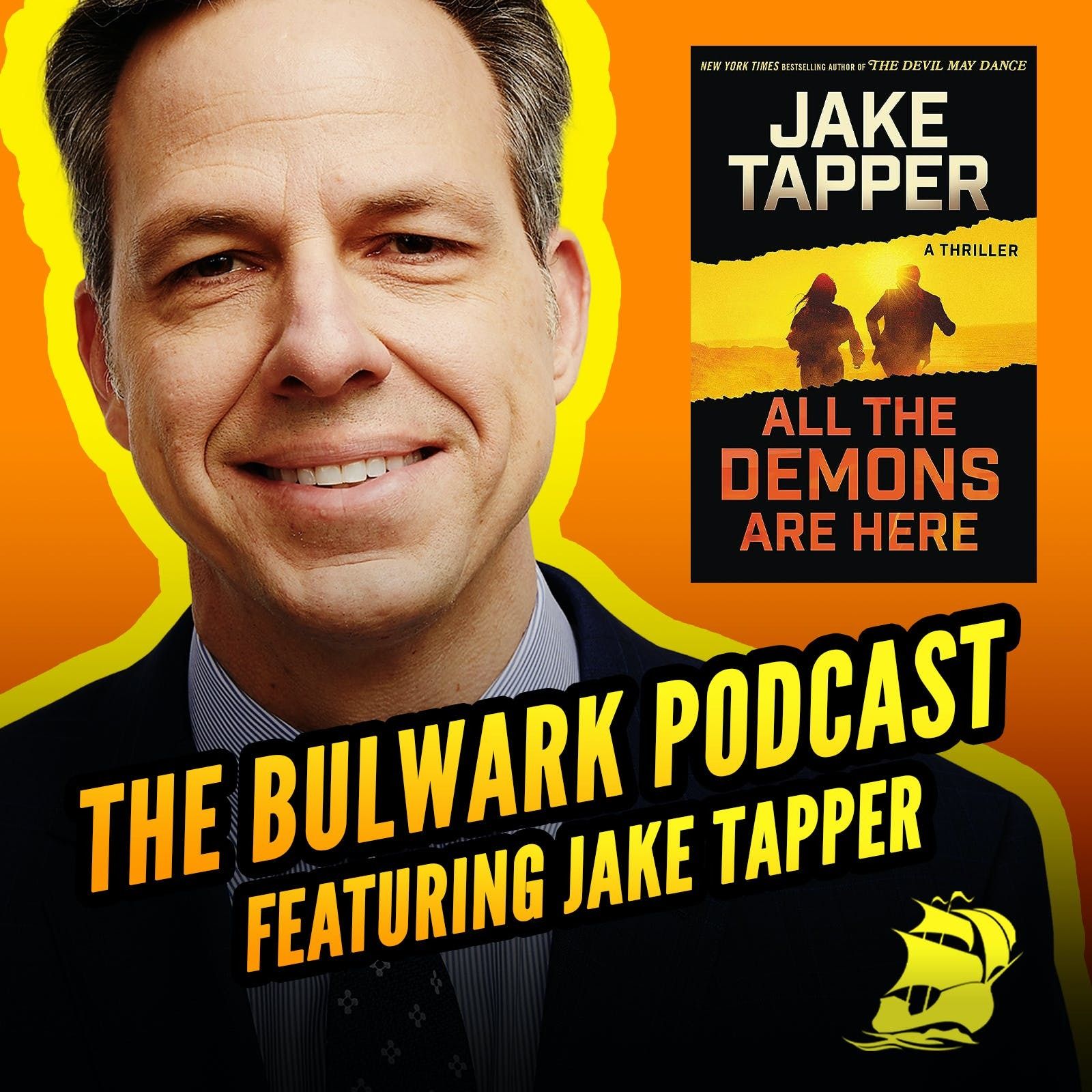
Jake Tapper: "All the Demons Are Here"
The CNN anchor and author re-visits the 70s with a new thriller, featuring a Murdoch-esque character getting his toehold in American journalism, and Evel Knievel—a Trump precursor—reimagined as a presidential candidate. Plus, the media's Trump coverage and Fox's lucrative lies. Jake Tapper joins Charlie Sykes.
show notes:
Learn more about your ad choices. Visit podcastchoices.com/adchoices
Press play and read along
Transcript
Speaker 1 Get ready for Malice, a twisted new drama starring Jack Whitehall, David DeCovny, and Carise Van Houten.
Speaker 1 Jack Whitehall plays Adam, a charming manny, infiltrates the wealthy Tanner family with a hidden motive to destroy them.
Speaker 1 This edge-of-your-seat revenge thriller unravels a deliciously dark mystery in a world full of wealth, secrets, and betrayal. Malice will constantly keep you on your toes.
Speaker 1 Why is Adam after the Tanner family? What lengths will he go to? One thing's for sure, the past never stays buried, so keep your enemies close.
Speaker 1 Watch Malice, all episodes now streaming exclusively on Prime Video.
Speaker 2 Master distiller Jimmy Russell knew Wild Turkey Bourbon got it right the first time.
Speaker 2 Kentucky born with 100 years of know-how, our pre-Prohibition style bourbons are aged longer and never watered down. So you know it's right too, for whatever you do with it.
Speaker 2 Wild Turkey 101 Bourbon makes an old-fashioned of bold fashion for bold nights out or at home wild turkey bourbon aged longer never watered down to create one bold flavor copyright 2025 with power america the orb near never compromised drink responsibly
Speaker 3 Welcome to the Bold Work Podcast. I am Charlie Sykes.
Speaker 3 We are fortunate to be joined today by Jake Tapper, who, of course, is CNN anchor, but also author of the new best-selling thriller, All the Demons Are Here, a work of historical fiction.
Speaker 3 Although, Jake, the title, All the Demons Are Here, feels like it's ripped from the headlines.
Speaker 4 Yeah.
Speaker 4 Well, it's ripped from Shakespeare.
Speaker 4 It's a line kind of from The Tempest, but the actual line is, hell is empty and all the devils are here. And it does feel that way sometimes, doesn't it?
Speaker 3 So this is an interesting moment to write historical fiction when actual history is so amazing.
Speaker 3 I mean, a lot of what you write about is this broader metaphor about, you know, the contemporary threats facing America.
Speaker 3 But before we get into all of that, I really want to bounce a couple things off you. Sure.
Speaker 3
Because we're in this incredible moment here where the former president of the United States is standing trial in multiple venues. He faces 78 separate felony charges.
It is completely unprecedented.
Speaker 3 He's running for president. It seems as if he is the odds one favorite to be the Republican nominee, and he's running a competitive race.
Speaker 4 So we're in this absolutely uncharted political cultural media moment.
Speaker 3 So
Speaker 3 as an old school media guy,
Speaker 3 has anybody in the media figured out how to cover this guy?
Speaker 4 Huh.
Speaker 3 Because I feel like Donald Trump broke the media model back in 2016 and nobody's figured out how to put it back together again.
Speaker 4 I can't authoritatively state that this person has figured out how to do it or that person has figured out how to do it.
Speaker 4
But I can say that I think that there are some general rules that I've picked up along the way from covering him. One of them is we can't act as if he is a normal, regular candidate.
He's not.
Speaker 4 He's, you know,
Speaker 4
I don't think you even have to dislike him to acknowledge that he is his own creature. You can't necessarily treat him.
the same way as you would other candidates because he says things
Speaker 4 that are often untrue and of more concerning he says things that can put other people's lives in danger for instance i think one has to think about
Speaker 4 at the very least whether or not you air his comments live i think that that is a discussion and a debate i'm not saying it shouldn't be done but i'm saying it is a discussion and a debate that everyone in any newsroom that has video should have because you never know what he's going to say and the ramifications of it.
Speaker 4 I mean, he has said things before that ended up costing lives.
Speaker 3 So that's one.
Speaker 4
Two, I don't think you can ignore him. That also means you can't ignore things he says that aren't out there.
I mean,
Speaker 4 one of the reasons he is still as popular with Republicans is because this actually kind of ties in with the book, not to be book pluggy, but the book takes place in 1977 with the character of Ike, who is an AWOL Marine, is kind of representative in ways of how skeptical and mistrustful the U.S.
Speaker 4 public was of everything that they were hearing from the Pentagon and from the government.
Speaker 4 And understandably so, after Vietnam, after Watergate, people didn't know what to believe about the Kennedy assassination, either one of them, or the Martin Luther King assassination.
Speaker 4 So that skepticism, that distrust, that willingness to believe conspiracy theories, et cetera, that still is in us today.
Speaker 4
And Donald Trump feeds into some of that. And, you know, he's not always wrong about everything he says and does.
So I think that also has to be part of the equation, too.
Speaker 4 Yeah, I mean, I go back and forth on all of this.
Speaker 3 There are people who say, well, you shouldn't give oxygen to the crazy things he says, but wait, I do think he needs to be held accountable. People do need to know what he's saying.
Speaker 3 On the other hand, let's talk about what happened last week when he showed up in D.C.
Speaker 3 We basically had the O.J. Simpson slow-moving Bronco moment where you had this endless sort of blank time with showing the empty podium, showing the car and everything.
Speaker 3
I want to read you something that my colleague JVL wrote last Friday in the bulwark. He said, The O.J.
Simpson case was the signal media evolution of our time.
Speaker 3 It established the template for modern broadcast news.
Speaker 3 Everything in our media world, from the treatment of Monica Lewinsky to the 2000 recount to the weeks of 9-11 coverage to Trump's 2016 campaign, is directly descended from O.J.
Speaker 3 And he goes on to say, I would argue the broadcast media, as much as any other factor, has driven the collapse of American political life.
Speaker 3 It changed the incentive structures for both politicians and journalists. It created a sense of manic obsessiveness in the public, and it acted as an accelerant in our ongoing polarization.
Speaker 3 And then he goes to the wall-to-wall coverage of Donald Trump, you know, Donald Trump's getting off the plane, Donald Trump's getting in the car. So what is your reaction to that?
Speaker 3 I kind of think of you as a media throwback, and I asked this as a media throwback myself.
Speaker 4 Yeah.
Speaker 3 What is the right balance to strike? And what did you think of the wall-to-wall empty podium coverage that we got again last week?
Speaker 4 Well, it's a complicated question because I don't see every one of these things as the same. For instance, like showing Donald Trump flying to Washington, D.C.
Speaker 4
in the motorcade, arriving for this historic and in some ways tragic event where he was arrested and arraigned at the federal courthouse. That's news.
It's not positive for him.
Speaker 4
It's not celebrating him. It's not celebratory.
It's news. Now, is that the same thing as, for instance,
Speaker 4 that time that we all got rick-rolled when he said he was going to acknowledge that Barack Obama was born in the U.S., right? And that was just, we were all just sitting around.
Speaker 4 And I don't know what MS or Fox or anyone else was doing because I was anchoring CNN or I was part of the team at CNN, but it was we were just sitting around watching an empty podium while Donald Trump was about to say something acknowledging the reality that Barack Obama was born in the U.S., which is not a proud moment for the media, I don't think, because we were being used by the campaign.
Speaker 4 And
Speaker 4 I mean, it's offensive on its face when you think about the fact that this was even a matter of discussion. Barack Obama was born in Hawaii.
Speaker 4 I mean, like, why we're, we were all sitting around breathlessly waiting for him to acknowledge that he'd been perpetuating a racist lie for a decade does not speak well about us.
Speaker 4 And then there's another example, for instance, when he was arrested and arraigned in Florida, and then he stopped and went into this Versailles cafe, this Cuban cafe,
Speaker 4
and people sang happy birthday to him and this and that. And the value of that I question as well.
So I don't know that I agree with
Speaker 4 all of the criticism, but I certainly think that there are nuances and ways to talk about different points of it.
Speaker 4 I myself didn't care for the Versailles Cafe coverage because I thought it was, we don't do that for anyone. There are no campaign stops that any candidate does that we cover live.
Speaker 4 Biden, DeSantis, Nikki Haley. So why were we doing it for him? I just think there need to be more discussions and debates in newsrooms before
Speaker 4
just running whatever is the latest live feed. Yeah.
If that's the point, right? That we shouldn't just be running live feeds because we can. I agree with that.
Speaker 3 Yeah, and you've been asked this many times before, but in retrospect, the decision to give him a live town hall meeting?
Speaker 4 You know,
Speaker 4 I'm ambivalent about it. I don't know that that gets into the, do you ignore him thing? Are we supposed to ignore him?
Speaker 4 Are we supposed to pretend he's not the leading Republican presidential candidate? I don't know. I mean,
Speaker 4
obviously, my mind is open. I had nothing to do with that town hall.
Like, I wasn't part of it other than just covering it afterwards.
Speaker 4 But Caitlin was fact-checking him and the crowd was Republicans and Republican leading independents in New Hampshire. And Donald Trump is Donald Trump.
Speaker 4 Do you think, forget the live component of it, just forget like how we did it. Should Donald Trump be given a town hall?
Speaker 4 Should voters get to ask the leading Republican presidential candidate questions? What do you think?
Speaker 3 Yeah, I mean, I go back to your point about giving him, you know, live unedited time.
Speaker 3 I mean, I think you could ignore him without turning over that kind of airtime to him because he can't be treated like any other candidate because he is going to be a fire hose of disinformation and bullshit.
Speaker 3 And there's really no way around that.
Speaker 3 But this is not to move past this too quickly, but this is what makes, I think, your book so interesting and so fun because, of course, 1977 is a completely different world, but it's not.
Speaker 4 It's not. And it is not such a different world.
Speaker 3 And what is interesting is the way you actually create these characters of Max Lyon, who is loosely based, or how do you want to describe it, loosely, actually based on Rupert Murdoch?
Speaker 4 Pretty clearly based on Rupert Murdoch. I mean, small differences, but some of the lines he says in the book are actual quotes of Rupert Murdoch because I tried to understand
Speaker 4 what motivates Rupert Murdoch journalistically, because the rise of tabloid journalism is something that happens in 1977 and in the book. And then also, obviously, we're dealing with it today still.
Speaker 3 And I think this is hilarious that your Donald Trump character is Evil Knievel, the motorcycle stun performer, who I will admit I have not thought about for months.
Speaker 3
I mean, basically, he is kind of a precursor, kind of this recurring American character like P.T. Barnum or Jesse James with the showmanship and the spectacle.
But he actually did stuff, right?
Speaker 3
I mean, he... He didn't just sell his brand.
Evil Knievel actually did jump stuff.
Speaker 4 He did. He wasn't a very good jumper, but he was willing to do it.
Speaker 4 Evil Knievel, for your listeners who don't know or barely remember, was a huge figure in American pop culture and even sports culture in the 1970s, even though it's questionable how athletic he actually was, although he was in many ways the father of a lot of the X games and extreme sports that we see today.
Speaker 4 And a lot of those people, Tony Hawk, et cetera, will credit Evil Knievel for getting them interested in kind of these dangerous one-man sports.
Speaker 4 He was a stunt man, and he would do motorcycle stunts, and he would just come up with the wildest ones he could to get attention.
Speaker 4 And there really wasn't much more to it than that and his larger-than-life persona where he was, you know, he lived in Butte, Montana, and he was kind of a shoot from the hip Elvis type and was a fascinating character.
Speaker 4
And there exists in him the same DNA as Donald Trump. And I don't mean it in a negative way.
I don't mean it in a pejorative way.
Speaker 4 It's just there is in American culture these kind of showmen that arise, whether it's P.T.
Speaker 4 Barnum or Evil Knievel or Donald Trump, these people who are just able to command, they have charisma and they have a certain charm about them and they shoot from the hip and they get lots of attention and they come up with media spectacles and the media obliges and there is this similarity in many ways.
Speaker 4 And in fact, I don't know anything about motorcycles at all and motorcycles are a big part of the book, huge part of the book.
Speaker 4 Because of Evil Knievel, because of the character Ike, who's a motorcyclist, there are a bunch of plot points that have like big motorcycle action scenes.
Speaker 4 So I hired this guy, Mark Gardner, who's a writer and a motorcycle enthusiast, to help me edit the motorcycle parts. He was a great guy and really helped.
Speaker 4 You need to believe that Ike knows about motorcycles to buy the premise. Anyway, when we had done our, we had finished our bit of business.
Speaker 4 He said, oh, by the way, I thought you'd find this interesting. And he sent me a link to an essay he had written like two or three years ago where he compared Evil Knievel to Donald Trump.
Speaker 4 And like, I had never seen it, but it's just there. It's just this DNA that's there.
Speaker 4 And it's just, you know, there was this silly attempt to have Evil Knievel run for president in 72 as a joke, like as a stunt to get attention to Montana.
Speaker 3 That's a real thing.
Speaker 4 That really happened. Yeah.
Speaker 4 So, I mean, you know, it was there to play with.
Speaker 3
Well, let's get a little bit of background here. This is your third historical novel.
I mean, the first one, The Hellfire Club, was in the 1950s in the McCarthy era.
Speaker 3 And you had fictional protagonists, you know, Congressman Charlie Martyr and his wife right in the thick of the McCarthy hearings.
Speaker 3 And the next book, The Devil May Dance, is set in the 60s, where you had Frank Sinatra and the rat pack and all of those guys, and
Speaker 3
the whole story of John Kennedy and Sinatra. And then this one is set in the 70s.
And for some of us, it's kind of a little bit of PTSD. I mean, the 70s was that was a screwed-up decade.
Speaker 3 And so you have Elvis and Anita Bryant, the son of Sam,
Speaker 3 Studio 54. There's, you know, cameos, you know, mentions of Farrell Fawcett, Elton John, and Cher, and everything.
Speaker 3 So I don't know whether you describe Max Lyon, the Rupert Murdoch character and the Eva Clinieville character, as are they the demons?
Speaker 4 The demons are, it's more just like at the end of the book, I don't want to spoil it, but there's this big confrontation where a mob is about to attack a place where a lot of politicians have gathered, which is obviously, you know, residents of January 6th, although not, it's not direct, it's not a direct analogy, but it is a mob frustrated with a bunch of things taking out their anger.
Speaker 4 And when I saw The Tempest, last time I saw The Tempest, there was a recent adaptation.
Speaker 4
And, you know, it opens in the midst of a storm on an island. And I just loved that idea.
But I didn't want to start with the storm on an island. I wanted to end with the storm on an island.
Speaker 4
And that's why I came up with the title, All the Demons Are Here. And the idea of who the demons are, that's up to the reader.
Are the demons the politicians?
Speaker 4 Are they the angry mob confronting the politicians? That's for people to decide.
Speaker 3 You use this book to reflect on what was happening to journalism in the 70s as Rupert Murdoch was just, you know, getting a toll hold and really began this attack on truth.
Speaker 3 Max Lyon, who is the Rupert Murdoch character, I mean, he clearly knows, you know, how to sell newspapers by playing the race card, by exploiting the struggle over race and racial justice.
Speaker 3 And you're right about the son of Sam Burger. Just can you just set the scene for me and why you chose that moment to begin saying this is when this began?
Speaker 4 Well, Rupert Murdoch had gotten his toehold in American journalism when he bought a couple of San Antonio newspapers. And I was fascinated.
Speaker 4 First of all, the idea of Rupert Murdoch becoming a character in this book is: I have to give all the credit to Kara Swisher. I did her podcast back when I was promoting The Devil May Dance.
Speaker 4 At the end of the interview, she suggested it. And she didn't even know that I was doing the 70s next.
Speaker 4 But I thought it was too broad. Who would believe that character today?
Speaker 4 But then when I decided to do the 70s and I picked Evil Knivil, and then I wanted to have this plot involving Ike's sister Lucy, the idea that tabloid journalism was rising right in the same era too, I found fascinating.
Speaker 4 And I started watching some documentaries about Murdoch and I read a couple books about Murdoch.
Speaker 4 And so first of all, he'd gotten his toehold in San Antonio and I realized that my fear of killer bees when I was a kid is entirely his fault.
Speaker 3 Really?
Speaker 4
Yeah, the killer bees were like this vague threat in South America. And, you know, it's not like one of them stinging you, kills you.
It's like a thousand of them stinging you, kills you.
Speaker 4
And only if you. I remember worrying about this.
You do? I remember being terrified of this. Yeah.
Speaker 4
And it was completely overhyped by Murdoch in the 70s in those San Antonio newspapers. And it like became a national obsession.
And they made the movie The Swarm. NBC did a special.
Speaker 4
And it was crap. Yes, they were making their way slowly to the United States, but it's really way overhyped, the the threat of killer bees.
Anyway.
Speaker 3 But it worked for Rupert Murdoch.
Speaker 4
It worked. Yeah.
And it scared me for years as a kid.
Speaker 4 So then I started reading about him and I realized he says at some point, Murdoch, but then also my character, Max Lyon, based on Murdoch, he articulates the idea that news consumer behavior is driven by either fear or rage.
Speaker 4
That's it. Once you know that about Murdoch, you can't unsee it.
Almost everything they do is fear or rage. That's the secret sauce.
Yeah. That's it.
Speaker 3 That's the formula.
Speaker 4
Turn on Fox Prime Time and you'll see fear or rage. Fear or rage.
Every story is one of the two. Oh, the trans community is going to come.
Oh, the Latino community is going to come.
Speaker 4
Everything is fear or rage. So, putting Lucy into that context, Lucy is in my book.
She is the daughter of Congressman Charlie Marter and his wife Margaret, who are the heroes of the first two books.
Speaker 4 And she wants to be a journalist, and she joins this new tabloid newspaper in Washington, D.C. called the the Washington Sentinel and goes into the world of tabloid journalism.
Speaker 4 And that was fun for me to explore because we live it, not just Fox, obviously, but like there has been a tabloidization of all news media, period.
Speaker 4 You touched on it a second ago with your question about OJ and how that shapes coverage with cable news and social media. And there are all sorts of imperatives here.
Speaker 4 There are all sorts of things that are shaping this all. But it was interesting to me.
Speaker 4 And then the idea of taking this story, because Lucy becomes a top top reporter assigned to cover a serial killer in washington dc because there's a big serial killer story a real one in new york city that is boosting murdoch's paper the new york post because of the son of sam serial killer summer of sam yeah then i thought well what what would murdoch do
Speaker 4 if he actually had this story this serial killer and not the summer of sam and you really have to know the plot of the book to know what i'm talking about but you know he would inject racial politics into it yeah i mean he pushed the idea that their fictional fictional serial killer in D.C.
Speaker 3
was a black man. Yeah.
And they play that up. It's interesting.
Speaker 3 You were in Philadelphia at a book event talking about this, and you recalled how the New York Post actually plastered a photo of two black men in Boston on this cover back in April 2013 and asked, are these the Boston Marathon bombers?
Speaker 4 Yeah, I don't know if they were black or
Speaker 4 Indian or, I mean, they were not white is all I know.
Speaker 4
Yeah. They did that, right? They had to pay up.
That was a settlement they did way before the Dominion settlement,
Speaker 4 the new score enterprise. And I bet those two guys are thinking they should have held out for more money.
Speaker 3 So were you writing this during or before the Dominion lawsuit?
Speaker 4 Before.
Speaker 3 Okay, so in many ways, you can't read this without thinking about the Dominion lawsuit where the Fox anchors kept talking about a stolen election, even though they knew it wasn't true. Right.
Speaker 4 So how did that happen?
Speaker 3 Why did they do it? What did we learn about that?
Speaker 4 Because the imperative structure is
Speaker 4 entirely
Speaker 4 ratings and money
Speaker 4 i don't know of any journalism awards anyone at fox gets nominated for other than when chris wallace interviewed putin he did get nominated for that for an emmy and he deserved it by the way but he's no longer at fox and at cnn we just got nominated for 47 emmys uh news emmys and you know we're not going to win them all or even most of them probably but that's an honor like but you're in a different business than they are aren't you well that's the thing yeah we're We're in an entirely different business.
Speaker 4
They don't care how they are regarded in the journalistic community. They don't care that they don't get recognized for good journalism.
It's entirely about clicks, 100%.
Speaker 3 So I've been thinking a lot about the 1970s, which is still burned into my consciousness, and that you chose 1977. In 1977, there was a great deal of cynicism.
Speaker 3 There was a great deal of doubt, and that this was just beginning.
Speaker 3 But in 1977, nobody really thought back then that this tabloid style of journalism was going to pose an existential threat to American democracy.
Speaker 4 Correct.
Speaker 3 In 1977, you could look at the media and say the media is going to continue to be a guardrail. The media will stand against people like what happened during Watergate.
Speaker 3 And now you have like 40% of Americans believe something that's abjectly false, right? I mean, even after it's been adjudicated in courtroom after courtroom, they believe the election is stolen.
Speaker 3 And I think you made this point. You know, we're now at the point now where we're not sure how the American experiment is going to turn out
Speaker 4
because of what you're describing here. Yeah, no, I agree.
I mean, 100%.
Speaker 4 And Fox could make the decision to be part of the solution, I guess. The lawsuits are not over.
Speaker 4 There's still the smart-matic one, and there are still individual people who are alleging defamation.
Speaker 4 And by the way, remember, they also had to pay some settlement to the family of Seth Rich, that poor kid that was murdered, who used to work for the DNC, and Hannity was involved in a whole bunch of stuff having to do with like pretending that he leaked the Hillary Clinton emails to the Russians, etc.
Speaker 4
I mean, they had to pay a huge defamation suit as far as I can tell. And part of the deal was that it couldn't be announced until after the 2020 election.
Great.
Speaker 3 In any other newsroom, news organization, business, or just any institution, these things would be real huge shocks, right? I mean, they would be moments of deep introspection.
Speaker 3 And I mean, some heads did roll at Fox, but.
Speaker 4
No, no, no, no, no, no. Let me stop you there.
The heads that rolled were the people that were telling the truth.
Speaker 4 Except for Tucker, the heads that rolled were. You know, they fired like Chris Steywalt and Bill Salmon.
Speaker 4 And I mean, they fired the people that had been, it was reporters who were telling the truth who got canned, a lot of them.
Speaker 3 A little confessional here.
Speaker 3 I had a very, very painful conversation with Paul Ryan earlier this year before a lot of this, this went down, asking, when are you going to do something as a member of the Fox board?
Speaker 4 What did he say?
Speaker 3 Well, you know, he kind of threw Tucker under the bus.
Speaker 3 But what I was asking him was, you know, do you understand that you are on the board of directors of a company that is pumping this toxic sludge into the American system?
Speaker 3 And his answer was basically, and I, you know, reading between the lines is, look, I need to be in the room because it would be way worse without me.
Speaker 3 I am trying to do, to steer it into the right direction. I am trying to be the voice that says we can be part of the solution.
Speaker 3 And even though I think it's apparent that you're right, that they haven't made that turn, they're still there. So the powers of rationalization must be really intense.
Speaker 3 I mean, does Fox make that much money? Is it really worth it to them to do this?
Speaker 4
I don't know. I mean, they're not in it for the journalism, right? I mean, they're not in it to speak truth to power.
They're not in it to tell the stories that other people aren't telling.
Speaker 4
I mean, I don't know. I know there are good journalists there.
Yeah. So I don't know.
I don't quite understand it. I mean, they just tell so many lies and they smear so many people.
Speaker 4 It's always punching down.
Speaker 3 It's always.
Speaker 4 I don't get it, but I think it's very lucrative. Those are the values that in the book, Max Lyon espouses because it's succeeding.
Speaker 4 His strategy to get new readers for the Washington Sentinel is succeeding and it's having an influence.
Speaker 3 Let's go back to the book because I am absolutely fascinated by the Evil Knievel Donald Trump nexus here.
Speaker 3
Evil Knievel is running for president. One of the quotes that you attribute to Evil Knievel, the candidate, is, our country is in serious trouble.
We don't have victories anymore.
Speaker 3
We used to have victories, but we don't have them. Our enemies are getting stronger.
And as a country, we are getting weaker. Like straight out of Donald Trump.
Speaker 3 well that might actually have been Donald Trump that might have been from the Donald Trump announcement speech okay we'll keep that between us but so you see him as the quintessential American bad boy character I just yeah you're starting to write your third novel you've decided you've done the 50s you've done the 60s you're going to do the 70s you want to write about these themes of American culture and the media Walk me through how you came up with evil can evil because that wouldn't have occurred to me I mean it didn't occur to me either okay it's gonna sound the story is gonna be a little name-droppy but it is the true story story.
Speaker 4 So I go fishing with Jimmy Kimmel at his fishing lodge in Idaho in 2021, and he has purchased it and refurbished it, and he has decorated it with all this Evil Knievel stuff.
Speaker 4 Evil Knievel, you know, famously or infamously tried to jump over the Snake River Canyon in 74, just a few miles away. And the charm of Evil Knievel completely eluded me as a kid.
Speaker 4
I was not into that, but he was a big dude. I mean, he was, you know, he was on the cover of Sports Illustrated.
He was on the cover of Rolling Stone.
Speaker 4
He was featured prominently often on ABC Wide World of Sports. That was not part of my existence, but it was part of Jimmy's.
And Jimmy said, You really need to check him out.
Speaker 4 It was like, he's this incredible character.
Speaker 4
I don't think he meant it like for your next book. I think he just meant it like just for shits and giggles.
You should know about this guy.
Speaker 4 And he referred me to a documentary made by a different guest at the lodge, Johnny Knoxville. And Johnny Knoxville had made this documentary called Being Evil about Evil Knivil.
Speaker 4 And I watched it and it was great.
Speaker 4
And then I read a book about Evil Knievel. And Knoxville had told me a couple stories, just like wild stories.
Some not even in the book.
Speaker 4 I mean, some that are just having to do with like, he was a thief and a con man before he was a motorcycle stunt man.
Speaker 4 He was legitimately a criminal, but then he rose from that and became this other superstar celebrity. And then the more I read about him, and I just wrote something about about this for USA Today.
Speaker 4 I'll have to send you the link. He legitimately, when he was like 22, when he was a poacher, before he was Evil Knievel, when he was just Robert Knievel,
Speaker 4
he got pissed off because the Park Service in Yellowstone was killing elks because it had an overpopulation. And he didn't like that because he wanted to kill elks.
He was a poacher.
Speaker 4 He would take people on hunting trips into Yellowstone. He wasn't allowed to, but he did anyway.
Speaker 4
He took a bunch of antlers, hitchhiked across the country, and literally got a meeting with the Secretary of the Interior. I think it was Stuart Udall, and had the rule changed.
He was like 21 or 22.
Speaker 4 So he did have a certain acumen and he did have a certain sense of stunts for the sake of changing policy.
Speaker 4 So, you know, on Earth 2, where Evil Can Evil is alive today, he would have run for president. Or if like social media had happened.
Speaker 4 earlier or I don't know, just like if a couple things had worked out differently, it's really not difficult to imagine him running for president and being very, very much like Donald Trump.
Speaker 3 What's interesting about this, it's historical fiction, but it also captures how our template of American politics has been completely changed.
Speaker 3 And this maybe was one of the reptilian insights that Donald Trump had, that
Speaker 3 the future of politics was not in policy wonkery or
Speaker 3
any of the traditional forms of working through the system. It was about entertainment.
It was about providing the masses with the shits and giggles.
Speaker 3 It was about being larger than life and flamboyant and that there was an appeal for being the bad boy.
Speaker 3 You remember there was a moment when you thought, well, you know, if somebody did this or did this or did this, they would be disqualified.
Speaker 3 And Donald Trump basically said, yeah, you know, hold my beer.
Speaker 4 Look what I'm going to do. Totally.
Speaker 3 And part of his appeal is that he is entertaining and that people don't like him in spite of some of this bad boy stuff, but exactly because of it, don't they?
Speaker 4 David French had this great column that I'm sure you've read and I'm sure you've talked about
Speaker 4
how liberal critics and others of Donald Trump miss the fact that to his fans, he is a blast. It is fun to be a part of MAGA.
It is a club that you're in.
Speaker 4 And yeah, a lot of it's based on rage and fear, just like the Fox ethos. But beyond that, there's also a lot of goofing around and making fun of people and making fun of each other.
Speaker 4 And, you know, there is something joyous about it.
Speaker 4 Now, when I say that, I'm not making light of any of the darker sides of it, which I take very seriously and think are very problematic, but that is something that people miss.
Speaker 4 And it is something that I tried to capture in the book because Ike, who is also the child of Charlie and Margaret, Ike goes and teams up and works for Evil Knievel and sees Evil Knievel as a man with flaws, but also as somebody who is charismatic and it's fun being part of his world for a while.
Speaker 3 I have to admit that the fun escapes me a little bit with.
Speaker 4 Well, I don't think it's aimed at you and me.
Speaker 3 No, no it's not and i think that you know that's part of the problem i mean going back and i'm sort of toggling back and forth between 1977 and now because i think the assumption back then was if somebody told a lie and they were caught telling the lie that there'd be universal condemnation that there would be a pushback that might even be disqualifying now we live in an era in which people are told lies and there's a large portion of them that even if they know they're being lied to, don't seem to care.
Speaker 3 And I think that goes back to my question about breaking the journalism model, because wasn't it the assumption once that if we did a fact check on somebody and prove that what you just said was not true, that there would be consequences to that, that people would go, hey, thank you for telling me the truth.
Speaker 3 And I am outraged that I am being lied to.
Speaker 4 And that doesn't happen anymore. Yeah, I know.
Speaker 3 How do we deal with that? How do we cope with that?
Speaker 4
I don't know. I don't know.
I mean, one of the things that Trump did was you talked about how Trump's effect on the media.
Speaker 4 I've talked about this before, too, about how I see him as a disruptor of news media. And one of the ways he's done that is by making facts partisan.
Speaker 4
The idea that if you call out a lie, you're being a liberal, you're being a hack, you're being anti-Trump. He has somehow sold people on this.
And Fox is right there with him.
Speaker 4 You know, they're doing that too. They're hand in hand with him on that.
Speaker 3 Oh, you can see that the facts are partisan or the Trumpian style of projection, that when he's doing something, he will project it onto the other side, the what about ism.
Speaker 3 I mean, I think think it's fascinating that he is openly now saying, you know, if you elect me, I am your retribution, making no secret of the fact that he would, in fact, do what he's accusing the Biden administration falsely of doing, of weaponizing the Department of Justice.
Speaker 3 He makes no secret of it, does he? I mean, it's right there.
Speaker 4 You know what's so interesting? There have been times in the last five years when I have reported on something having to do with
Speaker 4
Trump or Trump Jr. or an anchor at Fox or whatever, and they insisted that I was misinterpreting.
But that's not what I meant. You know what I mean? You're taking the worst possible interpretation.
Speaker 4 And they appealed to my sense of fairness and they appealed to my sense of wanting to be allegiant to the facts. And I am who I am.
Speaker 4 So I listen and I not correct the record, but like say Donald Trump Jr.
Speaker 4
has reached out and this is what he said he meant or Sean Hannity reached out and he said he meant to be saying blah, blah, blah. And I've done that.
And they afford no such opportunity for me.
Speaker 4 So to me, it's like they understand.
Speaker 4 Well, yeah, they understand that I try to be a person of honor and truth and fact, and they don't care that they are not.
Speaker 3
No, that's interesting, that asymmetry where they will take an admission from more traditional media that, hey, we were wrong about that. Here's a correction.
Like, aha, we're jumping all over it.
Speaker 3 You will never see that kind of apology or admission on their side. So there is that asymmetry.
Speaker 3 Part of when I was going back to my question about breaking the media model as an old school journalist, and I started my first newspaper job in 1976, the timing of your book, and came up through a tradition where journalists went and dug out facts and challenged power and wrote theoretically without fear or favor.
Speaker 3
Now it seems as if the model has become more about fan service. Yeah, I agree.
People don't like hearing negative things about people they like.
Speaker 4
I agree. And that's a problem.
And that's not just a Fox problem, but that is a problem. And it can't be that way.
Let's take Hunter Biden as an example.
Speaker 4 Hunter Biden broke laws. I mean, we saw him break numerous drug laws on those tapes and everything.
Speaker 4 But beyond that, like he's tried to cash in on his family's name and put his father in a horrible position. And his father does seem to have a blind spot about it.
Speaker 4 And the whole thing about not acknowledging his daughter with that woman in Arkansas is just heartbreaking for that girl. And that whole story, the whole Hunter Biden saga
Speaker 4 really awful.
Speaker 4 And yet on the left, if you even cover it or talk about it or discuss it, then they don't want to hear it because it's saying something unpleasant about a side that they root for.
Speaker 4 Fan service is not a good way to do journalism.
Speaker 3 No, and I think that's become sort of internalized on the part of a lot of folks who believe that the job of the media is to confirm their priors, tell them what they already believe, what they want, to hate the right people and to praise the right people.
Speaker 3 And so so let me just ask you one last question because I know that a lot of people are probably wondering this. You know, with your heavy broadcast schedule, how the hell do you write novels?
Speaker 4 So the first answer is obviously I'm wired a little differently. And I don't mean that
Speaker 4
it's probably not a good thing, but like I don't relax very easily. And like I come home and I write and I just I am very driven.
And so that's part of it.
Speaker 4 The other part of it is when I write a book, I spend a lot of time researching, I spend a lot of time outlining, and then i break it up into chapters and then i have assignments for myself okay in this chapter these five things need to happen and then i try to write for at least 15 minutes a day every day when i'm in the middle of a writing project because even if i'm busy everybody has 15 minutes a day breakfast lunch dinner whatever and if that's all you do that week that's still an hour 45 that's two pages maybe and that's the lesson is i wrote a novel in my 20s it didn't get published and then i put it down and then i didn't try to do fiction again for another like 20 years.
Speaker 4 And if you don't sit down and write, then that will happen to you too. 20 years will go by and you haven't written a word of fiction, or you've written a word, but
Speaker 4 you never finished anything. And it can happen like that unless you have the schedule and make yourself abide by it.
Speaker 3 Are you already thinking about your next novel?
Speaker 4
I am. I'm thinking about my next novel.
I'm also thinking about like a couple of nonfiction projects I want to do. So I need to talk to the publisher and figure out what they want me to do.
Speaker 4 But I'm not just thinking about them. I've worked on the nonfiction project and I've worked on a next book, book four.
Speaker 3 Well, the good news is at least you have something else in your life because you got a new dog today, right?
Speaker 4 We got Moose.
Speaker 3 Congratulations.
Speaker 4
We lost our Australian terrier, Winston, who some of your listeners might have seen on Twitter. Winston Tapper, he was 12.
We lost him a few weeks ago. So we got Moose today.
Bernadoodle.
Speaker 4 He's a big, goofy guy. We're going to have to set up a Twitter account for him, too.
Speaker 3
I think that will be therapeutic. The new book is All the Demons Are Here.
Jake Tapper is, of course, a CNN anchor.
Speaker 3 His earlier books include The Outpost: An Untold Story of American Valor, The Hellfire Club, and The Devil May Dance. Jake, thank you so much for coming on the podcast today.
Speaker 4 Such a pleasure, Charlie. Thank you.
Speaker 3
And thank you all for listening to today's Bullwork Podcast. I'm Charlie Sekes.
We will be back tomorrow and we'll do this all over again.
Speaker 3 Bullwork Podcast is produced by Katie Cooper and engineered and edited by Jason Brown.
Speaker 3
Imagine fishing all day and not catching a single thing. That's what the other kind of fishing is like when hackers face Cisco Duo.
Nothing breaks through duo's end-to-end fishing resistance.
Speaker 3 Cisco Duo, fishing season is over. Learn more at duo.com.
Speaker 5 Even though severe cases can be rare, respiratory syncytial virus, or RSV, is still the leading cause of hospitalization in babies under one.
Speaker 5 RSV often begins like a cold or the flu, but can quickly spread to your baby's lungs. Ask your doctor about preventative antibodies for your baby this season and visit protectagainstrsv.com.
Speaker 5 The information presented is for general educational purposes only. Please ask your healthcare provider about any questions regarding your health or your baby's health.
Speaker 5 Even when you're playing music,
Speaker 5 you're always listening to your baby, especially when RSV is on your mind.
Speaker 5 Bifortis, nercevimab ALIP, is the first and only long-acting preventative antibody that gives babies the RSV antibodies they lack.
Speaker 5 Baphortis is a prescription medicine used to help prevent serious lung disease caused by RSV or respiratory syncytial virus in babies under age one born during or entering their first RSV season and children up to 24 months who remain at risk of severe RSV disease through their second RSV season.
Speaker 5 Your baby shouldn't receive Baphortis if they have a history of serious allergic reactions to Baphortis, nursevimab ALIP, or any of its ingredients.
Speaker 5 Tell your baby's doctor about any medicines they're taking and all their medical conditions, including bleeding or bruising problems. Serious allergic reactions have happened.
Speaker 5 Get medical help right away if your child has any of the following signs or symptoms of a serious allergic reaction, such as swelling of the face, mouth, or tongue, difficulty swallowing or breathing, unresponsiveness, bluish color of skin, lips, or underfingernails, muscle weakness, severe rash, hives, or itching.
Speaker 5
Most common side effects include rash and pain, swelling, or hardness at their injection site. Individual results may vary.
Ask your baby's doctor about Bayfortis.
Speaker 5 Visit Bayfortis.com or call 1-855-BEFORTIS.