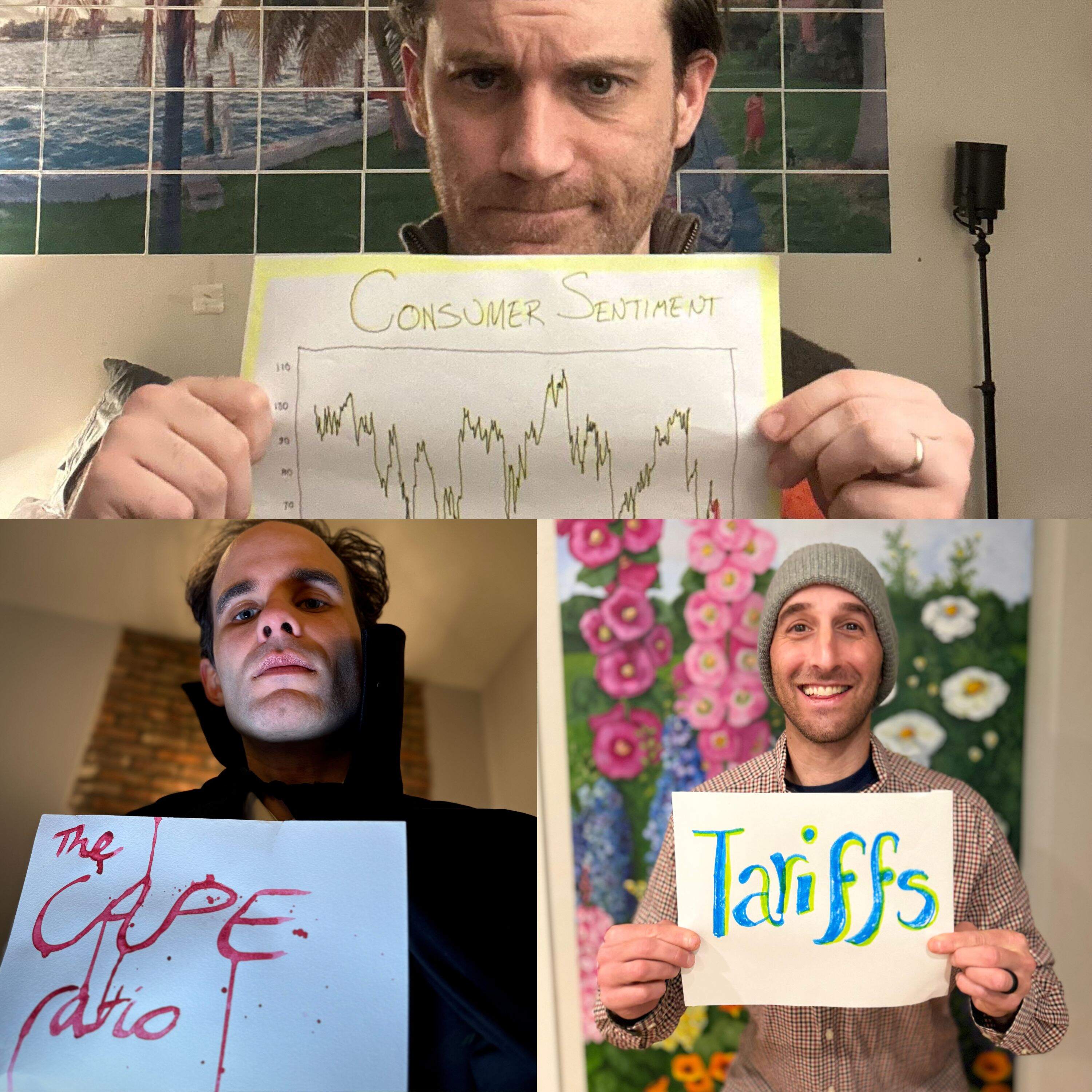
How a former Fed vice chair would approach rate cuts
Related episodes:
A little doomsday feeling is weighing on the economy
Can ... we still trust the monthly jobs report?
For sponsor-free episodes of The Indicator from Planet Money, subscribe to Planet Money+ via Apple Podcasts or at plus.npr.org. Fact-checking by Sierra Juarez. Music by Drop Electric. Find us: TikTok, Instagram, Facebook, Newsletter.
Learn more about sponsor message choices: podcastchoices.com/adchoices
NPR Privacy Policy
Press play and read along
Transcript
Speaker 1
Hey everyone, it's Darian Woods here. Just quickly before we start the show, I want to take a minute to talk about public media.
This is what makes The Indicator and other NPR podcasts special.
Speaker 1 Public media was founded to inform, to educate, and to expand our perspective. But as of this fall, federal funding for public media, including NPR and local NPR stations, has been eliminated.
Speaker 1 Despite that, we remain committed to this work.
Speaker 1 Just this year, we've done episodes on why the trade war is missing a referee on the stock market and the magic of diversification on the surging cost of healthcare for pets.
Speaker 1
We go beyond the headlines to show you how the economy affects your life. In 2026, with your help, we can do even more.
Thank you if you already go the extra mile as an NPR Plus supporter.
Speaker 1 If not, you can join the Plus community, get a bunch of perks like bonus episodes from Across NPR's podcasts, and support public media by signing up for NPR Plus today. Just go to plus.npr.org.
Speaker 3 NPR.
Speaker 1 This is the indicator from Planet Money. I'm Darian Woods.
Speaker 2
And I'm Stephen Bassaha. Because of the recent government shutdown, a lot of economic indicators have been delayed or even canceled.
That is troubling for decision makers.
Speaker 2 The chair of the Federal Reserve, Jerome Powell, recently put it like this.
Speaker 4 If you're driving in the fog, you slow down.
Speaker 1 And so if the central bank is a car slowly driving in the fog, well, this week it's hit a T intersection. The Federal Reserve is meeting today and tomorrow to decide what to do.
Speaker 1
On one side is the way of high interest rates. You might call this Hawke's Highway.
A steeper incline of higher borrowing costs that will try to finally vanquish inflation.
Speaker 1 But the other direction is Doves Drive. That's a gentle downward slope promising lower interest rates and encouraging businesses to start hiring again.
Speaker 2 So in one direction, stable prices, or the other one, jobs. Which road should we take?
Speaker 3 They're missing official statistics. And so for them, that's very difficult.
Speaker 2
That is Lal Brainard. She was one of the drivers of this central bank car.
She was on the big decision-making committee at the Fed for eight years. Most recently, she was vice chair.
Speaker 1 Today on the show, we get inside the committee that makes the big decision steering the economy and learn what this former decision maker would do today.
Speaker 4 This message comes from AT ⁇ T. America's first network is also its fastest and most reliable.
Speaker 4 Based on Route Metrics, United States Route Score Report Report 1H 2025, tested with best commercially available smartphones on three national mobile networks across all available network types, your experiences may vary.
Speaker 4
Rootmetrics rankings are not an endorsement of AT ⁇ T. When you compare, there's no comparison.
AT ⁇ T
Speaker 4
This message comes from LinkedIn Ads. One of the hardest parts about B2B marketing is reaching the right audience.
That's why you need LinkedIn ads.
Speaker 4
You can target your buyers by job title, company, role, seniority, and skills. All the professionals you need to reach in one place.
Get a $250 credit on your next campaign so you can try it yourself.
Speaker 4
Just go to linkedin.com slash nprpod. That's linkedin.com slash nprpod.
Terms and conditions apply. Only on LinkedIn ads.
This message comes from Capital One.
Speaker 4
Capital One offers checking accounts with no fees or minimums. What's in your wallet? Terms apply.
See capital one.com slash bank for details. Capital One NA, member FDIC.
Speaker 1 Lael Brainard says the decision of the feds committee tomorrow will be fueled by two sources, caffeine and sugar.
Speaker 3 Everybody gathers for coffee and donuts in the morning, and every person sits around this massive table, and they each have their own time to make an observation about what they're seeing in the economy.
Speaker 2 She says there does seem to be more disagreements between decision makers at the moment, but.
Speaker 3 People listen to each other. Even when they disagree, they take each other's views very seriously.
Speaker 2 At today's meeting, those observations might be taken even more seriously because of that lack of government data.
Speaker 1 So because of the government shutdown, there's a whole host of indicators we're missing. The CPI, the Consumer Price Index, was cancelled for October and delayed for November.
Speaker 1 The latest jobs report only covers jobs from months ago.
Speaker 1 How would you describe this situation for decision makers?
Speaker 3 So right now, with that data being so lagged, at a moment where the economy is really pulled between these opposing forces, primarily because of tariffs and immigration restrictions, but also because of the AI boom, that is starting to affect both
Speaker 3 job prospects and very much investment because it's pulling investment away from manufacturing in some of the areas that are not immediately related to AI.
Speaker 3 So at a moment like this, you really want up-to-date data.
Speaker 2 She says those up-to-date indicators are needed to really know whether the risks of having higher inflation outweigh the risks of having higher unemployment.
Speaker 3 It would be great to have the most recent data instead of two-month-old stale data to try to make those decisions.
Speaker 1 Yeah, how bad is it to be missing this data at this critical time?
Speaker 3 So it is certainly an impediment, but it's also true that when the economy is at turning points, it's just always hard to read the economy. The data always feels a little bit like driving,
Speaker 3 looking into the rearview mirror, because it is inherently backward looking. So a moment like this, it would be hard to read the economy even with the most recent official statistics.
Speaker 1
So thought experiment, you are on the committee this week, and positive news is your binder is a little thinner, easier to lug in. The downside is that there's less data.
So
Speaker 1 what would you be looking at instead?
Speaker 3 So I would do a lot of calls and meetings in that intervening time. I used to find that incredibly important at turning points in the economy.
Speaker 3 I would certainly look at all the private sector and non-governmental data sources that are up to date.
Speaker 2 Leo's talking about private sources like ADP and Revellio Labs jobs numbers. These are businesses using job listings and payrolls to try and give their best estimates of how the labor market's doing.
Speaker 2 Also, consumer sentiment surveys.
Speaker 3 People are much more worried about job security than they were even a year ago.
Speaker 1 So what's your take? If you were there in the decision-making room, would you vote for raising interest rates, lowering them, keeping them the same?
Speaker 3 So I think it's actually quite a difficult decision. I do think it's important
Speaker 3 for the committee to bring inflation to 2%,
Speaker 3 which is their target over the next two years. On the other hand,
Speaker 3 we don't want to see the economy go into a downward self-reinforcing spiral where more people are laid off, they are no longer able to afford the same consumption, and so the economy weakens and there are more layoffs.
Speaker 3 So I would probably on balance favor one more cut and then holding for a period of time, but with a very firm commitment to getting inflation to 2% over the next two years.
Speaker 1 What some people call a hawkish cut.
Speaker 3 That, I think, would be the right way to describe it.
Speaker 1 In the surveys I've seen, people are getting increasingly worried about jobs. But when you ask Americans what the number one issue facing the country is, inflation and prices seems to be number one.
Speaker 1 And so by cutting, is that putting more weight onto the jobs and economy part of the equation and less so on the inflation and prices?
Speaker 3
Sure, you're absolutely right. Affordability is the critical challenge for American households.
Electricity is more expensive. Health care is becoming incredibly expensive.
Speaker 3 Groceries have become more expensive. And of course, we know housing has been challenging for some time.
Speaker 3 But a lot of those things that I just mentioned really are not simple price pressures that will be affected by cutting rates.
Speaker 3 They are long-standing challenges that have to do with underlying supply dynamics, like in the housing sector. And so a more complicated set of solutions, I think, are really important there.
Speaker 3 And they really sit with the White House, with the executive branch.
Speaker 2 In other words, Leo thinks that high prices aren't the same thing as rising prices. She says for people on ACA insurance, their high prices are stinging because the subsidies aren't being extended.
Speaker 2 She also says groceries could be made cheaper by removing the tariffs. And that's different than the high interest rates needed to curb generally rising prices throughout the economy.
Speaker 1 You said that the data in a critical time is kind of like looking in the rearview mirror because it's past events. And
Speaker 1 would you say that now it's like looking in the rearview mirror that is also foggy?
Speaker 3 Well,
Speaker 3 either that or, you know, a very imprecise rearview mirror.
Speaker 2 Tomorrow, the Federal Reserve will announce its decision. Whether it was the right one, we'll only know when we get to look back through that rearview mirror.
Speaker 1
This episode was produced by Corey Bridges with Engineering by Robert Rodriguez. It was fact-checked by Kubikatz McKim.
Kate Kinkaden edits the show, and The Indicator is a production of NPR.
Speaker 4 This message comes from Donors Choose. Donors Choose connects public school teachers with donors to fund classroom needs, including school supplies.
Speaker 4
Donations put books, art supplies, and student smiles into the classrooms that need them most. Make a difference today.
Donate now at donorschoose.org slash local.
Speaker 4
Support for NPR and the following message come from Edward Jones. A rich life isn't always a straight line.
Unexpected turns can bring new possibilities.
Speaker 4
With a hundred years of experience navigating ups and downs, Edward Jones can help guide you. Let's find your rich together.
Edward Jones, member SIPC.
Speaker 5
This message comes from Capital One with the Venture X card. Earn unlimited double miles, a $300 annual Capital One travel credit, and access to airport lounges.
Capital One, what's in your wallet?
Speaker 5 Terms apply. Details at capital1.com.