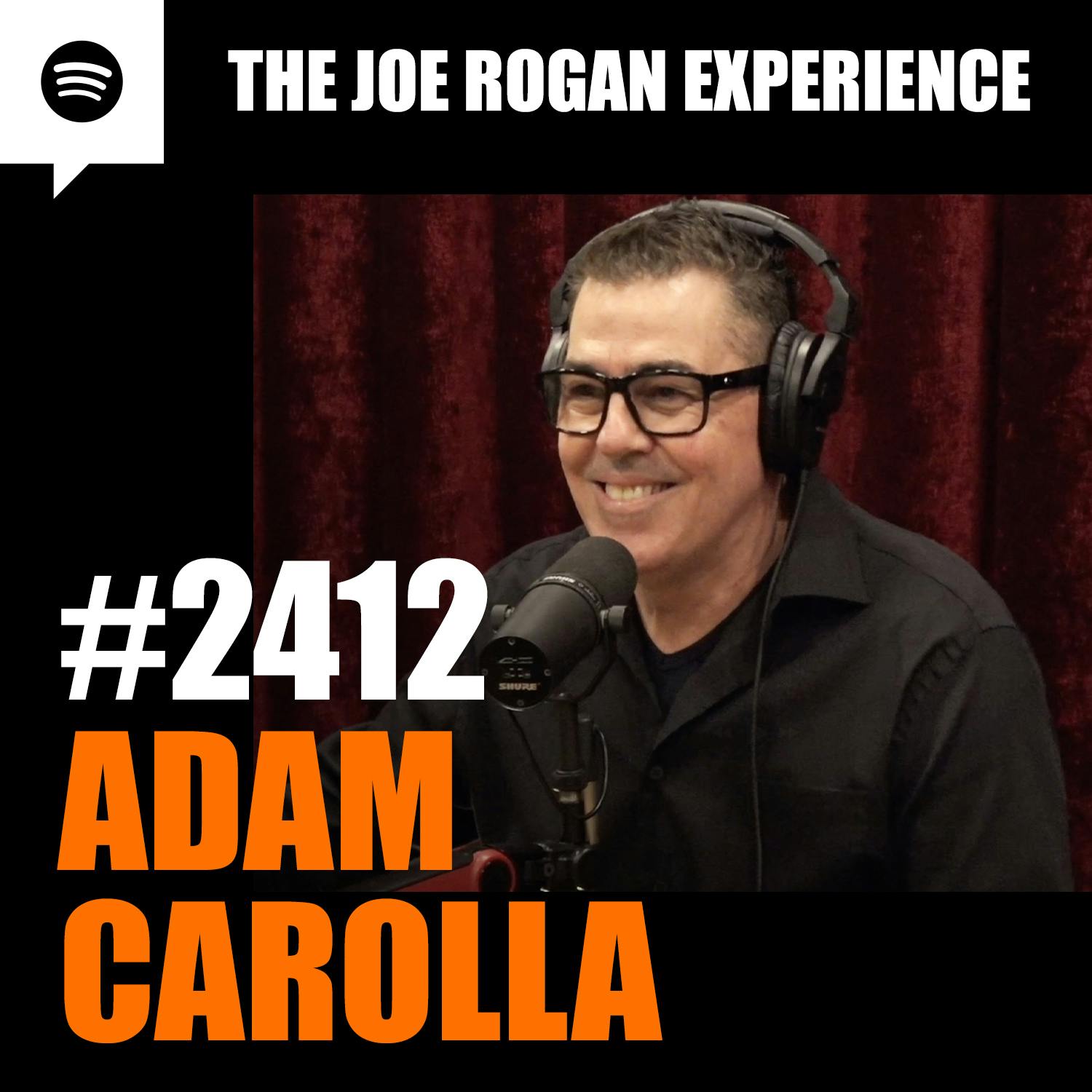
#2412 - Adam Carolla
https://www.angel.com/watch/adam-carolla-comes-cleanerwww.youtube.com/@TheAdamCarollaShow1
Perplexity: Download the app or ask Perplexity anything at https://pplx.ai/rogan.
Buy 1 Get 1 Free Trucker Hat with code ROGAN at https://happydad.com
Go to https://roka.com for Black Friday deals.
Learn more about your ad choices. Visit podcastchoices.com/adchoices
Press play and read along
Transcript
Speaker 0 Joe Rogan podcast, check it out!
Speaker 1 The Joe Rogan experience. Train by day, Joe Rogan podcast by night, all day.
Speaker 2 Good to see you, brother. What's happening?
Speaker 1 Oh, man, everything.
Speaker 2 It's been a few years, man. Yeah.
Speaker 1 When was the last time I saw you?
Speaker 1
I think I saw you outside of the ice house. Oh, yeah.
You were coming in doing a set. You got a land cruiser or something with an an LS swap engine in it or something.
Speaker 2 Yeah, that's right.
Speaker 1
And you showed it to me. And I think I was thinking about it.
I went to your house to do the podcast.
Speaker 2 Early in the days.
Speaker 1 Early. Yeah.
Speaker 1 Up deep valley, up the hill. And then I think you got your place sort of down
Speaker 1
strip mall kind of kind of place down in the flatlands of the valley. Yep.
The woodlands. Yeah.
And I think that, I mean, it's been a million years.
Speaker 2 Yeah, it's been a while. Time flies, buddy.
Speaker 1 I know. It's so sad.
Speaker 1
You know what? You know what's sad? It goes so slow when you're young and miserable. You know what I mean? Now I'm old and happy and rich, and it just flies by.
You know what I mean?
Speaker 1
Like all the stuff you want to do, and it just goes right by you. And then when I was like 13, I just sat in a class and stared at the clock and just went, God damn.
You know why that is?
Speaker 2
It's relative. It's a percentage of your life.
No. So when you're 10, a year is 10% of your life.
Right. You know, when you're 55, a year is really quick.
Speaker 1
I know. It just sucks that like I remember going back to school in September and going, when's Christmas vacation? And they'd go, two months.
And I'd go, oh, man, no way. That's too long.
Speaker 1 And now it just goes flying by, but now it's good and you want it to slow down. Yeah, I always think of life as sort of like driving to San Francisco from L.A.
Speaker 1
Like the first time you do it, it takes a long time. And the 50th time you do it, it's like nothing.
And that's the relative part.
Speaker 2 You get used to it.
Speaker 1 Yeah.
Speaker 2 Yeah, it's, I don't know. Just got to live in the moment and enjoy it while it's here.
Speaker 2 Hope it works out. Hope something's next
Speaker 1 or not.
Speaker 1 I guess, yeah, that moment, you know, that thing.
Speaker 1 You know, it's like that thing where people have a near-death experience and then they swear they're going to change their ways and they're going to appreciate everything and they're going to do all that i don't think it works works on some people yeah i've met people that have had near-death experiences and completely changed who they are
Speaker 1 yeah i wonder if it's worth trying to have a near-death experience the problem is is it's too close to death.
Speaker 2 Well, it's really what kind of a person are you? Are you a reflective person? Are you an introspective person?
Speaker 2 Do you think about the way you think and the way you live and do you analyze it and decide whether or not this is a good way to proceed or whether or not you need to make adjustments?
Speaker 2
Some people don't. They don't look, they don't self-analyze, they don't course correct, they just don't.
And so something comes along, I'm changing everything.
Speaker 2
But you never changed anything in your whole fucking life. You've never done that.
You've never exhibited that kind of will. You've never had that kind of discipline.
Speaker 2 So like, how are you going to change now? You're not. You're going to say you're going to change, then you're going to go right back.
Speaker 1 Yeah, I think I went to high school with all those guys.
Speaker 1 Me too it's crazy right what's most people don't know how to live yeah don't understand that you're you're you are in control of the way you think about things that's one of the only things you're in control of well change is like one of the greatest gifts we have like it really if you think about perks of being a human being versus being a hyena or any any other creature, it's you get to change.
Speaker 1 And then so many people just squander that gift, which is the greatest gift.
Speaker 1 And they just go, I'm not, and then you're sort of no different than any other animal if you just sort of stay the course, you know, and the ability to grow and change and transform
Speaker 1 is such a gift that people completely squander.
Speaker 2 Well, it's hard because you have to change the way you think.
Speaker 2
You have to decide that you've been doing things wrong. And people don't like to do that.
They don't like to admit fault.
Speaker 2 They don't like to look at themselves in a negative way and analyze what they've done wrong and be critical of themselves.
Speaker 1 They don't like
Speaker 1 a comfortable crazy externalizer now. And young people have it more than our generation.
Speaker 2 Well, it's encouraged.
Speaker 1 You can't tell them stuff. They just push back on everything.
Speaker 2 It's encouraged to think that everyone else is the reason why you are not happy.
Speaker 1 Yeah, I get it, but I think growing up, and maybe it's just being coached a lot, you know, like you got coached a lot. I got coached a lot.
Speaker 1 It's just dudes telling you you're doing something wrong all day, every day.
Speaker 1 And I believe they did it because they cared, because they wanted you to get better, because they wanted you to succeed, they wanted to win, you know, and I just got used to being coached.
Speaker 1
You know, I just got used to people just yelling at you, hey, dummy, you're fucking up. Fix it.
Do it right. And it never felt like criticism to me.
Speaker 2 Well, even if it is criticism, it doesn't matter.
Speaker 2 It's like if coaching is good, like if you can be coachable, that's like one of the best indicators that you're going to do well in life if you could take direction and instruction from someone who knows what they're talking about.
Speaker 2
Yeah. Like if you want to learn something, like say if you want to learn jiu-jitsu, you have to listen.
You have to really listen. And the people that don't listen, they don't get better.
Speaker 1 Yeah, and
Speaker 1 I shouldn't have said criticism. It was criticism, but that's fine.
Speaker 1
It's just how you digest it. You know what I mean? It's criticism.
They go constructive criticism or criticism. It's just criticism.
You're doing something wrong. That's fine.
Speaker 1 Now, how do you perceive it? How do you ingest that?
Speaker 2 Well, also, how do you look at yourself? Do you look at yourself as like, do you think of yourself as only being valuable if you're good at a thing? Right.
Speaker 2 And if you're not good at that thing, do you take it as a slight against you? Or do do you just understand that you are a person?
Speaker 2 This is you, and this thing you're doing is something you don't know how to do as well as this person who's teaching you. And if you can do that, then you can get better.
Speaker 2 And then getting better at anything that you are trying to do that's difficult, any discipline, that discipline becomes a vehicle for developing your human potential.
Speaker 2 If you can figure out how to get good at that by listening to this person and then proceeding and seeing the steps of improvement, you can apply that to everything in life.
Speaker 2 But if you never learn how to do that, you're going to get stuck.
Speaker 1 You know what I've been thinking about? I've been thinking about how insecure a lot of people are and how they really react when you tell them something, criticism or coach them.
Speaker 1 But I think it's their insecurity that's reacting. And then I sort of realized like
Speaker 1
you have a skill set. You have multiple skill sets, right? And you take just martial arts, you know, okay, you know it.
You're comfortable with it.
Speaker 1 You're real secure about it, you know your abilities and you know your abilities as a comedian and you know your abilities as an archer and stuff like that.
Speaker 1 So you have a bunch of stuff that you know, you own.
Speaker 1 And for me, like I'm a builder, so I have a skill, so I have a trade, you know, and so I don't feel insecure.
Speaker 1 I feel like there's stuff I know, and then there's other things I do know, but I don't walk around with that insecurity that I realize like a lot of people, they don't have a trade.
Speaker 1
They don't have a skill. They don't have really anything who they could call expertise.
Like you would go, you know, what are you an expert at? Well, you would go, I can teach
Speaker 1
UFC, mixed martial arts, jiu-jitsu. I can do that.
I can do this.
Speaker 1 podcasting, stand-up comedy, like there's fields of expertise, speaking another language, mastering an instrument, you know, things like that. And I realize so many people just are,
Speaker 2 there's just nothing.
Speaker 1 They never found a thing that really don't find a thing and they're so insecure and they walk around in this heightened state of insecurity.
Speaker 1 And then somebody runs into them somewhere at an airport or a Starbucks or something and they start ripping off, you know, throwing furniture. And it's like, why are you in this state all the time?
Speaker 1 And I realize it's an insecurity. And how would it feel? Like, how would Joe Rogan feel walking around not having a black belt, not being successful at stand-up, like not having any expertise?
Speaker 1
Like, it'd be a really vulnerable feeling. Yeah.
And I think.
Speaker 2
This episode is brought to you by Squarespace. If you've got something to sell or want to take your business online, Squarespace has you covered.
Their built-in SEO tools help people find you
Speaker 2 and you can sell products, take payments, even manage bookings all all from one easy platform. Go to squarespace.com/slash Rogan for a free trial.
Speaker 2 And when you're ready to launch, use the code Rogan to get 10% off your first purchase of a website or domain. This episode is brought to you by the farmer's dog.
Speaker 2 I think we can all agree that eating highly processed food for every meal isn't optimal. So why is processed food the status quo for dog food? Because that's what kibble is, an ultra-processed food.
Speaker 2
But a healthy alternative exists, the farmer's dog. They make fresh food for dogs.
And what does it look like?
Speaker 2 Real meat and vegetables that are gently cooked to retain vital nutrients and help avoid any of the bad stuff that comes with ultra-processing. And it's not just random ingredients thrown together.
Speaker 2
Their food is formulated by on-staff board certified vet nutritionists. These people are experts on dog nutrition and they're all in on fresh food.
The farmer's dog also does something unique.
Speaker 2 They portion out the food to your dog's nutritional needs.
Speaker 2 This ensures that you don't overfeed them making weight management easy research shows that dogs kept at a healthy weight can live up to two and a half years longer head to the farmers dog.com slash rogan to get 50 off your first box plus free shipping this offer is for new customers only that's a lot of it that's most people yes yeah most people just get jobs and they never really find a thing where they can throw themselves into it and watch the improvement and understand that, oh, I know that I started this out as a beginner and now I'm really good because I put in so much time and so much effort.
Speaker 2
So I know that I have that in me. I know I have that willpower.
It's also like some people just don't have good brains. That's just a fact.
You know, it's like some people are born with big ears.
Speaker 2
Some people have small ears. Some people have shitty brains.
And that's just true. I've met a lot of people.
They're just dull. They're just dull-minded and dull-witted.
Speaker 2
And even if they threw themselves into something, they don't have the horsepower. They They have a nine-volt brain.
It sucks. Not since, but that's just reality.
Speaker 1
I know, and it's hard not to look at them through your lens because you go, come on, man, the sun's shining. Let's make some hay.
Let's go. There's so much to do.
And they're like, huh?
Speaker 1 And you're like, come on.
Speaker 1 The saddest thing for me is when I talk to anybody, but especially a young person, I go, what do you like? What do you do? What's your thing? And they go, I don't know.
Speaker 1 I like video games. I go, no, no, but but what's your passion? You know, what do you want to get into? And they go,
Speaker 1 I've been watching a lot of Netflix.
Speaker 1 I go, no, man. Like, what is your thing? What do you want to get your hands on? And they just go, I don't know.
Speaker 2 Well, they've probably never been introduced to something like that. The problem with video games is it'll steal your thing.
Speaker 2 Like if video games, if there was a thing, maybe that you maybe you were into golf or maybe you're into something, video games will steal your time. They'll steal your desire because they're so fun.
Speaker 1 Yes.
Speaker 1
I think there's a problem with like satiation. Like you'll feel satiated.
Like you'll, you'll say, I did something. But it's like you didn't do anything.
You simulated
Speaker 1 doing something.
Speaker 2
Unless you're a professional video game player. And then you can make a lot of money.
So it is weird. Because he used to tell you, you're playing video games, you're wasting your time.
Speaker 2 But then you find out that some people playing professional video games are making a lot of money. Like those StarCraft guys, what does a good StarCraft, like the best StarCraft player, make?
Speaker 2 Like they have sponsorships and stuff like that, but they're making millions of dollars, right?
Speaker 1 It is weird that you can no longer tell your kids that's a crazy idea that'll never work.
Speaker 2 How about those Twitch guys?
Speaker 1 That's what I'm saying.
Speaker 2 Those guys that play video games all day on Twitch, they make a ton of money.
Speaker 1
I know. You couldn't.
I mean, there was a time when we started, if someone young said, I want to do a podcast. You'll go, come on, you got to get a real job.
That's not going to work. Yeah.
Speaker 2 Like Howard Stern.
Speaker 2 So this guy,
Speaker 2 Soral, his name is Juna Sotala. He's from Finland, and he made 1.8 million
Speaker 2 total earnings. So yeah, South Korea, 1.3 million.
Speaker 2 Cho Sung-choo,
Speaker 2
Park Young-woo made $1.19 million. Yeah, so they're making money.
But this is like only the top five. So top five, you get to the bottom of the top five, it's 1 million, 1.1.
Speaker 1 okay yeah i can't do it i i bought a video game once and it was a world war ii one and i thought i was going to go to the deck of the ship and shoot at some zeros who are dive bombing our ship but the video game started below in the barracks we're in our bunks and a torpedo hit and i could never get to the deck
Speaker 1 i couldn't I couldn't get out of the bunk.
Speaker 1 I kept burning up in a fire in the bunk. And after 20 times of trying to get to the the deck, I just abandoned it.
Speaker 1 And I also just realized there's just a bunch of shit I'm not good at, and I don't care to even try. I think there's another part of life where you have to kind of go,
Speaker 1 what are you good at? What are you not good at? And
Speaker 1 when you're not good at something, you should just pay somebody to do that.
Speaker 1 And that's where I'm at.
Speaker 2 Pay somebody to play video games for you?
Speaker 1 Well, I mean, like type.
Speaker 1 Yeah, of course. Yeah, I hear you.
Speaker 2 Yeah, I hear you. Yeah, you don't,
Speaker 2 yeah, you're not going to want to do everything. And things that some people enjoy, like whether it's golfing or video games or whatever it is, like you got to find out what you like.
Speaker 1 Yeah, I think that's a bunch of stuff.
Speaker 2 It's one of the things that's missing in school is introducing people to the possibility of things they might like. Instead, what do they do? They just teach you stuff.
Speaker 2 You know? Yeah, it didn't work for me.
Speaker 1 No. It was not good for that.
Speaker 2 It didn't work for me either.
Speaker 1
Yeah. Well, look at you now.
You landed on your feet.
Speaker 2 I know, but that's a weird thing. It's like there's no
Speaker 2
consideration of alternatives. There's no like, hey, you're kind of a wise ass.
Have you ever thought about being a comedian? You know, you can make a lot of money doing comedy.
Speaker 2 Nobody ever says that to you.
Speaker 1 No,
Speaker 1 I never had that.
Speaker 1 It was a weird thing because it was always a sort of
Speaker 1 shut up.
Speaker 1 So it was the opposite of encouragement, which is be quiet, be quiet. You're disruptive.
Speaker 1 So by nature, comedic nature is to sit in the back of the class and pop off and try to entertain an audience, which is sort of built in, which is the classroom.
Speaker 1 But it is interesting that they then offer an award called class clown. Did they offer an award for class clown? My high school, I was class clown.
Speaker 1 So I got the class clown designation, but all through high school, I was told to shut up by every teacher, which is a weird,
Speaker 1 it's a backhanded compliment, but it's a weird message to send to the clown, which is shut up, shut up, shut up. Here's your award at the end for talking.
Speaker 2 Yeah, that is weird.
Speaker 1 I would get rid of the award or stop telling everyone to shut up all the time.
Speaker 2 Well, you know, it's undermotivated teachers that are underpaid.
Speaker 1 Well, who attracts, you know, I was thinking about like, who's attracted to that profession?
Speaker 2 Right.
Speaker 1 It's sort of people that have, I know we have to call them heroes, but they've kind of opted out of the private sector. They're just like, I want consistency.
Speaker 1 I don't care if I'm underpaid as long as I never stop getting paid and I can retire early and I have a place to go.
Speaker 1 And it's a kind of a version of life where you're not telling people to chase their dreams and explore the possibilities because
Speaker 1 you're in this place right now where you didn't chase your dreams. You're just here.
Speaker 1 You know, I mean, save the 10% who love kids or just want to work with kids, but most of my teachers were miserable.
Speaker 2 Most. Yeah.
Speaker 2
Miserable and very uninspiring. And this made you, I used to have nightmares after I left high school that I failed and I had to go back.
I used to have nightmares. Yeah.
But I didn't get my diploma.
Speaker 1
Oh. It's funny.
I wanted to go back because I wanted to play football.
Speaker 1 Like that I didn't want to go to, I didn't want to go to class, but I would have dreams about going back to play like one more year of football.
Speaker 2 Oh, that's funny.
Speaker 1 Because it's all I wanted to do, and it was the only thing I was good at, you know, back
Speaker 1 then. And once I got out of high school, it was just, you know, construction sites, garbage.
Speaker 2
Yeah, me too. I just didn't know what to do.
I mean, I was fighting at the time, but I didn't know like what I was going to do with my life.
Speaker 1 Did anyone tell you,
Speaker 1
like, I never had anyone go, hey, you should do comedy. Like, that seems to be your thing, or it seems to be what you're interested in, or where your proclivities are.
I never had that.
Speaker 1
I didn't have anyone in my family say it. I didn't have any of my friends say it.
I never had a teacher say it. I never had a guidance counselor say it.
Speaker 1 It never came up in my life.
Speaker 1 Did it? It did.
Speaker 1 For you.
Speaker 2 With me, it was guys that I would go to tournaments with. So we would all be scared because we'd be on a bus or something, traveling out of state to go to some tournament.
Speaker 2 And everybody would be like real nervous because there's a real good chance you might get kicked in the head and knocked unconscious. And I would be the guy that broke the ice.
Speaker 2 I would be making fun of everything and making everybody laugh. And my friend Steve, who's Steve Graham, who's a good friend of mine still to this day, he was older than me at the time.
Speaker 2 I think I was like 16. And he was
Speaker 2
probably 30, 31, something like that. He's an ophthalmologist.
And he's like, you should be a comedian. And I was like, you think I'm funny because you like me.
Speaker 2 I'm like, other people are going to think I'm just an asshole.
Speaker 2
And he's like, I think, I think you could do it. I think you could do it.
You should just go to an open mic night and check it out.
Speaker 2 And I went to an open mic night, and that's when I understood that, oh, everybody starts out as a beginning and you're terrible.
Speaker 2
When I thought of comedians, I thought Jerry Seinfeld was Jerry Seinfeld from the jump. He's just really good and really funny and great jokes.
And Richard Pryor, same thing.
Speaker 2
I didn't realize, like, it's a thing that you get better at. And then when I watched people do it, I was like, oh, these people are terrible.
I could do this.
Speaker 2 It's one of the things Jenny, Richard Jenny, said,
Speaker 2 terrible comedians are great because they inspire people to try it.
Speaker 1 Yeah.
Speaker 1 Yeah, I agree with you in that sense. Like,
Speaker 1
I remember, like, I always go, oh, this guy's excellence inspires. You know, Michael Jordan inspires.
And I'm like, no, he's too good. You know what I mean?
Speaker 1
I remember being young and watching like Dennis Miller do a special. And I'd go, I could never do that.
Right. That's too much.
Where do you, where are all these words coming from?
Speaker 1 How do you remember them all? How does he even know what they mean? Like, no way am I pulling that off.
Speaker 1 But later on, when I was driving a truck, you know, to the construction side every day, I would listen to morning radio in LA.
Speaker 1 And I'd listen to these morning teams and I'd go, oh, shit, I can do that. Like,
Speaker 1 I was inspired by their inability to be consistently funny. Right.
Speaker 1 And it is a weird thing where people do that.
Speaker 2 They always think the best is going to bring it out in you, but it's intimidating sometimes you have to see people that are mediocre at their job for you to think oh hell i can do that certainly at the beginning you know like if you walked right into a gym and as you like terrence crawford t-shirt i'm wearing and terrence crawford's working out it's the first time you ever worked out and someone says do you want to spar with terrence crawford you're like no yeah what the fuck are you talking about i'm not i can't spar with him no yes because it's he's too good but if you see someone who's like at your level and he's hitting mitts the way you're hitting mitts and like, okay, we'll try that.
Speaker 2
This episode is brought to you by Happy Dad Hard Seltzer. A nice cold happy dad is low carbonation, gluten-free, and is easy to drink.
No bloating, no nonsense.
Speaker 2 When you're watching a football game or you're golfing, watching a fight with your boys or out on the lake, these moments call for a cold happy dad.
Speaker 2 People are drinking all these seltzers and skinny cans that are loaded with sugar, but happy dad only has one gram of sugar in a normal size can.
Speaker 2 You can buy Happy Dad on the GoPuff app and your local liquor and grocery store, including Walmart, Kroger, Total Wine, and Circle K. And you can't decide on a flavor, grab a variety pack.
Speaker 2
Lemon lime, watermelon, pineapple, and wild cherry. They also have a grape flavor in collaboration with Death Row Records and Snoop Dogg.
They have their new lemonade coming out as well.
Speaker 2
Visit happydad.com for a limited time offer and use code Rogan to buy one Happy Dad trucker hat and get one free. Enjoy a cold happy dad.
Must be of legal drinking age. Please drink responsibly.
Speaker 2 Happy Dad Hard Seltzer Tea and Lemonade is a malt alcohol located in Orange County, California.
Speaker 1 The real danger is when they go, you want to spar with that guy over there. And then you go, who is that guy? And they go, I don't know, it's just some gym guy and it's Terrence Crawford.
Speaker 1 And then you're really... you really get demoralized because you don't even know who he is.
Speaker 1 And sometimes you'll run into those guys early on before they are who they are.
Speaker 1 And you realize, oh, I got my ass kicked by this guy, turned out to be a champion. But at the time,
Speaker 1 I just thought something was wrong with me.
Speaker 2 Yeah. Well, and then you just realize like some people have a giant head start,
Speaker 2
you know, whatever it is. Maybe they started earlier in life.
Maybe they have family members that are really good at whatever it is, boxing or whatever it is.
Speaker 2
Maybe they got really good coaching early on. Maybe they have great genetics.
Maybe they're just naturally fast. Maybe they just have a mind for the game.
Speaker 1 Yeah, I mean, I think it's kind of the fast Twitch stuff and the rhythm stuff. Like some guys
Speaker 1 have the rhythmic, you know, you can watch it, but there's a it's a rope.
Speaker 2 There's that, but there's also like the most important things, understanding the skills, understanding technique. And some people just get bad coaching.
Speaker 2 And if you get bad coaching, you get like a kind of coach that just wants you to brawl all the time when you're sparring. And you never really learn the finer points.
Speaker 2 like they don't stop you and say, look, you got to stop that jab here and then counter.
Speaker 1
Well, I found, at least when I taught boxing, that most of the coaches were boxers, like my gym was Mike Weaver, ex-heavyweight. I remember Mike Weaver.
He was a brick shithouse.
Speaker 2 Boy, that guy was a tank.
Speaker 1
Oh, my God. He looked like a bodybuilder.
It was crazy. Even when I worked with him when he was 48 or something, he still looked like that.
Speaker 1 But so Weaver and then his half-triplet brothers, the fighting triplets, Troy, Floyd, and Lloyd, by the way, they're all fighters, right?
Speaker 1 And I realized they were good fighters, but they didn't know how to teach fighting
Speaker 1 because they couldn't verbalize it and they couldn't intellectualize it. They just did it, you know?
Speaker 1
And it's not always the guy. So a lot of time they got ex-fighters.
This guy's an ex-champ. He's an ex-this, an ex-that.
Speaker 1 that that doesn't mean you're good at teaching it that just means you did it and were good at it but you can't always articulate it and describe it right and like my thing was I wasn't an ex-champ but I knew how to articulate it better than these guys and I could use these you know metaphors and examples and stuff like that I would end up being a good boxing coach, not because I had all this ring experience, it's because I understood it sort of intellectually.
Speaker 2 Yeah, like some of the greatest boxing coaches of all time weren't good fighters or were okay fighters.
Speaker 2
Like Freddie Roach, perfect example, is a journeyman fighter, but one of the best boxing coaches ever. Emmanuel Stewart, same deal.
You know, weren't world champions.
Speaker 1 I always liked Emmanuel Stewart because he coached.
Speaker 1
Vladimir Klitschko, but he couldn't say the word Vladimir. He'd just go, Vladimir, Vladimir.
And it's like his name is Vladimir.
Speaker 1
It doesn't start with an L. It starts with a V.
If
Speaker 1 you listen to him talking to Vladimir Klitschko, he just called him Latimir. And I've inter I
Speaker 1 interviewed Vladimir Klitschko and I did, he said, I said, he called you Latimir your whole career. And he went, yeah,
Speaker 1
the way he pronounced it. I'm like, it's a name, and it starts with a different letter.
He just called him Latimir the whole time. He gave up.
Speaker 2 He was the first, but Emmanuel Stewart was the first guy to figure out that training in the heat. I get a shout out to him.
Speaker 1
Yeah, yeah. Get in there.
Yeah.
Speaker 2 That training in the heat was great for your cardiovascular system.
Speaker 1 Oh, really?
Speaker 2
Cronk Gym. They used to crank it up.
Cronk Gym was like 100 degrees in there. Yeah.
Like a hot yoga room.
Speaker 1 Yeah, and they put that, was it Abilene? They called it?
Speaker 1 The sweat stuff on, and then they put you in a garbage bag.
Speaker 2 Yeah, all that.
Speaker 1 God damn.
Speaker 2
Yeah, they would always put abiline on you before you worked out. I always thought that was weird.
Like to get your sweat going. I was like, I'm kind of sweat.
It's so weird.
Speaker 2 It was a part of the boxing world. Like when you'd get Ringside Magazine, they would sell Abilene, like these big fucking jars jars of it.
Speaker 1 As far as I could tell, it was pretty much just Vaseline. I don't know what was different about it.
Speaker 2 Some slippery oil, that's for sure.
Speaker 1 Yeah.
Speaker 2 Which it's interesting because in MMA, that stuff is like...
Speaker 2
That's shunned. Like you, you, like, because you get in trouble if you grease yourself up.
Because there's guys that grease. And what they do to cheat is they'll put baby oil on the night before.
Speaker 2
And they'll like literally soak in baby oil. And then they'll take a shower.
And so, when they show up to fight, their skin is dry, and so they don't have any baby oil.
Speaker 2 But as soon as they start sweating, that baby oil comes out of their pores, and they are slick like a fucking trout. Like, you can't get a grip on them.
Speaker 1 I bet you could probably convince someone to drink baby oil.
Speaker 1 Told them when you started sweating,
Speaker 1 I just love that, whatever the sport, whether it's MMA or F1, there's always someone trying to shave a tenth,
Speaker 1
just trying to figure out some way around just to pick up a little advantage. Yep.
It's so human.
Speaker 2 It's so human.
Speaker 2 Victor Conte just died recently. He's the Balco guy.
Speaker 2
I interviewed him on the podcast back in the day. He was the guy that got Barry Bonds on that stuff called the clear.
So they figured out a steroid that would evade testing.
Speaker 2 And it was something that you just wipe on yourself. And it was.
Speaker 1 Oh, really? Yeah.
Speaker 2 It was highly effective. And it's just people looking to skirt around the rules and find something that works that they can't detect.
Speaker 1 It's such, I mean,
Speaker 1 it's what happens when you are attracted to competition, I think. So the people who aren't attracted to competition sit around and go, why would you do that? Or how dare you do that?
Speaker 1 Or this guy's wrong for doing it. But you don't run an F1 team.
Speaker 1 But if you're attracted to a job that makes you a trainer in UFC or running an F1 team, you'll probably be a person who's attracted to competition, thus attracted to winning.
Speaker 1 And then at some point, your livelihood will depend on it, and
Speaker 1 you'll try to do everything you can do. Yeah.
Speaker 2
It's interesting with steroids, though, with baseball in particular. There's never been a sport that rejected steroids as hard as baseball did.
Like, you remember the Maguire, Sammy Sosa era? Sure.
Speaker 2 Like, when we found out those guys were juicing, juicing, and we kind of all knew they were juicing, but once we found out they were juicing, everybody was so mad at them because you you had defamed our great American national pastime, which is baseball.
Speaker 2 I don't know. You cheated at baseball.
Speaker 1 I love it when, I don't know, Bob Costas
Speaker 1 gets all...
Speaker 1 and Billy Crystal get all upset about the majesty of baseball and how you've ruined the sanctity of it and stuff like that. Baseball was always always kind of a pussy sport for me.
Speaker 1
Like I thought if you're a real dude, you play football and then maybe box or wrestle or something like that. But baseball was kind of fun.
Like I played baseball and baseball,
Speaker 1
at baseball practice, you got to play baseball. You got to hit, you got to field.
You essentially played baseball.
Speaker 1 You didn't have a game, but you'd be out in the field hitting the cutoff or up at bat, batting practice where you literally played baseball.
Speaker 1 In football, i never touched a football you're just pushing a sled and getting in some tackling drill running laps like in they just torture you but you don't play football i played football for 10 years and never touched a football we didn't i wasn't i played linebacker and guard and there was no football right there was just me blocking guys who were touching a football or trying to tackle a guy
Speaker 1 who touched football football bracket was the worst football bracket was just torture did you wrestle no they didn't have wrestling in my high school. Really?
Speaker 1 We didn't have, like,
Speaker 1
it was, you know, I know a little more East Coast, I think, like lacrosse and certain things are kind of regional. We didn't really, I grew up in North Hollywood.
Like, they didn't have hockey.
Speaker 1
They didn't have lacrosse. They didn't have wrestling.
It's crazy they didn't have wrestling. Oh, God.
Speaker 2 I think wrestling was one of the most important lessons in hard work that I ever got.
Speaker 1 Oh, for sure. Like running bleachers and cutting weight and carrying people around.
Speaker 2 Yeah.
Speaker 1 Yeah.
Speaker 2 I had a brutal coach, too.
Speaker 1 Our coach was brutal.
Speaker 2 It was awesome.
Speaker 1
Wrestling. Taught me a lot.
Wrestling practice and football practice are not dissimilar. It's just torture young people, essentially, and kind of try to break them a little bit.
And
Speaker 1 wrestling is probably more torturous than football, but football is hot because it's the San Fernando Valley or wherever, Florida, and you're outside and you're in a uniform and you're just baking in the sun and they didn't want to give you water because they thought it was bad for you.
Speaker 1 But really, thinking back on it.
Speaker 1 Dumb that is. Well, it wasn't, I think they didn't want to do it because they thought it would make you soft.
Speaker 2 They thought you would get cramped up. That's what people used to think.
Speaker 1
They would say, yeah, they'd say you're going to cramp up. But there's another underlying point, which is you would enjoy it.
And they didn't want to do anything that you enjoyed.
Speaker 1 Like, their whole thing was, we're going to torture you.
Speaker 1 And if you want water, then you're not getting water.
Speaker 2 When you hear something crazy, when I was a kid, when I was fighting, I didn't like that I wanted sex.
Speaker 2 I didn't like that
Speaker 2 I desired pleasure because I thought it was weak. Because I thought that anything soft and sensual, anything that feels good is going to make you weak.
Speaker 1 Right.
Speaker 2
Because all I was thinking about was competing. And I was just thinking about keeping an edge edge on everybody.
And that sex was like, damn it. Like, I didn't like that.
I liked it.
Speaker 2 I thought it was a weakness. Did you have crazy?
Speaker 1 Did you have like a pillow on your bed? Like, where does this end?
Speaker 2 The girlfriend was really horny.
Speaker 1 I didn't mean a pillow to hump. I just meant you'd be more comfortable with that pillow and you wanted the eye of the tiger.
Speaker 2 No, it didn't. I mean, it didn't stop me from having sex with my girlfriend, but it did make me feel like that was a weakness.
Speaker 1 But don't you feel,
Speaker 1 I feel like I fall back on my misery and those two-a-day practices and the San Fernando Valley and getting yelled at by coaches and being on a construction site and sort of getting yelled at by a foreman and like just doing sort of miserable donkey work all day.
Speaker 1 As I get older, I realize, oh, everything seems pretty simple and pretty easy compared to that. And I realize I talked to a lot of people that never went through that.
Speaker 1 And so they don't really have, they're not calibrated. Like, like sometimes, like, ever since I got out of construction and into comedy, I've never looked at comedy as work, you know.
Speaker 1
And then sometimes they'll go, oh, they want to add a second show or whatever. And I go, yeah, go ahead.
And someone will go, you really want to work that much? I go, it's not, it's not, it's not.
Speaker 1
It's air-conditioned. Right.
No one's yelling at you. It's fun.
Free beer. It's fun.
People like you. What do you mean? And they'll go, you want to work that hard on the weekend?
Speaker 1 You know, and I go, what work? It's not work compared to the work I knew from back in the day. But then I realized I do deal with a lot of people that never had that baseline.
Speaker 1 And so they never had that misery and they never had that experience.
Speaker 1 And so for them, their baseline is sort of air conditioning and a 401k and a coffee maker.
Speaker 1 And it's not, you know, using a port-a-potty and eating lunch on a pile of plywood and eating off a lunch truck and all that kind of stuff. So
Speaker 1 drinking off a hose, no air conditioning, like that world. So, they don't have a base, they're not like calibrated.
Speaker 1 And so, for them, a second show is a lot of work or working on a weekend or doing whatever.
Speaker 2 It's that old expression: the worst thing that's ever happened to you is the worst thing that's ever happened to you, no matter what it is.
Speaker 2 So, if you've lived an incredibly sheltered life and the worst thing that ever happens is you get in a mild fender bender and you can't believe it, and your world has ended, and you're just sobbing and weeping.
Speaker 2
Or if you're a guy who's lived a fucking difficult, hard life and then you get an offender, Benny, you're like, oh, they'll fix that. We'll fix that.
No worries. And then it's gone.
Speaker 2
You don't think about it at all. You just think about it.
It's just like, there's a dent in my car now. No big deal.
Speaker 1 Yeah, I've always thought that,
Speaker 1 you know, when it came to boxing or a sport like that,
Speaker 1 that, you know, people go, oh, you know how to box so you could use your hands. And then you have an advantage, you know, if some drunk guy comes at you or something, like you can use your hands.
Speaker 1 So you know what you're doing. But I always thought the real advantage is being used to having someone punch at you all the time.
Speaker 1
That was sort of the real advantage of not freaking out if somebody threw a punch. If you just get used to people throwing punches, then you know how to react.
And that was the advantage.
Speaker 1 It was more like being used to being knocked around and punched
Speaker 1
and having people throw stuff at you versus you knowing how to throw back. The real advantage was not being being phased.
Right. Like when stuff was coming at you.
Right.
Speaker 1 And I think that's analogous to sort of this, like the advantage to our past misery is how relatively easy everything seems now.
Speaker 2 If you have a group of brothers and they all start competing and fighting, the toughest one's the youngest one always. Oh, really? Almost always.
Speaker 2 Almost always, because that's the one that's been fucked with by everybody else, by the middle brother, by the older brother. The youngest brother, brother, I always look to like, that's the savage.
Speaker 2
Just watch. If that kid can make it through, he will be the one.
He will be the one.
Speaker 1 So let's see. Is that Stephen Baldwin? Which Baldwin is that?
Speaker 2 Yeah, that would be Stephen.
Speaker 1 I think. Right?
Speaker 1 Alex, the older. That I know.
Speaker 2 But that's a different thing.
Speaker 1
Yeah, I don't think they're beating each other. I'm making a joke.
But they probably did kick each other's ass a few times.
Speaker 2
Probably, I would imagine. Yeah, I would imagine.
This episode is brought to you by Roka, my favorite sunglasses.
Speaker 2
They're made right here in Austin, Texas, and they are the best sunglasses I've ever found for outdoor stuff. You can run around in them.
I could do stuff. They never fall off your head.
Speaker 2
They fit tight, but they're very comfortable. And before I tell you more, I want to start off with a little secret.
They have some great deals right now for Black Friday.
Speaker 2 Roka works with scientists and high-performance athletes to build the best, most comfortable, most capable eyewear out there.
Speaker 2 You'll feel it the second you put them them on they don't slip even when you're sweaty gym kettlebells chasing the dog whatever they stay locked in but comfortable and now temps are dropping and snow has fallen so if you're headed to the mountains check out roca's brand new snow goggles engineered to adapt to weather and light at altitude they are sick also roca has brought back their home tryout program you can literally test their glasses in real life for five days moving sweating living in them when you're done you get a 30 gift card towards your favorite pair and if you need prescription glasses or you're just looking for killer sunglasses check them out go to roca.com and take advantage of their limited time offers that's r-oka.com you know one of the things i like about you is and always stuck with me years ago when i interviewed you i said your biological dad do you ever have a desire to get back in touch with him or reconnect or whatever that was?
Speaker 1
And I think you went, no, screw him. Like, I don't, I never knew him.
So I don't need to redo something that never was done.
Speaker 1 And I,
Speaker 1
I like that. I mean, I, I respect it.
I, I feel like there's people do too much. Like, come on, he's your blood.
I'm like, if you don't know him, you don't know him.
Speaker 1 Like, I, I always, I don't know, it stuck with me. Hmm.
Speaker 2 Well, I think
Speaker 2
family's nice if they're nice. Yeah.
You know, if they're great people and you want to be in touch with them. but I don't think you should spend any time with people that you don't like.
If they're
Speaker 2 family or not, I don't think it matters.
Speaker 1 I think my life was sort of saved by friends, just having really good friends all the time. And I sort of realized my family wasn't going to provide what my friends would provide, and I just hung out.
Speaker 1 with my friends.
Speaker 2 Well, that's also why people join gangs.
Speaker 1 Yeah. Yeah.
Speaker 2 I mean, that becomes their family. Because everybody has a desire to be a part of a tribe and everybody has a desire to have a good team and people that care about you.
Speaker 2 That's a big motivating factor for human beings.
Speaker 1 Thank God North Hollywood didn't have a strong crip or blood connection back in the day. Because I probably would have joined up.
Speaker 2 Sure, it's probably exciting. It's probably exciting, especially if you get away with a few things.
Speaker 1
I get it. I mean, it's tried and it's true.
Like, it works. It's been around for a long time.
Speaker 2 It's a reason why gangs in New York. Look, it goes all the way back then.
Speaker 1 Yeah, it goes, I'm sure, throughout the dawn of humanity and history.
Speaker 1 Yeah, and I mean, we formed our own gang. It was just a bunch of dudes who did stupid stuff, you know, but it wasn't drive-bys and that shit.
Speaker 2
It was just a group. It was a tribe, not necessarily a gang.
Yeah.
Speaker 1 Yeah, we did things.
Speaker 1 We would do stuff to each other, but not to society.
Speaker 1
Like, that was kind of our code. Like, we would torture each other and do unthinkable things to each other, but you couldn't go mess with civilians.
Yeah. That was crossing the line.
Speaker 2 That's fun, too.
Speaker 2 I've been paying attention to a lot of your stuff covering the Palisades fire and all that stuff. And I think
Speaker 2 I'm really glad that there's someone like you out there that gets to shine light on these things and show people how fucked up this whole thing was.
Speaker 2 You know, and we talked about it on the podcast that you immediately, once the fire happened, you were like, no one's rebuilding. Like, you don't understand the Coastal Commission.
Speaker 2
You don't understand the permitting process. This is going to be like this forever.
Yeah.
Speaker 1 And you're right.
Speaker 2
Look at here. We are.
It's almost a year later, right? How many months later is it? 10, 11?
Speaker 1 10 and change. 10.
Speaker 2 Okay. No one's rebuilt the house.
Speaker 1 No, there's a little bit of building going on in the Palisades, but there's zero in Malaysia.
Speaker 1 Yeah, there's no coastal, anything. And I've been monitoring it.
Speaker 2 How much has grown on the Palisades? How many houses have been rebuilt?
Speaker 1 I would say,
Speaker 1 you know, less than 5%.
Speaker 1 But
Speaker 1 it's scattered. Like, I toured one that was being framed for the latest vlog, the fire vlogs I've been doing.
Speaker 2
You do rebuild, what is surrounding you? Just wreckage. Yeah.
Can you imagine you're on a hill and
Speaker 2 the husks of burnt down houses are your view now? Yeah. It's fun.
Speaker 1
Yeah, it's basically you're living in an ashtray. Yeah.
You put a double wide in an ashtray.
Speaker 2 Who knows what the fuck is in that ground?
Speaker 2 Well, you know? Yeah, no, it's all bad.
Speaker 2 Burning and melting and all the chemicals and electric cars and all that shit has gotten into the water table. It's all in the ground.
Speaker 1 Yeah, well, some of it's in the bay because it rained and it just flowed into the sea.
Speaker 1 I mean,
Speaker 1
it's a mire of muck. And yeah, it's hard.
Is it still bad? Is it still bad? No, it's okay. It's still sort of filtered out.
Speaker 1 You're talking about the ocean? Yeah.
Speaker 1 Yeah, I mean,
Speaker 1 it's livable.
Speaker 1 I don't know if your doctor would recommend it, but it's livable. But the thing that I've always known is I've always known how burdensome regulation is in Los Angeles, and
Speaker 1 it's invisible.
Speaker 1 And that's why we don't have housing, and that's why houses are too expensive, and that's why there's no homeless shelters and housing, and all that stuff is because it's so burdensome to build.
Speaker 1 I make it so difficult to build that people don't build.
Speaker 1 And I knew this is what was coming, but other people didn't really know it because they've not dealt with the city plan check, regulations, plan approval, engineering.
Speaker 1
Like this is stuff I've been doing my whole life. So I knew early on that this wasn't going to happen.
And I think people who live in Los Angeles are sort of naive.
Speaker 1 Like, they just think the Coastal Commission and the City Council and Plancheck and Building and Safety, like they're there just to facilitate this stuff. They're not there to facilitate any of it.
Speaker 1
They're there to deter it. Like, they want you to go away, is basically what it is.
So, I knew none of this was going to happen.
Speaker 1 But also, there's a thing that I don't think anyone really is aware of, which is
Speaker 1 they are so over-regulated that they make it so difficult to build that people can't afford it and they're then stymied by it and they tend to just get discouraged and they go away. They don't do it.
Speaker 1
So what they do is like I was friends with Suzanne Summers and Alan Hamill and they lived in Malibu. and they loved Malibu and then their home burnt down years ago.
This was another fire.
Speaker 1 And then they wanted to rebuild the home. But the Coastal Commission made it so difficult that after five years of trying, they just went, fuck it, and
Speaker 1
they moved to Palm Springs. They wanted to live in Malibu, but they couldn't.
And it is
Speaker 1 so
Speaker 1
regulated and so difficult. And the hoops they make you go through and the engineering is insane.
There is one place that they're building on on Pacific Coast Highway.
Speaker 1 And I've been down to the construction site and I've looked at it. They're sinking six-foot,
Speaker 1 six-story caissons, so 60-foot caisson cages. They have to drill.
Speaker 1 So, a caisson, you just drill into the earth and you use a huge auger bit, and the hole's like 30 inches around, and you go down six stories, and then you drop a rebar cage into it, and then you pump concrete into it, and that's your caisson.
Speaker 1 There's a house and it's a small lot. They're going to have 60 of these things into the ground before they can start building this.
Speaker 2 Is this because of the instability of the ground, like landslides and stuff like that? Well, they get a lot of that in Malibu.
Speaker 1
Right. So here's what California does.
They go, we're an earthquake country or whatever they do.
Speaker 1 But I've lived in houses in California that were built in 1923 and 1929 when they had none of this stuff and they had none of the technology and they saw their way through many earthquakes and they're just there.
Speaker 1 So they blame stuff like earthquake or coastal or whatever it is and then they make you go 2,000 times further than you needed to go. And I was talking to the guy.
Speaker 1 I said, how much into this foundation before you can start building? He said, $2.5 million.
Speaker 1
Into the ground. That's the ground.
That's before the first.
Speaker 2 And is this a new standard?
Speaker 1
Well, what they do is they just add new ones every year. So it just keeps getting more and more and more.
And then eventually
Speaker 1 that house becomes, it becomes impractical to build there because it costs too much money and then you don't have houses. So that's what we do with all housing in Los Angeles.
Speaker 1 And that's why the city council is like, we need more housing.
Speaker 1 And it's like, well, you're not going to get more housing, bitch, because you're over-regulated and no one can reach that standard and it's too expensive.
Speaker 2 Well, and it's also, then it's not consistent with the houses that are already okay. Like, how about those houses that are like on the side of a hill with like poles?
Speaker 2 Just poles stuck into the ground, like half the house is hanging over the hill?
Speaker 1 Oh, well, the thing about Malibu is the Malibu pier is 125 years old, and that's just telephone poles going into the ground. Yeah.
Speaker 1 I mean, all they did back then is take a pile driver and just mash a telephone pole into the ground, and then they build, they build, many of the houses that burnt down were on those because they were like from the 40s and the 50s.
Speaker 1 So the foundation was fine. It was the fire that got the house.
Speaker 2 Is anybody developing a legitimate fireproof house? Yes. Yeah? What's that like?
Speaker 1 Cement outside? Yeah, I mean, basically what they're doing is they're doing a cement. Yeah, so it's like the walls are like modular and it's filled with like foam and like sort of a wire cage.
Speaker 1 And then the outside they spray on gunnite, which is like lightweight cement, and just like trowel it on. So the inside and the outside is essentially cement.
Speaker 1 But, you know, a stucco house is basically cement too. Like really what they're doing now is they're saying, we're going to frame the houses the way we always frame the houses with wood.
Speaker 1 Because I think a lot of people go, well, why aren't they using steel or metal studs or concrete? Or like, why are they
Speaker 1 using,
Speaker 1 why why aren't they using non-combustible materials and what they're doing essentially because i just walked one of these houses in the palisades they're building it in a traditional way using wood but they're making the outside fireproof.
Speaker 1 They're not going to have the eaves, the rafter tails hanging out, the wooden rafter tails hang out.
Speaker 1 They're not going to have the vents to vent the attic where the embers can get into the attic and then get to the wood and cause, because most of it was just stuff blowing into the attic attic and then the house ignited sort of from the inside out right so if you do a flat roof a metal roof and you do a stucco glass aluminum and you don't do the rafter tails or the eaves and you don't have any whey then essentially you have this
Speaker 1 combustible house with a hard candy shell around it that with nothing combustible on that and so the fire can't get started essentially and how many houses have that?
Speaker 2 Because you would imagine a lot of houses have been built in the Palisades since like the 2018 fire.
Speaker 2 There was fires before that. I remember there was a fire in the 90s because this is a funny story.
Speaker 2 Me and J.B. Smooth were doing a show in New Jersey, and this was like probably like 92, something like that.
Speaker 2 And some college in the middle of New Jersey, and it was hard to get, and there was no navigation back then. So it was hard to get to.
Speaker 2
And so you had to follow, you know, right on this road, left on, and you had a piece of paper you're following. And so I got there.
I left early. JB wasn't there yet.
I was supposed to headline.
Speaker 2
And they were like, well, we're going to wait for JB to start the show. I said, okay.
So I sat down in the rec room and I started watching this documentary on the Malibu fires.
Speaker 2
So whatever Malibu fires this was back then. And this guy was, they were calling, this kid was calling for his dog.
And this guy was crying. He was a fireman.
He was just weeping.
Speaker 2 And I was like, so depressed. And then they go, look, JB's not coming.
Speaker 2
He hasn't been here yet. We can't reach him.
So we're just going to have you go up.
Speaker 1 I'm like, okay. And I
Speaker 1 wiping the tears away. I went on stage and fucking flat out bombed.
Speaker 2
I just bombed. And then he came in.
He finally figured out how to get there. So I brought him up and he killed.
Speaker 1 It was
Speaker 1 the heavy burden of the guy who lost his dog.
Speaker 2 It was a very valuable lesson. Do not watch anything depressing right before you go on stage or listen to anyone that's depressing.
Speaker 2
Like if people start saying depressing shit to me in the green room, I'll just go, stop. I can't do this right now.
Like, I gotta go on stage.
Speaker 1 I'm a compartmentalizer. Really? I could watch a documentary on the Holocaust and then walk out on stage and go right in.
Speaker 2 This episode is brought to you by Visible. When your phone plans as good as Visible, you've got to tell your people.
Speaker 2 It's the ultimate wireless hack to save money and still get great coverage and a reliable connection.
Speaker 2 Get one-line wireless with unlimited data and hotspot for $25 a month, taxes and fees included all on Verizon's 5G network plus now for a limited time new members can get the visible plan for just $19 a month for the first 26 months use promo code switch26 and save beyond the season it's a deal so good you're going to want to tell your people switch now at visible.com slash Rogan terms apply limited time offers subject to change see visible.com for planned features and network management details.
Speaker 2 This episode is brought to you by Tocovas. Anywhere worth going is worth going in good boots.
Speaker 2 Tocovas craft quality Western boots for everyone, so bring it home this holiday season with a gift from the West.
Speaker 2 From cow hide and goat to exotic leathers like ostrich and caiman, whether it's their first pair or their 50th pair at Tocovas, you'll find comfort and joy in their exact size.
Speaker 2 A great escape from the holiday chaos. Stop on in, slow down, grab a specialty poor, and find that perfect gift.
Speaker 2 Their expert and friendly staff are at your service to answer any questions and help you pick out that perfect pair of boots for yourself or a loved one.
Speaker 2
And right now, get 10% off at tacovas.com/slash/rogan when you sign up for email and texts. That's 10% off at T-E-C-O-V-A-S dot com/slash Rogan.
C-site for details. Takovas.
Point your toes west.
Speaker 1 I'm doing.
Speaker 2
I can't do that. That's not me.
Yeah, I can't do that.
Speaker 2 I get too empathetic. I just, it is, I just start thinking, what would I do?
Speaker 2
What would I do if I was them? And the fuck. I can't believe this.
But point is,
Speaker 2 those fires had always been there. Like, didn't Flea lose his house up there? I know a lot of people.
Speaker 1
Yeah, a lot of, a lot. And listen, when I was a carpenter in the, I think it was probably the later 80s, I built a house up.
I mean, it wasn't my house, but I worked on a house.
Speaker 1 Like I was doing Finnish work. So I was like hanging doors and doing base and case and
Speaker 1
stair railings. And like I was doing the Finn, I was like the Finnish guy.
And I showed up on one of our jobs. You know, we had a few jobs going on.
Speaker 1 I worked for this outfit, but I worked there for like six months, just doing all the stair railings and the doors and everything. And that house burned to the ground.
Speaker 1 Like I went up there some years later, and there was just a foundation there. And I remember, but to speak of me being able to watch a doc on the Holocaust and then go out and do comedy,
Speaker 1 I was sitting outside, I was with somebody, and all it was was the foundation, the whole place. And I said, man, I remember being here, like shaping the oak and making the railings and
Speaker 1 turning the oak and getting my router out and putting the finish on and everything.
Speaker 1 And it's all gone and and somebody went wow how does it make you feel and i went i got paid i'm cool now let's go watch a holocaust
Speaker 2 movie
Speaker 1 yeah i was you lost your house in this fire right no i didn't i i lost everything in front of my house and most everything behind my house and like almost everything to the right and the left wow literally yeah
Speaker 1 just luck yeah wow i wish it was you know i wish i did something. I wish I could claim something.
Speaker 1 I couldn't. I didn't do anything.
Speaker 1 There was
Speaker 1
burnt stuff on the roof of my house. I could see where it kind of got started.
But
Speaker 1
everything in front of me is gone. And a lot of stuff behind me.
And probably 50, 60%. Like, I was an outlier for sure.
Speaker 2 How many houses in your neighborhood burnt down? Most of them? Oh, yeah.
Speaker 1 Half of them? Oh, yeah.
Speaker 2 Most of them.
Speaker 1 Most. Well, so
Speaker 1 PCH, everything is gone.
Speaker 1 And,
Speaker 1 yeah, I would say I'm in the 10 percentile or something. Like, it was really,
Speaker 1 the odds were not good.
Speaker 2 And you're still living in that house?
Speaker 1 Yeah, after many months of
Speaker 1 being out. Yeah, but I'm building up.
Speaker 2 Not allowed to go back to your house?
Speaker 1
Yeah, yeah. It was had to flee that night.
Had to go stay at a hotel in Burbank or something, and then basically just watch the news. And I could see
Speaker 1 once in a while in the news, they'd cut to a spot where you'd go, Oh, that's the restaurant in front of it, and it was ablaze. Like everything,
Speaker 1 every time they cut to something around my house, it was all on fire. So I was like in Burbank, and I was sitting in a hotel room, and I was like, Well,
Speaker 1 it's gone. It's gone for sure.
Speaker 1 And
Speaker 1 that's when the following day I I did my podcast from the Burbank hotel room because the winds were so strong that the power was out to my studio, but the power was on at this hotel I was in.
Speaker 1 So I just sort of set up in the living room of the hotel. And that's when I delivered my none of this shit's going to work speech, which is like, you know, the difference.
Speaker 1
It was like the opposite of whatever Winston Churchill would have done. I'd have done the opposite.
Like, don't even try to build. The city's going to fuck you up.
It's never going to work. And
Speaker 1 that was like eight hours after the fire. I was like, you're not getting a permit and you're not rebuilding.
Speaker 2 You were right.
Speaker 2 In the 2008 fire, 2018 fire, rather, when I was living in Bell Canyon,
Speaker 2 three houses in front of me burnt to the ground.
Speaker 2
Like I would say like maybe 20% of the neighborhood burnt down. It wasn't.
It wasn't quite as bad as Malbo, but it was, you know, three houses right in front of our house.
Speaker 2
It was just dumb luck that our house didn't catch fire. And some things did catch fire.
Our fence caught fire. We had that shitty equestrian fencing, the shitty kind that's made out of plastic.
Yeah.
Speaker 2 That's that stuff just fucking caught fire.
Speaker 2 But we didn't have anything close enough to the house that it carried over and burnt the house down. We were lucky.
Speaker 1 Yeah, I was totally lucky, too, and I had no idea that the place was intact. I just assumed it wasn't because everything around it went.
Speaker 2 Did you take much when you left?
Speaker 1 No, just pretty much,
Speaker 1 you know,
Speaker 1 a pillow and a blanket and like just like underpants, like just kind of, just kind of got out. It was kind of the middle of the night.
Speaker 2
I didn't even take underwear. I had to go buy underwear.
That's when I realized like some underwear is better.
Speaker 2
Me undies had been a sponsor and I was only wearing me undies. And then I went and bought some cotton underwear.
And this stuff fucking sucks. Yeah.
It was terrible.
Speaker 2 I didn't have, I didn't bring any clothes. I didn't bring anything.
Speaker 1 I just brought my laptop
Speaker 2 and
Speaker 2 maybe some important photos or something like that like we didn't bring much and then just went to a hotel in beverly hills and just the sky was filled with fucking smoke everywhere you looked you know that was again folks this is the 2018 fire la burns all the fucking time yes all the fucking time yes and the fact that it burns all the time and they had a giant reservoir that was just sitting there empty yes in the middle of fire season and no one was addressing it No one was pointing out this is a real critical thing.
Speaker 2 We got to get on top of that right away. We got to fill that fucking reservoir.
Speaker 1 Yeah, well, we don't. See, LA
Speaker 1 sort of has process people, but they don't have get shit done people. They just have people that talk about stuff and then have a committee.
Speaker 1
And we got to talk about the homeless, and everyone needs a seat at the table and no one's illegal and all this kind of stuff. And then they go, all right, let's eat.
And they just leave.
Speaker 1
They don't really do the nuts and the bolts. Like, I realized, you know, like Trump is a builder.
So he is a commercial builder. So his world is hurry, hurry, get it done.
What's going on?
Speaker 1 What's the holdup? Why aren't we building? And so everything, when you're a commercial builder is,
Speaker 1
well, where's the foundation guy? Foundation's done. Where are the framing guys? Framing's done.
Where are the drywall guys? Where's the HVAC guys? Where's the plumbing guys?
Speaker 1 Like, what's taking so long? You know what I mean? Hurry.
Speaker 1
And LA has a bunch of procedural people. Like, they just sit around and talk about stuff.
They don't want to get stuff done.
Speaker 1 And like when you had Karen Bass mayor, and you had Trump at that presser, like a few days later, Trump was going, let's go, let's go, like, clean your own lots.
Speaker 1
We don't, and Karen Bass was like, slow your roll, man. She was like on a different, you know, she was like, slow down safely.
We'll do it safely. Cause everything is under
Speaker 1
the sort of tyranny of safety. They don't really realize how much safety fucks people up.
I mean, that's what happened with COVID. Like safety, say, we're just going to shut the schools.
Speaker 1 Like, yeah, you're just going to ruin civilization because you said it was safe.
Speaker 1
And no one argues with you when you go safety, safety, safety, but safety can be debilitating. I mean, you can stop progress.
You can ruin young lives. Like too much safety stops a society.
Speaker 1
And they're all safety oriented and they're process people. So they're like, slow it down, slow it down.
And Trump's like, speed it up. And that's what you have in LA.
Speaker 1 You have just sort of safety, process, mostly women just kind of running the thing going, if one child gets COVID, that's one child. No, no, no, bitch.
Speaker 1 We got to open shit up and we got to get moving, you know? And that's basically what happened with COVID. The thing about
Speaker 1
the fires is like, you know, Gavin Newsom's like, oh, climate change. You You know, just blame everything about climate change.
Hilarious. Which is insane.
It's hilarious.
Speaker 1 But it's like, look, New Orleans is below sea,
Speaker 1 below sea level. They're down.
Speaker 1
And so they have sea walls. So man intervenes and gets involved with nature and says, we'll make it safe.
You know, like plenty of people live in Nevada now. They have air conditioning.
Speaker 1 Somebody figured out air conditioning and now there's casinos in Nevada where it used to be unlivable because of of the heat.
Speaker 1
Earthquake, you know, you take L.A., and I used to do earthquake rehab in Los Angeles. You take a 7.3 earthquake in Los Angeles and almost nothing happens.
There's no death.
Speaker 1
It's a couple apartment buildings and receita fall off or whatever. It's really, it's almost nothing in L.A., like a 7.3.
7.3 in Guatemala, Place is leveled, right? So what's the difference?
Speaker 1
Well, we have a bunch of codes, an earthquake, reinforced concrete. We know we build for earthquakes, and so when an earthquake hits, almost nothing happens.
So, you can mitigate any of this stuff.
Speaker 1 Like, you're talking about climate change. Well,
Speaker 1 earthquake is sort of the ultimate climate change, if you think about it. It's like it's going to shake the earth.
Speaker 2 You're making an argument for those giant pylons.
Speaker 1 Ah, I'm making an argument for some caissons, but not 65 of them, six stories deep.
Speaker 1 That's the point. There should be some.
Speaker 1 Once you keep going,
Speaker 1 that's where it gets real burdensome and real expensive.
Speaker 1 Like, you know, your car should have a crumple zone and an airbag, but it doesn't need a full roll cage and a fuel cell, and you don't need to wear a helmet when you're driving.
Speaker 1 It would be safer, but it would cost so much more to manufacture that car that most people couldn't afford the car. So you can make cars with a fire suppression system.
Speaker 1
And like my race cars have systems for fire suppression, but it would add 15 grand to the price of every car. And it's not, so you have to kind of pick your battles.
So we
Speaker 1
did not prepare for the fires. We didn't clear the brush.
We didn't fill the reservoirs. We didn't do all the stuff.
Speaker 2 All things that could be done.
Speaker 1 And Newsome goes, climate change. And my thing is, yeah, climate change, fine.
Speaker 1 make your argument climate change now do something
Speaker 2 but is it really like if you really it's not climate change it isn't it's not because la's had the same climate forever there's been fires that happened through la where la burns half to the ground i mean while i was doing fear factor there was a crazy fire that as i was driving home that was a time where a guy died on the highway i got to see this i didn't see him get hit but this guy got hit trying to make it across the highway and everybody was panicking but it took an hour of driving home where the entire right side of the highway was on flames like the Lord of the Rings.
Speaker 1 So this is always, and this is like early 2000s.
Speaker 2
So LA's always caught fire. It doesn't rain there.
It doesn't rain there ever. And it's been like that forever.
That's why they film movies there. It's not climate change, you fucking asshole.
Speaker 1
No. It's a lack of preparation.
Well, listen.
Speaker 1
It only rained. The only time it ever rains is three days after the fire so we can have a mudslide.
Nice. And so, you know, we can have a sort of end of days type Sodom and Gomorrah situation.
Speaker 1 So that is the only time it, it rains is just to cause the mudslide after the fire. But to prove your point with climate change, they're always talking about rising sea levels, right?
Speaker 1 All the houses that burn to the ground
Speaker 1
are on the ocean. And the ocean didn't get them.
It was the fire that got them.
Speaker 1
The places on PCH, many of those places have been there since the 30s and 40s. The ocean's in the same place.
It hasn't moved at all. The ocean is only six or eight feet below PCH.
Speaker 1
It's not even that low. It's never on PCH.
It never makes it to PCH.
Speaker 1 And to show it's a weird thing, because people in California talk about climate change, but the lots that are on the ocean side of PCH are 10 million bucks more than the ones that are up the hill that would be safe from the ocean that was rising.
Speaker 2
Yeah, the ocean is not rising. It hasn't risen at all.
It's all bullshit. In fact, there was some crazy thing that I was reading about,
Speaker 2
God, I don't want to say whether it's Iceland or what. I think I put it on my Twitter.
I'm 99% sure I did. So I'll send it to you, Jamie.
Speaker 1 Yeah.
Speaker 2 It's from Reuters, and it's about Iceland.
Speaker 2 Iceland is declared a threat to the Atlantic Ocean current, a national security risk, potential collapse of which could trigger a modern-day ice age, with winter temperatures across northern Europe plummeting to new cold extremes.
Speaker 2 This is Reuters, and this is a new thing. Like, I have brought in climate change people,
Speaker 2
a lot of them who are scientists and skeptics. Yeah, yeah.
You found it, Jamie.
Speaker 2
So this is fucking bananas. So this is the exact opposite of what they've been telling you about the ice.
The ice is going to melt, the ocean's going to rise, and they're saying, no, actually,
Speaker 2 we might get plunged into a new fucking ice age in Europe.
Speaker 1 Well, I mean, if you really think about it, I mean, these people were the ones who were talking about the food pyramid 20 minutes ago. You know what I mean? They're wrong about everything.
Speaker 2 Almost everything.
Speaker 1
And they're so wrong that they had to switch it. Like it used to be global warming.
Before that, it was the ice age.
Speaker 1 Now it's just, now they just go climate change because that basically covers them being wrong about everything. They're depressing the shit out of young people.
Speaker 2
They're scaring the fuck out of them. Climate change fear is one of the biggest anxieties that young people have.
They don't believe the world will be there for them in the future if we don't act now.
Speaker 2 That's the Greta Thurnberg.
Speaker 1
Dare you. Right.
But then why, you know, and the whole point is like, why do anything at that point? Why procreate? Why study? Why get a degree? Why learn a trade, a skill?
Speaker 1 Why learn how to play the clarinet?
Speaker 1 if everything's going to be underwater or on fire or whatever that is? Like it's really debilitating to young people. And it's weird.
Speaker 1 It's weird that these people
Speaker 1 try to depress the shit out of young people. It's kind of weird.
Speaker 1 It's kind of interesting that all the white people, all the young white people, they sell climate change to, and then the young black people they sell systemic racism to because they're not really into the climate change.
Speaker 1
But they're like, hey, everyone, you you got to be miserable. That's our whole point.
So it's like Greta Thunberg talks to all the white kids and goes, climate change.
Speaker 1 And then Obama talks to all the young black kids and goes, systemic racism. But either way, let's not enjoy ourselves.
Speaker 2 Yeah, there's also a thing that you come to realize as you're an adult.
Speaker 2 If there is ever a public narrative where they're protecting you and protecting the future and trying to help and save people, that's a lie.
Speaker 2 Almost always, it's about money.
Speaker 2 It's almost always about somebody profiting from some green energy initiative or some other bullshit they're trying to push through, some vegan meat, whatever the fuck it is. Stop eating beef.
Speaker 2 The cows are ruining the climate.
Speaker 2
It's all lies. There's no fucking real statistics that can point to that in any way, shape, or form.
And yet they spit it out on TV all the time pretending that they care about you.
Speaker 2 They never, ever, ever care about public health and safety, ever.
Speaker 2 It is always about how am I making money by scaring you about public health and safety, whether it's climate change or whether it's COVID, whether it's take the vaccine or whether it's stop using gas-powered vehicles.
Speaker 2 It's someone making money.
Speaker 1
I agree. The scary part is our sort of infinite, infinite ability to absorb the next one that comes down the pike and run with it.
Right. And
Speaker 1 I don't mean you or me, but I just mean as a society, they'll just go, what's next? And they'll start pitching the next Ukraine. Right.
Speaker 1 Whatever their pitch, they'll imbibe it and they'll digest it. And by the way, then they become sort of carriers.
Speaker 1 They just go out and report on it and then tell you, you know, they somehow become ambassadors of bullshit. They're like bullshit ambassadors.
Speaker 1 Like we have deputized all you dumb, scared people to be released onto society as ambassadors of bullshit who are going to scare everybody.
Speaker 1 Because COVID wouldn't have worked if we didn't have a bunch of dumb, scared people running around.
Speaker 1
Like, Gavin Newsom can shut the beaches all he wants, but if everyone just declared a beach day, then we'd be fine. Everyone would just show up.
They can't police it. You know what I mean?
Speaker 1 They
Speaker 1 are sort of...
Speaker 1 limited in terms of what they can do in terms of policing it, but they deputize all these dumb ambassadors to go out and enforce it for them and then that's the scary part right right it's the people doing the man's work for the man yeah like nobody in a uniform ever told me to put a mask on it was all middle-aged women it was there was nobody of any who had any authority or a badge or a gun it was all the idiots that had been weaponized in the society yeah and it was also a thing where they had the opportunity to yell at you and you just had to take it.
Speaker 1 Yes.
Speaker 2
They were on the right side. Put a fucking mask on.
Like, whoa, who are you talking to, bitch? Why are you talking to me like that? Everybody had to just eat it.
Speaker 1
I think all roads lead to narcissism. Like they felt like they go, I have a son who has asthma.
Do you think it's okay? Me, everything was I, me, I, I have an elderly parent. I'm a caregiver.
Speaker 2
You killed me. My granny.
Me.
Speaker 1 Yes. That's all.
Speaker 1 God, that was all. That's all it was.
Speaker 2 But also, but no anger towards the people that created the disease.
Speaker 2 Once the information came out, and literally Newsweek was, I think, the first place that broke on the front cover the lab leak hypothesis, and they were saying it seems like that is actually the case.
Speaker 2 Nobody got angry.
Speaker 2 You were angry at people that didn't want to get vaccinated, and you didn't get angry at the person who used science to create a horrible disease that was completely...
Speaker 2 this episode is brought to you by Dodge the 2026 Dodge Durango SRT Hellcat is all about one thing unlocking performance with 710 horsepower 645 pound feet of torque and a supercharged 6.2 liter Hemi V8 under the hood the Dodge Durango SRT Hellcat is the most powerful SUV in the segment it's also insanely capable towing up to 8 700 pounds with seating up to seven that's best in class muscle in a three row suv plus you can jailbreak it and customize the hell out of it the srt hellcat jailbreak has over six million possible configurations you can customize everything from paint to wheels to badging to seats make it your own this isn't a quiet suv it's loud it's fast it's powerful and unapologetically Dodge.
Speaker 2
Learn more now at dodge.com based on the latest competitive information available, IHS standard, full-size CUV segment and horsepower. This episode is brought to you by Activision.
You know me.
Speaker 2
I love a bit of action. That's why I'm excited to tell you that Call of Duty Black Ops 7 is out now.
And let me tell you, this game is the biggest Black Ops ever.
Speaker 2 If you're into intense action, strategic gameplay, and just straight up kicking ass this is it kicking ass sounds like that's right up my alley black ops 7 drops you right into three massive modes first you've got the co-op campaign where you can team up with your buddies to tackle some serious missions then the multiplayer it's explosive 18 maps that keep the fights fresh and the stakes high and zombies oh boy this is the best zombie mode yet featuring a brand new drivable wonder vehicle that completely changes the the game.
Speaker 2
Seriously, whether you're a hardcore gamer or just want to jump into some crazy action, Black Ops 7 delivers. Call of Duty, Black Ops 7 is available now.
Rated M for mature. Completely avoidable.
Speaker 2 And that killed who knows how many people. That didn't make you mad?
Speaker 1 Well, I think what was going on, because
Speaker 1 you and I, I've talked to a lot of people about this. Like, where's the anger? over finding out that it was made in China at a lab and so on and so forth.
Speaker 1 And then where's where's the anger over being forced or being vaxed? Or all this misinformation being used, and blah, blah, blah.
Speaker 1 And I realize they don't want to say anything because they're ashamed because they were the ones who bought it and enforced it and got really militant about it and started screaming at anyone who suggested it came from a lab or suggested the shot wasn't.
Speaker 1 good or going to work or spread or natural immunity. They went after everyone so hard
Speaker 1
that now it's a lesson in embarrassment and humiliation for them to go, oh, me a cobalt. Like, okay, I get it.
I was wrong.
Speaker 1
I think the people that were a little more neutral about it can definitely process it. Everyone else is sort of.
reporting that they're idiots if they do this and they're gullible.
Speaker 1 And it also leaves them vulnerable for the next one. Meaning,
Speaker 1
if you go, hey, man, I was 100% wrong about all things COVID. I thought it came from a pangolin and a wet market.
I thought getting triple vax would save the day.
Speaker 1
I thought ivermectin was the horse paste or whatever. Like I went all in and I was 100% wrong.
If you do that,
Speaker 1
well, eventually there's going to be another thing that comes along. And it doesn't have to be a pandemic.
It can just be whatever.
Speaker 1 Climate change.
Speaker 1 And then you go, well, you know how wrong you were about everything COVID? Perhaps you're wrong about climate change or this next thing or who you voted for.
Speaker 1 And they don't want to open that window, that possibility.
Speaker 2 Well, that's unfortunate because what you're saying is actually a formula for figuring out how to better navigate the world.
Speaker 2 Because if you do say, hey, I was wrong, I really believed all that stuff they were saying, and now I get it, and I'm sorry.
Speaker 2 And I'm sorry that I called you a plague rat because you didn't get the vaccine.
Speaker 2 I'm sorry I thought it was a good idea to mask children right and vaccinate children i'm sorry maybe then the next time something comes along you'll say okay wait a minute what what is the public narrative that's being forced down my throat that i'm a bad person if i don't believe and let me analyze this and let me see are there any dissenting opinions that are like from stanford and mit which there certainly was during covet and those all got silenced Is there anybody else out there that makes a very good point that maybe this is bullshit?
Speaker 2 And is there a financial incentive as to why they're pushing this narrative?
Speaker 2 So, if you go through something where you are totally wrong and you're adamant about enforcing this wrong opinion, and then you have to realize it, and if you can come to grips with the idea that your ideas are not you, you are just a person, and your ideas are just some things that you have that you carry with you, but they are not you.
Speaker 2 And they will become you if you get married to them and defend them, even if you know that they're wrong, then they'll be like a child, and you're hiding a body for them.
Speaker 2 And instead, you can say, oh, this is why that idea worked on me.
Speaker 2 Now I recognize, you know, it's like if someone cheats on you or if someone like, if you have a business manager that steals money, next guy, you're going to check the fucking books.
Speaker 2 You know what I mean? If you're working with a guy and you think he might be showing up at the job drunk, the next person you hire, you're going to go, you have a drinking problem.
Speaker 2 You're going to be a little bit more ready for it. That's a thing that could be happening here as well.
Speaker 2 Like if you just admitted that you were wrong and then just came clean with it, you'd feel better about yourself.
Speaker 2 People would feel better about your opinions because they know they can trust you to say when you were wrong.
Speaker 2 And you'll probably be way better equipped to analyze the next narrative that's being shoved down your throat and go, hold on, before we jump right in this and blow up all the gas-powered cars, let's look at before we kill all the cows, let's look at this.
Speaker 1 You are right, but we're sort of getting back to a sort of insecurity thing. Like,
Speaker 1 you are good at enough stuff and successful enough that you can handle somebody going,
Speaker 1 yeah, you were wrong about this thing. Right.
Speaker 1 For them, so much of their worth is tied up in this. You know what I mean? Like, I don't know.
Speaker 1 And I don't think you know any guys that really are good at stuff, really mastered something, could be an instrument, could be mixed martial arts, could be master carpenter.
Speaker 1 They don't walk around with that
Speaker 1 so insecure,
Speaker 1
so they don't fight so hard. Like, I remember when I was a kid, I would argue real hard because I guess I was insecure.
Like, I'm right, you're wrong.
Speaker 1 You know, like, remember you're a kid, you get so caught up in stuff, you know, like, oh, who would win in a fight, Godzilla or King Kong? And you'd start getting like really fired up and stuff.
Speaker 1 And then I got older, and then I got successful and I learned a trade and I knew some stuff and I had some race cars and did some stuff and I kind of went okay I can be wrong because I'm I'm still gonna be this person right you know what I mean yeah and it's it's like
Speaker 1
you own the building we're sitting in so you can be wrong It's your building. It's still going to be your building.
You know what I mean?
Speaker 1 But if it's not your building and you're just sort of temporary and you don't own anything and you don't master anything and nothing has your name on it, well, then you're fighting for that.
Speaker 2 You're fighting for your very identity.
Speaker 1
Yeah, that becomes part of your identity. Whereas like COVID, being right or being wrong wasn't really, I wasn't that wrapped up in it.
I had other things that was going on.
Speaker 1 So I think we're dealing with a deficit of expertise and these people are fighting hard. Like for me, a lot of it
Speaker 1 toggling in between the blue collar world and the sort of ideas world of, you know, air conditioning and cubicles and thoughts and ideas and stuff.
Speaker 1 And then being on a job site, the job site guys are the most even guys I've ever hung out with.
Speaker 1 By the way, COVID, neither here nor there.
Speaker 1 To the workers, to the dudes putting on the tool bags and swinging the hammer. Just I've spent a lot of time with these guys.
Speaker 1 And I would go from the the job site, blue collar, regular dudes, and then I'd go into the white collar world and it's triple mask and everyone's distancing and dumping Perrel on their head.
Speaker 1 And I was like, what is so different about these two?
Speaker 1
And the ones they're up in their head, they intellectualize everything. And the other guys are tactile and they have a relationship with danger.
Everything on that job site could cut your hand off.
Speaker 1
There's belt sanders and bandsaws and like routers are really dangerous. They have, you know, carbide bits on them that'll gouge you and fuck you up badly.
And you got to know what you're doing.
Speaker 1
Like, and a router is not the same as a high point saw, and that's not the same as a framing gun. Like, you have to sort of know, and there is no such thing as, well, that's dangerous.
Don't use,
Speaker 1
don't use the power saw. It's too dangerous.
Like, well, we got to build a house. Well, it's too dangerous.
Speaker 1
Well, we got to speed it up. Meaning, like, you got to get up on scaffolding or you got to get on a ladder, but you have to do it.
And you have to weigh it.
Speaker 1 You know, you have to kind of go, well, it's going to take a long time to put scaffolding all the way around this house. How about I just put a ladder?
Speaker 1 And you go, well, that's not as safe as scaffolding. Yeah, I know, but we got to do this thing.
Speaker 1 And so it's a constant weighing of danger, like pros, cons, what could happen, because everything could kill you in that situation, but you have to get the job done. And so those guys are calibrated.
Speaker 1 And so like COVID felt like something to them,
Speaker 1 but they calibrated the danger and realized, yes, it's a thing, but I also have to go to work and schools need to be open and it doesn't really affect kids. Let's protect the old people.
Speaker 1 They had to make those decisions. And the white-collar college crowd
Speaker 1 cannot calibrate and they don't know what to do with danger they don't know how to deal with it and they've been off the farm for so long and in the air conditioning that it's gone right like you grow up on a farm and that's part of your life and that used to be part of everyone's life.
Speaker 1
You were just going to a factory, working a stamp or in a press, you know, whatever it is. It could take your hand off and then you're on a farm and it's the same thing.
Equipment, stuff's above,
Speaker 1 stuff can happen. You're constantly sort of calibrated for danger.
Speaker 1 And then you move everyone out of the farm and off the factory and out of the construction site, and you put them in an air-conditioned cubicle, and you slather them up with Purel, and they lose all their calibration.
Speaker 1 So, when something like COVID comes along, they go, oh, shit, close everything.
Speaker 1 Get a distance, put a mask on.
Speaker 1 Even if you're going to swim practice, you got to wear the mask in the pool because we got to,
Speaker 1
it's 100% safety Uber Alice because no one was calibrated. And it was all of the administrators and the teachers and all the academics and all the people that ran college.
They were making all,
Speaker 1
they were the ones that were doing all the process for this. They were making all the rules.
It wasn't the blue collar guys making the rules. It was all the white-collar college educated people.
Speaker 2 Terrified people.
Speaker 1 Terrified because they don't.
Speaker 2 They don't have a relationship with danger.
Speaker 1 They don't have that.
Speaker 2 I think you just laid it out.
Speaker 1 That was brilliant. It's true.
Speaker 2
It's absolutely true. It's not a normal way to live.
You know, it's not natural.
Speaker 1
Well, being as safe as humanly possible all the time is not good. And they look at it as good.
So again, it's
Speaker 1 we can put five caissons in the ground and that'll be enough for the next 200 years. Yeah, but why not do 500 caissons? Wouldn't that be better? And it's like, yeah, no, it's too expensive.
Speaker 1
It's not feasible. It's not going to work.
And so like saying, protecting old people would be a good idea. Shutting down schools would be a bad idea.
Speaker 1 And their whole thing is we're shutting everything because we're going full safety all the time. And it is a big problem.
Speaker 2 There's also no diversity of thought.
Speaker 1 Right.
Speaker 2
Because it's a giant liberal bubble. It's a big echo chamber.
And so all the crazy ideas get supported by other people that think these crazy ideas are rational. And there's not enough balance.
Speaker 2 There's not enough people.
Speaker 2 The fact that they did it with, I mean, all those people with children, right?
Speaker 2 They must have known this is bad for their child's development. They must have known the kid didn't need a vaccine.
Speaker 2
They must have known that COVID, if you look at the statistics, it's very insignificant for kids. It's not even like the flu.
That's how it was with my kids.
Speaker 2
That's how it was with most of my friends' kids. It was nothing.
But yet they allowed those motherfuckers to keep them out of school for a year and a half.
Speaker 2 They told them to wear masks when it didn't make any sense and when there was no studies whatsoever that masks did any good.
Speaker 2 In fact, not only that, but there's some real indicators that masks, like carrying on a dirty fucking mask and breathing into it all day, probably increases the amount of bacteria you're taking in.
Speaker 1 Oh, yeah.
Speaker 1 It's terrible.
Speaker 1 Well, first off, I want you to know, I told my son, who was in high school at the time, If you come back from school and tell me that no one told you to put a mask up at least 15 times, I will disown you.
Speaker 1 I want that fucking mask around your nutsack like the entire time. I want it to be a constant correction where you put the mask.
Speaker 1
When they're done telling you to put the mask up and they walk away, put it back down again. So stupid.
I will be so proud of you if you get suspended for this.
Speaker 1 I was in Catalina and I was outdoors. In Catalina during COVID.
Speaker 2 Which is an island, folks.
Speaker 1 Which is an island, folks. And I was trying to exchange a ticket for a ferry ride in a outdoor kiosk in Catalina.
Speaker 1 And I was standing on one side outside and the woman was inside the kiosk, like behind the glass. And I go, look, I just got to trade this two o'clock ticket in for like a five o'clock ticket.
Speaker 1
And she goes, you got to put a mask on or we can't do anything. I said, I'm out here.
You're in there. I'm outdoors.
There's glass between us.
Speaker 1
She's like, you got to put a mask on or we cannot do this transaction. And I was like, I don't have a mask.
And she's like, you got to put, and I looked around.
Speaker 2 Could you do this?
Speaker 1 Do the shirt? Yeah, isn't it the same thing? I don't know.
Speaker 1 I've tried it for farting for years and it's not proven to be effective.
Speaker 2 But you could do it with the bandana.
Speaker 1
What's a bandana? She goes, you need a mask. And I said, okay.
And I looked around and there was someone else's mask was blowing down the sidewalk.
Speaker 1
Literally, I went and got the stupid mask and I put... Somebody else's dirty mask from the ground on my face.
And I went, okay, you satisfied? We got a mask.
Speaker 1 And she goes, all right, here's your ticket. And then I just took it off and threw it away.
Speaker 1 i did that way more than once i did that walking into lax right i never had a mask i would it was so insane to me that i wouldn't even think about it but i would find myself walking into an airport going oh shit i don't i don't and i'd see one on the ground and i'd just pull it up and put it on.
Speaker 2 Have you ever seen those landfills filled with masks? Oh, God. How many masks turned into just landfill?
Speaker 1 We're so dumb.
Speaker 2
It's so dumb. It was an environmental disaster.
There was millions, hundreds of millions of those fucking things just in this country.
Speaker 1 Just in this country.
Speaker 1 Not to mention gloves. I mean, people are putting gloves.
Speaker 2
I didn't wear any gloves, but I wore masks. So think about it.
All the times I wore a mask. I'm one person.
I probably wore 30 or 40 different masks over the course of however long it took. Maybe 100.
Speaker 2 Who knows?
Speaker 1 I was a mask recycler because I get my shit off the ground.
Speaker 2
When I first moved here, that was one of the things that I was shocked by. People weren't wearing masks.
I was like, they're living in a totally different reality.
Speaker 1 Well,
Speaker 1 not only, but the thing that's crazy is the first time we heard the phrase mask up in between bites, like on an airplane where they'd yell at you to wear the mask the whole time, right?
Speaker 1 And then at some point, they'd hand you the hummus box and they'd go, in between bites. I was like,
Speaker 1
we all should have went, okay, this doesn't exist. Masking up in between bites.
Like, I yelled, I was talking to Dr. Drew and I said, mask up in between bites.
That's zero. That means zero mask.
Speaker 1 I mean, it wouldn't work at all, right? He goes, no, it's nothing.
Speaker 1 And I said, if I ran a highway safety campaign that said belt up in between lights, it would make more sense than mask up in between bites.
Speaker 2 Oh, that actually would make sense.
Speaker 1 At least 50% of the time you'd have your seatbelt on.
Speaker 2
If you could get it on in time for when the green light goes. Yeah, it would totally make sense.
Unless somebody rearrangs you while you're parking.
Speaker 1
Well, I would recommend just keeping the seatbelt on all the time, but masking up in between bites makes zero. Zero.
And the weird thing is, is like
Speaker 1 people,
Speaker 1
the scary part is people weren't skeptical at all. Like they should have heard mask up in between bites and went, oh, okay, so this is all theater.
This is bullshit.
Speaker 1
Like, I'm not going along with this. Or half the people that lectured me on wearing a mask were wearing theirs down around under their nose, you know.
Or the one I liked,
Speaker 1
my favorite one was when the flight attendant would go, You're going to have to get that mask out. Because for me, it was a constant.
You got to, you know, I'm a mouth breather.
Speaker 1
I'm like, this is driving me nuts. You know, I'm being like waterboarded with my own saliva here.
And they'd always come.
Speaker 1 And half the time, the flight attendant had their mask with the elastic strap twisted 180, which made it create a huge gap on the side.
Speaker 1 Like I can see three quarters of an inch of daylight coming in the side of your mask, bitch, and you're giving me a lecture about wearing a mask.
Speaker 1
We should have known, people should have been skeptical. We should have seen it didn't hurt kids.
Like the whole lie was the kids part.
Speaker 1 I was on to them early because
Speaker 1 I realized, well, somebody pointed out to me later why I was skeptical early, which is
Speaker 1 there was a pattern that had broken, which is every time
Speaker 1 they give you a death, like when you're driving and listening to the radio and they go, an 89-year-old man was struck and killed by a cyclist on, you know, and then they'd go, a 61-year-old mother from Laverne, you know, whatever that thing.
Speaker 1
And when I started hearing about COVID deaths, I didn't get an age. I just got another person died of COVID.
And I was like listening to it, like this was like five days in. This person died of COVID.
Speaker 1 And I was like, how old was that person? And they never said the age. They just said died of COVID.
Speaker 1 And I was like, but if you died in a motorcycle accident or a heart attack, they gave an H all throughout history. I was like, I'm not getting ages.
Speaker 1 I think these are really old people, but they're not telling us they're really old people because it wouldn't scare us as much.
Speaker 1 Because if a 91-year-old dies of of anything, you just kind of go, all right,
Speaker 1 had a good run. You know, but if you hear about an 11-year-old dying, it's a big deal.
Speaker 1 And so I stopped hearing ages, and I was like, they're trying to fuck with us now because they don't want to tell us these are elderly people who are dying of COVID.
Speaker 1 And so I kind of caught on that kids weren't being affected or being affected, I should say, early with COVID. And then they focused all on the kids, but the kids were there to scare us.
Speaker 1 Because when elderly people die, it's just not a tragedy compared to young people dying.
Speaker 1
And so they left the old people off. They focused real hard on the kids.
They shut the schools. And then when we started to catch on and go, well, I don't think these kids are dying.
Speaker 1 They go, yeah, but
Speaker 1 they get COVID and they bring it home because they live with Nana and Pappy. And I'm like, who lives with their grandparents in Los Angeles in 2021? You know what I mean? Like
Speaker 1
it's like Italy, 1930. You know what I mean? Like, I don't live with, nobody I know lives with their grandparents, but they were working the kid angle.
Yeah. And that was to scare the moms.
Speaker 1
And then the moms control the house. And that's how it works.
The moms are the ones kind of setting the pace for the house. Right.
Speaker 2 And if they're being told that something's going to keep everybody safe, they're going to lean in that direction.
Speaker 1 And hurting the kids. Yeah.
Speaker 2
This episode is brought to you by Tommy John. I really love their underwear.
They're very comfortable. And if you prefer classic colors or holiday prints, they have all kinds of different styles.
Speaker 2
And comfort never gets out of style with Tommy John. They have up to four times more stretch than competing brands.
They're very breathable, these fabrics they use to keep you cool and dry.
Speaker 2 No more chafing, adjusting, or jingling, just softness and support right where you need it.
Speaker 2 At Tommy John, I can grab gifts for myself and others all in one place because it's not just men's underwear. They have women's products too, including pajama sets, hoodies, joggers, and more.
Speaker 2 And don't forget, your first purchase is backed by Tommy John's risk-free guarantee. So in the rare instance that you don't love it, you get your money back.
Speaker 2
Look, with 30 million pairs sold, there are thousands of other guys wearing Tommy John right now that are way more comfortable than you are. Don't settle for less.
I wear Tommy John.
Speaker 2 They're great as gifts and you're gonna love it. Give the gift that lasts with Tommy John and get 30% off site-wide right now at tommyjohn.com slash Rogan with promo code Rogan.
Speaker 2 This episode is brought to you by Degree Original Cool Rush, the legendary scent that's back and better than ever.
Speaker 2 You know the one bold, fresh fan favorite that people ask about, rave about, and remember. Plus, it still delivers that all-day sweat protection with the crisp vibe that makes it famous.
Speaker 2 Whether you're hitting the gym, headed to work, or just trying to stay fresh, Cool Rush has you covered. So here's your sign.
Speaker 2 Head to Walmart or Target and grab Degree Cool Rush, the fan favorite scent from the world's number one antiperspirant brand.
Speaker 1 And they go Super Safety Uber Alis.
Speaker 2 Yeah, that's what they did. This is the thing is like...
Speaker 2 I wonder how many people, if something very similar happened tomorrow, if a new COVID that's just just as bad as the last COVID, meaning that it's not really that bad.
Speaker 2 It's not the bubonic plague.
Speaker 2 It's something that's going to really mostly be a major problem for old people and for people that are already immune compromised or have many comorbidities, like most of the people that died.
Speaker 1 Right.
Speaker 2 But
Speaker 2 if that came along today, I wonder how quickly people would be willing to accept the rejection of alternative medicines.
Speaker 2 Like if people found out, like one of the big big ones that was really, I thought, insidious was monoclonal antibodies. Monoclonal antibodies were really effective.
Speaker 2 And because of that, they made them really hard to get.
Speaker 2
Like, there's a conspiracy there. I don't want to connect any dots.
I don't know who was involved in it, but I do know that they were making monoclonal antibodies very difficult to get.
Speaker 2
And when I asked my doctor, I said, why do you think they're doing that? He said, to encourage vaccination 100%. He said, it has nothing to do with the effectiveness of it.
It's very effective.
Speaker 1 I listen, I was always really suspicious how everyone became overnight experts in everything.
Speaker 1 You know what I mean? Like, oh, they knew hydroxychloroquine. They couldn't pronounce ivermectin 10 minutes ago, and now they're experts in it.
Speaker 1
And also, I'll tell you when you should be suspicious. Be suspicious when people aren't sort of agnostic about things.
Like if you'd said to me, what about
Speaker 1
ivermectin or hydroxychloroquine? I'd go, well, I don't know. I'm not a doctor.
Why don't you talk to your doctor about it? What am I? Epidemiologist? I'm a comedian. I don't know anything.
Speaker 1 Everyone on CNN was an expert, and they all knew that it didn't work. And I'm like, how do you guys all know this all at the same time?
Speaker 1 How does Rolling Stone magazine,
Speaker 1 how do you losers, all know this thing that you'd never heard of before that you couldn't pronounce pronounce the day before yesterday. You now all know it doesn't work based on nothing.
Speaker 1 So now I'm suspicious.
Speaker 1 Because if
Speaker 1
CNN was just sort of like, hey, maybe it works. Maybe it doesn't work.
I don't know. You should definitely look into it.
But they all knew it didn't work.
Speaker 1 And when you know it doesn't work, then you should be suspicious of those people because it's impossible. It's like...
Speaker 2 Well, the whole gamble was hoping you didn't Google search it.
Speaker 1 Right. They knew it didn't come from a lab.
Speaker 1 How is that knowable? Right. How do you know unequivocally that it didn't come from a lab where they develop
Speaker 1 these antibodies?
Speaker 1 Not only that,
Speaker 2 a racist theory.
Speaker 1 Right, right. So here's the whole thing.
Speaker 1 If CNN, you know, if somebody said to CNN, Hey, do you think it came from a wet market or it came from a lab? Do you think ivermectin works or hydroxychloroquine works?
Speaker 1 And they just went, I don't know.
Speaker 1 We got to look into it.
Speaker 1
Maybe it makes sense it came from a lab, but I don't know. We should look into it.
But they all knew. Right.
And when you know something you don't know, then you're lying. Right.
That's
Speaker 1 how it works.
Speaker 2
That's how it works. And that's what we got.
Shoved down our face. The ivermectin thing was fascinating because
Speaker 2
When CNN was saying that I was taking a horse dewormer, which is they chose to refer to it as that. That's perfect.
I had no idea ivermectin was even remotely controversial when I said that.
Speaker 2
I didn't know. I just knew that this was what was recommended along with all that other stuff.
But they didn't focus on any of the other things.
Speaker 2 They couldn't dismiss monoclonal antibodies because everybody knew that that was really effective.
Speaker 2 IV vitamins proven effective.
Speaker 1 But they protested so much.
Speaker 1 I was yelling like they're going, oh, look at Joe Rogan. I go, is Joe Rogan dead? Because he seems fine.
Speaker 2 Not only was I not dead, I got better really quick and didn't care about that at all.
Speaker 2 And I'm not young. At the time, I was 53 or 4, 54.
Speaker 2 It wasn't what they said it was. And that was what the problem was.
Speaker 2 When they found a healthy person who takes care of himself, got over it really quickly with these medications. They had to figure out, they turned my face yellow.
Speaker 1 I know, but here's my whole thing.
Speaker 1 Why would you mortgage your integrity?
Speaker 1 Why would you play so fast and loose with the only thing you really need to own? Like it's really all you got. In terms of,
Speaker 1 you know,
Speaker 1 my house could have burned down in Malibu, but I can get a new house, you know, and my Paul Newman race car, I could crash in total, but it's... But I can get a new one.
Speaker 1 But when your reputation goes, that's it. Exactly.
Speaker 1 That's all you got yeah especially when it's a provable easily provable so why were they so fast and loose like why was sanjay gupta up there talking about horse paste when he knew better when it is now so damaging to their reputation like if somebody said to me hey rolling stone magazine i'd go fuck off i'm not gonna listen to any of those people sanjay gupta recommends i'd be like that asshole all he does is lie and i'm not gonna maybe he's right, by the way.
Speaker 1 Maybe he's not lying about this thing.
Speaker 1
I'm just saying I'm not going to listen to him and many other people because of this. And I don't get why you would do that.
I mean, for him to say horse pace, like I like,
Speaker 1 well, it can be used on a horse.
Speaker 2 It's like, I don't think Sanjay said that, but most of them.
Speaker 1 No, what he did is he
Speaker 1 went
Speaker 1 back onto like Anderson Cooper's show.
Speaker 2 Don Lemon. Or Don Lemon.
Speaker 1 Sorry.
Speaker 1 Yeah. To me, they're almost the same guy.
Speaker 1 They love lying and cock. Those are their things.
Speaker 1
But you're right. They're different.
They're different.
Speaker 1 So he went on Don Lemon, and Don Lemon is going, but it can be used on a horse. He's like, well, it can't.
Speaker 1 I mean, he really should have used that moment to clarify a little bit, but he just sort of passively went along with Don Lemon
Speaker 2 on that one. He was more of
Speaker 2 just not being a very brave person and being confronted and not being very easy. Also, it was like, I think one of the first times he'd ever been attacked,
Speaker 2
he got attacked publicly after, and he got attacked publicly even more after that. And I actually made a post about it.
Just like, he's a good guy.
Speaker 2
He's a part of a system. You know, I don't think Sanjay's a bad guy at all.
I like talking to him.
Speaker 1 I think he's a really nice guy. I agree.
Speaker 1 I agree. And I don't, I feel that way about most people who were involved with this.
Speaker 1 Most, not all. But
Speaker 1 still
Speaker 1 being a good guy, but sort of peddling misinformation that you know enough, like you know what the truth is.
Speaker 1 I think many of them don't.
Speaker 2 This is a problem with medicine. Like, say, if I believe Sanjay is a neurosurgeon, is that correct?
Speaker 2
I believe that's what he does. He's a practicing doctor.
Right. Right.
So that involves him being focused on his area of expertise all day long and very little time for anything else.
Speaker 2 You're working long hours. You're doing very complicated surgeries.
Speaker 2 I don't think you have the time to go look on Reddit and find out conspiracy theories about SB40 and the fucking vaccine, the simian virus 40. Like, what is this?
Speaker 1 No, I am. Hold on.
Speaker 2 What's mRNA? How did they make it? What do the tests actually show?
Speaker 2
He's going by whatever the medical establishment tells everyone to go by. If they're saying it's been shown to give you antibodies, it will stop deaths.
This works. He's just going to say that.
Speaker 2 He's not the guy that's going to do a bunch of research and go find it. So when he's saying that, when he's trying to tell people to get vaccinated, it's not because he's a propagandist.
Speaker 2 It's because he believes the business that he works for, because he's not that guy. He's not like Peter McCullough, who goes digging into all the studies and says, no, none of this is accurate.
Speaker 2 Or Robert Malone, who did the same thing, who
Speaker 2 literally owns patents, nine patents on the creation of mRNA vaccine technology, got vaccinated, and then was telling people, don't do it. This is not what they said.
Speaker 2
It has a terrible reaction to the body. This is why it doesn't stay local.
He starts saying all these things and they're accusing him of spreading misinformation.
Speaker 2 Like he literally helped create the fucking thing.
Speaker 1 Wow.
Speaker 2 And he's telling you to not do it.
Speaker 1 They would go after anybody. But that's got outside the narrative.
Speaker 2 But what I'm saying is Sanjay's not that guy.
Speaker 1
No, Sanjay. I agree.
But he could have figured out the horse paced part. Like there's a...
Speaker 2 He just, I think he probably just wanted to keep that giggit. Yes.
Speaker 2
And Don Lemon didn't want to take the L. He didn't want to take an L.
Like your whole company took an L. And here's the big way they took an L.
They are used to doing that to people.
Speaker 2
They're used to doing that. They're used to lying about you.
They're used to bullshitting and getting away with it because they had a bigger platform.
Speaker 1 Right.
Speaker 2
And I don't think they've realized up until that point. I don't think they've realized how big podcasts had gotten.
I really don't think they knew. I think they thought we're CNN.
Speaker 2
We can get away with anything. There's a hundred people working in this building.
It's just him and fucking Jamie. This is crazy.
We're going to bury this guy.
Speaker 2 And I think they went for it in that way. And, you know, my first of all, I easily could have sued him.
Speaker 1 Oh, yeah. Easily.
Speaker 2 Easily could have won a ton of money.
Speaker 2 But
Speaker 2 my perspective was like, Do you think you can just lie? And what? I can talk. Like, you can't stop me from telling the truth.
Speaker 2
Mortgaging your integrity is the perfect way to describe it. Because, like, what a stupid thing to do for the whole network.
I wouldn't care if it's the pharmaceutical drug companies or whoever.
Speaker 2 If I was the head of that network and someone said we're going to just lie about someone and we're going to call
Speaker 2 a universally accepted effective medicine, we're going to to call it horse dewormer, something that's in the World Health Organization's list of essential medicines. Yes.
Speaker 2
The guy who created it won a Nobel Prize. We're going to call that horse dewormer.
And we're just going to say that it's killing people. And then we're going to just run with it.
Speaker 2
I'd be like, what the fuck are you talking about? We have to stay. CNN has to be here in 2030.
CNN's got to be here in 2040.
Speaker 2 If we kill the reputation in 2020, you're going to fuck it up for the future. This is not worth doing.
Speaker 1 Well, they definitely,
Speaker 1
and by the way, they came right off of Russian collusion of like four years of that. Exactly.
Right into COVID. Like, they were just wrong about everything.
But you're right.
Speaker 1 They got used to it and they got kind of complacent.
Speaker 1 And I don't think they anticipated what you're talking about, the sort of alternative media and podcasters and just voices coming from other places.
Speaker 2 And also those voices being united. Like you were saying things that I was saying, that Glenn Greenwald was saying, that Matt Taibbi was saying.
Speaker 2
It was like all these different podcasts were all saying, this is horse shit. Right.
And that voice of this is horse shit was enormous in comparison to CNN.
Speaker 1 Right.
Speaker 1 And but it's always, it's what happens to all sort of old guard companies or many. I mean,
Speaker 1 it can be media, but it could also just be automotive manufacturers.
Speaker 1 Like the big three were so big and so dominant for so long in this country that when Toyota and Dotson started showing up in 1969, they're like,
Speaker 1
get out of here. I'm just going to try that little pop gun.
No one wants that crap. Come on, man.
Speaker 1
We make land yachts, you know, and they didn't start changing. Right.
It took them a long time because they were like, we're Ford, we're Chrysler, we're GM, we're huge. We do it.
Speaker 1 We sell cars to the world and they want our product. And nobody, I mean, it happens countlessly like in business.
Speaker 1 Like somebody needs to sound the alarm, but no one says anything and they just sail off. And at some point, their market share drops, you know, below 20% or whatever.
Speaker 1 And now it's time for a huge correction, right? And I'm guessing.
Speaker 1 Legacy media is going through that. They're basically going through what the big three auto manufacturers went through in the early 80s.
Speaker 1 Like we need to make a more reliable, smaller car that's more fuel efficient. Yeah,
Speaker 1 they were Toyota, Nissan, you know, Dotson, whatever, they were way down the road on that, making those cars before Ford and Chrysler and GM and whatever started to begin to think about that. Right.
Speaker 1
You know, so it's like a... It's like an aircraft carrier.
It takes a long time to turn around.
Speaker 1 And these media companies, at least like traditional legacy stuff, are realizing we got to write the ship. And they're doing it, but it's
Speaker 1 a while.
Speaker 2 I don't see any difference in the middle. What CNN's doing other than bringing on guys like Scott Jennings and Coleman Hughes and more reasonable people.
Speaker 1
It's like incremental. It's slow.
Barry Weiss is now.
Speaker 1 doing the news division at CBS.
Speaker 1 So CBS, who's like lying all through 60 minutes and editing and cooking and all that kind of stuff, they found somebody from our sort of media sphere to come in and sort of be a little more middle of the road.
Speaker 1 And it's going to be tough because you got a bunch of old guard there who doesn't want to do it. I mean, it's sort of like the first Trump administration.
Speaker 1 Like, he goes, I'm going to come in and I'm going to do a whole bunch of shit that I want to do.
Speaker 1 And it's like, not with all these old guard people hanging around going, all right, oh, we'll call you president, but behind your back, we're not going to let you do any of this shit.
Speaker 1 Well, it's going to take these progressive media companies a little while to flush out all of these college grads that have been there for 10 years that have just been used to having their way.
Speaker 2 Yeah, parasitic ideologues.
Speaker 1 Right.
Speaker 2 Yeah.
Speaker 2 That's news. I mean, half of what you see in the news is essentially propaganda.
Speaker 2 They're pushing a very specific narrative.
Speaker 2
It's not an objective look at both sides of any story. It's always coming from some sort of an activist lens.
And it's weird that that's been allowed to talk. I mean, it's the same thing.
Speaker 2 You're mortgaging your reputation.
Speaker 1 But
Speaker 1 just to cut you off,
Speaker 1
you don't know it until they start writing about you and talking about you. And that's when you realize, oh my God, they got everything wrong.
Like, forget about
Speaker 1 COVID just in general. You know what I mean? Like just back in the day when they'd start writing an article about you.
Speaker 1
I mean at the beginning of your career or whatever. Like I started noticing it when they just write articles about me.
Not, they weren't being negative.
Speaker 1 I just read the article and go, they got that wrong, they got that wrong, they got that wrong. And I realized that the person next to me who was just reading the newspaper thought it was all that.
Speaker 1 You know what I mean? And so until they start writing about you, you don't really realize just how far off they are, even without an agenda.
Speaker 1 And then once they get an agenda, now they're way the fuck off because now it's intentional. Whereas in the past, they're just inaccurate, you know?
Speaker 1 But it is kind of sobering to read stuff about yourself. And it's always like, oh, they got it wrong.
Speaker 2
Well, when someone's doing something like that on purpose, that's evil. That's an evil person.
And that's a giant chunk of that business.
Speaker 2 A giant chunk of that business is purposely misrepresenting people because that's going to make for a more salacious story or that's going to push the narrative that you're trying to push.
Speaker 2 And this BBC thing that they did with Trump, I'm sure you watched that.
Speaker 2 That's a perfect example of that. They felt justified in editing something to make it look like he had a completely different sentence.
Speaker 1 Well, the funny thing about it is whenever they confront the outgoing head who's on the way out, they always go, yeah, we did this, but we're not biased at all.
Speaker 1 And it's like, well, it's first off, it's one or the other, bitch. Like, it's
Speaker 1
biased and why did you do it? Why, why? By the way, you didn't get the tape like this. You edited the tape like this.
So that's a calorie burner right there.
Speaker 2 A thing you could say you made a mistake when it's literally 53, 54 minutes later, he says the second part of the sentence.
Speaker 1 Right.
Speaker 2 That's crazy.
Speaker 1
Yeah. So you're biased and you're cooking it.
Yeah. And that means we don't need to listen to the BBC anymore, which is the part about mortgaging your reputation,
Speaker 1 which
Speaker 1 people, I think, I've come to sort of learn that it's not always about accuracy. I think it's about authenticity, which is to say
Speaker 1 people may disagree with something that Joe Rogan or Adam Carolla has to say, and that's fine because it's gonna happen. I mean, that's society, that's opinions, that's how it works.
Speaker 1 But they have to believe you believe it. And if we believe you believe it, and I think a lot of your success is people go,
Speaker 1 he 100% believes what he is saying.
Speaker 1 And even if I disagree with 20% of your 100%,
Speaker 1
I will listen to you because you believe it. And I think that's the problem.
The problem is, is when you don't believe that person believes what they're saying. Right.
Speaker 1
So you can be inaccurate. I mean, it's a lot of moving parts, a lot of information, a lot of stuff you never heard of before.
You can be, you know, something like COVID.
Speaker 1
I don't know about ivermectin or hydroxychloroquine. I don't know monoclonal.
I don't know any of this stuff. So I'm willing to go, I could make a mistake.
I don't know this subject,
Speaker 1
but I am saying what I think and I believe. And if you believe that, then we're going to have a relationship.
If you start thinking I'm lying, it's really going to hurt the relationship.
Speaker 2 Yeah. And if your job is to just lie, if they've given you some sort of a mandate, this is how we're going to frame this.
Speaker 2 It's not like it was their ideas to all lockstep in uniform, start calling it horse dewormer. Right.
Speaker 2 And that Rolling Stone article where they pretended that a bunch of people were waiting in line at the emergency room for gunshot wounds.
Speaker 2
And not only that, it was a photo of people wearing winter coats because they were lining up for the flu shot. That was the stock photo.
And this was Oklahoma in like August.
Speaker 1 First off, I was in Catalina when Rolling Stone ran that. I literally was looking at my phone.
Speaker 2 Was it at the same time when the lady was telling you to do the mask?
Speaker 1 Someone was yelling, get your mask. And I was looking at this thing.
Speaker 1
And it was so weird. I just had a flashback.
I was, I was there. Yeah, I did a gig and like, I don't know, it was the summer.
It was like Catalina.
Speaker 1 But yeah, yeah, it was the middle of the summer and everyone was wearing beanies and parkas and scarfs and stuff and Rolling Stone. And that's the problem.
Speaker 1 The problem is I used to subscribe to Rolling Stone.
Speaker 1 when I was younger and I liked Rolling Stone and I would read their articles and I would believe Rolling Stone And now I don't believe them anymore because they're not
Speaker 1
right. And the real danger is, is they may be right about something, but I'm still not going to believe it because it's them.
Exactly.
Speaker 1 And you may be wrong about something, but I'll believe that you mean it. And that's all you need.
Speaker 2 Well, if I am wrong about something and I find out I'm wrong about something, I'll tell you I was wrong about something. And I'll tell you why I thought differently and what I learned.
Speaker 2 I don't think you should be married to ideas. I think they should bounce around inside your head and you should cling on to them if they're rational and they make sense and if they've been challenged.
Speaker 2 But if you don't want your ideas ever challenged, then they're not ideas.
Speaker 2 You're basically in a religion.
Speaker 1 You know, there's also, as we go down and talk about this, this sort of
Speaker 1 posture that you have, that I have in terms of your ideas,
Speaker 1 where
Speaker 1 I realize that having like a building background, my process is constantly saying to people,
Speaker 1
here's my idea. Here's what I want to do with this deck.
Right. Now tell me why I'm wrong or tell me how to make it better or give me a better idea.
Speaker 1 And oftentimes people go, yeah, why don't you just do it this way instead of that way? And I'll go, oh, that's a good, okay, I'll do it.
Speaker 1 And you know, from training and training with people and being in that world, it's constantly going, is there a better way to do this?
Speaker 1
And someone goes, you're doing this, but you should be doing that. And this is a better way.
And you're receptive to it because you want to get better. You want to get faster.
Speaker 1
You want, you know, I was always like, I'm going to live in this house. So I'll take any idea anyone has that makes it better because I own it.
You know what I mean? And so.
Speaker 1 Your posture is always, tell me what I'm doing wrong. Tell me why I'm wrong.
Speaker 1 Prove me wrong tell me a way to do it better even in comedy sometimes people go you know you could do it this way or you could kind of flip it and start it with this premise and then make this the button and you go oh yeah thanks yeah that's a better way to deliver it so you're in a dry sponge kind of receptive mode all the time
Speaker 1 But if all you had was your ideas and you had no other expertise or anything you could call your own, then those ideas you would be very protective of.
Speaker 1 And they're constantly like circling the wagons, protecting their ideas. Whereas you're saying, give me a better idea and tell me why I'm wrong so I can flourish.
Speaker 2 Well, this is also the jiu-jitsu philosophy.
Speaker 2 When you learn jiu-jitsu, one thing that you learn is if you are doing something incorrect that leaves you you vulnerable, you're going to get caught because other people are going to know that.
Speaker 2 And so someone has to show you, hey, when you're doing that, you're reaching with this arm. When you reach with this arm, the guy's going to get head and arm on you.
Speaker 2 And you're like, okay, how should I do this? Keep your arm tucked to your chest and use the proper technique.
Speaker 2 If you don't, if you don't listen, if you say, this is the way I do it, I'm going to try to do it. You're just going to keep getting caught over and over again and you're not going to advance.
Speaker 2
So everybody understands that there's a reality to positions and technique. There's a reality.
And then sometimes new realities get exposed.
Speaker 2 so sometimes people have been taking the back getting back mount a very specific way but then someone comes up with some new move that gets you in a leg lock when you go to take mount and they're like oh fuck okay well now you can't go that way anymore and then we have to break it down and then we all like try different things right so
Speaker 2 that
Speaker 2 thing of not being married to any ideas is a giant part of the philosophy of jiu-jitsu because all of a sudden there's heel hooks oh i didn't think of that you can't stand that way because then the guy can get you in the heel hook oh jesus Right.
Speaker 2
All right, let's let's break down the guard pass now. We're going to have to do it a different way.
And this is a constant cycle in jiu-jitsu because jiu-jitsu is never ending.
Speaker 2 There's new techniques in jiu-jitsu that are invented every day. There's things that people are trying right now somewhere in Portland that are going to make its way onto the national scene.
Speaker 2 Some guy will have some new way of doing a choke or some new way of getting a heel hook and everybody's going to adopt it. And then everybody has to figure out the counters to it.
Speaker 2 And then it's so this is endless process. So I that to everything.
Speaker 1 Yeah.
Speaker 2
It either works or it doesn't work. It's real or it's not real.
And then the weird, ambiguous stuff, like how you feel and how you behave. You have to take into account who you're talking to.
Speaker 2 Are we trying to make microaggressions punishable by jail time? Because someone is so fucking sensitive because they're crazy and that's going to be the barometer that everybody has.
Speaker 2 Or are we going to say, hey, get it together and join us? You're going to have to deal with microaggressions. You're going to have to deal with
Speaker 2
you're going to have to deal with those. People deal with those.
They're not that big of a deal.
Speaker 1 Well, it's sort of microaggression, it's sort of like mask up in between bites. If you put the word micro in front of aggression, there's no aggression.
Speaker 2
It's everything. It's looks.
The way you look at me could be a microaggression. It's like, it's the dumbest fucking idea ever.
Right. You're just too, you're too sensitive.
Speaker 1
Making everyone's safer is hurting them. Like wiping.
I was always against the sterilizing everything like wiping everything down Purel I never used Purel I never
Speaker 1 indulge in any of that stuff I like barely use soap like I was always really I always sort of worked in the dirt like I was just in the dirt all the time I was in football you're like in the dirt just on your belly all the time like the field's all fucked up and it's half of it's dirt and you're just on your belly just breathing dirt and then in construction I was like in the in the dirt all the time and i started noticing everyone was getting sick and having food allergies and allergic to peanuts and all this kind of stuff and none of the in the dirt guys were ever allergic like
Speaker 1 i'd i'd go on so many food runs for the crew and a construction crew you just go i'm going on a lunch run and they go thanks and you just leave they don't say i'm lactose intolerant or i have a gluten situation.
Speaker 1 I can't use tree nuts.
Speaker 1 You just go and you bring home a shitload of Taco Bell or whatever it is and you just throw it at them and they go, thanks, FA. And they just eat because their immune system is fine.
Speaker 1 They don't have any of this stuff. They're not wiping everything down.
Speaker 1 And I think.
Speaker 1
Everyone has a gut issue now. Like everyone I know is like, I can't do that.
There's too much acid in that pizza sauce. You know what I mean? I go, I'll eat it all.
Give me the shit you can't eat.
Speaker 1 I'll eat it, you know? And everyone I know has got some sort of gut thing, some sort of head thing, some sort of bowel thing.
Speaker 1 And I realized they grew up sterile and taking antibiotics and wiping everything down and killing all the bacteria. And their immune system needs something to push back against.
Speaker 1 Like your immune system's got to work out a little bit. It's got to fight something.
Speaker 1 It's got to get worked out. And you are, you know, they do those studies where like Amish kids don't have hay fever and they don't have peanut allergies, not anything because they're outside.
Speaker 2 Also, they're not vaccinated.
Speaker 1 And they're not vaccinated. But people who have dogs that are outside dogs who come in are exposed to more stuff and they get sick much less than just indoor dog people.
Speaker 1
And so their immune system is not working out. Like your immune system needs to work out like you need to work out.
Like it needs something to do. And you
Speaker 1
taking away all the gravity gives it no workout. It's like being in the space shuttle just floating around.
You lose your muscle mass and you lose bone density.
Speaker 1
And I think your ideas are the same way. Like with microaggressions and stuff like that, you need some calluses.
You need a little something built up. You know what I mean?
Speaker 1
Like a little intestinal fortitude, a little keep walking, a little just mind your P's and Q's. I'll, you know, you need a little that.
And if you're so vulnerable all the time, like literally
Speaker 1 your gut and your biome and your bacteria need a workout, but your brain needs a little workout, like a little controversy, a little pushback, a little somebody disagreeing with you.
Speaker 1 And if it's all bubble wrap and Purel and microaggressions,
Speaker 1 you have no system. You have no way to protect yourself.
Speaker 2 It's a really good point about the diseases, about getting sick, about just your health in general.
Speaker 2 Like being sterile and living on a street all the time, like stepping on concrete, never being exposed to nature at all. If you're a total city person,
Speaker 2 you're probably lacking in a very crucial vitamin to being a human being, which is our exposure to some kind of nature.
Speaker 1 Well, and it's always Madison Avenue who's trying to sell it to the housewives, right? Because they show them wiping everything down, right? That's what a loving mom would do.
Speaker 1 She would take Lysol, spray it all over the place, and wipe it. It's always them wiping it down.
Speaker 1 And then disease is some kind of weird green animation that's evil, you know, and then the good mom wipes it down and cleans. She's always slathering the kid with something.
Speaker 1 And it's all the like shampoo and all the soaps and all the antibacterials.
Speaker 1 Like this huge business of trying to scare the moms into buying all this shit to prove they love their children and they love themselves. And they've coached everyone up.
Speaker 1 Like if I say to people, like, I'll go, I don't really use soap that much. They go, oh, gross.
Speaker 1
Oh, dude, yuck, yuck. And I go, I don't, I just rinse off in the shower and then I go about my business.
I go, oh, and I'll go like, sometimes I won't shower for like three days.
Speaker 1
And I'll go, whoa, gross, so gross. Like, it's a campaign.
It's not that different than COVID. Like, if you go, I don't want to wear a mask.
Speaker 1 They all turn on you because they've all been sort of programmed. But I'm also the one who never gets sick.
Speaker 1
And you're the one who's always taking all your tums and all your mylanta and all your stomach shit and all that. You're the one who's taking all that.
I never take any of that.
Speaker 2 Do you work out and then take a shower after workout?
Speaker 1 I do the
Speaker 1
oh, I try. Well, I try to do the cold plunge, but after the fire, the cold plunge, and it's a long story.
So I do the freezing shower move. I just just go in there and do it.
Speaker 1
Yeah, like I don't, I don't want to be gamey. You know what I mean? Like I'll, I'll, I'll put on some deodorant and, you know, that kind of stuff.
Like, I'm not looking to offend people on the subway.
Speaker 2 But you don't use soap after a hard workout.
Speaker 1 I'm not, no, never use shampoo, never use soap. Like,
Speaker 1 if you bought me a bottle of shampoo, it would last like 28 years. Oh.
Speaker 2 Well,
Speaker 2 I got in the habit of always showering and washing my skin because of jiu-jitsu. You get
Speaker 2
a lot of different infections. Yeah.
You can get like I've got staph a couple times. I got ringworm a couple times.
And it becomes a problem.
Speaker 1 I'm not saying outlaw soap.
Speaker 1
I'm saying too many people are too sterile. Yes.
And you're hurting your system by being so protective.
Speaker 2
What I was going to say is, so I use special soap. So I use a soap called defense soap.
And defense soap is like designed for grapplers.
Speaker 2 And what it does is it kills bad bacteria, but it promotes healthy skin flora. It's all like eucalyptus oil and
Speaker 2
healthy stuff for it. It smells good, but it's good for your skin health.
So it doesn't torch your skin.
Speaker 2 So one of the dumbest things that I know grapplers have done, they get some sort of an infection, and then what they do is they wash themselves with antibiotic soap. Right.
Speaker 2
Well, you are just torching all of the healthy bacteria around your skin, and you're just putting poison all over your skin, which is an organ. It's a fucking terrible move.
Yes.
Speaker 2
And that, when that, when guys do that, I've seen it spread. I've seen them get like ringworm that spreads all over their chest.
It's fucking horrible.
Speaker 1 Well, I mean, if you think about how many people have peanut allergies now versus what we grew up with, because I've never heard of a... anyone being allergic to peanut butter when I was a kid.
Speaker 2 No, I never heard of that.
Speaker 1 And now
Speaker 1 30% of kids are like allergic to peanuts, and it's because they're not exposing them to it. It's because we're removing the peanuts from the house and the airplanes and everything else.
Speaker 1
They need to be exposed as infants. And now the studies are coming out, which is they need exposure to peanuts, not removal of peanuts.
One of the funniest...
Speaker 2
It's kind of nuts that peanuts became toxic. I mean, if you want to show an example of how kooky we've made the world.
Oh,
Speaker 2 peanuts used to be everywhere.
Speaker 1
It's funny that peanut butter is like the only universal food when you're trying to trap any critter. Like you just go, we got a raccoon in our backyard.
Get some peanut butter.
Speaker 1 We got a rat, we got a mouse, whatever, a lizard. You just go, get some peanut butter.
Speaker 1 And now humans are the only creatures that can't eat peanut butter. The animal kingdom, you can catch a buffalo with peanut butter.
Speaker 1 Every animal on the planet agrees on peanut butter, but we're removing it from the classroom.
Speaker 2
That's so funny. And it's so true.
Remember they used to hand out peanuts in airplanes, and they stopped doing it because people got so bad with peanut allergies that the peanut dust was dangerous.
Speaker 2 Right.
Speaker 1 And
Speaker 1 so what is going on in the last 20 minutes? It's not like human physiology has changed that much in the last 40 years that everyone is allergic to peanuts. Like you are removing them.
Speaker 1
We're not building a tolerance to anything. Our systems are weakened because you've sterilized everything in our world.
Everything is sterilized now.
Speaker 1
And now we're vulnerable because we didn't build up any immunity to anything. But I really don't, I do.
Like when you go to space, they got a big problem. No gravity.
Right. And their bodies wither.
Speaker 1 Yep. And they need to figure out, like,
Speaker 1
they agree. You need gravity.
You need gravity
Speaker 1 in the world
Speaker 1
of ideas, and you need gravity in the world of your microbiome and your gut. Like, we just as human beings, we just need gravity everywhere.
It's not.
Speaker 2 You need some kind of resistance.
Speaker 1 Yeah, you need somebody pushing against weights. Like, you need gravity for your quads, and you need them for your ideas, and you need them for your immune system.
Speaker 2
Maybe that's the problem with dumb people. Maybe they're just out of shape, just brain-wise.
Like, they've never, they're just like a couch potato for the brain.
Speaker 2 They just never tried to get it moving. Maybe it's not even that they're that dumb, that they just have the dumb patterns.
Speaker 2 Well, I don't think, obviously, I don't think everyone's a blank slate. I think some people definitely have intellectual advantages at a young age.
Speaker 2 But I think, you know, the amount of people that just kind of give up and never put forth any effort at all, it's a lot, man. It's a lot.
Speaker 1 Well, it's, it's, you know, I think a lot of it is because I grew up in a real downtrodden environment and you just kind of get broken.
Speaker 1 And like I could remember sitting around watching TV and it's like, the Brady bunch are going to Hawaii. And I'd go like, who goes to Hawaii? How do you even go to Hawaii?
Speaker 1 Like, how would you get to Hawaii?
Speaker 1 Who has, and then they check in at a hotel and it pulls a credit card out. Like, who's got a credit card? How would you do this? Like, that's for other people.
Speaker 1
Like, that's how you would look almost every commercial where you'd see somebody successful or a sitcom or something like that. I would just go, well, that's for other people.
That's not for us.
Speaker 1
Right. And so you get really like broken and then you just kind of buy in and then you go, well, this is my lot in life.
That's for like other people.
Speaker 1 And
Speaker 1 it like infects you and it infects whole communities. You know what I mean? And they just go, there's nothing better.
Speaker 1 Like it, it's not that we don't know there's credit cards and big homes and nice cars. Like, I knew about all of it, but it wasn't for me or it wasn't for my family and it wasn't for my friends.
Speaker 1
And you just buy into a system where you go, well, this is it. And you do it early.
And it's stifling.
Speaker 2 I think.
Speaker 2
And it's very difficult to break out unless you find a thing that you do, maybe a sport where you travel and go to different places and meet different people. Something.
It has to to be something.
Speaker 2 You get involved in something where you tap into a community of people that think differently. You start a band, you know, whatever it is.
Speaker 2 If you find a thing where there's a bunch of sort of forward-minded people that are, you know, optimistic and have a good work ethic that's contagious.
Speaker 2 But if you're just stuck in your neighborhood with the same people and the same family members that are real negative,
Speaker 2 it's a giant problem because they program you, whether you realize it or not, as much as you want to pretend you're wholly and entirely independent, no one is.
Speaker 2 Everyone is at least partially dependent upon the people they surround themselves with and the energy of the people they surround themselves with. Yeah.
Speaker 1 It's hard. Yeah, I remember I said to my mom when I was like eight, I was like, why don't you get a job?
Speaker 1 Because if you get a job, then maybe we could go to Hawaii with the Brady's, or we could have a decent car, like something. We could have stuff.
Speaker 1
Because I wasn't really thinking about, you know, it's an interesting thing. My whole life, no one ever said the word career.
They said job. You got to get a job.
Yeah. They didn't go career.
Speaker 1
They go like, what do you want to do? What are you good at? They didn't think in terms of career. This is, you get a job.
It sucks, but you got the weekends, you know?
Speaker 1 But I said to my mom, I go, why don't you get a job?
Speaker 1 And she goes, I get a job. I'll lose my welfare.
Speaker 1 And I was like, oh, I guess that, yeah, that makes sense. Like, that's, I was eight, you know, I was like, oh, yeah, that makes sense.
Speaker 1 And then I realized the fact that it made sense to me means I was being sort of indoctrinated
Speaker 1 into that system.
Speaker 2 It's beneficial for really poor people. It's also a trap.
Speaker 1 Oh, it's a free stuff is a gilt cage, man.
Speaker 1 It is bad. We had a free house and welfare, and it was stifling.
Speaker 2 Isn't that crazy?
Speaker 1 Yeah, it was. You're so
Speaker 1 like, like, sometimes people go,
Speaker 1 why'd you get into comedy? And I'm like, I wanted some air conditioning, man.
Speaker 1
Really? I go, yeah, it was miserable. Like, it was sucked.
I drove a truck. It didn't have air conditioning.
I lived in a crappy apartment. It didn't have air conditioning.
Speaker 1
I went to a job site and there was no air. And I was in the San Fernando Valley.
Like,
Speaker 1
boiling, you know? So I did it because I wanted air conditioning, but I had to be miserable. Like, I was, I had discomfort.
I was not comfortable. I didn't have air and I wanted air.
Speaker 1 And so I knew to get air, I had to get paid. And so I was, I was like motivated to do stuff.
Speaker 1
And when you're kind of comfortable, you're not really that motivated. Right.
And I realized like
Speaker 1 when you were young, when I was young, like we were
Speaker 1
like, I was probably confused, but I was hungry. I was like, I want to get something done.
Like, I want to do something. I want to do something.
Speaker 1 And I would talk to people, like young young dudes, you know, who work for me or whatever. And I wasn't trying to insult them, but I was kind of curious.
Speaker 1 I'd be like, you're a 30-year-old dude and you're just not getting it done. Like you're, I wouldn't say it to him, but I'd be like,
Speaker 1 what are you into? And I realized there was no fire in the belly. You know what I mean? Like when you came up
Speaker 1
when you were younger, like when I met Jimmy Kimmel, Jimmy was like 26 when I met him. He was like, he was on it.
He had a motor. Like he wanted to do something.
Speaker 1
And I was like, good, I want to do something too. We'll do it together.
You know, there's like a fire. And I start talking to all these young dudes.
And I'm like, what's up?
Speaker 1 You know, they're like, man, and I go, what's the deal? So you got a car and it's got air conditioning and it runs. And you're not really a car guy.
Speaker 1 Like, I'm a car guy, but when you're poor and you're a car guy, it's super frustrating, right? Because you want something cool.
Speaker 1 Like, I wanted a cool car, but I had to drive a truck with a lumber rack and a bed box on it because I'm a carpenter and I can't have a sports car because you can't put plywood in a sports car, you know?
Speaker 1 So I would talk to these young guys and I'd go, you a car guy? And they go, nah, I don't really like it. I go, what do you like? Video games, edibles.
Speaker 1
I like pot video games and watching stuff on Netflix. And I go, you got a big TV? They go, yeah, I got a 70-inch TV.
I got a Mini Cooper automatic with air and I like to eat pot.
Speaker 1 You know, and I'd be like,
Speaker 1 you have air conditioning? They'd be like, yeah.
Speaker 1 I'd be like oh you don't want anything they don't want anything you don't want anything like I wanted cool cars with air conditioning in them and so I was motivated to do stuff don't you think that some people are just internally motivated anyway because they become curious about something and they really want to get good at it oh that's an inherent part of being a person I do one of the more one of the most interesting things and I don't know why it just stuck with me from years ago but I was watching one of those like 2020 shows or 48 hours or something like that.
Speaker 1 And they were showing guys who trained dogs, like dogs
Speaker 1 who sniffed out gunpowder at the airport or contraband or whatever, you know.
Speaker 1 And I was looking at this thing and I was thinking to myself, I was like, every time there's a dog that does something, sniffs out drugs or explosives or whatever, they're all different breeds of dogs.
Speaker 1 Right. And I was like, why are they all different breeds of dogs? Like, why isn't there like one dog that does all super good at gunpowder and cocaine and whatever?
Speaker 1
And in the show, they go, well, we just go down to the pound. We get any dog and we can train them.
And the guy goes, well, how do you know what dog to get? And they go, the enthusiastic dog.
Speaker 1
Like you go to the pound, some dog's just sleeping. You walk in, it doesn't lift its head.
The other dog's jumping up and down, doing backflips.
Speaker 1 They go, we'll get that dog because that dog's enthusiastic. Now, he doesn't know anything about gunpowder or cocaine, but he's got a motor and we're going to teach him.
Speaker 1
And I started thinking, oh, I know a lot of people that are like tired pound dogs. Yes.
And then I know a lot of people that are yappy pound dogs.
Speaker 1 And once you take the yappy pound dog, like Joe Rogan, you go, well, go ahead and get into bow hunting. And you go, what does he know about bow hunting?
Speaker 1 He's like, nothing, but he's going to find out and he's going to learn and he's going to practice because he's got a motor. Yeah.
Speaker 1 And there's a lot of people I know that are just kind of flatliners and they don't have that motor. And if you have the motor,
Speaker 1 you'll be fine.
Speaker 2 Well, part of the motor is your physical body. And that's something that a lot of like
Speaker 2 self-professed intellectuals like to ignore. The amount of energy that you have to think about about things is dependent upon the amount of energy your whole system has.
Speaker 2
A giant part of your system is your body. And it's not just a vanity thing.
It's a function of it,
Speaker 2
if it works better, you think better. Everything works.
I see it on a day-to-day basis. If I have a day where I do not work out, my brain, I don't think as quickly, it doesn't work as well.
Speaker 2 I'm more irritable.
Speaker 2 Maybe I don't react the same way that I would if I was more calm and relaxed after a workout. There's a lot of things going on where it balances out your mind and your ability to think.
Speaker 2
It alleviates anxiety, lets you think more clearly. And one of the things that writers like to say, it's one of the, and I was actually just talking to someone about this yesterday.
A comic does this.
Speaker 2 After you write to go for a walk. Go for a walk and get your blood pumping.
Speaker 2 And when you go for a walk, sometimes when you're thinking about those ideas, new ideas will just pop into your head because it's like the seeds are already planted.
Speaker 2 go for a walk, you're watering them. Like it's the whole system works together.
Speaker 2 And if you want to have energy, if you want to have a motor, well, the best way to have a motor is to have a physical body that works well. If your physical body doesn't work well,
Speaker 2
you're tired all the fucking time. And you could say it's, oh, I'm getting older.
I'm getting this.
Speaker 2
A lot of it is just ignoring your physical body for too long and it atrophies. Just like your body, everything needs gravity.
Well, you need fucking gravity. You need weights.
Speaker 2 You need to pick things up and move them around. Because if you don't, you can't pick things up and move them around because your body thinks you never have to do that.
Speaker 1 I agree.
Speaker 1 And I also would add, you need curiosity. Yes.
Speaker 1
You're a curious person. And all the curious people I know are doing just fine.
And then there's people I know they're just not curious. And that's a weird gift, I guess.
Speaker 1 I don't know how to make someone curious.
Speaker 1 I think as a comedian,
Speaker 1 you're sort of curious, you know, and I could remember
Speaker 1 even when I was young, I'd go, What's the difference between, you know, why they call it a sofa or a couch? What's the difference between a sofa and a couch or curtains and drapes?
Speaker 1 Is there a difference, or we just have a difference? And every one of my friends would go, I don't know, shut up. Who cares? You know what I mean? And I realized they weren't curious about stuff.
Speaker 1 Like, I was constantly being curious. And by the way, your curiosity is annoying to uncurious people,
Speaker 1 which happens a lot. Oh, yeah.
Speaker 1 But if you're curious, it's almost, it's like what you're saying about your physicality. Like,
Speaker 1 it'll feed you. Yes.
Speaker 1 Most
Speaker 1 everything you know is started in curiosity.
Speaker 1 Wanting to know about this stuff, you know? And for other people
Speaker 1 and many people, they lack a curiosity.
Speaker 2 Do you think that's inherent or do you think that is how they grew up?
Speaker 1
I'm starting to think of nature more than nurture. Like I used to be more nurture than nature.
I have twins and I have boy-girl twins and they're totally different.
Speaker 1 And one of them is that pound dog jumping up and down and the other's just sort of chillax, you know. And I didn't make them one way or the other.
Speaker 1 They got raised, they got fed the same thing, they went to the same schools, they breathed the same air, you know what I mean? Like they just sort of were who they who they are. Yeah.
Speaker 1 And I think you can take something like like a motor that's like a little too much and guide it and sort of nurture it and figure out an outlet for it, you know, like a sport or something.
Speaker 1
And there's things you can do, but like my sister is totally different than I am. And I didn't get this way or that way.
My parents didn't instill anything in me. I didn't, then I didn't guide me.
Speaker 1
I didn't have conversations with them about things. I wasn't exposed to anything.
I was just kind of who I was.
Speaker 2
Well, it makes sense that we see it in nature, right? We see it in animals for sure. Like there's a golden retriever.
It's what I have. And then there's a Belgian Malamois.
Speaker 2
They're two very different dogs. One of them is a great family pet, and one of them is a meat missile.
Right. And that's just how they come out of the box.
Right.
Speaker 2 And the idea that that wouldn't be the case with humans is kind of ridiculous.
Speaker 1
Yes. Why should we? And I know we do it because we're sort of narcissistic and we have to claim some dominion over things.
Like it's kind of religion. You know what I mean?
Speaker 1 Like where we had to create it to go, well, grandpa's in a better place now and he's been reunited with his old golden retriever who died eight years earlier.
Speaker 1 And we're just kind of constructing constructing a thing because we need some control. Like we need to feel like not having control
Speaker 1 is really threatening to a lot of people.
Speaker 1 I
Speaker 1
don't have that problem. Like I don't mind not having control.
I don't, I realized.
Speaker 1 I realize when I'm racing a car and the car goes out of control, which has happened a few times, I sort of just relax. I don't try to grab and overcorrect and, because you'll get in more trouble.
Speaker 1
Like there's a version of this for sports. There's a version for life.
There's a version for relationships. There's a version for driving race cars.
Speaker 1
But to sort of relax, like if you can, you can see film of me spinning. a 935 backwards in a race in the middle of the race and you can see me.
I'm not doing anything.
Speaker 1 Like I will relax in that environment. But
Speaker 1 people need control. I mean, sort of religious control or like,
Speaker 1 here's the way I control my kid. I get him violin lessons and then I take him to the French tutor and then I take him to this camp and space camp and that camp, you know, and
Speaker 1 they're trying to do something.
Speaker 1
You have to just kind of admit they kind of are who they are. You can't really control it.
You can fuck them up.
Speaker 1 You can molest them and get them, you know, hooked on Vicoden or something when they're 14.
Speaker 1 But basically, you're there to be there and not fuck them up and to offer things and try to go, you know, if you see your kid banging on pots and pans all day, you go, somebody needs a drum kit because I think this is what, I think this is what your thing is.
Speaker 1 You know what I mean? And somebody probably should have got a hold of me and went, seems like comedy may be something you'd like, not swinging a hammer.
Speaker 1 But I figured it out because it was there.
Speaker 2 Well, nobody could ever really give you that advice, honestly, because the problem is most people that aren't involved in it don't even know where to start, how you would do it, how difficult it would be, how long the process is, what is it like to actually put together an advanced
Speaker 1
list. I don't think your mom or your dad can craft a good, tight, 20-minute set for you.
No, but I'm saying nine, but they never encourage you to do it.
Speaker 2 Very few parents would encourage their kid to take such a risky approach to life.
Speaker 1 No, I agree. I think there's a middle ground where they go,
Speaker 1 you seem to like to talk or you seem to like ideas or you seem to be sort of creative.
Speaker 1 Ideally, right?
Speaker 2
But it depends on the family. Maybe it's a family that doesn't encourage creativity.
Maybe the dad's in finance. Maybe the mom is, you know, who knows?
Speaker 2 But maybe they're just not into risk at all and they just want you to go to school and get a degree and you're just annoying. And then they go,
Speaker 2 maybe we should take him to a doctor.
Speaker 1 Yeah, get him some Adderall.
Speaker 2 Get him some something. He can't concentrate.
Speaker 1
Yeah, no, I agree. I think as a parent, you're supposed to observe and you're supposed to look and the kid will guide you.
They'll have a propensity. They'll bang on pots and pans.
Speaker 1
They'll like sports or whatever it is. And then your job is to sort of go that way and help facilitate.
that, you know,
Speaker 1 and conversely, like
Speaker 1 I grew up, I started playing Pop Warner football when I was seven. Like I played tackle football when I was seven.
Speaker 1 And I played my whole life or my whole, you know, until I was, you know, 19 or something. And I always was like, every good lesson I ever got was on that football field, man.
Speaker 1 Like everything I learned, all my, whatever success I have, I owe it to that because I got
Speaker 1 intestinal fortitude. I learned a lot of tough lessons and now I use that.
Speaker 1 And so like, I, I was like, if my son is going to play football because he's going to learn all those valuable lessons I've learned.
Speaker 1 My son didn't play any football, didn't really like it, and it wasn't his thing. And I didn't force him into it at all.
Speaker 1 I was just like, all the stuff that I was into, football, cars, wrenching on cars, race cars, you know, that kind of stuff, swinging a hammer, building architecture. My son's not down with any of it.
Speaker 1 And I was like, fine, but you got to find your own thing.
Speaker 2 But I'm not going to try to stuff you into this thing that's going to make you resent me later yeah that's not a good move but a lot of parents fall down that trap that's for sure yeah it's just i mean if you have a child that wants to be a comedian it's probably a fucking terrible feeling like oh my god like what is he trying to do like how do you even start what do you do like well
Speaker 1 get a degree go get a degree you're gonna get a job you're gonna work in a respectable business but did anybody try to talk see my thing was no one ever tried to talk me out of anything because they weren't trying to talk me into something either.
Speaker 1 You know, it's like, Adam, you're going to be a physician. There was like, the thing was, you got to leave and get a job.
Speaker 1
And then we're done. So I never had anyone say it was a harebrain idea or it's not going to work because they didn't care enough.
to get that involved.
Speaker 1 It's not like I was going to go into my dad's unfinished furniture business
Speaker 1 and open that empire. And I don't imagine you got a lot of that either, did you?
Speaker 2 No, but that's the good thing. I got to figure it out on my own.
Speaker 1 Well, you know,
Speaker 1 the thing that's kind of cool about where you landed is it's organic in the sense that, like, I ran into someone who I went to high school with, and I like asked him what he's doing.
Speaker 1
And he's doing fine. He goes, I do outdoor signage.
I do big vinyl signs. Like when the Oscars come to town, we print the signs that hang the whatever.
And it's his business. It's his dad's business.
Speaker 1 It's their family business. And I thought, nobody,
Speaker 1 when they're 15, says I'm going to make vinyl signage,
Speaker 1 they want to be an astronaut or baseball player or comedian or whatever,
Speaker 1 but you're doing it. But is this really where you belong, or is it just because your dad did it and it's lucrative and whatever?
Speaker 1 And the thing that I'm happy about, at least as it pertains to stand-up or comedy, or whatever, cars, or whatever I'm into,
Speaker 1 it's all organic.
Speaker 1 There's no dad was a comedian or dad raced cars or dad had a lot of people.
Speaker 2
You're just into cars because you're into cars. You're into doing a podcast because you enjoy it.
Yeah. Right.
Speaker 1 So you know you're where you should be because you didn't get sort of artificially coaxed or pushed into something where it's just kind of like, yeah, I'm a doctor because my dad is a doctor or a lawyer, like whatever that thing is.
Speaker 1 Like you can own it 100%.
Speaker 1
And I think it's fine if your dad's a lawyer and you become a lawyer and you take over his practice one day. Like, that's good.
That's successful. You're paying taxes.
Good.
Speaker 1 But I don't know. Can you ever 100%
Speaker 1 really own it? Like, you can own it.
Speaker 2
Maybe you couldn't or I couldn't, but maybe for some people that's fine. You know, I don't want to set up.
No,
Speaker 1
it's definitely fine. And I don't even know if they think about it.
Right.
Speaker 2
Well, I know you would. But the thing is, like, you have the very fortunate situation that I have, which is we are our own boss.
And when you are your own boss, it's infinitely easier.
Speaker 2
You're responsible for all the stuff you do. You know what to do.
No one's telling you what to do or how to do it. No one's telling you what to say.
You say what you want to say. And that's very rare.
Speaker 2 It's very rare and very fortunate.
Speaker 1 And it also is freeing because, like the aforementioned CNN, Sanjay Gupta, whatever, you're in an apparatus.
Speaker 1 And
Speaker 1 it's an apparatus where I don't think people are actually explicitly told lie. You know, here's what we're saying.
Speaker 1 But it's sort of like if you worked at a big company and
Speaker 1 the president was vegan
Speaker 1 and
Speaker 1
you started showing up with a ham sandwich for lunch and someone's like, I don't think you should eat that in front front of Gary. Well, he's vegan.
Yeah, okay. Well, he doesn't appreciate.
Speaker 1
You'd go, oh, okay. And you would start getting the idea that this wasn't a great plan.
You know what I mean? And so would everyone who worked at that place, right?
Speaker 1 And then eventually you'd go, what's for lunch? And they'd go, the veggie lover sub.
Speaker 1 And you'd go, well, what about the roast beef? And someone goes, listen, man.
Speaker 1 I'm not telling you you can't eat it.
Speaker 1 I'm saying it's probably a good idea, if you'd like to grow with this company to just eat the fucking veggie sub would you especially if Gary comes down here and so it's not like anyone it's not like the boss showed up and went you can't eat chicken anymore it's understood
Speaker 1 what's going on around there and if you're working for CNN and you just walk in and you go hey listen I you know I don't agree with Trump about everything but I think he's right about this Ivermectin thing right
Speaker 1 people start looking at you sideways and you'd get the idea that maybe you weren't long for that job And that's what you got to deal with in any environment, you know, and the thing that's nice about creating your own environment is back to being organic.
Speaker 1
It's what you believe. Yeah.
I mean, it may not be 100% accurate. It may not be right all the time, but it is authentic.
Speaker 2 But how crazy is it that authentic is rare? Like that we've made it all the way to 2025 with all the communication we have with the internet and authentic is still rare. That's really weird.
Speaker 2 Well, so easy to do.
Speaker 1 I think we're so
Speaker 1 obsessed with not being cast out.
Speaker 1 You know, being cast out is like a major human
Speaker 1 thing, you know, and I've realized like
Speaker 1 I remember, I don't, I always bring it up on my podcast. I don't know why, but I was in Maui.
Speaker 1 and
Speaker 1 with the Brady family.
Speaker 1 I was in Maui, you know, it was 10 years ago, and I was sitting at a table having brunch with like a bunch of nice people we traveled to Maui with, you know, the couples and the kids and go to the resort, and it's the dads and the moms, and there's like 10 adults, and everyone brings their kids and all that.
Speaker 1 And we're sitting having brunch, and we're like enjoying ourselves. And somehow, someone fired up a leaf blower in the back, you know, some gardener off to the side.
Speaker 1
And it's like, ah, goddamn, leaf blower. I can't enjoy our conversation.
It's too loud or whatever. And I I said to the table, I go, you know,
Speaker 1
leafblowers are illegal in Los Angeles. They basically criminalized leaf blowers in like 96 or 97 or something, but it's not enforced at all.
And everyone's like, they're illegal?
Speaker 1
And I'm like, yeah, the gas-powered ones are illegal. And these guys up and down my street all day with these things.
I go, yeah. They go, why don't they enforce them?
Speaker 1 I go, well, because it's all Mexicans who make their living with the leaf blower. And the city council doesn't like the optics of coming down on the poor Mexican gardeners who use their leaf blower.
Speaker 1 So it's really illegal, but the Mexicans use it and they turn the other way.
Speaker 1 They look the other way because they don't like the option. And everyone looked at me and went like,
Speaker 1
that sounds kind of racist or something. I was like, I go, no, it's just what happened.
And they're like, I don't agree. You're saying Mexicans shouldn't be, whatever.
Speaker 1
And the whole table like turned on me. And I realized, wait a minute, none of you assholes know anything about this subject.
I know because I read an article on it.
Speaker 1 There was literally like the million man Mexican march. They went down to city hall.
Speaker 1
They brought their leaf blowers and the lily white city council was like, we don't like the optics of busting poor, hardworking Mexican gardeners. I remember all this.
Right.
Speaker 1
And Brian Holtzman had a bit about it. I was telling the table about, I wish he was with me and Maui.
He could have defended me.
Speaker 1 But I was sitting there and I realized like the whole table was turning on me because they were like kind of white liberal folks. They're my friends.
Speaker 1 And they were turning on me and I realized, I go, listen,
Speaker 1
maybe you don't like it. Maybe it sounds racist.
I don't know what you think. I'm just telling you
Speaker 1 leave blowers are illegal, but they're used all day, every day, because the city won't enforce the law because they don't like the optics of it. And everyone's like having problems with me.
Speaker 1 And then I realized I ruined brunch.
Speaker 1
I ruined brunch. But I was like, I'm not, listen, assholes.
I'm not backing down. I'm not apologizing.
I know all this stuff. What do you want me to say? Sorry you don't like it.
Speaker 1
But what I realized is half the people at the table were just going along with the other half. They didn't know anything.
They didn't know anything about leaf blowers or laws or city council.
Speaker 1 They just realized that I was the one being thrown out of the tribe and they wanted to stay in the tribe.
Speaker 1 So everyone took a subject they didn't know shit about and turned on the guy who knew something about it and said he was bad and should go out to the cornfield because they were all, and this is socially, it's like no one was going to lose their job.
Speaker 1 They were just eating brunch, but it all kicked in. And I could see like the wives who had no thoughts about leafblowers like going, yeah, man, I don't agree.
Speaker 1
And their chairs are like scooching away from me and stuff. And I thought, oh, I'm being thrown out of the tribe.
And that's when I realized that was just about leaf blowers. And those are my friends.
Speaker 1 Now we go to COVID, and it's a real deal now, that feeling of not wanting to be excommunicated from the tribe.
Speaker 1 And it's so easy to get everyone to go along with everything because we have that innate baked-in human quality of not wanting to be ostracized and pushed out of the tribe.
Speaker 1 And I also started to realize that
Speaker 1 you're good at what you do
Speaker 1 and so you can say and do what you want.
Speaker 1
Most people are mediocre at what they do and they can't afford to be unpopular. And this is something I sort of, I was talking to Greg Gutfeld about it some years ago.
I was just doing a podcast.
Speaker 1 with him and I was interviewing him and it started to kind of dawn on me that like when you're really good and you could be a really good carpenter.
Speaker 1
Like if you're a really master carpenter, you're never out of work. No one gives a shit what your thoughts are about politics or COVID.
You walk around with a MAGA hat on. It doesn't matter.
Speaker 1
We need you. Like you're good.
You're skilled. And when you're really good at comedy or you're good at whatever, you cannot be thrown out.
You can't be squashed.
Speaker 1
You can't be silenced, but you got to be good. If you're sort of in the middle and most people are in the middle, it's a little bit of a popularity contest.
Like, you got to, you better eat vegan.
Speaker 2 You better say the right things.
Speaker 1 And you better say the right things.
Speaker 2
You better put that black square on your Twitter. Right.
Or on your Instagram.
Speaker 1 Which I did not do.
Speaker 1 But
Speaker 1
they told me, you got to do it. That's crazy.
I'm not doing it.
Speaker 2
It was so nuts. I was watching people do it.
I was like, what are you doing?
Speaker 1 Yeah.
Speaker 1 I think we're out of coffee. Unfortunately.
Speaker 1
It might be a little bit nuts. Yeah, that's all right.
I love coffee. Oh, there's plenty of there.
Speaker 2 Yeah, that is a thing that a lot of people lack in this life.
Speaker 1 Well, it's the problem is, is like
Speaker 1 if you think you're good and you're not good, you get smacked down. Like you get into trouble, right? So if you're not that good and you go, screw this, I'm not working for CNN anymore.
Speaker 1 I'm going to go do my own podcast and you're not that good, then you're in trouble, right?
Speaker 1
And if you go, I'm going to blow this taco stand and get out of this business, I'm going to go do something, I'm going to open a restaurant. But you're not that good.
You'll get into trouble.
Speaker 1 And most people are sort of living in the middle and kind of fearful.
Speaker 1 But if you're good and you kind of own it and you're calibrated and you know you're good, then you can kind of say what you want and you can kind of do what you want, but you
Speaker 1 have to be good. And like all the people
Speaker 1 that were sort of in mainstream media that like broke out and started doing their own thing
Speaker 1
were were good. I mean, they thought they were good and they thought they were good enough.
When you're in the middle, it's vulnerable. Yeah.
You got to kind of
Speaker 1 watch yourself and mind your P's and Q's.
Speaker 2 And it's also that thing that you were talking about at the dinner table where all those other people who didn't know anything about it were signaling to the tribe that they were, you know, that they didn't want to get cast out.
Speaker 2 Right.
Speaker 1 They were one of the good ones.
Speaker 1 Right. Yeah.
Speaker 2
There are so many cowards that do that. There's so many people that are just terrified.
And they don't encounter a lot of difficulty in their life, a lot of like real anxiety-inducing difficulty.
Speaker 2
And so when something does come up that's like that, they just fold. They just want to be comfortable again.
Like, what do I have to do?
Speaker 1 It's so
Speaker 1
sad. And it's also people, people in dignity, like dignity and character.
Like character used to be something we talked about. We don't really talk about character anymore.
And it's also
Speaker 1 people like their resting state of a lot of people is weak and kind of like a little disappointing and it's it's it's like i think guys that are have
Speaker 1 like high character people
Speaker 1 and also stoic type people
Speaker 1 are kind of really always disappointed by people. Like, like, you're probably a pretty stoic guy and you see how people act and you go, oh,
Speaker 1 like,
Speaker 1 like, it's sad. You know what I mean? Like, like,
Speaker 1 and
Speaker 1 it's sort of,
Speaker 1 I don't know why, but it reminded me, but when I lived in
Speaker 1 Santa Monica million years ago, somebody got their purse stolen out on the street at night. I was this poor guy living in a rent control apartment,
Speaker 1
swinging a hammer, you know, driving a... Isuzu trooper.
And I was coming home at night. It was like nine o'clock at night.
Speaker 1 I was just with groceries and I walked up to my apartment and I heard a woman screaming out in the street he's got my purse like help like just out in the street I couldn't really see it from where it was so I just ran out there because a woman was screaming and I got there and she said the guy stole my part guy he's got my stuff you know and I just started chasing the guy just sort of instinctively I didn't really think about it.
Speaker 1 I was just chasing him. And
Speaker 1
also, like, I was like, well, I boxed. I played football.
Like, I felt good. I was in good shape.
I didn't care. I didn't have much to lose.
I didn't have anything. So I just started chasing him.
Speaker 1 And a guy was trying to pick him up in a car because they had like a wheel guy.
Speaker 1
But I was too close to the guy and he couldn't get in the car. I chased him like a couple of blocks and eventually just threw the briefcase or the purse.
He just threw it and he kept running.
Speaker 1
And when he threw everything down, I just stopped. It was all scattered around the sidewalk.
And I stopped and I started to. like put it back together and I was like, I'm not going to chase the guy.
Speaker 1 He dropped all the stuff. And then the woman showed up and she started getting her stuff together.
Speaker 1
And at some point, the neighbors started filing out onto the street and a crowd kind of gathered up. And then a cop pulled up at a certain point.
And the cop was like, what went on here?
Speaker 1 What happened? And I remember the neighbors, they go, well, we heard this woman screaming, so we all ran out and chased the guy. And I was like, none of you ran out and chased anybody.
Speaker 1
I ran out and chased the guy. He dropped the stuff.
And then 10 minutes later, you guys all came out in your bathrobes, but you didn't chase anybody. But then I realized that's what they want.
Speaker 1 They wanted to be that person, but they weren't that person.
Speaker 1 So they created this scenario where they were that person.
Speaker 1
And I listened to them all like talk to the cops. And I've just stood there.
I didn't say anything. I wanted to hear what they had to say.
And they all told the same story.
Speaker 1 Like, when I heard a woman screaming,
Speaker 1
I snapped into action and ran out. You know, it's like, none of you did any of this because I was there.
And I realized, oh, people have a real,
Speaker 1 they have a version of themselves that's in their head.
Speaker 1
And then there's the version of them that's kind of a lazy coward. And they're busy watching that.
film footage of the hero stuff.
Speaker 1 And nobody thinks, like no one during COVID said, I'm bad and I'm weak and I'm dumb and that's why I made fun of Joe Rogan or whatever.
Speaker 1 They just go, I was trying to do the right thing, trying to save people. We didn't know, you know, there's always this sort of hero's
Speaker 1
reel that's running in their head. It's not the real one.
It's not the one you know. It's not the weak, cowardly one.
It's the stoic, strong one.
Speaker 1
It's the one that heard a dansel in distress and snapped into action. Damn the torpedoes.
I came running outside to find this guy and chased him. That's what's in your head.
Speaker 1 The reality is, you were looking out the window and you were scared. Yeah.
Speaker 2 And most people don't really have any moments like that in their life where they can go, oh, remember that time that guy had the purse and he ran down the street and we tackled him?
Speaker 2
Let's do that again. It's happening now.
Like most people, that's never going to happen. No, I in your safe little life.
Speaker 1
Yes, but fear is a crusher. Yeah.
Man, I mean, a little bit of fear goes a long way. Yeah.
Speaker 2 And especially with men, the desire to inflate their participation in any heroic act.
Speaker 1 Yeah.
Speaker 2 Men love to pretend they're something they're not. It's amazing.
Speaker 1 It's sad, Joe.
Speaker 2 Well, it definitely is, but it's also a symptom of a lack of being tested. You know, the people, all the people that I know that,
Speaker 2
like, I always say this about MMA fighters, they're like the nicest people you're ever going to run into. Oh, for sure.
Because they don't have to test themselves with you.
Speaker 2 They've been tested constantly.
Speaker 1 No, there's something about the boxer and the fighter and those guys
Speaker 1 that are so secure
Speaker 1 in their
Speaker 1 version or vision of themselves that they're never overcompensating with a bunch of other horse shit.
Speaker 1 And I sort of always liked those guys and I've always found it to be that way, like being in boxing gyms and stuff like the movie version of the boxing gym is a tough guy you know whatever and the rallies is people are like
Speaker 1 I could remember like back in the day like like the bell you know because you're on a bell
Speaker 1 you know the whole gym was on a bell right like three minutes and then one minute off or whatever like it's sometimes You'd go walking up to a heavy bag because you didn't think the guy was on it.
Speaker 1
And then some huge dude would come up and go, oh, I'm sorry. I was working on that bag.
And I'd go, oh, okay. And he'd go, sorry, you can get in.
Speaker 1 And like, it wasn't like, hey, bro, you know, there wasn't any of that. It was always really,
Speaker 1
they always seemed like secure and kind of calm. I mean, it was sort of like a big dog versus a yappy little dog.
You know what I mean? The big dog sort of knows. And I appreciate it.
And I like that.
Speaker 1 And I definitely like those guys.
Speaker 1 And I
Speaker 1 see why
Speaker 1 you like those kind of guys because they're just more attractive. like they're just better.
Speaker 1 And I was going to tell you that, you know, when people like, there's so many weird, soft sort of dudes like transitioning and all that shit.
Speaker 1
And then there's these sort of carnivore meat lovers, MMA guys going on. And I was, someone, it was Dr.
Drew. Dr.
Drew always says to me, where are we going? What's going on?
Speaker 1 Where are we heading as a society? When are we going to fix this, essentially? And I just said, safe spaces and octagons.
Speaker 1 He's like, what do you mean? I go, the fucking safe space people are going to go further that way.
Speaker 1 And then there's a group of people that are moving to Florida and moving to Texas, and they're going the other direction. Like in LA,
Speaker 1 when they started pushing electric cars, I started seeing tons of Ram dually pickup trucks popping up.
Speaker 1 Like every for every one person you push into an electric car or or a Prius, another dude buys a ram and puts a gun rack on it. Like, like that's what we're doing.
Speaker 1 And I don't know how it's going to end, but I can tell you, we're just going safe spaces and octagons.
Speaker 1 It's going to be move out to Texas and practice MMA with Joe Rogan, or it's going to be move to Seattle and get your dick cut off.
Speaker 1 And there'll be nothing in between.
Speaker 2 That's the ultimate civil war.
Speaker 1
Yes. And it's my conclusion that the safe spaces eventually are going to have to come to the octagons and go, we need protection.
Well, we need you.
Speaker 2 It's a great way to look at the world right now.
Speaker 1 And
Speaker 2 it's certainly a symptom of going one way or the other.
Speaker 2 But I always wonder, is it the nature of the nurture thing?
Speaker 2 Like, is there something wrong with not just society, but also the environment that we are creating more biological organisms that are susceptible to weakness?
Speaker 2 You know, like not just physical weakness, but emotional and psychological weakness.
Speaker 2 Like there's a thing that's going on that's on top of what's going on as far as culture and society, and that's like microplastics in people's diets. They're just destroying their endocrine systems.
Speaker 1 That's all like trackable.
Speaker 1 We've got like a spork in our brain worth of plastic right now.
Speaker 2 Dr. Shanna Swan has an amazing book about it.
Speaker 2 You all should read it because it's terrifying.
Speaker 1 Well, I think there's a lot of practical
Speaker 1 organic stuff, like plastics and microplastics and stuff like that.
Speaker 2 Environmental toxins, what you were talking about before, about living in cities. Yeah, not being encountering nature.
Speaker 1 There's all of that, but there's also...
Speaker 1 Why do you need to be able to fight anymore? You don't need it. You know what I mean? Like,
Speaker 1 we don't live.
Speaker 1 Why do you need to be able to lift heavy things? You know what I mean?
Speaker 1 Like, hey, man, if you're a coal miner or you work on a farm and there's bales of hay and you got a chuck, you can't have a wimpy guy throwing bales of hay up onto the loft, you know, but everything is computerized and air conditioned and you're in your cubicle.
Speaker 1 Like, what do we need you for? You know, like, what's the necessity? Like, why wouldn't we get softer and weaker? We're not baling hay and throwing it up to the barn anymore.
Speaker 1 We're not mending the fences. Nobody's having to, you know, wrangle the steers.
Speaker 1
We don't have to make cabins. You don't have to chop a tree down and make a cabin anymore.
You go to Ikea, and there's a cabin there you can buy, you know, made in China.
Speaker 1 Like, we're not, why wouldn't we go this way?
Speaker 2 Well, it's natural.
Speaker 1 It's a natural course of congressional.
Speaker 2
Well, when you look at aliens, they're never jacked. Right.
You never see a jacked alien. You see these aliens that have no muscle tone, they have no gender, and that's where we're headed.
Speaker 1 But that is a great name for an energy drink.
Speaker 2 Jacked alien?
Speaker 1 Joe, if you threw your considerable weight behind my new product, Jacked Alien, Monster, Red Bull, kiss my ass.
Speaker 2 We would kill it.
Speaker 1 Jacked Alien, we'd be sponsoring X games,
Speaker 1 fighters, it'd be in every ring, it'd be in every octagon.
Speaker 2
We might hold this podcast for a couple days and get a patent on Jacked Alien. Oh, yeah.
You might have to. Yeah.
Speaker 1 You're going to be the face of Jack's alien by the time.
Speaker 2 Which where humanity seems to be heading, some sort of genderless direction. Everyone's a giant egghead.
Speaker 1
Right. You don't need to fuck and you don't need to fight.
So
Speaker 1 what do we need all this shit for?
Speaker 2 If the aliens aren't real, I think that's what the architect... There's a Jacked Alien website?
Speaker 1 What is it? Oh, really? Workout clothes.
Speaker 2 That's hilarious.
Speaker 1 And they make workout clothes?
Speaker 1
I'm suing the shit out of that company. That's so funny.
That's my IP, man.
Speaker 2 Jacked Alien, that's hilarious. Well, we just gave him some press.
Speaker 2 Shout out to Jacked Alien. I hope you got cool shit.
Speaker 2 But
Speaker 2 when we think about what human beings are eventually going to be, the alien archetype is what makes the most sense, right? Like genderless, not using their mouth to talk anymore, giant fucking hands.
Speaker 2 No muscle at all.
Speaker 1 Why do you need big biceps to move a joystick or push a button?
Speaker 2 And the only reason why it's attractive, if you don't need it, is like a biological reproduction attractiveness, right? The hips of a girl,
Speaker 2 the waist, the beautiful symmetry of the face. All that stuff is just biological reinforcing
Speaker 2 to get you to breed with good genetic people. But if all that's out the window and all breeding is done through some sort of a computer or something along those lines.
Speaker 1 But also, why do you need any of it if it's antiquated? You know what I mean? Like if we're just a society of button pushers, what do you need that big V strapping dude with big shoulders?
Speaker 2
It depends on what's going on. in the in the body.
Like, are you the still, do you still have the same monkey body that you had 10,000 years ago?
Speaker 2 Because if you do, you're going to need to exercise just for sanity. And it'll help you to have all those things.
Speaker 2 And things like jiu-jitsu, yeah, you probably don't need to use jiu-jitsu ever in your life if you're lucky. But it's a good thing to learn because it's really fucking hard to do.
Speaker 1
I agree. And I think doing things that are hard to do are good.
And I think doing things that scare you are good.
Speaker 1 And I've had a bunch of situations in my life where people, like people would say to me all the time, they go what made you decide to do dancing with the stars and i go i didn't decide to do it i remember where i was and my agent called and he said they want you to do dancing with the stars and as soon as he said that i felt that weird fear like remember when you're in junior high and they're like johnny finnegan wants to meet you by the tunnel after school and you're like you had that moment remember that weird fear moment and they said do dancing with the stars and i went i felt that weird junior high
Speaker 1 he's gonna fight you after school like that weird feeling of fear right of making a fool of myself you know and i felt it and i could have went oh that's lame or i wouldn't embarrass myself on that show but i felt fear and as soon as i felt fear i was like i'll do it because i realized that everything would be a lie.
Speaker 1
Like I could go, that's stupid or that's lame or I don't want to do that. But that wouldn't be the reason.
The reason is, is I was scared. I felt scared.
I can't dance. I'm going to humiliate myself.
Speaker 1 And you can get like
Speaker 1 most of the stuff I've done that has been good.
Speaker 1
I did a professional Trans Am car race once and I was just like, someone said, you want to do it? And I was like, I'll do it. But it was only because I was like, I was scared.
Like, I was like, what?
Speaker 1
I felt this moment. I just went, fuck it, I'll do it.
And
Speaker 1 too many people do way too much. Like, I don't know, I got to talk to a bunch of people about it, or that's not for me, or why should I? Which just starts saying yes to stuff.
Speaker 1 You get a lot of experience out of that.
Speaker 2 Especially while you're young and you don't have any obligations.
Speaker 2 Because once those obligations saddle you down, you got a mortgage and you got a family and you got obligations and social commitments. You don't have that kind of ability to just go fuck it.
Speaker 1 No, you're right.
Speaker 1 Like my whole time I was a carpenter, I remember guys pulling up in new trucks and I'm driving a piece of shit beater and they're like, Adam, why don't you go down to Galpin Ford and get yourself a new truck?
Speaker 1 And I'm like, because then I'd have payments and then I'd have insurance and then I couldn't go to the groundlings at night and I could, I'd have to take care of that and I couldn't work on this.
Speaker 1 And I felt the same way with kids and the same way with everything. Like I got to.
Speaker 1 get this going before I get weighed down with monthly payments and mortgages mouths to feed. Yeah.
Speaker 2 Yeah, that's a really important message to young people because they think they're going to be young forever. Like, boy, before you start a family, get something going.
Speaker 2
Just like, take your chances now. When you're young and free, it's like, God, it's an amazing opportunity.
You know, the whole world is ahead of you.
Speaker 2
Things can change so quickly if you work hard and you find a lane and you really throw yourself into it. But if you don't, time goes by quick.
And next thing you know, you're 30.
Speaker 2 Next thing you know, you're 35. And like, I'm gonna get it together this year, and you never do.
Speaker 1 Yeah, you gotta make hay while the sun shines.
Speaker 2
And with that, Adam Carolla, ladies and gentlemen, thanks, Joe. Thank you, brother.
It was fun.
Speaker 1 Let's do it again.
Speaker 2
Real estate. All right.
Yay! Bye, everybody.