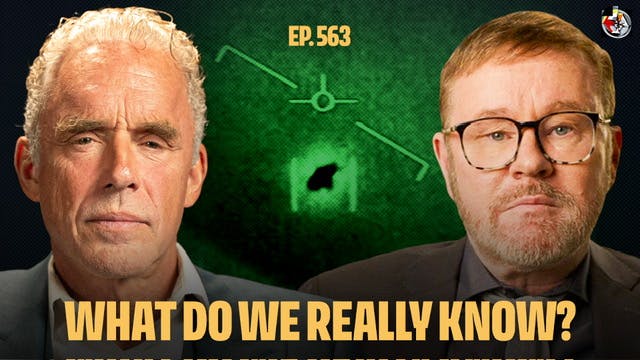
563. “Something Non-Human Has Been Here A Long Time” | Dr. Garry Nolan
This episode was filmed on July 7th, 2025
| Links |
For Dr. Garry Nolan:
On X https://x.com/garrypnolan?lang=en
Learn more about your ad choices. Visit megaphone.fm/adchoices
Press play and read along
Transcript
Speaker 2 Last year, Instagram launched Teen Accounts, which default all teens into automatic protections for who can contact them and the content they can see.
Speaker 2 And we'll continue adding new safeguards for teens to help give parents peace of mind.
Speaker 2 Explore Teen Accounts automatic protections and all of our ongoing work at instagram.com/slash teen accounts.
Speaker 4 This next one's for all you CarMax shoppers who just want to buy a car your way.
Speaker 3 Wanna check some cars out in person? Uh-huh.
Speaker 3 Wanna look some more from your house. Okay.
Speaker 3 Want to pretend you know about engines?
Speaker 4 Nah, I'll just chat with CarMax online instead.
Speaker 3 Wanna get pre-qualified from your couch. Woo! Wanna get that car ASAP?
Speaker 3 You wanna do it your way.
Speaker 3 Wanna drive?
Speaker 3 CarMax.
Speaker 5 Introducing Taking Share Lessons from Leaders with Rob Holmes, Chairman, President, and CEO of Texas Capital.
Speaker 5 During each episode, you will hear from leaders, decision makers, and culture shapers across industries. What drives them? What tips the scales when making tough calls? How do they continue to evolve?
Speaker 5 We're here to understand the thoughts behind their actions and discover how they are taking share. For more information on Texas Capital, please visit us at our website.
Speaker 3 I'm a professor in the Department of Pathology at Stanford. It's pretty obvious that you have a multitude of abilities and a stellar track record.
Speaker 3 You started to become interested in unidentified aerial phenomena.
Speaker 3 Somebody representing the CIA and an aerospace company showing up at my office at Stanford showed me their credentials and said, we need your help looking at patients who had harm done to them.
Speaker 3 And then a small subset of them said that they'd been in proximity to things that you would call a UFO. I thought it was a joke at the beginning.
Speaker 3
Let us know, if you would, what the hell you think is going on. That there's something non-human here, and it's been here for a long time.
Well, I imagine it's put a bit of a bump into your life.
Speaker 3 I mean, maybe one that's mostly interesting, but still, to call it strange is to barely scrape the surface. If something is here, it's likely been here longer than humans have even been civilized.
Speaker 3
Dr. Gary Nolan is an immunologist, academic inventor, and biotech entrepreneur, serial biotech entrepreneur.
He's a professor at Stanford University School of Medicine.
Speaker 3 and somewhat surprisingly, a ufologist. We talked about his career, his research interests, the rise of AI, and his interest in unidentified aerial phenomena.
Speaker 3 So, Dr. Nolan Gary,
Speaker 3 before we get to the heart of the matter with regards to your interest in unidentified aerial phenomena, more commonly known as UFOs, let's talk a little bit about you so that we can situate you in the minds of our readers.
Speaker 3 So, you have a remarkable research
Speaker 3 background and a technology background. Clue us in a bit and tell us who you are.
Speaker 3
So I'm a professor in the Department of Pathology. I hold the Ratchford and Carlotta A.
Harris Endowed Professorship.
Speaker 3 And the major focus of my lab's research, frankly, over the last 30 years since I've been at Stanford, has been on the immune system and creating technologies that allow us to collect more and more data about the immune cells and/or cancer cells that we're interested in.
Speaker 3 And so that's led me from the development of retroviral techniques for gene delivery and gene therapy.
Speaker 3 So, all the retroviruses and lentiviruses that are used in the world today for gene therapy were developed based on a technique that I came up with called the 293 T cell technique.
Speaker 3 And that's it, frankly, that's old technology to me, but it still generates a nice royalty stream.
Speaker 3 So, and then
Speaker 3 from there, it's about measuring more and more what we call parameters per cell, which are events that relate, we think, to the biology of the cells.
Speaker 3 And so we've created and spun out, I don't know, probably at least half a dozen companies on that side of things alone.
Speaker 3
Lately, we've been moving into artificial intelligence. We've started and spun out two companies there.
And now I'm actually moving into atomic imaging because I sort of feel like that's the next
Speaker 3 level down of information that I need to get at to understand gene function. So
Speaker 3 I've raised the money to create a whole new kind of instrument that can measure things at the atomic level.
Speaker 3 Tell me about that a little bit.
Speaker 3 I mean, that's a lecture on microscope territory. You have a new technology that you're that
Speaker 3 I know that's an old technology now.
Speaker 3 It's a fusion of two technologies, something called atomic probe tomography and field ion microscopy. And it's a way to bring the two together
Speaker 3
because previously they couldn't sort of exist in the same machine. So by bringing them together, we can go another order of magnitude lower.
We can get down to what's called sub-angstrum.
Speaker 3 Like the bond length between two atoms is in the sub-angstrum realm.
Speaker 3 But this technology that we've developed not only can see down at that level, but can also determine what kind of bond structure we have locally and that has a range of applications all the way from biology through to metals alloys nanotechnology etc and actually the instrument is already half built down at a lab in um here in cupertino that we've set up so we're excited about that so how many companies have you started or been involved in starting about rocks about a dozen uh and we've had about eight successful exits so far.
Speaker 3
That's pretty good track record, all things considered. All things considered.
One complete failure, but that's okay. One failure out of that many isn't so bad.
Speaker 3 Yeah, well, if you don't fail, maybe you're not trying enough diverse things. I mean, that seems to be particularly true on the entrepreneurial side, right?
Speaker 3
It's very difficult to invent something and then... equally difficult to make it profitable or maybe perhaps more.
Right.
Speaker 3 So
Speaker 3 on the medical side, tell me a little bit more about your research into viruses.
Speaker 3 So our research into viruses was,
Speaker 3 well, first of all, the retroviruses, I got involved with HIV research back in the day, and that was mostly trying to understand what turned the virus on and off in the immune system.
Speaker 3 So I was involved with what was called the cloning and characterization of the, what are called transcription factors that turned the virus on and off.
Speaker 3 And I I actually cloned it in David Baltimore's lab at MIT when I was a postdoc there. David won the Nobel Prize, actually, for reverse transcriptase, very famous man, obviously.
Speaker 3 So, but when I came to Stanford and using the technologies that we developed, we did everything from Ebola research to Zika to whatever the current manifestation of whatever the plague was that people were worried about.
Speaker 3 And we even actually saw the first COVID lungs from unfortunately deceased patients. And that's what really
Speaker 3 scared the bejesus out of me when I realized that we're dealing with something extremely serious with COVID, at least in some people. But
Speaker 3 most of my research these days is in cancer research and looking at how the immune system interfaces with the tumor and trying to learn about the signals
Speaker 3 that the usually tumor manifests to turn off the immune system or to disrupt the function of the immune system. And so that required the development of new instruments to see things at a level
Speaker 3 previously people were incapable of, but then also to develop the algorithms to understand the complexity because you've got thousands of cells in a complex dance with the cancer, and trying to figure out what that means
Speaker 3 took a lot of algorithmic effort. So we're a computational lab as well as a wet lab, as you would, would, as we call it.
Speaker 3 Do you have an engineering background? No,
Speaker 3 but
Speaker 3 I've always been a tinkerer.
Speaker 3 And so, you know, what's, I mean, I think what makes a good scientist is knowing what you don't know and knowing who to bring in to help you create what it is that you want and being able to explain it to them in a way that gets them interested.
Speaker 3 And that talent, frankly, translates very well in the entrepreneurial entrepreneurial side of things.
Speaker 3 When you're talking to venture capitalists, you can convince them that the biology is interesting, that it's doable,
Speaker 3
that here's the kind of people I need. And I always use this term inevitable, that it's inevitable.
This is something that's coming. So it really is up to the early bird.
that gets the worm.
Speaker 3 If you can see that it's something that will happen and has to happen and you have a solution for it, it might not be currently the best solution, but it's a solution.
Speaker 3 Get to it first and own the market.
Speaker 3 And your degrees,
Speaker 3 in what areas were your degrees awarded? All genetics. But one way to think about genetics is genetics is actually programming.
Speaker 3 I'm actually pretty good as a programmer as well, but genetics itself is software.
Speaker 3 And so if you think about genetics as software, it was very easy, again, for me to be both a programmer and a geneticist at the same time.
Speaker 3 So I've always been good at math. I've been good at the, I'm more, I would say, good at the intuition of how biology works.
Speaker 3 And intuition plays a larger part, frankly, in science than people would like to admit.
Speaker 3 Yeah, you know, one of the things that's always struck me as peculiar about scientific research papers is that the introductions are always a lie. You know,
Speaker 3 it's so interesting because
Speaker 3 I thought about this for a long time. It really struck me when I was first in graduate school because
Speaker 3 when you write a scientific research paper, you present the situation as if all the background reading that you did produced an incremental transformation in your thinking such that you generated a hypothesis.
Speaker 3 And that's almost never the case. Usually what happens is that people have an intuition that's derived from some pattern recognition, and then they backfill it and make it look like it's algorithmic.
Speaker 3 And then the other thing that's so bloody peculiar about that is that there's almost no discussion in graduate school training, maybe this was different where you went, on hypothesis generation itself.
Speaker 3 It's as if scientists swallow the idea that you're creating your hypotheses in this algorithmic manner as a consequence of grinding through the research.
Speaker 3 I know I had a student at Harvard, Shelley Carson, who worked on creativity, and she would make very large leaps
Speaker 3 with regard to her hypothesis, and then it would take her a few months to backfill so that she could bring people along to explain the justification.
Speaker 3
But that certainly wasn't the method by which it was derived. You strike me as a peculiarly creative person for a scientist, by the way.
I mean,
Speaker 3 that might seem a perverse characterization, but we also studied predictors of scientific prowess.
Speaker 3 And openness, which is the trait marker for creativity, was actually slightly negatively correlated with scientific productivity, at least at the graduate school and then early career level.
Speaker 3 But you, you, you've got a very wide range of abilities, and then you've got this
Speaker 3 both an entrepreneurial and a managerial twist.
Speaker 3 Is that a fair characterization? Because that's also a rare combination.
Speaker 3 I think
Speaker 3 what, I mean, it's hard to talk about yourself as if you don't sound like a, not to sound like a narcissist. But
Speaker 3 I think if you can marry creativity with practicality,
Speaker 3 that's the magic mix, at least for me.
Speaker 3 is I'm very good at rapidly iterating all the possible reasons why something can be the case and then rank ordering them very quickly, coming up with at least two cutoffs. One is,
Speaker 3 yeah, this is possible, but it's very unlikely that magic dwarves run the universe, right? Everything below that level. But then above that level,
Speaker 3
there's one more cutoff. One is possible, but impractical or perhaps not easy to prove.
And then above that is the provable.
Speaker 3 And so if you can rapidly rank order and come up with where something sits, then you can immediately turn and tell the student, yeah, you should do this.
Speaker 3 Or, yeah, you probably shouldn't do that because here's the reasons why there are so many other things that it could be that you can't prove or disprove.
Speaker 3 So let's not go down that road and it's because it's a rabbit hole. So I think marrying creativity with practicality and being able to see, and frankly, what I call reverse engineer the future.
Speaker 3 You know, it's, it, it's like you can see what it is, and then you know, I need to do this first, and then I need to do that.
Speaker 3 And once I've done each of these steps, those are milestones that give you confidence to take the next step.
Speaker 3 And then, because if I think like that, then that actually helps with talking to venture capitalists because they can then follow the path that you've just laid out for them.
Speaker 3 And when did you start your first company?
Speaker 3 Soon after getting to Stanford, actually, it was around 1994. But I had already learned a lot from my mentors, Len and Lee Herzenberg.
Speaker 3 So I was lucky having come to Stanford to end up in their lab because Len and Lee, who were frankly hippies,
Speaker 3 you know,
Speaker 3 they had the two
Speaker 3 of the three biggest patents at Stanford. One was for something called the flow cytometer,
Speaker 3 which brought in hundreds of millions of of dollars. And perhaps even more important were the monoclonal antibodies, what are called humanized antibodies.
Speaker 3 So by making monoclonals that could be injected into humans without raising an allergic reaction or a strong immune response, almost all of the injected antibodies today are based on those original technologies.
Speaker 3 And Len was just a natural
Speaker 3
a natural entrepreneur. He never started any companies, but he knew how to license them.
So he would always bring me into his office when he was negotiating with the pharma companies.
Speaker 3 And he would give me the contracts to read because I was one of his favorite students. So he's like, okay, I'm not going to waste my time
Speaker 3
by giving this guy something because he'll actually understand it and pick it up. And he introduced me to the best patent attorneys of the day.
And so I learned from them what it was all about.
Speaker 3 So it was, you know, much of what I would love to say is mine is just a rewrite of what I learned from
Speaker 3
Len and Lee. Right.
So you were very favored in your mentoring. Yes.
I got I got lucky. But I was also
Speaker 3
lab, and Stan, of course, hadn't had the Cohen-Boyer patents. So Boyer, her Boyer, started Genentech.
Stan Cohen had the other of the three biggest, and they were all in the Department of Genetics.
Speaker 3 And were the those were the patents for genetic engineering. So it was sort of an environment that led you to think about practical applications.
Speaker 3 Now, when I started my company as an assistant professor, I got a heck of a lot of pushback from senior
Speaker 3 scientists saying, Gary, it's too early.
Speaker 3 you shouldn't dirty your hands with this yet or now, frankly. They didn't even want me getting involved at all.
Speaker 3
And it was funny because a lot of them, you know, 10 or so years later, were back in my office asking for my advice on how they could start a company. Right, right.
Well,
Speaker 3 it's a rarer pathway to be scientifically productive and to
Speaker 3 make your talents manifested in multiple directions and to be an entrepreneur.
Speaker 3 I mean, that's the research that I referred to, looking at predictors of scientific productivity, showed that the best predictor, apart from IQ, obviously, which is always the best predictor of virtually anything complex by a lot, was conscientiousness, right?
Speaker 3 Just sheer diligence. And that there's a certain kind of narrow focus that goes along with conscientiousness, too.
Speaker 3 And so it is reasonable advice if you're talking to someone whose primary talents are diligence and industriousness for them to focus intently on one area so that they can establish themselves.
Speaker 3 But that obviously wasn't the appropriate pathway for you. And so,
Speaker 3 but that that, and it's also complicated and difficult to start a company as well as a research lab and to teach and all of that. So
Speaker 3 as generic advice, it probably wasn't too bad, but it didn't seem to hold in your case. How many patents do you have?
Speaker 3
I think somewhere between 50 and 60 at this point. Uh-huh.
And research articles? Uh, over 350.
Speaker 3
Right. Okay.
Well, so for everybody watching and listening, I mean, obviously, that's a tremendous number of patents because actually one patent is a lot of patents. And so 60 is a tremendous number.
Speaker 3 And on the research side, you can do a rule of thumb calculation, and not everybody agrees with this, but three research papers papers properly packaged make a pretty nice PhD thesis.
Speaker 3 So, 300 is roughly equivalent to 100 PhDs, and that's a lot of PhDs. And I think that's a reasonable way of looking at it, not least because most PhDs end up with either zero or one publications.
Speaker 3 So
Speaker 3
the three-publication rule of thumb isn't a bad one. What do you think of that characterization? Yeah, I think it's good.
I think the better way to do it is how often are you cited?
Speaker 3 So you can publish and never be cited.
Speaker 3 So at this point, I think I'm at about 89,000 something citations. So that puts you in the top whatever percent.
Speaker 3 And a lot of those, frankly, were the retroviruses, because people use the retroviruses.
Speaker 3 And then a lot of it are the technologies that I've developed because for the immune system measuring technologies, whether it's something called Cytof that I co-developed with this guy at the University of Toronto.
Speaker 3 His name was Scott Tanner. He invented the machine, but I showed how it could be used for immunology or the Codex or the MIBI or PhosphoFlow or now
Speaker 3 the split-pool synthesis technology for single-cell analysis were all things that
Speaker 3 sort of just like came to me. It's amazing that some people think that science is this methodical step-by-step, whereas more often than not, it's you pose the question in a way that
Speaker 3
sort of sets your subconscious to work. But then you lay out in front of you all of the necessary raw material and you say, somewhere in this morass is the answer.
And then
Speaker 3
at a lecture out of nowhere, it suddenly just appears, you know, in your head, fully formed. It's almost as if your subconscious was busy working and it finally said, oh, I'm done.
Here it is.
Speaker 4 As we celebrate Independence Day this July, we're reminded of the freedoms our founders fought to protect, especially the fundamental right to life, liberty, and the pursuit of happiness.
Speaker 4
But here's something that might surprise you. There are still Americans today whose most basic right, the right to life itself, is at risk.
That's where Preborn comes in.
Speaker 4 They're doing incredible work through their network of clinics offering free ultrasounds to women facing unplanned pregnancies. And here's what's absolutely amazing.
Speaker 4 These ultrasounds don't just provide medical care, they're actually saving lives. When a mom sees her baby on that screen, hears the heartbeat for the first time, everything changes.
Speaker 4
But pre-born isn't just about the baby. They truly care for these women as well.
They provide love, support, and resources during what can be an incredibly difficult time.
Speaker 4 Look, if we really believe what the Constitution says, that all people are created equal with unalienable rights, then this has to include the smallest, most vulnerable among us.
Speaker 4 These babies deserve the same rights that our founders declared, life, liberty, and the pursuit of happiness. You can be part of that mission for just $28.
Speaker 4
That's That's the cost of a life-saving ultrasound. Or you can sponsor five ultrasounds for $140.
To donate, just dial pound250 and say baby. That's pound250, baby, or visit preborn.com slash jordan.
Speaker 4 That's preborn.com slash Jordan.
Speaker 6 Every minute your finance team spends wrestling with data is a minute lost. Insight Software's AI-powered insights instantly move you from complexity to clarity.
Speaker 6
Automated analysis, real-time reporting, strategic recommendations, all at your fingertips. Transform Transform how your finance team works and watch your business grow.
Stop wasting time.
Speaker 6 Start making smarter decisions. Learn more at insightsoftware.com/slash AI.
Speaker 3 Yeah, well,
Speaker 3 your thoughts and revelations, let's say,
Speaker 3 as well as your perceptions are extremely influenced by your goal. And so, if you set the right question, you establish the quest, and your thoughts are orienting mechanisms.
Speaker 3 They're going to be working on the pathway to that goal. And they do deliver the goods, just like when you're walking down the street and you orient towards a goal, you can see the way to walk.
Speaker 3 I mean, it's analogous to that. And
Speaker 3 we're not shocked that
Speaker 3
that our perceptions are delivered to us. No, it's not like we effortfully construct them.
They make themselves manifest in our consciousness.
Speaker 3 And if thought is an abstracted equivalent of perception, which is at least one of the things it is, it's not that surprising that once you set your mind to the task, that you're,
Speaker 3 what would you say, that the spirit of revelation visits you in the appropriate manner. That's especially true if
Speaker 3 it's a genuine question, you know, if you're really interested in in it. So, how, how, could you describe your typical day? Like,
Speaker 3 how many hours a day do you work? And how do you set up your day?
Speaker 3 I probably
Speaker 3 work
Speaker 3 14, 15 hours a day.
Speaker 3 I get up, I feed the dogs because they're very demanding.
Speaker 3 I sit down, I start on email,
Speaker 3
and then I look at my task list. And usually these days, it's a lot of editing.
And luckily, large language models have come along and help with that.
Speaker 3 In fact, it's actually almost fun to write grants now.
Speaker 3 That's a, you know,
Speaker 3
wow, that's something to say. That's for sure.
Because I figured out how to use large language models to write grants. And so now, and what's interesting is that
Speaker 3 you really only need to give it like five or six sentences of the basic idea, the way I've constructed this large language model version.
Speaker 3 And the rest of it gets automatically produced, which is actually kind of sad because what it means is the majority of it is wrote.
Speaker 3 The majority of what we write is similar to what you were saying about papers. The majority of that is wrote, and it's just there for the convenience of the reviewer.
Speaker 3
But the central idea is only a few sentences. Aaron Powell, Jr.: Right, right.
Now, do you have your own large language model?
Speaker 3 And how do you stop them from lying to you and producing false, like hallucinations and citing papers that don't exist?
Speaker 3 Yeah,
Speaker 3 we use pretty sophisticated versions. We don't have our own LLM, but we have our own chain of thought layer that sits on top of these for the work that we do with the large language models.
Speaker 3 We use OpenAI or Anthropic or Gemini, you name it. And then we have a layer sitting on top.
Speaker 3 Oh, yeah.
Speaker 3
And And is that layer trained on your work? Yes. Or on relevant work? Well, I see.
I see. I have one of those as well that I trained on my books and some other material.
Speaker 3
Right. Yeah.
And it's a very weird thing to use. I don't know if you have the same experience, but
Speaker 3 this system we trained thinks like I think, but it can also think up things that I haven't thought up, which is, no, I guess what's happening as far as I'm concerned is that
Speaker 3 in the statistical encoding of my linguistic knowledge is all sorts of latent information, right?
Speaker 3 I mean, there's relationships in my patterns of thought that I haven't explored, obviously, and they're probably near infinite in scope.
Speaker 3 I mean, I would say that's the case for everyone, but because there's just so much information that's encoded.
Speaker 3 And so does your system refer to the material that you've trained it on first and then to the large language model that's general after that?
Speaker 3
It's I mean it's in the context window. It starts with it.
But I think the value is because it has lowered barriers, which is really what you're talking about.
Speaker 3 The barriers are lower to finding analogous or metaphors of what it is that you've said in other ways of thinking. I mean much of my work,
Speaker 3 the
Speaker 3 inventions that we've made, were taking the metaphor approach of finding somebody else's technology that works in something else, completely unrelated to biology, and showing how it could be applied to biology.
Speaker 3
Right. And so, you know, ideas, very often, the best ideas are saying, or the best teachers are people are saying, this is something like this.
Think of it like this.
Speaker 3 And then giving a metaphor or an anecdote that explains the idea. And so the large language models are just metaphors on steroids.
Speaker 3 Depending on how you set the heat, it can find things for you and solutions for you that you probably could have thought of,
Speaker 3
but it did the legwork. So, for me, for instance, on the atomic imaging idea, you know, I said, okay, well, here's what I'm doing.
Help me write the patent on it.
Speaker 3 And it helped me start the patent that I gave to the patent attorneys who wondered what lawyer I'd used to write this because it was already pretty good.
Speaker 3 But
Speaker 3
I said, find me five other ideas that might also do the same thing. And surprisingly, it came up with ideas.
Now, they were impractical,
Speaker 3 but it came up with ideas that were that, you know, we're like, oh, that's pretty cool. I wish I knew about this area of physics.
Speaker 3 So,
Speaker 3 you know, it's actually, there was a study just done out of Stanford just last fall that showed that large language models can be as creative as humans, if not more creative, as scored by humans,
Speaker 3 just less practical.
Speaker 3 I wonder what the bound is on practicing. Like, do you suppose I've talked to some computer engineers,
Speaker 3 including my brother-in-law, who's quite a genius.
Speaker 3 And one of the things that he is prognosticating, and not only him, is that we have these, obviously, we have large language models that are assessing the statistical relationship between words at multiple levels of resolution and can do this remarkable thinking, for lack of a better word because it sure looks a lot like thinking to me but you know human beings we seem to be able to do that with images as well right and also with movement like embodied movement and my guess is this the practicality constraint is probably something like the the referencing of the semantic system to the domain of image and movement, right?
Speaker 3 Will this because just because it's coded hypothetically in the linguistic corpus doesn't mean that it's in keeping with the way the world makes itself manifest.
Speaker 3 And humans have three different memory systems at least, right? We've got semantic and episodic and procedural. And
Speaker 3 my suspicions are that when we're looking for practicality, that we assess the joint contributions of all of those different ways of representing information.
Speaker 3 And the large language models can't quite do that yet, but they will soon. I mean, it's got to be the case, right?
Speaker 3
Because someone like Elon Musk, for example, he has this immense corpus of real-world data. And it's got to just be a matter of time before that's integrated with the large language models.
Right.
Speaker 3 Well, actually, you know, there's a part of your brain that does a lot about what you're talking about.
Speaker 3 And it's called the basal ganglia and the caudate potamon, which is actually where intuition happens. So there's a game,
Speaker 3 a Japanese game of chess, which is sort of a limited form of what we think of as chess. And so they were doing doing
Speaker 3 basically
Speaker 3 reads of people's brains while they made these moves, and especially when they made
Speaker 3 what would be considered a genius move. And the area of the brain that lights up is the head of the caudate and the pitamen.
Speaker 3 Which is, so the basal ganglia is actually what part of the brain tells you where your body is in 3D space, what your memories are, et cetera.
Speaker 3 It's all subconscious, subservient to your executive function.
Speaker 3 So when you make a decision to do something, that gets sent to the basal ganglia, which determines whether or not you can actually do it and whether you want to do it.
Speaker 3 Like if you're walking across a room, how do I walk? All those subconscious decisions are all done in the basal ganglia.
Speaker 3 But as it turns out, as humans have evolved, that has then been sort of taken over to be used as our decision-making system. Our intuition system works through the basal ganglia.
Speaker 3 So, all those ideas that you just talked about, where it actually finally comes to, is this practical or not, the basal ganglia is part of that process, a central place for that process.
Speaker 3 So, is that an embodiment constraint, essentially?
Speaker 3 Sorry, what do you mean by that?
Speaker 3 Well,
Speaker 3
some things you can act on. Oh, I see.
Yes. You can't.
Yeah.
Speaker 3 But
Speaker 3 it also appears to be used in the abstract sense now. Like, is this the right move to make in a chess game, which is,
Speaker 3 which is kind of
Speaker 3 abstract reasoning.
Speaker 3
And we actually did a study. Right, right.
We did a study on it. I mean, believe it or not, we came to this area of the brain because of some of my UAP stuff.
Speaker 3 And we did a study with a group at Harvard and found, in fact, that the size of this area of the brain brain correlated directly with intelligence.
Speaker 3 And so. Oh, really?
Speaker 3
Which part exactly? Was that the caudate? That was the caudate. Yeah.
But we were.
Speaker 3 How high was the correlation? Do you remember?
Speaker 3 What was the magnitude of the correlation?
Speaker 3
I can't remember. But we have three papers.
Okay. Three papers on it that we published.
So it's interesting stuff. When were they published? In the last three or four years.
Speaker 3
Oh, yeah. Okay.
So I haven't come across those. I'm very interested in the neurological determinants of intelligence.
But
Speaker 3 there was a guy in literally, I think, the year 2000 from Harvard who, through his own sort of best guesses or whatever, who had proposed before anybody actually found it, that I think his name was Hoffman.
Speaker 3 He's now at UCLA. He's a professor of neurology there.
Speaker 3 Had proposed that
Speaker 3 the caudate and the basal ganglia were going to be involved in intuition. I didn't read his whole paper on it, but it was already a postulate when he was like a postdoc.
Speaker 3 I wonder what do you think the connection is? I mean, when you think of intuition,
Speaker 3 you tend to think, at least I tend to think, of pattern recognition, let's say.
Speaker 3 What do you suppose the connection is between pattern recognition
Speaker 3 and the caudate
Speaker 3 and its relationship to motoric movement?
Speaker 3 It's making a decision with sparse data.
Speaker 3 It's the instantaneous decision to leap
Speaker 3 when there's movement, like the leopard's about to jump out of the tree at you, and it's the movement. But, you know,
Speaker 3
in the military. Right.
So
Speaker 3 that's having to... Well, I'm imagining someone on a playing field, you know, in a hockey game or a soccer field.
Speaker 3 Obviously, they're tracking many moving objects simultaneously and abstracting out something like a meaningful pattern, right? Which direction is this going?
Speaker 3 And then they're modulating their reactions in consequence of reading the field. And the great athletes, the great team athletes are particularly good at that.
Speaker 3 Wayne Gretzky was particularly good at that in hockey. And so, and so, okay, so the pattern recognition would be something like you could imagine that being all also crucial in a hunt,
Speaker 3 right? Because you're going to want to know where the animal is going to go. And with your pack,
Speaker 3
you have to orchestrate your movements and you have to do that together. There's something almost musical about that, like lions can do that and pack animals.
And so, oh, yeah, I see.
Speaker 3
And that would be focused on a goal, the hunting arrangement, and that would require extremely fast. reflexes.
So it's the intuition in that regard is a very complex form of reflex in a sense.
Speaker 3 Yes, exactly. So it's humans seem to have evolved a way to use a pre-existing system
Speaker 3 in the basal ganglia that was really just there for motor movement and making subconscious decisions.
Speaker 3 And they've layered over it and they've put an abstraction layer on top of that so that we can now use it for mathematical principles and other ideas.
Speaker 3 It is what provides that aha moment. And I've learned actually to
Speaker 3 see
Speaker 3
when the aha moment comes. It's almost like a form of color.
It's like when the next time you get an aha moment,
Speaker 3 if you can try to capture that it happens, when it happens, and realize that it was a different kind of input than what a methodological moment is, where you basically you've added it up and you've gotten the number by just simple addition as opposed to that aha moment.
Speaker 3 And I've learned to recognize and pay attention to the aha moment, not that it's always true, but that it came from an intuition.
Speaker 3 Because,
Speaker 3 you know,
Speaker 3 it very often you can get it and then just dismiss it because it was just an intuition as opposed to something that you figured out.
Speaker 3 So listening to those aha moments, and I'm telling you, I see it as a color. When it happens, I recognize it as a different kind of thought.
Speaker 3 It's not like it's being given to me magically or anything like that. I know a lot of of people would like to think that that's what it is.
Speaker 3
I don't know. There's something kind of magical about it.
It like thought has this revelatory quality, as you pointed out. You can set your sights on something, and then the pathway there,
Speaker 3 the mechanism that delivers you there is delivered to you. You know, so there is a magic about it.
Speaker 3 You know, I'm going to, people are going to laugh at me for this because I always do it, but I'm going to do it anyways.
Speaker 3 I've been studying Old Testament literature
Speaker 3 a lot for a long time. And I'm interested, I'm bringing this up because of something you said about the basal ganglia, too, developing an abstraction layer.
Speaker 3 You know, part of that abstraction layer is no doubt our ability to tell stories because stories are verbal representations of action patterns. And so, so the burning bush episode in
Speaker 3 Exodus, that's an intuition episode.
Speaker 3 And Moses takes his intuition seriously enough to deviate
Speaker 3 from his normative path, and then he delves deeply into the source of the intuition, and that's what transforms him into a leader.
Speaker 3 He gets to the bottom of something, down a rabbit hole to the bottom of something.
Speaker 3 And so
Speaker 3 it is a...
Speaker 3 narrative representation of not only of intuition, but of the willingness to attend to it and
Speaker 3
to delve into it deeply. Right.
So, okay, so we should switch topics here. I wanted to go over your background with you to establish for everybody listening who you are.
Speaker 3 And it's pretty obvious that you have a multitude of abilities and a stellar track record
Speaker 3
that's continuing. And so that sets the foundation for our next discussion.
You started to become interested, and I would like to know the story, in
Speaker 3
unidentified aerial phenomena. And that's definitely a lateral move from your other interests.
And so I'm very curious about all of that. I guess what I'd like to start with is
Speaker 3 why the interest and
Speaker 3 why take the risk to pursue it as well? Because you have a lot to lose, let's say, on the reputational front. And it's clear you're a very creative person, so I'm sure your interests go everywhere.
Speaker 3 But
Speaker 3 tell us how it is that you became interested in this and why you decided to pursue it with some degree of seriousness.
Speaker 3 So,
Speaker 3 I mean, there's a couple of origin stories to it, but I think the most, the easiest to start with is with the Atacama mummy, right?
Speaker 3 The small mummy that people had been promoting as being an alien, right? The mummy that was found in Atacama, Chile.
Speaker 3
And right, that was a couple of years ago, not too long ago. Oh, actually, it was, no, it was 12 years ago.
It was. Oh, it was a 12 years ago.
Yeah, actually, already.
Speaker 3
Yeah, it was a long, long time ago. I mean, that was.
And so
Speaker 3
I had seen it on YouTube. I reached out to the people who were, let's say, marketing it.
And I said, hey, I can figure this out for you.
Speaker 3 I can tell you what it is. And so we arranged to get a small piece of
Speaker 3 the body,
Speaker 3 a rib. I wanted the rib because I wanted the bone marrow from within the rib because I felt that that would be the place best protected from bacterial contamination.
Speaker 3 And the long and the short of it was that we showed that it was a human baby,
Speaker 3 probably, well, it was probably preterm birth, but that we found a number of mutations in it,
Speaker 3 in the genome that could explain
Speaker 3 what it looked like and why it looked the way it did.
Speaker 3 And so, you know, when a movie came out regarding that circa 2012 or so, it was like sending up a,
Speaker 3 you know,
Speaker 3
a flare to two sides of the world. One, the people who didn't like that I was debunking the alien.
So I became an instant
Speaker 3 a symbol of dislike for the UFO community, which is interesting,
Speaker 3 paradoxically these days.
Speaker 3 But then it also was a flare to scientists, as it turned out as well, the intelligence community, that here's a guy willing to look at things and just call them as he sees it.
Speaker 3 And so that led, as it turned out, to somebody representing the CIA and an aerospace company showing up at my office at Stanford, literally unannounced, showed me their credentials and said, we need
Speaker 3 help
Speaker 3 looking at patients who've had harm done to them. And I was like, well, what kind of harm? And then they laid out the data, literally like MRIs and x-rays of internal scarring of
Speaker 3 these people who reported abductions? No, no, no.
Speaker 3
Oh, no. Oh, sorry.
Okay.
Speaker 3 I'm off on a wrong tangent. These are intelligence agents, diplomatic corps, military personnel,
Speaker 3 et cetera, all who
Speaker 3 had said that they were hearing buzzing in their ears, or, you know, and then a small subset of them said that they'd been in proximity to things that you would call a UFO.
Speaker 3 So
Speaker 3 I thought it was a joke at the beginning, especially when they mentioned the UFO stuff, because I had no intention at the time of going back and doing more alien research
Speaker 3 after the Atacama mummy
Speaker 3 escapade. And
Speaker 3 so they had come to me. I mean, why come to me?
Speaker 3 Well, one, I was willing to talk to people about this stuff, but two, they wanted to do blood analysis of the individuals who'd been harmed as part of a complete medical workup.
Speaker 3 And so they'd asked around and they said, well, who does the best blood analysis? Oh, you need to go talk to this guy, Nolan, at Stanford.
Speaker 3 He has this thing called Cytof that can do the deepest analysis of blood that, you know, currently today. And still.
Speaker 3 So
Speaker 3 basically, over the course of two or three years on working with this group and on these patients, it turned out that these were actually the first of the Havana syndrome patients.
Speaker 3 I'm sure you've heard of Havana syndrome.
Speaker 3 Yeah, review that for everyone. So Havana syndrome was
Speaker 3 something that basically came out around 2015, 2016, and
Speaker 3 it was called Havana because it was the diplomatic core individuals in our government who were getting headaches. They were having to be sent home.
Speaker 3 And it turned out that it's probably a kind of microwave technology being used by some of our adversaries.
Speaker 3 It's 100% real. You know,
Speaker 3 some people in the CIA tried to debunk it, but now
Speaker 3 there's a whole set of paperwork out.
Speaker 3 put out by the Department of Health and Human Services on anomalous, what's now called anomalous health incidents, where Havana syndrome and all of the sets of associated symptoms are all listed.
Speaker 3 And there's a path now for people who think that they have it to go follow it up, you know, appropriately with the Veterans Administration or what have you. But in the three years.
Speaker 3 Okay, so let me get this straight. So
Speaker 3 you had someone from the CIA show up to your office, and he had a list of people who had medical problems.
Speaker 3 And some of those medical problems
Speaker 3 were a consequence of people coming into
Speaker 3 contact with what? Technology that is mysterious? Is that the right way of thinking about it? Yeah,
Speaker 3 yeah. Well, I mean, they didn't know what the source of it is, but now we know that there was basically, I mean, it's an energy weapon, just a microwave weapon.
Speaker 3 Just imagine you could focus the beam of your microwave in a very narrow path towards a person's person's head, you'll bake the brain cells in their head. So, I mean, there's nothing magical about it.
Speaker 3
We have them. Everybody knows that these things exist.
At the time, when we were working on it, we were calling it interference syndrome.
Speaker 3 You call something a syndrome when you don't know the exact cause, but it can have a variety of manifestations.
Speaker 3 And so, what we had done was we had matched the symptoms to what are called the international diagnostic codes so that we had the ability to say, oh, it's this and it's this and it's this.
Speaker 3 And if you have 10 of 15 of these, you have interference syndrome. So at the same time, somebody was figuring out what Havana syndrome was.
Speaker 3
And it turned out that our set of symptomologies matched perfectly with the Havana syndrome ones for most of our patients. We were able to hand all of that over to the U.S.
government.
Speaker 3 And I've worked with Senate staff and others
Speaker 3 on that. And that's something I can't talk much about.
Speaker 3 But what remained, and this is what's good about how science is done, once you've characterized something and you find it uninteresting, not that it's uninteresting, that these patients are being harmed, but I could hand it off to somebody else who would then take care of it as a national security concern,
Speaker 3 what was left on the table were the oddities. And those were now the people who had gotten close to UAP, they claimed, at least some of them.
Speaker 3 And they had, as it turned out, slightly different symptomologies. Some of those were more likely to have erythemas or,
Speaker 3 you know, scarring on the skin as opposed to internally or
Speaker 3 manifestations on the back of their neck
Speaker 3
of some kind of irradiative damage of some kind. Now, there they...
And there was a pattern to this. Yes, there was.
Yes.
Speaker 3 Well, and the pattern was always anecdotal, unfortunately, in that they had a story that you at Facebook.
Speaker 3 But I mean,
Speaker 3 the symptom pattern was stable.
Speaker 3 And how many people, how many individuals approximately, like what kind of sample pool were you
Speaker 3 assessing? Now you're down to about five or six people because of the original.
Speaker 3
Small number of people. Of the original hundred that we started with, 90 or so, it turned out, were what we could think of as Havana syndrome.
The remaining were what were interesting.
Speaker 3 And, you know, but sort of back to, let's say, my career.
Speaker 3 My career has always been
Speaker 3 i've always been good at seeing the the the data point off the curve and and realizing that it's not noise or at least asking the question how did that data point get there
Speaker 3 and not just you know going with what's sitting on the line but understanding why the data point off the curve is important.
Speaker 3 And then being able to quickly, again, back to that, iterate the possibilities, say, ah, well,
Speaker 3 if we know that it's not a
Speaker 3 problem with the instrumentation, then it's an indication that we don't understand something.
Speaker 3 And so that was where I was already starting to get introduced because of this UAP stuff.
Speaker 3 Because of that, we had these groups of individuals who said that they'd gotten harmed by UAP, and we diligenced them to to make sure that they didn't have some sort of psychological problem.
Speaker 3 They had full psychological workups and we knew that these were people that we're, you know, we're trusting the nation's security with.
Speaker 3 You know, it's kind of like, okay, well,
Speaker 3
it's an anecdote, it's a story. And now I've heard 50 stories like this by that point.
Right.
Speaker 3 And it's like, well, no, they say the plural of anecdote isn't data, but the plural of anecdote is definitely hypothesis. Yes, right.
Speaker 3 And so once you start to get that, I was like, okay, well, there seems to be something here.
Speaker 3 And
Speaker 3 you raised a point, ruin your career.
Speaker 3 I literally was told by a senior official at the National Cancer Institute by around circa 2014, 2015, because I was just talking about this, just saying, isn't this an interesting idea?
Speaker 3 You're going to ruin your career, Gary.
Speaker 3 And I was just like, but it's, but the data's on the table. It isn't isn't ridiculous to ask the question,
Speaker 3 but the fact that they were trying to push it off the table incensed me. It was just like, that's not how a scientist thinks.
Speaker 3
That is just your, and I said to him, I said, you sound more like a priest than a scientist. Maybe you should give your PhD back.
Oh, and. Well, there aren't that many scientists, you know.
Speaker 3
There are a lot of people who act out the role of scientists, but that's not the same thing. Yeah.
Right. Scientists are very peculiar people when they're real.
Speaker 3 So.
Speaker 3 So, and that, and that, you know, and that's been sort of my approach to it. It's like, how dare you tell me I can't ask the question?
Speaker 3
Because there's more than enough evidence that there's something worth studying. And people mix up evidence with proof.
You know, data sits in isolation and has no meaning whatsoever.
Speaker 3 It only has meaning in the context of a hypothesis. And, you know, so
Speaker 3 does the hypothesis and the data match to mean that it is perhaps evidence? Evidence, just as in court, is not proof of anything.
Speaker 3 That requires a jury to decide whether or not the evidence is sufficient to
Speaker 3
manifest guilt or not. The same thing in a paper.
There's very few papers that you will ever read that ever say there is, at least in biology, this is a conclusion.
Speaker 3 There's all kinds of weasel words that we as biologists use to give ourselves diplomatic egress just in case.
Speaker 3 So, but you know, when people like Neil deGrasse Tyson say there's no evidence, well, that's just a lack of understanding of what the difference between data and evidence is.
Speaker 3 There's reams of evidence, there's libraries full of evidence, there's books I could throw, I could drown people in with evidence, but that's not a conclusion.
Speaker 3
That's not what we think of as scientists as proof. Now, I have, I'm of personally two minds.
As far as I'm concerned, there's definitely something going on that
Speaker 3
appears to be not human. That's just my point.
Okay, so okay. But that's different than science, right? I'm sure.
Yeah, right, right, right.
Speaker 3 Go for it.
Speaker 3 Okay, so tell me, well, tell me a typical story, like the typical story pattern that characterized the testimony of these leftover individuals whose symptoms were troublesome but somewhat anomalous.
Speaker 3 Like, what were they reporting? And then you took it seriously because there had been psychological workups done on them, and there were a number of people reporting the same thing.
Speaker 3 So you know that something's up. So
Speaker 3 tell me a story, and then tell me what you started thinking about with regards to a potential cause.
Speaker 3 Well,
Speaker 3 one was a guy guy by the name of John Burroughs and the Randall Shelm Forrest case, where he literally got close to one that came down near our nuclear storage facilities there.
Speaker 3 It's a very famous case.
Speaker 3 And
Speaker 3 he came to me as part of this group of
Speaker 3 10 remainders, and I was introduced to him to do the blood analysis and do the collection of the blood.
Speaker 3 And then later, as it turned out, and here's an interesting thing, later, he developed a heart problem and he couldn't get the Veterans Administration to open up his
Speaker 3 file so that he could get, he could prove that or that it might have actually been originally caused at Rendlesham in England
Speaker 3 because his medical file was deemed top secret. So we literally had to go to, and this is on the record, we literally had to go to Senator McCain,
Speaker 3 in whose state this guy lived in Arizona,
Speaker 3 and get him to write a letter to the Veterans Administration forcing them to open his file so that he could get insurance payment for his heart condition. It's all on the record.
Speaker 3 So why there's an individual who had a problem that he claims had been
Speaker 3 caused through some interaction way back when, why do you have to make his file top secret? What's in it?
Speaker 3 There was nothing in it, frankly. It was just somebody had decided it needed to be top secret because things related to UFOs just need to be, you know, nobody talks about them.
Speaker 3 Brush them under the table. But we look, you know, but we literally, and it's again, it's public record.
Speaker 7
This Marshawn Beast Mode Lynch. Prize pick is making sports season even more fun.
On prize picks, whether you're a football fan, a basketball fan, it always feels good to be right.
Speaker 7 Right now, new users get $50 instantly in lineups when you play your first $5.
Speaker 7
The app is simple to use. Pick two or more players.
Pick more or less on their stat projections. Anything from touchdown to threes.
Speaker 7 And if you write, you can win big mix and match players from any sport on Prize Pix, America's number one daily fantasy sports app.
Speaker 7 Prize Pix is available in 40 plus states, including California, Texas, Florida, and Georgia. Most importantly, all the transactions on the app are fast, safe, and secure.
Speaker 8 Download the PrizePicks app today and use code Spotify to get $50 in lineups after you play your first $5 lineup. That's code Spotify to get $50 in lineups after you play your first $5 lineup.
Speaker 8
Prize picks, it's good to be right. Must be present in a certain six.
Visit PrizePicks.com for restrictions and details.
Speaker 3 And so, what did he experience? He saw something. He came close to something.
Speaker 3 Something that was about five feet across on the ground. And
Speaker 3
I don't know. I mean, I wasn't there.
I'm just relaying the story. Right, right, right.
And was that what's the typical pattern of encounter? You know, I mean, is there a pattern of the phenomenon?
Speaker 3 No, no, there's not enough of a.
Speaker 3 This is the problem: is that you can't repeat harm.
Speaker 3 You know, when harm happens,
Speaker 3 it's sort of incidental. And so you just have to deal with.
Speaker 3 And I think it's less about the harm. So, I mean, I think we should move away from a discussion of the harm and just talk more about what it is that people are seeing.
Speaker 3 And I'm talking about credible people, right? What's the credible data that we can collect?
Speaker 3 What's okay, so it's a broader conversation on unidentified aerial phenomena.
Speaker 3 That's so, so sure, Lee, and I want to talk about your Sol Foundation as well, and also the fact that you've analyzed materials with unusual properties.
Speaker 3 So if we can tangle all that together, that would be good. Yeah.
Speaker 3 So, the reason why we started the Saul Foundation, and it was me, Peter Skayfish, and David Grush. David Grush was the
Speaker 3 gentleman who testified in front of Congress about what he claims were the reverse engineering programs. And the principal reason for starting the Saul Foundation was to enable,
Speaker 3 let's say, a picket fence within which people of reasonable intelligence or academics who don't always have reasonable intelligence, but could have a conversation and not be laughed out of the room.
Speaker 3 To be able to say, here's a hypothesis, and here's the data I have. Do you think my hypothesis matches, or do you have another idea?
Speaker 3 But the spectrum of things about which we wanted to be able to talk about were everything from religion all the way through to material science on my side.
Speaker 3 So we have Peter Scafisch who's an anthropologist and
Speaker 3 what is the other one? Well, he's an anthropologist let's call him an anthropologist. And so he's interested in people's stories, right? What are so-called experiencers?
Speaker 3 What's the pattern of the experiencers?
Speaker 3 And what kind of, let's say, trauma might they undergo, not only because of the experience itself, but the trauma of not being able to talk to your friends and/or family about what it is that you think that you saw because of the stigmas associated with talking about this and not wanting to be
Speaker 3 considered crazy.
Speaker 3 And then,
Speaker 3
so he's collecting and writing papers on that. We have a focus on religion.
We had somebody from the Catholic hierarchy write a paper on that for us.
Speaker 3 on the more
Speaker 3 extreme science side, the hard science side, the materials analysis that I do.
Speaker 3 And part of it, again, was to say, okay,
Speaker 3 let's have this conversation.
Speaker 3 We had our first
Speaker 3 foundation meeting, I mean, big convention at Stanford,
Speaker 3
where we had about 200 or 300 people there who'd come from all over the world to have a meeting. What year was that? That was three years ago now.
We've had one each year. Okay.
Each year.
Speaker 3 And the funny story there was about two weeks before we were to have the
Speaker 3 meeting, I started getting these pings from administrators around Stanford that there might be a problem.
Speaker 3 And I was like, oh, God, you can't do this to me.
Speaker 3
Everybody's invited. The plane tickets are paid for, you know, et cetera.
What's going on? And I managed to trace down who it was at Stanford that was sort of causing the trouble.
Speaker 3 It turns out it was the branding office at Stanford and that they had a problem with that Stanford's name name wasn't first, that we had put Seoul Foundation first and not Stanford, and they wanted it Stanford, you know, and the Nolan Laboratory, not the Seoul Foundation.
Speaker 3 So Stanford was more than willing to, you know, to be upfront about it. They were open about it.
Speaker 3 In fact, the Alumni Association
Speaker 3 had me
Speaker 3 give at the last homecoming a big talk to probably about 200 people about it
Speaker 3 because of the interest level.
Speaker 3 So there's been no problem on that front.
Speaker 3 But then I then got interested in the materials because, again, through the connections that I had made,
Speaker 3 I came to know a gentleman by the name of Jacques Vallais.
Speaker 3 Jacques Vallet is probably one of the most famous,
Speaker 3
let's call them ufologists ever in terms of like his scientific prowess. He was involved in the early days of the internet.
He was an astronomer. He's a venture capitalist in the Bay Area.
Speaker 3 And he's heretical in the sense that
Speaker 3 he didn't believe that whatever this was was necessarily extraterrestrial, but
Speaker 3 it was some other kind of manifestation of either the human psyche or something
Speaker 3 more
Speaker 3 beyond, something almost
Speaker 3 paranormal
Speaker 3 in its capabilities. So it was interesting to listen to this, but I was more interested in, you know, okay, well, what can I teach another scientist? How can I convince another scientist?
Speaker 3 So it turns out Jacques had a number of materials, metals and or objects that had been associated with landings of alleged UAP or UFOs.
Speaker 3 And
Speaker 3
so I said, okay, well, give me some of them. I need only tiny amounts, and we can do pretty traditional analysis on it.
And so
Speaker 3 one of the things that I got a hold of, we showed recently to be that was from a beach in Ubatuba, Brazil, that
Speaker 3 a fisherman had seen this object drop from some other, from
Speaker 3 this UFO. And
Speaker 3 it shattered, and he picked up some pieces of it, and it made its way way through what I would consider to be a reasonable chain of custody.
Speaker 3 And we measured it, and it was 99.999% silicon.
Speaker 3 Okay, that's not hard to make today, but it's not something in the late 1950s or early 1960s, you
Speaker 3 drop giant pieces of all over a beach in
Speaker 3 Ubatuba, Mexico. So it's whatever that was,
Speaker 3 it was clearly an object of industrial purpose, right? There's no 99.999% silicon anywhere on planet Earth.
Speaker 3 It's all contaminated. And I actually have atomic, I have an atomic map of
Speaker 3 one of these pieces that we developed, that we did with atomic probe tomography. What was fascinating was that one of the two chains of custody that I obtained
Speaker 3 also had magnesium ratios that were not
Speaker 3
what you would expect from Earth. They were different than the standard magnesium ratio.
So magnesium has three isotopes,
Speaker 3 24, 25, and 26.
Speaker 3 24 is like, let's just say rounded up to 80%, and the other two are 9 and 11%.
Speaker 3 Whereas
Speaker 3 one of the two chains of custody, the magnesium ratios, were just higgledy-piggledy all over the map.
Speaker 3 They didn't look anything like what you expect to find from a piece of silicon on Earth. Anywhere you look on Earth, you're going to find silicon, sorry, the magnesium at the 80, 11, and 9 ratio.
Speaker 3 Whereas this one of these pieces was wrong.
Speaker 3 That doesn't prove that it's a UFO. It just proves that it's
Speaker 3
of some kind of manufacturing purpose. So that's one.
We're actually writing the paper up on that one.
Speaker 3 I published a peer-reviewed paper on another thing,
Speaker 3 another object from
Speaker 3 what's called Council Bluffs, Iowa, where again, there were multiple witnesses, in this case even the police.
Speaker 3 had seen an object and it seemed to drop something.
Speaker 3
And when the people arrived, they thought actually it was a plane crash. When they arrived, they found about 30 pounds of molten metal in the middle of a frozen field.
And
Speaker 3 I have the original Polaroids. And so I just did an analysis of it.
Speaker 3 And the long and the short of the analysis was there was nothing wrong with the isotope ratios, but it was a mixture of metals that nobody would normally put together. It was not fully mixed.
Speaker 3 It was only partially mixed.
Speaker 3 So it's kind of like if you you were to take chocolate, vanilla, and strawberry ice cream and partially melt them and just kind of turn it your spoon a couple of times around.
Speaker 3 Depending on where you looked, you'd find different ratios of chocolate, vanilla, and strawberry. As opposed to if you were to put it in a blender,
Speaker 3 everywhere you look, it would look the same.
Speaker 3 So, what I found in the metals was that it was incompletely mixed. Okay, so
Speaker 3 who would drop 30 pounds of incompletely mixed iron, titanium, titanium, and aluminum in the middle of a field
Speaker 3 for no good reason from something that looks like a UFO? So all the conventional explanations that it was thermite, it's not thermite because there's no aluminum hydroxide, and I've checked.
Speaker 3
You know, to carry that much molten metal requires, at that temperature, a cauldron that would be like half a ton to the middle of a field. You're not going to put it in a plane.
So what is it?
Speaker 3 Unexplained. But the reason for doing it, and actually
Speaker 3 there's somebody who's, it looks like is going to give me sort of free money to analyze more of these things, is not to prove that they're from UAP, but it's to do the right kind of analysis on the materials so that I can get it out there.
Speaker 3 and publish it with no conclusions, just here's the data and here's the story and here's the analysis as complete as we can do at this time.
Speaker 3 Because maybe somebody else will look at it three years from now or some other enterprising student will go, ah,
Speaker 3 that's how you would,
Speaker 3 if you released this, this would be the engine control for,
Speaker 3 I don't know, anti-gravity or something. So it's, it's, you know, you, you, it, it's part of that
Speaker 3 thing of like you come up with an intuitive idea because you've spread all of the data in front of you. Well, if you don't have the data, you can't come up with the solution.
Speaker 3 But if I can get the data out to as many people, maybe somebody else will come up with the hypothesis that unifies the story.
Speaker 3 So it's part of like the, I mean, I think of it as the open source
Speaker 3 data approach or the open science where you get the data out for everybody because somebody paid for it.
Speaker 3
So maybe you shouldn't keep it in your, you know, in your desktop drawer or these days in a folder on your computer. Get the data out there so that other people can use it.
Does that make sense?
Speaker 3 Okay, so
Speaker 3 so far it makes sense. I've got more questions.
Speaker 3 So
Speaker 3 you started by assessing the medical problems of a small subset of people whose symptoms didn't fit the pattern, but whose self-reported stories had their own characteristic and that their symptoms had their own identifiable characteristics.
Speaker 3 Now, I'm not sure how you got from that to the Seoul Foundation. Now, my understanding is that because you had
Speaker 3 worked on
Speaker 3 that
Speaker 3 hypothetical alien corpse and debunked that, and then you got involved with this CIA project, that more of these stories were coming your way? Yes.
Speaker 3 Is that and okay, and so what other kinds of stories? And
Speaker 3 tell us about the foundation itself and who's involved. And then I'm also extremely curious about
Speaker 3 your conclusions. I mean, I'm sitting here thinking,
Speaker 3 you're obviously studying anomalous phenomena. Why would you make the
Speaker 3 why or have you even derived the inference that apart from the
Speaker 3 isotopes, why would you derive the conclusion that extraterrestrial origin is the most likely
Speaker 3
culprit? No. Okay, fine, fine.
Fair enough. Fair enough.
You didn't. And so, well, that's exactly why I'm posing the question.
I'm not trying to corner you with that.
Speaker 3
I want to know. Like, you're studying anomalous phenomena.
You know of Charles Fortnite very well. Yeah.
Yeah. Yes.
Okay. Okay.
Okay. Yeah.
Did you ever watch Magnolia?
Speaker 3
No. The movie? No.
Oh, Magnolia is a great movie, by the way, and it's about Charles.
Speaker 3
Okay. It has a sub-theme of Charles Fort.
So if you're interested in Charles Fort, Magnolia is very much worth watching. It's a great movie, also beautifully put together musically.
Speaker 3 And of course, Charles Fort studied anomalous phenomena his whole life. And
Speaker 3
Magnolia happens to be about that. But okay, so you're studying anomalies.
Lay out the realm of hypotheses because there's military experimentation.
Speaker 3 I mean, there's all sorts of obvious competing hypotheses.
Speaker 3 So tell me what you've done, you know, what you've gone through, more about your foundation and what you've concluded so the principal reason for starting the soul foundation was that i was because of
Speaker 3 let's say my um
Speaker 3 public persona about this more and more scientists were coming to me and saying hey i want to help how can i do it and then it uh a a common friend of Peter and Peter Skayfish and I, along with David Grush, who I had met through all of these events.
Speaker 3 And David, again, was the guy who sat in front of Congress and testified about the alleged reverse engineering programs, of which he was aware. And I'd met with Dave and spoken with him, you know,
Speaker 3 very deeply and watched every element of his body language that I possibly could to see, you know, look for evidence of being, of misconstruing him in some way.
Speaker 3 And as far as I can tell, he's telling, at least as far as he's concerned, the truth about what he knows. And I said, okay, well, we need a more formalized way to approach this.
Speaker 3 And so what do you do as a scientist in a new area? You start a society, more or less, or you start a foundation that becomes the lead foundation for other groups to come together.
Speaker 3 And the Seoul Foundation pretty much has established itself as
Speaker 3 a non-partisan
Speaker 3 umbrella group through which the many individuals who are interested in UAP and talking about it
Speaker 3
in a professional manner can come together. And our next, actually, event is going to be historic.
It's going to be in Italy.
Speaker 3 And we've got people from the European Parliament.
Speaker 3 We've got a number of
Speaker 3 former,
Speaker 3
let's say, U.S. officials who will be there to talk about these matters.
And again,
Speaker 3 I don't expect a revelation.
Speaker 3 I expect just
Speaker 3 from this
Speaker 3 people
Speaker 3 to come and know that there's a place where they won't be laughed at, but they can share, maybe give ideas.
Speaker 3 And one of the sets of ideas of what's going on right now is there's a big movement for what's called the
Speaker 3 UAP Disclosure Act. That for your listeners, for the last two years, Senator Rounds and Senator Schumer, supported by multiple representatives on both sides sides of the aisle,
Speaker 3 have put forward a part of the bill that goes into the Defense Department bill, 60 pages of which talks about the reverse engineering programs and extraterrestrial, or let's say not even extraterrestrial, non-human intelligence.
Speaker 3 And that for
Speaker 3 the next five to ten years, there will be an oversight group which will collect and gather all of this information for potential
Speaker 3 benefit of humanity. Now,
Speaker 3 you just asked me about ruining my career. Would Senator Schumer, the head of the Democratic Party,
Speaker 3 and Senator Rounds, an important figure on the Republican side, come out and make any of these kinds of statements or allow for their offices to be the vehicles through which such a bill would manifest itself if they felt that they were going to be derided
Speaker 3 on the floor of the Senate? Probably not.
Speaker 3
And so there's Marco Rubio has come out openly and talked about this. He's now our Secretary of State.
There's
Speaker 3 20 minutes of part of a film that he's in where he's openly talking about the fact that there are these
Speaker 3 objects moving in ways that we don't know. I was speaking with your producer prior to your getting to the set,
Speaker 3 The Seoul Foundation, one of our purposes, we put together press kits of like 15 different snippets from former heads of the CIA, the DIA, NSA, President Obama, et cetera, all saying there's something that we don't understand and is moving in ways in our atmosphere that we can't explain.
Speaker 3
And it appears to be technology. Now, they'd like you to think that it's some thing out of Lockheed, perhaps.
But, you know,
Speaker 3 these things were being seen before Lockheed existed,
Speaker 3
right? They were seen in World War II. They were seen subsequent to World War II, long before we had any capabilities.
So what is it?
Speaker 3
I don't care if it's human or not. I just want to have reproducible findings.
And yet
Speaker 3 somehow, for some reason, the government won't release the information that it has. I mean, just recently,
Speaker 3 there was a Freedom of Information Act release of the so-called Mosul Orb, M-O-U-M-O-S-U-L, Mosul,
Speaker 3 Iraq,
Speaker 3 and
Speaker 3 a solid silver ball that Arrow,
Speaker 3 which is the anomaly resolution office of the Department of Defense, came out and said, yeah, we see lots of these things. The former assistant director of Arrow, which is the office
Speaker 3 programmed and set up by the DOD to collect the kind of information around these anomalies, openly stated just three weeks ago on a podcast that, yeah, we see, we've seen multiple, we have videos of these black triangles that move in ways that we don't understand.
Speaker 3 Okay, if it's our technology,
Speaker 3 And we can move in ways like that, why are planes still crashing at Reagan Airport?
Speaker 3 Right?
Speaker 3 Why are we letting
Speaker 3 airplanes use fuel when we have some other kind of technology that can move the way that these things can? And it's being kept a secret. Is that just for defense?
Speaker 3 So you talked about black triangles and silver orbs. Can you go into a little bit more deep? Like what, I'd like to know the central phenomena.
Speaker 3 Where do you think most of the signal resides with regard to these anomalous sightings? What's the pattern?
Speaker 3 The best pattern are what it is that the military sees.
Speaker 3 And those are the ones that where I have a focus and where actually I'm involved with another group that's funded privately
Speaker 3 called Sky Watcher. And what we're doing is we've been setting up sensor systems
Speaker 3 in what we call cleared areas where we know that there's no overflight.
Speaker 3 And we do sometimes work in concert with the FAA and others to make sure where we're setting up for repeatable measurements and sensor systems to see things.
Speaker 3
And we're seeing stuff that doesn't make sense. And so we're not coming to conclusions, but we're collecting the data.
And because I'm a scientist, I'm like their principal advisor to this group.
Speaker 3 And we're setting up and doing the kinds of measurements that I think are necessary because I'm not going to wait for the government.
Speaker 3
You know, I'm not going to wait for daddy government to tell me what's right. I'm just going to, I'm a scientist.
I'm going to go out and do it myself.
Speaker 3
And so that's what we've done. And we've raised significant funds.
I mean, and you can go look up Skywatcher on the internet and what it is that we're doing. And part of what we're doing is
Speaker 3 it's two purposes. One, it's basically aerial surveillance, partially just for drones, because we've seen what drones can do in wars.
Speaker 3
So, and we knew, and you know about the drone incidents in New Jersey, right? And all of the hubbub that that caused. Well, we were actually there.
We were actually measuring things.
Speaker 3 What was that? What was that? Some of them were simply drones. Some of them, though, were moving in ways that would be hard to explain by drones.
Speaker 3
But all the stuff that we observed close to shore was clearly human activity. But so we're setting up, we're setting up Skywatcher as sort of a dual purpose.
One is to work with the government to,
Speaker 3 hopefully, or defense contractors or anybody who wants to pay for our services to collect aerial data
Speaker 3 basically as rapidly as possible. Because often you can't deploy the necessary equipment on site quickly enough to collect the data when there's an anomaly that shows up.
Speaker 3 I mean, our principal goal is protection of the United States.
Speaker 3 But if, in so doing, we happen to collect other information about some, let's say, anomalous objects, we will have the tracking data necessary to say, hey, well, this is, we don't understand this.
Speaker 3 And it's important to know because if it isn't a human adversary who have capabilities that we don't appreciate, even if
Speaker 3 somewhere in Area 51 they have something that does that, it's good for, I think, our military,
Speaker 3 the more public aspect of our military, to know that these objects do exist and report them when you see it, because it might be the Chinese or the Russians or the Iranians, right?
Speaker 3 You want to know this because if you ignore it, you could be ignoring the data point off the line
Speaker 3 that is important to know about.
Speaker 3 Always back to that.
Speaker 3 Don't ignore the anomalies because anomalies, just about every single Nobel Prize that was ever awarded in physics and chemistry or biology is because somebody paid attention to the anomaly.
Speaker 3 Right, right, right. Yes.
Speaker 3 So
Speaker 3 tell me
Speaker 3 about the patterns of anomalous activity that characterize, that define something as an unidentified aerial phenomena. And then tell me what you've concluded as a consequence of
Speaker 3 your investigations and where you, yeah, let's do that.
Speaker 3 So
Speaker 3 there are, let's say, five
Speaker 3 characteristics of something that you would think of as an anomaly. One is instantaneous acceleration and deceleration.
Speaker 3 There's very few things that we know of that can go from zero to 5,000 miles an hour and then stop on a dime without squishing everybody on the inside, you know, sending them through the windshield.
Speaker 3 So, when you see these things go from, in the case of the, I think it was the Nimitz or the Eisenhower,
Speaker 3 it goes from sea level to space in less than a second, and they have the radar trackings of those things.
Speaker 3 And now, imagine the size of the object, let's say it weighs a ton.
Speaker 3 To instantaneously accelerate and decelerate at that level takes more than the, would take the energy of more than the nuclear output of the United States for a year.
Speaker 3 Okay, so where did you get that energy, first of all?
Speaker 3 So instantaneous acceleration and deceleration. So seeing things that do zigzags across the sky
Speaker 3 means that somebody or something has control, if it's going fast enough, and it's not doing an arc. It means something has control of momentum and inertia.
Speaker 3 They can negate momentum and inertia. So that's an observation seen hundreds, if not thousands of times by pilots all over the world.
Speaker 3
So what does that mean about our understanding of physics, first of all? So that's one thing. The other is no apparent flight services and no apparent exhaust.
So no energy output.
Speaker 3 So you're you're moving and doing these things, and yet if you look at them on with flur, which is a kind of infrared, you don't see any hot spots. If you were to look at a jet, all you would see is
Speaker 3 the plume from the jet.
Speaker 3 So,
Speaker 3 no flight surfaces, meaning, you know, basically Bernoulli's principle is not at play here, right? Which is basically how the wings work and lift. So, Bernoulli's principle is not at play.
Speaker 3 So,
Speaker 3 you're moving without a flight surface and without an apparent mode of
Speaker 3 inertia. You're not putting something out so that you can move forward.
Speaker 3 And then the other one is what you would think of as what's called transmedium travel, meaning something that can go from the water to the air and then back again or to the air and to space.
Speaker 3 We have nothing that can do.
Speaker 3
something like that. Recently, there have now been drones made and talked about openly.
And actually, these are U.S.
Speaker 3 drones, just shown on a
Speaker 3 I saw on a military video recently, where they can go, drones can be underwater, travel, and then come out of the water and go do the attack.
Speaker 3
But that's only been developed in the last few years, not something from 50, 60 years ago. So those are the kinds of things that people see.
And again, it's, it's, you know, you ask me what I
Speaker 3 think of as real. That those anecdotes are to me stories, and why I get interested in the medical or the material side is it's something I can repeat.
Speaker 3 I can't repeat these pilot observations, but I can repeat experiments on materials or experiments on, not experiments on human, but reading the humans who've been harmed.
Speaker 3 Now, the thing about Skywatcher is
Speaker 3 that we,
Speaker 3 at least in a limited sense,
Speaker 3 have a signal that can be released that sometimes it seems to attract these objects. And so that's where the repeatability attempt is coming in.
Speaker 3 Explain that a bit more.
Speaker 3 So there's a there's a
Speaker 3 because it's a company and I'm not the official spokesperson for it, and this is public information that's out there, is that there's a signal that an individual as part of Skywasher, had determined when he was working with the military, not as it wasn't his purpose to develop it, so he didn't take anything out.
Speaker 3 It was sort of a he noticed something
Speaker 3 and then he refined the technique. And now he knows that he has, let's say, an electromagnetic
Speaker 3
sequence that he can release that somehow seems to have these things, objects, show up. And I was there when it happened.
We go out on these
Speaker 3 week-long
Speaker 3 events in like the middle of nowhere,
Speaker 3 and stuff shows up.
Speaker 3 And, you know, some of it's been on,
Speaker 3 some of it's, you know, you can go find it on Twitter. But the stuff that's on Twitter isn't good enough, in my opinion.
Speaker 3 I'm more interested in the
Speaker 3 data that we're more recently collecting with better cameras and better sensor systems. Because the idea is just to do the science.
Speaker 1 Tito's handmade vodka is America's favorite vodka for a reason.
Speaker 1 From the first legal distillery in Texas, Tito's is six times distilled till it's just right and naturally gluten-free, making it a high-quality spirit that mixes with just about anything.
Speaker 1
From the smoothest martinis to the best Bloody Marys. Tito's is known for giving back, teaming up with nonprofits to serve its communities and do good for dogs.
Make your next cocktail with Tito's.
Speaker 1
Distilled and bottled by Fifth Generation Inc., Austin, Texas. 40% alcohol by volume.
Savor responsibly.
Speaker 3 So I think what we'll do on the Daily Wire side, because we have to wrap this up in relatively short order,
Speaker 3 I want to close
Speaker 3 here
Speaker 3 by asking you what you've concluded provisionally as an explanation for this, like what
Speaker 3 hypothesis you're nursing.
Speaker 3 And then on the Daily Wire side, for everybody watching and listening, I'd like to ask you more more about stories, about what you've seen, for example, when you've been on these SkyWatch expeditions and what the SkyWatch program is reporting.
Speaker 3 And then also to delve a bit more into the political, you talked about the
Speaker 3 Schumer and I don't remember the other senators. Senator Rounds.
Speaker 3 Rounds, this bipartisan proposal to declassify and make public
Speaker 3 narratives of sightings from pilots in particular. Okay, so we'll delve into that more on the Daily Wire side for everybody watching and listening.
Speaker 3 So you can join us there for an additional half an hour. To close up here, I think it would be useful for you to
Speaker 3 let us know, if you would,
Speaker 3 what the hell you think is going on
Speaker 3 and
Speaker 3
what this has done to you, too. I mean, this has got to kind of come out of left field, so to speak, in a severe way.
And so I imagine it's put a bit of a bump into your life.
Speaker 3 I mean, maybe one that's mostly interesting, but still, you know, it's to call it strange is to barely scrape the surface. So what, what are, what are you, what do you make of this?
Speaker 3 That there's something non-human here, and it's been here for a long time is my provisional conclusion.
Speaker 3 And, you know, the question is not, and that people should ask, is not, not, is there something here? You have to ask the question first, can there something be here?
Speaker 3 And the short answer is, of course there can be.
Speaker 3 The universe is 14 billion years old. You could have gotten from one side of the galaxy to the other, in our galaxy, in Elon Musk's Tesla, if it were traveling at 10,000 miles an hour.
Speaker 3 But what got on in the first place doesn't mean the same thing as what gets off on the other side. So,
Speaker 3 yes, the short answer is something can be here.
Speaker 3 What it is, I'm not 100% sure, and I feel very uncomfortable with the sightings of biological beings, if only because they
Speaker 3 just look a little too much like us. And I just can't see from a genetics point of view how why the human form is so, or even two legs and two arms is necessarily biologically the most,
Speaker 3
you know, successful shape. So I think there's something here.
I think the data, the evidence
Speaker 3 of the hypothesis, there's more than enough evidence to say that it's worth investigating. So I would ask my colleagues to just hold their, you know, hold their sarcasm for a while.
Speaker 3 Because
Speaker 3 how do you deny thousands of reports like like this?
Speaker 3 And,
Speaker 3 you know, I don't want to sound conspiratorial, but I mean, I did get a phone call from
Speaker 3 somebody representing the White House because I was talking about something that they felt was a little too on the edge.
Speaker 3 They said, you need to just shut up, Gary.
Speaker 3 I mean,
Speaker 3 I'm just telling you, I mean,
Speaker 3 I've
Speaker 3 I've briefed Canadian Parliament. I went to your
Speaker 3 parliament in Toronto and I briefed briefed all three parties on it.
Speaker 3 The only ones who didn't want to hear anything were the separatists.
Speaker 3 So interestingly, but no, I spent two days there on that.
Speaker 3
And we've briefed the European Parliament as well on it. And they're aware.
of what their own some of their own military are talking about. So that I conclude that there's definitely something here.
Speaker 3 But I think the more interesting conclusion is
Speaker 3 if they are, if something is here, it's likely been here longer than humans have even been civilized. So it really opens the question.
Speaker 3 And actually, it's something that I think Charles Fort actually said:
Speaker 9 the first impression of your workplace shouldn't be a clipboard at reception. Sign-in app turns check-ins into a moment of confidence for your team and your guests.
Speaker 9 Visitors, contractors, and staff can sign in by scanning a QR code, tapping a badge, or using an iPad in seconds.
Speaker 9 We handle the security, compliance, and record-keeping behind the scenes, so you can focus on people, not paperwork. Enhance security without compromising visitor experience.
Speaker 9 Find out more at signinapp.com. That's signinapp.com.
Speaker 3 You know,
Speaker 3 Earth is probably somebody else's property.
Speaker 3 Well, that's a hell of a place to end. So I think we will end there.
Speaker 3 For everybody watching and listening, we're going to continue our investigation on the narrative side and the political side behind the paywall at Daily Wire.
Speaker 3
And so if you want to join us there for an additional half an hour, that would be good. Thank you very much, Dr.
Nolan. That was
Speaker 3 interesting, to say the least. It's very difficult to know what to make of it, obviously.
Speaker 3 You have an incredibly credible background and a very wide-ranging mind. And
Speaker 3 it's very fascinating to see
Speaker 3 your reaction to this
Speaker 3 set of circumstances that have come your way. And thank you for sharing
Speaker 3
what you've learned with us. And to everybody watching and listening, thank you very much for your time and attention.
We'll continue on the Daily Wire side. Join us there.