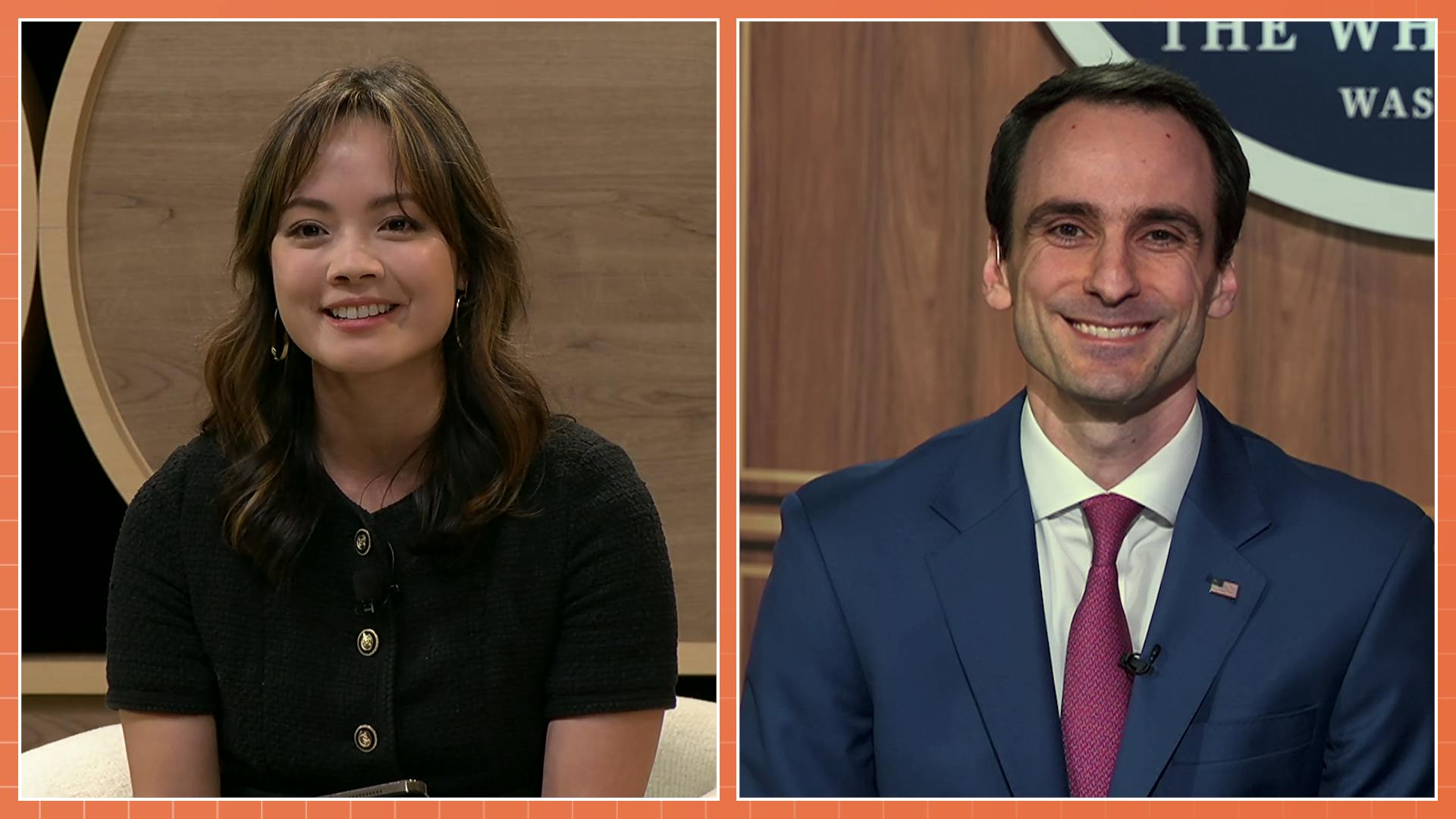
The Man Leading Trump’s AI Charge Against China
Further Listening:
- Is the AI Boom… a Bubble?
- How a $1.5 Billion Settlement Could Alter the Course of AI
- The Nvidia CEO’s Quest to Sell Chips in China
Sign up for WSJ’s free What’s News newsletter.
Learn more about your ad choices. Visit megaphone.fm/adchoices
Press play and read along
Transcript
Speaker 1
China and the U.S. are locked in a race over AI, and President Trump says the U.S.
is ahead.
Speaker 2 China and other countries are racing to catch up to America having to do with AI, and we're not going to let them do it.
Speaker 1
But winning the AI race isn't going to be easy. The U.S.
lags behind China on electricity generation, and earlier this year was shaken by the advancements of Chinese AI firm DeepSeek.
Speaker 1 Today, I'm joined by the man the president has chosen to lead the government over these hurdles, Michael Kratzios.
Speaker 1 Michael worked for PayPal founder Peter Thiel and became chief technology officer in Trump's first administration. He spent four years working at the AI startup, Scale AI.
Speaker 1 And earlier this year, he returned to government as the head of the Office of Science and Technology Policy, the agency in charge of the nation's tech strategy.
Speaker 1 Michael and I are going to talk about everything from chips to chatbots and his thoughts on the the role the government should play in AI development and innovation.
Speaker 1
From the Wall Street Journal's Tech Live event, welcome to this live taping of the Journal, our show about money, business, and power. I'm Jessica Mendoza.
Coming up on the show, how the U.S.
Speaker 1 plans to win the AI race.
Speaker 3 This episode is presented by SAP. A bad storm hitting your warehouse, incomplete customs forms, a short supply of those little plastic twist ties.
Speaker 3 These could all deal a crushing setback to your business, but they don't have to. The AI-powered capabilities of SAP will help you navigate uncertainty.
Speaker 3 You can pivot to new suppliers, automate paperwork, and source the twist ties you need so your business can stay unstoppable. Learn more at sap.com slash uncertainty.
Speaker 4 This episode is brought to you by Indeed. Hiring isn't just about finding someone willing to take the job.
Speaker 4 It's about finding someone with the right skills and background who can move your business forward. And a good way to start your search is with Indeed Sponsored Jobs.
Speaker 4 It's one of the best ways to make your job post stand out and reach the candidates you're looking for faster.
Speaker 4 According to Indeed data, sponsored jobs posted directly on Indeed are 90% more likely to report a hire than non-sponsored jobs. Plus, there's no monthly subscriptions or long-term contracts.
Speaker 4 You're only paying for results. Find the candidates who check all your boxes faster with Indeed sponsored jobs.
Speaker 4 Listeners of this show will get a $75 sponsored job credit to help get your job the premium status it deserves at Indeed.com/slash journal. That's Indeed.com slash journal right now.
Speaker 4
And support the show by saying you heard about Indeed on this podcast. Indeed.com slash journal.
Terms and conditions apply. Hiring, do it the right way with Indeed.
Speaker 1 Michael, thank you so much for joining us today.
Speaker 5 Thank you so much for having me. I wish I could be there in person.
Speaker 1 I know it's unfortunate that you couldn't join us in person.
Speaker 1 And just for everyone's knowledge, this is because of the government shutdown, which is now in its fifth week.
Speaker 1 I wanted to ask, besides impacting business travel, how is this affecting, how is the shutdown affecting your work at the OSTP?
Speaker 5 I think generally speaking, we are full steam ahead on executing on our AI action plan and driving the president's agenda forward.
Speaker 5 Obviously, it would have been great if we could have kept the government open and hopefully the Democrats can get their act together and pass the CR very soon. But for us, it's full steam ahead.
Speaker 1 Well, I think regardless of who you feel is to blame, I think we're all hoping that the shutdown ends soon, isn't that right?
Speaker 1 But you mentioned the AI action plan, which the administration released this summer. And in it, you wrote that America is going to win the AI race, quote, just like we won the space race.
Speaker 1
Now, winning the space race, you know, we all know what that looks like. It was getting the first man to walk on the moon.
What does winning the AI race look like?
Speaker 5 For us, I think winning the AI race
Speaker 5 generally is focused on adoption, this question of how the American tech stack can be the dominant technology stack adopted around the world.
Speaker 5 And in order to do that, we lay out sort of a three-pronged strategy to make that a reality. The first big thing we have to do is make sure that we lead on innovation, meaning that the U.S.
Speaker 5 has to be the home where the next great AI discoveries happen.
Speaker 5 And we need a regulatory system that can allow our greatest AI technology companies and our AI innovators to actually deploy those technologies.
Speaker 5 Now, married with all that innovation, you have to have the infrastructure to drive an AI revolution. And that means we need the power and we need the data centers in order to do all that.
Speaker 5
And lots of work can be done. I'm going to get into that on how to make that a reality.
And the third, which ties to this global adoption question, is all about diplomacy.
Speaker 5 It's how do we make sure that we in the U.S. are proactively exporting our great American technologies to all these countries around the world that want to use this tech.
Speaker 5 Every tech leader that I talk to, no matter where I travel around the world, they want their countries and they want their people to realize the benefits of artificial intelligence.
Speaker 5
And right now, the U.S. is so lucky.
We have the best chips, we have the best applications, we have the best models.
Speaker 5 We should be getting those out in the hands of all these different countries and all these different people that want to get the benefits of AI. So that's generally how we view our strategy.
Speaker 5 And we think that if you follow that, we're ultimately going to have widespread adoption of American tech. And that's what winning looks like.
Speaker 1
It's still a little bit harder to picture than walking on the moon, but I see what you're saying. I'm curious, though, you mentioned adoption.
What about the government adopting AI?
Speaker 1 Is that part of the vision? Where are we at on that?
Speaker 5
It is. You know, I will say I am now on my second stint in government.
And as much as I am excited about government adoption, I will say it never is at the pace that you see in the private sector.
Speaker 5 And you never should expect the government to be an early adopter. That being said, I think a lot of efforts are underway
Speaker 5 under the plan to get the federal government up and running. There's lots of cool projects going on at various agencies.
Speaker 5 There's great work at the VA being underway in order to use AI in places for medical diagnosis and tools for medical practitioners to help the VA.
Speaker 5 So I think there's lots of opportunities out there, and I think all of our secretaries and all of our agencies are super enthusiastic about finding ways to do adoption.
Speaker 1 I want to talk about China.
Speaker 1 You were President Trump's chief technology officer in his first term, and you mentioned, you know, the U.S. has the best technology.
Speaker 1
Now, for years, the approach to competing with Chinese tech has been to try to keep the best of U.S. technology out of China, including powerful AI chips.
How effective was that approach?
Speaker 5 You know, generally speaking, I think if you look at the totality of the US chips and what percentage are actually exported, it's quite small. It's just the very high-end chips.
Speaker 5 And that's something that the president reaffirmed when we were on our trip to Asia just last week. And so that those chips were not on the table for the Chinese now.
Speaker 5 And I think that that's really important.
Speaker 5 And I think for us, we want to make sure that the best chips that we have here in the United States are available to our innovators and are available to our companies in order to build the next great AI solutions.
Speaker 1 I'm glad you mentioned that meeting
Speaker 1 between President Trump and President Xi Jinping because the Wall Street Journal reported that during that meeting the President was planning to talk to Xi about
Speaker 1 greater access for NVIDIA to the Chinese market.
Speaker 1 We know that the administration this summer allowed NVIDIA to sell its less advanced H20 chips to China, but that officials ahead of that meeting were concerned that this would boost China's AI capabilities.
Speaker 1 So I'd love to hear you talk more about that, where you stand on balancing exporting US AI tech and these national security concerns.
Speaker 5 Yeah, I think if we bracket China for a second and focus on the broader AI export program, the key there is to get our technology out in the hands of those adopters.
Speaker 5 And for us, I think you kind of, we have to view the world in a couple of different buckets. I think China is a different case given their artificial intelligence ambitions themselves.
Speaker 5 And that's why you see most of the export control rules singularly focused on China
Speaker 5 as a country. Outside of that, I think our general posture is we want to get the world using our best chips.
Speaker 1 So there's no concern or you're not worried at all, like if we have all of these chips out in the world, that it wouldn't make its way to China anyway?
Speaker 5 Well,
Speaker 5 as part of the ability to export them, I think as part of your license to be able to have them,
Speaker 5 there are restrictions on what you could ultimately do with them.
Speaker 5 And if you sort of break the rules and ultimately diffuse those to places that you're not allowed to, then you wouldn't be able to get any chips going forward.
Speaker 5 So I think there's a lot of incentive for you to follow the rules.
Speaker 1 Another important factor in winning the AI race is public receptiveness.
Speaker 1 And I found this really interesting. Stanford University came out with a report recently that found that 83% of Chinese believe that AI-powered products and services are more beneficial than harmful.
Speaker 1 And in the U.S., Americans, it's 39%.
Speaker 1 What do you say to Americans who are skeptical of AI?
Speaker 5 To me, I always like to talk about the great benefits that this technology can bring to changing the lives of American people for the better.
Speaker 5 I think examples that I think really can be impactful are particularly in the medical space, and it's ones that a lot of Americans can resonate with.
Speaker 5 But at the same time, I think we have to be very cognizant in understanding that people are skeptical of this technology, especially when it comes to America's use.
Speaker 5 And I think that's a priority that we've taken as a White House. The president signed executive order around AI and education.
Speaker 5 And the one thing that we always talk about, and the First Lady is a big advocate for, is actually teaching and educating young Americans about AI, having them better understand what the limitations of these technologies are, where it's useful, where it's not useful, where you should be using it, where you shouldn't be using it, what's the best way to use it.
Speaker 5 And I think for us, the more education, the better that we can do in teaching our students in K through 12 how to leverage this technology, the better off we'll be as a country going forward.
Speaker 1 We also know that when it comes to AI safety, especially for minors, there's already some cases where interactions with chatbots have led to teens taking their own lives.
Speaker 1 And I think last week there was a bipartisan bill that was introduced in the Senate that would ban AI chatbots for minors, for example, and it would introduce criminal penalties for AI companies that design chatbots that encourage suicide or discuss sexually explicit content.
Speaker 1 Would that be a bill that you would support?
Speaker 5 Yeah, I'm not familiar with that piece of legislation, but I think broadly speaking, as I said earlier, I think I'm heartened to know that and to observe that sort of the children's safety around AI is something that is truly bipartisan.
Speaker 5 We saw it with the Take It Down Act that the First Lady supported, and we see it continually in both
Speaker 5 chambers of Congress where new legislation continues to be introduced in this area. I'm a new father.
Speaker 5 I take this stuff very seriously, and I think it's critically important that as we think about regulation of AI, that one place that we can all agree on is we have to look carefully at how it affects our youth.
Speaker 5 And that's something that the White House is behind, that the First Lady is behind, and that we've already signed legislation to.
Speaker 1 Well, congratulations on being a new dad.
Speaker 1 How do you expect, how do you anticipate talking to your kids? I know it's going to be a while, but how do you anticipate talking to your kids about this kind of technology?
Speaker 1 What do you say to your friends?
Speaker 5 Well, I don't know. My wife and I go back and forth on this all the time.
Speaker 5 I mean, it's so funny because I think when I first met my wife just a few years ago was when you know the first Chat GPT came out you know and we were sitting there playing on it and kind of doing silly games on it asking silly questions and then and then over time now it's become better and better and better and you you could and I think the other thing that we've all also observed together is the transformation it's had in education you know if you remember when it first came out universities were trying to ban it high schools were trying to stop kids from using it and just in a few short years it's become abundantly clear that that definitely is not the right path forward and that in one way or another students are going to be using this.
Speaker 5
Adults are going to be using this. It is a part of our life.
So I think it's changing so quickly day to day.
Speaker 5 You know, I don't quite know how it's going to affect my son, but I do know it's going to be a big part of his life.
Speaker 1 You can ask ChatGPT or whatever version it'll be by that point, what you should be doing.
Speaker 5
Exactly. I'll ask it tonight.
We'll see what it says.
Speaker 1 Just to sort of close the loop on this, what do you think the role of government should be when it comes to AI regulation, if any?
Speaker 5 Yeah, the government has a very important role.
Speaker 5 And what we have advocated for and I've advocated for for years, even in the first Trump administration, is the best approach to AI regulation is for it to be use case and sector specific.
Speaker 5
And what we mean by that is because AI is so ubiquitous, it is going to be in every technology out there. Here are some examples.
There are AI-powered medical diagnostics. There are drones.
Speaker 5 There are self-driving cars. And all those examples I just gave you, there are already regulatory agencies that exist that regulate those technologies.
Speaker 5 The FDA regulates medical diagnostics, whether or not they have AI in them or not. And NHTSA, for example, regulates safety of vehicles, whether or not they're autonomous or not.
Speaker 5 The FAA regulates air travel, whether it's autonomous drone or not. And in those cases,
Speaker 5 I think the best path forward is for those regulatory agencies that already have jurisdiction over a particular type of technology or action.
Speaker 5 Those are the ones that should just continue to expand or mold the way that they think about regulation when
Speaker 5 this new technology is introduced.
Speaker 1 I understand what you were saying, you know, the agency that regulates vehicles and
Speaker 1
can also do that for automated vehicles. But isn't there still a bit of a learning curve? I mean, as you were saying earlier, this technology is moving so quickly.
How do you know?
Speaker 1 How are these agencies expected to catch up given everything that they're already doing?
Speaker 5 Yeah,
Speaker 5 I agree that this technology is moving quickly. I do have faith in our regulatory agencies to kind of do this.
Speaker 5 I observed in the first Trump administration that the FDA in, I think it was 2018 or 2019, approved the first
Speaker 5 AI-powered medical diagnostic in history, and they've continued to approve a lot more in the time being. I think
Speaker 5 these are professionals. They know their domain very well, and we should have confidence in their ability to kind of mold.
Speaker 5 That being said, I continue to encourage these agencies to look for and hire experts that are able to understand sort of the new nuances of how AI affects their technology.
Speaker 5 And it's a constant challenge in the government. Like we need more, better, smarter people to come in and work on these issues, particularly in areas where the technology is moving.
Speaker 1 It's interesting that you say that we would want to see more hiring of the best and the brightest to help with this, given the fact that thousands of, tens of thousands of federal workers have just been cut.
Speaker 1 So how do you square that?
Speaker 5 I think those are very different things. I think cutting personnel at a federal agency that
Speaker 5 may not necessarily be necessary or important for a particular mission, I think is very different than trying to hire experts that can help in a particular domain of regulation.
Speaker 5 And I think what we've been doing as an administration, very tactically, is to try to find and identify kind of what are the key missions and drivers of particular agencies and make sure that we have human capital allocated to the highest impact areas that we can deliver on the statutory mandate of those individual agencies.
Speaker 1 Coming up, is the U.S. government worried about an AI bubble?
Speaker 4 This episode is brought to you by Indeed. Hiring isn't just about finding someone willing to take the job.
Speaker 4 It's about finding someone with the right skills and background who can move your business forward. And a good way to start your search is with Indeed sponsored jobs.
Speaker 4 It's one of the the best ways to make your job post stand out and reach the candidates you're looking for faster.
Speaker 4 According to Indeed data, sponsored jobs posted directly on Indeed are 90% more likely to report a hire than non-sponsored jobs. Plus, there's no monthly subscriptions or long-term contracts.
Speaker 4 You're only paying for results. Find the candidates who check all your boxes faster with Indeed Sponsored Jobs.
Speaker 4 Listeners of this show will get a $75 sponsored job credit to help get your job the premium status it deserves at Indeed.com slash journal. That's Indeed.com slash journal right now.
Speaker 4
And support the show by saying you heard about Indeed on this podcast. Indeed.com slash journal.
Terms and conditions apply. Hiring? Do it the right way with Indeed.
Speaker 6 What does it mean to live a rich life? It means brave first leaps, tearful goodbyes,
Speaker 6 and everything in between.
Speaker 6 With over 100 years experience navigating the ups and downs of the market and of life, Your Edward Jones financial advisor will be there to help you move ahead with confidence.
Speaker 6 Because with all you've done to find your rich, we'll do all we can to help you keep enjoying it. Edward Jones, member of SIPC.
Speaker 1 I want to take one more step back.
Speaker 1 And going back to this idea of
Speaker 1
the U.S. winning the AI race, a key part of that is power generation.
And And we know that, again, China has the edge when it comes to electricity generation.
Speaker 1 Open AI pointed out that China added hundreds more gigawatts of power last year compared to the U.S. And you've said the answer to that is nuclear power.
Speaker 1 How quickly, practically speaking, can the U.S. accelerate this effort and catch up?
Speaker 5
Well, I have been a nuclear energy advocate for many, many years. My hope is as quickly as possible.
There was an announcement actually made by the Department of War just last month.
Speaker 5 They believe that they'll be able to field
Speaker 5 an SMR by 2028 that they're going to put on a nuclear base.
Speaker 5 We're seeing timelines where you could actually see sort of Americans connected to new nuclear power sort of at the beginning of the next decade.
Speaker 5 And I think in the meantime, we're doing everything we can to sort of bridge the gap there with as much as we possibly can on
Speaker 5 other sources of fuel as well.
Speaker 1 One question that honestly I get asked a a lot by our listeners on the journal podcast.
Speaker 1 People are very interested in AI, but are you worried about an AI bubble?
Speaker 5 I am not at the moment.
Speaker 5 I am excited that this technology is having such a tremendous impact on our economy, on our sort of national power, our ability to project power around the world, and I think the impact that it's ultimately going to have on American businesses and consumers.
Speaker 5 And I think what's most exciting to me about where we are in this cycle is we're still pretty early.
Speaker 5 I mean, I joined the administration from a private sector AI company that was spending a lot of time trying to help governments and help a lot of folks in industry adopt AI and build it into their workflows.
Speaker 5 And I will say, you know, even kind of a year ago, you know, adoption is hard. It's really easy.
Speaker 5 It's not as simple as just signing up for an API for one of our great model builders and suddenly you're going to have a miracle. Like it takes effort and it takes a lot of work.
Speaker 5 But once you get it up and running, I think it can be a huge, a huge boon for governments and
Speaker 5 for the private sector. So to me, I think we are barely sort of seeing the benefits of it.
Speaker 5 So I think if you try to map that to kind of where the projection is of energy consumption and chip demand and all these big announcements you're seeing from our big model builders, it all kind of generally maps my head.
Speaker 5 You're going to see the adoption uptick by people, but much more than just individual consumers, and that's going to pair well with the projected energy and chip demand.
Speaker 1 Okay, so just to be clear, it's a no from you, not concerned about an AI bubble.
Speaker 5 I am excited about where the AI industry is going, and I think I'm very confident in the capital markets in the United States more so than anyone else to allocate capital to the right places.
Speaker 1 Okay.
Speaker 1
All right. Well, we're running out of time here, but I did want to ask you one last question, Michael.
People might not know you're a marathon runner.
Speaker 1 If this AI race is a marathon, what mile are we on?
Speaker 5 Oh, that's a good one.
Speaker 5
I don't know. Maybe we just passed the 5K mark.
We've got a long way to go.
Speaker 1 Got a long way to go. Well, thank you so much, Michael Kratzios, Director of the Office of Science and Technology Policy at Region.
Speaker 5 Thank you.
Speaker 1
That's all for today, Wednesday, November 5th. The journal is a co-production of Spotify and the Wall Street Journal.
Additional reporting in this episode by Amrit Ramkumar.
Speaker 1 Thanks for listening. See you tomorrow.
Speaker 7
What I bought? A new Blink Mini 2K Plus smart security camera. What I got? 2K clarity sharp enough to see every detail of home when I'm away.
Plus, audio like I'm in the room.
Speaker 7
Not with my bestie traveling to another city. Plus, easy plug-ins set up to install faster than skipping through podcast ads.
But you'd never skip ads, right? Plus, I got all of this for just $49.99.
Speaker 7 Blink Mini 2K Plus, mini camera, max performance. Shop now at amazon.com/slash blink.
