74. The Hunt for Pablo Escobar: Rise of a Drug Lord (Ep 1)
58m
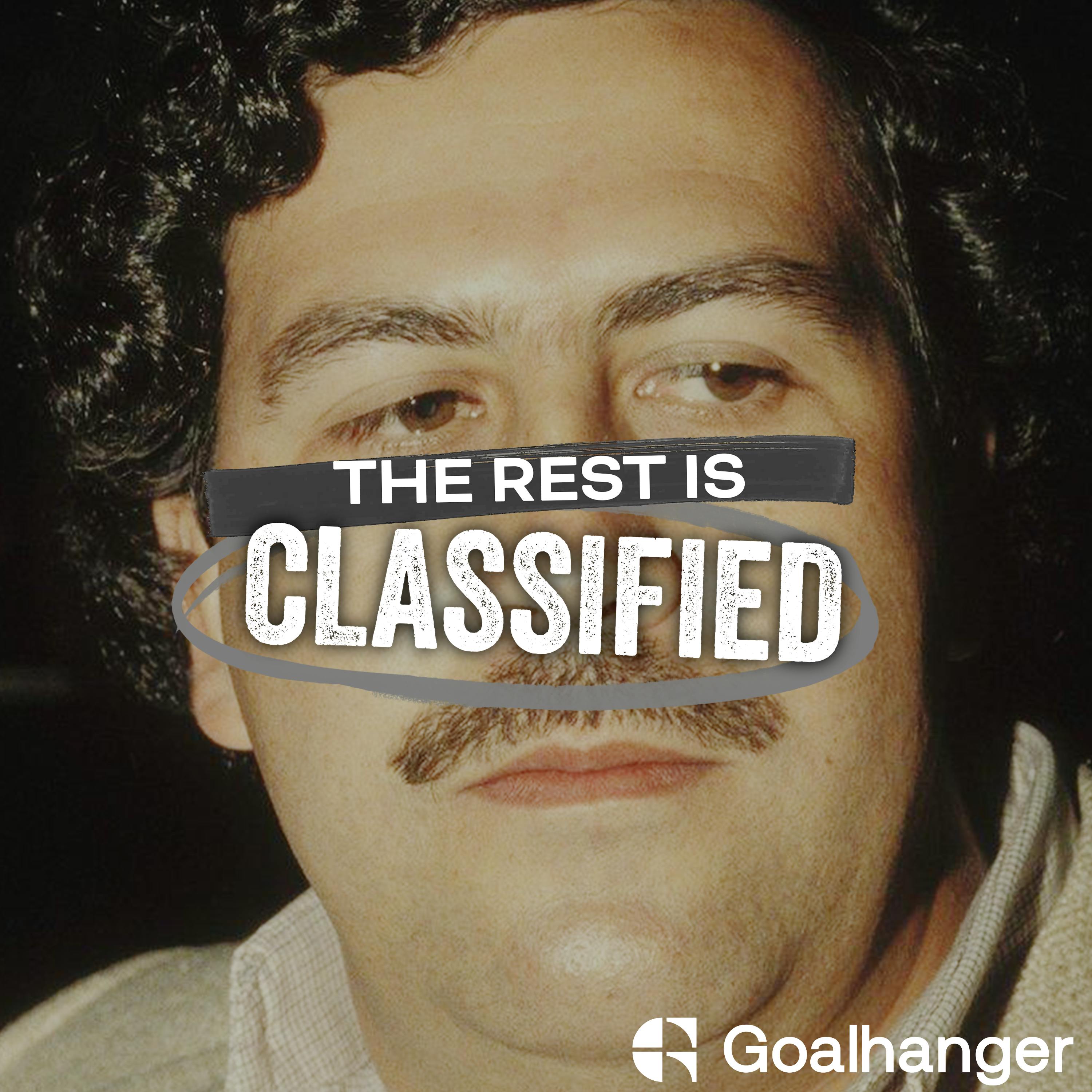
Colombia in the mid-20th century was a place of beauty and bloodshed - where jungle mountains sheltered rebels, the cities were ruled by oligarchs, and outlaw legends became folk heroes. Into this world stepped Pablo Escobar. Charming, calm, and calculating, he would become one of the richest men in history - and one of the deadliest.

In this first episode of our Escobar series, Gordon Corera and David McCloskey explore Escobar’s early years: petty crime in Medellín, his first forays into smuggling, and the moment cocaine transformed from a fringe luxury into a multi-billion-dollar industry.

From stolen cars to international drug routes, this is how Escobar built the foundation of the Medellín Cartel - and how the war to bring him down began.

-------------------

Join The Declassified Club: Start your free trial at therestisclassified.com - go deeper into the world of espionage with exclusive Q&As, interviews with top intelligence insiders, quarterly livestreams, ad-free listening, early access to episodes and live show tickets, and weekly deep dives into original spy stories. Members also get curated reading lists, special book discounts, prize draws, and access to our private chat community.

To sign up to the free newsletter, go to: ⁠https://mailchi.mp/goalhanger.com/tric-free-newsletter-sign-up⁠

-------------------

Order a signed edition of Gordon's latest book, The Spy in the Archive, ⁠⁠⁠⁠⁠⁠⁠⁠⁠⁠via this link.⁠⁠⁠⁠⁠⁠⁠⁠⁠⁠

Order a signed edition of David's latest book, The Seventh Floor, ⁠⁠⁠⁠⁠⁠⁠⁠⁠⁠⁠via this link.⁠⁠⁠⁠⁠⁠⁠⁠⁠⁠⁠

-------------------

Email: classified@goalhanger.com

Twitter: ⁠⁠⁠⁠⁠⁠⁠@triclassified⁠⁠⁠⁠⁠⁠⁠

Assistant Producer: Becki Hills

Producer: Callum Hill

Senior Producer: Dom Johnson

Exec Producer: Tony Pastor
Learn more about your ad choices. Visit podcastchoices.com/adchoices

Press play and read along

Runtime: 58m

Transcript

For exclusive interviews, bonus episodes, ad-free listening, early access to series, first look at live show tickets, a weekly newsletter, and discounted books, join the Declassified Club at the RestIsClassified.com.

You're deep into your favorite true crime binge. The twist, the theories, and suddenly, hunger hits.
Grab a Paleo Valley 100% grass-fed beef stick. These aren't your average gas station snacks.

They're made from real beef sourced from regenerative, small American family farms. No preservatives, no gluten, no grains, soy, or sugar.
Just naturally fermented protein that fuels your obsession.

Whether you're road tripping, hiking, or pulling an all-nighter with your favorite case. Choose from five bold flavors, original, jalapeno, summer sausage, garlic summer sausage, and teriyaki.

They're keto, paleo, and carnivore-friendly, made to work with your lifestyle, not against it. With over 55 million sticks sold and a 60-day money-back guarantee, you've got nothing to lose.

Get 15% on your first order at paleovalley.com. Just use code Paleo at checkout.
Running a small business is tough. Why add online threats to the mix?

Norton's Small Business can help you and your employees stay safer online.

It's an all-in-one cybersecurity solution that protects your employees' devices, monitors for information like your EIN on the dark web, and alerts you in real time to suspicious activity.

And if you ever need help, our 24-7 Business Tech Support has you covered. Let us be your IT department so you can focus on the business you love.
Visit Norton.com slash business today.

Hi, this is Joe from Vanta. In today's digital world, compliance regulations are changing constantly, and earning customer trust has never mattered more.

Vanta helps companies get compliant fast and stay secure with the most advanced AI, automation, and continuous monitoring out there.

So whether you're a startup going for your first SOC2 or ISO 27001 or a growing enterprise managing vendor risk, Vanta makes it quick, easy, and scalable.

And I'm not just saying that because I work here. Get started at Vanta.com.
Victory over drugs is our cause. A just cause.

And with your help, we are going to win. Pablo Escobar, the head of the Medellin Drug Cartel, the world's 14th

man.

He was, in many ways, a terrorist. This is an economic power concentrated in a few hands and in criminal minds.
What they cannot obtain by blackmail, they get by murder.

And I don't think he express any regret at all. He tries to portray himself as a man of the people, this kind of like leftist revolutionary outlaw.

Nearly everyone in Medellin supports the traffickers. Those who don't are either dead or targets.

If you declare war, you've got to expect the state to respond. This is the moment where he goes too far.

13 bombs have gone off from Median since the weekend. By the end of 87, Bogotá is essentially a war zone.
U.S.

spending for international anti-drug efforts is going to grow from less than $300 million in 1989 to more than 700 million by 1991.

It is the certain knowledge that no one is really safe in Colombia from drug cartel assassins. It's a conflict where the goal wasn't even to stop the flow of cocaine.

It was to bring down this narco-terrorist. Everything has turned against him after this point.
The whole thing he was building is collapsing.

What I've seen and heard in the media is that cocaine costs a lot of money and is consumed by the high social classes in the United States and other countries of the world.

I've seen that many political leaders and governments around the world have been accused of narco-trafficking, like the current Vice President of the United States, who's been accused of buying and selling cocaine and marijuana.

I've also seen the declarations of one of Mr. Reagan's daughters, in which she admits to taking marijuana.
And I've heard the accusations against the Kennedy family.

My conclusion is that there is a universal hypocrisy towards drug trafficking and narcotics.

And what worries me is that from what I see in the media, all the evil involved in drug addiction is blamed on cocaine and Colombians, when the truth is that the most dangerous drugs are produced in labs in the United States like crack.

Well, welcome to the Rest is Classified. I'm Gordon Carrera.
And I'm David McCloskey. And that was none other than Pablo Escobar.
You might be confused by the British accent, but that was

Pablo.

I decided not to do my mock Colombian accent. Apologies to anyone out there who was hoping for that.
That's good. I think that was wise.
But that was the,

you know, how to describe him, the drug overlord, the narco-terrorist, a man who's been glamorized as well as demonized in film books and TV.

Pablo Escobar in that conversation railing to a judge against the hypocrisy, the hypocrisy, David, of the United States and its war on drugs.

Because this time we're exploring the nexus of intelligence, special operations, and the war on drugs. That's right.

It's the hunt for Pablo Escobar, which we are going to be exploring in this wild six-part series on really kind of the nexus of the war on drugs and then the world of the CIA, the DEA, the Drug Enforcement Administration, special operations, and how, I mean, in a way, kind of 20 years before the hunt for Osama bin Laden, in a very different context, how do you hunt down somebody that, you know, doesn't want to be found?

How do you hunt them down in Colombia in a part of the world that they kind of own? And I guess bring them to justice.

It's going to be a really fascinating exploration of really the actual war inside the war on drugs.

Yeah, that's right, because you often think about the war on drugs really as something done by the DEA or by the FBI, but actually the intelligence part of it, which we're going to look at, I think is really interesting.

And it is like the bin Laden hunt in it.

It's trying to find someone who really doesn't want to be found and using the latest tracking and intelligence surveillance technology to try and find them as well as human informers and all those other things.

So I think there's really interesting parallels there. But also it's a story with contemporary relevance, isn't it?

Because the new administration in the US has launched something like a new war on drugs.

I mean, it's pushing the CIA to take on, in this case, now, Mexican cartels and Mexican gangs and designating them as terrorist organizations.

So, using drones and the modern surveillance technology to go after them. So, it is that sense of how you can use intelligence agencies to go after drug lords, essentially.
That's exactly right.

I mean, I think there's also really

an almost straight line from the story that we're going to tell about pablo escobar the rise of the medin cartel in colombia and

really the crack epidemic that struck the u.s in the 80s and the rise of mexican drug cartels and syndicates whose smuggling in particular over the past 15 20 years has really shaped so much of our modern politics in the states.

So there's an incredible social tapestry to this as well that really frames.

And it's all happening in the context of this really amorphous kind of war on drugs, where the United States has spent a trillion dollars going back several decades to sort of try to bring the drug problem under control to really almost no avail.

So it's this massive effort, and it has this very fascinating kind of military and intelligence component that I think really starts in the Pablo Escobar story.

Yeah, and Pablo Escobar as well is this extraordinary character. And he has been, as I said, slightly glamorized.

And I think we need to be careful about that because, you know, he's glamorized for his kind of wealth and his power, which was extraordinary at the time. I mean, so wealthy.

And yet he was in many ways a terrorist. I mean, he was described as a narcoterist.
He was, you know, a drug lord.

And actually, when we get to the detail of some of the things we'll see in this story, he was doing things which we associate with terrorists, which explains this kind of complicated framing and the ability to use some of those spy agencies to go after him, I think.

His legacy is, I mean, it's something that's going to hang over this entire story because, on the one hand, you have this remarkably ruthless and personally brutal individual who was not shy about killing all manner of innocent people, not to mention the people just inside the context of the drug war who, I guess you'd say, are involved.

Pablo and his organization killed thousands of innocent people who wanted no part in this drug war. And so he's all of that.

And then on the other hand, he still inspires a tremendous amount of fascination. You can look at the Narcos series, right, as evidence of that, millions upon millions of viewers.

But he's got this kind of Robin Hood vibe to him in some circles as well that would almost want to, I think, put him in a pantheon with like Fidel Castro. Cheguevari.
Che Guevara.

Which of these two worlds does he live in? I mean, the interesting thing is even in his hometown of Medellín, the money from the cocaine trade essentially financed the skyline of that city today.

And yet at the same time, you see this backlash against Pablo and really the cocaine business, because I think it really frames so much of how we view Colombia, right?

I mean, there's a much broader, culturally rich Colombia beyond Pablo Escobar, and yet so much of our lens for that country is him and the drug trade that he really built. So let's set the scene.

Let's get to Pablo, but perhaps let's describe a bit of where he comes from and Colombia at the time he's growing up. Because I think that context is important, isn't it?

To understand how he grows to be this hugely influential figure. Yeah, he is very much a product of mid-century Colombia and all that that entails.

And I think there's probably four things that are really relevant about the Colombia that he grows up in that listeners should be aware of and that really kind of paint the context for Pablo.

So mid-century Colombia, elite rule, it's a very unequal place. 3%

of the population probably owns 97% or so of the land and wealth, right? Massively unequal. But it is also, it is a democracy.
There are elections. There is a free press.

There's a history of a kind of liberal democracy. This is not a place that is run.
by a military junta.

That kind of elite structure is almost an oligarchy you could think of that sits in Bogota, the capital.

It is widely seen by vast suaths of the Colombian population, including many in the city of Medellín, which is the second largest city in the country where Pablo is from.

It's seen as a really extractive enterprise, right?

You have this oligarchic ruling class where you have elections that kind of trade back and forth between these parties, but essentially it's just a bunch of rich families in Bogota that kind of trade the politics back and forth, kind of in league with corporate U.S.

investors to export the nation's wealth, be that mining, be it coffee. So it's a really, I guess, politically fractious place, but it's also kind of free and open.

I think one of the best English language histories of modern Colombia is written by a guy named David Bushnell, and the title is The Making of Modern Columbia a Nation in Spite of Itself, right?

So it is a pretty fractious place. It is also, and this is the second point, extremely blood-soaked, okay?

Mark Bowden, in another book on Pablo called Killing Pablo, which I would highly recommend to our listeners, writes, violence stalks Colombia like a biblical plague.

The Spanish conquest of Colombia was unbelievably bloody. There were entire kind of Andean civilizations that were erased.
There are eight civil wars in Colombia in the 19th century.

One in 1899 leaves 100,000 dead and destroys most of the country's infrastructure. There is a very recent spate of violence that is going to be extremely important to kind of young Pablo.

And that is a civil war that begins in the late 1940s and continues through the 1950s that is so utterly senseless in many ways that it's just called la violencia, the violence. The violence.

The violence. It's this period of kind of social chaos and civil war that lasts for years.
Maybe 200 to 300,000 people are killed, most of them in the countryside.

You have the government fighting guerrillas. You have Catholic Church fighting liberals, Industrialists.
Everyone's union. It's just basically everyone's fighting everyone.
Yeah.

And we should preface this in particular, just like the next little bit here is if you are listening to this with young children or somewhat squeamish, perhaps you should

kind of fast forward this for a couple minutes. But violence is a very intimate part of Colombian culture, and it gets a lot more twisted during La Violencia.

And I'm not trying to assert here that Colombians are violent, right?

That is not what I'm saying, but I'm saying that violence is kind of part of the social fabric of the country, in particular in this period. And it's theatrical in many ways, right?

You have a tremendous amount of mutilation, obviously, sexual violence.

You have horrific displays of this in the countryside, where you'd have, you know, heads that are put up on pikes along the road. It's kind of medieval, isn't it? It is, yeah.

And, you know, I think many people have probably heard of the Colombian necktie, right, as this pretty gruesome kind of display of violence.

And it gets its origin during La Violencia, where this particular gang kind of comes up with almost almost a signature, like a cut that they would do on victims to display their own power.

And here it is basically making a slice in the neck and then pulling the victim's tongue out through the slice. to resemble

a necktie. Okay.
The joke.

Gordon calls it off. Colombians have a joke that says God made the land so beautiful, so rich in every natural way that it was unfair to the rest of the world.

And he had even the score by populating it with the most evil race of men. Right.
So, speaking of evil men, Colombia is kind of a bandit country in some ways.

The geography makes the place very hard to govern. Lush jungles, very mountainous.

It is a pretty unique place in that, even very recently, there are corners of Colombia that are basically untouched by kind of modern civilization, right?

It is one of the few places in the world where new species are still found.

As recently as a decade ago, the mid-2010s, there's a hunter-gatherer tribe that was actually discovered in the dense jungles of Colombia, right, that had never had contact with the outside world.

And even the Spanish took several hundred years to subdue some of these Andean civilizations, right? And it was, of course, done by bloody violence.

So as a result, governments, and this will be a feature of the Pablo story, right? Colombian governments have tended to be very weak. Authority doesn't extend much outside the major cities.

And this is a country we should remind listeners, and I think this group shows up in the TV series Narcos. There's a group called the FARC, F-A-R-C.

It's a court of a Marxist insurgency that had run in the hills of Colombia up until 2016. This is a sort of geography that enables a Marxist insurgent group to operate up until nine years ago.

So you've got violence, and then the geography gives refugees places to hide, which makes it perfect for groups to operate beyond this state control and in this culture of violence.

It's kind of like Afghanistan. It's unique in its weak central government.
You know, they are almost like those Afghan warlords in some places, aren't they? As well as bandits and criminals.

That's right. And outlaws, as a result, there's a real tradition and kind of mystique around the outlaw in Colombia, right?

People who are hunted by the government or hunted by these kind of wealthy families in Bogota, right? The outlaw in Colombia can really be a hero.

There's social meaning behind the actions of the outlaw. They're not just criminals, although they are deeply criminal, right? And violent.

Their violence and their mayhem is kind of seen as a blow against an oppressive power.

And so, as a result, a lot of Colombian citizens will actually look at outlaws and take a certain manner of delight in their exploits, right?

And so, during La Violencia, as Pablo Escobar is growing up, there are all of these really famous outlaws in Colombia, and they've got great names. There's an outlaw named Tarzan.

There's an outlaw who nicknames himself Revenge. There's one called Sure Shot, Blackblood, who I believe Blackblood and his gang were the inventors of the Colombian necktie, necktie, Gordon.

There's one known as Sparks, right? So, Pablo grows up in a world where these outlaws, they're not just common criminals, right? They're sort of revolutionaries in some way, right?

So, Columbia, number one, fractious but liberal politics, number two, blood soak, number three,

outlaw tradition, and number four, right? Well, they're all religious Catholics, right, Gordon? Catholicism is this sort of unifying force and it's reached the entire country, but

it's been accomplished by smart Jesuit priests by kind of pasting Catholicism atop local tradition.

And so you have this kind of element of magic and superstition and violence that coexists with fervent Catholicism. And it's a kind of pagan Catholicism that I think Pablo will himself adopt.

A great example of this is that Pablo himself will finance a shrine outside Medellin known as the Virgin of the Assassins, where cartel hitmen, Sicarios, go to pray for forgiveness before they kill.

Before they kill. Before they kill, right? So this isn't like, come get your sins absolved.
It's like, get that forgiveness, but still go kill somebody.

I think those elements kind of frame the Columbia that Pablo Escobar is going to be born into. And so let's get to Pablo himself, young Pablo, born December 1949.

So that's just as the Violencia is getting going, as that kind of brutal period was there. And I guess that must mark him.
It does. No, absolutely.

Because he's going to grow up in the years of La Violencia. He's born in a village outside Medellin.

His mom is a school teacher. His father is a cattle farmer.
They own a house. They own hectares of land.
They own cows. There's no electricity, but there is running water.

Pablo later on will try to spin a myth that he had been born dirt poor, but he's really probably upper middle class given his family's standing.

They move soon after to Envigado, which is another village outside Medellín. His mom is sort of an important person in the community.
She founds the elementary school there. Pablo does well in school.

He loves soccer, Gordon, football. Good.
He's chubby, I think, from a young age. You see in the photos, he's always kind of on the bigger side, and that'll be part of the story.

He's well-dressed, he likes fast food, loves American, Mexican, Brazilian cinema. And he's got a round face.

He's got these thick, long, you know, sort of black, curly hair, combs it over his forehead. And he's one of these, I think, pagan Catholics, right? Which is very common in the region around Medin.

Lots of prayers to idols, communing with dead spirits. His mother's the same way.
By the time he's a teenager, La Violencia is easing. It's the late 50s and early 60s.

And just like in the U.S., there is a kind of Colombian counterculture that's building called nadíismo.

I will note here also that, Gordon, I don't know where your Spanish language skills are, but if you've come to this podcast expecting wonderfully accurate pronunciations in Spanish,

you're in the wrong place. We're going to we are going to try hard.
We always try hard. That's actually our number

on the rest is classified as we try hard, but

we're not going to live up to your expectations if you are expecting perfect pronunciations. But nadíismo, nadaistas, the nothingists.
It's kind of a big middle finger at their elders.

Lots of music and lots of, this might surprise you, Gordon, a lot of smoking of marijuana, dope, right?

Lots of weed. And in Colombia at this time, weed is very plentiful.

This is another piece of Colombian geography that's important is basically Colombia is like one of the most fertile places in the entire world. And so everything grows there, right?

Just basically everything grows. The weed's plentiful.
It is very potent. By the 1960s, it's kind of the worldwide gold standard for pot.

And Pablo is a heavy doper, a heavy weed user, and he will be for the rest of his life. So he's spending his time pretty much doped up rather than at school, I think it's fair to say.

He's a bit of a school dropout. He's not good with the books.

So it sounds like he'd sleep in until the afternoon, eventually get kicked out, effectively.

I guess what you'd say is, you know, this is the classic case of like, you know, sometimes like the pastor's kids are the most insane.

This is the case where the elementary school teacher's son is having a hard time staying in school. This is another facet of him that I find wonderful is that he basically wakes up in the afternoon.

Pablo, Pablo stays up for most of the night and will go to sleep and then wake up at like one or two in the afternoon, right? So he's, he's stoned all the time. He's sleeping late.

And unsurprisingly, he's going to rebel against his school teacher mother and he'll drop out of high school just before his 17th 17th birthday.

Although he remains quite close to his mother, doesn't he? Oh, yeah. So it's not, yeah.
So it's worth saying that he kind of rebels against school, but not he doesn't leave his family in that sense.

But it's interesting, isn't it? So he's kind of dropping out. He's a pothead, but he just kind of falls into crime and moves up through the hierarchy of crime, doesn't he?

It's not as if he starts off in the darkest place of drug dealing and violence.

If listeners needed any more proof that, you know, marijuana is just a gateway drug to worse things, you have the case of Pablo Escobar, because I think what he does is he's looking for adventure and excitement, and he kind of just gets involved in Medellin street life, essentially, right?

Conning people out of money, kind of getting involved with lower-level gangsters on the street.

So it's not a, I think the dip into crime is not some massive strategic choice on his part or something that was written in stone from a young age, but he kind of just one step at a time gets into it.

You mentioned Medellín. We should also talk about that because Medellín is an important part of this story as well.

A second city of Colombia and an interesting place which is going to become the center of his organization and the center of his power.

And I think Medellín is essentially a character in this story, Gordon. And if you, dear listener, are picturing a massive crime-ridden sprawl and sort of misery and slums, that's wrong.

It's got bits of that, but that is the wrong picture to have of Medellín in Pablo's time, or even today.

It is a very lush, green, gorgeous, mountain sort of metropolis of about 1.2 million people that sits across this kind of mile-high river valley, pine forests all around.

It's in the north-central province of Antioquia in Colombia. It is the second city.
I mean, the photos are amazing. I have never been there, but it looks like an absolutely gorgeous place.

It is known as the Orchid City. It has these kind of stately colonial neighborhoods.

It's got a new, really bustling downtown with a lot of skyscrapers, many of which will eventually later on be financed by the cocaine industry in part.

Dozens of parks, tree-lined boulevards, very green. It's got these suburban hills, the country homes and weekend chalets on them.
The average temperature year-round is 72 degrees Fahrenheit, right?

Which is 22 Celsius. It rains a lot, but there's tons of sunshine.

The mountainsides that kind of rise above the city reflect the social classes of Medellín, but it's in reverse, right? The higher you go, the better the views, but the worse off you are socially.

The wealthy city center is in the valley. That's where the elite live.
You go higher and higher. The views get better, but you're poor, right? Now, the locals in Medellin are known as paisas.

It is very much the commercial capital of the country. It had started as the mining center, and then it becomes a center for coffee.
By the 20th century, it's the industrial center of the country.

And those paisas are rich, they're industrious, but they're also the butt of jokes of this kind of oligarchy in Bogota. The Bogotans are more refined.
It's where they have the political power.

So there's a kind of regional resentment here, right? Which is going to play an important part of the story in how Pablo tries to set himself up kind of as the feudal lord of this city.

And the region around it is quite wild, isn't it? And then that's where you've got got smugglers, contrabands, bandits. It's bandit country around the city.
There's a long tradition of

almost gentlemen smugglers, I think you could say, in Medellin. You have a class of people in Medellin

who have created wealth and a perfectly, at least seen in the eyes of other paisas, as a perfectly respectable occupation, which is... You might be smuggling gold and emeralds.

It's going to be liquor, cigarettes, electronics. In Pablo's time, it's going to be be cocaine.
And this is like an accepted way to ascend in the sort of social classes of Medellín.

And there's a great book about the Medellín cartel in Pablo's time called Kings of Cocaine by Guy Gugliata and Jeff Lean.

And they make this wonderful comparison to say: if Bogota has the reputation as the Athens of South America, Medellín was at Sparta. It is rough and tumble, harder and more productive, right?

And that's how the locals kind kind of see themselves.

Now, I like the story that he got his start in crime by stealing headstones from the cemetery and then sandblasting the names on them so they could be resold for other people.

But you're suggesting that's not true. That's a myth.
But I love that story. I just think

it's a great way stealing from the cemetery is your first bit of crime. But maybe that's an exaggeration.
But that's the kind of thing he's doing in his early days.

As you said, he's a kind of con artist, petty crime, bit of a thug, element of violence. Yeah, that's right.

And it does seem like the sort of the headstone business was legend that was appropriated as biography, but it's probably, probably not true.

It seems like it's too much actually of an honest business for Pablo Escobar. So to your point, Gordon, he moves through this world of kind of petty crime in Medellin

and gets involved in the smuggling game by going to work as some of the muscle for one of these established smugglers who's running stereo equipment in and out of the Panama Canal zone, right?

He moves from that to actually running a very successful business stealing cars. So by the time he's 20 in the late 60s, he's running a kind of car-pinching business.

So they literally pull people out of the car in the middle of the day. And then Pablo and his gang break the car down for parts and then resell them.
This seems to be pretty lucrative.

He builds up some capital, and then they start buying off municipal officials to issue new papers for the stolen cars so they don't have to break them down.

The arrest records, this will will be another great theme of this series. The arrest records from the time have largely vanished, Gordon.

Pablo does spend a few months in jail before his 20th birthday. This stint in jail seems to have no impact on his desire to continue his criminal ways.

I just think it's worth painting a picture of him as a character, isn't it?

Because you get a sense of it from these days, that he is someone who is comfortable in criminality to the point of actually enjoying it. He finds it fun, I think.

He's clearly ruthless and willing to undertake violence.

But one of the things other people seem to say about him is that he is calm, that he has a kind of calmness in dealing with sometimes the most chaotic, violent, extraordinary situations.

And you can see those facets of his character will kind of see him well as he tries to rise up the ranks or as he does ride up the ranks. But the violence is going to be the key theme.

I mean, it's a violent time, but he's going to show himself capable of violence. Very much so.

And I think those two things are going to be a feature of his character character throughout this entire series, which is on the one hand, he's actually a very interpersonally polite, not a lot of profanity.

He's not particularly intimidating when people meet him. And then you pair that with the extreme ruthlessness and the ability to be remarkably

unusual mix in some ways, isn't it? He doesn't have the kind of hot-headedness that you'd imagine with some people capable of extreme violence.

It's a more calm, thoughtful, deliberate violence rather than a wild, reckless violence, I guess. Yeah, exactly.
And I think if you're picturing him as some like coked up Tony Montana, that's not it.

He doesn't use cocaine. He is a lifelong user of marijuana.
He does not use cocaine.

He's capable of the violence himself, as we'll see, but I think he sees himself as a businessman running a particular kind of business, right?

So that business turns into a protection racket because car theft is so widespread in Medellin because of his car thievery, right? So they expand into protection. They have debts to collect, right?

So that they'll occasionally have someone who doesn't pay. The gang will kidnap someone who owes them money and demand a ransom.
If it's not paid, the person will be killed.

Sometimes they're killed if the ransom was paid, just to send a message. Again, getting back to that kind of violence is theater.

And, you know, what's interesting is that that debt collection kidnapping soon transforms into a business where they're essentially kidnapping for ransom.

And there's this very famous case, which is attributed to the young Pablo in 1971 when a Medellín industrialist named Diego Acavaria, who's a conservative factory owner in the kind of Medellin high society that I think Pablo resents, is kidnapped.

And his body is found in a whole. He'd been beaten and strangled, even though the family had paid a $50,000 ransom.
Some reports have that ransom higher at over $100,000.

And it's kind of the beginning, in some ways, of Pablo's outlaw legend, because here we have this very profitable murder that Pablo can kind of spin and uses people to spin as being done for the cause of social justice.

And there's no way to prove Pablo's involvement, but it's been so widely attributed to him that in the slums, Pablo becomes known with some admiration as Dr. Equavaria or simply El Doctor.

And so you have this kind of Pablo gelling here by 1971. He's vicious, he's highly commercial, and he's totally tuned in to public sentiment around him as this kind of revolutionary outlaw.

Sounds like the start of the legend of Pablo Escobar. Well, at that point, let's take a break.
And as we come back, we'll see how he moves in and up the drug trade. See you after the break.

This episode is brought to you by NordVPN. We tend to imagine bad actors in clandestine meetings picking locks or planting bugging devices.

However, these days, much of the world's malicious activity really occurs online. And unfortunately, anybody with a bad Wi-Fi connection is now an open target for someone spying on their data.

Cyber espionage agents don't need disguises or gadgets to infiltrate your life, just an unprotected device.

But David, thankfully, NordVPN encrypts your data and your data, and its threat protection probe blocks malicious links and scans downloads for up to 10 devices or your whole house when installed with your router.

Or your router. NordVPN also protects your wallet.

Some online retailers change their prices depending on your location, but with NordVPN, you can do your Christmas shopping safely, knowing that you are not being targeted by algorithmic pricing.

So, to get the best discount off your NordVPN plan, go to nordvpn.com forward slash rest is classified. And our link will also give you four extra months on the two-year plan.

There's no risk with Nord's 30-day money-back guarantee. The link is in the podcast episode description box.
It's 7v7 soccer. Smaller the pitch, faster the action.

The world's elite soccer clubs compete for their share of a massive $5 million prize. Catch World Sevens on TNT, True TV, and HBO Max, December 5th through the 7th.
Adobe Acrobat Studio, so brand new.

Show me all the things PDFs can do. Do your work with ease and speed.
PDF spaces is all you need. Do hours of research in an instant.
Key insights from an AI assistant. Pick a template with a click.

Now your prezzo looks super slick. Close that deal, yeah, you won.
Do that, doing that, did that, done. Now you can do that, do that, with Acrobat.

Now you can do that, do that with the all-new Acrobat. It's time to do your best work with the all-new Adobe Acrobat Studio.

Well, welcome back, everybody, into the story of Pablo Escobar. We've met the young Pablo.

Clearly, a sense of what he's capable of, and he's ambitious, isn't he? He wants to be somebody. He wants to be the big man.

He doesn't just want to make money. It's more than that, isn't it? It is.
It's much more than that, I think.

And we talked before the break about this kind of outlaw culture in Colombia and I think in Medellín in particular.

And I think it's fair to say, though, that Pablo, as he's stealing cars and kidnapping wealthy industrialists for ransom and conning people out of money and robbing banks, that it's it's very possible that he would have remained a notorious outlaw in Medellin, like Tarzan or Sparks or Blackblood or one of these other guys from La Violencia, that Pablo would have fallen into that category where he's essentially unknown, certainly outside of Colombia, if not unknown outside of Medellin.

But, Gordon, a particular drug is going to really come online in the 1970s. We would not be talking about him today, of course, if not for cocaine.

Cocaine is going to be the business that makes Pablo Escobar. And I think, Gordon, it is worth a brief digression into cocaine.

And I have to give a credit here to the journalist Toby Muse for his absolutely wonderful book, Kilo, which traces a kilo of cocaine from essentially the fields.

He takes a farm-to-table approach to cocaine, Gordon, in that he tracks how a kilo moves from the fields into the United States. So kilo, the basic unit is a kilogram of cocaine.

If you're using a kilo of cocaine in one sitting, you're probably dead. It is the wholesale unit that drives the business.
Now, the cocoa bush, Gordon,

we're going to start with the plant. Are we going to explain to people how to make cocaine? Is that what you're telling me, Dave?

Is that the plan? Sort of. A bit like we've taught people how to make a nuclear bomb in other episodes.
That's right. That's right.
Is it your turn now to show us your technical expertise?

This is less technically complex than creating a nuclear weapon. Okay.
I'm not particularly alarmed by explaining how this works because, A, it's already out there in Toby Muse's book.

And then B, you need a vast swath of land, smuggling routes and chemicals and a large quantity of industrial chemicals to do this. So listeners won't just be able to pick it up, I don't think.

You're prejudging our listeners that they're not the type to have those kind of resources or the ambition to do it. But anyway, let's put that to one side.
Let's get back to what you need to do it.

Okay, you need the coca bush. It is a plain-looking bush, Gordon.
Okay. It's about three feet high, but it has in its leaves a very precious alkaloid.

Okay, so like caffeine, nicotine, codeine, morphine, heroin. Cocaine is an alkaloid.
It is a psychoactive compound that is produced by a plant. Now, The thing about coca

in its kind of raw bush form is that it is cheaper to grow and to transport than other potential cash crops like coffee or citrus or cocoa. So there are real incentives for farmers to plant coca.

That was true in Pablo's time and it's still true today. So the first stage of this process is picking.
The pick is apparently a very quick movement.

The leaves grow back and the process will be repeated in about two and a half months. So the cycle is pretty quick.
The leaves get packed into sacks and then they are lugged on the picker's back.

I think sometimes also taken by llama. They're lugged and taken a good ways to a lab.

Now, lab is going to be a bit of a generous term here because it's essentially poles in the ground with sheets of black plastic for the roof. The lab workers are going to weigh the coca leaves.

And the job inside this lab, which again is also happening out relatively close to the fields and farms where the coca is being grown, The job of this lab is to turn coca into coca paste, which is a brick of dried powder that is not yet pure cocaine.

The sacks get emptied. The coca leaves are passed through a wood chipper.
All that mulch gets put on the floor. It's tossed with an ammoniac solution.

It's then dusted with a mix of cement, lime powder, and ammonia. And then the lab worker is wearing rubber boots will stomp all over the mulch to mix it all together.
Like making wine from the cold.

Right, just like that. Exactly.

Now, the mulch then gets shoveled into huge barrels. Gasoline is added.
The gasoline is going to extract the coca base.

So the barrels are drained after three days, and that gasoline now holds the cocaine alkaloid in it. That final solution is poured into a barrel.

It gets strained to ensure nothing solid makes it through. The solution over time then will dry and become coca paste.
The coca paste then goes back to the farmer who's going to bring that to market.

Okay, so so far, And this was true in Pablo's day and it's true now, the business up to this point in the kind of value chain, Gordon, is rural, very low margin.

In recent years, so these are not numbers from Pablo's time, but the dynamics are similar.

That kilo of coca paste would be sold by the farmer for $400 to a militia, a narco-militia in the Colombian countryside, or to a trafficker.

Now, once that is turned into a kilo of pure cocaine, those narco-militias or traffickers can then sell it to a cartel for about $1,600 per kilo. So, a full, four times the

turn the coca paste into pure coke now. Here, it's going to get to another lab.
That lab is going to be a bit bigger. There might be 20 people there.

Here, in this second lab, the paste is dissolved, it's brought to heat, it's mixed with acetone and hydrochloric acid to produce cocaine hydrochloride.

The kilos are then weighed to the gram, wrapped as a brick, and a logo from the lab gets slapped on it to kind of of market as its own.

The kilos are then going to be packed in trucks and sent to Medellin,

where it's going to link up with networks that are specialized at getting it out of the country.

And so here in Medellin, the narcos know the foreign buyers, how the product should move, who needs to be bribed, those roots. They have the roots out to market.

And the roots, and this is again, a critical facet of the cocaine trade to understand Pablo, is that the smuggling routes are the most valuable piece of this value chain.

The chemistry is not the hard bit of the labs. The hard bit is moving the product out to people and knowing how to do that without getting caught.
That's right.

The profit pools in the smuggling are the most valuable in the whole business, right?

And it's here at this nexus of the wholesale product coming in to Medelline and the narcos in Medellin who understand how to get it out to market where the violence is most prevalent.

And it's because the stakes are so high, given the prices, right?

But the business gets a lot more fragmented and complicated here because you've got this vast network of suppliers and customers.

You have a back office infrastructure of security, those Sicarios we mentioned, buyers, the real estate. So Sicarios, we should say, are basically the muscle.
The muscle. They're the people.

Yeah, the assassins for the cartels. You've got all the people who do the transport.
You've got the finance. You have the money laundering side of it.

It's a cash business, especially in Pablo's day, and you have a massive cash management problem.

The rumor in Pablo's time is that he'll actually basically write off like 10% of the cash that he gets as it's going to be lost because rats are going to eat it. It'll get mildewed and ruined, right?

You can't store all this cash. You've got tons of transactions, lots of opportunities for people to cheat you.

This is an illegal market that is operating with a very high-margin product that's got tremendous demand. And so there's a huge amount of violence that congregates around

this last piece of it. But it is only from the 70s and the 80s that it really starts to emerge in Colombia, isn't it? As we were saying earlier, it was dope and marijuana through the 60s.

So it's quite late that it actually takes over. I think before maybe 1973, you'd say that the cocaine business is kind of a cottage industry, right? It's actually originally based in Chile.

It's controlled by a few refiners who bring that coca leaf in from Peru and Bolivia. The Chileans have the labs in that period.
They then send it north to the U.S. via Colombian smugglers.
The U.S.

demand prior to that is actually pretty limited. But then in 73, the Pinochet government takes power in Chile and it cracks down on the Coke business.

And so the trade basically moves to Colombia starting in the early 70s. So Colombia had kind of been this way station for a small amount of cocaine prior to 73.

I mean, that's the supply side, but it's the demand side which really drives this, isn't it?

As you said, it's been a cottage industry, it's been relatively small, but suddenly cocaine takes off, doesn't it? Particularly in the US as the drug of choice in that period.

And that is crucial because it is the demand side which is going to drive a lot of this story.

Yeah, I think by the maybe the mid to late 70s, I mean, cocaine is kind of a status symbol for a very small group of kind of largely elites in the U.S.

There's a great memoir written by a guy named Robert Sabag called Snowblind, where he equates cocaine to a kind of fashion statement in those years. He says, it's like flying to Paris for breakfast.

You know, it's this kind of cool jet-setting thing to do, right? Some people do that. Some people do that.

You want to be with the people who are doing that, Gordon. You know, that's kind of the point.
It's this kind of pixie dust for elite parties and Hollywood.

And so it's going to flow down the social scale as a result. Exactly.
It is going to move down into kind of the middle class, the club scene. And, you know, in small doses, cocaine makes you euphoric.

It ignites these feelings of power and control. In larger doses, of course, it makes you exceptionally paranoid.
It's highly addictive.

There's not a lot known at the time, of course, about any of the kind of addictive qualities of it or any of the kind of health downsides, right?

But by the late 80s, just to show you how quickly it expands, there's maybe 6 million Americans who are using cocaine regularly, not just dabbling regularly, which is like if you filled up a school classroom, 30 kids, I mean, at least one in there is probably a regular cocaine user.

And so demand is skyrocketing. Production is having a hard time keeping up because at this point, which we'll see, the cocaine business is not a centralized, we don't have cartels, right?

We've got like entrepreneurial traffickers trying to, you know, make a buck. The prices rise insanely in the 1970s.

So in Miami, which in those years is kind of the port of entry for a lot of cocaine entering the U.S., the prices rise from about $34,000 per kilo to $51,000 per kilo. So there's this massive spike.

in demand for cocaine. And Miami is a is a crucial part of the story because of course you haven't commented on my slightly pink pastel shirt today, but this is me.

This is the close I could get to Miami Vice. This is basically this is your Miami Vice look Gordon.
Oh my gosh. Are you too young for Miami Vice, Crockett and Tubbs? I am too young for it.

So I've got a pastel shirt. I was going to have one of those jackets with my sleeves rolled up and go out on a jet boat.
And that's this is the closest I get in South London to Miami Vice.

But anyway, this is it. But are you trying to look like one of the one of the DEA agents?

Yeah, exactly. Okay.
Yeah, yeah, yeah. One of the good guys.
Yeah. Yeah, yeah, yeah.
This is my attempt. Anyway,

Gordon, I don't think if you were trying to convey 1970s Miami to me, I feel like

you missed a little bit on. Well, it was either that or trying to

grow a Pablo Escobar moustache, and I decided I didn't have time to do that. You didn't have the time or the inclination.
Yeah.

But the point is, Miami vice grows out of something real, which is Miami becomes the hub, doesn't it?

The import hub, because of its location on the Caribbean or even the Caribbean, if you want to be American about it. Do you say Caribbean? Like, you'd say pirates of the Caribbean?

Yeah, that is exactly how you say it. Okay.

Agree to disagree. That's fine.
Let's leave it tomato, tomato. But that becomes the hub, doesn't it? The shipment route into America for all of this cocaine, which is coming in.

And it's, of course, the advantage is it's got the coastline, hasn't it? So it can come in by boat, it can come by air on small aeroplanes, and Colombia is going to become the...

the place where it's coming from. Yeah, that's right.

And I think if you look at a map that has the North Pole at its center and then the geography spreads out from there, it gives you another interesting picture.

And like, if you have this sort of Arctic lake, who actually borders it, if you do the same thing with the Caribbean, Gordon, you see that basically Florida sits at its north and Columbia sits at the south, right?

So they're on a shared body of water.

And you kind of, I think sometimes on the normal maps that we view of the world, you have this tendency to see or think of Columbia as being this very distant place.

The reality is that Miami is closer to Verenquilla than Miami is to Chicago, right? So this is a system.

And it is the Colombians that become the kings of the business because the production has shifted from Chile, demand is skyrocketing, and the Colombians are sitting on those exceptionally valuable trade routes into the U.S.

And it's going to start as a trickle, mostly small shipments, moving by drug mules in many cases. By the 1980s, those routes are going to be worth billions of dollars.

And that is going to change Colombia, turn it into the basically the biggest industry and change Medellín, isn't it? The city, and therefore Pablo's fortunes.

Yeah, and Pablo, you know, you said earlier, Gordon, he wants to be kind of a big man. He's got ambitions that go beyond certainly being a small-time kind of gangster or outlaw, right?

He, I think, in the Coke business starts to see that there's a path to not just power, right, but respectability as one of these kind of gentleman smugglers and almost feudal lords in Medellin, right?

It is a way, and I think Becky, one of our producers, had the great comment that he kind of wants to be Vito Corleone. You know, he wants to be this

mobster who is socially respectable and accepted, right? And in the same way, you know, Vito thinks that, hey, Michael could become a sender. Yeah, the big man.

You know, the family can sort of become socially respectable and he can do that by himself sort of building this business and becoming big. There's a path here, right?

You get rich, you buy one of these villas or mansions out of the city, you buy yourself a finca, which is a cattle ranch for taking vacations.

You can kind of go from a hoodlum to a respected Catholic businessman overnight, right? And cocaine is his sort of pathway there.

Now, Medellín is having some problems as the cocaine business starts starts to take over in the 1970s.

There are working class suburbs and slums on its north end that are becoming really in many ways the cradle of that kind of smuggling end of the cocaine business. They're becoming very dangerous.

Medellín in the 1980s has a murder rate that is 5x, five times worse than the worst U.S. cities in the 1980s.
The 1980s is not a great decade for crime in the States either.

But it's also a boomtown, Gordon. There's tons of money coming in, financing construction, business startups.
The employment rate is higher.

There's so much money that comes into this business that, and this is a bit of a fast-forward, but just to give a sense of kind of where this is going, by the mid-1980s, Pablo will own 19 residences in Medellin alone, fleets of helicopters, planes, boats.

The estimates of what he's making in his heyday are, of course, all over the place. But the organization itself might be pulling in $70 million a day in the 1980s.

And Pablo personally might be pulling in like 10 million per day. So Medellin earns the nickname, it's the Wall Street of Cocaine.
So you can see, rewind a bit, 1970s.

How would Pablo not get involved in this business, right? But let's explore a little bit. It's worth exploring how he moves into it and moves up because it's a violent trade.

And it's not easy, I guess, for a young man to suddenly assert himself and become the big figure. You got to be pretty smart to be able to do that.
You do have to be smart. You have to be ruthless.

The Coke business then, as it is now, is not a particularly easy business to be in, despite the seeming material benefits.

And we should say that in the mid-70s, as Pablo is really dipping into it, there aren't cartels like there will be in the story and like we think of them today.

The Coke business in Columbia in that period is

newish. There are dozens of entrepreneurs and kind of smugglers that are doing this.
There's those old gentleman smugglers. They have a portfolio of products they smuggle.

Cocaine might be one of them. One of these entrepreneurs is a guy named Fabio Restrepo, who is kind of newish in the business, kind of entrepreneurial, almost Playboy guy.

He hires pilots to bring the product north into Miami. Pablo contacts him about moving some product, and it's small.
It's like 14 kilos. When Restrepo goes to see it, it's in Pablo's dresser drawer.

And this is very common in the business then of like somebody would have a small shipment and they would go to somebody who has a route and say, basically, in exchange for, you know, some fee, can I move my stuff on your route?

Right. And this is what Pablo's doing.
So they buy it from Pablo. They move on.
They don't think anything of it. Two months later, Fabio Restrepo is murdered.
No proof.

It's widely believed to be Pablo's doing. And this is going to be a pattern for Pablo's construction of his cocaine empire, which becomes known on the streets as Los Pablos.

How do you consolidate disparate businesses in a fragmented market, right?

In normal markets, if you're acquiring small veterinary practices in the United States, you go and you buy a whole bunch of them and you roll them up.

And then you sort of create the proper economics for that deal by unifying all the pricing and the back office stuff. And it's all done legally.

But with Pablo in the Coke business, you've got to do these roll-ups with violence, intimidation, and fear.

In business school speak, he's doing vertical integration and horizontal integration, isn't he?

Because he's both wiping out competitors, but also moving up the chain to take over all the aspects of it. That's right.

And I think the most violent piece of this, and frankly, what Pablo is most focused on, to use our business school language in in this period, is the horizontal integration.

It is the elimination of rivals in Medellin who control lucrative smuggling routes into the United States to market.

Now, Gordon, in a bit of a, I would say, wonderful coincidence, but it's but it's not that.

And this is another nod to our Osama bin Laden series: is that in 1976, Gordon, Pablo gets married and he marries, of course, a 15-year-old named Maria Victoria and now Vallejo.

And Maria Victoria will play an exceptionally important role in this story because this is the start of a family in 1976 that is going to be absolutely critical, not only to just understanding Pablo, but to the hunt for Pablo that is to come.

So in 76, though, and by the way, I don't think that it was legal to marry a 15-year-old in Colombia at that point in time, but he gets a dispensation from a bishop for a fee to make this marriage legal.

She is 15, he's 26, and the Escobars are setting off into the world.

Now, soon thereafter, he is arrested after a tip-off to agents of the DAS, the Departamento Administrevo de Securidad, which is basically Colombia's FBI.

And along with his cousin, who's one of Pablo's business partners and a few other men, they're doing a drug run to Ecuador, and they're arrested by the DAS.

The DAS finds 39 kilos of cocaine in the spare tire of the truck they're driving in. This is a massive problem for Pablo Escobar.

It is way beyond sort of the severity of his other more youthful arrests. And so there is, of course, going to be potentially a trial.
Pablo tries to bribe the judge, which doesn't work.

So he and his organization research the judge. They find out that the judge has a brother who's a lawyer and the two don't get along.

So Pablo hires the judge's brother as his lawyer and the judge has to recuse himself. I mean, it's clever, isn't it? It is.
It's a great strategy.

It goes back to that point, which he is both incredibly violent, but also smart. So now he's got a better judge appointed who he can bribe, basically.

Yes, exactly, because a lot of judges in this period were open to bribes. So Pablo bribes the judge.
He and his cousin Gustavo. are freed.

There's an Apola judge later who reinstates the indictments, but there's a bunch of appeals that tie up the case.

And the following year, those two DAS agents who are responsible for the arrest are killed. We should say a word on Pablo's violence.

There is a very long tradition in Colombia of what are called auto defensas, which are basically private security and military companies, in many cases, that are hired to protect very wealthy families.

And I think Pablo, even though I find the comparison somewhat demented,

he views his organization, I think, similarly. He's an outlaw.
I think he believes the state is not going to enforce justice, right?

He thinks that the wealthy in Colombia have sort of always done whatever they wanted, enforced their own brand of justice. And he kind of thinks, well, this is the way things are done, right?

How is my violence any different?

And I think one way it is a little bit different is that Pablo sometimes, particularly in these early years, will do it himself, right?

There was a case where a worker was discovered stealing something from one of his properties and Pablo apparently had the man bound hand and foot and in front of guests, kicked the guy into a swimming pool and then watched him drown, right?

So you have a kind of, I think, willingness to step in and actually use the violence himself, which maybe bleeds away over time. He becomes more distant from it, as we'll see.

But I think in his early years, you definitely have this sense that he's this kind of rising entrepreneurial violent drug lord that is kind of riding the cocaine wave to notoriety.

And his justice is going to soon be labeled with this wonderful phrase that becomes his trademark. It's plato plomo.
And that it means either silver or lead.

So you either accept his silver, accept the bribe, and you're fine. Or you get the lead, you get shot, you get killed.
Your family gets killed, you get tortured.

So it's really the underpinnings of his business model and the Median cartel that form in these years. So there, David, I think with the offer of silver and lead to Pablo's enemies, let's stop.

And next time we'll come back and we'll see his rise really to become this mythical figure almost, this drug kingpin who rules over Colombia, who even tries to get in politics and takes on the states and comes into the sights of Washington.

Well, that's right.

And of course, Gordon, we have to say, if listeners don't want to wait for that, can't wait, and why wait, you can get access to the entire Hunt for Pablo Escobar series right now by going to therestisclassified.com and signing up to join the Declassified Club, where, in addition to early access to series, you're going to get a bunch of wonderful bonus content and a whole lot more.

So, we do hope you sign up. We'll see you next time.
See you next time.