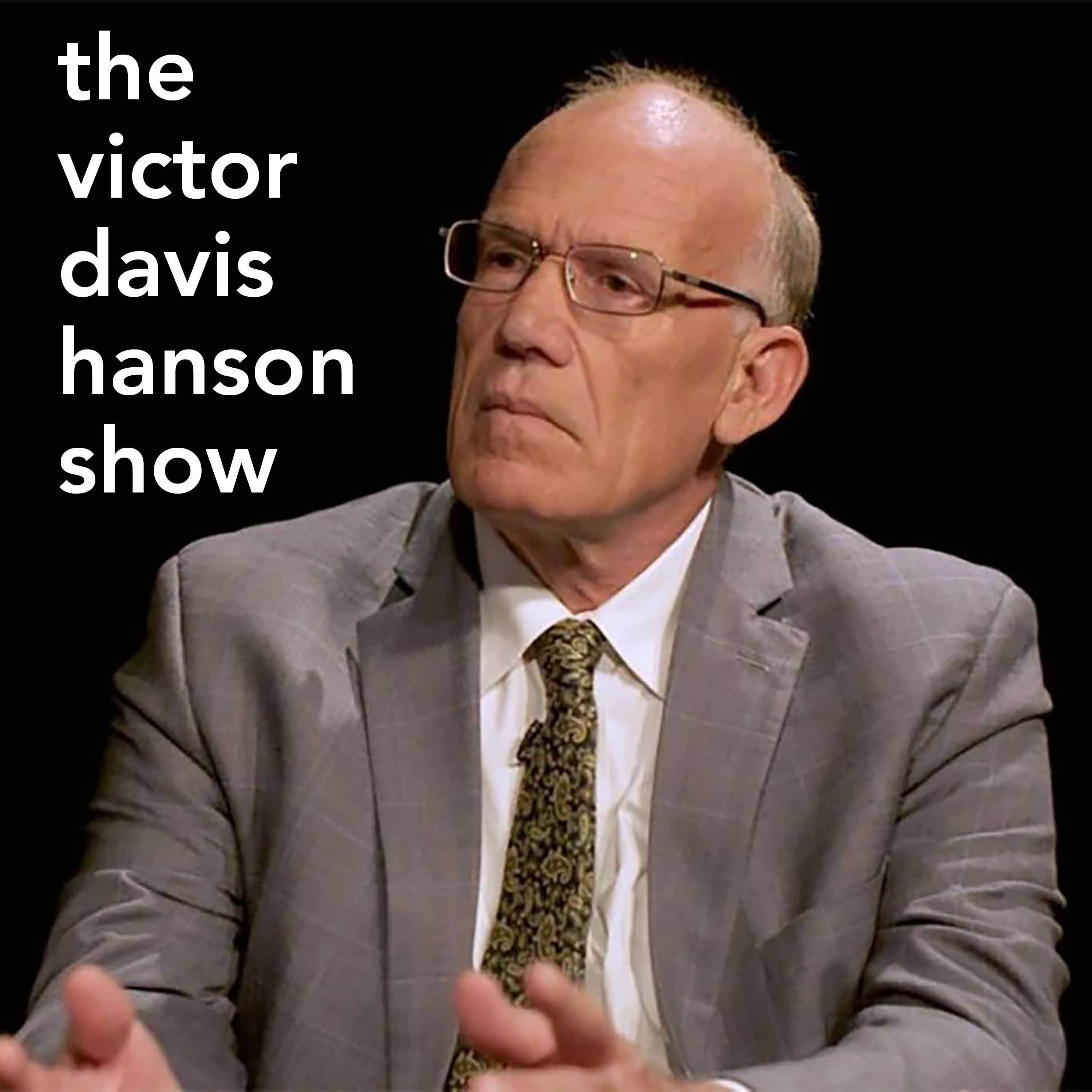
The Mausoleum of Halicarnassus and Europe Undone by the Left
In this weekend episode, Victor Davis Hanson, with cohost Sami Winc, takes a look at the Mausoleum of Halicarnassus, a wonder of the ancient world. They also discuss the strangeness of Leftist violence and the damage it has done to Germany and England.
See Privacy Policy at https://art19.com/privacy and California Privacy Notice at https://art19.com/privacy#do-not-sell-my-info.
Press play and read along
Transcript
Speaker 1 Ever notice that everyone always wants more of a good thing? More rewards, more savings, more special offers?
Speaker 1 Well, when you become a new member of the Shell Fuel Rewards program, that's exactly what you get. More.
Speaker 1
Join today to save 10 cents per gallon on your first bill, 20 cents on the second, and 30 cents on the third. Then enjoy everyday savings afterwards.
Want more?
Speaker 1
Then head to Shell where members get more. Offer valid from 4:2125 to 12:3126 at participating shell locations.
Offer must be redeemed within 60 days of registration. Limit 20 gallons.
Speaker 1 Restrictions apply. Visit fuelrewards.com/slash join25 for more information.
Speaker 2 Hello, and welcome to the Victor Davis-Hanson Show. This is our Saturday edition where we do something different usually in the middle segment.
Speaker 2 And this week, Victor's going to be looking at one of the seven wonders of the ancient world,
Speaker 2
the mausoleum at Holocarnassus. And so we'll do that in the middle segment, but we've got more news from the week.
So we're going to be looking at the speaker, Mike Johnson.
Speaker 2
Potentially, he'll be re-elected to his position. And then Liz Cheney gets a President's Citizen's Medal.
So stay with us, and we'll be right back.
Speaker 4 This episode is brought to you by Progressive Insurance. Do you ever find yourself playing the budgeting game?
Speaker 4 Well, with a Name Your Price tool from Progressive, you can find options that fit your budget and potentially lower your bills. Try it at progressive.com.
Speaker 4 Progressive Casualty Insurance Company and affiliates. Price and coverage match limited by state law, not available in all states.
Speaker 5 You know that feeling when you come home late from work and those puppy dog eyes just pierce right through your soul? Or when you're packing for a trip and your cat refuses to leave your suitcase?
Speaker 5 Yeah, we've all been there. Pet parent guilt is real, and you know what? It's completely normal.
Speaker 5 I feel it all the time, like when I have to leave for work and my dog gives me that look, you know the one.
Speaker 5 Or that time I forgot my phone inside after already saying goodbye and had to do the whole emotional departure scene twice. These moments just come with being a pet parent.
Speaker 5 That's why I'm grateful for Hill's science-led nutrition, which helps you give more love than humanly possible.
Speaker 5 Whether it's those long work days or trying to balance attention between multiple pets, Hill's Pet Nutrition gets it.
Speaker 5
They've created science-based nutrition that supports your pet's lifelong health so you can feel confident even when life gets hectic. Because you're only human, there's Hill's.
Science does more.
Speaker 5 Ready to let go of the guilt? Find the right food at hillspet.com/slash wondery. That's hillspet.com/slash wondery.
Speaker 2 All right, welcome back to the Victor Davis-Hanson Show.
Speaker 2 Victor's the Martin and Ellie Anderson Senior Fellow in Military History and Classics at the Hoover Institution and the Wayne and Marsha Busky Distinguished Fellow in History at Hillsdale College.
Speaker 2
So, we welcome everybody to the Victor Davis Hanson Show. Come join us at his website, it's victorhanson.com, and it is called The Blade of Perseus.
We'd love to have you all there. Well, Victor,
Speaker 2 we've got new information about New Orleans first, and then we'll look at Mike Johnson and Liz Cheney. I thought you wanted to say something on that.
Speaker 3 I think everybody was really confused
Speaker 3 when the New Year's Eve terrorist operation that I guess has now killed 15 or 16 people.
Speaker 3 Mr. Jabbar, who was a military veteran and but had been self-radicalized, according to his family, in radical Islam.
Speaker 3 But we've discussed earlier that the assistant special agent, apparently, that was in charge of the initial responses, I think her name was Alethea Duncan,
Speaker 3 the first thing out of the gate was that she assured us that it was not a terrorist organization. That reflected, I think, an indoctrination.
Speaker 3 That's something that Cash Patel will have to address at the FBI.
Speaker 3 Because if you want to withhold, you want to withhold information, you want to withhold inclusions that you are not supported by data, and there was no data for that.
Speaker 3 But it tells you that her first impulse was to say, we don't want to accuse anybody of terrorism.
Speaker 3 That was more important than really getting, she should have just said, we don't know whether it's terrorism, we're working on it, we'll have an announcement. And then she said, it's an IED
Speaker 3
problem. That's just a methodology.
That's stupid.
Speaker 3 The methodology of killing is not the pathway to find out necessarily who who did it or what type of causation there was.
Speaker 3 And then you had the mayor, Latoya Cantrell, and she came out and the FBI said they were thinking there were more than one person. She said, he said, she said they were completely at odds.
Speaker 3 She was famous, remember, for being accused of credit card fraud and taking bribes, I remember. And then we had this Anne Kirpatrick, the chief of police, and she was confused about the barriers.
Speaker 3 She should have been up to block
Speaker 3
the cars coming in, and she gave a convoluted explanation why they weren't there. She was fired, you remember, from the Oakland Police Department a few years ago.
She's bounced around.
Speaker 3 She's kind of a DEI consultant for the FBI.
Speaker 3 So you get the impression from those three people.
Speaker 3 Ann Kirpatrick and Aletha Duncan and Latoya Cantrell, that there's nobody in charge really until they flew in the FBI, I think somebody from their Washington office that kind of cleaned up the mess.
Speaker 3 But there's a larger theme here, and that is
Speaker 3 if you look at the
Speaker 3 May, June, late May, June, July, August, September, May of 2020, when, as I said earlier, $2 billion in property was destroyed.
Speaker 3 There were 35 to 40 people killed, depending on how you count the particular violently caused deaths.
Speaker 3 There was, I think, 14,000 people arrested, unlike the January
Speaker 3
six people. They were mostly let go by Soros district attorneys in major cities.
Then we go to the Mangione case, where this cold-blooded assassin in mafioso style lurks outside a building, executes a
Speaker 3 United Health executive, and then gets 40% of the youth on major campuses applauding that cold-blooded murder. And I could go back to the Stevens Galise attacks,
Speaker 3 and then the European Islamic attacks. And we saw right after the New Orleans attacks, massive demonstrations in New York by pro-Palestinian, radical Palestinian,
Speaker 3 add it all up. And there's this problem with the left that
Speaker 3 They keep saying, as Joe Biden did at Howard University on other occasions, occasions, it is white supremacy.
Speaker 3
It isn't. If you just look up, people have looked up the number of dead the last 20 years, and the number of dead are not due to white supremacists.
It's Middle Eastern terrorism.
Speaker 3 But my point is this, is that there's something in the left that believes that these
Speaker 3 violent acts,
Speaker 3 if they're not justified, they're at least directed at the right people. And we saw this contextualization about Donald Trump's two-failed assassin.
Speaker 3 Somebody who I've talked to on the phone at least once or twice, John MacArthur, he said in the New York Times, a columnist, not in his column, but in a podcast with Glenn Lurie, that he thought it might have been preferable for Donald Trump to be killed.
Speaker 3
And then when you look at the social media, there were people, oh, he missed, you know, that type of attitude. So the left has a problem with violence.
And
Speaker 3 they believe that in all of these cases,
Speaker 3 the violent act, whether it's Trump or a health care person, or even innocent, there is some justification for it, whether the oppression of Muslims
Speaker 3 or the oppression of the poor by health care or the oppression that Donald Trump supposedly is responsible for.
Speaker 3 And they can't come to terms with it, that it's overwhelmingly a left-wing problem, and they just don't want, they contextualize it.
Speaker 3 Violence is okay because there once you start with the premise that you're for the people diversity equity inclusion or the marxist idea of a pro proletariat that's noble a noble peasantry that's always in the marxist binary oppressors oppress victimizers victimized then you can justify anything yeah anything and that gets back to go into a store in california until recently steal up to nine hundred and fifty dollars and you're not going you're not going to be arrested if you're arrested you're not going to be booked.
Speaker 3
If you were booked, you were not going to be indicted. And if you were indicted, you were not going to, and convicted, you were not going to jail.
If it was less than $950.
Speaker 3 And
Speaker 3 the exegesis or the basis behind that reasoning is something that they call critical legal theory, that laws are just simply constructs of wealthy white people who have power and money.
Speaker 3 And so we get back to that reductionist point I think I made in an earlier podcast that the only reason they believe it's against the law to steal sneakers is because wealthy white people who made the law don't like, you know, don't have to have sneakers.
Speaker 3 Anything that they don't need, they make a law against critical legal theory.
Speaker 3 And so they believe that people, it's a cry of the heart. They go into a store and they think,
Speaker 3
wow, I need aspirin. I need diapers.
I got to steal it because the capitalist system has made these unaffordable to me and the government won't give me enough.
Speaker 3 And then when you actually look at it, they're going in and looting in gang style processes, swarming sneaker stores, computer stores, high-end fashion stores, jewelry stores.
Speaker 3 But that's the problem, that they can't just come out and say we condemned unequivocally the use of violence for political means.
Speaker 3 And we can say, I wish they could, I wish the university president would have gotten up in 2024 and say, if you come to this campus and you deface the library, if you chase students into the library, if you deface the sidewalks, you are destroying property and that's against the law and you will be held accountable.
Speaker 3 They always say that.
Speaker 3
The worst thing about the left recently is these ragadachio threats. And it goes right to the top.
Joe Biden,
Speaker 3 he did this incoherent reaction to New Orleans.
Speaker 3 We're not going to stand for it. Remember he said about what would you do if
Speaker 3 Putin came in? At first, he said it depends on this major, minor invasion into Ukraine.
Speaker 3 And then he always says, don't. What would you think about Iran hitting Israel? Don't.
Speaker 3 What would you think about Israel replying? Don't.
Speaker 3 And it gets back to the whole corn pop saga
Speaker 3 creations and fictions. Are he slamming the head of somebody who insulted his sister at a luncheon desk?
Speaker 3
That's the word of the Biden. You know, it's all this tough talk.
But
Speaker 3
he never did anything. He never did anything.
So it was carry a twig and talk loudly.
Speaker 2 Yeah, and it's hard for the party of peace to reconcile that with their. So I think that's where they lost all of those Democrats that were one-time Democrats.
Speaker 3 I was curious about this because today's woke DEI party used to be Obama's progressive party and used to be Bill Clinton's liberal party, liberal Democrats. And these were far to the left of the
Speaker 3 Carter Clinton Democrats, were far to the left of the old JFK Harry Truman Party. So it's gone left.
Speaker 3
But I went back and looked at the 1996 reelection effort of Bill Clinton and the official statement in the Democratic Party convention platform that summer. You would not believe it.
It is surreal.
Speaker 3 It says,
Speaker 3 Bill Clinton was a crime fighter. He brought the, he made people punish, and just youthful offenders shall be treated harshly just because you're youth.
Speaker 3 As far as the border goes,
Speaker 3
he closed it. There is no such thing as an exemption for illegal immigration.
It drives down wages. And then he got into physical sobriety, physical sobriety.
We
Speaker 3 balanced the budget and we are going to continue, he hadn't quite yet, we are going to continue to exercise
Speaker 3
fiscal restraint, not physical, physical, fiscal restraint. I couldn't believe it.
And then when he talked about environmentalism, it wasn't banning fossil fuels or EV.
Speaker 3 It was, we have to protect God's earth.
Speaker 3 He used the word God with a capital G.
Speaker 3 That party, and Nancy Pelosi gave a speech about why it's unfair to suggest that Democrats were for open borders, that they said it hurts wages of our union brothers.
Speaker 3 That party today would be called nativist, protectionist, racist, homophobic, transformed by the new Democratic Party.
Speaker 3 So if you want to know why they lost, go back and watch that descent into Jacobinism. This is a Jacobin French Revolutionary Party.
Speaker 3
changing names, toppling statues, creating new genders, new foundational dates of America. This is something that the Clintons and JFK or Harry Truman would have never imagined.
Yeah.
Speaker 2 And then there's a whole host of people that used to be Democrats that wanted law and order and America first diplomacy. And that's what Donald Trump was calling for.
Speaker 2 I think that's a big thing that turned out.
Speaker 3 You don't talk about that, but if you look at 2016 when he won, I think it was 67 or 68. I'm doing this by memory.
Speaker 3
I hadn't prepared for this. 67 or 68 million voters.
And then he got 11 million more when he lost in 2020. And it went up to like
Speaker 3 70,
Speaker 3
maybe it was 72 or 73 million. And then it went up to 77 million.
So win or lose, it was like this.
Speaker 3 And of course, lose is this aberration that historians are going to ponder how in the world 2020 had so many million more votes when four years later a greater population, the actual people who participated went down.
Speaker 3 No one could quite, with the same, at least for part of the campaign, the same two candidates.
Speaker 3 So anyway, my point is that
Speaker 3
the Democratic Party alienated people and they had, and the people who were alienated ended up voting for Donald Trump. I got chastised in a letter somebody wrote me.
I get a lot of emails.
Speaker 3 I can't keep track of them. But I say that because I'd like to reply to all of them.
Speaker 3 But this person said, you said on your podcast that the middle class, and I live in a zip code where the majority per capita income were business, and we went 62% Trump.
Speaker 3 I didn't mean that as an exclusionary term.
Speaker 3 I meant that is if you were lower or middle class, you, and that's the largest demographic in the United States, that they went overwhelmingly for Donald Trump. The very wealthy zip codes did not.
Speaker 3
But in that continuum, small business owners could be considered part of the middle class. And they did as well.
And some wealthy people did as well.
Speaker 3 There were a lot of corporate CEOs that voted for him for reasons of taxes and deregulation. But he won the election because
Speaker 3 he captured the old, not just the old Buchanan voters and the old Ross Perot voters and the old working class lunch bucket people who had sat out and did not want to show up for John McCain and Mitt Romney, but he got Hispanics, I think
Speaker 3
17% of African Americans. I think that's kind of low.
Those are estimates. And then he got somewhere around
Speaker 3 43 to
Speaker 3 48% of Hispanics, depending on who was exit polling.
Speaker 3 And that was the difference.
Speaker 2
Yeah, amazing. Well, you got away from my agenda, Victor, but that's okay.
That was an interesting riff. What about your views on Mike Johnson as Speaker and the chances for that?
Speaker 2 It seems like there's one Republican, Thomas Macy, who says he won't vote for him. So
Speaker 3 what are your ideas or what do you think?
Speaker 3 What would Thomas Massey do if he was Speaker when he has a two-vote majority and there are people in the Republican Party, it's more Trumpian than it ever has been in its congressional
Speaker 3 representation, Senate, and House. But what would he do as Speaker when he has people from states like
Speaker 3 Maryland or California or, and these are purple districts, or Colorado, where they can't be completely 99% behind Trump. They're 90%.
Speaker 3 But when you pick on particular issues that they will not vote for, you lose your majority and there is no Trump agenda.
Speaker 3
At least not until these, I think it's three people he appointed that were congressional representatives. I don't know why.
Matt Gaetz is including Matt Gaetz.
Speaker 3
They have to have special elections and they have to get Republicans elected. Then it will go back to four or five.
They lost three seats.
Speaker 3
I don't know how they lost the Steele, Duarte, and Garcia seats in California. They were all great representatives.
They were ahead. The mail-in ballot 10 days later sunk them.
No comment needed.
Speaker 3 So
Speaker 3 I don't know what you're supposed to be. You know,
Speaker 3
very famous Petronian statement, summus homines non-dei. We're just men, we're not gods.
What do you expect him to do, given the chaos of liquidating your speakers? Does he think, Mr.
Speaker 3 Massey think that Hycom Jeffries, even with his Jacobin party, doesn't have a few Democrats who are in purple districts and don't really want to go along with this radical, radical left 99.9%?
Speaker 3 Yes, he does.
Speaker 3
But, I mean, our representative for years was Jim Costa. He bragged that he was part of the old blue dog coalition.
I don't think it existed then, really, and it doesn't exist now.
Speaker 3 But on questions of water and agriculture, he was middling in the middle. So my point is, he voted every single time with Hichem Jeffries.
Speaker 3 So Hichem Jeffries is able to tell all of those people, not one of you, as Nancy Pelosi taught me, not one of you is going to deviate.
Speaker 3 We are going to vote en masse against every single speaker until they come to us and in disjointed mob fashion don't have the same degree of discipline and they have defections and they're going to need our votes.
Speaker 3 And the moment we give our votes to them, that speaker is compromised because then his own party will say he couldn't even get Republicans. He had to go over and sell out to Democrats.
Speaker 3
Is that what Mr. Massey wants? Because that's what you're going to get.
If you reject
Speaker 3 Mike Johnson, you're going to have a vote after vote after vote until some person goes over to the Democrats and says, I can't corral these cats.
Speaker 3 I need five votes and I will approve your trans bill or I will approve your DEI initiative or your green initiative.
Speaker 3
So they need to have discipline and they don't have to be perfect to be good. They just have to be better than the alternative.
So I hope he
Speaker 3
makes it. But they need absolute discipline and solidarity and they can win.
If they don't and the
Speaker 3 Democrats do, they'll lose.
Speaker 3 I mean, they lost Obamacare, didn't they? They would have repealed Obamacare if John McCain hadn't
Speaker 3
defected. In the Senate, they always have these defections.
The Senate, it's not so much. They have a three-vote majority now, you know, 53, 47.
So
Speaker 3 four, really, with the vice president.
Speaker 2 So that's why Donald Trump shouldn't have any trouble getting his appointments through. Not too much trouble.
Speaker 3 In the Senate, it'll be much easier to do anything.
Speaker 3 I think he has a very powerful argument in
Speaker 3 the appointments.
Speaker 3 All he has to do is
Speaker 3 go to any defecting Republican,
Speaker 3 Susan Collins,
Speaker 3 Murkowski in Alaska, you name it, and just said,
Speaker 3 if you vote against Cash Patel or Tulsi Gabbard or Pete Hegseth, we are going to run commercials in your district, and we're going to say, Cash was not okay, but you voted for Mallorkis, and you you voted, and then just put the whole Pete Butterjig is her favorite, not prime fighter Cash.
Speaker 3 Lloyd Austin is her ideal pentagon, but not, and that's going to be devastating because they have votes.
Speaker 3 There's six or seven of them that have talked about not voting for
Speaker 3 the Republican nominees of Trump's. But a lot of them are on record that they okayed all of
Speaker 3
almost all of the appointments that Joe Biden nominated. And so I think he can stop that.
And Donald Trump, you know, I mean,
Speaker 3 there's always ways to corral people. I'm sure he's calling apostate representatives right now and saying,
Speaker 3 you know, I understand that you have to be reelected and you're in a purple district or you're in a crazy
Speaker 3 district that it's unpredictable or you're in a hard right district. But I have ways to influence you.
Speaker 2 Well, Victor, we are at a break and we're going to hear a few messages and then we'll come back and talk a little bit about the mausoleum at Howard Carnassis. Stay with us.
Speaker 6 It's time your hard-earned money works harder for you.
Speaker 7 With the Wealthfront Cash Account, your uninvested cash earns a 3.5% APY, which is higher than the average savings rate.
Speaker 7 No account fees, no minimums, and free instant withdrawals to eligible accounts anytime. Join over a million people who trust Wealthfront to build wealth at wealthfront.com.
Speaker 8 Cash account offered by Wealthfront Brokerage LLC, member FINRA SIPC, and is not a bank. APY on deposits as of November 7th, 2025 is representative, subject to change, and requires no minimum.
Speaker 8 Funds are swept to program banks where they earn the variable APY.
Speaker 6 It's time your hard-earned money works harder for you.
Speaker 7 With the Wealthfront Cash Account, your uninvested cash earns a 3.5% APY, which is higher than the average savings rate.
Speaker 7 No account fees, no minimums, and free instant withdrawals to eligible accounts anytime. Join over a million people who trust Wealthfront to build wealth at wealthfront.com.
Speaker 8 Cash account offered by Wealthfront Brokerage LLC, member FINRA SIPC, and is not a bank.
Speaker 6 APY on deposits as of November 7th, 2025 is representative, subject to change, and requires no minimum.
Speaker 8 Funds are swept to program banks where they earn the variable APY.
Speaker 2
Welcome back to the Victor Davis Hansen Show. You can find Victor at his X account.
His handle is at VD Hansen. And you can find him at Facebook on Hansen's Warning Cup.
So please come join us there.
Speaker 3 So Victor, I haven't heard a whole lot.
Speaker 2
I know that it doesn't exist anymore once again. But we do know what it looked like.
And so I'm interested in this
Speaker 2 mausoleum at Halicarnassus.
Speaker 3 Yeah,
Speaker 3 we've been talking in our history section the last two times about the not the modern seven wonders of the world or the natural seven wonders of the world, but the ancient as compiled in the Hellenistic period.
Speaker 3 And it's very easy to remember, as I said before, the seven. There's two in Greece.
Speaker 3 We've discussed the Colossus of Rhodes on the island of Rhodes and the statue of Olympian Zeus in the Olympian Zeus temple in Olympia, Greece. The foundations are there.
Speaker 3 There's two in Egypt, and we're going to discuss the pyramids of Giza and the site, the site, because the
Speaker 3 lighthouse at Alexandria is, you can go out and look down and see the foundations.
Speaker 3 And there's two in Egypt, and then there's two in Turkey. And today we're going to talk about the Mausoleum in honor of
Speaker 3 Mausolus of Caria
Speaker 3 and the Temple of Ephesus.
Speaker 3
a temple to Artemis at Ephesus up the coast. We'll talk about that next time.
And then there's one final, the seventh, that's not in modern Greece, Egypt, or Turkey, and it's in Iraq.
Speaker 3 And I saw that, and that was
Speaker 3 Saddam Hussein attempted to rebuild the hanging gardens of Babylon.
Speaker 3 You can go there and see these little bricks that he put his own initial on to rebuild it. Falsely, I mean, it was poorly done.
Speaker 3
But I went out to the site, and I flew over it, I think, twice when I was in bedded those two years. I've been to every one of them.
That was my goal as a high school kid on a farm.
Speaker 3 I said to myself when I was 17, by the time I'm 30, I want to go to all the seven wonders of the world.
Speaker 3 And I think I fulfilled that pledge by 21,
Speaker 3 except
Speaker 3 for
Speaker 3 I did not get to the hanging gardens of Babylon. I thought I'd never get there.
Speaker 3 And then when the Iraq War came, and I went twice with combat units, once with the observation on Blackhawk, and once with H.R. McMaster, and toured.
Speaker 3 But it was the first time I flew over it, and we stopped. And
Speaker 3 I was with a group that went there and then I flew out to Kuwait and we drove out there and some people flew me out, drove me out there.
Speaker 3 So what is the
Speaker 3 third wonder of the world is that down the coast of Ionia, that is modern Turkey, and there's a beautiful city today. If anybody is vacationing in Turkey, it's called Bodrum, B-O-D-R-U-M.
Speaker 3
It's kind of famous for its harbor. They have an industry there that makes wood power boats and sailboats.
Beautiful finished mahogany, oak.
Speaker 3
These boats are just beautiful in the harbor. And it's a vacation city, and it looks at the Dodecanese Islands across.
I was there once talking to a Turkish journalist, and he said, see those islands?
Speaker 3
Those are Turkish because they're two or three miles away. And I said, no, they're not.
They've been Greek since antiquity. And he said, well, they may be Greek now, but someday they won't.
Speaker 3 Which Which kind of was chilling. But you can go to the site of the Mausoleum, which was created around 350
Speaker 3 BC
Speaker 3 by
Speaker 3 a pre-Hellenistic, a late classical
Speaker 3 tyrant, dictator, ruler of Caria. Caria is the area of the southern part of Ionia, southern coast of the Mediterranean, Turkey, not that faces Cyprus where Anatalia is, but
Speaker 3 some of the southernmost of western seaside Turkey. And Mausilus built, while he was still alive, this new city of Haliconarsis and colonnades, statuary,
Speaker 3 a harbor, and he decided to make his own tomb before he died. And he was married to Artemisia, not the famous one of the Persian War, but later.
Speaker 3 It was this, you know, in this Asiatic, excuse me for using that word, Asiatic was permissible at once.
Speaker 3
It was all right to marry your sister in the way that the Ptolemies had done that in some cases, but especially the pharaohs. So anyway, he decided to make this monumental tomb for himself.
And
Speaker 3 it existed from 350
Speaker 3 for
Speaker 3 it existed almost 1800 years. All we know is that when
Speaker 3 the
Speaker 3
Crusader knights came there in 1400, they saw the ruins. But there had been a geographer, I think, in 1300.
So there was a hundred-year period when it disappeared under the Ottomans.
Speaker 3 The British imperialists, thank God for some of the British imperialists, when they came into the Middle East, they were able to
Speaker 3
buy some land. They kind of dug under...
land they didn't buy and find out where the foundations were and they appropriated some of the statues and of course being Brits they brought them back to the
Speaker 3 the London
Speaker 3 British Museum in London where you can see some of the surviving statuary. I say that because according to the ancients and Pliny the Elder talks about it who was a peripatetic observer
Speaker 3 and
Speaker 3 it was one of the most extravagant statues you can ever see. Scopus was one of the most famous of the late classical Greek.
Speaker 3 That's when Greek sculpture reached its pinnacle,
Speaker 3 Praxilates,
Speaker 3 Scopus.
Speaker 3 And apparently Mausolus scoured all of the Greek-speaking world, got the best sculptors and architects, and he built this great mass.
Speaker 3 You know, the
Speaker 3 statue of Liberty,
Speaker 3 if you look at this from ground,
Speaker 3 the ground floor all the way at the top, I think it's 350 or something, but the actual statue itself is only about half. It's about 150 feet.
Speaker 3 Well, the base of the mausoleum looks almost like the base, I mean some of the reconstructions, not all of them, the base of the Statue of Liberty statue.
Speaker 3 In other words, it's kind of a rectangle, and it was a temple, but it was solid and with a monumental
Speaker 3
wall around it. And then there was a colonnade around that.
And then there was a
Speaker 3 the structure looked like like it was pyramidal with a roof four-sided pyramid roof and it had colonnades at each section but it was massive and it was considered famous in antiquity because it was the place where all of the all-stars of the late Greek and remember sculpture
Speaker 3
reached its pinnacle between 350 and 250 not during the classical period. That was it was real more realistic.
This is the great period of the Hellenistic Laocoin statues.
Speaker 3 I think that's in the Louvre, isn't it? Or is it in the Vatican Museum? I can't remember.
Speaker 3
But in any case, this was a period where Greeks not just were idealistic, but realistic. And Scopus was one of the best masters.
And so these statues that were
Speaker 3 in the upper levels of the temple, it is a temple. but it had layers on it and it was apparently about 150 feet high
Speaker 3 So it was almost the size of the Colossus of Rhodes, which was not too far away. And it was one of the most famous tourist sites in antiquity because it was a place you could go and see a perfectly
Speaker 3 proportioned classical Greek temple. You could see Ionic columns.
Speaker 3 And then they had famous
Speaker 3 Parthenon-like metopes and freeze courses, the Battle of the Giants, the Amazons, all of those typical Greek mythological scenes that allowed the sculptors a chance to show muscularity, women, monsters, etc.
Speaker 3
And it had that, and then it had the brother-sister rulers. And then he died, and his wife, I think, died two years later.
But
Speaker 3 according to Pliny, the people
Speaker 3 the people engaged in the project, I guess they still had their contracts. They continue to finish it, which is quite rare, even though the two creators of
Speaker 3 the mausoleum were no longer around. So our term mausoleum does not come from any word in Greek that means tomb or
Speaker 3 sanctuary for the dead or monument. It comes from the word mausoleus,
Speaker 3
the king. And this was so huge and so famous that people called it the mausoleum, mausoleon in Greek.
And so that's become the noun ever since in English and all of the European languages for
Speaker 3 people who are buried above ground and not cremated,
Speaker 3
which is very rare now. But there's still many cemeteries in New York and Los Angeles where that's true.
I had an uncle, just as a
Speaker 3 Dan Rhodes, and my grandfather was his great-nephew, so I'm his great-great-great-nephew.
Speaker 3 And I have a picture of him in um my stairwell and he was
Speaker 3 along with his brother i think it was tom rhodes
Speaker 3 they were uh at sutter's fort during the donner party snow uh trapped party that was up in the sierras near what's now donner lake and north of lake tahoe a little bit donner pass and they needed people to hike in there
Speaker 3 so
Speaker 3 He and his brother were over six feet. They hiked in there and they rescued the Donner party and bought, they found the trail, got some of them back, and then organized relief.
Speaker 3 And he became, at the turn of the century, because he lived a half century, he became one of the wealthiest people in Central California.
Speaker 3 And he was kind of, I don't know, a loan shark, but he had a lot of capital around Tulare Lake. Tulare Lake was the largest inland lake in the United States west of the Great Lakes.
Speaker 3 And it was basically from where today's 99 Freeway is, all the way over to 41, and all the way from what is now Tulare to the Grapevine, so to speak.
Speaker 3 It was a huge lake, very shallow, but it was the receptacle for the end of the Kings River, the Kern River,
Speaker 3 the Coweah River. And it was just huge until these dams on the Kowia River or the Pine Flat on the Kings stopped it.
Speaker 3 My point of all this is, when I was growing up, every once in a while local historians wanted to write about him and they would trace down where his portrait was.
Speaker 3 And apparently this picture he made and he gave to his
Speaker 3 grandsons,
Speaker 3 one of which was my grandfather's grandmother
Speaker 3
and grandsons and grandchildren, granddaughters. And we had it.
I think there's three or four other copies. There's one in Hanford by a family.
It's related to him.
Speaker 3
But in any case, he built a mausoleum. That's my point.
And it's a California historical monument right off 41.
Speaker 3 And so when I was a little boy, we would drive to Morrow Bay and we'd say, There's Uncle Dan's mausoleum. Can we stop it? It was on private.
Speaker 3 Now it's a you can you have access in theory still on private property. But here's my point:
Speaker 3 We were always scared because we had an uncle who, when he was a little boy,
Speaker 3 somewhere around 1910, went in there and saw the mausoleum.
Speaker 3 But apparently, something had,
Speaker 3 a piece of architecture had broken into the crystal, and
Speaker 3 the remains of my great, great, great, great, great uncle were not intact.
Speaker 3 And then the question is, how come you couldn't get it in? We were little boys, we would always argue, they threw the key in Tilary Lake and it dried up. No, he threw it in the Kings River.
Speaker 3
No, Tilari Lake, Kings River. No, he was under glass.
No, he was under crystal. And so every time we'd drive by, we want to go to the Mausoleum, please let us in, let us in.
Speaker 3
No, no, you're not going to Uncle Dan's Mausoleum. So I have his picture here, and I think a few years ago, somebody did a documentary on him, and they found out about it and came here.
And
Speaker 3 they took pictures of it. And I have another picture of him somewhere.
Speaker 3 But that was something that we don't do anymore with Mausoleum. No, actually.
Speaker 3 That was famous in
Speaker 3 Sergio Leone
Speaker 3 once on a time in America where Robert De Niro
Speaker 3 and James Woods.
Speaker 2 Oh, yeah.
Speaker 3 They ended up in a mausoleum for them.
Speaker 3 James Woods is one of my favorite actors. He's just a brilliant actor who is politically incorrect, so they have tried to compound him and persecute him to no avail because he's very talented.
Speaker 2 Can I take you back to Halicarnassus and that mausoleum?
Speaker 2 What was it? Was it used for something? It was huge. So was it used for something? Did they have religious ceremonies in it as well?
Speaker 3
No, it was not. It was not used as a treasury, as most temples are.
It was sealed. So
Speaker 3 it was a burial for the royal family.
Speaker 3 But
Speaker 3 there was such expense put into it, and he wanted to make Halicarnarsis
Speaker 3 a tourist area or a place of exquisite beauty. And remember, this is now during the
Speaker 3 Achmenid Persian Empire's closing days because Alexander is going to invade in 334, 333.
Speaker 3 So just 16 years after this is built, Alexander comes in because that's part of his route down the coast.
Speaker 3 And he's going to, of course, preserve it.
Speaker 3 and absorb the Carrion,
Speaker 3 this little mini-empire, small little, that the Achmenids had incorporated along with the Lydians.
Speaker 3 So he's going to come in, and this is all going to be part of Hellenistic, the Seleucid, and then to the north, the Pergamon, Adelids
Speaker 3 empires. And this is when people are exposed to the world again outside of, you know,
Speaker 3 early archaic Greece or early classical Greece when people went to Egypt or they went east and talked about now under Alexander, the Mediterranean is going to be a Greek lake.
Speaker 3 and people are going to much more frequently go see the Greek-speaking Ptolemies in Egypt and see the pyramids, or they're going to see Greek speakers in Asia, Minor, and Ephesus.
Speaker 3 The old city of Ephesus is now not going to be Persian anymore. It's going to return to its Greek roots.
Speaker 3 And this is when they start cataloging all the best places in the world to be a tourist and go see these seven places. And seven is a kind of a magic word.
Speaker 3 If you're a sage, there's the seven sages of Greece, the seven wonders of the world, etc., etc.
Speaker 2 Yeah, I also think it's pretty cool that the
Speaker 2 British bought land next to it and then tunneled under to they are, that's crazy.
Speaker 3 They didn't have the money to
Speaker 3 do that.
Speaker 3 Yeah, they didn't have the money to, the explorers didn't have the money.
Speaker 3 I've been in Malta twice, and there's a place
Speaker 3 out in the harbor where they brought the blocks to put them on display when the British ran Malta. But then I think
Speaker 3 the
Speaker 3 port sunk and it's now out there. But I remember reading that there was one block that came from the Mausoleum.
Speaker 3 It was,
Speaker 3 I'm trying to think of it. It was in the 1970s when I first went there in 73 and 74, and there was a Danish archaeologist that was that our archaeology program was an undergraduate.
Speaker 3 And then I went there as a graduate student, although not with the American School that year. I was at the American School, but I did this privately.
Speaker 3 But I was told before I went that this person was just finishing, I forgot his name, but he was Danish, and he went through the entire site, cataloged every stone, every piece of statuary.
Speaker 3 He traced them down in every museum. And he did some beautiful reconstructions.
Speaker 3 And it's kind of funny, if you look at all the reconstructions from the 19th century, none of them look alike because they're based either on Plenty's description or haphazard early British
Speaker 3 discussions of what the style will be. And you go there today, I'm going to go to the mausoleum, and you get to Baudrum, and
Speaker 3
it's just up a hill. It's in the city.
But you walk up there, and
Speaker 3 I took my daughter.
Speaker 3 and her husband when they were first married there. We were on a classical tour.
Speaker 3 and
Speaker 3 I took them up there, and then they went to Ephesus, and they got in a traffic jam with some people and didn't come back. So, I spent the whole day there at a cafe.
Speaker 3 So, I walked around the whole thing, and they're trying to make it a little bit more interesting,
Speaker 3 but
Speaker 3 it's been completely obliterated. Most of the blocks were melted down.
Speaker 3 That was a problem in the ancient world.
Speaker 3 Marble, when it's melted down, creates lime, and lime is what they use to whitewash and cover blocks.
Speaker 2 Is it a good vacation spot? I mean,
Speaker 2 or does it belong to Greeks still?
Speaker 3 People got to remember that
Speaker 3 the coast of Turkey in antiquity was the richest part.
Speaker 3 The area, if you want to go on a tour of a classical,
Speaker 3 you can go to
Speaker 3 Shanakali, the modern city, but you start at Troy, and then you can go down to the city of Pergamum, Pergamum, which was one of the most impressive classical Hellenistic cities in the world, of that famous theater that's on a ledge almost.
Speaker 3
And then you can go to Miletus and Ephesus. If you want to go inland a little bit, you can see the monumental temple of Apollo at Didyma.
That's where you can stand between the flutes of the column.
Speaker 3 They're so huge. And then you can continue south
Speaker 3 to
Speaker 3
Halicanarsis at Bodrome. You can even turn the corner a little bit and go to Anatalia.
It's a beautiful city. But it's very wealthy.
Speaker 3 And this was everybody should remember this was Greek from the first two millennia before Christ all the way until the
Speaker 3 onset of the Persian Empire in the 6th century. And then the Greeks revolted during the Ionian revolt in the fifth century.
Speaker 3 And that proved they put that down, but they did get their freedom with the destruction of Persia, the second onslaught into Greece after the Battle of Salamis.
Speaker 3 The Greeks went through with the Delian League and freed those cities. And they were Greek then until
Speaker 3 the end of the Athenian Empire. And then there was some
Speaker 3
reconquest by the Achmenes, and then Alexander put an end to that from 330, 329, 328. I'm doing this by memory.
And then it became Greek-speaking under the successor kings.
Speaker 3 The Adelids donated their kingdom to Rome and the Seleucid Empire was annexed by Rome. And then it was Western till the 5th century AD and then it became Byzantine.
Speaker 3 The Eastern Empire took that area until
Speaker 3 they finally started to lose that
Speaker 3 coast of Anatolia in the 14th and 15th centuries of the modern area.
Speaker 3 And that was largely because of the
Speaker 3 misdirected forced crusade where they sacked the city in 1204, I think it was, 1203.
Speaker 3
And that was a, you know, that split Christendom and it weakened the empire. And then 250 years later, they lost everything.
But that had been Greek.
Speaker 3 There was an I'm getting off topic, but there was an effort called the
Speaker 3 Megali Idea,
Speaker 3 the great idea after World War I. The Greeks bet correctly that the Allies would win, and they used Thessaloniki, Salonika, as an allied port to fight Turkey.
Speaker 3 You know about the Gallipoli disaster, but the Turks lost. The Greeks won.
Speaker 3 They were able to get Crete and during the earlier Bulgarian War, what is now northern Greece, and they got the islands after, you know, they were Italian after World War II.
Speaker 3
They were formally returned to Greece. But this is the point I'm making.
And the great idea,
Speaker 3 there was the idea that we won World War I, Turkey is gone, we can go back and recreate the ancient Byzantine Empire. So what we need to do is get the Allies to support us
Speaker 3 to
Speaker 3 go back from the coast and reclaim Ionia and then reclaim the traditional capital of the Byzantine Empire at Constantinople.
Speaker 3 And during the weakness of Turkey from 1914 to 1918, the Greek population had actually
Speaker 3 crested. There had been kind of the Ottoman Empire had been weak for the last 50 years, and during that period of anemic central control, Greeks had come back.
Speaker 3 So there was a million people living in Smyrna, in the area around Smyrna, which is modern Izmir.
Speaker 3 So then they got this idea that they were going to galvanize the Greek-speaking community and go all the way and free Constantinople. And they got near Ankara.
Speaker 3 And they were so overexposed and so outnumbered. And then the British and the French, especially the British, said,
Speaker 3
this is a bad idea. We're not going to support this.
How would you ever control all of this with 10 or 15 million people when they have 30 or 40 million? And we don't want this trouble.
Speaker 3 And we're dealing with Turkey to steal in the post-war area.
Speaker 3 We want, the French said, well we're going to take Lebanon and Syria and the British said, oh, we're going to take Iraq and we're going to take Egypt.
Speaker 3 So they were carving up the Ottoman Empire and the last thing they wanted to do was to get in another war with the young Turks, this new Ataturk government, Kamala's Turk.
Speaker 3 And so they sold the Greeks out and they pushed them all the way back.
Speaker 3
And that was one of the most horrific things in the world. They butchered all of the Greeks.
And they jumped in the water. They jumped in boats.
It was worse than Dunkirk. And they fled.
Speaker 3
The Americans were off the coast trying to help. I lived on a Nicras Asiasa.
I lived on Asia Minor Street in Athens, where almost everybody in the 1970s that I talked to
Speaker 3 who was over the age of 70 or 80, they had all lived in Asia Minor for six, seven generations, and they were refugees. That was the Asia Minor, but they were all,
Speaker 3 Veria had been very wealthy, and when they ethnically cleansed and purged the Greek-speaking population, it was economically devastating to Turkey. Today, if you go into
Speaker 3 Constantinople, you see very few under
Speaker 3
Erdogan, you see very few Greek-speaking Orthodox churches, as I remember in the 1970s. They seem either closed down or there are very few people left.
He's trying to kind of squeeze them out.
Speaker 3 Remember, he said he was the new Ottoman Emperor.
Speaker 2 Yeah.
Speaker 2
Well, Victor, we need to take a break and then come back. And we're going to talk a little bit about England and Germany.
And I like that you've told us these little tidbits of England.
Speaker 2
Too smart to back Greece in that, and they're clever scientists. And England has that legacy, but the current PM doesn't seem to be quite living up to its tradition.
So we'll come back, though.
Speaker 2 Hold on.
Speaker 2 We're back, and you're at the Victor Davis-Hanson Show. Welcome.
Speaker 2 So, Victor,
Speaker 2 the current PM, and I don't know how to pronounce his first name, but it looks like Kyr Starmer.
Speaker 2 He was the chief prosecutor some years ago, and right now the Labour Party is trying to cover up that he
Speaker 2 wasn't prosecuting grooming gangs for child sex labor. And so
Speaker 2 what are the British up to? I mean, that's.
Speaker 3
Well, the British have adopted this American vibe. They've been infected by the American virus of woke, DEI.
And remember, one of the tenets of woke is
Speaker 3 it took the old affirmative action, identity politics, new tribalism, and it amplified it.
Speaker 3 And one of the tenets was if you were part of the victimized oppressed binary, they divided the world in half,
Speaker 3 then you yourself could not be an oppressor. So it was almost a blank check for anybody, anybody, human nature being what it is.
Speaker 3 If your parents say for a week you're not going to be, you're a victimized child, so you can do what you want, of course you're going to do stuff without the fear of the law or deterrence. So
Speaker 3 what's happened in England is that with this nearly, I don't think, I think it's nearly 16, 17% of the population is
Speaker 3 from the Middle East or from Eastern Europe, but maybe 10% is Muslim, but that figure increases enormously in Manchester, Liverpool, London.
Speaker 3 And given that reality, that it is a parliamentary democracy, so people count on the Muslim vote. And under the auspices of now DEI,
Speaker 3
they are not going to apply the law unequivocally across tribal identity politics line. And that's true of DI everywhere.
So they have people who are from Pakistan or from the Middle East in general.
Speaker 3 who have very different ideas
Speaker 3 about
Speaker 3 the role of women in society. And so in these cases of child trafficking, or I think in Britain they call it child grooming, where younger women that are
Speaker 3 younger than the age of consent, they're either watched carefully by particular gangs or groups
Speaker 3 and they are trafficked out to people, or they're quote unquote, married to people, or multiply married, but under British law, some of the marriages are informal.
Speaker 3 In other words, they're trying to retain attitudes toward women that they grew up with in the Middle East or their traditions. And under
Speaker 3 old British system,
Speaker 3 good luck. I mean, the British had that famous
Speaker 3 custom of getting rid of salty, salty, I don't know if I'm pronouncing it right, but the Indian custom that the
Speaker 3 widow of the prince or the baron or the local grandee, when he died, she had to go onto the pyre.
Speaker 3 And they said no. And
Speaker 3 when somebody tried to do that, they strapped them to a cannon and blew them up.
Speaker 3 Not very frequently, at least in the British.
Speaker 2 I mean, you tried to force somebody to do that.
Speaker 3 No, the British did, to stop it.
Speaker 3 And when they were told, we have a
Speaker 3 custom in India that the widow has to, regardless of her age, follow her husband.
Speaker 3 Many of the widows follow their husband onto the funeral pyre. The British reply, the Raj.
Speaker 3
We have a custom in England, too, that we kill murderers. So they stamped it out.
And they did a lot of things like that that now would be considered culturally oppressive, but not now.
Speaker 3 Now the British have the opposite idea that we went abroad in the 19th century. century to spread the rule of law and Western civilization and the English language and
Speaker 3 economic and political and social, what we consider norms, it made us the most powerful country in the world even though we had, you wouldn't know it from our small population and scant natural resources.
Speaker 3 That was the implicit British message.
Speaker 3 We went to America, we went to Australia, we went to New Zealand, we went to Africa, we went to the Middle East, we went to India.
Speaker 3 Wherever we went, we built railroads and we treated, we taught people about the English methodologies of education and government and the result is you're better off even though you want you resent us and you hate us and what would they call the Kipling called the white man's burden and everybody thinks that's terrible today but
Speaker 3 the people who think it terror that was terrible
Speaker 3 don't look at any upside at all. In other words, that all of the multiplicity of languages in India and tribal customs do have a unified language, English.
Speaker 3 And one of the reasons that India is so competitive is that people like to invest there because so many people know English. And they have a parliamentary democracy that still works, sort of.
Speaker 3 And that's not usual anywhere else in the world. But the point I'm making is today's British
Speaker 3 ruling classes have the opposite idea, that we're going to bring people in from the former empire and they're going to enrich our culture by bringing their indigenous practices, one of which is very different attitudes toward women.
Speaker 3 And who are we to say, given our exploitive record, to question that our system is better than theirs?
Speaker 3 And so when it butts up against British law, which protects youth and children from sexual exploitation, some people are going to be lax about it.
Speaker 3 And they're not going to think much about it because it's just just who were to say that that custom is any worse than any other custom remember what fanny willis said she took everybody should understand how insidious dei is when she was caught with nathan wade that she remember what i'm talking now about the fulton county prosecutor who kind of cooked up this idea that Donald Trump was guilty of making an inappropriate phone call by suggesting that he had 10 or 12,000 10, I think.
Speaker 3 There were votes there. He knew, and he just asked them to find them.
Speaker 3
If you invited every losing candidate, you called the registrar up and said, I know that I have votes. You just don't want to count them.
Can you find them?
Speaker 3
You would put half of the political world in jail. But she did.
Then they found out that her paramour, Nathan Wade,
Speaker 3 was completely indifferent
Speaker 3 and he was getting this money. And part of the
Speaker 3 the prosecutorial suggestion was that she was going on junkets with him. Remember that? Yes.
Speaker 3 And she was paying him this lavish salary, and then he was taking her all over the world on cruises and trips. But this is what I'm getting at.
Speaker 3
They asked, well, we want to see the records of it. We just, if you're what you said, everything was appropriate, above board.
Just show, we want to know why you don't have a record of your expenses.
Speaker 3 Because she said, I paid for it all myself.
Speaker 3 We had his credit card. Where is yours? Well, I paid him back.
Speaker 3 Well, where's the check? I paid him back in cash. And they said, well, can you show me that we say, no, you don't understand.
Speaker 3
This is an African-American tradition to have a lot of cash. And they said, like, thousands of dollars in your house.
And she said, absolutely.
Speaker 3 Then she got her father, a former Black Panther himself, and he came in and swore that people didn't understand Black culture, that they had loads of cash and they paid for things in cash.
Speaker 3 But the point I'm making is that this was another attempt to suggest that because of our past victimized status or cultural antithesis to your mainstream, you have no right to apply your standards to us.
Speaker 3 So it's perfectly okay to pay things in cash and have no record. And how dare you ask us in a culturally inappropriate way to show receipts?
Speaker 3 And
Speaker 3 I'm not saying that that's unique to the African-American.
Speaker 3 I mean, so-called the Bidens were past masters of it when Joe Biden gets a check for $250,000 and it says loan repayment. You think, okay, he was asked, can you show me where you gave
Speaker 3 Frank Biden or whoever he was?
Speaker 3 Where is
Speaker 3 the loan documents and where were the interest payments? And no, I mean, so
Speaker 3 obviously he got some money.
Speaker 3 Cash was there.
Speaker 3 But
Speaker 3 that's one of the
Speaker 3
pathologies of DEI, the idea that you retreat to your superficial appearance and then from there all good things come. You can nullify the law.
You can say, we're going to have sanctuary cities.
Speaker 3 Believe me, if we had
Speaker 3 one million illegal aliens coming from the Netherlands and Belgium and France, California wouldn't be.
Speaker 3 a sanctuary city. We would say, how dare you people come to our country illegally? I would say that.
Speaker 3 But But because the people who are coming are from a DEI protected category, then all the law is forgotten.
Speaker 3 That's what's very, I think people sometimes fail to appreciate one of the great dangers of BEI.
Speaker 3 It's an attack on norms and laws, and it says that people can be exempt from expected behavior because of past victimization, even though you can't really prove that victimization in a particular case or a particular group of people.
Speaker 2 Yep, and it makes it so you can groom children for sex trafficking and the
Speaker 2 prosecutor
Speaker 3 will go after the professor of 50 years.
Speaker 3 50.
Speaker 3 I taught my first class when I was 21 and 22 at graduate school.
Speaker 3 But I've had students who come up to me and said,
Speaker 3 I either need special
Speaker 3 consideration where I take my test, and I will say to them, well, do you have the
Speaker 3 certificate to show me or the authorization to show me your disability? Well, no, I don't, but I you don't understand my culture or my this or that.
Speaker 3 And then you're and the physician, if you don't allow that student to take it under special
Speaker 3 non-exam conditions, i.e., in a room by himself or something, then you're considered exploitive or racist or whatever. So
Speaker 3 that's the real problem, everybody, with DEI. It creates
Speaker 3 an erosion or it erodes the equal application of the law.
Speaker 3 It's the modern equivalent to the old boy white sort of southern idea that if you were white in the south and you committed a crime against a person who was not white, the legal system looked the other way because of your particular tribal identity.
Speaker 3 And so we went from one extreme to the other and called it recompense, I suppose, or Yubis or Nemesis. I don't know, but it destroys the law.
Speaker 2 Trevor Burrus, Jr.: That's one wing of the left that has undone modern civilization, but also climate and environmentalism.
Speaker 2 And you recently wrote an article about Germany and the plan after World War II to dismantle it. And your article was arguing that the left in Germany has done that today, I think.
Speaker 3 I did. I wrote an article on the Morgenthau Plan, Henry Morgenthau Thaw, I should say, Morgenthau.
Speaker 3 He was Secretary of the Treasury for a long time. He came in in 1934, and he lasted till the end of the Roosevelt administration, 1945.
Speaker 3 And he was a very, I mean, he didn't, I don't think he ever really went to college.
Speaker 3 He had no degree, but he had made a lot of money, inherited a lot, but he made more, and he knew a lot about finance. They made him Secretary of the Treasury.
Speaker 3 So as the Allies were getting near the Rhine River,
Speaker 3 he came up with a plan.
Speaker 3 It came up in Quebec, and it would come up in
Speaker 3 Yalta, and then after the war at Potsdam, what are we going to do with Germany?
Speaker 3 And his position was, well,
Speaker 3
they invaded France in 1870, 71, siege of Paris. Then they took the Alsace-Lorraine.
And then they invaded Belgium.
Speaker 3
in 1914. And then they invaded Poland in 1939.
So they always start start war. But this time, 60, 70 million people got killed.
And we're going to punish them.
Speaker 3 So
Speaker 3
what to do with the post-war Germany? Well, there was already a problem because, as I said earlier, Stalin stole half of Poland. He was not going to give it back.
He was on the winning side.
Speaker 3 He had flipped sides. And he said, well, I'm going to keep
Speaker 3 Eastern Poland. It's now Ukraine.
Speaker 3 In fact, today, independent Ukraine, as I said earlier, about a third of it is Polish and was Roman Catholic and Polish-speaking since the Middle Ages, not after 1939.
Speaker 3
He ethnically cleansed the Poles and he made it part of the Soviet Union. So they said, take it to the Poles who needed a country.
They said, take it from Pomerania and East Prussia. And they did.
Speaker 3 So, you know, Danzig became Gdansk and everything. So my point is that
Speaker 3
this was a change of borders. So Morgenthau said, we're going to change the borders, number one.
Number two, we're going to de-industrialize.
Speaker 3 So all of the plants and industries and energy apparat along the River Valley will be decommissioned.
Speaker 3 Well, it wasn't hard to do because the bombing campaigns by September 1944 had been pretty extensive. And then he said, we're going to make it a pastoral society.
Speaker 3 and break up the central control from Berlin and have different, sort of like East-West Germany, but even more so broken up into principalities before the unification of Germany, a loose confederation organized and supervised by Britain and the United States.
Speaker 3 Well, in addition to that, they were going to have no army or no military ever.
Speaker 3 So you can imagine what
Speaker 3 the powerhouse of Europe for 100 years was kind of not going to have anything.
Speaker 3
But then they leaked it. And Joseph Goebbels, this was September 1944, that by October the Germans had it.
And as you know, the Battle of the Bulge is going to start just in two months in December.
Speaker 3 And pretty soon, George Marshall, chief of staff of the army, came to Roosevelt and he said,
Speaker 3
Morgenthau's an idiot. What he's done is he's told the German people that they're going to revert back to a pre-civilized country forever.
Kind of like Tacitus of Germania.
Speaker 3
That's a a first century A.D. treatise about the wilds of Germany and, you know, people swimming in ice-cold rivers and drinking milk in this tribal society.
And they're fighting like fanatics.
Speaker 3 We lost 80,000 casualties at the Battle of the Bulge. And then Herbert Hoover came in, the great hunger baron who, you know, who tried to save, he did save millions of people after World War I.
Speaker 3 He said, you're going to have, it's going to be worse than World War I. You're going to have mass starvation
Speaker 3 if they can't make steel or light bulbs or medicines. What are you going to do? How are you going to...
Speaker 3
And Goebbels went to town. So, between those two arguments, they dropped it.
So I wrote this article and I said, if you look at what Germany is doing today,
Speaker 3 given the power of the Green Party and those loose coalitions that have allied themselves with it, they have shut down nuclear plants.
Speaker 3 They tried to shut down coal plants, oil-fired plants, and nuclear generation, and go solar and wind. But Germany is
Speaker 3 not very sunny, is it? And in very many cases, it's not that windy. So
Speaker 3
they had a power with, they had a problem with power. So they were buying nuclear power from France.
Then
Speaker 3 they got so desperate that the price of electricity has gone up four times what it is in the United States on average, not here in California that's becoming Germany, but nationwide.
Speaker 3 So then the biggest three car companies are
Speaker 3 Mercedes,
Speaker 3
Volkswagen, Mercedes, BMW, Audio, not the other, and Porsche. And they said, we cannot compete.
And then they have the EV mandates that you have to have a certain percent worse than ours.
Speaker 3
And they said, look, people do not buy a Porsche or Mercedes to drive 250 miles. They just don't do it.
They want a high-performance, reliable, German product, stamp of excellence, engines. And so
Speaker 3 it started to hurt the competitiveness.
Speaker 3 And then they also decided basically to disarm. So I think Germany has, I don't know, 125 jets.
Speaker 3 They announced, I think they announced we're going to buy F-35, the state-of-the-art, the multi-task force fighter. And I thought they were going to buy 100 or 200.
Speaker 3 They couldn't decide whether they're going to buy six or eight and add to their 25 or 30.
Speaker 3 And they're giving leopard tanks to, but the tanks they're giving to Ukraine, I don't know how many there are, 20 or 30, that's almost, they don't have much more than 200 or 300 tanks.
Speaker 3 They used to have 200, I don't want to get back. You can see where what, in fairness to Morgenthau, you can see what he was reacting to.
Speaker 3 He's reacting to the invasion of Western Europe, the Holocaust, and this monstrous Nazi regime.
Speaker 3 But
Speaker 3 my point in the article was, if you fast forwarded and you looked at Germany today, after this wondrous economic miracle after World War II, after a very
Speaker 3 solid contribution to NATO in the 1950s and 60s, late 50s and 60s, you would say, my gosh,
Speaker 3
they are disarming. They don't really have a military.
Oh my gosh, they have no borders anymore. It's not, it says it's Germany, but a million people from the Middle East just walked in with Merkel.
Speaker 3
We can do this. We can do this.
Remember that?
Speaker 3 And 20% of the German population was not born in Germany, many of them from the Middle East. And they're not assimilated.
Speaker 3
And then you'd say, okay, no military, no real borders, and electricity, four times the price anywhere else in the world. businesses shutting down, corporations outsourcing.
It's the Morgenthau Plan.
Speaker 3
They won after all. They deliberately did on their own what they once objected to.
So we, the victors,
Speaker 3
said, we can do anything we want to Germany, but we're not going to do the Morkenbelt plan. Even that is too radical, given even their sins.
Not all Germans are responsible for that.
Speaker 3
They would ruin Germany. We wanted to be rehabilitated and powerful, but not militarily powerful.
But they did it on their own.
Speaker 3 I wrote that, and somebody wrote me, I'm just talking about all the stuff I get in the mail. I don't have time to reply to him, but he said, How dare you say that? They didn't do it.
Speaker 3 Their leaders did it.
Speaker 3 Who elected their leaders? And if you want to say to me,
Speaker 3 well, Victor, you didn't let in 20,
Speaker 3
I don't know, Joe Biden's 12 million illegal aids, Joe Biden did. We elected Joe Biden.
We elected him. And so we're all responsible in a democracy or a constitutional republic.
Speaker 3 And so I know that you didn't, you, the letter writer, didn't vote for candidates, but the majority of candidates who won had a majority of the population, and they thought it would work.
Speaker 3 And it's a complete suicide, it's a pact with suicide on a collective national scale. Yeah.
Speaker 2
So, as somebody who reads the comments on your site, there were many Germans who wrote in and said, You got it all right, Victor Davis-Hanson. I lived it.
So, there's one thing there, but also,
Speaker 2 but also,
Speaker 2 Elon Musk recently wrote an article advocating for a new party called the Alternative for Germany. So there is hope on the horizon.
Speaker 3
It's been around in about a decade, and it's been called, of course, by the Greens and the Christian Democrats, the Socialist Parties, racist, white only. It's not really.
It's returning it back to
Speaker 3 where the country was in the 1950s or 60s.
Speaker 3
It's for energy development. It is for rearming, not in a massive way, but in a European fashion.
And
Speaker 3 it's to stop this crazy DEI stuff and to apply the same rules of order and behavior and law to immigrants as they do to Germans. And it's now
Speaker 3 after
Speaker 3 the latest poll after the horrific terrorist attack three weeks ago, they have the largest
Speaker 3 public support of any of the many parties in Germany.
Speaker 3 But
Speaker 3 anyway,
Speaker 3 I should say that
Speaker 3 just to finish today,
Speaker 3
I get a lot of letters and I get it in so many different ways. I get to the website and I have somebody that does it and I go through those.
Then I get them to me. I don't know.
Speaker 3 I don't give out my personal, but I get a lot every day.
Speaker 3 And then
Speaker 3 I get a lot to my Stanford address. We have a full-time person doing that.
Speaker 3 So if you put them all together, there's maybe 100 or 200, not as much as I'm just a normal person, but for me, I can't go through two or three hundred snail mail.
Speaker 3 But my point is that sometimes people will say, well, why don't you reply to this? Or why don't you do this? I can't even address all of it.
Speaker 3
One of them today said, or it was a comment and said, I'm getting so tired of your 10-year-old videos. I'm glad you're doing a video for Ultra.
And I thought, I haven't done any 10-year-old.
Speaker 3 And then I think what He must be referring to is that people on their own post YouTubes of lectures that were just stale.
Speaker 3 You know, I for 30 years I toured the country, I was flat broke, so I would go to universities or corporations, get a thousand dollars, five hundred, and give a lecture, and they taped it.
Speaker 3 And then maybe they thought because we have this podcast or I became a little bit better known, they started to put it out, but I didn't, I have no control over that.
Speaker 3 We do, just to finish, we do three
Speaker 3 independent
Speaker 3 up-to-date each week, and that is two ultra 750-word articles. I used to do three, but we're starting
Speaker 3 with a video, five-minute video on a contemporary topic. In fact, I think the one I did yesterday, it's going to be posted today as I speak,
Speaker 3
is about 12 or 15 minutes. So that's three a day.
And then I have a long column every Monday for American Greatness, about 15 to 2,000 words.
Speaker 3 And then I have a column syndicated I've done for 20 years.
Speaker 3 I've never missed one, not one, even though I've had a death in my family, even though I had a ruptured appendix in Libya, even though I had three or two kidney operations.
Speaker 3 So
Speaker 3
that's five days a week is original content. So when I'm doing that, five each day I have a new thing.
I have a full-time job at Hoover, and I have now a three-book project with basic books.
Speaker 3 First book is due just in a few months, and I just started it. So I've been really busy.
Speaker 3 So it's not like I haven't been doing anything, and I'm trying to suggest I have been by posting 10-year-old videos. I have no control over it.
Speaker 3 You know, it's very funny about the, you have to be kind of ambiguous when you see people who take all of your videos and they'll do things like great generals of World War II, and then they'll put your videos, your lecture on Patton or Curtis LeMay, or they'll say,
Speaker 3 my website is
Speaker 3 trends in small farming, and then you'll have a lecture, you'll be listed there as, you know, they'll have a little link to a lecture. So
Speaker 3 rather than go back and say, don't do that, that's you didn't get permission, I don't know who has permission.
Speaker 3
So then I kind of say, well, if they want to get the word out, go ahead and do it. But it's not me doing it.
So I don't know how old it is. Some of them are 20 or 30 years old.
Speaker 3 You can tell usually if I had hair.
Speaker 2 Not when you have hats on.
Speaker 2
Well, thanks everybody for listening. Victor, you've been wonderful today.
It's been a nice. I hope everybody's enjoying their weekend.
Speaker 3 Thank you, everybody, for listening once more.
Speaker 2 This is Sammy Wink and Victor Davis-Hansen, and we're signing off.