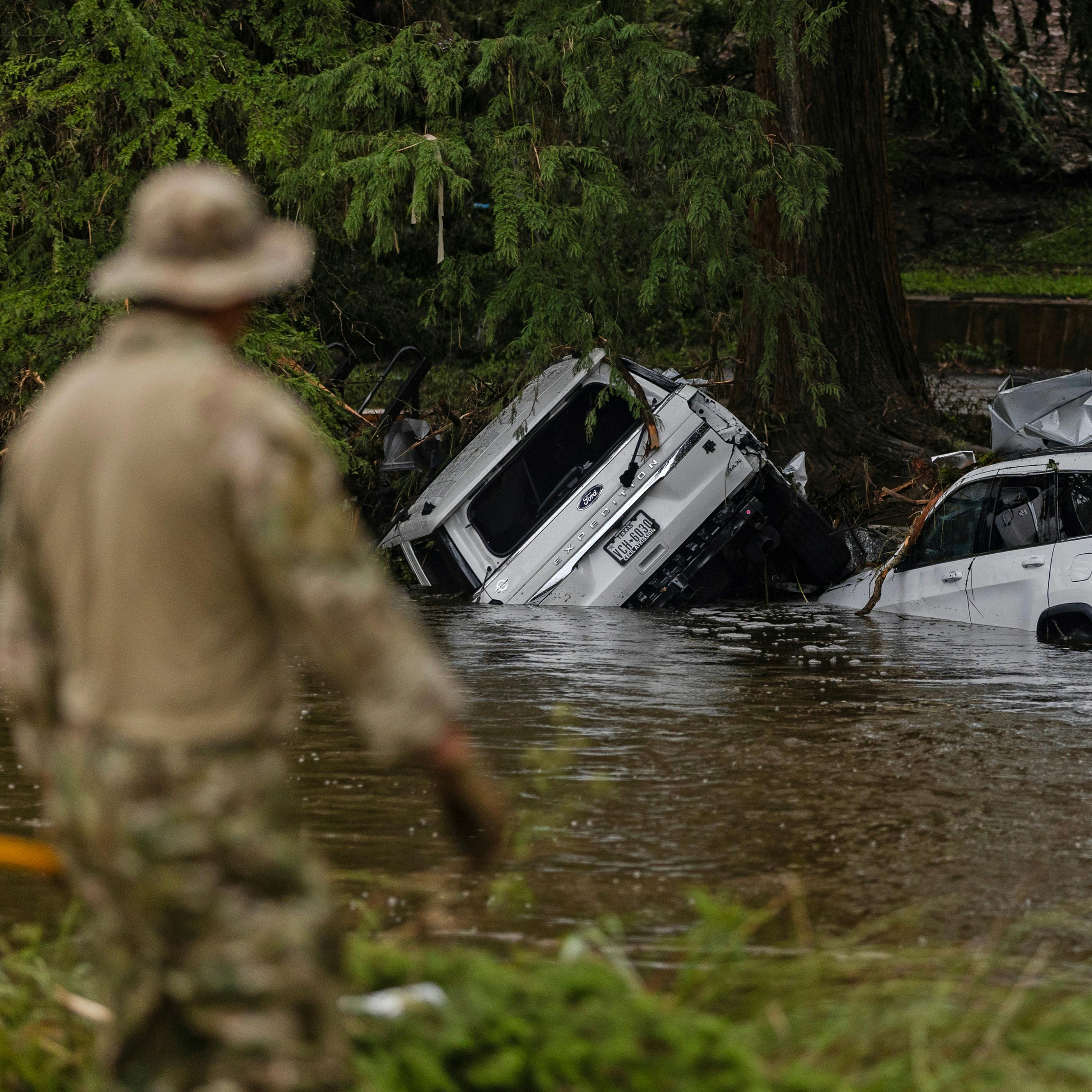
Texas blame game
This episode was produced by Denise Guerra and Peter Balanon-Rosen, edited by Jolie Myers, fact-checked by Gabrielle Berbey and Miles Bryan, engineered by Andrea Kristinsdottir and Patrick Boyd, and hosted by Noel King.
Listen to Today, Explained ad-free by becoming a Vox Member: vox.com/members. Transcript at vox.com/today-explained-podcast.
A search and rescue worker looks through debris along the Guadalupe River in central Texas. Photo by Jim Vondruska/Getty Images.
Learn more about your ad choices. Visit podcastchoices.com/adchoices
Press play and read along
Transcript
Speaker 1 Good morning, everyone. Good morning, good morning.
Speaker 3 Relax, relax, relax. I've just got some.
Speaker 4 In Texas, officials are facing hard questions about why so many people were in the path of floods that inundated parts of Kerr County this weekend.
Speaker 5 Y'all ready?
Speaker 1 As of 8:30 this morning, we recovered 75 deceased bodies here in Kerk County, including 48 adults and 27 children.
Speaker 4 Many of the victims were children because that area is home to a bunch of summer camps.
Speaker 6 Someone told me that when they were walking around campgrounds that they saw that Cabin 5, their wall had fallen over. And my door flooded away.
Speaker 4 What went so wrong here? Did the weather alert system fail? Did cuts to the National Weather Service leave critical jobs unstaffed? We've got some answers coming up on Today Explained.
Speaker 8
Support Support for today's show comes from ATT, the network that helps Americans make connections according to ATT. When you compare, there's no comparison.
ATT.
Speaker 9 Adobe Acrobat Studio, so brand new.
Speaker 10 Show me all the things PDFs can do.
Speaker 11 Do your work with ease and speed. PDF spaces is all you need.
Speaker 9 Do hours of research in an instant.
Speaker 10 With key insights from an AI assistant.
Speaker 7 Pick a template with a click. Now your preso looks super slick.
Speaker 12 Close that deal, yeah, you won. Do that, doing that, did that, done.
Speaker 13 Now you can do that, do that with Acrobat.
Speaker 9 Now you can do that, do that with the all-new Acrobat. It's time to do your best work with the all-new Adobe Acrobat Studio.
Speaker 14 You're listening to Today Explained.
Speaker 15 I'm Dominic Anthony Walsh. I'm a senior reporter with Houston Public Media, the NPR station in Houston.
Speaker 4 It seems like the big story now is the search for people who are still missing. Where do things stand there?
Speaker 15
Yeah, so we know how many children were at some of the popular summer camps. For example, Camp Mystic had 750 kids.
The majority are accounted for.
Speaker 15 But we don't know exactly how many people were camping along the river. So officials have been reluctant to estimate the total number of missing people.
Speaker 15
They said over the weekend that more than 850 had been rescued. And first responders, of course, have discovered dozens of bodies.
Officials are holding out hope that they'll still find people alive.
Speaker 15
But, I mean, they're really hoping against hope. It's been, as we're speaking, more than 72 hours since the flooding.
At some point, this will turn from search and rescue to recovery.
Speaker 4 What does search and rescue actually look like for people who aren't there?
Speaker 4 What is happening on the ground?
Speaker 15 Yeah, I mean, so if you drive or walk along the Guadalupe River, you will see and hear helicopters flying overhead, swift water rescue boats behind trucks loading into the river.
Speaker 15
So people on foot, people in boat, people in helicopters. Authorities also have drones in the air.
So a lot of activity on the ground.
Speaker 4 So you have, from what I'm seeing, you have official first responders, but you also have people looking for their family members?
Speaker 15 Yes. And local authorities have asked people to not self-deploy.
Speaker 15
Yeah, understandably, some people are very anxious to find their loved ones. So we absolutely have seen people just walking along the river.
It gets dangerous.
Speaker 15
We had a flash flood warning in effect last night. And authorities have basically said that folks self-deploying complicates their work.
And they have encouraged people to not do that.
Speaker 5 It's not that we think we don't need any help.
Speaker 5 It's that we want to make sure everyone helping is doing the job that we need, where we need it, and when we need it, and we have the ability to communicate with them.
Speaker 4 What is the latest on these children from Camp Mystic who are missing, these girls?
Speaker 15 Right, there were 750 girls at this nearly century-old summer camp right on the river. Camp Mystic this morning confirmed that 27 campers and counselors have been found dead.
Speaker 15 The camp director, Dick Eastland, was found dead on Saturday, reportedly near the bodies of three girls. Initially, they were saying 27 people were missing.
Speaker 15 That statement this morning says 27 people were dead. So the majority of them at this point are accounted for.
Speaker 4 Let's go back to the early hours of July 4th when the flooding started.
Speaker 4 What were the warnings like? What advance notice did people get?
Speaker 15 Yeah, the timeline starts as early as Wednesday.
Speaker 15 That's when the state's emergency management division mobilized swift water rescue teams in anticipation of flooding.
Speaker 15 On Thursday afternoon, the National Weather Service issued a flood watch, which is essentially warning that a flood is possible.
Speaker 15 That was followed by a flood warning just after midnight, so saying that floods are happening. And after 5 a.m., it announced a flash flood emergency, the highest alert level.
Speaker 15 The Washington Post looked at federal logs of emergency alerts, and it turns out the local government did not issue its first amber alert style warning until Sunday.
Speaker 15 So, two days after the flooding, questions remain about why that wait happened. And the actual timeline of the flooding was just so fast.
Speaker 15 Between 4 and 6 in the morning, the Guadalupe River rose as much as 30 feet. In most segments, that rise happened in less than an hour.
Speaker 15 That affected homes along the river where residents were shocked awake by the floodwaters. This is a popular area for camping, and it was a holiday, so the flooding washed away campers and RVs.
Speaker 15 Trees were pulled from the roots, cars swept downstream, along with an undetermined number of people. And the consistent theme I heard from folks was that they just did not have warning.
Speaker 15 They did not know this was coming until the floodwaters hit them.
Speaker 16 We lost everything, but we have our lives.
Speaker 17 Oh, bless.
Speaker 16 Yes.
Speaker 16 It was very difficult to get out of the house. We couldn't push the door open with all the water that just came within five minutes.
Speaker 16 And my neighbor up the hill helped my husband with a rope around his waist. He has Parkinson's.
Speaker 16 And
Speaker 16 like many of us, we lost everything inside the home. But we have our lives.
Speaker 4 In terms of where the warnings come from, who is actually pushing those alerts? Is it the National Weather Service? Is it the local government?
Speaker 4 If I were there and my phone was to sound an alarm, who would it come from?
Speaker 15 There are two levels of responsibility: the National Weather Service and the local government.
Speaker 15 The National Weather Service did send alerts in the middle of the night, but according to an analysis by the Washington Post, the local government didn't send any alerts until Sunday, so significantly after the floodwaters hit.
Speaker 15 Residents I spoke with said they didn't know what was coming until the floodwaters reached their homes. And of course, campers along the river didn't know until they were swept away.
Speaker 4 You've been out in the field talking to people who live in this area,
Speaker 4 including people who are looking for family members.
Speaker 4 What do you feel like you're hearing again and again? What's sticking with you?
Speaker 15 So as soon as I got into town, my first stop was the reunification centers and the supply depots.
Speaker 15 They were together, the reunification centers were also serving as supply depots. And I spoke with folks dropping off supplies,
Speaker 15 like resident Marissa Baldwin and her son Hudson. They were pulling a cart full of blankets and towels to a supply depot.
Speaker 18 Yeah, right now we have blankets and towels. We dropped off non-perishable food earlier.
Speaker 15 I heard from them them and from other residents time and time again that the small towns along the Guadalupe River form a tight community and so the scale of this destruction hits especially hard.
Speaker 18 And so everyone knows someone that's been affected. We have friends that are missing, friends that were
Speaker 18 recovered last night.
Speaker 2 So everyone's just doing what they can.
Speaker 15 Kirk County is home to just over 50,000 people, so everyone knows everyone. I also spent some time on Sunday in a little neighborhood called Bumblebee Hills.
Speaker 16 We have about 20 homes here at Bumblebee, and they're all devastated, but one house, which is up on the hill. He was our refugee to everyone around here.
Speaker 15 When I stopped by, residents and volunteers were scooping out mud and ruined possessions from their homes.
Speaker 16 We did not have flood insurance, and they said they would not cover not one thing.
Speaker 15 Folks are still in shock.
Speaker 15 They're still processing what happened, especially the people who know people who are missing, the people who, you know, lost their homes or had their homes damaged by the floods. The mood is somber.
Speaker 15 Folks are grateful.
Speaker 15 You know, I heard over and over again, even from the folks who lost their homes, that they're lucky to be alive. Not everybody is alive.
Speaker 15 You know, I've been living in Houston since 2021, and we saw three major weather disasters last year.
Speaker 15 Each time the community came together, and I saw that same spirit in Kerr County. I actually found another man from Houston who felt the same way.
Speaker 19 My name is Donnie Mosier. I'm from Houston.
Speaker 15 Who was trapped in his Airbnb without food or water? Local residents took him in.
Speaker 19
He said, Look, y'all need coffee and you need food. And he gave us directions to his house.
It said, be there at noon. We're eating.
Speaker 15 And he said it reminds him of the way Houstonians come together after hurricanes.
Speaker 19 This is an incredibly, incredibly sad situation, but the way people just kind of took us in and helped us and just made us part of their family is just amazing.
Speaker 15 So even though there's this somber mood, there's also this community spirit. People are coming together.
Speaker 4 Dominic Anthony Walsh is a senior reporter with Houston Public Media. Dominic, thanks so much for your time.
Speaker 15 Thank you, Noel.
Speaker 4
You can find Dominic's work at HoustonPublicmedia.org. They're doing some great reporting.
Coming up, did President Trump's cuts to the federal workforce play a part in this disaster?
Speaker 4 We're going to talk to a reporter who's been doing some digging.
Speaker 8 Support for Jay Explain comes from ATT. There's nothing worse than needing to make a call and realizing you can't connect, says ATT.
Speaker 8 And of course, every wireless provider will claim that they're the best, but ATT says ATT has the goods to back it up. According to Root Metrics, ATT earned the best overall network performance.
Speaker 8 While the other guys are busy making claims they can't keep, ATT says they're making connections on America's fastest and most reliable wireless network.
Speaker 8
No matter if you're at a concert, a huge sporting event, or just out enjoying nature, you can post when you want to post. Don't post when you're enjoying nature, guys.
Keep it in control.
Speaker 8
Call when you want to call and rest easy knowing that no matter where you go, AT ⁇ T has got you covered. When you compare, there's no comparison.
AT ⁇ T.
Speaker 8 Based on Root Metrics United States Route Score Report 1H2025 tested with best commercially available smartphones, smartphones on three national mobile networks across all available network types, your experiences may vary.
Speaker 8 Root Metrics rankings are not an endorsement of AT ⁇ T.
Speaker 8 Support for Today Explained comes from Wondery and their new podcast, Lawless Planet.
Speaker 8 It unfolds almost like a true crime podcast, I've been asked to tell you, but it is about the global climate crisis, complex stories wide-ranging happening in every corner of the planet.
Speaker 8 On Lawless Planet, the new podcast from Wondery, you will hear stories from the depths of the Amazon to small-town America.
Speaker 8 Host Zach Goldbaum takes you around the world as he investigates stories of conflict, corruption, resistance, and highlights activists risking their lives for their beliefs, corporations shaping the planet's future, and the everyday people affected along the way.
Speaker 8 Each episode takes you inside the global struggle for our planet's future, mysterious crimes, those high-stakes operations, those billion-dollar controversies that you do know so well.
Speaker 8 To reveal what's truly at stake, you can follow lawless planet on the wondery app or wherever you get your podcast you can listen to new episodes early and ad-free right now by joining wondery plus in the wondery app apple podcast or spotify
Speaker 8 support for today explain comes from udacity udacity says they can help you prepare yourself to be able to use IT.
Speaker 8 Udacity is an online learning platform. It has courses in AI and tech, generative AI, agentic AI, Python, data science, so much more.
Speaker 8 When you learn with Udacity, according to Udacity, you're not just passively watching videos or reading articles, maybe even books, you're doing practical exercises and projects that prepare you for the job you want.
Speaker 8 That's why they claim 90% of Udacity graduates surveyed say they achieved their enrollment goal. Udacity just launched a master's degree in AI.
Speaker 8
When you have a certification from Udacity, they say recruiters and employers take notice. You can check out Udacity today.
The tech field is always evolving. You should be too.
Speaker 8
You can try Udacity risk-free for seven days. You can head to udacity.com/slash explained.
Use code explained for 40% off your order. Once again, udacity.com slash explained for 40% off.
Speaker 8 Make sure you use the promo code explained.
Speaker 14 This is Today Explained.
Speaker 4 I'm Noel King. The mandate of the National Weather Service is a simple one, to protect people and property.
Speaker 4 And right now, that agency, which has been subject to cuts by the Trump administration, is taking a lot of flack.
Speaker 20 Did Trump's cuts to the National Weather Service cause the situation in Texas? Here's what the information tells us so far.
Speaker 3 The state's emergency management chief says the amount of rain that fell was never in the weather service's forecast.
Speaker 4 What happened? Andrew Friedman, a senior reporter covering weather and climate for CNN, has been banging the phones trying to figure out who, if anyone, dropped the ball.
Speaker 2 In this instance, there were two weather forecast offices that were involved.
Speaker 2 But the idea behind that is that these are meteorologists who are embedded in these communities, come to know these communities and the idiosyncrasies of their weather,
Speaker 2 and
Speaker 2 are better able to warn for
Speaker 2 inclement weather than, say, somebody just forecasting out of Washington, D.C. or somewhere else.
Speaker 4 So, we're talking about two offices in Texas, and what do we know about them? Were they fully staffed?
Speaker 2 The term that I would use is they were adequately staffed. They were staffed to the extent that most offices would be staffed overnight during the night of the horrible tragic flooding.
Speaker 2 They each are missing some employees.
Speaker 2 In In the case of the Austin, San Antonio office, they're missing a warning coordination meteorologist and a science and operations officer. Both of those positions were
Speaker 2 opened up because people took early retirement under the Trump administration's program to try to get people to
Speaker 2
reduce the size of the federal government. And then the office in San Angelo, Texas is missing a meteorologist in charge.
So that's like the top meteorologist for the office.
Speaker 2 These staff cuts in those two particular offices do not seem to have had a major impact or even a very clear impact
Speaker 2 on the way the weather service performed during this event.
Speaker 4 What I think I'm hearing from you, Andrew, is that your reporting does not seem to suggest at this point that the disaster in Texas was caused by the Trump administration cuts.
Speaker 4 Am I hearing that right?
Speaker 2 You are hearing that right. The
Speaker 2 missing warning coordination meteorologist in the Austin office,
Speaker 2 that's the biggest question because
Speaker 2 that position is somebody who
Speaker 2 interacts with emergency managers who are then responsible for warning the community.
Speaker 2 But when I've talked to sources, they basically are saying it probably did not affect the timeliness of the warnings, the tone of the warnings, which ratcheted up very quickly, as well as how early they caught on to this event possibly taking place.
Speaker 4 Do we know why that top meteorologist position in San Angelo was unfilled?
Speaker 2 I don't know specifically offhand.
Speaker 2 However, there are offices around the country that are without their meteorologist in charge.
Speaker 2 The National Weather Service lost about 600 people. They did get hit hard by doge cuts.
Speaker 21 Federal workers who were not let go said the afternoon layoffs included meteorologists who do crucial local forecasts in National Weather Service offices across the country.
Speaker 22 It is truly the backbone of all weather forecasting in this country.
Speaker 23 Every living former NWS director is warning potential funding cuts could lead to needless loss of life.
Speaker 2 What's happened with these cuts is they're losing the most experienced people. The people who are near retirement age are taking these packages and are leaving.
Speaker 2 And then you have to train up people who are coming in and they don't have the same level of experience.
Speaker 2 But again,
Speaker 2 when one looks at the warnings that were issued when they were issued, there isn't really a smoking gun there.
Speaker 2 But there is one point that's really important here.
Speaker 24 Because
Speaker 2 the cuts have been so deep around the country, this is a question that's going to come up at every single disaster
Speaker 2 that takes place. Because the meteorologists that I've been talking to in the broader community are basically telling me, this doesn't seem to be
Speaker 2 the event that vacancies caused a tragedy. But mark my words,
Speaker 2 that will happen at some point if this isn't addressed.
Speaker 4 What are your sources worried about?
Speaker 2 They're concerned about hurricane season. This event actually
Speaker 2 was the remnants of Tropical Storm Barrie and that rained out over inland Texas.
Speaker 2 We also just had tropical storm Chantal that made landfall in South Carolina and is causing flooding today and caused flooding over the weekend. So it's just this
Speaker 2 sense in the community that they're really stretched thin, that people are working longer shifts, people are working six-day six-day weeks.
Speaker 25 We are generating kind of a Swiss cheese weather service. We have holes throughout the weather service now that are not well thought out.
Speaker 2 It is not an ideal situation, and people are worried that there is going to be a time when they miss something. But this doesn't seem to have been it.
Speaker 4 When that time comes, when a disaster hits, FEMA is often there to pick up the pieces, to help clear up the wreckage. The Trump administration has also made cuts to FEMA.
Speaker 4 Do we know how broad those are?
Speaker 2 Yeah, the cuts to FEMA from reporting done by my colleagues
Speaker 2 really are quite broad. They really are quite deep.
Speaker 2 The administration has talked about getting rid of FEMA after the hurricane season.
Speaker 26 FEMA's turned out to be a disaster, and I think we're going to recommend that FEMA go away.
Speaker 2 However, they pretty much kind of stopped that process
Speaker 2 as hurricane season came upon us.
Speaker 8 Are you still planning to phase out FEMA?
Speaker 26 Well, FEMA is
Speaker 26 something we can talk about later, but right now they're busy working, so we'll leave it at that.
Speaker 2 So FEMA is active in Texas,
Speaker 2 but they lost a lot of experienced staff. They
Speaker 2 have have
Speaker 2 a shortage of the people that go out to immediately respond and immediately offer help.
Speaker 27 The Federal Emergency Management Agency is losing a fifth of its staff. We're talking about a thousand permanent full-time workers that are expected to take the voluntary buyouts.
Speaker 27 These are, of course, part of Doja's latest staff reductions.
Speaker 17 I worry a lot about how thin the situation is and the ability to get information across during what could be a very active season.
Speaker 4
These cuts are being made to the National Weather Service, FEMA, in the name of cost savings. This will save the federal government money.
Does this actually save money?
Speaker 2 You know,
Speaker 2 that's a very good question. I don't know that I can answer that conclusively here.
Speaker 2 I can tell you, though,
Speaker 2 that
Speaker 2 There are enormous economic benefits to accurate weather forecasts.
Speaker 2 Studies have shown the savings of billions of dollars with more accurate hurricane track forecasts, for example.
Speaker 2 And if you look at the proposals that the administration has put forward for the 2026 budget,
Speaker 2 They want to actually close every single weather and climate lab that we have in this country.
Speaker 2 So the people who are working on improving flash flood forecasts, the people who are working on improving hurricane forecasts,
Speaker 2 and doing the research that would then lead to the forecast capabilities of tomorrow would be out of a job if that budget were enacted as proposed.
Speaker 4 All right, so your reporting suggests that staffing cuts are not the cause of the disaster in Texas.
Speaker 4 But I wonder if you have spoken to people inside the Trump administration who are now going to have to grapple with what occurred and with a popular narrative that says the Trump administration did this by cutting jobs.
Speaker 4 Do you think in some way
Speaker 4 this tragic event makes this real for the Trump administration?
Speaker 2 I think there is an element of that. You actually saw the administration pushing back on social media
Speaker 2 over the weekend, saying the mainstream media media is lying to people by saying it's due to these cuts.
Speaker 24 At DHSGov, the mainstream media is deliberately lying about the events leading up to the catastrophic flooding in Texas.
Speaker 24 The National Weather Service executed timely, precise forecasting and warnings despite unprecedented rainfall overwhelming the region.
Speaker 2 When the mainstream media, myself included, all we're doing is asking the questions that need to be asked and then coming to the conclusion almost universally that
Speaker 2 the cuts probably were not
Speaker 2 a significant contributor to this event.
Speaker 2 The
Speaker 2 real
Speaker 2 problem that I think most weather experts have been pointing to is the so-called last mile problem,
Speaker 2 which is
Speaker 2 what happened between the times when the weather service pushed the button to set off emergency alerts on on people's phones did they get these warnings was there any type of a warning system what was cell phone coverage like okay what was the wording of the warning and did it give people actionable information of what to do
Speaker 2
But yes, this makes it real for the administration. This makes it an accountability issue.
And like I said, I think that's going to keep happening the more you have weather-related disasters.
Speaker 4 Andrew Friedman is a senior reporter covering climate and weather for CNN. Andrew, thank you so much for your time.
Speaker 2 Thank you for having me.
Speaker 4
Denise Guerra and Peter Ballinon Rosen produced today's show. Jolie Myers Edited.
Patrick Boyd and Andrea Christian's daughter are our engineers, Miles Bryan and Gabrielle Berbay.
Speaker 4
Check the facts today. I'm Noel King.
It's Today Explained.
Speaker 9 Adobe Acrobat Studio, so brand new.
Speaker 10 Show me all the things PDFs can do.
Speaker 11 Do Do your work with ease and speed. PDF spaces is all you need.
Speaker 9 Do hours of research in an instant.
Speaker 10 Key insights from an AI assistant.
Speaker 7 Pick a template with a click. Now your Prezo looks super slick.
Speaker 12 Close that deal, yeah, you won. Do that, doing that, did that, done.
Speaker 13 Now you can do that, do that, with Acrobat.
Speaker 9 Now you can do that, do that with the all-new Acrobat. It's time to do your best work with the all-new Adobe Acrobat Studio.
Speaker 14 Support for this show comes from Neiman Marcus. This holiday season, Neiman Marcus is your home for the most exceptional gifts.
Speaker 14 From the ultimate stocking stuffers to statement bags made for celebration to their legendary fantasy gifts that surpass every expectation, Neiman Marcus has something extraordinary for everyone.
Speaker 14 And with style advisors to guide you, finding the perfect gift at every price point is effortless. So head to Neiman Marcus for a truly unforgettable holiday.


