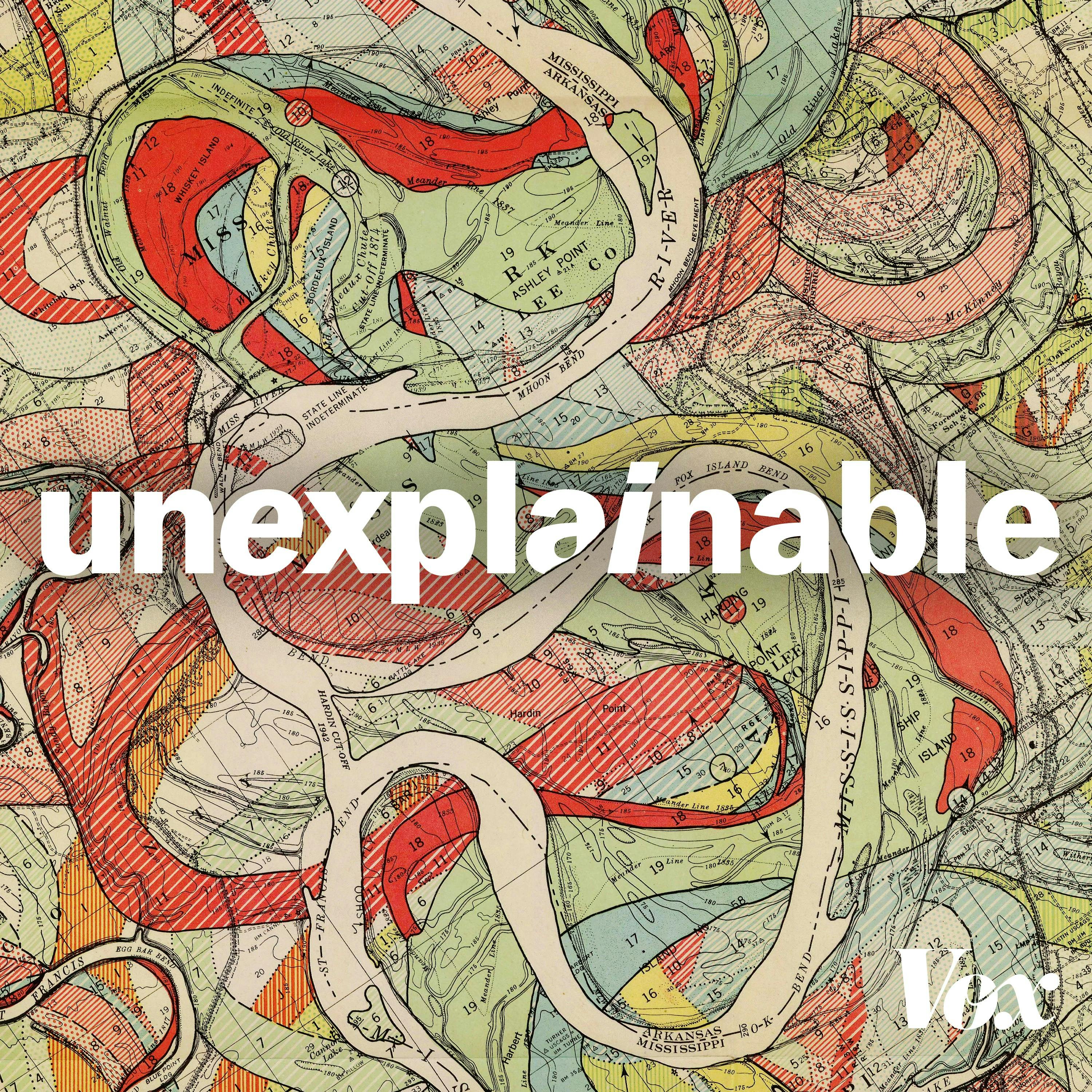
Solve me a river
Guests: Douglas Edmonds, professor at Indiana University; Neel Dhanesha, science reporter
For show transcripts, go to vox.com/unxtranscripts
For more, go to vox.com/unexplainable
And please email us! unexplainable@vox.com
We read every email.
Support Unexplainable (and get ad-free episodes) by becoming a Vox Member today: vox.com/members
Thank you!
Learn more about your ad choices. Visit podcastchoices.com/adchoices
Press play and read along
Transcript
Speaker 1 Support for the show comes from the Audible original The Downloaded 2, Ghosts in the Machine.
Speaker 3 Earth's final days are near, and the clock is ticking for members of the Phoenix colony.
Speaker 2 All they need to do is upload their minds back into the quantum computer.
Speaker 2 Simple enough, but their plan is disrupted by digital duplicates of their own minds that could destroy their stored consciousness forever.
Speaker 7 Listen to Oscar winner Brendan Fraser reprise his role as Roscoe Caduleon in this follow-up to the Audible hit sci-fi thriller, The Downloaded, by Canada's most decorated sci-fi author, Robert J.
Speaker 2 Sawyer. What are you willing to lose to save the ones you love?
Speaker 1 Find out in the thought-provoking sequel, The Downloaded 2, Ghosts in the Machine.
Speaker 10 Available now, only from Audible.
Speaker 11 Adobe Acrobat Studio, so brand new.
Speaker 12 Show me all the things PDFs can do.
Speaker 13 Do your work with ease and speed.
Speaker 14 PDF spaces is all you need.
Speaker 15 Do hours of research in an instant.
Speaker 14 Key insights from an AI assistant.
Speaker 16 Pick a template with a click. Now your Prezo looks super slick.
Speaker 17 Close that deal, yeah, you won. Do that, doing that, did that, done.
Speaker 18 Now you can do that, do that, with Acrobat.
Speaker 11 Now you can do that, do that with the all-new Acrobat.
Speaker 20 It's time to do your best work with the all-new Adobe Acrobat Studio.
Speaker 21 This is Unexplainable or Not, the game show where we finally get some answers.
Speaker 21 Today, we wanted to introduce you to one of the newest members of our team, Sally Helm. Sally has worked on all kinds of shows you probably listen to.
Speaker 21 She's the host of History This Week from the History Channel, and she's done tons of amazing reporting for Planet Money. Welcome, Sally!
Speaker 22
Hello, I'm so happy to be here. It's a delight, it's an honor, and I'm scared.
It's a game show, so I'm in the hot seat.
Speaker 21 Okay, Unexplainable or Not is a game show where you have to guess what we know and what we don't.
Speaker 21
You're going to hear three scientific mysteries, and you're going to hear them from me, from my co-host, Bird Pinkerton. That's me.
And from longtime friend of the show, science reporter Neil Denasha.
Speaker 23 Hello.
Speaker 21 Two of these mysteries are still unexplainable, but one of them has recently been solved.
Speaker 21 After you hear all three mysteries, you're going to get a chance to guess which one you think scientists have actually recently explained.
Speaker 22 Okay.
Speaker 21 And this week, I want to start with a question we got from a listener.
Speaker 16 Hi, team.
Speaker 23 Love the podcast, but there's one thing that's been bothering me for a while now. Where does your cover art come from?
Speaker 6 I'm really excited we got this question because we do have new artwork and we've been wanting to talk about it for a while on the show.
Speaker 29 New-ish.
Speaker 6 Yeah, new-ish, Bert is right.
Speaker 22 Okay, you're talking about like the podcast tile, the thing that shows up next to Unexplainable.
Speaker 31 Yeah, and it's a river map from 1944.
Speaker 32 And we figured the best way to explain why we chose a river map was with an entire game show all about rivers.
Speaker 22 Obviously. Obviously, the easiest possible thing.
Speaker 25 What else would you do?
Speaker 34 Talk about it?
Speaker 6 The least amount of work possible.
Speaker 29 So, first up, you're going to hear a mystery from Bird.
Speaker 23 Sally, hello. Hi, Bird.
Speaker 26 Hello.
Speaker 26 Sally, we've known each other for a while at this point, ever since
Speaker 23 many years.
Speaker 26 Interns at NPR, the same intern class.
Speaker 26 But I realized I've never asked you an important question all this time, which is, are you a fan of mussels?
Speaker 22 Mussels. Okay, since we're talking about rivers, I'm going to assume we mean the kind that has shells that come together.
Speaker 26
We are indeed talking about freshwater mussels. Okay.
So the unsung heroes of rivers, as some might say.
Speaker 22
Myself. I have an underdog.
I'm already on board.
Speaker 26 So basically, freshwater mussels are in all kinds kinds of rivers in the u.s and this researcher a professor at the university of wisconsin madison this guy named tony goldberg he told me that that the u.s is actually a hot spot of muscle diversity so we have all kinds of amazing species we have one called the heel splitter that looks it looks kind of like a clam but then it has this like really sharp edge.
Speaker 23 So the name is ouch. So heel splitter our heels when you step on it.
Speaker 22 Yes.
Speaker 26 And then there's like a kind of muscle that makes part of its little like fleshy bit, essentially, look like a tiny fish.
Speaker 26 And then like a bigger fish will come and try to eat the fake fish, and the muscle will explode eggs at the big fish. So it like carries the eggs somewhere else.
Speaker 26
Pretty cool. Genius.
And honestly, I just wanted to take a minute with some of the amazing names we've given to these muscles.
Speaker 26 So you have the purple warty back, we got the pocketbook, the flat pig toe, the mucket, my favorite, the golden riffle shell, the
Speaker 26 stirrup shell, and my favorite, the turgid blossom pearly mussel.
Speaker 23 That is a poem in itself.
Speaker 26
I agree. And I think like these mussels are just delightful, right? Like in and of themselves.
But Tony was telling me that they are also fairly vital for river ecology.
Speaker 26
So they essentially filter water like it is their job. They like suck in the water, right? They pull out particulates.
So that can be food, but also pathogens like E.
Speaker 26 coli, herbicides, just like chemicals in the stream. And then whatever remains, they just kind of like poop out.
Speaker 22 Hmm. And are they doing this to like eat and get nutrients for themselves, but then as a byproduct, they clean the water?
Speaker 26
Yeah. And there's this video from like the Minnesota Department of Natural Resources.
It's this like little time lapse.
Speaker 26 And so they start with like two containers of like dirty, kind of brownish, orangish muck. One has mussels in it, one doesn't.
Speaker 26 And over the course of literally like a few hours, you watch the dirty tank, right? It remains filthy, brown, and the mussel tank just like cleans up essentially.
Speaker 26 The water becomes see-through and probably not like lovely, but certainly more lovely than it was before. So these mussels, right, they are doing all this invisible work.
Speaker 26
And then on top of that, they're helping stabilize the riverbed. They're feeding animals.
They're like dead shells, shells, provide habitats.
Speaker 26 So, they're just this like amazingly helpful, delightful creature that we have the privilege of having in our rivers.
Speaker 26 Except, unfortunately, for a while now, some specific mussels have been struggling. So, actually,
Speaker 26 some of the species that I told you about,
Speaker 26 like the flat pig toe, the stirrup shell, also, unfortunately, the turgid blossom pearly mussel.
Speaker 22 No bird.
Speaker 26 Yes, I am very sorry to say.
Speaker 26 They were all declared extinct, actually, in 2023, because they hadn't been seen for decades.
Speaker 26 Some other species are endangered. But also, Tony says, sort of more recently, researchers have started seeing these massive muscle die-offs.
Speaker 26 A whole bunch of mussels will just like die over the course of even just one season. So he calls it like an ecological emergency.
Speaker 26
And Tony is an epidemiologist. So he studies like pathogens in animals, everything from monkeys, robins, fish, mussels.
And he joined like a whole team of people that wanted to investigate this.
Speaker 26 He said that they called themselves the Delta Strike Force of muscle-interested scientists.
Speaker 26 But in Tony's case, he's looking to see if the problem could be a pathogen of some kind, a bacteria or a virus or a parasite.
Speaker 22 Makes sense. Mussels dying, maybe they're getting sick from something in the water.
Speaker 26
Exactly. And so they kind of had to start from scratch, he told me in some ways.
Like he said they had to figure out how to identify even that a muscle was sick.
Speaker 22 If you just look at its shell, you're like, oh, that's a muscle. And you'd have to see its.
Speaker 26 Well, yeah, they kind of just like open and close and like hang out.
Speaker 26 So they had to sort of figure out like, how do you identify like sickness in a muscle?
Speaker 26 And there were a lot of viruses in these muscles, for example. But he had to figure out like,
Speaker 26 were any of those a problem?
Speaker 26 Are there viruses or bacteria or parasites that are in the sick or dead muscles, but not in the healthy ones? And so basically, in order to kind of
Speaker 26 preserve our rivers as we know them, right? In order to keep these incredible animals in them that literally keep them clean for us,
Speaker 26 researchers like Tony are still hunting for the culprit here, right? The smoking gun that is killing off these mussels in these big die-offs. And they have not found it yet.
Speaker 22 Okay.
Speaker 26 Unless
Speaker 26 they have.
Speaker 22 Please tell me that we know what is after our deer muscles.
Speaker 28 What do you think, Sally?
Speaker 37 Do you think we know or do you think it's still a mystery?
Speaker 22 You know,
Speaker 22 I feel so much like I want us to know that I'm wondering if we don't, you know, like I'm wondering if I just have optimism and hope in my heart that we have figured it out.
Speaker 22 And it seems like we should be able to, but I'm intrigued that it's hard to even know what a sick muscle looks like.
Speaker 22 That makes me worry that maybe we don't know enough about muscles to really answer this question.
Speaker 22 So I'm going to say, maybe as emotional self-protection, that we don't. We don't know.
Speaker 28 I love the way you're thinking about it.
Speaker 3 So no need to lock in your answer yet.
Speaker 6 Just have it float around in the back for now. Great.
Speaker 22 As if on a river.
Speaker 6 And Neil is up next. He's got another mystery for you about rivers.
Speaker 22 All right.
Speaker 23 Hello.
Speaker 25 We were not interns at NPR and this is the first time I'm meeting you.
Speaker 22 I've never met you before. Hi.
Speaker 23 Hello.
Speaker 25 Well, since I've never met you, I also don't know where you live. Do you live near a river?
Speaker 22
You know, I live in Brooklyn, so kind of near the Hudson. And I grew up in Los Angeles, which is like, you know, ocean country.
So rivers are a little less known to me overall.
Speaker 25
So I also live in Brooklyn. And I think one thing I've taken for granted in Brooklyn is that the East River and the Hudson River stay where they are.
Like the amount of water in them might change.
Speaker 25 Like there might be like a flood or a drought and that could sort of affect how much water is in the river. But the course, for the most part, is pretty stable.
Speaker 25 And And they're so stable that we build entire cities around them, right? Like New York exists and these two waterways have sort of been a major part of the shape of the city.
Speaker 25 But sometimes rivers can dramatically change course by as much as hundreds of miles.
Speaker 25 And it's not like just a river meandering one way or the other a little bit and then coming back to where it was before. It like fully moves and it leaves a dry channel behind where it was before.
Speaker 25 What? I know, right? So imagine if the Mississippi River, when it hit Louisiana, instead of going east and then down to Baton Rouge and New Orleans, it went west.
Speaker 22 And just like zoink, different course.
Speaker 25
Exactly. And it would completely transform these cities.
Like New Orleans would be in a lot of trouble. I mean, the entire state would.
Speaker 25 And this actually almost happened.
Speaker 25 Back in the 1960s, the Army Corps of Engineers built this huge floodgate on the Mississippi so that it wouldn't change course and join another river called the Achifalaya.
Speaker 22 Okay, it was trying to change course, and the Army Corps of Engineers was like, we can't allow this. And they were kept apart by the Army?
Speaker 25 They got kept apart by the Army Corps of Engineers. This tale of river love was stopped.
Speaker 22 Okay, yeah, it's a star-crossed love story.
Speaker 23 I'm hooked.
Speaker 26 Question: Would they have had to rename one or the other of the rivers if they'd merged?
Speaker 38 That's a good question.
Speaker 26 Do they hyphenate?
Speaker 22 But that just kicks the can down the road.
Speaker 28 What if that river meets another riverbird? Come on.
Speaker 23 Exactly. Right.
Speaker 26 You know what? This is unimportant.
Speaker 25 So anyway, these like dramatic changes in course are called avulsions, and they can be pretty catastrophic.
Speaker 25 I talked to Douglas Edmonds, who's a professor at Indiana University, and he told me avulsions have caused some of the biggest river floods in the history of our planet.
Speaker 25 There's a really recent tragic example of this when the Indus River in Pakistan moved west by 30 to 60 miles back in 2010.
Speaker 25
And that flooding affected about 20 million people and almost 2,000 people died. Wow.
I know it's really brutal.
Speaker 22 Right, because we don't expect rivers to change in this way.
Speaker 22 And like you said, we've built whole cities and whole neighborhoods and people have their lives in a place where they didn't expect a river to be.
Speaker 6 Yeah, exactly.
Speaker 39 And you want to be like right up against the river, right?
Speaker 31 To use it as best as you can.
Speaker 25
Right. There have historically been so many benefits to being on a river, right? It's great for trade.
It's also a good water source.
Speaker 25 If it's not super polluted, it's also just kind of nice to be by a river. And so, you know, that particular instance in Pakistan, it happened during a really heavy monsoon storm.
Speaker 25
So it was especially quick. But most sublungs, Doug told me, are slower.
They take decades or even centuries.
Speaker 25 So if he notices in time, we can build things like that floodgate in Louisiana, which is called Old River Control.
Speaker 25 And if anyone's interested in reading more about that, there's a great essay by John McPhee called Atchiphalaya. I love it so much that I talk to people about about it unbidden all the time.
Speaker 25 But the point is that, you know, in either case, whether it's the slow, gradual avulsion or the fast-moving one caused by a storm, like in Pakistan, the stakes are really high.
Speaker 25 But it's still kind of a mystery. Like, we don't really know what causes these avulsions to happen
Speaker 23 unless we do.
Speaker 25 And... we can do something about it.
Speaker 22
On this one, I'm going to say we do. I just feel like we know.
I feel like rivers are so big, the stakes are so high.
Speaker 22 I mean, it is
Speaker 22 crazy that this happens. Like imagining the zoink, the turning left instead of right or right instead of left, it does feel like a magical thing.
Speaker 22 Yeah, I'm going to say we figured this one out. I'm going to say someone knows why.
Speaker 23 Okay.
Speaker 26 But you do have to remember that this was unexplained for a long time. No, it's so true.
Speaker 22 As I was saying that, I was like, We've had rivers, we've had
Speaker 25 the Indus one was like not that long ago, you know.
Speaker 22 Yeah, yeah,
Speaker 30 hold your thought for now.
Speaker 6 There might be another mystery coming, or actually, there is another mystery coming from me right now.
Speaker 6 And mine starts with a seemingly simple question:
Speaker 6 What is the longest river in the world?
Speaker 22 Uh,
Speaker 4 I don't, I don't, the Nile, the Nile, great answer.
Speaker 6 That is basically what everyone would say.
Speaker 41
It's what the U.S. government says.
It's what the Guinness Book of World Records says. It's what Wikipedia says.
Speaker 6 But scientists are starting to wonder whether the Amazon might actually be longer.
Speaker 22 That was my number two.
Speaker 23 You're very good on river length, just intuitive river length.
Speaker 31 Deep intuition of that.
Speaker 6 So when I heard about this, I was sort of surprised that it was even a question.
Speaker 23 Right.
Speaker 23 Right, because can't we just just measure? Can't you just measure the river? It's a very big tape measure to the Amazon.
Speaker 7 We see where the river is.
Speaker 23 Just measure it.
Speaker 29 So I called up this explorer, Yuri Sonata.
Speaker 23 An explorer.
Speaker 33 An explorer.
Speaker 6 I'm so excited to just like interview an explorer, especially because he has this expedition that he is planning to go the entire length of the Amazon on a boat.
Speaker 40 Wow.
Speaker 25 And it has a really big tape measure on it. Yes.
Speaker 42 It's going to just leave one end at the beginning of the Amazon.
Speaker 41 And then the snap back is just really dangerous.
Speaker 28 But he told me there's two things that make answering this question really hard.
Speaker 24 So, one is deciding how to measure it.
Speaker 39 And two is deciding where it starts and ends.
Speaker 29 So let's just start with how to measure it.
Speaker 22 Yeah. Do you mean like what tool to use, or like, do we go with meters or feet?
Speaker 6 So it's related to something called the coastline paradox.
Speaker 9 Basically, like rivers, coastlines are really tough to measure.
Speaker 32 So if you look at Norway and compare it to Russia, on a map, Russia looks like it has this huge coastline.
Speaker 24 Norway is just this little country hanging out at the top of Europe.
Speaker 32 But when you zoom in,
Speaker 10 you'll see that Norway has all of these things kind of etching into the land, these fjords.
Speaker 4 And when you follow every little nook and cranny into Norway, turns out Norway actually has the second longest coastline in the world, much longer than Russia, longer than the entire European Union.
Speaker 3 And it's because when you zoom in, these squiggly lines get longer.
Speaker 32 And it's the same thing with rivers.
Speaker 3 So from above, the twists and turns, they get smoothed out.
Speaker 4 You see, like, okay, the river is just this kind of line.
Speaker 41 But when you zoom in, you see it takes all of these little twists and turns.
Speaker 5 And the question is, how far should you keep zooming in?
Speaker 3 Should you zoom in to where you'll be measuring every twist and turn with a ruler? or whether you'll be measuring every twist and turn with a microscope.
Speaker 31 The further you zoom in, the longer the river gets.
Speaker 6 It's honestly almost like a fractal. You could zoom in to the point that this question becomes absurd and there's a situation where it could become like an infinitely long river.
Speaker 29 That's probably beyond where we need to go.
Speaker 26 All rivers are actually the same.
Speaker 23 All rivers are the same.
Speaker 23 Trick question.
Speaker 6 And then also like rivers are changing, they're moving. It's tough to get a consistent measurement, just like Neil was saying.
Speaker 22 It's like you're going to have to approximate like what level are you approximately? Exactly.
Speaker 6 Any way you measure it is an approximation, right? You just have to decide what approximation you're comfortable with. But that's only one of the big issues.
Speaker 32 The next one is: where are you measuring from?
Speaker 32 So you might think, okay, just go to the beginning of the Amazon, right?
Speaker 4 But there's no one beginning.
Speaker 6 There's a bunch of little rivers that come out of the Andes and feed into the Amazon. You know, people used to think the furthest was the Marañón River in northern Peru.
Speaker 32 But then a few years ago, explorers followed another tiny river from the Amazon and they realized it went further away.
Speaker 5 This was the Montaro River.
Speaker 24 And Yuri says that at the source of the Montaro River, it just looks like some water dripping from a rock in the mountain.
Speaker 22 That feels like the beginning.
Speaker 29 I mean, it could be, but this is just the furthest source they've got so far.
Speaker 39 There could be another river that they haven't found that's just really tiny and twisty that could actually go longer and start even further away.
Speaker 29 But it's so remote.
Speaker 5 It's so high up.
Speaker 39 We're talking like 15,000 feet up in the Andes.
Speaker 28 It's so high up that Yuri said that for the entire first month of his expedition, he's going to be whitewater rafting down the mountain for a month.
Speaker 22 This is why we get to have explorers.
Speaker 3 Yes, this is why we still, in 2025, we need explorers.
Speaker 6 And then the same issue happens at the end of the Amazon.
Speaker 6 It's less complicated, but when the Amazon hits the Atlantic, it runs through a series of islands right at the Atlantic where the land kind of starts to break up.
Speaker 39 And there's this question, does the river follow along the side of the islands or does the river end when the islands start and so we're left with this situation where right now most people think the nile is the longest one african scientist got in touch with yuri because he heard about his expedition was like please please don't take the record from us but yuri is plowing ahead on his expedition unless
Speaker 32 he's already done his expedition and we do know
Speaker 24 what is the longest river and I am pulling a fast one on you.
Speaker 22 I'm going to say, and I don't think Yuri would agree with me, but I'm going to say this is not an answerable question at all. You've convinced me that all rivers are the length infinity.
Speaker 22 It's all an approximation anyway.
Speaker 9 Oh, so your answer is there's no longest river.
Speaker 22 My answer is there's no longest river. Yeah.
Speaker 22 I mean, one of my high school teachers once told me the difference between physics and math is if you're walking towards a wall in math, you never get there.
Speaker 23 Like if you're going halfway towards the wall, you just always go halfway again.
Speaker 22 But, you know, in physics, eventually you get there.
Speaker 26 Zeno's River.
Speaker 22 Zeno's River, exactly.
Speaker 23 They're all Zeno's river.
Speaker 6 I mean, it's a creative explanation. You will have to ask yourself, did we choose to answer this question with math or with physics?
Speaker 22
Yeah, exactly. I mean, I think we don't know.
I think we don't know this one.
Speaker 38 Okay, you got three mysteries.
Speaker 6 You got the mystery of muscles, you got the mystery of rivers changing course, and then you got the mystery of the longest river.
Speaker 24 They're all unexplainable, or at least they all were unexplainable at one point.
Speaker 4 One of these mysteries has recently been figured out, and you're going to have a chance to make your final guess after the break.
Speaker 11 Adobe Acrobat Studio, so brand new.
Speaker 12 Show me all the things PDFs can do.
Speaker 13 Do your work with ease and speed.
Speaker 14 PDF spaces is all you need.
Speaker 15 Do hours of research in an instant.
Speaker 14 With key insights from an AI assistant.
Speaker 16 Pick a template with a click. Now your Prezo looks super slick.
Speaker 17 Close that deal, yeah, you won.
Speaker 18 Do that, doing that did that done now you can do that do that with acrobat now you can do that do that with the all new acrobat it's time to do your best work with the all new adobe acrobat studio
Speaker 43 support for the show comes from charles schwab
Speaker 43 at schwab how you invest is your choice not theirs that's why when it comes to managing your wealth Schwab gives you more choices. You can invest and trade on your own.
Speaker 43 Plus, get advice and more comprehensive wealth solutions to help meet your unique needs. With award-winning service, low costs, and transparent advice, you can manage your wealth your way at Schwab.
Speaker 43 Visit Schwab.com to learn more.
Speaker 34 As a founder, you're moving fast towards product market fit, your next round, or your first big enterprise deal.
Speaker 34 But with AI accelerating how quickly startups build and ship, security expectations are also coming in faster, and those expectations are higher than ever.
Speaker 34 Getting security and compliance right can unlock growth or stall it if you wait too long.
Speaker 34 Vanta is a trust management platform that helps businesses automate security and compliance across more than 35 frameworks like SOC2, ISO 27001, HIPAA, and more.
Speaker 34 With deep integrations and automated workflows built for fast-moving teams, Vanta gets you audit ready fast and keeps you secure with continuous monitoring as your models, infrastructure, and customers evolve.
Speaker 34 That's why fast-growing startups like Langchain, Ryder, and Cursor have all trusted Vanta to build a scalable compliance foundation from the start.
Speaker 34 Go to Vanta.com/slash Vox to save $1,000 today through the Vanta for Startups program and join over 10,000 ambitious companies already scaling with Vanta.
Speaker 34 That's vanta.com/slash Vox to save $1,000 for a limited time.
Speaker 34 Why is that not unexplainable?
Speaker 3 Okay, it's unexplainable or not.
Speaker 5 Sally, welcome back. Hello.
Speaker 23 Business-like.
Speaker 23 One word.
Speaker 23 We're so happy to be here. Hello.
Speaker 29 No, Sally.
Speaker 6 I feel like Sally's got her game face on, you know, she's ready.
Speaker 23 She's ready. Sally the person who you're playing Parcheesi, and she's like, this is actually not a joke, and I am mad at you.
Speaker 23 Your go-to game there was Parcheezi.
Speaker 7 I don't even think I've ever played Parcheesi.
Speaker 38 What is Parcheesi?
Speaker 26 No, it's like one of the most fit. If you go, I went to like a board game exhibit, and like half the board games were Parcheesi.
Speaker 22 I feel like it is the most classic game, and also I've never seen it.
Speaker 23 This is what I'm saying, Sally. All right.
Speaker 26 Well, later as team bonding, we're all playing Parchees-E. Okay.
Speaker 26 And it will probably start a fight, presumably with Sally, because she takes games very seriously, apparently.
Speaker 29 Anyway, so we've got three mysteries for you to choose from.
Speaker 24 Only one of them has been solved.
Speaker 30 Mystery one, what is killing freshwater mussels?
Speaker 24 Mystery two, why do rivers change course, sometimes by hundreds of miles?
Speaker 29 And mystery three,
Speaker 6 what is the longest river in the world?
Speaker 6 So, Sally, without making your final guess just yet, what are you thinking? What's going on in your head?
Speaker 22 I mean, as we know, my initial impression was we know about the rivers, we don't know about the muscles, we know about the avulsions, we don't know about the muscle killer, and the question of the longest river has become a philosophical one in my mind that is unanswerable.
Speaker 22 I think... What I'm feeling now is that maybe actually we know about the muscles because
Speaker 22
Bird is right. The river question has been unsolved for so long that maybe it's still unsolved.
Maybe it's still just like a giant geological mystery.
Speaker 3 I would say that when you're playing a game show, you might not want to take advice from the person trying to trick you.
Speaker 22 That's true. That's a great point.
Speaker 25 This is high-level Parteesi.
Speaker 23 I'm playing checkers.
Speaker 23 Bird's playing Parcheesi.
Speaker 26 I'm playing four-dimensional Parcheesi.
Speaker 22 Okay, I'm going to say
Speaker 22 that
Speaker 23 we
Speaker 22 have found
Speaker 22 why the muscles are dying. We know the answer to that.
Speaker 23 Okay.
Speaker 5 Mussels dying.
Speaker 24 Final answer?
Speaker 25 Yes.
Speaker 41 Okay,
Speaker 23 here's the answer.
Speaker 44 It's almost as if you live in New Orleans, but over the course of a month, the river has disappeared. It's run dry.
Speaker 44 The river channel is still there, but the water is gone.
Speaker 23 Okay.
Speaker 29 I wish people could see Sally's face looking like just, oh, and Bird just dancing like, oh,
Speaker 23 wow.
Speaker 22 Okay, so we've solved this long-running geologic mystery that we've been struggling with for centuries. Neil, what do we know?
Speaker 2 Yeah.
Speaker 22 Why does this happen?
Speaker 25 So the person you just heard is Doug Edmonds, who's that professor at Indiana University I mentioned earlier. He's one of the co-authors of a paper about why avulsions happen.
Speaker 44 So there are really two competing ideas for why river avulsions occur.
Speaker 44 One is simple and one is a little more complex.
Speaker 25
The simple idea is that water likes to go downhill. And so if the water finds a steeper slope than the one it's currently on, it'll go that way instead.
Doug calls that gradient advantage.
Speaker 44 So the more complex explanation has to do with the fact that, especially near the coastlines where a lot of avulsions tend to occur, rivers are depositing sediment on their beds.
Speaker 25
They're full of sediment. They're carrying it downstream.
Some of it settles to the bottom of the river as it goes along.
Speaker 44 If you imagine, just like you jack up a car with a jack, that sediment kind of brings the river up above its surrounding floodplain.
Speaker 25 That is what Doug calls super elevation, which is just one of those fantastic scientific names that everything should have. And we've known for a while that sediment can cause super elevation.
Speaker 25 We've known that since I think the 1940s or so, but it's been historically really hard to measure super-elevation, kind of related to what Noam was talking about earlier.
Speaker 25 There's like all kinds of factors that makes it hard to measure what the surface of a river actually is like.
Speaker 25 But that is exactly what Doug and his team did. And they did it with space lasers.
Speaker 44 Yep, space lasers.
Speaker 23 No.
Speaker 22 Yes. I did not know space lasers were coming.
Speaker 25 I, you know, I didn't either. But yeah,
Speaker 25 they used LiDAR from these NASA satellites to do two things. First, they actually measured the surface of rivers as they are now, all over the world.
Speaker 25 But they also used the satellites to find evidence of evulgions that happened over the past 30 years. And they found a bunch that they had no idea existed before.
Speaker 44 We ended up realizing that both super elevation and gradient advantage actually work together to create the best predictor we now have of when a river evulsion will occur.
Speaker 22 Wow.
Speaker 25 And, you know, I think like in a lot of the U.S. and Europe, our rivers are really engineered.
Speaker 25 We have things like dams and levees and that floodgate I mentioned earlier, but we also have seen how they fail.
Speaker 25 You know, 20 years ago, very famously, the levees on the Mississippi failed when Hurricane Katrina hit New Orleans.
Speaker 25 And similarly, in the Indus River in Pakistan, part of the reason that the avulsion happened is because a levee failed.
Speaker 25 So, what Doug says actually is that the best sort of solve for avulsions, if you're going to go down the engineering route, is making spillways, which essentially divert the flow of the river when it's in flood and sort of send some of that water and sediment into like a floodplain or somewhere else that like, you know, you can safely sort of just dissipate some of the force.
Speaker 25 But, you know, that kind of infrastructure is expensive.
Speaker 25 And for most of the rest of the world, which might not have the capacity to build that infrastructure or the time, frankly, these hazard maps could help people figure out where the most urgent places to build the most targeted kinds of infrastructure could be, or at the very least, educate them on the risks, which is especially relevant now because climate change is making flooding worse.
Speaker 25 There's more water in the atmosphere. When storms happen, they dump more water on things like rivers that then could flood in the way that the Indus River did.
Speaker 25 And so that data could just save a whole lot of lives.
Speaker 22
Wow. So we know why rivers change course and we can do something about it.
This is good news, Neil.
Speaker 28 So just to just to circle back to that initial question we got at the beginning, we started the show with this question from a listener about why did we pick our cover art?
Speaker 32 And our cover art is a
Speaker 29 map from 1944 of all the courses that the Mississippi River has taken over thousands of years.
Speaker 22 Wow, it's an evulsion map.
Speaker 3 It's called something like the Mississippi Meander Map.
Speaker 6 It's basically the map of Neil's mystery.
Speaker 6 And the basic reason I wanted to do a game show just to answer this question is to show how many mysteries there are in rivers, these things that maybe we take for granted, how much we still don't know.
Speaker 6 But Bird, you were the one who found this specific 1944 river map.
Speaker 28 And I wonder if you could say a bit about what got you so excited about it.
Speaker 26 Yeah, I think we were looking at a lot of really beautiful old scientific imagery that is just, you know, at the crux of sort of science and art, which is where I would like to hope that our show is.
Speaker 26 But I think what I really loved about this as we were all talking about it was this idea of like
Speaker 26 Science too is this thing that is constantly sort of carving new channels for itself and finding new directions and new spaces and is like both shaped by the environment around it and shaping the environment around it.
Speaker 26 And so this particular image just sort of felt really
Speaker 26 representative of just some of the themes of our show.
Speaker 6 I don't know. For me, I guess it reminds me that
Speaker 39 All the stuff that we take for granted, all of these things that you just, you look in the world and you see a river there and you think that that just must be where it's always been.
Speaker 6 And it's kind of like the scientific knowledge we tend to take for granted, that it's just that way because we figured out the right thing.
Speaker 6 And when you see the map that the Mississippi River has taken over thousands of years and you see that it's sort of gone in different ways and traced different patterns.
Speaker 28 To me, it tells you how hard it is to get to where we are today in terms of scientific knowledge and also rivers.
Speaker 37 And it also tells me that like so many of the things that we take for granted are not written in stone and are kind of always evolving.
Speaker 26 I also like that Joey, the graphic designer we were working with, changed the colors such that it sort of also looks like guts and worms. But that is perhaps the less
Speaker 26 theoretically advanced
Speaker 26 take on the logo.
Speaker 23 Okay.
Speaker 6 One last thing before we leave.
Speaker 23 Sally.
Speaker 22 Yes.
Speaker 24 Even though you didn't win, you were so close, though.
Speaker 23 I was so close until Bird sabotaged you.
Speaker 23 Uh,
Speaker 6 even though you didn't win, we do have a consolation prize for you.
Speaker 37 We have a tradition on our game shows that I write a song about the revealed mystery, in this case, Rivers Changing Course.
Speaker 5 So, I'm gonna play it for you.
Speaker 35 When I was young, it was paradise
Speaker 35 Growing up bright by the riverside
Speaker 35 By the riverside
Speaker 42 But one day I looked for tilapia
Speaker 42 And I couldn't find where the river was
Speaker 42 Where the river was
Speaker 23 How'd my river abandon me?
Speaker 23 Maybe lasers from space will see the evulsions of yesterday.
Speaker 23 How my river curved away
Speaker 23 from the windows of the water.
Speaker 35 When I was young, it was paradise.
Speaker 35 But I've made my tilapia sacrifice.
Speaker 35 No tilapia.
Speaker 23 Like
Speaker 23 anymore.
Speaker 23 What?
Speaker 23 I love this so much.
Speaker 26 No one, were you like, did you write this this while waiting for dinner? What is this? What is the dilapidation?
Speaker 38 I call it no tilapia.
Speaker 22 Into the canon of river songs it goes.
Speaker 21 That's it for Unexplainable or not. Thank you to our guests, Sally Helm.
Speaker 25 Thank you.
Speaker 21 To our presenters, Bird Pinkerton.
Speaker 26 That's me.
Speaker 21 And Neil Denesha.
Speaker 23 That's me.
Speaker 21
And thanks to our audience for joining us. If you have a mystery or a solved mystery you want us to tell on an upcoming game show, let us know.
You can write us at unexplainable at vox.com.
Speaker 21 We read all the emails. And that is it for Unexplainable or Not.
Speaker 23 Goodbye.
Speaker 22 Woohoo!
Speaker 7 This episode was reported by Bird Pinkerton, Meredith Hodnott, and me.
Speaker 9 No, I'm Hasenfeld.
Speaker 5 I also wrote the music.
Speaker 30 Production from Meredith, who also runs the show.
Speaker 6 Editing from Joanna Solatarov.
Speaker 8 Guessing from Sally Helm, thank you, Sally, mixing and sound design from Christian Ayala, fact-checking from Melissa Hirsch, and Jorge Just and Julia Lingoria are our editorial directors.
Speaker 8 Special thanks this week to Kim Moss for turning Bird onto freshwater mussels, and to Joey Sendai Diego for designing our artwork.
Speaker 21 Thanks as always to Brian Resnick for co-creating the show along with me and Bird.
Speaker 9 And if any of you out there have thoughts about the show, send us an email.
Speaker 28 We're at unexplainable at vox.com.
Speaker 9 You can also leave us a review or a rating wherever you listen, which really helps us out.
Speaker 21 And if you're into supporting the show even more and all of Vox in general, you can join our membership program.
Speaker 8 You can go to vox.com/slash members to sign up.
Speaker 4 And right now, there's a sale, 30% off on an annual membership.
Speaker 23 Check it out.
Speaker 21 Unexplainable is part of the Vox Media Podcast Network, and we'll see you next time.
Speaker 35 When I was young, it was paradise.
Speaker 35 But I've made my tilapia sacrifice.
Speaker 35 No tilapia
Speaker 35 anymore.
Speaker 11 Adobe Acrobat Studio, so brand new.
Speaker 12 Show me all the things PDFs can do.
Speaker 13 Do your work with ease and speed.
Speaker 14 PDF spaces is all you need.
Speaker 12 Do hours of research in an instant.
Speaker 14 With key insights from an AI assistant.
Speaker 16 Pick a template with a click. Now your prezzo looks super slick.
Speaker 17 Close that deal, yeah, you won. Do that, doing that, did that, done.
Speaker 18 Now you can do that, do that, with Acrobat. Now you can do that, do that.
Speaker 11 With the all-new Acrobat.
Speaker 20 It's time to do your best work with the all-new Adobe Acrobat Studio.
Speaker 23 What do walking 10,000 steps every day, eating five servings of fruits and veggies, and getting eight hours of sleep have in common? They're all healthy choices.
Speaker 23 But do all healthier choices really pay off? With prescription plans from CVS CareMark, they do.
Speaker 23 Their plan designs give your members more choice, which gives your members more ways to get on, stay on, and manage their meds.
Speaker 23 And that helps your business control your costs, because healthier members are better for business. Go to cmk.co/slash access to learn more about helping your members stay adherent.
Speaker 23 That's cmk.co/aces.

