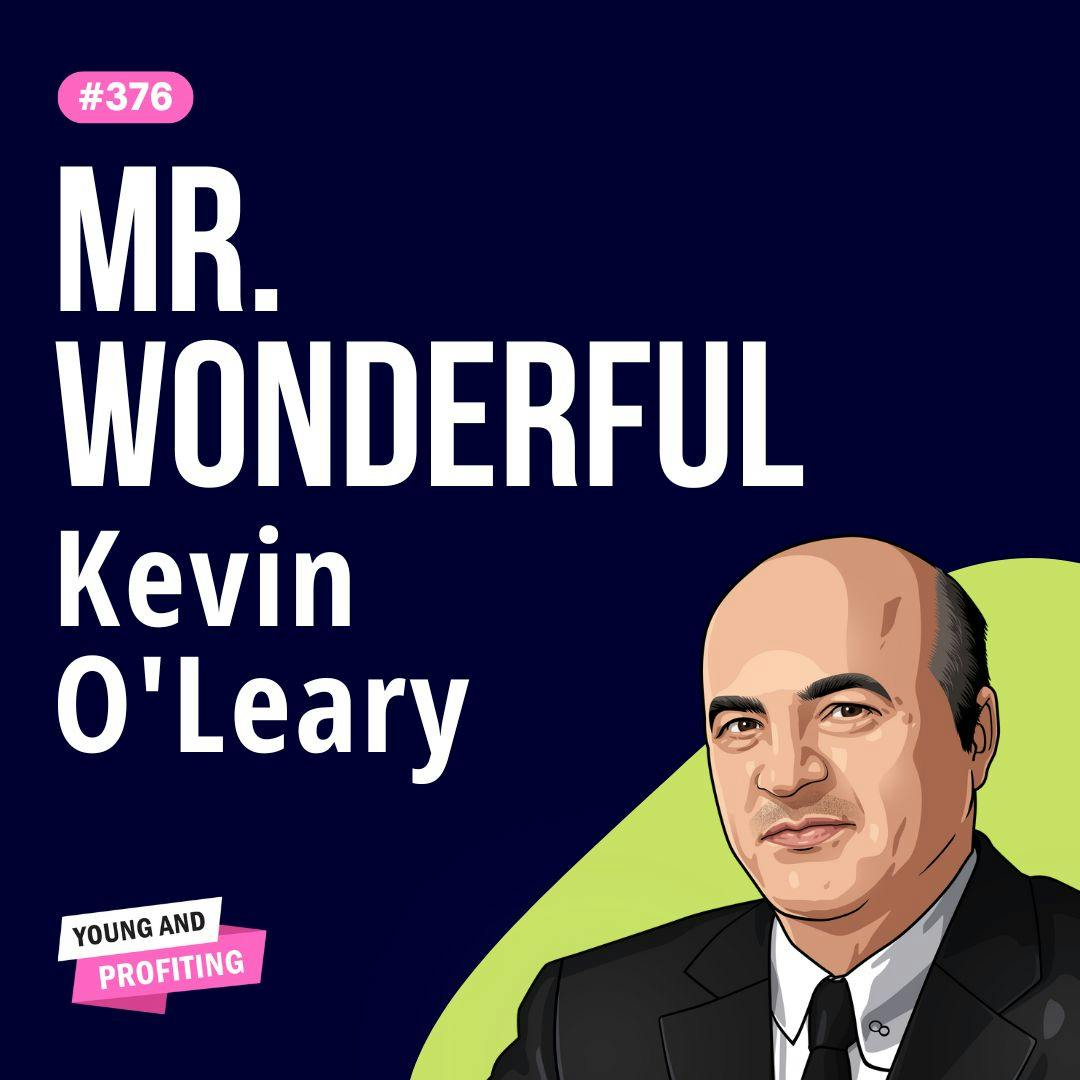
Kevin O'Leary: The Game-Changing Habits That Set Top Entrepreneurs Apart | Entrepreneurship | YAPLive | E376

1h 16m
Now on Spotify video!

Starting a business is brutally hard, and Kevin O’Leary is a living example of that truth. Despite early failures, he went on to build and sell The Learning Company for $4.2 billion in one of the most competitive tech markets in history. As an investor in over 50 companies, he can spot true entrepreneurs from a mile away and knows exactly what it takes to stay in the game. In this episode, Kevin exposes the harsh realities of entrepreneurship and shares the essential traits, skills, and strategies that separate successful founders from those who fail.

In this episode, Hala and Kevin will discuss:

(00:00) His Early Life and Path to Entrepreneurship

(06:04) Kevin’s Rules for Scaling Beyond $5M

(14:05) Lessons From a $4.2B Business Exit

(22:37) Transitioning From Operator to Investor

(27:42) Managing the Highs and Lows in Business

(32:32) What Makes a Successful Entrepreneur?

(36:51) Rating the Traits of True Entrepreneurs

(46:29) High-Performance Habits for Entrepreneurs

(01:01:16) The Power of Creator Entrepreneurship

Kevin O’Leary is a serial entrepreneur, venture capitalist, and television personality, best known as “Mr. Wonderful” on ABC’s Shark Tank. He co-founded and built The Learning Company, which was later sold for $4.2 billion, making it one of the largest tech exits of its time. Kevin is also the Chairman of O’Leary Ventures, as well as a bestselling author, global speaker, and advocate for entrepreneurship and financial literacy.

Sponsored By:

Indeed - Get a $75 sponsored job credit to boost your job's visibility at Indeed.com/PROFITING

Shopify - Start your $1/month trial at Shopify.com/profiting.

Revolve - Head to REVOLVE.com/PROFITING and take 15% off your first order with code PROFITING

DeleteMe - Remove your personal data online. Get 20% off DeleteMe consumer plans at to joindeleteme.com/profiting

Spectrum Business - Visit Spectrum.com/FreeForLife to learn how you can get Business Internet Free Forever.

Airbnb - Find yourself a cohost at airbnb.com/host

Northwest Registered Agent - Build your brand and get your complete business identity in just 10 clicks and 10 minutes at northwestregisteredagent.com/paidyap

Framer - Publish beautiful and production-ready websites. Go to Framer.com/design and use code PROFITING

Intuit QuickBooks - Bring your money and your books together in one platform at QuickBooks.com/money

Resources Mentioned:

Kevin's Website: kevinoleary.com

Kevin's LinkedIn: linkedin.com/in/kevinolearyshark

Kevin's Instagram: instagram.com/kevinolearytv/?hl=en

Kevin's YouTube: youtube.com/channel

Active Deals - youngandprofiting.com/deals

Key YAP Links

Reviews - ratethispodcast.com/yap

YouTube - youtube.com/c/YoungandProfiting

Newsletter - youngandprofiting.co/newsletter

LinkedIn - linkedin.com/in/htaha/

Instagram - instagram.com/yapwithhala/

Social + Podcast Services: yapmedia.com

Transcripts - youngandprofiting.com/episodes-new

Entrepreneurship, Entrepreneurship Podcast, Business, Business Podcast, Self Improvement, Self-Improvement, Personal Development, Starting a Business, Strategy, Investing, Sales, Selling, Psychology, Productivity, Entrepreneurs, AI, Artificial Intelligence, Technology, Marketing, Negotiation, Money, Finance, Side Hustle, Startup, Mental Health, Career, Leadership, Mindset, Health, Growth Mindset, Side Hustle, Startup, Passive Income, Online Business, Solopreneur, Networking

Press play and read along

Runtime: 1h 16m

Transcript

Yeah, fam, I have to admit, Revolve takes all my money. I spent all my money at Revolve, it is by far my favorite place to shop.
I've been shopping there for years.

And I recently moved from Jersey City to Austin. And when I got here, I realized that I needed a wardrobe upgrade.
In New York, I went out, it was always like really fancy mini dresses and heels.

Out here, it is cool girl Austin vibes. People are wearing baggy pants, they're more casual, and I seriously needed new clothes.

I recently did a fall pant haul and I got all new pants and I just can't wait to wear them. I totally fit that Austin girl vibe now.

And I'm so obsessed with Revolve because they've got all the amazing trends and brands that you could ever imagine. They've got inclusive sizing from extra, extra small.

And also they've got men's clothes. So I have been buying my man a bunch of clothes on Revolve because I'm also trying to have him match my style.

And since it's that time of year, you've got to check out the Revolve holiday shop.

They've got sparkly dresses, cozy sets, and the cutest gifts and every holiday look that you need, all curated in one place.

And for you young and profiting men out there looking to upgrade your wardrobe, you've got to check out Revolve for men.

If you don't think you have good fashion sense, just go on Revolve and buy some stuff. You'll be fashionable after that.

Whether it's a weekend away or a big night out or a holiday party, your dream wardrobe is just one click away.

Head to revolve.com slash profiting, shop my edit and take 15% off your first order with code profiting. Fast two-day shipping, easy returns.
It's literally the only place you need to shop from.

That's revolve.com/slash profiting to shop my favorites and get 15% off your first order with code profiting. Offer available for a limited time.
So happy shopping.

There's so many people that want to believe, oh, the market changed. Oh, the competitors changed their prices.
Oh, there was dumping on the market from China. Yada, yada, yada, yada, yada, yada.

Bullshit, all bullshit. The founder and the CEO, they are the person who failed.
Unless I hear that, I never invest in them. In this episode, episode, we're diving deep with the one and only Mr.

Wonderful himself, Kevin O'Leary. Kevin is a world-famous entrepreneur, investor, Shark King star, and a self-made multi-millionaire who's turned setbacks into strategies for massive success.

Entrepreneurship is a disease, actually. It's a virus, and it never sets you free.
And so you have to know that. And the more successful you are, the harder you work.
You're never going to be free.

And then you have to decide, what's my life balance like? Well, there isn't any. That's a bullshit concept.

You know, when I go to a value, a company, there's only two people I want to talk to before the CEO. Just those two people will tell you, is this a good business or not?

I want to meet the person runnings and I want to meet the head of a lot of entrepreneurs forget to do this. Get that first 5 million really secure in your name.
I like that goal. It's a good goal.

It's enough to push you, but you're not going to stop working. You're going to keep going.
So what needs to change at 5 million to then hit 10 and 30 and 100?

At the 5 million point, you need to transition from being the entrepreneur to the leader. And many fail at that point because

hello, young and profiters. What does it take to build an empire, sell it for billions, and stay on top when the stakes are sky high? In this episode, we're diving deep with the one and only Mr.

Wonderful himself, Kevin O'Learty. Kevin is a world-famous entrepreneur, investor, shark tank star, and a self-made millionaire who turned setbacks into strategies for massive success.

We'll talk about how Kevin built and sold the learning company for $4.2 billion,

why culture clashes can destroy great businesses, and the biggest lessons he's learned from decades of investing in over 50 companies.

Kevin also shares his secrets to staying focused on what matters, cutting through the noise, managing the emotional roller coaster of entrepreneurship, and using storytelling and personal branding to dominate in today's creator economy.

Believe me, you don't want to miss this conversation. And without further delay, Kevin, welcome to Young and Profiting Podcast.
Thank you, Ella. Great to be here.
I'm so excited for this interview.

I've been watching Shark Tank for years. It was actually like the show that me and my family always watched.
I think Shark Tank's older than you are.

I wish.

But I watched it all the time, and now I'm running a company that's about to hit eight figures this year.

And I feel like Shark Tank was really one of the things that inspired me when I was growing up. So thank you for all the work that you've done for young entrepreneurs.

Yeah, we're very proud of the platform. We certainly didn't know when we started out what would happen.

The first three years, it was canceled three years in a row. And

it was kind of interesting that Disney just kept it going. And we found out that Willow Bay, Iger's wife, was part of the reason.
Her kids were watching it. She loved the show.

She was an advocate for us. And then, of course, season four, it exploded.
It's just like a classic in terms of TV. And you guys have done so much.

So, Kevin, you're one of the most recognizable businessmen in the world. You're an extremely successful entrepreneur.
But what was Kevin like growing up? You know, I was like any other kid. I

was really very interested in that time in photography. And I was part of the photo club in my high school.
And I told my father I wanted to pursue photography and film production.

And he said, you're going to starve to death. You're just not good enough.
You just, you got to realize you're competing with a million other people who want to do the same thing.

And there's nothing special about what you do. And that's, you would think that would be very hard love to hear from a stepfather, but he was factually correct.

And it forced me to take a different path to pursue some business education, which ended up being immensely valuable, but not for the education I learned later.

I don't remember anything I did in my MBA at all, but I met all these people that went on to become leaders in pretty well all 11 sectors of the economy. And I can phone them today and

get instantly through to them and use them as my network. Business school is not about

balance sheet training or income.

If you're successful at an entrepreneur, you're going to hire a bean counter. So I don't do the books anymore, but I certainly needed that network to get ahead in those critical years.

And I'm glad I did it. I'm glad I spent the time.
So an education isn't worthless, although there's lots of billionaires that never finished high school. Yeah.

So if somebody was considering going to college or getting an MBA now, would you say it's necessary or don't do it? No, I wouldn't say it's necessary. I would say it's

the reason you would do it is to understand for 24 months you're in a cohort of some of the most incredible people from around the world because these institutions, I teach at them, these Ivy League schools, they curate an international group of people that are extraordinary.

And it doesn't mean they're all going to be successful, but they all have unique attributes and they kind of build these cohorts around each other.

So there you are, put into this place where there's some really smart people challenging your ideas for two years.

And you have to defend for yourself, but it has nothing to do, you know, it's when I teach these classes myself, I walk in there and I say, look, everybody, you're all going to forget me.

It doesn't matter. But the real value in this class

is you, is these relationships you're forming in here. You should never forget that.
And I think that's a wonderful thing. And if you can get in, it's worth it.

And, you know, that to me was what made it worth it. And now I know that with certainty because I'm decades past it.

I got a 4.0 in my MBA, and I don't remember anything from what I actually learned, but I didn't go to an Ivy League school. And I have to say, like, I didn't really get connections from it.

So I feel like if you go to an Ivy League school and you can get into an Ivy League school, maybe it's worth it.

But otherwise, well, the brand helps, Harvard helps, MIT helps, any of these Ivy League names, I get it. But I think the education, I'm glad I did it.
And it certainly set me up to do.

And by the way, I went right back into photography afterwards, but I figured out how to turn it into a business. I started making films for the NHL for Saturday hockey games.
I built a business.

We eventually sold it called Special Vent Television. It was my first exit.
So I kind of got in the groove of being an entrepreneur from the things I was passionate about.

And that's the secret to entrepreneurship. You want to do it in something that you're willing to work 25 hours a day, eight days a week, because some guy in Mumbai or Shanghai is kicking your ass

because they're working that hard. Let's talk about how you actually got your start into entrepreneurship.
I heard that you've only had one job in your life and you got fired on the first day.

It's true. It's the ice cream story, Magoo's ice cream parlor.
It was the name of it. And

I wouldn't scrape the gum off the floor because the girl I was hot for in high school was selling shoes across the mall and she was watching me.

And I thought the only reason I took the job was to hit on her afterwards so we got off you know six o'clock but um yeah she whacked me and it was very humiliating and it actually was so important because it really gave me the understanding of there's the people that own the store and there's the people that scrape the shit off the floor and i didn't want to be the guy scraping i wanted to own the store and and and i owe her a great um

you know sum of gratitude. And I went back to find her decades later when I could afford to bulldoze the whole mall myself if I wanted to, but I'd already been bulldozed.
So I never found her.

But most entrepreneurs I talk to have that definitive moment that pushed them on the path towards entrepreneurship, that somehow their lives are changed and they get this burning desire to pursue something where they're in control of their destiny.

Doesn't mean they're always successful, but if you don't have that fire, you don't have that passion and you're not willing to take that risk, you're not going to succeed. Yeah.

So you have so much money, right? But you're still working and you could retire today, of course.

So so what actually drives you in entrepreneurship i don't need more money um i need more time there's so many things i'm pursuing now that interest me i'm able to invest in almost all of them they don't always work out but enough are you know successful i mean the whole thing about money that that um

A lot of people don't understand, you're going to find this out as time passes and only the experience of going through it gives you the knowledge because nobody believes this when, when, you know, if you're an entrepreneur and you can sell $100,000 of the product to people that are not your relatives, that's the first thing because your aunt will always buy your shit from you.

Yeah. But that's useless.
You got to sell it to an arm's length person who wants the product and the service independent of the fact that they want to help you.

They want to be served a product that helps reduce a pain point for them. They're willing to pay you money for it.
If you can do $100,000 of that, you can do $500,000.

If you can do $500,000, you can do $5 million.

If you do five million, you can do fifty. If you do fifty million, you can do half a billion.
That's how it goes. But at the five million point,

that's when the whole system tests you because

you need to be able to build a team. You need to transition from being the entrepreneur to the leader.
Yeah.

And many fail at that point. And I see this when I invest in them.
And I have to take them behind the bar and whack them eventually.

They're still shareholders, but they don't have the leadership skills, the ability to lead people so that you can get the leverage to build a business past 5 million.

But really, what's driving you, if you're going to do that, is

you're competitive and you want to win. And

I never thought about ever the money when we were doing the journey on my big exit, the learning company. Neither of the other nine guys that were sort of founders.

We just one day woke up and someone bought our company for 4.2 billion and we were all,

filthy rich. And

that didn't change anything.

We still went back to work the next day.

It's weird, but it just doesn't matter. It's great to have the liquidity, but it doesn't really change your life that much.

And so people should understand that it's

all you really need in the bank to be secure for the rest of your life is $5 million.

And I tell every entrepreneur that go well past that,

the discipline is get $5 million

and put it in T-bills. And just look at it.
It's just sitting there and don't touch it. Because

if poo-poo hits the fan,

you're still good. What are T-bills in case people don't know? Treasury bills, U.S.
Treasury bills. You know, you can also buy gold, but it doesn't have any yield.
I have T-bills.

I roll a bunch of T-bills. That's my f ⁇ you account.
And it always has been. I've never touched it.
And, you know, I buy dinner with the interest.

So you never touch it. And then whatever you make off of it, that's what you spend.
Trevor Burrus: Well, that's the protection. I had that goal decades ago.
I mean, it's more than five.

It's grown over the years. I just leave it in there.
But it's something that gets you, that sets you free.

It's a lot of money, but... A lot of entrepreneurs forget to do this on their way.

They keep rolling all the dice all the time. They don't take anything out.

And something goes wrong and they end up with nothing because it puts too much leverage on their business or something happened. It's get that first 5 million

really secure in your name and then look at it on your phone every day and say, I've achieved that. Yeah.

I like that goal. It's a good goal.
It's enough to push you, but it's not, and it's enough to make it safe for you and your family, but it's certainly you're not going to stop working.

You're going to keep going. Something that you said reminded me of what Brandon Dawson talked to me about.
So he's a co-founder of Cardo Inventures, and he's like a very successful entrepreneur.

And he was telling me there's like three pivotal moments for entrepreneurs, like hitting 1 million, hitting 10 million, and 30 million. And like each one of those stages requires different things.

You say, you were just saying like 5 million to you is like a pivotal point. So what needs to change at 5 million to then hit 10 and 30 and 100?

Yeah, you won't get past five if you haven't started to build a team because no one is perfect in all aspects of business. You have to hire to fulfill or fill in.

It's like a crack in the wall you put plaster on.

You have to find and understand your own weaknesses and hire people that are strong in that attribute and give them equity in your business, make them your partner.

It's sort of like Steve Jobs and Wozniak. I worked for those guys in the early 90s.
They were both brilliant, but they had completely different skill sets.

They couldn't have made it without each other. It was impossible.

But it's because

they had that partnership and they were able to build it together, knowing they couldn't do it without each other.

You will find out what you're weak at by the time you hit five. You may start it on your own and be just the sole proprietor, own all the shares, but your cracks will start to show at 5 million.

Now, it might be in logistics, it might be in compliance, it might be in accounting. It might be whatever it is.

You have to hire the person that's going to take that off your back so you can focus on your strengths. I'm sales and marketing.
That

in that I trust.

Very few people are better than I am at that. And that's arrogant, but I know I'm right.
And so that's my competitive weapon. You can't touch me.
But I am shit at logistics.

I don't care about worrying about the bookkeeping. I want someone else that knows what they're doing to do that.

Manufacturing, distribution, all that crap.

To me, the only reason those people exist is to serve my needs as the sales guy. There are no widgets if I'm not selling them.

So I value the salesperson in the head of sales is more valuable to me than the CEO.

I can always replace the CEO, but I can't replace a great saleswoman or a great salesman because they know not only their product inside out, they know their distribution channel, they have relationships with their buyers or whatever it is.

It's all about sales. And so, you know, when I go to evaluate a company, there's only two people I want to talk to before the CEO.

I want to meet the person running social media and I want to meet the head of sales. And I take them out for dinner separately.
We drink really good wine on my tab.

Everything goes better with a couple of bottles of wine. You're going to learn a lot more.
And

then

I know two things, what the sales distribution channel feels like and CAC and ROAS, customer acquisition costs and return on ad spend.

Just those two people will tell you, is this a good business or not? Because if they know what they're talking about, and I know if they know right away,

all I'm doing is pouring gasoline on the fire.

and building the business because they've already figured out the business model.

Now, it doesn't mean I whack the CEO, but usually you find out often the CEO is not the original founder and they don't have that much stock.

It's some guy that found the company that's still in there that's the engineer or something. It's very, it's different every time.

But sales and social media are really what it's all about. I want to go back to talk about the learning company.
So you sold it for $4.2 billion.

And later on, the company basically failed after it was bought. And for me, I've got this company, Yap Media.
I've essentially been growing it for five years.

And selling it really scares me because I know that so much can go wrong after you sell your company. So walk us through, like, would you have done anything differently with that sale?

And like, how should we think about exits as entrepreneurs? So

that's a classic example of failure of meshing two cultures together.

The learning company was extremely entrepreneurial. It would do a new title every four months, maybe even every 90 days.
And it had a very tight relationship with retailers.

Back then, the distribution of software, all software was on CD-ROMs, slowly transitioning to online, but majority of titles, and particularly the gaming side, were all CD-ROMs.

And so there was retail distribution and shelf space and purchases online and everything else. But it was CD-ROMs.

And so you would go to Walmart or Target or any of the large retailers that had multiple yards of shelf space for their software titles, like records.

And you'd have a planogram set up for an annual basis, and you would always hit your target. So, if you're going to drop a new version of Oregon Trail, you're going to make 12 million copies.

You have to manufacture them, you've got a massive logistics problem, you're going to deliver them to every Walmart and every Target and everywhere else they were going.

And you never missed that slot because the retailer was giving you maybe 18 inches of space, which is extremely valuable for six or seven facing SKUs.

And so, when we hit Walmart,

when we were doing our plans, one of the great advantages was they had these incredible brands like Fisher Price and Barbie and

American Girl. And so what we had modeled out in the learning company so successfully is I had a job decades earlier just for the summer

between my first and second year of MBA.

Nabisco Brands. And I worked for a Dutch product manager who had Miss Mew cat food.

And I, and I, it's remarkable how experiences in your life that you inventory in your brain that you don't use for a decade come back and serve you later. I guess they call that experience.
Yes.

My first day on the job, my Dutch

boss basically said, look, you're going to be here for four months, and I want you to launch two new flavors.

so that we can get more shelf space on Miss Mew.

But you should understand something about cat food. There's only two engines of protein.
It's beef renderings and chicken faces, which are boiled in papaya juice and compressed,

or it's tuna from the Sea of Japan, dark, the underbelly of tuna. That is your protein base.
Your job is to dream up a flavor on one of those two engines of protein.

So whether it's going to be bacon bits or egg bits or green pepper, and you call that the flambé or something, whatever it is.

Because the cats don't have credit cards, it's their owners that buy the flavor. And they say, Well, I think Kitty would love that one.
And so you have to dream up a flavor.

And I was pretty good at that.

But the thing that hit me when I went to the rendering plant to see the two stacks of protein manufacturing, like the face of a cow getting scraped off the skull and getting boiled in papaya juice, was pretty fucking freaky.

Excuse my language, pretty freaky. I mean, it really freaked me out.
And then slabs of tuna.

But

two engines. It was two engines.
And everything else was just

marketing. Years later, I'm looking at our business at the learning company.
And we're, you know, we're just, we're growing, but we had lots of competitors. And I said to my partner,

because I had a fantastic, because my weakness was logistics, so I found a partner and became partners in the business. I was sitting with him one day in the office around six at night in Boston.

I said,

I want to tell you a story about this trip to the rendering plant and hear me on this. Because if you looked at our business, 80% of it was advancing math and reading scores.

So we had math rabbit, read a rabbit, this title, that title. We're advancing these two scores that parents bought the titles for to advance those scores for their children.

Because

in school, you got to, it's math and reading all the tests, right? So we would advance math and reading scores. We were pretty good at it.

And I said,

if those are the two engines, math and reading,

why do we have all these programmers? Why don't we just get two teams that just do math and reading core code, and then we add a license, like, you know, Big Bird, or we get, you know,

whatever, you know, character we would go license, whatever it was. It was Big Bird.
It was the Muppets. It was, whatever it was.
And we just

slammed it on top of one of the engines. And my argument was our kids are four years old.
They don't care if it's the same software. They're four and they're five and they're six.

They just want the character. So we can license the character.
We can fire two-thirds of the coders, which are really expensive, and just use the two

tuna and beef.

That was the moment that changed everything. And he said,

I love it. Let's do it.
And the shit hit the fan. There's even an article in the Wall Street Journal.

I mean, it's just, no one had ever done this in the software industry, the consumer software industry before. Our cost of capital dropped dramatically because our margins went up dramatically.

And we were so,

our valuation was so high that we used our stock to

do hostile acquisitions on all our competitors. We ate them alive.
And we fired all their programmers. And we just licensed our characters.

And we dropped our prices by 50% and we increased our volumes by 5x.

We took the software business down from $99

to $12.99

and we were profitable.

All from that magic moment with that Dutch product manager showing me beef and tuna.

I owe so much to that guy. But that's how life is.
It's serendipitous. You don't know the moment that's going to change everything.
We commoditized educational software.

We sold hundreds of millions of copies of it in multiple languages all around the world off the tuna and the beef. That was it.

And, you know, so when we tried to integrate that philosophy, going back to your original question,

I said to the CEO then, look, we're going to have to get the Barbie title out. in 90 days.
We don't need anything. We're going to do it off the tuna and beef.

She said, no, no, no, no, no. We're going to have to study this for two years.

I said, no, no, we're going to study it for two minutes because we have an order for 12,000 units the first day and 12,000 the day after that and 12,000 the day after that. It's the holiday.

We're putting it in for September. We've got $24 million worth of orders here just on the Barbie reading title.
And then we're going to do the American Girls title, same thing.

And then we're going to do the math reading, American Girls.

It didn't matter to to me, but the philosophy there was completely different, that these were very coveted brands, and I understand it.

But the amount of money we left on the table, the profit margins on just putting our own character onto a title, our margins were like 70%.

So we gave up hundreds of millions of dollars. And

that is what I call a cultural error because I didn't control the board, although I was one of the largest shareholders. And I went and saw the board and said, guys,

this is nuts.

But it put me in a conflict with the management there. But I lasted quite a while, explaining to them how to do it.

And unfortunately, it didn't work out for them because they went and said, no, no, no, let's wait two years. Two years, it's over in the software business.

We left hundreds of millions of profit on the table. Yap gang, what is one thing that every successful modern business needs? Rock solid internet, of course.
And you know, I get it.

Yap media runs fully remote. I've got 60 employees all around the world.
So if the internet cuts out for me, I can't talk to any of them and everything stops.

And I know every business owner listening in can relate because staying connected is everything these days. We've got to stay connected to clients and employees.
It's not optional.

It's the lifeline of any modern business. And that's why I love telling you about brands that actually help you win, like Spectrum Business.
They don't just give you internet.

They set you up with everything that your business could need. internet, advanced Wi-Fi, phone, TV, and mobile services, all designed to fit within your budget.

And they've got a killer deal right now. You can get free business internet forever when you add four mobile lines.
Think about that: free internet forever with no contracts and no added fees.

That means more money in your pocket to grow your business and less time stressing about connectivity. Visit spectrum.com/slash free for life to learn how you can get business internet free forever.

Restrictions apply, services not available in all areas.

Yap bam, of course, before I built Young and Profiting, I had a million doubts. Every time I thought about starting, it just felt so daunting.
I didn't know if I was cut out for entrepreneurship.

But one day, I stopped putting it off and I turned my dream into a reality. Step by step, I built my dreams.
And now I'm running a nearly eight-figure company.

I bet a lot of you guys out there are thinking about starting a business, but you need a little push. Take this as your sign.
It's time to stop thinking about what if and start doing.

And one of the easiest ways to do that is to use Shopify.

Shopify powers 10% of all US e-commerce from big brands like Gymshark to small business owners getting started.

You don't need a big team because Shopify handles everything from web design and inventory to customer service and shipping.

Their marketing tools help you find and keep customers and their point of sale connects online and in-person sales. Shopify even helps you sell globally in over 150 countries.

With 99.99% uptime and the best converting checkout on the planet, you'll never miss a sale. Turn those what-ifs into

and keep giving those big dreams their best shop with Shopify. Sign up for your $1 per month trial and start selling today at shopify.com slash profiting.
Go to shopify.com slash profiting.

Again, that's shopify.com slash profiting.

Young and profiters, can we take a moment and talk about something essential for anybody starting a business? I'm talking about your business identity.

When you're building an empire, you've you've got to think about what the world sees and what stays private inside your business. Things like legal documents, security, and especially privacy.

I get it. Starting a business can feel really overwhelming with all the paperwork, but imagine building your complete business identity in just 10 clicks and 10 minutes.

That's where Northwest Registered Agent enters the equation with reliable, straightforward support. They've been helping founders for nearly 30 years and have over 1500 corporate guides.

These are real experts who know their stuff and can help you. When I was first figuring figuring things out with the app media, I would have loved something like Northwest Registered Agent.

For just $39 plus state fees, they set you up with everything you need to start a business: an LLC, domain name, business email, local phone number, business address, and even a registered agent.

Plus, they help you protect your identity by using their address instead of yours on state documents. That commitment to privacy is why I feel confident endorsing them.

They treat your data with respect. Don't wait.
Protect your privacy, build your brand, and get your complete business identity in just 10 clicks and 10 minutes.

Visit northwestregistered agent.com slash paid yap that's paid YAP and start building something amazing. Get more with Northwest Registered Agent at Northwestregistered Agent.com slash paid YAP.

So I know that you were essentially in this business for over a decade, right? Oh, yeah.

Once you were out of the business, I know they bought you, you're still working in there, but once you were actually out of the business, did you have any sort of like identity crisis?

Did you go through anything mentally? Well, I had a non-compete for 36 months. I was getting my full salary, and

although I think that's illegal today, but back then it wasn't.

And so I said to my family, look, why don't we go visit every beach on earth? Let's make it a mission to go to every great beach on earth just for the hell of it.

And after about 90 days of doing that, I was bored out of my mind. I just, I said, what am I doing? This is crazy.
I'm not in the game. And so

I immediately said, okay, I talked to my lawyer, I said, what are the confines of this non-compete? I don't want to get into litigation. What else can I do?

And he said, well, you can be an investor and you can start investing in startups and you can go on boards and you can.

And I immediately said, okay, I'm going to do real estate. And I started doing that.
And I got into climate control storage. And I started to diversify into all 11 sectors.

And, you know, my operating days were over and my investment days were starting. And I was going through a transition

of from being the, you know, the operator guy to being the investor guy. And how old are you at this point? I think I was

36. Oh, wow.
So maybe

40, I don't, around then.

And I was, you know, pursuing my passions, watch collecting.

I was always a film editor, and I wanted to keep my chops up and I was still cutting on an eight-plate steenbeck,

things like that.

And

then all of a sudden I started having some failures and successes on the investment side. And so I was starting to understand, you know,

I was starting to identify people and being able to read their traits to determine

which one's to back and which one's not to, which I've become, I think, very good at. And, you know, I can see the ones that have what it takes.

But it's really from the experience that I learned during that time.

And life got even more interesting because

today,

you know, in an average day, starting for me at 5.45, because I was riding my bike on Miami Boardwalk, along with a lot of other people do the same thing at sunrise.

And I'm listening to all of my messages or the feeds of the networks. I listen to BBC, Al Jazeera, Fox News, Fox, CNBC, all of them.

I just listen for the seven stories of the day because I'm often going back on those networks and

doing my contribution.

The phone will start ringing. And in any one-hour cycle, there will be a phone call of utter catastrophe.

Just got sued for $100 million,

product

food poisoning or something in the product line of a company I'm invested in, whatever, something catastrophic. Minutes later, total euphoria.

I just got an offer to be bought up for a quarter of a million cash and you're crossing shareholder, are you going to agree with this deal or not? I'm thinking to myself,

you have to learn how to be,

what's a great word for it?

You can't get emotional about this. Like stoic.
You just have to realize that for every catastrophe, there's euphoric outcome. And by the end of the day, your life is balanced again.
So I just wait.

I wait for the bad news. I wait for the good news.
And I just roll with it. And I found it very, very interesting to see how that plays out.

And our portfolio is now 54 companies, plus a bunch of other stuff we do.

But

I will say that

that was quite a journey to understand how that works because you can hit me with, I mean, people,

you're getting sued or something.

I don't give a shit. Like, it just, you know, people that sue me, and I get a lot of litigation, these are, you know, there's contingency lawyers.
I always say to them,

go back and look at the last 30 lawsuits and show me, can you outlast me?

Because I know how you work. You're a single cell amoeba contingency lawyer.
You're only going to be able to hold this up for seven years and I will outlast you.

And your partners will say, we got to give up on this guy. But you should know that now.

Because, you know, I got a lot of this crap. It's one of the bad things about the system.
But

I love to f with them. Yeah.
I really like to f with them. It's really powerful what you're saying.
You're saying, like, don't, you know, get too excited about the highs.

Don't go so down when there's anything bad happening in the lows. So for new entrepreneurs, that's really difficult.

Like entrepreneurship, sometimes it can feel like you're just getting punched in the face over and over again.

And sometimes it can be really good. But how can we better manage those highs and lows? What advice do you have? It's important that you get punched in the face.

It's important that you get bloodied and get knocked down multiple times. It will never be an easy ride, ever.

No matter what you think and no matter what you think your plan is, it won't be that that works. It just never is.
And so really what the punch in the face is teaching you is how to pivot.

And the more you get beaten to a pulp, the better it gets because you start to realize, if I go in that direction, I'm getting another smack right in the face. I'm going to go in this direction.

It's less painful. It's sort of trying to figure out the path of least resistance based on your experiences of what didn't work.

But I have never met anybody that's been successful ever that said it was easy, that ever said they were able to take the original business plan and execute on it, because that never, ever, ever happens, or didn't go through hell on earth to get to where they are.

And so

only one-third of the population can do it. That's it.
And I'll tell you a story that I think is very important that I always bring up for everybody to think about. We talked about business school.

You and I have both been there. In my last week in the second year,

they they were getting

Jamie Diamond kind of guys would come in and lecture about their sector and people are going to go work in financial services or whatever. And

this guy came in, I'll never forget it, never.

It's probably the only one I'll ever remember of all the guests we had that week. And he didn't say anything for like a minute and a half.

You know, the amphitheater type thing, there's a staircase up the sides, and you've got 240 people sitting in this thing and got the name plate in front of you.

He just looked at everybody

for the most uncomfortable period of time.

And then he finally said, oh,

MBAs,

you think you're so damn smart and you're just going to get out there and kick the world's ass and you just can't wait to leave here. Well, let me tell you what's really going to happen to you people.

A third of you are going to become consultants and leave a life of mediocrity and never make a decision of consequence in your life and eventually go to consulting hell when you die.

Because it's true, about a third of the class were going to become consultants.

And they were going to lead a life of mediocrity and never make a decision of consequence. They were just going to be consultants, which is such a waste of a life.

And then he said, a third of you think you're entrepreneurs and you're going to try and you're going to fail over and over and over again until you're an employee again because you don't have what it takes.

Very depressing. And a third, he said, are going to work like hell for much longer than you think.
And you will make it, but it will change you forever. It's so hard.

And I leaned over to Barry, my guy beside me, I said, this guy is such an asshole.

But today, that guy is me. Because when I meet my new cohort, I give them the same speech because he was right.
He was 100% right.

And so it's sort of, you learn that as time passes, that the journey for entrepreneurship

is into the valley of death.

It has to be or you will never be successful.

And when you get out of the valley of death and you all of a sudden have your five mil in your T bills and you're working even harder than you started because you're trying to do something else.

Entrepreneurship is a disease, actually. It's a virus.
And it never sets you free. And so you have to know that.
And the more successful you are, the harder you work.

It's never, you're never going to be free. And then you have to decide, what's my life balance like? Well, there isn't any.
It's a bullshit concept. It's bullshit.

The idea, oh, I'm going to have time for my family. That's such shit.
That's such bullshit. You might as well face it.
You're going to work like hell.

And as you grow a family, you better have a better, significant other that can take time to raise them because you won't have any. And I know that sounds like a sacrifice because it is,

but you will buy your family freedom. That's what you will do.
Now, do you feel like some people are not cut out for entrepreneurship at all? And do you feel like

there's some people who can be, you know, some people are natural entrepreneurs. I think you're a natural entrepreneur and some people can be taught.
What are your thoughts on that?

I think you have to have certain personality traits that, I mean, for me, it's marketing and sales. Other entrepreneurs have great technical skills or whatever.

Everybody has something that they are particularly good at that's in their DNA. But there are attributes you learn over time because you're getting punched in the face, as you brought up earlier.

These are important lessons that give you ammunition for the future not to make those mistakes again.

There are some lessons, and I've talked about this quite a bit lately,

that I find very, very important

that

I have to share with you, because everybody should listen to this. When working for jobs, for Steve Jobs in the early 90s,

he

not a nice guy, that's well documented, but he had a concept that I'll never forget, and I've used it, and it really works, and he changed me forever with this.

He said, in any day, in any 18-hour working day, because he worked 18 hours a day, the guy was unbelievable. What a ferocious guy.
I mean, damn. You never met anybody like him.
I hadn't, anyways.

He said, there are three things you have to get done

in this one 18-hour cycle. That is called the signal.
Your ability to know what the three things are is what you must learn. But once you know what the three things are, that is the signal.

And all the things that will happen that stop you from getting the three things done is the noise.

And the ratio must be 80% signal, minimum 20% noise, or you will fail. Wow, was he right.
Yeah.

And so, if you can learn to do that, nothing could stop you. Unfortunately, one of the problems with this strategy, as you will find,

is you will have no time to suffer fools. You don't have any time.
So, if somebody comes at you with something that's clearly noise,

you don't have any time for them.

And

they take it personally. Yeah.

I don't give a shit. Because what I've learned is they will come around when they realize that you're achieving your goals and you're executing.

They will stay part of your team because they want to be led by somebody that gets it done and wins. And you can only win if you understand that you must get the three things done.

You don't need friends in business. You need people that respect you.

I'm trying to teach this. You don't need to make everybody happy because you can't.
It's impossible.

You want to make your friends and family happy, which is probably no more than 15 to 20 people that matter to you in your life. Everybody else is either noise or signal.

And you have to treat them that way because that's the right way to treat them. That's the fair way to treat them.
That's what helps them get their job done.

And I go through this every day. Now, the only guy that I've seen that's higher ratio than Jobs was

is Elon Musk.

100% signal. Will not waste one nanosecond on noise, which makes him very awkward socially.

He'll walk away from conversation two seconds the minute he knows it's noise. Really? So if you're not contributing towards getting something done, see you later.
Ask anybody that works for him.

But boy, do they want to work for him because look at the success he's achieved. People want to follow a successful leader.
So

as an entrepreneur, your job is not to make everybody happy. You will fail.
You can't make everybody happy. You want to respect people.
You want to honor them.

And you want their respect. But don't try and make them happy.
Not going to work.

Yap, we have a super unique company culture. We're all about obsessive excellence.
We even call ourselves scrappy hustlers. And I'm really picky when it comes to my employees.

My team is growing every day. We're 60 people all over the world.
And when it comes to hiring, I no longer feel overwhelmed by finding that perfect candidate, even though I'm so picky.

Because when it comes to hiring, Indeed is all you need. Stop struggling to get your job post noticed.

Indeed, sponsored jobs help you stand out and hire fast by boosting your post to the top relevant candidates.

Sponsored jobs on Indeed get 45% more applications than non-sponsored ones, according to Indeed Data Worldwide. I'm so glad I found Indeed when I did because hiring is so much easier now.

In fact, in the minute we've been talking, 23 hires were made on Indeed according to Indeed Data Worldwide. Plus, there's no subscriptions or long-term contracts.

You literally just pay for your results, you pay for the people that you hire. There's no need to wait any longer.

Speed up your hiring right now with Indeed, and listeners of this show will get a $75 sponsored job credit to get your jobs more visibility at Indeed.com/slash profiting.

Just go to Indeed.com/slash profiting right now and support our show by saying you heard about Indeed on this podcast. Indeed.com/slash profiting.
Terms Terms and conditions apply.

Hiring, Indeed, is all you need.

Yap gang, here's the truth. In business, cash flow isn't just numbers on a spreadsheet.
It's the fuel behind every smart move that you make. Cash flow powers your business.

At Yap Media, we've trusted Intuit products for years now. And I can tell you that Intuit QuickBooks is essential when it comes to our cash flow and ensuring that we have strong cash flow.

They have powerful money tools that are built right into the platform that help you get paid faster and pay your bills smarter.

With QuickBooks Money Solutions, you can say goodbye to manual bill entry and reduce manual work by half. No more juggling passwords and nine different spreadsheets.
QuickBooks does it all for you.

QuickBook Money Tools bring in your money and your books together in one platform with real-time insights into your cash flow.

I'm logging on to QuickBooks every single day, checking out the health of my business. So with QuickBooks, you know what's coming in, what's going out, and when you should act.

To transform your cash flow and your business, check out QuickBooks Money Tools today. Learn more at quickbooks.com slash money.
Again, that's quickbooks.com slash money. Terms apply.

Money movement services are provided by Intuit Payments Incorporated, licensed as a money transmitter by the New York State Department of Financial Services.

Hey, App Fam. As an entrepreneur, I've been thinking a lot about digital privacy lately because naturally I'm in the public eye.

You know, I'm all about protecting my money and assets, but I never really thought about how much of my personal information might be floating around online.

So I decided to run a delete me report and wow, I was not ready for what I found.

My phone numbers, past addresses, even my relatives' names like my mom and sister were all listed on these data broker sites because of me, because of my website, because I'm an entrepreneur.

And it felt weird knowing that anybody could buy that info with just a few clicks because I decided to start a business. This was a total wake-up call for me.

And that's why I personally use and trust DeleteMe to protect myself and my family. I don't want people knowing my phone number, or where I live, or where my family lives, or their phone numbers.

And Delete Me searches for your personal information across hundreds of data broker sites. They remove it.
They keep checking all year to make sure that data doesn't come back on those sites.

And you even get a privacy report that shows where your data was found and what got deleted.

If you're online at all, if you're an entrepreneur who has a business, chances are that your data is online for people to buy.

Get 20 off delete me consumer plans to get rid of that data when you go to joindeleatme.com slash profiting and use code profiting at checkout again that's joindeme.com slash profiting with code profiting at checkout p-r-o-f-i-t-i-n-g that's join delete me.com slash profiting So you mentioned earlier that you've invested in 52 or so companies.

You obviously have been on Shark Tank for a very long time.

You know what founders, what successful founders look like, what entrepreneurs that are really successful sound like, and all their different traits.

So, I thought we could play a fun game called rate the traits.

And basically, I'm going to list off a trait about entrepreneurship. And you're going to let me know: is it a 10? Is it a one? We'll rate them one through.
10 is the high score. 10 is the high score.

Got it. I'm interested.
I'm interested. All right.
So, we're going to rate them one through 10:10 being really needed for successful entrepreneurship, one being not so needed. Okay.

First prompt:

creativity:

10.

Why?

That's problem solving. That's when you get punched in the face.
If you don't have a creative bone in your body, you're just going to keep getting punched in the face.

You got to think outside of the box. That is the definition of creativity.
You have to realize: ouch, that hurt. I don't want another punch like that.
How am I going to solve for that? That is

using the brain.

Okay, next one. High risk tolerance.

I'm going to give it a five. Risk tolerance

can also be stupidity. Doing things because you, oh, I can take the risk, I can take the risk and keep failing.
You're an idiot. I mean,

the whole idea is to mitigate risk. In fact, I'm going to give it a one.

Don't do stupid stuff. Like, don't do it.
Don't don't keep risking it all over and over again. The whole idea is to find the path of least resistance without the risk.

But it's it's true that when you launch, you're taking huge risks. But as you build it past the first hundred thousand, you want to stop taking the risks and start to mitigate the risk.
So it's

the launch itself, you need some kahunas because most people say, I don't want to do it, I'm not going to do it. You have to try, even though you're going to fail three times at least, probably.

But the four, you only need one hit to make it to get your five mil ski. Yeah.

Okay, being able to tell good stories, so your storytelling ability. 10.

10, 10, 10, 11.

The world's changed so much

that if you can't tell the story of your product or service, if you can't capture someone's imagination about the promise of your brand, you will fail.

Storytelling is the whole deal because we are living in a social media customer acquisition cost model now for large and small companies.

Great storytellers, people that can capture the audience, capture the potential customer, bring them into

the aura of the promise of the brand. These are great entrepreneurs.
These are great social media directors. These are great editors, storytellers, videographers, photographers.
They tell stories.

And you know what? I'm going to give it a 15.

That's how much I feel about it. Wow.
Charisma.

Not important. I'll tell you why.
I do business and invest in a lot of assholes that have no charisma, but they have remarkable executional skills.

Charisma can be also bullshit.

You know,

you want sexy charisma, you show me executional skills. That's sexy.
The fact that you can set a goal each quarter and hit it, that's charisma.

So, you know, traditional definition of charisma is bullshit when it comes to being an entrepreneur. Industry experience.

Yeah, I'm going to give it an eight and I'll tell you why.

There's a concept developed in Europe decades ago, hundreds of years ago, in places like Switzerland and France, Germany, Italy, where they create apprentice programs where they bring talented as young as 14

and they

let them work for a stipend and a free lunch or whatever after their school at 4 o'clock till 7 at night so that they can experience what it's like to work in a business and understand what the passion is of that business, whether it's watchmaking or pharmaceuticals or tire making or high-end machinery in Switzerland, whatever it is, to see if they have the attribute or the DNA to connect with what that's about.

Particularly important in the watchmaking industry. When they identify you to be a master watchmaker when you're 14, you're going to commit your whole life to it.
I know a lot about that. And

that's industry experience, but at a very early age, so you can find out, do you connect with the cosmos of that business? And is that your path for your life? You don't know until you try. Yeah.

Okay, last one. Failing fast.
Yeah,

that's a buzzword in the valley.

I don't put a lot of weight on it. I'll tell you why.
I'm going to give it a two, but here's the rule that I've put in place. In your launch years, in your mid to late 20s,

and you've decided you're going to pursue the entrepreneurial path, One of your most important assets is time.

So,

and I've seen this countless times with entrepreneurs.

I meet them in their fifth year of beating a dead horse that just never took off, but they're so emotionally attached to this piece of shit idea that they're going to bankrupt their parents through mortgaging their parents' home.

I mean, I've seen it so many times. If after 36 months,

It's not working and by working I mean it's growing and it's profitable and you clearly have figured out out how to acquire customers.

Take it behind the barn and shoot it. I'll do it for you.

Good bottle of wine, shoot it behind the barn because it is killing you.

It is sucking your energy and it is basically taking away from the most valuable thing you have the time to start a new idea.

Entrepreneurs deal with failure. They have to because they're going to fail.
There's no such thing

as just starting something out of the basement. It happens so rarely that it won't happen to you.
I can tell you that.

You can't, I prefer to shoot them after two years. If in 15 months they haven't figured out CAC, customer acquisition, they're going to fail.
Yeah.

And why spend any time on a dead idea that didn't work? It's okay. It didn't work.
Who gives a shit? Move on. I much prefer to invest in entrepreneurs that felt the sting of failure, but understand.

So, you know, fail fast. If it means take it behind the barn and shoot it early, great.
But shoot it.

And don't let anybody tell you, no, you got to keep on going and wasting everybody's time and money. Because remember, the people that you're employing, you're also hurting them.

You have a responsibility to tell the truth to them and say, look, this idea didn't work. I'm going to fire you with this best, you know, package I can give you.
But I'm also starting something else.

You get a lot of respect for that.

You really do to admit failure and own it. And the thing that drives me crazy about people, and I'm telling you to listen to this because

I get pitched a lot. And I say, well, what did you do before this? What were you doing last two years? And they talk about a business and they tell you it failed, but it wasn't their fault.

They'll tell you every reason on earth why it wasn't their fault.

Bullshit.

They should own it. It's 100% their fault.
They were the founder and the CEO. It wasn't anybody else.
They are the person who failed.

Unless I hear that, I never invest in them. There's so many people that want to believe, oh, the market changed.
Oh, the competitors changed their prices.

Oh, there was dumping on the market from China. Yada, yada, yada, yada, yada, yada.
Bullshit, all bullshit.

They failed. So accountability.

100%.

And some of them walk away in tears when I force their nose into, you know, when a puppy takes a shit in the house and the first time you're going to roll up a newspaper, stick his nose in it, give them a little whack, they never shit in the house again.

I stick their nose in their failure and I whack them with a newspaper and say, this shit is your shit. You dumped this.
You failed. Now smell it.
That's what has to happen.

Well, that was a fun game. Is there any other traits that you you want to call out that you think makes a good entrepreneur? Yeah, I'm going to give you some interesting

points that

I learned. You know,

after all this time and investing in so many different people, and after a few years, I start to see which ones are successful. And I look at their traits.
And let me give you some.

Remember, these are in different sectors. They don't know each other, different businesses completely.
And yet they're successful versus ones that are not so much.

Because even in a venture portfolio like mine, maybe three out of 10 really work. And what do you consider a successful business? Like, how big do you have to grow before you can? Well, you know,

the classic venture capital model is if you invest in 10 deals, five years later, two have gone bankrupt.

Six of them are living dead, just sucking your time. They're not going anywhere.
They should be shot behind the barn, but they won't shoot them. And two of them made a thousand X

and they paid for all your mistakes. So, you know, as an investor, you want to focus on your winners, and you got to figure out which ones are losers and winners.

We do a little bit better on Shark Tank deals because we have 110 million eyeballs seeing the product in syndication, so our customer acquisition costs are lower.

So they'll call it three to four out of 10 work.

So even a marginal business works on Shark Tank. One of the reasons you want to get on Shark Tank is that free eight minutes of network television on in perpetuity and syndication.
It's crazy.

Ask any entrepreneur. Their product just keeps showing up on television every night.
Yeah. It's pretty good.
And so we want to invest in companies like that. But what happens is

you look at the traits of those people in the winners. And let me tell you what they are.
Very boring in some ways, but you'll find this fascinating. Number one, this may sound crazy, but it's true.

Diet.

Somehow, along the way, they've decided that

food is important to them.

Not some crazy Atkins diet, none of that stuff. The rule that I learned from two of them, and they didn't even know each other, was they look at their body weight.

Let's say they weigh 150 pounds, they eat 150 grams of protein a day, one gram for each pound, which is very hard to do, by the way. Very hard.

But you don't have to modify your diet that much. You just have to decide what you're eating.
And it has to be more protein-based. There's lots of ways to do it.
There's lots of apps.

You can use LoseIt. It's free.
You just take a picture. AI tells you how many grams of protein you're serving, and it just adds it up for you during the day.

And the other app that I use, because I'm doing this myself now, is Yuka, Y-U-K-A.

Scan any snack and it tells you a score from zero to 100. Anything lower than 60, don't put it in your mouth.
After about 10 weeks of just following this protocol,

your energy level goes through the roof. It's unfing real how good you feel.
That's number one. Number two, the classic exercise.

All the entrepreneurs that are successful have found a way to spend some portion of the day exercising. Sometimes it's only 10,000 steps a day.
That's it. I do cycling.

Those two together kind of this one is really interesting see I'm wearing an aura ring here I got into this about four years ago a great entrepreneur showed me this product was more of a prototype back then sleep

you know

decision making

and critical thinking

and sleep go together.

So you really want to try and figure out sleep. And it's not just any sleep.

These rings and these other devices, there's many other devices, break down your sleep into the REM sleep and the deep sleep. You want REM sleep.
That's your brain being cleansed for the next day.

Unfortunately,

sleep doesn't work with alcohol. And this is a big problem for me.
I don't drink. I mean, sorry, I don't smoke.
I don't do drugs, but I love wine.

And if you drink wine three hours before you go to bed you don't get any REM sleep it really

your sleep so the strategy you got to go to is drink at breakfast

and don't drink again because at the end of the day if you can get those seven hours the sleep the the diet and the exercise you can't believe

how you feel As an entrepreneur, you need that energy and you're going to get it.

And most of my entrepreneurs are hip to this now now and are struggling with the whole wine thing, or they're moving to the purest tequila or something, or they don't drink it before they go to bed, or they don't drink three days a week, or whatever it is.

Everybody's trying to solve for this alcohol problem because all the rings are showing you you get no rem

and one last one, and this is the one that

I really have learned,

and you got to try it. Entrepreneurs, once they're successful or

growing their business, get in a rut. They only want to do things that give them a good outcome because they've been trained and they've been punched in the face so many times

that

they get into this routine of only doing the things they know well over and over and over again all day long.

And it's easy to get there, particularly when the team is humming, sales are coming in, everything's going great.

But the one most important exercise you're not getting is that on your brain because you're now in the maintenance mode.

And that's not where great creativity comes from.

So you have to get into a position, and this is very, very difficult, but I've done it, and believe me, it works. And I learned it from one of my great women CEOs years ago.

She said, you've got to spend a portion of every day outside of your comfort zone in some space that you're very nervous about getting into because you're scared you're going to fail and you're you're going to be embarrassed in front of your team or in front of your family, or you can't do it, or you don't think you can do it.

It could be learning how to play the cello, it could be painting, it could be mahjong or something, or chess, or it doesn't matter.

It's something you don't know how to do that you're forcing your brain to deal with and the uncertainty.

This gives you a superpower because you're basically recharging your ability to solve problems that you have no idea how to solve. And 50% of the time, you're successful.

This is the superpower for really good entrepreneurs to do. And yet no one wants to do it because, oh, I don't want to be embarrassed.
So I'm telling you the story because last year

I got a phone call

from one of my agents and he said, listen, Kevin,

have you ever heard of Josh Safety? He said, yeah, that's the guy that directed Uncut Gems. And Ronnie Bronstein wrote it.
It's a great movie, Adam Sandler, dark comedy.

He said, he's making a new movie called Marty Supreme.

And they're looking for a real asshole, and they think you're it. I said, I don't act.
He said, yeah, I know that.

And I'm just telling you, if you're going to pursue this, you could shit the bed and destroy your brand. You could look like a real dick.
But that's when it hit me.

I got to do this.

I got to try it. I got to see if I can learn 70 pages of script.
How do I do that when I'm dyslexic? How am I going to memorize all that stuff? I said, f it, do it. Like, just see what happens.

We finished it a few weeks ago. It had some screenings.

And the buzz for Timothy Chalamet. So it's Timothy Chalamet.
I'm Gwyneth Peltrow's husband. It's a movie from the 50s.
Amazing. Yeah, it was shot in New York, in Tokyo.

And the experience was remarkable. But

the buzz for that movie, and this has really not that much to do with me because I'm just a supporting actor, is Oscar. So I would love that thing to win.
I'd like Timmy to win one.

I'd like the director to win one because that would be great for my little contribution in that. But I worked on that for eight months.

It was totally outside of my comfort zone. So I'm waiting to see what audiences think when they see me in it.
So go see that movie, Christmas Day. Amazing.
You know, Marty Supreme.

But the point is, do something today outside of your comfort zone, whatever it is, because you're not doing that. I know you're not doing that.
No one's doing that. And it's a superpower.

What do you feel like you learned from, you know,

you were in this movie? Like, you weren't just like a little blip at the movie. It sounds like you were in it.
No, I played a role as

the richest man in America, married to, you know, in a loveless marriage with Gwena Pelch. It was very dark.
I'll tell you what I learned,

and I could have never known this until I was in the moment.

When you make a movie like this, particularly a period piece, and you have a great director like Safdi, what he wants to do is create an environment with like 100 extras. And

we took over the Plaza Hotel from 7 at night to 7 in the morning. And

I'm just remembering this one sequence we shot all night long.

When you close your eyes before he says action, and everything on the table is vintage 52, your clothes are 52, your watch is 52, everybody, the menu is 1952, the art is 52, everything around you is 1952.

All of a sudden, you magically transform to 1952. You're there, you're in it, and everybody is in 1952.
And it's not, you're not acting anymore. You're just there.

You're just being your character in 1952 with everybody else in 1952. And magic happens.

And by the time you do the 40th take, you are definitely, you know, in the zone because you're doing it on film and they have to move the single camera back and forth and you're there all night long.

I remember that day in New York when that day was over. It was a very, very important scene, which if you see the movie, you will definitely remember this scene.

It's dark. It's dark.
But

I was so wired when I got back to... Cassa Chipriani's in New York where we were staying, my wife and I.

It was 7 a.m. And I went upstairs to the restaurant and I said, Look, I want the scrambled eggs and I want some smoked salmon and I want a 1922 or 2022 bottle of Montrache.

You said, sir, it's 7 in the morning. I said, not for me.
It isn't. I just got back from 1952.
I need a bottle of Montrache. And I called my wife, said, Look, I'm drinking up here.

And she said, what are you crazy? It's breakfast. I said, no, I'm just so wired.
I'm just so

stuck in 52. I got to snap out of it.
It's like if you're dyslexic, sometimes the world will shift 180 degrees and you have to shake your head and get back. It snaps back.

I was in that kind of a mode. I had to get back to 2025 and I didn't want to go back to 2025.

It was so magical to be in the birthplace of entrepreneurship in 1952 in America because that's where the American Dream started in Brooklyn back then. And that's what the movie is about.

And so I was, I mean, it was emotional for me. It was crazy.
And damn, that Montreché was good.

That's how that experience was. And it comes out Christmas Day.
I can't wait to see you. You got to see it.
I mean, I'm so proud of the work. I mean, I just dying to see what people think.

Okay, let's switch gears back into your investing in other companies. I learned that you only invest in profitable companies.

That's not quite true.

The larger investments, that's astute on your part.

If I'm going to put in $5, $10, $15 million,

it's into a business model. It's proven it's profitable.
And I'm just negotiating my liquidity, my position on the cap table, what I bring to the table, what my team brings. It's a negotiation.

That's really the majority of what I do. But I also have a massive,

you know, I feel that all of us on Shark Tank can become ambassadors to the American dream.

And so we invest in many, many, many startups. And my job is to figure out, you know, which ones to back.
But I have learned something about this whole Shark Tank journey that goes to this point.

I always thought

a decade ago that people thought of America our number one export is probably technology or energy. It's not.
It's the American dream. That's what we export.

And Shark Tank's just part of that whole thing. The number one thing that we export around the world is the idea that you can start with an idea and change your life forever with it.

So that's what Shark Tank's about. But most of my larger investments are, as you suggest, They're in profitable companies.
My job is to make them more profitable.

But I also do my own startups outside of Shark Tank. Recently, I just did Wonder Care

watch insurance

for people that own watches, because if you put it on your home package, you may find this out the hard way.

Many home package insurances with a rider for watches of jewelry, they give you the depreciated value. Watches do not depreciate.
Rolex goes up in value over time.

So you want to get the replacement price. So that's what we offer at Wondercare.

To do that business, I partnered with seasoned professionals on the tech stack of AI to be able to scrape insurance data so we could issue policies through AI.

Wonderful relationships with companies like Chubb. You know,

I'm one shareholder in it. I think I'm the largest shareholder because I funded it from the beginning, but

I probably won't end up remaining the largest shareholder because I'm going to bring a lot of talent in. We just hired a new CEO.
And it's growing. Business is growing.
And so

that's from scratch.

And I'm very fortunate, as you are, I have millions of followers, followers, millions of followers, and they all know I'm a watch guy. So my customer acquisition cost is zero.

I just do my own 15-second ads on my own social media, and I say, look, I'm selling this product. I use it myself, and here's why.

And I'm fortunate enough to issue policies without any customer acquisition costs. I don't know anybody else in the insurance industry that has that luck.

So you're bringing up a topic that I feel like I talk about on almost every show now, which is creator entrepreneurship. I feel like that is totally the future.

Having a personal brand is so important, especially with AI coming out and just the ability that it's like everybody can start a business, but what is actually going to differentiate you?

And I think what it is, is your ability to create content and grow on social media and be a creator entrepreneur.

What are your thoughts about personal brand and the importance of it as an entrepreneur? You're more than 100% right. You are more than 100% right.

It's the greatest opportunity this economy has ever offered an entrepreneur. It's extraordinary.
But it goes back to something you said earlier: storytelling.

If you don't have the ability to tell a story, you can't do that. Personal brands are built on remarkable,

authentic, passionate relationships with communities that you're building. People smell bullshit a mile away on social media.

If you're not authentic, if you're not honest, if you're not telling the truth, you're going to get slaughtered, beyond canceled.

I mean, so the brands that are working are the ones that say, look, here's what I am. Here's what I do.

This is the way I see it. You may not agree with me, but I'm always going to be true to what I believe in.
And whether it's a product or a service,

the people that fail at this think that somehow they can attach celebrity to any product and sell more of it. People smell that bullshit so far away.

The only products I ever associate myself with, I eat my own cooking. I would never, ever endorse a product I don't use, ever.
I get offered that all the time.

Well, we'll pay you to say this is great. I don't know it's great.
I'm not using it and I never would use it. You know, it's just not what I want.
It's not an easy path, but when you start

what you have on your, if you're good at it and a good storyteller and you're authentic, you get advocates. They become your community.

They tell others about how important their relationship with you is.

And that is a remarkable outcome. Yeah.
It is the ultimate, ultimate entrepreneurial experience. I'm part of this entrepreneurship group called Hampton.

And there's like 10,000 of us and a Slack channel all across America. And I'm probably one of the only like real creator entrepreneurs.
And I find that like, I don't relate to them at all.

Like, I don't relate to them at all because I feel like all their problems for me, it's like I'm coming out with a new LinkedIn offer that's going to be for small business owners.

And to sell it, like I just have the idea and I'm just going to, you know, put it online and run a couple webinars and I'll be sold out basically. And so like, it's just like so simple.

I have an idea and I just put it out and, you know, operationalize it. That's because people trust you.
They know who you are. I mean, it's all these, these communities are built on trust.

They're built on a someone who believes what you said and believes you will deliver what what you say you're going to deliver and the experience will be a positive one and if they buy or use the product again a second time they will experience the same they did on the first that's a brand being built and that's what the whole deal is about and you can't do that unless you're authentic and you deliver what you said it's why the bloom is off the rose on a lot of celebrity endorsements now because they're not being transparent and honest.

They don't actually use the product.

I mean, you can't endorse 16 products. You possibly can't use them.
The model's changing.

That's why you can emerge as a creator out of nowhere because you're authentic and all of a sudden have, you know, 10 million followers that believe you.

I think it's a great and powerful force, but also it's a dark side. Look what happened to Bud Light.

They did that themselves. They didn't think about who their customer was.
And they shot themselves in the foot multiple times. They stored billions of dollars with a market cap.

I mean, it was unbelievable. That's the dark side of social media, but shows you the power of it.
Yeah. One of my weaknesses, I would say, is that like, I'm not the best at finance, right?

So I have a business partner who does like a lot of my finances. And I know that you mentioned

one of the things that you say see entrepreneurs fail at is not knowing their numbers. Yeah, it's a big problem.

So what would you say are the key metrics that founders, CEOs should be following for their business? If you don't know your numbers, you better get somebody who does, as you've done.

You have to have somebody that gives you the dashboard of your business every day. I mark to market my business business portfolio, all positions, every day, right after four o'clock.

And I work with my finance team to say, okay, there's something happened over here, something happened over here. I see this cash came in, this account, and this bank.
What was that about?

Because I don't recognize that revenue stream. You know, every single day, I spend maybe 20 minutes just going through the top line.

of where I'm anticipating revenues coming in from whatever business, whether it's a royalty or whether it's a stock that's going public or whatever it is, every day.

And what I find is that keeps me sharp and it keeps me in touch with the ebb and flow of revenue and margin and free cash flow. And so that's what I focus on.

If you don't have that skill, you need somebody who

has it because that's a really big problem

if you don't do that. And I think, you know,

you will fail if you can't read. I saw that you were just looking at your watch and I noticed you were in two of almost.
Oh, yeah. This is actually New York time and this is local time.

So I end my show with two questions that I ask all of my guests. The first one is, what is one actionable thing our young improfiters can do today to become more profitable tomorrow? Learn AI.

Find out which models you can rent for your business because there is plenty of product on the market now that will enhance your margins and your productivity.

Every single one of my companies now is using AI, most of it primarily for content generation, but they're also using it for all kinds of analytics and data scraping. It's very inexpensive today.

Every single one of them is using it. And so if I'm looking at business and they're not using AI, I mean, it's not that complicated.

It's very easy to adopt it and you will find ways to save money almost immediately. I mean, some of these models you can rent for $129 a month that do incredible things with content.

So save yourself a ton on creating content for your social media. And what would you say is your secret to profiting in life? And this can go beyond finance and business.
I would say

going back to focus on the signal, my secret is I'm able to focus on the signal now every day. I know what's signal, I know what's noise.
I don't let noise slow me down.

And, you know, that's why they call me the mean shark. That's complete bullshit.
I just tell the truth. But I'm focusing on signal there, and I'm determining what's important

for me. And the things that matter for that day, that just that day, just the three things that day.
It's not that complicated. Not next month, next year, whatever.
It's that day.

What do you got that I got to get done? I'm going to get it done. And I do it day after day after day after day.

And the more confidence you build, and then I'm really into this mantra of getting up in the morning feeling good because the diet and the exercise and the sleep, it's such a game changer.

You know, that old mantra about you sleep on the sofa, you only get two hours sleep because you're that amazing entrepreneur. That is such crap.

The guys that are winning, and even Bezos talks about this, he doesn't make big decisions after noon. He doesn't want to be tired.
He does the sleep thing. He does the diet thing.

He does the exercise thing. And you want to make those decisions.
I can even think last week, I was riding the bike. It hit me.

I had an idea and boom, I had had that thing executed by four in the afternoon. And

I think it's going to make me a ton of money. Yeah, I love that.
Kevin, thank you so much for your time today. I really appreciate it.
Where do you want to send everybody to?

I know that you're so visible online, but where do you want to send everybody to? I'm on all the platforms at Kevin O'Leary TV.

Come and see me anywhere. I love my community and we have a lot of fun together.
And I love the discourse. I love to get into the debate with people

because there's always a pro and a con to everything. And I think that's what's great about life that we have a great discourse and we, you know,

we chart the path. I support entrepreneurship in America.
We create 72% of the jobs.

That's my army. Thank you, Kevin.
You are such a role model. Thank you for all that you do.
I know me and a lot of entrepreneurs really look up to you. So thank you.
Thank you.

I appreciate that so much. Take care.
Well, guys, this was such an important interview for me.

It was a full circle moment because I've admired Kevin for so long and I grew up watching Shark Tank together with my family.

One of the takeaways I found most powerful today was Kevin's signal versus a noise framework that he learned from Steve Jobs.

Every single day has three critical tasks that will actually move your business forward. That's your signal.
Everything else is noise.

The ratio must be 80% signal, 20% noise or less, or else you'll fail. This isn't just productivity advice.
It's a complete mindset shift. Stop trying to make everyone happy.

Stop wasting time on things that don't matter. You don't need friends in business.
You need people who respect you.

Kevin also reminded us that getting punched in the face is essential to entrepreneurship. Every step back teaches you how to pivot smarter.
But here's the brutal truth.

If your business isn't profitable after 36 months, take it behind the barn and shoot it. Your time is your most valuable asset, especially in your 20s and 30s.
Own your failures completely.

No excuses about market conditions or competitors. The moment you can smell your own failure and accept it, that's when the real growth begins.

And I loved Kevin's emphasis on fueling your body for peak performance. One gram of protein per pound of body weight, consistent exercise, and seven hours of quality sleep.

These aren't just wellness tips. They're competitive advantages that sharpen your decision-making when the stakes are highest.

Remember that Kevin said, entrepreneurship is a disease that never sets you free.

But if you have the guts to focus on your signal, own your own setbacks completely, and take care of your mind and body, then you have what it takes to make it through the valley of death and come out the other side victorious.

Thank you for listening to this episode of Young and Profiting Podcast.

If you listen, learned, and profited from this conversation with the incredible Kevin O'Leary, then share it with somebody who needs to hear these hard truths about entrepreneurship.

And if you enjoyed this episode and learned something valuable, I'd really appreciate it if you left us a five-star written review on Apple Podcasts, Spotify, or Castbox.

Your support helps more people discover young and profiting and allows us to bring a powerhouse guest like Kevin O'Leary on more often.

You can also find me on Instagram at Yap with Hala or LinkedIn by searching my name. It's Hala Taha.

And before we wrap up, I want to give an incredible shout out to my guest outreach team for always being on top of their game.

Shout out to Hisham, FurCon, and Joshua for absolutely crushing it and for snagging an incredible guest like Kevin O'Leary.

Until next time, this is your host, Hala Taha, aka the podcast princess, signing off.