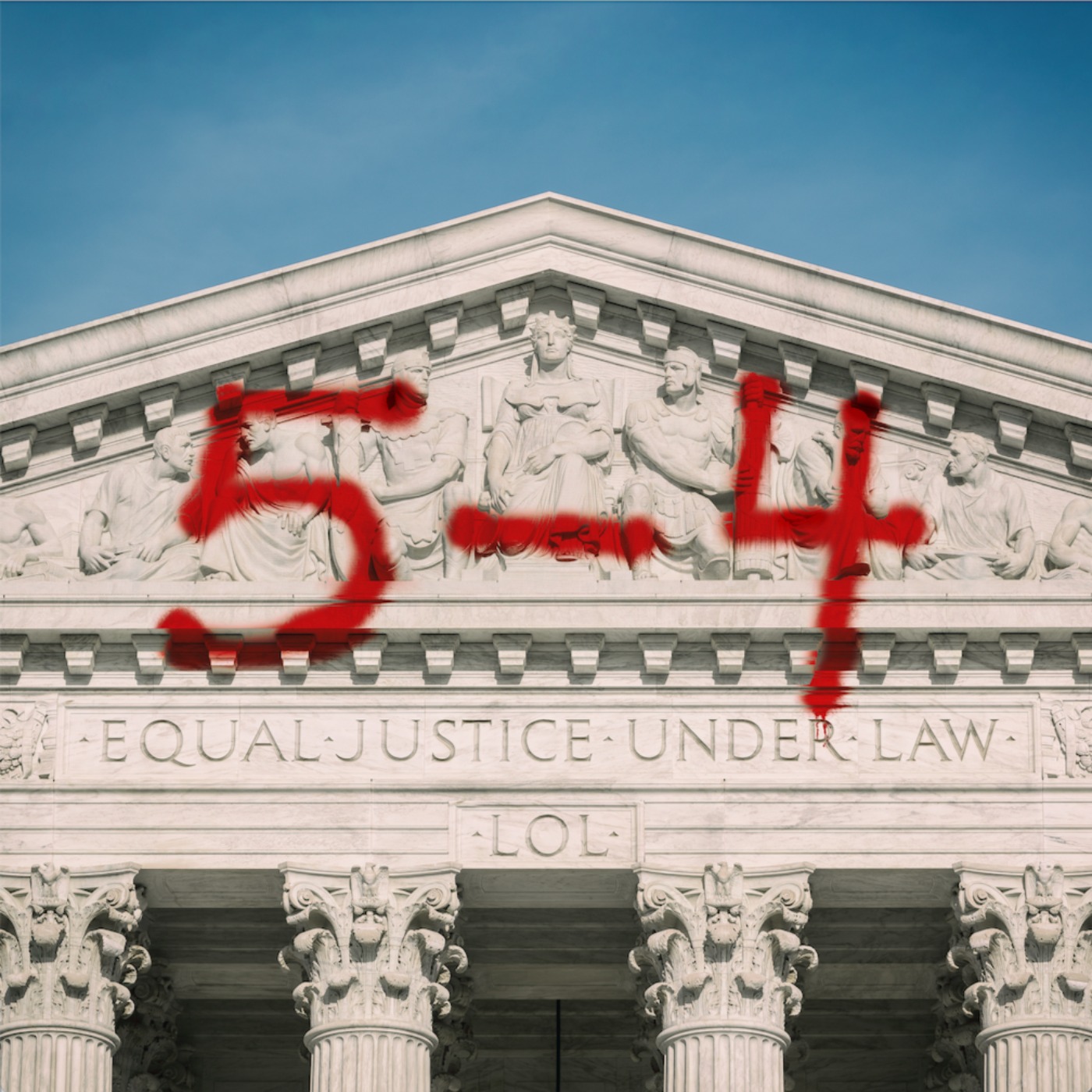
Securities and Exchange Commission v. Jarkesy
White collar ass crime...
You can subscribe to 5-4 Premium on Patreon, Apple Podcasts, or Spotify.
5-4 is presented by Prologue Projects. This episode was produced by Benjamin Frisch. Leon Neyfakh and Andrew Parsons provide editorial support. Our researcher is Jonathan DeBruin, and our website was designed by Peter Murphy. Our artwork is by Teddy Blanks at Chips NY, and our theme song is by Spatial Relations.
Follow the show at @fivefourpod on most platforms. On Twitter, find Peter @The_Law_Boy and Rhiannon @AywaRhiannon.
Hosted on Acast. See acast.com/privacy for more information.
Advertising Inquiries: https://redcircle.com/brands
Press play and read along
Transcript
Speaker 1 We'll hear argument this morning in case 22-859, the Securities and Exchange Commission versus Jarkusi.
Speaker 1
Hey everyone, this is Leon from Prologue Projects. On this episode of 5-4, Peter, Rhiannon, and Michael are talking about SEC v.
Jarkusi, a case that hinges on the right to a trial by jury.
Speaker 1 Specifically, whether white-collar criminals, when prosecuted by the SEC, are entitled to a jury trial.
Speaker 2 I mean, it's a really interesting question that Justice Barrett raises because I think it appeals to this intuition. Like, we know jury rights are very important, and everybody agrees with that.
Speaker 2 And the idea that you would have it in one place and not have it in another place is, well, why is that?
Speaker 1 In a 6-3 majority, the conservatives on the court issued a ruling that weakens the power of government regulators and will result in more white-collar crime going unpunished.
Speaker 1 This is 5-4, a podcast about how much the Supreme Court sucks.
Speaker 1 Welcome to 5-4, where we dissect and analyze the Supreme Court cases that have wrestled our rights to the ground, like Miami police taking down Tyreek Hill.
Speaker 1
I'm Peter. I'm here with Rhiannon.
Hey. And Michael.
Very upsetting. Very upsetting.
Upsetting to my co-hosts as a public defender and a Dolphins fan.
Speaker 1 Those fucking pigs in Miami. Getting into an argument with Tyreek Hill and then getting violent immediately.
Speaker 3 Yeah, doing what the pigs do.
Speaker 1 Of course, cops as a whole, a great institution. These are simply the rare bad actors that always appear during every interaction with police that ever gets recorded.
Speaker 3 Those pesky bad apples, man.
Speaker 1 I'll never get over people using the bad apples phrase because the phrase is a few bad apples spoils the bunch. Right.
Speaker 1 That's the whole point. Like, that's the point of the phrase.
Speaker 1 Well, this is like how
Speaker 1
pulling yourself up by your bootstraps was originally a tongue-in-cheek thing. Right.
Like, you can't. And then conservatives just started using it.
Speaker 1 They don't understand metaphors in any meaningful sense.
Speaker 1 Or irony or satire. Yeah.
Speaker 1
Today's case, SEC v. Jarkassy.
This is a case from just this term about due process for white-collar criminals.
Speaker 1 In the wake of the Great Recession, Congress passed Dodd-Frank, a bill designed to more aggressively regulate wrongdoing in the financial industry.
Speaker 1 One thing the bill did was allow for the SEC, the Securities Exchange Commission, to adjudicate matters internally.
Speaker 1 It used to be that if someone committed financial fraud, for example, the SEC would file a lawsuit against them in federal court, but after Dodd-Frank, they could bring an action against the person before the commission itself.
Speaker 1 Generally, there would be an administrative law judge, an ALJ, present, but no jury. And the administrative law judge could make a determination and, if necessary, impose a fine.
Speaker 1 This was important because the SEC doesn't have the resources to litigate these cases in federal court, nor could federal courts handle the caseload.
Speaker 1 So without these in-house adjudications, you basically just have a huge amount of white-collar crimes going unpunished.
Speaker 1 This guy, Jarkasy,
Speaker 1 he was your run-of-the-mill hedge fund fraudster, misreported some information to the SEC.
Speaker 1 But after he was brought before the SEC, he said that this was all a violation of his constitutional right to a jury trial.
Speaker 1 And the Supreme Court, in a six to three decision, agreed with him.
Speaker 1 So we are going to go over the court's really sloppy reasoning here in a minute.
Speaker 1 And we're also going to talk a bit later about why exactly we don't really care whether this guy receives a jury trial or not.
Speaker 3 Since this case is actually about disempowering the administrative state in a different kind of way, fresh new flavor, I think we should start just broadly with like what the SEC does.
Speaker 3 Like why is it an an important administrative agency that operates the way it did until the Supreme Court fucked with it in this specific way, right?
Speaker 3
And of course, we know that the Supreme Court has taken swipes. of course, at agencies like OSHA, the FDA, the EPA.
We've talked about a lot of those cases.
Speaker 3 We even talked a few weeks ago in our episode on the Loper case about how the Supreme Court did away with chevron deference, which, you know, puts the federal courts in the position of answering like all these little questions about the scope of federal agency powers rather than deferring to the agencies themselves.
Speaker 3 This case is like another way of stripping administrative agencies of power, this time with the Constitution, using a constitutional argument.
Speaker 3 So, yeah, jumping in, like, why is this an important federal agency that should have administrative powers to regulate?
Speaker 3 The SEC, that's the Securities Exchange Commission, is a federal agency that's tasked with enforcing federal laws against market manipulation.
Speaker 3 This is the agency that oversees American financial markets, the trading of stocks and bonds, mutual funds, investment advisors, those guys.
Speaker 1 All the people we love. Yeah.
Speaker 3 A big part of what they do, of what the SEC does, is preventing fraud.
Speaker 3 The SEC has an enforcement division that investigates violations of securities laws and regulations, and the SEC brings legal actions against violators. Peter mentioned Dodd-Frank.
Speaker 3 That's the Dodd-Frank Wall Street Reform and Consumer Protection Act. It's a big, big federal law passed in 2010 that totally overhauled financial regulation in the U.S.
Speaker 3 after that Great Recession, 2008, 2009 era.
Speaker 3 Part of what Dodd-Frank did was allow the SEC through that enforcement division I just mentioned to do administrative adjudication of fraud claims without a jury trial.
Speaker 3 So that means like for fraud claims, you weren't going to federal court and having a trial.
Speaker 3 In some cases, it would be an administrative law proceeding that the SEC enforcement division brought, and the case would be decided by an administrative law judge, not a federal judge in trial court.
Speaker 3
The SEC, big, big federal agency, has 1,600 administrative law judges, ALJs. They do something like 650,000 hearings a year.
This is a big part of what the SEC does.
Speaker 3 So, turning to this case, Jarkassy the jerk.
Speaker 3 Back in the late aughts, the SEC brought one of these administrative law proceedings against George Jarkassy, who had been accused of securities fraud against investors when he willfully made materially false statements to those investors, those are his clients, about their investment funds and like how much money they were making.
Speaker 3 He was lying to his clients.
Speaker 3 So, the ALG in that case, the administrative law judge, found him guilty guilty of that fraud, fined him $300,000, and required, here's some like actually kind of fun legal terminology, required disgorgement of $685,000 in ill-gotten gains.
Speaker 1 You got to disgorge that, George Jarcasi.
Speaker 3 Yeah, you've been gorged. You gorge in, and now you got to disgorge.
Speaker 1 You have to disgorge. Yep.
Speaker 1 That's the origin of the place, I believe.
Speaker 3 The SEC in that administrative law proceeding also barred
Speaker 3 George Jarkassy from participating.
Speaker 1
George Jarkassy is such a fucking ridiculous name. It's such a jerk-off name.
George Jarkassy, you must disgorge.
Speaker 1
It's so good. It's so good.
That's such a fit.
Speaker 1 I don't think it should be illegal for him to do what he did because I don't think that anyone who puts their money with someone named George Jarcasi
Speaker 1
deserves legal protection. But defrauded.
Yeah.
Speaker 3
You know, this decision is handed down. Jarkassy says, hold up, hold up.
Wait a minute. I want actually a jury trial.
Speaker 3 It's a violation of my constitutional rights for you to adjudicate this without giving me a full trial in federal court in front of a jury. And what do you know?
Speaker 3 But Jarkassie is very lucky in making this claim that some really important people agree with him, including the DeVos and Scaife families and the Koch brothers through, of course, their little quote-unquote grassroots organization, Americans for Prosperity.
Speaker 3 These evil fucks are circling the wagons, and they get this case all the way to the Supreme Court.
Speaker 1 So the majority here is written by John Roberts, our nation's chief justice.
Speaker 1 The heart of this opinion, and I'm going to boil it down to its component parts, and then we can sort of talk about the more complicated stuff later.
Speaker 1 But the heart of the opinion is the idea that the Seventh Amendment says that you have a right to a jury in civil cases, quote, in common law.
Speaker 1 So, this entire case is sort of about whether this qualifies as a common law case.
Speaker 1
Common law is law made by judges. Back when the Constitution was passed, there weren't many actual laws on the books.
Much of our law consisted of rules created by judges
Speaker 1 and passed down and refined over time. That's the common law.
Speaker 1 As time has passed, though, most of the important common law rules have been made into formal laws, statutes. So there's a question of what the Seventh Amendment means now in contexts like this.
Speaker 1
So back in 1977, there was a case called Atlas Roofing v. OSHA, where the Supreme Court heard this issue, and they held that OSHA could conduct its own internal adjudications.
And they created a rule.
Speaker 1 They said, okay, so the right to a jury applies to common law, but if Congress creates a new type of legal claim, that can be adjudicated by a federal agency like OSHA or like the SEC. Yeah.
Speaker 1 So on the surface, this case actually seems kind of simple.
Speaker 1 Congress passed a law creating a new claim, a new cause of action for securities fraud, basically identical to the OSHA situation from the 1970s. OSHA was created to regulate workplace safety.
Speaker 1
They adjudicate it internally instead of in courts. The Supreme Court said that was okay.
SEC does the same thing with securities. So this should be fine, right? Yeah.
Wrong. Wrong.
What?
Speaker 1 Wrong.
Speaker 1 John Roberts is coming for your ass.
Speaker 1 Roberts says that the exception to the Seventh Amendment, right to a jury trial, only applies when Congress creates a new claim or a new cause of action. Now, in this case, again, they did.
Speaker 1 The cause of action, right, which is just the basis for your lawsuit, that's securities fraud, which did not exist before.
Speaker 1 And Robert says, yeah, that's basically true, but securities fraud is similar to other types of fraud.
Speaker 1 And those did exist before. Those existed in the common law.
Speaker 1 So there's no exception to the Seventh Amendment. The SEC cannot do this.
Speaker 3 You have to have a jury trial.
Speaker 1 Yeah.
Speaker 1 So they're sort of having this debate about whether this is a common law claim.
Speaker 1 And the way they do that is they figure out, well, is it like this old type of claim that you trace back through the common law, or is it something new that Congress made?
Speaker 1 Now, this one, everyone agrees, is something new that Congress made. But John Roberts is like, yeah, but it's kind of like the old stuff, too.
Speaker 1 Right. So
Speaker 1 he's like, well, fraud is a common law claim. Therefore, securities fraud is basically a common law claim.
Speaker 1
And I just don't think that's right. I just don't think that's correct.
First of all, fraud is way too broad of like a category to be treated as if it's one thing. Right.
Yeah. Right.
Speaker 1 Fraud is basically like lying
Speaker 1 in an official capacity.
Speaker 3 You killed killed someone. Yeah, you pulled one over.
Speaker 1
You can't say that's just one type of crime. Yeah.
No.
Speaker 1
Securities, as they exist in modern markets or even as they existed in like the 1930s, back when the SEC was created, did not meaningfully exist at the time of the founding. No.
Right. No.
Speaker 1 So it feels like Roberts is stretching it pretty thin here.
Speaker 1
We're now dealing with this guy who's like managing billions of dollars for his clients. Back when the Seventh Amendment was written, come on, people were trading potatoes for onions.
All right.
Speaker 1 You cannot make this comparison in good faith. They were trading potato derivatives.
Speaker 1 Potato futures.
Speaker 1 Strike points. The strike price of potatoes.
Speaker 1 Sorry.
Speaker 3
I do want to add one thing. It's not a huge part of the majority.
This is the majority's basic justification for the ruling, right?
Speaker 3 But, you know, John Roberts does say the majority does rule that not only is this not a new claim created by Congress, but also Congress could not create a new claim for securities fraud because that would violate the non-delegation doctrine where Congress would basically be usurping power, right, from courts to adjudicate these claims.
Speaker 3
So just another, you know, like sort of cap on this that, yeah, what Roberts is saying is, yeah, what it comes down to, securities fraud, basically fraud. That's common law.
Seventh Amendment applies.
Speaker 3 You got to give the right to a jury trial. But also, Congress can't make it any different if they wanted to.
Speaker 1
Right. Right.
A message to Congress that, like, you can't refine this law in any way to get around this ruling. Right.
Speaker 3 You can't give this power back to the SEC.
Speaker 1 Soda Mayor writes a pretty good dissent. She gets a lot into the history of agency adjudication of statutorily created rights.
Speaker 1 She frames her discussion around what she calls public rights, which very briefly is just like in the OSHA example, if somebody has an unsafe workplace, if they're not following regulations, if there's
Speaker 1
a high walkway with no railing, That's a violation, even if no worker falls off. Nobody breaks their leg, nobody gets hurt.
It's still a violation of the law, right?
Speaker 1
And so the party bringing the suit is the federal government. It's one that's held by the people.
This is a public right. Right.
Speaker 1 So it's a right that like the general public, the citizenry holds, and their representative is the government, right? You see this in various forms all the time, right? The people, the O.J.
Speaker 1 Simpson or whatever, right?
Speaker 1 This is something that is relatively common, but in this context, it's very relevant whether or not this is a public right, what the SEC is defending here.
Speaker 1 Because it's pretty much black letter law that you can just assign those to an agency to adjudicate. And her point, I think her strongest point is
Speaker 1
securities fraud is like this. If you lie to your investors, if you manipulate the market or whatever, even if there's nobody hurt, even if...
despite your lies, your investors get a return, right?
Speaker 1 And they're happy, you've still violated the law. You've still committed fraud.
Speaker 1 So even if there's no injured party,
Speaker 1
you have violated the law. That makes this a public right held by the people and properly adjudicated within the agency.
I think that's her strongest argument.
Speaker 1 And I think it's hard to really get around that.
Speaker 1 It might be hard to identify if you're not deep in the weeds here because there's a lot of like legalese going on in these opinions, but soda my ore absolutely swamps the majority here.
Speaker 1 It's a massacre to the point where we'll talk about this, but the Gorsuch concurrence is meant to fend off the dissent, which usually just means that the majority sucks, you know, where someone else is like, I'm going to write a concurrence that tries to actually deal with the arguments that are being made by the dissenter.
Speaker 1 But
Speaker 1 I think important to realize that the distinction that Sodomayor is making here is this isn't like a common law claim for fraud because that requires someone to actually suffer an injury and then bring a lawsuit.
Speaker 1
This is totally different. No one has to suffer an injury.
The government can just bring a case for fraud even if no one was injured. That's what makes this a quote-unquote public right.
Speaker 1 That's what makes this distinct.
Speaker 3 Yeah, this is what regulation is. This is what the government does when it is regulating.
Speaker 1
It's saying you have to behave in certain ways. Exactly.
If you don't behave in those ways, you're in violation of the law.
Speaker 3 Exactly. And that's different from an individual party suing another individual over a harm that was caused to that plaintiff, to that individual party, where you go through a trial court system.
Speaker 1 Her dissent is good, not just because it dismantles the majority, which it does, I think, very well, but because it also places it in a bigger picture.
Speaker 1 She says, make no mistake, today's decision is a power grab. Once again, the majority arrogates Congress's policymaking role to itself.
Speaker 1 And I think she's really strong on this.
Speaker 1 I'm just going to read from it a little bit. She says: there are good reasons for Congress to set up a scheme like the SEC's.
Speaker 1 It may yield important benefits over jury trials in federal court, such as greater efficiency and expertise, transparency and reasoned decision-making, as well as uniformity, predictability, and greater political accountability.
Speaker 1 Others may believe those benefits are overstated in that a federal jury is a better check on government overreach. These arguments, and she cites competing amicus briefs for both these points.
Speaker 1 She says, those arguments take place against the backdrop of a philosophical and perhaps ideological debate on whether the number of agencies and authorities properly corresponds to the ever-increasing and evolving problems faced by our society.
Speaker 1 This court's job is not to decide who wins this debate.
Speaker 1 These are policy considerations for Congress in exercising its legislative judgment and constitutional authority to decide how to tackle today's problems.
Speaker 1 It is the electorate and to the executive, not this court, that can and should provide a check on the wisdom of those judgments, right?
Speaker 1 And this is, you know, this is what we've been saying for years now.
Speaker 1 This is the court taking power for itself, taking legislative power, taking executive power, and taking power away from the electorate to shape the government and saying, we decide what the government looks like.
Speaker 1
We decide what your rights look like. You think this is a democracy? It's not.
We're in charge. I am glad to see her say it so clearly, right? That that's what's happening here.
Speaker 1 I do have one complaint about the dissent, which is that at the end, she quotes
Speaker 1 George Washington's farewell address.
Speaker 1 I don't think we need to do shit like that.
Speaker 1 If the conservatives did something like that, I would flip my desk over. I'm going to stay impartial here and say you can't do that.
Speaker 1 Sonia, don't do that shit. Come on.
Speaker 3 Let's talk about Gorsuch's concurrence.
Speaker 3 Just like we said, it is a direct response to what Sona Mayor is saying in dissent, addressing these things in a way that Gorsuch clearly doesn't think the majority does a good job of.
Speaker 3 But yeah, that's not to say Gorsuch's arguments are good, right?
Speaker 3 And in fact, the whole thing is really on some high horse bullshit about what the Constitution means and how important constitutional rights are from a conservative who does not give a fuck about constitutional rights in a whole host of other cases, which we'll get into.
Speaker 3 Gorsuch, first of all, in his concurrence, hates.
Speaker 3 the public rights argument, hates that argument that Sotomayor makes, that securities fraud, bringing an action for securities fraud, that is a public right that is properly adjudicated within a federal agency.
Speaker 3 Gorsuch hates that.
Speaker 3 A lot of like snide, kind of snarky references to the quote-unquote public rights argument, you know, saying like the dissent would just sweep all of this stuff under whatever it is, whatever they're calling a public right.
Speaker 3 And then throughout the concurrence, which this is related to him trying to
Speaker 3 pick apart the public rights argument, throughout the concurrence, just
Speaker 3 dripping with self-righteous principles about how we should treat the Constitution starting of course with the Seventh Amendment right the Seventh Amendment guarantees a jury trial right in civil cases and
Speaker 3 Gorsuch says the Seventh Amendment's jury trial right does not work alone. He's saying there are other parts of the Constitution that demand that George Jarcasi get a jury trial, right?
Speaker 3 The Seventh Amendment, he says, operates together with Article III and the due process clause of the Fifth Amendment to limit how the government may go about depriving an individual of life, liberty, or property.
Speaker 3 The Seventh Amendment guarantees the right to a trial by jury. Article III entitles individuals to an independent judge who will preside over that trial.
Speaker 3 And due process promises any trial will be held in accord with time-honored principles. Taken together, all three provisions vindicate the Constitution's promise of a fair trial in a fair tribunal.
Speaker 3 Then he goes into how ALJs, those administrative law judges and administrative adjudication processes are like completely suspect in all of these regards, that they're actually not impartial, that George Darcasi, for example, is not getting an objective and fair proceeding.
Speaker 3 Multiple paragraphs calling into question ALJs, those judges' impartiality, saying, you know, like, yeah, yeah, yeah. In theory, they're like independent.
Speaker 3 They don't work directly with SEC lawyers, but ALJs, quote, remain servants of the same master, the very agency tasked with prosecuting individuals like Mr. Jarcasi.
Speaker 1 Of course, it's just like, look, I know a hack judge when I see this.
Speaker 1 If anybody can recognize a fucking hack,
Speaker 3 he says, quote, this close relationship, he's talking about the relationship that an ALJ has with the administrative agency itself, with the SEC.
Speaker 3 He says that close relationship, there's something suspect about that. We can't trust it.
Speaker 3 What about judges that take gifts from parties with cases in front of them currently?
Speaker 1 What about that?
Speaker 3 What about their impartiality, Gorsuch?
Speaker 1 This scheme exists all across our system. Yes.
Speaker 1 Like all across our system. Immigration,
Speaker 1
deportations would be impossible without ALJs. Right.
And
Speaker 1 in almost all of those contexts, Gorsuch makes excuses for it, right? He talks about immigration here, and we'll talk about this in a minute, but like
Speaker 1 ALJs exist in the immigration context. And he's just like, well, yeah, immigration is different.
Speaker 1 That power is vested very specifically in Congress so they can do it in that context without violating the Seventh Amendment.
Speaker 1 But like, there's always some fucking excuse wherever they want there to be an excuse. But then when they don't want there to be one, they're like, these judges are servants of the same master.
Speaker 1
Like, relax. Exactly.
Fucking Lord of the Rings bullshit.
Speaker 3
Talking about the deprivation of life, liberty, and property, and then being like, but deportation's working this way. Totally fine.
I get it.
Speaker 1 Right? Like, that's life, liberty, and property, dude. These hedge fund guys are
Speaker 1 having these adjudications without ever even entering the room, right?
Speaker 1 Their lawyer is just shooting them an email, like went well today, and he's like, thumbs up.
Speaker 1 Do not bother me tomorrow night.
Speaker 1 Like that's that's the deprivation of liberty that we're talking about here.
Speaker 1 I want to get big picture for a second.
Speaker 1
The justices are sort of arguing over precedent. They're arguing about public rights.
They're arguing about common law.
Speaker 1
And I think the liberals are right. The conservatives are wrong.
But let's take a step back here and focus on what should be the issue. Does this guy have a constitutional right to a jury trial?
Speaker 1 We are a rights-focused podcast. And I think you can argue that in an ideal world, this guy gets a jury trial.
Speaker 1 But what's lurking behind this case, and a lot of due process cases, is that our system could not withstand the burden of giving every person like this a jury trial and still function to dole out justice in any meaningful sense.
Speaker 1 And so we must choose where sacrifices are made. If the conservatives were operating from a principle that everyone must get a jury trial, I think that would be an admirable and defensible position.
Speaker 1 But that's not the conservative position.
Speaker 1 As we just discussed, there are numerous exceptions to the Seventh Amendment, all of them created by judges. A big one is immigration law.
Speaker 1 So when we talk about this case, we're not talking about like whether there are exceptions to the Seventh Amendment. We're talking about who gets them.
Speaker 1 If I had to analyze that question, I'd think about it in terms of who needs those rights, who needs that protection, whose position is more precarious such that it is impacted by their access to a jury trial.
Speaker 1 When some hedge fund fraudster gets fined by the SEC,
Speaker 1 which barely ever fucking happens, by the way, he gets a text about it from some beach somewhere,
Speaker 1
and he pays it by wire with the fund's ill-gotten gains. those are the stakes for George Jarcasi.
Yeah.
Speaker 1 Forgive me for not particularly giving a shit about whether this guy gets a trial by jury when there are people whose actual freedom is at stake who are arguably having their Seventh Amendment right violated.
Speaker 3 Yeah, you know, we talk Seventh Amendment applies to civil cases, right?
Speaker 3 A jury trial and civil suits, but we talk about in criminal law, we've said multiple times bad facts make bad law when a crime is really bad, right?
Speaker 3 When something is really violent, when a court, when no judge or no jury is going to want to defend a criminal defendant.
Speaker 3 You get bad cases from that where their rights are very easily chipped away at because people want these convictions.
Speaker 3 This is a weird inversion of that where
Speaker 3 The conservatives are like hearkening to a principle that we talk about a lot on this podcast for criminal cases where we should be upholding these very important constitutional rights, even for people we quote unquote don't like because they have maybe committed some sort of violent crime.
Speaker 3 But in this case, they're doing this haughty,
Speaker 3 again, self-righteous life, liberty, property deprivation. Oh, no, for
Speaker 3 people who do securities fraud.
Speaker 1 Yeah, allegedly.
Speaker 1 Who knows if he really did it? Because the judge was a servant of the same master.
Speaker 1 Yeah.
Speaker 1 The facts of the fraud, according to Sotomayor, at least, that they told brokers and investors that a prominent accounting firm would audit the hedge funds, a prominent investment bank would serve as their prime broker, and that they would invest 50% of their capital in certain life insurance policies.
Speaker 1
In reality, there was never an audit, never had a prime brokerage account, and invested less than 20% of its capital. Like, if that's true, that's fraud.
Like, like, what very easy, simple fraud.
Speaker 1 Like, you said you're going to do these things.
Speaker 1
I'm sorry. It's very frustrating.
It's also frustrating, like Rhea was saying, to read this, like, highfalutin bullshit because, like,
Speaker 1 in the criminal context,
Speaker 1 something like 90 plus percent of cases are settled via plea deal.
Speaker 3 Right.
Speaker 1
And certainly there's like some process involved in that. You have certain protections.
You know, the state's supposed to turn over material that's exonerative.
Speaker 1 There's motion practice about what will and won't be admitted at trial, which can shape plea negotiations.
Speaker 1 But for like indigent defendants, the amount of process you get is very little because at the end of the day, one of the reasons they accept a plea offer is because, well, I have an overworked public defendant who doesn't have the resources to like give me the really full, vehement defense that, you know, a rich person would get.
Speaker 1 The state is promising to steamroll me with like eight, you know,
Speaker 1 heavily overcharged crimes if I go to trial. Or I could take this plea deal that's like something minor.
Speaker 1
And even if I'm not guilty, even if I'm innocent, maybe just take the plea deal and be done with it. Right.
Nobody gives a shit. Like, I mean, people give a shit, but none of these people give a shit.
Speaker 3 Not these judges, right?
Speaker 1 Right. Justice Gorsuch does not give a shit.
Speaker 3 And you know what, Justice Gorsuch says in his concurrence about an exact parallel here.
Speaker 3 So we should say that in criminal law, the only evidence that the Supreme Court has said must be turned over in a criminal case is that exculpatory evidence, right? It's called Brady evidence.
Speaker 3 But you do not have to have open reciprocal discovery, open reciprocal exchange of evidence.
Speaker 3 A criminal defendant does not, under the Constitution or under any case that the Supreme Court says, does not have to have access to all of the state's evidence against them. Right.
Speaker 3 In Justice Gorsuch's concurrence in this case, he says that a problem with the administrative adjudication process at the SEC is that they don't have to turn over all the evidence they had against Jarkassi.
Speaker 3 They only had to turn over anything exculpatory. That's the fucking rule.
Speaker 1
That's the constitutional rule. That's the rule.
That's the rule.
Speaker 1 That's how it works.
Speaker 1 I do agree it's a problem. I don't think that Gorsuch understands the scope of that problem.
Speaker 1
Yeah. Yeah.
This is one of those things where like you can talk yourself in circles about any given case, but like the bottom line is that crime exists everywhere.
Speaker 1
And I'm not going to like deny that it might like, you know, exist more in certain certain forms and poorer communities or whatever. But crime exists everywhere.
White-collar criminals exist, right?
Speaker 1 The biggest policy choice that we make isn't about being tough on crime or soft on crime. It's about where we look for crime.
Speaker 1 And
Speaker 1
the Supreme Court is very, very interested in not looking for it here. Yes.
They go to parties with these guys. Multi-level marketers are like a core donor base for the Republican Party.
Speaker 1 Ginny Thomas is selling cutcoat knives right now.
Speaker 1 No, but it's all funded by like advertising, like selling seniors reverse mortgages and all sorts of shit.
Speaker 1 It's like scam, scams, scams, frauds, frauds, frauds, bullshit, bullshit, bullshit that is like an integral part of that whole media environment. So
Speaker 1 they don't like fraud being punished is
Speaker 1 what they don't like. And they want to make it as hard as possible for the government to punish fraud in any form.
Speaker 1 Our friend of the pod, James Fallows Tierney, the law professor, not to be confused with James Fallows, the political reporter,
Speaker 1 recently wrote a paper.
Speaker 1 Not to be confused.
Speaker 1 Folks, do not confuse these two. Do not confuse these two.
Speaker 1
Recently wrote a paper about Jarkassy. I thought it was pretty interesting.
I wanted to give him a little shout out. He cites 5-4 in it.
Speaker 1 An earlier case from the Supreme Court from a few years ago had already sort of put the SEC on notice that this might happen.
Speaker 1 And so they have been moving away from these sort of internal adjudications for a lot of, let's say, quote-unquote constitutionally suspect matters.
Speaker 1 So, as a practical matter, in terms of like what the SEC was doing last year versus what the SEC is doing this year, not much will change because their behavior had already been chilled by the Supreme Court.
Speaker 1 That being said, I think if you've been listening to this episode, it's pretty clear that this is just
Speaker 1 another step in the
Speaker 1 aggrandizing of power to the judiciary and the reshaping of government in
Speaker 1 the image of conservative wet dreams. It should be noted, there have been some real changes from this case.
Speaker 1 For sure.
Speaker 1 At the SEC, they just a couple of days ago dropped all of their in-house misconduct proceedings in the accounting space.
Speaker 1 And then there have been a number of challenges to the in-house adjudication operations at other agencies, like the FCC, for example.
Speaker 3 Yeah, or the FERC, Federal Energy Regulation Commission. Yeah.
Speaker 1
And Tierney makes this point. This is just one step in, you know, the broader project.
And so we should still be very alarmed by this case as the jumping off point for
Speaker 1 coming at a lot of different agencies. Aaron Ross Powell, one point to make about this case that we make every couple of episodes now, this originates from the Fifth Circuit.
Speaker 3 That pipeline.
Speaker 1 Now,
Speaker 1 I want to be clear about this case. This case functionally overturns that OSHA case from 1977 that I mentioned before, right?
Speaker 1 There's no real way to read it congruently with that case. John Roberts pretends that they're not overturning it, but
Speaker 1
they are. Sodomioras.
Like, you're overturning it. This is something they've done before pretty consistently, where they're just like, no, we're not overturning it.
Speaker 1 We're just turning it into a fine mist.
Speaker 1 Yeah.
Speaker 1
This odorless, tasteless case. The Supreme Court is within its rights to do that, I suppose.
The Supreme Court can overturn the case. The Fifth Circuit can't.
And yet,
Speaker 1 guess who they sided with when this case came up to them, right? Right.
Speaker 1 And it just speaks to the Fifth Circuit strategy of like, we're just going to ignore precedent, ignore reason and logic, arrive at the most right-wing outcome we can, and then we're going to throw it up to the Supreme Court.
Speaker 1 And
Speaker 1 as a result, the Supreme Court will side against the Fifth Circuit with frequency
Speaker 1 because they are tossing up so much bullshit. But some of that bullshit they will accept and they will make it into our law.
Speaker 1 If the Fifth Circuit gives 10 insane cases to the Supreme Court and the Supreme Court slaps down eight of them and stands with the Fifth Circuit on two, that's a win for everyone.
Speaker 1 The Fifth Circuit has sort of tested the right word bound of the court and the Supreme Court gets to be like, look, look how reasonable we are.
Speaker 1 We're only accepting the reasoning of the Fifth Circuit two out of every 10 times.
Speaker 1
I wouldn't call it a sophisticated political operation, but it certainly is a functional one. It is all unique.
It's a teaching scheme. Yeah.
Speaker 1 It's like a category error to critique their legal reasoning. Their job is to push the law to the right, and they tee up cases for the Supreme Court to push the law to the right.
Speaker 1 And they're not doing their job if the Supreme Court doesn't have endless opportunities to push the law as far right as it wants. That's how this ecosystem works.
Speaker 1 And you need to understand that to understand like the federal judiciary and policymaking right now.
Speaker 1 The last thing I want to say about this case is that cases like this really give the lie to the idea that the modern right wing is anti-establishment in any real way, right?
Speaker 1 The MAGA wing of the Republican Party has started to acquire the aesthetics of an anti-establishment political movement. And in some like limited ways, you can argue that it's true.
Speaker 1 Like they are a distinct cultural minority.
Speaker 1 But in all the material ways that actually matter, it is bullshit. They remain a political movement dedicated very specifically to the interests of the powerful.
Speaker 1 There's always chatter about Republicans supporting workers more under Trump, for example. But when the chips are down, it's six votes for the finance perverts every single time.
Speaker 1 Every single fucking time.
Speaker 3 Yeah, anybody identifying like
Speaker 3 this Republican posturing as like truly a populist movement, right? Or that they really are speaking to or wanting to deliver political gains for a populist base is absolutely ridiculous.
Speaker 3 When if you would explain the facts of this case and what George Jarcasi did, every single person except for financial fraudsters would be like, yeah, yeah, that shouldn't be allowed.
Speaker 3 It seems like a really easy situation that, yeah, the government should be able to like protect all of us from people doing.
Speaker 1 How much of a fucking sucker do you have to be to be like falling for Josh Hawley's shtick at this point? Yeah, true. Or like, I just have to, I have to assume that you're in on it.
Speaker 3 Yeah, exactly.
Speaker 1 That there, there are no more suckers left who are, who are falling for it, that they are all in on
Speaker 1
the con themselves. Now, before we wrap up, I do want to bring up one unrelated topic.
What's going on with Alito and this German princess?
Speaker 1 I've only seen bits and pieces.
Speaker 3 Wait, I haven't seen anything about this. What is it?
Speaker 1 It seems like
Speaker 1 he stayed with and accepted gifts from a German princess. A German princess, which...
Speaker 3 Do they have a monarchy?
Speaker 1 What?
Speaker 1
I mean, I guess... I think they have like a residual aristocracy.
They have the British fake aristocracy thing, but it's not as prominent. So it's just a bunch of creepy weirdos.
You know what I mean?
Speaker 1 Yeah. But he went and stayed at her castle and they went to
Speaker 1 it. Which I think everyone is sort of like, well, that seems weird.
Speaker 1
Really weird. Isn't this a violation of emoluments? It should be.
It should be.
Speaker 1 The original emoluments clause is like, yeah, you can't take gifts from foreign royalty, which like I would have thought of as a nullity.
Speaker 1 No person holding any office of profit or trust under them shall, without the consent of Congress, accept any present emolument, office, or title of any kind whatever from any king, prince, or foreign state.
Speaker 1 Okay, so it says prince, but not princess.
Speaker 1 There we go. You got fucking just owned by textualism.
Speaker 1
Queen and princess, take as many gifts as you want. Yeah, that's what it means.
We're going to get one of the most incredible non-recusals of all time when this reaches the court.
Speaker 1 It is interesting to see them do corruption in ways I never thought possible.
Speaker 1 Violating the royalty portion of the emoluments clause in 2024. How do you do it, Sam Alito? How do you do it? Yeah.
Speaker 1 The man is a fucking
Speaker 1 maestro, right?
Speaker 1 We're going to find out that he's actually the leader of a foreign nation, a small foreign nation.
Speaker 1 That's what's next.
Speaker 1 All right, next week we're going to talk about a hot little news item. The New York Times just did a bit of an expose on the behind-the-scenes goings-on
Speaker 1 in some of the big high-profile cases from this term, and it's a little bit spicy, so we're going to talk about it. Follow us on social media at 54pod.
Speaker 1 Subscribe to our Patreon, patreon.com slash 54pod, all spelled out for access to that episode, other premium episodes, ad-free episodes, special events, access to our Slack, all sorts of shit.
Speaker 1
We'll see you next week. Bye.
Bye, everybody.
Speaker 1
524 is presented by Prologue Projects. Our producer this week is Benjamin Frisch.
Leon Nafok and Andrew Parsons provide editorial support, and our researcher is Jonathan DeBruit.
Speaker 1 Peter Murphy designed our website, fivefourpod.com. Our artwork is by Teddy Blanks at ChipsNY, and our theme song is by Spatial Relations.
