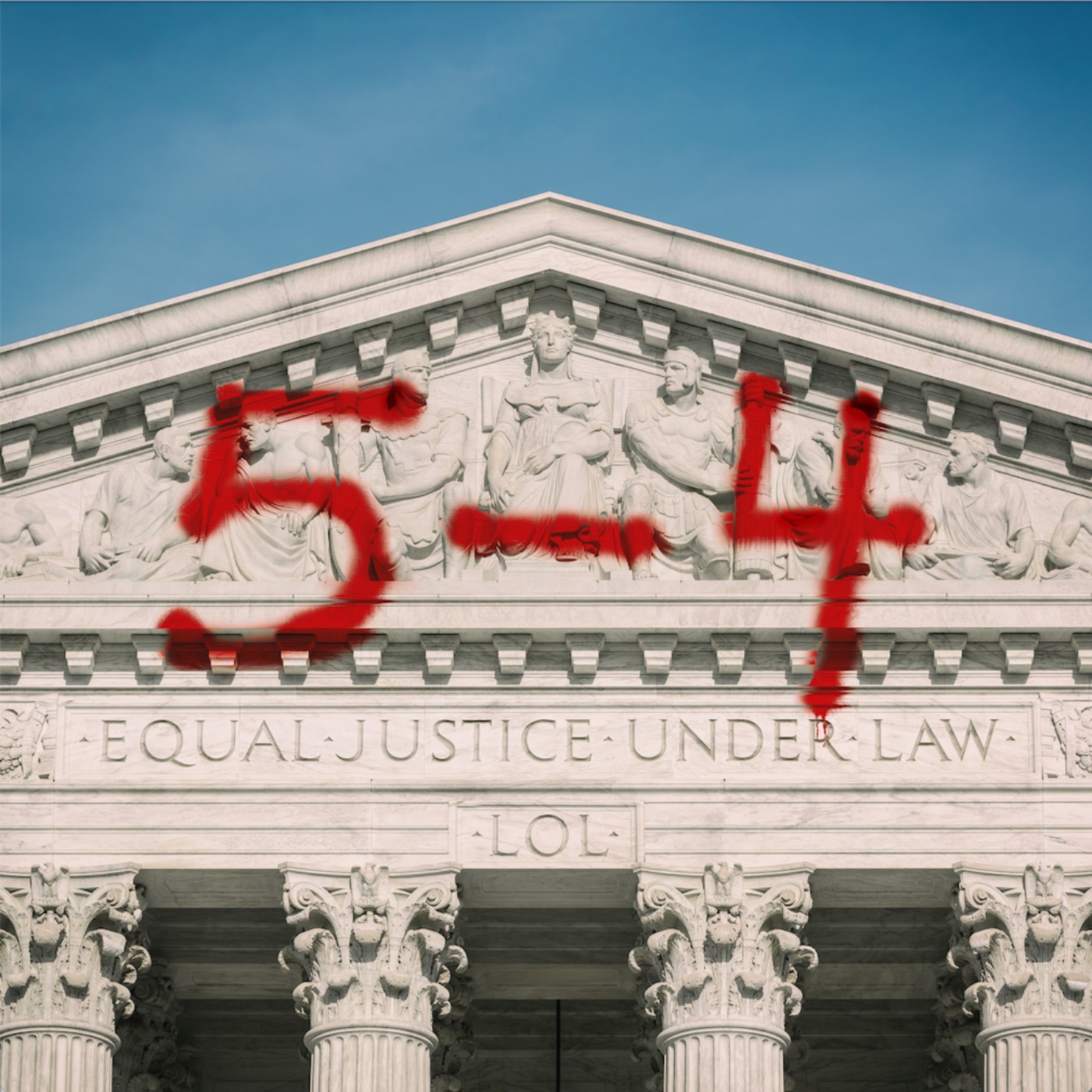
Citizens United v. FEC
Hosted on Acast. See acast.com/privacy for more information.
Advertising Inquiries: https://redcircle.com/brands
Press play and read along
Transcript
Alright folks, a quick word from our sponsor Quince. A lot of people come up to me and they say, Peter, how is it that you are by a wide margin the best dressed legal podcaster in the game?
And how could I replicate that? And I say you can't. It's natural talent.
But if you want to try, it's about essentials. Quince provides essentials.
Italian wool coats.
Mongolian cashmere sweaters for $50 somehow. I got a pair of drawstring corduroys from them, and I had the coolest pants in Trader Joe's this afternoon.
So get your wardrobe sorted, get your gift list handled with Quince, go to quince.com slash five four for free shipping on your order and 365 day returns. Now available in Canada as well.
That's q-u-in-ce-e.com/slash five four, all spelled out, free shipping and 365-day
Hey everyone, Leon Napok here with a message about our new sponsor, Give Well.
At a time when deep cuts to foreign aid have raised real concerns about people's well-being in some of the world's poorest communities, it can be hard to know what's actually happening or how to help.
GiveWell doesn't claim to have all the answers, but its team of researchers are analyzing the impact of foreign aid funding cuts in real time, identifying highly cost-effective ways to save and improve lives, and sharing what they're learning for free so that everyone can have a big impact.
GiveWell has spent 18 years researching global health and poverty alleviation and only directs funding to the highest impact opportunities they found.
Over 150,000 donors have already trusted GiveWell to direct more than $2.5 billion.
Rigorous evidence suggests that these donations will save over 300,000 lives and improve the lives of millions more. You can find all of their research and recommendations on their site for free.
And thanks to the donors who chose to sponsor their research, GiveWell doesn't take a cut from your tax-deductible donation to their recommended funds.
To make a tax-deductible donation today, go to givewell.org and pick podcast and enter the numbers 5-4 at checkout. Make sure they know that you heard about GiveWell from 5-4.
Again, that's givewell.org to donate or find out more.
We'll hear argument today in case 08205, Citizens United versus the Federal Election Commission. Mr.
Roles. Hey, everyone.
This is Leon Napok, co-creator of the podcasts Fiasco and Slowburn, bringing you this week's episode of 5-4.
Today, Peter, Rhiannon, and Michael are talking about Citizens United v FEC, a Supreme Court decision that allowed corporations to donate as much money as they want to the politicians of their choice.
It has the potential to shake up the national political scene. Five to four vote rules that corporations can contribute anything in political campaigns.
This really takes us into uncharted territory.
Citizens United resulted in billions of dollars being pumped into politics, all in the name of protecting the free speech rights of corporations and the rich people who run them.
It has dealt a critical blow to our American democracy.
This is Five to Four, a podcast about how much the Supreme Court sucks.
Welcome to episode two of 5-4, where we dissect and analyze the Supreme Court decisions that have made this country, by a wide margin, the worst in the world. I am Peter, aka the law boy.
I'm here with Michael. Hey.
And from Austin, Texas, Rhiannon. What up?
And together, we are the only three lawyers without a diagnosed personality disorder.
Not even limited to podcasts. That's right.
Not limited to podcasts. That's all lawyers worldwide.
There have been some garbage fucking cases
this past month or so.
They've really,
the five conservatives have outdone themselves. They have.
If you had asked me a couple years ago if you could just
like no scope a teenager across the Mexican border
without any consequences at all,
I would have said probably not. No,
that doesn't sound right. It doesn't seem like a close issue either.
No, but I was wrong about that. I was wrong about that.
And that's why I'm not up there with the big boys on the bench.
Today, we are covering Citizens United v.
FEC, maybe the most symbolically important case of the past decade, a case that has kind of come to represent the impact of income inequality on the political process and has become emblematic of the ideas that money is speech and that corporations are people and all these kind of big concepts that sound completely ridiculous and are completely ridiculous.
That's right.
And, you know, we, with this podcast, we're trying to show that the Supreme Court is not apolitical. The justices have agendas and they push those agendas.
And I think this is a prime case for that.
The whole process that gave us this decision was just blatantly political and hard to hide what was going on here. Yeah, absolutely.
I do want to point out, you know, I think we're likely to get some criticism here because this is about big money in political advertising. And this podcast also runs some ads.
But our promise is that we will not be influenced by those companies,
nor will we ever advertise. And this is a guarantee for a company that was instrumental in a genocide in the past 50 years.
That's our promise to all of you. And you might criticize that promise saying, oh, it's unclear what instrumental means
or like 50 years, that's not. That's just a couple of genocides.
But first of all, there are a lot of genocides in there. Second of all, if you want to criticize us, that's fine.
We're able to weather that criticism because we're built for it tough. That's right.
And also, beyond Citizens United, this is a nice time to talk about the First Amendment generally and the direction of the court because we're also at just about 100 years even of First Amendment jurisprudence.
The first Supreme Court First Amendment case was in 1919 and obviously 2019 just ended.
If you look at the arc of the court's decisions, the early cases seem to be very concerned with, you know, minorities, the disenfranchised, the powerless citizens.
You have anti-fascist leagues suing the government because they were put on some government watch list and the Supreme Court saying that they can challenge their inclusion on that in the 40s or the NAACP in the 50s using the First Amendment as a shield.
And this is maybe the case of all cases that sort of shows how the court's emphasis has shifted to protecting the wealthy and the powerful. Aaron Powell, yeah.
So here in Citizens United, the court is asked whether McCain-Feingold, a 2002 law that bans outside political spending right before elections, violates the First Amendment by unconstitutionally restricting a corporation's political speech.
And the court says that not only does this particular ban violate the First Amendment, but in fact, any expenditure by a corporation at any time and for any amount is protected under a corporation's right to free speech.
The idea that corporations have speech is something that sort of slowly built up momentum until it hit this crescendo and turned into something, I mean, that I think started off a little weird and is now just completely ridiculous.
Right. Right.
So So, in this case, the party asking for the Supreme Court to weigh in is Citizens United, originally known as Americans for Bush.
These guys are a political action committee founded in the late 80s to support George H.W. Bush in his campaign for president against Michael Dukakis.
So, Ree, you want to start walking us through the history? Like, how does this get to the court?
Americans for Bush are the people who produced the racist as fuck Willie Horton ad back in the late 80s.
So, it's about this furloughed Massachusetts prisoner who was accused of sexually assaulting a woman while he was out of prison. Bush accused Dukakis of not being tough on crime in that ad.
It's racist. It shows the guy's mugshot.
It's disgusting.
It calls him Willie Horton, even though he didn't go by Willie. It's like extremely fucked up.
Is that true? That's 100% right. I didn't know that.
Jesus Christ. Those guys who made that ad.
Once Bush I
was elected, Americans for Bush turned into Citizens United, and they hire this guy, David Bossey.
He is obviously obsessed with the Clintons in the 90s, running ads against Bill, Al Gore in 2000, and then Kerry, John Kerry, of course, in 2004.
This guy says that he's inspired by Michael Moore, and particularly Michael Moore's film Fahrenheit 9-11.
And he's inspired to make political documentaries. He starts with a rebuttal documentary that's called Celsius 4111.
Whoa. Punchy.
Smiley. So creative.
In an L.A. Times article in 2004,
Bossi says, after seeing Moore's impact, I wanted to counter-punch. Documentaries have become a weapon of the left.
Still true. Right.
If you record stuff and then show people
what happens,
that's a weapon of the left. Photographs, too.
I feel the same way about them.
So, you know, this guy obviously sees himself as a propagandist, right? Right, absolutely. He's a political operative.
Yeah.
The problem with that is the FEC correctly identified that Citizens United was a political organization. It's not a bona fide movie studio commercial venture.
And so they continued to restrict Citizens United's ability to air their movies in advance of elections.
Right. Again, because McCain Feingold, the campaign finance law, said at the time that corporations couldn't run ads for a federal candidate within a certain time period before an election.
Right.
So David Bossi is like, hmm. He's got the fucking answer to that.
And he says, all right, well, what if I turn Citizens United into an actual movie studio then?
I bet they turned out some quality shit. Yeah, you know,
Citizens United has made over 20 movies now, including several that have been written and directed by
the garbage, smelly Steve Vannon,
such as Fire from the Heartland, The Awakening of the Conservative Woman. Something tells me that's not a sexual awakening,
which features Michelle Bachman, Ann Coulter, Michelle Malkin, et cetera. Good stuff.
One of the movies that
they made was Hillary the Movie. Even punchier than than Celsius 41.
And Citizens United wants to air this quote-unquote documentary in January 2008 to try to kneecap Hillary's primary run. They want to get it, obviously, to as many people as possible.
And so they want to put it on demand, but free to watch. Right.
They have an issue here, which is that, you know, there's campaign finance laws that say, you know, there's no corporate or union spending 30 days in advance of primaries or 60 days in advance of elections on election year and communications.
And so Citizens United, having been sort of burned on this law previously, sought a declaratory judgment in district court saying, look, we're good to go. We're a movie studio.
This is just a documentary. And
the court was like, no, you're not. And no, it isn't.
Get the fuck out of here. And said they couldn't do it.
And that was how we got to the Supreme Court with this case. Right.
And so this starts on a very narrow question of whether the law is unconstitutional as it's applied to this documentary.
And Citizens United is making a number of arguments that, like, look, the law doesn't really cover us, or to the extent it does cover us, it's unconstitutional in
those ways. And there's oral argument on this point in March of 2009.
But the justices, the conservative justices, were not satisfied with that.
And they pushed Citizens United during oral argument on a much broader question of whether the campaign finance law and the restrictions on corporate spending were in their entirety unconstitutional.
And this pisses off the liberals on the court.
So David Souter, who's like a few weeks from retirement, writes a dissent that, according to some reporting, is just airing all the courts' dirty laundry, accusing the Conservatives of
blatant political machinations. And so somewhat shamed by this, actually like cowed by
a retiring justice ready to just put them on fucking blast, they decide to to set this case for re-argument.
And they're going to make the parties brief them on the broader question of whether or not these campaign finance restrictions are constitutional at all. Right.
Basically, taking a very narrow question about some stupid movie and a very narrow law that
applies to certain spending occurring within like a month of a primary, and all of a sudden making it a case about corporate free speech that would apply in like a huge array of contexts.
Aaron Powell, right. The story, the detailed story is that at a conference, like originally Roberts,
Chief Justice Roberts, had written a majority opinion
on the narrow question. And Justice Kennedy, who's very libertarian,
which comes through in his writings,
had wanted to write a concurrence on the broader constitutional question.
But Roberts was persuaded by Kennedy, and they decided to switch. And that was when suitors started to write a dissent, you know, calling them out for being a bunch of fucking hacks.
And it's important to realize a few things, which is, one,
justices and judges in general, they have certain intuitions about the law, and maybe on non-core issues, they can be persuaded one way or another, right?
Some arcane workings of maybe like patent law or some shit. They might be persuadable.
But these guys have ideas about the way the First Amendment works, right? They know what they think about things like campaign finance law, right?
These are big issues that they've been thinking about for a long time.
They've been talking about it and all their friends have been complaining about it at fucking cocktail parties that they're at for 10 years. That's right.
Right,
right, exactly. And
there are just a number of ways they could have avoided ruling on this, which is, generally speaking, what's required of the Supreme Court is to avoid big constitutional questions on this. Absolutely.
Yeah, there's a doctrine called constitutional avoidance, which basically means if you don't have to answer to address a constitutional issue, you don't.
And they flip that completely on its head because they want to expand corporate speech rights and take a narrow question and turn it into a constitutional question. Aaron Ross Powell, Right.
You can't overstate.
how important it is that the petitioners themselves, Citizens United, as shitty an organization as it is, as awful a person David Bossi is, and what they want the results of this case to be,
that they didn't even ask for this result, right?
This is the court really bending over backwards to fashion a case and a legal question so that they can, they're always planning backwards from the result that they want.
And this is, I think, what makes Justice John Paul Stevens in dissent here.
You know, this. This is kind of a famous dissent of his.
It's known as like pretty intense. It's 90 fucking pages long.
They wanted to avoid the shitty Souter dissent and instead they got the shitty Seevet's descent and he's like a better writer than Souter is.
Although 90 pages. Nobody's going to read it.
Believe I didn't read that shit.
But what is good about the dissent is like it does do that. I mean, there's a little peel back of the curtain, right? It's a little bit mask off where he's calling out like what's going on.
So he says, quote, it is only in the most exceptional cases that we will consider issues outside the questions presented.
The appellant in this case did not so much as assert an exceptional circumstance, and one searches the majority opinion in vain for the mention of any. That's unsurprising, for none exists.
Setting the case for re-argument was a constructive step, but it did not cure this fundamental problem.
Essentially, five justices were unhappy with the limited nature of the case before us, so they changed the case to give themselves an opportunity to change the law.
It's very upsetting, and my heart is like pounding right now.
I'm so worked up.
But one thing I was thinking about is:
one, I feel like you could go through law school very easily without ever reading this case. But two, even if you did, there's no way any of this shit is going to end up in your case book, right?
Right.
You're going to read like a little introductory paragraph from the author of the case book that basically tees up some of the bullshit issues, and then you'll read a few excerpted paragraphs from Kennedy's majority opinion about the First First Amendment, and then maybe a few paragraphs from Stevens' dissent.
And this context is very important for understanding what this case is and what the court is doing here. Yeah, I mean, it's ideological warfare, right? And it's express.
It's as close as you can get to admitting that you just have this political goal you want to achieve and you're going to go do it.
But yeah, I mean, I did learn about this case in law school, and I didn't learn about the history of it until I read about it myself. Right.
It's taken for granted that like this argument and the holding of the case are legitimately gotten to. Like the process was legitimate and right.
And I think setting the case for re-argument after you had already written your majority opinion deciding the case one way along those questions is like such obvious bullshit, right?
Like there's no chance. Real weird.
Right. There's no chance that they're actually going to
change their mind at this point, right? This is about laundering it. It's about legitimizing what they're doing.
All right.
Let's talk about the opinion itself. Michael, you want to...
You're the election guy.
The election law guy. I was briefly an election lawyer.
I know a little bit about this stuff. After this episode, Michael will have no more expertise.
Michael peaks episode two.
All right. So just quickly going through the decision, and you know, I don't think this decision is worthy of extended discussion other than to, you know, take a massive shit on it.
So just describing its reasoning as briefly and succinctly as possible. That sucks ass.
Yeah. Moving on.
Obviously, when you're talking in abstract terms, the government banning speech sounds pretty bad. Censorship sounds sounds bad.
And in elections, of course, political speech is maybe the core of the First Amendment. That all sounds bad, right?
And so
there are portions of this opinion that you can be fooled into thinking sound reasonable. Aaron Ross Powell, Right.
There are definitely a couple of big misconceptions about Citizens United, things that it's sort of
come to be associated with, although it's not really the case for those things.
If you ever talk to like a conservative or see a conservative academic talk about it, they'll say, well, actually, you completely misunderstand the case because money as speech, that's a settled question.
And whether corporations are people, that's a settled question. But that's only really true in like a narrow, almost semantic sense.
There is absolutely no coherent, comprehensive explanation under federal law for why and to what extent corporations have constitutional rights at all, despite the fact that they are not actual people.
What there is is like a mishmash of different theories of rights with no real consistent framework. And it's sort of unclear why these entities created by state law
would be subject to federal constitutional protection. And, you know, some decisions have granted corporations due process and property protections.
I guess you shouldn't, the feds shouldn't be allowed to knock down a corporation's door and steal their stuff. I will begrudgingly accept that that sounds right.
It depends on the corporation.
But they haven't been expressly granted speech rights, and it's not really clear if they even could be.
And so when we're talking about bans on free speech, you got to think about what's required, right? You need a speaker, and in this case, that's a corporation.
And of course, corporate personhood makes sense, right? Like corporations need to be able to sign contracts and you need to be able to sue them. But whether or not that means
corporations have feelings that they need to express,
that like General Motors is really behind Mayor Pete, you know, in the 2020 Democratic primary, and it feels it in its heart. Like, it's that's pretty ridiculous.
And I, before we, like, really dive in, I think one question needs to be addressed, which is: what's a corporation? Like, what
is a corporation?
And there are like all kinds of little fancy academic theories about what a corporation is, but you know, it's a separate legal entity designed to allow people to more readily do business, right?
You can hide all of your assets and liabilities in this entity, and it's controlled by management and it's owned by shareholders.
And that's really the most you can say about it without getting into like frou-frou academic bullshit, I think.
And the theory that they use and that courts have used for like 200 years to give them constitutional rights and speech rights is the idea that corporations are quote, an association of citizens.
It's like kind of settled law that, you know, this makes sense. If you're a group of citizens, the fact that you're acting as a group doesn't nullify your free speech rights, right?
Because you're an association of citizens. You're all acting together to speak and say something, so you get free speech rights.
Makes sense, right?
But the idea that a corporation is an association of citizens is like completely ridiculous. And it feels like it's based on like...
an extremely antiquated idea of what a shareholder is, right?
Like, you know, some prospector rolls into town and goes to the local general store and goes in, and there's like six pelts on the wall and a bottle that just says elixir.
And
he's like, oh, well, I like the look of this store.
I'll give you a buffalo nickel for 25%. And then the guy's like, oh my god, a buffalo nickel.
And
now the guy's a shareholder.
But like the modern system of shareholders is that you give Vanguard or some other brokerage firm your money, and then they invest it for you in like a bunch of shares chosen based on some algorithm that tells them how to change their capital allocation for risk purposes or whatever.
They buy and sell some stocks for you,
and you have no idea what you own. No idea.
Like, do you know what's in any of your exchange-traded funds? Right? Like, who could possibly know? Like, I have like a 401k, I have absolutely no idea.
Do I have stocks? Peter, no. Do I have stocks? No, I do not know.
No,
okay. I didn't think so.
Thank you.
So, like, you know, most people have no idea what companies they have stock in, and that can't be an association of people.
I can't be part of an association of people when I don't know what the association is. Right, right.
The modern shareholder as like an entity is barely sentient.
The idea that they're an association of citizens such that they are able to express themselves and therefore deserve speech protections is just beyond absurd. Trevor Burrus Right.
And the opinion tries to make itself seem like it's above basic sort of ideological concerns.
And it mentions, well, like, look, the Sierra Club is an association of individuals and it's got to be able to speak, right? But like the Sierra Club is an advocacy group about people with
a shared interest in making political statements. Like that's the fucking point.
That's why you join.
If you buy $500 of stock in Disney because you heard that they're going to buy like Fox searchlight properties and, you know, you're going to see Spider-Man in the Marvel Universe, that doesn't mean you have some fucking
relationship with the other millions of people who hold stock in Disney and that now you have some coherent group viewpoint that you need to express in the political sphere. Like, it is absurd.
And it creates, like, so you have this corporate entity, and then you have this, like inexplicably distinct association of citizens that also has legal protections and is just allowing corporations to have their cake and eat it, too, right?
When they get sued, all of a sudden they're this just the corporate entity, right? And you can't sue the individuals who are part of it.
And you have no remedy against any individual shareholder when they
blast some baby in the face with sulfuric acid or whatever because it increases the bottom line.
But when they want free speech, all of a sudden the shareholders are part of it and
it's an association of citizens. Right.
Right.
The whole point of creating a corporation, right, is to limit individual people's liability and to create a legal entity that sort of takes the hit for legal problems in doing business.
I don't fucking know what I didn't take corporations.
But what's clear is... Did you take corporations at all?
Was that required?
No, of course I didn't take it. It's my worst grade in law school, so I don't really have any ground to stand on.
I strolled right up to the law school. I said, teach me about business.
Yeah, you said, gimme dat corporate education. Right.
So one
thing that's so
just infuriating to me is in the last like substantive paragraph of the opinion. This is Anthony Kennedy.
And so, of course, he's really, he's pulling out all the stops in terms of like flowery, like how much we care about rights, all of this stuff. He loves that shit, right?
But it's absolutely disgusting because actually, like, motherfucker, you're talking about corporations. Like, there's actually people.
So, he's saying, like, the First Amendment, quote, underwrites the freedom to experiment and to create in the realm of thought and speech.
Citizens must be free to use new forms and new forums for the expression of ideas. The civic discourse belongs to the people, and the government may not prescribe the means used to conduct it.
Fuck you. Please suck my ass.
In conclusion, the United States is the greatest country on earth.
Anthony Kennedy is still alive, right? Because I just. Not for long.
I'm not going to kill him. I'm not going to kill him.
I just. That's just a statement about his age.
Yeah.
Uncle is having like an actual,
like a minor
attack.
There's a point in this opinion when
Kennedy says, like, look, some people
point out accurately that corporations could still do all this shit that we're saying they can't do.
They just have to have a political action committee, what's called a separate segregated fund, which means rather than from their general treasury, they have a separate fund that only shareholders and executives and employees can
contribute to, that will then engage in political advocacy. And he's like, well, first of all, that's a lot of regulations and that's really hard.
And
they have to submit a lot of forms to the government. And like, I don't think that's really fair that they should have to do that.
And in any event, if a corporation has a PAC, that doesn't allow them to speak.
The PAC is a separate entity with, I guess, separate thoughts and feelings from the corporation that once you give one entity thoughts and feelings, all of a sudden they all have them and it becomes this like incredibly convoluted mess of bullshit.
The idea that a corporate created political action committee is a separate and distinct speaker for the sake of the First Amendment, then the corporation itself that created it is fucking ridiculous.
And he says it, he writes it in a way that he's like offended. by the idea that anybody would suggest.
So
one of the big arguments brought up by the dissent, maybe the biggest argument, is the corruption argument. They're like, doesn't this allow for corruption, right?
If corporations can simply spend with the purpose of influencing elections, isn't that corruption? And Kennedy says, well, the only thing that really counts is quid pro quo corruption.
Like, literally, just, here's your money. I would like this political objective in exchange.
Right.
And so Kennedy's argument is that since only direct quid pro quos count as corruption, any supposedly quote-unquote independent campaign spending, meaning spending that's not really directed by the candidate or the candidate's campaign, that independent spending cannot actually be corruption for the purposes of the First Amendment.
And that means you can't put any limits on it. Right.
Whereas direct contributions could be part of a corrupt scheme, and so you could put limits on those. Right.
And this distinction is the heart of what makes this decision so ludicrous, right?
So, like, according to the court, giving direct contributions to a campaign can be limited or in certain circumstances made illegal.
But if you just run ads for the candidate on your own, that's independent and doesn't count, right? This is how super PACs became so powerful, right?
Their technical name is Independent Expenditure Committees. And the idea is you form an entity whose sole purpose is to help a candidate or a group of candidates in an election.
And as long as you don't directly coordinate with the campaign, the Supreme Court says not only is that legal, but it cannot be limited due to the First Amendment, right?
And this is as easily gamed as it sounds, right? Yeah. So it was reported by Esquire, I think,
that in 2018, then Speaker of the House Paul Ryan facilitated a meeting between a big donor and a super PAC, the Congressional GOP Super PAC.
And because he was an elected official, he couldn't legally solicit a donation, right? So what does he do?
He makes the pitch to the donor and then just leaves the room while the donor and the PAC representatives talk money.
That conversation ends with a $30 million donation to the PAC.
And despite the fact that the distance between the politician and the PAC in this case is completely artificial and fraudulent, that's ostensibly legal under Citizens United.
And certainly Paul Ryan is banking on it being legal right now.
No corruption there. And yeah, and that's like, you know, that's happening behind closed doors.
But you have right out in the open, you have fucking Michael Bloomberg pouring hundreds of millions of dollars into elections
for Democrats and Republicans alike, and then bragging about it on national TV in a fucking Democratic primary debate, saying that he bought 21 congressmen, which, you know, he's not a total idiot.
He corrects himself and says he helped them get elected. But, you know, that shit slips out because, you know, he thinks that, you know, he says that in private all the time.
He brags to his buddies at their little fucking cocktail parties. And
the Supreme Court thinks that's okay. They say, look, that's not corruption.
It's not even the appearance of corruption.
Because he didn't directly coordinate with the games. Or if it's the appearance of corruption, it doesn't matter.
It doesn't matter. Right.
Yeah, it's very fitting that a decade after Citizens United, you have Bloomberg, officially the ninth richest person in the world, just openly and unapologetically trying to purchase the presidency of the United States.
Yeah. With what I think, no matter what happens, has to to be described as some amount of success.
Absolutely.
And, you know, it's in large part because he's making huge donations to establishment Democratic politicians to win their favor.
And those donations are considered protected free speech under Citizens United, right?
And the Supreme Court has said not only is this not corruption, but it is sacred and untouchable free speech.
And I think, you know, the bottom line with this stuff to me is that I don't think that conservative justices care whether this is corruption corruption or not, right?
They know the Republican Party is fueled by big money, and this is just how the wheels are greased, right? And they're going to get behind it one way or another. Right.
It's clear from the opinion.
They think that that's normal. They think that you should be able to do this.
It goes back to like couching it in this really flowery language.
In the second paragraph of this goddamn awful opinion, Kennedy is quoting the evil one himself, Scalia, saying,
Oh, we should note that this case overturns the Austin decision. And in Austin, the Supreme Court held that speech could be banned based on a corporate speaker's identity.
So there are some rules, there are some restrictions on corporate speech.
But in this opinion, Justice Kennedy quotes Scalia, who said in another case, that Austin was a significant departure from ancient First Amendment principles.
Again, you have the mysticism around the law. Ancient.
Dude, the First Amendment's like five minutes old. What the fuck are you talking about? Like, it's not an ancient.
There was a longer gap between when the country was founded and the first time the Supreme Court handled a First Amendment case than that's a really good point. From then to now.
Like this fucking ancient case isn't even like half as old as the country. Like there are people alive today that are older than like the oldest Supreme Court First Amendment case.
This is not ancient. This is literally law that's been created in the lifetime of living people.
Yeah, but to be fair, it's like just a couple women in Japan.
It's like five people. But
so
the other thing that they basically do away with is the idea that the appearance of corruption matters, right?
And this is a part of the law previously where the court had said, look, we want to not only do away with corruption, but also the appearance of corruption so that people don't lose confidence in democracy.
Aaron Ross Powell, which makes sense. Like, if democracy is powered by people, it sort of starts with their investment in the process.
Right. And
the majority basically says, well, look, the public's not going to lose confidence in democracy. And that's really it.
That's like a direct quote. It is.
And it's.
I have it. Yeah, pull up the quote.
Yeah, yeah. Let me let me get it.
The appearance of influence or access, furthermore, will not cause the electorate to lose faith in our democracy. That's the fucking Supreme Court.
Well, that's reassuring, though. Holding forth.
Thank you so much.
On this shit. Thank you, Anthony Kennedy, for letting me know.
I'm going to sleep good tonight. I don't know you guys.
The Constitutional Speaker. Anyway, objectively false.
Objectively fucking false.
Right, right. Fucking wrong.
One of the many times that this is like a classic thing that conservatives do where they just sort of like assert this thing and you're like, isn't that an objectively measurable concept?
And then they just move on. All right.
The other, I think, big and kind of related thing is the idea of free speech in relation to the audience, right?
Free speech isn't just about the freedom of the speaker. It's about your freedom to hear what they got to say.
And so the majority is like, the public has a right to access all the information, and then they determine the reliability of that information after the fact. And I think it's important to note that
here we are in an era of constant, often purposeful misinformation and extensive research showing that some percentage of people will believe it no matter what.
And maybe we should be evaluating the rights of the listener to hear something with a little more nuance, given our understanding of that, right?
Like we live in a world where 40% of the population believes Hillary Clinton is a murderous pedophile, right? Which means that 60% of the population is wrong about that.
That's right.
But hold on. There's also, Kennedy says this: this is a direct quote: there's no such thing as too much speech.
Shit. Like, obviously, there are restrictions on the First Amendment, right? There are all kinds of, like, you know, classic fire in a crowded theater sort of thing.
You know, you can't make direct threats. There are tons of restrictions on the First Amendment.
So when you are a Supreme Court justice writing, there's no such thing as too much speech.
How does that get by like your clerks? Like, does it, none of your clerks are like,
this is obviously not true. But by the way, in 2007, there is a case where a guy held up a banner near a school that said bong hits for Jesus.
And you were
just like, well, that was near a school. So you can't say bong near a school.
If you say bong near a school, that's something different. If you're annoying people,
that's really.
I think a really important point to make, too, is that saying something as asinine as there can't be too much speech, like you just have to call that out as being so connected to capitalism, right?
That the idea of a free market being a good thing
where there's just an excess of shit out there and everybody chooses for themselves what shit they engage with and buy.
A quote like that, there's no such thing as too much speech. Right.
It's just free speech in the form of like a Coca-Cola billboard outside your fucking apartment.
He even mentions the marketplace of ideas, which like fucking drives me nuts because like the marketplace of ideas is like a great idea if we think like McDonald's makes the best fucking hamburgers that have ever existed.
Right? Right.
Because
pretty much everybody, if they've eaten a hamburger, they've eaten a fucking McDonald's bullshit hamburger. And like, is that really, is that what we're going for here? Like, is that the idea?
Right. Have the best hamburgers won.
That's right. Well, that's
all right. Hold on.
Well, let's, I want to get into what I think is, no joke, the majority's only like real decent point, which is that there's a weird tension here.
If you're restricting the ability of corporations to spend on political expression, then what do you do about media corporations? And the majority puts this forward as sort of just like,
ooh, like,
are you saying that you can restrict, you know, MSNBC or something? Right.
Now, Stevens, Justice Stevens in his dissent is just like, well, that question isn't even before us.
This isn't a media corporation, which is a good point, but also, let's be honest, a little bit of a dodge, right?
But I think perfect example of just like the conservative preference for rules, even if the rules are bad, rather than like actually engaging with nuance and context, they would much rather have a bad rule than give
like uncertain guidance to judges who might, in their mind, do the wrong thing with it. Right.
You know, it sounds scary, right? And like, it does sort of like raise this concern.
And if you're not really thinking too critically about it, you can be like, yeah,
what if the government is like, no more CNN? Where will I get my pro-Clinton news?
Or whatever, right?
I think the prototypical example of that would be like maybe a small independent filmmaker with a strong political point of view trying to like make a real sort of artistic statement about the state of our society, like perhaps Michael Moore with Fahrenheit 9-11, which, believe it or not, was able to be released within
30 days of an election over a complaint to the FEC, because the FEC was able to very easily identify them as
his studio as a bona fide movie studio and that this is a general political expression of the media and this wasn't an issue. And what's amazing is that that this was before the FBC.
Hey, Michael, who, who, who, who, uh, who lodged that complaint? Citizens.
Fucking United.
Citizens United tried to get Fahrenheit 9-11 pulled from the air. The same fucking company that's out here saying, like, this shit is way too onerous was trying to get
media pulled like five years earlier. And that was, it was their failed attempts
to get Michael Moore silenced that inspired this whole thing. So what the court is trying to say is like, look, it's hard to distinguish between types of speakers, right?
And so it's best to just let them all do the same thing. But first of all, they don't actually do that, right?
I just, I referenced a case where there was a student on campus holding a sign that said bong hits for Jesus. And they said it's okay to ban that because it's a student in a school, right?
You're making these quantifiable judgments about
the value or impact of speech based on the context?
Are we really pretending that the guy on the street corner with a sign saying the end is near is doing the same thing as the corporation that's lobbying the government for fucking changes in regulations in their own industry?
But that's what they're doing. That's what they're saying.
It essentially means that the court sees no constitutional difference between a multi-million dollar expenditure by a corporation and a nominal expenditure by an individual. None.
What they're saying is it's too hard to distinguish between those two things. Aaron Powell, Jr.: And the conservatives love doing this.
They love talking about how difficult rules can be to
be applied in the real world. But a common theme in the opinion is we're sitting here banging on them about big, multi-million
corporations that have tons of resources.
And they're like, well, look, 96% of the Chamber of Commerce members have less than 100 employees, and they're small businesses, and they can't handle this shit and whatever.
But, like, the law easily distinguishes between those. Like,
there's a concept called a closely held corporation, and there's different laws that surround closely held corporations.
If corporations only have a few shareholders and they don't really respect the formalities of the corporate form and have shareholder meetings and all that shit, they have duties to each other, and the laws are very different for them than they are for
what a Tesla stock owner owes, which is nothing to another Tesla stock owner, right? Because that relationship is different. And judges and courts have no problem distinguishing between them.
And if the court was concerned about those corporations and their speech, they would have no problem distinguishing between them.
They didn't want to distinguish between them because what they want is to give fucking massively wealthy people and their corporate shells the ability to have a huge impact on elections.
That's the goal.
Trevor Burrus, Jr.: I want to get one point in here before we talk about the impact of this decision, and that's that there was a concern in here that this would open up the possibility of foreign intervention in elections.
And so this decision drops in late January 2010, a couple weeks later, State of the Union. Barack Obama is talking about this, and he says that.
With all due deference to separation of powers, Last week the Supreme Court reversed a century of law that I believe will open the floodgates for special interests, including foreign corporations, to spend without limit in our elections.
And Samuel Alito, the conservative justice, Bush Jr. appointee, famously mouths not true.
Big scandal. Not true.
Big scandal because a Supreme Court justice was talking.
He's supposed to just sit there and sort of look angry, I think.
Instead, he like mouthed his opinion. You just sit there in your robe looking important.
That's right.
Very sort of, at the time, it was just like, ooh, he's talking back at Obama, very sassy Supreme Court justice. And now it's like,
you sure about that, Sammy? You really want to be the guy who like went down his history as telling Obama
he's the guy who was like foreign intervention and elections in 2010. Absolutely not, Barack.
You're an idiot, Barack. You don't understand this stuff at all.
And just there's no there's no question that Citizens United
creates a pathway through which foreign money can run into our elections. There's absolutely no way to avoid that fact.
As will be made clear by some of the numbers we're about to tell you, the impact of this decision on spending, spending that can come from any corporation,
is considerable. Aaron Powell, right.
And so the thing about the corporate form is that it is
a great vehicle for pretty much anyone to get their fingers into the electoral process now and i don't think it's maybe worth our time to get into detail about all the various different ways individuals you know foreign or domestic um can do that but the main thing is that by opening up this avenue you just invited basically everybody who who wanted to do this to just you know form a little fucking LLC or whatever.
Right.
The definition of corruption in this context is so narrow that anyone who is not a complete and total incompetent can now funnel huge amounts of money into elections. Right.
Yeah.
And I think the reason why I want to do this podcast is not just to show that the Supreme Court justices are political and actually not objective, but also that they're dumb as shit. Right.
Everybody at the time.
Like, literally, I was going to be talking about it. Everybody at the time was saying these would be the consequences.
Corruption is a risk here. Foreign intervention is a risk here.
This is what, and they were all like, no, no way, dog. Like, that's not going to happen.
Like, if you read the Stevens dissent now, you could look at it and be like, oh, he's fucking Nostradamus.
Like, this stuff all came true.
Or you could realize any moron looking at this decision and understanding the basic framework of spending and elections could have predicted this stuff.
Fucking in 2018, Sheldon Adelson alone gave 122 million. Casino magnet and one of the most disgusting people you will ever lay your eyes on.
Just one of the most aesthetically disturbing people you will ever see in your fucking life. If you don't know what Sheldon Adelson looks like, just Google him right now.
A-D-E-L-S-O-N.
He looks insane. Just like an unbelievable human being.
It's barely human.
I don't even think he deserves free speech rights. I don't think he qualifies as a person.
He looks like a nine-foot person was melted down into a normal person size. Sorry for that, Tanja.
Yeah, so Michael said in 2018, Sheldon Adelson alone gives $122 million.
And then just to compare that back in 2010, the year this decision comes out, the largest reported individual contributions totaled $7.5 million. So it's just ratcheted up.
Another big impact in terms of like campaign spending being up is outside spending, which is referring to PACS political action committees operating independently of campaigns.
So, for example, in 2008, that outside spending totaled a little over $330 million.
Fast forward to 2016, we're talking in the billions now, $1.4 billion.
And in 2018, the first midterm with over $1 billion in spending. Yeah.
So one way to contextualize this is:
has anyone listening to this podcast ever tried to max out their donation to a candidate?
Because the maximum that you're allowed to donate is $2,800 per candidate per cycle. If you've done that, call me, because that means you have like $3,000.
That also means you're rich.
That is a lot. I mean, so the end result of this, and by the way, those restrictions have been found constitutional.
All of this like high-falutin language about how the importance of speech and shit has not prevented the Supreme Court from saying, well, yeah, you can cap individual contributions.
And the result is that while you can only donate $2,800 if you and some of your richer friends decide to form a company, pull together your millions,
all of a sudden you can spend the whole fucking thing. Right.
And you want to run an entire shadow campaign
in parallel with the candidate of your choice. Yeah,
you and your friends can do that too. Just like a billionaire, you and your friends are allowed to run ads
against or for the candidates of your choosing. So don't tell me that this country is unequal.
Right.
The easiest way for a normal citizen to actively engage in the political process in a meaningful way beyond just like talking to your neighbors is very restrained.
Whereas people with means can fucking go hog wild.
Sorry. Oh my god, I love it.
Michael is just
ready.
Yeah. Ready to punch someone.
I mean,
after this, we'll go punching people.
Next episode is Fisher v. Texas, which is,
I think the best way to put it is the story about the dumbest white girl you ever heard.
It's going to be good. It's an affirmative action case and a great exploration of one of the more mediocre women
you'll ever hear about in your whole life.
5-4 is presented by Westwood One and Prologue Projects. This episode was produced by Kacha Kunkova, with editorial oversight by Leon Nafok and Andrew Parsons.
Our artwork is by Teddy Blanks at ChipsNY, and our theme song is by Spatial Relations.
From the Westwood One Podcast Network.