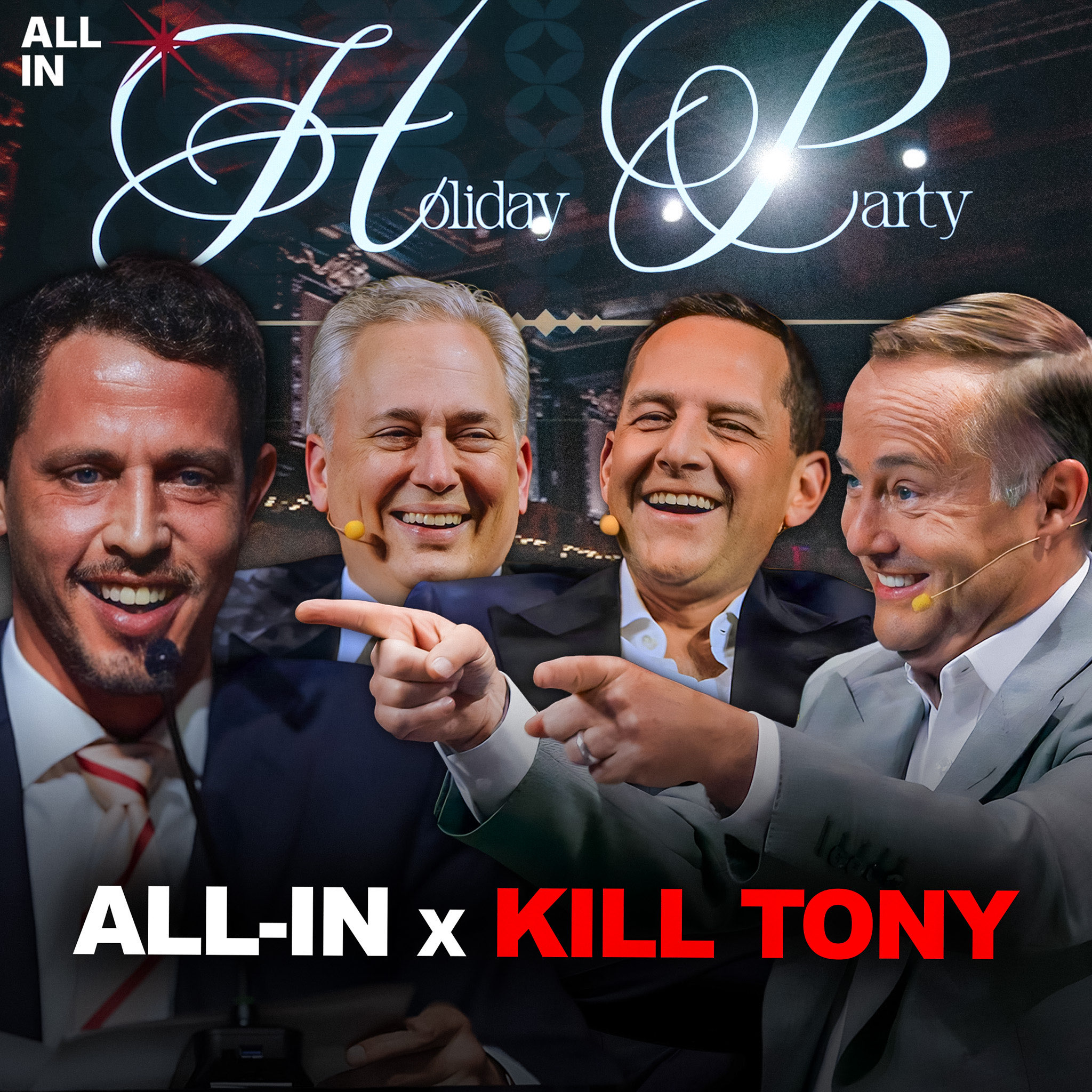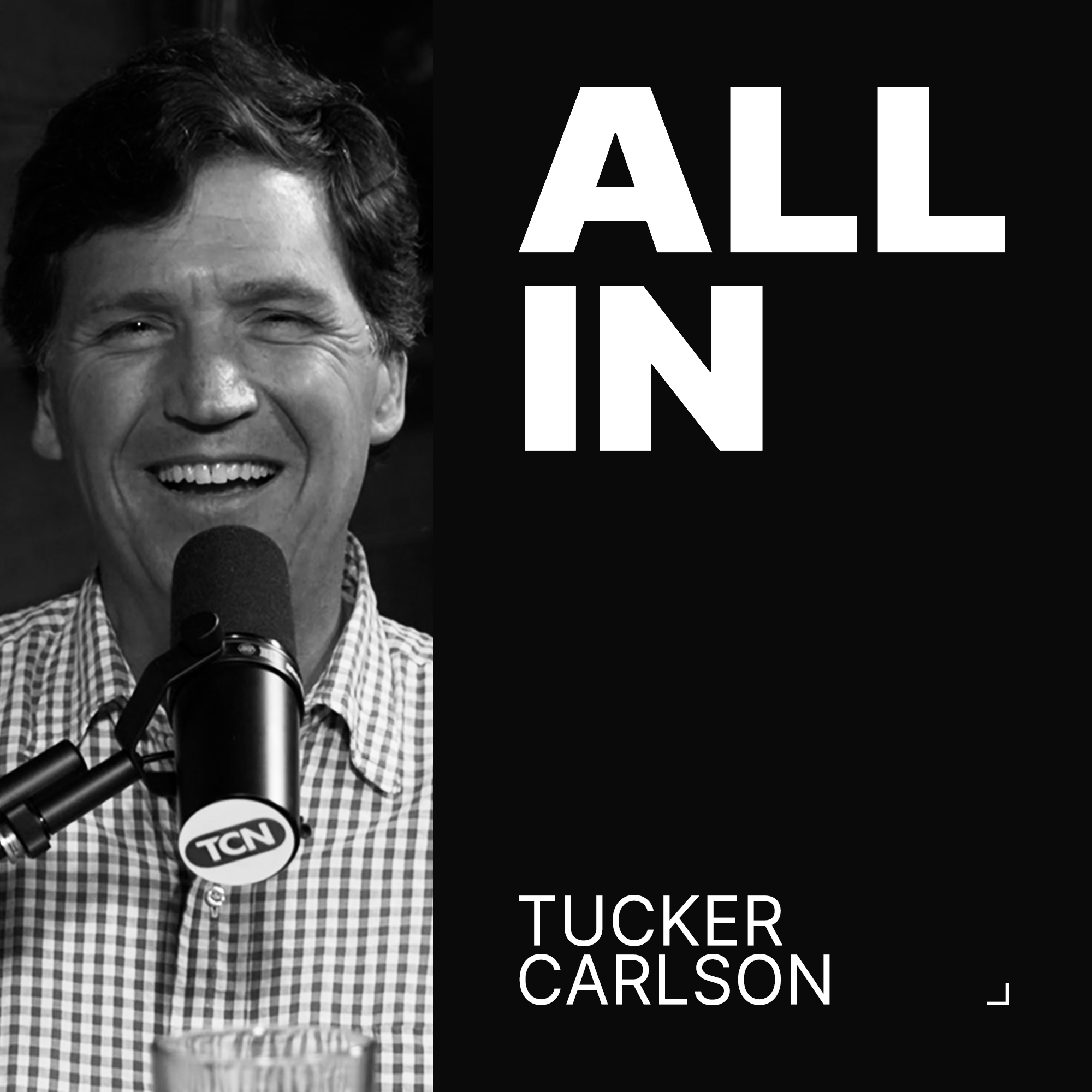
Tucker Carlson: Rise of Nick Fuentes, Paramount vs. Netflix, Anti-AI Sentiment, Hottest Takes
(0:00) Tucker joins the besties!
(4:11) Paramount vs Netflix: bidding war over Warner Bros Discovery
(25:40) What's behind the rise of Nick Fuentes and America First?
(49:13) Understanding the Anti-AI sentiment
(1:21:52) Tucker in 20: Venezuela, Midterm issues, fall of Europe, Qatar, Charlie Kirk investigation, leaving NATO, supporting Israel
Follow Tucker:
Check out Battalion Metals:
Follow the besties:
Follow on X:
Follow on Instagram:
https://www.instagram.com/theallinpod
Follow on TikTok:
https://www.tiktok.com/@theallinpod
Follow on LinkedIn:
https://www.linkedin.com/company/allinpod
Intro Music Credit:
Intro Video Credit:
Referenced in the show:
https://x.com/chamath/status/1999139689173749835
https://www.vulture.co/article/netflix-vs-paramount-ownership-warner-bros-discovery.html
https://polymarket.com/event/who-will-close-warner-bros-acquisition?tid=1765487045602
https://www.realityslaststand.com/p/the-manufactured-rise-of-nick-fuentes
https://x.com/DavidSacks/status/1997843165102100528
https://fred.stlouisfed.org/series/LNS14024887
https://www.wsj.com/business/data-centers-are-a-gold-rush-for-construction-workers-6e3c5ce0
Press play and read along
Transcript
Speaker 1
All right. Back with us in place of David Freeberg, who's busy this week.
He is the one, the only, on his fourth appearance here on the all-in podcast, Mr. Tucker Carlson.
How are you, Tucker?
Speaker 2 Thanks for having me.
Speaker 3 Hey, Tucker. Good to see you.
Speaker 2 David,
Speaker 2 how do you have time for every time I
Speaker 2 turn on my phone? There's like David Sachs on something incredibly complex. Like,
Speaker 2 are you sleeping?
Speaker 3 Usually people attacking me for something.
Speaker 2 But it's not just like, like, oh, your views are this or that geopolitical conflict. It's like the details of something
Speaker 2 very
Speaker 2
complicated. And I'm just like, wow, man, that's a lot.
That's a lot to digest.
Speaker 3 Yeah, there's not a very high bar in Washington, as you know.
Speaker 2 You're a giant among pygmies, but still, it's a lot of work.
Speaker 3 In the land of the blind, the one-eyed man is king.
Speaker 2
King, exactly. Exactly.
Are you still enjoying it?
Speaker 3 Yeah, it's been a lot of fun. Well, you know, President Trump's a lot of fun to work for.
Speaker 2 He's the the most fun. I mean, the best, right?
Speaker 4 He got a big shout-out yesterday. It was really awesome, actually.
Speaker 2 David did? Yeah, huge shout-out.
Speaker 3
Oh, that's right. We were at the White House Christmas party.
I think they do like 25 of these.
Speaker 2 Yeah, literally.
Speaker 3 Literally, because they got so many thousands of people, but they can only fit a couple hundred people in the White House. And they're doing like two a day.
Speaker 3 And the president comes down and gives a speech, and every speech is different. You know, it's like a Dave Chappelle comedy routine where he never does the same set.
Speaker 3
And he does it with so much enthusiasm and gusto. You would think that you were the only, you know, holiday party crowd that he ever addressed.
He never expresses any irritation at doing that.
Speaker 3 He loves it. It's like amazing.
Speaker 2 It's unbelievable.
Speaker 3 But in any event, he gave me a shout out during the speech. And then
Speaker 3 he called me up there to like, hey, can you say a couple of words about AI?
Speaker 3
And I'm like, well, this isn't exactly Chris's party conversation. So I just kind of.
talked about how great he was and how much fun it was to work for him. And then he gave Jamath a shout out as Way.
Speaker 3 And he just starts talking about the all-in pod, like we're in the audience, and he just starts having a conversation with us about the all-in pod and how's it doing. And
Speaker 2 you know, the funniest part was he says to me, Oh, and the Nat was behind him.
Speaker 4
So he goes, Hey, Nat. And he says, I hope everything's going well.
How's your relationship? He looks at me, and I'm like this.
Speaker 2 And then Nat's behind her, me going like this.
Speaker 2 Oh, it's so awesome. I'm going this weekend because I miss him.
Speaker 1 You're going to see him this weekend. You guys are on good terms, Tuck?
Speaker 2
With Trump? Oh, yeah. The best.
I mean, the best. I mean, of course, people have told him, many people, he's not allowed to talk to me.
Speaker 2 So that just makes him like me much more because all he hears is, oh, he's people will be like, he's the worst human being who's ever lived. And all Trump hears is, who's ever lived?
Speaker 2
You know, and he's just that. He's just, he's, you can't control him that way.
Period. So, no, I get along with him literally in 25 years better than I ever have.
That's good too. Hilarious.
Yeah.
Speaker 2 The last part of that story is,
Speaker 2 so after he calls up me and Jamath, actually, he calls me up to speak and then calls David up to speak.
Speaker 2 He went on a little bit of a riff saying, you know, I don't like the term artificial intelligence because why would you want to call it artificial? It sounds bad.
Speaker 2 Why don't they call it something else? Superior intelligence.
Speaker 4 Intelligence, organic.
Speaker 2 And then, and then he calls up Jamath. He's like, Jamath, what do you think? And Jamath says, well, I think AI is too late to change, but maybe it could be American intelligence.
Speaker 2 And then he says, yeah, but we want this to be used by the whole world, sell it to the whole world. Anyway, we start workshopping this branding exercise in front of the entire Christmas party.
Speaker 2 How about we call it Trump Super Intelligence?
Speaker 1 Okay.
Speaker 4 Trump intelligence. No, but you know what? Calling AI American intelligence is actually the smartest and best one could do around AI.
Speaker 4 We got a lot to talk about, Tucker.
Speaker 2 I mean, you've been on a run, huh? You've been on a run. I mean, not in my world.
Speaker 2 I mean, I'm off off social media mostly so it's like nothing's actually really happening in my you don't open x at all it's all about me man i'm not gonna i don't like to read about myself so i don't look at it no
Speaker 1 all right topic number one paramount versus netflix they're in a bidding war over the future of warner brothers and all that amazing ip
Speaker 1 the assets obviously many of us know warner brothers is led by Zaslov, David Zaslov, but he owns currently HBO, DC, and the Warner Brothers collections of films. Also, they have that great studio lot.
Speaker 1 On the cable side, they own CNN, TNT, Discovery.
Speaker 1 And
Speaker 1
they just saddled that company up with $30 billion of debt. And they had a little bit of a competition for who would buy it.
Netflix and Paramount Skydance. run by the Ellison family.
Speaker 1 Netflix offered $83 billion to purchase just the streaming assets, which would put the number one and the number three player together. And
Speaker 1 WBD publicly accepted Netflix's offer last Friday. This has created a bit of our kerfluffle.
Speaker 1 Paramount now is coming in with a hostile offer, $108 billion in cash for the entire company. That includes the cable assets.
Speaker 1 That would be interesting because then David Ellison, son of Larry Ellison, would own not just CBS.
Speaker 1 which is being run CBS News by your favorite Tucker Carlson, Barry Weiss.
Speaker 1 She would also, I guess, own and run CNN in this instance, potentially.
Speaker 2 We'll get to that.
Speaker 1 The $108 billion offer includes two vehicles, $41 billion in equity financing by the Ellison family, and then a bunch of other folks coming in, including, and we'll get to this, some Middle East sovereign wealth funds.
Speaker 1
Polymarket, interestingly, has Paramount as the favorite at 51%. And Netflix has dropped to 36%, even though they say they have a done deal.
And 14%
Speaker 1
chance of no deal. I think that might be the free money, the 14% chance of no deal.
What's your take on this, Tucker?
Speaker 1
And just broadly speaking, consolidation in media having pulled the ripcord and left traditional media. And now, yeah, the understanding is you're doing better than ever.
You control your destiny.
Speaker 1 And I think you're making probably as much or more money now than you did when you were working the men.
Speaker 2 Yeah, I actually haven't checked, but I'm not much of a money guy, but I'm fine and can pay my non-existent mortgage.
Speaker 2 I'm against monopoly power in general because I think it stifles creativity. I'm not that worried about this because these,
Speaker 2 you know, these things never move in exactly the direction you imagine. I've been in a media my entire life, and none of the big changes I anticipated, in fact, almost all of them I made fun of.
Speaker 2 I just don't think that we're really threatened by
Speaker 2 a conglomerate of CNN and Netflix and all. So it's like,
Speaker 2 okay, you can assemble huge companies. Can you make people consume and believe the product?
Speaker 2 Buying CBS news is like buying RCA records or something. It just doesn't have any effect.
Speaker 2 And only people who are not paying attention are pretty cut off think that you're going to win hearts and minds by being buying CBS News or CNN. These brands are husks.
Speaker 2 In fact, all they are is brands at this point. And I just am not at all convinced that this will have a material effect on anyone's attitudes at all.
Speaker 2 You know, if you started to mess with what YouTube is allowed to air or the ownership of X, you know, then I think you could really change the country and the conversations that we're allowed to have.
Speaker 2 But I don't see any of this as especially meaningful on the society. I mean,
Speaker 2 is the product going to get,
Speaker 2 I don't know, more subversive than it already is? I mean,
Speaker 2 Netflix is going to be worse for American society? Probably not. You know, I think this is a business story, not a cultural story.
Speaker 1 Jamathi, your thoughts?
Speaker 4 I'll give you two. The first is that whenever you see deals, it's important to look at the amount of money that is at risk.
Speaker 4 And that is the best tell about whether this is important for the future or not. $100 billion
Speaker 4 deals are typically about things in the past. What is the future? Billion dollar deals.
Speaker 4
So for example, when you look at when Facebook bought Instagram for a billion dollars, that turned out to be a huge bet about the future. It was right.
When Google bought YouTube for a billion six,
Speaker 4
that was a huge bet on the future. They were right.
When Microsoft invested a billion dollars in OpenAI, that was a huge bet on the future. It was right.
Speaker 4 But when you look at assets that trade at $100 billion plus valuations, they're so undergirded by by debt, all of that debt is only ever bought by looking at the past, meaning how much money have they made, and then it's the best guess about how much money could they make in the future.
Speaker 4
So these multi-hundred billion dollar assets, to Tucker's point, they don't really matter that much. I don't think it's super anti-competitive.
These are financial transactions.
Speaker 4 The reality in media, so specifically about this deal, so that's a general statement about deal quantum. And you can just judge the importance based on that.
Speaker 4 People should be spending much more time looking at billion-dollar transactions and $100 billion
Speaker 4
transactions. That's my takeaway there.
But at the very specific thing about this deal, the reality is that the future is unscripted, uncontrolled, user-generated content. You see it on YouTube.
Speaker 4
It is already the 800-pound gorilla in the space. And then separately, it's now becoming about shorter form video.
And you see that with things like Instagram, Reels, and TikTok.
Speaker 4 None of that landscape will change based on this deal.
Speaker 4 If anything, if those trends accelerate, the value of historic IP is going to erode even faster, meaning this generation of kids will have no idea or care about the Marvel cinematic universe, about Star Wars.
Speaker 4
And that may upset those of us who are nostalgically tied to it. So I don't know.
I would let the deal happen. I don't think it's particularly that important.
Speaker 1 Sachs, obviously, you don't speak for the administration on these issues, but I'm curious your thoughts.
Speaker 2 on this.
Speaker 2 Yeah, just my personal view on this is that we're going to get meaningful consolidation in the industry either way, because either Netflix and Warners are going to merge or Paramount and Warners are going to merge.
Speaker 2 So either way, you're going to get consolidation.
Speaker 2 But that being said, if Netflix is allowed to buy Warners, the antitrust concerns are a lot more serious because Netflix really is the 800-pound gorilla in Hollywood right now.
Speaker 2 It's the number one streamer by far. It's got the biggest market cap.
Speaker 2 And they're the party who the rest of Hollywood is freaked out about right now.
Speaker 2 And so you saw that the Hollywood unions like the WGA, SAG, they oppose the deal because they're fearing job cuts, lower wages, worsened conditions due to reduced demand for talent.
Speaker 2 And then the content creators and distributors are worried about this too, because
Speaker 2 Netflix is known for making tougher deals, I think, than the traditional studios. I've got a friend who's a showrunner.
Speaker 2 in Hollywood, and he's done projects with both Netflix and with the studios, traditional studios.
Speaker 2 And he says the big difference is Netflix will pay you pretty well, but you don't get any equity in your show. Like whatever you get is sort of agreed to at the beginning and that's it.
Speaker 2
So you're not really an entrepreneur when you do a show for them. But when you then work for a studio, you actually get it back in.
Now there's all sorts of
Speaker 2 Hollywood accounting associated with that, but he kind of misses the days. that are going away where he got to be a little bit of an entrepreneur and have real upside in his shows.
Speaker 2 And if Netflix now is allowed to acquire Warner Brothers, then that's just another nail in that whole coffin. And so I think it is a big change.
Speaker 2 And if the antitrust regulators look at this, I do think that Paramount has a better chance. The other big factor is just that
Speaker 2
Paramount's offering more. They up the bid.
It's $108 billion versus around $80, or it's like $30 a share versus $27.
Speaker 2 And they're also buying the whole company, whereas Netflix just wants Warner's studio assets and streaming assets like HBO, as opposed to the cable assets, which are considered a little bit of a shoe.
Speaker 2 So I think if you're a shareholder in Warner's, you probably want to sell the whole thing. You don't want to just be stuck with the bad assets.
Speaker 2 So I'm a little surprised actually that the Warner's board went with Netflix when they had Paramount as an option, assuming this Paramount offer was on the table, because it seems like a better deal and it's probably a little bit more likely to get through the regulators.
Speaker 2 So I guess I'm a little bit surprised they chose Netflix. But I guess Netflix is the more bona fide party, right? It's $400 billion market cap.
Speaker 2 And maybe they thought that they're more able to execute this transaction.
Speaker 1
Yeah. I have only three points on this.
Number one,
Speaker 1 it really depends on how you frame competitors in this space. Here's your paid streaming platforms, Netflix, Disney, and HBO.
Speaker 1 Disney's done an amazing job after starting a decade after Netflix with streaming of really getting a lot of subscribers and
Speaker 1 consolidating one in three here, obviously, puts Disney way behind. But if you start looking at TikTok, Instagram, YouTube, these properties have the majority of the audience.
Speaker 1
They dwarf the audience of these paid services. And young people are not interested in movies anymore.
They want, obviously, TikToks and YouTube. If you look at the revenue, it's a good idea.
Speaker 2 Can I ask you a question about that chart before you move on?
Speaker 2 How do you compare or do you adjust for time watched or minutes?
Speaker 1 I didn't in this, but yeah, that would be a good idea.
Speaker 2 But there's a big difference between watching a TikTok and watching a movie on Netflix in terms of attention span. No, no, I'm not disagreeing with you about the
Speaker 2
question. The cultural significance has moved away from Hollywood towards user-generated content on these online platforms.
But I'm just curious if you adjusted for that.
Speaker 1 Yeah, no, I didn't adjust for that.
Speaker 1 You could slice it a bunch of different ways. But at the end of the day,
Speaker 1 I put the competitive set as a little bit broader here, which is including the free
Speaker 1 UGC services, since that's what young people are doing.
Speaker 1 And then if you look at revenue,
Speaker 1 it's a slightly different picture here. These paid services are doing extremely well, and they are juggernauts in terms of making money and profitability now.
Speaker 1 And UGC
Speaker 1
obviously is much larger, especially on a global basis. The more important thing here is how we do antitrust in in the country.
Trump wants to be involved in this.
Speaker 1
He said he's going to be very involved in it, you know, which as an 80-year-old, he's involved in everything. Why not be involved in this? He shouldn't be.
Put that aside.
Speaker 1 I think we need to have a way to pre-vet these and then just let the highest bidder win. I don't know how this concept is getting convoluted, but the Ellisons are compromising Trump a bit here.
Speaker 1
I think that's why. Trump gave a lot of shine to Ted Sarandos.
I don't know if he saw his quotes about that, Sachs, but he was praising what a genius Ted Sarandos is and and how amazing Netflix is.
Speaker 1 The Ellisons coming out and, you know, basically saying that they've got this in and, you know, they're going to basically have the inside track here, I think,
Speaker 1 is
Speaker 1
one of the issues. I propose we have a pre-vetting of these large deals because we want M ⁇ A to be vibrant in this country.
We want more M ⁇ A after the wrath of Lena Khan.
Speaker 1 So I think you should be able to pre-vet, Jamaf. You should be able to go to the government and say, hey, we're considering selling this asset, whatever it happens to be.
Speaker 1 You know, YouTube back in the day. Is there anybody who's not able to participate in this auction and then just have the FTC pre-vet some of these?
Speaker 1 And then highest bidder seems like what's best interest in the best interest of shareholders.
Speaker 4 So
Speaker 4 that's untenable. And the reason it's untenable.
Speaker 1 Yeah, explain.
Speaker 4
You have multiple facets of antitrust that can come up from any number of organizations in the United States. And that's just but one part.
of the complexities you have to navigate.
Speaker 4 Because if you do business in any other country, all of these other countries are in a position to opine.
Speaker 2 Oh, sure.
Speaker 4 If you think about doing a deal where you're in China and that other asset is in China, it can slow down for a very, very, very long time and never happen for reasons that have nothing to do with the industrial logic of the merger.
Speaker 4 So I don't think you can pre-vet these things because it's not scalable. And I think the government would get frustrated because you'd have a thousand people outside the door.
Speaker 4
They'd have no time to do anything else. They have to govern.
The different thing that we have to figure out whether is allowed is how these deals are getting done.
Speaker 4 The only thing that I would observe is the two biggest transactions that have happened thus far this year that I've taken note of happened as total raw asset sales to work around antitrust.
Speaker 4
The best example was Meta and Scale AI. Okay, I'll say this thing is worth 30 billion.
I'll give you 15 billion in cash. But what am I really doing?
Speaker 4 I'm carving out these assets so that I don't have to file even an HSR filing. So I think the future is that if the government has to have an opinion, not just America, but the Europeans, the Chinese,
Speaker 4 what's going to happen instead is that very smart lawyers who get paid, you know, $10, $20, $30 million a year, the NBA salaries now, they're going to find workarounds.
Speaker 4 They've already done so for big tech, and I think it'll spill over to other industries.
Speaker 4 You're kind of like creating these boundary conditions where I think the concept of antitrust is going to be a very difficult thing because if businesses want to be in business, you're not going to do these traditional deals.
Speaker 4 As David said, an enormous sign of confidence about how
Speaker 4 there isn't going to be a competitive threat for Paramount to just say, we'll take the whole thing because they're subjecting themselves to a level of scrutiny that they wouldn't if they felt there was any shred of a good argument for competitive antitrust.
Speaker 4 Yeah.
Speaker 2 I just want to address the gratuitous pot shot at President Trump. Which one? Well, your claim that he shouldn't get involved and somehow antitrust is better if the presidents don't get involved.
Speaker 2 You may remember that Teddy Roosevelt was known as the trust buster because he directed the DOJ to sue 45 companies under the Sherman Act, including the whole Northern Securities Company.
Speaker 2 His successors, William Howard Taft, Woodrow Wilson, FDR, they were just as aggressive using antitrust. Anyway, a lot of presidents have gotten involved in mergers and antitrust actions.
Speaker 2
So it's just not that unusual. Yeah, I just think that's a good question.
That's brought to you by Grok. Oh, yeah, that's great.
Speaker 2 Yeah. But we need to have like a Grok fact-check part of the show.
Speaker 4 We need a Grok fact-check.
Speaker 1 No, the reason I would say it's problematic for Trump to get involved in it is because the Ellisons have also been major supporters of Trump and made commitments for buying TikTok.
Speaker 1 Now you have one family who is a major supporter of Trump, massive donators,
Speaker 1 basically getting the inside line on TikTok. And now, after a deal has been closed with Netflix, being able to lobby to get Trump to let them buy CBS and CNN.
Speaker 1 So if we start thinking about the influence that Ellison, the Ellison family is having on the Trump administration, whether it's quid probe quo or it's the appearance of quid probe quo, it's best for Trump to stay out of it because already we have the TikTok deal.
Speaker 1 Now CBS they own and they're going to own CNN. This is a lot of consolidation for one family to
Speaker 4 be aware of. Nine people watch those two channels.
Speaker 2 So those channels are irrelevant.
Speaker 4 Those guys have to rebuild these things from scratch, number one. And number two, it doesn't incentivize or disincentivize 3 billion humans from using and watching that content.
Speaker 4 Who owns that asset is not known to any of these people. CBS did not go up and down because
Speaker 4 one person owned it versus another. Nobody knows who the CEO of TikTok is.
Speaker 4
TikTok is either good or not good. And so I would just keep in mind that this is something, it's like the party circuit babble.
Like you go there and you talk about it like, oh my God, it's so bad.
Speaker 4 It's so good. And you miss the basic fact that nothing about the ownership changes the human incentive to use a good product and to disqualify a product
Speaker 4 maybe
Speaker 1 i would take the other side of it there's still millions of people watching this and it's pretty clear that millions of people watch this show because it's good no no ultimately people are
Speaker 1 people are going to be drawn to great products there's no doubt about that but consolidation of the major news assets cbs and the influence of tick tock and the influence of CNN, is undeniable.
Speaker 1 That is just undeniable.
Speaker 2 Undeniable to who? Undeniable for what?
Speaker 1 Just reality.
Speaker 2
Reality. You're real.
Man of Americans.
Speaker 4 No, not my reality.
Speaker 1 You can try and insult me. That's not the point.
Speaker 2 It's not an insult to you. One company.
Speaker 1 No, it's not my reality. That's not where I get my news from.
Speaker 2 Millions of people don't
Speaker 4 watch CBS and CNN. It's not true.
Speaker 1 Literally, it's 4 million people who watch it. So, yes, it is technically millions.
Speaker 2 If you're adding it all up over what, a year?
Speaker 4 Deduplicated.
Speaker 4 What is CNN's most qualified, qualified best run most popular show okay what is it uh
Speaker 2 on the network or on the news i don't know because i don't have it i don't even have cable yeah i know and you don't even know
Speaker 1 you asked your friends to steal new york times or i am the leading stage of what else are you anybody will i am the leading
Speaker 1 you get the final word having lived inside the beast should Trump be involved in these mergers and acquisitions? Yes or no?
Speaker 4 Talk or call.
Speaker 2
Well, you're not going to stop him, so it doesn't matter. What should we be concerned about is not media monopoly power.
It's censorship of the tech platforms, a return to that.
Speaker 2 That is where you destroy creativity and diversity of thought, put the entire nation into the mental prison from which it escaped last November.
Speaker 2 That is the threat, censoring YouTube X, Instagram. And I just think we should be focused on that.
Speaker 1 And what's your take on Barry Weiss taking over CBS News? not sure if you've commented on that.
Speaker 2 I mean, I'm kind of impressed.
Speaker 2 I mean, I, you know, it's easy to make fun of Barry Weiss for being dumb or whatever, which is fair, but it's, you have to sort of look at it in reverse image and it's negative.
Speaker 2
It's like, with those talents, you got where? You're amazing. And I will say.
I agree with that. I think that she's charming.
She's tireless, energetic. I don't know.
That still matters.
Speaker 2 Like we, we overvalue IQ. Oh, a person's so smart.
Speaker 2
You know, it actually doesn't matter. Like being charming, meeting people, you know, pushing an agenda tirelessly, like that, that really works.
And in the end, the prize she got is not worth having.
Speaker 2
Like, how would you like to run CBS news such as it is? No, for real. That's torture.
They couldn't pay you enough.
Speaker 1 What would you do if you had CNN? They put it in your lap, Tucker, and they say you're forced to be CEO of it for the next 10 years. What would you do?
Speaker 2 Well, actually, I've had that conversation.
Speaker 4 Slightly more relevant. What would you do if you ran my son's school newspaper? Because it's about the same scale.
Speaker 2 No, I'd get radical.
Speaker 1
Actually, Tucker had an interesting question. Any other good questions? No, it was a great question.
Tucker was about to answer it. Thanks for stepping on it, Jamaf, with your inquiry.
Speaker 2 Oh, and the CNN question? I mean, I spent almost 10 years there, so I feel like I'm familiar with it. Yeah.
Speaker 2
I have, you know, I actually had this conversation with someone who's like, we should buy CNN. You should run it.
And so I had cause to spend like an evening thinking about it. And no way.
Speaker 2 I mean, first of all, I'm with Chamaf.
Speaker 2 Like, I don't have a New York Times or Washington Post or New Yorker subscription anymore after a lifetime of having all three because they're totally irrelevant. They mean nothing.
Speaker 2 They're speaking to no one.
Speaker 2 And there's a kind of musty, it's like going back to your childhood home and seeing that your bedroom was really small and like the paint was actually turquoise and all these kind of sad posters from the 80s are still there.
Speaker 2 Oh, it's depressing. Like I would just shut it down and build something new.
Speaker 1 Okay.
Speaker 4 Shut it down. Jason, can I give you my one thought exercise about the New York Times?
Speaker 4 The one thing that I think is worth talking about the New York Times is I think they will, in the next five years, do something so egregious and over the line, akin to some sort of libel or some sort of statement that it turned out to be completely false, they will get sued.
Speaker 4 And I hope when that settlement happens, the person says, I do not want to get paid the $4 billion.
Speaker 4 I want this to be turned in kind into a nonprofit and into a public trust, and then shuts it down.
Speaker 1 Interesting. That's kind of what happened with Fox when they did their $700, $800 million settlement, the largest one.
Speaker 4
But the next one, Jason, the next one will go up. It won't be that scale because you've had now that precedent.
That's a very important precedent about the scale of lying and misrepresenting things.
Speaker 4 And it only goes up from here. This is a one-way ratchet.
Speaker 1
Yeah, you couldn't be more wrong about that. It's definitely not going to happen.
They have controls in place, but it's a nice fantasy. They're also crushing it, by the way.
Speaker 1 When they move to subscriptions, they have 12 million paid subscribers now.
Speaker 1 They are objectively crushing it and figuring it out better than any other news organization whether we agree or disagree with you know their content and the quality of it they are the most successful objectively here in america all right speaking of successful in taking over the dialogue we've got to talk about nick fuentes who you just had on your podcast tucker you platformed him
Speaker 2 being facetious here you platformed him
Speaker 1 i created him basically it was an interesting discussion for those of you who don't know nick Fuentes and have been living under a rock, he's a 27-year-old white nationalist with a very popular show on Rumble, about 500,000 subscribers, which isn't actually that big when you think about it.
Speaker 1 His followers call themselves groipers, and he's gained hundreds of thousands over the past six months.
Speaker 2 He's on quite a heater,
Speaker 1
and he's got a bunch of controversial opinions. I'll just give you the quotes.
This is nothing to do with my opinion on him.
Speaker 1 He was asked by Pierce Morgan if he described himself as a racist, and he said, Totally. I think everybody, if we're being honest, is racist.
Speaker 1 The only people that aren't racist or pretend not to be are white people to their detriment on women. Piers asked Nick if he was gay.
Speaker 1 Nick said, No, but I will say women are very difficult to be around. Piers then asked, and do you think they should have the right to vote? Nick said, I do not, absolutely not.
Speaker 1 On Israel, Fuentes is very critical and what he calls organized jury in America. So now you interviewed him a couple of different ways to take this, but you did a good job of telling his origin story.
Speaker 1
He was part of Prager U. He's got this really activated base.
Why is he resonating at this moment in time?
Speaker 1 And maybe you could explain to the audience MAGA versus America First, America only, which I think are part of America First, but you tell us, because I think these are just terms terms right now.
Speaker 1 They're not like political parties or anything.
Speaker 2 Well, there's a struggle over what those terms mean. It's very ugly and probably necessary because you need to define terms.
Speaker 2 Like that's the first thing you do, I would say, when you think through what you should be doing with your life, for example. So
Speaker 2 as for Fuentes, his origin story is a little more precise and I'll keep it short, but he tweeted something as a freshman at BU, critical of, pretty mildly critical of the Congress for doing the bidding of this foreign country, Israel.
Speaker 2 And somehow Ben Shapiro saw that and attacked him and tried to get him kicked out of his Republican club and made sure he didn't get an internship with some conservative organization.
Speaker 2 And I'm not attacking Ben Shapiro,
Speaker 2 but that kind of tells you what attempts to shut people down, to shut conversations down result in.
Speaker 2
They don't go away. They just fester in the darkness and they can sometimes become really ugly.
So what Fuentes is, among other things, well, first of all, Fuentes is saying a a lot of true things.
Speaker 2
That's why he's popular. He's funny.
He's smart.
Speaker 2 But
Speaker 2 really,
Speaker 2 he's a great broadcaster. But Fuentes, on some macro level, is
Speaker 2 troubling because
Speaker 2 his platform is an expression of something that has kind of taken over all political discourse, which is identity politics, tribalism. And I'm just opposed to that, period, and always will be.
Speaker 2 And I just think that we're governed by universal principles or we're governed by the mafia. Those are our choices.
Speaker 2 And so, you know, our principles have to apply to every human being or certainly every American citizen, period, or they're not principles. They're just justification for tyranny.
Speaker 2 So Fuentes, you know, has a different kind of identity politics, but there are all kinds of different identity politics. We lived under it during the Biden years.
Speaker 2 We've lived under it most of my life, actually, in one form or another.
Speaker 2 And so if anything, Fuentes reminds us that we have to come up with some kind of principle that every American can ascribe to, something called national identity.
Speaker 2 That is not a dirty phrase that's actually necessary to keep the country from disintegrating, comma, which it is. So, like, what does every American, all 350 million, have in common with every other?
Speaker 2 And that's the conversation we need to have.
Speaker 2 And in its absence, then we get a lot of people popping up and being like, well, all white people over here, and all black people, or Jewish people, or whatever. That's not going to work.
Speaker 2
That will end in violence. Everyone knows that.
And so now is probably a pretty good time to figure out what we all have in common. I didn't platform him.
I, first of all, platform is not a verb.
Speaker 2 And anyone who says it is a verb is probably opposed to my core interests, I would say, and
Speaker 2 conversation.
Speaker 2 Yeah, I interviewed him, like interview everybody, you know, and my general belief is you should let people say what they think and others can decide whether they mean it or not, whether they're being false or sincere and what they think of what the person is saying.
Speaker 2
But that's, that's my job. I'm not ashamed of it, despite a lot of efforts to make me ashamed of it.
I do disagree with Fuentes on the question of universal principles. I think it's immortal.
Speaker 2 Well, first of all, it's against my religion to hate any group, and I told him that, but I didn't do a lot of other posturing designed to make me seem like the good person.
Speaker 2
Piers unfortunately fell into that trap as an older man. You know, well, isn't it? You are bad.
And it's like, okay, I don't even disagree with some of that, but.
Speaker 2
You don't elevate yourself. You look like an out-of-touch buffoon.
And that's exactly the trap that was awaiting Piers Morgan.
Speaker 2 And if you watch that interview and if you watch the reaction to it, that did not diminish Nick Fuentes in any way. It enhanced Nick Fuentes.
Speaker 2 What diminishes Nick Fuentes is asking him straightforward questions, particularly about women, not, have you had sex with anybody, but like, why are you so mad at women?
Speaker 2
And that, you know, letting people talk a lot reveals who they are. That's just true.
Sorry.
Speaker 1 If you were to give the top two or three reasons why he's resonating with,
Speaker 1 it seems like young men and
Speaker 1 this burgeoning American First movement, which I guess it would be good for you to define right now as best you can, recognizing you're not the leader of it, but you have said, I think
Speaker 1 this concept
Speaker 1 resonates with you. So maybe
Speaker 1 why is Fuentes resonating and what is America First versus MAGA?
Speaker 2 Like explain that. Just in reverse order, I mean, I would argue that the premise of MAGA is America First, but I wouldn't say that America First is a movement.
Speaker 2
I would say it's the only legitimate reason to run a government. And it's very simple.
The government of your Democratic Republic ought to act in broad terms on behalf of its own citizens.
Speaker 2
I mean, it's not more complicated than that. There's nothing sinister about it.
In fact, anything other than that is sinister because it's illegitimate. For what other reason would you run?
Speaker 4 a democratic republic? And treasonous.
Speaker 2
There isn't one, actually. So, of course, this has to be an America.
You can think of a new name for it if that name makes you uncomfortable.
Speaker 2 But the idea has to be the reason we have a government, or else we have to get rid of the government because there's no other justification for having a government. Okay, so A, B, why is he popular?
Speaker 2
Because he says that, but I would say more broadly, because he's defiant. There's a kind of up yours, buddy.
I can't say that, okay, watch this. I will.
He's hilarious.
Speaker 2
He seems steadfast and strong. I don't think he is.
He's not even married. So, like, if you're afraid of girls, I think you're a wuss.
That's my personal view.
Speaker 2 But there is a, but in his defiance, people see something really appealing. Why wouldn't they?
Speaker 2 You know, you know, these are kids who've grown up in a world of hectoring and telling them they're bad because of how they were born.
Speaker 2 And Nick Fuentes is just raising the middle finger to the people saying that and saying, up yours. And who wouldn't love that? Of course, people love that.
Speaker 1 The second piece of the America first is America only.
Speaker 1 And I guess that.
Speaker 2
I don't know what that means. That's it.
No, of course, it's look, we work in concert with others by definition. It's a globalized economy.
You know, maybe it shouldn't be, but it is.
Speaker 2 But America only,
Speaker 2 that argument, to the extent it's not really an argument, it's like a counter-slogan designed to undercut the main argument,
Speaker 2
doesn't really mean anything. No one is arguing that.
It's just saying, look, the U.S.
Speaker 2 government ought to act on behalf of its own citizens, to which people who don't believe that, who are embarrassed to explain why they don't believe it, because there's no justification for not believing that are like, well, you're, you're America only.
Speaker 2 No,
Speaker 2
the government should do that. Every part of the government should have that foremost in mind.
How does this help the people who pay for this, in whose name it's done?
Speaker 2 Like, again, even calling it a movement drives me bonkers because compared to what? Some sort of creepy secretive oligarchy, which we've had most of my life. Like, that's just bad.
Speaker 2
There's no way to defend that. And we can argue within the framework of America First, how to put America first.
That's a totally legitimate argument.
Speaker 2
And there are all kinds of different thoughts about that. But what the motive should be, the goal should be, there's no debate.
It has to be for American citizens primarily.
Speaker 2
If they're, you know, ancillary beneficiaries, that's great. Not against that at all.
Let's help everyone if we can.
Speaker 2 But the point is to help the people who own the country, the shareholders of the United States who are American citizens. There's no other point, is there?
Speaker 1 Shamab, let me bring you in on this from the angle of the America First movement, America only movement, as a reaction to the first year of the Trump administration feeling to many people in the Republican Party as benefiting maybe tech oligarchs, billionaires,
Speaker 1 international issues more than the working man.
Speaker 1 You have started to tweet a little bit and become vocal about, hey, maybe year two of the Trump administration, we got to get refocused on some of these things.
Speaker 1 Unpack that for us in the audience.
Speaker 4 Well, can I offer my feedback on Fuentes first?
Speaker 1 Of course, yes. Go with Fuentes if you like.
Speaker 4 There's a couple points I want to make. The first is that
Speaker 4
he is, as Tucker said, charismatic. I think he's funny.
And I think that he can animate around a lot of touchy subjects and say things that have shock value.
Speaker 4
And I think in that what he is, is actually like a modern shock jock. He's like a younger Howard Stern.
He's the Howard Stern of this era.
Speaker 4 The way that Howard Stern was in that era, unlistenable to so many people because he would be kind of okay for 80% of the time and then go totally off the rails and you think, man, this guy is some combination of mean, nuts, crazy.
Speaker 4 And then you throw out all these other adjectives. So that's point number one.
Speaker 4 Point number two is it is true that the longer you allow him to speak, actually, the more you understand what he thinks. And as a result, the quality of the product will dictate the scale of adoption.
Speaker 4 And now this is where I think the media yet again has been very sloppy and doesn't do their work, which is, and Nick, you can throw this up, there's been a lot of research on what has been happening in the last few months.
Speaker 4 And the bottom line takeaway in the last few months is that there is a coordinated effort of individual, largely unverified accounts in social media.
Speaker 4 They typically emanate from India, Pakistan, Malaysia, Indonesia, Nigeria. And there is a coordinated amplification process that is happening around this content.
Speaker 4 And in this chart that you're seeing, it's just a comparison of Nick in the first 30 minutes to what people like Elon get in the first 30 minutes of him posting.
Speaker 4 Now, why that's so important is you start to see this huge disparity where even though you have the most viral person and account in the world, i.e. at Elon Musk on X,
Speaker 4 what you see is him completely crushing and dominating the virality in the beginning of his content creation versus anybody else's. And then there's a bunch of other charts.
Speaker 4
Nick, you can retweet a link to this. It starts to show a pattern where there is a coordinated effort to amplify.
I think that's why we're having the Nick Fuentes moment at this point in time.
Speaker 4 The New York Times all of a sudden sees this information, probably doesn't bother to do the diligence, has a bunch of positive mentions, starts to pump him up as a
Speaker 4 leader of some kind of nefarious, crazy, scary rebellion.
Speaker 2 Oh, no, they want to mainstream him.
Speaker 4 And they want to try to mainstream him. So what you see is the New York Times trying to mainstream this guy and make him credible so as to paint the right as a bunch of evil, racist ideologues.
Speaker 4 I think the producers at Piers Morgan didn't understand this was happening.
Speaker 4 And so when you put him on a 20-minute soundbite shot, it feeds into exactly what makes him popular, the ability to land these small soundbites.
Speaker 4 This is why I think Tucker's was much better, because again, in multi-hour programming, you can't hide.
Speaker 4 You see the full facet of what the person is and you start to understand that this is a very savvy young media personality.
Speaker 4 Now, when you strip away all of this amplification, the product has to work for it to scale and grow.
Speaker 4 There is no way that you're going to manifest average normal men and women spending their time to take these views credibly unless it's good and right.
Speaker 4 There will be a moment in time where curiosity will cause you to say, why is everybody talking about this? We are firmly in that moment.
Speaker 4 But I think that there is a large portion of what he says, which I don't know whether he believes or not because I haven't spent that much time, but is meant to shock.
Speaker 4 It's meant to catalyze and animate people. But I don't think it's sustainable because the views themselves are repugnant.
Speaker 2 So I think
Speaker 2 he's trying to elevate him. Can you put it up there?
Speaker 2 So there I am.
Speaker 2 I look amazing. He looks like
Speaker 4 that picture.
Speaker 2 I look like a slack-jawed yokel, and he looks like
Speaker 2 rebel with a cause.
Speaker 2 It's Jed Clampett versus
Speaker 2 James Dean.
Speaker 4 The other thing I'll say is that Sax and I are in a couple of these group chats with some folks, and some of the chatter there is that
Speaker 4 who is paying for and who is activating all of these bots and fake accounts in all of these developing world countries? And why did they pick him?
Speaker 4 Some of that conspiracy basically points to a handful of nations who would love to foment that kind of dissent and that kind of
Speaker 4 chaos and uprising.
Speaker 1 I mean, this has been clear for a long time.
Speaker 4 So I think it's very important from here on out that if people are to listen to him, I think the longer form content exposes what he really thinks so that you can judge it for yourself.
Speaker 4 But I would not discount the fact that this moment is happening is not entirely organic. There is a deep, inorganic effort to put this on the front page of the news.
Speaker 4 And so it's up to traditional media to decide whether they're going to basically lift this guy up as some kind of newfound hero or call it out for what it is, which is lead in the articles with this data, which is widely available and easy to get.
Speaker 1 Well, he literally explained this when he was on Tucker's podcast. He was originally in college part of this Prager you kind of movement.
Speaker 1
And he said he was in a Facebook group, which was the Prager Army. And I've talked about this before.
We've joked about it. But there are groups like the one you mentioned that you're in this group.
Speaker 1 I heard about it. A couple of hundred right-wing folks of note.
Speaker 4 Take it easy, Jason.
Speaker 1
My invite didn't got lost, apparently, to it. But yeah, had me to that group, please.
But what happens in these groups, some of them are designed to make money.
Speaker 1 Some of them are designed to make impact. Andrew Tate had one where there was an affiliate scheme put up for it when Twitter started sharing revenue with accounts.
Speaker 1 And you start looking at these like accounts that are anonymous but get to massive scale, King Coa the Great.
Speaker 4
Clip farming. You're talking about the clip farming.
Yeah.
Speaker 1
And they're regurgitating stuff. They're doing it for the money.
Obviously, they're making 10, 20 grand a month. It becomes a full-time job to do that.
Speaker 1
But we've got the Russians, we've got the Chinese, everybody in between doing this kind of pumping. And then there is the actual army.
So he, Nick Fuentes, has an army of young people who do this.
Speaker 1 And they're on VPNs and they flood comments.
Speaker 1 And what they do is they share a clip, and you can experience this in your own social media if you're of note, because you'll have 10 posts get X number of replies, and then all of a sudden the 11th gets 10 times that, all at the same time, directly to it, not from your followers.
Speaker 1 And that's when they get shared on these group chats.
Speaker 4 By the way, we should mention.
Speaker 4 Just tangentially, because I want to get Tucker's take on this, but Australia just passed a law that under 16, you're now not allowed to use social media, Instagram, Facebook, TikTok, all banned until you turn 16.
Speaker 4 And in part, Jason, I think it's because these coordinated myths and disinformation or amplification campaigns are on all kinds of characters, not just Nick. They're proliferating.
Speaker 4 Because to your point, the economics creates an incentive, if nothing else. Then there's obviously the state-level sponsored chaos that it tries to sow.
Speaker 4 And one of the only high-level bits that you can flip is to say, under a certain age, we're just going to minimize how much of this content you get exposed to because we don't know what it is.
Speaker 4 Before we go there, can I just say the one thing on America First, America Only, whatever these terms are? I don't know what they are.
Speaker 1 America First, America only.
Speaker 2 Okay, I don't know what they are.
Speaker 4
These are its slogans and de-slogans. Here's what I will say.
I think it's very important, and I speak as an immigrant.
Speaker 4
I want to be American. I don't consider myself Canadian American.
I don't consider myself Sri Lankan Canadian American. I consider myself American.
I want to absorb and I want to reflect.
Speaker 4
the values of this country. I want to know and be able to talk to you about the Constitution of this country.
I want to be able to celebrate the cultural heritage of this country.
Speaker 4 That's part of the compact that I think I'm making. And I do think that's an important thing that we have all lost, where we have to run around in all of our traditional garb.
Speaker 4 And it just loses that what makes countries great is a shared set of principles and values. And we have to find a way of doing that.
Speaker 4 When I immigrated from Canada, what I will tell you is Canada took the opposite view. We used to call America a melting pot, pejoratively, even in textbooks.
Speaker 4
And the textbooks would call Canada a toss salad. And we would celebrate that that form of multiculturalism was better.
But when you fast-forward the clock 20 years, all it did was create confusion.
Speaker 4
For example, if you go to school in Canada, there's like a bajillion holidays. Every culture gets their day off.
And then all of a sudden, what happens?
Speaker 4 The kids don't get educated because you have to have every long-tail country get recognized in some way, shape, or form. All of a sudden, you lose this very standard form of basic organization.
Speaker 4
That's just but one example. You know, the forms are in 50 languages.
All that does is create chaos.
Speaker 4 It should have been in English and French because those are the two official languages of the country.
Speaker 4
All of that indirection, trying to celebrate everybody's heritage, confuses and slows that country down. And you can see it in the GDP.
You can see it in the FDI, foreign direct investment.
Speaker 4 You can see it. So the one thing that we have to agree is that there is an American culture and set of values, and we should not lose it.
Speaker 4
And we should ask the people that want to be here to embrace it. We all embraced it.
Sachs embraced it. If you talk to Sachs's parents, they've embraced it.
Speaker 4 If you talk to Friedberg, Freberg's parents, we all came from different countries, but we are fundamentally American.
Speaker 2 JKL,
Speaker 2 I wasn't sure, but were you intimating that
Speaker 2 the party behind Nick Fuente's meteoric success is the Russians?
Speaker 1 No, no, I was just saying that there's brigading going on.
Speaker 2 Which foreign actor do you think it is?
Speaker 1 You know, some of them just want to create chaos.
Speaker 4 I put Russia in that.
Speaker 1 Just creating division in America distracts Americans. I think they like that.
Speaker 1
But there are three levels of this. There's his army.
Fuentes does have an army of super fans who are disaffected, young men. And there's a reason why they're disaffected.
It's hard to get jobs.
Speaker 1 It's impossible to get a home. Healthcare, they've seen people
Speaker 1
go bankrupt because of healthcare. If you look at healthcare, homes, and education, those are the three most important things we have to fix in America.
That's why young people are disaffected.
Speaker 1 And when you're disaffected as a youth and somebody starts blaming the Jews, the blacks, the Hispanics, the border, this issue, that issue, it's really appealing because then you don't have to take any personal responsibility for it.
Speaker 1 And it is, in fact, really hard to own a home in most cities in America unless you move to Texas or, you know, Nashville, Florida. And then there's too many homes and prices are going down.
Speaker 1 And he's a kid and he says stupid stuff, but he says he does tap into that disaffectedness. Where would you put it if you ranked it, Tucker, since you are pretty plugged into this?
Speaker 1 Is Fuentes' popularity based on the Groipers and this like really inside group of people who are amplifying him? Is it what he's saying or is it like some foreign actors promoting him?
Speaker 1 How would you handicap his massive popularity and then we'll move on?
Speaker 2 All three play a role, I would say. And if you want to know who is primarily responsible for amplifying him, consider who benefits.
Speaker 2 If you wanted to discredit America for, say, foreign policy, then you would put it in the mouth of someone who is pro-Hitler, of course.
Speaker 2 Anytime I hear someone endorsing Hitler, I love Hitler, then I'm like, hmm, you know, the Fed alarm goes off or the inorganic alarm goes off, right? Okay, so A.
Speaker 2 B, he is the product of a system that the rest of us tolerated and certain among us created. And we shouldn't be surprised.
Speaker 2 You know, if you have identity politics, at some point you're going to get white identity politics. I think I wrote a book about this almost 10 years ago, which was totally ignored.
Speaker 2
But that's inevitable. It's inevitable.
And so to fix it, it's not a matter of censoring Nick Fuentes or anyone who likes Nick Fuentes.
Speaker 2 It's a matter of deracializing our society and making it a fair society where rewards or condemnation are not given on the basis of your DNA.
Speaker 2
Like you can't have that and hope to avoid a Rwanda because it's just going to happen. It's inevitable.
Tribalism is the threat to every society. And
Speaker 2 I don't know how we lost sight of that, but we did.
Speaker 1
People are sort of saying he's a fed. He's accusing you of being a fed.
You know, I don't know.
Speaker 2
There's the whole fed convert. I unfortunately, so he, it's such a long story, I won't even bore you with it, but he attacked my father at one point.
So I got baited into it
Speaker 2 and I called him a fed.
Speaker 2 You know, I don't, I don't know.
Speaker 2 But I do know that there are, and I think that Fuentes is prime, let me just be clear.
Speaker 2 I think he's primarily successful because of his talents and because of the obvious truth behind some of what he is saying. I mean, it's just true, right?
Speaker 2
The government of this country or any country should act on behalf of its own citizens and ours doesn't. And that's an outrage.
So, okay, that's just true.
Speaker 2
But the white identity politics part of it, once again, is inevitable. Identity politics will give birth to white identity politics.
Why wouldn't it?
Speaker 2 And your efforts to stamp it out will never work because they're too hypocritical.
Speaker 2 So the only way to fix that, if you don't like it, is to eliminate all identity politics, which we should do tonight, because it's the road to disaster. That's it.
Speaker 4 I have an AI question for Tucker. I'm increasingly surprised by the number of people on the right who I would describe as
Speaker 4 ardent, free-market, low-regulation to no regulation folks
Speaker 2 who
Speaker 4 are very anti-AI.
Speaker 4 And I'm just curious, where do you think that comes from? And what do you think?
Speaker 2 It comes from, so far as I can tell, the perception that the risks outweigh the benefits.
Speaker 2 So the risks would include, you know, massive job loss, chaos where nobody sort of knows if anything is real and the fabric of reality itself begins to tear.
Speaker 2 You know, of course, the massive energy draw and the huge and expensive infrastructure changes that will require the disruption that will inevitably cause so like the downsides are super obvious not even to mention the potential this gets completely away from us and eats us or something okay
Speaker 2 as weighed against the potential benefits which are what
Speaker 2 and i i don't doubt that there are some you know
Speaker 2 coming to faster you know, diagnostic conclusions in medicine, you know, or organized, you know, getting rid of tedious tasks that no one wants to do, elimination of clerical work, et cetera.
Speaker 2 I guess those are upsides, but it's disproportionate.
Speaker 2 In the view of most people, I think, who aren't experts in this, not daily involved in it, the risks far outweigh not just the upsides, but the announced upsides.
Speaker 2 So typically when we roll out a new product, we tell the people we hope to buy it, like, this is going to be amazing. It's going to blow you away.
Speaker 2
Everything about your life will be better once you get the iPhone 27 or whatever. There's been none of that with AI, like none.
The announcement has been, holy,
Speaker 2
this is going to change everything. Stop.
How exactly? Well, it just is.
Speaker 2 I mean, I don't know who's in charge of the marketing for this.
Speaker 2
Seriously. Sam Almond.
Sam Altmond and David Sachs. Go.
David.
Speaker 2 Hold on.
Speaker 4 Can I just, can I just follow up on this? Okay, so Tucker, here's just a thought exercise. And just tell me how this factors into that opinion, if it should at all.
Speaker 4 So let's say in a world in 10 years where you have these super intelligent computers and systems and models, okay?
Speaker 4 In my thinking, what that does is it reorders the geopolitics of all countries in the world where you're in one of three buckets. In bucket number one,
Speaker 4 you're an exporter of that intelligence. And I think right now, steady state, it's going to be China and America, right?
Speaker 4 China will have one version of exported intelligence and we will have one version of exported intelligence. Then there'll be these strategic partner countries, of which I suspect there's less than 10,
Speaker 4 who are the enablers, the facilitators. They have specialized skills that wrap either the Chinese version or the American version with energy, with money, with know-how, et cetera.
Speaker 4 And then I think there's everybody else.
Speaker 4 And it almost creates this thing where if you are an importer of intelligence in the future, you theoretically are at risk of becoming essentially a vassal state.
Speaker 4 And so if you think about it at that level,
Speaker 4 isn't AI something that is almost existential that we must win?
Speaker 2
I mean, for sure. I mean, at that level, for sure.
And I would just point out that like almost every single state in the world is already a vassal state. So like no change there.
But
Speaker 2
yeah, I mean, you don't want to be on the wrong side of it. That's clear.
Is it containable to nation states? That's not clear, to be honest to me at all. But whatever, I get the argument.
Speaker 2 I'm just saying at the consumer level, no one has explained why we should be excited about this. And if I, you know, I'm a gold buyer and ammo buyer and freeze-dried food buyers already told you.
Speaker 2 So it doesn't kind of affect me as an investment matter, but like just, I think it would be, so I don't have a
Speaker 4 dividend, you're saying the dividend of AI is not clear. Like it's like the positive.
Speaker 1 You are 100% correct, Tucker, on this. We have done a terrible job as an industry communicating.
Speaker 2 But what's the answer to this? What's the answer? Like, how is this great for me?
Speaker 1 It'll wind up being great for you because the prices of goods and services will get much lower. You'll live much longer.
Speaker 1 And listen, I'm not saying this is mine, but this is what the industry should be saying. The price of education is going to go down 80 or 90%.
Speaker 1 You're going to have customized, adaptable education versus, you know, paying for $50,000 a year degrees. You're going to be able to learn anything in half the time at 90% less.
Speaker 1 All of these deliveries coming to your home are going to be delivered at half the price, twice as fast, because it's going to be in a drone or it's going to be in a self-driving car.
Speaker 1 And we're going to make breakthroughs in healthcare that will reduce suffering and you will not die of cancer. You're going to live to 120.
Speaker 1 We will have job displacement, but we believe the lower cost of living and the greater services that are going to be available to you in healthcare and education will make up for that.
Speaker 1 And if it doesn't, We're going to put in ways to pace out the job displacement. In China, they're doing this.
Speaker 1 In China, they're proposing, and Sachs and President Trump, the amazing President Trump, will be doing an AI national edict soon, I believe, or an executive order.
Speaker 1 But in China, in Wuhan, paradoxically, they are talking about giving out licenses to self-driving cars in a paced rollout so that young men don't lose their jobs en masse.
Speaker 1 which is what we're about to see in America.
Speaker 1 And if we don't take this into account, and the great czar will speak in a a moment, that's when this will become, I think, the worst nightmare that you're talking about, the dystopian version of this.
Speaker 1 We need to figure out health care, homes, and education, and make those free, close to free, and do a Manhattan project on creating 10 new cities with 10 million new homes and free health care for everybody and free education for trade schools, et cetera.
Speaker 1
That's what solves the problem. That's what nobody's doing.
Sax, your chance to jump in here.
Speaker 2 Well, I mean, there's a lot of things going on here, but I think one of them is that humans are really attracted to either utopian or dystopian narratives.
Speaker 2 I think liberals are probably more attracted to utopian narratives and conservatives are attracted to dystopian ones. And I think the future is going to be more in the messy middle.
Speaker 2
I don't think it's going to be to either one of those extremes. And I agree that the industry has not done a good job.
They've created a lot of fear.
Speaker 2 The whole AGI narrative didn't help because you had a lot of people in the industry saying we're going to get to AGI in two or three years. Those timeframes have all been pushed back, by the way.
Speaker 4 Or eliminated. You don't even hear that term.
Speaker 2
Or eliminate. People were saying a few years ago that we'd have AGI by now.
Now no one is saying that. They're basically pushing back.
Speaker 4 By the way, just on that, that was exactly a function of the immaturity of our industry. So to what Tucker said, it is true.
Speaker 2
Well, it's a utopian mindset, right? Yeah. What they saw is utopian.
I think a lot of people reacted and said, wait a second, that sounds pretty dystopian to me.
Speaker 4 And I also think it's what needed to be said in that moment to get that next quantum of money.
Speaker 4 They were telling the investors some version of what the investors either didn't understand or wanted to hear in order to get that next scale-up capital.
Speaker 4 But now that we're past that and we're seeing more practical implementations, right now we're actually at the beginning, I think, of the positive productivity loop.
Speaker 4 And that isn't explained because we've spent so much time offering up this grand utopian vision.
Speaker 4 It does seem like an over-promise, under-deliver kind of situation to show up and say, oh, now your DMV form,
Speaker 4 you don't need to fill it out anymore. And people are like, wait a minute, that's what we've spent all this money on?
Speaker 4 And I think that we should have taken a much more conservative view in explaining what the upside was in the path.
Speaker 1 Perfectly said, Shamath. And I think, Tucker, one way to frame it is the abundance of Star Trek versus, you know, to Sax's point, the dystopian nature of Terminator 2.
Speaker 1 One of the great paradoxes here, we will have massive job displacement destruction, whatever term you prefer, in entry-level jobs already happening in,
Speaker 1 you know what i'll call chores like dishes and driving cars entry level jobs those are going away and they're going to go away in the millions and they're going to go away in the millions in the short to midterm two three four five years you're going to have people protesting in the streets over this issue
Speaker 1 i don't know you know you're done with it you say it every time you interrupt me every time i say it but i will be right on this one you will be wrong because you'll see taxi drivers are going to be the first group to do it and it's already happening in different places in the world as i mentioned in China.
Speaker 1 And it's already starting to happen in places like San Francisco, where they're burning the Waymos and with them for a reason.
Speaker 1 The abundance argument is something we need to get on, and we need to get on it quick, or we need to get on some sort of promises about re-education and retraining.
Speaker 1 And you don't hear rich people and these rich companies talking about that half as much as they did. But you know what could be the great paradox, Tucker?
Speaker 1 is that the America First Movement is acutely aware of this and shutting the border and deporting people, which I'm fine with deporting criminals, that actually might be the solution to the problem.
Speaker 1 As we deport people, as we don't let people in, unemployment might stay at a low enough level that we could manage giving the dishwasher jobs, the nanny jobs, the ones that maybe were being done by illegals, construction jobs, and we're just going to have to pay more for those.
Speaker 1 It's going to be $30, $40 an hour job. So America First might actually be the solution to this displacement.
Speaker 2 May I just say one thing? First of all, it makes me uncomfortable to hear you use the term re-education.
Speaker 2 Yes, sorry.
Speaker 2
I don't want that. Yes.
But,
Speaker 2 you know, the awesome power that AI gives governments and other concentrations of power over the population is a concern, particularly in the United States where we have a Bill of Rights.
Speaker 2 And it seems to me it would be important, and I never hear it raised, to put in some guardrails that protect the average powerless person against surveillance or having his rights taken away in effect.
Speaker 2 100% famously, you know, social human.
Speaker 2 It's just too easy to extract compliance from people with technology this powerful. And of course, the very obvious next 10 years looks like this.
Speaker 2 There's a lot of disruption because of the elimination of jobs, particularly low-end jobs, but not only low-end jobs like lawyers and stuff, the true revolutionaries in any society.
Speaker 2
And then the technology itself is used to keep the population under control through repression. Like, I don't think that's a crazy scenario at all.
You're a hundred.
Speaker 4 That is the biggest.
Speaker 2 So, what are we doing about that? Let me speak to this.
Speaker 2 So, first of all, I agree that that is the biggest risk of AI is let's call it the Orwellian concerns as opposed to like the James Cameron Terminator concerns.
Speaker 2 Just as an aside, I agree actually with the Star Trek analogy that I think the right way to think about AI, it's like the ship's computer in Star Trek, where you can tell it what to do.
Speaker 2 It understands language and it can speak back to you, but it doesn't have a mind of its own.
Speaker 2 But that doesn't mean that it couldn't be used by humans or governments in an oppressive way. And that's, I think, the biggest risk of it.
Speaker 2 And I think the track that we were on at the end of the Biden administration is that they were starting to require that DEI be programmed into AI.
Speaker 2 And that should be seen as an attempt to kind of infiltrate AI with ideology that then programs or brainwashes our kids and everyone who uses AI.
Speaker 2 And we were seeing that when Google rolled out their first product, you had the whole Black George Washington thing and black Nazis and all that kind of stuff.
Speaker 2
History was being rewritten in real time by AI in order to serve a political agenda. And that didn't happen by accident.
It's because the values, the ideology was being programmed in.
Speaker 2 Now, I think that that was the track we were on before President Trump got elected. I think it was a pretty scary track.
Speaker 2 And let me say one other thing is that that whole apparatus of so-called trust and safety from social networking, which was basically a big excuse for censorship and shadow banning, all of that was in the process of being ported over to these AI companies.
Speaker 2 And in fact, they even used some of this same terminology about like safety is really this like catch-all term for a lot of things.
Speaker 2 In the social networking context, when they talked about safety, the idea was that users would be confronted with ideas they didn't like, and therefore that was a threat to their well-being.
Speaker 2
So therefore, we need a safety team to censor those opinions. Safe space.
Yes. And I think in a similar way, like that whole safety apparatus was in the process of being applied to AI.
Speaker 2 Like, we can't have users be confronted with ideas that they don't like.
Speaker 1 Training data, right, Sax?
Speaker 1 I mean, if the training data is a set of woke ideologies and those are pervasive on the open web, then as Elon pointed out, like I think an early version of Grok, it was like, if I misgender somebody, that's not as, that's worse than no, no, that's right.
Speaker 2 Like an early version of mod.
Speaker 2 Yeah, no, the earlier versions of the model you would ask it what is worse
Speaker 2 global thermonuclear war or misgendering caitlin jenner and the model would say misgendering so look that ideology was coming from somewhere right
Speaker 2 yeah
Speaker 2 so i think tucker is right that there is a real risk that ai is used by future governments or the deep state basically to surveil us to censor us and even potentially to brainwash us because it is really good for that it's not that i think the AI is going to develop a mind of its own.
Speaker 2 I don't think the technology is anywhere close to that, but I do think that it could be used by the government in a much more invasive and intrusive way in the manner that the government was, the deep state was already trying to get in bed with the social networks.
Speaker 2 That's right.
Speaker 4 Yeah, go ahead, go ahead.
Speaker 4 This is the absolute biggest risk. Both of you guys nailed it on the head.
Speaker 4 In the future, when you have these really powerful models, the reality is the incentive for governments to try to infiltrate the information cycle, they will not be able to hold themselves back.
Speaker 4 And then what comes with that is a lack of privacy, a total loss of privacy, and then a push towards censorship.
Speaker 4 So as these AIs become more powerful, we have to marry it with a set of technologies that can preserve privacy and preserve access to monetary resources.
Speaker 4 If you look at the examples today that we have,
Speaker 4
There's nothing you can do today, nothing online that is not tracked. Now, we have sets of rules that say that tracking can't be shared.
I'll give you an example. I decide to buy a very sugary cereal.
Speaker 4
That is not shared with my insurance company that underwrites my health insurance. And there's all kinds of laws that prevent that.
But that's just a flimsy law.
Speaker 4
That's a moment in time that could change. If that decision were to change, now my buying patterns become subject to scrutiny.
That could also apply to how I consume information on these networks.
Speaker 4 So we have to find a way to make sure that you can transact, right?
Speaker 4 The great thing about the US dollar is when you get a dollar and you put it in your pocket, the physical dollar build, it is completely fungible. Nobody knows what it was used for in the past.
Speaker 4 Nobody can judge how you use it in the present or in the future. And we have to find a way to replicate a version of that so that you can preserve privacy and minimize censorship.
Speaker 4 Because if you have to transact all day, every day online for everything,
Speaker 4 and there's no way to shield some amount of privacy, it's a very scary outcome.
Speaker 2 One other point on this is: I do think that if you look at kind of who's promoting a lot of these scary narratives about AI, it is people on the far left of the political spectrum.
Speaker 2 Because when you create enough fear in a population, the people will cry out for government to intervene and save them.
Speaker 2 And I don't think it's a coincidence that, again, that a lot of the voices who are spreading this like doomer ideology and saying that we need the AI models to be reporting a lot more things to the government, which is a stepping stone to surveillance.
Speaker 2 Or previously they had said we need to
Speaker 2 embed DEI in AI models or we need AI models to prevent discrimination, which is kind of their back door for doing the same thing. They're on the left of the political spectrum.
Speaker 2 And I do kind of worry that people on the right are buying into this in a way that's actually going to lead to a lot of government intervention in a way that actually could lead to the orbeling outcomes that we're talking about.
Speaker 2 I don't think that people on the right who are concerned about civil liberty should want the government to play this super intrusive role in AI, if that makes sense. Of course it does.
Speaker 2 Of course it does.
Speaker 2 I think you've got a lot of people suddenly in the United States who are very sensitive about power and feel like their own power has eroded so dramatically, almost down to nothing, their economic power, their political power, the power of their vote, the power of the dollar in their pocket, like have all been really reduced.
Speaker 2 And all of a sudden, you have a technology that promises to concentrate power still further in the hands of people other than them.
Speaker 2
And so they're, they're touchy about it. I mean, they're definitely just freaked out in general.
I agree.
Speaker 2
Right. So that's, that's the backdrop.
So people who feel panics like that, and I'm, I have power, but I still, I sympathize with it and I feel it to some extent,
Speaker 2
they're, you know, you're more open to doomer scenarios when you feel that way. And so it would be helpful agree with that.
Just to reassure people, you will be protected.
Speaker 2
And yes, there is an upside for you. Yeah.
Look, I agree with that.
Speaker 2 And I think there's actually a couple other things that account for like the visceral nature of the criticism because I'm on the receiving end of a lot of it right now. So I see it.
Speaker 2
So one of them is when people hear AI, they think that's not me. Like that doesn't include me.
Right.
Speaker 2 So there's all these benefits that are supposedly being created, but I'm not going to participate in that. In fact, I might even lose my job.
Speaker 2 This is why I think it's like pretty important to get out the message about how the whole whole country potentially benefits from this, not just a small click in Silicon Valley.
Speaker 1 Have you come up with examples of it, Sachs, like how the country benefits from it?
Speaker 2 Well, sure.
Speaker 2 I mean, there's an article that didn't cover it last week at the Wall Street Journal talking about how construction workers have seen their wages increase 30% because of the data center build out.
Speaker 2 I mean, we are seeing a huge infrastructure boom throughout the country on energy production and construction that's related to this. And so it's not just software where people are benefiting.
Speaker 2 But the other thing I think that's very visceral on the right is that the hatred of big tech, quite frankly.
Speaker 2 I mean, a lot of conservative influencers were directly censored and shadow banned during this COVID period, especially, where the big tech companies, you know, Incoust, the Biden administration were really coming down on them and censoring them.
Speaker 2 And there's still a lot of hatred towards big tech. And I think some of that's even misplaced, but there's been like almost like a transference.
Speaker 2 Also with social media, a lot of people have concerns about what social media is doing to kids, body image concerns, or
Speaker 2
fear of online predators, all that kind of stuff. And I don't think it's an analogous situation with AI chatbots because you're not meeting people.
You're kind of doing research.
Speaker 2 It's like a whole different activity.
Speaker 2 But I think there's almost like a transference of anger or anxiety or fear from what happened over the last decade or two with social media or with again, like these online platforms, and that's being transferred over to these new AI platforms, even though I don't think they're precisely analogous and the regulation should be looked at a little bit differently.
Speaker 4 Let me, Jason, give you some credit. I do think you've put your finger on the pulse of what the problem is.
Speaker 4 Whether we call it a perception or a misperception, the point is people are afraid for jobs, of their jobs. That I agree with you.
Speaker 4 I think the data about what has happened, though, is pretty flimsy that it actually has seen a bunch of job loss.
Speaker 4 For example, When we got home from the Christmas party, Sachs, last night, I turned on CNBC and it was Jim Kramer.
Speaker 4 And he was interviewing this wonderful guy who I'd never heard speak before, but he's the founder and chairman of Service Titan.
Speaker 4 And he had this very elegant way of describing it, which is
Speaker 4
AI will put the jobs that are purely cognitive at risk. But when you marry cognitive ability with physical dexterity, those jobs are thriving.
And he talked about
Speaker 4 construction workers, plumbers, electricians. In fact, this week when I was in
Speaker 4 Abu Dhabi, we were talking about the transformation of power, right?
Speaker 4 And that these electricians now get paid five, six, seven, $800,000 a year, which by the way, just FYI is more than most engineers in Silicon Valley, okay?
Speaker 4 These guys are the ones that are actually winning, but the stories are not told. And then the incentives aren't there.
Speaker 4 And so there's a bunch of things that I think need to happen to highlight where the success stories are. They're not the obvious places that one would think.
Speaker 4 It's not just some engineer tickling the keyboard, making millions of dollars and putting people out of work. That's not what's happening.
Speaker 4
But I don't think the story is told. And so the palpable fear of job loss is there.
To your point, I do agree with you, Jason.
Speaker 4 That is the overriding narrative that we have to, with data and facts, convince people of what is actually happening.
Speaker 1 There is definitely a narrative that's ahead of the job loss. And the question is, what pace will it happen at?
Speaker 1 When people are seeing young people having a hard time getting jobs and, you know, for whatever reason, but I suspect it's AI, when they see firms like Amazon
Speaker 1 estimating in the future they're going to eliminate these 600,000 jobs and that leaks and that they're going to do a PR campaign about it, when you see drive-thrus moving to AI and when you see a third of rides in San Francisco and LA move to Waymo without the driver in it, it's really hard to say it's not happening.
Speaker 1 So we're just on a different, it's a matter of what timeline it's happening on.
Speaker 1 You can't have it both ways where, you know, these companies are raising billions of dollars and they're replacing jobs and saying, hey, these jobs are going to be 10 times more efficient or we're going to replace your driver and we're going to replace your cash flow.
Speaker 1 I see that as an early stage investor in Founder University, I see it every day.
Speaker 1 Company, hold on, let me finish, please, gentlemen. People are pitching me on startups and they're getting funded for these startups to to specifically replace roles.
Speaker 1 And they're saying we want to make the perfect sales development rep. We want to make the perfect customer support agent.
Speaker 1 And enterprise customers are agreeing with them and buying these products and services specifically to stop hiring and increasing their headcount. I see it on the front lines.
Speaker 1
It is definitely happening. The only difference is timelines.
And can we create enough jobs? This is why I think we've done a bad job of explaining it.
Speaker 1 We need to explain for every one of those robo-taxis that gets out there and that job is gone, how do we get that person another job?
Speaker 1 Because they're not going to get the job as a cashier at Starbucks anymore, because that's going AI too.
Speaker 4
Here's a very practical idea. Yesterday, I was at the Senate to just talk about this.
What is the idea?
Speaker 4 I think we have to start looking very honestly at stopping the federal underwriting of student loans. Why?
Speaker 4 Because it would allow the market to move very quickly to your reality, Jason. Because we would
Speaker 4
go beyond just funding somebody to become a master electrician. I suspect that we would pay people.
Yes.
Speaker 4 I bet if you went to Google, they would not only subsidize you, they would probably pay you a salary to get educated to do that job.
Speaker 4 Because once you graduated and you could work up the ranks and become a master electrician, there is so much work that, for example, Google needs, Amazon needs, Microsoft needs.
Speaker 4 And so if you eliminated the federal underwriting, we don't have it for car insurance.
Speaker 2 We don't have it for home mortgages.
Speaker 4 We allow the free market to tell us this home is more risky than that home because it's near a fire area. This person is a poorer driver than that other person.
Speaker 4 We should allow the free market to say, go to this kind of a job and you'll get paid so much, but go to this other kind of a degree, it will cost you a lot of money and let people decide with more clarity.
Speaker 4 But that one thing would allow us to reinforce what the economic upside of AI is in a very practical way for a lot of people. And it would solve this student debt crisis that we're in.
Speaker 1 Sachs, should there be a license fee or a tax? This has been floated by people.
Speaker 2 I'm not saying this is my position.
Speaker 1 But should there be a tax on having a robo-taxi or a humanoid robot that is then used to retrain actual humans?
Speaker 2
Look, I think first we just need to start with some accurate facts here. And we need to explain what's happening.
And part of that is debunking some myths around this.
Speaker 2 Now, I remember about a month ago, there was a whole wave of very scary headlines, including in a publication I really liked, the New York Post.
Speaker 2 Nick, maybe you can put this on the screen, claiming that AI was wreaking havoc on U.S. jobs.
Speaker 2 This was a headline from the New York Post last month based on the October report from Challenger Gray, which basically tabulates announced layoffs in the economy.
Speaker 2
And we had a spike in October, and about 20% of those were attributed to AI. It wasn't even the majority.
It was actually a relatively small number. It wasn't even the number one reason.
Speaker 2 But based on this, you got a wave of scare headlines that AI was wreaking havoc on U.S. jobs.
Speaker 2 Well, lo and behold, the November Challenger Gray report has come out and it makes clear that October was an anomalous spike.
Speaker 2
The number fell by 53%. And only about 6,000 of the layoffs that were announced in November in the entire country were attributable to AI.
This is only a layoff, by the way.
Speaker 2
It doesn't include job creations. Okay.
So So only 6,000. And if you look at the year-to-date in the Challenger Gray report, AI has only accounted for 4.7%
Speaker 2
of total layoffs. And that number is self-reported by CEOs.
So my guess is it's inflated because if you're a CEO, you'd rather blame AI for your company's non-performance rather than yourself.
Speaker 2 So 4.7% is probably the high number. So what we're actually seeing in the data is a very small number of actual layoffs related to AI.
Speaker 2
And that was corroborated by a new study by Yale Budget Lab, which looked at the first 33 months after the release of ChatGPT. And it said there is no discernible disruption in the labor market.
Okay.
Speaker 2 So that's, I think, a really important fact is regardless of what you want to claim will happen in the future, job loss has not happened yet, not in any meaningful numbers. And in fact,
Speaker 2 AI has been responsible for
Speaker 2 about half of GDP growth this year. So GDP growth is about 4%.
Speaker 2
That number would be at 2% if it weren't for AI. So within that is a lot of job creation.
You see that again with construction workers. So
Speaker 2 it's just not the case that AI is creating job loss in any meaningful way right now.
Speaker 2
And people do this Mott and Bailey thing where they're like, well, AI is creating tons of disruption. It's wreaking havoc.
And then you point these facts out and say, no, no, no.
Speaker 2 I mean, in the future, it's going to. But then they revert to, well, no, it must be happening now, right? The disruption is so profound.
Speaker 2 So look, we can all argue about what's going to happen in the future, but right now it's not. And if you're going to talk about the future, the timeframes matter a lot because
Speaker 2 obviously we've always had technological change in the economy and it does change people's job. But if those changes are happening over 20 or 30 years, that's very different than the next five years.
Speaker 2
And I really don't think you know how fast the disruption is going to be. and how much time people are going to have to react and for new jobs to be created.
I'll give you an example.
Speaker 2 Back in the 90s, I remember when they said that brick and mortar is going completely out of business.
Speaker 2 That was part of the reason why we had the first dot-com bubble in 99 was that, hey, everything's going to the internet. It's going to go pets.com instead of Toys R Us and so forth and so on.
Speaker 2
And people thought that bricks and mortar was going to be out of business within five years. Well, it's literally 30 years later and bricks and mortar is still a thing.
I mean, it's not a blockbuster.
Speaker 2 Now, look, it hasn't been a great business. I mean, like Amazon has been super successful and, you know, you did not want to own Toys R Us, but bricks and mortar is still around.
Speaker 2
Walmart's still around. The change is still ongoing.
And I think that's what's most likely going to happen here is this, this technology is going to create a productivity boom.
Speaker 2
I don't think the main thing it's going to do is cause job loss. It's going to have lots of different impact on our lives.
And we're going to have time to adapt.
Speaker 2 I don't think this is a two to three year timeframe thing.
Speaker 1 This will be the debate of our lifetimes, I predict.
Speaker 2 But look, I mean, if I'm wrong, we'll find out in the next five years. But what I just really resist is this Mott and Bailey thing where people are like, this is happening right now.
Speaker 2 And then they, no, no, no, no, this is going to happen in the future.
Speaker 4 I don't think you're wrong, but I think the summary of this point is the following, which is the facts today don't bear out the bear case. But the perception is that people are afraid.
Speaker 4 And married with that is that we as an industry, and I don't actually blame it on you because you had to clean up all kinds of craziness that the Biden era left. So I think you've done a great job.
Speaker 4 But our industry needs better spokesmen. I mean, we talked about this after our tech dinner.
Speaker 4 There needs to be a way for a handful of people who can really represent the future in an articulate way that people believe. And I think we do need to do that.
Speaker 4 We can't have the CEOs of these companies seem either sketchy on the one hand or too focused on material consumption on the other.
Speaker 2 It's just bad.
Speaker 4 It's a bad look.
Speaker 2 I agree with you, but think about the two biggest narratives that created this fear and resentment towards AI.
Speaker 2 I would say it's the AGI narrative and the timeframes now are people are pushing them back, right? Yeah, that was was fun.
Speaker 2 There's one called a famous project called AI 2027,
Speaker 2
where they were predicting AGI in 2027. And now they've pushed their timeframes back into the 2030s.
Look, you know, once your timeframes are over 10 years, we know from the tech industry that
Speaker 4 you have no idea.
Speaker 2
You have no idea. But it was that.
It was AGI and job loss. And I would say current, current profound disruption and job loss.
Speaker 2 And both those narratives, I think, have been debunked in the last several months.
Speaker 1
Final chart. Nikki, you could pull it up here.
This is just Fred unemployment rate, 16 to 24-year-olds. This is the one I think you should watch.
9% in January, now 10.5%.
Speaker 1
I think this chart's going right up to 14%. Just my prediction.
And I think it's because of AI.
Speaker 1 Tucker, I'll give you the final thoughts on this, and then we're going to start everybody's favorite game, Tucker in 20, where we do a lightning round with Tucker Carlson.
Speaker 2 Tucker in 20 coming up.
Speaker 1 Any final thoughts on this?
Speaker 2
Well, I was just thinking about the consequence of it. I mean, having lived through Y2K and Obama, Y2K we thought was going to be a disaster.
Obama people thought was going to be great. Both
Speaker 2 were the opposite of what we imagined.
Speaker 2 I don't know that it's possible to predict the effects of this, but I guess my one worry, which I would just, I think that people, all people, especially men, need to feel useful.
Speaker 2 And the thing that's offended me most about the. about the AI conversation is not the AGI stuff, which always seemed a little bit fantastical to me.
Speaker 2 It's UBI. It's the idea that you could just like pay people to be content or something.
Speaker 2 And having grown up both around inherited money and welfare, you know, both are, you know, two sides of the same coin, like people need to feel like they're contributing and that their lives have meaning.
Speaker 2
And I don't know. I just hope, I hope people are thinking about that a lot.
Yeah, I agree with you.
Speaker 2
By the way, that whole UBI narrative, I think Sam was like tatting that a couple of years ago. Oh, he funded it.
He funded a study.
Speaker 2 It made this whole thing so much worse because, again, it was playing into this idea that everyone's going to be put out of work and that's a good thing and you'll just get welfare from the government.
Speaker 2 And who would want that? You know, it's not, that's not the situation we want. Now, I mean, I mean, where I disagree with my friends on the right is I just don't think that's what's going to happen.
Speaker 2
I mean, I could be wrong, but I just don't think that's what's happening. It hasn't happened yet.
I don't think that's what's going to happen.
Speaker 2 But look, I agree with them about the undesirability of that world very much.
Speaker 1 All right. Tucker in 20.
Speaker 1
Your thoughts on? You can take up to 30 seconds, but Tucker in 20 sounds better. Tucker in 20.
What do you think of of Venezuela?
Speaker 1 These boats and then seizing the oil tanker. Why are we doing this? Why are we so active in Venezuela, Tucker?
Speaker 2 No freaking idea, but I do know that if it becomes a real war, people are going to be shocked. And it's the last thing the country needs.
Speaker 2 I mean, the number one requirement of war is that you explain to your population why you're doing it, even if you're lying about it. Even if it's like, oh, they have weapons of mass destruction.
Speaker 2
We'll find them once we invade. Everyone mocks that, but at least it was like a real rationale that allowed the country to unite behind the invasion.
That groundwork has not been laid.
Speaker 2
The drug stuff, everyone's against drugs. They're not coming from Venezuela primarily, as we know.
So they're coming from Mexico. I'm not advocating for an invasion of Mexico.
Speaker 2 There may be a good reason to have a war with Venezuela, but I think
Speaker 2
now would be the time to roll it out. If, in fact, we are going to have one, my sense is we're probably not.
This is all an effort to get Maduro to leave. I don't think he's leaving.
Speaker 2 So I hope we can live with that. But I just don't think right now is the time for a ground war in South America.
Speaker 1 You've been very excited about the potential of Qatar being a deeper ally of the United States, and you're buying a place there.
Speaker 1 Why are you so why are you so Qatar?
Speaker 1 To mix me up.
Speaker 2
I'm not. I'm not.
I mean, of course, anyone who travels to the Gulf can tell you there's something amazing happening there. And it's not just about money.
It's about openness. But I'm an American.
Speaker 2
I'm not going anywhere. I have one passport.
I'm buying a house in Qatar to make the simple point. I've been attacked for being a tool of Qatar, paid by Qatar.
Speaker 2 I've never taken a dollar from Qatar or anyone else. I have no investors at no debt.
Speaker 2 So I'm not into taking money from people, but I wanted to turn it around and be a net investor in Qatar in order to take control of Qatari propaganda, in order to say, no, they haven't bought me.
Speaker 2
I've bought them. And I'm texting them my talking points and they're repeating them.
And that's what I plan to say the second I close on my house.
Speaker 1 Candace Owen, Charlie Kirk's assassination, conspiracy theory.
Speaker 1 What's your take?
Speaker 2 I think it's important for, I mean, look, in the end, it's the job of federal law enforcement to find out who did it and then explain it to the public in a way that makes sense and can be proven.
Speaker 2
And I really hope that will happen soon. So they're, they're part, like in any, any, I mean, I was a crime reporter.
I wrote a book on this.
Speaker 2 There's in any aftermath of any crime, there are anomalies, weird coincidences, things you can't fully explain. I mean, the closer you look at anything, the more complex it reveals itself to be.
Speaker 2 So that's certainly true here. But because of the nature of this murder of our friend,
Speaker 2 I think it's all the more important to make sure the public understands
Speaker 2 who did this and
Speaker 2
why. And I would say the FBI doesn't have a lot of credibility.
It's not the fault of Cash Patel and Dan Buncino.
Speaker 2
They inherited an agency with basically no credibility that has a documented history of manufacturing crime. So like it's not enough to say the FBI says it.
You have to explain how.
Speaker 2 And I'm not even doubting the core case they're making.
Speaker 2 But if they are telling me that this was a lone gunman, that no one else was implicated in this crime, I think it's fair to ask, like, how did you reach that conclusion?
Speaker 2
And did you look at this, that, and the other thing? And I don't think we should be intimidated out of asking those questions. Those are not unpatriotic questions.
Those are questions that I think,
Speaker 2 you know,
Speaker 2 express our
Speaker 2 reverence for Charlie Kirk. This is a way to honor him and any American who's murdered.
Speaker 4 So sorry, by the way, just in this, if anybody has not watched Tucker's documentary
Speaker 4 about the Butler Pennsylvania shooter, I can't remember his name.
Speaker 2 We're memories holding that anyway. So
Speaker 2 please don't ask any questions. Yeah, what happened with that?
Speaker 4 Jeez. I thought your documentary was pretty kick-ass.
Speaker 2
Worthwhile. Well, thank you.
And it just, I mean, look, it's. It was really good.
We, we asked obvious questions, couldn't get straightforward answers. I do think the more.
You did more than this.
Speaker 4 I have to give you credit because you were able to scrub internet searches. You went back to the Wayback Machine.
Speaker 4 There was a level of detail because my interpretation was it seemed like you guys were afraid of just getting sh on from everybody.
Speaker 4 And so you went to the point of making sure that this stuff was irrefutable fact. And you had a level of detail in there, which I hadn't seen in an investigative research piece in a long time.
Speaker 4 I do encourage people to watch it. I thought it was very good.
Speaker 2 Well, the good news about being universally hated is it keeps your standards higher because you can't afford
Speaker 2 to make too many mistakes. No, but we can't have too many high-profile murders or attempted murders that don't have firm, believable resolutions.
Speaker 2 The social fabric can't handle that because then people become totally postmodern in their thinking and don't believe anything. So that's incumbent on federal authorities to reassure us.
Speaker 4 Tucker, if you are running the
Speaker 4 Republican campaign going into the midterms, what do you do the same? What do you do more of? And what do you do less of?
Speaker 2
Well, I would, you know, I'd focus on on domestic economic issues to the exclusion of everything else. I would.
And
Speaker 2
I would. I think that's the main concern.
It's always the main concern. Now I'm entering into very banal territory because I'm repeating every
Speaker 2
obvious observation of the past hundred years in American politics. But people do care about that and they are concerned.
AI is part of that.
Speaker 2 probably not in its reality, but in its expectation, in its fears that people have about what's coming.
Speaker 2 And so I would try to address those issues at least by explaining them.
Speaker 2 I do think, like, well, I'm in the explaining business, so I'm biased, but 80% of the problem, this is true in marriage and child rearing and governing as well.
Speaker 2
You need to explain what you're doing, what's going to happen. I'm going to give you the shot.
Count backwards from 10. By seven, you're going to be asleep.
When you wake up, you'll be fixed.
Speaker 2
Like, that's what they tell you in surgery. And they tell you that for a reason.
They don't just roll you into a dark room and start injecting you with stuff. They walk you through it.
Speaker 2 And that's enormously reassuring. In fact, it's critical.
Speaker 2 And so we just need a lot more of that from everyone, and not just government, but people with a platform explaining what the hell is going on because we're getting to a place where trust is vanishingly rare.
Speaker 2 And that's bad. That creates volatility.
Speaker 1 After three hours with Milo Yiannopoulos,
Speaker 1 is homosexuality, nature, or nurture a trauma response? And David Freeberg wants to know: why are you so gay?
Speaker 4 gay?
Speaker 2 Why are you gay? Why are you? Why are you gay? I just wanted to do an interview where I could quote my favorite
Speaker 2
Nigerian, but no. I mean, well, clearly it's not nature, at least primarily, or we wouldn't be having an absolute rise in it.
And there would be some hint of a gene responsible for it.
Speaker 2 I mean, so many different
Speaker 2 genetic manifestations have been isolated from the decoding of the human genome. And that we're not, you know, so no, clearly it is primarily primarily
Speaker 2
nurture, but that's not an attack on anyone. Doesn't make it any less real.
I'm not saying it's fake. Of course, that's the opposite of fake.
It's very, very real.
Speaker 2
Um, and it's not even a value judgment. It's just an observation.
I think on the question of sexuality and gender, it's best to depoliticize it.
Speaker 2 It's been so politicized, you can't even have an honest conversation about it, or you get attacked from all sides. How does that help anyone? It doesn't.
Speaker 2 And so, it's best just to look at this as coolly and as rationally as you can. Try to get to the truth and then allow people to make their own decisions about what to do with it.
Speaker 2
I mean, that's my view of everything, really. But it's time to take that approach to sexuality.
Okay, final one.
Speaker 1 Should we be in NATO? Should America pull out of NATO?
Speaker 2 Of course, we shouldn't be in NATO.
Speaker 2 What?
Speaker 2
I thought these were hard questions. Exactly.
Why would we be in NATO?
Speaker 4 Sometimes I give you a little alley oop. I'll let you dunk the ball.
Speaker 2 Why would we be in NATO? NATO is like the single most destructive force that we're a part of, way more than the UN.
Speaker 1 Should we support Israel and give them weapons?
Speaker 2 It depends for what
Speaker 2 to
Speaker 1 fight in Gaza and should they be our number one partner in the region?
Speaker 2 I think, or the partner in the world, really.
Speaker 2 I think all of our alliances should be assessed and now reassessed through a single lens. Does this help the United States?
Speaker 2 And in the specific instance, I'm certainly not against being allied with Israel, and I'm not against supplying Israel with weapons. Again, it depends what they're being used for.
Speaker 2 But I do think what's happened in Gaza does not help the United States at all. I mean, tell me how it does.
Speaker 2 And
Speaker 2
so, yeah, in fact, I'm not even sure what the argument that it has helped the United States would be. I've never heard it articulated.
Instead, I've heard people name-calling.
Speaker 2
You know, from my perspective, that's all I care about. And I got it.
I never wanted to have this debate. I avoided it for many years.
The only reason I get into it was the prospect of
Speaker 2 a regime change war in Iran. And I just thought, man, there is no way that helps us in any way.
Speaker 2
So I piped up and said something and my life has been a disaster ever since, but my views have not changed. Is it good for the U.S.
or not?
Speaker 4 What is the future of Europe and the U.K.?
Speaker 2
Oh, it's so dark. I have family there.
I was just there. I mean, just there.
Speaker 2 Let me start with the good news.
Speaker 2 I mean, everyone knows all of this, so I'm not going to repeat any of it other than to say, finally, Europeans, even the Germans, I spoke to one of the most powerful people in Germany yesterday about this, are starting to realize, wow, this is not going well at all.
Speaker 2
And migration is, there are many problems, but migration is the core problem. The second is energy.
And they've made massive mistakes. They've committed self-harm over decades.
Speaker 2 We can argue about why they did that, but there's a growing realization that they did. I was in Oslo this
Speaker 2
pretty recently salmon fishing. And you go to Norway.
I'm Scandinavian, so I pay attention. And all they talk about is Sweden.
Speaker 2 And of course, everyone's always kind of looked up to Sweden because it's huge and industrialized. And, you know, Norway looked up to Sweden.
Speaker 2 Now you go to Norway, and the Norwegians all say, man, the one thing we're not going to do is become Sweden and open our borders and destroy ourselves.
Speaker 2
So I think the Europeans are finally catching on to this. And that's a blessing.
Is it too late? I hope not. Maybe
Speaker 2 Finland and Norway caught it. Yeah.
Speaker 1 They caught it early and said we could only have this many people come in each year reasonably as a citizen.
Speaker 2
It's not that early. They've made a mess of Oslo.
Oslo is not what it should be. But yeah, I mean, it's not totally destroyed.
So yeah. All right.
Speaker 1 Listen, when Tucker has a new product or service in the world,
Speaker 1
we calls his boy J. Cal and we do a little mutual support.
You're today launching some silver or gold, apparently.
Speaker 2
Basically, we are selling gold as close to wholesale as we possibly can. Okay.
And it's, as usual, a reaction against all the gold scams going on.
Speaker 2 But people should be able to easily buy physical gold with a minor transparent markup on the internet. You shouldn't have to call a number, so you're fooled into buying a commemorative coin for
Speaker 2 eight grand an ounce or whatever, twice spot price.
Speaker 2 So that's that's the idea. And it's gone really well in the two weeks we've been open.
Speaker 2 What's the form factor? Are they it's it's like one-ounce coins or you guys you can you can buy any kind of precious metal. Um I am a personally a one-ounce coin buyer of long-standing.
Speaker 2
Turned out to be be a pretty good route, I would say. I was much mocked by everyone I know.
All the finance sophisticates I went to college with were making fun of me. You're a gold bug.
You're crazy.
Speaker 2 And yeah, I do bury it in my yard because that's the kind of man I am, primitive.
Speaker 2 But it has turned out to be a good thing coming together. You can buy with a shovel.
Speaker 2 Oh, well, I've thought that through, Shama.
Speaker 2 I've also scattered millions of ball bearings around my backyard. So good luck with your metal detector.
Speaker 2 That's so awesome.
Speaker 2 I'm not kidding, by the way.
Speaker 1 Also coming in 2026, Tucker Carlson's baked beans and fat bag.
Speaker 1 When you're prospecting out in the Wild West, you can get your...
Speaker 2 You want to hear something weird? I used to work in a baked bean factory, actually, B ⁇ M Baked Beans in Portland, Maine. in 1988 and for the summer.
Speaker 2 And I've never eaten a baked bean since because I made them and I OD'd on baked beans. But in general, they're good.
Speaker 1 Go buy yourself a gold coin at battalion medals.
Speaker 4
I think this is a great idea. I have to be really honest with you.
I do think that having this as a practical hedge, there's like a whole set of elements that we all have to be educated on to hedge
Speaker 4 the status quo.
Speaker 4 And
Speaker 4 there are lots of reasons to own cryptocurrencies, gold. I'm glad you're doing this because the way that this is done for most people is completely bonkers.
Speaker 4
And these sites, unlike yours, that typically sell direct to retail, do not do a good job. So I'm glad you're doing it.
I hope it's a success.
Speaker 2
Thank you. And let me also put in a good word for firewood and ammunition.
I don't think that's your bad. If you want to diversify your portfolio.
Speaker 1 Also, two wells. You got to have two wells, not just one.
Speaker 2 Different devs.
Speaker 1 That's what I have on the ranch. Two wells.
Speaker 2
Look, I think this is going to be very successful. Me too.
Congratulations, Tucker. I think this will be a very successful venture because you have a lot of trust with your audience.
Speaker 2 And if you're going to sell gold, that's the most important thing is people just want to know that this is like 100% legit pure gold.
Speaker 2 What's your daily carry? And the lowest price they can get. Tucker,
Speaker 2 what's your daily carry?
Speaker 4 What do you carry around
Speaker 4 the ranch or whatever? What's your daily carry?
Speaker 2 How much do I carry in gold?
Speaker 4 No.
Speaker 1 What's your pistol? What's your piece?
Speaker 2 What do you keep on
Speaker 2
your side? Oh, I carry a Ruger LCR in 38 Special. I like the revolver because it doesn't go off accidentally and castrate you.
So
Speaker 2
that's personally. I had a general.
It's a 100 Ruger.
Speaker 2
Okay, great. People like these high-capacity striker-fire handguns.
And I just, I'm a revolver man. Everyone makes fun of me, but that's how I feel.
Speaker 4 No, you know what?
Speaker 1 You leave that revolver in the bottom of a pool for three years, take it out, hammer some nails, and then fire it. Still fires.
Speaker 2 Dude, I still fires.
Speaker 2 But you're the liberal here? Really? You don't say that?
Speaker 1 I'm a moderate. They say liberal to keep people tuning in.
Speaker 4
All right, everybody. When he's selling ads, he's a liberal.
When he's spending his money, he's a conservative.
Speaker 2 I'm the only guy who lives in Texas on a ranch and carries a firearm.
Speaker 1 So we'll just leave it at that. But you never know.
Speaker 2 I might have some guy's living two lives.
Speaker 4 He's living two lives.
Speaker 2 Man,
Speaker 4
he's living two lives. Every time he gets on a PJ, he's a conservative.
But every time he has to talk to people, he's a liberal.
Speaker 2 And the PC-24 and the Phenom 300 are great planes.
Speaker 1
And we had our holiday party last weekend. Wish you were there, Tucker.
Tony Hinchcliffe burned the place down. We did a live Kill Tony.
A little bit of roasting. A good time was had by all.
Speaker 1
Major thanks to our three partners. OKX hooked up the gifting suite, custom candles that fans loved.
Also, they had a really classy milk and cookie bar.
Speaker 1
IREN sponsored all the VIP spaces with great cocktails. And Google Cloud built out an amazing lounge with spite hot chocolate and other holiday drinks.
Well done to our friends at Google Cloud.
Speaker 1 And we will see you all next week on your favorite podcast, the all-in podcast.
Speaker 2 Love you, boys. Thanks, Tucker.
Speaker 4 Bye-bye.
Speaker 2 Thank you guys. See ya.
Speaker 2 We'll let your winners ride.
Speaker 2 Rainman David Sachs.
Speaker 2 And it says, We open source it to the fans, and they've just gone crazy with it. Love you,
Speaker 2 Queen of Kinwa.
Speaker 2 Let your winners ride.
Speaker 2 Let your winners ride. Festies are all going through that.
Speaker 2 That is my dog taking a notice in your driveway. Sacks.
Speaker 2
Oh man. My habitasher will meet me at Lindsay.
We should all just get a room and just have one big huge Orbie because they're all just useless.
Speaker 2 It's like this like sexual tension that they just need to release somehow.
Speaker 2 We need to get Murphy's Really.
Speaker 2 I'm going all in.