Andy Matuschak - Self-Teaching, Spaced Repetition, & Why Books Don’t Work
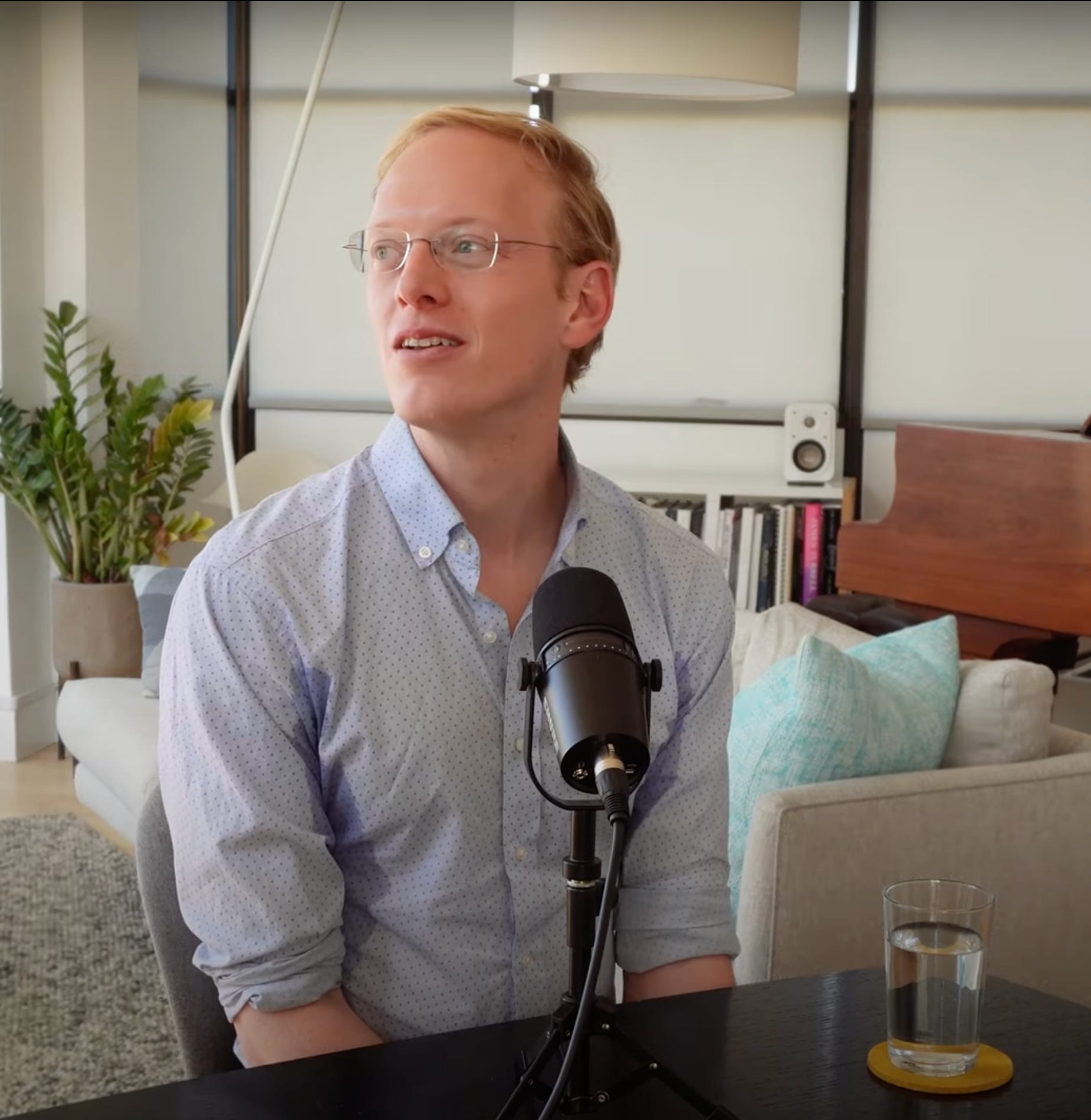
A few weeks ago, I sat beside Andy Matuschak to record how he reads a textbook.
Even though my own job is to learn things, I was shocked with how much more intense, painstaking, and effective his learning process was.
So I asked if we could record a conversation about how he learns and a bunch of other topics:
* How he identifies and interrogates his confusion (much harder than it seems, and requires an extremely effortful and slow pace)
* Why memorization is essential to understanding and decision-making
* How come some people (like Tyler Cowen) can integrate so much information without an explicit note taking or spaced repetition system.
* How LLMs and video games will change education
* How independent researchers and writers can make money
* The balance of freedom and discipline in education
* Why we produce fewer von Neumann-like prodigies nowadays
* How multi-trillion dollar companies like Apple (where he was previously responsible for bedrock iOS features) manage to coordinate millions of different considerations (from the cost of different components to the needs of users, etc) into new products designed by 10s of 1000s of people.
Watch on YouTube. Listen on Apple Podcasts, Spotify, or any other podcast platform. Read the full transcript here. Follow me on Twitter for updates on future episodes.
To see Andy’s process in action, check out the video where we record him studying a quantum physics textbook, talking aloud about his thought process, and using his memory system prototype to internalize the material.
You can check out his website and personal notes, and follow him on Twitter.
Cometeer
Visit cometeer.com/lunar for $20 off your first order on the best coffee of your life!
If you want to sponsor an episode, contact me at dwarkesh.sanjay.patel@gmail.com.
Timestamps
(00:00:52) - Skillful reading
(00:02:30) - Do people care about understanding?
(00:06:52) - Structuring effective self-teaching
(00:16:37) - Memory and forgetting
(00:33:10) - Andy’s memory practice
(00:40:07) - Intellectual stamina
(00:44:27) - New media for learning (video, games, streaming)
(00:58:51) - Schools are designed for the median student
(01:05:12) - Is learning inherently miserable?
(01:11:57) - How Andy would structure his kids’ education
(01:30:00) - The usefulness of hypertext
(01:41:22) - How computer tools enable iteration
(01:50:44) - Monetizing public work
(02:08:36) - Spaced repetition
(02:10:16) - Andy’s personal website and notes
(02:12:44) - Working at Apple
(02:19:25) - Spaced repetition 2
Get full access to Dwarkesh Podcast at www.dwarkesh.com/subscribe
Press play and read along
Transcript
Speaker 1 We underappreciate the role that memory has in our lives.
Speaker 1 If what you're trying to do is to understand something pretty difficult, your ability to understand that thing is still absolutely going to be bound on your memory, the constituent material.
Speaker 1 For the median student, the education system mostly wants to make the student do things they don't want to do.
Speaker 1 It's not about helping them achieve their goals more easily or more effectively for the most part. It's about like achieving goals that aren't theirs.
Speaker 1 The histories in educational psychology that I'm most aligned with are like the most robotic, authoritarian kind of histories, and also the ones that are most like kind of unschooling and Montessori-esque.
Speaker 2 Do LLMs make memorization more or less valuable?
Speaker 1 LLMs depend on our ability to externalize things and to make them legible. Basically everyone in the educational space are focused on really like the bottom quartile, like not even medium.
Speaker 2 Today I have the pleasure of speaking with Andy Matuszak, who is a researcher, engineer, and designer working on tools for thought.
Speaker 2 In addition to this podcast on Andy's YouTube channel, we did an interesting collaboration, which I encourage you all to check out, where I just watched Andy try to learn some new material.
Speaker 2 So it was just an intro chapter of quantum mechanics.
Speaker 2 And I honestly, I was expecting to see some cool techniques or be impressed, but I was way more surprised than I expected to be by the deliberateness, the effortfulness of the practice. practice, how
Speaker 2 what was really important? I mean, it was like 15 minutes a page in this textbook. And any small thing that Andy thought, like, I don't fully understand this.
Speaker 2 The author is trying to say something here. He's trying to draw an analogy or relationship.
Speaker 2 I'm not sure I totally comprehend the relationship between this classical mechanics equation and the quantum mechanics equation the author thinks is analogous. Just really delving deep in that.
Speaker 2 So I was super, I thought that was, I thought that was really interesting that this is a way to
Speaker 2 approach a new material. Yeah, so in this conversation, I'm looking forward to talking with Andy about not only that experience, but a whole bunch of his other research and the other tools he's built.
Speaker 2 Let me ask you this. So that experience made me think, listen, this is somebody who actually cares about understanding the material if you're going through it this deliberately.
Speaker 2 Do you think people in general care about actually integrating and understanding the material they're consuming in books and textbooks?
Speaker 2 Don't you think they'd make more an effort to actually assimilate that information if they cared to to get it?
Speaker 1 Yeah, I mean, I think the statement is just a little too general probably to comment on.
Speaker 1 I mean, so I think it's certainly the case that most students don't actually want to do this because they're learning stuff that they don't actually care about learning, or even if they do care about learning it, often like there isn't a clear connection between whatever reading or activity they're doing in the moment and like the thing that originally inspired them for the subject, like what they actually want to do.
Speaker 1 And so there's always something tenuous going on.
Speaker 1 I think, on the other hand, like it's amazing to look at, say, subreddits and to look at the level of nerdery and fascination that will be brought to bear on gardening equipment or like knots, for instance.
Speaker 1 People are competing to tie some very obscure
Speaker 1 18th-century knot or whatever, and they're flipping through almanacs from the period.
Speaker 1
So when people are interested and it connects to something that's truly meaningful for them, I think they really do want to absorb. And we see that in their behavior.
There is a second thing
Speaker 1 that I think is relevant. Well, to explain this, I will reference Mortimer Adler and Van Doren's How to Read a Book, which is a great guide on serious reading.
Speaker 1 And they consider the case of people who often have books on their bedside table. And sometimes they're like very difficult or demanding books.
Speaker 1
These are kind of aspirational, like, oh, I wish I could read King Lear. I want to be the kind of person who reads King Lear.
You put it on your bedside table and people will like read it before bed.
Speaker 1
And they'll find that they fall asleep while they're reading it. They're not really absorbing or understanding this book.
I mean, it's not just an issue of memory. It's like
Speaker 1 they simply are not apprehending the words on the page.
Speaker 1 And the authors of How to Read a Book make the case that
Speaker 1 the issue here with these people who are falling asleep reading King Lear is in many cases, it's not that they don't want to stay awake and to really deal with that text.
Speaker 1
In many cases, it's that they actually don't know how. They butt their heads up against this very difficult wall of material.
It's almost like maybe a rock climber
Speaker 1 who's not very experienced going up against a wall, that all it has is these like really subtle notches. To an experienced rock climber, those subtle notches are like a ladder, right?
Speaker 1 Like they can get right in there and start like making some progress and seeing what's up with this wall.
Speaker 1 But if you're an inexperienced rock climber, it just looks like a solid wall.
Speaker 1 So the claim, maybe, maybe this is an optimistic claim, you can take me to task, is that there is such a thing as being a more skillful reader.
Speaker 1 And being a more skillful reader will actually, in practice, in many cases, when the reading is aligned with your actual interests,
Speaker 1 produce a more serious, more understanding, forward kind of reading.
Speaker 1 Right.
Speaker 2 So there's like two models of why people might fail to retain the material they're consuming. One is they got it at some point, but they forgot it.
Speaker 2 And the other is they never understood it in the first place, and they just never noticed that they never understood it.
Speaker 2 And what was really, what I found really interesting was you going paragraph by paragraph, sentence by sentence. Have I got this?
Speaker 2 And by the way, this was material that I had tried to go through the week before. And there were things when you dwelved on something, I'm like, actually, I don't understand that either.
Speaker 2 And I didn't notice I didn't understand that.
Speaker 2 How were you able to notice your confusion
Speaker 2 while you were going through?
Speaker 1 This is again a habit. It's a skill that can be built.
Speaker 1 Adler and Ben Doran suggest that the first and most important rule of skillful reading, active reading, is asking questions and trying to answer them.
Speaker 1 And that really, if you just dwell on that and dwell on, well, what kinds of questions should I be asking? And how should I go about asking them?
Speaker 1 How should I go about answering them when the author isn't present? And so on and so forth, then you'll get very far.
Speaker 1 And they also say, conversely, and like this isn't meant as a criticism, an undemanding reader asks no questions and gets no answers.
Speaker 1 And I certainly have read many, many books that way, particularly before I developed this habit.
Speaker 1 And I often found myself falling into that second category: of you know, the issue was not that I failed to remember things, but rather that my eyes just kind of skidded across paragraphs without even realizing.
Speaker 2 You're, you know, halfway through a chapter and you're thinking, what is this chapter about?
Speaker 2 Okay, so a broader question is, now that we have all these online resources, some of which, you know, you've helped develop,
Speaker 2 Khan Academy and elsewhere,
Speaker 2 it seems that the value of conscientiousness as a trait has dramatically increased. If you can motivate yourself to learn these things, the world is out there for you to absorb.
Speaker 2 What are the sort of design or UI or even content modifications that can be made to give you a conscientiousness boost?
Speaker 2 Where in the past you have a professor, you have peers, you have in-person deadlines that motivate you.
Speaker 2 Is there something equivalent to a pen and paper how that boosts your mathematical IQ for conscientiousness?
Speaker 1 Right. So, one enduring result in education psychology is that when you're doing a lot of cognition, metacognition is difficult.
Speaker 1 So, what I mean by that is like when you're thinking really hard about the stuff on the page, it's very difficult for you to plan,
Speaker 1 regulate yourself, figure out what the best next action to do is reflect and evaluate
Speaker 1 whether you're understanding things, all the stuff that we're talking about, about asking questions.
Speaker 1 All that gets harder
Speaker 1 as the material gets harder and as it gets less familiar. So
Speaker 1 one common thread, at least in kind of learning science stuff, has been to outsource metacognition. So some of the ways we outsource that are actually very familiar.
Speaker 1
They're things like somebody gives you a syllabus and tells you what to read when, you reference that. So that is a user interface.
That is a design practice.
Speaker 1 If you're a self-motivated student, one thing you can do that I've done is just go appropriate a syllabus from some graduate-level course that corresponds to the text that you're reading and say, well, that might be a good guide as to
Speaker 1 what's most important, how to approach this. There are also lots of things that one can build directly into the interfaces.
Speaker 1 Just as one example, in Quantum Country, which was a textbook that Michael Nielsen and I developed to explore some ideas around augmented reading experiences, we embedded a bunch of review questions every, say, 1500 words or so in this text on quantum computation.
Speaker 1 And our primary intention in doing this was to help people remember what they read.
Speaker 1 And we had this theory that part of what makes it hard to learn a complex subject is that there's all these new definitions and notation and terms and things being thrown at you at once.
Speaker 1 And you're being asked to combine these things which are still unfamiliar. And so you're constantly having to retrieve these elements and struggling to do it.
Speaker 1
Either it's taking a while or your success rate is low. So, anyway, that was our motivation.
But
Speaker 1 it had this other metacognitive benefit that was really important: that you read 1500 words and now you're being asked these questions.
Speaker 1 That is an opportunity for you to notice that you did not, in fact, absorb what was in that thing.
Speaker 1 Not that you don't remember, but that, like, you know, there's a word in the question that is apparently important that you simply didn't even notice.
Speaker 1 And so, not only does that give you feedback, so it tells you, oh, maybe you need to go reread that specific section, but it may also change your behavior towards future sections.
Speaker 1 So in interviews, readers told us, for instance, that after they reached the first set of questions or a particularly difficult set of questions, they found themselves slowing down and reading more attentively, or realizing actually that their reading practices were ineffective in general, kind of in the way that you were mentioning towards the start of the conversation.
Speaker 1 There's been a bunch of research on
Speaker 1
the key phrase here, is something like adjunct questions, questions that go along with a text. That's kind of like what I was just talking about.
And they have all kinds of effects.
Speaker 1 So the adjunct questions have the kind of effects on forward material I was just describing. And they also have the effect of making you kind of reflect on what you've just learned.
Speaker 1 And in addition to the questions being asked, you might find yourself pondering, well, I'm being asked about this, but why does this matter?
Speaker 2 Yeah, on the point of adopting a syllabus from somebody else, I mean, one thing, one problem you might have as a self-learner is you have some goal. This is the reason I'm learning this.
Speaker 2 And then you start thinking, well, do I really need this chapter? Do I really need this content? At this point, you are doing the metacognition that you were using,
Speaker 2 you're trying to use the syllabus to avoid.
Speaker 2 If you are trying to self-learn and there is a resource that is a close approximation, of the syllabus you want, should you just like, hey, I don't know why I need this chapter or I'm just going to go through it?
Speaker 2 Or Or
Speaker 2 should you use your own judgment there?
Speaker 1 This is, I think, like a pretty classic issue for learning in general.
Speaker 1 You have this problem where you have to sort of, to bootstrap yourself in a domain, you have to outsource
Speaker 1 the question of what is necessary to know. You might know, for instance, that you really want to build
Speaker 1 a model that can generate images, given descriptions, or something like that, like Midjourney, but you don't even know what you need to study to do that.
Speaker 1 So So, you know, you pick up some textbooks on machine learning, and you're kind of outsourcing the answer to this question to the author: like, what is necessary to know to build things?
Speaker 1 And maybe you can find a book that's actually labeled what you need to know to make an image-generating model. But even then,
Speaker 1 you're outsourcing your answer to the author. So, you can take that answer as a start
Speaker 1
and treat it as tentative and revise it iteratively. And as you become more skilled, you can lean less on it.
And you probably should.
Speaker 1 I think a very common mistake that people make is to
Speaker 1 feel like they need to do the thing the right way. And that is exhaustive and completionist or something.
Speaker 1 If they fail because they find themselves bored or unmotivated because the material doesn't actually seem to relate to what they want to know, but they're just kind of going on faith that like, well, if I follow what the author says, you know, everything will be good.
Speaker 1 Anyway, they find themselves having trouble for that reason, and then they just stop. So this is bad.
Speaker 1 And they would be better off just skipping around according to their interest and continuing. One other thing I'll say about this is that
Speaker 1 the role that these syllabi play is
Speaker 1 as a scaffold. This is sort of a term apart from learning science, but it's actually, it relates to the thing we're familiar with.
Speaker 1 If you want to get higher up a building, you may not be able to climb it yourself, but you can build some scaffolding around it.
Speaker 1 And then suddenly you can reach that top shelf or the top of that building. Where the metaphor breaks down is that although scaffolding is ubiquitous in education,
Speaker 1 we give you simpler versions of questions first.
Speaker 1
That's a kind of scaffolding. We partially work the answer first.
That's a kind of scaffolding. We give you worked examples first
Speaker 1 where we might ask you to predict the next step of the worked example.
Speaker 1 That's also a kind of scaffolding. Where the metaphor breaks down is that once you become more capable, we try to remove the scaffolding.
Speaker 1 It's called fading. The idea is that once you have solved a lot of calculus problems, you don't need half of it worked out, and you're just like filling in one of the blanks anymore.
Speaker 1 And in fact, doing that would not be as effective a learning experience.
Speaker 1 So, the application with the syllabi might be something like: if I'm studying something in computer science, which is a domain that I know really well,
Speaker 1 I don't need those syllabi,
Speaker 1 not in the same way for most subjects. And
Speaker 1 I think that's mostly just because the amount of cognitive demand that's placed on me by the subject is just much lower than it is for other subjects.
Speaker 1 So much of it is familiar already that I can deploy my own planning more effectively as I go. But it's also the case that
Speaker 1 because I
Speaker 1 know so many things about the subject,
Speaker 1 I can do a better job from the get-go of making a plan.
Speaker 1 Because making a plan requires kind of
Speaker 1 modeling a path or predicting a path or saying, like, well, I guess I'd need to see how this connects to that or something like this.
Speaker 1 And if your destination and your starting point are very far away, then you can't necessarily see all the things in between or how to draw those lines.
Speaker 1 But if those things are only a couple hops away, you can maybe kind of infer pretty accurately. Right.
Speaker 2 I guess this maybe implies that if you do want to learn about a subject, it might just be helpful to just do an intro to X subject course or textbook, not necessarily because it is instrumentally valuable to, I don't know, whatever problem you're interested in, but because it'll give you the context by which to proceed on the actual learning syllabus.
Speaker 1 That's true. It's also the case that you don't even know, like you don't know all the stuff there is.
Speaker 1
And this is another key problem. This is another reason why we outsource stuff.
Like
Speaker 1 there's a fundamental tension in unschooling, for instance.
Speaker 1 Just let the kids pursue what what they're interested in and like that's cool there's there's a lot of good things about that but also like say that a kid's like true passion turns out to be like i don't know ocean geology or something and they're in a landlocked country and there's just no one around them that talks about ocean geology uh then they're like missing out on some great opportunity but you know if the school had a program where they are like bringing in guest speakers or whatever and then there's a special lecture on ocean geology from this person and it you know lights up the kids world
Speaker 1 Even if they wouldn't have chosen that lecture, that's a good thing.
Speaker 2 Yeah, unschooling is actually an interesting subject to talk to you about.
Speaker 2 We'll get back to that. But before that, I want to ask you about this excerpt from a Paul Graham blog post.
Speaker 1 Yeah.
Speaker 2 How you know, the title of the post. And it says, reading and experience train your model of the world.
Speaker 2 And even if you forget the experience or what you read, its effect on your model of the world persists. Your mind is like a compiled program you've lost the source of.
Speaker 2
It works, but you don't know why. So it's a compiled program, you don't need the source code.
Is it okay that we're forgetting so much of what we're reading?
Speaker 1
Yeah, yeah. I mean, what he's saying is true to some extent.
Whether or not that extent is sufficient is going to depend a great deal on the situation and on what you need.
Speaker 1 If your aspiration actually depends on having a deep, detailed understanding of the material, then
Speaker 1 the kind of imprint on your worldview or on
Speaker 1 your automatic responses or something like that made by the book may not be sufficient. On the other hand, if what you want is to absorb a lot of different ways of looking at the world,
Speaker 1 knowing the details of these isn't necessarily important, maybe you just want to know like, well, you know, Confucius emphasizes community and society as a moral patient in contrast maybe to the individualism of a bunch of like humanist philosophers.
Speaker 1 And like that's kind of the level that you feel like you need to make decisions in that domain, then I think that's fine. Very practically speaking, it's funny that he uses the word compile because
Speaker 1 one of the prominent theories of cognition, that is like how we come to know and learn things, is this theory called ACTAR by John Anderson. And
Speaker 1 a key part of it is this
Speaker 1 process that he calls knowledge compilation. This is the process by which we take
Speaker 1 individual facts and turn them into
Speaker 1 higher level patterns that we can generalize and apply in more contexts.
Speaker 1 And I think that's what Paul is gesturing at, that you read a book, it contains a story, a case study, and by reading it, you learn to generalize to some extent, and you apply it in other contexts when it seems relevant.
Speaker 1 And the reason why I bring up Anderson's theory is just that like he has a bunch of specific claims about like what's necessary for knowledge compilation to happen and what you'll be able to do as a consequence of certain degrees of knowledge compilation.
Speaker 1 I think he'd probably respond to this by saying something like,
Speaker 1 actually, in order to effectively compile things that you've learned into schemas that will match feature scenarios effectively, then you need to be exposed repeatedly to those things.
Speaker 1
You need to use them. You need...
to do a variety of things that will basically show your brain that it is relevant to apply these things in combination. And simply reading probably won't do that.
Speaker 1 But if you read and you have a lot of conversations and you're in a context where it's kind of demanding and it's drawing on what you read, then you may naturally do that kind of compilation step.
Speaker 2 I've actually been thinking about this in preparation to talking with you, where I look back on some of my old conversations.
Speaker 2 And, you know, I've had the pleasure to talk to a lot of interesting people across a lot of different fields. And
Speaker 2 at the time I interviewed them and had done all the prep, I actually kind of had a lot more context than I can remember now.
Speaker 2 Sometimes I'll listen back to a conversation and I won't even remember the content in the conversation.
Speaker 2 And I know, I remember thinking after the conversation, I knew so much more about this field than was compressed into this one hour interview, right? I had to prep other things that might come up.
Speaker 2 And afterwards, I'm like, I don't even remember the things that were in this one hour. But then the other part of me thinks, well, I'm getting better at doing the podcast.
Speaker 2 That might imply that, you know, I've picked up something.
Speaker 2 But it is a shame that I didn't have some sort of rigorous practice throughout the time of, you know, retaining the material that I was keeping.
Speaker 1 Well, yeah, I mean, I expect the main way in which you're getting better is actually not really about any of the details of those materials.
Speaker 1 I think it's about your practices as an interviewer, the way that you generate questions. Like you probably have a bunch of patterns, whether you know it or not.
Speaker 1 Like you read a thing that a person has written in hopes of generating good questions about it.
Speaker 1 And even though you don't have this habit for textbooks yet, maybe, of constantly demanding things of the textbook, you have, I think, started to develop this of essays or blog posts that interesting people you're interviewing have read.
Speaker 1 And to point to this Anderson theory, like in the course of repeatedly doing that, you've made it automatic, parts of it automatic, so that you don't need to do it consciously.
Speaker 1 You can focus more on the material.
Speaker 1 You can probably take on more difficult material or actually understand material at a higher level than than you could have before because less of yourself is engaged in this kind of question of how do I make the questions from the material.
Speaker 2 Yeah, I certainly hope so. Otherwise, there's a question to be asked of what I've been doing all these years.
Speaker 2 So, you know, having interviewed some of these people who are info wars and have consumed and continuously consume a lot of content, this is something you also noticed and pointed out in your notes.
Speaker 2 But, you know, Tyler Cowan, for example, I don't think he has any sort of note-taking practice. He
Speaker 2 just devours information.
Speaker 2 What is your theory of how these people are integrating things that they're?
Speaker 1
Tyler's a good example. I think he's actually a little easier than some others we might discuss.
So let's talk about Tyler for a second.
Speaker 1 One of the other things that's so interesting about Tyler is his writing obligations. So this is a man who's blogged every day since, I don't know, 2007 or something like this, and
Speaker 1 has a Bloomberg column, I think weekly, something like 1,500 words, and also has published something like a book a year for, I don't know, a decade or more, and occasionally publishes some academic articles, plus like a bunch of other collateral.
Speaker 1 So, like, that is notes.
Speaker 1 And I think it's also important to note that, like, the way that Tyler writes these blog posts and the way that Tyler does these columns and even the books is very different from the way that many other book authors work.
Speaker 1 Like, Tyler, the blog posts often have this like real first draft mentality to them. He's just thinking out loud.
Speaker 1
And he's got decades of practice thinking out loud and writing down a decent take the first time. And so he gets something pretty good the first time, much of the time.
And that works for him.
Speaker 1 So that kind of is a note, right? Like
Speaker 1 doing the thing, or I guess your initial thoughts on the subject is kind of what you would write in a note.
Speaker 2
Yeah, one of my former guests, Scott Young, was comparing Brian Kaplan into Tyler Cowan's books. And he said, you know, you read a Brian Kaplan book and it's like a chess game.
Right.
Speaker 2 Like, the opponent is,
Speaker 2 if you try to move a pawn up on this case for education, I've got this rook that I can move here.
Speaker 2 With Tyler, it's more like, you know, he's like shooting the shit on a subject, basically.
Speaker 1 Pangladeshi train station. Yeah, right, right, right.
Speaker 2 On a separate question,
Speaker 2 do LLMs make memorization more or less valuable? So there's a case you can make for both. But on net,
Speaker 2 is it more important to have more anky cards in your deck now that the GP4 is out?
Speaker 1 Maybe this is a good time to talk about what memorization is or like what it's for. So we could use that word to refer to the practice of learning more trivia, for instance.
Speaker 1 So for instance, a thing that I and some people I know have done is gone through this book, Cell Biology by the Numbers, which says all of these things.
Speaker 1 How big exactly is a nucleotide? How much volume does it take up? It's kind of helpful occasionally to know that it's about a nanoliter and that that can help you model things.
Speaker 1 So you can just like commit all of those things to memory, right? That's one kind of memorization. We could talk about how LLMs affect that.
Speaker 1 But I just want to make the case that so much of what you do and experience day to day is memory bound or is memory influenced in important ways.
Speaker 1 So just for instance, your ability to understand a difficult argument,
Speaker 1 even in the course of a text, is memory bound. Some of that's working memory, but your ability to
Speaker 1 understand an argument that has many steps in it, more steps than you can keep in your working memory, depends on your ability to think of some of those steps in terms of some stuff that you already know so that you can kind of reduce it or abstract it.
Speaker 1 Likewise in creative work, there's a bunch of studies trying to catalog case studies of how it is that people have flashes of insight.
Speaker 1 You know, it's a little hard to talk about that. But one of the things that's a pretty consistent source for insight for people is noticing a surprising connection or a surprising contradiction.
Speaker 1 It probably feels pretty familiar, right? Like you're reading through the newspaper and you see
Speaker 1 people have finally figured out how to do X and you're like, wait a minute, that means if I combine it with this other thing, we'd be able to do Y or something like that.
Speaker 1 Now that's only possible if the other thing
Speaker 1
is in your memory. If you have to think to look up the other thing, then the newspaper wouldn't seem so salient to you.
Likewise,
Speaker 1 and in just really boring ways, early on in my time in Khan Academy, I just learned in a very thorough way using memory systems, just a whole lot of details about the education market.
Speaker 1 And this let me be in high-level executive kind of conversations where we're trying to figure out strategy stuff. And somebody would propose a particular direction, or
Speaker 1 what about this? What about that? And I could say, well,
Speaker 1 the total budget spending for instructional materials is this, and like that market is growing by this percent per year, and 10% of students in the US are in this place, and, you know, and so on and so forth.
Speaker 1 And so basically, like, on the fly, I can evaluate ideas in a way that others can't. So anyway, this and other things are kind of just part of my rant about people.
Speaker 1 I think in general, we underappreciate the role that memory has in our lives.
Speaker 1 So just to come back to the question, explicit memorization or explicit making sure that you can recall the thing reliably, we can test test it against these things.
Speaker 1 So, for the case of the creative instinct, for instance, noticing the contradiction, noticing the connection, I imagine that we will have future notebooks that will do some of this noticing with us
Speaker 2 and that will decrease our need
Speaker 1 to
Speaker 1 be able
Speaker 1 to rely on our own sense of salience or something like that. But
Speaker 1 I guess I don't know how much.
Speaker 1 I'm skeptical that, like, my own experience coming up with weird ideas that feel very new
Speaker 1 is that it feels very personal.
Speaker 1 It feels very intuitive. I often haven't been able to describe textually the constituents of the thing very clearly.
Speaker 1 There's just kind of a feeling that something in this general direction is connected with something in that general direction, or there's a tension. And so that makes me a little hesitant.
Speaker 1
LLMs depend on our ability to externalize things and to make them legible. Back to the learning point about the role of memory.
If what you're trying to do is to understand something pretty difficult,
Speaker 1 your ability to understand that thing is still absolutely going to be bound on your memory of the constituent material.
Speaker 2 Do you think there's value in, there's pedagogical value in forgetting?
Speaker 2 So I guess some sort of anecdotal or unrelated evidence is in neural networks, sometimes you can improve performance by pruning some of the weights.
Speaker 2 Obviously, we forget things, right? So clearly we don't remember everything. When we sleep, we lose a lot of our memories.
Speaker 2 Is it possible that by forgetting the details and only getting the gist, that actually helps us better generalize the insights we're getting from text and things like that?
Speaker 1 What do you think of that way of thinking? Yeah, it could be. So memory is very connected to attention.
Speaker 1 And we can't attend to everything, right? So one of the roles of memory is to help guide us to the things that are important.
Speaker 1 So like maybe I happen to know
Speaker 1 the magnitude and energy of an electron volt. That's something I can draw on because of the memory system stuff.
Speaker 1 But I also don't like, I don't want that to be front and center in my mind all the time. I don't want it to be hyper salient the way that I don't know some very important design principle is to me.
Speaker 1 So yeah,
Speaker 1 there's some role there.
Speaker 1 There's also some theories that
Speaker 1 the reason we have forgetting is that our environment, our ancestral environment was very traumatic. And so our episodic memory in particular, we would like to maybe not be all that faithful.
Speaker 1 I actually, I don't know the status of those theories.
Speaker 2 Probably why we forget dreams as well, right? Like dreams are pretty traumatic if you thought of them at the same as a real-life experience.
Speaker 1 Yeah. So I mean another weird thing about memory is that as far as we can determine, memories aren't lost exactly, at least not completely.
Speaker 1 There's a bunch, there's a series of interesting experiments that people have used to demonstrate that decades later, things are still there.
Speaker 1 If you can cue them right,
Speaker 1 people can bring things back, even things that they feel are lost.
Speaker 1 And of course,
Speaker 1
you can also cue people in ways that are hallucinatory. So we need to be careful about that.
But
Speaker 1 I guess the reason why I bring that up is that it flies in the face of this view that there's a limit.
Speaker 1 One of the things that I think is kind of weird about this memory system stuff, or memory champions, ships, or something like that, is people are like, oh, if you do these things,
Speaker 1 will you start to forget other normal human stuff?
Speaker 1 And what's weird is no.
Speaker 1 I've been doing this memory system stuff for years.
Speaker 1 I just know more stuff now. And this is aligned with
Speaker 1 the experimental literature, which seems to suggest that there's probably upper bounds, but we're not close to them. And some of these memory champions have memorized truly absurd,
Speaker 1 you know, orders of magnitude, maybe two orders of magnitude more things than I have practiced. Certainly, people who are multilingual
Speaker 1 have
Speaker 1
really, really absurd numbers of things memorized. So there isn't a resource management argument.
Huh. Well,
Speaker 2 if there isn't, why do we forget so many things?
Speaker 2 Is there some reason the brain just
Speaker 2 so many things we're coming across? Maybe they're just not.
Speaker 2 We were training the ancestral environment to find certain things salient that just don't map on to books.
Speaker 1 It's a good question. So
Speaker 1 we're getting to a part of the cognitive science space that I'm less familiar with and also that I suspect we simply know less about. But let me just riff a little bit.
Speaker 1 One of the things that we sort of know is this idea of spreading activation.
Speaker 1 So when you go to try to look something up or when you try to deal with a particular situation, there's something almost kind of like DNS exchanges or like routing on a network or something where, okay, like we start from some point that it's like a stimulus and just speaking very informally, we kind of expand outwards from there.
Speaker 1 And there are effectively like weights on those connections. And by tuning those weights effectively, we like route the packets on the network effectively.
Speaker 1
Memory is encoded in these weights, at least partially. So if you didn't forget things, then you might just have this weird cacophony on the network.
And in particular,
Speaker 1 what's salient, what to do next, like which response seems most appropriate to this question,
Speaker 1 you might answer those kinds of things very ineffectively because all this stuff is coming up for you that is much less less relevant.
Speaker 1 Like one of the theories about how well we remember stuff in what circumstances is actually called predictive utility theory. And it suggests that
Speaker 1 the probability of retrieval of a particular item in a given situation actually does correspond with basically a model of
Speaker 1 to what extent the brain predicts it will be useful.
Speaker 1 Right.
Speaker 2 And then the prediction doesn't necessarily map onto
Speaker 1 doesn't necessarily, exactly. And so like, you know, when you repeatedly access something, when you practice retrieving it,
Speaker 1
the prediction of the utility of the thing goes up. Yeah.
And when you do it in a variety of situations, it goes up across a broader distribution.
Speaker 2
Okay, so this is interesting. When did you start your memory practice? Presumably, it was after Apple? Yeah.
Okay. So let me ask you this.
Speaker 2 So at Apple, you were in charge of a bunch of important flagship features on iOS and I'm guessing other things. Presumably,
Speaker 2 you didn't have some sort of practice, but since you were encountering these things day to day, that natural frequency and way in which problems came up, did you have a worse understanding of those problems than the things now, knowing what you do and knowing that having the practices you do, you're able to comprehend now?
Speaker 1
I don't know if that question made sense. No, that's a great question.
So, I mean, like, here's a fun thing. I was much better at what I was doing then than I am at what I'm doing now.
Speaker 1 That's pretty funny. So, I mean, it was just totally different.
Speaker 1
Let's talk about this a little bit. This feels very, very juicy for me.
Most of what I was doing was engineering, some of it very difficult engineering, but mostly engineering, mostly on
Speaker 1 things that were fairly well understood. So I wasn't trying to decide what should be done usually.
Speaker 1 Sometimes I was from a technical perspective, but certainly rarely from a product perspective was that a relevant question for me.
Speaker 1 I was kind of like a somewhat design-minded engineer, and I did a bunch of kind of engineering and design-ish things on tasks which were set out for me. At that point, I had been programming for
Speaker 1 a really long time. I don't know, 13 years maybe by the time I joined Apple, longer.
Speaker 1
And programming in Apple's ecosystem for probably two-thirds of that time, three-quarters of that time. So everything was just really familiar.
And like, it was mostly flow all the time, every day.
Speaker 1 I was kind of like, I was just in it.
Speaker 1
I knew the stuff that I needed to know. I was very well practiced.
And the space didn't change that much. You know, like engineers,
Speaker 1 most engineers at Apple most of the time are not like pushing the frontier of what is known, like trying to
Speaker 1 discover. They're like doing very difficult technical work, mostly applying things that they already know and understand quite well
Speaker 1 to problems which are
Speaker 1 usually, not always, moderately well, but pretty well understood, let's say. Memory was essential to me doing that job well, but I had already built most of it by the time I got there.
Speaker 1
I'd already built just tons of stuff for Apple's platform. And I had to learn a lot of stuff.
I learned a ton of stuff about the internals of those systems.
Speaker 1 But because I already had such a rich understanding both of Apple's platforms and of computer science and engineering in general,
Speaker 1 I had this really rich network for stuff to slot into.
Speaker 1 So learning stuff is easier when you have other stuff to connect it to is a nice principle. Metacognitive load on me was lighter because others were figuring out what we should be doing.
Speaker 1 So, just like by contrast, now I'm doing research, like I'm trying to discover things that are not known, I'm trying to make things that didn't exist.
Speaker 1 The hard questions that I answer are mostly like, what should be done? Or like, what should I do?
Speaker 1 And that question is not just a technical one of like, how should I implement this feature that needs to get built, but like, what intervention on a reader should be taken. That requires synthesizing
Speaker 1 lots of different unfamiliar literatures.
Speaker 2 There's two different threads I want to go on. Maybe I'll just mention the other one.
Speaker 2 This is also related to the thing we're talking about a few minutes ago with LLMs.
Speaker 2 And there's this thing that I'm sure you've talked about yourself as well, the Swanson linking, where this guy was just.
Speaker 1 I don't know Swanson-linking.
Speaker 2 Okay, actually, Michael Nielsen has written about it in his work.
Speaker 2 But this guy was just somebody who read the medical literature and
Speaker 2 he was just like familiar with a lot of esoteric results. And one of the
Speaker 2 different things would come up, and he would be able to figure out different things are connected. For example, I think he noticed in one case that headaches are linked to
Speaker 2 some other symptom and that other symptom is linked to magnesium deficiency.
Speaker 2 And so apparently a whole bunch of people's headaches were solved once they were given a magnesium supplement and he noticed that connection. Again, this is the kind of sort of
Speaker 2 combinatorial thing. that you wouldn't notice otherwise.
Speaker 2 But on this subject itself, so listen, there's this natural way in which we were able to get up to speed in all the things that are happening at Apple.
Speaker 2 Is it possible and maybe advantageous to do similar kinds of things in other fields?
Speaker 2 For example, instead of doing an explicit space repetition system when you're trying to absorb material from books, you just read a cluster of books and hopefully things will just come up that are relevant again and again.
Speaker 2 Or is there a value in having explicit practice of setting up cards and so on?
Speaker 1
Yeah, right. So again, the answer is going to be it depends.
I think that maybe the most familiar example of what you're talking about is immersion learning a new language.
Speaker 1 So immersion learning is a great thing.
Speaker 1
And it's going to be more interesting and more effective than doing space repetition practice. It's going to be integrative.
It's going to be socially based.
Speaker 1 So there's a bunch of stuff about social learning that's relevant.
Speaker 1 A problem is, though, is that, say that you decide you want to learn Swahili today and you go down to the local Swahili community center and you're like, cool, I'm going to immerse myself.
Speaker 1 Good luck.
Speaker 1 you can't even get started. So, through this lens, explicit practice is a way to bootstrap yourself.
Speaker 1 Likewise, a great way to become a better musician.
Speaker 1 All of the best pianists at sight reading that I knew in university played with churches.
Speaker 1 They were so good at sight reading because, you know, they had to show up every Sunday and they're playing a different thing.
Speaker 1 New hymn every Sunday, right? So this is immersion also.
Speaker 1 And, you know, over time, they're learning all these cadences and these things that are really common and whatever.
Speaker 1 But you can't show up and be the church pianist every Sunday in the first place if you don't already have some decent foundation.
Speaker 1 So this is sort of a bootstrapping argument that one role for explicit practice of this kind is to get yourself into a position where you can more naturalistically reinforce.
Speaker 2 I see. Okay, got it.
Speaker 1 But there are still going to be instances where the naturalistic reinforcement isn't going to work. So for example, the linking that you brought up, one issue for doctors is rare diagnoses.
Speaker 1 So if it's only gonna be once every couple of years that you see a patient that's gonna present with these symptoms, that's not gonna be frequent enough to naturally reinforce your memory of that.
Speaker 1 And you're gonna need some out-of-band mechanism.
Speaker 1 And unfortunately, I think for many kind of creative leaps and creative insights, that may be closer to the regime that we're in.
Speaker 2 Yeah, that makes a lot of sense. Where in many fields, you just have the things you're regularly doing is a thing you need to reinforce.
Speaker 2 It makes a lot of sense that if you're a researcher, the long tail of events that might come up is a thing you're, you know, it might happen once every few months, but the regularity is not a thing that matters, right?
Speaker 1 It's sort of an effect on your work.
Speaker 2 Here's a question I actually have. So when we were doing the practice, or when we were doing the
Speaker 2 quantum mechanics textbook, it was like three hours, and afterwards, I was just exhausted. And I was actually surprised that you went the entire three hours without interruption.
Speaker 2 And so afterwards, I was packing up, and you were like, hey, I'm about to actually go to my piano lesson.
Speaker 2 I was so confused at how you had the stamina to keep going. Is the stamina just inherent in you or is that something you did to develop?
Speaker 1 So one of the things that I think is funny about stamina is, first off, there's some kind of weird grass is always greener kind of situation where like I often feel struck by other people's stamina and feel like I have very little of it.
Speaker 1 I struggle with energy. I've actually written extensively about all my struggles with energy and like ways of managing energy.
Speaker 1 I spend a lot of time thinking about it and like managing my energy levels, structuring my day around it.
Speaker 1 So I think there is something where like one often feels maybe lower stamina than one actually is because one misapprehends others' stamina.
Speaker 1 Okay, so in that particular situation, how do I explain why three hours of studying, et cetera? First off, social.
Speaker 1 So if I were alone and studying that book for three hours and I weren't effectively trying to perform for you, Dorkesh,
Speaker 1
it wouldn't have been nearly as energizing for me. And I definitely would have taken taken breaks.
I still would have been able to go for three hours, I think.
Speaker 1 And part of the reason for that is that it's simply way less hard than things I normally do. In some sense, learning quantum mechanics should be
Speaker 1 much harder, and it kind of is cognitively demanding in a lot of ways.
Speaker 1 It's much more cognitively demanding in kind of a direct way than what I actually do day to day. But it's much less...
Speaker 1 It's much less demanding on what William James calls the energies of men, which is something like a life force that permits you to act according to your will or something like that.
Speaker 1
Maybe it's gumption, maybe it's willpower, maybe some people call it spoons. I don't know.
These aren't all the same thing exactly. But
Speaker 1 sitting and staring at a page and deciding what you should do next on a research project is incredibly draining on that resource.
Speaker 1 The not knowing, sitting and not knowing is like the hardest thing that I do in my work. And so there's something, it's like a wonderful vacation to be presented with,
Speaker 1 oh great, somebody else is going to tell me what to do.
Speaker 1 This is great.
Speaker 2 So although it might be less demanding than our usual work, it is definitely more demanding than the way in which I or most people approach textbooks or other material.
Speaker 2 In the sense that, you know, I would just like read through. And then once I get to the exercise, I'm like, let's see what I didn't understand.
Speaker 2 Whereas just the attention and the intensity to go through sentence by sentence and constantly being paying attention seems like way more exhausting than
Speaker 1 yeah. I mean, so this is sort of true.
Speaker 1 Like, and it's definitely the case that I will occasionally do some of this like before-bed reading where I think, like, oh, like, you know, let me just do a little bit more, you know, and it's like, it's basically useless.
Speaker 1 Yeah.
Speaker 1 But I want to make the case that there is a kind of pocket that you can fall into. Maybe you call it flow, I don't know, where
Speaker 1
like the demandingness that you're bringing to bear is matched to your ability. The book book is not overwhelming.
Like you feel like you can make your way through it. And
Speaker 1 this is actually more engaging.
Speaker 1 So I occasionally will find myself reading as an undemanding reader and finding my attention kind of slipping because I feel like I'm just not that attached to the text emotionally.
Speaker 1 I'm kind of reading dutifully. I'm like trying to get through it.
Speaker 1 That produces sometimes like an adversarial aspect where the text is in my way
Speaker 1 or it's kind of something to be,
Speaker 1 I don't know, like accomplished.
Speaker 1 And often then I will find that I need to bring more gumption to bear to kind of power through and like, you know, make myself sit there and keep flipping the pages than I need if I actually just like open my curiosity and open my attention and really start engaging with the book.
Speaker 2 There are sorts of ideas that people have come up with for different pedagogical tools
Speaker 2 or mediums that give closer connection to the reader.
Speaker 2 One is, you know, you have some sort of fiction account where a concept is introduced and reinforced, or you have a video game with characters you care about.
Speaker 2 And as far as I know, there isn't something that has really taken off using these sorts of new mediums.
Speaker 2 What do you think that is? Is it just an inherent limitation of everything but text and lectures, or people just haven't given it the right content and
Speaker 1 design?
Speaker 1 Yeah,
Speaker 1
I'm fascinated by this question. Let's see, I can say a few things about it.
One is that I would argue that one medium has taken off in an absolutely enormous way, and that's video. People love video.
Speaker 1 People will watch Grant Sanderson spend an hour going through some explanation of an esoteric math problem. People who would never crack
Speaker 1 a Springer graduate textbook in mathematics or something like that. The issue is that they will, in general, not walk away from that interaction with much understanding.
Speaker 1 But they are much more engaged.
Speaker 1
So that's cool. That's suggestive.
And it suggests the question, well, but is there a version of that that I could actually produce detailed understanding?
Speaker 1 Maybe. One approach to producing that might be like a game.
Speaker 1
My favorite example of this is The Witness by Jonathan Blow. Have you played The Witness? Okay.
I think The Witness is an absolutely extraordinary work of art.
Speaker 1 So it's a game that has no text, at least no text that's relevant to the game elements.
Speaker 1 In kind of classic mist style, you wake up on an island and you figure out what's going on. And the game proceeds to explain to you, without using words, but just by shaping your environment,
Speaker 1 a series of extremely complex mechanics, basically, of a system that exists in this world.
Speaker 1 So you learn a bunch of stuff,
Speaker 1
and it gets to the point where it feels like you're in conversation with the game's designers. It's like, ah, he's asking me to do this here.
No one's asking you, right?
Speaker 1
There's no text, but you can feel that you are being asked. And you perform some interaction in the environment and you feel that you have answered.
And the game responds in kind.
Speaker 1
This is very, very interesting. It's like it's a medium of action.
Some people have tried to make educational games, games which are explicitly about arithmetic or something.
Speaker 1
Jonathan Blow's game is not about that. The mechanics that you learn are, they're like about the environment.
I don't think anybody has yet really succeeded in doing this about explicit subjects.
Speaker 1 There are, for instance, things like Kerple Space Program.
Speaker 1 Maybe people learn some things about project management or orbital mechanics from that. Zachtronics has a bunch of games that are sort of about assembly language, roughly speaking.
Speaker 1 Maybe you can learn some things about that. The issue seems to be that games are ultimately, they're an aesthetic form.
Speaker 1 Like the purpose of the game is to have an experience that feels a particular way. And so they're sort of serving a different purpose than Grant's videos
Speaker 1 or a text.
Speaker 1 Grant's videos are also serving a different purpose from the text. Like the text you might pick up because you're like, I want to be able to build a robot.
Speaker 1 Like so you pick up a textbook on robotics or something.
Speaker 1 And so is there something that you can pick up that's sort of like a game insofar as it's an active environment that you'd use in a similar situation to, I want to learn to build a robot.
Speaker 1 Maybe, kind of.
Speaker 1
We don't quite have those yet. We have some things that are kind of like that.
I don't know if you've seen like From NAND to Tetris.
Speaker 1 This is a very interesting project that's kind of along these lines.
Speaker 1
And what characterizes it, like games, is doing. It's active.
So when I was asking all those questions of the book, that was active learning, active reading. NAND to Tetris is naturally active.
Speaker 1 So this is a course in which
Speaker 1
you kind of start with basically nothing. You start with memory and you build a virtual computer and you build Tetris.
You build a processor and stuff. And so the whole thing's active, the whole time.
Speaker 1 You're making the computer go.
Speaker 1 This is doing a similar job to the question asking that I was doing, except that
Speaker 1 You don't have to regulate all of that yourself.
Speaker 1 The regulation, the choice of what activity to do, do is in the course, is in the structure of the material. I think there is waiting to be created some kind of mass medium that is like
Speaker 1 that,
Speaker 1
but that can be applied in many, many circumstances. We have the non-mass medium version of it already, and it's apprenticeship.
Like if you want to be a good yoga teacher, you like...
Speaker 1 go hang out in yoga studios. If you want to be a good surfer, like you go to the beach when the other surfers are there and you like participate peripherally
Speaker 1 and you talk to them and you learn about their tactics. They might give you some feedback eventually and you'll start to participate less and less peripherally over time.
Speaker 1
And eventually you'll be part of the community. This isn't a mass medium.
We can't print a billion copies of it.
Speaker 1 We can with a book.
Speaker 2 What is the experience of watching George Hawson's stream coat up tiny grad? How does that compare to just being in an office with him? Yeah.
Speaker 2 Because even if you're in an office with him, there's, you know, there's there would be constraints on his time and how how much engagement there would be.
Speaker 2 So why isn't video a scalable way to increase apprenticeship?
Speaker 1
I'm incredibly excited about streaming, actually, as a medium for this. So we're kind of gesturing at a particular kind of learning that needs to happen.
It's often called tacit knowledge.
Speaker 1 So one of the things that you have to learn to do as an engineer is to learn to deal with 100,000 different like weird situations where something is not behaving the right way.
Speaker 1
And eventually you learn learn a kind of pattern recognition, you learn ways of dealing with this. And much of this is like not described in any book.
It's not explicitly taught.
Speaker 1
You just kind of learn it by doing it over a long period of time. So by watching George do it, I think that people do absorb stuff.
They can absorb some of that knowledge.
Speaker 1
That's part of how apprentices absorb that knowledge. There's a few things that are missing.
You know, you're not getting feedback. There's a whole lot of chaff there.
Speaker 1
Like there's a whole lot of stuff that probably isn't all that meaningful. It's also true for apprentices.
So I'm pretty, actually, I'm pretty excited about streaming videos.
Speaker 1 I've complained loudly that there aren't more designer streamers.
Speaker 1 So one of the things that I think is really interesting is that we have some disciplines like programming where there are like a million books on courses about how to learn to program.
Speaker 1
And they don't give you everything you need. There's this tacit knowledge stuff that you need to develop.
But like,
Speaker 1 if you work through these courses, if you go through the MIT open courseware for computer science, you'll be able to build some stuff and you'll be able to leave yourself up.
Speaker 1 This is not true in all domains.
Speaker 1 If you're looking at,
Speaker 1
well, in particular, design, but lots of other domains that are sort of like that, like musical composition, architecture, something like this. Nope.
It's normally done in studio classes.
Speaker 1 Lots and lots of hands-on feedback.
Speaker 1 Stuff has,
Speaker 1
the feedback is highly contingent. It's highly contextual.
We just haven't figured out how to communicate this.
Speaker 1 And so it's good to see lots of programmer streamers, but I really want to see the streamers in these other domains. Right.
Speaker 2 On the point about the more programming books, ironically, the reason why there's some more resources on programming is that it's just so legible, but it already makes it easier to understand in the first place.
Speaker 2 So you just have this reinforcement. But so, you know, the man to testris is, let's say, it's like a video game analog to learning
Speaker 2 maybe not just programming, but how things in the internals of a computer work.
Speaker 2 But programming has an element where it already feels like a video game.
Speaker 2 I have a friend who has a sort of intense sort of manic energy, and he used to be addicted to video games when he was a teenager. And now he just stays up all night in these coding binges.
Speaker 2 It's just the same part of the brain. Are you optimistic about things like video games and fiction? being able to work in fields that are not already kind of like a video game, like programming?
Speaker 1 I think what makes programming feel like a video game is
Speaker 1 this sense of instantaneousness,
Speaker 1 this sense of direct contact with the environment. You're learning about a kind of a conceptual world, but that world is right underneath your hands.
Speaker 1 And as you manipulate it, you're constantly getting this feedback, the red squiggly. You're pressing Command-R regularly, and
Speaker 1
you're seeing it fail. And that feels great.
Like, there's this feeling that's very common for programmers, and
Speaker 1 it's laden with doom. The feeling is
Speaker 1 it's like 9 p.m.
Speaker 1
and you've been working on a thing all day, and it's almost working. It's almost working.
And you know, like, if you just debug this one thing, then like your project will be like done.
Speaker 1 You'll be able to go to the so you're like, well, I'll just stay up and like, I'll debug this one last thing. And then you start debugging it, and you get it, and you solve it, and that feels great.
Speaker 1
And then immediately you like run into one more thing. Like, oh, it's almost running all the way through.
It's almost going end to end. And you're like, well, I'll just stay up a little bit longer.
Speaker 1
And before you know it, it's like 2 a.m. And you keep going because it feels so good.
Like you feel the sense of forward progress. You're not just staring at a wall.
Speaker 1 I think for the programming problems where you are at a brick wall, it doesn't feel like this. It feels bad.
Speaker 1
So can every field be transformed into something where you can feel the sense of forward progress? You can get this rapid feedback cycle. I think that's really hard.
I think some fields,
Speaker 1 like, it's not clear to me that they can be transformed in that way. I think we can get a lot closer in most cases
Speaker 1 than we're at right now.
Speaker 1 So what's hard about designing the user interface is that often there's this feeling of exploring kind of a combinatorial search space.
Speaker 1 Programming often feels like a search problem too. You have a sense that
Speaker 1 there's some right way to solve the problem.
Speaker 1 There might be some set of right ways to solve the problem, and you're kind of looking for it.
Speaker 1 And you have some heuristics that guide you to, like, oh, this might be a dynamic programming problem, or like this might be something that is solved well by
Speaker 1 separating concerns or something like that.
Speaker 1
Design often feels less like that. You have those heuristics too.
You have those patterns too. Often it just feels like, nope, I just need to try like 300 things.
Speaker 1 And so there's this characteristic where you'll look at a designer's Figma file and like what you do in Figma is you press Command D. This is like the core action of Figma is to duplicate.
Speaker 1 So you have an artboard, you tried something, you're like, that didn't work. So you select it and you press Command D.
Speaker 1 And what you end up with, and you look at design Twitter and it's just all these screenshots of people's Figmas with like a million artboards. They're just like trying stuff.
Speaker 1 And you don't have this feeling, or at least I don't, and I think many designers don't have this feeling of like progress.
Speaker 1 It's like you're just kind of exploring exploring parts of the search space and like you're learning that parts of the search space don't work.
Speaker 1 And
Speaker 1 eventually you stumble on one that does, but you don't have this feeling of like getting closer often.
Speaker 1 Often there will be like weeks that go by without feeling like you're getting closer because what you're doing is just kind of like narrowing the search space.
Speaker 2 Interesting. Although there are people who are obsessed with design.
Speaker 2 And what is the sort of loop that keeps them obsessed with a process that doesn't feel intrinsically forward feeding?
Speaker 1 So to some extent, I think
Speaker 1 they are
Speaker 1 skillful.
Speaker 1 So the people that I know who are like this,
Speaker 1 it's a combination of their skillful often and the nature of the problems that they're solving are highly tractable. So
Speaker 1 an example of a kind of thing that designers will often rabbit hole into is like designing a poster.
Speaker 1 It actually often used to be kind of a a cliché that at Facebook, there were all these posters up on the wall of the office, very, very elaborate, beautifully designed posters for like a talk that someone was coming to give at Facebook.
Speaker 1 And it's like, why?
Speaker 1 Why did somebody put all this effort into it? Like, well, it feels really good because a poster is this like really constrained,
Speaker 1 it's like finite, it's ephemeral.
Speaker 1 You can start it and within a few hours, like, yeah, there's a search space, but you can find a decent part of the search space pretty rapidly.
Speaker 1 And once you're there, there's this beautiful and very enticing feeling of turning the crank and like making it better and polishing it and like trying this or that.
Speaker 1 But when you're trying this or that, like all of the options are kind of okay, and you're kind of trying them out of curiosity, or like maybe it can be even better.
Speaker 1 And that's very different from the kind of design where you're just like,
Speaker 1 I simply don't know how to do this.
Speaker 1 And I think it's part of why
Speaker 1
those designers loved making those posters. It's like it's a snack.
It's a treat. It's also something they get to control,
Speaker 1 whereas ordinarily they don't.
Speaker 2 Just don't tell the manager how many software engineering hours are used up in the poster designing at Facebook.
Speaker 1 Well, it's no software engineering. No, it's only designers.
Speaker 1 But for the software engineers, I mean, Code golf is the equivalent, right? What is code golf? You know, in golf, like you try to get the lowest score. Uh-huh.
Speaker 1 So code golf, you try to solve the problem as minimally as possible, right? Like, ah, ah, you know, I don't need this.
Speaker 1 I can combine this. I can do it in three lines.
Speaker 1 If I use Haskell, I can do it in one line.
Speaker 1
That's a kind of thing programmers do that's like this. But just endless refactoring is another thing that's kind of like this.
You have the thing working, but it could be more beautiful. Right.
Speaker 2 Well, so it seems like the tools and the ideas you're developing seem especially geared towards
Speaker 2 very intelligent and very motivated students.
Speaker 2 If they would be different,
Speaker 2 what would the tools that you would develop for a median student the education system look like? Both in motivation and in other
Speaker 2 traits?
Speaker 1 Yeah, they'd be super different.
Speaker 1 I kind of got out of the educational space in part because I don't like the framing of this problem.
Speaker 1 For the median student, the education system mostly wants to make the student do things they don't want to do.
Speaker 1 It's not about helping them achieve their goals more easily or more effectively for the most part. It's about
Speaker 1 like achieving goals that aren't theirs.
Speaker 1 Obviously, like that's not always true, but for the median student, I think it kind of is true. I become very interested
Speaker 1
when I was at Khan Academy. I was kind of thinking about this problem.
And
Speaker 1 one of the angles that I found really interesting was
Speaker 1 So at Khan Academy, we were mostly thinking about not just the median learner, but like maybe the 25th percentile learner. One of the angles that felt most relevant,
Speaker 1 maybe not from an efficacy perspective, but
Speaker 1 for me from like a breaking out of this, getting them to follow goals that aren't their own perspective, was to focus on inquiry learning and to focus on transforming the learning experience into something that actually is related to their goals.
Speaker 1 That is, we're asking questions that are authentically interesting, that they authentically want to answer, and that they can participate in in a way that feels natural.
Speaker 1 We did a lot of experiments with dynamic media representations of things.
Speaker 1 The idea being that, like, you've probably seen maybe these plastic blocks or things that people can play with when they're kids to get an idea of numbers and number systems.
Speaker 1
Kids will play with these things unprompted because they're fun. Like, it's just a pleasure to handle them.
It's a pleasure to manipulate them.
Speaker 1 When you
Speaker 1 have them in hand, it's very natural to suggest, like,
Speaker 1 ah, can you make a pattern like this? Like, why? You can't seem to make patterns like that.
Speaker 1 Why is that?
Speaker 1 So, you know, for instance, you can start to point out things like,
Speaker 1 so quis and air rods is the name for
Speaker 1 a set of
Speaker 1 10 rods that have basically unit length one to ten and they're all different colors.
Speaker 1 And so you can do things like take eight and like the rod that represents eight and put two of the rods that represent four up next to it and show that like this one you can you can like divide into two rods effectively.
Speaker 1 But then if you take seven, like there aren't, there is no other pair of rods that for the same color you can put it next to it. So you get these different patterns.
Speaker 1 So things kind of naturally suggest themselves
Speaker 1 by experimenting with these materials and having conversations with people around these materials.
Speaker 1 And so one of the things we were interested in was: well, are there things that are like that that are for more advanced topics?
Speaker 1 Like, can we create something that's kind of like those rods, but that is about,
Speaker 1 you know, like a more advanced topic in math or
Speaker 1 about debates in history or something like that.
Speaker 1 One of our tactics was to lean heavily on social interaction.
Speaker 1 People like talking about stuff with people, if it's like a real conversation.
Speaker 1 And for the same reason that I had to use less willpower to study that quantum mechanics text because you were there with me.
Speaker 1
A student who's engaged in like a real activity with a peer will need less willpower as well. They'll also learn from their peer if you structure things right.
So social learning becomes interesting.
Speaker 1 But I think at a high level,
Speaker 1 I mostly have abandoned this question to others. Basically everyone in the educational educational space,
Speaker 1 this isn't totally true, but like, you know, 90 plus percent of people in the educational space are focused on really like the bottom quartile, like not even medium.
Speaker 1 And there's a good reason for this. Like many, not quite as many, people
Speaker 1 who are in education, they are motivated by arguments of equity and opportunity. And they want everybody to have the opportunities they had.
Speaker 1 They're very motivated by the injustices that they see in the differing access and the differing support that different people have.
Speaker 1 And they're very motivated by the very real disadvantages that accrue to the bottom quartile performing students.
Speaker 1 It's also true that the marginal impact that you'll have on that student's life will be much greater, probably, than the marginal impact on, say, an 80th percentile performing student.
Speaker 1 Or so the argument goes, like that student will be fine, which is like probably true.
Speaker 2 But
Speaker 2 there's a big marginal difference between fine and
Speaker 2 supercharged.
Speaker 1 Yeah, yeah, I mean, that's true. But anyway, I mean, like, I say all this to say, like, I understand why the vast majority of people in education are focused on what they're focused on.
Speaker 1 And I think it is good, and I'm glad they're doing it. And I'm mostly
Speaker 1 have decided to let them do that and to focus elsewhere.
Speaker 2 Yeah, yeah. No,
Speaker 1 I see tremendous value in focusing on the people
Speaker 2 realistically, like, the cool new shit that's coming out, you know, where's that coming from? And what's the way to increase that?
Speaker 2 Yeah, okay, so but it's interesting to know that the same tools might not just work across the spectrum.
Speaker 1 Yeah, let me also say, like, part of the trouble here is that, like,
Speaker 1 the cool shit is very likely to come from students who are like performing at the 20th percentile in school because they're like disaffected and bored, and none of this stuff matters to them. Right?
Speaker 1 And so, like, part of the trouble here is that
Speaker 1 by
Speaker 1 like opting out of helping these people learn,
Speaker 1 there are all kinds of interesting inventions that could probably occur that aren't occurring.
Speaker 2 So I don't quite know how to contend with that.
Speaker 1 I guess basically I'm like trying to bite off a piece of a problem that feels maybe tractable.
Speaker 2 Once all the tools are built,
Speaker 2 when you're at the end of your career,
Speaker 2 with the learning process, is it supposed to feel fun?
Speaker 1 Or does it have to feel fun?
Speaker 2 Is there an element of, even when all the tools are there, that there's just like a level of David Goggins, you know, this is going to be miserable, but I've decided to learn this in this way and I just had to go through it.
Speaker 1 Where does misery come from?
Speaker 1 Hmm.
Speaker 2 Where does it come from?
Speaker 1
I guess I'm asking this honestly, not really rhetorically. Let me try to answer my own question.
I mean,
Speaker 1 let me say first off, like, I think I am broadly speaking very opposed to what I understand to be David Goggins-esque attitudes towards almost anything. In this particular instance,
Speaker 1 I think what I think is something like, if I ask, why is it miserable to learn a a particular subject, the answers that come to mind are things like, first off, I don't care about this subject.
Speaker 1 And I think that's not what we're talking about.
Speaker 1 Like, you're asking about a world in which these great tools exist and someone's using one of these tools to try to do something they really care about.
Speaker 1 So another reason why it could be miserable that I think is pretty common is that you have some idea about like
Speaker 1
you're not going fast enough or like you're failing or you're struggling. And the misery comes from resisting that.
It comes from feeling like
Speaker 1 you're doing poorly and like you shouldn't be doing poorly. Like it's bad that you're doing poorly.
Speaker 1 And maybe you're feeling fearful, like others are going to judge you or like you don't have enough time or something like that.
Speaker 1 And I think that's basically like an emotional problem that needs to get healed rather than like a practical problem with learning.
Speaker 1 In the case of something like organic chemistry, where like you truly do just need to learn like, you know, 200 names or something, one answer is that like, okay, that can be done very cheaply using modern memory systems actually.
Speaker 1 So like organic chemistry students suffer through this and they don't need to.
Speaker 1 But even with modern memory systems, like you're probably going to spend a total of, I don't know, call it 100 minutes across some weeks
Speaker 1 studying all of these
Speaker 1
formulae. And that still is unpleasant.
So can that be resolved? And I think the answer is yes, actually.
Speaker 1 So I was thinking about this in the context of the cell biology by the numbers book I was telling you you about, where there's all of these
Speaker 1 things like the volume of the nucleotide, I said, is a nanoliter. So, to like study the flashcard, what's the volume of a nucleotide is like not terribly pleasant.
Speaker 1
I'm not sure it constitutes suffering exactly. It's fine.
You know, I'll do it while like waiting in line.
Speaker 1 But I think there is a better version of that, which is like
Speaker 1 solving an interesting Fermi problem which involves that term. So, something like: if I have a vial
Speaker 1 of the COVID COVID vaccine, like how many copies of the COVID RNA are likely to actually be in it
Speaker 1 if the vial is a milliliter large or something? That's like kind of a fun little question. And I can enjoy sitting and noodling on that.
Speaker 1 And in doing so, I will need to retrieve the volume of the nucleotide to help me make that approximation.
Speaker 1 So I think there's moves like that that you can use to kind of paper over any remaining stuff that feels kind of necessarily unpleasant or rote.
Speaker 1 I'm actually surprised to hear you say that because one way in which I read your stuff is,
Speaker 2 at least some of your stuff, is that this is actually a way of endorsing the traditional way of thinking about education, but using new tools to get the traditional ones.
Speaker 2 To give you an example of what I'm talking about, you know, you go back to like a headmaster from the 1900s and you say, is it important to have the taxonomy of a subject memorized?
Speaker 2 And you say, of course it is. That's why you're going to spend a year memorizing taxonomy.
Speaker 2 And then you would say, you know, memorization should actually be that you have a dictionary by which to proceed on the subject.
Speaker 2 So in those ways, but you have sort of, you know, new systems for doing that same kind of thing.
Speaker 2 So I'm actually surprised to hear you say on this particular, and the reason in this particular case, I was expecting you to say that, no, that you have to be disciplined if you decide to learn something.
Speaker 2 is I expected that, you know, in the case of the three hours of intense learning followed by an intense piano session, you were just like really tired at the end and you were like, but no, this is something I've had to do this evening.
Speaker 2 So, yeah, so I'm actually kind of surprised to hear you say that.
Speaker 1 Yeah, yeah, no, I really enjoy this tension. And I'm probably overstating my,
Speaker 1 I'm probably like reacting to the Goggins reference with
Speaker 1 a bit of an overextreme overcorrection or something.
Speaker 1 But this really is how I feel. And I feel this tension all the time.
Speaker 1 Like, the histories in educational psychology that I'm most aligned with are like the most robotic, like authoritarian kind of histories, and also the ones that are most unschooling and Montessori-esque.
Speaker 1 Like, I really have a ton of sympathy for elements of both of these directions. And there's kind of a weird synthesis of this in my head that I can't, I guess, fully externalize.
Speaker 1 I guess part of what I'm saying is aspirational. Like, I mean, it certainly is the case that I do, in practice,
Speaker 1 use willpower to make things happen.
Speaker 1 So, just as an example of something that's totally contrary to everything I was saying, I use a tool called BeMinder, which charges me if I don't do certain things.
Speaker 1 This sounds, I don't know if it's kind of military, but it's certainly more authoritarian than this kind of freewheeling butterflies kind of gesture I was making a moment ago.
Speaker 1 And I use it to make sure that I do my memory practice. Shouldn't my memory practice be so joyful? It's at the center of my research, right?
Speaker 1 It should be like the most interesting, exciting part of my day, but often it's not.
Speaker 1 And so I use this to do it anyway. So there's some tension here.
Speaker 1 I think I do want to say, you know, the reason why I'm willing to endorse this headmaster's view about the taxonomy has to do with the price.
Speaker 1 I did a bunch of rote memorization in high school, and it was very inefficient, and it was very uncertain. So it was like, it was emotionally difficult because
Speaker 1 I wouldn't even feel confident that I had learned the stuff. I didn't know what it was to learn something reliably, like to be confident that I'd be able to recall it.
Speaker 1 And it also, like, it was hugely time-consuming
Speaker 1 because I didn't have techniques or tools. And now, you know, part of why I respond so favorably to like, yeah, just learn the taxonomy is that like for me, it's just trivial.
Speaker 1
Like, yeah, sure, whatever. Throw it in the deck.
You know, like,
Speaker 1
it'll consume a total of 15 minutes over the next few weeks, and then I'll know it. You know, it just doesn't cost anything.
So, like, yeah, okay, fine.
Speaker 1 Other things in learning do still have real costs. And
Speaker 1 those are maybe more difficult to negotiate.
Speaker 2 Actually, this is a good place maybe to ask you about unschooling and your attitude towards.
Speaker 2 I think somebody on Twitter had this question, which is your kids as they're growing up,
Speaker 2 how are you structuring their education?
Speaker 1 Well, okay, so d to be clear, I don't have kids. Right.
Speaker 1
Hypothetical kids. And so, yeah, so you're going to hear the the foolish response of you know, like a a person talking about uh what one would do hypothetically.
This is very difficult.
Speaker 1 So school, of course, has many purposes other than instructional, right?
Speaker 1 Like it has a social purpose, it has a societal purpose, it has a behavioral purpose, and it also has like a pragmatic purpose of basically babysitting. Those things can be unbundled.
Speaker 1 I think it's pretty interesting to consider that. If I actually did have a kid, I would probably consider that project pretty thoroughly.
Speaker 1 I think it's like pretty likely that some kind of homeschooling situation would occur. It probably wouldn't be me being the teacher, but it would probably be the people I would hire.
Speaker 1
I have some resources. Like I'm not wealthy, but I have some resources.
So like that is
Speaker 1
maybe a difference. But during the pandemic, I was struck by Brian Toball started a company, which is now defunct.
And so this is a fun example to bring up, but it's called Schoolhouse.
Speaker 1 And the idea was that he noticed that people were getting together in pods, right? That was the thing we did during the pandemic.
Speaker 1 And in particular, they got together in pods with like their classmates from school, maybe five or six kids.
Speaker 1 And some of these pods started hiring elementary school teachers who were not working because of the pandemic.
Speaker 1 And these elementary school teachers would come to the backyard of one of these people's houses, and the five or six kids would get together with the elementary school teacher and they do stuff all day.
Speaker 1
Buying this one teacher's time split five or six ways was actually really very tractable. You know, say you want to pay the person $50 an hour.
Maybe that seems reasonable for a teacher.
Speaker 1 This is not that hard to do.
Speaker 1 And actually cost less, substantially less than a private school. I think schoolhouse costs something like a fifth or whatever the cost of an elementary school.
Speaker 1
Once you got to older grades, you need maybe specialists. It's actually not clear if you do.
My friend Alec Resnick is working on
Speaker 1 a very interesting school called Powder House in Somerville, Massachusetts, that
Speaker 1 does something like the model I just described, where you have adults who are in more of like a coaching role.
Speaker 1
And they aren't necessarily domain specialists, but they'll connect people with domain specialists. So anyway, I would explore something like that model.
I'm sorry, this is a little bit vague.
Speaker 1 If you want to ask about specific questions,
Speaker 2 let me ask,
Speaker 2 you got a 12,
Speaker 2 this child grows up and is 12.
Speaker 2 So, at this point, you know, it's not just like, of course, you're taught them arithmetic and reading and everything.
Speaker 2 Are there, do you proceed and you have to learn your biology, you have to learn your chemistry, or do you just say, what are you interested in? Are you interested in Roman history?
Speaker 2 Oh, let's learn about the aqueducts. Or is there an actual curriculum that proceeds until they get to college?
Speaker 1 Yeah, this is really challenging. So,
Speaker 1 one of the sort of heroes of the reform school movement is this philosopher named John Dewey.
Speaker 1 And he has a lovely book called Experience in Education, sort of written near the end of his time, looking back on all of his efforts to reform schooling in a kind of unschooling-ish direction.
Speaker 1 He was never as extreme as that, but broadly looking for freedom on the child's part. And
Speaker 1 he makes this wonderful argument that because these kids, kids, a 12-year-old, doesn't have a fully developed prefrontal cortex, certainly doesn't have a fully developed kind of sense of self, to
Speaker 1 let them do
Speaker 1 whatever it is that their whim
Speaker 1
commands them to do in any given moment is actually not freedom. but rather is chaining them to whatever that impulse is.
It makes them the subject of these tides of impulse.
Speaker 1 And I think that's a pretty compelling argument. It doesn't authorize tyranny,
Speaker 1 but it also suggests that, you know, you got to be a little bit skeptical about the planning, the plans of 12-year-olds, I guess. How skeptical should Bone be? I don't know.
Speaker 1 I think I would probably have stronger opinions on that if I had a 12-year-old, but my instinct as a foolish non-parent
Speaker 1
would be something like a kind of mix. I would be interested in exposing the 12-year-old to lots of topics and possibilities.
I would be voluble in expressing the consequences of
Speaker 1 any particular actions. Like, if they just want to compose music all day, we could talk about, well, what does that mean? What kind of life does that look like?
Speaker 1 I would try to be non-coercive in this as much as is possible.
Speaker 1 And I think to some extent, the student should,
Speaker 1 or the child should be allowed to feel the consequences of their choices. This is complicated by the fact that, like, you know, again, like, I'm not wealthy, but like
Speaker 1 any child of mine would like have chances, I guess.
Speaker 1 You know, like, if they made some weird choice about a career path when they're 13, and so they didn't get into Harvard or whatever, like, that would be okay. You know, like they could do
Speaker 1 They could be 24 and finally figure it out then or 32 and finally figure it out then like it would probably turn out fine. And so this doesn't seem like reliable guidance.
Speaker 1 You should notice, I'm feeling very confused about this.
Speaker 2 No worries. Yeah, okay, so one question I have is: historically, and maybe even to the modern day, it seems like improving education has been a very intractable problem.
Speaker 2 And you did reference this earlier when we were talking about gearing towards the median student versus the whatever
Speaker 1 percentile you're working with.
Speaker 2 But I don't know, but do you feel like there's been progress even in the percentile you're gearing your stuff towards? And if not, what is the explanation for the relative stasis?
Speaker 2 I mean, this is something you've talked about. We have so many new tools with IT.
Speaker 2 Where is the,
Speaker 2 what explains the broader sort of segmentation here?
Speaker 1 Well, the fun answer to your question is actually there's been a ton of progress.
Speaker 1 Like, actually,
Speaker 1 things are pretty good. One thing is, I think the stat is in 1900, 6%
Speaker 1 of teenagers graduated high school in the US. Now, that doesn't mean that 94%
Speaker 1 didn't have an education that we would regard as a high school education but it like kind of means that it roughly means that now
Speaker 1 many of these people are homeschooled it's also the case that a high school education meant something lesser than a substantial fraction of high schoolers now study AP courses and complete them in high school that's at the high end on the low end illiteracy uh was a a very live situation 100 years ago in in the US
Speaker 1 and is emphatically not now.
Speaker 1 Now, it is the case that something like 10 to 15% of adults, depending on which polls you use,
Speaker 1 maybe
Speaker 1 would struggle to perform like simple kinds of number manipulation or reading or writing kind of tasks.
Speaker 1 But our bar is basically moved. It used to be like, can you read it all?
Speaker 1 And these tasks are like maybe a little artificial, like they're maybe not relevant to their day-to-day, and that's actually why they're experiencing this. So
Speaker 1 the number of people,
Speaker 1 the fraction of the population who graduates
Speaker 1 at 17 or something,
Speaker 1 knowing a particular amount of stuff has basically moved up monotonically. And this is mostly about the bottom
Speaker 1 portion of
Speaker 1
the population. It used to be the majority were effectively uneducated past age 10 or something, other than informally and in their trade.
And
Speaker 1 really the story of the 20th century has been in part one of mass education,
Speaker 1 where part of why we have a service economy, an IT economy, is that basically all of our population is educated at a particular level.
Speaker 1 If you look at there are these kind of national tests of fourth, eighth, and 12th grade math and language proficiency, you'll see really like pretty slow movement in the 75th percentile and like practically none at all in recent decades.
Speaker 1 But you'll see like absolutely enormous movement
Speaker 1 in the bottom quartile. And so in some sense, the story, especially the last 20, 30 years, has been closing what's often called like the performance of the achievement gap,
Speaker 1 where certain groups, part of underfunded schools or who might have households that are unsupportive or
Speaker 1 difficult, you know, were just not having anything like the educational attainment of their peers.
Speaker 1 And that story has changed.
Speaker 2 One thing I'm curious about is every other part of the distribution has been moved upwards.
Speaker 2 Has the ceiling been raised significantly?
Speaker 1 Yeah.
Speaker 1 Well, it depends on what we mean by the ceiling.
Speaker 2 Because you can go back like hundreds of years and the most learned people around, it's just incredible. You look back on how many books Thomas Jefferson read.
Speaker 1 There's some story where
Speaker 2 Kennedy
Speaker 2 had a bunch of Nobel laureates, was hosting a bunch of Nobel laureates in the White House in 1963 or something.
Speaker 2 And he says, This is the greatest collection of genius and insight and wisdom that has been collected into this room ever since the time that Thomas Jefferson dined alone.
Speaker 1
Right. I think it's very hard to raise the ceiling.
So the ceiling has aristocratic tutors.
Speaker 1 The ceiling has
Speaker 1 whatever family dynamics and
Speaker 1 heritable propensities produce tremendous intellectual greatness, early 20th century schools produced von Neumann.
Speaker 1 And it's certainly not at all clear that they are now producing more von Neumann's or something like that. In fact,
Speaker 1 von Neumann's productions seem to have probably very little to do with any kind of mass schooling that we would recognize. As far as the very top, I think
Speaker 1 that's difficult. We're talking about an institution that was created for,
Speaker 1
I guess, the masses. I guess there have always been people who have been using resources outside of those kinds of systems.
So the mass system doesn't seem to help those people.
Speaker 1 I guess that doesn't seem surprising.
Speaker 2 By the way, on the
Speaker 2 von Neumann thing, okay, mass system doesn't help him. But what is the production function for von Neumann?
Speaker 1 Yeah, so lots of people have studied this. I actually am not a student of von Neumann's history.
Speaker 1 I know that many of his peers, the 20th century greats, got something like aristocratic tutoring or came from
Speaker 1
small Eastern European, incredible schools, that there's stories about these things. I actually don't know them.
I'm sorry.
Speaker 2 I mean, I'm sure you've heard about that one high school.
Speaker 1 Yes. Yes.
Speaker 1 Okay.
Speaker 2 Interesting.
Speaker 2 Are we getting worse at
Speaker 2 the von Neumann production or is it just static?
Speaker 1
Oh, maybe. I mean, so I don't know.
So
Speaker 1
let's see. Here's a theory that seems kind of plausible.
If someone was going to have aristocratic tutors in the late 19th century, would they now go to a fancy private school?
Speaker 1 And would that experience now actually be less good for them? I don't know.
Speaker 1 I think it's probably more likely that they'd go to the fancy private school and also still have fancy tutors and then go to a very exclusive university where they're going to get a bunch of highly hands-on kind of interaction with professors.
Speaker 2 Although, the reason that might not be the case is the opportunity cost for people who might become teachers or aristocratic tutors is much higher now.
Speaker 2 Whereas the kind of person who would be, you know, your tutor can now directly be making lots of money on Silicon Valley or Wall Street.
Speaker 1 That's interesting. Okay, so that would be an argument that maybe
Speaker 1 it's not so much about the 20th century that we've gotten worse about this, but more like over history, you know, maybe Aristotle was a tutor to Alexander the Great, and now Aristotle would be like a full professor professor and wouldn't need to take that job.
Speaker 1 That might be so. I mean, I think it may be the case that some tutors have been priced out of the market, but it's not clear to me that the most expensive tutors
Speaker 1 actually would be the best.
Speaker 1 There is a bunch of empirical research on tutoring, and one of the questions they ask is, what kind of experience level do the tutors need to have?
Speaker 1 And it's interesting how far you get in tutoring efficacy when the tutor doesn't necessarily know anything. So just having another another warm body there actually contributes a very large effect.
Speaker 1 No, I mean, things get better as you get an expert. And I also have a kind of healthy skepticism of these studies.
Speaker 1 Like, I think part of the role of having Aristotle as a tutor is communicating a worldview. It's not something that would show up on a test or something that these studies would be measuring.
Speaker 1
So, having an extremely inspiring individual might actually be the important component. And inspiring is going to be highly correlated with expensive, I think.
Not necessarily. I don't know.
Speaker 1 That feels complicated.
Speaker 2
I mean, especially today, the material is available. What the tutor is bringing is the inspiration and the motivation.
Not the exclusively, but one of the large parts of their that's right.
Speaker 1
They're not really responsible for instruction. I mean, I'll say also, like, I know lots of people who have postdoc tutors right now.
You know, these people, as graduate students,
Speaker 1 they're very pleased often to have, you know, a $60 an hour, say, tutoring kind of commission and that's a little sad but you know the pool of available postdocs to hire as tutors I think is very large now compared to how it would have been 100 years ago.
Speaker 1 The pool being bigger doesn't mean that the top 1%
Speaker 1 are getting more though. So I think that's undecided.
Speaker 1 There is a question of like, have teachers gotten better at their jobs like over the last 50 years, say?
Speaker 1 And there are some ways in which maybe they have uh there have been a bunch of projects of trying to disseminate you know certain research results like ways of instruction that are more effective than other ways like it's good to interleave stuff uh for instance like rather than doing blocked units where it's like okay like we're going to talk about the civil war and then we're going to talk about women's suffrage you know it's better that those are somewhat far apart, but it's better to kind of weave these things into each other,
Speaker 1 not just in history, but in general. So that kind of dissemination has been happening more systematically in the last few decades.
Speaker 1 I actually am unaware of any kind of studies or results trying to establish anything about the efficacy of teachers now versus long ago.
Speaker 2 Well, I'm sure you've seen the claim that one of the consequences of the very unfair circumstance of the 20th century or the mid-20th century was that one of the very few occupations an intelligent woman could pursue was teaching.
Speaker 2 And now that other options are available, which is obviously on that
Speaker 2 hugely good.
Speaker 2 There's other competition for those same very intelligent women.
Speaker 1
Oh, that's interesting. I haven't heard that claim.
Yeah, I think I'd have to think about it.
Speaker 1 I guess
Speaker 1 it's not clear to me how much intelligence matters. Like if you want to think of that as some kind of separable quantity.
Speaker 2 Or whatever trait is relevant, it just that you just had a population that was hostage to either housework or teaching.
Speaker 1 I guess what I'm saying is something like, if that were true and there are like a bunch of people who are now, you know, astrophysicists or something, you know, it's not clear to me actually that they would have been the good teachers.
Speaker 1 Like being a good teacher is often about empathy and effective communication and care.
Speaker 1
It's very personal. It's very intimate.
Like you need to understand the subject, but to teach a 15-year-old or something, you actually don't need to understand it.
Speaker 1 at a like a postgraduate level necessarily.
Speaker 1
It's very interesting to see that there's a bunch of studies of kind of the impact of domain knowledge on teaching efficacy. I've read some in math.
I'm sure they exist in all fields.
Speaker 1 And one of the things that comes up is like, if you aren't very familiar or comfortable in math, then you will struggle specifically to do like inquiry-oriented classes, classes that are more about like creative ways of thinking with math or
Speaker 1 open-ended problems as opposed to like, here's how to do this algorithm.
Speaker 1 Because
Speaker 1 to conduct those kinds of classes, you have to be able to think on your feet. Like you pose a difficult question to which there may not be just one appropriate answer.
Speaker 1 And your students will throw all kinds of stuff at you.
Speaker 1 And you have to be able to take that stuff and integrate it and show how one student's answer relates to another student's answer and show how those conceptions can be built upon in order to
Speaker 1 produce some useful understanding for what you had in mind. Anyway, this kind of improvisation requires a mathematical familiarity and ability, but I don't think it requires anything like
Speaker 1 an extraordinary ability.
Speaker 2 Yeah, yeah, yeah. But more than the extraordinary have been pulled out of teaching as a consequence.
Speaker 1
Yeah. I guess I'm just wondering what the correlation is.
Like, if it's the case that actually effective teaching is mostly about empathy, then maybe it's anti-correlated.
Speaker 1 Like the people who are going to be good anti-particle physicists are actually like, they wouldn't have made good teachers anyway.
Speaker 2 Interesting.
Speaker 1 Maybe.
Speaker 2 Why hasn't hypertext changed how people write more?
Speaker 2 You know, so often, you know, I write a blog post and I actually do wonder how much different it is with the knowledge that I can add footnotes and I can link to things.
Speaker 2 But you would just hope that, you know, I'm actually kind of a fan of how Wikipedia organizes content.
Speaker 2 It is genuinely surprising how often the best explanation of a subject is just this like resource that is trying to explain every single subject.
Speaker 2 Because I think there's just this practice of, you don't need to do exposition on every single topic. You can just hide it behind links and things like that.
Speaker 2 Anyway, so why hasn't hypertext changed writing more? Online writing at least?
Speaker 1 This is a really good question. So
Speaker 1 I think the reason why Wikipedia works as well as it does
Speaker 1
is that encyclopedia entries are already forced to stand on their own. And that was true before hypertext existed.
In fact, encyclopedias were already hypertext-ish before there was hypertext.
Speaker 1 There are some other interesting kinds of hypertext that existed pre-computers. There was this very interesting book called The Syntopicon
Speaker 1 from Adler that
Speaker 1 if you want to understand what classical authors had to say about a topic like the father's responsibility to a daughter, you can look that up in the Syntopicon and you will get references across Rousseau, through the Bible, and so on and so forth.
Speaker 1
And those are kind of hyperlinks. I mean that they're printed on dead trees, but you're expected to get the books down and look up the appropriate pages.
The Syntopicon wasn't that successful.
Speaker 1 I think it's in part because those concepts, unlike the Wikipedia entries, they don't quite stand on their own so cleanly.
Speaker 1 You kind of need sinews, you need linkages.
Speaker 1 And actually, I want to make the case that while Wikipedia is an astounding resource, I find it rarely to be the best available introduction or explanation of a topic.
Speaker 1
I find it often to be like a good jumping-off point. It'll help me know the right thing to ask about.
It's good as a reference.
Speaker 1 So hypertext is a very effective navigational aid. It can help you get to a spot that you're looking for very quickly because it's about automating flipping through pages.
Speaker 1 And so for a reference, it's very effective. If what you have is like a table of chemical compounds and their properties,
Speaker 1 like a book starring of chemical compounds and their properties, hypertext is going to let you navigate that book very effectively. Likewise, dictionaries have been revolutionized by hypertext.
Speaker 1 So, navigating around thesauruses by clicking on links to say, like, oh, shaded a little bit more like that, it's like a much better thesaurus. So, I guess I'm making the case that, like,
Speaker 1 there are certain kinds of text that are more amenable to hypertext because they are more amenable to having the reader dropped in the middle of them.
Speaker 1 Encyclopedias are like that, dictionaries are like that.
Speaker 1
Most text is not like that. And I guess, like, most concepts are not like that.
I guess most ideas are embedded in something kind of holistic or richer.
Speaker 1 They require a narrative arc. They're difficult to excerpt.
Speaker 1 Not everything, but things that are not so raw and atomically informational.
Speaker 1 So there were all these dreams of hypertext novels, for instance, and some people wrote them.
Speaker 1 And one of the problems that a hypertext novel has is actually could be seen in a choose your own adventure book that existed before there was digital hypertext.
Speaker 1 And that's that the author is forced to write something like a lowest common denominator story. The page that is the destination of a hyperlink, it has to work as the endpoint of all of its reference.
Speaker 1 And so it can't establish any kind of coherent or consistent arc
Speaker 1 unless there's a kind of sameness to all of the reference.
Speaker 1
And the more that there's sameness to the reference, like the less useful hypertext is. So a lot of people have been disappointed by this conclusion.
I am among them.
Speaker 1 I'll say that I do find hypertext very useful in my own notes,
Speaker 1 not really for reading. I actually don't think it makes for a very good reading experience for others.
Speaker 2 But I haven't, being a reader,
Speaker 2 you have a separate webpage where you have your working notes for the audience, by the way. It actually is like a very cool UI in the format to explore your thoughts.
Speaker 1
Thanks. It does an interesting thing for me as a writer.
It lets me build stuff up over time.
Speaker 1 So today
Speaker 1 I was working on, I was reading
Speaker 1 this very old cognitive psychology paper on the topic of adjunct questions, which we discussed earlier, the effects of asking questions while you read.
Speaker 1 Not on remembering the information covered in the questions, but actually just on kind of the general effect that it has on stuff that isn't touched by the questions.
Speaker 1 I have some notes on the design decisions of the mnemonic medium, this quantum country thing that I was talking about earlier,
Speaker 1 interleaving the questions into the text.
Speaker 1 And those notes are kind of partial.
Speaker 1 They evolve over time. What was the impact of doing this?
Speaker 1 My notes about that, they've come from interviews with readers. They expand when I read a paper like this that's relevant to them.
Speaker 1 And it means that when I go to design the next system and I'm thinking about the role of questions in text, I'll have sort of a place to look.
Speaker 1 The role of hypertext in this is
Speaker 1 roughly as a kind of navigational aid.
Speaker 1 It's possible to do this without hypertext. You just end up with
Speaker 1 like what Luman had, you know, a giant
Speaker 1 something like a dresser,
Speaker 1 but made of card files rather than drawers for clothing.
Speaker 2 This actually goes back nicely to the original conversation we had about why people like Tyler are able to integrate so much information without an explicit note-taking system.
Speaker 2 And in fact, I just remembered another person who comes to my mind immediately when I think about a person like this is Bern Hobart.
Speaker 2 And again, you have an example of somebody who is extremely prolific, a daily finance newsletter with just like a tremendously detailed and insightful daily financial newsletter.
Speaker 2 So it's like all, it is like a daily note-taking practice in some sense.
Speaker 1 Nothing quite accumulates for either of them, at least not in the same way. Right.
Speaker 1 It's very interesting. Like they're doing the whole thing over again every day.
Speaker 1 One thing I find kind of interesting about Matt Levine's newsletter is that when he's talking about a topic repeatedly, like something that comes up, like the recent bank collapse or something, he will have to explain some concept like interest rate risk over and over and over again for days.
Speaker 1
Like every day he has to explain it. But every day he explains it anew.
And every day the explanation is like colored a little bit by that day.
Speaker 1 And this is an argument against the kind of note-taking that I do. It's an argument for ephemerality, for like recreating the thing every day,
Speaker 1 because it will change and it will become kind of inflected by
Speaker 1 what you're thinking about now and your experiences. I think it's pretty interesting.
Speaker 1 I find myself these days doing a kind of mix.
Speaker 1 I have
Speaker 1 a journal that's about today, and I'll do a bunch of writing, and often I'm recapitulating stuff I've written before. And I have these other things that are trying to
Speaker 1 be more durable, be like a
Speaker 1 useful reference that can stand outside of time.
Speaker 1 The combination feels useful. I don't yet have like a clear model of when one is better than the other.
Speaker 2 Well, actually, an interesting way to tie in what you just said with the hypertext is
Speaker 2 Burns' newsletter is, it doesn't give that much context on, you know, often you'll find yourself lost about what, you know, what is the concept being talked about here if you're not familiar with the
Speaker 2 topic. And in fact, I asked him at some point, have you considered doing narrations of your blog post? Like, Scott Alexander has somebody who has a podcast where they narrate his blog posts.
Speaker 2 And he said, I don't think it would work out as well for mine because I heavily rely on the old blogosphere's norms around hypertext, where you can add jokes and sarcasm based on.
Speaker 2
One example of this is he was talking, he had a write-up about SPF and his collapse. And he said, you know, he had a bunch of links.
Like, if you want to learn more about
Speaker 2
margin calls, read this. You want to learn more about this.
And he he goes, and if you want to learn more about the psychology of utilitarian bets, read this.
Speaker 2 And there's just a link to the Amazon page of Crime and Punishment.
Speaker 2 So just that kind of stuff is harder to do.
Speaker 1 Yeah, you're right. So he's leaning more on his past explanations, which is interesting because he can't update them.
Speaker 1 Like that format of writing a newsletter and then linking to past newsletters, or as you say, the...
Speaker 1
This is a sort of a former blogosphere thing to do. You have a series of six words and like each word is a link to a previous post on a topic.
I certainly have written stuff like that.
Speaker 1 It's kind of funny. I mean, it's approximating the durable note thing I was writing about, but without the ability to revise it over time.
Speaker 1 And maybe for many topics, like you don't need that ability. It's certainly the case that,
Speaker 1 well, I wonder now what fraction of my notes are basically in the state they were
Speaker 1 when I did my first major revision of them.
Speaker 1 It's probably at least a third. It might be more than a half.
Speaker 2 What percentage of your notes have you published?
Speaker 1 I don't know.
Speaker 1 You know, by word count,
Speaker 1 by note.
Speaker 1 So like, for instance, my journal notes are not published, and there's one of those every day, so there's a lot of them. So if we're looking by note, we're excluding all of those.
Speaker 1 I also have like a note about all of the people in my life.
Speaker 1 And those are, for the most part, not public, unless they're public individuals, you know. And so there's a lot of notes that are not public, but they're mostly not.
Speaker 1 durable.
Speaker 1 They wouldn't be all that meaningful to others. The journals might be,
Speaker 1 but they're also intimate.
Speaker 2 Are they written in a way that would be intelligible to if you were to give that to somebody else?
Speaker 1 It depends.
Speaker 1 But usually, actually. My journals are like complete sentences, complete paragraphs, usually.
Speaker 1 Sometimes bullets, sometimes kind of veering and breaking and changing to new subjects suddenly.
Speaker 1 But they tend to be filled with links to the things that I'm talking about, in part because I'm trying to accumulate context in those things.
Speaker 2 How come they're in
Speaker 2 why not just shorthand?
Speaker 1 It's partially because past me is another person. It's kind of a cliche, you know, but like I am routinely looking at journal entries from a year ago.
Speaker 1 This is partially like
Speaker 1 you could view that as a failure of this note writing system.
Speaker 1 Like maybe in some ideal sense, I shouldn't be looking at these journal entries because if something's important and it's going to be something I refer to a year later, it should be in some durable evergreen note.
Speaker 1
I don't know. Like, you don't, you don't always always want to do that.
It
Speaker 1
feels like prepping. Maybe there's an amount of prepping that's good.
We live in California and maybe everybody should have an earthquake kit, right? Like maybe that's good.
Speaker 1 But maybe you don't need to hoard
Speaker 1 300 cans of beans.
Speaker 1 So there's an amount of prepping that feels like a reasonable amount to do, and there's an amount that feels kind of dutiful and unpleasant.
Speaker 2 As a researcher who is in the stores of Silicon Valley Circles, what is your opinion on the startup advice of do things fast, fail fast, get to users immediately with an MVP as somebody who is making products, but is also
Speaker 2 in a different mode than a typical startup kind of making products. How do you think about advice like that?
Speaker 1
I have complicated feelings about this. I need different advice on different days.
And of course, different people need different advice on different days.
Speaker 1 But when I was getting into this kind of work, What that kind of advice led me to do, practically speaking, is to not think all that deeply about the ideas I was exploring and to look to
Speaker 1
basically like an idea would come up and I'd think like, oh, I can try that. And then I would, I would try that.
And then I'd learn something and then I'd repeat.
Speaker 1 And there wasn't this sense of building a theory of like what the problem is and what it would mean to solve it. Instead, it was just a theory of action.
Speaker 1 Like a theory of action as opposed to a theory of change is if you imagine like you're at some point,
Speaker 1 your current position, and eventually you want to get to some goal state, a theory of action is you look around you and you say, Well, what can I do? What can I build? What do I see as possible?
Speaker 1 And a theory of change is to look at the endpoint to try to work backwards. Now, the metaphor is imperfect because in research you actually usually don't exactly know what the end point is,
Speaker 1 and you certainly don't know how to work backwards. But I guess what I'm saying is that following that advice historically often has led me to
Speaker 1 try things that were straightforward. I think the most powerful design work
Speaker 1 has ideas in it.
Speaker 1 What makes
Speaker 1 a nonlinear text editor, that is like the text editors that we all know and love, so powerful is this observation
Speaker 1 that
Speaker 1 writing is a nonlinear process, but writing with a pen linearizes it.
Speaker 1 And many, many other observations like that, and on the nature of what it means to have a thinking environment, is how we got that particular interface.
Speaker 1 Likewise, the way that we got powerful programming environments, insofar as we have them,
Speaker 1 is by people thinking very hard about what it means to specify a system
Speaker 1 and coming up with new primitives that express those ideas.
Speaker 1 I think the most powerful interfaces are often the expression of new ideas or new primitives that capture new ways of doing new kinds of objects that can be manipulated.
Speaker 1 In Photoshop, for instance, you can manipulate a photo by means of a construct called a layer. This is a very strange idea.
Speaker 1 It has some precedent in dark rooms where you could potentially have kind of like sheets of film. I don't mean like the
Speaker 1 negatives,
Speaker 1 sheets of like gels that you could potentially put over the lights to affect the exposure and to make there be more exposure here and less there.
Speaker 1 But in Photoshop, they're non-destructive and they're continuously manipulable. And the layer is like a new primitive that is introduced into the activity of photo editing.
Speaker 1 And it utterly changed what you could do in photo editing.
Speaker 1 So I guess what I'm saying in a very long-winded and confused way is that I think it's difficult to have ideas by means of building an MVP very rapidly.
Speaker 1 Now, if you have an idea that you think is interesting,
Speaker 1 it is good to test it rapidly. And so, part of why I'm confused is, in my response here, is that it's good advice
Speaker 1 once you have something worth testing.
Speaker 1 It's just that for me, adopting that mindset, and I've lived in it it for so long that it's very ingrained in me, it makes me not sit in stillness and in confusion and in contemplation with the ideas long enough for them to be good.
Speaker 1 I mean, very concretely,
Speaker 1 so Michael Nielsen and I made this quantum country thing. When I was trying to think about what to do next,
Speaker 1 the most obvious or natural idea was like, well, what if we just try that with lots of other things? And that idea occurred to me, and the pandemic had just struck. So I was feeling a little
Speaker 1
timid, I guess, creatively or emotionally. I wanted something that felt kind of safe.
And I knew that I could do that.
Speaker 1 Like, okay, I can build a platform that like generalizes this thing that we did for this textbook. So I did.
Speaker 1
And I did it relatively quickly. I did it in a few months.
And that wasn't the right thing to do.
Speaker 1 It wasn't really the right question to be asking. The idea
Speaker 1
wasn't that strong. It wasn't the right way to test it.
like building this highly general version of it.
Speaker 1 I would have been better building more one-offs rather than like a self-serve thing that anyone could use. And this comes down to like the difference in aim.
Speaker 1
Like, I'm not trying to build some kind of scalable thing for the world at this moment. I'm trying to build the idea.
The prototype is an expression of the idea.
Speaker 1 And once it arrives at a good place, then maybe there can be some scalable solution.
Speaker 1 But it's not necessarily at that place. And until it's at that place, there's like a lot of thinking and sketching that goes along with the building and prototyping.
Speaker 1 I think part of my confusion here is that often I still need to hear this advice. Like, often I will just tie myself in knots in Theoryland.
Speaker 1 And like, what I really need to do is to have a friend sit me down and say, like, you know, is there a piece of this that you can carve off and like build next week? And so
Speaker 1 you're hearing a lot of tension.
Speaker 1 Interesting.
Speaker 2 And then, so, what was the consequence of shipping Orbit out, I guess, before it felt ready to scale?
Speaker 1
I mean, I learned some things. It was fine.
Like, it taught me a lot about where that particular format succeeds and fails in other venues.
Speaker 1 It was just not a very effective way to find those things out.
Speaker 1 I built this very general,
Speaker 1 it was an MVP in the sense that it has very few features and it's very simple, but it was highly general.
Speaker 1 I mean, it's like it's a deployed thing that has infrastructure, it has accounts, it has like all this stuff that you do when you're building like a real thing.
Speaker 1 And that's very different from like, well, let me like work with this one author and like see if I can make it work with this one other other book that's very different from Quantum Country to form like a specific question or a specific theory about like, well, it worked for this text.
Speaker 1 Like what's the next kind of text that would be good to test with?
Speaker 1 And then to do that, I could potentially do it. Well, I certainly could have done it much more rapidly.
Speaker 2 Why do you think this idea of tools of thought has nurtured sniped so many people in Silicon Valley?
Speaker 1 Well, it contains this message for technologists that they can potentially be very powerful. And that's always tantalizing for people, I guess.
Speaker 1 I think it also feels very actionable for people in a way that's actually super misleading.
Speaker 1 I mean, so I meet tons and tons of people who tell me that they're interested in tools for thought, and 95 plus percent of them are engineers.
Speaker 1 And the problem with this is that like building an interesting tool for thought is basically entirely a design problem.
Speaker 1 And their design ideas are usually
Speaker 1 not very good or troubled in a variety of ways. And yet, they can make a thing.
Speaker 1 They can make a thing that solves a problem maybe for them in their lives.
Speaker 1
And that feels very tantalizing or encouraging. It feels like something they get their hands around, I think.
I think we in Silicon Valley are very, very interested in thought.
Speaker 1
We are like a thinky people. And people are very interested and engaged also.
with anything that could potentially expand our capacity there. And so that too is tantalizing.
Speaker 1 Like, what if I could think better?
Speaker 1 It's also tantalizing because it's meta.
Speaker 1 So there's all these clichés about people tinkering with their dot files endlessly or tinkering with their blog website, which has two posts on it, but they have to rewrite it because they want to do something else.
Speaker 1 And now the new one will have three posts on it before they rewrite it again. Tools for thought also scratch that itch.
Speaker 1 It's work about the work.
Speaker 1
This sounds very cynical, by the way. I don't mean for it to be.
I'm just trying to earnestly answer the question.
Speaker 1 But, okay, here's a more optimistic and generous response.
Speaker 1 I think many of us got into computing because computers
Speaker 1 portray
Speaker 1 a sense of personal empowerment and possibility.
Speaker 1 We maybe remember growing up and being locked in our bedrooms at midnight or whatever, like fooling around, and we have this very powerful tool at our disposal and it's opening up these worlds for us.
Speaker 1 And I think for many people here, that was like a formative part of their personal development. And
Speaker 1 so anybody pointing to that and saying we can do more stuff like that
Speaker 1 is going to be pretty compelling, I think.
Speaker 2 Okay, this was an interesting question from Matt Clancy on Twitter. What are the characteristics of a good crowdfunded research project?
Speaker 1 One of the maybe unfortunate things that I've learned in my crowdfunding experience is that there are some dynamics that seem hard to change. So one of them is a churn rate.
Speaker 1
You know, like any subscription kind of revenue business model, I guess that's what I have. You lose subscribers every month.
In my case, it's about 2%.
Speaker 1 And it's not that large, but it does mean that I need a certain number of new subscribers all the time.
Speaker 1 And one thing I've learned that's kind of interesting is that the churn rate is surprisingly insensitive to anything that I do.
Speaker 1 You know, I've experimented with a a variety of things, and it really hasn't meaningfully changed the churn rate. What does change things is getting more people into the top of the funnel.
Speaker 1 In other words, marketing. And there are some things that have maybe affected
Speaker 1 the fraction of those people in the top of the funnel who convert or whatever. I really hate this way of thinking about it.
Speaker 1 In summary, The thing that I've discovered that's kind of sad is that I end up having to think about this a little bit.
Speaker 1 And in particular, I realized that this project only even slightly works, the one that I'm doing, for crowdfunding, because it's understandable to others and it's interesting to others.
Speaker 1 And it's already in a place where,
Speaker 1 you know, there's some results that maybe look kind of promising or people are like, oh, more like that. But it's very easy to imagine other projects that are not broadly applicable.
Speaker 1 You know, if I were doing marine geology stuff,
Speaker 1 I probably wouldn't have a big crowd of internet people, not nearly as large anyway, who are excited. So that's that's one property this work is very general it applies to many many people
Speaker 1 it applies to people who have disposable income so if I if I were doing a research project on
Speaker 1 I don't know like writing practices of disadvantaged artists like I don't know like I think my audience might not have as much disposable income I have already made some progress I think that's probably important unfortunately So it's probably very difficult to use crowdfunding in the very early days of a research project.
Speaker 1 I've already sort of chosen a research agenda or direction, and I can kind of express it.
Speaker 1 So I think this says that like crowdfunding applies probably
Speaker 1 after the first few stages of research have been completed. There's probably something like the standard grant advice where at some point here, I'm going to be using this crowdfunding
Speaker 1 to figure out the next thing and I won't be able to explain it to anybody.
Speaker 1
And there certainly are seedlings like that. but you have to like have something in flight.
I probably need to be able to say something about my progress with some kind of of regularity.
Speaker 1 So, for instance,
Speaker 1 my wife is working on this
Speaker 1 study of biological markers of age in association with delirium and traumatic brain injury.
Speaker 1 And to do this, she is basically signing up patients who show up to the hospital who have traumatic brain injury. And
Speaker 1 once they agree to participate in this study, taking various blood samples and things like that from them.
Speaker 1 And recruiting enough patients to get the significance that she requires will take two years or something like this.
Speaker 1 She can report a little bit of intermediate stuff, but certainly not a monthly update or something like that, right?
Speaker 2 Be a weird Patreon post.
Speaker 1 Yeah, I mean, I can't quite report monthly updates either, but I think there's a cadence that's necessary.
Speaker 2 Why bother with it at all? I'm sure there's many wealthy individuals that would be happy to single-handedly fund your research.
Speaker 1 Is there a reason you chose crowdfunding? Well, those wealthy individuals are very welcome to reach out and offer to do so.
Speaker 1 You know,
Speaker 1 I will say I've been fortunate to have many high-net worth individuals as sponsors, but I guess each of them is
Speaker 1 providing,
Speaker 1 I guess on my Patreon, a sponsorship is $100 a month. So that is
Speaker 1 what I get from these people. And I'm certainly not getting
Speaker 1 wild offers for more.
Speaker 2 I think you're using the wrong tool given the distribution of your given the wealth distribution of your.
Speaker 1
Maybe. There's a couple of ways to interpret your question.
One question is like, why crowdfund when I could appeal to high net worth individuals? And another version is like, why crowdfund at all?
Speaker 1 Like, as opposed to raising grants or talking to philanthropies or whatever. Are you mostly focused on the first of those?
Speaker 2 Yes.
Speaker 1 If I'm going to be honest, it's because it has worked.
Speaker 1 The history of the crowdfunding of this project is, like many things in my life, the result of goading from Michael Nielsen.
Speaker 1
Early on when we were working on this quantum country project, he suggested we set this up. And I kind of hemmed and hot.
And I said, yeah, you know, it's going to be a distraction.
Speaker 1 Like, we don't really need this right now.
Speaker 1 Let's deal with it later when we have something to show. And he's like, no, no, no, let's just get it started.
Speaker 1 It's going to be a long time to get enough subscribers and so on. And it turned out he was right.
Speaker 1 You know, the process of crowdfunding a project is, it takes like maybe a couple of years, at least in my experience, to build up a subscriber base? And starting earlier was better.
Speaker 1 And if that hadn't worked, or if we hadn't started early, I think I probably would have just reached out and asked for individual help. And I probably will if it fails on me.
Speaker 1 I'll say also, like, when there have been specific projects that I've wanted to do that require, say, hiring people,
Speaker 1
I have reached out to high net worth friends and they've helped, but you know, in kind of like the low five figure or four figure kind of range. And that's great.
And I'm very grateful.
Speaker 1 So I guess the answer may be a mix. One of the big limitations to the crowdfunding thing is
Speaker 1 it seems pretty clear to me it can't sustain a team or an institution or anything like that. It can barely sustain me.
Speaker 1 I earn somewhere between like a grad student and a junior faculty member.
Speaker 1 And like
Speaker 1
That's kind of okay, I guess. And there's like a variety of reasons why that's okay for me that are like pretty particular to my circumstance.
But
Speaker 1 it certainly wouldn't be okay for everybody. And even for me, it doesn't allow me to support others.
Speaker 2 Right. And it's even more, I guess, striking because in terms of the success of
Speaker 2 what a public intellectual is, basically, in some sense, you're like a public researcher
Speaker 2 in the sense that some of your research is public fac or you publish your research in a public-facing way. Even in a context in which you're pretty well known, especially amongst the
Speaker 2 kind of audience who would be happy to fund this kind of thing. If the LeBron James of independent public research is like between a grad student and
Speaker 2 yeah,
Speaker 2 it's not a great sign in general for that.
Speaker 1 I think it's worth considering that I'm also maybe not very good at this.
Speaker 1 First off, I'm not that successful as a researcher. Like I guess I kind of object to the LeBron James characterization.
Speaker 1 It's true that I'm maybe the most successful crowdfunded researcher in tech stuff, and that's kind of weird.
Speaker 1 But like, the last couple of years, you know, I've like figured some stuff out, but I guess I wouldn't say I've had any like spectacular hit kind of publication kind of things.
Speaker 1 One thing that is true of this is that, you know, when I have big publications, I get a lot of new subscribers.
Speaker 1 So I think like there is some kind of market force that could be higher if I were, you know, like having a more spectacular success or whatever with my research.
Speaker 1
I think it's also true that I pretty systematically avoid marketing it. That's kind of a self-protection thing.
Like
Speaker 1 I
Speaker 1 am really worried about the corrosive influence influence of audience and marketing on inquiry, honest inquiry.
Speaker 1 Okay.
Speaker 1 It is very easy, very, very easy to
Speaker 1 distort my work.
Speaker 1 It's almost a default
Speaker 1 to try to make it be something that people would be more likely to like rather than the thing that I actually want to investigate.
Speaker 1 Or to do the boring, simple version of it rather than the interesting, deep version so that I can publish more stuff more often.
Speaker 1 Like one thing that I've chosen not to do that is a choice that's definitely cost me financially is to publish what academics would call like minimum viable units of paper or something like that so that they have a pithier phrase than that.
Speaker 1 Minimum viable papers.
Speaker 1 It's very common to take you know any new marginal insight that is kind of above a particular bar and publish that as a little thing. And I just haven't done that.
Speaker 1 Like I, you know, I've written little informal letters to my patrons, like, hey, I figured this thing out this month. And if I were an academic, I probably would have published that as a paper.
Speaker 1 And if I were a marketing-oriented, crowdfunded researcher, I probably would have done some glossy thing and like promoted it and whatever. Like, look at this thing I figured out.
Speaker 1
But like, actually, I just don't think it's that big a deal. And I'd rather get on to the next thing.
I have that choice, I guess, of waiting to publish. But
Speaker 1
that's not really what I'm worried about. Really, what I'm worried about is like marketing, man.
Marketing.
Speaker 1 It makes it so hard to be honest with oneself, at least in my experience.
Speaker 1 Not only to be honest, as I said, with what I think is interesting and what I think is important, but even to be honest about the results.
Speaker 1 Like every paper is, in some sense, a little marketing piece trying to make the case that it's significant, that its results are really exciting or really important.
Speaker 1 And that is really corrosive to discovery. I mean, it's true that
Speaker 1 you need a really strong emotional connection to the work, I think, in order to do good work.
Speaker 1 And part of that emotional connection comes from a sense of excitement of maybe being hot on the tail of something really good.
Speaker 1 But there's a temptation to kind of portray what you found in the best possible light and to kind of downplay its limitations and to take up space and to totalize.
Speaker 1 All of this is just,
Speaker 1 I think it's just death for discovery.
Speaker 2 It is interesting to hear that from somebody who inadvertently and without intentionally trying to do so has done a good job of spreading your material.
Speaker 2 You know, I've known about you for a long time.
Speaker 2 But I do wonder if there's an element of, I think if you get to a certain level of quality, after that, trying to market your stuff not only doesn't help, but probably hurts you.
Speaker 2 If you can try to think of somebody like, I don't know, Gwern trying to post YouTube shorts of his blog post or something like that, it would just be like, what are you doing, man, right?
Speaker 2 Whereas it's just so good that he doesn't need to promote it.
Speaker 1 Gwern is an interesting example because there's a simpler failure mode. And that's that I still routinely run into people who will tell me like, oh, I've really liked your work for a while.
Speaker 1
I didn't know you had a Patreon. And that's kind of like a simple failure of a certain kind of marketing on my part.
And I think Gwern actually has this even worse.
Speaker 1
I adore Gwern. Like I have learned so much from him.
And
Speaker 1 it is the case, like you can go to his Patreon page and he actually makes public his revenue he makes on Patreon like a tiny fraction of what I do I think this is inappropriate like Kuern is a much more impactful researcher than I am and he has a much bigger audience than I do so the fact that they aren't converting into patrons I think is mostly a matter of like the way that he talks about it and the way that he presents it And like, it's not that he needs to market more people to his webpage.
Speaker 1 I expect he has plenty of traffic and a plenty large audience. I I think it's much larger than mine.
Speaker 1 I think it's more just like there are a bunch of variables about the way that you talk about this membership offering,
Speaker 1 and none of us really want to think about them.
Speaker 1 And I've ended up at a slightly more effective part of the space, but I'm pretty sure that there's like much more effective ways to do whatever it is I'm doing.
Speaker 2 Yeah, this is a really interesting problem because I have a sub stack where if people choose, they can help contribute to the podcast.
Speaker 2 And while it's brought enough revenue to help pay for certain episodes and traveling, in comparison to now that I'm going to be doing ads, in comparison to while we'll be making an ads, it's like a small fraction.
Speaker 2 And which is, some people might say it's unfortunate that you have to do ads. And I'm maybe listeners will just be finding out for the first time that there was an option on Substack.
Speaker 2 But also, you don't want to be in the position where you're asking listeners for money every episode, right?
Speaker 1
Yeah, I hate asking people for money. Right.
I think this is a common issue for creative people. I hate it.
I really hate it.
Speaker 1 I probably need to get over this. I do want to make one point, though.
Speaker 1 I had much more success with my Patreon when I recast it as like, oh, please like support me, like subscribe to support my work, like the thing you were describing, to something that I guess feels slightly more like, I don't know, an offering, like become a member.
Speaker 1 And like, when you become a member, like these things will happen. We're like, these things are not terribly substantial necessarily.
Speaker 1 But I guess what I'm saying is like, there's a difference between a tip jar and a membership in people's minds. And like becoming a member means something.
Speaker 1 And if you can offer something small that feels membership-ish,
Speaker 1 you might get very different results. And Gwern has the kind of tip jar vibe.
Speaker 1 And I these days have kind of like a member vibe. And my instinct is that if he were to move to like a you know, become like a member of Gwern's lab kind of thing, he would have better results.
Speaker 2 Well, he has a thing on Patreon where it's like, if you donate five bucks or eight bucks, he'll read an entire book and review it.
Speaker 1 Yeah, this is crazy. I don't know if anybody's ever taken him up on this.
Speaker 2 Yeah, but I mean, that's like valuing his time at a dollar.
Speaker 1 Yeah,
Speaker 1 I don't quite understand this. I mean, I think it's also the case, like you'd probably have an easier time
Speaker 1 asking for subscriptions if you had a larger audience first. Like, you can build the audience for free and then kind of have some bonus offering or something that's behind a wall, maybe.
Speaker 1
I feel very conflicted about this, actually. Maybe you can help me think about it.
Well, I just have all these patron essays.
Speaker 1 It's like where most of my writing is these days because I'm kind of waiting until I can collect enough things for the next big public piece.
Speaker 1 I have a couple of like big public pieces in various stages of flight. And so anyway, I mean, I'm writing a lot for patrons.
Speaker 1 And I think probably much of my audience or people out there don't even know that's there
Speaker 1 so like one challenge of member only content is even making clear that it's there to others and often people will try to achieve this by like tweeting about or sending newsletters out about this subscriber only content and I just can't bring myself to do it it just it feels terrible to say like oh here's a link but you can't view it
Speaker 1 yeah I can't I can't do it I don't know how you think about this or if you think about like subscriber only material for Lunar Society.
Speaker 2 I was actually just about to to mention this to you, which was, you know, I'm a patron and I got a chance to read all your
Speaker 2 patron only essays and they're great.
Speaker 2 And I was actually thinking while I was reading them, it's like really unfortunate that a person might not know they exist or if they're not familiar enough with your work to go ahead and sign up just like behind the Patreon.
Speaker 2 So it's a shame that the way to fund public work is, or one of the ways to fund public work is to make some of that work less public. I think it would be, yeah, if there was some way to make this.
Speaker 1 I think there are better ways to do this.
Speaker 1 I think there are like design solutions.
Speaker 1 So, for instance,
Speaker 1 if it were the case that my work was kind of mostly all in one place rather than in these separate places, and the subset of the work that's public was kind of visually and structurally adjacent to the subset of the work that's private, it would be clear that there's like this additional stuff that's available, and perhaps you can see the first bit of it.
Speaker 1 You know, Substack has this kind of stuff
Speaker 1 to get some sense sense of what it is that you'd be seeing. I just, I've invested like zero effort into figuring out an appropriate presentation of this stuff.
Speaker 2 Right.
Speaker 2 And also another thing to consider is to the extent that this may not be the largest thing you care about, but it is a factor, is that a big part of the impact of at least your writing work, one of the things in that equation is how many people actually consume it.
Speaker 2
Yeah. And the expected value on that is dominated by the probability it goes viral.
Sure.
Speaker 2 And it just can't go viral if it's on.
Speaker 2 Like, for example, I think your recent post on, you had this really insightful post based on your experience in industry at Apple about the possibilities of a Vision Pro and in what ways it's living up to and not.
Speaker 2 And I think like that would have just.
Speaker 1 Oh, thanks. I mean,
Speaker 1
I did make it public. I put it on Twitter and it was on the front page of Hacker News.
Oh, right. Okay.
Speaker 1
I think you're right. And like, usually I don't want this stuff to go viral.
Like it's in Media's race.
Speaker 1 It's, I think that the primary value that most of it has for people is kind of opening up a window into a particular, very unusual kind of creative work that they don't normally get to see the behind the scenes of.
Speaker 1 And most of it is kind of context-laden.
Speaker 1
It's not really freestanding. And I don't really want to write it as if it could be freestanding.
I've occasionally had the experience of
Speaker 1 one of these kinds of things getting widely distributed and then getting all these comments of people like just like being kind of angrily confused about what I'm even talking about.
Speaker 1 That's kind of discouraging. I guess all of this to say, when I want to write something for broad public consumption, I write something for broad public consumption, you know.
Speaker 2 Okay, I've got some questions for Twitter from Twitter.
Speaker 1 Okay, bring it on, Twitter.
Speaker 2 This is actually another question from Matt Clancy.
Speaker 2 Are there other examples of beneficial knowledge work practices that perhaps mostly work because they are a former space repetition practice, but the participants don't realize it?
Speaker 1 Yeah, I mean, I think this is like, this is embedded
Speaker 1 in our working world.
Speaker 1 So, for a researcher, when you need to write papers regularly and you're writing those background sections and you're repeatedly explaining the history of a particular line of research and citing the appropriate sources, like that is a kind of spaced repetition.
Speaker 1 When you have students and you're mentoring them in conversation about, like, oh, in this kind of situation, you really need to remember to do X,
Speaker 1 that is a kind of spaced repetition. And all of this stuff is, it's kind of accidental.
Speaker 1 Doctors have grand rounds when, you know, even when they're not seeing patients regularly, they're still exposed to
Speaker 1 other patients. And there's often a structure in this where, like, while the
Speaker 1 patient is being presented, you're supposed to be kind of trying to think, like, you know, what would I think to ask? Like, what would my differential be
Speaker 1 before you hear it? There's like covert retrieval happening. So I think it's like it's everywhere in our world.
Speaker 1 And it's spaced and
Speaker 1 it's repeated.
Speaker 1 The thing that differentiates the kind of formal practice that I've been exploring, I think, is mostly it focuses on material that you wouldn't otherwise normally have repeated, either because you're too early with it to have a consistent practice or because it's just not firmly tethered enough in anything in your life.
Speaker 2 This is a question from Ian Bonagas.
Speaker 2 What is the optimal amount of effort that should go into a personal website?
Speaker 2 And I think you might have noticed the amount of CSS that exists on douchebag.org, or which is very beautiful, but
Speaker 1
I don't like it. Oh, no.
This is what everybody says about their website, right? You know, it's three years old.
Speaker 1 That means I want to redesign it, but I will not allow myself because it feels like a distraction. What's the right amount of effort? You know, I mean, there's no general answer to that question.
Speaker 1 Of course, that's going to be my answer. But what can I say about it? What's the job of the website? What's it trying to do?
Speaker 1 I think many, especially engineers, do themselves a disservice by fretting over their websites unnecessarily and building vast technical infrastructure when really what they want is like a place to post the markdown files.
Speaker 1 And they're better off just like getting a ghost installation and going to.
Speaker 1 I think the main thing to think about is like what is it that you want to put out in the world? What is the ideal form of that thing? And to try to find some way of organizing and expressing that.
Speaker 1 We have these common patterns, like the blog or
Speaker 1 a portfolio. And
Speaker 1 often people end up kind of forcing themselves into these patterns. People will end up using blogging software to make something that's kind of durable.
Speaker 1 And I think like very interesting personal websites often come from people who are thinking about that question and kind of the shape of the thing that they want to put out into the world and making something that speaks to it.
Speaker 1 Often once you understand the shape, making the thing is not that effortful.
Speaker 1 My website was not an enormous project for me. It probably should have been a slightly larger one, given that my income depends on people coming through it.
Speaker 2 The working notes with the, I mean, that was a weekend.
Speaker 1 Really? Yeah, I feel kind of bad about it because it's made its way into tons of commercial projects now, and people are like, oh, this is like, this is the way to present network notes.
Speaker 1 And like, there's actually, I think it's not very good in a variety of ways.
Speaker 1 I spent like a couple of days on it.
Speaker 2 Wow. Because I thought this is where the question was alluding to.
Speaker 2 You must have spent months on this.
Speaker 1 And then you're like, wow.
Speaker 1 I mean, it is a little bit of like the
Speaker 1 thing about the mechanic, like, you know, hitting one thing and kind of knowing the thing, like, okay, I have design intuitions that led me in a particular direction, but there's lots of things I don't like about it.
Speaker 1 I just haven't allowed myself to spend any more time on it because I just don't think it's important enough.
Speaker 2 I have a question about actually your time at Apple before I ask the final Twitter question.
Speaker 2 You know, like
Speaker 2 everybody have an iPhone and from the outside, there just must be so many different trade-offs and constraints when a thing like this is being designed.
Speaker 2 You know, what is the supply of certain components and the cost? What do different consumers want?
Speaker 2 What features is the RD team ready to put forward?
Speaker 2 And then at your time at Apple, you were responsible for a lot of these cornerstone design features.
Speaker 2 How is all that information integrated? Where a guy is like, all right, taking all of these constraints into account, this is the design. How does that happen?
Speaker 1 I mean, one thing that's very interesting is that it's very compartmentalized. And basically, none of what you just said was relevant to me.
Speaker 1 It was all pre-specified. So the thing at Apple is like
Speaker 1 you have a little domain that's like your own, and like the boundaries of that domain are determined by
Speaker 1
everybody else's little domain. And so there's a person who's responsible for thermals.
Actually, there's a team that's responsible for thermals. And they kind of figure out,
Speaker 1 okay, how can
Speaker 1 I guess what is our thermal budget?
Speaker 1 How much can we have the CPU on during what kinds of working situations? And I basically can't argue with that. Like those are just my constraints.
Speaker 2 But aren't those constraints informed by
Speaker 1
differential problems? It is iterative. So we'll run into stuff where like, oh, there's a thing we really want to do.
We can't pull it off because like it drains power too much. Right.
Speaker 1 So hey, Siri is an interesting example. To be able to activate a voice command at any time without interacting with the device is great.
Speaker 1 And people prototype that just like having a thing listening in the background and like watching for it. But that requires having the main CPU on all the time, like processing audio buffers.
Speaker 1
And like, you simply can't do that. It drains the battery.
And so that attempt led to eventually having this dedicated coprocessor that runs at a lower power and it's very limited and restricted.
Speaker 1 And it can be on when the main CPU is not on and it can listen for that sound.
Speaker 2 So is there a person whose job it is to take all things into account? And like, I decided,
Speaker 2 given the memos from everybody, that thermals you guys need to work on this you know you guys work on this um not exactly it's a little more push and pull so like a given team
Speaker 1 usually some of their priorities will be internally determined like the thermals team has its hobby horses and it knows what it thinks is important and some of them will be externally determined there is an executive team that makes ultimate decisions about like you know the main priorities for next year's devices or whatever like ah next year we're we're gonna do this like face id thing to unlock the phone and we're not going to have a home button.
Speaker 1 Like, okay, as soon as you, like, if you want to not have the home button and you want to have the screen go edge to edge, like, this has all of these impacts like top to bottom on the device.
Speaker 1
So that decision creates lots of necessary work for lots of teams. But some stuff is kind of handled at a, I guess, a more local level.
So for instance,
Speaker 1 more locally to the iOS team rather than at a top-level executive team, the
Speaker 1 director of iOS apps might decide: like, we have this problem that because the apps were built at the same time as the system frameworks,
Speaker 1 we end up building our apps using this like weird Frankenstein, like partially internal framework, partially the public one that our developers use.
Speaker 1 And the internal one is always like a little bit different, and like it's not always maintained reliably. And so, we have all these problems about the skew between the two.
Speaker 1 So, like, a big priority for us is going to be to like, you know, rewrite all the pieces of our apps to only only use the public bits and like, you know, so that they could be distributed on the app store.
Speaker 1 And that's kind of like a more local decision.
Speaker 2 What I find really interesting about this is that it's possible for a $2 trillion company to integrate all this information
Speaker 2 to have a cohesive hierarchy where so many different products, so many different trade-offs are being made.
Speaker 2 Does that make you think that over time, these very well-functioning tech firms will get bigger and bigger, that they can actually handle the cost of having this much overhead.
Speaker 1 Let me first just respond to this observation about the enormity of the company, and then maybe we'll talk about the other firms.
Speaker 1 I think the reason Apple's able to do this is because of the way that they delegate. So, while there is a very strong command and control structure,
Speaker 1 and for
Speaker 1 important decisions,
Speaker 1 they really are made by a small group of people at the top.
Speaker 1 The individual leaders in the various areas at all levels of the hierarchy have an enormous amount of latitude. And that's the only way that any of this can work.
Speaker 1 So individual people are given very, very strong responsibility and authority within domains to make decisions. And that's how you can have all of these disparate products.
Speaker 1 Like Craig Federigi is head of software at Apple. What does that mean? How can you be head of software? Like they have, how many platforms do they have?
Speaker 1 You know, iOS, iPad OS, Watch OS, VisionOS, Mac OS. Also, there's like an operating system running in a bunch of the cables, like on little chips in the the cables, right?
Speaker 1 And like, oh, that is under Craig. What does that mean?
Speaker 1 You know, like in practice, what it means is there is a set of software concerns that he's actually super concerned with and he's thinking about day to day.
Speaker 1 Like, when I was at Apple, I had Craig Federigi in my office, like, talking about gesture recognizer heuristics with me, because like that was something that was hyper-salient to him.
Speaker 1 At the same time, he was basically completely ignoring 95% of software-related decisions, and he just fully delegated those things to to others.
Speaker 1 There's a really interesting Harvard Business Review piece from a few years back about Apple's management structure and about how they have a couple of different concentric rings of kinds of responsibility for any given leader.
Speaker 1 There will be, I don't remember exactly the breakdown, you know, call it.
Speaker 1 5% of things that you're responsible for that you have your hands on at all times and you are like directly manipulating and controlling.
Speaker 1
And then there's a ring outside of that that's a little bit bigger. Those are the things that you're keeping an eye on, right? So, like, they are salient to you.
You're getting reports on them.
Speaker 1
You are checking in on them. You are thinking about them.
You're coming up with ideas and sending them down the chain, but you're not directly controlling them.
Speaker 1 And then there's a bunch of stuff that you've figured out how to delegate and you want to hear if there's problems.
Speaker 1 And they talk about how that structure's evolved
Speaker 1 over time.
Speaker 1 It's been now eight years since I've been at Apple, and so I'm sure it's practically unrecognizable to me.
Speaker 2 This is a question from Basil Halperin on Twitter. Is the lack of space repetition adoption a market failure, or is the lack of adoption efficient?
Speaker 1 I think it's probably mostly efficient. So in places where space repetition, as it stands, without substantial
Speaker 1 novel cultural knowledge that's difficult to transmit and isolate,
Speaker 1 where all of that is valuable, we see a lot of space repetition usage.
Speaker 1 So among medical students who are highly motivated, have lots of reason to study, and the material is shaped in a way that's highly amenable to space repetition usage, There's tons of space repetition usage.
Speaker 1 In fact, the med student Anki subreddit is like bigger than the Anki subreddit.
Speaker 1 Likewise among language learners, space repetition in various forms is extremely common.
Speaker 1 Duolingo has space repetition integrated into it and space repetition is kind of naturally present in the process of immersion learning.
Speaker 1 In fact, modern space repetition tools between the Leitner box and Wozniak's Super Memo, they were both originally motivated by language learning.
Speaker 1 So, in language learning, there's like a substantial market for space repetition.
Speaker 1 It could probably be used in a variety of more creative ways. For instance,
Speaker 1 Russell Simmons has pointed out to me that studying individual vocabulary words on flashcards often misses kind of integrative opportunities.
Speaker 1 What you really want is to kind of study lots of sentences or something like that, or possibly to build up towards that.
Speaker 1 And Duolingo does something kind of like that, and people in space repetition for language learning subreddits mostly don't some of them do it's kind of complicated so there's there's edges of the market right where you need early adopters to kind of try things that have rough edges and the early adopters sometimes they get cut and they bleed a little bit and so that's why people aren't rushing into it as to why space repetition isn't widely used for instance to like learn quantum physics i think it's basically correctly priced you know i can use space repetition to learn quantum physics a bit faster.
Speaker 1 It doesn't make it a fait accompli or anything like that. It's not like learning anatomy, where basically, if you study the deck, you'll be done.
Speaker 1 You need some more stuff, and I'm working on some of that stuff.
Speaker 1 And also, you need like an incredible amount of very unusual knowledge that's largely tacit at the moment in order to use it in that way.
Speaker 1 That's part of what motivated recording this other video is to kind of show some of that in action.
Speaker 1 So, the fact that the market isn't acting on this thing that it kind of can't really act on seems pretty appropriate.
Speaker 2 That's, I think, that's a good place to
Speaker 2 tie off that other other collaboration and attack Bo on this project. This was really interesting.
Speaker 1 This was
Speaker 2 many hours of just insights and
Speaker 1
lots of food for thought. Wonderful.
Thank you.
Speaker 2 Thanks for coming on.
Speaker 2
Hey, everybody. I hope you enjoyed that episode.
As always, the most helpful thing you can do is to share the podcast. Send it to people you think might enjoy it.
Speaker 2
Put it in Twitter, your group chats, et cetera. It just splits the world.
I appreciate your listening. I'll see you next time.
Cheers.