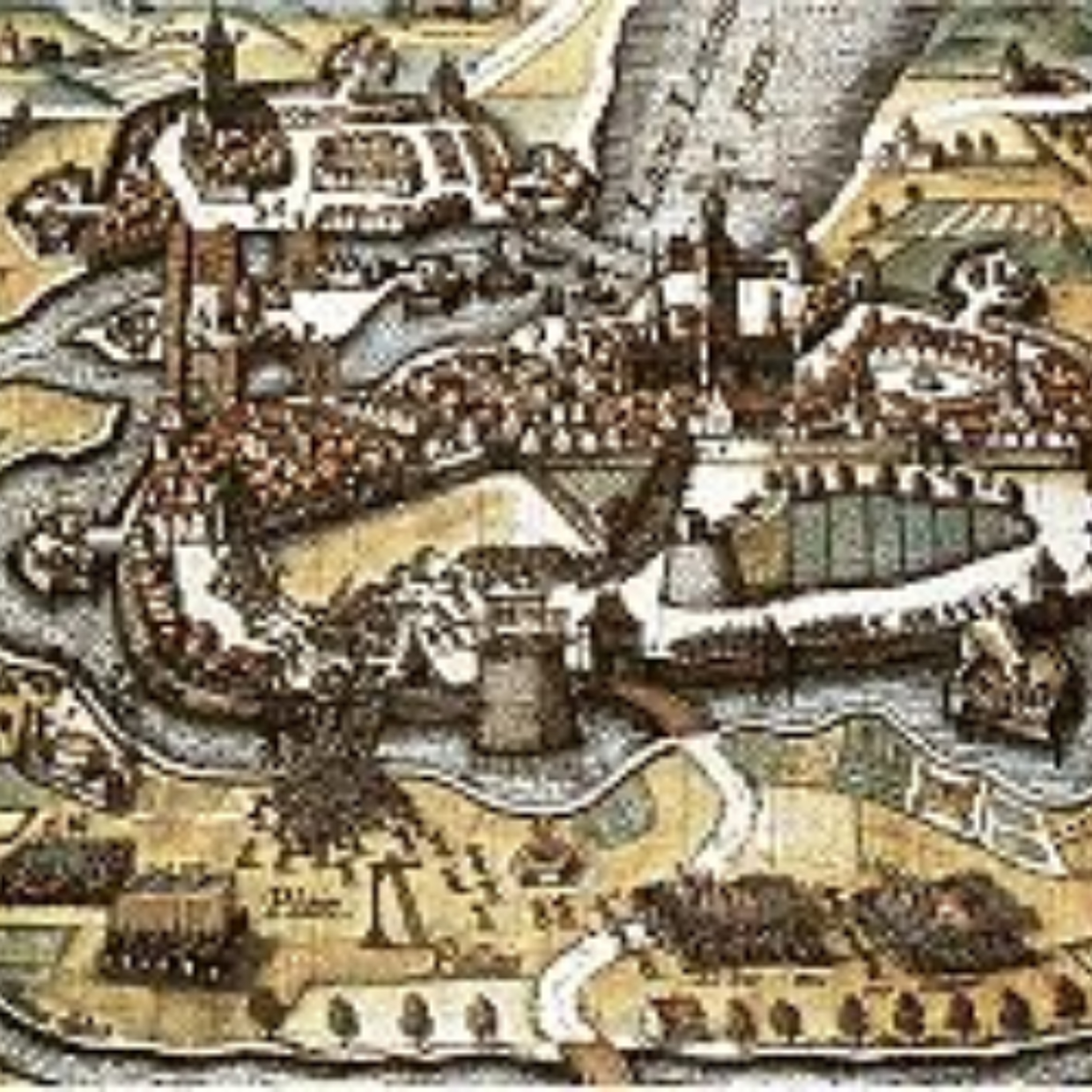
Episode 392 - L'Escalade
www.patreon.com/lionsledbydonkeys
In 1602, Savoy launched an invasion of Geneva, forcing the city-state's residents to rush to the walls and arm themselves with whatever they could get their hands on, including, in one infamous case, a pot of boiling soup.
sources:
Abplanalp, Andrej. “L’Escalade.” Blog: Schweizerisches National Museum. 11 Dec 2020. Online: https://blog.nationalmuseum.ch/fr/2020/12/l-escalade-de-geneve/, consulté le 01.12.2025.
Aeschlimann, Jacques. “Tabazan, ou Le bourreau de Genève.” Geneva: La Sirène, 1961. pp. 97
Bonivard, François. Chroniques de Genève: Tome 2. Revilliod, Gustave, ed. Geneva, J.G. Fick: 1887. Online: https://gallica.bnf.fr/ark:/12148/bpt6k65402785/f154.item, consulté le 01.12.2025.
Dufour, Alfred. “Histoire de Genève.” Collection “Que sais-je ?” Paris, Presse Universitaires de France: 2001.
Fazy, Henri. “Genève, le parti huguenot, et le traité de Soleure (1574 à 1579).” Geneva, H. Georg: 1883.
Monnet, Vincent. “Ce fut en mille six cent et deux…” Campus, v.61. December 2002-January 2003. Geneva, Université de Genève, 2002. Online: https://www.unige.ch/presse/campus/pdf/c61/rtheologie.pdf, consulté le 01.12.2025.
Santschi, Catherine. “L’Escalade: Expositions des archives de l’état.” 2002. Online: https://archives-etat-ge.ch/page_de_base/lescalade, consulté le 02.12.2025.
- "Blondel, Philibert", in: Dictionnaire historique de la Suisse (DHS), version du 13.11.2002. Online: https://hls-dhs-dss.ch/fr/articles/025640/2002-11-13/, consulté le 02.12.2025.
Schaetti, Nicolas. “La nuit de l’Escalade.” Bibliothèque de Genève: Expositions. 2023. Online: https://expos.bge-geneve.ch/escalade/, consulté le 30.11.2025.
Schaff, Phillip. “History of the Christian Church. Volume 8: The Reformation in Switzerland. Chapter 8. New York: Charles Scribner’s Sons, 1890. Logos Research Systems, Inc digitized version. Online: https://ccel.org/ccel/schaff/hcc8/hcc8.i.html, accessed 1 Dec 2025.
“Quelle est la signification du texte en latin et allemand sur la gravure tirée du ‘Thésaurus philopoliticus’ de Daniel Meissner et visible au musée de la Réforme ?” Questions-Réponses. Bibliothèque de Genève. 2023. https://www.geneve.ch/themes/culture/bibliotheques/interroge/reponses/est-la-signification-du-texte-en-latin-et-allemand-sur-la-gravure-tiree-du-thesaurus-philopoliticus-de-daniel-meissner-et-visible-au-musee-de-la-reforme
“Est-il vrai qu'une mère maquerelle appelée ‘Regina bordelli’ était en fonction à Genève jusqu'à la Réforme ?” Questions-Réponses. Bibliothèque de Genève. 2023. Online: https://www.geneve.ch/themes/culture/bibliotheques/interroge/reponses/est-il-vrai-quune-mere-maquerelle-appelee-regina-bordelli-etait-en-fonction-geneve-jusqua-la-reforme
HLS DHS DSS: "Escalade", in: Dictionnaire historique de la Suisse (DHS), version du 26.11.2009. Online: https://hls-dhs-dss.ch/fr/articles/008905/2009-11-26/, consulté le 01.12.2025.
Press play and read along
Transcript
Speaker 1 Hello, and welcome to the Lions Led by Donkeys podcast.
Speaker 1 It's a cold night in mid-December 1602, cold enough for ice to form, and Joe, Tom, and I are enjoying the warmth of the fire inside our guest house near the shores of Lake Geneva.
Speaker 1 We're a band of traveling entertainers touring our light-hearted comedy show, The Valiant Lion and the Hated Donkey, Who Is His Boss.
Speaker 1 The rough terrain of the upper Rhone and foothills of the Alps caused delays in our travel schedule as we were passing from Lyon towards Strasbourg, and we realized we'd be better off spending the night in the Republic of Geneva.
Speaker 1 We categorically refuse to snuggle under one big blanket ever again, and the years we've spent on the road have caused irreparable damage to our tent, the one that's shaped like a big shoe.
Speaker 1 We arrived at our guest house a little after one in the morning, far too late for dinner, and we had to lie about our occupations in order to not be deemed blasphemers.
Speaker 1 Instead of saying that we make people laugh for a living, we've told our hosts that we're pilgrims visiting the city of Calvin, seeking enlightenment and the precise sequence of prayer that not only prevents you ever being horny, but also irradiates everyone around you too.
Speaker 1 We want to pray so hard we cast mute on our own dicks.
Speaker 1 This satisfies our hosts, well, we think, and we're overjoyed to discover that they've made arrangements for us to receive a cauldron of soup from a local merchant.
Speaker 1 Who doesn't enjoy a big bowl of night soup? However, right around the time that we're expecting our delicious meal, we hear some noises that concern us.
Speaker 1 A single gunshot, frantic clanging, a number of ominous thumps, the distinct cry of an Italian guy yelling, Mama Mia, that soup's a hot.
Speaker 1 It becomes pretty clear to us that we're not getting our promised cauldron of road broth. We're gathered up with our fellow travelers in the inn in a general muster of all the defenders.
Speaker 1 And then, as if adding insult to injury, we're detained as suspected enemy agents because it turns out that there's been some sort of misunderstanding where the Duchy of Savoy, after having sworn numerous times on numerous comically oversized and bedazzled Bibles to not invade Geneva, has tried to invade Geneva again.
Speaker 1 The Genevan authorities immediately seize upon Joe, thinking he looks the most like a mercenary in disguise.
Speaker 1 Within his personal effects, they find a sketchbook of what they think is incriminating artwork, suits of spiked armor, fantasy future axes, guns that shoot smaller guns, a guy with one big arm to swing one even bigger chain.
Speaker 1 Monsieur, Joe says, you must understand that none of these weapons is real, nor could they ever be real. They are simply works of my imagination.
Speaker 1 I drew them as representations of the eternal threat of sin, blasphemy, and incontinence.
Speaker 1 Such is my devotion to God and to our Protestant confession that I have devoted my life to carving and painting small figurines in hopes of reminding the faithful that that human immorality is an ever-present threat.
Speaker 1 In fact, I have developed an entire taxonomy of such menaces, which I refer to as the moral hammer of war against all 40,000 sins.
Speaker 1
The authorities are not convinced, but the chief executioner François Tabizan makes the final call. This man is not a threat, he says in a gruff voice, speaking in Arpitan.
He is simply a dweeb.
Speaker 1 Searches of mine and Tom's personal effects only reveal shared drawings of an idea for a device that, as far as anyone can tell, would allow its user to create an instant burst of steam in their mouth, but the steam would contain the juices of the heathen tobacco, as well as a kind of strawberry cordial.
Speaker 1 When we present ourselves as humble men of God, who also have tummy aches, the guards are not particularly sympathetic.
Speaker 1 However, when brought before the chief of the guards of Geneva himself, Philibert Blondel, we receive some small degree of leniency. These men are imbeciles and certainly not spies, Blondel says.
Speaker 1 They are so impressed with their own own thoughts that they cannot see the obvious fact that such a device would instantly kill its user.
Speaker 1 Their ideas pass back and forth between the other, each time becoming less coherent and less plausible. In this manner, they are like two huge dipshits telling each other exactly.
Speaker 1 In the end, we're allowed to leave the city-state, and we're grateful to not count ourselves among the 67 men whose heads are placed on spikes atop the ramparts.
Speaker 1 Clearly, this was a catastrophic defeat for Savoy, which concerns us to some extent. Savoyards are our biggest supporters on the barred funding platform known as Pat Tréon.
Speaker 1 Nevertheless, we begin our journey to Strasbourg as quickly as possible, hungrier than before, and telling each other that, look, if you're being honest, it must have tasted good as hell to have a cauldron of soup fall on you, even if it did wind up being the soup that ends your life.
Speaker 1 Gentlemen, how are you doing?
Speaker 1 Really good. I think we're off to a good start to what I'm calling,
Speaker 1 I want to say Nate Tober, but it's technically December.
Speaker 1
Natember. Nate Tember.
It's Nate Tember.
Speaker 1 Maybe it's the Midwestern culture in me, but when you're talking about roadies and soup, like the only thing I think of is for maybe people who are from such an alcoholic part of the world, a roadie is a beer that you drink on the road, which is also illegal.
Speaker 1
Rot soda. Yeah.
Yeah. And someone's like, hey, yo, you want a roadie? You're like, yeah.
They just like lead you over and hedge you a cup of soup. A road soup.
Speaker 1 Like, god damn it.
Speaker 1 it i mean that's yeah it's like midwestern guy goes to japan and drives goes to japanese gas stations where they sell soup from like a big container and is like fuck it having a road soup
Speaker 1 i'm just obsessed with the idea of the the bedazzled bible with a matching velor tracksuit that just says jesus in dimantes on the ass it's like like like juicy couture fucking priest attire
Speaker 1
The monk just takes off his robes. He's in a full Jesus couture.
I didn't realize he was an Armenian Catholic monk.
Speaker 1 It's weird that that priest has the juiciest ass.
Speaker 1 I love it when the priest shows up in all the ceremonial regalia and I can't stop being distracted because he's wearing these fucked up looking Balasiaga sneakers. I hate when my priest drops it low.
Speaker 1 The papal legger Rybatsa report is that despite the voluminous nature of his Cossacks, you can still see his giant ass.
Speaker 1 Well, look, as you may have imagined, our episode takes place in the very start of the 17th century in what is now the very western tip of Switzerland.
Speaker 1 However, at the time, there were some critical differences in terms of the political organization at work.
Speaker 1 And as you may have deduced from the cold open, Geneva was an independent republic and city-state known colloquially at the time as Protestant Rome.
Speaker 1 This originated from the beginnings of the French wars of religion in the early 16th century when persecuted French Protestants sought refuge in Geneva starting in the early 1520s.
Speaker 1 And then, in 1536, Geneva declared itself a Lutheran republic and expelled the last of the Catholic Church's representatives.
Speaker 1 And as a quick note here, the French course of religion are, they're worthy of an entire series on their own. And there are nine of them across basically the entirety of the 16th century.
Speaker 1 The scope is massive, and I'm choosing to only address those conflicts if they're directly relevant to what we are talking about today. Otherwise, this would go on forever.
Speaker 1 There's a lot of changes of popes and kings and dukes of Savoy and other people. And it's just, I've done my best to keep it where it's only, only people who are relevant to our specific story.
Speaker 1
It's the French wars of context. Yeah, oh, there's so much.
There's so much.
Speaker 1 And believe me, it's the same thing as reading 1500s English in that, like, I can understand it when I read French from then because it is, it's not old French, but my God, is it fucking weird?
Speaker 1 So we'll get into that later.
Speaker 1 Nate, this is just like twinning your two great journeys in life as like understanding the various factions of French Protestantism and like listening to the entire back catalogue of Guided by Voices.
Speaker 1 I don't like Guided by Voices that much. But yes,
Speaker 1 there's
Speaker 1
it is voluminous. It is extensive.
Eight minutes. It took eight minutes to get to a band.
Well done.
Speaker 1 Eight minutes to get to a band that Joe doesn't recognize. Well, it's okay.
Speaker 1 Much like John Calvin, I too am guided by voices.
Speaker 1 So in the mid-16th century, the French Protestant theologian John Calvin effectively ruled the city-state of Geneva, although local political actors sometimes weakened or threatened his powers.
Speaker 1 Calvin, who himself converted to Protestantism in the early 1530s, arrived in Geneva in August 1536 and became hugely influential alongside his fellow French Protestant comrade-in-arms, Guillaume Pherel.
Speaker 1 Much like our traveling band, he wasn't planning on staying in Geneva, but Pharrel implored him to remain there.
Speaker 1 And I mean, I've lived here for a little while and I can say that if the weather's not too hot and there's a nice breeze coming off the lake, Geneva in August is actually pretty wonderful.
Speaker 1 But needless to say, this surprise European summer backpacking detour had some enormous consequences. It would be a massive understatement to call it a time of dramatic change in Geneva.
Speaker 1 Perhaps one telling example, one that you'll hear cited quite often in histories of the Reformation, is that Geneva actually had a church-recognized office to manage prostitution in the city, led by a figure known as the brothel queen, or La Rene du Bordel in French.
Speaker 1 Genevans at the time were apparently fond of drinking, singing, cavorting, and generally not behaving in an uptight or sober manner.
Speaker 1 This was all to change practically overnight when Protestant forces formally took control of the city in 1536.
Speaker 1 Before we get into what follows, it's worth understanding that the popular support for the Reformation in Geneva was not entirely due to religious convictions, although obviously there were a significant number of Protestants, and that number was growing due to persecutions in France.
Speaker 1 A good deal of support from Genevan citizens stemmed from frustration and outrage toward the Catholic Church, or, more specifically, their lack of say in the governance of the church while subjects of the Duchy of Savoy.
Speaker 1 Becoming an independent Lutheran city-state was a means of asserting their independence. The Duchy of Savoy, which does not exist anymore, was a territory of the Holy Roman Empire created in 1416.
Speaker 1 It covered much of what is now southeast France and northwest Italy, and at the time its capital was Chamberry, about 70 kilometers south-southwest of Geneva.
Speaker 1 In the mid-16th century, its capital would move to Turin as events that we will discuss in this episode led to the loss of territory, owing to much worsened relations with France and the Swiss Confederacy.
Speaker 1 But setting the stage for our story, Savoy controlled Geneva at the time, even if its political center remained far away.
Speaker 1 And when it did make itself known, it managed to make everyone in Geneva extremely angry. A side note, it's 70 kilometers, but the terrain's pretty rugged now.
Speaker 1 And back then, it would have been very difficult to get back and forth. So, like, it was fully like you being governed by people on a different continent.
Speaker 1 I'd like to believe that they moved to Turin because they knew in several hundred years they would be able to get into what they're doing best, and that is construction-based fraud to host the Olympics.
Speaker 1 Well, I mean, I'll put it this way.
Speaker 1 Whenever you meet, if you encounter a French politician with an Italian last name who's from the part of France that used to be Savoy, or used to be Italy, that got exchanged basically in 1860, they're like, they're almost always fascists.
Speaker 1 I don't know why. For context, the Romans founded the city of Geneva in the time of Julius Caesar, and at the end of the Western Empire, it fell to the Franks.
Speaker 1 It then subsequently fell to the Burgundians and then to the Holy Roman Empire, which granted it a principality.
Speaker 1 But from 1424, it was ruled by the Duchy of Savoy, and as I said before, at a considerable distance.
Speaker 1 In the eyes of Genevans, this story's chief enemy is Charles Emmanuel I of Savoy, who became Duke in 1580.
Speaker 1 But, since we're currently discussing events in the early 1500s, the reigning Duke of Savoy was Charles III.
Speaker 1 However, to really understand the situation at hand in the 1530s, in order to conceive of why Geneva was willing to become a Protestant republic and accept the whiplash of John Calvin's reforms, it's worth taking time to examine an even more parochial avatar of Savoy rule, the Bishop of Geneva, Jean of Savoy.
Speaker 1 In 1513, after the death of the serving Bishop of Geneva, Charles de Ceyl, the Council of the Cathedral of St. Peter in Geneva elected a successor.
Speaker 1 However, this was immediately vetoed by Charles III of Savoy, who received the blessing of Pope Leo X to install Jean of Savoy instead.
Speaker 1 Born sometime before 1490, Jean was the illegitimate son of François of Savoy, a church administrator in Ancy, and very obviously part of the House of Savoy.
Speaker 1 A chronicle by the Genevan historian François Bonivard from the 16th century refers to him in very unflattering terms, which is extremely funny for two reasons.
Speaker 1 First, because it's written in 16th century French, which makes me feel like I've smoked salvia when I read it.
Speaker 1 And secondly, because Bonnivard cannot stop talking about how John the Bastard, as he calls him, has syphilis.
Speaker 1 He effectively argues that John of Savoy was a huge piece of shit and a gigantic idiot and also a bastard child, and he received the role of bishop as a favor in order to grant him the wealth and resources to seek medical treatment for his fucked up dick.
Speaker 1 Yo, this motherfucker's dick be looking like Yacoub's head.
Speaker 1 There's admittedly some debate among historians as to whether or not Bonnevart was talking about the correct illegitimate Savoy noble installed in the Archdiocese, which I would say in his own right is pretty telling detail.
Speaker 1
Yeah, between all the Jeans, all the guys with syphilis, it gets very confusing. Yeah, and all the guys of the, whatever of Savoy.
I mean, like, yeah,
Speaker 1 there is a question as to because he had misidentified another member of the House of Savoy.
Speaker 1 I think it was, I genuinely think his name might have been, it was either René de Savoy or Michel de Savoy, whether or not he was talking about the right person when he wrote all these passages about like this guy's dick is fucked up but like he was like he called it the Neapolitan disease and he's like or the big the big variola and he's absolutely stricken with it and like all he can do like this is enough evidence of how much of a bastard he is like it's it's very funny and incredibly petty the neo the Neapolitan disease is what happens when your dick has three distinct flavors
Speaker 1 exactly
Speaker 1 The Neapolitan disease is when one part of your dick is constantly trying to mug the other part.
Speaker 1 You got to soak it to the ball to get the chocolate. Obviously, given these circumstances, Jean of Savoy was never going to side with Geneva over the Duchy of Savoy.
Speaker 1 But his venereal disease and lack of legitimacy wasn't what caused the most offense.
Speaker 1 More seriously, the Duchy of Savoy tried and executed citizens of Geneva who'd negotiated a treaty of common citizenship with the cantons of Bern and Fribourg.
Speaker 1 This was an effort on the part of the Genevan bourgeoisie to seek political support.
Speaker 1 in order to push back against Savoy's power, also due to the fact that Protestantism was massive at the time, it was growing in Geneva, and and Bern and Fribourg were cantons of the Swiss Confederacy that were Protestant at this point.
Speaker 1 And although a treaty was signed in February 1519, this immediately led to conflict.
Speaker 1 Jean of Savoy moved his residence to Geneva from Turin, occupied the city with his troops, and initiated spurious trials in order to execute Philibert Bertelier, the Genevan council member I mentioned above, who was one of the people who'd negotiated the treaty with Bern and Fribourg.
Speaker 1 This led to a military confrontation between Savoy and those two cantons, but in the end, the other 11 cantons of the Swiss Confederacy negotiated a settlement in order to avoid open conflict with Charles III.
Speaker 1 The joint citizenship pact was canceled in December 1519, but Fribourg's troops occupied Geneva after Savoy, by which I mean Charles III, the Duke, and Jean of Savoy, the bishop, agreed to withdraw.
Speaker 1 So it was not great for Geneva, but it was also something of a basically Savoy was forced out, told, like, okay, you control this place, but you can't actually be here.
Speaker 1 I'm going to simplify this somewhat, but these events repeat themselves in the early 1520s after Jean of Savoy dies.
Speaker 1 Duke Charles III is formally installed as in like a physical presence in Geneva and resides there between 1523 and 24, forcing the Grand Council of Geneva to renounce all pacts with the Swiss cantons.
Speaker 1 During this time, Savoy's new bishop allowed for yet another show trial to execute a pro-Swiss council member, Amélévrier, in 1524.
Speaker 1 So, as you can imagine, the citizens of Geneva hate Savoy at this point, and the Swiss Confederation is getting really tired of Savoy's behavior as well.
Speaker 1 And into this situation arrives our errant proselytizing French Protestant backpacker, John Calvin. Calvin's first residency in Geneva was not to last long, however.
Speaker 1 To give you some idea of what the new policies entailed, I'm going to quote the Swiss-American historian Philip Schaff's work from 1890 entitled The History of the Christian Church, a work highly sympathetic of Calvin and old-fashioned historian enough to reflect an unconcealed, completely unreconstructed, if you want to call it, Calvinist worldview.
Speaker 1 So, quoting Schaff here: The ministers were incessantly active in preaching, catishizing, and visiting all classes of the people.
Speaker 1 Five sermons were preached every Sunday, two every weekday, and were well attended. The schools were flourishing, and public morality was steadily rising.
Speaker 1 Sonier, in a school oration, is one of the ministers, praised the goodly city of Geneva, which now added to her natural advantages of a magnificent site, a fertile country, a lovely lake, fine streets and squares, the crown and glory of the pure doctrine of the gospel.
Speaker 1 The magistrates showed a willingness to assist in the maintenance of discipline. A gambler was placed in the pillory with a chain around his neck.
Speaker 1 Three women were imprisoned for an improper headdress. Even François Bonnevard, the famous patriot and prisoner of Chilon, was frequently warned on account of his licentiousness.
Speaker 1 Every open manifestation of sympathy with popery by carrying a rosary or cherishing a sacred relic or observing a saint's day was liable to punishment.
Speaker 1 The fame of Geneva went abroad and began to attract students and refugees. Before the close of 1537, English Protestants came to Geneva to see Calvin and Pharrell.
Speaker 1 Calvin then wound up instigating a riot during Easter 1538 after he refused to give communion to parisioners due to his opposition to the fact that the Bernese Reformed Church had insisted on retaining the custom of giving unleavened bread for the Eucharist.
Speaker 1 According to contemporary sources, everyone got so mad they drew their swords and started yelling really loud. Within three days, Calvin and Pharrell were expelled from Geneva.
Speaker 1 This gives you an idea of how well received some of his more extreme ideas turned out to be.
Speaker 1
I love we get a bread beef seemingly against a group of Burmese mountain dogs. Think about this for a second.
People are insanely religious. Religion affects their every waking thought and decision.
Speaker 1 Obviously, though they are breaking from Catholicism, the Eucharist and communion is still an important part of Christian theology.
Speaker 1 Obviously, on Easter, you can argue the most important day in Christianity, I think.
Speaker 1 And John Calvin is like, no, I'm not giving you this bread is unleavened, and that's, that's, that's popery, that's idolatry, that's heathenism. You can't take communion on Easter, you fucks.
Speaker 1
I won't do it. Fuck you.
Can you imagine? To be the
Speaker 1 religion understander to log on.
Speaker 1 For those who don't know, like one of the
Speaker 1 big,
Speaker 1 there's like several really big breaks between like Calvinism, a kind of more normal Protestantism and like Catholicism.
Speaker 1 One of them being to transubstantiation, that is the belief that through the sacrament of communion, the water, the bread, and wine are actually Jesus Christ's bodies.
Speaker 1
Whereas the Protestants are like, this is a metaphor. And then Calvinism is like, fuck that.
We're going to go even harder. See, I'm putting on my monster rebellion hat and calling them all cannibals.
Speaker 1 Somebody texts Home Cry someone his opinion on this. Yeah,
Speaker 1 his Eucharist is just a fist full of grass clippings.
Speaker 1 I guess what I'm saying here is that Calvin, his power will only grow as we'll learn as this goes on, but he just was categorically unwilling to read the room ever. And it gets more exceptional with
Speaker 1 our boy John. Of course, Calvin would return in 1541 and control Geneva until his death in 1564.
Speaker 1 He did not rule completely unopposed, but it's safe to say that he dominated his enemies and made Geneva into a city completely and inexorably associated with Protestantism.
Speaker 1 He made a point to shelter Protestant refugees from France and Italy during the anti-Protestant persecutions of the late 1540s, as well as English Protestants fleeing persecution from Mary Tudor in the 1550s.
Speaker 1 In 1553, he had the Spanish theologian Michael Servetus tried for heresy and, once convicted, burned at the stake.
Speaker 1 See, this is why Calvin is unpopular in Geneva, because he moved to Switzerland and then brought refugees, which wouldn't be popular in Switzerland in 2025.
Speaker 1 No, I mean, but it was also
Speaker 1 one of the things as a side note that's interesting is that Geneva as a city-state,
Speaker 1 you had the right to live and reside and work there, but not really any path to becoming a citizen. And
Speaker 1 you basically, if your children were born there, they could potentially like eventually rise up a little bit on the social ladder, but becoming the only people who had any say in political and religious matters were people who were, in the case of Calvin, people who were sort of like part of the, because he, well, he was French.
Speaker 1 He wasn't, I mean, he obviously became a citizen, but he wasn't born there. But there was definitely like a pretty,
Speaker 1 it wasn't an aristocracy, but there was like a kind of nativist hierarchy. And so people coming and going from there was pretty common anyway.
Speaker 1 It's just that Protestants were welcomed in the sense that Protestantism had already caught on.
Speaker 1 And then obviously a lot of Protestants, yes, you'll find a lot of Protestants brought with them businesses, skills, et cetera, money.
Speaker 1 They came, a lot of Protestants who fled in this part of the 16th century were... I'm glad this is like the foundation moment of Swiss culture? No, it's not.
Speaker 1 Geneva is completely different than the rest of Switzerland. It's completely different.
Speaker 1 They brought a lot of skills. And so it was very much like to Geneva's benefit.
Speaker 1 Calvin instituted wide-ranging reforms, mandated compulsory schooling for children, created educational institutions that survive to this day, and wrote the foundations of Protestant doctrines that still hold sway in many European countries, as well as countries the Europeans colonized.
Speaker 1 You may be asking yourself, what were these reforms? And were they weird? Oh, yeah, I can't wait to fucking get into this. Are we going to talk about penal atonement?
Speaker 1 Well, not quite, but to quote Alfred Dufour's history of Geneva, in Geneva, as in the other reformed cities of Switzerland, the enterprise of moral reform began first with the police orders, which was not only limited to crackdowns on prostitution and libertinism by closing brothels and any mixed-sex establishments, but also included a ban on gambling, the frequentation of taverns, and lewdness.
Speaker 1 It is from this perspective that by 1536, the councils ordered the prostitutes of the city to choose between their profession and their residence in the city, and that Calvin imposed in 1547 a strict regulation of morals in rural areas, prohibiting songs, dances, games, drunkenness, and baudiness by the ordinances of rural churches.
Speaker 1 However, it was not until 1558 that the first sumptuary ordinances were actually finally adopted by the Petit Conseil, basically the lower council of Geneva, and proclaimed throughout the city.
Speaker 1 They would not only regulate luxury expenses relating to clothes and banquets, but also the intendance of worship and catechism, as such that of the public baths, duly separated, and moreover, severely punishing gambling, dice, or cards.
Speaker 1 Revised in 1564, they illustrate in an exemplary way the Calvinist resolution to transform the costly fairground city of Geneva into an austere lay convent, subject only to the word of God, and whose golden rule was sobriety.
Speaker 1 Goddamn John Calvin stole my drape.
Speaker 1 What do you like to do for a hobby? Oh, well, with accordance with local regulation, I like to stand quietly in the quarter and not touch anything, but especially not myself.
Speaker 1 Basically, no fun allowed. Like
Speaker 1
there's an anecdote that there was a period of decades where no musical instrument was allowed within the city of Geneva. Like that would be considered contraband.
People could be expelled for that.
Speaker 1
Like genuinely, it was smuggling in jugs so I could make wind noises and finding myself whipped by the Calvinists. Yeah, exactly.
Like I doing dishes in a very, very sober and forthright way.
Speaker 1
And as I'm drying, I accidentally rub the rim of the glass and it makes the note. And everyone's like, heretic.
And drag you outside and stone you to death. Yeah.
Speaker 1 John Calvin has made it illegal to do a money spread and like listen to future at the same damn time within city limits.
Speaker 1 It's one of those things where it's like people are like, oh, I can't believe the insanity and the backwardness and craziness and extremism of ISIS.
Speaker 1 And it's like Europeans got there first a long fucking time ago. We had European Salafism a very long time ago.
Speaker 1 And this period of time is so mad because like this is before it gets really fucking mental.
Speaker 1 Like this is like really before the institution of like the five points of Calvinism, penal atonement, like all of the real insane shit that comes with Calvinism very, very soon.
Speaker 1 And so effectively, by the time of Calvin's death, Geneva's economy had grown significantly. It became a city of manufacturing and trade, as well as a center of the publishing industry of the time.
Speaker 1 Watchmaking, probably the one thing most of the world knows about Geneva, flourished in this era. Sources also describe metalsmithing, tailoring, carpentry, printmaking, and dyeing.
Speaker 1 There was a significant growth in the professional sector as many doctors, teachers, professors, and publishers arrived within the Republic.
Speaker 1 This was due, in no uncertain terms, to a Protestant brain drain from other nearby countries, and Geneva reaped the benefits.
Speaker 1 To put it mildly, it was a massive outlier in Western Europe, even as more monarchies and principalities were becoming Protestant.
Speaker 1 As we moved solidly into the second half of the 16th century, Geneva was still independent and thriving, and the Duchy of Savoy was absolutely fucking furious.
Speaker 1 You know, Kelvin outlawed music and all that stuff, but allowed in clocks, which means he must be turning in his grave.
Speaker 1 That the term TikTok was, before it became an app, turned into the name of a song by Kesha. So we have
Speaker 1 a cross-generational blood vengeance situation here
Speaker 1 of John Kelvin versus Kesha. John Calvin spinning in his grave because there's just loads of watchmakers popping and locking to the ticking of the clocks.
Speaker 1 Well, no, he was really, really happy that obviously Geneva's, you know, the industries that he helped foster are globally recognized.
Speaker 1
But then when he hears Jay-Z say, new watch alert, Hublow's, and the big face rollies, I've got two of those. He's like, that's debauchery.
That's licentiousness. That's excess.
Speaker 1 Spray paint that watch gray.
Speaker 1 Wait, the walk-a-flock of flame line, trade my, was it
Speaker 1
Trade my Breitling in for a Rolex. I got Muscle's motherfucker call me Boflex.
He's like, there's two things in there that I find offensive, both the sin of vanity and also the sin of avarice.
Speaker 1 No, you dig up John Calvin, put a pair of headphones over his head, and make him listen to Tyga's Rack City.
Speaker 1 History failed to consider Ahista John Calvin. He's actually buried not that far from here, but unfortunately, his body's not actually there, so they just made a grave.
Speaker 1 Like, they don't know where he's body. They don't know where he's buried.
Speaker 1 Then you need to get like a shitty bluetooth speaker put it on his grave and just start blasting grack city and just walk away no one will understand what's happening except the one other person in geneva that listens to this show i mean i would like to hope i would like to hope that people as you will find later um geneva has in many ways moved beyond calvin because um geneva needed workers and tons of them came in the 50s and 60s from catholic countries so as i said before in between the three of us that to understand what it's like to live in Geneva, imagine like the high-tech fantasy future city from Final Fantasy VIII, but everyone's Portuguese.
Speaker 1 That's what it's like to actually live in Geneva. It's important to remember that the Swiss Confederacy was not particularly thrilled with Savoy either, and even less inclined to trust them.
Speaker 1 In 1536, after Savoy besieged Geneva, the Bernese sent a force led by an experienced statesman named Hans-Franz Negli, the most Bernese name that could ever exist, to relieve their allies.
Speaker 1 This went very well for Negli and very poorly for the Savoyards.
Speaker 1 In the end, not only was the siege lifted, but Savoy also lost a significant amount of territory in what are now the cantons of Vaux and Jura, as well as in Pay de Jex, which is now part of France and immediately adjacent to the border with Geneva.
Speaker 1 Well, it's really easy to chase away an invasion of the Bernese by just like throwing a ball in the opposite direction, and they get really excited and run off after it.
Speaker 1 I'm going to continue thinking that the Bernese are the mountain dogs, yeah. All of them carrying a little barrel of schnapps under their neck as they march.
Speaker 1 I mean, it's I've been to Bern and it is extremely not far from the kind of cultural border where it goes from French-speaking to German-speaking, and yet it's like night and day dramatic.
Speaker 1
Like, oh, I am in this, I am in German-speaking Switzerland, I am in Schwitzerdutchland. It's, it's just, it's a completely different culture.
They love Halberds. They love people
Speaker 1
with Halberd. I can't hate them for that.
Beautiful river. Very, very, very alarmingly high road bridges above said river.
Speaker 1 But yeah, the Bernese, the thing to understand here is that at the time there were 13 cantons in the Swiss Confederacy, and
Speaker 1 they have always operated with a certain degree of autonomy and they were allowed to form alliances with other entities.
Speaker 1
But, like, there's so much of kind of consensus building and like, you know, the group kind of weighing in. It's hard to describe.
And that's how Swiss politics is.
Speaker 1
Today is how the country is governed. Now it's really difficult to explain.
But imagine Bern as both part of a larger entity, which is the Confederacy, and also kind of an independent principality.
Speaker 1 And so you'll find that, for example, as we go on, there are treaties being signed with the canton of Zurich or the Canton of Solotern. Like, these are, this is,
Speaker 1
that's not like them going rogue. It's not like, you know, Maine signing a free trade deal with North Korea or something like that.
Like, even to this day, maybe. Maybe they can't.
Speaker 1 I feel like Maine could benefit from some Juce.
Speaker 1
I'm just imagining a Stephen King story set in Maine, but it's also a Juje. It's indicative of the Juce spirit.
He's writing like socialist realism.
Speaker 1 Yeah, a socialist realism monument, but it's like a lobster holding up a flag.
Speaker 1 I mean, to this day, I mean, when I, God willing, if I'm able to eventually get Swiss citizenship, I won't be getting it from the federal government. I will be getting it from the canton of Geneva.
Speaker 1
Like, imagine if Maine could issue a U.S. passport decided by Maine.
Stephen King gets to weigh and be like, no, this guy is actually, he should be a citizen. Like, that's.
Speaker 1
I mean, nowadays, that's a better option. I mean, it's weird, man.
It sounded crazy until another federal system that we know more intimately went fucking batshit. So I don't know.
Speaker 1
So the Savoy had lost a significant amount of territory. Some of it is areas immediately around Geneva.
And on the southern side, actually, the Bernese were able to dislodge the Savoyard troops.
Speaker 1 So where Savoy had previously completely encircled Geneva, Geneva, now
Speaker 1 that had been broken. So, bear in mind, the Confederacy had signed another Treaty of Common Citizenship with Geneva.
Speaker 1 And as a result, in 1536, when Savoy attacked, Savoy was effectively attacking those cantons as well.
Speaker 1 And without derailing, you have to recall this is the era of the absolute pinnacle of Swiss mercenaries being extremely good at killing people, and that military experience translated into an effective fighting organization.
Speaker 1 This was an extremely positive turn of events for Geneva, but sadly, it was not to last. After the Treaty of Lausanne was signed in 1564, Bernese troops withdrew from Chablais and Pégex in 1567.
Speaker 1 This was meant to assuage concerns from the Catholic region of Valais in particular regarding a buildup of Protestant forces, and it meant that Geneva was once again surrounded on nearly all sides by Savoy.
Speaker 1 The one lasting positive change from the Genevan perspective, at least, was that their allies in Bern now occupied the neighboring canton of Vaux.
Speaker 1 But the Confederacy's withdrawal meant Savoy was right on their doorstep yet again.
Speaker 1 And like I said previously, Bern took territory it could have held, but then that kind of weird politicking of Valais wasn't part of the Confederacy, but like it was a principality that they dealt with that with is now part of Switzerland.
Speaker 1 Like these kinds of decisions can be very confusing where it's like they can kind of act independently, but then when the group makes a decision, they're like, I guess we got to go with the group decision.
Speaker 1
It's like this today. And it's interesting that, you know, back in the day of absolutist monarchies, that's still the case.
This wasn't a monarchy, by the way. You have to understand,
Speaker 1 Switzerland was not a monarchy. It was this, it was this weird system that just, I don't know, I don't know.
Speaker 1 They invented dogs with barrels of schnapps and they invented cows with bedazzled flowers and fucking bells, and they invented this.
Speaker 1 That's a really interesting
Speaker 1 Confederation council to sit on where the dogs are barking, the cows are upset, and there's like three really angry Italian bankers trying to get them all to commit fraud.
Speaker 1
And there's just a guy who will not stop blowing this enormous horn that's like two stories high. Yeah, that's Minister Ricola.
Yeah, exactly. Yeah, yeah, yeah, exactly.
Speaker 1 And then all the German guys have Italian names for some reason. Like
Speaker 1 world's world's most racist Swiss politician, like not a real person, but just figuratively being like a German guy named Renato Zwingli. Like, that's 100% real.
Speaker 1 So there was room for adroit political maneuver in the situation. And Savoy tried to play it smarter this time.
Speaker 1 Charles III had died in 1553, and his successor, Emmanuel Philibert, had an opportunity to enhance Savoy's position by applying pressure via the Catholic cantons of the Swiss Confederacy, cantons with whom Savoy had until recently been in alliance.
Speaker 1 In the returned territories of Perit Pay-d-Jex, for example, he allowed Protestant worship even after the reinstatement of the Catholic Church, and in 1579, he endorsed the terms of the Treaty of Solotern, which recertified a perpetual peace between France and the Swiss Confederacy.
Speaker 1 It also guaranteed that were Geneva attacked, France would pay for a military garrison of 1,500 men supplied by the cantons of Bern and Solotern to defend it.
Speaker 1 In truth, Emmanuel Philibert was not pleased with the terms of this treaty, and he tried to prevent its ratification, even asking Pope Gregory XIII to send his agent to intervene by pressing the Catholic Swiss cantons to sink the negotiations.
Speaker 1 He was then made to endorse it when it became obvious that King Henry III of France was not going to tolerate his interference.
Speaker 1 There is no doubt at all that Savoy ultimately wanted to recapture Geneva, but they'd done very poorly when confronting the Confederacy on the field of battle, and Emmanuel Philbert was also trying to rectify the internal problems stemming from a long period of instability in Savoy.
Speaker 1 Geneva would have preferred a permanent Protestant occupation of its surrounding environs, but what they had in 1579 was at least an improvement on the events of 1513 through 1536.
Speaker 1 But then, of course, Emmanuel Philibert died, and his son, Charles Emmanuel I, became Duke.
Speaker 1 Charles Emmanuel I immediately began a military build-up near Geneva, and Geneva's Ground Council saw this as enough of a warning sign to re-enter negotiations with Zurichenburn.
Speaker 1 The previous treaties had been allowed to lapse for long periods before renewal, and with the humiliation of 1519 definitely not forgotten, the Genevans negotiated instead for a double alliance with the two most powerful cantons in the Swiss Confederacy.
Speaker 1 Charles Emmanuel I, not to be outclassed, fomented a plan with Philip II of Spain and Pope Sixtus V to cut off Geneva entirely.
Speaker 1 Starting in 1585, this was a military siege that prevented the transport of grain from the farmland surrounding the city. The goal was to starve Geneva, and it was not subtle in the slightest.
Speaker 1 Seeking to break the siege, Genevan forces conducted skirmishes and engagements with Savoyard troops, but in general, the situation remained difficult and unenviable for the city.
Speaker 1 One significant development, however, is that it solidified anti-Savoyard opinions among the ruling citizens of Geneva and served as a reminder that things were never fully settled.
Speaker 1 It would be hard to argue that Savoy didn't have designs on Protestant Rome.
Speaker 1 The Genevan soldiers must have been horrible to fight against because think of all the pemped up aggression that they have.
Speaker 1
Like they can't drink, they can't smoke, they can't bust, they can't do anything. Everything is a sin.
Everything has to be atoned for. You know, everything is predestined.
Speaker 1
And then they see a bunch of Catholic dudes who are just like, oh, it's fine. I can absolutely fuck a sheep.
I just go to confession. And we're cool with it.
Speaker 1 I'm clapping sheep cheeks left, right, and center. You can't stop me.
Speaker 1 Yes, I can imagine. It must have been, it's like, we have to starve these people.
Speaker 1 But then it's like they secretly kind of get off on it, both because like they love suffering and also when you're hungry, you don't get hard. So it's like, we've only made them more powerful.
Speaker 1 You're fighting the army of the mountain Cenobites. Jesus Christ.
Speaker 1
They don't have any marching music. They have no entertainment.
These people were built to murder.
Speaker 1 Well, it could have gone well for Savoy, but unfortunately, Charles Emmanuel I made a genius decision in 1588 to invade the city of Saluzzo, which is now part of Italy, but at the time was French territory.
Speaker 1 This was an act of war against France by an ally of Spain, and this led to a French-Spanish conflict in which Geneva and the Swiss Confederacy fought on the side of France.
Speaker 1 In fact, Genevan diplomats made specific appeals regarding religious freedom to King Henry IV of France, who was raised Protestant but converted to Catholicism before ascending to the throne.
Speaker 1 And Geneva quickly followed the Confederacy's lead to agitate for peace as the war dragged on.
Speaker 1 The treaties of Vervin in 1598 and Lyon in 1601 ended the Franco-Spanish and Franco-Savoyard wars, respectively.
Speaker 1 Henry IV specifically included Geneva as one of the parties to the peace treaty, stipulating that Savoy did not have the right to aggress them.
Speaker 1 However, in January 1601, with his other conflicts settled, Charles Emmanuel I began making preparations for the ultimate battle with Geneva, a chance to definitively, ineluctably, bring the Protestant heretics to heel, to make his haters his waiters at the Catholic table of success.
Speaker 1
You know, many people, many people say Geneva is a New York city of Switzerland. Oh, just hold that thought.
Hold that thought.
Speaker 1
Never mind a treaty with his much more powerful neighbor. Never mind the dogged hard-headedness of Geneva as the city that will not stop being like that ever.
He was going to capture it for good.
Speaker 1 It didn't help matters that the Treaty of Lyon had required Savoy to cede a significant amount of territory in the area surrounding Geneva.
Speaker 1 Brest, Pay-d-Jex, and Bougé, formerly Savoy possessions, now belonged to France.
Speaker 1 It's also worth mentioning very quickly that by 1601, the forces of the Catholic Counter-Reformation were significant and loud.
Speaker 1 Pope Clement VIII remembered, among other things, as the pope who said it was okay for Christians to drink coffee. It's very funny if you've ever read what he said.
Speaker 1
He's like, oh, this smells too good. It can't be evil.
Also, it's kind of unfair for the heathen Muslim to have dominion over this. Like, we can't let him have something this good all to himself.
Speaker 1
We love the anti-Mormon pope. Exactly.
Exactly. Mormonism could never.
Speaker 1 The pope reverses previous papal bulls and says, actually, coffee is holy. Pope Clement VIII was supportive of Charles Emmanuel I's designs on recapturing the city.
Speaker 1 Geneva was, for all intents and purposes, a figurehead of Protestantism and a great big target.
Speaker 1 In fact, a counter-reformist illustration from the era depicts Geneva as a walled fortification of turbine-wearing combatants atop an elephant.
Speaker 1 So imagine a war elephant, but there's like a, you know, like a a crenellated tower with dudes.
Speaker 1
Yeah. Turbans and bows and arrows, fully looking like Saracens, Turks, whatever you want to call it, whatever the depiction of the heathen Muslim.
Why? Why an elephant?
Speaker 1 Well, in the view of weird 16th and 17th century Catholic fanatics, Protestants are heathens and therefore Muslim somehow.
Speaker 1 And one has to assume that the elephant is also Muslim. In the worldview of this image, it follows that if New York City is the big apple, Geneva is the big Muslim elephant.
Speaker 1 Mashallah Dumba has seen the light of Allah.
Speaker 1 How do you get
Speaker 1 an elephant to say the Shahada? Or is it born Muslim? The elephants absolutely can kneel so they can fucking
Speaker 1 make salah. Elephants can use their trucks to do wudu like they're absolutely flawless Muslims.
Speaker 1 It's gonna make marching around the Kaaba a horror show.
Speaker 1 Using up like 50% of the GDP of Geneva to get a really big prayer prayer mat for the elephants.
Speaker 1 You know, I really like this idea because that means by extension, like the Barnum and Bailey Circus will be far too racist to bring them to America.
Speaker 1 Therefore, you'll save them from American animal cruelty. Oh, God.
Speaker 1 In the summer of 1602, Charles Emmanuel I deployed spies to Geneva to scout out fortifications in advance of an invasion.
Speaker 1 The plan was to send a contingent of what were effectively commandos, wall-scaling shock troops, to mount the city walls, which would allow them to take control of the Port Neuv Gate and Plan Palai on what was at the time the south central part of the city fortifications.
Speaker 1 Once secured, the open gate would allow a force of 2,000 soldiers to enter the city and take complete control.
Speaker 1 At the same time, the commando force already within the city walls would move to three other gates and attack the defenders there, forcing the gates open or at a bare minimum, preventing the defenders from blockading them shut.
Speaker 1 Gotta deploy the papal shinobi to
Speaker 1
Geneva. Yes, 100%, dude.
Like basically, they went and tried to do ninja shit. I can't believe they would try to attack the heartland of Swiss rap, south-central Geneva.
Speaker 1 I mean, it's funny because I used to live very close to Plan Palais and, like, it's the urban area of Geneva is so massive now compared to what it was back then that it's hard to remember that basically the actual city at this time was such a tiny fraction of what is now the because the metro area of Geneva is like a million people.
Speaker 1 It was so tiny. And yeah, that actual, the, the, the, the area around there was where they had enormous walls, gates, et cetera, because it was this fortified like fortress city.
Speaker 1 Um, you know, the area around where the entry of Lake Geneva
Speaker 1 to the Rhone River was completely that was like, which is basically walled off.
Speaker 1 Spies were able to measure the walls undetected, and the reports indicated that Geneva was not in any way anticipating an imminent attack. It was defended, sure, but not on high alert.
Speaker 1 The Savoyards assembled a mercenary force led by a Picardian named François de Brunelieu. Among the group were a number of Piedmontese, Neapolitan, Spanish, and French citizens.
Speaker 1
They even brought a Scottish Jesuit priest to provide encouragement. These were all experienced fighters.
Making them all drink bucky before they scale the whole hole. It's okay.
It's okay.
Speaker 1
You can go to confession for any fucked up shit you say. This is where it earns the nickname Wreck the Hoose Juice.
Yeah, yeah.
Speaker 1 The papal shinobi sharpening their kunai that are in the shape of a cross, neck in a bottle of book fast, and then running at the wall.
Speaker 1 It's okay. If your faith is strong enough, the wall opens up.
Speaker 1 These were all experienced fighters, but this was not a coherent military unit used to working together. The command of force, though, by contrast, was made up entirely of experienced savage fighters.
Speaker 1 There was an inherent risk to this choice, as the area around Plan Palais was the most built-up of the city defenses.
Speaker 1 However, as we heard before, the tactical situation is derived from spies' reports was that the defenders were not particularly on guard, especially not on a cold night, and that their posture would be especially lax there in the most fortified area.
Speaker 1
The spies noticed a pattern. After midnight, the sentries would return to the warmer interiors of their posts and wouldn't conduct patrols on the ramparts.
Oh man, they're just like me for real.
Speaker 1
Oh yeah. Oh yeah.
I've seen me do it.
Speaker 1 It sounded like the makings of a successful attack, and Charles Emmanuel I smuggled himself from Turin to Saint-Julien, just over the French border south of Geneva, in order to observe.
Speaker 1 Once everyone was in place, the assault began late on the night of December 11, 1602.
Speaker 1 The Savoyard force crossed the border from France near Fossart and followed the course of the Arve River in order to mask movement, assuming that the combination of darkness and the noise of nearby watermills would prevent detection.
Speaker 1 It was about six or seven kilometers of tactical advance in total darkness and choppy terrain around the bend of the Arve, and it had gone off without any problems.
Speaker 1 The commando force arrived at Plan Palais about 2 a.m. and began scaling the walls with three siege ladders assembled on site.
Speaker 1 The ramparts were about seven meters high, and moving an armored infantry force up them took time. But up to this point, they were unopposed.
Speaker 1 Things went so well at first that Charles Emmanuel I assumed victory was his and prepared to dispatch announcements to the courts of Europe that Geneva had fallen.
Speaker 1
In some renditions or some interpretations of the story, he actually did send these messengers and that the news got there. Real Dewey beats Truman moment.
Yazir.
Speaker 1 He promised to celebrate Christmas in Geneva, and it looked like he was going to get his wish. However, at some point, one of the attackers must have broken noise discipline, or so it's assumed.
Speaker 1 This attracted the attention of a patrol of two Genevan sentries, which means gigantic red exclamation points immediately peered over their heads. And they said, and I'm translating from Arputan, huh?
Speaker 1 What was that noise?
Speaker 1 You can't expect the papal ninjas to be that quiet when they're licored up with Bucky. You know what I mean?
Speaker 1 They just, they got a little into it. And
Speaker 1 they said in like Piedmontese or Neapolitan or 16th century Spanish or whatever, oh, fuck yeah, bud, this is going great.
Speaker 1 What the fuck did you say about my mom? Like, stop fighting each other. God damn it.
Speaker 1 So the sentries then headed in the direction of the sound, walking straight into Savoy's commando advance guard. They were, of course, immediately killed.
Speaker 1 However, one of them managed to fire off a shot from his archebus, which obviously got everyone's attention. And by this, I mean everyone.
Speaker 1 At about 2:30 a.m., alarm bells began ringing throughout the city. People immediately ran out to join their defense militia units, men and women alike, carrying any weapon they could find.
Speaker 1 Lances, halberds, swords, kitchen knives, oblong objects. And with the element of surprise lost, the Savoyard commander de Brunelieu managed to make things worse by dying right away.
Speaker 1 I haven't been able to find any sources depicting exactly how he died. And there's no depiction of his death in the 400-plus years of historiography surrounding the attack.
Speaker 1 But it seems to be a settled fact that it was very early in the mission. And one source I read, it said within the first minutes.
Speaker 1 Yeah, he pissed off his
Speaker 1 very drunk, buck fast, wheel big soldiers and refused to give him a cigarette. So they glassed him and he died.
Speaker 1 I love the idea that like this guy, I mean, he's not the overall mission commander that was a savoyard noble but uh the the commander of the this of this commando detachment manages to die in the same way as the dude what is it uh palmer in final fantasy 7 just runs and gets hit by a truck that comes out of nowhere and they're like there wasn't any traffic there how the fuck there's not even a road i'm like how the
Speaker 1 why did that happen deprived of their leader the savoyards quickly lost the initiative everyone wanted to kill them and some of them were actively killing them while wearing their pajamas they'd ruined everyone's sleep they'd made everyone cold and grumpy.
Speaker 1 They'd fumbled the bag full of watches and chocolate for all time.
Speaker 1
The pajamas, I assume, are like the sleeping gown, the nighty hat, the little candle on a plate. Yes.
Yeah. Exactly.
Speaker 1 They'll look like the sleepy time bear armed with knives.
Speaker 1 Getting just like gut stabbed by the sleepy time bear.
Speaker 1
It's just so, such a... Fucked up like fan anime, fan manga, just like the sleepy time bear doing mass murder shit.
And it actually happened.
Speaker 1 the sleepy time bear sitting over one of their chests slowly sinking a knife in and saying the line that the ss soldier says in saving private ryan like no more sin
Speaker 1 until the bubbles stop according to one popular legend one genevan woman named katerine royaum heard the alarms while cooking a cauldron of soup and upon looking out her window observed savoyard troops inside the city thinking fast and adopting a kitchen tactical posture she immediately dropped the entire fucking cauldron on a guy and killed him a cauldron of soup on a three-point sling with the with uh with what was that what's it the the tactical mount like the mounting rails on either side of the soup cauldron yeah if you're the one throwing the cauldron you say cauldron out and if you're the one having the cauldron thrown at you you say soup
Speaker 1 no one expects liquid warfare what kind of soup we talking here what is a genevan soup it was it's definitely putting it it was vegetable soup i think um this it was just been described as a vegetable soup interesting the soup was also halal well yeah exactly they read the propaganda about the correct me if i'm wrong correct me if i'm wrong here it was this i believe it was a saturday night when it happened or it was friday night into saturday and so it's possible that it was like leftovers of the non-meat meal i don't know because you remember correctly but i don't know if the protestants if they were like catholic style we don't eat meat on fridays or if they were like no we will eat meat on fridays to piss the catholic i don't know how into it they were but maybe it was one of those perpetual soup type situations like that guy just had eight generations of soup dumped in exactly like he like this the the the soup's entire lineage was was being raised for this one mission to like kill a random spanish guy he's being scalded to death he's just on the ground he's like gurgling he's like
Speaker 1 death is so delicious well i don't think that it was he scalded him it rather that the cauldron hit him in the head and killed him because it's a big oh he got bonked he got bonked to death yeah but i've seen depictions of
Speaker 1 we'll get into this, but the Geneva National Anthem is a fucking song about this battle. And it is very long and it has a ton of stanzas to include a stanza about the guy getting killed by the soup.
Speaker 1 And
Speaker 1 in that, he gets hit in the head by the cauldron and he falls over dead.
Speaker 1 Whereas I've also seen children's book cartoons depictions of the battle because they do that here, whereas he's dumping the soup on people and it's liquid that's going to scald them. So I don't know.
Speaker 1
So it's more like the scene from Indiana Jones where the guy just kind of melts. Yeah.
Yeah. It could very well be.
Okay.
Speaker 1 See, what I really, really want is Max Miller from Tasting History to do a YouTube video about, I've got to remake the soup that kills you from the fucking 16th century. From Lescalade 1602.
Speaker 1 It became an all-out brawl in the streets of the city and on the ramparts, but enough Savoyard troops had penetrated Geneva that there was still an opportunity for them to succeed.
Speaker 1 If they could gain control of the Port Nove and force it open, they'd be able to clear an axis of advance for their main body.
Speaker 1 Given that Geneva's population at the time was about 16,000 people, most of them civilians, a force of 2,000 soldiers would have easily overwhelmed the defenders.
Speaker 1 As their troops fought for control inside the city fortifications, the Savoyard sappers attempted to blow up the doors from the outside. If they succeeded, they'd have achieved their decisive point.
Speaker 1 However, a junior soldier in the Geneva militia named Isaac Mercier saw the sappers at work and immediately made the decision to cut the rope suspending the portcullis on the gate.
Speaker 1 Once it fell, there was no way for the savoyards to break into the city with enough mass to overwhelm the defenders.
Speaker 1 Similarly, there was no way for the ones inside the city to get out except by either climbing down whatever way they could or jumping off the walls.
Speaker 1 Remember, at this area of the fortifications, the walls are seven meters high and these guys are wearing metal choiruses and helmets.
Speaker 1
I've been to that area of the city where some of the wall still stands. It's fucking gigantic.
You wouldn't want to jump off it. That PLF-ing has yet to be invented yet.
Speaker 1
The tactical soup operator has been invented. Exactly.
But the PLF has not.
Speaker 1 That's what it's going to be the next business venture venture of the Black Rifle Coffee Company people. Exactly.
Speaker 1 We're stealing tactical soup operator. Like a woman in pajamas with the suit with soup on three-point sling, wearing like an operator helmet with the night vision that has like six fucking
Speaker 1 things on it.
Speaker 1 Six monocles. And then like one of them is like one of those like reticle, like pop-up reticle displays, but it's just got like what you'd have in a measuring cup.
Speaker 1 This is absolutely an outfit that was cut from Metal Gear Solid 3. I mean,
Speaker 1 I love the idea of like, yep, sorry, you got to learn how to do the PLF, by which I mean papist landing fall.
Speaker 1 Geneva's defenders began to fire cannons in the directions of plan play, but it's almost impossible to imagine that they'd identified targets.
Speaker 1 This was likely either suppression, recon by fire, or just plain panic.
Speaker 1 But the cannon fire had the surprise effect of getting the attention of the Savoyard main body, who thought it was the sound of the doors exploding at Port Neuve, a sign that the Sapper mission had succeeded.
Speaker 1
So they began their advance towards the gate, and, well, now the cannon crews definitely could see their targets. And one can assume that even more soup got spilled.
Different kind of soup this time.
Speaker 1 Human soup. Yazir.
Speaker 1
I hate when my human soup gets spilled on the streets. I hate when my main body gets just turned into soup.
It's like, I thought only a wizard could do this.
Speaker 1 And it's like, no, enough heavy objects fired with gunpowder can, in fact, supify just about anything made of flesh. This is how marinara sauce was actually invented by Italians.
Speaker 1
Excuse me, it was invented by Italians when they saw it done to other Italians. Exactly.
At this point, the Savoyards were fucked. And that's the doctrinal term.
Speaker 1 They had no way of establishing a foothold, and their piecemeal units within the city walls were easy targets for defenders. The remaining forces fled, and the attack was over.
Speaker 1 The big Muslim elephant on the confluence of the Rhône and Arv rivers was still standing, still trumpeting, stomping its feet, still flinging Savoyards into low earth orbit with its trunk, and presumably still saying the Shahada.
Speaker 1 Geneva lost 18 defenders, all of them men who ranged in age from 22 to 65 years old.
Speaker 1 Contemporary estimates on the Genevan side counted 54 Savoyards killed, while Savoyard sources counted 72 killed and 120 wounded.
Speaker 1 The latter is probably more accurate, as Genevan defenders did not open the gates until long after the attack, and as such likely only counted the bodies found within the walls.
Speaker 1
There were also 13 Savoyard prisoners taken alive. They were immediately executed.
They got given the soup.
Speaker 1 They got tenderized before the soup, which was somewhat controversial, as some of them were nobles, and at least according to popular memory, and something that's cited in the 1950 Jacques Eschliemann play Tabizon, they were promised they'd be spared if they laid down their weapons.
Speaker 1 However, Genevan forces then claimed that the men were not entitled to any protection because they'd participated in a surprise attack in violation of the Treaty of Lyon.
Speaker 1 They were effectively committing an act of brigandage.
Speaker 1 They were therefore killed immediately by the Genevan executioner François Tabizon, who is mentioned in the extremely long Arpaton language song Sequei La No, or He Who Is On High, which is the official anthem of the Canton Republic of Geneva to this day.
Speaker 1 Because, and I'm not joking, although Savoy no longer exists, the Republic of Geneva will simply not ever let this one go.
Speaker 1
In the song, someone goes to fetch Tabazan who says, Don't you know there's work to be done? There's 13 of them who will be ashamed. We have to hang and strangle all of them.
Hurry up, I want to go.
Speaker 1 That is, okay, they don't sing all the stanzas of the song because it would take like 20 minutes, but in the National Anthem of the Department, they're like, I'm gonna fucking strangle some dudes.
Speaker 1 I really want to do this. Let me put on my strangling gloves.
Speaker 1
Some of the extra stanzas are. The last thing they're going to see is the price tag.
I mean, there's literally, there's so many funny stanzas in the longer version of the song.
Speaker 1 One of them is just like, you know, we're like, once we get our hands on these guys, we're going to hang them up and take their clothes off and show their ass to the world.
Speaker 1 One of them is like, yeah, you might feel bad that we're killing these dudes when they're prisoners, but you know what?
Speaker 1 They wanted to take you in chains to Rome and parade you around as a sacrifice to their Satanism. Like, it's, it's very, it's very European deep lore.
Speaker 1 I wouldn't expect a place like Geneva to have a national anthem or regional anthem, whatever you want to call it, that goes so hard.
Speaker 1
The word in French is the immune officials, like official anthem or hymn. And they typically only sing, I think, four stanzas total of the 68.
Do they get to the soup stanza?
Speaker 1 No, it's it's it's unfortunately the soup, the soup part isn't in the song.
Speaker 1 Our tactical soup operators are not getting enough respect. Oh, brother, you need to wait a second.
Speaker 1 Before you say that the soup isn't getting any respect, the defenders then decapitated all Savoyard dead, placing their heads on spikes in the city ramparts, where they remained until the Treaty of Saint-Julien was signed in 1603.
Speaker 1 There were 67 heads on display, and there are 68 stanzas in the song Seiqui Le No, which I have to presume is tied to the symbolism here, or potentially evidence of a miscount.
Speaker 1 Or maybe it's not a miscount, because I'm thinking maybe there's one extra stanza in case a Savoyard Ronin decides he wants to try his luck one more time.
Speaker 1
Maybe there was like a young lieutenant who lost track of a sensitive item and it happened to be a severed head. Brother, just you wait.
God God damn it.
Speaker 1 One funny detail to this effect, though, is that in 1610, a Savoyard was caught measuring the walls of Geneva in the middle of the night and, under interrogation, admitted that he was, in fact, at the battle in 1602 and had also measured the walls with Captain Brunelio during reconnaissance of the city.
Speaker 1 He said he'd walked with a limp ever since that night because he'd escaped capture by jumping off the walls. Why he'd come back, no one is sure.
Speaker 1 What is sure is that he was immediately executed and beheaded, so maybe there were in fact 68.
Speaker 1 Eight years later, he's like, I'm going to get you fuckers. I'm going to measure your walls.
Speaker 1 My one-man revenge mission to measure walls will not be stopped. It's like, here's a Savoyard, presumably Catholic, doing this.
Speaker 1
Like, measuring walls as a means of getting off is such a Protestant thing. It just sounds like it's like, ah, I'm so horny and I feel so sinful.
I'm going to measure my walls. Yeah,
Speaker 1
you won't let him jerk off. All he's got left is measuring walls.
Someone's going to measure your back walls.
Speaker 1 As regards the Treaty of Saint-Julien, it was signed in July 1603, eight months after this battle, which is now known as Lescalade, which you could translate as either the climb or the assault.
Speaker 1 Mediated by other cantons of the Swiss Confederacy, the treaty granted freedom of commerce, religion, political independence, and physical sovereignty to Geneva, and prohibited military fortifications within four leagues of the city, which is about 18-ish kilometers.
Speaker 1 This was the last attempt of Savoy to take Geneva, and while Charles Emmanuel I was more or less the same afterwards in terms of terrible military decisions, he did, in fact, seem willing to leave this one target alone.
Speaker 1 There's a more than minor drama involving the chief of the Geneva Guards, Philibert Blundell, who was tried for negligence and convicted, and then acquitted, and then convicted again and executed in 1606.
Speaker 1 There's a lot of additional detail that I'm admittedly sparing in the interest of time. But suffice it to say, Geneva got very lucky given how fully not on guard they were when the attack commenced.
Speaker 1 In the end, Geneva remained independent until 1798, when Napoleon invaded Switzerland and annexed a significant amount of the country into France.
Speaker 1 After Napoleon's retreat in the War of the Sixth Coalition in 1813, the Republic successfully negotiated for admission into the Swiss Confederation, which it joined in 1815, despite concerns from the other cantons that there were already too many Protestants in Switzerland.
Speaker 1 And as far as the popular memory of this battle, when I say that Geneva will never let this go, I have to stipulate that I mean this in as strong of terms as possible.
Speaker 1 There are children's comic books about Lescalade featuring drawings of Catarine Royaum dropping a soup cauldron on the Savoyard attackers. It's one of the biggest celebrations in the canton, even now.
Speaker 1 There are public events to commemorate the victory, featuring historical reenactments, a road race, dressing up in costumes, and a party in which the youngest and oldest of all gathered attendees share the responsibility of cutting a chocolate cauldron open with a sword and then say, thus perish the enemies of the Republic.
Speaker 1
Beam at your head, pull up with the Campbell shooter. This ceremony is so common that it takes place in just about every office, school, and even in daycares.
My daughter is going to...
Speaker 1
Go to what we're going to go to her daycare by the time this episode comes out. You better cosplay as the tactical super.
I have to find out. I apparently have to wear a costume.
I have to figure out.
Speaker 1 I'm like, how can I get a really good wizard costume in about 10 days? I'm going to find out.
Speaker 1 I feel like in Switzerland, a place with so many guns, you could get a good three-point sling. Find a way to connect it to a soup cauldron.
Speaker 1 I don't think people would get a podcast joke in English, but if I dress up as a huge wizard, that would at least make for a funny photo we can share.
Speaker 1 But I'm serious. There is a huge stack of chocolate cauldrons on sale in the grocery store downstairs from where I live.
Speaker 1 These celebrations have been officially endorsed and also officially suppressed in equal measure over the centuries.
Speaker 1 But nowadays, given the steep decline of religiosity in Switzerland in general, and the fact that Geneva is way more Catholic after waves of southern European immigration in the post-war era, the ceremony is seen entirely as a commemoration of the city's history and culture and a lot less like sectarian provocation, which it absolutely was at one point.
Speaker 1 And so, if there's a lesson to be learned, it's this: if you come at the big Muslim elephant, you best not miss the end. You better bring some bread bread for that soup that's coming for you.
Speaker 1 So what do you think? What do you think about Leslie Wild 1602? That was delightful. I'm enjoying the big Muslim elephant with a soup cauldron on his back, like a brew mach from Gears of War 2.
Speaker 1 I'm enjoying the tactical soup commando too much, personally.
Speaker 1 I like this idea way too much. I think the thing here is makes it so funny to me is that this is not a particularly like religiously animated place, but obviously it has this history.
Speaker 1 And I think the degree to which, like, no, this is a huge thing, and we've made it into a huge thing, and it's going to stay a huge thing.
Speaker 1 It's funny because if you knew it at surface level, you'd be like, oh, it commemorates a famous battle, and there's a soup cauldron, and we cut this chocolate cauldron, and the kids love it.
Speaker 1
And we dress up in costumes. It's kind of like Halloween, you know, all these things.
And then you use your like, oh, and it's part of the national anthem or the, you know, the Cantonal Anthem.
Speaker 1
And then you dig into it, and I'm like, oh, it goes so much deeper. There's so, so much like weird European deep lore, man.
Like, and I'm like, oh my gosh, I'm just remembering something.
Speaker 1 We all know like the Call of Duty character Soap McTavish. We now have Soup McTavish.
Speaker 1 Yes, yes, we have a female operator, and it's a mother of 14 with a huge soup cauldron, and she's just whipping ass, destroying people. This is soup going dark, splash.
Speaker 1
We found the woman who was living in the shoe with her like 14 kids. That's what she was doing in the towel.
She was making
Speaker 1 drop it on Catholics.
Speaker 1 This is great.
Speaker 1 Obviously, I know, you know, be a little bit behind the scenes look here. I am really hesitant to give up the wheel of the show.
Speaker 1 Um, and I'm doing it pretty much for the entire month of December, uh, so I can, you know, take some time for myself, uh, so I can, you know, heal and all of that. Uh, and this is outstanding.
Speaker 1 I mean, I knew you'd love this, and I, I, another thing is that I'm still working on the Byron series, and so realizing that the episode release date would coincide with the day of Lescalade, I was like, this is perfect.
Speaker 1 It's pretty self-contained. See, that's how you know I didn't write it because if
Speaker 1
I would have written it, it would have come out in June. I never pay attention to dates at all.
You want to know something funny.
Speaker 1 Remember Francois Bonivard, the guy writing about like, this dude has a fucked up dick and everyone knows it. He was imprisoned for agitation against the Catholic Church and against Savoy.
Speaker 1
He spent six years in prison in a castle in what's now the Canton of Vaux. He is the subject of the George Gordon Byron poem, The Prisoner of Chillon.
So I didn't know this.
Speaker 1 I knew Byron's work and I've heard of that poem, but I didn't realize because I hadn't read that specific poem. I didn't know it was the same guy.
Speaker 1 So this guy was introduced to me as this dude who wrote in the 1500s about like this, this embarrassing bastard and his messed up penis. Like that.
Speaker 1
has a direct link to Byron and Switzerland and all this stuff. So to me, it's been actually a lot of fun researching it.
And I am amazed.
Speaker 1 I am just so amazed at like how much lore there is around this because it's a thing that's been commemorated basically every year since 1602 except when it was banned like there's so many illustrations there's so many representations of it the bridge of this show and the bridge of history is sometimes constructed by a string of syphilitic dicks yeah syphilitic dicks falling weaponized soup cauldrons uh recon by fire creating effectively soup by fire it's soup pressions
Speaker 1 is that anything yeah
Speaker 1 did i do it yeah exactly i'm not the dangerous concept of uh soup being weaponized across Europe against Catholics. Yeah, exactly.
Speaker 1 You made your haters, your waiters, the table of Catholic success, but then, oh no, they have big tureens of soup and they all start falling. Fucking gravity starts taking effect.
Speaker 1 Maybe that's where Cromwell got the idea. Oh, of making people take the soup?
Speaker 1 You're going to take it whether you like it or not. Well, all I can say, guys, is thank you for letting me go search a little in deep lore.
Speaker 1 There was a part of me that I feel a little bit ridiculous having to like, I mean, because I dug in quite a bit. In some cases, I wanted to make sure that I had gotten gotten details right.
Speaker 1 And there's a part of me that feels stupid when I'm reading, like, you know, academic histories in French to verify one tiny detail.
Speaker 1 But there's a part of me that's like, well, I don't want to sound like a dumbass. Swiss people are pretty picky about details.
Speaker 1 And in general, too, it's like, it can be kind of fun when you, because I have found that whenever you do that, you do the work and dig in and finding more, like more intense detail in the process of searching, you find something fucking ridiculous that also makes for a really good story.
Speaker 1 I mean, that is how one time I found a captain named Captain Dick Pancake.
Speaker 1 Is I knew that this was going somewhere, and after two hours of reading weird, like World War II era memos had been scanned, I did discover a Captain Dick Pancake.
Speaker 1 Could have made it all worth my while. Was it important? Absolutely not.
Speaker 1 Was it an absolute joy to behold? Yes. I mean, there was a guy who basically, I think it may have been Charles Emmanuel I, who said,
Speaker 1 you know, I won't rest until I rid myself of that nest of caterpillars, which was an interesting comparison.
Speaker 1 And part of me was like, yeah, you, you attack the nest of caterpillars, but it turns out to be huge peas instead.
Speaker 1 But I mean, like, I felt to me, this, this story, I think getting the chance to dig into it.
Speaker 1 And also, because I know living here, some of the stuff is still there and you have an idea for the terrain.
Speaker 1 Like, it is very, very funny when you look at like how SEAL Team 6 doing a fucking force march in the total darkness the first part of the commando raid is.
Speaker 1
And the next part is just like, whoops, the fucking in-game AI is broken, the enemies are running into the walls. It's very funny.
They deployed Swiss aim bomb.
Speaker 1 They're all armed with soup. So we do a thing on this show called Questions from the Legion, and I actually harvested a question from the Legion in order to prepare for this episode.
Speaker 1 Now, obviously, if you become a patron of the show on Patreon or Patrion, as described earlier, you can have the right to ask us a question via the Discord or an email or a Patreon message, or you can smuggle it in a cauldron of soup dropped upon the hated Savoyard.
Speaker 1 We're going to get so many bowls of soup at our next lunch.
Speaker 1 We don't need soup in real life. The question is, what have you guys' experiences been with the postal service from the nations you currently and previously lived in?
Speaker 1 Okay. Oh, God.
Speaker 1
I got some decent ones. I mean, without talking about the U.S., because whatever, it mostly works fine without any real complaint.
Armenia doesn't exist. Next question.
Speaker 1 So at Armenia, it's a various collection of different companies, none of whom are reliable, and your package may or may not exist.
Speaker 1 Now I live in the Netherlands and I've had a lot of, let's say, run-ins with Post NL.
Speaker 1 And that is your packages enter some kind of vortex, which when they come out the other way, may or may not end up at your home. I've had multiple packages like say it's been delivered.
Speaker 1
It has vanished. I've had others where they get delivered, no problem.
And then I've had seemingly a new collection of them, which is like delivered, but they're not at my door.
Speaker 1 What has been happening is they just throw them on my balcony and leave and don't tell me about it. And, you know, it's currently December when recording.
Speaker 1
I'm not going out to my balcony very often in the Netherlands. It's not warm.
So I'm like, okay, all of my packages have disappeared. And then I was taking my dog out to the grass to take a piss.
Speaker 1 And there is a large pile of mail.
Speaker 1 I live on the ground floor. It is the only place anybody could possibly like package pirate from in the like the American sense is from my ground floor balcony.
Speaker 1
And I have like a week's worth of mail piled up there. And I got an email that says, like, delivered to resident, like to my hands.
And I have other complaints to them as well.
Speaker 1 Like, I live on the ground floor, so they just deliver all the mail to the building to my door and expect me to give it to all of my neighbors because they don't want to walk up a flight of stairs.
Speaker 1
Or my building has an elevator. Take the elevator.
So I've just become the building mailman. Fucking hate PostML.
I hate them so much.
Speaker 1
I obviously, here in Switzerland, I have La Paste, you know, Switzerland, and it's fine. I don't really have a problem with it.
Because I live above a mall, there's a post office downstairs.
Speaker 1
So if, like, I miss something, typically I just, it'll get set for pickup there and I just go get it. It's really not a problem.
But I have some fucking stories about Royal Mail.
Speaker 1 And I think that probably the funniest one, without going, because one of them is long and circuitous.
Speaker 1 And it makes me realize that like the whole story about the post office scandal is like, that's just how they are. They just, they just lie their asses off all the time.
Speaker 1 And I constantly had to call their business customer support center numerous times. And it's located somewhere in the north of England.
Speaker 1 And so it's like, I'm just getting condescended to by friendly dwarves and I fucking hate it.
Speaker 1 But the thing is, what I discovered is that if they determine that an address is undeliverable, even if they don't even try, even if the system says it is, if they don't feel like it, they can just mark it as undeliverable and you can't intervene.
Speaker 1
And the post office customer service can't talk to the sorting offices. They can't call them.
There aren't any phone numbers. You can't get in touch.
Speaker 1 If they've got a customer service line, you better pray you can get through to that sorting office and it's still there because you get about two hours a week when it's open.
Speaker 1 And if they determine it's undeliverable and it's returned, it returned to sender, and then they say, oh, but the sender is undeliverable, which they can also arbitrarily do, it goes to their unclaimed processing center, which is in fucking Belfast.
Speaker 1 So they have a black site for your mail in Northern Ireland.
Speaker 1 That is the most British thing I've ever heard in my life.
Speaker 1 I know, like, literally, and every time there's a commission about any kind of wrongdoing, they're like, ah, well, no one's actually going to be punished for it because, you know, who can say?
Speaker 1 And I'm like, does every British organization have a black site? I mean, my wife basically got detained in a fucking NHS hospital in sort of like permanent purgatory.
Speaker 1 So I was like, that hospital has a black site.
Speaker 1 Is that just like, does like the British Library have like a secret detention cell in Cyprus or something like that where they take it just full of books? Yeah, exactly. It's, it's, it's, it's, it's.
Speaker 1 In the BBC investigative documentary about royal mail the guy who runs the black site has to be voiced over yeah exactly the british the british library has a black site in cypress for all of like the antiquities that aren't stolen his his name is like mail carrier six like the soldier that couldn't be named yeah exactly he's yeah exactly postmodern
Speaker 1 i do remember i mean i don't live in the uk but obviously we do a lot of business in the UK.
Speaker 1 And I remember having an experience of, I believe it was Tom and you simultaneously attempting to explain the royal mail situation we had because we did a live show where some of our merch didn't show up on time.
Speaker 1
And it wasn't because we didn't order it. And it wasn't because we weren't there to pick it up.
They just decided that they couldn't deliver it that day.
Speaker 1 And then they delivered it to Tom's house and then said they were going to deliver it to the trash future studio the next day. Like, what in the fuck are you talking about?
Speaker 1
This happened to me numerous times. I was in the sorting office.
And the funny thing was, is that I actually filed a complaint through a lawyer because I was like, this cannot keep happening.
Speaker 1
I I can't keep losing equipment this way. And they were like, actually, the person who delivered it that day said it was undeliverable was a temporary worker.
We have no idea who they were.
Speaker 1 We don't know their name.
Speaker 1 Also,
Speaker 1 there wasn't any signage posted. So a recommendation is please post a sign on
Speaker 1
your business so they know which door. And like, this has been signed since 2021 and it's on Google Street View.
That happened to me here as well.
Speaker 1
Like this happened when we were setting up the studio here, trying to get all the soundproofing and everything. We ordered it from a very reputable company.
This is not that company's fault at all.
Speaker 1 And for some reason, they decided that the packages could only be delivered at 9 p.m., which was weird enough. I'm like, okay, whatever.
Speaker 1 I'll be there just to make sure because it's a lot of sound equipment and I can't leave it outside. And I have a locked gate, so I have to open it for them.
Speaker 1
They decided that my, my, uh, the, the studio's address is undeliverable because there's no sign. Mind you, we have a sign.
Sure, do. Not that I asked for.
The landlord put it there.
Speaker 1
It's been vandalized multiple times, but it's still there. And like, oh, well, we just couldn't find it.
How could you not find it?
Speaker 1 I just found it very funny that like trying to figure out why they lost your equipment that, you know, now has to be replaced with insurance, you get the same kind of like explanation by commission as like when you're, you know, like a like a complainant in like a, you know, war crimes trial for the British military or like a fucking like, you know, children's care home abuse scandal.
Speaker 1
And it's like, wow, this is just everything about Britain. It's just that.
It's diffused responsibility and black sites. But Tom, I imagine you've got some experiences as well.
Yeah.
Speaker 1 Well, I was just going to say is like with the missing equipment, equipment, I hate when my packages are delivered by post-McTavish, but uh
Speaker 1
post-McTavish has face tattoos like post Malone, though. Yeah, post McTavish has tears through every time that he's stolen a package that was worth money.
Every time he sends a package to Belfast.
Speaker 1 I've had to try and figure out how to tell this story without doxing exactly where I live.
Speaker 1 So, I'm where I live in northwest London, there is a building quite close to to mine that is completely out of place because it is like somehow an Airbnb apartment hotel, but also people live there full-time.
Speaker 1 That I have only ever seen like rich overseas kids live in and like the occasional person who obviously works for like, you know, a Canary Wharf or shit like that. These people have so much money.
Speaker 1 And Royal Mail has decided that anytime I order something that is delivered through DPD, sometimes Royal Mail, a lot of times FedEx as well, rather than deliver it to my house, they deliver it to that really nice, fancy building.
Speaker 1 And I have to go down and go to their concierge and say, I have a parcel here to be delivered. And they're like, what flat do you live in? It's like, I don't live in this building.
Speaker 1
I live down the street. I was like, well, I can't give you the package.
It's like, I know what the floor looks like in your mailroom. Here is a picture of my package.
Speaker 1 Give me whatever fucking bullshit I have ordered. And one time I ordered, it's like a crossbody bag or something that I could use on like video shoots and stuff to put all my gear in.
Speaker 1
That's like easily accessible. I went down and was like, blah, blah, blah.
Here's my address, whatever. Went in.
It's not there. And I'm like, what do you mean it's not there?
Speaker 1
It was delivered yesterday. I have a photo of it in your mailroom.
And they're like, it's not here. And I was like, did someone take it? And then the person goes, huh, maybe.
Speaker 1 Goes to the corresponding flat, same number as my flat. The woman who lived there took my package opened it and tried it on
Speaker 1 oh i got a i got a good one for package drop off they've recently opened some company some fucking dutch startup whatever has started popping up all these package reception places with like blockers and whatever this has been and over like the last year in my neighborhood mind you i've always gotten all my mail at my apartment and to the point that like i stopped having work stuff sent to the studio because post nl just refuses to acknowledge that the address exists which is impossible in the netherlands because the way it works is all of these addresses need to be registered with the chamber of commerce and if it's not a legal address you cannot register your company but that's besides the point post nl will say package delivered to recipient meaning me at my home address and they had just dumped it at some package drop-off place and I have no idea which one it is when it was dropped off so I just don't get my mail about 25% of the time.
Speaker 1 This is why I think with those like delivery lockers, I think Royal Mail is secretly being run by Hussein Kasfani, friend of the show, because we have those delivery lockers.
Speaker 1 One of them is by my local Sainsbury's and it is always full. So they always deliver it to the other postal locker within the cashman area, which is outside the local mosque.
Speaker 1 Slowly converting you to the light of Islam by making you pick up your post there.
Speaker 1 Yeah, I'm going to pick up whatever bullshit I bought on Vinted and I just hear the call to prayer and I'm like, hmm, maybe I will say the Shahada this time.
Speaker 1 This time, this pair of boots is so good. I think I need to go in there and really see what it's all about.
Speaker 1 Hussein is hand-delivering the parcels into the little lockers and whispering the Shahada into each one as he closes the door.
Speaker 1 My local package drop-off place is connected to a hardware store, so I think they're trying to get me the dad that I never had.
Speaker 1 I'm just bringing it back to the show and imagining a post-like a postcard with Geneva. It says with love from the big Muslim elephant
Speaker 1 grinder but for a fatherly experience this is like dad's near you that's my startup idea every signup is going to be uh someone with the surname Kasabian from my personal experience so all I can say is thank you for letting me letting me drive letting me run this one and I think you're going to take this opportunity to plug other shows so I am the co-host and producer of Trash Future What a Hell of Way to Dad and Kill James Bond.
Speaker 1 Well, not a co-host, but just producer.
Speaker 1 I also executive produce, help a little with No Gods, No Mayors, but at this point, they're doing great, and I'm happy to watch them just fucking hitting the stratosphere of success.
Speaker 1
I am also, I can announce this now, I have a band. It's called Second Homes.
We have an album coming out next year, and it's getting mixed in February.
Speaker 1 And I am very excited to release that when the time comes. It'll be on Bandcamp because I'm not selling my masters to a label because fucking God knows that means I make no money at all.
Speaker 1 Probably won't make any money off this, but there's at least a chance as opposed to with a label. And yeah, so that's about me.
Speaker 1 and tom you've got another many other projects uh beneath skin show about the history of everything told through the history of tattooing uh there's also blood work a show about the economy of violence so if you want to learn about the history of the ak-47 or how dick cheney was a piece of shit or the attica prison uprising check it out you can also buy my book uh in support of gaza sunbirds which is a mutual aid fund in gaza it's photos from the trial of makara from kneecap earlier on in the the year.
Speaker 1
You can check that out beneath skinshop.com. This is it.
This is all I got. So thanks for listening.
Until the end of the month, using the code DEC25, you can get 50% off all Patreon subscriptions.
Speaker 1 So get one for yourself, get one for your friend, foist one on to one of your enemies, put it in a barrel of soup and dump it on someone's head, whatever.
Speaker 1
Use the code, get 50% off, leave us a review on wherever it is you listen to shows. It helps immensely, especially when it comes to getting venues.
And we start planning our live shows for next year.
Speaker 1 And I hope everybody enjoyed Nate Tember as I take a step back until next year, until the
Speaker 1 new year, I should say, and
Speaker 1
heal a bit. So it's been a lot of fun.
I really like this episode. And now I want some soup.
Speaker 1 I was going to say, until next time, if you're fucking around Geneva or anywhere with bad intentions, there might be a Calderonist Soup with your name on it. Better watch yourself.