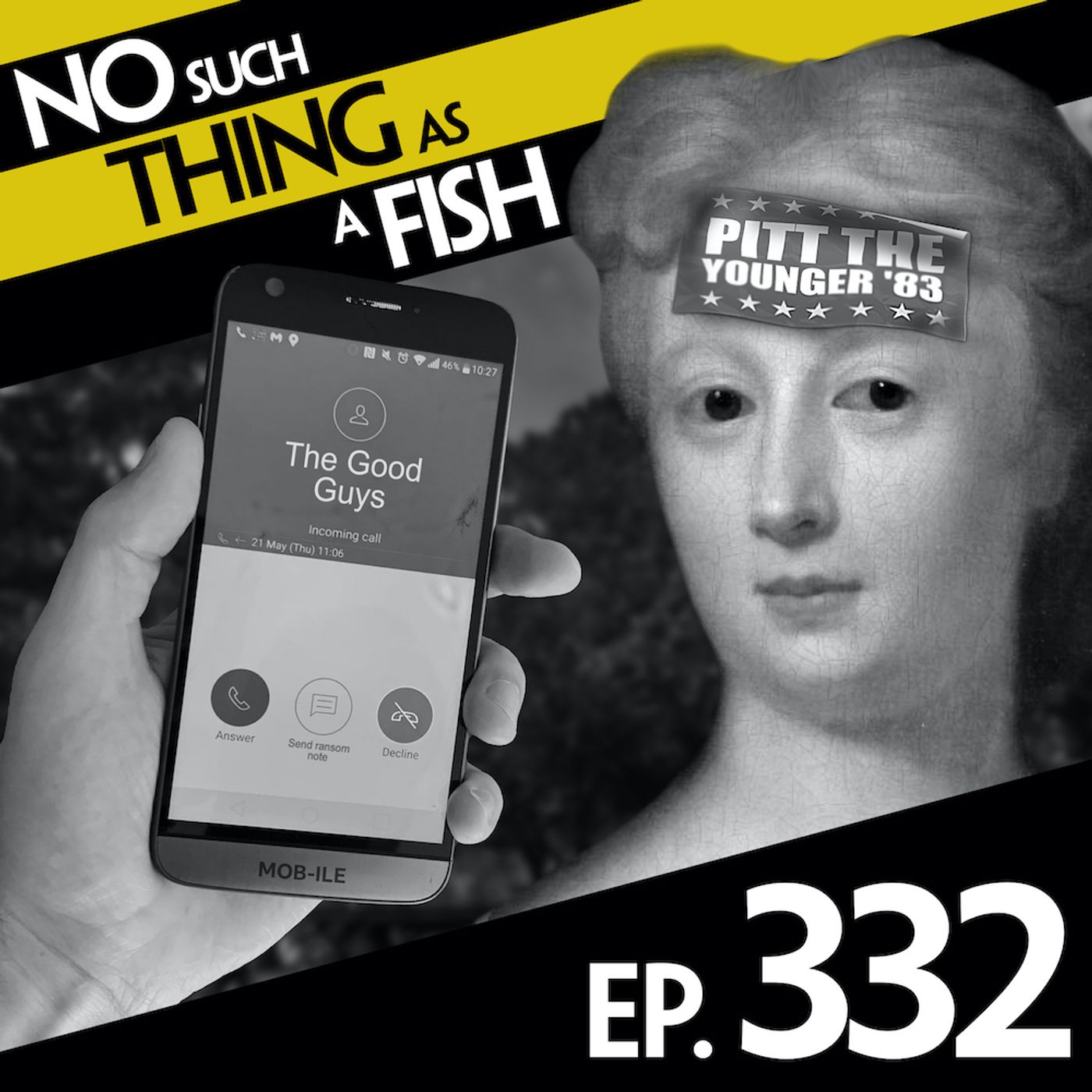
332: No Such Thing As An Innocent Apple
Visit nosuchthingasafish.com for news about live shows, merchandise and more episodes.
Press play and read along
Transcript
Let's do the 60-second savings challenge. Step one: Download Rocket Money.
Step two, link your accounts and see every subscription you're paying for. Tap one you don't use and cancel it.
That's money back every month. Step three: create a financial goal: $50 every paycheck, or let the app automatically move small amounts of cash when you can afford it.
In a week, you'll forget you set it up. In a month, you'll see real dollars piling up.
In a year, you'll be shocked at how much money you've saved.
Bonus challenge, upload an internet or phone bill and let Rocket Money try to lower it. You only pay if they find you savings.
On average, Rocket Money members can save up to $740 a year when using all the app's premium features. Users love the app with over 186,000 five-star ratings.
Make saving money the resolution you actually keep. Start the 60-second savings challenge at rocketmoney.com/slash cancel.
That's rocketmoney.com slash cancel. Rocketmoney.com/slash cancel.
Running a business is hard enough. Don't make it harder with a dozen apps that don't talk to each other.
One for sales, another for inventory, a separate one for accounting. That's software overload.
Odo is the all-in-one platform that replaces them all. CRM, accounting, inventory, e-commerce, HR, fully integrated, easy to use, and built to grow with your business.
Thousands have already made the switch. Why not you? Try Odoo for free at odoo.com.
That's odoo.com.
In fact, and the reason I want to tell you that is because,
first of all, it's obviously in the office and we're all still in our homes at the moment.
And also because there'll be a few things that we might say in there that might really perhaps give away that we didn't record it this week.
For instance, I do talk about Jasper Carrot for a while and that probably would have been a dated reference anytime that we'd said it in the last five years.
But hey, when you listen, you'll get the idea. So enjoy the show and just marvel about how young we all sounded back in February.
Okay, on with the podcast.
Hello, and welcome to another episode of No Such Thing as a Fish, a weekly podcast coming to you from the QI offices in Covent Garden. My name is Dan Schreiber.
I'm sitting here with James Harkin, Andrew Hunter Murray, and Anna Chaczynski.
And once again, we have gathered round the microphones with our four favorite facts from the last seven days, and in no particular order, here we go. Starting with you, Anna
my fact this week is that in the 18th century women expressed their political beliefs by wearing decorative stickers on their faces Wow that's cool what kind of stickers did they say like vote labor or yeah screw you Boris just
hold all over their foreheads very prescient of that well women have amazing foresight
and foreheads if you want
a sticker huh
no this one so facial stickers were this huge fashion for about sort of 200 years. And about the turn of the 18th century, they suddenly became political.
And so there was one commentator, for instance, who said that he went to the opera and he saw two parties of very fine women, as he said, arranged in battle formation against each other.
And he said one group was wearing patches and stickers on the left side of their foreheads and the other on the right. It became apparent they were Whig supporters and Tory supporters.
And I looked into this and this was a thing. So it wasn't the stickers were just like little beauty spots or something, but it was where you wore them that was important, is that it?
Yes, that seems to be it, yes.
So they started off as for decoration.
But it got to the extent that there were some marriage contracts where women would insist before they married their husband that regardless of the husband's political opinions, the wife should be able to patch as she pleased.
Wow. And so you would have one or two things, but did it get to the point where people, you know, when you see full face tattoos, did you ever see people just completely?
You would see, not completely the full face, but you might see lots of these like fake beauty spots.
And you could supposedly identify prostitutes because their faces had so many of these patches on them.
Was that a sign of being sexy though, having lots of stickers? Well, having one sticker was supposed to be. And the reason is
supposedly Venus. the goddess of beauty, she had one mole on her face.
And it was by that one imperfection that you could see how beautiful the rest of her face was.
And the idea was that they were kind kind of copying that. And by having like one little beauty spot, it would show the paleness of your skin, perhaps, or you know, show off the rest of your skin.
So, if you have lots and lots of stickers, that means you're really, really beautiful because
you need so many imperfections to disguise how fit you are. Could be that.
I wouldn't believe what I look like without these stickers on. I look really nice.
It could have been that you're covering the symptoms of STDs.
It's a real gamble.
So, were the, sorry, I didn't think that we had
glue sticker technology in the, when is this, 18th century? We had glue. Sure, okay.
Were they kind of fuzzy felt stickers, that kind of thing? I actually don't think we had fuzzy felt.
They would be made of various things, so they could be made of silk or taffeta or leather sometimes, and then they'd have mouth fur, apparently. Mouth fur? Mouth fur.
Like
on your tongue.
No. Have I suddenly developed a lisp?
It sounded like mouse from where I was sat, but. Okay.
Oh, mouse hurt. Okay, I've heard mouth as well.
Ah, okay, write in and tell us what you heard.
So, and then they'd have on the back, often a surface that you could lick. So, women tended to take them out of their handbags and lick them to attach them to their face.
So, you get very thin paper that does that. Or they had adhesive, so they'd just stick it on with some glue.
Yeah, but sometimes the adhesive wasn't so great.
So, there was an article in The Spectator that spoke about a woman who had a beauty spot on her forehead, but by the end of the evening, it had gone to her chin.
They got more and more elaborate as well, didn't they? As it caught on.
So I think it started in France and the French called them mouche, which is for flies because they look like little flies landing on your face.
But yeah, they expanded to be weird shapes. So by the end of the 18th century, you'd have them cut into stars or sort of moons or crown shapes or any shape you wanted, really.
You still get those, don't you? On small children? Yeah. Yeah.
And adults who like a bit of fun. Yeah, Yeah.
Why are you wearing that weird puppy dog on the middle of your forehead?
I was so considering doing it this morning, but I bottled out of it in the end.
No, you do get them like little kind of,
I don't know, stars.
Yeah. I've been very brave at the dentist today.
They don't stick those on your forehead though, do they? No, actually,
I used to have one of those, but it was a safety pin one, so that's not for the forehead. That's for the clothes.
Safety pin, really? Oh, what is a badge? I'm describing a badge.
But what's interesting about that is, I think you're only brave at the dentist once, so you don't need it to be a badge, you only need it to be a sticker. Do you know what? You're right.
I'm confusing it with my I've been to a party at Pizza Hut badge, which is a badge, because that's a thing that lasts for life. If you go to a party at Pizza Hut in the early 90s.
Yeah, you want to show off about that, don't you? That's why you wear badges. You don't want to be wearing a badge that says, I've been brave at the dentist, just to show off.
You'd feel pretty silly at the military parade, wouldn't you, next to all the other medals?
It was just being brave at the dentist's award.
I got this one for bravery.
I thought there's some drawings that people have done of some of the designs, and there was a horse and carriage one, and I think that's been
questioned, did it? That was satar, wasn't it? That was someone taking
the shit out of how absurd they've got. What a shame I thought that was real, too.
Yeah, I was really hoping that that would be... Because I just felt how interesting heads must have been back then.
Watch now, I don't know what you're doing. Well, it's just way more.
If you're sitting on the tube and someone sat across from me with a horse and carriage drawn on their head, and they had other cartoons, you know, I wouldn't need the paper. But
people still have tattoos these days, so do you just, when you sat at the tube, just read people's tattoos? I do, but they give me a look that says I'm not friendly.
Oh, well, this is the thing about other kinds of stickers, is that they can be indicators of how friendly or not someone is.
So bumper stickers, if people have bumper stickers on their car, they tend to be more aggressive and territorial drivers. Oh, yeah, that's a good idea.
Yeah,
there's a study in 2008 by Colorado State University, and they surveyed people saying, Do you have bumper stickers on your car? And do you drive like a bastard?
And basically, people who said yes to one said yes to the other. They said, Yeah, I drive more territorially, more aggressively.
I do not respond constructively on the road when people get in my way.
And how often are these the baby on board stickers? Because I do think that's irresponsible. Well, I read that article, and actually, it says that it doesn't matter what's on the sticker, right?
So, you might have a sticker that says everyone needs to be kind to each other, and you're still going to drive like a maniac. Yeah.
So baby on board as well. Yeah.
Yeah. More likely to be aggressive.
Just one more thing on an alternative use for stickers for yourself, for decoration, is to cover blemishes. And so I think that's sort of where facial stickers might have come from originally.
But men wore them quite a lot to cover blemishes or to accentuate them. And so
if men had been to war, for instance, it became quite common for them to come back. and they'd put a scar sticker over their scar.
I think if a scar started to fade or something, then you'd put a big black scar there. And so there's, for instance, there's a bit in All's Well That Ends Well, which now makes sense.
If you know it, where Bertram comes back from war and it says he's got a patch of velvet on his face and it's unclear if there's a scar underneath.
And it was sort of a thing that people did if they hadn't really seen much military action and they're a bit of a coward and they'd run away at the first sign anyway.
Is that they'd suddenly put a big blemish on their face to imply that they'd been shot in the head. Wow.
That's amazing. I've got a little scar on my face.
Maybe I'll try and accentuate it. Have you
with some mouse fur?
One of the sides, I'm not sure which side. That side.
Someone got shot in the Civil War, isn't it?
Obscene bumper stickers can sometimes be a matter for the law. Okay.
So
there are these lawsuits that happen in the USA over whether you're allowed a particular bumper sticker or not, or whether it's basically creating a public disturbance just by having it on your car.
So in 2008, a guy went to the Georgia Supreme Court because he had a shit happens bumper sticker. Okay.
And he won.
And then, more recently, this bit is very rude, by the way, but the police in Florida arrested and charged a man who had a bumper sticker which said, I eat ass.
And it was really big and it's right in the middle of his back windscreen as well. So there's no way if you're driving along that you won't see it.
And was he referring to donkey meat? Do we know?
I'm not sure.
That wasn't his defense, actually.
I mean, it absolutely should have been. But the police pulled him over and they said, can you amend it so it wasn't offensive? And he said, said, well, how do you suggest I do that?
And they said, can you remove the second S from ass
so it would be I eat as.
But then the grammar police come over to the outside.
Guys, who's the grandfather, the god of stickers? The god of stickers. The god of stickers.
You all know this. The football albums.
Panini. Yeah.
Oh, no, I was thinking of Mr. Avery.
Oh, Avery, yeah.
Oh, Avery. Stanton.
Sorry, sorry.
Well, because you never do any of the office admin, Andy, you are not familiar with Avery stickers, but those of us who post letters every once in a while this feels like more of a grudge it feels like this whole fact has been building up to a grudge
no so Stanton Avery mate was the inventor of the self-adhesive sticker as in you didn't need to lick it you didn't need to add glue to it and he still dominates the label market today so I was looking into him
He
so he built his first sticker machine, I love this, by marrying together a motor from a washing machine and a sewing machine, sewing machine pass.
So he smushed them together and generated a shed load of stickers. His company was initially called Cum Clean Products, spelling Cum K-U-M,
which I think is a good thing was changed.
How did he make his glue?
He was actually very cagey about the process.
He was also pretty tired.
He was.
He was super poor.
And so he really dragged himself himself up from the bottom. He lived in a rented chicken coop while he was.
Wretched, he couldn't even afford the deposit on a chicken coop.
Did he pay the chickens every day?
I don't know if the chickens owned the coop. I think they were also renting.
Oh, wow.
Terrible flatmates. Yeah.
You get eggs every morning. Oh, that's true.
Yeah. Do you want to eat an egg if your flatmate has just laid it before your horrified eyes?
I refuse to eat food that's come out of any of my friends ask this,
however delicious.
That's amazing. Yeah, so cool.
He could have written, I eat, and then in brackets, eggs that have come out of a chicken.
Close brackets. Ah, so good.
Another strong defense. So many articles are going up for.
So he tried a bunch of business.
How did he get a washing machine in the chicken coop?
So I think this was post-chicken coop. And he got it because he married a slightly wealthier lady who lent him a bit of money.
Wow. And he thought, what I need is a washing machine.
You got back to your place, I'm mine.
Chickens out tonight.
So anyway. Did you invite them to the Hendu?
He got laid that night.
Let's do the 60 second savings challenge. Step one, download Rocket Money.
Step two, link your accounts and see every subscription you're paying for. Tap one you don't use and cancel it.
That's money back every month. Step three, create a financial goal.
$50 every paycheck or let the app automatically move small amounts of cash when you can afford it.
In a week, you'll forget you set it up. In a month, you'll see real dollars piling up.
In a year, you'll be shocked at how much money you've saved. Bonus challenge.
Upload an internet or phone bill and let Rocket Money try to lower it. You only pay if they find you savings.
On average, Rocket Money members can save up to $740 a year when using all of the app's premium features. Users love the app with over 186,000 five-star ratings.
Make saving money the resolution you actually keep. Start the 60-second savings challenge at rocketmoney.com slash cancel.
That's rocketmoney.com slash cancel. Rocketmoney.com slash cancel.
Running a business is hard enough. So why make it harder? With a dozen different apps that don't talk to each other.
One for sales, another for inventory, a separate one for accounting, before you know it, you are drowning in software instead of growing your business. This is where Odoo comes in.
Odoo is the only business software you'll ever need. It's an all-in-one, fully integrated platform that handles everything.
CRM, accounting, inventory, e-commerce, HR, and more.
No more app overload, no more juggling logins, just one seamless system that makes work easier. And the best part, Odoo replaces multiple expensive platforms for for a fraction of the cost.
It's built to grow with your business, whether you are just starting out or already scaling up. Plus, it's easy to use, customizable, and designed to streamline every process.
So you can focus on what really matters, running your business. Thousands of businesses have made the switch.
So why not you? Try Odoo for free at odoo.com. That's odoo.com.
Okay, it is time for fact number two, and that is my fact.
My fact this week is that the very first print run of The Adventures of Huckleberry Finn had to be pulped after a bookstore owner discovered someone had sneaked a drawing of a penis into one of the illustrations.
The first suspect has to be the illustrator, I assume.
Yes, we genuinely don't know. We don't know if it was the illustrator.
We don't know if it was the photo engraver at the actual factory where they were printing the book.
What we do know is when these books came out, at the end of chapter 32, Huck Finn is meeting his aunt sally and uncle silas and uncle silas has a big erect penis drawn in in the illustration itself and as a result 30 000 copies had to be
pumped and do they they definitely checked they checked the plot and they don't it's not part of the storyline that references uncle silas's erect weirdly weirdly i read the book and i can confirm there isn't a bit where uncle silas has an erection and is showing it off to his family must have been very disappointing when you got to the end of that.
It's the only reason I bought the book in the first place.
So, this is obviously a very important book in American literature. Ernest Hemingway said all modern American literature comes from one book, and it's called Huckleberry Finn.
And the idea was it was the first book that used the vernacular of Americans.
At that point, Americans were really writing in the tone of British and European authors, not using the day-to-day language, and he kind of set the tone.
Unfortunately, it's also a book that's laced with racism and that's caused huge problems basically since publication. It's not a book that's sort of not been controversial throughout the years.
The language used is difficult and racist, and we should say that it's set. Mark Twain wrote it in the 80s, but it's set about 40 years earlier in the 1840s, isn't it?
And the main plot of Huckleberry Finn for anyone who hasn't read it is basically it's about Huck Finn, who is this kind of poor kid who, how old is he 12 or 13?
And he runs away along with a runaway slave who is called Jim. And they run away together and they are good friends.
And Jim is a very sympathetic character, but at the same time, very problematically drawn. Yeah, one of the...
Not drawn with an erect penis like Uncle Silas, we should say.
People have objected to stuff other than that.
So it was extremely controversial as soon as it was published, largely because of the kind of crudeness of some of the language and that it was written in this native dialect.
It wasn't just like ordinary American dialect, it was proper Mississippi 1840s dialect. And it was banned for bad grammar and employment of inelegant expressions.
Things like in 1905, a Brooklyn library banned it because Huck not only itched, but he scratched. So apparently that's disgusting.
And he said sweat when he should have said perspiration.
So Mark Twain had been kind of unhappy with the way that publishing had been going and he decided he didn't want to have normal publishers like before and get the money that way.
He wanted to have a subscription service. So he sent people door to door with like, you know, the first chapter and said, look, there's this new book coming out.
How do you fancy buying it?
And then we'll send you all the chapters in future. And he basically, because he did this, it meant he could have full control of it, which meant he had full control of all of the illustrations.
And it meant that when the illustrator kept sending him stuff, he was like, don't like that, don't like that, don't like that, don't like that. I do like that.
But love that penis.
So is that maybe why they brought it up? That's one theory that the illustrator hated him so much because he kept asking him to change things that he was like, right, fine.
But they offered a massive reward to the pressmen working on the novel, a $500 reward, which would have been a lot of money today. And no one fessed up, so he's still, there's no culprit.
And is the investigation still open?
I think
the reward is still available. He had a terrible relationship with his sort of typesetters and proofreaders and everyone like that, didn't he? Which might be why they were so pissed off with him.
He hated them. And it does sound like they kept on trying to improve his punctuation and grammar, which was deliberately vernacular.
And once upon getting a text back and seeing the corrections that had been made, he wrote to a friend, I've telegraphed orders to have the proofreader shot without giving him time to pray.
So it was tense, I think.
If someone wrote that about him, I'd draw a penis on their picture.
It wasn't the most successful book that he published with that firm. So the first two books that that firm published were Huckleberry Finn and The Memoirs of Ulysses S.
Grant, ex-president.
And it was pretty much the last thing Grant did was write this book. And it was so successful that he gave Grant's widow the biggest ever royalty check in American publishing history.
Like it was absolutely massive. And it was thanks to that door-to-door technique that James mentioned because it was war veterans.
So it was Civil War veterans going door-to-door selling the book.
And that's a pretty strong sell, you know. I might be wrong in saying this, but from the story that I know about that, it's that when Ulysses S.
Grant died, his wife was really struggling financially and was not given any help from anyone.
And Mark Twain published the book and gave her that high amount of royalties before he knew it was going to be successful so that she had money to live off for the rest of her life.
Apparently, it's an extraordinary book, that autobiography. Really? Yeah.
Yeah.
I've read so many things about it being the best book by anyone in government ever as a solid, it's just incredible, apparently. Surely not better than The Art of the Deal.
Surely.
Surely not better than Jacob Reese Mogg's book about the Victorians.
Can't be better than that, can it? Now, if we want to talk about offensive language and things.
Mark Twain wrote the first book on a typewriter in America. There's a bit of dispute over whether it was Tom Sawyer, another one of his books.
It's usually credited as Tom Sawyer.
But he used to love writing on a typewriter and no one really had it at the time. So people used to write him letters and he would write letters back on his typewriter.
They would then write back to him asking about the typewriter, and that got so annoying with so many people writing back to him, asking him, Holy Molly, what is this?
This is incredible that he stopped writing letters using his typewriter. She's got inundated.
Yeah.
I really love his correspondence because he didn't really much like getting them a lot of the time, did he?
I read one that he got in 1901, and the letter said, Dear Mr. Mark Twain, I am a little girl, six years old.
I have read your stories ever since they first came out.
I have a cat named Kitty and a dog named Pup. I like to guess puzzles.
Did you write a story for the Herald competition? I hope you will answer my letter. Yours truly, Augusta Cortrecht.
To which he replied, Well, no, he didn't reply, he just wrote a comment on it saying, Labor tempt of a middle-aged liar to pull an autograph.
He invented one game for kids, which I think sounds pretty cool.
So he measured out a 817-foot path of his driveway and he marked every single foot and that was supposed to be a year and it was the year from 1066 when William the Conqueror arrived in Britain and the idea is you would walk along the path and at each point when there was a new king or queen in England or Britain then you would put a stake in the ground and you would be like, oh this is Edward the First, this is Henry II, blah blah blah.
And it was a way of having fun but also learning your kings and queens because in those days education was very much rote learning, like you just had to learn all these things, and this was a fun way of doing it.
Or a very annoyingly slow way of getting to the front door after a long day in the office.
But he turned it into a board game, didn't he? Or he tried to. It sounds really complicated.
I didn't fully understand it even after reading it. I thought it sounded quite
a bit like Battleship. So basically, it was another sort of history date memorization game.
And essentially, you'd have a chart with a series of dates on it. And each player would say a date.
So you say
1918, and then the other player has to say an event that happened on that date, say the end of the First World War. See, I cleverly chose my date in advance, so I'd have something to say for it.
I mean, you also chose a date that was nearly 10 years after Twin died when no one could possibly have guessed what was going to happen.
True.
But then a player puts a pin in that date if they get it right.
And if they don't get it right, they don't get a pin. And I guess when you've covered up all your dates, you've won.
So that's quite fun for a nerd.
Okay, it is time for fact number three, and that is Andy.
My fact is that before vaccination was invented, the main method of inoculation against smallpox was to powder scabs and blow them up your nose.
Lovely. Or to get someone else to blow them up your nose, I suppose.
It's very hard to blow up your own nose.
And this was how inoculation worked for a long time. It was done in China a thousand years ago.
This was the method. They knew about this.
And it did work, didn't it?
It worked reasonably well so if you were healthy you would get some smallpox scabs and you would leave them for a little while because fresh scabs were likelier to give you the infection properly so they would be dried aged smallpox scabs and they would be powdered up and then they would be blown up your nose with a special silver blowpipe for the procedure as well.
The Chinese doctors had special blowpipes to do this. And then apparently, the right nostril was used for boys and the left for girls.
And you would maybe get some mild symptoms. And some people did actually just then get full-blown smallpox.
But
most people then got it, you know, some mild symptoms and then were resistant to any following exposure. It was a low percentage, wasn't it?
Yeah.
So this was a really decent way of doing it before we had the method of vaccination. And we didn't know about this.
Is that right? The 18th century. It took about 700 years to get over.
And it works by the same method as vaccination, right? Which is that it's an attenuated or weakened version of the disease
in a scab. And your body then makes antibodies that can fight against that, and then it can fight against the main thing.
Is that right? Yeah, I think.
There was another version where you had some powdered scab as well, or you had some pus from a smallpox pustule, and you would make a little scratch on your skin, and then you would just pour that pus or, you know, dust, rub that powdered scab into your skin, and that worked too.
And that's called variolation, because variola was the Latin for smallpox. In 2011 the Virginia Historical Society in Richmond had some things from its collection
and one of them was a letter from the 1870s that had a smallpox scab in it.
And the idea was that the person who wrote the letter in the 19th century was sending it to his father.
It had been taken from the arm of a child and his father was going to make it into dust and inoculate people.
But then it never got to the recipient. And so they just found this letter.
And of course, immediately the censors for disease control came in the hazmat suits and
said, Holy shit, we don't need to be having this, that the public can see this because smallpox has been eradicated, basically, hasn't it? And
so, yeah, in the end, there was some of the virus on this scab still, but it wasn't deadly enough. I mean, it must have attenuated pretty hard by that time.
When was it? It was from 1876, and they found found it in 2011. Wow.
That is really spooky, finding it and not knowing what it is.
You just think you found a little button or something.
Or maybe it's like a little sticker to put on your face.
But all these doctors have their own different methods of doing variolation. And there were some celebrity doctors in Britain in the 17th, 18th century who worked this out.
So have you heard of Johnny Notions?
Johnny Notions. Sounds like he's got some weird ideas for him.
Well, he was a Scottish doctor, and he had a really successful method for variolating because he would he would collect the pus first of all yeah and everyone had their own method of making it a bit less deadly basically so he would dry it with peat smoke so he had a lovely sort of smoky flavor for the pus very nice and then he would bury it in the ground between sheets of glass okay with some camphor um then he would keep it there for seven or eight years
this it's like he's making a whiskey isn't it whiskey yeah genuine years and then he would uh insert it and he would then put a cabbage leaf on top as a plaster.
And this was apparently a really good way of doing it, and it just gave you the nice amount. I suppose it does take the edge off the pus, doesn't it?
Nice peaty, cabbagey flavour to it.
Apparently, you were more likely to get a job if you could be seen to have smallpox scars because then the suggestion was, oh, great, you can work with us, you're not going to pass it on, you've had it already.
So that was seen as a sort of great
safe workmate. So
two of the earliest people who worked with inoculation were Robert Koch in Germany and Louis Pasteur in France.
And they fell out with each other because
Pasteur once was doing a talk and he used the phrase requis allemande, which means a collection of German writing, but the translator translated it as augui allemonde, which means German arrogance.
And so Koch never forgave him for that because he thought that Pasteur was calling him arrogant. Although I think before that, they loathed each other.
If you read the dialogues that they had, the letters they wrote each other, it's just basically spitting with rage.
You know, Koch writing letters to Pasteur, accusing him of stealing all of his ideas and vice versa, saying you're a fraud, you know, really foul language.
Because there was this huge fight, basically, when we suddenly discovered the power of the idea of vaccination between a few scientists, wasn't there?
So So,
that was after Jenner?
Yes, Edward Jenner. Oh, okay.
So, Edward Jenner is the person who
kind of we give the, we say, created vaccinations today, right? He
got it from milkmaids. Did he?
Yeah, because there were milkmaids near him, and he noticed that they got a thing called cowpox, which is a disease that cows got, and they would only get one single pustule on their hands, which is where they've been touching the cows because of all the milking.
And he theorised maybe this is a milder version of smallpox so then he did this amazing gamble Jenna he took some pus from a milkmaid and
he injected it into a child yeah and then six yeah not his child by the way although he did also do it with his own child actually later on so fair play
I think when he knew it worked
and then he six weeks later he injected the child with full-blown smallpox and he didn't know how it worked and yeah and then but later in life they became friends so him and the child?
Yeah, James Phipps. He was the son of Edward Jenner's gardener.
Which, if it hadn't worked, would have made the gardening very, very awkward, I think, for a long time.
I think he would have ruined your rosebush after that.
He had smallpox when he was a child, Jenner.
And one of the reasons that he kind of went into getting rid of it later is because he had such a bad time of it. He was virulated, so they gave him some of the pus or some scabs or something.
But he was prepared for that by being starved, purged, and bled and locked in a stable with other infected boys.
With other infected boys. Yeah.
So they kind of virulated all these people, gave them like very mild symptoms and then put them all in a stable. Wow.
Meanwhile, Stanton Avery's outside of the checking crew. You don't know you're born, mate.
The number one resolution for people last year was to save more money. But nearly half gave up by February.
Don't let that be you. Download Rocket Money to reach your financial goals this year.
Track your spending, cut waste, and automate savings in one simple app.
Rocket Money shows you all your expenses and categorizes them so you know exactly where your money is going and where you're overspending.
From there, the app cuts waste by canceling your unused subscriptions and lowering your bills. No customer service needed.
With that money freed up, the app will automatically set some cash aside for your goals. Whether it's an emergency fund, paying off debt, or saving for vacation, Rocket Money's got you covered.
Users love the app with over 186,000 five-star ratings. And on average, users can save up to $740 a year when using all of the app's premium features.
Make saving money a priority this year.
Go to rocketmoney.com slash cancel to get started. That's rocketmoney.com/slash cancel.
Rocketmoney.com slash cancel. Running a business is hard enough.
So why make it harder?
With a dozen different apps that don't talk to each other. One for sales, another for inventory, a separate one for accounting.
Before you know it, you are drowning in software instead of growing your business. This is where Odoo comes in.
Odo is the only business software you'll ever need.
It's an all-in-one, fully integrated platform that handles everything. CRM, accounting, inventory, e-commerce, HR, and more.
No more app overload, no more juggling logins, just one seamless system that makes work easier. And the best part, Odoo replaces multiple expensive platforms for a fraction of the cost.
It's built to grow with your business, whether you are just starting out or already scaling up. Plus, it's easy to use, customizable, and designed to streamline every process.
So you can focus on what really matters, running your business. Thousands of businesses have made the switch.
So why not you? Try Odoo for free at odo.com. That's odoo.com.
Okay, it's time for our final fact of the show, and that is James. Okay, my fact this week is that you can tell if a movie character is a goodie or a baddie by the kind of phone they use.
That sucks now that I know that and I'm watching movies. I know, sorry, this is not just a spoiler of one movie, this is a spiler of all movies.
So this came up in my RSS feed thanks to the blog Nitarama, which I follow. And it was an interview with Rian Johnson, who is the director of the film Knives Out.
And he said that Apple have forbid filmmakers from letting villains use their iPhones on the screen. And so, if one of your characters is using an Apple product, then they must be a good guy.
Oh, thanks. So, you can't tell who's the good guy in the good, the bad, and the ugly, for instance.
Or, it's a wonderful life. I'm not sure any of them had mobile phones in this.
They've been edited in.
But sometimes it's not clear who is a goodie and who's a baddie.
If someone pushes one person in front of a train to save five people, who will be allowed an iPhone at the situation? You're absolutely right.
In any decent story, everyone has a mixture of good and bad of them as well. Everyone has one iPhone and one Android.
Yeah.
That's a good point. Actually, that saves it for me because the movie might have been sponsored by Samsung, for example.
Yeah, of course. Yeah, so that's good.
Okay, great.
I'll stop googling which phone sponsored all my movies.
But yeah, and there was also an article in The Verge that says that Apple says that its products should only be used in the best light
that reflects favorably on Apple products.
And they don't, they, according to Apple, they don't pay to have their phones in movies but what they do do is give lots of free phones and MacBooks and stuff to the people who are making the movies in return for them being nice but you they wouldn't show someone looking up on the internet how to kill orphans
no on a MacBook on a MacBook you couldn't do that on a MacBook no yeah were to inject this puss into the garden so they wouldn't do that but this is a thing called product displacement which is the or it's kind of like product displacement Product displacement is where you replace a real brand with a fictional one because the original brand are really annoyed about.
Oh, okay.
So there's a film called Flight, which stars Denzel Washington as an alcoholic pilot who
manages to pull off a crazy move. The plane's about to crash due to, you know, it's all gone wrong on the plane.
And he manages to fly it in upside down and then land it the right way up at the very last moment. I've got to say, the first five minutes of that movie is one of the best things I've ever seen.
It's so tense. It's so amazing.
Okay, and the rest is terrible, right? You didn't want to say it out loud. No, I've seen it too.
It's shit.
Damn, think the film is bad.
Gotta tell you all not to watch it, especially now the ending's been spoiled anyway. Well, the rest of the film is, I gather, just a lengthy legal process about whether he was right to save the play.
It's a legal drama. Imagine if you go to watch that film and you're five minutes late.
That would be the worst thing ever.
Oh, my God. They should make it into a short and release it in the short film.
Yeah.
Anyway. That's Robert Zemeckis, who gave us back to the future.
He is an alcoholic pilot, Denzel Washington.
The character, sorry, not Robert Zemeckis, not Denzel Washington, the character. But he drinks Budweiser and a vodka that Budweiser own, either while he's flying the plane or shortly before.
I mean, you guys have seen the film, so you'll know. But Budweiser were furious about this, and they said, Can you not show this drunk pilot sinking a bud before he flies the plane? And they refused.
They said, There's nothing you can do. But it's so that happens.
Sometimes movies do have to buckle to these bigger companies.
So, Slum Dog Millionaire, when Danny Boyle made that, he gave an interview where he talked about the fact that he had some criminal gangs drinking Coca-Cola at one point,
ice-cold Coca-Cola. And I don't know if I say ice-coca-yeah, are we sorry? Are you personally sponsored by Coca-Cola today?
Wow,
it was a refreshing ice-cold Coca-Cola. So, yummy,
Available in all shops.
But yeah, they're drinking in that, and Coca-Cola took a sort of stand against it, and so they had to paint it out in the post-production of it. Yeah.
Slum Dog Millionaire was the most bizarre film.
I hadn't realized this, but obviously at the time it was so huge and it won the Oscar, didn't it? Yeah. And it was massive.
I hadn't realized it was made by the same company that makes Who Wants to be a Millionaire. So it was one huge piece of product placement.
Yeah. Isn't that Jasper Carrot who makes that? Does he
sell? Yeah. Well, he wrote Slum Dog Millionaire.
It might be. It's called Kellador.
Yes, yeah. He's pretty hands-off with it, but yeah, he's a direct beneficiary of both those things.
I think it's Celador, isn't it? Is it Celador?
Well, it's a company called Celador. Oh, of course, it's like Cellador.
I just got it.
I don't think it's deliberately named to be like the Cellador. It might be.
It's Jasper Carrot. He does love his puns.
What's the metaphor behind that?
Don't look behind the Cellador. It's actually Jasper Sarat.
Any international listeners who are wondering wondering who Jasper Carrot is, there's no time.
So Sylador made this, Who Made Who Wants to be a Millionaire, and then they decided to make Slum Dog to sort of advertise Who Wants to be a Millionaire.
And the screenwriter for Slum Dog Millionaire was one of the co-creators of Who Wants to be a Millionaire.
But the only thing that they stipulated was that at the end, and this is a spoiler, where he's being accused of cheating, the hero is being accused of cheating.
The host of Millionaire sort of tortures him backstage. And at that point, they said, we can't have it look like the the show is torturing this boy because that's going to make us look bad.
So it's just got to be the host. So it's like Chris Tarrants got out on a limb.
It wasn't Chris Tarrant in the film, but the international listeners who were clinging on after Jasper Carrot
Chris Tarrant.
So hang on, what kind of torture equipment does the host of Who Wants to be a Millionaire have access to backstage? Like, you couldn't do more than a quick Chinese burn or a wedgie, could you?
He's got that tension music. Yeah, yeah.
He's got a super long advert break without telling him
i found out uh product just looking up product placement stuff i found out one of the first ever examples of product placement on a podcast okay so this was in 2005 there was a show called the dawn and drew show okay
and it was the newspapers at the time had to explain what a podcast was which is so the report i read said a podcast is or this particular podcast is a program filled with strong language that is available only in a digital format and downloaded on iPods and other devices that play MP3 files.
So that's what a podcast is. And this one was the Dawn and True Show and it was sponsored, it was product placemented by Durex.
Okay. And Durex
had inserted their product into the show because it was hosted by a husband and wife. And the show featured the husband and the wife and their dog, Hercules, tasting flavoured condoms.
That was the first ever product placement.
The firm said they were delighted and they said this is, quotes, exactly how we want to position the brand.
Were they condoms for dogs and humans alike?
No, because you'd have to have a dog meat flavoured condom.
Sure, they don't love strawberry, do they?
Oh, God, it's incredible. So anyway, I'm just saying we've got further to sync before we hit wrong button.
You know, you're, this is not a bit of product placement, but we're recording this podcast on a Mac computer. And we're all good guys.
Now, if you were to close that, and don't close it because we might lose the recording, but you would see that the Apple is upside down as you're looking at it.
So maybe if you half close it, you see it's kind of upside down as you're looking. Now, the reason that is, is for product placement reasons.
So it was in Legally Blonde, which is a properly great film.
She is using an Apple Mac, but the Apple is upside down to what we have it today because that's the way it used to be.
Because it makes much more sense that if you have it closed and you're looking at it, the apple is the right way up. Oh, yeah.
And that's how it used to be.
But then there was an employee called Joe Moreno who said to Steve Jobs, Look, if we're going to put these in movies, what we need is when it's open and you're looking at it, the apple is the right way up.
And so they changed it. Or if someone's just watching you in a cafe, of course, you've got to put it the right way up for the people looking at it, not the one who owns it already.
That's really interesting.
So basically, the Apple on your Apple Mac is not for you, it's for everyone else. Yeah.
Wow.
Some advertisers, this is sort of the next step they're doing for advertising and things so advertisers in soap operas are now selling billboards inside the fictional locations in the soap operas whoa yeah so coronation street
is a fictional street yeah but it's a fictional street with advertising billboards on it yeah and you know jewelry shops and other shops are buying up advertising space and fictional coronation street yeah so clever and there's a new thing also that other advertisers are doing where you know you'll be able to digitally alter what viewers see on screen when they're streaming.
So you'll see that. So different people see different things.
Is that what you're saying?
So if you are watching, let's say you drink whiskey and your TV knows that you drink whiskey, there might be billboards for whiskey brands in the background. Whereas if you.
But what if you're a person who
secretly buys dog meat flavoured condoms
and you're watching Coronation Street with your parents?
That's such a good point.
That's such a good point.
The whole family looking at each other suspiciously. It's like an Agatha Christie.
Yeah, exactly. Wow.
Well, they might do it based on the time of day, even. So if you're watching late at night, there'll be adverts for
Coronation Speak Late at Night. Absolutely.
Have another late night sack.
Yeah, there'll be adverts for, I guess, late night stuff like swearing.
Wow. Whiskey.
Cocaine. Whereas if you're watching in the morning, there'll just be adverts for cereal and orange juice.
Or whiskey.
Just one ironic thing about this fact is that apples are a sign that someone's a villain. What? Huh? In films, apparently, people have spotted this.
If you're the baddie, you're always eating an apple. Not always.
This is good across films. Yeah? So, Mr.
Bond.
The bad guys in Doctor Who do that, don't they? Because an apple a day keeps the Doctor away.
This is true. Please send in more if you've seen them.
But Joco Malfoy does it.
Jeffrey Rush in Poets of the Caribbean eats and crunches down on an apple, Colin Farrell when he's playing a vampire in something or other. Um and it's it's got a name as the arrogant apple.
So I'm like it's really just to show your dominance because it's kind of showing you're so aloof. Yeah, yeah, yeah.
I can eat an apple as well as talking to you.
I don't give enough of a crap about what you're saying to stop eating my apple. I wonder if there's like the history of the poisoned apple in fairy tales and things.
That's been theorised on the internet, James. You should check the internet out for more on that.
Garden of Eden? Again,
an apple was eaten there. It's all on the forums.
It sounds like we can think of everything on the internet, Anna, so I'm not worried.
Okay, that's it. That is all of our facts.
Thank you so much for listening.
If you'd like to get in contact with any of us about the things that we have said over the course of this podcast, we can be found on our Twitter accounts. I'm on at Schreiberland.
James?
At James Harkin. Andy? At Andrew Hunter M.
Ed Shazinski. You can email podcast at QI.com.
Yep, well, you can go to our group account at no such thing or our website no such thingasoffish.com.
Why not check the internet out as well while you're there? And we'll be back again next week with another episode. We'll see you then.
Goodbye.
Anyway, our sponsors this week are the new Durex range of Pedigree Charm.
Stop the podcast. Oh, God.
california has millions of homes that could be damaged in a strong earthquake older homes are especially vulnerable to quake damage so you may need to take steps to strengthen yours visit strengthenyourhouse.com to learn how to strengthen your home and help protect it from damage.
The work may cost less than you think and can often be done in just a few days. Strengthen your home and help protect your family.
Get prepared today and worry less tomorrow.
Visit strengthenyourhouse.com.
It never happens at a good time. The pipe bursts at midnight.
The heater quits on the coldest night. Suddenly, you're overwhelmed.
That's when Home Serve is here.
For $4.99 a month, you're never alone. Just call their 24-7 hotline and a local pro is on the way.
Trusted by millions, HomeServe delivers peace of mind when you need it most.
For plans starting at just $4.99 a month, go to homeeserve.com. That's homeeserve.com.
Not available everywhere. Most plans range between $4.99 to $11.99 a month your first year.
Terms apply on covered repairs.
Winter is the perfect time to explore California, and there's no better way to do it than in a brand new Toyota hybrid with 19 fuel-efficient options, like the stylish all-hybrid Camry, the adventure-ready RAV4 hybrid, or the rugged Tacoma hybrid.
Toyota has the perfect ride for any adventure.
Every new Toyota comes with Toyota Care, a two-year complementary scheduled maintenance plan, an exclusive hybrid battery warranty, and of course, Toyota's legendary quality and reliability.
Visit your local Toyota dealer and test drive one today so you can be prepared for wherever the road takes you this winter. Toyota, let's go places.
See your local Toyota dealer for hybrid battery warranty details.