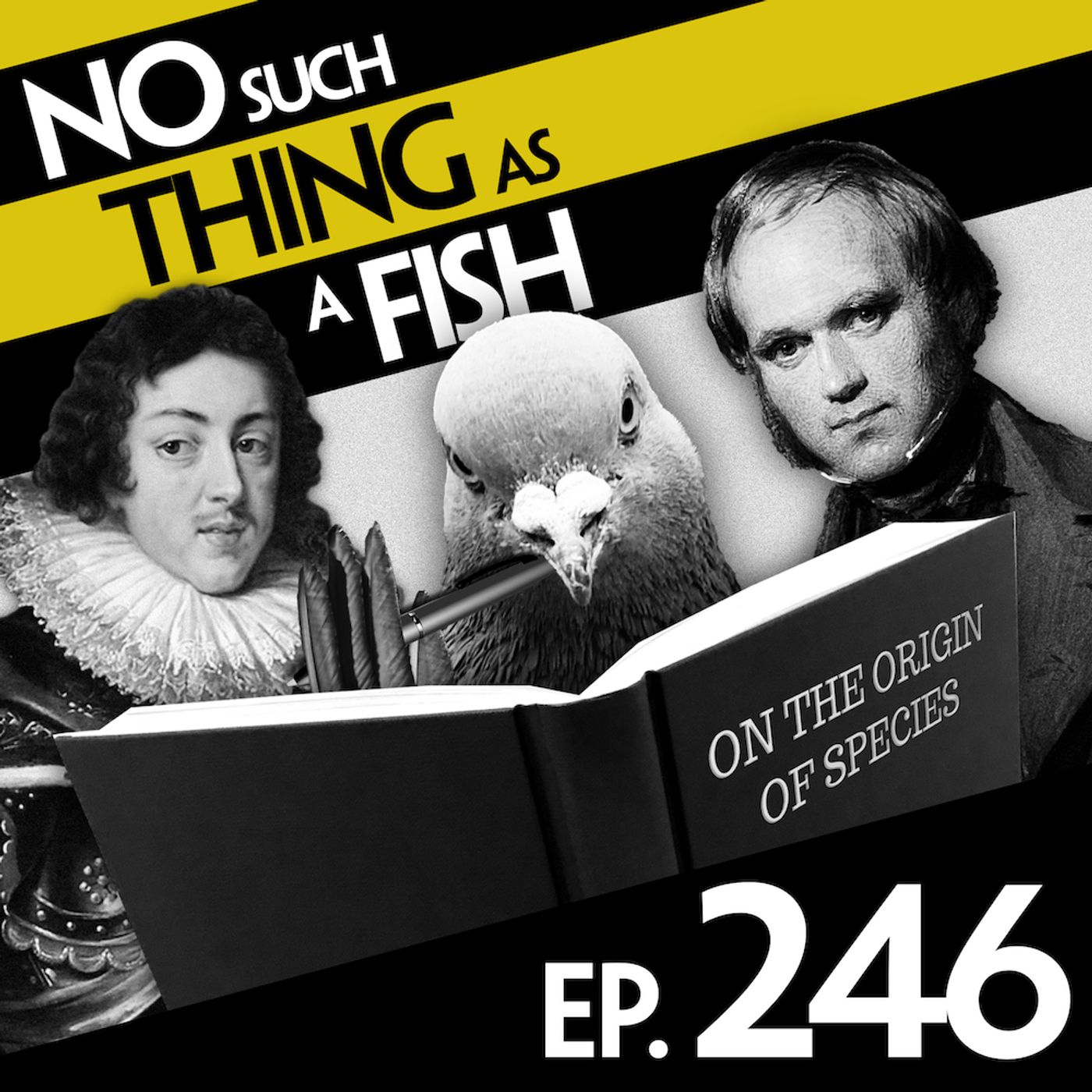
246: No Such Thing As The Worm Revolution
Dan, James, Anna and Andy discuss the Royal Anagrammist, the man from M.O.U.L.D, and Darwin's publisher's not-so-helpful notes.
Press play and read along
Transcript
Speaker 1 From Australia to San Francisco, Cullen Jewelry brings timeless craftsmanship and modern lab-grown diamond engagement rings to the U.S.
Speaker 8 Explore Solitaire, trilogy, halo, and bezel settings, or design a custom ring that tells your love story.
Speaker 10 With expert guidance, a lifetime warranty, and a talented team of in-house jewelers behind every piece, your perfect ring is made with meaning.
Speaker 11 Visit our new Union Street showroom or explore the range at cullenjewelry.com.
Speaker 9 Your ring, your way.
Speaker 14 Hello, and welcome to another episode of No Such Thing as a Fish, a weekly podcast coming to you from the QI offices in Covert Garden.
Speaker 14 My name is Dan Schreiber, and I am sitting here with Anna Chasy, Andrew Huncher Murray, and James Harkin and once again we have gathered around the microphones with our four favorite facts from the last seven days and in no particular order here we go starting with you
Speaker 14 James. Okay my fact this week is that there is a special language in Papua New Guinea that is only used when gathering nuts.
Speaker 14
It's very weird. Yeah.
So can you only use it when
Speaker 14 gathering nuts? Actually picking the nut or when you're on your way to pick the nut or in the general nut picking area. Okay.
Speaker 14 So
Speaker 14 if you try and use it outside the area where the trees are, then there's a worry that mountain spirits might come down and investigate and then cause problems with the nuts.
Speaker 14 And basically, this is a taboo language. This is relatively common around the world.
Speaker 14 And you change your language whenever you're doing anything as a superstition, and eventually it becomes an actual language or an actual vocabulary of more than a thousand words in this case.
Speaker 15 And what's the idea that the spirits will steal the nuts from you? What's the fear here?
Speaker 14 So some some normal words that you might use like say I don't know I'm making these up but like wither or dry or dead or whatever they might be bad for the plants they might be unhealthy for the plants and so you have to use alternative words that wouldn't be generally unhealthy to the plants.
Speaker 14 And is this if you were going to be part of the nut gathering unit, would you have to study this language or does everyone know this language? That's a really good point.
Speaker 14
I don't know but I imagine they teach it to you. It's probably not the first thing you learn.
It's probably more like a second language. Yeah.
Speaker 14
So it's really weird. There seem to be two different kinds of belief.
One is that there's a spirit called Kita Medo who can rip people apart, but that's only one group of people.
Speaker 14 That's only one social group.
Speaker 14 Because there are loads of different groups all over New Guinea and lots of them gather the nuts and they travel in from the coast to the mountains to get to the nut area.
Speaker 14 And the other is that, as you say, that if you talk about wet things, then all the nuts you find will be really wet. And if you use words like empty or bitter, same deal.
Speaker 14 But it's two completely separate beliefs about why you have to use this language.
Speaker 15
So then you have a euphemism for empty or bitter or wet, but then that starts to mean that. So then surely that becomes bad luck.
Right. And then you've got to make a new one.
Right.
Speaker 14 So this is a thing called perjuration, and it happens in English as well. So for example, the word for
Speaker 14 the toilet in the 15th century it was privy and then that was replaced by a euphemism but then that which was it was replaced by bog house which i didn't know that was the the polite way you'd say it instead of privy, because privy was rude.
Speaker 14 And then toilet, but then toilet becomes rude, so then lavatory. And now in America, it's restroom.
Speaker 14 But as soon as people really associate restroom, as soon as that becomes the rude word, they'll have to think of another even more remote word. So, what is it in Britain then? I think bathroom.
Speaker 14 People say bathroom to be polite, don't they? Yeah.
Speaker 15 But it will move on. Should we make a new one quickly now?
Speaker 14 Can we not go back to bog house?
Speaker 14 Yeah.
Speaker 14
Like the privy. Oh, sorry.
The bog house.
Speaker 15 Only when you're around the queen.
Speaker 15 In a similar vein, our word for bear in the Middle Ages was taboo, because it probably came from Ursus. So, you know, obviously you have Ursa Major and stuff, and that's the Latin for bear.
Speaker 15 But because bears were big, scary things, it was thought to bring bear rage upon you if you said their name. So people would refer to them as the brown one or the shaggy one.
Speaker 15 And so the word for bear comes from the word for brown. It's like bruh.
Speaker 14 And in China, you can't say the word tiger in some places. So if you're speaking about a man-eating tiger, you'll use a different word, often referred to as big insect
Speaker 14 there's a massive insect down the road
Speaker 15 i think you'd be more terrified if someone said there's a large insect behind you and you turned around and it was a tiger
Speaker 14 i would say just give them the warning straight out so it's to prevent it from coming into the village so you don't if there's a tiger behind you you probably say tiger
Speaker 14 but it's if you say big insect then it won't hear its name and it won't come down oh do you know what i mean yeah so it won't know it's been summoned so you'll get summoned instead loads of big insects.
Speaker 14
Yes. At least there's no possibility.
At least it's big insects, yeah.
Speaker 14 In Papua New Guinea, so this language, even though this is language purely for picking up nuts, the diversity of language in Papua New Guinea is extraordinary.
Speaker 14
I think it's the highest diversity in the world. So they have over 800 languages, 850 languages.
And
Speaker 14 they have so much, this is what's crazy, population versus the amount of languages that they have.
Speaker 14 There's this thing called the Greenberg's Diversity Index, which charts how much diversity language is in per country. It says Papua New Guinea holds the top spot.
Speaker 14 It is so diverse there that the probability of two random people selected in the country, any two random people, if they were brought to each other to talk to each other, there's a 98.8% chance that they won't speak the same language.
Speaker 14 Wow. Isn't that crazy? That's a bad speed dating day.
Speaker 14 Yeah.
Speaker 14 So how do you have courts and things like that?
Speaker 14 How do you have they must have a national language of, let's say, English or something yeah exactly they've got they've actually got four official languages in papua new guinea um the fourth being sign language uh as the official language but that's exactly what it is everyone speaks a main language and then these are all other languages that are slowly going extinct with one or two speakers left yeah because they've got english that's very widely spoken there and then they've got toko pisin haven't they which is pidgin talk um so just pidgin english which is great and i i just love all kinds of pidgin english or kind of creole when you read them because it's such a funny warping of what we say.
Speaker 15 So the word for broken in Toko Pisin is baggarapim, which is bugger up from bugger up. That's what you now say broken.
Speaker 15 MT tin is a person who talks nonsense, you know, like an empty person.
Speaker 14 Like an empty vessel.
Speaker 15 An empty vessel, exactly. Susok man is a sophisticated person.
Speaker 14 Susokman.
Speaker 15 Why? James might know this.
Speaker 14
Oh, wow. James, you always wear silk socks.
Is that it?
Speaker 15 You always say there's a phrase that you used to say when you're growing up to say that someone's a bit well-to-do.
Speaker 14 Look at you with your matching shoes. Exactly.
Speaker 14 Same thing.
Speaker 15 Siusong man means person with shoes and socks.
Speaker 14 Oh, look at you.
Speaker 14
Look at you with your matching shoes. There you go.
You'd fit right in. I didn't know that Papua New Guinea is the second largest island in the world.
I didn't know that either. It's massive.
Wow.
Speaker 14
Depends what you count as an island, of course. Very true, yeah.
If you count Eurasia as an island, come down to three immediately. But sorry.
Speaker 14
It doesn't include Australia. It doesn't include Australia.
After, I think it's after Greenland.
Speaker 14 Yeah, it's the country is called Papua New Guinea. The whole island is called New Guinea, but the western half of it, which is part of Indonesia, is Papua and West Papua.
Speaker 14
And then you also have Guinea and Guinea-Bissau. Right.
And Guiana. Yeah.
Speaker 14
It's absolutely nightmare. Germany.
I often get that mixed up.
Speaker 14
I looked up a couple more taboos. Oh, yeah.
So, this is an interesting one. There's an Ethiopian language called Kambata,
Speaker 14 and it's got marital linguistic taboos. That's quite common, isn't it? Yeah, so a woman can't use...
Speaker 14 Some married women follow this system which is called balisha and it means that they are not allowed to use words that begin with the same syllable as your father-in-law's name or your mother-in-law's name.
Speaker 14
So my mother-in-law is called Natalia. So you wouldn't be able to talk about that.
Talk about Natajak toads.
Speaker 14 You wouldn't be able to talk about Natajak toads at all. You'd have nothing to say.
Speaker 14 And you'd have to coin a completely different word for them. I'd just call them toads.
Speaker 14 Yeah. Yeah.
Speaker 14 So it's not such a problem for James, which is great.
Speaker 14 What syllable would you not be allowed to use?
Speaker 14
Lille. Lille.
So you won't be able to talk about the northern French city. Right.
Speaker 14 So we'll get there.
Speaker 14 Where is this Euro star going to? Oh, God.
Speaker 14 We'll see when we get there.
Speaker 14 Shouldn't have become a train announcer.
Speaker 15 Yeah, that's really cool. Well, there's another kind of gender-based specific language I was looking at in Nigeria, actually.
Speaker 15 So I guess the thing you're talking about is a language specific to one thing.
Speaker 15
And this is a language in the Ubang community in Nigeria. And they have different languages for men and women.
And they say they think they're the only tribe in the world who has this.
Speaker 14 That would be even worse for speech dating, wouldn't it?
Speaker 14 I don't know how it works.
Speaker 15 And it's also bizarre because when people are born, then you get raised by your mother and your sisters and generally women. So everyone speaks the women's language.
Speaker 15 But then apparently, there was an interview with one of the tribal leaders who said that as boys start reaching adolescence, they just start speaking the male language.
Speaker 15
And it is completely different. I mean, the words are utterly different.
And he's like, if boys don't start speaking the male language, then we consider them a bit abnormal.
Speaker 14 So it was a kid. What a rough adolescence is that.
Speaker 15 You're like, shit, I've got to sort of memorise secretly this language I'm supposed to miraculously start speaking.
Speaker 14 We talk about toxic masculinity in this country, don't we? But that is pretty bad.
Speaker 14 You know, sometimes when you're at a restaurant and you see a couple who just don't speak to each other the whole meal, I presume every restaurant is like that.
Speaker 15 Relationships are constantly awkward.
Speaker 14 That's so weird. So the males can still speak the...
Speaker 15 Yeah, they can understand each other. They're just not allowed to speak each other's language anymore.
Speaker 14 No. I was reading about a secret language that was used in wartime in Canada, and it was very cleverly done done because it's a secret language in that not many people spoke it.
Speaker 14
So they were in the Canadian Army, they enlisted these native North Americans and they spoke Cree. And Cree was a language that barely anyone speaks.
It's only these people.
Speaker 14 And so what they used to do is in between battalions, they would have Cree speakers and any messages that they needed to send across, it was those people who took it.
Speaker 14 So if they were caught, there was no way of getting the information out of them because the language barrier was so great. So
Speaker 14 yeah, but the problem was that Cree didn't have words for the things that they needed to get across. So things like
Speaker 14 they had
Speaker 14 tanks and machine guns and bombers. So a machine gun they had to translate into their language, which is little gun that shoots fast.
Speaker 14
Or a fighter bomber would be the Cree word for mosquito because that was the best way of explaining it. So yeah, they had to invent new words and new phrases in order to do this.
That's so cool.
Speaker 15 That's interesting because there were planes called mosquitoes, weren't there?
Speaker 14 This isn't fucking old war, right?
Speaker 15 My granddad flew one of those.
Speaker 14 Were they the ones that were slightly made of wood?
Speaker 15 Yes, they were.
Speaker 14 I'm pretty sure that's mosquitoes.
Speaker 14
Yes. Or partly wooden frame.
That's very cool. I have some stuff on gathering nuts.
Oh, great.
Speaker 14 So don't go gathering hazelnuts on September the 21st in Birmingham. Why? Because that is devil's nutting day.
Speaker 14
Apparently, according to an old folklore, Satan comes out at that time and he collects his nuts on September the 21st. So you leave it for him to do.
And where's this? Birmingham.
Speaker 14 It's in the West Midlands, basically.
Speaker 14 And there's an old saying of something being dirty in Birmingham. You would say it's the colour of the devil's nutting bag.
Speaker 14 Oh.
Speaker 14 You're ever in Birmingham? A bit of local slag for you to use.
Speaker 15 Yeah, that's going to go down like an absolute charm.
Speaker 14 Coolest kid of the party.
Speaker 15 Just on nut gathering, gathering, it's quite dangerous sometimes, isn't it? So if you're gathering big nuts, then they can fall on you.
Speaker 14 And
Speaker 14 you laugh.
Speaker 15 That is a genuine danger.
Speaker 14
Coconuts. So if you're gathering coconuts, then they always wear hard hats.
I picture nuts on the ground as opposed to in the tree.
Speaker 15
No, sorry, yeah, from the tree. Okay, coconuts, obviously.
It's not like you're just crawling on the ground and you keep bumping into nuts.
Speaker 15 But I like the, so gathering Brazil nuts, then foragers wear hats and they don't collect them on windy days days and stuff like that.
Speaker 15 But I didn't realise that they, when they fall out of trees, they fall from so high that they'll bury themselves 30 centimeters into the ground.
Speaker 15 So, when you're nut gathering for Brazil nuts, then you're digging up the ground to get the nuts out. Isn't that weird?
Speaker 14 Because they're quite spiky, are they, Brazil nuts?
Speaker 15 In their outside, they are on the outside, yeah.
Speaker 14 So, do you reckon they're made like that so that they because it's quite clever if you're a nut, isn't it?
Speaker 14 To kind of go directly into the ground and not have to get trampled in, because that's where you want to be in the end. Absolutely.
Speaker 14 If you're a worm, that must be terrifying.
Speaker 14 If you're a worm, going through the soil, suddenly these
Speaker 14 daggers are coming down. Yeah, that would be amazing.
Speaker 14 Slicing your friend in half, and now you've got two friends.
Speaker 14 So it's quite nice.
Speaker 15 The only species where watching your friend be cut in half is quite nice.
Speaker 14 God, the worm French Revolution would have been really weird, wouldn't it?
Speaker 14 With double the aristocrats.
Speaker 14 The worm James Bond.
Speaker 14 When the laser comes down, it just cuts him into two James Bonds. No messers, Bond.
Speaker 2 From Australia to San Francisco, Cullen Jewelry brings timeless craftsmanship and modern lab-grown diamond engagement rings to the U.S.
Speaker 8 Explore Solitaire, trilogy, halo, and bezel settings, or design a custom ring that tells your love story.
Speaker 10 With expert guidance, a lifetime warranty, and a talented team of in-house jewelers behind every piece, your perfect ring is made with meaning.
Speaker 11 Visit our new Union Street showroom or explore the range at cullenjewelry.com.
Speaker 9 Your ring, your way.
Speaker 14 Okay, it is time for fact number two, and that is Anna.
Speaker 15 My fact this week is that the man who worked out how to stop soft cheese going moldy came from a place called mold.
Speaker 14
So, Anna, just before this, we started recording, we as it's saying that it's pronounced molde. Yeah, mold.
Is that what you just said?
Speaker 15 Yeah, I think I said mold.
Speaker 15 So it's a place called Molde. It's in Norway, and you sort of say it Molde, but it's still got the word mold in it.
Speaker 14 I mean, it is still quite amazing. That was amazing.
Speaker 14 This is a great fact written down. Yeah.
Speaker 15 It looks pretty good.
Speaker 15 As long as you spell mold the American way.
Speaker 14 So if you're reading this podcast, then great. In America.
Speaker 15
So this was a Norwegian cheesemaker. He was called Olaf Kavli.
And yeah, he grew up in this municipality in Norway. And he was actually really old when he invented Primula, which is that...
Speaker 15 You're laughing because I pronounce it old, not older.
Speaker 15 He ended up inventing Primula, which is, you know, that cheese that you see that comes in a squeezy tube. That's interesting.
Speaker 14 I always pronounce that primula. Same.
Speaker 15 I think it probably is pronounced primula. And in fact, it's named after primroses because he thought the beautiful yellow colour reminded him of the beautiful yellow of a yellow primrose.
Speaker 15 So, primula makes a lot more sense.
Speaker 15 Anyway, yeah, he discovered this and then he got really rich.
Speaker 15 And he, I quite like this because it gives us all hope for our future later years of being finally successful rather than hanging out with you, dorks.
Speaker 14 Because he
Speaker 15 was in his 60s when he came up with this. He just ran this delicatessen.
Speaker 14 I mean, it's not good for your next 30 years, though. I don't say
Speaker 14 30 years of hanging around with us darks until you managed to invent some cheese.
Speaker 15 You're right, I'm not going to last that long.
Speaker 15 He actually lived to 100. Lived to 1958.
Speaker 15 And also, a good thing to know about Primula, and I'm actually going to start buying it, is that all...
Speaker 14 Well, now that you can pronounce it, it's not cheesy.
Speaker 15 But all the profits go to charity, go to good causes, because he was a massive philanthropist, and then his son was and didn't have any offspring.
Speaker 15 And so set up the company, which is the, I think it's called the Cavli Trust, and it's legally required to donate all its profits to scientific, humanitarian, charitable causes.
Speaker 15 But yeah, cheese and sobbing cheese going moldy. It's been a problem for centuries.
Speaker 14 Just on the place called Molder or Mold.
Speaker 14 Its name comes from the word mould without an E on the end. It's a plural form of that place.
Speaker 14
And the word mold in Norwegian means either fertile soil, skull, or mould. Wow.
So it might actually be
Speaker 14
mold. That's very cool.
So I was looking up moldy cheeses or soft cheeses. So there's a cheese called Cougar Gold, which is made in Washington State University.
And this is really weird.
Speaker 14 So it's canned soft cheese, but
Speaker 14
it's canned when it's still in the curd form. So it develops as it ages.
As in, it's not... Once it's gone into the can, it doesn't stay the same.
Yeah. Oh, wow.
Speaker 14
So the lactic acid bacteria inside, they don't need oxygen. So the flavor keeps developing.
And there are fans who age their cans for years and years before opening them. And it's just curds.
Speaker 14 I think it goes in as curds. No way.
Speaker 14 Nobody? Yeah. No, yes.
Speaker 14 It was too good. I just had to sit back in them and just stare in awe.
Speaker 14 I can now,
Speaker 14 looking back when you said three more years on us,
Speaker 14 I said, I'm done.
Speaker 14 Yeah, that's really cool. So there's no use-by-date on it, presumably?
Speaker 14 Maybe there is for safety, as then maybe after a certain number of years, it does go off, but I'm not sure.
Speaker 15 So, when processed cheese came about, which this is an example of, then it was very controversial because it threatened the normal cheese market.
Speaker 15 And there were actually a lot of cheese makers in America who said it should be called embalmed cheese,
Speaker 15 which it was almost named.
Speaker 15 But I hadn't quite realized that it's just a blend of lots of other cheeses, which I think most people will, but like offcuts of the cheese-making process. So, for instance,
Speaker 15 I think American cheese, you know, your classic American processed cheese, is a combination of bits of cheddar, Colby, provolone, things like that.
Speaker 14
That's incredible. And then they add sodium phosphate, which kind of makes it all go goopy.
Yeah. And quite easy to slice and stuff like that.
Speaker 14
And that was invented, American cheese, by a Canadian, of course, who is James Lewis Kraft of Kraft fame. Kraft cheese.
Yeah.
Speaker 14 He was a Canadian and he kind of came up with this idea of kind kind of shredding it and then adding this stuff which makes it kind of cuttable.
Speaker 14 So it's kind of a Franken cheese. Yeah.
Speaker 15 And they pasteurize it so it doesn't ripen, so it's not it's really not proper cheese as we the French might know it by the time it's been so for instance Velveeta has to be called pasteurized prepared cheese product.
Speaker 15 It does. Did you know that's only since the early 90s, which is when they finally worked out a way to make the base not real cheese at Kraft.
Speaker 15 So it was a really exciting moment because instead of like using just this mixture of cheese and then adding this sodium phosphate and stuff, they worked out a way of cracking milk, which I didn't know was a thing.
Speaker 15 But basically, this is you add little bits of plastic membrane into milk and it causes all the milk particles to separate and it separates out into its milk protein lumps and it makes this kind of concentrated protein and that can be the base for their cheese.
Speaker 15 And it was at that moment when some inspectors went around their factories and they went, guys, you're not using cheese anymore.
Speaker 14
I'm afraid you have to call it cheese products. How did they come up with this shit? Yeah.
So weird. I was thinking the other day I found out this is completely off topic, but
Speaker 14 early cars had white tires. Right.
Speaker 14 And the only reason that we have tires that are black is because you add something called, I think it's called black carbon, which is just this tiny bit of weird carbon that they managed to get from the industrial process.
Speaker 14
And they just thought, let's just try it with rubber. And it turned out to make rubber 10,000 times more solid than normal.
Wow.
Speaker 14 But even on that, I was like, how do you even think of that? Didn't they just try in everything or what?
Speaker 15 I can't believe early cars had white tires.
Speaker 14 So cool.
Speaker 15 But an absolute nightmare to keep clean.
Speaker 14
Exactly. You would just naturally have a black tire after a week.
Yeah, it'd be as dirty as the devil's nutsack.
Speaker 14
Sorry, I just checked. Nutting bag.
Nutting bag.
Speaker 14 Don't embarrass yourself in Birmingham by getting that wrong.
Speaker 14 I'm just thinking the difference between your brain and mine, James, is that you're fascinated by the fact that all these processes go on, and I'm still busy here going, wow, there was an actual guy called Kraft.
Speaker 14 That was a real person.
Speaker 14 Can't believe that.
Speaker 14 So I looked off a bit about food preservation.
Speaker 14 I don't think we've spoken before about Nicolas Apper or Appert. So he was the man who started preserving foods by heating it a lot and then putting it in an airtight container.
Speaker 14 So this was in the Napoleonic Wars and there was a massive prize on offer from the French army to anyone who could work out how to safely preserve food and keep it for long periods of time because it couldn't be done.
Speaker 14 And he invented it and it was called appetization.
Speaker 14
And he put all his food in glass jars, in fact, not in tins. So he won the prize and it was decades before microbe theory.
So he had invented safe food storage, but he didn't know how it worked.
Speaker 14
It's so good when that happens. Wow.
And then later on, there was a British innovator called Peter Durand, and he invented giant tins.
Speaker 14 So you know how you have a normal tin of beans or something, it's a normal size.
Speaker 14 He was keen to scale up for the Royal Navy, and he stored up to 13.5 kilos of meat in a single can.
Speaker 15 I'm already going to go on the limb and say that's not an invention.
Speaker 15 Making a much, much bigger version of something that's already there.
Speaker 15 I couldn't invent the giant book.
Speaker 14 Yeah, exactly. Well, not with that attitude, young lady.
Speaker 14 Yeah, no, we're talking about a Guinness World Record attempt, aren't we?
Speaker 14 Think of it. It's a giant,
Speaker 14
it's a quarter of a person's size. Oh my god, and he's showing us how big it is with his hands, and he's right.
It is an invention.
Speaker 14 Okay, innovator. He innovated it.
Speaker 15 He innovated. It's very impressive though.
Speaker 14 Wasn't he the same guy who
Speaker 15 wasn't this the one where it was like 30 years until they invented something to a specific tin opener, didn't they? So in the Napoleonic Wars they all used their what are those instruments called?
Speaker 15 Bayonets, yeah. Did they? Another name thing I came across.
Speaker 15 I was looking at some cheese studies and there was a cheese study in the Encyclopedia of Food Sciences and Nutrition that was published in 2003.
Speaker 15 It was called called Cheeses, Colon, Processed Cheese, and the author was called a Gouda.
Speaker 14
Isn't that weird? No. Yeah.
Gouda. What an unusual surname.
That was amazing. If you were surprised that there was a person called Kraft, I know.
Speaker 15 But I think you'd be biased if you were called Gouda, a proper cheese.
Speaker 15 I'm not sure I would trust you to write a balanced article about processed cheese.
Speaker 14 Oh, yeah, you're right.
Speaker 15 You know, it's like being called Baby Bell and writing about the cheddar industry.
Speaker 14 That is named named after a guy called Belle, isn't it? Is it?
Speaker 14 So I think the Laughing Cow company was founded by the Bell brothers, or maybe it was a father and son, and their surname was B-E-L. So I think Baby Bell is named after a guy as well.
Speaker 14
That's a nice name. And at one point, would have been a baby.
Yeah. So was Father, actually.
Yeah.
Speaker 14 The thing about Laughing Cow, by the way, which I did see, is I went on the website and they have one top secret technology there that they've never given away to anyone else. Okay.
Speaker 14 Do you know what that is?
Speaker 14 Oh, how to
Speaker 14 cut the triangles. Is it folding the foil?
Speaker 14 Kind of, yes.
Speaker 15 Is it the red thing, how you get the red thing to peel off so perfectly?
Speaker 14
No way. It's the easy open foil wrapping technology, which, according to the website, remains top secret to this day.
Wow.
Speaker 15 It's not a technology that we're crying out.
Speaker 14 Oh, guys.
Speaker 14 Brag about. That would be so useful.
Speaker 14
That would be so useful for so many people. Yeah, imagine if you had it for your clothes.
For your clothes.
Speaker 14
And whenever you needed to get undressed at the night, you start to pull one red string and you stopped completely undressed. You've got that.
It's a zip.
Speaker 14 Strip shows would be a lot shorter, wouldn't there, if there was one baby bell-style peel-off thing.
Speaker 14
I found a weird thing about cheese. Go on.
Humans invented cheese before they could digest milk. Okay.
What?
Speaker 14 Yeah. Okay, so
Speaker 14 all mammals, you know, they're lactose tolerant when they're very young because they're drinking their mother's milk. And then all mammals are lactose intolerant,
Speaker 14 or almost all are. And then humans only got the genetic mutation to
Speaker 14 allow them to drink milk as adults
Speaker 14
a few thousand years ago. But so we couldn't digest lactose.
But cheese has much lower lactose than milk.
Speaker 14 So if you make cheese, you can store all the calories of the animal's milk in cheese form, and that means you can keep the calories for longer, so you'll survive longer, you'll be better fed.
Speaker 14 So that that gives you a reason to keep animals for longer rather than immediately killing them or hunting them.
Speaker 14 So that means that you domesticate sheep and cows and all of this and you make cheese, but you don't drink the milk.
Speaker 14 But the thing is, like to make the cheese, is this not right that what you do is you get the milk and then you get the stomach of a dead animal and you put the milk inside the stomach because it's got acid which you need and then you leave it for weeks and weeks and weeks and then you eat it.
Speaker 14 I mean Anna was talking about things not being inventions. That is an invention in a half, isn't it?
Speaker 15 It is one of those things things that required them to be incredibly bored and wouldn't be able to be invented now because we've all got better things to do than experiment with these bizarre things.
Speaker 15 The ancient Greeks used to grate goat's cheese into their beer and wine.
Speaker 15 One of the earliest wines, actually, the kind of peasant wine mentioned by Homer, is actually wine and goat cheese.
Speaker 14 We could try and bring back.
Speaker 14 I mean, I like wine and cheese. Yeah, wine and cheese together, but not one inside the other.
Speaker 14 At a party, you know, at a party, you've got to hold a plate and you've got to hold a glass, glass, and it's really difficult if you ever need to use it.
Speaker 14
Gesture. Gesture, yeah.
If you just put the cheese
Speaker 14 in the wine, yeah.
Speaker 14 I'm going to try that this Christmas.
Speaker 14 Who are these? The Greeks or the Romans? The ancient Greeks. Oh, okay.
Speaker 15 Do you think if they came here, they would think we were really pretentious?
Speaker 15 Because you know, if you go to some really posh restaurants and they have deconstructed X, Y, Z, like you have a deconstructed crumble where the crumble's on one side, and do you know what I mean?
Speaker 15 Well, yeah, they'd come and say fucking deconstructed wine, cheese, drink.
Speaker 15 Your wine on one side, your cheese on the other.
Speaker 14 Do you think you are?
Speaker 14 Okay, it's time for fact number three, and that is Andy.
Speaker 14 My fact is that when Charles Darwin submitted On the Origin of Species to his publisher, the publisher suggested he should rewrite it exclusively about pigeons.
Speaker 14 So...
Speaker 14 Ouch. I know.
Speaker 14 So there's this article in the London Review of Books, which is reviewing
Speaker 14 a book all about the publisher John Murray and the correspondence between authors and the publishers over centuries.
Speaker 14 So it's got all these famous authors like Jane Austen and Lord Byron and David Livingston and all these people. And the firm sent On the Origin of Species out to two readers when it came in.
Speaker 14 One of them was a lawyer called George Pollock who said that it was beyond the apprehension of any living scientist.
Speaker 14 And the other was this guy called Whitwell Elwyn who was a clergyman.
Speaker 14 And he wrote back saying, look, I like Darwin, but it's a wild and foolish piece of imagination, and that it would really be a good book if he just wrote it about pigeons. That's really good.
Speaker 14 He said, everybody is interested in pigeons.
Speaker 14 So did when Elwyn then, Elwyn, sorry, spoke to Murray,
Speaker 14 did Murray then go back to Darwin and say, write it about pigeons? That's what I couldn't work out. Or was it just an internal email kind of thing? Well, I don't know.
Speaker 14 I don't know whether it got passed on to Darwin.
Speaker 15 But that wouldn't involve ripping the whole thing to pieces because there's quite a lot of pigeon in there.
Speaker 14 It's just a sharter book. Yeah.
Speaker 14 It's a very slight edit, I think.
Speaker 15
He was really into pigeons, though. I hadn't quite realised how much of a pigeon fancier he was.
So he might have been flattered that his pigeon work was so inspiring.
Speaker 15 He was a member of two London pigeon clubs. Two.
Speaker 14
One's not enough. I swear that your wife would be a bit annoyed, wouldn't she? You're spending your time at one pigeon club.
Yeah.
Speaker 14 And the thing is, with the pigeons, like, he was, it was a bit like breeding dogs wasn't it like the pigeons were really weird looking like they they bred them to look not like pigeons yeah so they didn't look like the pigeons you'd see on the farm
Speaker 14 yeah so like breeds that he worked on uh included the pygmy powder pigeon uh the polish helmet pigeon
Speaker 14 uh the english long-faced muffin tumbler
Speaker 14 Classic.
Speaker 14 If you look at these pictures, if you Google them, they don't look like pigeons at all.
Speaker 14 There's one, the English carrier pigeon, which you don't see anymore, it looks almost identical to Jacob Reesmog. Doesn't it? It really, really does.
Speaker 14
Like, honestly, if you Google it, it just looks like Jacob Reesm. Oh, you should put up a picture on Twitter.
I will, I will.
Speaker 15 Because they're extinct, aren't they? So maybe he's actually the one surviving member of the species.
Speaker 14 We need to start breeding him. He is breeding glasses.
Speaker 14 Because there were these ones called powders, which are really weird because they bred them to grow this.
Speaker 14 They're bizarre birds because it looks like they swallowed a bowling ball, basically. Yeah.
Speaker 14 They've got this huge lump under their
Speaker 14 chins, as it were, in their neck. It's really strange.
Speaker 15 Well, I find it weird that we're so used to our just very standard pigeons when there is this huge variety.
Speaker 15 So, if you go to pigeon contests and pigeon beauty pageants, which you can, they're quite a big deal in the Middle East, in fact, then they look almost nothing like pigeons.
Speaker 15 A lot of them have that kind of gross turkey-like red bulbous stuff around their eyes. But yeah, it's a very popular thing.
Speaker 15 I think they've been big in the Middle East since 1150 when the first pigeon post service was set up in Baghdad and it took messages from Baghdad to Syria.
Speaker 15 And by the 1160s then it was, you know, it was constantly taking messages back and forth to the extent that in the Crusades, the Christians brought loads of falcons over with them to try and intercept the pigeon posts in the Middle East.
Speaker 15 So they were the first hackers
Speaker 15 who would grab their messages.
Speaker 14 They also used to do a lot of homing pigeon races, which still go on to this day, but that's been going since the 1800s.
Speaker 14 And I was reading about one in china that happened very recently and it's a huge prize for this it's a big deal in china so 160 000 american dollars would be the prize for the winning homing pigeon so they get sent a hundred miles away and they have to fly back to this spot and um the fastest speed that a homing pigeon has ever done is um it go they go about 100 miles an hour what yeah but no way this is
Speaker 14 this is they've clocked speeds faster than 100 miles an hour um but the ones that won would have had to have gone 200 miles an hour the first four places and they couldn't work out how that was possible.
Speaker 14 And it turns out what it was is the owners of the pigeons had them fly off but immediately come back, hopped on a bullet train which can go 200 miles an hour, get to the other side and release them and they won, but they have been caught and sentenced to prison.
Speaker 14
I think that's such a silly cheat because you will be caught because pigeons don't fly at 200 miles per hour. Sorry, did you say they got sent to prison? Not the pigeons, the humans.
Still.
Speaker 14 Well, Well, it's a huge prize, isn't it? It's $160,000. So that's, yeah.
Speaker 15 Yeah, they go for a lot. I think a Chinese guy recently bought one for half a million dollars, American dollars.
Speaker 14
Yeah. They go for a huge amount of money.
I should say they were sentenced to three years, but it was a suspended sentence. So if another crime occurs, then they go to prison.
Don't do it again.
Speaker 14 Have you guys heard of the Spanish sport, which is called thieving? It's a pigeon thieving competition.
Speaker 14
No. This is amazing.
So it's basically pigeon love island.
Speaker 14 You get
Speaker 14 a pigeon fancier, and you have a male. So half a dozen men each bring a male pigeon and they paint them in bright colours to mark which one is theirs.
Speaker 14 And then there's a marked female, and the male pigeons all compete to seduce the female. And the aim is to get them to come home with them because this is a very unusual pigeon.
Speaker 14 It's called the horseman thief powder.
Speaker 14 And it
Speaker 14 unusually mates by bringing its mate back to its place
Speaker 14 for sex. And so.
Speaker 14 How do you know that they'll all fancy her, though?
Speaker 14 I think all pigeons just all fancy all other pigeons.
Speaker 15 They are actually quite randy, aren't they?
Speaker 14
These ones are not choosy, yeah. And so the owner wins if his male is the one who wins the seduction competition with the female.
Yeah. That's amazing.
Speaker 14 And they all strut around and they, you know, they dance and they do little.
Speaker 14 That was some excellent pigeon strutting there.
Speaker 14 And this happens in Scotland, too. It's called
Speaker 14 do, basically. The pigeons are called do's, D-Double O.
Speaker 14 And if you see a pigeon flying up and you know that one of your rival do-men has released their pigeon, you release your pigeon of the opposite sex.
Speaker 14 And then there's this battle in the skies over who goes back to whose place.
Speaker 14 And if the pigeon comes back to your place, you get to keep both pigeons. It must be confusing because they're completely painted, right?
Speaker 14 So that's almost the equivalent human-wise of going to a Halloween party and
Speaker 14 fancying someone who's come as a skeleton.
Speaker 14 but you get on well and then the next morning you're like, oh, you put them white.
Speaker 15 Pigeons were the first drones in a way, weren't they? Or some of the first drones in that there was in 1907 this guy called Dr. Julius Nurbronner,
Speaker 15 which I will have pronounced incorrectly, sorry, but he was a German apothecary and he invented the pigeon camera. And this was a very exciting invention at the time.
Speaker 15 It was thought to be quite revolutionary because a couple of cameras had been sent up on balloons and stuff, but this was really acting like a proper drone.
Speaker 15
So, he'd strap it like a backpack onto the pigeon's chest, like a chest pack, and send them off to fly through the air. And they took amazing aerial photographs.
It's so worth looking at them.
Speaker 15 They are like beautiful pictures. And I hadn't really considered that for most people, seeing those was bizarre because they'd never seen pictures taken from above.
Speaker 14
Oh, yeah. There's a whole school of First World War artists, which, or post-First World War art, which is derived from aerial photography and aerial landscapes.
It just wasn't a...
Speaker 14
I guess you saw maps, but... You could see it from the top of a hill or something.
But apart from that,
Speaker 14 you'd never be able to see a city from above.
Speaker 15 He also actually invented a horse-drawn dove cut, you know, a home for the pigeons and doves that he was strapping the cameras to. And darkroom, which is quite cool, to go with the pigeon cameras.
Speaker 15 So that when you thought, oh, I suddenly want to photograph this city, you take your whole horse-drawn dove cut and darkroom inside to where it was, and then you could send them off.
Speaker 14 Just one last quick thing on Darwin.
Speaker 14 Maybe you guys all knew this, but I didn't realize that in The Origin of the Species, in the sixth edition, he added a new chapter which was responding to all the criticisms from previous editions of his book.
Speaker 14
Oh, really? I think that's such a good idea. Yeah, that's a great idea.
Nice. That's great.
We should do that with the book of the year.
Speaker 14 I think you'll find the WASPS article is funny.
Speaker 15 How many people wrote in saying not enough pigeons?
Speaker 14 Did you have
Speaker 14 loads of responses?
Speaker 14
I just have one last thing. It's not great, but I'll mention it anyway.
Oh, yeah.
Speaker 14 Buggle up. This is just a fact on publishers getting it wrong.
Speaker 14 So in this fact, it's the pigeon suggestion.
Speaker 14 This has just happened. In Australia, there's a businesswoman and socialite called Roxy Jasenko, and she's just released a book.
Speaker 14 Now, she's very famous as a PR specialist, and she was on Celebrity Apprentice in Australia, so she's a big name there.
Speaker 14 And so, the book is described as a no-bullshit guide to PR, social media, and building your brand.
Speaker 14 And it had all these glowing reviews on it, being street smart and hard-headed, she's a totally tenacious PR expert.
Speaker 14 But they've had to pulp every single one of the copies of the book because it also included, as a result of the publisher's mistake, a quote that was a misquote that said on the front that the book never fails to disappoint.
Speaker 14 So med say never fails to deliver, but yeah, total PR disaster.
Speaker 2 From Australia to San Francisco, Cullen Jewelry brings timeless craftsmanship and modern lab-grown diamond engagement rings to the U.S.
Speaker 8 Explore solitaire, trilogy, halo, and bezel settings, or design a custom ring that tells your love story.
Speaker 10 With expert guidance, a lifetime warranty, and a talented team of in-house jewelers behind every piece, your perfect ring is made with meaning.
Speaker 11 Visit our new Union Street showroom or explore the range at cullenjewelry.com.
Speaker 9 Your ring, your way.
Speaker 14 Time for our final fact of the show, and that's my fact. My fact this week is that King Louis XIII of France had a royal anagramist.
Speaker 14 Wow. Yeah.
Speaker 14 This was like, you know, you'd have a court jester, and then you would also have your royal anagramist who would just be there ready to make anagrams for the amusement of the king.
Speaker 14 That really was the role.
Speaker 14 He did a number of things with anagrams. It wasn't just amusing name remixes.
Speaker 14 He used to do prophecies as well using anagrams. And yeah, so it
Speaker 14 had a lot of mystical purposes as well as... I wonder if he could make an anagram of Louis XIII because there's an X and three I's in there.
Speaker 14
That's pretty tough one. If he can do that, he deserves a job.
You're right. You get six.
I've got the word six there from Louis and then the X. And then you've got L-O-U and then three I's.
Speaker 14
You've got we in French. Yeah.
We.
Speaker 14 Six.
Speaker 14 L-I-I.
Speaker 14
I'm really bad at doing anagrams because I always end up with spare. Ili means or in Russian.
The Romans supposedly,
Speaker 14 there's a thing called Ars Magna, the great art, and supposedly the Romans called anagramming Rs magna, which is an anagram of the word anagrams. But I don't think they used,
Speaker 14 I don't think they knew the word anagrams because they didn't have a plural form like which just adds an S to the main noun.
Speaker 14 Normally, there are a few weird ones where it does, but anyway, I don't think that is true.
Speaker 14 But it does come from the Greek anagrammatizine from anna, which means backwards, and grammar, which means letter. So it's putting the letters backwards.
Speaker 15 Anna with one end, though, guys, not the two ends,
Speaker 15 which means excellent.
Speaker 14 Anna, meaning backwards. Considering that Anna is a palindrome, it's quite weird, isn't it?
Speaker 14 Yeah, that is weird.
Speaker 14 Anyway.
Speaker 14 So, what about this guy? Who is he? Oh, so yeah, so we're talking the 1600s here. This is when King Louis XIII reigned.
Speaker 14 And this person,
Speaker 14 I don't actually know if he had a number of them, but the one person you can find who definitely was one of his royal anagramists was Thomas Billon.
Speaker 14 So he lived from 1617 to 1647, and he served as the royal anagramist twice. So there's a suggestion that there might have been another person fulfilling the role in between.
Speaker 14 Actually, there was a royal Sudoku guy in between.
Speaker 14 So he did it from 1624 to 1631 and then from 1640 till his death, I guess, in 1647.
Speaker 15 Maybe he was fired in 31 because he had a leftover letter or something.
Speaker 14
But he also predicted people's characters. So he would rearrange the letters of your name.
And if it came out as being, you know, an evil phrase, then people would think badly of you.
Speaker 14
Do you think, as a parent, if you were having a new child, you would deliberately come up with a good word, like an anagram of... You call your child like an anagram of awesome.
Yeah. Yes.
Speaker 14 Yeah, you would try and trick it. Masawi.
Speaker 15 Moisawi, yes.
Speaker 15 This is something that I think we might have mentioned on QI, and one of our researchers found the other day, again, that during the whole Enlightenment, anagrams were something that fascinated people.
Speaker 15 They were thought to portend certain things, like you say, if your name could spell something bad.
Speaker 15 But also, they were used by lots of scientists as a way of concealing their discoveries whilst also kind of stamping them as their own.
Speaker 15 So, people like Galileo and Robert Hooke would record their initial results as an anagram and send it off when they hadn't actually confirmed their results yet, because that meant once they confirmed the results, they could say, Look, I did it first.
Speaker 15 Look, here's the anagram that proves
Speaker 14 it. It's like blockchain, I imagine, even though I don't really know what blockchain is.
Speaker 14 Me neither, but I imagine it is too. But the um, the anagrams were exceptionally poor, weren't they? Were they? Yeah, so uh, Christian Huygens
Speaker 14 discovered the rings around Saturn and he wanted an anagram.
Speaker 14 So he wanted to anagram anuto singitor tenui pleno nusquam coherente ad ecliptam inclinato, which means it is surrounded by a thin flat ring, nowhere touching, inclined to the elliptic.
Speaker 14 So he wanted to make that. His anagram was A A A A A A A C C C C C D E E E E E G H.
Speaker 14
He basically put all the letters in alphabetical. It's not even trying.
It's not even trying. That's really.
Speaker 14 Yeah, that's not an anagram, is it?
Speaker 15
That's like what we said a few weeks ago. The crosswords, answers didn't have to be actual words.
The anagram has to be an actual word, Christian.
Speaker 14 God, that was an easy job then, if that's all you had to do.
Speaker 14 Random things.
Speaker 15 Well, there are kind of different types of anagram.
Speaker 15 This is according to a book I was reading for about 100 years ago, I think, which was saying you get a synagogue, which is kind of like that, but a synagogue is an anagram where the anagram means the same sort of thing.
Speaker 15 So, vile is a synagogue of evil, or angered, of enraged.
Speaker 14
11 plus 2 and 12 plus 1 is a famous one. That blows my mind so full every time.
As always, yeah, always a winner.
Speaker 14 But imagine if you thought that there were hidden things in anagrams, you would use those as examples of like,
Speaker 14 look how connected the universe is when we reshuffle this stuff. I would have bought into that immediately.
Speaker 14 There's a great, there's a website called anagrammy.com, which has a monthly award. So, the Archbishop Archbishop of Canterbury is another church's type of rabbi.
Speaker 14 The Amateur Thespians is an anagram of inapt hams used theatre, which I really like. And do they release
Speaker 14
something they want an anagram made of, or are you just submitting? I think you submit your own. Right, okay.
And they pick a really good one each month. So they're synagogams.
Speaker 15 They're synagogams. And then you get antigrams, which are the ones that mean the opposite.
Speaker 15 So like diplomacy is mad policy.
Speaker 14
That's good. There's a Guinness World Record for the longest anagram that you can get in the English language.
And
Speaker 14 this is for a non-scientific English word, because in the scientific ones, they're pretty bizarre.
Speaker 14 So, in a non-scientific word.
Speaker 14 I have known that in the past, but I can't remember it now. Okay, so I'll give you
Speaker 14
the original word and see if you can make the anagram. So, conversationalists.
Oh, yeah.
Speaker 14 What is the anagram of that?
Speaker 15 Conservationalists? Yeah.
Speaker 15 Oh, that's a cheat. I think you should have to rearrange at least four letters.
Speaker 14
Yeah, that's true. It's making up rules on the fly.
Yeah, but I'm allowed.
Speaker 14 Yeah, it is a bit.
Speaker 15 A bit measly, isn't it?
Speaker 14 What about Scone and Cohn's? Yeah, so that's currently the record. No?
Speaker 14 Why is that not good enough? I think they should have to begin with a different letter. Scone and Cones.
Speaker 15 Yeah, okay, I'll accept Scone and Cones.
Speaker 14 I stopped with that right off the bat.
Speaker 14 Did you? Yeah. You invented it.
Speaker 14
Have you heard of Corey Calhoun? Nope. He's an anagrammer.
I don't think he's a pro, but he's about as close as the modern age gets to a pro-anagrammer.
Speaker 14 So he rearranged the first line of Hamlet's soliloquy to come up with a summary of Hamlet.
Speaker 14 So
Speaker 15 as in just to be or not to be?
Speaker 14
No. That is the question.
Let's see if it passes the Anna test for crazy anagrams.
Speaker 14 So to be or not to be, that is the question, whether it is nobler in the mind to suffer the slings and arrows of outrageous fortune, okay?
Speaker 14 That he rearranged to make, in one of the bard's best thought of tragedies, our insistent hero Hamlet queries on two fronts about how life turns rotten.
Speaker 14 That's very good.
Speaker 15 That's really nice. So good.
Speaker 14 There's another thing that gets done where these kind of big challenges, where people try to take complete texts and create an anagram that works so that it just works as a whole separate work, if that makes sense.
Speaker 14 So the biggest one that's ever been completed is a guy called Mike Keith has anagrammed the complete text of Moby Dick. So that's, yeah, 935,763 letters.
Speaker 14 And he used a computer to do this, so that's seen as a cheat. Also, the computer did it.
Speaker 14 Yeah, but there was a person who did do it all by himself, which was Richard Brody, and he made an anagram of Battle of the Books by Jonathan Swift. And that's 42,000 letters, 100, 42,177 letters.
Speaker 14 But how much of a different anagram does it be? Could you have the exact same book, but it just is call me male-ish?
Speaker 14 The rest of it's exactly the same.
Speaker 14 So the ancient Greeks had, this is kind of related, so it's about palindromes, not anagrams, but Greek fountains had a big palindrome written on them, which said, nisbon anomin mata me monan opsin.
Speaker 14
So that's exactly the same backwards as it is forwards. And it means wash the sin as well as the face.
Oh, that's a good one. Isn't that cool for a fountain? Yeah, very good.
Speaker 14
I do know what the longest palindrome in the English language is. Go on then.
It's re-divider.
Speaker 14 Redivider.
Speaker 14
Oh, cool. Just a a fact.
That's a good effect.
Speaker 15 Did you guys know the Dutch national anthem is an acrostic?
Speaker 14 As in the first letter of each word spells something out.
Speaker 15 The first letter of each line spells something else. So the first letter of, sorry, the first letter of each of the 15 verses spells out William van Nassau as in William of Orange's name.
Speaker 15
And it's sung from his perspective. So it's all in the first person.
Bizarrely, when you're Dutch, you all sing as if you're William of Orange when you sing the anthem.
Speaker 14 Isn't there a line where he kind of says, and I
Speaker 14 give everything to the king of Spain in that national anthem? I think there is, yeah. That's awkward.
Speaker 14
How weird. And they were trying to change it, I think, but now you can't really, otherwise, the acrostic won't work.
It doesn't work.
Speaker 14 Scuffered. There was a guy called André Pujon.
Speaker 14 And this was back in the day when everyone thought that
Speaker 14 anagrams were really important and they had some kind of spiritual thing behind them. He worked out that his name was an anagram of Pendueu de Riom,
Speaker 14 which means hanged in Riom.
Speaker 14 And so he decided to fulfil his destiny by travelling to the town of Riom and committing criminal offence, which meant that he was hanged. Wow.
Speaker 14 So he actually, you know, made sure that the omen happened.
Speaker 14 Oh, poor guy.
Speaker 15 Oh, no, silly, silly mouse.
Speaker 14 There could have been another anagram he might have found where it said, had a relaxing holiday somewhere else. Yeah.
Speaker 14 Yeah.
Speaker 14 I mean, it probably is just a story, isn't it? But it is a story that exists.
Speaker 14 And that's the bar we've decided to set ourselves.
Speaker 14 So there's an anagram thing in our book as well. In the book of the year,
Speaker 14
there's a thing about Banksy. Because he submitted an artwork to the Royal Academy under the name Brian S.
Garkman, which is an anagram of the words Banksy anagram. Yeah, and they did not spot it.
Speaker 14 They rejected it. And then they asked him, can he submit a work? They just got in touch with Banksy and said, can you submit a work of art? And he sent them the thing that they had already rejected.
Speaker 14 And they accepted it.
Speaker 14 Would they have been expected to spot an anagram? Do people naturally have an anagram pass over everything and submit it?
Speaker 14 This is an anagram of Moby Dick.
Speaker 14 Nice try, buddy.
Speaker 14 Supposedly, if you are asked to solve anagrams against a green background and then against a red background, you'll do worse on the red background. Oh, really? This has been tried, and
Speaker 14 the people who were exposed to the red background anagrams did substantially worse.
Speaker 15 Is that because the text was in red on both times?
Speaker 14 It was black text.
Speaker 14
Sorry, so is that. Sorry, I misunderstood.
So it's there's a piece of paper that is red. Yes, right.
And
Speaker 14 it's got anagrams in black that need to be solved. As black as the devil's nutsack.
Speaker 14 It's not.
Speaker 14 It's the devil's nutting bag.
Speaker 14 The language has evolved at this point. It's a nutsack.
Speaker 14
There was another paper that suggests that it's easier to solve anagrams while you're laying down rather than standing up. Right.
No,
Speaker 14
I don't believe that. I don't think that's true.
Is it because there's more blood flow in your head?
Speaker 14 Because the red-green thing is crazy. It suggests that if you do worse on the red, that you're sensitive to the cue of danger.
Speaker 14
You think these anagrams are dangerous, you know. It must be just that you can't see black on red as well as you can see green.
No, it's not.
Speaker 14 I tried it, and actually, I did better on the ones with the red background than the green ones, so I would have been an anomaly.
Speaker 15 You're so brave.
Speaker 14 Does that mean that you should lead us all into war?
Speaker 14 I'm now a general in the army.
Speaker 14
Okay, that's it. That is all of our facts.
Thank you so much for listening.
Speaker 14 If you'd like to get in contact with any of us about the things that we have said over the course of this podcast, we can be found on our Twitter accounts.
Speaker 14 I'm on at Schreiberland, James, at James Harkin, Andy, at Andrew Hutter and Chaczynski. You can email podcasts at qi.com, or you can go to our website, no such thing as a fish.com.
Speaker 14 We have everything up there from links to our upcoming tour, all of our previous episodes, as well as links to buying our book, Book of the Year 2018. Do please buy it.
Speaker 14
Okay, we'll be back again next week with another episode. We'll see you then.
Goodbye.
Speaker 2 From Australia to San Francisco, Cullen Jewelry brings timeless craftsmanship and modern lab-grown diamond engagement rings to the U.S.
Speaker 8 Explore Solitaire, trilogy, halo, and bezel settings, or design a custom ring that tells your love story.
Speaker 10 With expert guidance, a lifetime warranty, and a talented team of in-house jewelers behind every piece, your perfect ring is made with meaning.
Speaker 11 Visit our new Union Street showroom or explore the range at cullenjewelry.com.
Speaker 13 Your ring, your way.