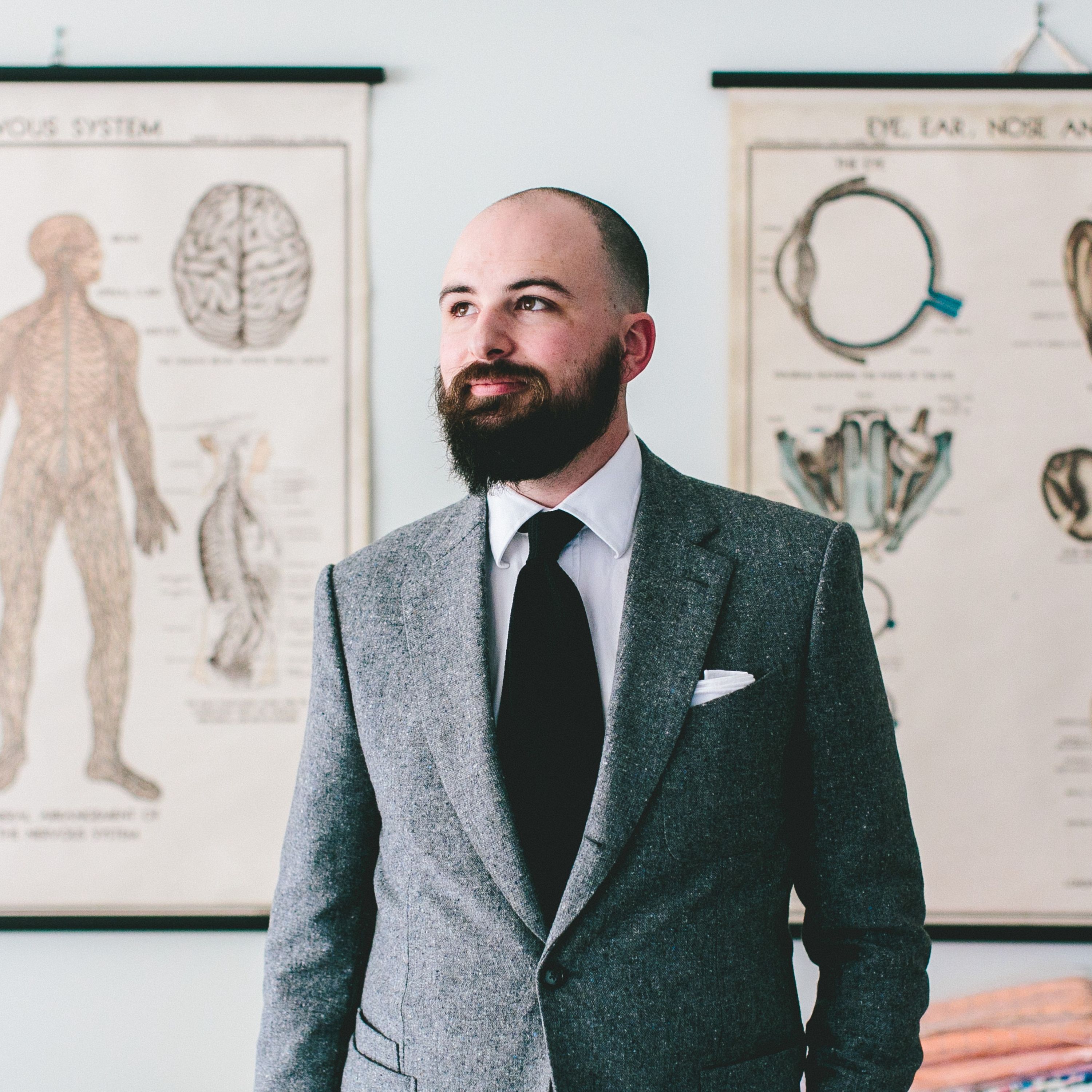
Bullseye's Jesse Thorn on Surviving in the Podcasting Industry
Press play and read along
Transcript
Speaker 1 On the media supported by Progressive Insurance, you chose to hit play on this podcast today. Smart choice.
Speaker 1 Make another smart choice with AutoQuote Explorer to compare rates from multiple car insurance companies all at once. Try it at progressive.com.
Speaker 1 Progressive casualty insurance company and affiliates, not available in all states or situations, prices vary based on how you buy.
Speaker 2 WNYC Studios is supported by USA for UNHCR, the UN Refugee Agency. Families fleeing war often arrive in camps hungry, cold, and exhausted.
Speaker 2 UNHCR, the UN Refugee Agency, provides emergency relief like hygiene kits with soap, clean water, and shelter materials to displaced families worldwide.
Speaker 2 For more information, visit UNrefugees.org/slash WNYC.
Speaker 3
This is on the media's midweek podcast. I'm Brooke Gladstone.
This month marks 25 years of Bullseye, a public radio show and podcast founded, hosted, and produced by Jesse Thorne.
Speaker 3 He's also the founder of Maximum Fun, a worker-owned network of artist-owned shows about reading, writing, wrestling, video games, you name it.
Speaker 3
Jesse also hosts The Turnaround, Judge John Hodgman, and co-hosts Jordan Jesse Goh. But Bullseye is where it all began.
It's a place where artists open up about how and why they pursue their art.
Speaker 3 Earlier this month, I called Jesse to ask him how this show survived every new iteration of podcasting, beginning with its very humble birth.
Speaker 4
I was 19 years old. I was a sophomore in college at UC Santa Cruz.
I was listening to the college radio station, KZSE, and they announced a station tour.
Speaker 4 And I went up there and literally, as I watched someone run the board, I thought, oh, up is louder, down is quieter. I can handle that.
Speaker 3 What did you expect to see?
Speaker 4 I guess I was thinking of Frazier.
Speaker 4 I thought there was like a producer and it was a whole thing, but actually it was just a lady in a bandana with a golden retriever in a bandana playing folk songs.
Speaker 3 And so finding out that the bar for previously acquired skills was not terribly high,
Speaker 4 you did what? We got an hour from 7.30 to 8.30 in the morning.
Speaker 4 We had to walk to the station and the UC Santa Cruz campus, very wooded, very hilly, and very large, but the bus wasn't running at 7 o'clock in the morning. And we did comedy mostly.
Speaker 4 We found this record of whale songs, and we would have conversations with what we claimed was the space whale that was a whale we'd met in space. We had call-in contests.
Speaker 4
At one point, we had a contest for a pair of tickets to a tango concert. And a woman called in and she won the contest.
And then she said she would only go if she could go with my co-host, Gene,
Speaker 4 who was the funniest of us. And they ended up dating for like a year and a half.
Speaker 4 But yeah, I think we very quickly realized how hard it is to fill an hour with material that you've written. And so we started emailing and calling people that we liked and admired.
Speaker 4 In the early days, we had Matt Besser and Matt Walsh of the Upright Citizens Brigade and Mike Nelson from Mystery Science Theater 3000.
Speaker 3 Can you pick one particular interview that you say was just disastrous?
Speaker 4 Yes, I can.
Speaker 4 There was the time that we interviewed Steve from Blues Clues, but he would not talk about Blues Clues.
Speaker 4 But the one that comes to mind is truly catastrophic because we interviewed Dustin Diamond, who played Screech on Save by the Bell.
Speaker 4
And we interviewed him because he had had a stand-up show in Santa Cruz. So we interviewed him by phone.
And the topics that he would not cover included Saved by the Bell.
Speaker 4 He was not willing to talk about Saved by the Bell at all. At one point, we literally, we were like, well, would you rank the cast members of Save by the Bell? I don't know by height.
Speaker 5 Dustin,
Speaker 5 who is number one on the entire cast? But see, I'm not understanding this. Who's number one?
Speaker 5
Yeah, just tops. As far as just great, awesome.
All right, I'll take the cheap way out. I think everybody was equally great.
Speaker 5 No, that's not going to fly, Dustin.
Speaker 5 Yes, but I'm not also going to trap myself in a very bizarre question.
Speaker 5 Great.
Speaker 4
And he said no. He wouldn't talk about his Math Rock band, which we were so excited to talk about the fact that Dustin Diamond had a Math Rock band.
That's like rock and weird time signatures.
Speaker 4
Why wouldn't he talk about it? Because he would only talk about his stand-up comedy. And he ended up telling street jokes about wheelchairs.
Like truly vile.
Speaker 4 And I remember the thing I remember is him telling a joke that
Speaker 4 we understood even as 22-year-olds in 1992, 1993, was too offensive to say on the radio.
Speaker 4 And telling him, Hey, maybe we should talk about your act. And then he said, This is my act.
Speaker 4 And we were like, Oh no, Dustin Diamond. So later when he stabbed someone in a bar, we weren't that surprised.
Speaker 4 God.
Speaker 3 Did the person die?
Speaker 4
I don't think the person died. So I think you're allowed to laugh.
As long as they recover, I think you're allowed to think it's funny. The lesson that I learned from that, Brooke, was
Speaker 4 we thought,
Speaker 4
here's Dustin Diamond. He's famous.
We should just do it.
Speaker 4 Since then, I've worked really hard not to talk to anybody on my show
Speaker 4 who
Speaker 4 I don't recommend. And I've been wrong about some recommendations, but
Speaker 4 I really try and say, this is somebody whose work I really believe in, and that's why they're on the show. And in doing that, I've had very few catastrophes.
Speaker 3 So then give me some examples of one of your favorite interview moments.
Speaker 4 I got this record that was like an act-along-with record.
Speaker 4 So, it was from the
Speaker 3 script or something?
Speaker 4
Yeah. So, it was like from the early 1960s, and it was like a teen idol of the time.
It was like a gun smoke-style Western, right? And it came with a script.
Speaker 4 So, you were supposed to read your side of the script, and then the record would play this teen idol reading his side of the script.
Speaker 4 And Mike Nelson from Mystery Science Theater 3000 was a guest on the show. He did not get the facts that we sent him of his side of the script.
Speaker 4 We faxed him from the radio station, and he did not tell us that he didn't get the facts. Like we would have faxed him again.
Speaker 4 So we had this idea where it would be great for him to act along with this record.
Speaker 4 But he didn't get the script. So he just made up a thing about mustard.
Speaker 4 And he was so funny.
Speaker 7
For heaven's sake, you're going to need me. No, I actually am leaving out the back.
Yes? Nope. I have to go buy money.
I guess I do. I know.
I have to go buy mustard.
Speaker 7
You mean that I'm a lawman? That's right. I'm not doing it for you, and I'm not doing it for myself.
I'm doing it for them, the people I swore to protect. Do you need anything while I'm at the store?
Speaker 7 I'm going to get mustard.
Speaker 7 You like the brown, don't you?
Speaker 7 Riley, huh?
Speaker 7
You said it. Let's go.
Come on, Sheriff.
Speaker 3 Give me another one.
Speaker 4 I guess it was maybe 12 years ago.
Speaker 4 I was already living in Los Angeles, and I got a press release for a movie called Soul Power. And this was a documentary about the concert in Zaire that went along with The Rumble in the Jungle.
Speaker 4 This is like the music parallel to When We Were Kings.
Speaker 4 And this concert had James Brown and Fela Kuti and Celia Cruz and the Fanya All-Stars, and it also had Bill Withers.
Speaker 4 And when I emailed the folks who were reping this movie, I thought they were going to say, yes, you can do an interview with the directors. But they emailed me back and they said,
Speaker 4 I don't know if you're familiar, but we'll actually have one of the musicians from the film there on hand if you're interested. His name is Bill Withers.
Speaker 3 They
Speaker 3 didn't think you would know Bill Withers?
Speaker 4 Well, at that point, he had not done any media
Speaker 4 in 20 years.
Speaker 4 He had done no press. He had done one morning radio interview with a friend of his.
Speaker 4 He quit the business after Just the Two of Us, which was a record that he put out with Grover Washington specifically because
Speaker 4 he hated his record label so much.
Speaker 4 It was in this fancy hotel in Pasadena with Bill Withers in a courtyard being interviewed by Pasadena magazine.
Speaker 4 And I went in there and he
Speaker 4 took me for a fool
Speaker 4 initially because the reason he quit the business was because he did not suffer fools, right?
Speaker 4 This is a guy who only started in the music business as a grown adult after a career in the Navy. He was 30 when he put out his first record.
Speaker 4
And he was an intense guy. He was physically large and strong, even at that age.
Like he looked like a guy who had just gotten out of the Navy, handsome as heck.
Speaker 4 And he just met your eyes and tested you.
Speaker 4 And I was worried about it. Sitting across from somebody who famously had quit doing press because he hated it
Speaker 4 and quit the music business because he hated the baloney that went along with it was intense.
Speaker 4 And besides that, this was a guy who had grown up in the Jim Crow South, had grown up in absolute poverty in West Virginia at a time when the civil rights movement was still like around the corner.
Speaker 4 And here's this white guy sitting in front of him.
Speaker 3 He said, My father was his coal miner. He was always interested in reading, never got a chance to go to school, but dignity was very important to him.
Speaker 8 I used to have a little poem in my mind:
Speaker 8 The manager's son goes to Yale and the blues man's son goes to jail.
Speaker 8 The one thing that kept me away out of this music for,
Speaker 8 and I had to sort this out.
Speaker 8 Can I go into this thing and avoid the minstrelness of it?
Speaker 8 This is a business.
Speaker 8 And you got some co-pimps
Speaker 8 that will mail you out until you're dying your grave.
Speaker 8 You got as many thieves in this stuff as so, so there's a life you have to run and you do the best you can and hopefully as a human being you improve.
Speaker 8 I'm 70 years old.
Speaker 8 I'm not some kind of mindless troubadour.
Speaker 8
You know, I have an intellect I have to manage. I have some thoughts I have to manage.
I have a life I have to maintain.
Speaker 8 I want to know who I am. I don't want to be some simple-minded blues boy.
Speaker 8 You can bleep this out.
Speaker 8 Kiss my
Speaker 8 with the
Speaker 8 so I'm doing the best I can to grow and improve my lineage as a species.
Speaker 3 And that's what kept him out of the business for a while?
Speaker 4 That was his experience of life.
Speaker 4 Like real poverty.
Speaker 4 Real injustice.
Speaker 4 He was somebody who joined the Navy
Speaker 4 because joining the Navy was the only way to avoid dying of black lung. This is the only job where he lived.
Speaker 4 Certainly the only job for a black man that didn't go to college.
Speaker 3 But he did eventually get into music. What stood out to you about the interview?
Speaker 4 I asked him, look, you live in Los Angeles. You could call the guy that runs Largo,
Speaker 4
250, 300 seat club in Los Angeles. And you could say, once a month, I want to come by with my guitar.
And if I have some friends that want to come too, and you could get that gig.
Speaker 4 And you could just enjoy playing music for people.
Speaker 4 So how, why have you chosen not to do that?
Speaker 4 And he said, I'm not a monkey and I don't have to dance.
Speaker 4 We started started doing interviews because we wanted to know what it was to
Speaker 4 make art for a living. Whether that art was something as dumb as Mystery Science Theater 3000
Speaker 4 or whether it was something as beautiful as Grandma's Hands by Bill Withers, right? What I want to know is
Speaker 4 what and why is it that we make art?
Speaker 4 I interview a lot of comedians and rappers and stuff and punk rockers and
Speaker 4 people think of that as pop culture or something rather than art. But like I believe it to be art for real.
Speaker 4 And that is the art that is most important to me in the world.
Speaker 4 And I think that art is what makes us freaking human beings and not slugs.
Speaker 4 So the moments that I most value on the show are moments like that where I
Speaker 4 feel like I have connected with somebody and learned something about what makes them an artist. And for Bill Withers,
Speaker 4 he chose above all else, agency and autonomy because he grew up in a world where that was not available to him, where he had no options,
Speaker 4
where the world was dark and cruel to him, and he did not get to choose what his life was. So he chose what his life was.
He defied that.
Speaker 4 When the world of music was not satisfying that,
Speaker 4 he chose not to do it.
Speaker 4 That is a powerful life lesson. Right.
Speaker 3 Who was hearing your show at this point? You aren't in college anymore.
Speaker 4
It's been like one station at a time for a long time. And I had another job and made the show by myself for a long time.
At that point, it was dozens of stations.
Speaker 4 It was almost but not enough money to live on.
Speaker 3 Wasn't it around that time that Chris Bannon, who was program director at WNYC, called you up?
Speaker 4
It was a life changer when Chris Bannon from WNYC emailed me. Chris said, I'd like to run a six-episode best of on WNYC in New York.
We'll pay you.
Speaker 4
I think it was $300 an episode. The interview that I remember Chris really being excited about was Amy Sederis came.
At this point, I was doing the show in my apartment.
Speaker 4 And Amy Sederis came into my one-bedroom apartment in Koreatown
Speaker 4 and was so excited to talk to me and so excited to talk about this taxidermied squirrel called Nutsy that I have.
Speaker 9
I have a taxidermied squirrel winks. You have a taxidermied squirrel too? Yeah, it's really nice.
It's free-stride. Did you see my taxidermied squirrel?
Speaker 9
No, I haven't had a chance to look around your chambers. My taxidermy squirrel's name is Nutsy.
Oh, Nutsy. I had no idea you had a taxidermied squirrel.
Yeah, I'm a little squirrel freak.
Speaker 4 And it was something that would not have happened on fresh air.
Speaker 4 Like,
Speaker 4 I do this.
Speaker 3 Well, Terry, after a while, she far preferred remote interviews because she didn't want to have any cues that the listener didn't have. I found visual cues very helpful.
Speaker 3 I don't get to see people live these days, but she really preferred not to, so she couldn't have had that moment with Amy Sederis.
Speaker 4 I mean, I think that the thing that is different about my show,
Speaker 4 and it's not necessarily better, but it's different,
Speaker 4 is
Speaker 4 my show
Speaker 4
really is a human conversation. A, I'm not a transparent journalist.
I am a guy who has his own radio show. The people that I bring on the show are because I want them to come on my show.
Speaker 4 But B,
Speaker 4 I am there with them and maybe we are just going to goof around for a minute in addition to talking about things that changed their life. And that is something that's a lot harder to do from far away.
Speaker 4 I mean, one of the most powerful experiences I ever had on the air was an interview with Michael K. Williams,
Speaker 4
who played famously Omar on the Wire, among other things. He passed away a few years ago.
He was at a studio in New York. I was in LA.
Speaker 4 And I played for him this dance record that he had been a dancer in the video for.
Speaker 4 So he was like a club kid. This was like his big break, this song.
Speaker 4 And I thought I was going to get, isn't it great that when you're on a music video set, somebody puts a bib on you when you eat your french fries?
Speaker 4 But he was really quiet. And because we weren't in the same room, I couldn't tell what was going on.
Speaker 4 And then when he started talking, I was like, is that like a hitch in his voice?
Speaker 4 Man, excuse me. That don't,
Speaker 4 I song, man. That was the first time, you know,
Speaker 4 like my dream came true. You know what I mean? Like,
Speaker 4 when Kim hired me to be a dancer, I was homeless. You know what I mean?
Speaker 4 I remember when I got the call,
Speaker 4 I was being kicked out, packing up my stuff. And
Speaker 4 it's just,
Speaker 4
I haven't heard that song in a while. Just brought back a lot of memories.
That's all. Pardon me.
Speaker 4
That was my first dance job. That's the first time anybody ever hired me to do what I'm doing now was Kim Sims.
That was my first job doing anything in this business. You know what I mean?
Speaker 4 Anything.
Speaker 4 You know what I mean?
Speaker 4 So I'm here today
Speaker 4 on the strength of that, that one song.
Speaker 4 Michael K. Williams was in tears because he realized that life in art was not given to him.
Speaker 4 He realized that he was a guy that was out dancing at clubs, and this woman that made this dance signal gave him the opportunity to be an artist, something that he had not even imagined for himself.
Speaker 4 What I found was
Speaker 4 someone who did not know they even had the option of being an artist who was given that opportunity.
Speaker 4 It was this completely unexpected moment that ended up being something that people talked to me about years later that was mediated by that telephone line.
Speaker 3 Are there other interviews that reinforced why it was you should keep doing this show, even though it didn't look like you were necessarily going to make a living at it?
Speaker 3 And why the work continued to feel so essential?
Speaker 4 I had a conversation with Pedro Amadovar once, and there's no greater film genius than he. And
Speaker 4 he is a migraine headache sufferer, a migraineur.
Speaker 4 I'm a chronic, severe, disabling migraine sufferer. Ugh, I'm so sorry.
Speaker 4 And I asked him about it because I know that because migraine is invisible and because many people with migraine choose to slash are forced to endure it silently because
Speaker 4 they don't want to be seen as a malingerer or
Speaker 4
a complainer. A lot of migraine sufferers don't talk about it.
He told me that sometimes his migraines are so severe that he is on set and cannot see.
Speaker 10 It changed completely my life. At least in my case, it's related with big noises and also with light.
Speaker 10 But you know, this is so ridiculous to be a director, a movie director, and being photophobiac because I work with light. I mean, light is even if you want to
Speaker 10 to shoot a sequence in darkness, the darkness is made by light.
Speaker 4 He has to have someone lead lead him around the set.
Speaker 4 It was very clear to me when I talked to him about that that this was not something that he had talked about much publicly.
Speaker 4 When you have migraine, you just learn not to say anything about it because it never benefits you to say something about it.
Speaker 3 And it can't buy you any time because you don't know when it's going to be over.
Speaker 4 Exactly. This film that he was promoting involved Antonio Banderas playing a character who was addicted to painkillers, eventually addicted to heroin.
Speaker 4 Almadovar told me this character was based on me and it was a result of my migraine. So it was both a profound insight into
Speaker 4 this brilliant artist's brilliant art
Speaker 4 and into him as a human being. And it was one that was obviously personally meaningful to me as somebody who couldn't hold down a real job because of my migraines,
Speaker 4 but also one that someone else couldn't have found for that reason.
Speaker 3 You've said that when you have an artist on your show, you want to talk about the art. You don't want to necessarily talk about their crappy childhood.
Speaker 3 Everybody has a crappy childhood, not everybody becomes an artist. And yet that stuff informs a lot of that art, as you just described.
Speaker 4 This past year, I interviewed Jean Gray, who is now retired from rapping, but let's say legendary underground rapper. And one of the things she said to me was she said,
Speaker 11
let me tell you something, Jesse. I think I would have wrongfully stayed longer in the industry if I had had more than one.
technical conversation
Speaker 11
about rap. If any, I was just dying for decades for anyone to talk to me about like a creative process or technicalities.
And there's like one article that I can remember someone doing
Speaker 11 about going really through the math of my rhythm, of my flow, of choosing words.
Speaker 4 And I was like, finally, finally.
Speaker 11 And like two people read that and I was like, what?
Speaker 4 Please, please talk to me. Please talk to me about the technical things.
Speaker 11 And that again is
Speaker 11 prison of, you know, being in this body and doing that job.
Speaker 4 She said, so many journalists have asked me what's it like to be a woman in hip-hop, all these things about her life, right?
Speaker 4
But nothing about how she actually makes her art. Yes, to the extent that people's life informs the making of their art, I am interested in that.
Like I'm not
Speaker 4 only asking people what paint set they use, right?
Speaker 4 But I do believe that it is worth talking about the work. It is easier to talk about biography because biography is built-in story.
Speaker 3
Let's pivot now. In 2023, Maximum Fun, the radio show production organization you founded, became a worker-owned cooperative.
Why did you choose that route?
Speaker 4 Once I decided through necessity that I would be primarily supported by the audience directly, I wanted to give people a deeper connection to what we were doing in any way that I could.
Speaker 4 I also had friends whose work I admired who were in the same position as me, folks like Davin Graham, who hosts Stop Podcasting Yourself, or the McElroy Brothers, who hosts The Adventure Zone and My Brother, My Brother and Me.
Speaker 4 The pieces fit together into a network.
Speaker 4 In some ways, I was good at being a businessman in the sense that I built a successful business, but I also was not good at the part of business where you're supposed to be leveraging capital to exploit labor and you are supposed to be losing money up front in order to gain scale later.
Speaker 3 And let's stipulate 2023,
Speaker 3 there was a flood of capital still coming into the medium, but not really based on a sustainable business practice. It was speculating on the future.
Speaker 3 You say the goal of a lot of this was to drive everyone else out of the business by flooding the zone?
Speaker 4 That's what venture capital is.
Speaker 4 The reason that these floods of capital are going into AI or whatever is because they want to capture the market and then behave anti-competitively.
Speaker 4 The reason Jeff Bezos decided that Amazon could lose money for the first 15 years of its existence was because he was trying to capture the e-commerce market so that he could exploit network effects and the sort of natural built-in advantages of monopoly and get rich after.
Speaker 3 It starts off great. You could order cement blocks for free shipping, and then ultimately they start extracting from their suppliers and then ultimately from their customers.
Speaker 3 This is what Corey doctorow calls inshittification.
Speaker 4 And this is true in any startup business that's funded by venture capital, which is who was funding the explosions in podcasting.
Speaker 4 There were many times when I was approached to sell, but I knew that if I sold to one of these speculative outfits, it would immediately result in half the shows on Max Fund getting canceled and half the staff getting laid off, simply because our model wasn't compatible with theirs.
Speaker 4 We were built for audience-supported sustainability, and they wanted hegemonic control of the entire industry so that they could sell ads or get people into a walled garden. I never wanted to do it.
Speaker 4 Like I wanted to stop being the owner of a business because it's stressful when it's your money and you don't have any resources behind it.
Speaker 4 My father-in-law, he just retired about six months ago, spent his career working at a worker-owned hardware store in Marin County. I called Steve and said,
Speaker 4 would worker ownership be a thing for MaxFun?
Speaker 4
And he said, I think it could be. I think you're on to something.
And I called a nonprofit that specializes in helping businesses transition to worker ownership.
Speaker 4
And we spent two years doing feasibility studies. And the end result was Maximum Fund is a 100% worker-owned cooperative.
I'm an employee of Maximum Fund now. I'm also a worker owner of Maximum Fund.
Speaker 4 We have an elected board that is elected by the workers. They oversee the management structure of Maximum Fun.
Speaker 4 And I also own my shows, just like the other shows in Maximum Fun are owned by their creators. It was also selfishly a way to protect this thing that I had dedicated my entire adult life to.
Speaker 3 You are so selfish.
Speaker 4 I know. But I mean, like,
Speaker 4 the thing about worker ownership is that it is demonstrably studied by economists more sustainable.
Speaker 4
Because workers are interested in sustainability. They're not interested in risk and infinite growth.
And to me, I want maximum fund to exist in 20 years.
Speaker 4 I don't want it to go the way of Wondery getting all of its shows folded into Audible and a bunch of them canceled and everybody laid off. This is a way to do that.
Speaker 3
So Bullseye is now a quarter of a century old. You're in the podcast hall of fame.
You've been called a survivor, a success story.
Speaker 3 I mean, is this why you are so well equipped to weather all of the different iterations of podcasting?
Speaker 4
I grew up in a family. My parents were divorced, but very acrimoniously.
But my father was an organizer and my mother went to graduate school when I was like 10 and became a junior college professor.
Speaker 4 I grew up in a family where it was expected that you would do something that mattered to you and the world.
Speaker 4 And I also grew up in a family where I never went hungry, the lights never got turned off, but we also, until my late teens, were never quite in the middle class.
Speaker 4
I never had the expectation that I would get rich from my work. But I also always had the expectation that I was responsible for paying my way.
And that's like a fine line, right?
Speaker 4 I was never in a position to be an artist who just made art and didn't think about money. And I was never in a position to accumulate capital and try and build scale.
Speaker 4 My goal always was: what can I build that will sustain this work that I want to do? Not what can I build that will make me rich. And that, I think, is what has led me to do this for 25 years.
Speaker 4 I would say the other thing is probably a generalized terror at trying something new.
Speaker 4 I have been doing the same radio show every week since I was 19.
Speaker 3 I wonder,
Speaker 3 in an era when we're contending constantly with attacks on public media from the GOP, the end of the CPB,
Speaker 3 I mean, given your track record of good and lucky choices, how do you see the future of public public radio?
Speaker 4 I believe really strongly in Bill Moyer's construction of what public media is for, what the value of public media is.
Speaker 4 He told Terry Gross, public media is for when you don't want as an audience member to be treated as a customer, when you want to be treated as a citizen.
Speaker 4 I think there needs to be a media ecosystem that exists outside of pure market forces.
Speaker 4 I think that the reason that you and I, Brooke, are in public media is because we believe it is worth doing something important.
Speaker 4 It's important that we who make public media understand
Speaker 4 that we serve all Americans and that the values of public media apply to all Americans.
Speaker 4 And I don't say that as a coded way of describing the political landscape at all. What I mean by that is that rappers deserve to be talked to about their art like it's art too.
Speaker 4 In many ways, public media has grown along those lines, but I think that the greatest successes of public media, Sesame Street, the tiny desk concerts, these are radically inclusive.
Speaker 4 And I think that public funding is essential for the pursuit of that kind of work.
Speaker 3 As you say, things have moved in a more inclusive direction. I was just wondering whether you were suggesting there ought to be less of a sense of entitlement that can come with making public media.
Speaker 4 It was very important to me at Maximum Fund that when we put out hiring notices, we make it clear you don't have to have graduated from college.
Speaker 4 And it's important to me at Maximum Fund that our staff reflects. our community of Los Angeles.
Speaker 4 Public radio in particular has made huge strides since I started doing public radio 25 years ago in its goal of reflecting the nation. I think there's still a long way to go.
Speaker 4 Years ago, I was at a public radio conference and I was on a panel about podcasts and podcasting. There was a woman on this panel who had made a podcast and it was something arts related.
Speaker 4 She seemed like a really nice lady. I bet her show was good.
Speaker 4 I say that dismissively sounding, but she was a genuinely nice woman, seemed smart. And
Speaker 4 the topic of this panel was making money in podcasting. And I'm there like going down the list of everything that I've tried and learned and whatever.
Speaker 4 She's like, oh, well, somebody gave me the money.
Speaker 4 And then I'm like, well, tell me about how many people listened to your show. And she's like, some of the episodes as many as 200 or 300 people.
Speaker 4 And I'm not saying that she shouldn't make that. I believe that you should build a train set in in your basement if it gives you satisfaction, very sincerely.
Speaker 4 There's lots of art that should exist in the world that nobody likes, you know, like for real.
Speaker 4 But my reaction to that also
Speaker 4 was, imagine how much money you could make if you made something people wanted to hear.
Speaker 4
Imagine if you cared about your audience. Like I do weird stuff.
I'm not not weird, but I always knew that if I didn't get people to actually listen to and enjoy it, I would not eat.
Speaker 4 Even when we were talking to a record of whale sounds on KZSC in Santa Cruz when I was 20, our goal was to get people to listen to and get something out of our show, which in college radio is not taken as red, you know?
Speaker 3 Thank you so much.
Speaker 4 Thank you, friend.
Speaker 4 I sure appreciate it. And you know, I mean, you know how I feel about your work.
Speaker 3 Jesse Thorne is the founder of the Maximum Fun Podcast Network and the host and producer of the radio show and podcast, Bullseye, among others.
Speaker 6 Grandma's hands clapped in church on Sunday morning.
Speaker 3 Thanks for checking out the midweek podcast. The big show posts on Friday.
Speaker 6 So well,
Speaker 6 Grandma's hands
Speaker 6 used to issue out a warning sheet.
Speaker 2 WNYC Studios is supported by Sony Pictures Classics and Fathom Entertainment, presenting Merrily We Roll Along, Three Best Friends Through Two Decades of Time, directed by Maria Friedman, starring Jonathan Groff, Daniel Radcliffe, and Lindsey Mendez, by legendary composer Stephen Sondheim and winner of four Tony Awards.
Speaker 2 Merrily We Roll Along, playing only in theaters starting December 5th.