No, DOGE Isn't Dead
Press play and read along
Transcript
Hear that? That's me with a lemonade in a rocker on my front porch. How did I get here? I invested to make my dream home home.
Get where you're going with MDY, the original mid-cap ETF from State Street Investment Management. Getting there starts here.
Before investing, consider the fund's investment objectives, risks, charges, and expenses. Visit state street.com/slash IM for a prospectus containing this and other information.
Read it carefully.
MDY is subject to risks similar to those of stocks. All ETFs are subject to risk, including possible loss of principal.
Alps Distributors, Inc. Distributor.
Winter is the perfect time to explore California, and there's no better way to do it than in a brand new Toyota hybrid.
With 19 fuel-efficient options like the stylish all-hybrid Camry, the Adventure-Ready RAV4 hybrid, or the rugged Tacoma hybrid, Toyota has the perfect ride for any adventure.
Every new Toyota comes with Toyota Care, a two-year complementary scheduled maintenance plan, an exclusive hybrid battery warranty, and of course, Toyota's legendary quality and reliability.
Visit your local Toyota dealer and test drive one today so you can be prepared for wherever the road takes you this winter. Toyota, let's go places.
See your local Toyota dealer for hybrid battery warranty details. Skipping cold and flu season is plan A.
But if you do get sick, be prepared for plan B with Kleenex Lotion Tissues.
Kleenex lotion tissues moisturize skin, helping prevent the added discomfort of red, irritated skin on top of your cold and flu symptoms. So, this cold and flu season, grab Kleenex lotion tissues.
Visit Kleenex.com to learn more and buy now. For whatever happens next, grab Kleenex.
This is the On the Media Midweek podcast. I'm Brooke Gladstone.
Late last month, Reuters reported that Doge had disbanded, that the group was no longer a centralized government entity. Doge is dead?
Elon Musk's Doge no longer exists. For all intents and purposes, Doge is done.
But according to Vittoria Elliott, a reporter at Wired, while Doge is no longer moving across the government in a quote, move fast and break things blitz, it is far from dead and gone.
One government source told Wired that Doge operatives had, quote, burrowed into the agency like ticks.
Yes, many of the people who were a part of Doge in some shape or form in those early days, when it was this sort of strike force going from agency to agency, cutting contracts, firing people, vacuuming up data, those people are still in government.
That includes the young engineers that we identified very early on in the administration, but also some of the more senior people.
And for instance, Joe Gebia, the founder of Airbnb, he's now leading what's known as the National Design Service. And the mission of NDS is supposedly to redesign government websites.
We are starting to see some of their work get out there. You have Sam Corcos, who is now one of the highest people at Treasury in charge of pretty much all of its tech.
And then secondarily, we need to think of Doge
as a set of priorities and values.
This emphasis on technology of rapid adoption, consolidating data across government agencies, and the emphasis on cutting what frequently the government has called waste and fraud and abuse, but often really is just quite essential government jobs and contracts.
That is all still happening.
How about the Doge impact on the Office of Management and Budget? Doge is not necessarily separate from the goals of the Trump administration.
Doge was a sort of strike force execution of a lot of its priorities.
What we have, particularly with OMB, is Russ Vogt, who is now in charge of it, who has said that he wants to cut vast swaths of the federal workforce, that he wants to drastically reduce government spending.
He also said memorably that he would like to see the vast core of civil workers traumatized. I found that really stuck with me.
It seems so cruel. Yes.
There's also Scott Langmack, who was previously at the Department of Housing and Urban Development, who is now at the Office of Management and Budget, working as the director of deregulation AI.
And his LinkedIn says he's using custom AI applications to accelerate the elimination of of excess regulations constraining American businesses.
You mentioned this guy, Sam Corcos, who is a Doge operative and also the chief information officer of the Treasury. Employees are now being tested to prove their worth.
This sort of started with Carcos.
What we understand from our reporting is that Corcos has asked for all members of the IRS teams that work in IT and on tech stuff to be tested with a tool that's frequently used in hiring for tech companies.
They have a limited time to complete certain assessments. They have to do it with their camera on.
They are testing on particular coding languages.
And while they're being told that this won't affect their pay, it's really hard to
see much daylight between this and the methods that a lot of tech companies use to either hire people or weed people out.
And even what we saw from Doge very early on in the administration, where they were sending out emails asking people to say what they had worked on. Yeah, what did you do the last week?
That kind of questionnaire that Musk sent out? Yes. I guess the question is, though, what does that mean for the IRS and more broadly for the rest of us?
You know, initially we saw Doge sort of spread out across the federal government, but there seems to be an emphasis on particular agencies. So, IRS is one of those.
We see that with Social Security as well.
There was a large team from Doge there, and there was talk of implementing certain projects there to try and make Social Security data more accessible across the government.
We saw the publication a couple of weeks ago of what's known as a system of records notice, which is what the government has to put out to say, we're going to be sharing data in a way that is new for the public to understand.
And we saw a system of records notice go out for Social Security data to be shared with DHS for immigration enforcement.
This is really important.
When you talked about it moving from kind of a civil service model to a tech model, you know, what gets lost? This is a violation of what Social Security told these people.
They were reassured they wouldn't have that information shared. Aaron Powell, Jr.: So here's the thing.
So this is an update. Consider it like your government version of your terms of service update.
And in terms of the sharing of that data, many, many experts have flagged that can be rife with problems.
Social Security data, for instance, was never collected for the purpose of confirming citizenship. And that means that it may not be up to date and it may not be fit for that purpose.
So for instance, when you are an immigrant here, for instance, on a green card, you would be assigned a social security number because it's really just a way to keep a record in the system and to allow you to pay taxes.
And when you naturalize, if you naturalize from that green card status, your social security number doesn't change. But the last interaction that Social Security might have had with you
is as a immigrant with a green card. They are not going to update your status to citizen because it doesn't matter.
It doesn't change your social security number.
So that kind of data in the Social Security Administration, if it were, say, ported over for the use of immigration enforcement, would likely be inaccurate. And that's incredibly concerning.
What is Musk's relationship to Doge nowadays? In a recent interview with Joe Rogan, Elon Musk said that Doge is continuing, but that because he's no longer part of it, there's less scrutiny.
Doge is is still underway. It's less publicized.
It's less publicized.
And they don't have like a clear person to attack anymore.
Musk himself sort of acknowledges this, that what Doge was doing and the goals of the Trump administration are not necessarily at odds, even if he himself had a seeming falling out with President Trump and is no longer in charge of the initiative.
It's just taken a different form. What we've seen over the past couple of months is that Musk has really seemed to warm back up to Trump.
We saw them together at Charlie Kirk's funeral.
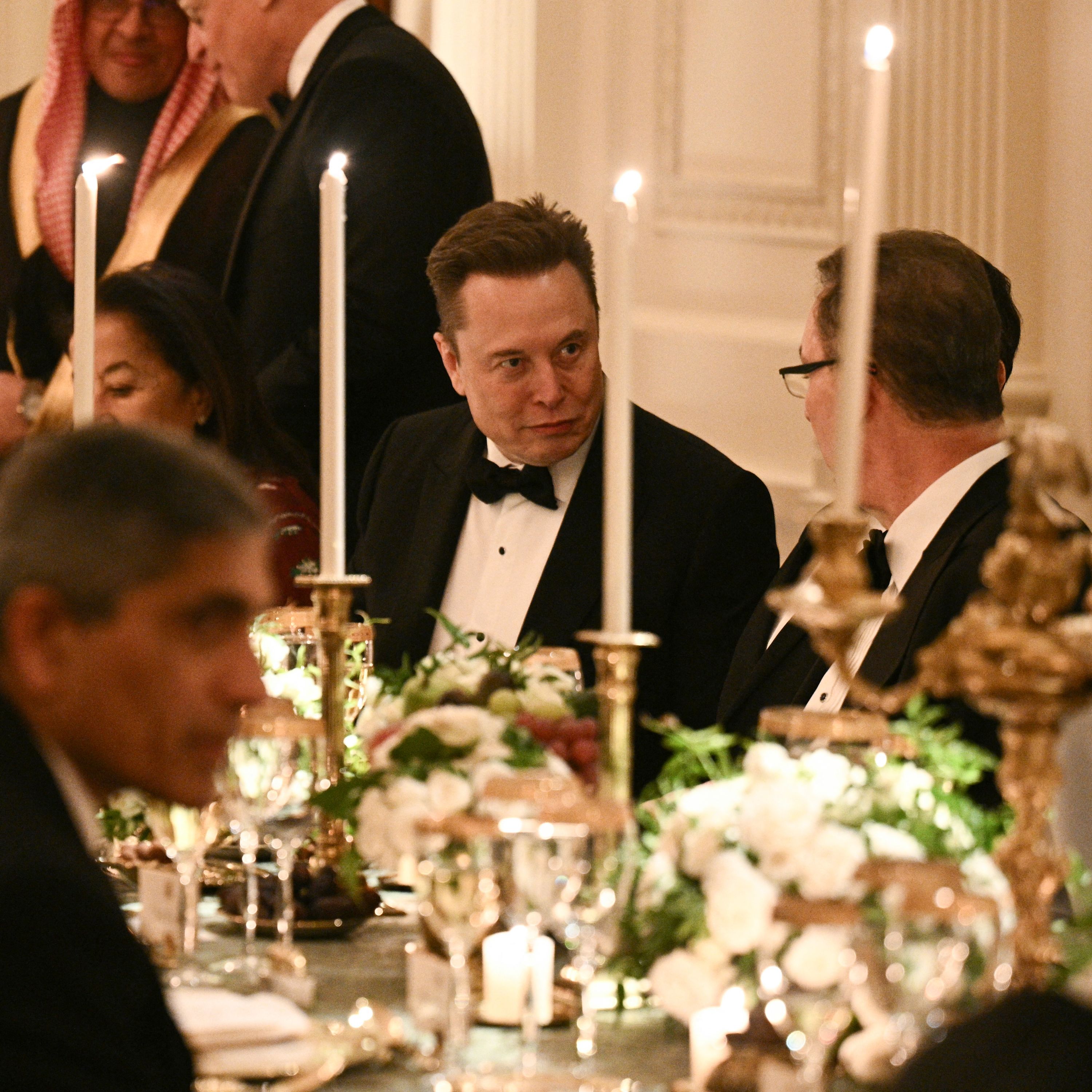
Musk attended the dinner with Mohammed bin Salman in November.
So while Musk is not necessarily directly affiliated or directing Doge anymore, obviously it would not surprise me if he was still in personal contact with some of these people.
For instance, Anthony Armstrong, who was part of Doge, is now the CFO at XAI, Musk's AI company. The New York Times reported that there was going to be a large Doge gathering in Austin.
Austin obviously is where Musk has one of his homes and is his primary residence for many of his litigation purposes.
I think the idea that he is completely severed from Doge would be foolish, but in terms of how much influence he's necessarily having in their priorities or in the work they're doing, that's unclear.
Aaron Powell, when you look at our government now,
where do you see Doge's mark
most apparent?
So I lived abroad for several years. I used to work in international development.
And I think to me, where I see Doge's fingerprints so clearly is in the suffering that has occurred in already really fragile places because of the lack of our presence.
Brooke Nichols and her team at Boston University have estimated that 600,000 people have died as a result of the U.S. aid funding cuts.
Yeah, I see it most acutely there. And I think for
those of us in the U.S., the wave is still yet to hit.
I think we got a taste of it in November when SNAP benefits were restricted, but we have yet to see the full scale scale of what these kinds of cuts and reductions in government services are actually going to wreak.
How does it feel to see all these news stories about the death of Doge? Why do you think outlets have been so eager to embrace the idea?
I don't necessarily know why there's a hunger for that narrative.
I do know that, for instance, in one of the stories, there was confirmation from OPM saying Doge doesn't really exist, but it doesn't need to if you've hired those people into actual government roles or found somewhere else for them to be in government.
The executive order created the U.S. Doge Service temporary organization that would run through July 4th, 2026.
So the idea that like Doge
as we knew it at the beginning had a time limit was always on the table. But that doesn't mean that the people who are a part of it and the agenda that it it was executing goes away.
Let me ask you about Wired. You guys have broken so many of the biggest stories about Doge.
I'm wondering how your reporting has evolved since the task force has shape-shifted in the way we've been discussing. Is it harder to track? Oh, yeah, I think it is much harder.
And is that by design?
Yes, but the thing that gave us the advantage at the beginning is, frankly, frankly, that we were, I think my colleagues and I were asked this a lot,
was how did you know? How did you know? And the answer was like
Musk tweeted about it. They had podcast interviews about it.
They talked about what they wanted to do.
And so, for instance, one of the big things that they sort of came in with was this assumption that Social Security data was being paid out to all these fake people, that there were all these people abusing the system.
And so, what did they do? They went into Social Security. They immediately started looking for those things because that was something they'd already started talking about publicly.
And we saw them claim that people who were 150 years old were receiving Social Security benefits. And my colleague David reported that was not the case.
Yeah, that was a huge story.
They didn't understand how these things were being marked numerically.
Exactly. And so, yeah, it was really dumb of them, but it was incredibly sharp of you guys.
You got on it so fast. I mean, obviously, my colleagues are incredibly brilliant.
I love working with them.
We work our butts off. But the reality is, so much of it starts from just listening to what they're saying and then believing them.
And I think we've seen that again and again with both the way that Doge operated, we've seen it with Trump's approach to immigration.
And they can't always do everything they want to do, but it's a very short line between
what they're talking about and execution.
So we talked about Russell Vogt. I mentioned that he famously said he wanted to put federal workers in trauma.
About 300,000 federal employees have lost their jobs, been put on leave, or chosen to leave since Doge began its work.
You've been in touch with a lot of them, and you contributed to an oral history of sorts for Wired, Doge as told by federal workers. What did you learn?
Actually, the one that stuck out the most for me was someone at the Social Security Administration who deals with actual Social Security benefits holders.
And that person described how when there was this panic around fraud, this person told me they were flooded with phone calls from panicked seniors who were terrified of losing their benefits and were scared that they would lose their Social Security.
And
these federal workers are simultaneously being told that their jobs don't matter. And then they're hearing elderly Americans sob on the phone with them
because
some young engineers and a billionaire don't fully understand the data they're looking at. I think that's the one that stuck out to me the most.
There are so many
painful stories, anguished stories. But I was really heartened by the one from that FEMA employee, the Federal Emergency Management Agency.
Do you know that one?
I was wondering if you could read that because our podcast lets us curse.
Okay, and I have to pull that one up.
It says, I'm the type of person where if you push me, I'll push back. I don't like to live in a mindset of despair and negativity.
When these people do this shit, it just lights my fire.
It makes me more fucking mad. This used to be the best job I ever had, the best environment I've ever had, the best culture I've ever had, and they fucking ruined it.
I will never, ever forget how much they ruined it. I'm like, fuck these people.
They can't get me scared. I will not give them what they want.
I will not just leave.
I'm going to make it as difficult as possible for these fuckheads.
How did that make you feel? I have been consistently
bowled over by
the bravery of people who will probably be invisible.
There are a lot of people who have been
in these roles for a vast majority of their career, who have given up private sector opportunities, who
really believe in government, even if they're frustrated by it, even if every last one of them would agree that it could be more efficient and better.
There are a lot of people who have spoken to us
at great personal risk,
at
very hard moments in their lives, and
that has been incredibly brave of them.
Vittoria Elliott is a reporter at Wired, covering platforms and power. This was great.
I really appreciate your time. I really appreciate yours, Vittoria.
Thanks for listening to the On the Media Midweek podcast.
Tune into the big show on Friday to hear all about the new Pentagon Press Corps featuring right-wing fear-mongerer Laura Loomer and former Congressman Matt Gates.
Yeah,
thanks for listening. I'm Brooke Gladstone.