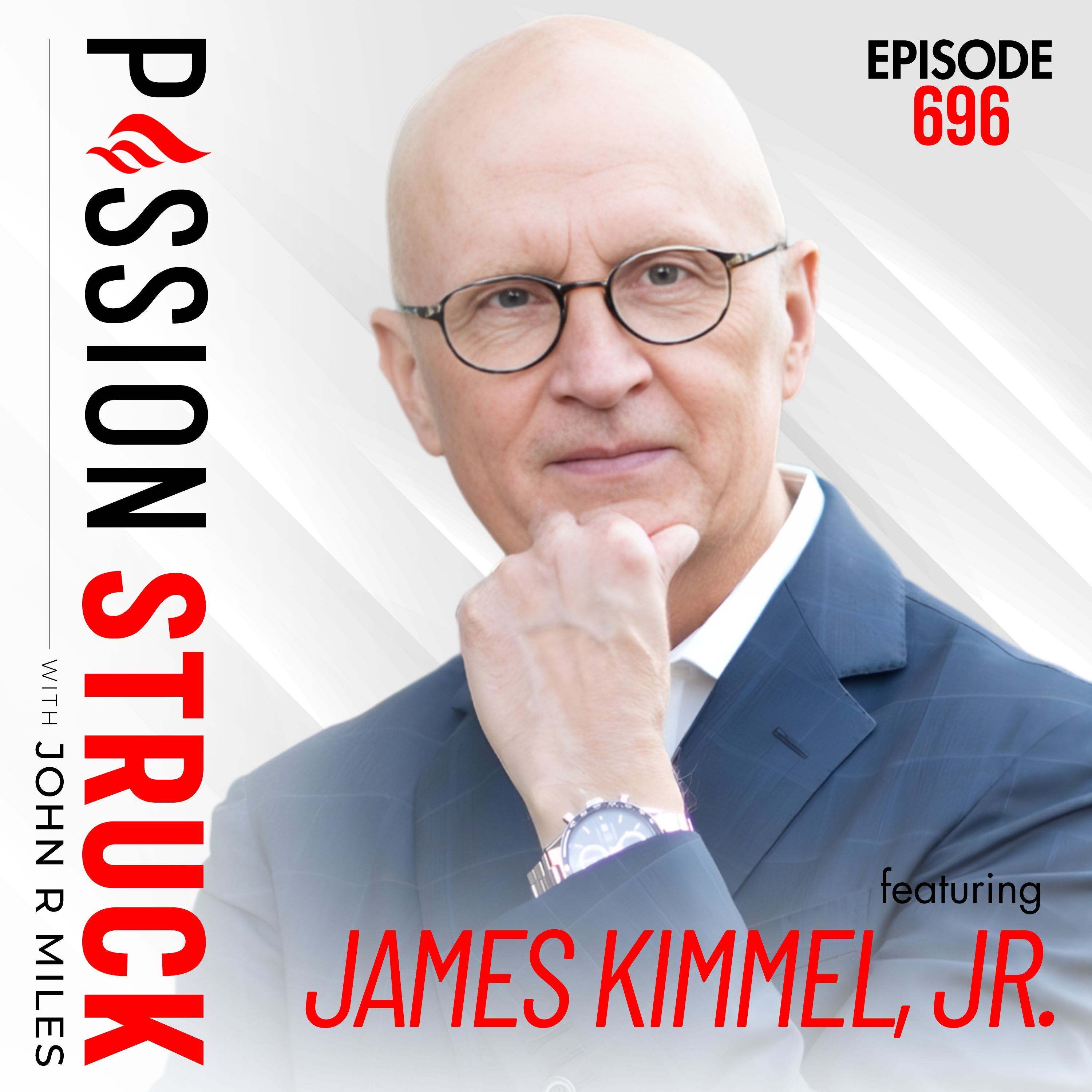
James Kimmel Jr. On Why Your Brain Loves Revenge | EP 696
What if revenge is not a moral failure, but a biological addiction?
In this gripping episode of Passion Struck, John R. Miles sits down with Yale psychiatrist James Kimmel Jr., author of The Science of Revenge, to unravel one of the most dangerous and misunderstood forces shaping our lives, our politics, our relationships, and our inner worlds.
This episode continues our acclaimed series The Irreplaceables, which explores the human qualities no machine can replicate. Yesterday’s episode with Don Martin explored loneliness, the crisis between us. Today, we explore revenge, the crisis within us. James explains why the pull toward retaliation can feel intoxicating, righteous, and impossible to resist.
Through neuroscience, evolutionary psychology, and Kimmel’s own harrowing personal story, we examine how grievance hijacks the brain, why revenge activates the same dopamine pathways as cocaine and gambling, and why forgiveness is not moral niceness but a neurobiological reset.
If you have ever held a grudge, fantasized about getting even, or wondered why our culture feels increasingly reactive and enraged, this conversation is essential.
Get the full episode show notes here: https://passionstruck.com/the-science-of-revenge-james-kimmel-jr/
Listen, Watch, and Go Deeper
All episode links are gathered here, including my books You Matter, Luma, and Passion Struck, The Ignited Life Substack, YouTube channels, and Start Mattering apparel:
https://linktr.ee/John_R_Miles
Download the companion workbook: The Clarity Reset Toolkit
Available at TheIgnitedLife.net
Includes reflection prompts, identity exercises, and tools for breaking harmful emotional loops.
In this episode, you will learn:
- Why revenge produces the same dopamine surge as addictive substances
- Why unresolved grievance becomes a compulsive loop
- The childhood trauma that shaped James’s life mission
- How the brain mistakes retaliation for relief and reward
- How political polarization and online conflict are fueled by biological craving
- Why forgiveness quiets the pain circuitry and restores clarity
- How to choose healing over the temporary high of revenge
Support the Movement
Everyone deserves to feel seen, valued, and like they matter.
Show it. Wear it. Live it.
See Privacy Policy at https://art19.com/privacy and California Privacy Notice at https://art19.com/privacy#do-not-sell-my-info.
Press play and read along
Transcript
Speaker 1 Hey, Passion Struck listeners. There are supplements and they're game changers.
Speaker 2 Miter Pura gummies from Timeline are in a league of their own.
Speaker 1 They're the first longevity gummy with urolithin A, a powerful ingredient shown to boost cellular energy and improve muscle strength by 12% in just 16 weeks.
Speaker 1 And I'm telling you, I feel the difference. More energy, faster recovery, sharper focus.
Speaker 2 All from just two gummies a day. If you want to stay strong and energized now and as you age, then you've got to try Modopure Gummies.
Speaker 2
My friends at Timeline are offering 20% off just for my listeners. Head to timeline.com slash Passionstruck to get started.
That's timeline.com slash Passionstruck.
Speaker 1 Yourselves will thank you.
Speaker 2 Coming up next on Passionstruck.
Speaker 1 So there's this science story that shows that revenge seeking actually activates the same pleasure and reward circuitry as addiction and that your brain on revenge looks like your brain on drugs.
Speaker 1 And that's a huge discovery.
Speaker 1 It just happened over the last 20 years and it's of momentous importance because revenge has been shown in multiple forms of data, public health data, the CDC's National Violent Death Reporting System and the FBI's national crime reports, and also behavioral studies around the world that revenge is the primary root motivation for almost all forms of human violence and intentionally inflicted suffering.
Speaker 3
Welcome to Passion Struck. I'm your host, John Miles.
This is the show where we explore the art of human flourishing and what it truly means to live like it matters.
Speaker 3 Each week, I sit down with change makers, creators, scientists, and everyday heroes to decode the human experience and uncover the tools that help us lead with meaning, heal what hurts, and pursue the fullest expression of who we're capable of becoming.
Speaker 3 Whether you're designing your future, developing as a leader, or seeking deeper alignment in your life, this show is your invitation to grow with purpose and act with intention.
Speaker 3 Because the secret to a life of deep purpose, connection, and impact is choosing to live like you matter.
Speaker 3
Welcome back, friends, to Passion Struck. This is episode 696.
And if you're a long-time listener, you'll notice something a little different today.
Speaker 3 The day after Thanksgiving usually brings a solo episode, a pause, a deep breath, a moment to make sense of the year that has just passed.
Speaker 3 But this year, I wanted to continue the momentum of the irreplaceables without breaking the thread. Yesterday, on Thanksgiving, we explored loneliness.
Speaker 3
the crisis of separation between us with Don Martin. Today we explore revenge, the crisis of of separation within us.
Both shape the way we love, the way we lead, and the way we lose ourselves.
Speaker 3
Both influence the world we build and the fractures we carry. And both reveal who we are becoming.
That's why these two conversations sit back to back.
Speaker 3 Before we go further, I want to take a moment to welcome you.
Speaker 3 Whether this is your first episode or your hundredth, The Passion Struck community has grown into something extraordinary, and your presence here matters.
Speaker 3 If this show has ever sparked an insight or shifted something in your life, I'd be grateful if you shared this episode with someone who needs it or left a five-star review on Apple Podcasts or Spotify.
Speaker 3
It truly helps new listeners discover these conversations. And one quick heads up before we begin.
Next week, we're launching a new December series called The Season of Becoming.
Speaker 3
Because the end of the year isn't a finish line. It's an opening.
a chance to shape who we become next.
Speaker 3 My guest today is James Kemmel Jr., a Yale lecturer in psychiatry and the author of The Science of Revenge, a book that reframes retaliation in a way few people have ever heard.
Speaker 3 Most of us think revenge is about morality or character, but James's work shows something more surprising and more human. Revenge operates like an addiction.
Speaker 3 It lights up the same neural pathways as gambling, cocaine, and high-risk thrills. and the brain learns to crave it.
Speaker 3 In our conversation, James and I explore why imagining payback gives your brain a hit of dopamine, how small hurts spiral into obsessive grievance loops, why revenge fuels polarization, online hostility, and broken families, how to interrupt the cycle before it hijacks your identity, and why forgiveness isn't weakness but recovery at the level of the nervous system.
Speaker 3 This is one of the most revealing conversations I've had on the show. because every one of us has felt the pull of retaliation.
Speaker 3 Some quietly, some of us loudly, some destructively, and and some bravely choosing another path. Now, let's step into this powerful and necessary conversation with James Kemmel.
Speaker 3 Thank you for choosing Passion Struck and choosing me to be your host and guide on your journey to creating an intentional life. Now, let that journey begin.
Speaker 4
Starting a business can be overwhelming. You're juggling multiple roles.
Designer, marketer, logistics manager, all while bringing your vision to life.
Speaker 4 But for millions of businesses, Shopify is the ultimate partner.
Speaker 4 Shopify is the commerce platform behind millions of businesses around the world and 10% of all e-commerce in the U.S., from household names like Mattel and Gymshark to brands just getting started.
Speaker 4 Build a stunning online store with Shopify's ready-to-use templates. Boost content with AI-powered product descriptions, page headlines, and enhance photography.
Speaker 4 Marketing is easy with built-in tools for email and social media campaigns. Plus, Shopify simplifies everything from inventory to shipping and returns.
Speaker 4
If you're ready to sell, you're ready for Shopify. Turn your big business idea into with Shopify on your side.
Sign up for your $1 per month trial today at shopify.com slash try.
Speaker 4 Go to shopify.com slash try. Shopify.com slash try.
Speaker 2
I am absolutely thrilled today to welcome Professor James Kimmel Jr. to Passion Struct.
Welcome, James. How are you today?
Speaker 1
Thanks, John. I'm doing well.
I really appreciate being here. Very excited.
Speaker 2 Yes, you and I have been trying to get this in the books for a while and I am so excited because when I saw your book, The Science of Revenge, Understanding the World's Deadliest Addiction and How to Overcome It, I had at the Go moment.
Speaker 2 So excited to have you here.
Speaker 3 Yeah, thank you.
Speaker 2 So you've called yourself a recovering revenge addict.
Speaker 2 And before we get into that science, I want to go way back in your journey. A question I love to ask on this show is about defining moments that all of us have.
Speaker 2
But before we get to your defining moment, I wanted to give the audience a little bit of context. I grew up in South Central Pennsylvania.
And all around where I grew up, we had farmland.
Speaker 2
A lot of it was Amish farmland in Lancaster. But I had a lot of classmates growing up in school who also lived on farms.
And I understand when you were a youngster, your family moved you to a farm.
Speaker 2 What that like for you?
Speaker 1
That was really exciting, I have to say. For the first 12 years of my life, I spent most of that time in a really small little kind of suburban couple bedroom house.
That's where my family lived.
Speaker 1 But when I was 12, my folks moved my brother and I out to what had been my great-grandfather's 200-acre farm in central Pennsylvania.
Speaker 2
Yeah. And for some of my friends who had farms, some of them were working farms, cattle farms, etc.
But I had other friends who it was more like a playground.
Speaker 2
And my best friend's father was one of the town's dentists. So we would go out to his farm to ride horses and dune buggies and motorcycles.
What kind of environment was it for you?
Speaker 1
It wasn't. That sounds pretty posh.
It wasn't that posh.
Speaker 1
I wish it was. I think every day I wished it was.
I wished we had more of the fun toys.
Speaker 1
But what it was like for me when I was 12 and moved there, my parents had, it was a like mid-1800s brick farmhouse. They had renovated it.
We moved in.
Speaker 1 It was super exciting for me to be there as a 12-year-old with all this land around me. My great-grandfather was still alive and I attached to him.
Speaker 1 And together, he and I took care of what were essentially his small herd of Black Angus cattle, the occasional litter of pigs, chickens, and just like a small i'll call it though a gentleman's farm because both my great-grandfather and my dad were insurance agents they were not farmers making their living on the land and that compares to all the farms surrounding us which were much larger than ours even working dairy farms primarily with hundreds of herd ahead of black ang or i'm sorry hundreds of head of holstein cattle so they were milking their cattle twice a day they had lots of the toys, but it weigh more than toys, working huge tractors and things like that.
Speaker 1 We had a 1950 Ford tractor that worked only about one, one quarter of the time. And so anyway, the thing about it was, as a 12-year-old, I just loved it.
Speaker 1 Almost on contact, I decided I wanted to grow up to become a farmer. That was my career goal.
Speaker 1 And I really wanted to reach out and hang out with the farm kids who lived on these big farms surrounding me.
Speaker 2 Yeah, and that farm I told you about was not posh at all. I think it is now because this was the father's playground.
Speaker 2 So he would go there and grow a lot of corn, hay, and he had all the toys, but we would either sleep in the barn or eventually he bought a really small used camper.
Speaker 2 And that's where us kids would sleep in.
Speaker 2 And in the middle of the night, unpredictably, he'd come at two or three o'clock in the morning and start banging, making us think that we were getting attacked by wolves or bears or something but it was pretty bare bones in fact i don't even think he brought food we would just eat corn and occasionally he would take us out for ice cream so it was okay but that sounds like it's a little rough maybe rougher than my situation by a good shot there but getting to to ride the motorcycles and doing the dune buggy races was worth it for me i get that when you're a team that's what matters most and that's what mattered to me i had a snowmobile and I loved being on that every chance I could get.
Speaker 3 I know from some of my friends who were on these farms, there's really a farm community within the farming ecosystem.
Speaker 1 So for you, when you
Speaker 2 were adjusting, because this was right in middle school, getting ready to go in high school, were you accepted by the other kids? who were on the accompanying farms around you?
Speaker 1
Unfortunately, no. I wasn't pretty much on contact for most of them.
There was a suspicion, I think. We just descended into their world out of nowhere, effectively.
Speaker 1 And so I think they were both suspicious and they saw us as not authentic farmers, right?
Speaker 1 We, and primarily because we weren't earning our living from the land and we didn't, that isn't, my dad wasn't up at 4 or 5 a.m. milking cows like their fathers were.
Speaker 1 There was a lot of shunning and a lot of disinterest.
Speaker 1 And that moved that shunning and disinterest as we got older but like i said i was i landed there when i was 12 by the time i'm 13 14 15 in that range it goes from shunning to a fair amount of bullying on a constant basis
Speaker 2 and as i understand it your farm was a lot of mr kind of one way going in one way coming out and one night all of a sudden you guys hear a gunshot Can you take us to that moment?
Speaker 2 Because for someone who loves animals, this is really a profound part of the story that I've heard you share that I think would be a turning point for me as well.
Speaker 1
Yeah, sure. I'm around 16 or 17 years old, late at night.
My family, parents, my brother and I were asleep, and we're awakened to the sound of a gunshot. And so we're on this one-lane country road.
Speaker 1 And that would be very unusual for us. So we all jump out of bed and we're looking out the windows.
Speaker 1 And when I look out the window, I see a pickup truck owned owned by or at least driven by one of the guys who had been harassing me and bullying me for the last few years and i saw that truck take off down the road after the gunshot so we looked around the house to see if there was anything any damage bullet holes through windows or anybody hurt or anything like that and it everything looked fine So we eventually went back to bed, shrugged it off as maybe it was spotlighting deer, or which is illegal, but using a light to hunt deer at night.
Speaker 1
So I went back to bed. And the next morning, one of my jobs before school was to go out and take care of our animals.
So that herd of black Angus cattle, our pigs.
Speaker 1 We also had a hunting dog named Paula, a small beagle, sweet thing. I had her for many years.
Speaker 1 And when I went to feed and water her at her pen, which was attached to the outside of the barn, I found her lying dead in a pool of blood with a bullet hole in her head.
Speaker 3 Yeah, how terrible.
Speaker 2 As someone who loves dogs and has two lying at my feet, I can't even put words to what my reaction would be.
Speaker 2 So in that situation, I'm sure you called the police and since you had an idea of who this was, thought that this would get taken care of by the authorities. What ended up happening?
Speaker 1
We did call the police. It was the state police.
They patrol these vast areas of farmland and they did eventually show up and took a report.
Speaker 1 But they made it clear clear they weren't going to do anything about it they weren't going to confront the guys who did this they counseled us to make sure we tell them if it escalates or repeats this is early 1980s so i think there was a different approach back then to bullying there weren't anti-bullying programs in my high school at all the impression at least that i got as a kid was if you were bullied that was your business to take care of somehow either tolerated it or you fought back when you could.
Speaker 1 This was a group of guys a lot bigger than me and many more of them than me. For the most part, I wasn't a fighter-backer kind of guy and it continued on.
Speaker 1 So the police left and a couple, three weeks passed.
Speaker 1 And I found myself at home pretty late at night. My parents were out somewhere, as was my brother.
Speaker 1 And I heard a car or a vehicle come to a stop outside of the front of our house. And that was unusual for that time of night on that road.
Speaker 1 And so, when I got up to take a look and see what was happening, I saw that same pickup truck that had taken off after the gunshot.
Speaker 1 And it started moving away from the house just at about the same time there was a flash and an explosion. And what that was, these guys blowing up our mailbox.
Speaker 1 So they detonated our mailbox and took off again that night.
Speaker 1 And with that detonation, went what was left of my self-control my ability to deal with and continue to accept this abuse and these attacks now on our house and after killing the dogs i eventually or i not even eventually i immediately ran through the house my dad kept a loaded revolver in a nightstand for protection we had been hunters i'd been shooting guns of various sorts from about the age of eight.
Speaker 1 And so I grabbed that revolver.
Speaker 1 I ran downstairs, jumped in my mother's car, and I took off after these guys through the dead of the night, just shouting and screaming in rage while I was driving down the road to catch them.
Speaker 1 And
Speaker 2 it's interesting to me when I first heard about your story. I don't know why I went here, but I went to Shashank Redemption and to the character Red in there because
Speaker 2 that character, as he's going up for parole during one of the scenes, talks about he was 18 years old and he ended up committing this act of killing someone, but he wishes he could go back to that 18 year old and talk some sense into him.
Speaker 2 And I always thought that that probably is a ton of inmates and people who have committed acts like that. But do you end up confronting this group of kids and you're faced with the same decision.
Speaker 2 Do I take out my revenge on them or do I walk away? And it's a really defining moment. What was going through your mind during those seconds when you had to face that decision?
Speaker 1
So I eventually did catch up with them. I cornered their pickup truck up against one of their barns.
So the scene is their truck against the barn wall, my car behind them with my bright beams on.
Speaker 1 And I can see three or four heads, the guys that had been bullying me all these years.
Speaker 1 And they're slowly getting out of the truck and turning around and squinting through my high beams to see who had just come roaring down their farm road.
Speaker 1 What was clear to me at that moment was that they were unarmed in the sense that they didn't have any weapons in their hands that I could see. Maybe there were weapons in the truck.
Speaker 1 And the other thing that was clear to me is that they couldn't have known that I had a gun.
Speaker 1 So it was a pretty ideal situation in terms of element of surprise
Speaker 1 for an attack or for a,
Speaker 1
let's call it a moment of payback. And so I grabbed the gun off the passenger seat.
I put the car in park and opened the door to get out.
Speaker 1 And as I was starting to get out with the gun, I just had this unexpected flash of insight
Speaker 1 that
Speaker 1 if I went through with what I really wanted to do, because I really wanted this payback.
Speaker 1 I wanted them to pay and I wanted them to hurt the same way I had been hurting hurting for years now and in an escalating way.
Speaker 1 But if I did that, I knew it would, I just felt like that would just feel so good and so amazing and cathartic to finally get the justice that I wanted against these guys, but that
Speaker 1 my identity, the guy who drove onto their land, would be killed with them figuratively for sure, if not. in actuality, potentially.
Speaker 1 And I'd have to drive home and for the rest of my life, identify myself as a murderer. And that was not an identity that
Speaker 1 had ever entered my head in my life and that I ever accepted or would accept. And I just didn't want that identity.
Speaker 1
And I didn't want the other risks as I was able to think maybe clearly for about two seconds. I didn't want jail.
I didn't want to confront my parents.
Speaker 1
I didn't want to confront teachers, friends, the rest of society in that form. And it was just enough.
It was very fast.
Speaker 1 It was just enough to cause me to hesitate and then decide, no way, this is the price of getting what I really want here is just way more than I'm willing to pay. And so that was enough to stop me.
Speaker 1 And I pulled my leg back inside the car, shut the door, put the gun down, and I drove home. So I'd come within seconds of a mass shooting, what we might call a senseless shooting.
Speaker 1 It wasn't that I forgave the guys at that time. It was just very clear to me that the price of of getting the revenge I wanted, despite how good it would feel, was more than I was willing to pay.
Speaker 1 And
Speaker 2 my question out of that, because I can't even imagine what was going through your mind at the time, do you think the boys who were there
Speaker 2 understood the gravity of what could have happened to them? And coming out of that, did the bullying stop? or did it continue?
Speaker 1 That's a really good question.
Speaker 1 I don't believe that they could have understood the gravity of it in that there's no way that they could have known that I had a gun or that I was planning potentially to get out of that car and use it on them.
Speaker 1 But the other half of your question, did it stop? The answer is it did stop.
Speaker 1
And I've been asked that question only a few times and it's pure conjecture. as to why it stopped.
But
Speaker 1 my conjectures are, one, I was in my mother's car and they may have recognized that car, and they may have thought it was her that was in the car because they were blinded by my high beams.
Speaker 1 And they may have thought, uh-oh, we've maybe taken this too far.
Speaker 1 And maybe
Speaker 1
we'd better stop and reverse course here and drop this vendetta against these people. Maybe.
That's my best guess as to maybe why they stopped. Or they may have also,
Speaker 1 even if they couldn't have known I had a gun, they may have wondered if I did. And they may have wondered if they didn't just have a very close call with death themselves.
Speaker 1 And maybe they smartly weighed the pluses and minuses there and decided to quit. But they did quit without any further exchange between me and them, no verbal exchange at all.
Speaker 1
But the bullying did stop. And I dropped my quest to become part of their farm community.
I dropped my dream of becoming a farmer.
Speaker 1 And I decided I'd better start to pay attention to the classes at school because I had not been doing that for all those years. I just thought, I don't need school.
Speaker 1 I'm going to be working on a farm the rest of my life. And so I'd better start paying attention and come up with a plan B.
Speaker 3 I hope you've been enjoying my conversation with James Kimmel. Before we continue, there's something important I want to highlight.
Speaker 3 In today's episode, James and I talk about how cycles of revenge often begin very early, sometimes in childhood.
Speaker 3 When kids feel invisible, misunderstood, or disconnected, those early wounds can harden into resentment, anger, and defensive self-protection.
Speaker 3 That's one of the primary reasons I created my upcoming children's book, You Matter Luma, to help kids feel noticed, validated, and grounded in their inherent worth before the world teaches them otherwise.
Speaker 3 If you want to help a child in your life grow up with a foundation of connection instead of grievance, visit UMatter Luma, or you can pre-order on Barnes Noble. Now, a quick break from our sponsors.
Speaker 3 Thank you for supporting those who support the show.
Speaker 3 You're listening to Passion Struck on the Passion Struck Network. Now, back to my conversation with James Kemmel Jr.
Speaker 3 When did this image of becoming an attorney enter your brain?
Speaker 2 Was it then or did it unfold as you went into college?
Speaker 1
Yeah, that's hard to say. It happened before college.
I can say that. So it happened within probably the next two years when I I was in high school.
Speaker 1 And I began to think, one, is, okay, let's become more academic and see if you can actually do some coursework here, buddy, which I hadn't been very good at doing up to that point.
Speaker 1 And B, then I thought, well, what skills do you have that might fit with careers in society that you're aware of?
Speaker 1 And a couple of skills that had been slowly manifesting for me in my last three years of college was one is that I could write.
Speaker 1
I suddenly realized, wow, that's something that I can do a little bit at least. And I enjoyed.
That was the key part is that I really liked it.
Speaker 1
And then I also started to have a few opportunities here and there with school groups to do a little bit of speaking. And I found that I could speak a little bit.
And I thought, I enjoy that.
Speaker 1 That's good. So I thought, well, what are there any careers in the world where you can make a life out of writing and speaking? And one of those career paths was being a lawyer.
Speaker 1 And among others, of course many others but an extra attraction at some point for me and i can't tell you when this manifested was the dawning in my mind that lawyers get to they get to get revenge without paying the high price that you pay if you do it on your own they have this special license and The government hires them to be prosecutors and private people hire them to be litigators to go out and settle grievances against other people for money.
Speaker 1
And on top of it, you can make a lot of money doing it. People will pay a lot of money to get this done.
So I thought, oh, that sounds good for me. Maybe that's my path.
Speaker 3 Have you sat on both sides of the aisle?
Speaker 2 Have you sat on the prosecution side and sat on the litigation side? And what are your thoughts observing this from both angles?
Speaker 1 So I did do some prosecuting primarily as in the Philadelphia District Attorney's Office as an intern during my last year of law school. And I liked that a good amount,
Speaker 1
but I also was keenly aware that they are paid very little. And I had lots of student loans, lots and lots of student loans.
And so I thought that's not something I can afford to do.
Speaker 1
It's not a career I can afford. So I decided to go in the civil litigation direction.
And I joined a big Philadelphia law firm instead that offered a lot of money to do this.
Speaker 1 And then as a litigator, I was on both sides of all kinds of litigation, which is to say, either as a plaintiff's lawyer or a defense lawyer. So I could be on either side.
Speaker 1 And what I found in doing this was that my hunches and my general impressions of what lawyers do were correct, but in a much more intense way than I imagined.
Speaker 1 going through lawsuits and they're just small challenges and opportunities for victory and to zing the other side and to make the other side have a bad day and make them miserable today.
Speaker 1 That these little wins make you feel really good for a moment, like these little hits, this little pleasurable,
Speaker 1
yeah, that feels good. And when it doesn't, when it comes back on you, it feels really rotten.
And there are these moments of just anger and rage and it just fuels you.
Speaker 1 You get new grievances to motivate you to try and get these hits of winning over and over again. And it wasn't just for the lawyers.
Speaker 1 I found that certain, I don't want to say types like you can identify them, but certain of my clients were fully invested in that same experience of getting the hits, craving them, wanting them, feeling the anger and rage when we got a little nick and then wanting to try twice as hard to smack them down again.
Speaker 1 And there was this.
Speaker 1 I can say this now as a little bit as a professor of psychiatry that it was like this kind of codependent relationship and almost this dealer user relationship between me as lawyer dealer and client as user but also i was using it as much as well and over 20 years i found that i felt like eventually that it was destroying my life destroying my personal life because it left the courtroom and it was it infected the way I interacted with my wife and kids and other people, other relatives, family members and things like that.
Speaker 1
And I couldn't get away from it. And I descended into a depression that at one point left me essentially suicidal.
And I was, and it also was very much against my spiritual upbringing.
Speaker 1 My grandfather was a minister and the forgiveness teachings of Jesus were something that had been important to me.
Speaker 1 I didn't know why, but I thought they meant more than just a path to getting into heaven. I thought there might be some practical value here in the real world.
Speaker 1 And so all those things came together and started to just crush me and try and get me out of the legal profession.
Speaker 1 But the more I tried to get out, the kind of the more it gripped me and dragged me back in for these momentary highs, plus the money, which it was very hard to walk away from.
Speaker 2 My aunt worked for the state of Illinois for many years as an attorney, defending primarily the prison system. And her son, my first cousin, became an attorney.
Speaker 2 But I remember he was trying to choose between
Speaker 2 getting his MBA or becoming an attorney. And I remember he asked me, What do you think I should do? And I said, Well, it fundamentally comes down to one question: Do you want to be an attorney or not?
Speaker 2 And I said, The reason I'm asking this is about 80% of attorneys that I talk to wish they had never become an attorney.
Speaker 2 So you really have to have a passion for it, or eventually you're going to want to get out of the profession. Where I want to go with this is on this podcast, a lot of people come come to it because
Speaker 2 they're facing a situation where they're in a career that is draining them and they're burned out, they're numb, maybe they're even feeling invisible because they are just becoming a version of themselves that they never thought that they would become.
Speaker 2 But they feel trapped because they're making the money now, they've got the standard of living, they identify their job with their identity, etc.
Speaker 2
And they find it very difficult to make a change, which is exactly what you were facing. And here you are, a top attorney.
You're probably making lots of money at the time.
Speaker 2 It's taking you to a place where it just is getting farther and farther away from your own value system and probably your aspirations and ambitions. Can you describe that moment?
Speaker 2 And like, how difficult was it for you? to do that change and for a listener if they're facing the same situation what would be your advice to them?
Speaker 1 Wow, those are really interesting questions and taking me back into that in a different way that I haven't been in a while.
Speaker 1
The quick answer to how difficult, it was excruciating. It took a long time.
It was excruciating to think about. It was excruciating to figure out what the problem even was.
Speaker 1 That was probably, that took quite a bit of time to understand that my problem
Speaker 1 was, as you described, there was a disconnect between what I was doing and my value system, for sure. I felt trapped.
Speaker 1 I felt trapped with the money, but not entirely because my wife, although she is a lawyer, she is a contract transactional lawyer. She does never litigate.
Speaker 1 She hates litigation, wouldn't touch it with a thousand-foot pole. And so her life has always seemed to be a lot calmer than mine.
Speaker 1 Stressful, but calmer in the sense of not having this constant dose of either administering revenge or getting gratified by it or getting harmed by somebody else doing it back.
Speaker 1 To parse out how to unwind from all of this and then where to go next took quite some time.
Speaker 1 And for me, it started really with a kind of a spiritual journey to get a hold of myself and what my problems were.
Speaker 1 And what I landed on because of my particular situation with law was I decided to take a spiritual journey in terms of studying the world's religions and their teachings on forgiveness versus justice.
Speaker 1 And what I found by studying them, and that was my first book I wrote way back in 2005 called Suing for Peace,
Speaker 1
is this spiritual journey coming out of this crisis. This, like I said, it was suicidal.
I left my big law firm to a smaller firm and a smaller firm. I went from full-time to part-time.
Speaker 1 None of it helped. I eventually just wanted rid of all of it.
Speaker 1 But this spiritual journey led me to study all the world's religions and find that they essentially all of them, or sects within all of them, speak almost all the time out of both sides of their mouths.
Speaker 1 They both counsel retaliation and revenge seeking, if you want that, and there's scripture or spiritual texts that support that. And then there are also spiritual texts that support forgiveness.
Speaker 1 Very frustrating because there was you can do whatever you want and find something in some text that will justify, not only justify it, sanctify it and bless it so that you could become, and people throughout history have become
Speaker 1 brutal dictators down to murderers and torturers.
Speaker 1 Think of things like the witch trials or the Spanish Inquisition and other things like that in individual lives to this day and in groups, in political groups to this day as well.
Speaker 1 But you can find some sort of Godspeak that will allow you to do anything you want to a person who you imagine or believe has wronged you. So that was a huge and almost heartbreaking moment for me.
Speaker 1 But out of it came a deeper insight, which was I began to suspect that this whole thing, this desire for revenge when somebody wrongs us, the desire to want to inflict pain on the people who hurt us, that seems like an
Speaker 1
blike for me at that time, an addiction. And I began to look at, is there any evidence that could prove that? It felt like it.
That was my whole life felt like that.
Speaker 1 The clients that I just mentioned seemed like they were addicted. The lawyers on the other side and their clients often seemed like they were addicted too.
Speaker 1 And I've, I eventually changed my career path to making my new goal in life was to determine, yes or no, can revenge be in an addictive process? And if so, what can we do about it?
Speaker 2 Well, a lot to unpack here, James.
Speaker 2 And I appreciate you sharing this the way you did, because
Speaker 2 there are so many parallels between your story and my story, although we came at it from completely different areas.
Speaker 2 I was a business executive and I remember getting this calling to do what I'm doing today.
Speaker 2 But at the time, I got it while I was doing a lot of spiritual work going through discipleship one, two, and three training. And I had no idea what to do with it.
Speaker 2 All I knew is that the more I was spending with these Fortune 50 companies, the more miserable I was feeling inside.
Speaker 2 And so similar to you, I thought maybe if I left Dell and I went to a smaller private equity owned company, the feelings would change. And they didn't.
Speaker 2 It just was prolonging the agony until I finally made the decision I needed a permanent shift and to do what I was called to do. But I also did a lot of work studying.
Speaker 2
religions because I was trying to figure out what is this calling that I was given by God. And what I found is it's interesting.
These things are universal.
Speaker 2
For me, I really study mattering and intentional living and a lot of things like that. But it's everywhere.
It's in Hindu
Speaker 2
religion. It's in Muslim, Judaism, Christianity.
It's across the board, what you found with revenge.
Speaker 2 And I think Campbell in his books really unearthed this that all the religions tell the same stories and the same
Speaker 2 and have this kind of the same lessons, but they just do it in different stories.
Speaker 2 So I love the part of the book where you talk about really origins and universality of revenge and you go into Cain and Abel as what you call really the first addiction story.
Speaker 2 Why did you think it was important to incorporate that into the book?
Speaker 1 Well, I wanted, so first of all, and we haven't gotten to it yet, and I know that we will, but there's a neuroscience story.
Speaker 1 So there's this science story that shows that revenge seeking actually activates the same pleasure and reward circuitry as addiction, and that your brain on revenge looks like your brain on drugs.
Speaker 1
And that's a huge discovery. It just happened over the last 20 years.
And it's of momentous importance because revenge has been shown in.
Speaker 1 multiple forms of data, public health data, the CDC's National Violent Death Reporting System, and the FBI's national crime reports, and also behavioral studies around the world, that revenge is the primary root motivation for almost all forms of human violence and intentionally inflicted suffering.
Speaker 1 That includes youth violence and bullying, and intimate partner violence, and street and gang violence, up through mass shootings, violent extremism, police brutality,
Speaker 1 terrorism, genocide, war, and also the nonviolent forms of revenge that we do: social exclusion, trying to ruin people's lives, exclude them from our lives in order to just inflict pain upon them.
Speaker 1 Mean tweets, insults, betrayals, galore. So, revenge is a big present motivating factor
Speaker 1 in humanity, and it has been since the beginning of recorded time. And that's really why I started with things like the story of Cain and Abel or Homer and the Odyssey.
Speaker 1 Some of the earliest written texts talk about revenge-seeking gone awry, people
Speaker 1 with
Speaker 1 compulsive, uncontrolled revenge desires that end up harming and killing other people to enormous effect,
Speaker 1 including the story of the Great Flood, which itself is a pure revenge story, but it just happens to be that God is the one with the grievance and becomes the perpetrator. If the story were true, the
Speaker 1 most dangerous and comprehensively murderous revenge act ever perpetrated, which was to destroy all life on the planet by sending floods, right? That's what goes on there.
Speaker 1 God is angry and God decides to punish. But at the end of that story, even that story,
Speaker 1
God has a true moment of remorse and reflection and looks at the destruction that God has wrought and goes, I'll never do this again. I just destroyed everything that I loved.
I can't believe that.
Speaker 1 And that's the story of the rainbows in the sky is the God reminding God's self, don't do that again. No matter how angry you get, do not take out revenge this way against your creation.
Speaker 1 And so those are important warnings for humanity that I wanted to bring out in the story, just to make it clear that this because the science shows we humans, we developed a desire and the pleasure that we get from inflicting revenge upon other people as an adaptive strategy thousands of years ago, like as early as the Pleistocene epic and the ice age.
Speaker 1 And so it's been with us forever.
Speaker 1 And to the extent that we think it's a useful strategy, we have a lot of evidence that it is a failed, disastrous strategy and is actually the cause of violence, not the deterrent to it.
Speaker 1 And so that's why I went into that to some extent. I go into it even more in that first book, The Science, Suing for Peace.
Speaker 2 Well, I want to use this whole topic to explore the science because
Speaker 2 the Old Testament recap you provide reads like a chronicle of escalating retaliation from Moses, Joshua, David. But I think there are tons of parallels to the modern world.
Speaker 2 And it told me that there's a lot we can learn from this on how institutions today, whether public sector or private sector,
Speaker 2
institutionalize the normalization of revenge. So with that as a backdrop, you write that our brain on revenge looks like your brain on drugs.
And
Speaker 2 you talk about different key players here, the anterior insula, the nucleus accumbens, the prefrontal cortex.
Speaker 2 But can you kind of walk us through how all of these layers interact interact with each other?
Speaker 1
Happy to do that. So about 20 years ago, neuroscientists began putting people inside of fMRI and PET scan brain scanners to see what's going on inside your brain.
when you feel wronged or victimized.
Speaker 1 In other words, when you have a grievance, a real or imagined grievance, a real or imagined sense of betrayal, humiliation, shame, injustice, maltreatment, mistreatment, any of these things.
Speaker 1 But when you have one of those, when you have that experience, what happens inside your brain when it happens? And what happens when you're given an opportunity to retaliate?
Speaker 1 And here's what happens inside your brain.
Speaker 1 So the grievance itself, even a psychological grievance, like simply an insult or a sense of shame or humiliation or betrayal, this activates inside your brain an area of the brain called the anterior insula, which is known as the brain's pain network.
Speaker 1
So it's registering inside your brain as real physical pain. And we all experience this.
Driving down the road and getting cut off by an inconsiderate driver is painful, right?
Speaker 1 We feel this immediate pain. And what is this pain?
Speaker 1 It's this pain, this injustice, how it's outrageous and unfair that this person just cut me off and maybe endangered me, other people around us, maybe them as well. So that's painful.
Speaker 1 And the brain doesn't like pain, but it's activated. inside the brain in that anterior insula.
Speaker 1 And in response, the brain almost immediately activates the pleasure and reward circuitry of addiction, which is the nucleus that comes in the dorsal stratum.
Speaker 1 Now, it's not only for addiction, this circuitry, it also activates if we see a chocolate cake and want a bite or ice cream or a trove of diamonds or something like that.
Speaker 1 And so we can get pleasure. from a lot of things, but we have evolved, evolutionary psychologists believe, so that we derive enormous pleasure, dopamine-rich in these circuitry.
Speaker 1 Dopamine actually floods the circuitry, and we begin to feel pleasure from fantasizing about and imagining inflicting pain upon the person who wronged us.
Speaker 1 This is an interesting thing because, in effect, the drug that is causing your pleasure is inside your head. It wasn't injected, it's inside your head.
Speaker 1 And it's also interesting and horrifying to think that the only way to gratify this craving, this desire, is by inflicting pain upon another person.
Speaker 1 So, the way a drug addict sticks a needle in their own arm to inject a drug is the way a revenge addict sticks, in effect, bullets inside the bodies of other people to get this gratifying, very intensely gratifying pleasure.
Speaker 1 And that is rewarding and it's dopamine-rich. And the last part of the brain that's involved is your prefrontal cortex.
Speaker 1 That's the decision-making executive function and self-control circuitry that is there to stop you from doing things that have negative consequences to you or other people.
Speaker 1 Well, if that area of the brain is inhibited or hijacked, as it's believed to be with other addictions, substance use disorders, substance addictions primarily, but also gambling and other behavioral addictions, if it's inhibited, nothing is there left to stop your brain from deciding to try and gratify that craving.
Speaker 1 Studies show that about 100% of people anywhere around the world experience revenge desires. But only a small percentage, about 20%,
Speaker 1 will say that they have acted on those revenge desires.
Speaker 1 And that aligns with about only 20% of people with a substance use disorder, like alcoholism or a drug use disorder, who become addicted from trying or experimenting with alcohol, tobacco, or drugs.
Speaker 1 So 80% of people who try substances, addictive substances, don't become addicted to them, but 20% of the people do.
Speaker 1 And it seems as though it's not been fully studied yet, but about the same percentages, 80, 20, are going to carry out their revenge desires in the real world, particularly in ways that result in negative consequences to themselves or other people.
Speaker 1
And that's really the definition of addiction is the inability to resist a desire. despite the negative consequences.
When you've moved into that state,
Speaker 1 when compulsion is uncontrollable for you and the desire to retaliate against the people who wrong you cannot be overcome and you do it, then you need to start thinking about maybe getting some help because you may actually have a revenge addiction.
Speaker 1 And the same three sets of circuitry are involved in all of the other addictions.
Speaker 1 Pain is seen as a cueing moment for people who are alcoholics or drug addicts that cue these desires in that reward circuitry, the dopamine-rich pleasure and reward circuitry, that lead to the taking of the substance and the prefrontal cortex that should be there to stop it isn't working right.
Speaker 1 So that's what we're seeing with revenge addiction.
Speaker 1 And by understanding revenge, which is the primary motive for most forms of human violence and intentionally inflicted suffering, as an addictive process, we can start to actually imagine and engage right away in treating and preventing violence by treating and preventing the revenge desires that are motivating most acts of violence.
Speaker 2 So these acts of revenge go back millennia. And one of the things you highlighted was the Roman Empire, where they turned punishment into mass entertainment.
Speaker 2 I think you cited three and a half million deaths, if I have the number correct. So it was almost like public revenge orgies.
Speaker 1 Yeah.
Speaker 2 Like, how do modern platforms, whether it's social media, spectacle spectacle news, et cetera, echo the dynamic that we saw thousands of years ago?
Speaker 1
It's a great insight. And then they do.
There is an echo there. Because revenge is so pleasurable.
Social media platforms just dropped into humanity's experience in the last 20 or 30 years.
Speaker 1 And we were not prepared for those. And so social media platforms have this clever algorithm in which they will
Speaker 1 constantly present to you the things that you're interested in and the things that cause you to continue to engage with the social media platform, which drives the advertising, which makes billions and trillions of dollars for the people that own those platforms.
Speaker 1 Well, what's occurred is one of the most reliable ways to cause people to engage and stay on the social media platform is to give them grievances and make them feel wounded, activating the anterior insula, and then give them opportunities as well to avenge those injuries and to retaliate and that's exactly what we see on social media is we see this ever-present stream where suddenly other people can instantaneously across millions of other people infect them with their grievance causing them to all feel the same grievance because we're all empathic we humans are very empathetic people we experience pain that other people experience so we feel the pain now we've suddenly activated across millions of people all at light speed the same desire for revenge against the same perpetrator of the original grievance.
Speaker 1 And then the social media platforms are even more dangerous than that because they allow you to instantaneously fire back, mean either retaliatory tweets or spread the grievance further.
Speaker 1 And they go further than that by allowing you to.
Speaker 1 plot and plan revenge-seeking real-life experiences outside of the virtual world by using the platform to meetings, to gather people together, to go as gangs or groups and inflict retaliation upon other people.
Speaker 1
So, we're a really dangerous, vulnerable moment as humanity. And I want to emphasize: it's not a conservative or a liberal problem.
It is a human problem.
Speaker 1
It doesn't matter what your political beliefs are. It's the same problem no matter what.
And a lot of grievances have nothing to do with politics.
Speaker 1
But right now, many of them, as we all know, have to do with politics. And we're at a dangerous point because of this.
And we don't even know it.
Speaker 2
James, throughout the book, you highlight a number of stories of people who have perpetrated revenge. Olga was one of them.
Mike, who was in the Navy, is another one.
Speaker 2 But I want to go back to what we talked about at the beginning of the episode, your situation where you had this opportunity to confront these other teenagers and you made the decision to walk away.
Speaker 2 As you started examining these
Speaker 2 other circumstances, famous examples throughout history, did you find a common pattern of what allows people to walk away and what causes people to take the step of actually committing the revenge and how there might be a way to stop that escalation from happening?
Speaker 1 There is some very good news with the research that has unfolded.
Speaker 1 So, we now know that revenge seeking is an addictive process and that means we can use a lot of the tools that we use for other addictions to help prevent and treat revenge addiction, prevent and treat violence.
Speaker 1 And that's everything from 12-step programs. Like I just recently, in the last week, our website for Revenge Anonymous went live.
Speaker 1 So I just founded Revenge Anonymous, a 12-step program to help create a recovery community for people with revenge addiction.
Speaker 1 I had received so much response from my book and emails of people seeing themselves or people they know and love or people they're afraid of as revenge addicts.
Speaker 1 And so it seemed as though the time was necessary that I get that started. And so I did.
Speaker 1 There are also things like counseling and motivational interviewing and CBT, cognitive behavioral therapy, and even eventually anti-craving medications.
Speaker 1 I think one day things like the GLP-1 semi-glutide drugs like Ozempic and Wegovi and similar might be used for reducing revenge cravings just the way they reduce food cravings and are now being studied for addictive drug cravings as well so there's more it's really exciting the more important though or more exciting for me and maybe for you as a spiritual guy as well is that over this last 20-year period not only were neuroscientists had begun studying the revenge process but some others studied the forgiveness process and that is an amazing incredible story that shows that forgiveness is actually a neurobiological wonder drug that we're all wired to self-administer inside our heads if we just know to use it and not think of it as some sort of a soft, either a gift to the person who wronged you, which it is not, or some way of re-victimizing yourself, which it is not.
Speaker 1 It is a truly proven way of healing yourself. And here's what happens when you forgive inside your head.
Speaker 1 If you even imagine what it would feel like to forgive a grievance that you have right now, and you can imagine any grievance in your life. And just imagine, what would I feel like if I forgave?
Speaker 1
Here's what happens inside your brain. Number one, that anterior insula, the pain network, shuts off.
Forgiveness actually turns off the pain.
Speaker 1 It doesn't just cover it up with a temporary dopamine hit that feels good for minutes. It shuts the pain off so that it can stay off for long periods of time.
Speaker 1 Number two, it shuts down the pleasure and reward circuitry, craving circuitry of revenge. So that is the nucleus that comes in the dorsal striatum, the circuitry of addiction.
Speaker 1
And then the last thing it does is it activates or reactivates your prefrontal cortex. That's your decision-making and executive function circuitry.
So we're getting enormous benefits.
Speaker 1 And we have now neuroscience evidence to support the forgiveness teachings of people like Jesus and the Buddha and Gandhi and Martin Luther King and all these other people.
Speaker 1 It's an amazing discovery that has not received nearly enough attention. You can heal yourself from the wrongs and traumas of the past.
Speaker 3 Man, that's an amazing discovery.
Speaker 2 And I wanted to use this as a jumping off point to go to an important part that you wrote about not only in your first book, but you bring back into this book.
Speaker 2 And to introduce this, you write, it's inside our minds, not in the physical world, where grievances reside as painful memories of the past and where revenge stirs. to sabotage the future.
Speaker 2 Grievances and revenge desires are thoughtful formations,
Speaker 2 so we must meet them where they reside. And then you introduce this term non-justice, which is something that you coined in your first book, but bring back into this one.
Speaker 2 So what is this non-justice system or NJS, which you call a courtroom of the mind?
Speaker 1 The NJS, the non-justice is, so first, non-justice means to abstain from seeking justice in the form of revenge.
Speaker 1 It's the middle step between the idea of non-violence, like Gandhian non-violence, and forgiveness, the easier to take middle step.
Speaker 1 A lot of people find forgiveness to be repellent for a lot of reasons. And although you can imagine it and experience how good it feels, it's difficult for a lot of people to pull off.
Speaker 1 And so I wanted to operationalize forgiveness and make it easier and more powerful for people.
Speaker 1 So I created really, as you just described, a courtroom of the mind because we already have this courtroom right now.
Speaker 1 We all have inside our heads this mental courtroom where we're endlessly trying, convicting, sentencing, and punishing the people who who wrong us every day of our lives.
Speaker 1 Almost, Freud said, hour by hour, we are going through our lives and in our subconscious, and we're doing away with the people who insult or insult us or get in our way.
Speaker 1 So knowing that we're doing this inside our head and that
Speaker 1 when we talk about revenge, we're only talking about punishing people for wrongs of the past. We're not talking about self-defense to prevent an imminent threat of harm to ourselves or people we love.
Speaker 1
Self-defense is regulated by the amygdala. It's a whole different brain system.
And I'm not talking about that.
Speaker 1 I'm talking about endlessly trying to punish people for something that no longer exists in the real world. It only exists in your memory.
Speaker 1 Well, if it only exists in your memory and no other human being on the planet can ever experience what happened in the past again, then we should go to that courtroom inside our heads, but we should reconfigure it a little bit.
Speaker 1 So the non-justice system is an opportunity to put on, actually put on trial anyone who's ever wronged you.
Speaker 1 and there's an app for this that you can go to for free it's called miracle court app and it's available at miraclecourt.com and you can put anyone on trial who's ever wronged you in your life and but you play all the roles so you play the victim testifying as to what happened to you you play the defendant who's the perpetrator who wronged you and that's a very powerful experience to put yourself in their role testifying then you play the judge deciding guilt or innocence and handing down a sentence then you play the warden carrying out that sentence and you get to experience in a sort of methadone for a revenge addict sort of way the opportunity to imagine what it feels like to actually punish the person who wronged you and get the revenge you're craving and get that craving off of your chest.
Speaker 1 And then in the last step, and this is the innovative step, because the rest of what I just described was the criminal justice system and a criminal justice trial and imprisonment and maybe execution.
Speaker 1 In the last step, though, you become the judge of your own life. And when you become the judge of your own life, you're asked to decide a couple of questions.
Speaker 1 One is, did it help to put that person who wronged you on trial and get all the justice that you hoped you crave and all the punishment that you want? Did it take away your pain?
Speaker 1 And most people will say, it felt good at first, but now the pain's back. All of a sudden, it's already back again.
Speaker 1 So then it gives you the opportunity to imagine what it would feel like to forgive and to activate your hardwired healing and and forgiveness circuitry inside your head and experience what that feels like and then make a decision for yourself.
Speaker 1 Do I want to set myself free from the wrongs of the past or do I want to continue to experience pain indefinitely? Because that's the decision you're making by not forgiving.
Speaker 1 To not forgive is to decide to condemn yourself to endless infliction of pain of a wrong that happened maybe years or decades ago.
Speaker 2 I love that.
Speaker 2 And thank you so much for going into it because you're giving the listeners so many areas now that they can take this revenge circuitry that they're possibly feeling and have outlets that they can use to do something about it.
Speaker 2
And one of those outlets that you bring up in the book that I was really happy to see is it seems like you and I both really respect the work of Dr. Anna Lemke.
I studied her in depth.
Speaker 2 I understand why unmattering unfolds because a lot of it ties into her work around dopamine nation, but you also
Speaker 2 cite her work in your book. Why did you think it was important to bring her science into a science of revenge?
Speaker 1
A couple of reasons. She's really gifted at explaining the circuitry and what and the brain chemistry of addiction.
And she does it in such a way that any layperson can understand.
Speaker 1 And although I'm a professor of psychiatry, I'm not a neuroscientist or an addiction scientist. And I found that her explanations were just, they spoke directly to me and made it simple.
Speaker 1 And I really thought I needed to bring that into the book to help readers understand just what's happening.
Speaker 1 And the second reason that I think her book is important is her methodology is applicable to all types of religions.
Speaker 1 And she has a set of steps that someone can take who's trying to recover from religion.
Speaker 1 And that just by coincidence, intuitively, a lot of her process mirrored a lot of this non-justice system process that I just described in terms of its benefits and how it works.
Speaker 1 And so I really felt like there was a lot of synergy there as well.
Speaker 1 And again, it was put in ways that anyone can use this and begin to bring themselves out of a dangerous revenge addiction cycle or any other addiction cycle, gambling or sex addiction or gaming addiction, all of those things.
Speaker 3 James, I want to bring this full circle.
Speaker 2 So there are probably a lot of listeners who are thinking, if I let this go, whoever harmed them, they win.
Speaker 2 What's your reframe looking back upon your life? And what did letting go give back to you in your own life that they can learn from?
Speaker 1
Oh, wow. 100% and unequivocal.
Letting go means you win. Forgiveness is for you, the victim.
It's not for the perpetrator.
Speaker 1 The forgiveness I've just described, if you were following along with me, does not include and does not require in any way communicating with the person who wronged you, offering them any form of forgiveness, letting them know you've forgiven them, condoning what they've done to you, or remaining in a toxic, dangerous, or painful relationship.
Speaker 1
It doesn't require any of those things. You can forgive without doing any of that.
And that forgiveness is an act of self-healing for you.
Speaker 1
And you are the only person who experiences the pain of choosing not to heal yourself. Only you can experience that.
And I've done, used the non-justice system with a lot of different people.
Speaker 1 And I talk in the book about a guy who had been in the military, came out, joined the KKK, became a violent extremist.
Speaker 1 and who I led through the non-justice system at one point, didn't want to have anything to do with it, absolutely was furious that anybody would would suggest that he should forgive the person who wronged him most in his life, a relative who had sexually abused him as a child, and walked away stubbornly going, I'm not going to forgive.
Speaker 1 And over the three months after that experience, he came back to me and he said, you know what? Just going through that process, I didn't realize it, but it's rewired my brain.
Speaker 1 And I suddenly realized I literally am the only person who's suffering by continually holding this grudge and refusing to forgive and move on from this.
Speaker 1 He didn't communicate with the person who abused him at all. He didn't offer that person forgiveness, but internally, he forgave it and set himself free.
Speaker 1 So it really is most beneficial for you, not the person who wronged you.
Speaker 3 And I love that.
Speaker 2
And James, last question for you. You are obviously passion-struck by what you're doing now.
It's very obvious. What does it mean? for you to live a passion-struck life?
Speaker 1
Oh, great question. Yeah, my life is, I hadn't really given anything.
Thank you, John, for describing passion struck. I
Speaker 1
just was looking at it as a title, but you just boom exploded my brain there. Went, yeah, I am passion struck.
You're right.
Speaker 1 I am completely 100% passion struck and have been for 20 years because to find a mission, especially one that can benefit others. That is like getting hit with a passion bomb.
Speaker 1
That's exactly how I feel. So yes, I don't know if that helps to describe it, but everything that I do is passion driven.
And
Speaker 1 unlike what I was doing as a lawyer when what I was doing was dopamine revenge driven, this is true passion and it doesn't contain the pain of what I used to do. So yeah.
Speaker 2 James, throughout the conversation, you've given some amazing tools, including apps that you're building and new websites for people to access all this stuff in case they can't remember, where's the best hub for them to go?
Speaker 2 And we'll be sure to have your book and these links in the show notes.
Speaker 1
Sure. JamesKimmeljr.com is my personal website that has most of the information.
Revengeanonymous.org is the new 12-step revenge addiction program.
Speaker 1
And MiracleCourt.com is that non-justice system app where you can put anyone who's ever met you on trial. And you'll hear my voice on it.
It's an audio-driven app.
Speaker 1 I take you through the trial as a lawyer would, but you're the lawyer, actually. I'm just guiding you to become a lawyer and to play all of the roles in the trial of the people who wronged you.
Speaker 2 James, I had hoped that this would live up to my expectations, and it certainly did. What an incredible conversation.
Speaker 2 Wish we had two more hours to unpack this, but for anyone who's intrigued, his book is 10x, what we were just discussing. So I highly encourage you to go out and grab it.
Speaker 2 Thank you so much for joining us on Passion Struck.
Speaker 1 Thank you, John. Pleasure to be here.
Speaker 3 That That wraps up our conversation with James Cammell Jr., and I hope it left you seeing revenge through a completely different lens, not as a moral flaw, but as a neurological loop, one that any of us can fall into and any of us can step out of once we understand what's actually happening in the brain.
Speaker 3
As you reflect on today's episode, here are a few key takeaways that matter most. First, revenge feels good because the brain rewards it.
Second, The grievance loop feeds on repetition.
Speaker 3
Forgiveness isn't about absolving someone. It's interrupting the cycle that keeps hurting you.
And finally, peace is not passive. It's a daily practice of choosing clarity over compulsion.
Speaker 3 If this episode challenged you or inspired you, it would mean the world if you took a moment to leave a five-star review on Apple Podcasts or Spotify.
Speaker 3 It generally helps more people discover the show and it fuels conversations exactly like the one you heard today. If you want to go deeper, you can join me at the Ignited Life on Substack.
Speaker 3 a place where we explore the science stories and practices that help you live with intention. You'll also also find companion guides and weekly reflections for every episode.
Speaker 3 And next week, we begin a brand new series called The Season of Becoming.
Speaker 3 It opens with an extraordinary conversation with my friend, intuitive medium and healer Susan Grau, where we explore what happens when life breaks you open and what it really means to find guidance, meaning, and connection on the other side.
Speaker 3 It's a beautiful counterpoint to everything we explored this week.
Speaker 5 When I give people information about their loved ones that I simply could not know and they say, how could you know that? And their hand goes over their mouth. I'm thinking, how could I know that?
Speaker 5 And what it's really about is opening up that pathway with spirit. Mediumship is speaking to the people who have crossed over because love does not end.
Speaker 5
They want to be near us as much as we want them near us. And love is a survival.
Love survives all, everything, and it's universal.
Speaker 5 I've never met one person on the planet that hasn't at least felt love once. Everyone has this ability to connect with love and mediumship.
Speaker 3
Until then, remember this: to matter is to be seen, to be seen is to be known. And the revolution starts with one moment of presence, one look, one name, one quiet.
I noticed. I'm John Miles.
Speaker 3 You've been passion struck. Now go start the revolution.
Speaker 6 Join us for Cycle to Zero, a legacy event from AIDS Life Cycle, benefiting the San Francisco AIDS Foundation.
Speaker 7 Cycle from San Francisco to Guerneville and explore Sonoma by bike, May 29th to the 31st.
Speaker 6 You can ride for all three days. Join us for just day two, or even register as a volunteer crew member.
Speaker 7 We'll spend two nights camping together along the Russian River, sharing stories, meals, and miles.
Speaker 6
By the time we return to San Francisco, we'll be a stronger community. Space is limited.
Register today at cycletozero.org.
Speaker 8 Shopify's point-of-sale system helps you sell at every stage of your business. Need a fast and secure way to take payments in person?
Speaker 8
We've got you covered. How about card readers you can rely on anywhere you sell? Thanks.
Have a good one. Yep, that too.
Want one place to manage all your online and in-person sales?
Speaker 8
That's kind of our thing. Wherever you sell, businesses that grow grow with Shopify.
Sign up for your $1 a month trial at shopify.com slash listen. Shopify.com/slash listen.