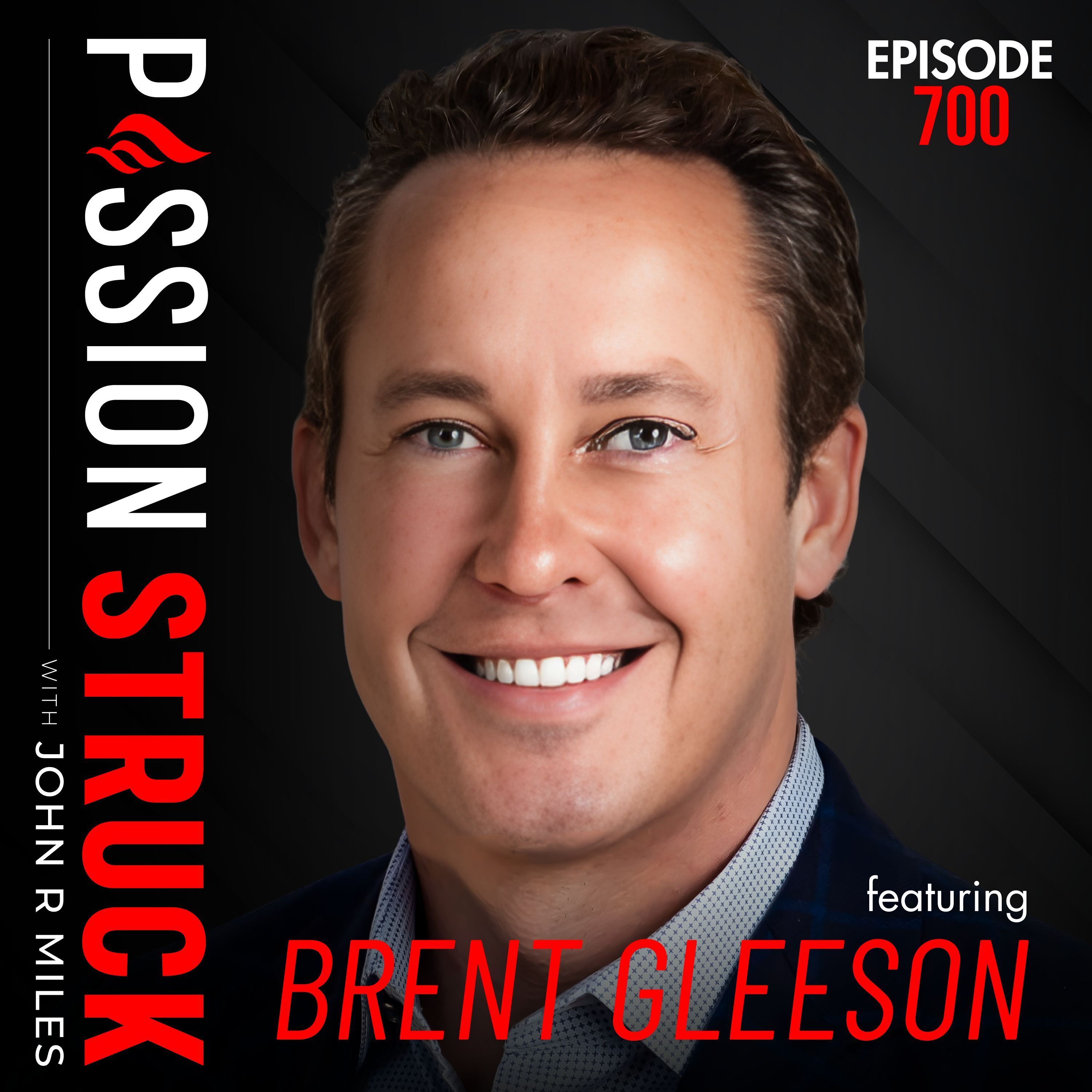
Brent Gleeson on How to Go All In on a Life That Matters | EP 700
What if becoming who you are meant to be depends less on adding more and more… and more on eliminating the things holding you back?
In this special EPISODE 700 of Passion Struck, John R. Miles sits down with fellow veteran and former Navy SEAL combat operator Brent Gleeson, bestselling author of Embrace the Suck and All In.
This milestone conversation goes deep into identity transformation under real pressure: military service, combat, losing a father, and rebuilding integrity from the inside out. Brent shares how the quietest decision of his life, choosing sobriety, unlocked discipline, connection, and clarity he didn’t know he was missing.
If you’ve ever felt stuck between who you were and who you know you could become, this one is for you.
Listen. Watch. Go Deeper.
Check the full shownotes here: https://passionstruck.com/how-to-go-all-in/
All links gathered here — including books, Substack, YouTube, and Start Mattering apparel:
https://linktr.ee/John_R_Miles
The Becoming Workbook: Build Discipline. Expand Identity. Choose Your Standard.
Reflection prompts + daily structure tools → Download the Companion Workbook
In this episode, you will learn:
- How comfort becomes a slow fade away from the person you’re meant to be
- The identity crisis many veterans face after service
- How to rebuild structure, purpose, and integrity from the inside out
- Why becoming is a daily choice, not a dramatic reinvention
- How to eliminate the habits that sabotage your potential
Support the Movement
Every human deserves to feel seen, valued, and like they matter.
Wear it. Live it. Show it.
Disclaimer
The Passion Struck podcast is for educational and entertainment purposes only. The views and opinions expressed by guests are their own and do not necessarily reflect those of Passion Struck or its affiliates. This podcast is not a substitute for professional advice, diagnosis, or treatment from a licensed physician, therapist, or other qualified professional.
See Privacy Policy at https://art19.com/privacy and California Privacy Notice at https://art19.com/privacy#do-not-sell-my-info.
Press play and read along
Transcript
Speaker 1 Hey, Passion Struck listeners. There are supplements and they're game changers.
Speaker 2 Miter Pura gummies from Timeline are in a league of their own.
Speaker 2 They're the first longevity gummy with urolithin A, a powerful ingredient shown to boost cellular energy and improve muscle strength by 12% in just 16 weeks.
Speaker 1 And I'm telling you, I feel the difference.
Speaker 2
More energy, faster recovery, sharper focus. All from just two gummies a day.
If you want to stay strong and energized now and as you age, then you've got to try Mitopure gummies.
Speaker 2
My friends at Timeline are offering 20% off just for my listeners. Head to timeline.com slash passionstruck to get started.
That's timeline.com slash passionstruck.
Speaker 1 Yourselves will thank you.
Speaker 2 Coming up next on Passionstruck.
Speaker 1 If I had to pick one thing, and I think a lot of veterans would resonate with this, is your experiences in the military, especially if you've had any experience downrange, is about perspective and really looking at the world and your life and the impact you want to have through a completely different lens.
Speaker 1 And you have a greater degree of discipline then because of that to eliminate things from your life that really are either adding no value or are blockages and threats to living a meaningful, purpose-driven life that'll have a positive impact on others.
Speaker 3
Welcome to Passion Struck. I'm your host, John Miles.
This is the show where we explore the art of human flourishing and what it truly means to live like it matters.
Speaker 3 Each week, I sit down with change makers, creators, scientists, and everyday heroes to decode the human experience and uncover the tools that help us lead with meaning, heal what hurts, and pursue the fullest expression of who we're capable of becoming.
Speaker 3 Whether you're designing your future, developing as a leader, or seeking deeper alignment in your life, This show is your invitation to grow with purpose and act with intention.
Speaker 3 Because the secret to a life of deep purpose, connection, and impact is choosing to live like you matter.
Speaker 3
Hey friends, welcome back to Passion Struck. Today is a special one, episode 700.
I don't take that lightly. 700 conversations about what it means to become the person you're meant to be.
Speaker 3 700 opportunities for someone listening to feel a little less alone. And I wouldn't be here, this show wouldn't be here, without you.
Speaker 3 Last week, Passion Struck reached number one in health and wellness worldwide on Apple Podcasts for the first time ever. And this is because you keep showing up.
Speaker 3
You listen, you share, you review, and you invite others into this movement about what truly matters. So before we go further today, I want to say thank you.
Thank you for your trust.
Speaker 3 Thank you for your time. Thank you for being part of a community that believes in growth, even when it's hard, especially when it's hard.
Speaker 3 We're continuing our series, The Season of Becoming, this transition moment between who we are and who we're ready to become next.
Speaker 3 Last Tuesday, Susan Grau guided us through the rebirth that can follow grief and how intuition leads us when logic fails.
Speaker 3 Last Thursday, Anne Libera showed us how letting go of control and performance can unlock new parts of our identity.
Speaker 3 And today, we enter a different arena, the one forged through discipline, discomfort, and clarity earned the hard way.
Speaker 3 My guest is fellow veteran and Navy SEAL combat operator Brent Gleason, entrepreneur and author of Embrace the Suck and now his new book, All In.
Speaker 3 This is a conversation about becoming when the stakes aren't theoretical, when life punches you in the gut and says, all right, now who are you?
Speaker 3 Brent and I talk about the identity collapse many veterans face after service, how comfort becomes a quiet form of self-destruction, the reckoning that came with losing his father, why sobriety was the bravest leadership decision he made, how to rebuild structure, discipline, and integrity from scratch.
Speaker 3 and why the standard you honor in private becomes the life you build in public.
Speaker 3 Yes, this is about performance, but it's also also about grief, redemption, and the moment you decide to stop negotiating with your own potential.
Speaker 3 If this show has helped you on your journey, I'd be grateful if you shared this episode with someone who needs it.
Speaker 3 And if you take 30 seconds to leave a five-star rating and a quick review on Apple Podcasts or Spotify. That is how this message reaches more people who are ready to become.
Speaker 3 And lastly, the workbook that accompanies this episode is available at our substack, theignitedlife.net. All right, here we go, episode 700.
Speaker 3 Let's dive into this powerful conversation with my friend Brank Gleason.
Speaker 3 Thank you for choosing Passion Struck and choosing me to be your host and guide on your journey to creating an intentional life. Now, let that journey begin.
Speaker 4 Stuck in a dinner rut? We've all been there, bored with the same takeout options or eaten a bowl of cereal for dinner.
Speaker 4 Let Cook Unity handle dinner tonight with ready-to-heat chef-crafted meals delivered straight to your door.
Speaker 4 New menu drops, weekly recommendations, and a thriving community of award-winning chefs keep your meal options endlessly delicious.
Speaker 4 With a team of over 160 culinary innovators, creating an ever-expanding lineup of small batch dishes, Cook Unity serves up more than 400 irresistible meals for every craving.
Speaker 4 Plus, you can pause, skip, or cancel any time, making it easy to find a plan that fits your tastes, schedule, and lifestyle. Shake up your meal routine.
Speaker 4 Go to cookunity.com slash mealtime50 or enter code mealtime50 before checkout for 50% off your first week and 20% off your next three weeks.
Speaker 4 That's 50% off your first week and 20% off your next three weeks at cookunity.com slash mealtime50.
Speaker 2
I am absolutely thrilled today to bring Brent Gleason onto Passion Struck. Brent, man, we've been trying to do this for such a long time.
It is so great to see you.
Speaker 1 Great to see you, brother, and honored to be on the show. I'm glad we finally got it on the calendar.
Speaker 2 As you and I were talking about before you came on, my father was UDT class 16, going way back, old school frogman.
Speaker 2
And I grew up around the teams before I even served myself. And there's this kind of unspoken thing.
You don't need rank or a trident to recognize.
Speaker 2 the way that someone carries themselves after they've served. I think that shared wiring we have as veterans is unmistakable.
Speaker 2 But when you think about your time in the teams, what's the moment, big or small, that shaped who you became after?
Speaker 1 I think there's an aspect, of course, that was a longer culmination of different types of identity transformation and experiences that obviously forge who we are during that transition period and how those experiences positively or otherwise influence every aspect of our lives.
Speaker 1 Obviously, it depends on the types of experiences you have when serving. So I would say there's not necessarily one specific moment or catalyst that defined who I have continued to become.
Speaker 1 Like you, I believe in continuous improvement and being a lifelong learner and trying to apply even the negative experiences and horrifying experiences and seeing the best and worst of humanity to bringing light and joy and positivity into the world or influencing how we do things, whether it's in my organization or with the books I write.
Speaker 1 But having gone in a few months before 9-11, obviously initially, so there's various stages of this to answer your question, initially, totally different vision for what service was going to look like, even if by the grace of God, service was in the naval special warfare community, which it was.
Speaker 1 But then 9-11 occurred and obviously service, especially within special operations, took on a totally different meaning.
Speaker 1 And then having deployed multiple times to combat zones and having a lot of combat experience pales in comparison to many of our brothers and sisters. I do want to say that.
Speaker 1 I've got friends and teammates who've done 13, 14, 15 combat deployments, and that's a whole different ballgame. But for me, I think it is
Speaker 1 a constant state of reflection on what those experiences have meant to how I approach being the best possible husband that I can be, being a fully present parent, being a responsible leader of my organizations and first and foremost, of myself.
Speaker 1 So trying to draw any type of positive experiences from that around discipline, personal accountability, narrowing your focus.
Speaker 1 And also, if I had to pick one thing, and I think a lot of veterans would resonate with this, is your experiences in the military, especially if you've had any experience downrange, is about perspective and really looking at the world and your life and the impact you want to have through a completely different lens.
Speaker 1 And you have a greater degree of discipline then, because of that, to eliminate things from your life that really are either adding no value or are blockages and threats threats to living a meaningful, purpose-driven life that'll have a positive impact on others.
Speaker 3 Yeah.
Speaker 2 For guys like my father and your father, coming from the earliest UDT era, Vietnam War, that identity shift for them after service was massive.
Speaker 2
But when I still talk to veterans today who are transitioning, that identity shift. is still pretty massive.
What piece of the brotherhood did you find the hardest to replace as a civilian?
Speaker 1
It's probably similar to what most would say around the camaraderie and the community and the support that you feel. The Brotherhood is real.
It's very real.
Speaker 1 It's something that, as you well know, I was just at a Veteran Suicide Prevention Gala here in Coronado this past weekend for Bets, one of my Bud's classmates and former teammates.
Speaker 1 He was at Dev Group for many years. He started this foundation.
Speaker 1 They created the new Netflix documentary, In Waves and War, talking about, it's the best documentary I've ever seen on the impact of combat on the human mind and what gets into the impact of psychedelic therapy as well.
Speaker 1 Yeah, Marcus Capone, yeah.
Speaker 1
And Marcus and Amber. They're a dynamic duo.
And it you'll go to these things or other types of events or reunions and you'll see people.
Speaker 1 I saw Matt Roberts, who I graduated with, haven't seen him probably since graduation or maybe some events here in California many years ago. Let's say I haven't seen him in 20 years.
Speaker 1 It's like we saw each other a year ago or six months ago.
Speaker 1 You pick up right where you left off and you cannot replicate that type of forged connectivity in any other type of organization or experience anywhere in the world.
Speaker 1 So you miss that, but obviously there's things you can do to stay involved in the community. I mentor guys into and through BUDS.
Speaker 1
It's nothing super formal, but I'm on the board of the SEAL Family Foundation. My wife and I.
are blessed enough to be able to financially support organizations like vets and things like that.
Speaker 1 So I think it's important, not just from a giving back standpoint, but selfishly for veterans to find ways to stay connected to those communities.
Speaker 1 It's very healing, but also altruism and giving back to those communities is one of the best ways that veterans heal.
Speaker 2 I got to meet Marcus and Amber in the most ironic of places. I agreed to do a four by four by 48 exercise and they were there.
Speaker 2 They didn't participate in it, but there were about 60 or 70 former operators who were there and it was across all the branches the only one that wasn't represented was coast guard and it was pretty ironic to me how
Speaker 2 much all of us who've served who've been in combat all have the same kind of trauma response that we're dealing with it was like 99 percent the same for all of us and as i was talking to people who were there who had used psychedelics in one way or another another to get through their trauma, most of them had tried everything.
Speaker 2 And it was crazy that the efficacy
Speaker 2 was like 75%, 80% or higher. So I really think what Marcus and Amber are doing
Speaker 2 with this
Speaker 2 documentary that they've done, everything else is going to be life-changing for so many people.
Speaker 1 Absolutely.
Speaker 1 Every operator I know who has tried psychedelic therapy and non-military who have tried it in different capacities, not through these types of nonprofit organizations, but on their own has been absolutely life-changing for them.
Speaker 1 And like you see in the documentary, one of my favorite lines of the documentary is when DJ says, so you're telling me that
Speaker 1 my wife is forcing me to go down to Mexico to do psychedelics. Okay.
Speaker 1 But at the same time,
Speaker 1 it is a proven fact thus far, coming from their own testimonies, that this is literally, not figuratively, but literally saving lives.
Speaker 3 So your first book was titled Embrace the Suck.
Speaker 2
And it's a phrase that I hear a lot. One of my Naval Academy classmates and friends, Mark McGinnis, who you might know, uses the phrase a lot.
I had William Brenham on the show.
Speaker 2 He talks about it a lot, as do most of the SEALs I know. But for someone who isn't familiar with that phraseology, Why did you decide to write a book about it?
Speaker 1 It, and to be clear, I don't think naval special warfare has the trademark on this term, but it has been a military term for a long time.
Speaker 1 We've definitely leaned into it in the special operations community. But the general philosophy around that is pretty much exactly what it sounds like.
Speaker 1 It's the intentionality behind comfort zone expansion. So identifying, and I think you have to be more specific than that even.
Speaker 1 Anybody can really understand it and most importantly apply it in their lives, but really looking at what am I trying to accomplish in various aspects of my life when it comes to my marriage or my parenting approach or for entrepreneurs and business leaders and in generally in your career and narrowing that focus down to understand what areas do I need to intentionally push those boundaries through innovation or learning or doing the things that I don't like to do or that make me cringe a little bit, but that I still have to do to be a successful business leader or entrepreneur or husband.
Speaker 1
or wife or parent. There's always going to be things that we're passionate about, that we connect to, that we enjoy doing.
And there's always going to be things that we just frankly don't like to do.
Speaker 1 And we always put them off, but we minimize them, especially in our professional lives and careers. But yet we have to do them.
Speaker 1 And what I found too, when you embrace the suck in those capacities, really lean into those things, you're building those mental calluses and you're building skills in those areas where you even start to enjoy those things.
Speaker 1 And then you go find the next obstacle and you lean into that one and you do it again and again. And you start to really expand the boundaries of your comfort zone.
Speaker 1 Again, with purpose, with strategy behind it, and with intentionality so that you're in a continuous state of not just improvement and learning, in a continuous state of developing resilience and mental fortitude, and even physical fortitude, if that's fits in a more of a health and wellness aspect of your life.
Speaker 1 But because of what we do at my company, we're at Accelerate, we're a hybrid of enterprise management, consulting, and software.
Speaker 1 But we spend a lot of time in driving growth and transformation in large organizations, always includes degrees of leadership and talent development, team cohesion, and other types of growth strategies.
Speaker 1 But a lot of that work really has to drill down into individual development.
Speaker 1 And for leaders to be effective in any organization, as you well know, whether it's military business or out of the community or in any type of team environment, we have to continually go through stages of intentional identity transformation.
Speaker 1 I cannot approach my business, for example, and how I lead it today only. I have to think about who do I need to become to drive this business into the future? Who do I need to surround myself with?
Speaker 1 What do I need to learn? What types of new strategies do I need to implement? And that requires a lot of embracing of the socks. So I thought it'd be a fun project.
Speaker 1 And I think, you know, like most of the things that I end up doing, it was my wife's idea originally,
Speaker 1 as it was with the new book, but it was an exploration into
Speaker 1 personal development that I had not done. I had not been a big digester of self-improvement content or books or podcasts.
Speaker 1 So one of the first things I I did was I went out and I started reading all the books and listening to books and listening to podcasts to see, first of all, part of my research, to see what's out there, what resonates, what aspects of that stuff that I like, what's measurable, what's not measurable.
Speaker 1 And then I found a path forward that ended up being becoming the book Embrace the Suck, which thankfully has had a huge impact.
Speaker 1 And I've gotten all kinds of very humbling messages that it's saved marriages, saved lives, helped people battle cancer, transformed their businesses or careers. So it's been a fulfilling journey.
Speaker 1 I'm very humbled by it.
Speaker 2 Before we get into your new book, I wanted to follow up with what you just said for a second, because this whole podcast, when I started it, it was all based on the idea of behavior change is possible, but it takes intentional choices to reshape how you're living your life in order to do it.
Speaker 2
So intentionality. has been the core of everything we do here.
And I had this discussion with Angela Duckworth, the Wharton professor who wrote Grit. And
Speaker 2 we were talking about West Point, because that's how she opens up the book. And I was talking about the Naval Academy, and I tried to get her to go to this topic.
Speaker 2 And I said, my experience, whether it's Beast Barracks or Phleb Summer or Getting Through, you can have all the passion and perseverance that you want in life, but if it's not aligned in the proper direction, you're not going to end up with where you want to go.
Speaker 2
And she says, well, that's really about self-control. But I think intentionality is bigger than just self-control.
How would you define it for a listener?
Speaker 1
I love that you, first of all, brought up Angela Duckworth. I love her work.
She's actually in the new book. I'm not going to reveal how, but in a very creative way.
Speaker 1 Think a combination of the movie Revenant and Angela Duckworth and where they converge. We'll leave it at that for now.
Speaker 1 Absolutely, I couldn't agree more.
Speaker 1 When it comes to having a strategic intent behind developing grit, developing resilience, it's not just about extreme ownership and mental fortitude and all the things that we talk about, just like in any good strategic approach to any project or initiative, whether it be business or personal, you have to identify and clarify what is the mission?
Speaker 1 What am I trying to accomplish here? What is the desired outcome at the end of this journey? Or if there's no... destination, then what does that journey need to look like?
Speaker 1 How am I going to measure those incremental improvements in my own personal grit and resilience and fortitude? And what is that going to mean for my life?
Speaker 1 How is that going to impact my relationships, my work, my personal well-being, whatever those categories need be?
Speaker 1 And like she writes about, and I know are based on a lot of your philosophies as well, there has to be a specific design to your process when it comes to learning, when it comes to mentorship and guidance that you want to receive from others who've been down that path.
Speaker 1 All those things have to be very specific and by design so that it is aligned with your desired outcomes, even going down to, okay, I have this path that I want to go down.
Speaker 1 I know just like in the Naval Academy is teaching you a mission planning scenario, they're going to talk about commander's intent. What is the strategic objective we're trying to accomplish?
Speaker 1 What resources am I or we going to need to achieve that desired outcome? Let's list them out: who owns those? How are we going to acquire those? What do we not have that we need to acquire?
Speaker 1 Next would be like, what are the threats and blockages that are going to stand in the way of achieving this desired outcome? And that gets into
Speaker 1 what things or bad habits or people do I need to eliminate from my life completely or otherwise in order to clear a better path to set myself up or my team or my family for a greater degree of success?
Speaker 1 So it's following a system just like anything else, as opposed to just thinking about resilience and thinking about mental fortitude or reading a couple books. It's systems that drive outcomes.
Speaker 2
Man, I love it. I want to dive into your brand new book.
I've read both your books, so I was very happy I got an advanced reader copy from your team.
Speaker 1 I like mixed emotion about advanced copies because they're not final copies, but thank you for reading. We'll get you a final copy too.
Speaker 3 I hope you're enjoying my conversation with Brent Gleason. If you want to watch this episode, full video interviews, shorts, and bonus content are available on both Passion Start Clips and the John R.
Speaker 3 Miles YouTube channels. If you want to wear your purpose, visit startmattering.com to explore apparel design to remind you you daily that you matter, live like it.
Speaker 3 Now, a quick break to thank our sponsors who make this show possible.
Speaker 5 With markets changing and living costs rising, finding a reliable place to grow your money matters now more than ever. In the Wealthfront Cash account, your uninvested cash can earn up to 3.9% APY.
Speaker 5 That's a 0.65% boost over an already high rate for three months just for being a new client.
Speaker 5 There are no monthly account fees or minimums, and you get free instant withdrawals to eligible accounts 24-7. So you always have access to your money when you need it.
Speaker 5 And when you're ready to invest, you can transfer your cash to one of Wealthfront's expert built portfolios in just minutes.
Speaker 5
More than 1 million people already use Wealthfront to save and build wealth with confidence. Get started today at Wealthfront.com.
3.25% base APY via Program Banks as of December 19th, 2025.
Speaker 5 It is representative variable, requires no minimum, and is earned on funds wept to program banks. Instant withdrawal subject to conditions boost up to $150,000.
Speaker 5 Cash account offered by Wealthfront Brokerage LLC member FINRA SIPC, not not a bank. Investing involves risk, including possible loss of principal.
Speaker 5 Investment advisory services provided by Wealthfront Advisors LLC, an SEC registered investment advisor.
Speaker 3 You're listening to Passion Struck on the Passion Struck Network. Now, back to my conversation with Frank Gleason.
Speaker 2 Well, All In is a fantastic book, and I want to start with your preface.
Speaker 1 You write...
Speaker 2 in the opening about your father, and it was very touching for me.
Speaker 2 I've already brought up my father, but the standard your father set, mine set, the expectations, the discipline you absorbed just watching him, I felt like I was walking into my own story because I grew up with that same feeling that you don't get to choose your standard, you inherit it.
Speaker 2 In many ways, you like me were shaped by the uniform long before either of us ever put it on.
Speaker 2 And you write candidly,
Speaker 2 and I want you to give more of what was happening here about a season when you drifted from that standard. So when did you first realize you weren't living the standard that your father taught you?
Speaker 2 And
Speaker 2 what made you decide to fight your way back?
Speaker 1
Well, the catalyst was his passing two years ago. So my dad passed away unexpectedly on September 20th, 2023.
And
Speaker 1 it was interesting because for all different types of various reasons that we don't need to get into necessarily, it was a shitty year already.
Speaker 1 There was things going on in the economy that were impacting our business, and that impacts the financial aspects of any type of entrepreneur or founder. And so, a lot of it was business-related.
Speaker 1 We had come off a growth year in 2022. We're coming out of COVID and all those things.
Speaker 1 Not that everything's related to COVID, but there are aspects of the clients and customers we serve spending more money on software and development and things like that.
Speaker 1 And then, for whatever reason, 2023 was just, it was a strange strange year so it was already extremely challenging high stress high anxiety that impacts marriage that impacts family impacts finances and then lo and behold my dad passes away unexpectedly out of the blue by the grace of god it's a crazy story i just i grew up in dallas and that's where my parents still live my mom still lives there my twin brother his wife I was in Dallas.
Speaker 1
We have a lot of clients and customers there, some investors there. So I'm there only like once a month.
So because of the frequency, I don't always get to see my parents.
Speaker 1 And sometimes I'm not even mentioning that I'm in town because I'm in and out. I know I'm not going to see them where I just forget.
Speaker 1
But at the end of this day, we're launching a new program with a client doing a lot of software onboarding and things like that. My phone had just been going crazy in my pocket.
Oh my God, what is it?
Speaker 1 I thought I was on some text chain with some college buddies or SEAL teammates. And it was actually my mom alerting my brother and I to the fact that my dad had a fall.
Speaker 1
We'll never know exactly what happened, but he had some heart issues. But my dad was still 80 years old, former Marine.
He liked three things, family, work, and working out. That's it.
Speaker 1
And hunting and some other things like that, you can imagine as a Texas guy. But he was still working in personal real estate as a real estate developer.
He had multiple deals in place.
Speaker 1 I think, frankly, he was pushing the boundary a little bit of what he could probably take on.
Speaker 1 Long story short, he had a fall and that he hit his head because of some heart medication he was on and blood thinners. He had a brain bleed that became inoperable.
Speaker 1 And like I said, by the grace of God, I just happened to be in Dallas. And so literally the CEO of this client organization, he's like, let's go.
Speaker 1 We got in his Corvette and he drove somehow by, like, it was like parting the Red Sea through Dallas rush hour traffic to get all the way from Carrollton to a Presbyterian hospital where I got to spend his last 15 hours by his side.
Speaker 1 But that anytime, again, as veterans, especially veterans who go down range, we're not immune or separated from the reality of loss and death.
Speaker 1 But someone close to you, a parent, a sibling, a child, God forbid, that is going to ignite a period of deep reflection and looking at our own mortality and looking at the realization of the fact that time is our most valuable commodity.
Speaker 1 We spend it freely every day without ever knowing the balance in our account. And so, what does the rest of my life need to look like?
Speaker 1 Where have I really gone off the path that I preach about, that I have a desire to live by and certain guiding principles?
Speaker 1 And so, during that period of reflection, I was identifying things that I I need to start doing or do better and things that I need to stop doing and eliminate from my life, whether that be bad habits or toxic relationships or business strategies and approaches, even that level of granularity that need to evolve or stop so that I can open the pathway to something better in all of those important categories of being a better husband, a better parent, a better founder, better leader.
Speaker 1 And for me, one of those, and I write about this in the first part of the book, is one of those was I identified the fact that I was going to eliminate alcohol from my life completely starting right then and there.
Speaker 1 And that was two years ago.
Speaker 2 I remember you and I texting about that I had seen you post about it on social media and reached out because I had stopped drinking myself maybe six months before that and was just if you need someone to help you through it.
Speaker 2 But I remember, and in this scene, it made me think about my own self because you're in the hospital with your dad and part of it to kind of, I guess, ease yourself, you decide to go across the street and grab a couple shots of vodka that you brought back.
Speaker 2 But I remember myself in my own professional career, there were so many times where I did the same thing. And I can imagine in your mind thinking, I'm leaving my father.
Speaker 2 He could have died while I'm gone. It's a big wake-up call.
Speaker 2 When you think about your life now, two years later, how much has not drinking opened up like your creativity and more the self-awareness that you have.
Speaker 1 And it's going back to that comment, it's fascinating what you can justify through different types of addiction, not just alcohol, but other types of addiction. The human mind is a fascinating thing.
Speaker 1 And obviously you can tap into it in a very positive way, but also there's things about the human mind that are powerful that leads us down the wrong path and we justify it every step of the way.
Speaker 1 And so for me, in that given moment, I wasn't right in that moment, but I think it was about a week or two after my father's passing and leading leading up to his funeral, where I made that decision just one day.
Speaker 1 And I'm an all-in, all-or-nothing. I don't do moderation very well.
Speaker 1 It's not about easing things back, especially if it's something that I know is important, whether it's something I'm going to start doing or stop doing. And I just made that decision.
Speaker 1 My wife reminds me that we didn't have a discussion about this prior to making that commitment. And she literally said, So, we're never going to have a glass of wine together.
Speaker 1 And I'm like, no, this is just till I'm dead. We just got to stay the course.
Speaker 1 But I said, no, we're not.
Speaker 1 And I know I will never deviate from this path because that would mean mission failure and i don't do mission failure i don't like that maybe there'll be hiccups along the way there have not been at all frankly and i say this with a great degree of humility because i'm frankly astounded by it but it's been one of the easiest things i've ever done
Speaker 1 i don't know why i put a lot of that towards my faith and the strength that i've gotten from that down this path but also because of the intentionality and purpose behind it just anything we do that's purpose driven whether it's service or going into battle or eliminating drugs or alcohol from your life, whatever that path is, if it's purpose-driven and you can emotionally connect to it, that is what will drive you through any type of obstacles or adversity that might deviate you from that path.
Speaker 1 But for me, when it goes down to the categories I've already mentioned, I looked at how is this positively going to impact my marriage?
Speaker 1 How will this make me a more present father when I'm with my children? How is it going to make me a better leader, a better CEO, a better founder? And there was hope there.
Speaker 1 And I would imagine that, yeah, okay, from the friends that I know that had that made this same choice, especially people that I've respected, whether they were former operators who've done this, because studies show that alcohol also does not have a great positive impact on PTSD or traumatic brain injury.
Speaker 1 I don't know. I'm not a doctor, but pretty common sense there.
Speaker 1 But at the same time, also founders, entrepreneurs who've achieved great, let's just call it great success financially as well, who built companies, sold companies.
Speaker 1 And I had had some degree of success along those paths, but my curiosity was around what could I be really accomplishing by eliminating this from my life.
Speaker 1 And every every single one of those categories has
Speaker 1
dramatically improved so much so that it's hard to actually articulate. My marriage is better than it's ever been.
I'm much more present with my children.
Speaker 1
And we justify the fact that, well, our kids are young or the younger ones don't really notice these things. They do.
They notice everything.
Speaker 1 And so they're aware of things like alcohol and alcohol consumption and more than we think they are. And so.
Speaker 1 Also, just by the nature of making that decision, I think for me, probably regained, I regained respect for my wife. I regained respect for my children.
Speaker 1 Again, I wasn't a drunk in a ditch on the side of the road, but at the same time, when we're abusing alcohol or other types of bad habits, it has an impact on every area of your life. And then from
Speaker 1 an entrepreneurship standpoint, and I've since the SEAL teams in grad school, I've only ever been a founder. So entrepreneurship is all I know because I like deep suffering and pain and anxiety.
Speaker 1 I'm a sadist in that kind of way, but it led me to have the mental clarity and the courage to completely transform our company from old school traditional management consulting into enterprise software, which requires a whole new strategy, requires raising a ton of capital, putting together completely new plans, new people, new talent, me learning new things.
Speaker 1 So it goes through an identity transformation process as well. And all of those areas have been astonishingly successful, I think, largely due to the fact that I made that tough decision.
Speaker 2 Man, well, thank you for sharing that and for being vulnerable about it, because I think it's a message a lot of people need to hear. I have so many people who ask me, you're still not drinking?
Speaker 2 What's wrong with you? And I had stopped drinking a few times before in my life, but this time when I made the decision, I said, August 1st, I am stopping. And I just stopped.
Speaker 2 But in the months that followed, I would kind of observe.
Speaker 2 everywhere we went just how much it kind of permeates every aspect of life that's around us and one of the most impactful thing for me is i realized how many of my behaviors were
Speaker 2 and even the environments i was putting myself in revolved around it and when i eliminated that
Speaker 2 so many of the things that were taking me away from the purpose that i felt i was compelled to do
Speaker 2 went away and it allowed me to focus on what mattered most.
Speaker 1 Yeah, completely.
Speaker 2 And where I want to go with this is when I was reading your book, a lot of people know who Marshall Goldsmith is, and they know his book, What Got You Here, Won't Get You There.
Speaker 2 But the book that I think is better than that is one that he wrote called The Earned Life. And I was talking to Marshall about it.
Speaker 2 And he has this framework in it that the earned life comes from aligning your value system, what you call your mind, heart, and soul.
Speaker 2 And he says with your aspirations and your ambitions, now aspirations are your long-term
Speaker 2 goals that you want to achieve and your ambitions are your more near-term things.
Speaker 2 You say it's anchored by deep self-awareness of what truly matters.
Speaker 2 And where I wanted to go with this is for the past six or seven years, I've been on this deep journey of studying the science of mattering.
Speaker 2 And to me, When you intentionally use the words, what truly matters in this sentence, it's really profound. Why did you think adding that was so important?
Speaker 2 The alignment of mind, heart, and soul anchored by deep self-awareness of what truly matters?
Speaker 1
Because when we don't, we want to be careful about spending too much time in deep self-reflection. I make time for those things.
I do it every morning.
Speaker 1 But at the same time, a lot of people get caught in that trap of trying to find themselves or discover their purpose.
Speaker 1 It is through action, specific, strategic, purposeful action that we find deeper meaning in our purpose, our why, and what truly matters in life through some trial and error, of course, not just sitting around ruminating over what is my purpose in life or what does my renewed purpose need to be to have a fulfilling, purpose-driven, meaningful life.
Speaker 1 But we can't really accomplish any of those things without intentionally working on our emotional intelligence and opening up certain degrees of self-awareness through coaching and mentorship and being open to feedback.
Speaker 1 The highest performers you or I know, and I'm not putting myself in that category, don't are just accepting of radical candor from trusted colleagues, spouses, friends, peers.
Speaker 1
They crave it constantly. There is a degree of healthy dissatisfaction in their life where, and my friend Terry Cruz, an actor, and former NFL.
Yeah, he is hilarious.
Speaker 1
He is hilarious, but he said something one time. I've heard him say it in an interviews.
He said it to me one time.
Speaker 1 I forgot what we were talking about, but he said, I want to be happy, of course, yes, but always just a little dissatisfied. And I'm like, that's me to a T.
Speaker 1 I'm never fully satisfied with my station in life.
Speaker 1 And so having a degree of self-awareness, and some people naturally have a heightened state of emotional intelligence, and others have to work on it a little bit more.
Speaker 1 All of us have to work on it, whether you start with a solid baseline or not. And that goes to your personal and professional life.
Speaker 1 But self-awareness on strengths and developmental opportunities or weaknesses is the baseline starting point.
Speaker 1 But then having the desire and growth mindset to lean into those areas that you know you need to upskill, whether it's in your relationships or your approach to work or your personal and physical well-being, all those key areas once identified, you have to have enough self-awareness to be accepting of feedback, to crave constructive criticism and feedback, be willing to learn and be willing to do the work.
Speaker 1 But again, only on the things that matter. It goes back to the general philosophy around the new book, which is titled All In, The Pathway to Personal Growth and Professional Excellence.
Speaker 1 I like the counterintuitive approach to the term all in because people are like, how do I be all in? What do I need to do?
Speaker 1 I'm like, you're only all in on the right things, the things that matter, the things that matter to connectivity with your values, the things that matter to what you want to achieve in your relationships and your career, and getting rid of everything else.
Speaker 1 I don't mean just marginalizing or putting some things off to the side, being disciplined enough.
Speaker 1 to learn the fine art of saying no and eliminating bad practices, bad habits, or even toxic relationships that are going to stand in the way of that. We only have so much time.
Speaker 1 We don't know when the end is. And frankly, we just don't have time to just spin our wheels and wasting that valuable commodity on stuff that has no impact.
Speaker 2 Brian, I was listening to another interview you did, and you were talking about self-efficacy.
Speaker 2 And where I want to go with this is there's this theory called efficacy theory where you're living the life you are. And then there's two different dimensions.
Speaker 2 There's the life you could be living and there's the life that most of us. end up living, which is what we feel we should be living.
Speaker 2 And in the book, you underline that aligning goals with values is key to purpose-driven action, going from that should to the could.
Speaker 2 But for someone who is in a rut, they're in all this noise around us today, and they've forgotten their core values. What's your advice to rediscover that core element? Like, how do you do it?
Speaker 2 How do you get back on that track?
Speaker 1 It's really about going back to the drawing board. And we all intellectually understand these things.
Speaker 1 We understand you, I can agree, that clearly defining values and purpose will lead to a more fulfilling life or help me overcome obstacles. Sure.
Speaker 1 But the operationalizing of those philosophies is a totally different thing.
Speaker 1 And therefore, we have to go back to treating it just like any other project we would at work or initiative at home, whether it's cleaning the garage or raising $100 million for your business.
Speaker 1
It all requires being very specific and intentional. And sometimes going back to the basics and wiping that slate clean and looking at, okay, I'm in a rut.
I've spent too much time in this rut.
Speaker 1 And yeah, maybe I've gotten some feedback and everybody's trying to tell me what I need to do.
Speaker 1 But for myself, what is going to be realistic for me to actually emotionally connect to get over this hump and start taking meaningful action so that I can climb out of this?
Speaker 1 bunker of normal human emotion, which we all experience. We all experiences those stages of grief, if you will, regardless of the magnitude of whatever obstacle we hit.
Speaker 1 But resilient people and teams spend less time
Speaker 1 in that emotional state and move more quickly to gathering insight, gathering data, getting some good coaching and mentorship, and then taking action, developing a plan.
Speaker 1 Not a full plan, there's no such thing, but a good old-fashioned 80% plan that they can start to execute and gaining some momentum and then learning from that momentum and making some specific pivots.
Speaker 1
I heard a snippet from Jocko in a podcast that we've all heard him say things like this before, but it was about overcoming fear. And in typical Jocko fashion, his response was one word.
He said,
Speaker 1 go.
Speaker 1
Yes, yes. What does that mean? But yes.
And what he means by that, obviously, is this is along the same philosophy of taking action, like getting off your ass. And I know it's, and again, I'm not.
Speaker 1 minimizing the grief or emotion of loss and the different experiences people have in their lives.
Speaker 1 But at the end of the day, we only have one life and it is about getting off your ass and taking action, finding the right mentors, surrounding yourself with the right people who are going to support you, getting rid of the people who are in that same position, unfortunately, or who are going to keep you in that same position, who do not really truly wish you well.
Speaker 1 Again, it's about eliminating relationships too, but then also finding the right resources that are going to help not just motivate you, because that's fleeting, but real actual resources that are going to get you going on a new path.
Speaker 1 That once you've defined, like, where do I really want to go from here? Kind of like we talked about when I lost my dad and things like that. But where do I want to go? What do I want to accomplish?
Speaker 1 Let's wipe the slate clean, if need be. If we add some things back in that are fall into that continue and elevate bucket, but what do I need to stop doing? What do I need to start doing?
Speaker 1 And then putting a prioritized plan in place and also looking at what needs to go on that stop list is just as important as anything else.
Speaker 1 What are the bad habits, the relationships, or just the things things that I waste time on that add no value that are going, that I'm going to commit to eliminating?
Speaker 1 And just one small incremental improvement every single day, seven days a week, putting new routines in place, but daily routines and rituals that will actually have an impact on that mission plan, if you will.
Speaker 1 Not just thinking about it or saying, Yeah, I'll get to some of these things, but having a systematic approach and daily rituals that'll help start driving that 1% incremental improvement each day philosophy.
Speaker 2 What you're saying is what Robin Sharma says.
Speaker 1 I love his work. I didn't initially think I would, but I've become a big fan of his.
Speaker 2 I have had him on the podcast twice now, and I always love talking to him.
Speaker 2 I always come out of that with two months of full steam on changing the way I'm operating, changing what I'm doing in the company.
Speaker 1 His book, The 5 A.M. Club, was part of my initial journey.
Speaker 1 I started, I looked at it, I was like, but his writing style, especially in that book, I've read all his books, but especially in that book, was I really connected with it.
Speaker 1
At first, I was like, this is a different approach, very storytelling-based, but terrible. Fascinating book.
I know he took four or five years to write it, but the 5 a.m.
Speaker 1 Club and the importance of those daily rituals and the way he presents them also influenced All In my new book.
Speaker 1 I jokingly say, not really joking, but if Robin Sharma and James Clear and some old Navy frogman had a baby, it would be all in.
Speaker 1
Three men and a baby. I guess that was an actual movie.
So if we all had a baby, it would be my new book all in.
Speaker 2 In your book, one of the main things that you start with in part one, since you just brought up James Clear and we're just talking about Robin, is relentless routines, which is something that they both talk about, which ties exactly to what you said.
Speaker 2 A lot of times when people think about the word passion struck, they think of, oh, this person has got so much passion, they're ready to conquer the world.
Speaker 2 And when I think of the word and I talk to people who I know are passion struck, whether it's been Derek Jeter or Robin or Mark Benioff from Salesforce or others, what they don't realize is that passion and pain are linked.
Speaker 2 And discomfort is the thing in between that's required for your new identity to emerge.
Speaker 2 And I think people don't realize how important this is, because if you're going to change that routine, it's going to come with a lot of discomfort along the way.
Speaker 2 So, for someone who's listening today, and you said this idea of you just have to start, what is the first thing that they can do to embrace that discomfort?
Speaker 1 I think it's pretty much an identical answer to when I get the question of what drives students in the first few days or weeks of BUDS or SEAL training, the ones that are successful, obviously.
Speaker 1 How do they embrace that deep, almost unimaginable degree of suffering while, and then ultimately are successful in that endeavor.
Speaker 1 It's the same thing adopting a new routine or eliminating a bad habit or overcoming addiction. It's doing two things simultaneously that applies to every category I just mentioned.
Speaker 1 One is maintaining an emotional connection to the long-term vision of what you're trying to accomplish. So, what is the desired outcome or outcomes I am trying to accomplish?
Speaker 1
That's why they have to be meaningful. It has to be purpose-driven.
Otherwise, you will not emotionally connect to them and you will fall off.
Speaker 1 So, if it's something that means something to you, like being a better husband, improving my marriage, being a better parent, who doesn't want to do that?
Speaker 1 Being a better founder and CEO and growing my business, obviously any entrepreneur wants to do that.
Speaker 1 So having that connectivity, but the other piece of that and doing these things simultaneously is also not just accepting the pain, the obstacles, the suffering, the anxiety or the little voices inside our head that tell us that, hey, this, maybe this isn't the path.
Speaker 1 And you start to justify that maybe you should dial the throttle back a little bit.
Speaker 1 not just being accepting of the pain but leaning into the pain embracing the pain because it's a critical fundamental part of going down this path it's required and therefore once we shift our mindset to understanding this pain or the suffering or the discomfort that i'm feeling is absolutely part of this journey everybody who's gone down this same path felt the same pain and suffering lean into it use it as fuel for your journey and learn from it and then the more you have that mindset the more you lean into it, those things that seem seemingly impossible or caused you deep suffering, it starts to alleviate.
Speaker 1 And then you can really push the boundaries further and further.
Speaker 1 So that the things that used to cause you a lot of anxiety or that caused you a lot of fear are just part of your normal everyday life and routine.
Speaker 1
And therefore, okay, let's go find the next big challenge and let's lean into that one. And you do it again and again.
And
Speaker 1 I'll tell you, and I know you know this, but it's when you can really embrace that sort of philosophy and intentionality of comfort zone expansion, a lot of things in your life just seem to organically fall into place.
Speaker 2 Oh, man, you're absolutely right. Something you just said made me think of Mark Devine, who you probably know since he's one of the people.
Speaker 1 I was on a show a couple of weeks ago.
Speaker 2
I know he lives there in San Diego. I remember talking to Mark.
a couple of years ago and we were talking, we happened to be talking about buds and how we got through. And he had three steps in it.
Speaker 2
But one of those steps was visualization. And this is something you also talk about in the book.
Why is this visualization so important?
Speaker 1
It's a powerful tool. And actually, in one chapter, I start by talking about the philosophy of manifestation, which I jokingly refer to.
I'm like, I can't believe I'm even writing about this.
Speaker 1 I think of sitting crisscross applesauce with gins and chanting and things like that.
Speaker 1 But really, we're talking about vision, having a very clear vision of what you're trying to accomplish, which again falls into that category of we all, yes, intellectually understand some element of why that's important, but having a very clear vision of what that outcome is that you're trying to accomplish.
Speaker 1 So let's go back to overcoming addiction. What am I actually trying to do?
Speaker 1 Yes, there's health benefits that I've heard about, or I'm not going to get yelled at by my wife as much, or whatever the outcomes as much was a key part to that.
Speaker 1 Whatever the outcomes are, just like a business strategy or an exit strategy for your company, what does it look like? What is the time-bound nature of that goal?
Speaker 1 What does it feel like once I've accomplished that goal? Or if it's a continued state of improvement, then what are those milestones that I need to hit?
Speaker 1 And what's it going to feel like when I hit them? What is my identity going to look like from the outside in and inside out when I start to achieve some of those milestones?
Speaker 1 So being really specific, very concise, and very measurable in your thinking of what does achieving that goal look like? And when I do achieve it, you know, what's next?
Speaker 1 What is that next plateau and what is that next milestone that i'm going to set once i've achieved that goal and so that's really what vision is all about and we're not talking about vision boards and magazine cutouts and things like that but to a certain degree literally identifying and even documenting what is this outcome going to what types of change in my life is this outcome going to impact personally professionally and my relationships and that's really what we're talking about because with that level of clarity then you can operationalize it then you can put a plan alongside that vision where you can start to chip away at it and hit some of those milestones, those benchmarks.
Speaker 1 So there's measurable progress towards it. But just thinking about it, be like, I want to become this or I want to do this.
Speaker 1
That's not a plan. And if you don't have a plan and it's not measurable, it ain't a goal.
I'm sorry.
Speaker 1 And you will not achieve it.
Speaker 2
So we don't have time to go through a ton of the book. We've touched on aspects of it.
For those who are listening, you really need to pick this up.
Speaker 2 I purposely didn't go into the remarkable results pyramid because I want you to read the book to absorb it, but it's such a good thing.
Speaker 2 Brent also goes into why high achievers plateau and how to break through that fog.
Speaker 2 It goes into long-term thinking and the importance of the long game, the purpose compass, commitment devices. There's so many crown jewels in here.
Speaker 2 And one of my favorite sections was the whole performance engine section where you reframe success not as a willpower problem, but as a systems problem.
Speaker 2 And I think that systems thinking is so important.
Speaker 2 All that said, I wanted to come back to this topic of passion struck because a question I love to ask all guests is, what does being passion struck mean to you?
Speaker 1 I think we've laid a good foundation for what that means in some of our discussion already, but being passion struck, again, goes back to
Speaker 1 clearing the path in your life, both professionally and personally, to really identify the areas that you really want to lean into, that you really want to focus on, and those areas that you care deeply about, that mesh with your values, assuming you've to some degree defined what those values are.
Speaker 1 I highly recommend that for everybody, because it's tough to emotionally connect different activities or initiatives or goals to your values if you haven't defined them.
Speaker 1 We won't go into all that right now, but.
Speaker 1 if I had to put it into a three-step framework, it would be identifying what your values are.
Speaker 1 And there's different tools you can do to think about when I've been most resilient in my life, what was true about me emotionally, cognitively, my behavior, when I've overcome obstacles, or when I've experienced the most joy, like what was true about me in that moment in my life.
Speaker 1 And you can start to drill down on the things that you really truly care about and then define some values and definitions and metrics for success along the lines of those values.
Speaker 1 And the second piece of that to be truly passion struck is looking at what do I want to accomplish in my personal life and professional life and only picking a few things.
Speaker 1 10 number one priorities means we have zero priorities. And so that goes into that second piece of decluttering your life.
Speaker 1 And then in my experience, Once we declutter and we remove a lot of those obstacles or bad habits or relationships and lean into these other areas that we at least believe that we are passionate about or know that we are, then that passion starts to really deepen because we lean into those things without distraction.
Speaker 1 We start surrounding ourselves with people who are passionate about similar things, people that can mentor us and guide us.
Speaker 1
We start digesting content and engaging in personal and professional learning and development that aligns with those passions. And then you're laser focused.
And then you have a path.
Speaker 1 And then you have a roadmap for being truly passion struck in the most important areas that matter to you.
Speaker 2
Awesome. And Brent, last question.
People want to learn more about you, what you're doing, your books, everything. Where's the best place for them to go?
Speaker 1
A few areas. I'm on LinkedIn.
So just look me up, Brent Gleason on LinkedIn. There's a search bar there.
My Instagram is Brent underscore Gleason. And then our company website, I'll just spell it out.
Speaker 1 Our company name is Accelerate, but the URL is E-X-L-R, the number eight, dot A-I.
Speaker 1 And the book is on any online retailer that you prefer, but the book title, again, is all in the pathway to personal growth and professional excellence.
Speaker 2
Awesome. Thank you, Brent, so much for coming on the show.
It was such an honor to finally make this happen.
Speaker 1
I am so glad that we got to do it. You're a fascinating guy.
I've enjoyed following you as well. And hopefully we can do it again.
Speaker 3
That was my friend, Brent Gleason. And what a way to honor episode 700.
Brent's story is a reminder that transformation doesn't happen when life is comfortable.
Speaker 3
It happens when something important is on the line. Your identity, your integrity, your future.
Here are a few truths that are worth remembering. Discipline isn't punishment.
Speaker 3
It's a promise to your future self. Comfort can turn into a slow fade away from the person you're meant to be.
And becoming isn't a one-time choice. It's a daily one.
Speaker 3
If Brent's message hit home today, please share this episode with someone who's ready to move from intention to action. And again, thank you.
Thank you for helping Passion Struck reach episode 700.
Speaker 3
Thank you for helping us reach number one in health and wellness worldwide. on Apple Podcasts.
This show is what it is because you choose to be part of it.
Speaker 3 If you want to go deeper with what you heard today, tools, practices, frameworks, join me over at theignitedlife.net, my Substack community.
Speaker 3 And if you want to help a child in your life grow up knowing they matter, visit youmatterluma.com or pre-order the book at Barnes and Noble.
Speaker 3 We continue the season of becoming this Thursday with Hannah Pryor, talking about the power of awkwardness. Why discomfort isn't a weakness, it's the doorway to confidence, creativity, and courage.
Speaker 6 A lot of us in the the last five years got thrown into these hybrid workspaces, virtual workspaces. We may not see our colleagues anymore.
Speaker 6
We tend to have this tendency to magnify or create a story around what it means to ask someone for help. We're not talking to them as often.
So the muscle feels underdeveloped.
Speaker 6 We are not clear on what they think our capabilities are, what we think their bandwidth is to help us. So we tell ourselves a whole story about what that represents.
Speaker 6 And because of all these factors, it's harder than ever to ask for help. But amongst all of those, the biggest one is we're just not doing it as much and we've gotten out of practice.
Speaker 3
Until then, remember, becoming isn't about perfection. It's about recommitting to the person you know you're capable of being, especially when no one's watching.
I'm John Miles.
Speaker 3 You've been passion struck. Now go live like you matter.
Speaker 7
League One volleyball is coming to Minnesota in 2027. The world's best players together on American soil.
This is volleyball like you've never seen before.
Speaker 7
Huge swings, massive blocks, jaw-dropping digs. A sport where every play is a highlight.
To learn more and get first access, visit LOVBminnesota.com/slash iHeart.