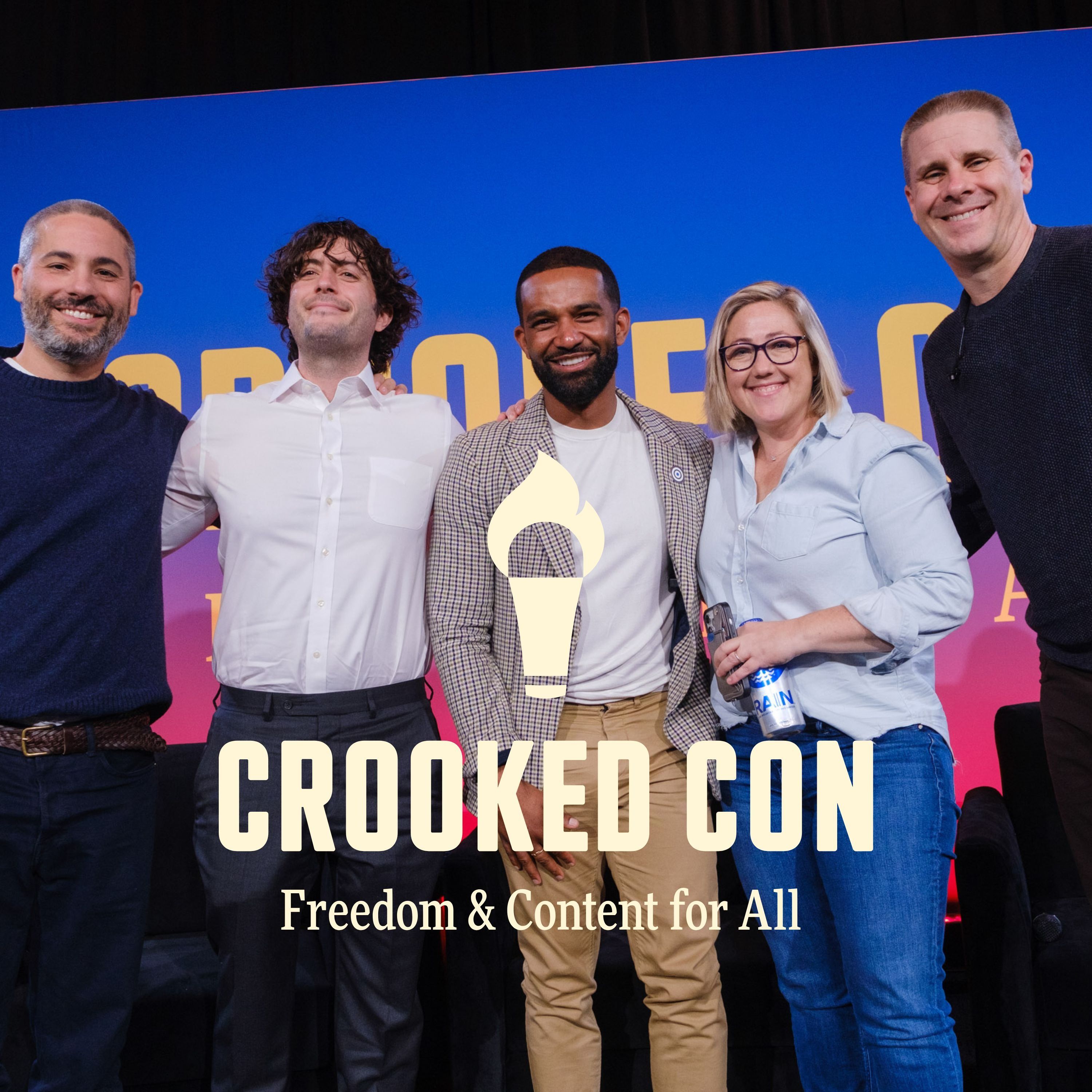
What Is the Polling Telling Us About 2026? + Gov. Andy Beshear (Crooked Con)
Press play and read along
Transcript
Speaker 1 presenting sponsor is Simply Safe Home Security. Are you feeling particularly anxious lately? Unsettled? Afraid?
Speaker 1 One small thing you can do right now to at least provide a sense of safety when you're home is to get Simply Safe Home Security. Traditional security systems respond after someone breaks in.
Speaker 1 SimplySafe is different because it can stop crimes before they happen with its active guard outdoor protection.
Speaker 1
High-tech cameras detect threats while they're still outside your home and alert real security agents. This is the game changer.
The agents take action while the intruder is still outside.
Speaker 1 They confront the intruder, letting them know they're being watched on camera and that police are on their way, even sounding a loud siren and triggering a spotlight if needed.
Speaker 1 This is how you stop crime before it starts. Other systems have cameras that let you talk to intruders, but they require you to see the alert yourself.
Speaker 1
SimplySafe's monitoring agents have your back and talk to intruders, even if you aren't there. There are no long-term contracts or hidden fees.
You can cancel any time.
Speaker 1
Named best home security systems by U.S. News and World Report for five years running.
60-day money-back guarantee, so you can try it and see the difference for yourself. John Lovett certainly has.
Speaker 1 He set it up himself.
Speaker 2 And boy, is he happy.
Speaker 1 So
Speaker 1
it's a great security system. Don't miss out on Simply Safe's biggest sale of the year.
60% off.
Speaker 1
Right now, our listeners can save 60% off on a SimplySafe home security system at simply safe.com/slash crooked. That's simply safe.com/slash crooked.
There's no safe like SimplySafe.
Speaker 2
Are you ready to get spicy? These Doritos Golden Sriracha aren't that spicy. Maybe it's time to turn up the heat or turn it down.
It's time for something that's not too spicy.
Speaker 2 Try Dorito's Golden Sriracha. Spicy, but not too spicy.
Speaker 3 Hello, everyone. I'm Dan Pfeiffer.
Speaker 3
We are live at CrookedCon. I'm so pleased to see so many data nerds here.
This is very exciting.
Speaker 3 In this panel, I'll be talking to some of the very best opinion researchers in the business to talk about what happened on Tuesday, the polling is telling us about 2026 and beyond.
Speaker 3 Joining me are Sarah Longwell of the Bulwark,
Speaker 3 Terrence Woodbury of Pitt Strategies,
Speaker 3 David Schore of Blue Rose Research,
Speaker 3 and Carlos Odeo of Eckies Research.
Speaker 2 Okay,
Speaker 3 the mood in this room, as you can tell, is pretty good because of what happened on Tuesday.
Speaker 4 Why, what happened?
Speaker 3 The Sixers won?
Speaker 2 Actually, I think they lost on Tuesday.
Speaker 3 But I want to talk about
Speaker 3 why we should be happy about it, maybe why we should trim our enthusiasm. I'm going to go down.
Speaker 3 We're going to start by asking each one of you to take, give me just one takeaway you have from the results, either across the board or in the race that you think is interesting and maybe tells us something about what's to come.
Speaker 3 Sarah?
Speaker 4 Democrats are super mad.
Speaker 4 And they showed up to say how mad they are.
Speaker 4 I bet my team, I didn't, even as mad as I've listened to Democrats be, I bet my team that I would take them to Vegas if Abigail Spanberger beat 13 plus, okay, if she went above that, and if Mikey Sheryl went above 7 plus.
Speaker 4 So I have to take my whole team to Vegas now.
Speaker 5 Are you hiring?
Speaker 6
Let's see. You know, when you invest in the base, you win.
You know,
Speaker 6 we saw the reassembling of our base electorate, where we did 20 points better amongst young folks in Virginia, 20 points better amongst Latino voters in Virginia, 11 points better amongst black voters in Virginia, and we have seen cycle-over-cycle erosion with many of these base voters.
Speaker 6 And so, to see us not only recover what we lost in 2024, but to actually build on some of that coalition gives me a lot of hope about what we can do in the future.
Speaker 7 To me, the real takeaway, I think a lot of people on both the Democratic and Republican side had convinced themselves that Donald Trump had rewritten the rules of politics. And that was wrong.
Speaker 7
Gravity is real. If you do a bunch of unpopular things that piss off a lot of people, then you get punished for it.
And it's nice to see democracy working.
Speaker 2 Yes.
Speaker 5 He has bent the rules of politics, but he hasn't broken them.
Speaker 5
He is incredibly unpopular. And guess what? It mattered.
We've gotten so used in the years of Trump to believe that nothing matters. And we saw on Tuesday, no, it still has consequences.
Speaker 5 And we still have the power to hold him accountable.
Speaker 2 Sorry. Yes.
Speaker 2 Yes.
Speaker 4 Also, I'll just say, because I wanted to get my Vegas anecdote in, but I also, swing voters exist. Like, and
Speaker 4 there was 7% of Trump voters turned out and voted for the Democrat in New Jersey and in Virginia.
Speaker 3 Maybe, I don't know, Carlos, maybe you can talk a a little bit about how much you think, like obviously there's some persuasion, but how much do you think of this sort of turnout position, particularly in
Speaker 3 with Latino voters, particularly in New Jersey, I think, where we have a little more data?
Speaker 5 Yeah, what I'll say is, I've spent the last year trying to convince people that Latino voters are winnable.
Speaker 5 I feel like now I'm going to have to spend the next year convincing you all that they're still losable.
Speaker 5 So I do want to temper expectations a little bit, right? What we saw in New Jersey was
Speaker 5 levels of support closer to what we had seen in 2021. So higher than 2020 or certainly 2024 in the most Latino areas, but still lower than 2016 or 2017.
Speaker 5 So what essentially you're doing is rewinding the tape. So going into 2026, 2024 levels of Latino support, so the Harris election, are not the right benchmark for thinking about 2026.
Speaker 5 But neither is 2018. right a blue wave election it's more like 2022 like a year of stability and dan to your question um it is, of course, always both.
Speaker 5 It is vote switching and it is turnout differentials. That's what you expect when you have the public reacting to the occupant of the White House, is that it comes out in both.
Speaker 5
There's a false wall between persuasion and mobilization. They tend to point in the same direction.
And we did see a lot of crossover voting.
Speaker 5 Like record this.
Speaker 5 I don't like to cite the exits, but for lack of other data, I will say suggestively, it does hold up that in New Jersey, something like 15% of Latinos who had voted for Trump crossed and voted for Mickey Sherrill.
Speaker 5
In New York, Momdani, it was around also, actually it was 18% for Mickey, Mikey. It was 15% for Momdani.
15% of Latino Trump voters in New York crossed the aisle to vote for Momdani.
Speaker 5 And in California for Prop 50, 23% of Latino Trump voters voted yes. for Prop 50 after just having voted for Donald Trump a year ago.
Speaker 5 And so we've seen this in our own polling where we have seen Latinos saying who had voted for Donald Trump, I will vote for Democrats in 2026. It's about 11% of Trump voters.
Speaker 5 So I want to manage expectations. A lot of things are just
Speaker 5 partisanship is a hell of a drug.
Speaker 5 It's hard to change people. 11% is a lot, especially when you consider that what we saw in 2024 was something like 9% of Latino Biden voters crossing over to vote for Donald Trump.
Speaker 3
And Carlos, I think there's... Oh, go ahead, David.
Go ahead.
Speaker 7
No, I just want to jump in with some dirty numbers here. You know, this is fresh off the presses.
I did these queries, I think, right before I walked over here.
Speaker 7 In order to really decompose the support versus turnout question, you have to know the individuals who voted.
Speaker 7 And some members of our staff actually just called the election offices last night in order to get the lists. And so our best guess is that it was about 50-50, turnout versus persuasion.
Speaker 7
It turns out both things matter a lot. It's not a false choice.
But to throw a little bit of cold water on the Latino story and the young voter story,
Speaker 7 I think that the big story of 2024 was that among these groups, there was this enormous polarization by political engagement where most of the young voters that became, that went for Trump are, and this is true for Latinos as well,
Speaker 7
were the voters who don't care very much about politics. That's where the bulk of these losses were.
And most of those people just didn't turn out to vote
Speaker 7 on Tuesday.
Speaker 7
They're not exactly trying to get on off-year elections. But one, that's a...
Great bull signal for 2026. They're probably not going to vote in 2026 either.
Speaker 7 And then even on top top of that, there still were large persuasion gains. And so I think this is the best thing we could have hoped for.
Speaker 3 One of the things you heard, Carlos, from people after people were talking about the Latino persuasion in this election is that is, you know, this is what happens with the ICE raids and the mass deportation.
Speaker 3 I know we don't know exactly what caused these voters to split, but you did a lot of research about what was causing Latino voters who voted for Trump to back away.
Speaker 3 Like, what is the issue set that's making him away? Is it immigration? Is it ICE? Is it just affordability? What are you hearing?
Speaker 5 Yeah, we could ask, is it immigration?
Speaker 2 Yes, and.
Speaker 5
Part of this is immigration. We'll say we had a different debate about immigration in 2024 that was about the border.
On the border, Latinos are a lot like most other Americans.
Speaker 5 When you have a debate about people who've been here a long time, Latinos are a little different from the rest of the electorate.
Speaker 5 And these raids have challenged fundamental views, especially because they have extended, the debate's not just about undocumented immigrants, it is about U.S.
Speaker 5
citizens who the Supreme Court says ICE agents can legally profile. And so a feeling of the identity of being Latino is still being politicized.
People talk a lot about assimilation.
Speaker 5
Assimilation is a real thing, but when the identity keeps being the subject of political debate, you get pulled back. But it's not just immigration.
Of course it's not just immigration.
Speaker 5
Latino voters are not extraterrestrials, live in all the same communities and experience all the same things. It is the economy.
Of course it's the economy. And it's the chaos of it all.
Speaker 5 And it is the extremism and the abuse of power. It's kind of everything happening all at once when it comes to Donald Trump and not isolating any one element.
Speaker 5 Let's not make the mistake we've done in the past of flattening any voters down to one dimension.
Speaker 5 It has been a challenge of engaging Latino voters, of treating them as one-dimensional, that they only care about immigration and the most liberal possible policy on immigration every single time.
Speaker 5 We got to think about all of our voters as full human beings with a more complex issue set and ideology.
Speaker 2 And
Speaker 7 the other thing I want to throw in here is,
Speaker 7 Carlos was just talking about how the difference between people who have come here recently versus people who have been here for a long time.
Speaker 7 But in all of the testing that we've done, there's also the people who are literally citizens
Speaker 7 who are being harassed because of the color of their skin, and that's something that plays pretty poorly with everyone.
Speaker 3 Terrence, anything you saw related to the black vote or other based communities on Tuesday?
Speaker 6 Yeah, look, we saw tremendous turnout in the black community. I was in Georgia on election day, actually just came from Georgia yesterday, and where we won two statewide public commissions.
Speaker 6 I was also in Georgia in 2024 on election day
Speaker 2 on behalf of the Commonwealth.
Speaker 3 So you're not necessarily good luck. That's what you're saying.
Speaker 2 That's right.
Speaker 6 And look, in 2024, we saw the black turnout underperform white turnout by 15 points.
Speaker 6 On last Tuesday, we saw black turnout overperform white turnout in Georgia by one point. And so again, when our base shows up, we win.
Speaker 6 The other group I do want to talk about, though, is, along with black voters, is our men of color, who we have seen eroding from the Democratic Party more rapidly than any other group.
Speaker 6 I have argued that men of color have emerged as the new swing voters. And I believe that they determined the outcome of the 2024 election.
Speaker 6 And we saw them once again turn out in higher numbers, swing in higher numbers. And
Speaker 6 we are beginning to bring them back into the coalition because the number one issue, again, not just the economy, the number one issue is cost of things.
Speaker 6 And
Speaker 6 we kind of conflate that with the economy, but specifically with young men, it is an affordability crisis. It is increasingly a health care crisis.
Speaker 6 And I think that we saw Democrats really coalesce around those two issues.
Speaker 3 You know, Sarah,
Speaker 3 Sarah, then everyone should jump in here.
Speaker 3 The big conversation before Tuesday that people were having is about the sort of the toxicity of the Democratic brand, how unpopular the party is, how the base is disenchanted with our leadership, Democrats, you know, there are all these polls coming out of the weekend with Trump with really low numbers.
Speaker 3 When you dig into it, Democrats are also quite unpopular. They even weren't that popular in Virginia, New Jersey on
Speaker 3
Tuesday. I was on your podcast a couple weeks ago.
We listened to Democratic voters. They were not happy with their party.
Yet they turned out. and won.
Speaker 3 Like,
Speaker 3 are we overly worried about the Democratic brand in a world where people are so motivated by Trump?
Speaker 4 No, because it's a long-term problem Democrats are going to have to correct.
Speaker 4 I mean, to do sort of a root and branch removing of MAGA and the toxic forces that Trump has unleashed on the party, like...
Speaker 4 Democrats can't just have a party that is based on being opposed to Trump, right?
Speaker 4 There has to be a party where people are like, hey, I know what these guys are for. And when I talk to Democratic voters all the time, and man, are they mad?
Speaker 4 I mean, we've been doing these groups where we ask Democrats, do you want want the party to be more moderate or do you want the party to be more progressive?
Speaker 4 Because that mirrors this big debate that's sort of happening online and everything else. Guess what?
Speaker 4 If you didn't tell me which focus group the voters were in, I wouldn't be able to tell because they all just want them to be more aggressive. And so like, I got to tell,
Speaker 4 I don't know if
Speaker 4 this might not be good because maybe Hakeem is here, but like Hakeem Jeffries did our
Speaker 4 like our podcast the other night when the election was coming in and people were not being nice to him in the chat.
Speaker 4 And when you do the focus groups with Democratic voters, they want their leadership to match the moment, and they do not feel like that is what is happening. They want wartime generals.
Speaker 4 They want wartime generals.
Speaker 4 Just going back, though, really quickly
Speaker 4 to sort of the different demographic groups and how that impacted these off-year elections, one of the things that's happened in the political realignment that Donald Trump has sort of forced into our politics is that a bunch of people like me, sort of moderate Republicans, maybe they voted for John McCain, maybe they voted for Mitt Romney.
Speaker 4 They live in the suburbs. They're college educated.
Speaker 4 They are now like
Speaker 4 angry wine moms who want to like stomp on the neck of any Republican, and they turn out to vote in these in droves.
Speaker 4 And so you can see there's sort of like the persuasion effect, but a lot of the numbers, when you look at it, it's going to be relative to turnout.
Speaker 4 And so the trade where Donald Trump brought in all of these low-propensity voters and then even was able to take low, and this is something Democrats, I really want them to understand, that if the turnout was bigger in 2024, Donald Trump would have won by more.
Speaker 4 And so like this idea that sort of like, oh, the bigger the turnout, the better it is for Democrats has... it has been inverted.
Speaker 4 And now in a midterm, in an off year, you have all these college-educated suburban voters, many of whom would have shown up in a Republican, voted for a Republican. They vote for Democrats.
Speaker 4 Now, the low-propensity voters, they don't show up, which bodes well for 2026.
Speaker 3 But it's a long-term problem.
Speaker 4
But it's a long-term problem. That is where I started.
Yeah.
Speaker 4 And look,
Speaker 4 and some of it, and look, this is where I'll say some really unpopular stuff.
Speaker 4 People are like, well, is it substance? Is it style? Is it our messaging? Is it our message? Is it our messenger? It's all of those things, right? It's obviously all of those things.
Speaker 4 And there's a bunch of things that Democrats are just going to have to correct to get to going back to the immigration thing. I talk to Democrats all the time,
Speaker 4
including Hispanic voters all the time, and they want a secure border. They just do.
Because Donald Trump, and Donald Trump has done something, and you talk about storytelling a lot.
Speaker 4 It's one of my favorite sort of themes that you talk about. The way that Donald Trump was able to take crime, immigration, terrorism, and jobs and turn them all into one issue around immigration.
Speaker 4 He collapses them together and then tells a story that kind of hits people in a gut level where they believe in it.
Speaker 4 And what happens is, is when they have fear, right, they're afraid because of crime or they're because then they, that's why you see all the Fox News stories about this person was killed by an illegal immigrant.
Speaker 4 It overrides the ability to access compassion because you're like, well, if unless I'm safe, I can't be compassionate about other people. And Donald Trump really was able to do that.
Speaker 4 And so until like Democrats are going to have to find a way to be like, no, we need a secure border. But these excesses, and this is, it's not just that Hispanic voters are like, oh,
Speaker 4 I'm I'm seeing this like broadly. Like ICE is in their communities.
Speaker 4 In the focus groups, if you talk to Hispanic voters, the ICE is showing up at the schools where their kids go to school to drag people off.
Speaker 4 And that's what's changing their minds, the direct personal consequences, because it's always direct personal consequences.
Speaker 3 David, what do you think about the Democratic Party brand?
Speaker 7 Well, obviously there's a lot of work to do. But I do want to say that, you know, to give a little bit of credit to leadership, things have really gotten a lot better in the last year.
Speaker 7 You know, just to put some numbers on this,
Speaker 7 even just because since the shutdown,
Speaker 7 one year ago, when you asked voters, what party do you trust more on the cost of living, Democrats or Republicans? Only 38% of Americans picked the cost of living, and today that number is 48%.
Speaker 7 It should be above 50%, but that is pretty massive progress. Trump's approval rating is quite a bit lower than it was two months ago.
Speaker 7 The Democrats are performing quite a bit better on the generic ballot. And so I don't want to be too hopeless.
Speaker 7 Like, you know, I like to tell people, you know, we are not fighting against a hyper-competent board. The other side is
Speaker 7 making a bunch of mistakes. And I do think Democrats have been exploiting at least some of them.
Speaker 6 I just want to add to the list of immigrants and crime and that list of things that Donald Trump is blaming for all of our problems and to make sure we don't forget gays on that list. Yes.
Speaker 6 Because very importantly, that is a part of the FOIA. But all of that together is the zero-sum politic, right?
Speaker 6 The zero-sum politics that says that you have less because those people that don't deserve it have too much.
Speaker 6 And a part of what Democrats do still need to figure out is to offer a different reason for the pain that they're feeling.
Speaker 6 When I'm in focus groups almost every day, I am hearing a level of pain and anger and frustration from voters that feel like they are working two jobs,
Speaker 6
following the rules, doing everything right, and still can't get ahead. And they need a reason for that pain.
And
Speaker 6 he's giving us the reason for that pain is all the people that have less than you that he wants to take it from.
Speaker 6 And I would offer that
Speaker 6 the alternative to that is not because of the people that have less than you. It's because of the people that have way too damn much.
Speaker 6 73% of Americans believe that wealthy billionaires and corporations are rigging the system to keep themselves rich.
Speaker 6 And they believe that in August of 2023, before the richest man in the world doged our federal government, before big ugly ass Bill took healthcare and school lunches away from poor kids.
Speaker 6 And so we have the fodder, we have the evidence. We now have to own a narrative that we understand the reason for your pain.
Speaker 6 And it's not because those trans kids, it's not because those immigrants, it's because of those that have way too much that are willing to take from you and from them so that they can have even more.
Speaker 5 And I want to, because this is one of the things I think about a lot, because there are short-term persuasive forces at play, right? Who is trusted more on the economy or cost of living?
Speaker 5
It's going to be really important when it comes to next year. There are deeper structural issues at play.
And I think about the story people tell themselves about the parties.
Speaker 5 People aren't rational actors, right? Like, they think of what party they belong in based on what kind of person they are and the stories they believe about the parties.
Speaker 5 And there's a party about the story about the Democrats, which is Democrats look out for the little guy.
Speaker 5 minorities, working people, those trying to get ahead, Republicans only look out for the rich.
Speaker 5 There is the MAGA alternative, which is I have been waiting my turn in line for the American dream. There are people cutting in line in front of me.
Speaker 5 And the Democrats are cheering on the people who are cutting in line in front of me.
Speaker 5 And the challenge is
Speaker 5 less than 50% of Latinos right now believe in the Democratic story.
Speaker 2 It's still there.
Speaker 5 It's still strong.
Speaker 2 But it is battered.
Speaker 5 The MAGA alternative has more adherents than it has in the past. It's around 40%.
Speaker 3 Do you have a theory as to why, like what happened over the course of time? Because we've had, obviously, there's a dramatic shift here from 16, you know, 12 and 16 to where we are now.
Speaker 5 Well, this is David Shorbate because it rhymes with global divides that are happening, right? Like, this is not just something that happened because of a few choices the Democratic Party made.
Speaker 5 We're seeing this across Western democracies, right? We're seeing it in Argentina and Brazil, and we're seeing it now in Canada where it hadn't held, in Portugal where it hadn't held.
Speaker 5 All of a sudden, there is a global divide in priorities. As the world has become more secularized, more urbanized, more educated, college-educated, the priorities shifted.
Speaker 5 And you have a world of people. I guess most people in this room live in this world, that has a different set of priorities that is about democracy and rights and the environment.
Speaker 5 And then another set of people who feel... passed over by the people who are doing well off and saying in reaction to that becoming far more traditionalist and nationalist.
Speaker 5 And that's a really big gulf that exists across national contexts. And so to cross that, you don't cross that with one ad in October.
Speaker 5 You cross that with bigger gestures, with people feeling reprioritized in your framework. And I'll say, the biggest thing in this moment is breaking from the past for Democrats.
Speaker 5 That the way out of this is you got to break hard from the Biden years because it broke the image of Democrats among many people.
Speaker 3 Go ahead.
Speaker 2 That was set up for you.
Speaker 7 Yeah, no, I agree with everything Carlos just said.
Speaker 7 I just want to emphasize the breaking from the past moment because I think Democrats are in a very weird place that we really haven't been in since the 80s, which is that voters see the Biden administration as a failure.
Speaker 7 Joe Biden, when he left office, was more unpopular than Donald Trump after January 6th. And that's just where the voters are.
Speaker 7 I think that that's a very different thing.
Speaker 7 After in the Bush years,
Speaker 7 in the Trump one, the previous, Bill Clinton, Barack Obama, they had been incredibly popular people, and then the Republicans won due to some weird quirk of our electoral system. And
Speaker 7
that's not the situation we're in here. And I want to emphasize that.
And then
Speaker 7 the other thing, I really like the framing that
Speaker 7 basically politics has become much more about self-expression of values as opposed to the
Speaker 7
material needs, healthcare policy, and unemployment, and all this other stuff. And that's just been a really terrible situation for Democrats.
And I think breaking with the past is important. But
Speaker 7 I think that
Speaker 7 a crosstab I really like to look at is when you ask voters what issue you care the most about, almost every single subgroup you can imagine picks cost of living as number one.
Speaker 7 Latinos, young voters, politically disengaged voters, everything, except for one, which is people who have donated to a Democratic campaign in the last year.
Speaker 7 Now, for them, climate change is number one, and then it's democracy, and whatever. And like, look, that group, it's about 1% of the population, maybe 90% of crooked
Speaker 7 subscribers.
Speaker 7 And I think that a lot of the changes in the media environment over the last 10 years have kind of given them a stranglehold over
Speaker 7
the Democratic Party. And I think that that's mostly been bad.
I'm to be clear. I donate Democratic campaigns, nothing wrong with that.
Speaker 7 But I do think that we have to use this newfound power more responsibly and make sure that we're making space for what the other 99% of the public cares about.
Speaker 3 And along those lines, we can clap for that.
Speaker 3 Like along those lines,
Speaker 3 is it the politicians responding to the incentives of the grassroots donor community?
Speaker 3 Because it's not just, there's a world in which it's like Democrats care about these esoteric issues because this is what the billionaires care about, but it's really not that.
Speaker 3 It's the people who are giving $5 at a time, right?
Speaker 3 And is it also the media environment? Because one of the things
Speaker 3 is like you're a big proponent of this idea that we Democrats talk about the economy all times, right? Affordability all times.
Speaker 7 Every moment, for sure.
Speaker 3 At every single moment.
Speaker 3 But one of the challenges is, and you'll hear this from members of Congress or other politicians, is in this media environment, which often, you know, algorithmically based and often prioritizes identity issues first,
Speaker 3 it's like very hard to get attention on economic issues, right? Like, how do you think about that?
Speaker 7 Well, I think that's 100% the challenge.
Speaker 7 It's not anyone's fault, but how, you know, what stories get put, you know, in front of people's eyeballs is just fundamentally different than it was 10 years ago.
Speaker 7 But, you know, I think one of the things I like the best about an obscure politician named Zoran Mamdani
Speaker 7 is that
Speaker 7 I remember as soon as his first ads came out, he ran the most economically focused campaign of any politician that I can remember, maybe since Barack Obama in 2012.
Speaker 7 You know, you go to his website and every single thing was about the cost of living. And I think people take for granted how weird that is.
Speaker 7 It means, you know, there were meetings where someone was saying, oh, let's put climate change in there. And someone was like, no, no, we're not going to do that.
Speaker 7 And then that's the discipline piece, but it's not just discipline.
Speaker 7 You know, the reality is that there are Democratic politicians talking about gas prices until they turn blue and nobody gets attention to it.
Speaker 7 But he did a really good job of making videos about things that are impacting people's day-to-day lives, and he got eyeballs.
Speaker 7
I'm not saying it's easy. Politics is not easy.
It's very hard to become an elected official, but that is the challenge.
Speaker 3 There is this, I would just note, for those of people who follow the online debates about democratic messaging strategy, is that David is sort of the person seen as the debate advocate for something called popularism, which is where you really talk about popular issues only.
Speaker 3 which has been treated as sort of a centrist approach to politics. Like that's how you like, it's much more complicated complicated than that.
Speaker 3 But the fact that the person who ran the most David Shore-like campaign in the last 10 years was the Democratic Socialists from New York.
Speaker 8
This episode is brought to you by Mint Mobile. Most holiday gifts end up in a drawer or in the back of your closet or accidentally left at your cousin's house.
Not this one.
Speaker 8 Mint Mobile is offering unlimited premium wireless for $15 a month. That's their best deal of the year, aka the only holiday gift you'll actually use every single day.
Speaker 8 Mint Mobile's best deal of the year is happening right now. Get a three, six, or 12 month unlimited plan for $15 a month.
Speaker 8
All Mint plans come with high-speed data and unlimited talk and text on the nation's largest 5G network. You can bring your current phone and number over to Mint.
No contracts, no nonsense.
Speaker 8 Crooked Media Zone Nina said yes to Mint Mobile last year. She is saving a ton of money from her previous wireless plan and she's enjoying that reliable service and high-speed data with Mint Mobile.
Speaker 8
Don't get them socks, get them premium wireless for $15 a month. Shop Mint unlimited plans at mintmobile.com/slash crooked.
That's mintmobile.com/slash crooked.
Speaker 8 Limited time offer, upfront payment of $45 for three months, $90 for six months, and $180 for 12-month plan required, which is equivalent to $15 a month. Taxes and fees extra, initial plan term only.
Speaker 8
Over 35 gigabytes may slow when the network is busy. Capable device required.
Availability, speed, and coverage varies. See mintmobile.com.
Speaker 3
But we're still in 2013 for a second, or 2020. I did done this five times.
2025.
Speaker 2 The
Speaker 3 year, if the polls had shown that Democrats were going to win by 10 and we won by 5, everyone in this room would be screaming about broken polls. The polls in New Jersey said we'd win by 5.
Speaker 3 In Virginia, maybe 7 to 9. We won by
Speaker 3
a lot more than that. The poll, like, do you guys have a theory? We're used to the polls underestimating Trump supporters.
The polls here underestimated Democratic supporters.
Speaker 3 What do you think happened?
Speaker 7
Yeah, I mean, I think that pollsters are social creatures. You know, polling is extremely hard.
And my guess is that after 2024,
Speaker 7 all the public polls heavily underestimated Trump. And I'm sure that everyone was trying their best to try to not make the results
Speaker 7 look too Democratic. But also, it's just really worth saying that we're in a very weird place in our politics right now where there's this enormous polarization by political engagement.
Speaker 7 You know, my best guess is that if you, is that the most highly engaged 25% of the electorate is now like 30 percentage points, you know, more Democratic than the bottom 25.
Speaker 7 And so trying to predict what's going to happen in a general is just a completely different game than what's going to happen in a low turnout primary.
Speaker 7 And I think that folks are having a lot of trouble with that.
Speaker 3 But they were pretty right in 2022 and 2018, right?
Speaker 2 For sure. Yeah.
Speaker 3 Like we sort of felt like we had nailed getting high.
Speaker 7
Though I will say, actually, the polls did underestimate Democrats in 2022. Maybe not.
And by I'd say about the same amount this time, by like, you know, two to three points on average.
Speaker 7 But I I think it's a big challenge for us. And I just want to really make this point, is that all of those voters who turned against us last year are still here.
Speaker 7 And they're not going to make their voice heard. We're not going to see them again until 2028,
Speaker 7 but they're going to really still matter. And so it's really incumbent on us to not forget that they exist just because they're not voting.
Speaker 4
Go ahead, sir. There's like a reason that I like qualitative work more than polling.
And it's the reason is that the polls just cannot capture, we'll call it enthusiasm,
Speaker 4 but also it can't capture meh.
Speaker 4 And so, like,
Speaker 4 you know, what we had this time was a ton of rage and enthusiasm to go out and vote for Democrats, which it couldn't quite capture. And I think in 2024, it couldn't capture the meh
Speaker 4 as effectively as.
Speaker 3 That really was the theme of your
Speaker 3 focus groups pre the candidate switch was meh.
Speaker 4 I would say my very, yes, complicated analysis is that people people are very meh on Joe Biden. Meh to meh.
Speaker 4 And it did help with Kamala Harris, but that hole was pretty big. Can I just say one thing?
Speaker 4 Nobody, I understand that it feels annoying for the former Republicans to walk into these more Democratic spaces and be like, I have some ideas for you about how you should be.
Speaker 4 But can I just offer when this point about break from the past,
Speaker 4 I do think I have, I have the weird, whether it's luxury or not, but I I have been behind the scenes on communications for both political parties.
Speaker 4 And there is a million cultural differences between the way the two of us do things. But one of the things that really strikes me is the way that Democrats test themselves.
Speaker 4
Like they test ads constantly. They are looking for margins all the time.
And Republicans, like Donald Trump's big thing in 2016 that allowed him to break through was like, build a wall.
Speaker 4
We're going to build a wall. And it's going to have a door in it.
And it's like, everybody's like, who's this idiot? Well, the one who wins.
Speaker 4 Because why don't Democrats just start being like, instead of trying to explain to people that they didn't really mean to fund the police, say, we're going to hire a million more community cops.
Speaker 4
And that's how we're going to start talking about crime. We're going to hire a million new nurses.
We're going to hire a million new social workers. We're going to focus on the people who help people.
Speaker 4 We're going to focus on building these middle-class jobs. And just have, I mean, I just, this, the like analysis,
Speaker 4 the paralysis by analysis, I think really hurts Democrats from being able to be like, I'm going to say simple things. I'm not going to talk about how we need to talk about rebuilding the middle class.
Speaker 4 I'm just going to be like, here's a bunch of middle class jobs and how we're going to build those out and that how they're going to make your life better because you, maybe person who doesn't care about nursing, doesn't like waiting in the waiting room for such a long time.
Speaker 4
You know, all of the places where people are feeling pain points, we could solve this by. shifting AI.
AI is coming. It's already here.
It's going to do destructive things to white-collar jobs.
Speaker 4 Well, there's all these other jobs that need doing. Let's talk about those.
Speaker 4 And until a Democrat could just sort of find a gut-level instinct toward not, and even someone, not don't have 10 meetings to listen to 10 pollsters. Not you should listen to us, but like, you know,
Speaker 4
but just like don't, you can't do that all the time. Somebody's got to in their gut be like, directionally, I know what it's going to be.
It's going to be about people working.
Speaker 4 It's going to be about how that improves everybody's lives in America. And the tribe we all belong to is Americans.
Speaker 4 And I'm going to stop breaking you up into little buckets and that's how we're gonna move forward.
Speaker 6 I would argue that
Speaker 6 directionally it's still gotta be about those people that have way too damn much that are willing to take from you and take from them so that they can have even more. The reason that's so important.
Speaker 4 That's not a plan though, it's a grievance.
Speaker 6 I mean no, well, first I think I think the narrative must start with defining the problem, right? And the problem can be a villain.
Speaker 5 There's got to be a villain.
Speaker 6 Right. And the problem cannot only be, think about this.
Speaker 6 What reason have Democrats given for why your life sucks?
Speaker 6 What reason have we offered? I can offer, I can tell you, there's been one for the past 10 years.
Speaker 2 Donald Trump. Donald Trump.
Speaker 6
That's it. It is not, one, they're not buying it.
I could tell you right now in focus groups, racism existed before Donald Trump. This is the shit I hear every day.
Speaker 6
Well, they were racist before Donald Trump. They were sexist before Donald Trump.
I was broke before Donald Trump. My hood sucked before Donald Trump.
And so
Speaker 6 we're going to have to offer something more than that. And I can tell you the thing that 73% of Americans believe is that those billionaires and greedy corporations are rigging the system.
Speaker 6 And the, you know, the
Speaker 6 wealth divide, the explosion in the wealth divide that is happening because of AI is only going to exacerbate this. We saw Elon Musk's wealth go from $10 billion to $44 billion in eight months.
Speaker 6 Let's have a conversation about it because I can tell you they're pretty pissed off and this is the reason for a lot of that pain.
Speaker 3 You know,
Speaker 6 meanwhile he's building a golden ballroom right now.
Speaker 6 You know, and I mean while the federal government is closed, we can have this conversation, guys, and we can still make it about affordability.
Speaker 3 Sarah, I think there's, you raise
Speaker 3
two points with Democratic messaging. Like, is there overpulling over message testing? We can talk about that.
We have whole sorts of message testing here.
Speaker 3 The other problem is we have too many policy people. Like, in 2016, I wrote an unsolicited memo to the Clinton campaign about running for Trump.
Speaker 3 And one of the things I put in there was he should fire all the policy staff because it wasn't going to be a white paper election.
Speaker 3 And in the read, like, we talk about like you need, like, the hard challenge is how do you get affordability breakthrough? Like, Zoran Mandani is obviously a generationally talented communicator.
Speaker 3
He can do all the videos. He's effortlessly charming.
He can do all of that.
Speaker 3 But the other thing he did is he had the the Democrats, he had policies that were memorable and broke through because they caused controversy, right?
Speaker 3 Free buses, you know, city-run grocery stores, rent freeze, tax the rich. Like everyone could do that, you know, four things.
Speaker 3 That's what the wall is, right? The wall, every voter knew the wall is an idiotic policy, but it signaled something.
Speaker 3 And so, like, Hamil Harris had a very well done, very smart tax credit for first-time homebuyers, but like you're never going to get attention on that, right?
Speaker 3 So it's like it's not just messages, you have to have like, you have to have ideas to break through.
Speaker 7 Yeah, I just want to really highlight, I mean, I agree with everything there, but I think the important thing is that there were only three or four.
Speaker 7 I think the biggest problem that Democrats have, I mean, first, a lot of the things we push for are unpopular, but actually, I think we just have way too many things.
Speaker 7 Obviously, the Zoron example is good. But my nerdy thing that I like to go back to is that there is a Labor prime minister in Australia, Albanese.
Speaker 7 The Labour has been in party for way in power for way longer than they've had any business to. And one of the secrets to how they ran is that they picked three issues.
Speaker 7
They're like, we're going to make pensions better, we're going to make it cheaper to go to college, and we're going to lower crime. And that was it.
They just picked three things and they repeated it.
Speaker 7 You can't break through if you're split across a thousand different issues at once.
Speaker 3 Yeah, that is that we're sort of in this world in these campaigns of trying to appease every audience, right? Where it's like, what's our thing for the climate change groups?
Speaker 3 What's our thing for this group? Stuff like that.
Speaker 2 Go ahead.
Speaker 7 Well, I just, you know, I really think that micro-targeting is just one of the most overrated concepts in politics, where everyone wants to say, oh, we're going to give this thing to this group and this thing to this group, but the way that you win is by picking broadly appealing messages that work for everyone.
Speaker 5 I just think you have to think less in terms of policies and more in terms of fights.
Speaker 5 What's the fight you want to have? What's the debate you want to be having at any given point? Because if you've got a policy that the other side's not going to pick on, that
Speaker 5 there's not going to to be heat around it it's just a policy
Speaker 4 but these are easy to weave together like what we're all saying right so this idea
Speaker 4 okay elon musk yesterday got a trillion dollar package he got a trillion dollar package he cut usaid and 600 000 people have died since he did that and snap benefits aren't getting through.
Speaker 4
Trump is building a ballroom. Like those are contrast messaging.
Look at what they're doing and look at what's happening as a result of it. And here's how I'm going to solve it.
Speaker 4 I often think Democrats miss the here's what I'm gonna, here's what I'm gonna do to solve it piece, which is why like this question of what your priorities are,
Speaker 4 everybody cares about having a job. Everybody cares that they can afford things, that their streets are safe.
Speaker 4 Like those are the main things people care about and Democrats, and some of it is by having something that they're passionate about, that they can say who they're for.
Speaker 4 We're for everybody who wants to work at a job and have, you know, and live a good life. Like all of a sudden, that's a big, wide, open aperture.
Speaker 4 The second you're like, well, here's what we're doing for trans people and here's what we're doing for black people and here's what we're doing for women, everybody's like, well, I'm excluded from that group, so I've stopped listening.
Speaker 2
And all of those people want to bring down costs. Oh, yeah, that's right.
All of those groups.
Speaker 4
But that is, and that's it. I mean, set some high-level narratives that you can tag things onto.
That's what Trump did with immigration. Immigration became about crime.
It became about jobs.
Speaker 4
It became about grievance. And like, you can do all of that with one thing.
Democrats just need to do that about jobs and affordability.
Speaker 4 Jobs and affordability all day long and not get distracted by everything else. Because Republicans want to fight with you about trans stuff.
Speaker 3 Well, how do you, that's a question. Like,
Speaker 3 there is a messaging dilemma every Democrat faces, right? Like, we get David's polls, we get Carlos' polls, show us listening focused groups, and it's like affordability, affordability, affordability.
Speaker 3 And we know we have this huge trust deficit on the issues that matter most, but then Trump invades a city with troops.
Speaker 3 How do you guys think, or how would you advise your clients on how to navigate that dilemma? Because there's a moral obligation, probably people feel like we got to speak up against this stuff.
Speaker 3 There's a news incentive, probably, because it's what they like.
Speaker 3 You can tell CNN or Pod State America that you want to come talk about your affordability and we will ask you the questions, give you a chance to do it.
Speaker 3 But also, we want to know what you're doing to stop the invasion of the city. How would you advise the folks, your clients, to think about those things?
Speaker 4 Okay, I'll tell you.
Speaker 4 Why is Donald Trump sending troops into cities while you guys are getting poorer and can't afford groceries?
Speaker 2 Okay.
Speaker 4 They talk about transports. Why is Donald Trump talking about something that happens in like 12 places or like in 12 individual instances when the vast majority of Americans cannot afford groceries?
Speaker 4 Why is he building a ballroom? Why is he paying Elon 12 trillion? Why is he making a trillion dollars when you can't afford groceries?
Speaker 4 You, you, you, you, all day long, you person who can't afford things.
Speaker 4
But you can't be boring about it. You can't do a PowerPoint about it.
Okay, you gotta get in people's chili and make it feel like you really care about whether or not they have a job.
Speaker 6 You know, the other.
Speaker 6 One
Speaker 6 is the obvious, he's trying to distract you and make you believe that they're the reason for your problem, right? Which is which is that is the entire zero-sum politic.
Speaker 6 But the other part is that we do have to start future casting.
Speaker 6 We have to start describing the world as we see it, the world where you know, you should be able to work one job, afford to provide for your family and contribute to society.
Speaker 6 You should be able to send your kids to school and
Speaker 6 them that end up like me 20 years later still paying their student loans, right? We have to start describing a world and then remind remind them why that world is not possible
Speaker 6 because those billionaires
Speaker 6 that have way too damn much are rigging the system, right? Again, we can keep coming back to the same thing as I'm going to continue to do for the next 20 minutes and 17 seconds.
Speaker 2 On message.
Speaker 2 And
Speaker 7
I'll just say, I mean, obviously, these are hard challenges. Politics is really hard.
If it was, we wouldn't have lost.
Speaker 7 But I think that if we live in a world where Donald Trump can can set the issue agenda of what we're talking about in any given time, then we're going to lose.
Speaker 7 Because he's always going to put his best issues right at the front center, and that's what he's been doing. And so Democrats need to actually, and it's harder because we don't control the government.
Speaker 7 So obviously it's not easy. But
Speaker 7
we have to change the issue landscape in Zeitgeist ourselves. And I think that there's a lot of examples of us doing this successfully.
With the shutdown, we were able to do that.
Speaker 7 And it's translated to immediate gains that have been clear in the polling. But I think that we've managed to
Speaker 7 make the ballroom stuff break through. To a lesser extent, we've made the Argentina thing break through.
Speaker 7 These people are making mistakes all the time, and we have to figure out how to bring them into the forefront.
Speaker 7
And that's really hard because obviously there's like a multi-billion dollar fight for attention happening. But that's what politics is now.
And
Speaker 7 that's the fight we have to have.
Speaker 5 And I think they have an opportunity, right? Because
Speaker 5 a lot of the disadvantages that Biden had being in the White House, Trump now has too, right?
Speaker 5 And everybody knows about the ballroom, right?
Speaker 5 There's a chance to reverse Uno on Trump on a number of things, right? So
Speaker 5 there was
Speaker 5 an argument that you hear among swing voters was that we were spending all this money in Ukraine that was better spent at home with people who were struggling.
Speaker 5 There was a broader story about resentment that they drew into a broader story about other people are getting stuff even though you're struggling. You could tie that into the trans argument.
Speaker 5 You could try that into handouts more broadly. Well, now they're giving, how many billion are we at to Argentina? Like a $40 billion bailout to Argentina because of his billionaire friends, right?
Speaker 5 Because of his allies. So
Speaker 5 there are opportunities now. I think the question I have for you guys is how you think about some of the more salient issues that are a little bit off topic and how you bring them back.
Speaker 5 So I think rich is actually, I'm wondering if rich is actually too broad these days, and we have to be thinking more about a small, wealthy elite, which is my way to ask you: should we be talking about Epstein?
Speaker 4 You should always talk about Epstein.
Speaker 2 Always.
Speaker 2 Always.
Speaker 2 Why?
Speaker 4
Because some stories just resonate with people. And also, he hates it, right? He freaks out.
Now, granted, he might like invade a country to make us stop talking about it.
Speaker 4 And so there are downsides and costs. But like.
Speaker 2
He did. Our country.
He invaded our country.
Speaker 4 He invaded our country.
Speaker 2 This city right here.
Speaker 4 Look, I do think people use the phrase, people should be able to walk and chew gum. I just, part of what I want is for people to just mean it really hard.
Speaker 4 Like, if you just mean it, like, you should be appalled that Donald Trump has come, Congress, like, he doesn't want them in session so that they don't vote on releasing the Epstein files.
Speaker 4 And the question is, is...
Speaker 4 It's just a matter of if you have enough breath to breathe, everything that comes out of your mouth every day should be, why is he covering up for pedophiles? Why are your grocery prices going up?
Speaker 4 Like every day, there are ways you can push this forward and every surrogate and every Democrat.
Speaker 4 And to me, what is always crazy, again, looking at the right, is that they know how to, and this is where you guys being a big fractious coalition and them being like a personality cult now, like works in their favor, which is Donald Trump.
Speaker 4 He just walks around being like, best economy for black people, best economy for women. How's your 401k, buddy? And everybody's like, okay, yeah, we're talking about the economy.
Speaker 4 And Democrats don't do that.
Speaker 4 They're talking about every little bespoke issue in the world and i think that democrats would do better if they just hit some high points we got our three things but they talk about affordability but even your billionaires it can be about epstein why is donald trump covering up for billionaires who were pedophiles and protecting his rich friends instead of lowering your grocery prices i mean that you can do it they all come back together i promise it's just a matter of being able to tell that story
Speaker 1 This episode is sponsored by Squarespace. Squarespace is the all-in-one website platform designed to elevate your online presence and drive your success.
Speaker 1 Squarespace provides all the tools you need to promote and get paid for your services in one platform.
Speaker 1 Whether you offer consultations, events, or other experiences, Squarespace can help you grow your business.
Speaker 1 Squarespace offers a complete library of professionally designed and award-winning website templates with options for every use and category.
Speaker 1 No matter where you start, your website is flexible to what you need.
Speaker 1 With intuitive drag-and-drop editing, beautiful styling options, unrivaled visual design effects, on-brand AI content, and more ways to list what you offer, no experience required.
Speaker 1
Every dream needs a domain. Squarespace Domains makes it easy to find the best name for your business at one fair, all-inclusive price.
No hidden fees or add-ons required.
Speaker 1 Every Squarespace domain comes with advanced privacy and security tools included to ensure your domain remains online and protected.
Speaker 1 Plus, Squarespace provides everything you need to bring more of your dream to life, whether that means building a website or adding a professional email service. Don't wait to claim your name.
Speaker 1 Invest in your dream domain today. Head to squarespace.com for a free trial.
Speaker 1 And when you're ready to launch, go to squarespace.com slash crooked to save 10% off your first purchase of a website or domain. That's squarespace.com slash crooked.
Speaker 2 Are you ready to get spicy? These Doritos Golden Sriracha aren't that spicy.
Speaker 2 Sriracha?
Speaker 4 Sounds pretty spicy to me.
Speaker 2
Um, a little spicy, but also tangy and sweet. Maybe it's time to turn up the heat.
Or turn it down.
Speaker 2
It's time for something that's not too spicy. Try Dorito's Golden Stratcha.
Spicy.
Speaker 2 But not too spicy.
Speaker 3 David, do you feel like the shutdown has broken through to people?
Speaker 7
Absolutely. Yeah.
I know, look, Donald Trump's approval rating has been in a very narrow band for a lot of the last five months, and that caused me an enormous amount of distress.
Speaker 7 It really, you just have to look at the numbers. His approval rating is way down over the the last month.
Speaker 7 The extent to which people trust us is up.
Speaker 7 And I think most importantly to me is the percentage of voters who say that health care is one of the most important problems facing this country is way higher than it was.
Speaker 7
And so, you know, that was the goal of the shutdown. And look, again, everybody wants to hate on leadership.
Everyone wants to hate on the Democratic Party.
Speaker 7 This play does seem to have worked, and I think it's worth acknowledging that. We don't have to do all the time.
Speaker 3 I think
Speaker 3 that's a really important point about raising the salience of health care because I think sometimes Democrats historically have decided to ask voters what their most important issue is and then decide our message is that.
Speaker 3 And even if that issue is the best issue of the other side,
Speaker 3 and Republicans tend to, and Trump really did this quite successfully, is they decide what their best issue is and then raise the salience of it.
Speaker 3 So immigration was not a highly salient issue before Donald Trump ran for president in 2016. He made it one, which was to their advantage.
Speaker 3 Because all of a sudden we're talking about immigration instead of
Speaker 3 a pretty good economy that Obama was handing over to his successor.
Speaker 3 And
Speaker 3 just as Democrats, I think we really have to change our mentality of we have the capacity to affect what people are thinking about.
Speaker 3 And if healthcare is a top issue in 2026, we're going to do much better than if it's the 17th most important issue.
Speaker 6 Look, I knew working on the Harris campaign that if on election day,
Speaker 6
economy was the number one issue for every for every group. Economy equals cost, right? Economy means something different in every election.
In this election, it meant cost. So we knew that.
Speaker 6 But I knew that if the next top issue was immigration and crime rather than abortion and guns, abortion and health care, abortion and insert, we have lost. Guess what the top three issues were?
Speaker 6 Economy, immigration, crime.
Speaker 6 We lost, by the way.
Speaker 3 As we begin to think about 2026,
Speaker 3 do you guys think Democrats need a
Speaker 3 six for 26? Do we need like a positive policy agenda as a party to run on? Or is it better to run simply in opposition to what is happening?
Speaker 7 Well, I think one, there's a false choice there, but it's just worth saying why. There is no leader of the Democratic Party, and there won't be for another two years.
Speaker 7 No one has the authority or legitimacy to be like, these are the six things we're going to do. The reality is that there's obviously an enormous amount of disagreement in our caucus.
Speaker 3 But I mean, the House could do it, right? House could do it.
Speaker 7 But
Speaker 7 my point is that the candidates have to do that.
Speaker 7 You know, even in this era, I think that positive advertising is actually just one of the most underrated things in politics.
Speaker 7 You know, it's funny, you get on the donor calls and they're like, oh, you're letting us walk all over them. You need to punch them in the face.
Speaker 7 And you're like, oh, negative advertising, never thought of that. We'll get right on it.
Speaker 7 Voters really,
Speaker 7 like,
Speaker 7 I think the big problem, what I always tell people, is that swing voters both hate Republicans less and also like Democrats less than we do. And so you just have to do both.
Speaker 7 Like every individual candidate is going to have a different six things, and I think that's okay.
Speaker 7 But it is very important, you know, these candidates actually pick a couple of things that they have an affirmative agenda for.
Speaker 3 Well, it's like in 2006, right?
Speaker 3 The Democrats running for the House picked six things, right? It was minimum wage.
Speaker 3 It was a bunch of reform stuff because the Republicans were being arrested left and right and going to prison at that time.
Speaker 3 So that's a version we could do, at least for the people running for for a house, right?
Speaker 3 There could be three affordability things: a healthcare affordability thing, and some anti-corruption stuff as an option. Now, not every candidate would run on it, but there is
Speaker 3 potentially some
Speaker 3 very different media environment than 19 years ago. But, like, you, the more people are for it, the more throw weight you get behind it for it actually to break through.
Speaker 3 Because I guess one of the things, and what you all think about this, that like I worry,
Speaker 3 like, I guess it's as everyone knows, it's my job to be the last half-full guy on the podcast. But
Speaker 3 I'm very excited about what happened on Tuesday, but I do worry that we may, as a party,
Speaker 3 use it as an excuse not to answer all the hard questions, sort of like 2022.
Speaker 3 And because we are, like, as you guys have all said, we're going to have to win in places a lot redder than Virginia and New Jersey, particularly if we want to take the Senate.
Speaker 3 And so, like, the Democratic Party brand, right?
Speaker 3 You know, in big Senate races, big governance races, there's enough ad money that these people can define themselves in opposition to that brand if they want to. We're filling the pictures.
Speaker 3 In house races, a lot of times it comes down to essentially generic Denver generic Republican. And if the generic Democratic brand is shit, that's not good, right?
Speaker 3 And so that's like one of the things about how you think about improving that.
Speaker 5 Well, 2026 is going to be, I mean, we need 2026 to be about Trump, a referendum on Trump, undoubtedly. And, you know, I think about the irregular voters.
Speaker 5 So among Latinos, among others too, Trump had this strength among a kind of irregular voting Latino. We tend to think of low-propensity voters traditionally as being Democratic.
Speaker 5 That's always been wrong. They're swing voters.
Speaker 5 And they swung toward Trump very heavily. Today, the more irregular voting Latinos are the most dissatisfied with Trump.
Speaker 2 And so if you just called it tomorrow, you'd say a lot of them are just going to stay home.
Speaker 5
I'd say that's like a field goal. For Democrats to win, they need the touchdowns, which is those people turning out and voting for the Democrat.
And that's going to require not a
Speaker 5 contract for America where you give Republicans a new target, where you move the target focus away from Trump, but a contrast. You're saying these are the things Trump is doing bad.
Speaker 5 Let's show a little bit just to at least reassure voters that Democrats understand where you are coming from and that there's a viable alternative.
Speaker 3 Does everyone agree that 2026 should be a referendum on Trump?
Speaker 4 I only think partly. And part of it is because.
Speaker 5 Who else is it a referendum on?
Speaker 4 No, it should. I mean, of course, they should be a referendum on
Speaker 2 the billionaires.
Speaker 5 McCall Miss Territories.
Speaker 2 The Democrats have their billionaires, too.
Speaker 6
North Star, guys. North Star.
When Trump is no longer on the ballot, why does their life still suck?
Speaker 6 The billionaires.
Speaker 4 Can I offer just a quick messaging frame on that? I would start talking about MAGA billionaires and not just billionaires.
Speaker 4 It's just, it just, you know, MAGA billionaires like Elon Musk and Peter Thiel, because those are weird guys.
Speaker 6 We've got some good ones. We do have some good ones.
Speaker 4 I'm just just throw MAGA in front of it. It's an easy...
Speaker 4 The thing about the referendum on Trump is that, like, there's, there's, there's,
Speaker 4 is this, there's one of the things that's happening in focus groups, we've been asking Republicans, do you want Trump to run again in 2028?
Speaker 4 And the answer is no. They don't want him to run again in 2028.
Speaker 4 Partly because they like term limits, partly because everyone's like, he's old now. They want something new.
Speaker 4 But like, Democrats aren't going to have Trump to kick around for forever, the same way Republicans aren't going to have Trump to turn out low propensity people forever.
Speaker 4 And in 2030, there's going to be another census, and that is not going to be good for Democrats.
Speaker 4 And so Democrats have got to start thinking long term about what they're going to do to make people understand who they are. And so in focus groups, I always ask Democrats, why are you a Democrat?
Speaker 4 Like, what makes you a Democrat? And a lot of times there's kind of like a, huh?
Speaker 4 But to the extent that people answer it, they really actually say one thing, because I think we're the party that helps people.
Speaker 4 And so Democrats have got to find a way to lean into that brand in a way that says, I am here for you.
Speaker 4 I'm going to help you, but not in a way that feels like a giveaway that isolates other people, right? Everybody wants jobs. And this is where I like popularism, which is...
Speaker 4
I don't like the art where you just are unable to talk about the things that are unpopular. Because I think just not talking about immigration was terrible for Democrats.
They had to have a plan.
Speaker 4 You have to have a strategy. But there's a question about how you play defense on things and what you go on offense on.
Speaker 4
And I'm saying if you go on offense on jobs and the economy and affordability all day long, that's why it shouldn't just be a referendum on Trump. It can be a contrast.
Trump is making you poorer.
Speaker 4
He's building a ballroom while you can't afford groceries. But also, here's what I would do.
Because voters do not know what Democrats stand for.
Speaker 5 But wait a second. But
Speaker 5 if you look at his approval ratings, you'd say, I would like this approval rating to be how people vote.
Speaker 5 If you look at the favorability of the the two parties, you would say this is not how I want people to be voting.
Speaker 4 What the favorability of the two parties? Oh, but that's no, but hold on, hold on. Do you know why Democrats are unpopular right now? Why their favorability is bad?
Speaker 4 Because Democrats are pissed at Democrats because they think they're not fighting hard enough. Like, those numbers are low.
Speaker 5 You shut down the government, Sarah.
Speaker 4 I know, which is the first sign of life. You're going to see their numbers go up.
Speaker 4 The approval rating of Democrats are going to start going up because people are like, these fuckers are finally fighting for something.
Speaker 3 There's,
Speaker 3 I don't want to harp on the problems of the party. Like, yes, what drives us to our record lows is Democrats are very mad at Democrats,
Speaker 3 but we also are less popular with independents than Republicans. And when you look at the issue-by-issue Trump...
Speaker 4 Because you stop talking about jobs.
Speaker 2 Yeah, yeah, no.
Speaker 3 I think we agree that there are problems we have to fix.
Speaker 5 To be clear, my dream is not a referendum on Trump. My true dream, if I had a magic wand, is a referendum on on Stephen Miller.
Speaker 3 That's my dream.
Speaker 4 Nobody knows who that gala is, guys.
Speaker 3 That's just Carlos' inner self talking, yes.
Speaker 7 So, you know, before we close out, I just want to go back to something that Dan said and put Dan on the spot a little bit, which is, you know, in 2006, it was true that Nancy Possi and Ram Emmanuel could get in a room and be like, all right, these are the five things that are going to define the Democratic Party.
Speaker 7 We don't live in that world anymore. I think that the world we live in is that now you, frankly, have a lot more control over
Speaker 7 what the definition of the Democratic Party is than Hakeem Jeffries does.
Speaker 2 Awkward, but yes.
Speaker 7 Yeah, yeah, look, I use that power seriously. But look, in all seriousness, there's been this incredible decentralization of the Democratic Party over the last 10 years.
Speaker 7 And now there are donor advisors and foundations and liberal media outlets, you and Ezra Klein and whatever. And frankly, you all do define the brand of the Democratic Party.
Speaker 7 And I think you should all kind of get together in a room. I think the six things you mentioned seem pretty good, but that is the actual challenge.
Speaker 3 Yeah, no, you're, I like, it's sort of a,
Speaker 3 you know, sort of a false choice I'm offering here, but like there is this sense that
Speaker 3 I raised the six for six thing just because I'm old first,
Speaker 3
but also there's a question of like how much we should be defining what we stand for, right? Like publicly doing it. And every candidate should do it.
Like, I have views on what it should be.
Speaker 3
I'm going to say them on the podcast. I'm going to say them in my sub stack.
I'm going to tell every politician who I want to talk to about it.
Speaker 3 But I think my view is just generally, we need a set of ideas. They can be individualized for individual candidates.
Speaker 3 They can be house-wide, if you could ever figure it out, but that are affordability-based and reform-based, like political reform.
Speaker 3 Like, I believe very, very strongly that we have to actually, like, that is a mantle we have to re-grab because we have made ourselves sort of inadvertently into the defenders of a broken system.
Speaker 3 But we need to do that. All right, we we have a few more minutes here.
Speaker 3 I want to end by asking a sort of a nerdy polling question for you guys to think about, which is,
Speaker 3
you know, the polls were wrong about Trump in 2016. They were wrong about Trump in 2020.
They were actually,
Speaker 3 even if
Speaker 3 the vibes were wrong in 2024, but the polls were right. And the way the polls were right was
Speaker 3 essentially a Trump-related hack to wait the polling to the 2024, 2020 election.
Speaker 3 How are you guys thinking about how to try to capture Trump supporters with Trump not on the ballot again? Do you wait it to the 24 election? Do you like, how are you thinking about it?
Speaker 6 I mean, the silence, because we are all dealing with the same crises, right, is that Trump has blown up turnout models.
Speaker 6 He's blown up our ability to predict who is and who is not going to vote when he's on the ballot and when he's not on the ballot, on the left and on the right, right?
Speaker 6 He's surging the left and having a 58%
Speaker 6 disapproval rating became a drag on the right in 2026. I mean, I'm sorry, in 2025.
Speaker 6 And so, I mean, the best thing that we are doing at Hitch Strategies right now is a very, very loose screen on turnout.
Speaker 2 If you have voted before,
Speaker 6 I mean, no, seriously, I just think likely voter screens are very risky because you're leaving out a bunch of votes. Now, we can, you know, we can cut them and cross-tab them and see,
Speaker 6 create some scenarios, but
Speaker 6 the belief that we can just predict what the next elector is going to be is very tough for any pollster right now.
Speaker 2 Yeah. Go go ahead, Cece.
Speaker 7 I think that the big challenge with polling is that the two biggest predictors of answering a survey, and this has always been true, is one, how interested in politics you are, and two, is your socioeconomic status slash class.
Speaker 7
And that's always been true. But those two things used to be pretty uncorrelated with who you voted for.
And now it has become the entirety of who you vote for.
Speaker 7
So we live in a world now where answering a survey is an inherently political act. And that makes it really hard.
Obviously, on our end, I'm proud of our polling record, but it's extremely hard.
Speaker 7 I think as a public consumer, it's just going to be really important to try to look back at the fundamentals where there was a lot of crazy public polling in New Jersey.
Speaker 7 And you just have to go and say, all right, well, party's out of power. How have the special elections been going? I think we need to, how is the early vote looking?
Speaker 7 Like we have to look at a, the reality is public polling is not very reliable right now and we have to look at a broader set of indicators.
Speaker 5 The question is for me is what are we trying to get out of the polling? I realize a lot of us use polling as therapy
Speaker 5
to understand should I feel happy or not today. I would say like get a therapist.
But
Speaker 5 like that's not the main way that polling matters, right? What polling does is help is a gut check. It's like to puncture the bubble so many of us live in.
Speaker 5 Fundamentals end up being incredibly important. And then you're using polling to kind of like say, do we need to update what we believe coming into these elections?
Speaker 5 And so that's where it's very important to understand who is changing, who might still change, but what is the actual percent estimate? Like this is not about having an oracle.
Speaker 5 This is about guiding strategies over the next year.
Speaker 3 Yeah, this is, I'm so glad I brought this. This is like the...
Speaker 3 Like this is the mantra of my podcast Polar Coaster, which is polls are not supposed to be predictive.
Speaker 3
They're supposed to be a snapshot in time. And we, as public consumers, and everyone in this room, uses the polls to manage our emotions.
How are we supposed to feel on election day?
Speaker 3 Are we supposed to, are we going to go into it feeling good?
Speaker 3 And then, even like you even take 2020, Biden won, and everyone left feeling depressed because we thought he was going to win by a lot, and he barely won.
Speaker 3
And so, it's just like we, everyone's just got to chill on the polling. And that is a great way to end our panel on polling.
Please thank our panelists. Thank you everybody here at CrookedCon.
Speaker 8
This episode is brought to you by Magic Spoon. Magic Spoon makes high protein, zero sugar cereal, and treats reinvented from your childhood, the nostalgia.
I love Magic Spoon. Me too.
It is delicious.
Speaker 8 Honestly, every flavor is great. I mean, I'm a big like frosted fan.
Speaker 1 Frosted. The original is great.
Speaker 8 Yeah, OG frosted, but they're good.
Speaker 1 The peanut butter is good.
Speaker 8
They're great for breakfast. They're great for a snack.
They're great for late at night.
Speaker 8 Every serving of Magic Spoon's high-protein cereal has 13 grams of protein, zero grams of sugar, and four grams of net carbs. They come in nostalgic flavors like fruity, cocoa, and frosted.
Speaker 8 Magic Spoons treats, their high-protein treats, are crispy, crunchy, airy, and easy way to get 12 grams of protein on the go.
Speaker 8 They come in mouthwatering flavors like marshmallow, chocolate peanut butter, and dark chocolate. Both are great on the go, pre- or post-workout, or as a midnight snack.
Speaker 8
Again, I told you I'm a huge frosted guy. I get some of the treats, though.
Those sound good. I think we have some in the kitchen here.
I'll go snacks.
Speaker 1 I got some of those treats at home.
Speaker 8
They're great. Get $5 off your next order at magicspoon.com slash crooked or look for magic spoon on Amazon or in your nearest grocery store.
That's magicspoon.com slash crooked for $5 off.
Speaker 9 Since 1918, Colette has redefined what it means to explore. Guided travel isn't just convenient, it's smart.
Speaker 9 Expert planning, insider access, and seamless itineraries mean you don't just see a destination, you truly experience it.
Speaker 9
Immerse yourself in traditions, flavors, and the heartbeat of every place you visit. See more, experience more, travel smarter.
Colette, by travelers, for travelers.
Speaker 9 To learn more, visit gocolette.com.
Speaker 10
Hello, everyone. Thank you for getting up early.
Is it early? I don't know. It's early for me.
Speaker 10 I'm Alex Wagner, and we are live at Crooked Con with a Democrat who sits in the state house against literally all odds. Kentucky Governor Andy Besher.
Speaker 2 Thank you all.
Speaker 10 Governor, it is quite a week to be at this convention.
Speaker 2 Isn't it a great week after Tuesday?
Speaker 10 And I'm just going to start with a question I think everybody is asking elected Democrats: is do you have kind of a unified theory of the case in terms of what went down on Tuesday?
Speaker 2 I do. Let me start by saying, as the incoming chair of the Democratic Governors Association,
Speaker 2 I am so proud of Abigail Spanberger and Mikey Sherrill.
Speaker 2 And while I do have a theory that I believe is a reality, that shouldn't take away from either of those candidates who worked hard, who took days and weeks and nights away from their family, and who are going to govern really well.
Speaker 2 They are going to both be great governors in their states. I think both won, and we won a lot of other races, because we've now recognized that people aren't as political as we think they are.
Speaker 2
When they wake up in the morning, we may be thinking about the next election, but they're not. What they're thinking about is their job.
and whether they can support their family.
Speaker 2 They're thinking about their next doctor's appointment for themselves or their parents or their kids.
Speaker 2 They're thinking about the roads and bridges they drive, the school they drop their kids off at, and whether they feel safe in their community.
Speaker 2 When we spend 80% of our time on those issues that matter to 100% of the American people, we gain extra votes, we win tough elections, and I think I am living proof the Democrats can and should be winning everywhere.
Speaker 10 One of the things about Spanberger and Cheryl, since you mentioned, is their ability in a year to flip a significant number of Trump supporters to the Democratic side of the aisle.
Speaker 10 I think both of those women flipped 7% of Trump voters who voted for Trump in 2024 to be Spanberger and Cheryl supporters.
Speaker 2 Well, and both races were challenging going in. I mean, winning a governor's race when you have a still popular Republican governor.
Speaker 2 And then in New Jersey, we hadn't had three straight terms of Democratic governors in 60 years. So not only did they win what should have been tough races, they ran away with both of them.
Speaker 2 Really impressive.
Speaker 10 I noticed you didn't mention Zora and Mondani when we were talking about the wins.
Speaker 2 That's because I'm head of the Democratic Governors Association.
Speaker 2 Sure.
Speaker 2 But
Speaker 2 same reason. Here's my hot take.
Speaker 2 I actually believe that not only did Mondami win for a lot of the same reasons that Spanberger and Cheryl won, I think they also won for a lot of the reasons that Donald Trump won in 2024.
Speaker 2 I mean, where the American people are right now is desperate. I mean, that next bill coming due could put them under one car repair could be the difference between making it or not.
Speaker 2 And I get that people care about a lot of issues. But if you're worried about the cost of your child's next prescription, it's hard to get to anything else.
Speaker 2 And so what we saw is voters who are willing to vote for the people they think were most focused on helping them get through tomorrow and next week.
Speaker 2 But when you look at that 2024 election, Donald Trump made those promises, and then he did the exact opposite.
Speaker 2 His tariffs are making everything more expensive. That new home, those groceries, his big, ugly bill is going to gut rural health care and make it so hard to see that doctor.
Speaker 2 So when you look at that flip of Trump voters, it's both that our candidates were more focused on where people are right now, on trying to make their lives a little bit easier and a little bit better.
Speaker 2 And Donald Trump has betrayed them with the way he's governed this last year.
Speaker 10 Yeah, I remember the table full of sweaty bacon that he stood in front of promising to bring the price down. That bacon's still sweating.
Speaker 2 That's an image.
Speaker 10 Yeah, you're welcome, everyone. Sweaty bacon, Donald Trump.
Speaker 10 We are in Washington, D.C. You mentioned the price of health care, right? And open enrollment started November 1st on
Speaker 10
my podcast. We talked to someone whose health insurance is going up from $110 a month to $886 a month.
These premium increases are real. The federal subsidies question is urgent.
Speaker 10 It's whether or not you can afford your child's prescription. What do you make of the Democratic strategy on the shutdown so far?
Speaker 2 Well, the Democrats have been very clear.
Speaker 2 that this is the issue and that they have been very, very focused in ensuring that everyone is carrying the message that is the reality: that things are already too expensive.
Speaker 2 Families are already struggling to put food on the table, even before the president refused to pay snap benefits, when every other president in every other shutdown has.
Speaker 2 If people go hungry during this shutdown, it's because Donald Trump decided they should go hungry and not for any other reason.
Speaker 2
By the way, I was proud to be one of the governors and a bunch of AGs. We stood up to this president.
We went to court. We got the ruling that at least partial payments could come out.
Speaker 2
And then some of my Kentucky employees, when we got the first word at 9 p.m. at night, went in, worked to 3 a.m.
We became the first state to put benefits on people's cars because of their great work.
Speaker 10 I mean, the administration has gone back and forth. They said, we're going to partially fund staff.
Speaker 10 Now we're going to do like three quarters or two thirds.
Speaker 2 I can't remember.
Speaker 2 What I I think is rich is a president that will do anything he wants, that is sending billions of dollars to Argentina during a shutdown, says he can't feed people because his lawyers tell him he can't.
Speaker 2 The USDA had up on their website that you can do this. And now we have two court orders saying they could do it.
Speaker 2 What's very clear is this president was willing to use starving people as leverage for a fight in Washington, D.C. That's cruel, it's wrong, and we deserve better.
Speaker 10 I mean, I got to ask, so you directed $5 million from the State Budget Reserve to feeding Kentucky food banks.
Speaker 10 Are people in your state, first of all, do people in your state understand that the reason there is this crisis is because Donald Trump wants to starve the country?
Speaker 2 Well, I think people are starting to see it, but when you're hungry,
Speaker 2
you're not necessarily even looking for blame. You're just looking for help.
And so what I've tried to do is surge those dollars to our food banks.
Speaker 2 I'm not worried at the moment about who somebody somebody voted for or whether they're going to change their mind. I'm worried about their kids having enough to eat tomorrow.
Speaker 2 And listen, we've got to be that party that doesn't just support Democrats.
Speaker 2 We've got to be that party that believes in the American dream, that believes that with a hand up, not a hand out, that families can do better, that believes that there is a better life waiting for people.
Speaker 2 And this is just the basic for me. I mean, I'm a guy that's driven by my faith.
Speaker 2 And in my faith, the miracle of the fishes and the loaves is in every book of the gospel, which means it's pretty darn important. And in a country where we grow enough food for everybody,
Speaker 2
no one should starve. And that shouldn't be a democratic principle.
That should be a basic part of our humanity.
Speaker 10 I mean, I would just say if you look at policy alone, the Democratic Party is much more concerned with the health and welfare of Trump voters than Trump.
Speaker 10 If you look at where the federal monies have gone in appropriations bills, in terms of food stamps, look at the big, ugly safety net. Yeah, the big, ugly.
Speaker 10 I'm so glad you call it that because we need one big, beautiful bill, camp.
Speaker 2 So just in Kentucky, a Trump plus 30 state, we're going to get hit harder than anywhere else. We've got 35 rural hospitals that may close.
Speaker 2 20,000 Kentucky health care workers who helped us through the pandemic, who walked into COVID wings when they didn't have enough PPE to protect themselves or their families, are going to lose their job.
Speaker 2
Hundreds of thousands of Kentuckians are going to lose their health care coverage. And that's just the health care side.
Each of these rural hospitals is the biggest payroll in their community.
Speaker 2
They're the second biggest employer behind the public schools. They close or they downsize.
You lose the local restaurant, the local coffee shop, the local bank.
Speaker 2 What this does is it punches rural America in the face over and over. And the pain that people are going to feel, we've got to make sure they know where it came from.
Speaker 2 And I'll tell you, people are starting. There is a business in Western Kentucky, a small business that gets its materials from different places and then uses U.S.
Speaker 2 labor to assemble their product, and they were growing. But guess what? The tariffs have increased prices so much they can't pass them on to the consumer.
Speaker 2 And so, this small business is having to lay people off. And when you do that in a small business, in a small town, you go to church with these people, your kids play soccer together.
Speaker 2 And he is telling every single one of them that the reason they're being laid off is because of Donald Trump, and he's right. Okay.
Speaker 10 So, just to circle back to the government shutdown, you think Democrats should stand strong?
Speaker 2 I believe that Democrats have to force a vote on extending these subsidies. And I am worried because open enrollment has started, sadly, the damage might already be done.
Speaker 2 You look at premiums going up for everybody on the exchange, but also everybody else is going to see their premiums go up.
Speaker 2 And when you think about that rural hospital, take away that Medicaid funding and they're struggling, but then take away the extra people who were covered, that that the hospital gets reimbursed at a higher rate, and suddenly there are fewer of those because they can't afford it on the exchange.
Speaker 2 You get hit twice. And so all those hits to health care and all those hits to the economy get even worse.
Speaker 7 I mean,
Speaker 10 when you think about that,
Speaker 10 well, let's just talk about how the dynamics are playing out in your own state, right? First of all, you have a Republican supermajority, right?
Speaker 2 Not so super.
Speaker 10 Just a term of art.
Speaker 10 How do you navigate that? How do you get anything done?
Speaker 2 Yeah,
Speaker 2
first of all, even with all that, I'm really proud of what we've done in Kentucky. And I think it shows that when Democrats win, we do something that Republicans can't.
We govern well.
Speaker 2 But with that said,
Speaker 2 it's that idea that most things that matter to people aren't partisan. And it's like we've tried to make everything political, and it's part of the division that has swept this country.
Speaker 2 And one of the most most important reasons that we've got to win is to heal the country and to welcome people back in, to make sure that our kids have the type of America and the stability in America that we had.
Speaker 2 That
Speaker 2 in elections, people might be a little more this way or a little more that way, but you were never worried about the future of the country or global stability when we were growing up.
Speaker 2 But I think that...
Speaker 2 Right now, it's just so important
Speaker 2 that we are running the right people, that we are running folks that are focused on everyday needs. And in Kentucky, that's what I've tried to do.
Speaker 2 I've tried to take as much of the politics out and share as much of the credit as I can. And part of it is that we're winning.
Speaker 2 You know, since I've been governor, we brought in more private sector investment, more new jobs, the best three-year average for wages, broke our export records, broke our tourism record three straight times.
Speaker 2 Drug overdose deaths are down three straight years, thank God.
Speaker 2 But
Speaker 2
when you have one of these wins, it helps everybody. So I was telling you a little bit about this.
I still remember there's a town in a county in Kentucky called Henderson.
Speaker 2
And Henderson is a former coal mining county. It had been blue in the past and it was trending red.
In 2019, I won it by about 500 votes. I thought that would be the last time.
Speaker 2 And about three months before my re-election, we opened the cleanest, greenest, recycled paper mill in the country in Henderson. And I'll never forget at the groundbreaking.
Speaker 2 the
Speaker 2
owner, who's an Australian, comes on the big screen. It had to have been 2 a.m.
or something there. And he says, we're bringing 350.
Speaker 2 And then he said the phrase, green jobs
Speaker 2 to Henderson, Kentucky.
Speaker 2 And you know what everybody did? They gave him a standing ovation because they paid $40 an hour.
Speaker 2 And so you might think that people get caught up in the politics, but that was a better life for everyone there. I ended up winning Henderson by 1,500 votes the second time, three times more.
Speaker 10 Do people know you're a Democrat?
Speaker 2 I'm kidding.
Speaker 2 If you look at my social media.
Speaker 10
Yes. Okay, right on.
But you, I mean, you've also championed issues like trans rights and abortion and or reproductive choice and universal health care.
Speaker 10 Like, how do you do that in a way that is both keeps you in office and is palatable to your constituents?
Speaker 2 Well, I think it's primarily two things. Number one, I stand up for every conviction that I believe in, but I still spend 80% of my time on things that matter to 100% of the American people.
Speaker 2 And so I'll stand up for my conviction, but I'll be opening a factory the next day. I'll stand up for everybody's rights, and I'll always stand against discrimination.
Speaker 2
But I'll make sure we're opening a road that week where people save 20 minutes each way. But the other thing I do is I explain my why.
You know, Democrats are very good at the what.
Speaker 2 We're really deep into the policy. Policy point two, sub point three, bullet point four, I, I, I.
Speaker 2 But how often do we talk about our why? What drives us? And so I'm running for reelection, and my legislature passes the nastiest piece of anti-LGBTQ legislation we had ever seen.
Speaker 2 They have $10 million of ads ready to go. And you know what I do? I veto that bill because it's the right thing to do.
Speaker 2
But I also explained my why. Now, I said, I'm driven by my faith, which teaches me that all children are children of God.
And so I don't want people picking on those kids.
Speaker 2 I said, if the legislature is going to show them hate, I'm going to show them love. If the legislature is going to show them judgment, I'm going to show them acceptance.
Speaker 2
If this legislature is going to attack them, I'm going to be a governor that stands up for them. I didn't lose a single point.
I won by more in re-election by far than in my actual initial election.
Speaker 2 I mean.
Speaker 2 But can I add one more thing to that?
Speaker 2 The next day, I am opening a factory
Speaker 2 because you always have to be.
Speaker 2
And there's a guy in a trucker hat that makes a B line towards me. And I thought, oh my goodness, I know it's coming.
And I've been on the other end of that.
Speaker 2 But he sticks out his hand and he says, Governor, I'm not sure I agree with what you did yesterday, but I know you're doing what you think is right.
Speaker 2 And he patted me on the back and said, I support you.
Speaker 2 Well, when we have the respect for people who always vote for us or never vote for us to explain our why, we at least create the opportunity for a little bit of grace and a little bit of space for people to think a little differently or to have some differences of opinion, but understand this is the party with the candidates that believe in them and are trying to make their life better.
Speaker 10 Can we dig into that a little bit, though?
Speaker 10 Because I think there are people that want to explain the why, but they, or Democrats, progressives, but they haven't figured out how to do that tonally or in terms of
Speaker 10 the line of communication. I mean, how do you have that dialogue when it feels like we live in such a bifurcated world where
Speaker 10 people
Speaker 10 are marinating in their respective echo chambers?
Speaker 10 How do you, how do you, I mean, how do you bridge that gap? How do you do that like practically?
Speaker 2
You do it in a way that's real. and authentic to you.
We have a lot of great creators that are here with us. And thank goodness that Democrats have now recognized what content creators can do.
Speaker 2 And they are here with us helping to spread the message in their own way.
Speaker 2 We need to make sure we show them the respect that their large audiences have earned them and recognize how important that communication is.
Speaker 2
But I think each and every one of them would say that their audience in part is there because they are themselves. They are real.
I mean, I don't know how to be anybody else.
Speaker 2 And certainly I came in as governor and the pandemic hit three months later. That is not cause and effect.
Speaker 2 But I gave an update every day, every day for a year and a half. I read the death list every day for a year and a half because I didn't want anybody else to have to do it.
Speaker 2 Hardest thing I've ever done.
Speaker 2 But when you do that, and when you have to go out and say things they told you you shouldn't say in politics, like I don't know, or I was wrong, or I'm sorry because of X, you tear away any facade.
Speaker 2
that might be there. You tear back all the rules and people actually see you.
And so it was about then that people stopped calling me governor governor and started calling me Andy in Kentucky.
Speaker 2 And I love it, right? It's a real relationship with our people where we can disagree on things, but also care about each other and want to do the best for everybody.
Speaker 2 And so I think everyone has to find their why. It comes from different places, but it's got to be real and people have to be vulnerable enough to express it.
Speaker 10 I wonder if you think, you know, as we look at Tuesday, or just even what you're saying about being authentically part of the community, being authentically who you are, Is there any concern that the Democratic tent is so big that you can do well at the state level, right?
Speaker 10 But how do you have a national candidate that is authentically themselves and appeals to this vast, vast country?
Speaker 2
I love that question because two years ago, we were saying the Democratic Party was too small. Yeah.
Wow. That if you didn't fit every litmus test, that you couldn't be a part of it.
Speaker 2
Elections are about math. You've got to be a big tent party to win.
And I think we as Democrats have recognized that we want people that are strong on the convictions that we have.
Speaker 2
But look at what we have in the White House right now. You know, the most important thing we have to do is win.
And we've got to win with people that are going to lead well.
Speaker 2 We've got to recognize that some people who win won't share every single value that we may have, but will share a lot of them.
Speaker 2 And if the focus is on bettering people's lives, if the focus is recognizing that everyone will do better and will have less division if they can pay their electric bill, if they can send their kids to the after-school program they need, if they can afford the therapy for a special needs child.
Speaker 2 You know, if we as a party put all of that first, then we can not only be a big tent party, we can be one that gets results.
Speaker 10 I'm hearing affordability as a central plank for Democrats going forward. But are there issues you think Democrats should distance themselves from?
Speaker 2
I think if you have a conviction, you ought to stand for your convictions. That's part of who you are authentically.
And I don't think we should run from that.
Speaker 2 We should stand up against discrimination. I mean, I vetoed every anti-DEI bill that's come to my desk as governor of the Commonwealth of Kentucky.
Speaker 2 And while the other side may have demonized a three-letter acronym, claiming it's a four-letter word,
Speaker 2 diversity is always going to be a strength. and always has been.
Speaker 2 I mean, you get to a better solution if you have people from different backgrounds offering their experiences, knowing that we're all shaped by how we've grown up and the different things that we've experienced.
Speaker 2 I mean, how can we lift all of our people up if we're not listening to all of our people? I vetoed every anti-LGBTQ bill that's come to my desk.
Speaker 2 I vetoed four anti-choice bills that have come to my desk.
Speaker 2 So I think I've shown that you can stand up for your convictions and still win, but I'm going to go back 80% of our time on things that matter to 100% of the American people.
Speaker 2 See, I believe that if we are viewed as distracted, that's when people vote the other way.
Speaker 2 They're not voting the other way because they might have one different opinion on a culture war issue or a conviction.
Speaker 2 They're voting a different way because they believe that's the only thing we're focused on, maybe at the expense of them being able to pay that next bill or being safe in their community.
Speaker 10 So you can veto anti-choice bills just beat a factory opening the next day.
Speaker 2 It is helpful.
Speaker 2 A new health clinic's good too.
Speaker 10 Are Democrats too reliant on anti-Trump sentiment as a sort of motivating factor?
Speaker 2
I think when you look at the governor's races, they each carried their own message. And that's really exciting.
I mean, we as a party have to be more than just against someone.
Speaker 2 We've got to be for something.
Speaker 2 And yes, being anti-Trump creates energy, but energy needs direction. You With the American people crying out for a better life, that's what we need to be talking about.
Speaker 2 Now the two are really closely aligned because Donald Trump's tariff policy is making every day harder and everything costs more.
Speaker 2 And the Democrats can come with that alternative, that we're going to try to lower the price of housing, that we're going to increase the supply of housing. Now we do...
Speaker 2 as we move forward have to not just win we've got to get results and i think that means we've got to be a little introspective too, maybe even a little self-critical.
Speaker 2
I mean, when we look back, we saw some amazing bills passed during the last administration. Yeah.
But we saw them take far too long to be implemented.
Speaker 2
If we believe in internet for all, if we believe this is something basic that everybody around the country needs, it can't take two and a half years. And we still have no fiber in the ground.
Rural.
Speaker 2 And so we've got to be a party of results, of the right levels of rules and regulations to protect the environment and protect our people.
Speaker 2 But we need to make sure we don't overdo it so that we can create that better life as fast as we can for our people.
Speaker 10 I mean, I'm not suggesting you're going to be running for president in 2028.
Speaker 2 I'm sure.
Speaker 2 You're just...
Speaker 10 doing all this media and talking about your stellar record as a Democrat that can win in a red state for, you know, good, good advice.
Speaker 2 Am I doing all that? What's that?
Speaker 10 If
Speaker 10 you were looking at the landscape, how do you think running for president as a Democrat in 2028 will be or should be different than in 2024, setting aside 107 days in the actual timeframe of running, right?
Speaker 10 But like, what lessons can be learned or should be learned?
Speaker 2 Well, I'm a little biased,
Speaker 2 but I believe our next president should be a Democratic governor. Oh,
Speaker 10 interesting.
Speaker 2 And I say say that because I got a lot of great colleagues.
Speaker 2 We've got such a deep bench of incredible Democratic governors, from your Gretchen Whitmers to your Josh Shapiros, to your Josh Steins, to Katie Hobbs, who's going to have a tough race, but is going to win.
Speaker 2 Westmore is a great friend of mine.
Speaker 10 Possible running mate.
Speaker 10 I'm just here. I'm just here offering color commentary.
Speaker 2 I mean,
Speaker 2 but what we have to do is we have to get results. We have to be common sense, common ground, and then we have to deliver for our people.
Speaker 2 And I think it's important that the next president, who must be a Democrat, is somebody that can not only bring our country back together, get us past this us versus them, which I believe is one of the biggest threats, but also has to restore faith in the American dream.
Speaker 2 And that's the second biggest threat to our country. You know, right now, so many people believe if they work hard and play by the rules, they still can't get ahead.
Speaker 2 And we've got to make sure that we have a president that can not only build back the federal government in a way that is more efficient, that's quicker, and that gets better results, but ultimately has to make sure that our people are doing better and has to be focused on that every day.
Speaker 2 I think that means you're going to have a cabinet that's going to have a lot of governors because it's not just the cabinet secretaries that are no longer there with experience.
Speaker 2 It's the head of each of these agencies. And governors are people who aren't just leaders, they have leaders in their states and some of these same areas.
Speaker 2
And I get to talk to my colleagues all the time. They love this country.
They're ready to do everything they can to build a better country.
Speaker 2
And so, you know, I'm also the incoming chair of the Democratic Governors Association. Right, sure.
No, it's not. So
Speaker 2 this answer helps me call each of them and tell them I need their help. Yes, cool.
Speaker 10 But, like, I mean, are there things that in the post-mortem, first of all, in the context context of
Speaker 10 the election wins on Tuesday, right? And the loss, the profound loss on Election Day 2024, like, are there things Democrats should not repeat?
Speaker 2 So if you look at 2024 versus 2025,
Speaker 2 2024, you know, I think that the strategy near the end for Democrats was we've got to do 84% with this group and 76% with this group and 65% with that group.
Speaker 2 And the Trump campaign said, let's do 3% better with everyone. And what we saw through that is regardless of what demographic you fall in, if you can't pay the bills, that's your number one issue.
Speaker 2 That, yes, we have differences in our backgrounds that should be respected, but we're not as different as people think when it comes to our basic everyday needs.
Speaker 2 I think how we won this time was making sure that we had. those one, two, or three messages because that's what's so important to the people of the country right now.
Speaker 2 And so I think it's we don't fall back into this idea of the coalition with X percent here and X percent there. We go out and we fight for every single vote in every single area.
Speaker 2
We start talking to rural voters again. We make sure that at every level of the socioeconomic that we're working for people and that ultimately when we win, we deliver.
We make life better for people.
Speaker 2 I think those are the lessons that we've learned.
Speaker 10 I want to ask you, just as we wrap it up, the idea of, I mean, in politics these days, it feels like one of the sort of central organizing principles of successful campaigns is that people feel an emotional
Speaker 10 identification. They feel community with the candidate and even inside the campaign, right? You see that with Trump, right?
Speaker 10 There's a strong sense of identification with Trump, probably a little bit zealous.
Speaker 10
And then there's, you know, even with Mamdani's campaign, right? He had 90,000 volunteers. They knocked on 2 million doors.
There's a huge sense of belonging, identity, camaraderie, community.
Speaker 10 How do you do something like that from the middle, right? Like, I feel like the sort of more defined your principles are, the more unifying they are, the cooler they are,
Speaker 10 the easier it is to recruit people to be part of that, what feels like a movement. Can you do that as a centrist?
Speaker 2 Yes. And it's because the most important emotion for people to feel about any campaign is hope.
Speaker 2 is hope for a better country, is hope for a better life, is hope that we won't be arguing with our neighbors four years from now.
Speaker 2 Every campaign ought to be about how we're going to do better and how we're going to better the lives of the American people. And I think when a campaign gets it right, people feel that hope.
Speaker 2 I will tell you before Tuesday, what I was trying to do traveling the country is give Democrats and people who are feeling despondent and scared and worried hope.
Speaker 2 The idea that we got to get off the mat, that this country is worth fighting for, that we've got to get out there and make sure that we win the next election, that we elect people everywhere from school board all the way up to make sure that we're delivering for the American people.
Speaker 2 And guess what? Tuesday gave us all a whole lot of hope. Totally.
Speaker 10 One last one.
Speaker 10 Do you need to be cool? Like, not you particularly, although do you, but I do feel like we're in this zone where it's like, do you have the right memes? Like, do you have, do you have the right suit?
Speaker 10 Do you have the right vibe? I mean, you have the right suit.
Speaker 10 Does that matter? And do you think you have it?
Speaker 2
I think you've got to pay attention more to media than ever before. I think you've, though, got to be yourself in different ways.
You know,
Speaker 2 if you watch the videos we put out, yes, there are videos
Speaker 2
on all the different issues. And then there's a bunch of me being a goofy dad.
Great. And part of that is because I'm a goofy dad.
You know, I love my kids and I love my family.
Speaker 2
And that's, I think, things that people can relate to. But there's no question you've got to show yourself in new and interesting ways.
And that's, again, why Crooked Con, I think, is so important.
Speaker 2 First, re-energizing everybody that's out there, but then engaging across all platforms. You know, my kids are 16 and 15.
Speaker 2 Thanks.
Speaker 2 If we weren't doing podcasts, if we weren't doing YouTube, if we weren't working with these content creators,
Speaker 2
they wouldn't watch different media. They would have no idea who you are.
They might not. They would just be Mr.
Beast and then dad at home.
Speaker 2 I did make a Mr. Beast video once, though.
Speaker 10 Well, there you go. Just hitting it on all fronts.
Speaker 2
He rebuilt six houses after a tornado in Kentucky. Wow, that's amazing.
Pretty grateful. Right on.
Speaker 10 We are going to leave it there with the Democratic Party's red state sweetheart, Governor Andy Bashir.
Speaker 10 Thank you for your time, sir. Thank you for all you do.
Speaker 2 Thank you.
Speaker 1 If you want to listen to Pod Save America ad-free and get access to exclusive podcasts, go to crooked.com slash friends to subscribe on Supercast, Substack, YouTube, or Apple Podcasts.
Speaker 1
Also, please consider leaving us a review. That helps boost this episode and everything we do here at Crooked.
Pod Save America is a crooked media production.
Speaker 1
Our producers are David Toledo, Emma Illich-Frank, and Saul Rubin. Our associate producer is Farah Safari.
Austin Fisher is our senior producer. Reed Sherlin is our executive editor.
Speaker 1
Adrian Hill is our head of news and politics. The show is mixed and edited by Andrew Chadwick.
Jordan Cantor is our sound engineer, with audio support from Kyle Seglund and Charlotte Landis.
Speaker 1 Matt DeGroote is our head of production. Naomi Sengel is our executive assistant.
Speaker 1 Thanks to our digital team, Elijah Cohn, Haley Jones, Ben Hefcote, Mia Kelman, Kirill Pelavieve, David Tolls, and Ryan Young.
Speaker 1 Our production staff is proudly unionized with the Writers Guild of America East.
Speaker 11
October brings it all. Halloween parties, tailgates, crisp fall nights.
At Total Wine and Moore, you'll find just what you need for them all. Mixing up something spooky?
Speaker 11 Total Wine and Moore is your cocktail central for all your Halloween concoctions.
Speaker 11 With the lowest prices for over 30 years, you'll always find what you love and love what you find only at Total Wine and Moore. Curbside pickup and delivery available in most areas.
Speaker 11
See TotalWine.com for details. Spirits not sold in Virginia and North Carolina.
Drink responsibly. B21.
Speaker 10 Try Angel Soft for your tushi.
Speaker 2 It's made by Angels.
Speaker 4 Soft and strong, budget-friendly.
Speaker 4
The choice is simple. A roll that feels like paradise.
You know,
Speaker 4 soft
Speaker 2 soft, angelsoft. Soft and strong, so it's simple.
Speaker 4 Pick up a a pack today. Angelsoft, soft and strong, simple.