Trump & Saudi Arabia: A Tale of Corruption
Press play and read along
Transcript
Speaker 1 of the World is brought to you by Built Rewards. No one likes paying rent, but Built makes you feel a little bit better.
Speaker 1 Built is the loyalty program for renters that rewards you monthly with points and exclusive benefits in your neighborhood. Let me explain.
Speaker 1 With Built, every rent payment earns you points that can be used towards flights, hotels, lift rides, Amazon purchases, and much more.
Speaker 1 And when you pay rent through Built, you unlock access to exclusive benefits from a network of more than 45,000 merchants.
Speaker 1 Just link your credit cards, spend at your favorite local spots, earn Built points on top of your regular card rewards, and get one step closer to that trip you've always wanted to take.
Speaker 1 Personally, I'd love to redeem my points for the Built Travel Portal. Figure out that dream vacation you've always wanted to take or that flight home that you couldn't afford until just now.
Speaker 1 It's a great way to make your built points work for you.
Speaker 1 Built points have been ranked the most valuable point currency by the Points Guy, and they just announced Built Cash, a way to unlock even more value from Built partners. It's simple.
Speaker 1
Paying rent is better with Built. Earn rewards and finally get something back for being a renter.
Join the loyalty program for renters at joinbuilt.com/slash world.
Speaker 1 That's j-o-i-n-b-i-l-t dot com slash world.
Speaker 1 Make sure you use our URL so they know we sent you.
Speaker 2
Hello and welcome. This is the Michelle Hussein Show.
I'm Michelle Hussein. I speak with people like Elon Musk.
Speaker 1 I think I've done enough. And Shonda Rhines.
Speaker 2 This will be a place where every weekend you can count on one essential conversation to help make sense of the world.
Speaker 2 So please join me, listen, and subscribe to the Michal Hussein Show from Bloomberg Weekend, wherever you get your podcasts.
Speaker 1 You certainly ask interesting questions.
Speaker 1 Welcome back to Pod Save the World on Tommy Vitor.
Speaker 3 I'm Ben Rhodes.
Speaker 1 Ben, I heard some music over the weekend that made me think of you, and I just wanted to just play you a little clip.
Speaker 1 That was, of course, Venezuelan President Nicolas Maduro delivering a message, I think, to the Venezuelan people, to Trump, and to John Lennon fans everywhere.
Speaker 3 Yeah, not exactly the most prominent cover of Imagine that We've Heard. No.
Speaker 1 Or the Galgoneau version. Yeah, exactly.
Speaker 3 But hey, you know, if you're facing down the USS Gerald Ford and 10% of the U.S. naval assets, I guess you reach for inspiration wherever you can get it.
Speaker 1 Yeah, whatever you can do. Yeah, we're not going to go in deep on Venezuela today because in part because that story has kind of been a holding pattern.
Speaker 1 I mean, there's this, as you just mentioned, massive buildup of naval assets in the Caribbean. But then on Sunday, Trump said his administration might be having some talks with Maduro.
Speaker 1
It's not clear if it's him directly or someone. Maybe Rick or Nell is back.
Who knows?
Speaker 1 We'll see. But also, Trump, our peace president, also said he was open to launching military strikes on Mexico.
Speaker 3 You don't need an aircraft carrier to blow up speedboats in the Caribbean, that's for sure.
Speaker 1
So we'll see what that's for. Or 15,000 U.S.
servicemen who are just sitting in a region. Maybe we'll get a twist.
Maybe we'll invade Chile or something.
Speaker 3 I mean, you know, it could be like spinning one of those wheels on my kids' board games.
Speaker 1 Yeah. What are the Falklands up to? Trump likes the 80s.
Speaker 3 Maybe we'll get him back to Argentina now that Mile's our guy down there.
Speaker 3 Maybe we'll stick at a curist armor and give the Falklands Maldives whatever
Speaker 3 island chain he chooses.
Speaker 1
There was a weird thing I saw on Twitter. I forget which good journalist retweeted this.
I apologize.
Speaker 1 So the State Department says they intend to designate a group called Cartel de los Souls as a foreign terrorist organization led by Maduro. That goes into effect on November 24th.
Speaker 1 I guess the question is whether that then becomes the justification for
Speaker 1 a strike on Venezuela proper.
Speaker 3 Certainly feels quite possible, but they've yet to tell us what their objectives are.
Speaker 1 Us to arrive anybody.
Speaker 3 Is it regime change? Is it the trillion dollars of oil underneath the ground? Is it
Speaker 3 something else that we're missing here?
Speaker 1 It doesn't seem to be drug trafficking. Do you see the report in the journal that said that fentanyl might count as a chemical weapon? And that was part of the justification, potentially.
Speaker 3 Yeah, but we're not invading China.
Speaker 1
Right. Where the fentanyl comes from.
Or Mexico.
Speaker 3 Or Mexico.
Speaker 1
Anyway, that we know of. So that's a story we're not covering.
But boy, keep an eye on that one. So, all right, we got a great show for you guys today, though.
Speaker 3
I thought you were going to play some Patriots theme song or something. No.
But that game was a while ago, no surprise to the Jets.
Speaker 1
The Thursday night game, yeah. Honestly, I didn't even watch it.
I had plans that night.
Speaker 3 You don't have to watch your team play the Jets because you already know the outcome.
Speaker 1 I was also getting texts from you being like, this offense is an abomination. Yeah, yeah, yeah.
Speaker 1
That's all you needed to know. Yeah, a tough game.
We got a great show, though. We're going to start.
We're going to cover Saudi Crinz Mohammed bin Salman's visit to Washington this week.
Speaker 1 We'll tell tell you what the Saudis want, what the U.S. wants, what Trump wants, and if any of it benefits us, the citizens of this country.
Speaker 1 We're also going to tell you about a very Swiss tale about U.S. government corruption, what we learned from a bunch of recent reports and profiles of FBI Director Cash Patel, our best friend.
Speaker 1 We'll talk about the ways the Jeffrey Epstein scandal has gone international and has impacted foreign governments.
Speaker 1 There's a scary report about AI and the future of hacking that we really should talk about more, but our government does nothing about it.
Speaker 1 And then we're going to explain why the former prime minister of Bangladesh just got the death penalty.
Speaker 1 We'll talk about a corruption scandal that has engulfed President Zelensky and the Ukrainian government, and then what a new documentary tells us about Adolf Hitler's junk.
Speaker 3 His package. Yes.
Speaker 3 His pee-pee. This is why you come to Pods of the World.
Speaker 3 We can curate these things for you.
Speaker 1
That's exactly right. And then, Ben, you did our interview today.
What are folks going to hear?
Speaker 3 It's about a different documentary.
Speaker 3 So Atul Gwande,
Speaker 3 was the assistant USCID administrator for global health, but is also just a leading public intellectual, writer, thinker.
Speaker 3 He's produced a new documentary for The New Yorker called Ravina's Choice, and he also wrote an article about it in a recent issue that focuses on the impact of USCID's dismantlement through the story of like one woman and like a terrible choice she has to make around nutrition for her child.
Speaker 3 But more broadly, we talk about what the impact has been of USCID being dismantled, how it's not like a light switch that you can turn back on because of the complex distribution networks and strategies of USCID, what the impact has been on a human level, what it will be going forward, the need to kind of bear witness, which is what this documentary does, but also like how it's changing or not changing perceptions of the U.S.
Speaker 3 around the world and what we can do about it. So we need to stay on top of this story and bear witness, and a tool is as good a person to talk to as anybody.
Speaker 1
Yeah, he really is. I mean, I read the New Yorker story.
I've not seen the documentary yet. I think it's pretty short, though.
It's like 20 minutes.
Speaker 3 22 minutes.
Speaker 1 22 minutes, yeah.
Speaker 3 So it's definitely worth your time.
Speaker 1 Worth everybody's time. I'll definitely watch that.
Speaker 1 And, you know, every time I see, I saw Elon Musk get in a fight with someone on Twitter the other day who thought it was gross that his new, Elon's new pay package could make him a trillionaire. Yes.
Speaker 1 And he was lashing out and being defensive. And every time I see that, I get mad all over again at the harm he did to millions of people all around the world.
Speaker 3 And the complete lack of any self-reflection that is following that decision. Yes, we're accountability.
Speaker 1 Yes. Also, finally, at at the end of the show, our friends of the pod subscribers will hear Ben and I answer some questions from the Pod Save the World Discord community.
Speaker 1
So join up if you want to hear that or if you want to fire some questions at us. You know, we'd love to hear from you.
We love it. We also did a whole subscription show
Speaker 1 called Inside 2025, where we told stories basically about being drunk on foreign trips.
Speaker 3 Yeah, Inside 2025 did not focus that much on 2025, but there were some good stories along the way.
Speaker 1 It was
Speaker 1
us revisiting back in the day. Yes.
All right. So big story this week is
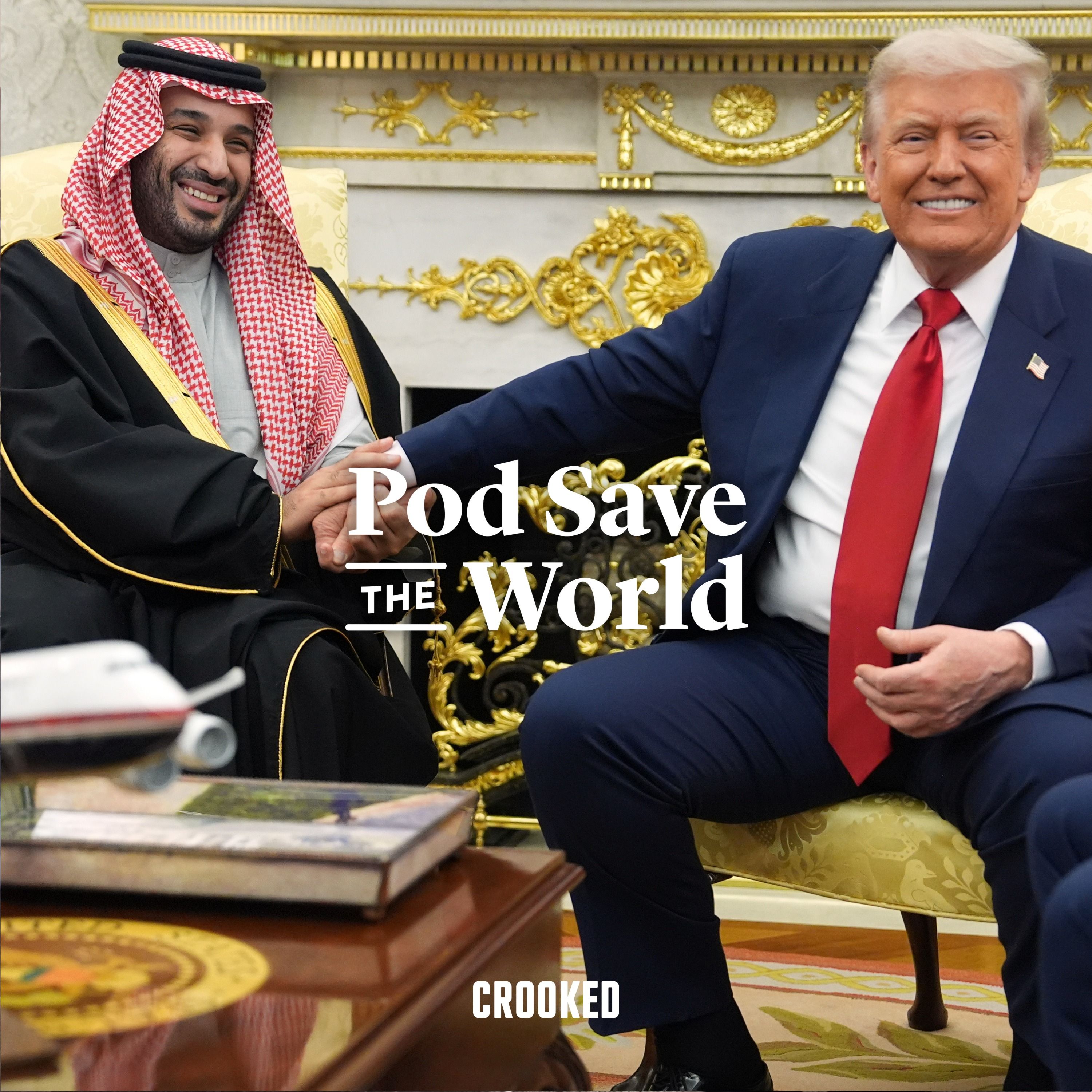
Speaker 1 Mohammed bin Salman's kind of quasi-state visit in Washington. So it's Saudi Crown Prince Mohammed bin Salman or MBS for short.
Speaker 1 It's technically not a state visit because MBS's dad is the head of state, but Trump is rolling out the red carpet. There's a black tie dinner.
Speaker 3 By the way, when's the last time you saw that guy?
Speaker 3 King Salman.
Speaker 1 Yeah, yeah, yeah.
Speaker 1 What's he doing? Just sitting in there.
Speaker 3 Not much.
Speaker 1 Yeah, yeah. Surprised that.
Speaker 3 Well, there's some health issues there.
Speaker 1 Yeah, big time. I'm surprised MBS hasn't, you know, grabbed a very expensive pillow.
Speaker 1 He doesn't need to. He doesn't.
Speaker 1 Getting cheered in the studio here. Okay, so
Speaker 1
Trump, there's lots of meetings. There's, you know, the red carpet.
There's all this stuff. So
Speaker 1
MBS is, this is his first visit to Washington since 2018. Listeners.
from back then might remember that that was the 2018 visit was like literally three weeks long.
Speaker 1 MBS, he went to D.C., he saw Trump, he got coffee with Mayor Bloomberg in New York. He went to Boston and like hung out at MIT with some robots.
Speaker 1
He went to Silicon Valley and saw the tech CEOs, like Tim Cook and Jeff Bezos and the Google guys. And he was feted in Hollywood.
Yeah, he came here. Just hanging out with a boat.
Speaker 1 Celebrities, producer, everybody. They all want his money.
Speaker 1 And MBS got all kinds of gauzy media coverage for being this great reformer.
Speaker 1 And then a few months later, MBS approved the brutal execution of a journalist named Jamal Khashoggi inside the Saudi consulate in Istanbul, Turkey. And it all went crashing down for a couple months.
Speaker 1 Now he's fully back thanks to business leaders who want Saudi money, President Biden who wanted Saudi oil, and the Trump goons who want corrupt crypto and real estate deals, as far as I can tell.
Speaker 1 So according to the various news reports, Ben, the MBS wish list for this visit is the following. You want some sort of NATO-like security guarantee.
Speaker 1 It's probably going to have to be via an executive order of some sort, like the one Trump gave to Qatar, because Congress is unlikely to approve anything without the Saudis normalizing relations with Israel.
Speaker 1 But I guess we'll see. He wants support.
Speaker 3 It's funny that that's a priority of all the things you could ask.
Speaker 1
Yeah, not sure why. We'll shoot into that.
So he wants support and technology for a Saudi civilian nuclear power program. What could go wrong there?
Speaker 1 The Saudis wanted advanced semiconductor chips to power their artificial intelligence industry and kind of match what the UAE got, basically.
Speaker 1 And then Reuters reported that NBS plans to personally appeal to Trump to intervene to stop the war in Sudan, which is objectively a good thing.
Speaker 1 But we should note that the Saudis have been backing the Sudanese military, while the Emiratis have been backing the RSF militia force. So this is also a bit of a proxy battle.
Speaker 1 So Ben, it's not clear to me what U.S. interests are going to be advanced.
Speaker 1 Trump and Biden, like they used to want the Saudis to join the Abraham Accords to normalize relations with Israel, but the Saudis say that's off the table.
Speaker 1 If the Israelis won't support a two-state solution, which
Speaker 1
BB reiterated last night on Monday night, he said he doesn't believe in a two-state solution. So you'd think that would be off the table.
Then there's the corruption piece.
Speaker 1 The Times had a great story on this that detailed how the Trump organization is in talks to lend its name to these massive projects in Saudi Arabia, including something, a $63 billion giga project, they're calling it, in the town of Daria.
Speaker 1 That's in addition to like Trump Tower, the Trump Plaza, private members-only clubs in Jeddah, other projects in Riyadh, Saudi golf events, the $2 billion that went to Jared Kushner.
Speaker 1 So, Ben, let's just, you know, you sort of preview this. Let's pretend this visit is on the level for a minute.
Speaker 1 How is it in the U.S. interest, do you think, to give the Saudis a a security guarantee or anything on their wish list besides ending the war in Sudan?
Speaker 3 Okay, so if I want to make the argument,
Speaker 3 it's a geopolitical argument. And the argument is essentially that the Saudis are sitting on top of, you know, trillion plus dollars.
Speaker 3 They've got a lot of money to spend to throw at issues at a time when there's not a lot of,
Speaker 3 you know, we're in a cash-poor world and these guys have like the biggest checkbook to take out.
Speaker 3 And, you know, I think in the Biden years, there was a sense that we don't want them to fall into the orbit of China. That essentially,
Speaker 3 if they, if they take their money and they start doing oral transactions in the RMB, the Chinese currency, it'll undermine the dollar.
Speaker 3 Or if they start buying Chinese weapons instead of ours, like that will hurt our defense industry or all these things. The problem with that is,
Speaker 3
first of all, it's not very simple for the Saudis to just kind of flip a switch and become like a Chinese satellite or something. I mean, their military has all been built by the United States.
Like,
Speaker 3 it's not as the people that are using that argument kind of overstate how much we need to court the Saudis and give them to kind of keep them engaged with us and Europeans and others.
Speaker 3 Like, they're doing just fine as it is, you know.
Speaker 3 So, I think everything he's asking for is kind of extra. You know, like, we don't need to give them a defense pact.
Speaker 3 It's not in our interest to have to go to war to defend Saudi Arabia at some point in the future. You know,
Speaker 3 we don't need to give them
Speaker 3 a nuclear program, which is something that they're also asking for. That seems crazy
Speaker 3 because they could flip a switch and turn that into a nuclear weapon if there's a sufficient amount of infrastructure in Saudi Arabia.
Speaker 3 The AI, you know, the argument you get there is the same one as, well, they might buy Chinese chips if they don't buy American chips and that kind of thing.
Speaker 3 But at the same time, that cuts both ways too, because if all these chips go to Saudi Arabia without any kind of restrictions in the same way that F-35s might be going to, seems like they're going to Saudi Arabia.
Speaker 3 Well, they actually do have relationships with China and that stuff could go out the back door too.
Speaker 3 So in a bizarre way, if we're like pouring chips into Saudi Arabia to beat China at the AI race, it actually may help China in the AI.
Speaker 3 So all these things are a little bit more complicated than they would be presented, and none of them, particularly the large investments in the Trump business interests,
Speaker 3 have anything to do with what is on the mind of most Americans.
Speaker 1
That's for sure. I think it makes total sense to give a a civilian nuclear energy program to the country with the second largest proven crude oil reserves in the world.
Yeah.
Speaker 1 It's just an obvious thing.
Speaker 3 They're in desperate need of energy.
Speaker 1 Obvious thing you would do.
Speaker 1 So Ben and I were
Speaker 1 our jaws were on the floor as we watched President Trump in MBS in the Oval Office earlier today. This is Trump taking a question from an ABC News reporter named Mary Bruce, who's very smart.
Speaker 1
Actually, we worked with her back in the day. She asked about Jamal Khashoggi, 9-11, and Trump's corrupt dealings with foreign governments.
Let's watch.
Speaker 6 Is it appropriate, Mr. President, for your family to be doing business in Saudi Arabia while you're president? Is that a conflict of interest? And, Your Royal Highness, the U.S.
Speaker 6 intelligence concluded that you orchestrated the brutal murder of a journalist. 9-11 families are furious that you are here in the Old Testament.
Speaker 5 Who are you with?
Speaker 6 Who are you with? Russian Americans. Who are you with? And the same to you, Mr.
Speaker 7 President. Now, who are you with? I'm with ABC News, sir.
Speaker 6 You with who? ABC News, sir.
Speaker 7 Fake news.
Speaker 4
ABC fake news. One of the worst in the question.
One of the worst in the business. But I'll answer your question.
Thank you. I have nothing to do with the family business.
Speaker 4
I have left, and I've devoted 100% of my energy. What my family does is fine.
They do business all over. They've done very little with Saudi Arabia, actually.
Speaker 8 I'm sure they could do a lot.
Speaker 4
And anything they've done has been very good. That's what we've done.
We've built a tremendous business for a long time. You're mentioning somebody that was extremely controversial.
Speaker 4
A lot of people didn't like that gentleman that you're talking about. Whether you like him or didn't like him, things happened, but he knew nothing about it.
And we can leave it at that.
Speaker 4 You don't have to embarrass our guests by asking a question like that.
Speaker 8 You allow me to answer. You know,
Speaker 8 I feel painful about
Speaker 8 the families of
Speaker 8 9-11 in America, but we have to focus on reality.
Speaker 8 Reality, based on CIA documents and based on a lot of documents, that Osama bin Laden used Saudi people at that event for one main purpose, is to destroy this relation, to destroy the American-Saudi relation.
Speaker 4 That's the purpose of my television.
Speaker 8 About the journalists, it's really painful to hear. It's painful, and it's a huge mistake, and we are doing our best that this doesn't happen again.
Speaker 1 So, in Trump's mind, Jamal Khashoggi, the journalist, was controversial.
Speaker 1 He has nothing to do with his family businesses, even though we watched him at the peace summit in Sharm al-Sheikh tell the president of Indonesia to call Don and Eric about a deal, presumably some sort of like, you know, golf resort in Bali.
Speaker 1 What did you make of that answer about bin Laden trying to use Saudis to divide the U.S. government? And how did it make you feel that MBS's answer was more reasonable than Trump's?
Speaker 3 Yeah, there's so much happening there. I do think that this is one for the time capsule
Speaker 3 because you are taking both the corruption and the autocracy and kind of fusing them in one presentation from Donald Trump.
Speaker 3 And the idea that he has nothing to do with his family businesses because he's not necessarily running day-to-day operations or not the bagman flying to the Gulf to pick up the check for the investments in the Trump properties is complete and utter bullshit.
Speaker 3 There's no reason that these governments would be pouring money into the Trump properties because of the business acumen of Eric Trump.
Speaker 3 They're doing it purely because of the access it gets them to Donald Trump, the preferential treatment that they think it's going to get them from Donald Trump.
Speaker 3 And they have decent reason to believe that, given the fact that we know, for instance, that lo and behold, World Liberty Financial gets a $2 billion investment from the Emiratis shortly before Donald Trump shows up and announces that there are no restrictions on AI trips and things like that.
Speaker 3 It's plugging in the Emirates, right? So, this does not take Inspector Clusot to figure out that there's a lot of corruption going on here.
Speaker 3 And Trump's efforts to obfuscate that are kind of absolute bullshit. Like, people can see what's happening before their own eyes.
Speaker 3 Then, on the Jamal Khashoggi thing, what's really depressing about this visit is that was a bit of a watershed moment in 2018 where it was such a shocking and glaring crime to murder and dismember a Washington Post journalist and U.S.
Speaker 3 resident who was a human rights activist who'd criticized MBS.
Speaker 3 You know, that even got the attention, as you said, for a few months of, you know, American business leaders weren't going to show up.
Speaker 3 I remember talking to some foreign leaders and diplomats who said there was a real moment there where actually MBS is in trouble. Like inside the Saudi royal family, did he go too far?
Speaker 3 And Trump is is the one who wrapped his arms around MBS at that time and kind of brought him in from the cold. Now, fast forward, he's all the way in from the cold.
Speaker 3
Like, this is MBS's world, and we just live in it. People like to talk about how Trump wants to be like Putin.
I don't think that's exactly the right analogy. He wants to be like MBS.
Speaker 3 He wants to sit on top of a trillion dollars. He wants to mix politics and business.
Speaker 3 He wants to be able to silence, maybe not by dismembering them, but he certainly, as he made clear in that clip, wants to be able to silence journalists who he finds to be a a pain in the ass.
Speaker 3 And look, you're right. MBS seemed like more reasonable.
Speaker 3 MBS, the person that our intelligence community says supervised the chopping up of a journalist, seemed more reasonable and less offended by not even a tough question, an obvious question that would be asked than Donald Trump,
Speaker 3 you know, who like, we can't, you know, get comfortable with the fact that he just literally said a journalist who was killed for doing his job was like a difficult guy. People didn't like it.
Speaker 3 First of all, it's not true.
Speaker 3 I don't remember like some chorus of people that were like, Jamal Khashoggi's an asshole.
Speaker 1 He was viewed as a guy who deeply loved Saudi Arabia, but was concerned about the treatment of civilians by the monarchy.
Speaker 3 Yeah, and the silencing of dissent and the kind of cult of personality around the NBS. So,
Speaker 3 yeah, I mean, and the 9-11 stuff is just, you know, they don't want the conversation to be about
Speaker 3
what bin Laden's ties might have been to Saudi intelligence or what Saudi money. I mean, I'll tell you a story.
Like, I went on
Speaker 3 the Axe Files, a now-defunct podcast by
Speaker 3 a great podcast in 2016 and Axe asked me about this Saudi relationship and I said something about them financing you know Wahhabi madrasas and you know essentially frankly in coordination with the U.S.
Speaker 3 was supporting the mujahideen in Afghanistan.
Speaker 3 They were spreading this kind of pretty strict and form of Islam and that that was kind of part of the incubator for what became the al-Qaeda and the Taliban.
Speaker 3 And we went to Saudi Arabia after that, and I was told by John Kerry and Rob Malley, who was at the time, like, you, MBS is really mad about this interview you gave to David Oxrod.
Speaker 3 And it's the first time I realized that
Speaker 3 I was like a podcast.
Speaker 3 I didn't know anybody listened to podcasts.
Speaker 1 Yeah, MBS, buddy. You got better things to watch and listen to, Paul.
Speaker 3 But so their very point is that they are very sensitive about this issue.
Speaker 3 And they redirect it to, is he wrong?
Speaker 1 And he's not wrong.
Speaker 3 Like, I'm sure bin Laden wanted to break up the U.S.-Saudi relationship. But that's not the question the families are, the families are not questioning that.
Speaker 3 They're questioning, like, do we know the full facts about whether there was any Saudi government contacts with the US?
Speaker 1
Yeah, certainly Bin Laden was pissed about U.S. troops in Saudi Arabia and in the Gulf and U.S.
foreign policy generally, but you're right, that wasn't the question at all.
Speaker 1 By the way, Crooked Media's Matt Berg spoke with Jamal Khashoggi's fiancé, you know, at the time when he was murdered.
Speaker 1 We're going to drop that in here in post just so folks can hear her perspective on all this.
Speaker 9 I got a very strange feeling, it just all came up.
Speaker 9 And it digging more in my brain, in my
Speaker 9 wound, because I feel, oh, there is a focus for his visit, for some deals and this, and Jamal being forgotten.
Speaker 9 He did take a responsibility in the 60 Minutes interview in 2019, but nothing happened behind after this.
Speaker 9 And since, okay, he took responsibility, but there is no real justice comes through.
Speaker 9 I do feel
Speaker 9 great in sense
Speaker 9 there is some development going on in Saudi Arabia, which is Yamal wish to have it.
Speaker 9 And
Speaker 9 I feel
Speaker 9 this have to align with another,
Speaker 9 something is missing with all of this development and all of this advance.
Speaker 9 It has also to
Speaker 9 maintain the human rights side as well and democratic side as well and the real justice. It have to be aligned together.
Speaker 9 There is something missing now, which is the real justice, transparent, and the democratic and the equal right.
Speaker 1 So, Ben, just to flesh out this corruption piece, I mean, a lot of it is through a company called Dar Global, which is based in Dubai, but has close links to the Saudi government.
Speaker 1
And Dar Global seems to have helped Trump just license his name to all these Gulf countries' properties like Saudi, Qatar, Oman, the UAE. Their offices in the U.S.
are based in Trump Tower.
Speaker 1 Again, a lot of this is from a great New York Times story.
Speaker 1 Also, I don't know if you saw this, Ben, the Financial Times had a report this week about how the Trump organization is collaborating with the Saudis to build a luxury resort in the Maldives.
Speaker 1 But the twist is it includes some dumb bullshit about the blockchain technology, how you can like...
Speaker 1 own like a fractal share of this like 80 villa property that by the way was announced the day before mbs's visit that's very very very subtle corruption there and then i just i noticed that um senator warren and senator jack reed asked doj and the treasury department to investigate World Liberty Financial, the Trump family's crypto company that you just mentioned, because of transactions with North Korean hackers, Russian hackers, and even Iran.
Speaker 1 So I'm sure Pam Bondi will get on that one really, really fast. But this watchdog group called Accountable.us
Speaker 1 estimates that roughly $11.6 billion or 73% of Trump's net worth is tied to his cryptocurrency ventures. And so we can see this stuff happening with the Saudis when it comes to real estate.
Speaker 1 We still don't know what, if any, participation they have on the crypto side.
Speaker 3 Aaron Powell, Jr.: No, and it's all just like a scam. And you can't even get your mind around the depths of the corruption.
Speaker 3 And the reason they migrate to crypto is it's like the easiest place to be corrupt because the money's dark and it's hard to have a paper trail. Stuff can disappear, quite literally.
Speaker 3 And you can get away with anything because there's no real oversight anymore. Not that there ever was like that robust an oversight, but at least there were investigations in the pre-Trump years.
Speaker 3 But I think the other thing you have to kind of keep your eye on in this relationship is we started by talking about really big consequential things.
Speaker 3 Like, are they going to get a bunch of F-35 aircraft? Are they going to get a defense guarantee?
Speaker 3 Are they going to get potentially a civil nuclear program?
Speaker 3 They're making really minimal investments. to get that, right?
Speaker 3 If you have a trillion-dollar sovereign wealth fund, throwing $10 billion here, $10 billion there, and again, I don't know the amounts because we don't really know, but at real estate properties, it don't really matter, or into crypto ventures, it will never lead to anything.
Speaker 3 That's literally beyond a rounding error for these guys. Yeah.
Speaker 1 And NBS knows how to play the press release game, right? His first meeting with Trump, he said he was going to spend, I think, invest $600 billion in the U.S.
Speaker 1
I wouldn't hold your breath for that to come through. You know, they're kind of running out of money in summer.
Not running out of money.
Speaker 1 They're spending more than they should be on boondoggles like the NEOM project. We just talked last week.
Speaker 1
So I don't know. But Ben, just a quick aside.
So last week we covered Syrian President Ahmed Al-Shara's White House visit.
Speaker 1 After we recorded that, this unbelievable clip popped up that we just had to play for the listeners. Please watch.
Speaker 5 Men's fragrance.
Speaker 10 It's the best fragrance. Come here, man.
Speaker 3 I have one here, sir.
Speaker 5 Try to mess up the one.
Speaker 5 Okay.
Speaker 10 So what we'll do is just take that gel, put it in, and then the other one is for your wife.
Speaker 5 You guys never know, right?
Speaker 1 So we don't know why that was set to music. I don't know if there was a little string quartet in the room or if it just got edited that way.
Speaker 1 I think it came out.
Speaker 3 It makes it sound like a hotel lobby, right?
Speaker 1 I think it came out of Shara's side, like someone in the delegation was watching her.
Speaker 3 I don't know.
Speaker 1 So, Trump, what's happening there for listeners who are not watching on Pod Save the World YouTube? And please subscribe to Pod Save the World on YouTube. We got some great stuff for you guys.
Speaker 1 A lot of funny visuals. And it's free.
Speaker 1 So Trump is spraying Shara with Victory 47, his $250 Trump Cologne, which according to the website is, quote, for men who lead with strength, confidence, and purpose.
Speaker 1 He also offered Al Shara the counterpart Victory 47 Perfume, which, quote, captures confidence, beauty, and unstoppable determination for Shara's wife or wives.
Speaker 1 Trump helpfully asked him to clarify how many wives he had,
Speaker 1 which, you know.
Speaker 1 Made me laugh, but it was a weird fucking question.
Speaker 1 It was real weird.
Speaker 1 Whoever's filming it laughs. It was real weird.
Speaker 3 Maybe Trump's getting a little, you know, Sharia curious there. I don't know.
Speaker 1 But I have to say, like,
Speaker 3 it was objectively funny thing to watch.
Speaker 3
It also, I know this is like such a tired cliche, but like this guy was in like a U.S. prison in Iraq.
Then he was like fighting in northern Syria for years. He's got like a bounty on his head.
Speaker 3 And suddenly the president of the United States is spraying cologne on him in the Oval Office.
Speaker 1 It's crazy.
Speaker 3 Just like a one of seven billion life that this guy has.
Speaker 3 The movie rights alone. I don't know who play Al-Shar in the movie, but like that would, that, that would be quite the biopic.
Speaker 3 But I, I,
Speaker 3 I, the, the wives question, though, like, does that land poorly?
Speaker 3 Like, is that, I mean, because clearly it's like some, something he, you know, he has one of these kind of like Orientalist, you know, 100% views of like, if I was a Muslim guy with a beard, maybe I'd have like nine wives and maybe that'd be cool or something, you know?
Speaker 1 Yeah.
Speaker 3 There's a little bit of a, of, of a wish fulfillment in that question.
Speaker 1 Yes, you're right. I mean, although,
Speaker 1 you know, I don't know that the bounds of marriage really keep Trump from
Speaker 3 explorations. Yeah, that's true.
Speaker 1
That's true. That's true.
But yeah, I couldn't tell if Al Shar just kind of laughed because the situation was weird. I never know about like kind of translation and what he understands.
Speaker 3
What a weird thing for the translator, too, by the way. Yeah.
I mean, you're, you know, you, you, suddenly, this is like the conversation you're just talking.
Speaker 1 Yeah, you're like flipping through your mind, like, concubine, concubine. Where's that one? Yeah, yeah.
Speaker 1 Potse of the World is brought to you by Soul. When the holiday season rolls around, it feels like there's a party every weekend.
Speaker 1 All the sugary drinks add up this season reach for Soul's out-of-office gummies instead. Same fun vibe, low in calories, and zero hangover.
Speaker 1 Soul is a wellness brand that believes feeling good should be fun and easy. Soul specializes in delicious, hemp-derived THC and CBD products designed to boost your mood and help you unwind.
Speaker 1 Their best-selling out-of-office gummies were designed to provide a mild, relaxing buzz, boost your mood, and enhance creativity and relaxation.
Speaker 1 With five different strengths, you can tailor the dose to fit your vibe from a gentle 1.5 milligram micro dose to their newest 15 milligram gummy for a more elevated experience.
Speaker 1 And if you like their out-of-office gummies, try the new out-of-office beverage, a refreshing alcohol-free alternative that's perfect for winding down on the couch or socializing with friends.
Speaker 1 With wellness at the forefront, you can feel good about what you're putting in your body.
Speaker 1
All of Sol's products are made from an organically farmed USA-grown hemp and are vegan, gluten-free, low-in sugar, and federally legal. Soul is great.
It's got a ton of great options.
Speaker 1 One I'd highly recommend is the Blueberry Lemonade Nightcap Gummies.
Speaker 1 It's like a low-dose gummy, perfect way to feel relaxed before bed, to fall asleep quickly, and then wake up feeling great the next day. Take advantage of Soul's Black Friday Cyber Monday deal now.
Speaker 1
For a limited time, get 40% off your entire order. Go to get soul.com and use the code WORLD.
That's getsoul.com, promo code WORLD for 40% off. Don't miss their best deal of the year.
Speaker 11 At 1-800Flowers.com, we know that connections are at the heart of being human. Whether celebrating life's joys or comforting during tough times, 1-800 Flowers helps you express what words can't.
Speaker 11 For nearly 50 years, millions have trusted 1-800 Flowers to deliver thoughtful gifts that help create lasting bonds. Because it's more than just a gift, it's your way of showing you care.
Speaker 11
Visit 1-800-Flowers.com/slash SXM and connect today. That's 1-800Flowers.com/slash SXM.
SXM.
Speaker 1 So, Ben, the Saudis, though, they're not the only ones getting in on the corruption game. We wanted to talk about Switzerland for a minute and an incredible story about corruption.
Speaker 1 So, back in August, Trump reportedly had this disastrous phone call with the president of Switzerland, Karen Kelly Sutter. I think we covered it at the time, Ben.
Speaker 1 I think Trump was mad about the trade deficit.
Speaker 1 So, the Keller Sutter didn't grovel enough. So, after the call, Trump jacks up tariffs, and And that led her to calling this like emergency cabinet meeting to figure out how to fix the problem.
Speaker 1 It was like an actual crisis for the Swiss. So fast forward to earlier this month, the Swiss, they dispatch this group of Swiss business leaders and billionaires to meet with Trump.
Speaker 1 That crew brings with them a $130,000 gold bar. paging Bob Menendez, engraved with a 45 and a 47 on it and a gold Rolex desk clock.
Speaker 1 Now, technically, this bribe was paid to the Trump Presidential Library, not Trump himself. Big wink.
Speaker 3 Wink for you. I'm sure that that'll be for you.
Speaker 1 I need an exhibit.
Speaker 1
Either way, it worked. Now, tariffs are down to 15%.
So, again, I'm tempted to laugh at just the brazenness of printing 45, 47 on a gold bar and offering it up as tribute.
Speaker 1 But, you know, when you add it all up, like, we're the ones getting fucked here. Like, I don't know what the U.S.
Speaker 1 should be demanding from the Swiss in a bilateral trade deal, but it's probably not a gold bar for a deal leader.
Speaker 3 I was in Switzerland a couple weeks ago. I was in Geneva and Baron, beautiful.
Speaker 1 Geneva is beautiful.
Speaker 3
Yeah, both beautiful places. And the tariff thing was all anybody was talking about.
It was 39% tariff. And everybody's like, the Swiss are very reasonable.
Speaker 3 So they're like asking me, you know, why this number? Why 39%? Don't you know that we are a net importer of services from your country?
Speaker 3 Like you just add this trade deficit thing up. And people are like yelling at me about.
Speaker 1 You're like, well, sir, Kevin Hasett tariffed an island full of sheep in the South Pacific.
Speaker 3 So they were taking it very literally, but clearly they arrived at a different kind of strategy. And to your point, I mean, this is the crassest form of corruption.
Speaker 3 This is like medieval shit where there's like a king of like with a bigger army that you have to show up literally with like a gold brick.
Speaker 3 I mean, they probably just had to like go into some castle and dust off the playbook from like the 15th century. Like,
Speaker 3 how do you deal with like a bad tariff duty?
Speaker 3
Because there's nothing subtle about a couple of gold bars and a gold Rolex clock. And there's certainly nothing in that for US taxpayers.
And again, I desperately want people to bookmark this.
Speaker 3 All of the people that like to Sain-Wash Trump or like to, you know, I've had at some of my speaking engagements, people be like, well, isn't it time that we had an economic strategy to stand up for manufacturing in this country?
Speaker 3 If this was truly some theory of the case about reversing the iniquities of globalization through the use of tariffs, you wouldn't be relinquishing tariffs on Switzerland in exchange for gold bars.
Speaker 3 No. This is not a strategy for anything other than enriching and empowering Trump.
Speaker 1
Yeah, the Swiss are dusting off the playbook for like the Burgundian wars from the 1470s. Oh, good friends.
Yeah, thank you. I Googled quickly.
Speaker 1
Yeah, it's insane. It's so insulting.
It makes us look like just the most
Speaker 1
smart bit dictators. But anyway.
All right, Ben. So switching gears here.
Speaker 1 In the last couple of weeks, there's been a lot of really interesting reporting on FBI Director Cash Battell, who, according to one report in the Minnesota Star Tribune, is referred to as, quote, a giant douche canoe by a top aide to Stephen Miller.
Speaker 1
So point for Stephen Miller here. But let's tick through some of the things we learned about Director Canu from these articles.
It was the Wall Street Journal did a great one.
Speaker 1 The New York wrote a long piece the other day.
Speaker 1 And we'll kind of learn about some of the many controversies that are swirling around Cash Patel and the FBI right now. So the first is Cash Patel's use of the FBI's private jets.
Speaker 1 We've discussed this on previous episodes. Back in the day, Cash viciously attacked then-FBI director, Christopher Wray, for using the FBI's planes for personal travel.
Speaker 1 Now, Cash does the same thing all the time. He flies to Nashville to visit his 26-year-old quote-unquote country music sensation girlfriend, Alexis Wilkins.
Speaker 1 Cash even flew to Pennsylvania to see her sing the national anthem at a low-rent wrestling event.
Speaker 1 And then, according to the Wall Street Journal, after the wrestling event, Cash flew Wilkins home to Nashville, and then he continued on to a place called, I shit you not, the Boondoggle Ranch in Texas.
Speaker 1 It is owned by a big Republican donor named Bubba.
Speaker 3 It is stocked.
Speaker 3 Stop. This is
Speaker 3 fiction, right?
Speaker 1 You're wondering if Trump spent some one-on-one time time with Bubba? Yeah, yes. Per some recent reports.
Speaker 3 Yes, yeah, yeah, yeah, yeah.
Speaker 1 The ranch, the Boondoggle Ranch, is stocked with exotic animals that you can murder via the comfort of your customized Hummer. So there's that.
Speaker 1 Patel has reportedly asked an FBI SWAT team from Nashville to provide security for his girlfriend, which is just like nuts and unprecedented. Though we should note, she is like a MAGA influencer type.
Speaker 1 She shitposts a lot, and she has been baselessly, as far as we know, accused of being a massad agent by various right-wingers. The evidence is basically she's hot and Cash Patel is ugly.
Speaker 3
And she works at Prigger U. Prigger U.
She used to work at Prigger U.
Speaker 1 Yeah, which is some Israeli tenuous connection to the Mossad or whatever.
Speaker 3 I'm just saying, I'm just relaying the.
Speaker 1 Yeah, no, you're just relaying.
Speaker 3 I don't get sued here because she's suing everybody.
Speaker 1 She's also suing a bunch of right-wing animals.
Speaker 1
One for like $5 million. Yeah.
It's a lot of money. It's a lot of money.
Okay,
Speaker 1 it's going to open him up to discovery, too. It seems like a bad idea.
Speaker 3 Yeah, it seems like a bad idea.
Speaker 1 Okay.
Speaker 1 So there's also a public interest group called Public Citizen that has accused Cash Patel Patel of illegally failing to disclose his work for the government of Qatar and for failing to register as a foreign agent.
Speaker 1 Public Citizen also claims that DOJ changed the way it enforces the rules around foreign agent registration to prevent Cash from ever having to disclose what he did.
Speaker 1 Also, according to the New Yorker, almost a quarter of the FBI's more than 13,000 agents have been assigned to work on the apprehension of undocumented immigrants.
Speaker 1 We have talked a lot on this show about the kind of opportunity cost of reorienting all these agencies to do stupid shit. That quantifies it better than anything I've seen.
Speaker 1 There's also the more pedestrian stuff about Cash being just kind of bad at his job when he's tweeting out inaccurate information about ongoing investigations or pushing out competent agents who are just perceived to be liberal in some way.
Speaker 1
Or apparently the deputy director, Dan Bongino, didn't have to get a polygraph like everybody else does. So weird stuff.
So, Ben, let's just pause there. Like, we've talked about the flight stuff.
Speaker 1 I just want to harp on it for one second because I do think it speaks to a mentality within this organization.
Speaker 1 Because cash defenders will say, look, by law, he has to fly on an FBI plane because he needs the secure comms.
Speaker 1 But like, what makes me so mad about this is when you sign up to be a top national security official, you're like, I would say implicitly, but really explicitly agreeing to make that job your entire life.
Speaker 1 through the duration of the time you have it. You know what I mean? Like CIA director, FBI director, national security advisor, like homeland security advisor.
Speaker 1 Those people are not going to fucking ranches for the weekend to hunt big game. Like we worked with John Brennan when he was Obama's
Speaker 1
counterterrorism advisor and Homeland Security Advisor at the White House before he went over to the CIA. John had his knee replaced and then showed up for work the next day.
It might have been a hip.
Speaker 1 I can't remember. It was one of the other things.
Speaker 3
It was one of the two, but it was fucking weird. Yeah.
Yeah.
Speaker 1 He was at work the next day with a big cut and a brand new knee.
Speaker 3 Hopefully, I'll percocet or something.
Speaker 1 No, John, probably not. Probably not.
Speaker 3 Probably just fucking white knuckling.
Speaker 1
But like, you got Cash Ratell is flying to the ranches for the weekend. He's going to hockey games with Wayne Gretzky.
He's flying to UFC events. Like that, that's not the job.
Speaker 1 You sit in the fucking skiff and you try to stop bad guys. That's your whole life until you quit.
Speaker 3 Yeah, you know, the plane is not intended to like support the lifestyle of a MAGA influencer, which is essentially what he's living with these kind of random weekends.
Speaker 3 There are also other resources, too. Did you see that she's getting now like security from like FBI
Speaker 3 teams? SWAT teams, literally. And he keeps redirecting it, even when he was attacked mainly by MAGA people, as well as like a few libs like Asu.
Speaker 1 He's really mad at the right wing, though.
Speaker 3 But he took umbrage by saying what a great American patriot his girlfriend was. Like, people are not attacking your girlfriend, bro.
Speaker 3 Like, people are attacking you for being corrupt and incompetent and a little fucking weird. Okay.
Speaker 3 And
Speaker 3 so he's just redirecting, you know, the security for her and all this stuff.
Speaker 3 But the reality about a guy like Cash Patel that I find interesting is, is that, look, it's going to do a lot of damage in the short term.
Speaker 3 I mean, you mentioned that one story.
Speaker 3 The Times did a big deep dive on the DHS gaps that are being left by this focus on immigration enforcement that included areas like child protection and cracking down on child sex trafficking and pornography, like another thing that they just seem to be going pretty late on over at the FBI these days.
Speaker 3 But the reality is, in addition to being kind of this,
Speaker 3 you know, I mean, he's not even like one of these guys that's like
Speaker 3 going to go back to being a rich guy. Like, Cash Patel's future is as like a post-MAGA influencer.
Speaker 1 So,
Speaker 1 he's actually got some problems.
Speaker 3 Like, Cash is like taking on some water here because he's going to have to go back to like podcasting and YouTuber.
Speaker 3 And, you know, I don't know how long the girlfriend's going to stick around when he doesn't have the private plane anymore. So, he's kind of hanging on by a thread here.
Speaker 3 But the thing that bothers me whenever these kind of stories come up is, and we can tie together the MBS thing into this all.
Speaker 3 Do you ever feel, Tommy, like we are now like citizens of universe that is a fantasy camp for the worst fucking people in the world?
Speaker 1 The biggest
Speaker 3
thing. Cash Patel's like living fantasy camp, right? He's got his like 26-year-old girlfriend.
He's flying down to the Boondoggle Ranch and he's going to UFC fights.
Speaker 3 MBS is coming here and saying like you get a trillion dollars and he walks away with everything he wants. You know, Eric Trump's vacuuming him up billions of dollars in like crypto investments.
Speaker 3 And what are we doing here? You know, we're just literally like extras in the movie of their fantasy camp.
Speaker 3 I'm getting a little tired of it.
Speaker 1
It sucks. And then like the damage is being done left and right.
I mean, Cash Patel was angry and embarrassed by reporting about his use of the FBI jet.
Speaker 1
So he, like, in a fit of peak, fired a guy who was like in charge of the aviation program. That dude was also in charge of hostage rescues and child abduction cases.
Like, okay,
Speaker 1 I'd rather keep that guy around. I mean, to your point about him returning to be a podcaster,
Speaker 1 I think it was the New Yorker story noted that his podcast back in the day was produced by the Epic Times, the fallen gong kind of
Speaker 1 Chinese thing.
Speaker 1 There was a former senior White House official from like Trump 1.0 who was asked about Cash Patel and New Yorker, and they said Cash was seen as lazy and had no significant achievements during his time.
Speaker 1
And then just on your fantasy camp point, I just, it is worth noting that he's just a fucking dork. Yeah.
He's a huge dork and a loser.
Speaker 3 I guess that's how I feel better about it is because I don't even know that that guy knows how to have like a great time at the Boondock Orange, you know, like he's just such a weird, he looks so uncomfortable in his skin.
Speaker 3 And that's actually like what we have going on these guys is like some of them like Steve Miller literally look like they're being eaten from within by an organism of like hatred.
Speaker 3 Some of them like Cash Matte just look like deeply uncomfortable.
Speaker 1 No, they're not.
Speaker 3 They're just standing there like with their arms rigid and like weird looks on their face. Right.
Speaker 3 And then some of them like Trump are just like, whatever the fuck, like I just can't believe I, you know, get to do this every day. Right.
Speaker 3 But I will say, and you know, we don't do this that much anymore because we're 10 years into this Trump decade.
Speaker 3 But man, the people that like to lecture us on law enforcement and the sanctity of law enforcement, and
Speaker 3 you must honor the police. It is so fucking disrespectful to law enforcement in this country to have this guy running it.
Speaker 3 He's a client. And
Speaker 3 just advice to Democrats who are being called soft on crime.
Speaker 3 You might point out that putting Cash Patel in charge of the FBI to fly a jet around to see his girlfriend perform at like wrestling matches is not exactly a tough on crime.
Speaker 1 Put a photo of him in your wallet and bust it out any time someone yells at you to back the blue. Yeah, also to my friend Charlie Kirk, rest now, brother.
Speaker 1
We have the watch, and I'll see you in Valhalla. That's what he said about this.
I'm still trying to make good
Speaker 1
sense of that one. That is the most try-hard, try-hard shit I've ever heard in my life.
You're not a Viking, sir. Also,
Speaker 1
he gives out these challenge coins. It's designed to look like the Marvel character called the Punisher.
We're going to throw it up on the screen for, again, for the YouTube viewers.
Speaker 1 It is hard to overstate how lame and ugly it is.
Speaker 3 again go to youtube if you want to see it but it's like it's the shape of a skull there's three guns on it for some reason there's the number nine because he's the ninth fbi director there's cash the signature there's the fbi seal like a lot of time went into planning something this lame yeah he is the kid the tried yard kid like you know he was that freshman in college that like you know did too many keg stands in 30 minutes and had to have his stomach pumped because he was just trying to like trying so hard to be like the you know like it's just you know what it's okay to just be yourself, you know?
Speaker 3 Yeah, for just,
Speaker 3 you're probably a little bit closer to being yourself when you wrote the children's book about the wizard named Donald, you know,
Speaker 3 but because this, this, this Punisher, you know, country music boyfriend, it's just, it's not very convincing.
Speaker 1
She's not that into you, dude. Okay, so back in the day, Cash Patel used to talk a lot about the Epstein files and pledged to release them.
Now he's part of the cover-up.
Speaker 1 So we're not going to get into Trump's kind of crazy stonewalling of the release of the Epstein files because that is once again dominating the domestic political debate in the U.S.
Speaker 1
And by the way, it's like I was listening to the BBC this morning, it was like the lead story there, too. It's everywhere.
But there have also been some really
Speaker 1 interesting coverage of Epstein's ties with foreign governments that we want to just quickly touch on.
Speaker 1 A lot of this comes from the roughly 20,000 Epstein documents released by the House Oversight Committee, but then Dropsight News has been mining another, I think, kind of hacked archive of Ehud Barak's emails, maybe other Epstein-related files.
Speaker 3 So
Speaker 1 a couple of things that jumped out at us. First of all, Epstein tried to pitch himself as a Trump expert to the Russians.
Speaker 1 He told the then prime minister of Norway to tell Putin that Sergei Lavrov should give him a call to talk about Trump. This was leading up to the infamous Helsinki summit.
Speaker 1 Epstein claimed to have spoken to Vitaly Churkin, the former Russian UN ambassador. So that's interesting and notable.
Speaker 1 And then there's just been a ton of reporting on Epstein's ties to Israeli government officials.
Speaker 1 So we've talked about his relationship with former Israeli Prime Minister Ehud Barak, who stayed at Epstein's house a bunch of times.
Speaker 1 There's a ton of traffic between the two of those financial relationships.
Speaker 1 Ehud Barak is also allegedly the quote-unquote prime minister named in Virginia Jufre's book. Virginia Jufrey is one of the Epstein's victims, and she says Ehud Barak raped her.
Speaker 1 She died by suicide earlier this year.
Speaker 1 And then dropsight news, they've done a bunch of fascinating reports off of both the congressional emails and then another tranche released by this hacking group that looked at Epstein's relationship with with another senior Israeli intelligence official who lived at Epstein's house in Manhattan on and off from 2013 to 2016.
Speaker 1 That's weird.
Speaker 3 You haven't had former Israeli intelligence
Speaker 3 intelligence officials live at your house for three years?
Speaker 1 And there's also like lots of weird kind of clearly code-worded emails that leaked out being like, return the headphones.
Speaker 1 Return the airpods.
Speaker 3 The eagle flies at 12.30.
Speaker 1 Weird shit, man.
Speaker 1
And then they looked at Dropside News Day. They looked at the role Epstein played in brokering security deals between Israel and Mongolia and then Israel and Côte d'Ivoire.
As one does.
Speaker 1
Oh, yeah, as one does. And then Epstein's attempt to set up a back channel between the Israelis and the Russians over Syria.
So these reports are worth your time. They're long, they're complicated.
Speaker 1 We're not going to dig into all of it. But Ehud Barak clearly seems to have lied about his business relationship with Epstein.
Speaker 1 And clearly, anybody who has thought that Epstein had ties with the Israeli intelligence community that had not been disclosed sure seem vindicated.
Speaker 1 In fact, one might argue that Ehud Barak and Epstein were kind of international arms and spyware dealers.
Speaker 3 Yeah, this Ehud Brock relationship seems even closer than like any of the other Epstein relationships that have been discussed, right?
Speaker 1 Besides maybe Larry Summers.
Speaker 1 Looking for dating advice. Jesus Christ.
Speaker 3 Yeah, but the, you know, look, the thing about the Epstein-sadd I've ever read. It's sad as shit, but you're also, are you truly that surprised by the people that seem to turn up in these files?
Speaker 3 I don't know.
Speaker 1 A few of them. Yeah.
Speaker 3 Well, okay, yeah, I guess there are a few.
Speaker 3 But to be serious about this, like, you know, we've talked a lot about the royal, formerly known as Andrew,
Speaker 3 or Prince Andrew.
Speaker 3
But he seemed to kind of parachute in and out and stuff. Like, Ew Barack was like, like, tight with this guy for years, staying at his place, like emailing with him.
His associates are there.
Speaker 3 This is a guy that was not just the prime minister, again, was the defense minister of the country for years when we were there. And this has not gotten a lot of scrutiny.
Speaker 3 And by the way, the allegations against him are worse than we've heard
Speaker 3 about almost anybody else.
Speaker 1 Like that he's sadistic.
Speaker 3 It's like sadistic rape stuff, right? I mean, not even just ambiguous, you know, like assault claims. So the first point is that this is clearly like a tight nexus with Ahu Barak.
Speaker 3 Again, like this is not a conspiracy theory. These are emails we're reading, you know.
Speaker 3 And in Israel, as in the United States, unlike the UK, there doesn't seem to be this, you know, the mark of shame only falls on people who have the capacity to be shamed.
Speaker 3
So Larry Summers feels, it seems like he has a capacity to be shamed. He came out, gave a very like sad seeming statement.
That doesn't make it better.
Speaker 3
But it's just interesting that you don't hear much from Barack. You hear nothing, obviously, from Trump other than denials.
And then the secondary question about the, look, this Israel question is,
Speaker 3
it's not just kind of fringe stuff here. I mean, this guy was literally doing foreign policy type stuff with the Israeli government.
Like, that is clear from the emails. The Israeli government
Speaker 3 makes use of all kinds of relationships around the world.
Speaker 3 They like to brag about their connections in all kinds of countries and their, you know, Mossad's capacity to kind of run influence operations.
Speaker 3 So yeah, I mean, as this more information comes out, it is a legitimate line of inquiry to want to know more about that.
Speaker 1
Yeah, and shout out to Dropsight News for being some of the only ones covering it. There has been a strange lack of quote-unquote mainstream media coverage.
I mean, I don't know if that's because
Speaker 1 these documents are allegedly hacked by, I mean, even Dropsight was like, they're alleged to have ties with like the Iranian governments. We don't know how all this got out there.
Speaker 1 Maybe there's sort of like ethical questions or challenges verifying some of the documents. I don't know, but it is the lack of coverage is surprising.
Speaker 3 And look, the thing I'd say is, is yes, like people don't want to kind of jump all the way to the worst kinds of conspiracy theories that exist in the world, which are like, you know, anti-Semitic conspiracy theories.
Speaker 3 What we have to recognize, though, is that there's something in between saying like, there's nothing to see here, so we won't even look.
Speaker 3 And then saying, like, you're Candace Owens, and that, like, this entire thing was a creation of the Israeli government, right? There's some, there's a huge gray space in between those two things.
Speaker 3 And it's pretty obvious that Epstein was somewhere in that gray space. Right.
Speaker 1 And so is Ehud Barak.
Speaker 3 And it's, and so is Ehud Barak, and so is this random dude that lived with Epstein. And so is the question of why Jeffrey Epstein is involved.
Speaker 3 Trust me, if you're a New York, like, you know, wealth investor financier slash child trafficker on the side,
Speaker 3 I don't know why you're brokering a Cote d'Ivoire security agreement for the Israeli government.
Speaker 1 Right.
Speaker 3 It's not a normal thing that you do when you're like managing money for rich people.
Speaker 1
Yeah, it's really weird. Presumably the Israeli government could just call someone over there and set up a meeting.
You mentioned Prince Andrew,
Speaker 1 the prince formerly known as Prince Andrew, I guess.
Speaker 1 We've covered
Speaker 1 his scandals. We've covered the king recently stripping him of various titles and kicking him out of one palatial manor and into another, basically.
Speaker 1
But Andrew was always denied having met Virginia Duffrey. There's a infamous picture of them together touching each other in an intimate way.
Not an intimate, well, like
Speaker 3 given she was like 17 or something.
Speaker 1 He says it was doctored.
Speaker 1 Well, in this latest raunch of emails that was released, there's a message from Jeffrey Epstein to his former publicist saying, yes, Andrew met Virginia Duffrey and they took a photo together.
Speaker 1 So no surprise, Prince Andrew was a fucking liar.
Speaker 3 That guy is not only a liar, he's like a terrible terrible liar, terrible person. He's like frantically lying while resigning things.
Speaker 3 I mean, he doesn't give off I'm innocent vibes. Let's just say that.
Speaker 1 No, he does not.
Speaker 3 Mr. Monbatten now, I think, right?
Speaker 1
Right, yeah. He has a new name.
Yeah.
Speaker 3 Well, it's got to be weird to get a new name.
Speaker 1 Best of luck.
Speaker 3 60s or whatever his 70s.
Speaker 1
Old creep. We're going to take a quick break, but before we do, I wanted to let you know that the holidays are here.
Ben?
Speaker 1 Happy holidays.
Speaker 1
I guess we're having those this year. Now is the perfect time if you're looking to get something.
Go to the crooked store and snag gifts for your favorite activists and friends of the pod.
Speaker 1 We have everything from conversation-starting stocking stuffers to cozy sweatshirts that you'll be wearing all winter.
Speaker 1 We should make like a pod save the world like chew toy dogs. Yeah, yeah.
Speaker 3 I hope I have conversation starters.
Speaker 1
It's a brainstorm. The last day to purchase to ensure you get your order by Christmas is December 11th for domestic consumption and December 7th for international shipping.
So order soon.
Speaker 1 Go to crooked.com/slash store to shop.
Speaker 1
This episode is sponsored by BetterHelp. The holidays can be a blast, but also can be challenging for people too.
And it's important to look for help if you're struggling.
Speaker 1 This November, BetterHelp is encouraging everyone to reach out, check in on friends, reconnect with loved ones, and remind people in your life that you're there.
Speaker 1 And if you could use a little extra support this season, BetterHelp is there for you. BetterHelp therapists work according to a strict code of conduct and are fully licensed in the U.S.
Speaker 1 BetterHelp does the initial matching work for you so you can focus on your therapy goals.
Speaker 1 A short questionnaire helps identify your needs and preferences, and their 12 or more years of experience in industry-leading match fulfillment rate means they typically get it right the first time.
Speaker 1 If you aren't happy with your match, switch to a different therapist at any time from our tailored Rex.
Speaker 1 With over 30,000 therapists, BetterHelp is one of the world's largest online therapy platforms, having served over 5 million people globally, and it works with an average rating of 4.9 out of 5 for a live session based on over 1.7 million client reviews.
Speaker 1 This month, don't wait to reach out, whether you're checking in on a friend or reaching out to a therapist yourself. BetterHelp makes it easier to take that first step.
Speaker 1 Our listeners get 10% off their first month at betterhelp.com/slash crooked world. That's betterhelp h-e-l-p.com/slash crooked world.
Speaker 1 A massage chair might seem a bit extravagant, especially these days. Eight different settings, adjustable intensity, plus it's heated and it just feels so good.
Speaker 1 Yes, a massage chair might seem a bit extravagant, but when it can come with a car,
Speaker 1 suddenly it seems quite practical. The Volkswagen Tiguan, packed with premium features like available massaging front seats, it only feels extravagant.
Speaker 1 All right, Ben, we're going to turn to this fascinating report about the Chinese government using AI to automate most of its hacking operations. We wanted to dig into it.
Speaker 1 So, this was first reported by the Wall Street Journal, and then Anthropic, which is a big AI company whose tools were used by these Chinese hackers, put out a report confirming all of it and what they'd learned.
Speaker 1 So, there was a hack that happened back in September. Some Chinese hackers used Anthropic's clawed AI tool to automate 80 to 90% of their attack.
Speaker 1 And they could do things faster than any human being possibly could. And they were able to basically start these
Speaker 1 hacks and then only sporadically intervene, only have like human decision making at a couple key decision points, like should we continue? Should we stop? Things like that.
Speaker 1
The specifics of this hack were pretty limited. Like Anthropic said they detected about 30 targets.
The hacking, the execution wasn't perfect.
Speaker 1 So like the AI hallucinated some, you know, login and password stuff and messed up a few times.
Speaker 1 But going forward, if other hackers or their state-backed entities are able to get around safeguards that are put put in place by AI companies like Anthropic and then use those tools as publicly available tools to hack other targets, like the volume of hacking that happens in the world could just go up like exponentially.
Speaker 1 And so that is a scary prospect and like the defensive side never has keeps up with the offensive operations.
Speaker 1 And so Crooked Media's Matt Berg actually caught up with Senator Chris Murphy on Tuesday to talk about this issue and the total failure by Washington to regulate AI systems.
Speaker 1 And And he had sort of an interesting observation about the way industry is trying to avoid regulation. Let's listen.
Speaker 12 There's a lot of power in the AI lobby. The industry uses China as a red herring, right?
Speaker 12 They tell us that, well, if you regulate us at all, even lightly, China will gain an advantage and ultimately control the global AI industry.
Speaker 12 That argument is a red herring.
Speaker 12 In fact,
Speaker 12 China would delight if the United States put no regulation, no restriction, no protection on our AI systems and the AI destroyed American society and civilization before it destroyed Chinese society and civilization.
Speaker 12 China is actually being fairly thoughtful about the way that it rolls out AI. It is not going to use its citizenry as guinea pigs to test different versions of dangerous AI.
Speaker 12 They have more guardrails imposed by their federal government than we have on AI. So there is no worry that we are going to hurt ourselves by smart, sensible regulation of AI.
Speaker 12 In fact, it's probably the only way to protect ourselves.
Speaker 1 So, you know, it's worth saying it's not just China that's using these AI models.
Speaker 1 According to the Wall Street Journal, Google also spotted Russian hackers using an AI model to make like customized malware. But Ben, I mean, like, this is
Speaker 1
a massive problem. It's like one of those, this is one of those problems that only government can solve.
And we're just like, the White House is just absolutely.
Speaker 3 It's the huge story that just doesn't break through because there's so many dimensions to it, right?
Speaker 3 When you think about what's worrying about AI, you could think about security threats like could the AI be used to create like a biological pathogen, like a new pandemic.
Speaker 3 You worry about these offensive cyber attacks that I'll come back to.
Speaker 3 You worry about disinformation campaigns like deep fakes that are incredibly credible that can radicalize people or like cause a crisis. And then you just think about like job displacement.
Speaker 3 You think about AI companionship issues,
Speaker 3 teenagers committing suicide, and things like this. And I think it's so big that people are like, I don't know what to do about this, you know?
Speaker 3 But the reality here is that we might look back on this time and Trump is like a secondary story.
Speaker 3 Like there's a world in which, you know, I've thought about this like 20 years from now, like Trump was the analog to like what was really happening, which was that like we were just like giving over society to like artificial intelligence.
Speaker 3 And just to take the anthropic example here, this is already here, right?
Speaker 3 And you don't have to be a computer genius to realize that AI can both do things faster and potentially better, particularly in this kind of space, right?
Speaker 3 I mean, studies have already shown it's better at things like coding, it's better at programming makes sense because it's, you know,
Speaker 3 artificial intelligence, but it can also repeat things like at a volume that we can't even get our minds around. Like instead of one cyber attack, there could be a million, right?
Speaker 1 Yeah, it's like a volume game, right?
Speaker 1 Especially like password phishing and stuff.
Speaker 3 And a lot of cyber defense is a volume game. It's like you're a goalie and you're trying to keep out all these shots and all of a sudden like the shots went up a million X.
Speaker 3 And I think these AI agent cyber attacks, people have to realize is this is like the dial-up modem version that the fucking Chinese were using from Anthropic.
Speaker 3 Three years from now, when we've reached AGI, artificial generative intelligence and supercomputer and smarter than human beings, this stuff, if you're just like a North Korean, you're like, crash the power grid in Los Angeles, you know, like this stuff is going to happen.
Speaker 3 And the idea that we're putting no guardrails on it to connect it back to Saudi Arabia, if you want to know why it's kind of weird to just let them buy as many chips as they want and build as many data centers and have as many large language models.
Speaker 3 It's this. It's like, what might MBS want to do with AI in four years? You know,
Speaker 3 whether, I mean, just let your mind run, you know, with that for a little bit.
Speaker 1
Yeah, add in like a successful quantum supercomputer that can break any encryption. Yes.
And we are in real trouble.
Speaker 3 And that's why what you should want, and I actually don't even like this paradigm of like racing the Chinese, because the Chinese are going to get it.
Speaker 3 Like there's no world in which the Chinese don't have the same technology. And so what we normal times, we'd be negotiating with the Chinese, like a whole new global regime of regulations, right?
Speaker 3 Not just national ones, but international regulations for this stuff. But it's just not happening.
Speaker 1
Yeah, like, obviously, I don't love the Chinese. I don't trust them.
What I hate about this setup is it's like the same
Speaker 1 handful of assholes that ruined society through social media are now in charge of this stuff. It's like we're giving Sam Altman the keys to the kingdom here.
Speaker 3
And people don't even, I don't even think people are. Mark Zuckerberg.
And people are not excited about it. You know, like social media, like people were, you know, they liked it, right?
Speaker 3 I don't, most people I know are kind of like, fuck, this thing seems like it sucks.
Speaker 3 You know, like, like, you know, and like Sam Altman's doing these like weird interviews and he's like not convincing, you know,
Speaker 3 it just, it, like, it, I think,
Speaker 3 frankly, we need to help these people not destroy society. You know, like, they, they should want regulation, you know,
Speaker 3 because frankly, in the absence of regulation, it's more likely something really bad happens that causes like people to really react, you know?
Speaker 1 Yeah, I'm sure Elon Musk will be on it. He'll be really thoughtful.
Speaker 3 That's the thing. You're counting on like, you know,
Speaker 3 it's tough when you're counting on like Elon to self-regulate.
Speaker 1 Remember the point of this when he was like seen as like the one, the canary in the coal mine telling the truth about AI and like sounding the alarm.
Speaker 1 And now he's just racing to try to beat everybody too. He's just a rapacious capitalist with a weird, you know, at times Nazi.
Speaker 3 Yeah, and people have to realize that the goal of Elon is not to have Grok answer your weird weird queries on X about, like, you know, did this person really like, you know, shoot their dog or something?
Speaker 3 I mean,
Speaker 3 it's this next level.
Speaker 1 It's domination, it's AGI, and it's also displacing like as many workers as humanly possible at Tesla factories with robots.
Speaker 3 Yeah. Just like it's already happening at Amazon.
Speaker 1
Great future we got here. All right, we're going to take a big swerve here, Ben, and talk about Bangladesh.
I think we've talked about Bangladesh. Actually, we probably talked about it last summer.
Speaker 1
Oh, we did went to the next one. Yeah, in detail.
Yeah, so last summer there was a huge protest movement and then a violent crackdown on these student protesters that killed at least 1,400 people.
Speaker 1 So the protest kicked off when the Supreme Court of Bangladesh reinstituted a rule that set aside 30% of civil service jobs for the descendants of fighters in the Bangladesh liberation war against Pakistan back in 1971.
Speaker 1 Before that war, Bangladesh was known as East Pakistan, and then there was this
Speaker 1 liberation war.
Speaker 1 But like so many of these protests that we've covered on the show, the kind of quota ruling was the tipping point that got people into the streets where they expressed long-standing anger about corruption, lack of economic opportunity, and a broken political system, an increasingly authoritarian political system.
Speaker 1 So the prime minister at the time, Sheikh Asina, called the protesters traitors, and then she authorized the military to shoot them on site for breaking whatever rule.
Speaker 1 So fast forward to Monday, the Bangladeshi International Crimes Tribunal, a court in Bangladesh, sentenced Asina to death for authorizing these extrajudicial killings.
Speaker 1 And her case was kind of open and shut because they had leaked audio where she specifically authorized the use of deadly force. You probably don't want to do that on an open line next time, Autocrat.
Speaker 1 So
Speaker 1 Hasina was found guilty, but she's currently in India and refuses to return. So she was tried in absentia, and it's not clear what happens next.
Speaker 1 Bangladesh has been ruled by a caretaker government since she went into exile.
Speaker 1 That government has demanded that the Indian government return Hasina, but a bunch of political analysts don't think it's likely.
Speaker 1 It's tough politics for the the Indian government to return someone who's going to be killed, but also like she had close ties with them over the years.
Speaker 1
A lot of people think the Indian government was propping her up over the years. So we will see, I guess.
So Bangladesh has elections coming up in February.
Speaker 1 Hasina's party has been banned from participating.
Speaker 1 Ben, I don't know, how do you see this set of protests that kind of folding into the broader set of Gen Z protests we've been covering so much lately?
Speaker 3 Well, I think this one was kind of an instigator, right? It was like one of the first ones, and it succeeded to a point.
Speaker 3 It ousted her, and she would have been kind of an increasingly autocratic figure, been a dominant figure in their politics for decades.
Speaker 3 And, you know, got this transitional government under Muhammad Yunus, who was this kind of unifying figure in the country.
Speaker 3 I think one of the challenges that I see with this, though, is: look, I'm not, she was a bad leader, bad person.
Speaker 3 Number one, I'm not a big fan of like the death penalty, like in general. Like, it just
Speaker 3 am justice, but like, you know, put her in prison for life, you know? I just think like there's something kind of primal about the death penalty being like kind of the objective, right?
Speaker 3 But that ties to the second point, which is, again, that there should be accountability, right?
Speaker 3 And all these places, I'm not saying there shouldn't be, but you also really want the focus to be on, like, hey, what are we building next? You know?
Speaker 3 So you want to make sure that like vengeance doesn't overcome
Speaker 3 the opportunity of trying to do what is often harder, which is building an alternative political system in society.
Speaker 3 And so you want, to me, and I'm not suggesting that's not happening, Bangladesh, but you want to see that anger channeled constructively in addition to being directed at accountability.
Speaker 1 Yeah.
Speaker 1 Speaking of anger and how it will get channeled at corruption, let's talk about Ukraine.
Speaker 1 So there's been a major corruption scandal that's come out over the last few days that has ensnared members of President Zelensky's inner circle.
Speaker 1 Listeners might remember how back in July, Zelensky was roundly criticized for trying to weaken anti-corruption agencies in Ukraine.
Speaker 1 He backed down after there were these major protests and pushback from the international community, but people are now wondering, you know, what did he know at the time and why was that happening?
Speaker 1
So The Economist has an excellent report on what happened. Here's some details from it.
So there was this 15-month-long investigation by these anti-corruption bodies in Ukraine.
Speaker 1 They uncovered a scheme to steal at least $100 million from Ukraine's state nuclear power company. It was uncovered by all these secret recordings.
Speaker 1 They were bugging like offices and apartments and rooms. And the details are incredible.
Speaker 1 like these guys found a golden toilet bowl in an apartment that belongs to a guy named Timur Mindich who is a close friend and former business partner partner of Zelensky's Mindich left the country right before he was arrested so clearly he was tipped off somehow which raises a whole other set of questions this again is verbatim from the economist quote at one point in the transcripts one of the accused complains about back pain from lugging heavy bags of cash around Kiev that's tough that's how much they were stealing there's another individual recorded saying it would be a waste of money investing to protect parts of Ukraine's electricity grid near its nuclear power plants.
Speaker 1 And then, right before this story broke, the Russians hit those electrical substations with drones and blew them up.
Speaker 1 And so the conspirators seem to have figured out they were getting busted sometime in July. They started harassing the various members of the corruption, anti-corruption bodies.
Speaker 1 Again, that is when Zelensky's office and political party started trying to take control of the anti-corruption agency's independence,
Speaker 1 which is very bad timing.
Speaker 1 I've not seen
Speaker 1
an explanation for that. I've not seen an explanation for that.
I've also not seen a non-political actor say that Zelensky was
Speaker 1 in on the scheme or even aware of it, but there's a lot of questions being asked here because
Speaker 1 his current energy and justice ministers are among the alleged conspirators, along with a former deputy prime minister. And a lot of the money seems to have been stolen and taken over to Russia.
Speaker 1 There also, I think, is some evidence that this broader scheme started before the Zelensky administration came to be. Zelensky has called on two of the ministers to resign.
Speaker 1 He's announced sanctions on Mindich, who escaped the country. So, man, this is really bad.
Speaker 1 It already has enraged Ukrainians who can barely heat or light their homes. And then they're reading about $100 million being pilfered and these guys scoffing at the idea of protecting
Speaker 1 energy infrastructure from Russian drones.
Speaker 1 It's also going to infuriate Ukraine's international supporters who are like, why the fuck would I give these guys money if it's going to get sectioned off like that?
Speaker 1 How much damage do you think it's done? And, like, what are the odds you think that Zelensky can fix it?
Speaker 3 I mean, I think it does a lot of damage because, look, Ukraine has always had a lot of corruption.
Speaker 3 Um, a lot of the systems that were built there in the post-Soviet years, and frankly, some probably go back to the Soviet years, where kind of these everybody gets to take something off the top, and you grease something by paying off a politician.
Speaker 3 Um, but you know, Zelensky actually came to office as this kind of anti-corruption reformer type candidate, right? This outsider. And I think what the reminder is: look, you're right.
Speaker 3 There's no evidence or nobody's said that Zelensky was personally involved in this.
Speaker 3 Frankly, he's said and done the right things since this kind of came to light, at least recently.
Speaker 3 At the same time, though, it's a warning that just because you might like Zelensky and, you know, the way he's led the country, that doesn't mean that underneath him there couldn't be huge fucking problems, you know, and that he might not know about, right?
Speaker 3 But that the warning sign is this.
Speaker 3 Ukraine has drifted a bit to being like not a one-party state, but like Zelensky and his party have kind of dominating things. And when that happens, that's when this kind of shit happens.
Speaker 3 Even if the leader might be okay, if there's a sense of impunity and there's a sense that there's not like guardrails, like you know, you get bad apples in any party and this kind of shit happens.
Speaker 3 And it's especially dangerous for Ukraine because, number one, it could endanger that support.
Speaker 3 You know, who wants to be, you know, supporting a country to hundreds of millions or billions of dollars from Europe or the United States and then learn that some guys are like lugging that around in bags that were hurting their backs, literally.
Speaker 3 And also, like, you don't want to become, you know, the victory that Ukraine could win,
Speaker 3 we know, is not like reclaiming every ounce of territory and like vanquishing Russia on the battlefield.
Speaker 3 The victory is that they can emerge as a democratic society, which is how this all started, that could be a member of the European Union.
Speaker 3
Well, none of those things can happen if you're corrupt either. You're not going to join the EU.
So they have an extra responsibility to get this in order and to not get lazy
Speaker 3 and frankly to take democracy seriously because ultimately that's the prize that they have to win here.
Speaker 1 Yeah, it's a very big deal. I think the sort of I think the economist story on this reported that the next
Speaker 1
part of the government that they're going to look at, the anti-corruption body is going to look at is the defense industry. Yeah.
And, you know, there's some sense that like...
Speaker 1
Zelensky's better let that happen. Yeah.
And even if it sort of leads to him losing some top allies again,
Speaker 1 because it's sort of a question of
Speaker 1
cutting off a limb or letting the entire body get sick. Yeah, exactly.
Let's see what he chooses.
Speaker 1 So, I think I stole that from The Economist or someone quoted in it. Two more things before we're done, before we get to Ben's interview.
Speaker 1 So, we just want to keep highlighting what's happening in Sudan. So, we've covered the civil war there, it's been raging since 2023.
Speaker 1 More recently, there has been the capture of the city of Al-Fasher by this group called the RSF, the militia force, that is backed by the UAE and that is fighting the Sudanese military as part of this civil war.
Speaker 1 They are just accused of unspeakable atrocities in the Darfur region of Sudan.
Speaker 1 So, we reach back out to our friends at the Norwegian Refugee Council, who are working in a city called Tuwila, helping people who escaped Al-Fasher, you know, get services.
Speaker 1 So, this is a clip from Noah Taylor, who's the head of operations for NRC Sudan.
Speaker 13 When I arrived here again a few days ago, what struck me was as I crested this hill driving into the town, and what was
Speaker 13 burgeoning as a small makeshift camp back in June has now exploded into this sprawling megacity of a settlement with multiple sections and new arrivals still pouring in daily.
Speaker 13 I spent time with some families who had recently arrived, including a man who was reunited with his wife who'd been separated from for nine months. He walked on foot
Speaker 13 with crutches from Al Fasha with a wound in his leg.
Speaker 13 It had taken him 18 days to travel some 60 kilometers from Al Fasha to Tewila, dodging checkpoints, moving at night, moving in small groups to try to avoid those who would seek to extort him, those who'd seek to accuse him of being a soldier or intelligence, all to reunite.
Speaker 13 And unfortunately,
Speaker 13 this story is one of the happy ones.
Speaker 13 The ones that aren't are the people who sit and look out towards El Fasha daily, waiting for any sign that their loved ones could possibly still be making that journey.
Speaker 13 I've worked in displacement camps and sites like this my entire career and I've never seen anything like this before.
Speaker 1 So you know there the Marco Rubio called the Emirati foreign minister last week. Hopefully Sudan was on the agenda, but we don't know that's the case.
Speaker 1 We also saw that we talked earlier about how Mohammed bin Salman apparently came to the Oval Office today with a request that Trump help end the war in Sudan.
Speaker 1 So maybe Trump will take that seriously, but mostly it seems like they just don't care. Yeah.
Speaker 3 The only thing I'd say that's interesting is that MBS,
Speaker 3
Mohambin Zaid is the leader of the UAE. MBS and NBZ used to be super tight, and they seem to have kind of drifted apart, shall we say.
And this is one of the reasons why.
Speaker 3 But yeah, as we talked about, absent some pressure on the Emirates and others who are kind of financing this stuff, like it's going to be really hard to stop.
Speaker 1
Yeah. Final story, Ben.
So we're going to try to put the dick in dictator or measure it at least.
Speaker 1 Channel 4 News over in the UK, they produced a documentary called Hitler's DNA, Blueprint of a Dictator. They analyzed a swatch of bloody fabric from the couch Hitler killed himself on.
Speaker 1 They confirmed the blood was his, and they proceeded to start testing his DNA for like everything possible. A couple of conclusions.
Speaker 1 One, Hitler did not have Jewish ancestry despite longstanding rumors that he may have.
Speaker 1 Two, Hitler most likely had something called Kalman syndrome, which is a rare genetic disorder that can mess with sexual development during puberty.
Speaker 1 Kalman syndrome can lead to undescended testicles, and in 10% of the case, a micropenis. This tracks with an exam from a stint in Landsberg prison where doctors noted an undescended right testicle.
Speaker 1 So interesting. And one can only hope that those scientists who cloned Tom Brady's dog stay the fuck away from that swatch of fabric.
Speaker 3 So what you're saying is he had one undropped testicle and a micropenis.
Speaker 1 Sounds like that could have been the case.
Speaker 3 And it would, you know,
Speaker 3 I mean, look, famously,
Speaker 3 you know, Hitler
Speaker 3 made sure that they really burned his body thoroughly, right?
Speaker 3
And the thought was that he didn't want to get like, you know, paraded through the streets like Miss Lane. But well, maybe it was this.
I mean, maybe
Speaker 1 it's just a very
Speaker 3
tiny little secret that he was carrying around his whole life, right? Yeah. I also love, by the way, Channel 4 doing this.
And the Brits have been dunking,
Speaker 3 as they should. They've been dunking on Hitler.
Speaker 3 Like, I love that they're still dunking on the guy.
Speaker 3 Nobody deserves it more. Biggest creep in human history.
Speaker 3 We should have stories about his micropenis on a regular basis.
Speaker 1 It is
Speaker 1 a remarkable documentary. I don't know how you pull something like that.
Speaker 3 It takes a lot of patience, too, to just get on that.
Speaker 3 What was the pitch meeting here? Like, I wonder if we test his blood, whether we can find out.
Speaker 1 Yeah, I think it took a long-ass time. And I think, you know, there was the Guardian had a good write-up on it.
Speaker 1 It was like they tried to get a sample of blood from some modern descendant of Hitler, and it's like, they understandably weren't particularly interesting.
Speaker 1 That publicity is like, yeah, no shit.
Speaker 1
But anyway, I've not seen this documentary. I think it's out now.
So maybe I'll go to watch.
Speaker 1 Okay, we're going to take a quick break, but when we come back, you're going to hear Ben's conversation with Atul Gawande about the impact of USAID getting doged by Elon Musk and Donald Trump and a bunch of other assholes.
Speaker 1 So stick around for that.
Speaker 1
Ponte of the World is brought to you by Quince. Cold mornings, holiday plans.
This is when I just want my wardrobe to be simple. Stuff that looks sharp, feels good, and things I would actually wear.
Speaker 1
For me, that's Quince. And the bonus, Quince pieces make great gifts too.
This season's lineup is simple but smart and easy with Quince.
Speaker 1 $50 Mongolian cashmere sweaters that feel like an everyday luxury, and wool coat that are equal parts stylish and durable.
Speaker 1 Their denim nails the fit and everyday comfort at a fraction of what you'd expect to pay.
Speaker 1 By partnering directly with ethical factories and top artisans, Quince cuts out the middlemen to deliver premium quality at half the cost of other high-end brands.
Speaker 1
So you can give luxury quality pieces without the luxury price tag. I have a bunch of Quince stuff now.
I got a bunch of workout shirts. They've got basics.
They got some really nice jackets.
Speaker 1
If you're getting cold and you need something warmer, highly recommend the site. Check it out.
They will have something for you and it will be affordable and it'll show up fast.
Speaker 1 Give and get timeless holiday staples that last this season with Quince.
Speaker 1 Go to quince.com/slash world for free shipping on your order and 365 day returns now available in canada too that's quince.com slash world free shipping and 365 day returns quince.com slash world
Speaker 1 a massage chair might seem a bit extravagant especially these days eight different settings adjustable intensity plus it's heated and it just feels so good
Speaker 1 Yes, a massage chair might seem a bit extravagant, but when it can come with a car,
Speaker 1 suddenly it seems quite practical. The Volkswagen Tiguan, packed with premium features like available massaging front seats, that only feels extravagant.
Speaker 3 I'm very pleased to be joined by Atul Gawande, who is a renowned surgeon and public health leader. From January 2022 to January of 2025, he was also the administrator for global health at USAID.
Speaker 3 You may have read Atul's work in The New Yorker.
Speaker 3 He currently actually has a new documentary film out from The New Yorker that is meant to highlight the dire circumstances left behind by the destruction of USAID. It's called Ravena's Choice.
Speaker 3 It's short.
Speaker 3 It is incredibly powerful, and it really drives home in one story the impact that so many people are feeling. So, Atul, thanks for joining me and thanks for making the film.
Speaker 1 I'm so glad to be here.
Speaker 3 So, So let's just start with kind of the big picture of what's happened because, you know, there's a lot of attention for two weeks when you had 25-year-olds going through and firing people.
Speaker 3 And then, of course, it's the Trump era, so the camera kind of moves on to other things and people kind of memory hole what's happened.
Speaker 3 But obviously, the impacts of USAID's closure are being felt intensely around the world.
Speaker 3 And there's some estimates that show that as many as 600,000 people have already died this year because of the shutdown, including two-thirds of whom are children.
Speaker 3 Those are staggering numbers.
Speaker 3 But you're kind of warning that that could just be the beginning. Just put people a little bit inside the scale of what's happening.
Speaker 1 Yeah, so let me just start where you started, right?
Speaker 1 I was leading global health at the USAID
Speaker 1 when I departed at 11.59 on January 20
Speaker 1 at inauguration.
Speaker 1 A few hours later, President Trump signed the executive order saying that all foreign assistance needed to come to a halt. By that weekend,
Speaker 1 half of the global health staff was being let go because they were contractors and their contracts came to an end. You had
Speaker 1
all, you know, letters going out ceasing all spending of U.S. dollars.
You had medicines on the shelf that could not be distributed, food on the shelf not given to starving children.
Speaker 1 It was evident within those first few days that hundreds of thousands of lives would be on the line just in the first year alone.
Speaker 1 But there was zero curiosity, zero interest in how to mitigate that suffering. And instead, what was a pause
Speaker 1 turned into a complete shutdown of USAID. So the staff were
Speaker 1 purged, the
Speaker 1 83%
Speaker 1 of the programs were terminated, the
Speaker 1 institution was dismantled, and what remaining programs there were were transferred to the State Department and the funds were impounded.
Speaker 1 Now that meant everything from
Speaker 1 Global surveillance for bird flu that was being done in 49 countries was shut down. HIV meds halted.
Speaker 1 There are programs that are running, so things aren't at zero. The estimates that have been made have taken a fairly conservative view.
Speaker 1 The reason I went to the field and wanted to see it on the ground and brought a film team with me that followed me as I went. was because we're not going to have the actual numbers immediately, right?
Speaker 1 The mortality estimates for 2025 will be released in 2027.
Speaker 1 The data monitoring that would tell you, well, here's what services are working or aren't working, that set of funding was stopped by the administration.
Speaker 1 They also fired the inspectors general, who would be doing audits and heading into the field and seeing what happened. And so the result is you don't see what is happening.
Speaker 1
And then, you know, know, the deaths don't occur like they do in a war with everybody in one location. You go from a 3% to a 4% death rate for children.
And that's a one-third increase in deaths.
Speaker 1 But they're scattered. And just walking around, you don't see what's happening.
Speaker 1 And so following individual stories is how you begin to unpack it so we can begin to know what's happening now and you can see why.
Speaker 3 Yeah, so you,
Speaker 3 you know, sometimes people are overwhelmed by statistics and a single story can drive home what's happening in a more relatable or recognizable way.
Speaker 3 And so with Ravina's choice, you tell the story of a mother from South Sudan who's in a refugee camp in Kenya who has to make a
Speaker 3 terrifying choice about how to do it.
Speaker 1 Let's not give it away.
Speaker 3 Yeah, yeah, well, yeah.
Speaker 3 But I wanted to ask you, you know, you could have picked so many stories.
Speaker 3 Why this one and why does it uniquely kind of capture, maybe not uniquely, but why this one and why does it capture what so many people are facing around the world because of the USID closure?
Speaker 1 Yeah, so a couple of reasons. I mean,
Speaker 1 I've been,
Speaker 1 went into the field fairly early and have pulled together a team that includes people who are embedded, you know, people from Kenya, a Kenyan journalist.
Speaker 1
a refugee who's helping support the film team and do filming in an ongoing way, all of those things. And everywhere you're seeing these terrible cases.
You know,
Speaker 1 we met a family who lost their 18-year-old daughter to pregnancy.
Speaker 1 lost her life because the monitoring that was there for her eclampsia, preeclampsia, was taken away and she ended up having a seizure and dying, right?
Speaker 1 Story after story that you could tell.
Speaker 1 I was in primary health care centers. I was in a Nairobi advanced HIV facility and everywhere you could see what was happening.
Speaker 1 I was particularly concerned about malnutrition, however, and it's partly because Ravina tells a story that most people don't know about, that you just think malnutrition is like, we just need to give people food, and that's the problem.
Speaker 1 20 years ago, a child with severe acute malnutrition would come to a hospital and they'd have a 20% chance of death at that point.
Speaker 1 And we learned how to move the care and the detection into the community. You have community health workers simply going and measuring the height and weight of children once a month
Speaker 1 and having some basic recipe for saying, if this child is
Speaker 1 not gaining their weight or actually losing, here is now a therapeutic food specially formulated to recover this child, manufactured actually, invented and manufactured in the U.S.
Speaker 1 It's sometimes called plumpy nut, a peanut paste that can rescue children. And they got to 85% of the children with severe acute malnutrition and treat them in the home.
Speaker 1
And then the complications would come to the hospital instead of waiting for people to come in. And the result was dropping the death rate.
in Kenya to under 1%.
Speaker 1 That has been responsible for a big part of the reduction by half in child deaths that occurred during the last two decades. So I wanted to see what is the state of that system.
Speaker 1 I had worked on making that system work.
Speaker 1 And what Ravina shows as she tries to navigate the system with a sick child who's also got starvation, that
Speaker 1
that system, every part of it, is broken. The community health workers who do those measurements, two-thirds are laid off.
The food aid that can support people
Speaker 1 is down to only 40%, was at the time 40% of calories for
Speaker 1 the day, which meant just a single meal available to children and as well as adults.
Speaker 1 And then the treatments in the facility
Speaker 1
were pulled away. So, you know, we've found the way to make it so severe malnutrition, you don't have to die.
And then we pulled
Speaker 1 that treatment away.
Speaker 3 Yeah, and I want to ask a question about the system because
Speaker 3 I think it's really important for people to realize that this is not even just a dollar question, right?
Speaker 3 Because some people may hear this and think, well, why can't someone else pick up the tab for these things?
Speaker 3 First of all, that's not happening. We've actually seen the European Union cut their own development budgets too.
Speaker 3 But even if it were somehow possible to find some other money, I think people don't understand it's not just a sense that what USAID was, was like some dollars flowing out, it's, or even just some medicines or some peanut paste.
Speaker 3 It's who's paying the community health workers, how does that supply chain managed?
Speaker 3 You know, I was trying to explain on the podcast the other day that it's, it's, you know, in a place like Sudan, it's how do you get the things there?
Speaker 3 And there's logistics points and there's contracts with people who can move certain things around. And so if you remove USAID,
Speaker 3 talk a little bit about the system that is being removed on things like health and food support and not just the kind of now there's less money being spent on it.
Speaker 1 That's such a great core point you're making.
Speaker 1 One way we save lives is, yes, putting medicines on the shelf and putting food distribution out and putting out the funds to organizations like the World Food Program and UNICEF and so on to do some of those things.
Speaker 1
And that's important. It rescues lives in in the moment.
But the biggest, most efficient part of the investment is the investment that
Speaker 1 identifies and helps patch holes that are making it so instead of 70% of people on HIV
Speaker 1 or with TB or with malnutrition getting
Speaker 1 what they need because stocks are out of supply or there's a part of the system that's broken here and there.
Speaker 1 We were coming in and helping provide technical assistance that could identify here is where the gaps are.
Speaker 1 We sometimes would provide capital to close the gap and then hand over the system. You know, it might be fuel for motorcycle riders, making sure laboratory tests
Speaker 1 get to the places where they are.
Speaker 1 They can be run and it can happen in under 24 hours where it makes the difference instead of
Speaker 1 losing the time.
Speaker 1 And that expertise, you know most usaid staff were in the field they were in the countries where they worked they worked with their partners and that might be you know might be in ukraine we had 40 people for example you can't make the whole country run on 40 people they had networks of civil society of doctors and nurses of people in the health ministry that could do the uh do the execution and together you would partner around hey here's how you get the pharmacies back open again.
Speaker 1 You know, when you're in Kenya,
Speaker 1 here is how you get vaccination rates that are at 60% to 90%.
Speaker 1 And that's what saves hundreds of thousands of lives and ultimately millions. So just, you know, the last 20 years, the latest estimate is that USAID work saved 92 million lives.
Speaker 1 And those were the biggest parts of making that happen. It was ways that we kept scaling improvements in the system and accelerating making those things happen.
Speaker 3 Aaron Powell, J So the obvious priority area of concern in what's happening is the lives that are being lost or the lives that are not being made whole because of the absence of this assistance.
Speaker 3 I mean, there's research that suggests that this could
Speaker 3 end up costing tens of millions up to 22 million lives. But I also want to ask about there was a secondary aspect to USCID, which was, you know, it was founded founded by John F.
Speaker 3 Kennedy at the height of the Cold War. In part, just so if I could put it, you know, crudely, people liked us more.
Speaker 3 You know, like we're battling for hearts and minds against the Soviet Union, and we're showing up as the good guys, trying to help countries solve problems and develop and deal with challenges.
Speaker 3 What is your sense? Because
Speaker 3 if doing USCID well can be helpful in that regard, ripping it away from people
Speaker 3 is not helpful. And they don't watch Fox News in Kenya, and they don't
Speaker 3 have a steady diet of propaganda being fed to them about how great the president is.
Speaker 3 What is your sense of the impression that this has made on the people you've met with in Kenya and other places in the field, or people you talk to?
Speaker 3 How would you describe to Americans the impact this is having on the way that people around the world look at us?
Speaker 1
So a couple things. One, let me start with what inspired Kennedy was the Marshall Plan.
Here was America coming out of a war. We were the victors.
Speaker 1 And instead of raping and pillaging the resources of the societies that we just defeated,
Speaker 1 as so often happens in war, we did the crazy thing of investing in Germany, in Japan, in Italy, and other countries
Speaker 1 whom we had just defeated.
Speaker 1 And that ended up producing much more prosperity for the United States as well as those countries, gave us peace and stability for going on a century.
Speaker 1
And so it had enormous value and self-interest for us as well as benefit to humanity. And that is what has played out again and again in the USAID story.
There is a dark side to the USAID story.
Speaker 1 There have been periods, and we're in one of them, where the criticism is that soft power stuff is just soft-headed. It doesn't do any good.
Speaker 1 Cooperation and work with partners to solve big humanitarian problems. What's in it for the U.S.? We should be putting our objectives, our political and our military objectives first.
Speaker 1
And the humanitarian mission should be secondary to that. And we did that in Vietnam.
We did it in Iraq. We did it in Afghanistan.
Speaker 1 And every time you gave it in the hands of contractors who ignored what,
Speaker 1 you know, wanted to solve all the problems in one year or two years, had no long-term plan, no engagement with the country to solve together these problems.
Speaker 1
And the result was they were political failures. They were militarily a failure on top of being a humanitarian loss of life.
And you're seeing that again now.
Speaker 1 So, you know, we're not a reliable partner is the way the other countries see us now. They see China as being more open and predictable in certain ways.
Speaker 1 I'd say there's
Speaker 1
a mix of three different reactions that I hear. One group of people are just wistful.
They remember when the U.S. was an important leader
Speaker 1 and would rally the world around: we have to stop HIV, we have to stop polio, we have to
Speaker 1 end famine.
Speaker 1 And we contributed enormously to make that happen. A second group are like,
Speaker 1 good riddance. You all were,
Speaker 1 you know, you were never, you were never a good country. We knew this was the real you the whole time, right? We've given fodder to those folks.
Speaker 1 And then most people are like,
Speaker 1 you know, we survive. We survive.
Speaker 1
We got through, we had COVID. We had Hurricane Freddie in southern Africa.
We have had climate disasters of all kinds everywhere. This is another one, and they suffer,
Speaker 1 but we will survive. We will find a way through.
Speaker 1 And, you know, it's a mix of all of those things happening, none of which
Speaker 1 are ones where anybody says, you know,
Speaker 1 we see America as a force for good in the world or a force that we want to
Speaker 1 support rather than resist and fight.
Speaker 3 Well, obviously, one last question I want to ask you is: the kind of people
Speaker 3 that will be
Speaker 3 watching Rovina's Choice, or hopefully, the people that can be
Speaker 3 impacted by it and
Speaker 3 think more and care more about what's happened to USAID.
Speaker 3 And again, encourage people to check it out from the New Yorker. But
Speaker 3 if people are thinking, well, you know, what can we do about this going forward?
Speaker 3 Obviously, not much for the next couple of years, although I think people should try to do more to support organizations that are meeting some of these challenges.
Speaker 3 But the opportunity may come someday where we can build a new development agency,
Speaker 3 or at least reintroduce ourselves to the world as caring about these things that people need to survive.
Speaker 3 What would you tell people about how to think about what we could do differently in the future?
Speaker 3 Should we be thinking about like what would a new development agency look like?
Speaker 3 Should we be thinking about just different ways that America can show up in the world than not just the way we have under Trump, but the way we did in Iraq and Afghanistan?
Speaker 3 What would be your affirmative case for what we can do when we can remedy this?
Speaker 1 Well, first I would say, before I get to the affirmative case, we have an administration that denies any of this as happening. So it's absolutely critical that we bear witness and
Speaker 1 show the harm.
Speaker 1 And that harm, you know, the indifference to global, to health abroad and public health abroad is translating into indifference to public health at home.
Speaker 1 With the same HIV programs being shut down across the country, we abandon all HIV vaccine work,
Speaker 1 research.
Speaker 1 We've decimated significant parts of the public health capacity in the country as well as we almost got SNAP, just like we cut global malnutrition assistance.
Speaker 1 100%. See,
Speaker 1 it is the same thing being extended at home. So, all that said, I'd say the second thing is,
Speaker 1 USAID was built over 60 years and was a, you know, on the one hand, it was 10,000 plus people deployed around the world.
Speaker 1
Those people had networks that reached the millions of people. So you could make a lot happen.
It was our largest non-military force for operations in the world. Rebuilding it is going to be a multi,
Speaker 1 it's going to take, you know, decades to really rebuild that. And I do think we have to be building the case for recognizing this is an independent development agency function.
Speaker 1 It is not something that can sit, you know, we have three pillars of foreign policy, development, defense, and diplomacy. And if you say, look, let the diplomats run the
Speaker 1 development process, diplomats work on a months to one or two year kind of objective level. And these objectives are ones that are 20 years in the making.
Speaker 1 That's how we eradicated smallpox.
Speaker 1 It's how we were able to work around the world to lift a billion people out of extreme poverty and stabilize, turn places like Latin America into largely middle and upper income countries where they used to be
Speaker 1 the impoverished of the world. So we know we can do this, but it doesn't happen if you don't build that independent and longer casting capability.
Speaker 3 Yeah, no, that's a good, that's a good
Speaker 3 point that this is, there's no quick fixes to any of this. Well,
Speaker 3 again, everybody should check out the documentary, Ravina's Choice, continue to follow Atul Gwande's work and then Yorker
Speaker 3
and pay attention to this issue. We'll keep trying to do that over here too.
Thanks so much for joining us.
Speaker 1
Great. Thanks.
Huge thanks.
Speaker 1 Thanks again to Atul Gawande for joining the show, and we'll see you guys next week.
Speaker 1
Pod Save the World is a crooked media production. Our senior producer is Alona Minkowski.
Our associate producer is Michael Goldsmith. Our executive producers are me, Tommy Vitor, and Ben Rhodes.
Speaker 1
The show is mixed and edited by Andrew Chadwick. Jordan Cantor is our audio engineer.
Audio support by Kyle Seglin and Charlotte Landis.
Speaker 1 Thanks to our digital team, Ben Hefcote, Mia Kelman, William Jones, David Tolles, and Ryan Young. Matt DeGroote is our head of production.
Speaker 1 Adrian Hill is our senior vice president of news and politics.
Speaker 1 If you want to listen to Pod Save the World ad-free ad-free and get access to exclusive podcasts, go to crooked.com/slash friends to subscribe on Supercast, Substack, YouTube, or Apple Podcasts.
Speaker 1 Don't forget to follow us at Crooked Media on Instagram, TikTok, and Twitter for more original content, host takeovers, and other community events.
Speaker 1 Plus, find Pod Save the World on YouTube for access to full episodes, bonus content, and much more. And if, like us, you're opinionated, leave us a review.
Speaker 1 Our production staff is proudly unionized by the Writers Guild of America East.
Speaker 1 A massage chair might seem a bit extravagant, especially these days. Eight different settings, adjustable intensity, plus it's heated, and it just feels so good.
Speaker 1 Yes, a massage chair might seem a bit extravagant, but when it can come with a car,
Speaker 1
suddenly it seems quite practical. The Volkswagen Tiguan, packed with premium features like available massaging front seats.
That only feels extravagant.
Speaker 14 Being an American right now is a wild ride. The headlines come fast, but what do they actually mean for people's lives?
Speaker 14 I'm Alex Wagner, and on my new crooked media podcast, Runaway Country, I'm talking to people across the nation to uncover how political chaos is shaping their everyday realities.
Speaker 14 Join me and some of the smartest thinkers in politics to ask how we take back the reins of a runaway nation.
Speaker 14 Listen to Runaway Country with Alex Wagner every Thursday, wherever you get our podcasts or watch full episodes on YouTube.