ISIS Terror in Australia
Press play and read along
Transcript
of the World is brought to you by Quince. Cold mornings, holiday plans, this is when I need my wardrobe to just work.
They make it easy to look sharp and feel good and find gifts that last.
From Mongolian cashmere sweaters to Italian wool coats, Quince pieces are crafted from premium materials and are built to hold up without the luxury markup.
Quince makes the essentials every guy needs. Mongolian cashmere sweaters for $50, Italian wool coats that look and feel designer, and denim and chinos that fit just right.
Their outerwear lineup is also no joke. They got down jackets, wool top coats, and leather styles that are built to last.
Each piece is made from premium materials by trusted factories that meet rigorous standards for craftsmanship and ethical production.
By cutting out middlemen and traditional markups, Quince delivers the same quality as luxury brands at a fraction of the price.
It's everything you actually want to wear, built to hold up season after season.
So I've told you guys how I have personally bought a lot of stuff from Quince, a lot of just kind of basics, like workout shirts, sweaters, whatever.
But also, I was going and doing some holiday shopping earlier this week and I went to the Quince website and there's a ton of great stuff. Stuff for mom, stuff for your wife, stuff for you.
They even have just like a little tab you click that just says holiday gift options. And they got a whole section sorted out for you.
And then I went to a bunch of websites.
You know, when you Google like gifts for mom, gifts for her, stuff like that, and they're all linking to Quince because they agreed they have great stuff and great options.
So you'll want to check it out. Get your wardrobe sorted and your gift list handled with Quince.
Don't wait. Go to quince.com slash world for free shipping on your order and 365 day returns.
Now available in Canada too. That's q-u-in-ce.com slash world.
Free shipping and 365-day returns. Quince.com slash world.
Welcome back to Pot Say of the World. I'm Tommy Vitor.
I'm Ben Rhodes. Ben, we had another horrible mass shooting at Brown University last week.
The killer is still on the loose.
Let's just check in and see what FBI Director Cash Patel has been up to. We are so excited to be joined by Cash and his beautiful girlfriend, Alexis.
So I just want to clarify: you're not Jewish.
I'm not.
You are not from Israel?
No.
So, how did we get to Are You a Mossad agent? You know, that's a great question. Where's her ring?
Just to clarify, how often has he traveled to see you since January 20th? Has there been one moment where you're like, you can't make this up?
That's the KD Miller show. Apparently, Cash Patel had time to sit down for it with his lady friend.
That's the only clip they've released so far, although we might have used a different clip.
But in fairness to Cash, I guess he recorded this before the Brown University shooting. But once again, afterwards, Cash tweeted out disinformation.
Well, this is the extraordinary thing. Yeah.
How do you do that twice?
You think you would have learned the first time.
Let's just not put out that you have like a person of interest in custody.
What is gained by this? Wait, like eight hours. Just wait till you know you've got the right person.
And by the way, like, what is actually the motivation, too? Because even if it was the right person, like, what he once likes on
the FBI? A little dopamine hit from like his reposts, you know? I wonder what fancy restaurant he was at this time.
The only person happy about the Susie Wiles Vanity Fair interview was Cash Patel because it took the shine off that idiotic interview.
Although, I guess it's about to to come out in like 40 minutes, so maybe we can watch it then. Yes, I can't wait.
Anyway, great preview, Katie. So, okay, we got a
very intense show for you today. We got to talk about the horrible terror attack on Australia's Jewish community.
We'll tell you what we know about the attackers, tell you about some acts of heroism at the scene and the problem of anti-Semitism in Australia and how it's been growing since October 7th.
We're also going to talk about Israeli Prime Minister Bibi Netanyahu's response and reports that these terrorists might have gotten ISIS training in the Philippines or some sort of extremist training in the Philippines.
Then we're going to update you on the Trump administration's ongoing, constantly escalating regime change operation against Venezuela, the recent election in Chile, and why right-wing parties are ascendant in Latin America.
We're also going to talk about an attack on several U.S. service members in Syria that killed two.
What the hell U.S. troops are still doing there.
Trump was asked about this the other day.
It was a... Not the best answer.
Then we're going to tell you about the prosecution of Hong Kong media mogul Jimmy Lai, what it tells us about the death of civil liberties and freedom of expression in Hong Kong.
And also, we're going to cover the State Department's new demands for visitors to the U.S. who want to join a visa waiver program.
You're going to have to turn over a bunch of social media information. Wonder why.
We're also explain why Jared Kushner is having a bad week.
And then we'll check back in with friend of the pod, Liz Truss. I miss her.
And then, Ben, you did our interview this week.
Yeah, I talked to Zannie Minton-Beddos, who's the editor-in-chief of The Economist.
And they have an issue out that is about what to expect for 2026.
So it's an opportunity to kind of step back at the end of the year, at the beginning of the next year, and think about some of the big trends.
We talk about the rise of the far right in Europe and where that might go. We talk about the Ukraine negotiations and whether or how that war will end.
We talked about the spread of AI, what's good, what's bad,
what's potentially taking the place of the rules-based order that no longer exists, and what it's like to be the steward of the economist, which is so associated with kind of a set of policies that feel like they've been discarded.
And she had a really interesting answer on
how to evolve one's views and deal with facts as they emerge. So it's a great interview.
People should check it out.
The problem with us sharing like half a politics brain and half a foreign policy brain is we can't just get excited about the 2026 midterms in the United States because we're also nerds and we're thinking about elections coming up in the UK where reform will probably do well, elections in Germany that the AFD will probably do well.
And then 2027 is the French elections. I know you cover all of these.
We've talked about all three of those elections. Coming down the pike, and she was quite stark about how those elections are.
Social Democratic parties need to get their shit together and govern
between now and then. At the end of the episode, our Friends of the Pod subscribers will hear a QA from our Discord community.
If you want to join, if you want to be a Friends of the Pod, go to crooked.com/slash friends. It's the best way to support what we're doing here at Crooked Media.
It would mean a lot to us.
You're going to be talking about a lot of
shit to us. It's a great holiday game.
Give a gift, Christmas gift. Stocking stuffer, you know, Hanukkah, you know, night three or four since it's night two today.
Or is it night three right now?
It's night three. Sorry, night three.
I had some lockers last night. I had two candles last night.
Also, this is our last show for about two weeks, Ben, which is a nice amount of time off, but it makes me kind of sad.
I know.
I don't know what to do.
Tuesday rolls around and I just talk to myself. I'm just going to podcast to my kids.
I'm two.
Dad, why are you talking to me about Nigel Farage?
Who's that scary man on cameo? Why are you buying cameos from this weird man?
Yellow teeth. Bad teeth.
Anyway, well, maybe if something really bad happens, maybe we'll jump back in on YouTube. Yes.
Do a Pod Save the World YouTube. So subscribe to Pod Save the World's YouTube.
It's free. Also, like these right-wing nuts are killing us on YouTube.
Please, if you subscribe to us, you help us get good information into the algorithm. So just do it.
Yeah, you would rather subscribe to a YouTube channel in which people are explaining why Emmanuel Macron's wife is not trans than the
dominating Candace Owens' YouTube channel that is crushing us.
While also accusing the French of trying to kill her. Yes.
Weird shit happened. And Charlie Kirk now, I think.
Yep. The French are a part of that too.
They're just everywhere.
I think MKL Trump made it in. And yeah, French thousands.
Okay.
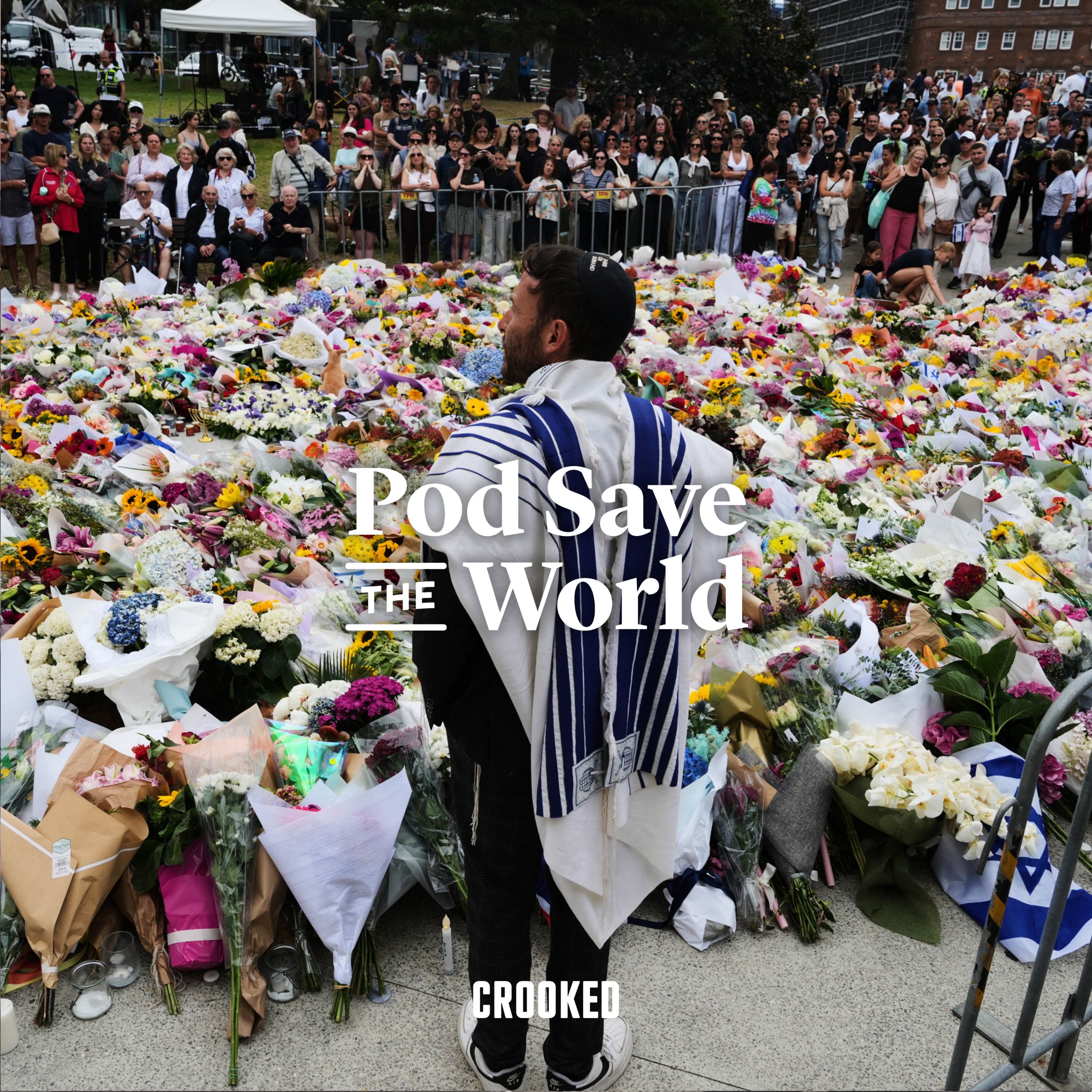
So enough of that stuff. So we're going to start with Sunday's horrific shooting in Australia.
This was at a menorah lighting festival celebrating the first night of Hanukkah.
About a thousand people had gathered at Bondi Beach in Sydney, Australia. It's one of the the most popular tourist sites in the entire country.
They were celebrating the holiday when these two gunmen opened fire. The shooting went on for like 10 full minutes.
The video is horrifying.
At least 15 people are dead. Dozens more are wounded.
The victims include a 10-year-old girl and an 87-year-old Holocaust survivor. The police killed one of the shooters.
The other is now in the hospital. These terrorists were a father and a son.
I just can't imagine why they do that. It's fucking dark.
It's real dark. Astajid Navid Akram.
Here's some of what we know about them and their motives at this point. So the police found two homemade ISIS flags in their car along with some homemade IEDs.
They reportedly took a trip to the Philippines last month from November 1st to November 28th.
There's some reports that say that they were there to undergrow what was described as military-style training.
The southern part of the Philippines has long-standing Islamic extremism problems that we'll talk about, including an ISIS presence. We'll get to that.
in a minute.
Prime Minister Anthony Albanese has said that the two were, quote, motivated by Islamic State ideology, and that in 2019, the younger of the two was on the radar screen of Australia's intelligence community because of his association with a self-proclaimed Islamic State commander who is currently in prison.
I think was sentenced in 2021. Albanese also said there is not evidence that the two were part of a larger cell, a terror cell.
But I did also just want to quickly highlight some stories of incredible heroism from this attack.
So there's this now famous video of this unarmed fruit vendor named Ahmed Al-Ahmed, who tackled and disarmed one of the shooters before being shot himself.
I just saw an interview where he said he saw that the shooter was walking towards about 30 people lying on the ground and he just had to go and do something.
He's a Muslim man originally from Syria, and Albanese visited him in the hospital.
One lifeguard named Jackson Dooland ran 1.5 kilometers from a neighboring beach with his defibrillator to help people as the attack was still ongoing.
There's this now iconic photo of this dude just hauling ass barefoot with his gear towards the gunfire.
And then Ben, I also read a story about this couple that got separated from their three-year-old daughter when the shooting started, and then they finally found her underneath a stranger who was shielding a little girl with her own body to protect her and had been shot in the process.
So just, you know, the two worst people in the world combined with this amazing heroism.
So this shooting comes after a spike in anti-Semitic incidents in Australia since the October 7th terrorist attack. That includes arson attacks on a synagogue, one on a kosher restaurant.
There's an organization that has been tallying these up and says the number of anti-Semitic incidents quadrupled in that period. Australia's last mass shooting of this scale was in 1996.
After that horrible incident, they passed a bunch of gun control laws. Prime Minister Albanese has pledged to pass even more gun control measures in the wake of this shooting.
So we're going to get into Israeli Prime Minister Bibi Netyahu's response in a minute, and we'll talk more about this detail about the Philippines. But just want to start with your general reaction.
It's the most horrifying thing to have a community like that together for a celebration
and to have something like this,
it just,
it's heartbreaking. And
on the positive side, I do want to say, like, the response in Australia, you know, from both the people on the scene
to the way Prime Minister Albanese, but also the whole kind of community has rallied around this.
You know, I know we have a lot of listeners in Australia, and just our hearts go out to you and the Jewish community, but the entire country that clearly is feeling this so personally.
In terms of like the motive, and we'll get into the Philippines,
look,
you've heard us on this podcast obviously be quite critical of the Israeli government's conduct in Gaza, its policies in the West Bank. And frankly, you know,
you...
you worry, and we've talked about this concern about like the possibility for radicalization. All that said, break, break, full stop.
To target Jewish people on the other side of the planet because you're mad about something that the Israeli government is doing is not only wrong, it's the fucking inverse of the thing that you say you don't like about what's happening in Gaza.
Like I to say all people in, you know, Gaza, Hamas, like people don't like that, but then how can you possibly blame Jewish people for all around the world for the policies of the Israeli government.
That is like textbook anti-Semitism, textbook bigotry. It's dangerous, and it absolutely has to be categorically rejected.
This capacity to dehumanize entire groups of people over something you don't like is just completely wrong.
It's evil. It's evil.
It's textbook terrorism. It's indefensible.
And I think people like us who've been critical of the Israeli government,
this should not be complicated.
Nothing justifies violence, full stop. And nothing justifies demonizing a whole group of people, whoever they are, you know?
So, yeah, this is clearly, you know, people should be safe being who they are, being their identity, whether that's at a synagogue or a communal gathering like this.
And, you know, you want to see, I'm glad the gun control measures will be pursued. That will, obviously, the data shows that that helps.
But
yeah, it's just a terrible thing on a
terrible day for it to happen. Yeah, I mean, my sort of observations one are just like heartbroken for Australians and the Jewish community writ large, right?
I mean, like, how many friends did you have who you talked to that day who were just terrified?
You know, they're at home in their houses trying to celebrate Hanukkah with family and friends and they're terrified.
It's also, it's just notable as an American watching an entire country react so strongly to this incident when we become inured to it. You know what I mean? Yeah.
That's what I was getting. Some bad things about us.
And they rallied together.
You didn't see stuff happens here, and everybody fights with each other about whose fault it is. You didn't sense that happening in Australia.
I'm sure there's a little bit of it, but I didn't see it.
Yeah, I'm sure there will be some political debates, and rightly so. Like, that's how we solve problems.
But yeah, and then, you know, I just,
we should talk about this Netanyahu piece, because Netanyahu, he almost immediately linked the terror attack to Australia's recognition of the Palestinian state earlier this year.
So let's hear what Netanyahu had to say, and then Prime Minister Albanese's response, and then we can talk about it.
I sent Prime Minister Albanese of Australia a letter in which I gave him warning
that
the Australian government's policy was
promoting and encouraging anti-Semitism in Australia. I wrote,
Your call for a Palestinian state pours fuel on the anti-Semitic fire. It rewards Hamas terrorism.
It emboldens those who menace Australian Jews and encourages the Jew hatred now stalking your streets. Do you accept any link between that recognition and the massacre in Bondi? No, I don't.
And overwhelmingly, most of the world recognises a two-state solution as being the way forward in the Middle East.
Netanyahu can't even say Albanese's name right. The Netanyahu's diaspora minister also blamed the Australian government, that's horrible stuff.
So, but just a few thoughts here.
Like, first of all, I just like, like, I can't overstate how
sad I find those comments from Netanyahu, how infuriating I find those comments from Netanyahu. Like, we don't have a complete picture of who these terrorists are, their motives, their associations.
Clearly, this was an act of terror designed to target the Jewish community in Australia and designed to terrorize Jews all around the world.
But I find the suggestion that these terrorists were motivated by Australia recognizing a Palestinian state to be just beyond absurd.
I mean, again, if these guys are ISIS-inspired, if they trained with ISIS, I'm pretty sure they're not like two-state solution guys, you know? Yeah.
And if Australia's intelligence agencies were watching the younger one in 2019, then clearly his radicalism predates October 7th and predates the Australian decision to recognize Palestine that happened back in September of this year.
And like, and also just stepping back a bit here, like what Albanese was getting at there is anyone who supports a two-state solution believes in the creation of a Palestinian state.
Is Netanyahu going to claim that all of us who believe in a two-state solution are fomenting violence in some way? Because we have a shared goal, right? Yes, he is.
Yeah, I mean, it feels that way, right? And like, what I find, I think, so upsetting is this should be a moment where we're just like mourning the loss of these lives.
We're showing solidarity for Australians, for Jewish people around the world who are just scared and who are horrified by the attack.
But Netanyahu cannot help but make this tragedy, this evil, about his own political project.
And there is also this kind of, I think, largely discredited at this point, but like vocal group group of people on the internet who are trying to claim that, you know, these guys, these terrorists did what they did because of speech or like things influencers said on podcasts or criticism of the war in Gaza.
And again, it's like, at best, it's baseless, right? Like, we don't, if we learn more information that these guys were inspired by some individual, like we can talk about it.
But at the moment, it's baseless. At worst, it is a cynical attempt to exploit a horrific massacre for political purposes, to settle scores.
And it's just, I like, I just find it so demoralizing, depressing, because I'd love for the world to just come together and support people in Australia and just not be talking about this right now.
No, it's just so profoundly cynical. You know, and Netanyahu, one of the things he shares in common with Trump is he has to make everything that happens about himself and his own political interests.
And the decent thing to do would be to express condolences to your fellow world leader, Prime Minister Albanese, who's going through this tough time. His people are going through such a tough time.
to immediately turn it to like your political.
And by the way, you're right, like the dumbest version of it. 157 member states of the United Nations have recognized the state of Palestine.
This is not like Australia is not some like extreme outlier. They're actually very much in the mainstream of what governments have done around the world.
And look, I also think it's very important.
I don't give an inch on this question.
Like one of the reasons that I believe that there should be a two-state solution, that there should be an independent state of Palestine next to the state of Israel, is because I actually think that's good for Jewish safety, you know, to end the conflict, to meaningfully actually end the conflict.
And part of what he's doing with that statement is trying to delegitimize that view, you know, that somehow, if you say anything about Palestinian rights, that you're somehow a terrorist or you're enabling terrorism.
Quite the opposite, you know?
And I think we don't like we exceed the terrain of framing the argument this way sometimes, but like I like I think that it's not just about you know the Palestinians having a state and having rights and having safety and security, it's frankly also about believing that that's the best thing for Israel.
Yeah. Um, because this kind of permanent conflict is just dangerous.
And again, that doesn't justify any fucking thing that these two guys did.
It's just to say that that's like a cynical way to insert himself into this crisis and to do so in a manner that's intended to delegitimize what is like a very mainstream view, like held by, you know, American presidents and most members of Congress, you know, that supported Palestinian states.
Israeli political leaders. I also think like Yitzhak Rabin.
Yeah, it's so cynical that I do think people are starting to see through it. And like, this is why you're kind of seeing like the denouement of Bibi Net Yahoo.
He's going to go back to the White House in December, but you know, Susie Wiles, the White House chief of staff, did this long interview that came out in Vanity Fair today where she talked about Trump constantly praising Netanyahu.
And when it came up, it says Wiles winced, quote, I'm not sure he fully realizes, she said, that there's an audience here that doesn't love it.
So like even in the White House, even in the MAGA base, they are just like running out of
time page.
So Ben, on the Philippines piece of this, so we don't know for sure what these guys did there, but they were there for a long time and they were there for a month.
And you and I are old enough to remember that the Philippines has been a hotbed for terrorism, including Islamic extremism for a while.
So So there was the first Bali bombing in 2002 that killed like 200 people, including 88 Australians.
And then there were several more like high-profile bombings after that, both in Bali and Jakarta and other places in Indonesia as well. And so some of these attacks were from
Islamic extremist groups.
So I'm conflating here like attacks in sort of Southeast Asia generally. But like some of these attacks were, you know, Islamic extremist groups like Jemma Islamiyah.
There were also like nationalist insurgent groups like the Moro Islamic Liberation Front. And there were even like a communist element of extremists.
And over time, a lot of these groups morphed and they kind of swore loyalty to ISIS in 2014 or 2015.
And then in 2017, the government in the Philippines started taking the threat very seriously after this ISIS-linked group or a couple of groups took over a major city with a population of about 200,000 people.
They launched this like very intensive military campaign. It was months of brutal urban combat.
And there was also
the Philippines government created this
programs to like allow fighters a path out of extremism that wasn't death. That was like counseling, training, assistance.
Like they had former pro-ISIS prisoners go into prisons, talk to current pro-ISIS prisoners, like try to talk them out of their allegiance.
There was an interesting mix of like military pressure and reintegration programs. So clearly, ISIS was never fully eradicated in the Philippines or in the region more broadly.
But I think the Philippines was seen as
a successful approach. And now I wonder,
was that wrong? Will there be a bunch of pressure from Australia and the United States and others to take more action? I don't know. What did you make of this piece of it? I think it's concerning.
And you're right that there's kind of this long history there where after 9-11, there was some deployment of kind of U.S. special forces to advise and support the Philippines in kind of going after
Islamic militants in southern Philippines. Then in the late Obama years, when ISIS was kind of taking over the kind of vanguard of global terrorism,
you had this kind of blend of extremists who'd kind of been active in the terrorism business all of a sudden wanting to declare a caliphate in the southern Philippines.
And what's complicated about it is this part of the southern Philippines, there's a separatist movement because they resent kind of being a part of a majority Christian country.
They want to govern themselves. They kind of blended with this idea that we're going to establish a caliphate.
And so that's what was kind of stomped out by the military in the Philippines with U.S.
and other support. And what this kind of shows is kind of the resilience of that ideology in that part of the world that is spanned from Malaysia to the southern Philippines and in Indonesia.
And the fact that these guys went there for a month, I mean, Look, we don't know that much about these guys. I don't think you go there for like tourism for a month.
Yeah, and they do this.
Clearly, something happened while they were there. The fact that they had these kind of homemade ISIS flags on them is kind of a trademark of what we used to see from ISIS.
And so I think what's concerning about this is,
you know, the ISIS problem has been kind of under the rug for a while.
Does the combination of what happened in Gaza and the Middle East and kind of the sense of maybe, you know, priorities have shifted and people aren't kind of watching this threat as much,
is this kind of regenerating?
And I think that's going to be a a subject.
You don't want to see an overreaction, I mean, but you do want to see a vigilance here because, you know, we've seen that movie before and it's not a good one. Yeah, and it's a very, very scary one.
Pate of the World is brought to you by HIMS. According to the National Institutes of Health, as many as 30 million men in the U.S.
have experienced EB. It's more common than a bad night's sleep.
The good news, HIMS make getting access to treatment simple so you can feel like yourself again without the stress or awkwardness.
Through HIMS, you can access personalized prescription treatment options for ED, like hard mints and SexRx plus climax control if prescribed.
HIMS offers access to ED treatment options ranging from trusted generics that cost 95% less than brand names to hard mints if prescribed.
You shouldn't have to go out of your way to feel like yourself. HIMS brings expert care straight to you with 100% online access to personalized treatment plans that put your goals first.
This isn't one size fits all care that forgets you in the waiting room. It's your health and goals put first with real medical providers making sure you get what you need to get results.
Think of HIMS as your digital front door that gets you back to your old self with simple 100% online access to trusted treatments for ED and more, all in one place.
To get simple online access to personalized affordable care for ED, hair loss, weight loss, and more, visit hims.com slash world.
That's hims.com slash world for your free online visit, hims.com slash world.
Actual price will depend on product and subscription plan.
Featured products include compounded drug products, which the FDA does not approve or verify for safety, effectiveness, or quality, prescription required, see website for details, restrictions, and important safety information.
The year-end clearance sale is going on now at your local Honda dealer. Honda cars, SUVs, and trucks are on clearance during happy Honda Days.
Get 2025 accords, pilots, and ridgelines on clearance with big savings on the full Honda line. Gas, hybrids, and EVs.
All new Hondas are in stock. Honda, KBB.com's best value and performance brand.
This is the time to get a new Honda with clearance savings. Search your local Honda dealer today.
Base of 2025, Consumer Choice Awards from Cali Blue Book. Visit kbb.com for more information.
Let's switch gears a bit to check in on how Emperor Donald Trump is, how his reign is going in Latin America.
So on Tuesday, December 16th, the Pentagon announced the military had hit three more boats in the eastern Pacific, murdering eight people.
These are boats that they allege are filled with drugs and drug dealers.
The Pentagon released a new snuff film about these strikes, but also I should note that Secretary of Defense Pete Hegseth still refuses to show members of Congress the unedited double-tap strike on the first one of these boats that we talked about last week.
So the U.S. Military Southern Command is ramping up firepower and sending more assets to the Caribbean, including F-35 stealth jet fighters, the EA-18G Growler electronic warfare planes.
So, things you probably don't need to
blow up a boat.
Yeah, I mean, certainly an F-35 could bomb a speedboat, but you do not need that.
Last week, the U.S. seized an oil tanker in the Caribbean that was carrying 2 million barrels of crude worth about $80 million from Venezuela's state-owned oil company.
The ship was sailing under the flag of Guyana, but Guyana has no official record of it.
And the boat had manipulated its transponder to appear to be hundreds of miles away. So, this tanker is known as the Skipper currently.
It had previously been sanctioned by, not the gipper, the skipper, by the Treasury Department when it was sailing under a different name and has transported oil from Iran to Syria and then to China.
It still seems unclear where the ship was headed because its official destination was Cuba, but the boat transferred like 50,000 barrels of oil to another ship before it was seized.
And then that ship went to Cuba and the skipper was going to Asia. So who knows? The Cuban government called the seizure an act of piracy and maritime terrorism.
The Cuban government has long exchanged doctors and intelligence sort of assets and know-how for in personnel for access to Venezuelan oil, much of which, as the Guardian has reported in some detail, they turn around and resell to China.
An estimated like 80% of Venezuelan oil ends up in China. So the New York Times laid out the administration's legal rationale for the seizure of this boat.
It was one, they got a warrant because of the ship's record of transporting Iranian oil, and two, that it was sailing under a false flag. Trump was asked what happens with the oil now.
He said, well, we keep it, I guess. So maybe he'll donate it to the library, like the Qatari Jet.
Maybe he'll sell it to China. Oh, that's a good idea.
Yeah, why not? Like the chips he's selling.
Have Jared just fly over with it.
So, Ben, there's some good reporting in the Times over the weekend that dug into how Secretary of State Marco Rubio views toppling Venezuelan President Nicolas Maduro as the key to taking down the Cuban government.
We've discussed that on this show before. In 2019, Rubio said weakening Cuba would be a welcome byproduct of regime change in Venezuela.
And, quote, anything that's bad for a communist dictatorship is something I support, quote, like straight out of the Cold War era.
Rubio's parents immigrated to Florida three years before Fidel Castro came to power. So this is personal for him and he came out of Miami politics.
So Ben, like just stepping back, it's very hard for me not to find the Iraq War echoes kind of deafening at this point.
Like the administration says they are targeting fentanyl in Venezuela, but and Trump literally just declared that fentanyl is a weapon of mass destruction, but fentanyl doesn't come out of Venezuela.
Venezuela doesn't produce fentanyl. And clearly, the administration is more focused on oil.
And then, again, like Bush said, that like taking out Saddam Hussein was a response to 9-11.
Rubio seems to think taking out Nicolas Maduro is the way to take out the Cuban government. Like the whole thing is just, it makes me feel insane.
The thing that is so frustrating about this is they are constantly claiming authorities and reasons for what they're doing that don't make any sense if you stack them up. Okay.
So if you just take the tanker,
look, we had a guest on this podcast recently who talked about the massive shadow fleets that are out there. Like, this is not uncommon, right?
We do not routinely detain those tankers under those authorities.
We land special forces on these tankers. Like dangerous operation.
Oh, yeah, including ones that sell Russian oil or Iranian oil or Venezuelan oil.
And so what is so frustrating about this is what we're seeing before our eyes is a regime change operation, but they won't say it. The boats are about narco-trafficking.
The
tanker is about, you know, illicitly selling oil. Like, they don't say it's about weakening Maduro, but that's clearly what it's about.
And this is where, like, in the first instance, this is just like a policy built on a pyramid of dishonesty.
The second thing that has all the hallmarks of past stupid regime change wars, from Iraq to all the way back to, you know, some of the justifications for going to Vietnam, is there's always the kind of manufacturing of a threat that is kind of wildly overstated.
Because just let's start with Cuba actually, because clearly there's some design that they have that there's like a reverse domino theory here that Vent Maduro will fall.
Cuba, like you may not like the Cuban government.
Just please explain to me what national security threat this completely impoverished island is crazy to the United States. Like I'm not suggesting everybody has to like the Cuban government.
I'm suggesting
they pose no threat to us. Like, the worst one you could trump up that Rubio used to talk about is like, there's Russian and Chinese.
They have like listening posts there or something. You know, like, well, I don't think most Americans think you like go to war in Venezuela to get rid of like the listening posts in Cuba.
And even Venezuela, again, like.
bad things that that government does, like I think worse things in the Cuban government, right?
But what is that he cannot describe to Americans like any threat that rises anywhere near the need to go to war there?
And so he wraps it up in drugs. He wraps it up in migration, all of his other boogeymen, right? Or just like repeating communist a bunch of times as if like, are we compelled to go to war?
Are we going to go to war with Vietnam next? They're communists.
And just to back up your first two points, like about the lies, about the intention, again, Susie Wiles in this interview said about Trump, he wants to keep on blowing boats up until Maduro cries uncle.
And people way smarter than me say that he will. So clearly it's a regime change operation.
It's not about the drugs.
And then about the drugs, she says, the president says 25,000, meaning 25,000 lives are saved per boat you blow up.
She goes, I don't know what the number is, but he views those as lives saved, not people killed. So even she won't back up this ludicrous statistic.
Yeah, there's no lives saved.
And I wonder about these so-called smart people. I mean, I'm just referring to the National Archivist Ruvio or who, but like
Maduro is going to, quote, cry uncle because some boats are getting blown up. Like, this is what's so weird about this strategy.
You know, I mean, I know they're squeezing and squeezing and squeezing, but like, at a certain point, you know, you're engaged in a regime change operation. That is happening now.
They're just using different tactics, and they're going to get increased. You know, what we're seeing is an escalation ramp, people.
Like, it starts with boats, then it's tankers.
Like, then there'll be something else. We have to bomb something in Venezuela.
Then maybe we have to send people into Venezuela.
Like, this has happened so many times in American history that it's astonishing to me that people people don't see this.
I also saw like some Democrats are like even still reluctant to come in against regime change.
Schumer was sort of half-hearted on this when one of the Sunday shows maybe is like, no, this is a bad idea. It's a bad idea.
It's illegal. It's a stupid idea.
There's a lot of governments I don't like around the world. Like of all stripes, by the way, I don't want to invade any of them.
It's just not the right way to go about doing things. And I just think the odds are that some invasion or regime change would lead to a massive, even bigger migration crisis.
No, it's like,
I've been struggling with this problem. I think everyone has been struggling with understanding what Trump is doing here because it makes no sense.
And because the claims about fentanyl are just self-evidently lies, like no fentanyl is being manufactured in Venezuela.
There's some relatively small amount of cocaine being trafficked through it, like 8%, 10%, but like most of it is Colombia and Ecuador.
What we do know is that Venezuela has 17% of the world's known oil reserves. Yes.
That seems like a hard number we could sort of base a theory on.
We know that last year, a Chinese company signed a 20-year contract with the Venezuelan state-backed oil company to invest billions into their oil fields.
And we know know that Trump says his big beef with the Iraq war was that we didn't keep the oil. Keep the oil.
I think, again,
and we've talked about him wanting to be the emperor of the Western Hemisphere. I think we should be very concrete about what they want, which is they want regime change in Venezuela and Cuba.
And then essentially what they want is all across the Western Hemisphere, they want compliant, right-wing, soft autocratic, if not hard autocratic, like Bukele leaders that provide us with the natural resources we want.
So, American oil companies, including some of Trump's buddies and donors, get in there and kind of get first dibs on the Venezuelan oil, whatever kind of critical minerals Trump is interested in that day,
and take our deportations, right? We'll take flights of all the people, the brown people that Steve Miller wants to deport. That's what they want.
Like, the entire hemisphere is basically people like Nae Bukele and Javier Mille and Maria Machado, and
Trump kind of calls the shots, gets the oil
at a good rate, gets the critical minerals, and
gets to fly plane loads of people wherever they want. That's what they want.
Yeah, and look, we've said a million times. Maria Machado is an incredibly brave person.
She's won the Nobel Peace Prize.
There's this amazing story about how she snuck out of Venezuela on this fishing boat and was like adrift for three hours in the ocean trying to get to the Nobel Peace Prize ceremony.
All of that. Yeah, Maduro stole the election, et cetera.
But the opposition really knows how to speak Trump's language.
And I saw a quote from her where she says, I'm talking about a $1.7 trillion opportunity, said Maria Machado.
We'll open all upstream, midstream, downstream to all companies, as well as its minerals and power infrastructure. She boasted of the infinite potential.
And I believe this was all on a podcast hosted by Donald Trump Jr. Yes.
Like they're just, this is how they're trying to get him to do regime change.
Yeah, and I'm glad you raised her courage because I got a note from a listener who's like a Venezuelan who's like, you guys are a little too hard on the opposition. I'm I'm not.
Like, I know people in the Venezuelan opposition. I know people who've been in journalists who've been
punished for their work in Venezuela. Like,
I don't support Maduro.
I want to say from a sincere place of caring about Venezuelans
that our track record of getting rid of the guy that people don't like
tends not to go well. I honestly mean this.
It's not just that I don't like Trump. It's that
it seems like maybe this is the quick and easy way. Like the U.S.
military comes in and gets rid of this guy, and then we can run the show. That's not how it's ever really gone with U.S.
regime change.
It's always better if this happens a different way.
If it either happens entirely internally or if it happens through some negotiation, I just think that putting all your chips into a regime change operation led by Donald Trump and Pete Hegseff and Marco Rubio is just unlikely to yield the outcome that I think think
most people want in that country. Yeah, we aren't going to dig into Ukraine today because it's sort of still in this pending phase.
But again, this Susie Wiles interview had a bunch of interesting quotes about Ukraine and Russia that I figured I'd mention here.
She says
he doesn't believe, privately, Trump says Putin doesn't want peace. She says Donald Trump thinks Putin wants the whole country.
And then she also has this quote where she talks about like when she watched Helsinki, she thought there was a real friendship between Trump and Putin or at least an admiration.
Then the quote is, but on the phone calls that we've had with Putin, it's been very mixed. Some of them have been friendly and some of them not, end quote.
And I think what I took away from both of those quotes is one, Trump is just lying. Yeah.
Right. Like he says, I think Putin wants peace.
And two, Susie Wiles is like an incredibly well-regarded, seen as like super genius, great chief of staff, and has this unbelievably naive sense of Putin that Putin really liked Donald Trump.
Like, no, he thinks he's a fucking mark. You know, what I take away from that is that
they have been living in their own information environment for so long because anybody who's just like an observer, a dispassionate observer of Putin, knows he wants all of Ukraine and that he's out for himself and he's not like buddies with Trump.
I guess if you've been living on a diet of like Fox News and right-wing podcasts, you might actually believe that Putin just legitimately wanted to keep. Ukraine out of NATO.
Like if that's all he wanted, like this war would be over. The Ukrainians have already accepted that.
And I think what's so dangerous is your point that he's being dishonest, that this deal is not going to be a peace deal, by the way. It could be a temporary ceasefire.
And the question is, can you make it strong enough so that Russia doesn't reinvade?
And they seem to know that internally, and they won't say that publicly because it contradicts the narrative that he's making peace in our time.
Not good.
Speaking of not good, also in South America, Chile just held an election, and unfortunately, they elected the most right-wing candidate since the Pinochet military dictatorship.
Jose Antonio Cast is a right-wing conservative Catholic. I don't think that, you know, people's kids should be judged based on the sins of their fathers, but his dad was a literal Nazi.
Literal.
Like, he literally fought for Germany in World War II and was a member of the Nazi Party. Cast's brother served as minister of state and the president of the central bank under Pinochet.
And Cast isn't shy about invoking Pinochet, at one point saying that Pinochet, quote, would vote for me if he were alive.
And remember, the Chilean truth and reconciliation report about the Pinochet regime found that thousands of people were killed or disappeared by Pinochet for political reasons.
Tens of thousands more were tortured, and hundreds of thousands of people were imprisoned or exiled. So that is not an endorsement you want, even if it's made up posthumously.
But CAST won overwhelmingly nearly 60% of the vote in the runoff, which we should note was against a communist candidate. So it was like a pretty stark choice for voters, but they went with the more.
They didn't exactly get the modern Joe Biden. Yeah, they didn't get the Joe Biden.
They went with the extreme choice. No Kier Starmer in Chile? No, no Kier Starmer.
So in the election itself, Cass downplayed his extreme social views, like opposing all abortion, opposing the morning after pill.
He focused on immigration and crime, feels familiar, and linked the two. So the New York Times highlighted some helpful stats in polling for context.
So Ben, across Chile, homicides reached a record high of 1,322 in 2022. That number dipped to about 1,200 in 2024, but it's still 43% above the 2018 number.
And then Gallup found that less than 40% of Chileans feel safe walking around at night. That's compared to like 70% of Americans.
And, you know, in terms of the immigration story, like there were parts of Chile that faced a surge of migration over the last few years, in particular from Venezuelans during the pandemic who are trying to escape.
CAST blamed those migrants for the crime increase, though the truth is a lot more complicated. It's a story about like transnational gangs across Latin America.
But Ben, I mean, the political followout is like this is not unique to Chile. Like the Times said that
they looked at polling in at least eight countries in Latin America and found that security is the top concern.
And that has led to the rise of right-wing leaders and people like Nayebukele in El Salvador. Here's President Trump taking credit for this election and many others.
Let's watch.
The communists have lost Chile. The pro-Trump candidate, Josanteno Cas won the elections.
Do you think this right-wing wave in the Spanish world is due to your influence?
Well, we just had a good one in Honduras, as you know. Had a great election there.
I endorsed somebody that was not leading, and he won the election.
And we had a good one just a little couple of hours ago, I found out in Chile, the person I endorsed who was not leading, ended up winning quite easily. So I look forward to paying my respects to him.
I hear he's a very good person. Is he slurring there? That's weird.
I didn't notice that.
What's your take on this result and kind of how it fits in with the broader trends we're seeing in Latin America?
Look, it's never great when the Pinochet admiring son of a Nazi wins an election.
Yeah, he's a huge fan of Georgia Maloney, too, who was like, what was she
kind of a little fascist youth? Yeah, she had a little Mussolini
vibe. Doing much to dispel the Nazi rumors there.
I will say he's been a little more
conciliatory since he won. We'll see how he governs.
Look, stepping back,
First of all, in Chile itself, the pendulum constantly swings back and forth, right? So you had Michel Bachelet, who is like a left-wing, tremendous leader, actually, in my view,
followed by Sebastian Piñera, who is like a right-wing businessman type, followed by Michel Bachelet again, followed by Sebastian Piñera, and then followed by Gabriel Borich, the leftist who was recently present, who I really like.
Point is that there's actually always this kind of left-right swing back and forth in Chile in the 21st century. That's been the record.
This is just a much bigger swing to the right.
So that's what is notable. Sebastian Pinera is kind of center right guy.
Second thing is there is a clear message from these electorates in South America and Central America that
public safety is a big concern. You know, that crime problems, there are drug trafficking problems, there are some migration pressures often from Venezuelan migrants.
I mean, that's part of what's happened in Chile, is like the people moving into northern Chile from who'd been out of Venezuela, that's been kind of linked to the crime and it with a Trumpian message.
So there's something to this.
And I think the message for center left to left parties in Latin America is take those issues seriously, like take public safety, crime prevention in particular seriously.
That said, I still think that the main test is going to be in the Brazilian election, which is upcoming.
Because what we have mixed results now, you did have this kind of left-wing boomlet in Chile and Colombia and Mexico. Now you see like
Milles election and then, I mean, the Honduras one was more of a 50-50 election so I don't kind of count that with a lot of irregularities. But Argentina and yeah, exactly.
Let's see.
Argentina and Chile though, that's the beginning of a potential trend. But keep in mind that Shane Baum is one of the most popular leaders in the hemisphere.
She's a leftist Mexico.
I think Brazil will be the real bellwether because if Lula holds on in Brazil, well, then you still have like Mexico, Brazil, Colombia, and then you've got Argentina.
You've kind of got two competing blocks. If Brazil tips, then, okay, then I think we're looking at a real right-wing
swing here. So
there's definitely signs of that happening.
Like, you know, let's see what happens. One other thing I want to say about this is Trump endorses these people.
I think that is
what it is. I wish Democrats, again, I've said this before, were more invested in the success of their like-minded.
We're so norm-based that like, you know, I remember in the Biden years, like, I wouldn't name the, but I was like suggesting that they meet with some opposition people at the the White House and was like, well, we only have to do that at a very low level.
It's like, I don't know, like
the president of the United States, as a Democrat, should meet with the center-left opposition from countries and maybe not endorse them.
That's going a little far, but we can make preferences known too here.
Yeah, like if Donald Trump can tweet, vote for my right-wing candidate or else we'll cut off all support for your country, Honduras or Argentina. Yeah, we can give a bear hug to an opposition leader.
Yeah, or if we offer like a $40 billion bank bailout to the Argentinian government to vote for for a Malay, it's bad. I was trying to watch,
see if Cast had delivered any speeches in English, and I saw he'd spoken at CPAC, so I clicked. It was CPAC Hungry.
The guy wasn't even at the main event. He was at like,
you know. Yeah, that's a franchise.
Yeah. Coachella and like Phoenix.
Yeah, it's like going to the, yeah, exactly.
Podzave World is brought to you by Rocket Money. You might think you have a solid solid handle on your budget.
Maybe your spreadsheet says you have an extra $1,000 left over each month.
But if your bank account isn't reflecting that, something is off. Rocket Money helps you track every dollar, uncover hidden spending, and take control of your finances.
Rocket Money is a personal finance app that helps find and cancel your unwanted subscriptions, monitors your spending, and helps lower your bills so you can grow your savings.
Rocket Money shows you all your expenses in one place, including subscriptions you forgot about. If you see a subscription you no longer want, Rocket Money will help you cancel it.
Their dashboard lays out your total financial picture, including bill due dates and paydays, in a way that's easy to digest.
You can even automatically create custom budgets based on your past spending.
Get alerts if your bill increases in price, if there's unusual activity in your accounts, if you're close to going over your budget, or even when you're doing a good job.
Rocket Money has saved users over $2.5 billion, including over $880 million in canceled subscription fees.
Their 10 million members save up to $740 a year when they use all of the app's premium features. I've used Rocket Money to cancel subscriptions.
Ben Rhodes has used it.
A bunch of people here at Crooked have used it.
That's because we all have some dumb service that we signed up for five years ago to watch one stupid thing and then forgot about it and then just bleeds you dry. Don't let that happen.
Don't get bled dry by some soulless streaming corporation that I'm not allowed to name because I get yelled at.
Cancel your unwanted subscriptions and reach your financial goals faster with Rocket Money. Go to rocketmoney.com/slash world.
Go today. That's rocketmoney.com/slash world.
Rocketmoney.com/slash world.
With Venmo Stash, a taco in one hand, and ordering a ride in the other means you're stacking cash back. Nice.
Get up to 5% cash back with Venmo Stash on your favorite brands when you pay with your Venmo debit card.
From takeout to ride shares, entertainment, and more, pick a bundle with your go-to's and start earning cash back at those brands.
Earn more cash when you do more with Stash. Venmo Stash terms and exclusions apply.
Max $100 cash back per month. See terms at venmo.me slash stash terms.
All right, let's switch gears in the middle. So, on Saturday, two U.S.
soldiers and an American civilian interpreter were killed in an ambush in central Syria.
So, the two soldiers were ID'd as Sergeant William Howard and Sergeant Edgar Torres Tovar of the Iowa National Guard, and their interpreter was ID'd by his family as Ayed Sekat.
The three other members of the Iowa National Guard were also wounded. So, the U.S.
and Syrian officials say the attacker was a member of the Syrian security forces who, tragically, was apparently about to be fired literally the next day because he was like reveted and had extremist views.
But then he did this horrible thing. And this shooter is believed to have been a former ISIS member who joined the Syrian security forces after Assad was toppled.
Trump has vowed to retaliate.
We have no idea what that means yet. So the U.S.
writ large has about a thousand troops still in Syria. That's down from 2,000 earlier this year.
The mission includes counter-ISIS work, in particular, working with Kurdish forces to take out ISIS cells or protect these prisons that are holding both thousands of ISIS fighters in northeast Syria.
And then there are also these camps filled with the families of these ISIS fighters who are just being held in basically like indefinite detention and hell.
I'm sure there are also like missions we don't know about that are focused on Iran.
So these U.S. troops were they were shot when they were guarding a meeting between the U.S.
and Syrian security officials about more cooperation. Obviously, this incident will make that harder.
On Tuesday, Trump was asked about the incident and what the hell U.S. troops are still doing in Syria.
Here are some of his comments.
You still have confidence in the Syrian president? I do. I mean, this had nothing to do with him.
This is a part of Syria that they really don't have much control over.
And
it was a surprise. He feels very badly about it.
He's working on it. He's a strong man.
And no, this had nothing to do with the Syrian government.
This had to do with ISIS.
As a a response, they'll be hit hard. Why do we have troops in Syria?
Because we're trying to make sure that there's going to be and remain peace in the Middle East, and Syria is a big part of it.
Do you know, we have legitimate peace in the Middle East, first time in 3,000 years.
Good question. Not the best answer I've heard.
Do we have peace for the first time in 3,000 years? I believe the White House were just leaking to Barack Ravid at Axios about how mad they were at
him again. Breaking the ceasefire, yeah.
Scolded him.
first of all uh
you see this and you are like i mean i know you you your passion for iowa um
why would these like why are these guys over there why are national guard troops i felt so bad for them obviously just and for their families to begin with just any loss of life but also just like why is the iowa national guard in syria like it's just i have no idea it's time to like trump said he was gonna end these forever wars like i just these troops have been there like way past any rational mission.
When's the last time we had a conversation with Americans about what? Imagine if you polled Americans, should we have like remote outposts with National Guard troops in Syria? Or do we have?
I'm sure it's like an overwhelming answer would be like, no, what the fuck are we doing there? And you're right.
I don't know what we're doing there because part of what they do, and there's been good reporting on this, is creative accounting, right?
So there's a set number of troops that are there, the National Guard people.
But then they rotate like Delta Force guys through there, and they don't stay for the full like six-month deployment, so it's not counted.
So it's kind of off-books deployments of special forces, and the Delta guys sometimes aren't even wearing uniforms, right? So I don't know what we're doing in Eastern Syria.
And by the way, we shouldn't be, if someone says, well, what about these people in prisons?
Well, we shouldn't be the solution. Like
the U.S., you know, having a thousand guys or 500 guys with some special operators or whatever it is.
It should not be the solution. Like there should be a regional solution to this, right? Turkey is a huge provider of security for Syria.
The Gulf Arabs want to kick in some money.
Trump's getting rid of the sanctions. Like, let's build some other architecture to deal with this, right? Let's, you know, I would like to see al-Sharra like work more with the Kurds.
That's been like a source of some tension, obviously. By the way, side note, like, hard for al-Shara to go after the extremists when the Israelis have destroyed his entire military.
I mean, like, do you remember that that happened? That's a thing that happened. Like, bombing again and again and again and just kind of, you know, taking out military hardware.
Like Syria needs enough military capability to govern its own territory.
And so the solution needs to be how do we build up the Syrian state, not like, where can we have like some outpost with some guys?
Yeah, I mean, like, the SDF says the ISIS has staged 117 attacks in Syria through August, which is more than all of 2024. So that's a bad trend line.
We obviously don't want to like rug pull.
The Kurds would never recommend that. No, you have to do this and someone I grabbed away.
But creating a permanent dependency is not the answer no and also Ben if you want to get really mad the Guardian has an article up about like what Bashar al-Assad is up to in Moscow these days
tremendous article yeah apparently he's taking classes
returning to ophthalmology he's living in a gated community with his family near the former Ukrainian president Viktor Yanukovych
the the report um it talks about how Assad just abandoned his extended family when he left Syria he took like just his wife and kids and fucked his you know uncles and brothers and stuff.
He's like, good dude. It says his kids frequently visit the UAE and want to move there, but they're not welcome yet.
It also says that Assad has lined up interviews with RT, a Russia today, and a popular right-wing American podcaster, which makes me wonder if Tucker Carlson's about to get the exclusive Assad interview, because he actually is, I mean, I've heard him say repeatedly that
he preferred Assad in place, like protecting certain communities over the status quo now.
I didn't know the podcaster part. I missed that.
First of all, the ophthalmology, can you imagine like you're just some Russian, middle-class Russian, and you got to get your eyes checked?
And so you're like, oh, go to this, and you sit in the chair and look up. Like, wait, what? Bashar al-Assad? You know, like,
because you are a little vulnerable there, you know, lying back and like pointing that light. Your eyes are fully dilated.
You're like, did I take acid?
But let's be clear, this guy's a fucking war criminal. And Putin is just going to give a safe haven to this war criminal.
This is, again, why you should support the ICC instead of sanctioning it like Trump is doing.
And the other concerning thing I saw in that reporting though is that some of the other people in Assad's inner circle are in Russia and they're like playing a play.
Like they're running some power play where they want to return to Syria and like foment an insurgency. Like the McClue family, like still people with real money.
With real money and power who might just want to create chaos in Syria. They just want to like fuck with El-Shara.
So they may not even, you know, it may not even be about like taking back power.
It may just be about like wrecking. So, I mean, I would like to see the Russians sit on those guys, but something tells me the Russians might not do that.
Yeah, the story suggests that Putin doesn't have the time of day for Assad anymore, which wouldn't surprise me anyway.
But they should, the Gulf Arabs, who do have some ties to Putin, need to say, like, just these guys should not be allowed to sit in Syria and plan to discuss. Oh, for sure.
You know, just like shut those guys down. Yeah, and you see, apparently
Bashar's son was like, posting on, you know, social media about how the narrative around his father's departure was wrong, and then that got shut down real quick. Yeah, yeah, that's good.
Just blaming the Russians. All right, so we're at a couple more things here.
So, um, it has been a while, Ben, since we talked about Hong Kong, so we're going to check in today.
Unfortunately, it's a terrible update because on Monday, pro-democracy media mocha Jimmy Lai was found guilty of one count of conspiracy to publish seditious publications and two counts of conspiracy to foreign collusion.
That's per The Guardian. The verdict was delivered by a panel of three judges and no jury.
This happened under the national security law that Beijing rammed through
upon Hong Kong in 2020 after the protests there. So Jimmy Lai was actually arrested in August of 2020.
He's basically been in and out of prison ever since on various bullshit charges, often in solitary confinement.
Lai founded the popular pro-democracy newspaper Apple Daily back in the mid-90s and has been a longtime critic of the Chinese Communist Party.
In 1994, he wrote a column himself telling China's then prime minister to, quote, drop dead. This was after a Tiananmen Square, so baldy guy.
He's now 78 years old, and depending on his prison sentence, he could die in prison.
Back in the campaign in October of 2024, Trump stooge Hugh Hewitt asked Donald Trump whether if elected he'd get Jimmy Lai out of prison. Trump said 100% I'll get him out.
He'll be easy to get out.
But when reporters check back in on the case after the verdict earlier this week, Trump would only say, quote, I feel so badly, I spoke to President Xi about it, and I asked to consider his release.
So sure sounds like he went from this will be easy to like, meh. I'm sure Huey's really like up in arms again.
I'm sure Hugh will go hard at him, but it doesn't seem like Trump wants to expend much political capital here. Also, you know, Jimmy Lai is a British citizen.
Prime Minister Kier Starmer has also called for his release. But again, Trump and Starmer are both going to Beijing next year.
So I think time will tell where like human rights issues or Hong Kong rank on their to-do list. So Ben, I'll pause there.
I mean, do you expect Trump to put any pressure on Chi to let Jimmy Lai go?
Do you think that's even feasible with like as much pressure pressure as possible? And in your mind,
how do you fold this case into the broader kind of death of civil liberties and press freedom in Hong Kong? Yeah, I hope he puts some pressure.
I mean, Trump seems to be willing to link all kinds of different issues together into a package. And like Jimmy Lai should be a part of what he's ostensibly negotiating with the Chinese.
I'm not hopeful that it will work because Trump is not exactly playing hardball with the Chinese. He just keeps giving them everything they want for nothing in return.
I think it's important to see this, how this fits into what's happened in Hong Kong.
Because essentially, the people of that city make it very clear that the Chinese Communist Party is encroaching on what was supposed to be a deal, one country, two systems, where they get to kind of run their own affairs, have civil liberties.
They're part of sovereign China, but they have their own system. When that encroachment was moving in, we saw those...
enormous protests where like literally like millions of people are taking to the streets.
The last time they actually had a credible election for for district councils in Hong Kong, I was actually there in 2019, and the pro-democracy people went overwhelmingly.
So it's pretty clear where public opinion is. The national security laws that the government put in place essentially erased the barrier between Hong Kong and China.
Like, Hong Kong is now just another Chinese city. It's not one country, two systems anymore.
Jimmy Lai's case is kind of the emblem of that. There is no free press.
There is no criticism of the Chinese Communist Party that is tolerated in the media as it was under Jimmy Lai.
Why this matters, though, I think people need to think about this is a story about why democracy can actually work better than the Chinese system.
Because what's the other story that we saw recently in Hong Kong? That devastating fire.
You saw like building after building, apartment building after, you know, well over 100 people killed. You know, people may have seen this reports.
Well, in the investigation, part of what they found is that the people were cutting corners there.
You know, they were using stuff that wasn't up to standard, like this kind of highly flammable plastics and bamboo netting.
And there was clearly like a hard-hitting investigative journalist might find a corrupt government
that got paid off. Like, we don't know about either, it's because, but one of them, either a corrupt government that got paid off or an incompetent government that wasn't forced.
One of those two things is true.
And guess what happened? They fucking shut that down. Like, people had to stop talking about that investigation.
Jimmy Lai would have been covering that story.
And so when people say, oh, you love democracy.
No, this is not just about democracy. It's actually about public safety.
It's about like a free press, an independent press, is how you make sure that people are held accountable for that kind of corruption. So
this is like the death knell or kind of the epilogue to the death knell of democracy and civil liberties in Hong Kong. But it also is a perfect companion piece to that fire.
Yeah.
And like, I do think it speaks to Trump's priorities. I mean, look, China, Hong Kong was crushed under the Trump administration.
Obviously, it didn't get better under the Biden administration, but Trump doesn't care.
And there's all these right-wingers who really do care about China and do care about human rights, people like Hugh Hewitt and, you know, back in the day, Marco Rubio, who claim to care about, you know, the treatment of dissidents and journalists and activists.
And it seems clear that Trump is ready and willing to cave for an economic deal. Seems like that might also apply to Taiwan
if they get
sieged or invaded.
So time will tell, but Trump just wants to set up a good meeting. Yeah.
There's
no, no more U.S. voice on these things.
There's no more U.S. ID that is a lifeline to civil society.
It's a dark time. Just selling soybeans.
Unfortunately, there's also been a crackdown on freedom of speech in the United States.
So the administration announced that some visitors to the United States may have to provide a bunch of new personal information to qualify for a program that allows you to visit the U.S.
for up to 90 days without a visa.
That data would include five years' worth of phone numbers, email addresses, close family names and birth dates, residences, and access to your social media posts for the last five years.
This would apply to visitors from 42 countries, including the UK, New Zealand, Australia, Japan, Israel, a bunch of European countries, Qatar.
This is under a program called the Electronic System for Travel Authorization, or ESTA.
Right now, you just fill out an application with basic identifying information, like your passport, birthday, criminal record.
I love filling those things out, by the way. And it's like, have you ever been a part of a terrorist organization or accused of sedition? No.
Anyway, but have you ever tried to overthrow the U.S. government, which Trump
would have trouble answering? Yeah. Can't pass an SF-86.
So this would be a very dramatic change for just visitors, right?
Like we've seen the State Department require social media, so-called social media vetting for like student visas, certain work visas, like H-1V visas.
But this would be a major imposition to someone who is traveling to the U.S. to go to a soccer game, go to the World Cup, go to the Olympics.
Ben, what's your sense of the impact of this change? And
also,
who does this vetting? Like, who has the time to go through five years of social media posts for every visitor?
There's so much that concerns me about this. I wanted to talk about it, like, just the quick and dirty on this is number one,
this is going to be absolutely debilitating to a lot of people coming here.
I have tons of friends in, let's just pick one country, in the UK. I have a lot of friends in the UK, a lot of friends in London.
Every single one of them, I would bet, has social media posts from the last five years that are highly critical of Donald Trump.
Every single one of them will think twice about coming here and might just choose not to come here or maybe they'll get negged and whatever that process is.
I can't imagine the impact this is going to have. It is just going to sort out all the people that
I would like to see.
I feel this personally because I, but it's already affecting
the ability to have like, you know, we hear something really depressing timing.
You know, I go to all all these like democracy convenings we can't have them in the US anymore because people from these countries can't come here because they're either on the travel ban list or they're people on social media they're democracy activists like that's dark so just think of that like we're just closed for business and by the way Trump is having let's let's watch the tourism numbers that's a huge economic hit to some American communities too so this has an economic dimension and political dimension meanwhile they're like rolling out the red carpet to the afd like the right-wing oh yeah the nazis are welcome here i mean like like we're just like sorting out the good people and letting in the not the white, the Afrikaners and the AFD are fucking, you know, getting like celebrated.
And then to your question,
I like there's a, at some point, we should have a longer Palantir conversation on this podcast because it's like, oh, who's going to go through that? Well, fucking Palantir is going to go through it.
You know, like they'll, like, with AI, I mean, I don't know, like, okay, to be clear, you know, lawyers or whatever, like, I don't know. I'm saying hypothetically.
Probably a big data AI.
Big data, like, Palantir sorts big data to, you know, find patterns, et cetera, et cetera. That kind of technology, I imagine, whether it's Palantir or someone else, with AI, you can sort.
If you say, like, we want to look for patterns in their social media that are critical of Trump or that or say negative things about America, like you don't need a person reading it.
You just need AI software that can basically do that. So suddenly this becomes, shit becomes real, you know, in terms of your ability to sort who comes in and who doesn't.
We should just say this is not like set policy yet. It's still in the comment period.
So there's time to stop it. But it seems like, you know, there's time to stop it.
So please come while you can.
But also, like, it says in some of the reporting that having no social media presence could be viewed as a like a strike against you, which is
crazy. Like, oh, you deleted all your stuff.
Or maybe you just don't like Instagram.
But now there's just all these idiotic ways where it's going to keep people out of the country and it's going to harm tourism and just be generally stupid.
I will say, too, like, this impacts people a lot. I know somebody who
was so nervous about coming here just because reading the news that they deleted a bunch of their accounts and then they couldn't you know like get it back like it's gone you know it just you know like so this is like and this to be clear there's nothing in there that was concerning it was just like you know someone who's critical of trump and stuff right By the way, there may be reprisals too.
Like, wait till we have to fucking fill out forms because countries love to do tit for tat on the show. Absolutely.
Absolutely. Yeah.
It's just going to be a lot harder to travel if you're an American.
Wonderful. Two more things.
So, Ben, we got some sad news this week for Jared Kushner.
As loyal Pod Save the World listeners know, Jared was trying to use some of the many billions of dollars he got from Saudi, Emirati, and Qatari-backed sovereign wealth funds to develop a hotel in Serbia.
As one does. And not just any hotel.
Jared wanted to lease an area and some buildings that used to house Yugoslavia's defense ministry.
Those buildings were damaged back in the late 90s after they were bombed by NATO forces. Those jerks at NATO were all butthurd about a little ethnic cleansing.
As part of the deal, Kushner's development group would have had to build a, quote, memorial dedicated to all the victims of NATO aggression and put that memorial next to the little Trump Tower they were building.
It's the metaphor for Trump selling out NATO. Perfect.
A little on the nose. Maybe put in the lobby of the Trump.
Yeah, why not? Put on the side, say Trump. opposes NATO aggression.
But Kushner was forced to withdraw from the project after there were major protests over this mess.
So the Serbian president, Alexander Vucic, he rammed through these measures through parliament to strip the building of its cultural heritage protections. That pissed off everybody, seemingly.
And Ben, you'll be shocked to learn that there were allegations of corruption in the process that include like forged documents,
allegations that Vucic was using his deal to curry favorites with the Trump administration via Jared. Yeah.
Serbian prosecutor has charged four government officials with corruption, including a cabinet minister.
So again, this deal, like it, it enraged the far right because like they, this is like an important cultural like touchstone in FU to NATO for them.
And that enraged the left because the current government is right-wing and corrupt,
and now it's dead, seemingly.
It will also probably make sentient Twitter troll come to life, Rick Rinnell sad as he reportedly helped negotiate the deal, and I assume he's getting paid, and Eric Trump, who got cut into the deal because this was supposed to be a Trump-branded property, and of course, Donald Trump, he gets paid for all of this.
So, sad day for Jared Benn. Hopefully, he is drying his tears with some Saudi bucks.
Yeah, or maybe from his buddy, the Russian sovereign wealth fund guy. I mean,
why Serbia?
Just because it's such a ripe environment for this kind of rank corruption, you know, and it's a smaller country. And
there's a gross pattern of these Trump kids, and I include Jared among them,
kind of going to these small countries because they know that those countries are scared, you know, that the U.S. can throw its weight around, right?
So I'm sorry that there will not be a Trump Tower in Serbia. I congratulate the Serbian activists.
There's a great kind of activist movement in Serbia right now that contributed to this outcome.
But let this be a lesson to other countries considering doing corrupt deals with Jared Kushner.
This may be left in the wake of him showing up with his Saudi money in your country, too. Yeah, it is.
You don't need a Trump Tower. It is telling where Jared tries to cut these deals.
Like, Vucic worked directly for Slobodan Milosevic from like 98 to 2000. I think think he famously.
He was chief of staff. Yeah, he was an information minister or something like that.
And he famously said, you kill one Serb and we kill 100 Muslims. So he was like, nice guy.
Pretty open about his.
Pro-Putin oligarchy. Working.
Yeah. It's just gross.
Okay, Ben, one final treat for us for 2025. So episode two of the Liz Truss show dropped on Friday.
It's called Britain's Free Speech Crisis.
She interviews three people who have been investigated by the British police for like bad tweets.
It is
probably a conversation.
The question is, is there a debate to be had over the police investigating or arresting people over tweets? Absolutely. I find that very weird, to be totally different.
It's a weird authoritarianism that's creeping in the UK. But for the record, she apparently spends like an hour treating these people as martyrs and fellow speech warriors.
So once again, we are letting our producer, Michael, treat us like lab rats. He's going to play some truss clips for us that we have not seen yet.
So let's enjoy together.
Free speech in Britain has been
As an instruction manual, they're being redoubled by the European Union, the death star of the anti-freedom stormtroopers. What?
These woke Europeans are aided and abetted by their international allies and their American Democrat cousins like Hillary Clinton this summer in his magnificent West of Scotland golf course, Trump Turnbury.
President Trump called out Keir Starmer over free speech. I hope President Trump wins
against the BBC. You've taken political refuge in America.
Would you describe yourself as
a kind of
energy against the sort of the wokeness that has taken over Britain? I think the best
saying I've ever heard is you need to watch what President Trump does, not what he says. I quite like what he says as well.
Do you think we can achieve a Trump revolution in Britain?
Do you think it's possible here? I don't know. I don't think that's possible.
it's needed?
I do think it's needed. And we have this argument in our house all the time.
I would happily move to Florida tomorrow. Then do it.
Go, go ahead. Yeah.
First of all, that's the shittiest set I've ever seen. It's like a shitty blue conference room wall with like a tiny little plant.
But like, don't you have any pride or nationalism?
Why are you glazing the American president and shitting on your own continent? Yeah, God, it's so uncomfortable. Like, she's just, there's nothing about her that is like
that makes you want to like listen to her speak or watch her other than like the same impulse that you have to like like look at a car wreck or something you know like very slow boring car
it's also like ai
like a bunch of ai prompts were given to like how do i sound like a british version of an american mega podcast influencer you know like praise trump say free speech like make bizarre pop culture references that don't stack up the e use the death star um i will say too by the way on the free speech issues it is fucking weird in the UK.
By the way, not just on the right-wing, like the Palestine action stuff. Right, yeah.
If you hold like a sign saying, like, I support Palestine action, like 80-year-olds, like 80-year-old priests are getting like dragged by the cops. I'm like, what's going over there, guys? Like,
so this is not like a right-wing targeting problem.
There's clearly our free speech issues, but Liz Truss is not your champion. I just wanted to say, and by the way, none of those people look like people that I would want to hang out with.
It's a weird-looking group of people. Not for one second.
Whoever's left in Liz Truss's approval rating is probably her entire guest list. Yeah.
She basically go find random people at the fucking pub who will come down to talk about how much they love Donald Trump in Florida. She also doesn't have a lot of viewers.
So episode one has 79,000 views. Episode 2, which was released four days ago, has 19,000 views.
And we've clicked on it probably a thousand times.
It's all my click on that.
It's
not a runaway hit here for Liz. Well, I mean, I guess keep it up, Liz.
I mean, I just please talk faster. It's my only request.
Well, yeah, we may have to play these clips at 1.5 speed.
Yeah, maybe we'll do that next time. Okay, that's it for us with Liz Trust.
When we come back, you'll hear Ben's interview with Zani Minton-Bettos, the editor-in-chief of The Economist, about all kinds of interesting stuff.
Pod Safe World is brought to you by Simply Safe. If you could stop somebody from breaking in before they got inside, why wouldn't you?
Most old-school systems go off after someone's already in your place. That's too late.
SimplySafe is different. It's proactive with a double layer of defense.
It stops crimes before they start.
First, AI-powered cameras spot potential threats outside, then live agents step in, talk to the person through the camera, letting them know they're on video, and police will be dispatched if they don't leave.
They can even trigger a loud siren or spotlight. That's how you help stop a crime before it starts.
There's no long-term contracts or hidden fees. You can cancel any time.
Named best home security systems by U.S. News and World Report for five years running.
60-day money-back guarantee. So you can try it and see the difference for yourself.
John Lovett set up a SimplySafe system all by himself. He always talks about how easy it was to do, how it gave him peace of mind when he was away.
The monitoring was so reliable.
There were no long-term contracts that you got stuck in. The app was easy to use.
The cameras were like top of the line. And the company itself was just very responsive and the response was fast.
So give it a shot. This month only, take 50% off any new system.
This is one of the best prices you will ever see for SimplySafe. So don't miss it.
Hit simplysafe.com/slash crooked world.
Again, that's simply safe.com/slash crooked world and lock in your discount. There's no safe like SimplySafe.
With Venmo Stash, a tag on one hand, and ordering a ride in the other means you're stacking cash back. With Venmo Stash, get up to 5% cash back when you pick a bundle of your favorite brands.
Earn more cash when you do more with stash. Venmo Stash Terms exclude supply.
Max $100 cash back per month. C terms of vimo.me slash stash terms.
Okay, so The Economist is really a huge resource for understanding the very strange world that we're living in.
And they have a world-ahead issue that looks at some of the trends and issues to watch for in 2026, which is almost upon us.
So for our last interview of 2025, we wanted to sit down with The Economist editor-in-chief, Zannie Mitten-Bettos. Zanni, welcome to Podze of the World.
Thank you for having me.
So I want to start in Europe, where you all have kept a close eye and country after after country on the rise of far-right parties.
Obviously you're in the UK where Nigel Farage is leading in opinion polls.
We have the national rally on top of polls in France, the AFD surging in Germany, and a US government that in its recent national security strategy talked about cultivating resistance in Europe
and by that they meant supporting essentially far-right parties. I wanted to ask you what you think the ceiling is for the far-right.
Because it it used to be for a long time, the idea was, well, maybe they're a threat to gain power in kind of smaller countries like Hungary.
And maybe the national rally in France could be an irritant, but it was hard to imagine them governing.
But now I think you see a possibility, at least, of major, large European powers being governed by the far right. What do you think the ceiling is?
I think it depends on the country. And I think actually, interesting, we talk about the populist right.
We've had a little bit of a debate about nomenclature, but I think that there is a group of parties which are what we're now calling the populist right, and in which I would include Reform UK or indeed, you know, Georgia Maloney's party, which are sort of, you know,
not the traditional centre-right party, but within the mainstream. Because I think there are also then far-right actors, and we've used the term far-right to mean even more extreme than that.
And I would, but if you kind of talk about the populist right broadly, and by that, you know, include Reform UK, include the RN, Bardella, and Marine Le Pen in France, include the AFD, although it has some fairly unsavoury elements to it in Germany.
I think we're seeing them now,
you know, in the high 20s in many of these countries, in the polls. And what we're seeing, Ben, is it's part of a broader fragmentation of the electorate in Europe.
I mean, the kind of caricature of post-war European politics is that in most countries, or in many, certainly in the big economies, you had a powerful centre-left grouping and you had a powerful centre-right grouping.
And that has now fractured.
So, in the UK, you know, traditionally the Conservative and the Labour Party, you now have the Greens, you have the Liberal Democrats, you have Reform UK, and you have the Tories, and you have Labour.
So, you have a fracturing, and in that fracturing, the populist right is in the ascendant in all of Europe's three biggest economies.
I think it is highly likely to be in power in France by sort of late twenties. I think that you could see next year
another parliamentary election. You could perfectly well see a Prime Minister Jordan Bardella.
But certainly in 2027, Marine Le Pen, if she can stand or Jordan Bardella, has a very strong chance in the Presidential election.
And in the UK, if you look at the polls, you know, Reform UK and Nigel Farage, which currently has a handful of MPs, is way ahead of every other party.
The one that is in a slightly different position is the AFD in Germany, the Alternative for Deutschland, because it is both more extreme and because Germany has this very strong firewall policy of not having anything to do with that party for obvious historical reasons.
But I think that firewall strategy is coming under increasing pressure because the party is doing so well in the polls.
And next year you're actually going to see that really tested because there are two state elections in Germany, in the east, one in Saxony-Anhalt and one in Mecklenburg-Vorpomen.
And in both of those states, the AFD looks as though it could win an outright majority. And if it does, then it's going to be impossible to maintain this firewall.
They are going to be in, at state government, they're going to be in control. And so I think next year is a bit of a pivotal year.
If you want to look for things to note, look at the British local government elections in May.
If you see a huge surge in councils held by reform, you're seeing that that is a serious threat then in France as I said I think that it's perfectly possible that you could have new parliamentary elections and in Germany look at these states and I think you could see them in power in a couple of major European countries and they're already in power in Italy right Giorgia Maloney and we'll come on to that because she's interesting because she was people were very worried about Maloney and actually in power it's been much less threatening and indeed more stable and more mainstream than you might have thought.
Yeah, well, certainly on issues like Ukraine,
where she is not
taking the kind of friendlier pro-Russia position that, say, like a Viktor Orban occasionally takes.
But I want to ask you about how this far-right politics interacts with Ukraine, because
right now these negotiations are ongoing.
Major sticking points continue to be territorial concessions by the Ukrainians, but also the security guarantee that the Ukrainians would need to receive.
And actually, I want to ask you, if you have this far-right trend, it seems like, you know, particularly given the U.S.
embrace of Russia or desire to normalize relations with Russia, maybe do business,
that Ukraine is going to have to rely a lot on Europe. And they're going to have to rely on Europe for security guarantees, for
arms for their military.
There was talk at one time, of course, of a kind of European force that could be in Ukraine. But that seems to me to be dependent.
And, of course, EU membership for the Ukrainians.
That depends on consensus, particularly among among the large European powers. And a national rally, I'm not sure that they would take the Maloney position given some of their history with Russia.
Maybe they would.
But do you see this kind of far-right politics or populist-right politics, as you say? And I get it, it's kind of the difference between Nigel Farage and Tommy Robinson or something.
But do you see this
as a danger to the credibility of either security guarantees for Ukraine or EU membership for Ukraine? Yes, in short. And I think there's two things that are hitting at the same time.
The first is that we all in Europe are coming to the realization that the U.S. is
not an ally that we can rely on and that is certainly under this administration, you know, transactional at best and certainly has elements in the MAGA movement that are, you know,
see a world where Europe is more of a baddie than the Russians. I mean,
it's a very different kind of world. So no one in Europe can rely on the United United States.
And as a result, a security guarantee that involves the United States, I think, is worth less than it would have been before, a lot less. At the same time, you're right.
If you're Ukraine, that means that you rely much more on Europe because Europe was already providing the funding, but it's going to be providing the funding.
And any credibility of a security guarantee essentially depends on what is the European element.
And that's happening at a time when European politics is likely over the next few years to see more of these populist right parties in power.
And so they are broadly, with the notable exception of Georgia Maloney, who, as you say, has been very staunchly pro-Ukraine.
The others have either kind of a historical relationship with Russia or are much more sceptical about supporting Ukraine. So I think for Ukraine it's a double whammy.
And it, for me, reinforces the idea that
A, I'm skeptical that even now that there is a lasting peace deal that is both acceptable for Vladimir Putin and is not a complete sellout of Ukraine.
I'm not at all sure that there is a middle ground there. But secondly, the only sustainable source of security for Ukraine is what you might call the kind of porcupine strategy.
It's got to be its own military and financial support for it to build up a defense industry that is part of the European defense industry.
And the notion of relying on some kind of written-down Article 5-like security guarantee cooked up by, you know, Steve Witkoff and Jared Kushner and a few people in the next 10 days,
I think that is very, very, I mean, if I were Ukrainian,
I would want to see dollars and cents and investment commitments and money for my defense industry and ability for me to have an army and those kind of things.
Yeah, no, I definitely share your pessimism about any deal this year.
In your issue,
three-quarters of your super forecasters
were skeptical of a deal even before 2027.
I want to ask about the kind of threat assessment, though. We're in this kind of, the threat to Ukraine is very obvious.
Putin is grinding away, taking territory kind of inch by inch.
There was a recent speech by the head of MI6, a new head, who talked about the acute threat from Russia and said, I think what is apparent, which is that this will be in place
so long as Putin, until Putin is forced to change his calculus. But
what might that be?
At this point, there have been so many sanctions. There's not an appetite in the U.S.
to provide some of the more advanced weapon systems
for the Ukrainians.
Putin seems to be comfortable running a war economy. What do you think can be done at this point to change his calculus?
And
if it doesn't,
what do you think the threat assessment is in Europe of an expansion of this war beyond just Ukraine's borders?
So I think the threat assessment to Europe is, you know, Vladimir Putin has been very clear, and he gives, you know, five-hour lectures on Russian history to whoever comes to see him.
He regards the existence of Ukraine as a kind of historical wrong.
And for him, it's not about territory in the Donbass. It's about, you know, he thinks almost the existence of this state is illegitimate.
And so he's it's very clear that I don't think he's going to be happy with any prosperous, westward focused, independent Ukraine. And secondly,
he broadly would like to recreate the Russian Empire. And therefore, he has, you know, he's, look at what he's been doing in the Caucasus, Moldova, you know, I'm sure the Baltics are in his sight.
Does that mean you're going to see a sort of, you know, traditional 20th century style tanks rolling invasion? No, but you're already seeing a huge amount of, you know,
sort of activity that is not quite war, but it is grey zone warfare, whether it's drones over airfields, whether it's cutting of undersea cables, whether it's all kinds of behavior.
And I think it was the German chancellor who said, we're not at war, but we're not at peace either. And that's the kind of new world that Europe finds itself in.
And I don't think that's going to go away if there's a peace deal or a ceasefire in Ukraine. It's not like Vladimir Putin is going to suddenly change, because for him,
the very existence of a sort of vibrant, liberal, democratic European Union is essentially the antithesis of what he's trying to create create at home.
And so he's going to want to keep undermining that. How do you deter him from undermining it? Well, you know, a credible NATO has and you know is still
a serious deterrence. Unfortunately, we're sort of undermining NATO from within.
Beyond that, I think, you know, uncertainty about the consequences of using force. And for him,
what's the sort of signals that are emanating from the US are just music to his ears. You've suddenly got a completely different approach.
You've got a very transactional approach from the US.
You've got a US that is much more, I mean, we haven't quite got clarity yet, but it seems to be keener on sort of spheres of influence kind of view of the world, where, you know, you focus on Europe and we'll focus on the Western Hemisphere and China can focus on
Asia.
That is exactly the opposite of raining him in. But I do think there are constraints.
Yes, he's turned Russia into a war economy.
And yes, he seems to be completely unmoved by the fact that hundreds of thousands of Russians are dying. But in the end, Russia is not sort of a completely
Russia is not an economy that can kind of be on this footing forever.
You are seeing signs of the underlying economy weakening. Inflation is a problem.
You're running. You completely changed the economy.
I think it's 50% of budget spending is on the military.
At some level, that is not sustainable without Russians feeling much more obviously in their day-to-day life that they are in a war economy for the moment he's been able to kind of you know no one as far as I can tell in in metropolitan Moscow feels this war very much and that can't go on forever it's been able to go on for longer than you think there will be sort of corrosion to that and then eventually
I mean I know you look at history and you think you know you never underestimate the ability of Russia just to continue to lose people.
But I think it's by June next year this war in in Ukraine will be longer than the First World War. I mean, it's just a tremendous loss of life and a tremendous drain at some point on a country.
So I think all wars end in the end at the negotiating table, and this one will. And I actually do think, I'm not sure I agree with us or forecasters with, you know.
all due respect.
I think there will be a lull in the fighting. But will it be a permanent peace deal? I'm not so sure about that.
Yeah, I agree with you on that.
I mean, it feels like there may very well be some deal next year, but it doesn't doesn't necessarily mean that the war is over.
Well, one thing that you and I agree is pretty much over is you recently wrote 2025 was the year when an old order ended.
And that, you know, it's interesting. That's an order that The Economist, you know,
was kind of a tribune for, right? Rules-based order, free trade, multilateral diplomacy.
I'm curious,
you know, what do you think
comes next from your perspective, from the kind of the economist's perspective, in the sense that
China seems fine with this, like they have their own alternative order that they're building, and we saw it on display recently in Shanghai.
Putin, very comfortable with the world order ending and spheres of influence, because he's trying to build a sphere of influence in at least Eastern part of Europe. Trump in the Western Hemisphere.
But where do the rules-based order people go?
Because Europe does seem much more discombobulated about this. I mean,
they're having a harder time fostering collective action.
I would suggest that now would be more of a time than ever for the EU to strengthen itself to be able to compete in this kind of great power world, almost pre-World War I world.
But where do you take the denizens of the rules-based order going forward? That's a great question. Where do the rules-based order people go?
Well, first of all,
I completely agree with you that that world that
we have long championed of free trade and rules and an alliance system is a world that has, I think, definitively gone.
I also believe, as a good classical liberal, that you should look forward rather than hearken back, as a conservative would, for time gone by.
So, I'm really not in the business of kind of trying to recreate that world. I think we've got a new world that we've got to build.
And I also completely agree with you that Europe, as the, frankly, one of the greatest beneficiaries of this post-war order, because security underpinned by the United States, a huge beneficiary of trade integration and global rules, is now
having a bit of an identity crisis.
It is not just all of the challenge from the populist right that we've been talking about, but Europe's, particularly Germany's industrial base under tremendous threat from China right now, having to spend more money on defense because of the lack of certainty and reliability of the US, much needed, frankly, long overdue increase on defense spending.
And at the same time, in these incredible welfare states, I mean, we can't do all of it. And we're a kind of regulatory overkill superpower that for whom, you know,
the risk is that the tech revolution that we're in the footails of,
particularly in AI, sort of passes us by, even though we have some of the best universities and
scholars and researchers in the world. And so it's a bit of a depressing time to be in Europe.
And I'm struck when I go around the world how, frankly, how irrelevant Europe is to much of the rest of the world.
We're like a nice place to go on holiday, nice museums, but we're not where the future's being built. So I wouldn't
if we if we kind of confine this conversation only to Europe, it'll be quite depressing. But I think there is a
self-interest for a lot of countries in the world that are not
the big superpowers that would you know benefit from a balance of power kind of world but whether it's you know whether it's mid-sized economies in Latin America whether it's the open economies of East Asia there are you know Africa huge numbers of places in the world that benefit from multilateral trade rules that benefit from a world which is not a might makes right world where there are you know rules of behavior and I think the challenge is to for for that class of countries to to kind of work together to preserve or indeed to adapt and renew
those rules. So let's take trade, which is, as you know, dear to the economist's heart.
I mean, at some level, you know, the US under Donald Trump has essentially stuck two fingers to the rules of multilateral trade and imposed tariffs, you know, unilaterally.
But actually, the rest of the world did not follow in a kind of 1930s style tit-for-tat trade war.
And most trade in the world actually is still done under wto rules now the wto is a sort of massively in need of rejuvenation doesn't cover services properly all kinds of things but you've got something to work with there yeah and the challenge now i think is for countries other than the us
and probably other than china because people don't really trust it to
think about how to kind of build that system. And we're not kind of living up to that, I don't think, certainly not in Europe.
And I'm not sure sure collective, there's a huge collective action problem. Like, how do you actually get this done? But for so many countries in the world,
it would be a much, much worse place if it was one that was a kind of might makes right, transactional, no rules, law of the jungle kind of place.
Trevor Burrus, Jr.: Yeah, well, and I want to ask you on the economic side about AI, which you all have covered a lot, and people should check out just the very regular coverage that kind of gives you a window into where things are going with AI.
But part of what I sense in traveling and talking to people is, you know, in the U.S., we're kind of all in, in part, because it's literally the thing, the only thing, juicing our economy, probably over-juicing it, right?
I mean, the AI bubble is very evident to people now here. The Chinese are all in, and they have been for some time.
The Gulf Arabs are too, because they have plenty of money and want to be at the vanguard of this. And I kind of sense everywhere else this
balance between, well, I need this technology
and it's going to, as diffusion goes forward and AI applications come online, I think we're going to see next year and more and more parts of the world, you know, AI being adopted for different uses.
And yet at the same time, this fear that where is this all going? What is this technology actually going to be used for?
And is there going to be a bubble, maybe in America, that kind of drags the world into some other kind of, maybe not a great recession, but something that could be economically painful.
What What is your sense between the kind of AI, and I'm not even really getting into the,
will the AI
turn against us scenarios? That's another conversation we can have. But what is your sense about the balance between AI pessimism and optimism as we head into next year?
So I look, I share your view that if you look at financial markets, there is incredible bubbliness around this.
And I'm, you know,
like, who knows when and how big a correction, but it seems to me at some point there will be a fairly substantial correction. As there has been in every
big tech period of technological innovation, look at the railway boom. I mean, you had huge financial bubbles around that.
And
that will burst at some point. I'm not sure I share your view that it will drag the world economy into
some kind of massive global recession.
I think that actually the way much of this stuff has been financed and the strength of the banks and so forth, and indeed, frankly, the resilience of economies is quite hard.
We haven't had a proper coordinated global recession apart from the short one around the pandemic since the global financial crisis.
And the way we've kind of insured ourselves against that is just by running huge budget deficits, which is storing up its own set of long-term problems.
But so at least in the short term, I'm not so worried about kind of global
economic collapse, but I do think there'll be some kind of bubble bursting and some kind of shakeout. I think
that may well happen the same time as the labor market consequences of rapid AI adoption and diffusion, as you say, with more and more companies adopting it, become more evident.
And I also think it will happen at the same time as the
clamor from the pessimist of concern grows louder.
And all of this is happening at a time, I don't think we can divorce it from the geopolitical tensions because the kind of you know, the argument made in the United States for we've got to go hell for leather is that it's absolutely absolutely imperative that the US is ahead in this game because this is going to define the power terms of the 21st century and we have to be the winners.
And there's a similar kind of rhetoric in China. And I think that this race dynamic between companies and between the two superpowers is leading to a,
you know, a kind of no-holds-barred rush of innovation. And
what I think is quite possible is that at some point, and who knows whether it's next year or the year after, but at some point, and I've used this analogy before, but that we have some equivalent of an AI three mile island.
And by that, I mean some kind of accident, something goes wrong.
Hopefully, it's not catastrophic and too awful, but it's big enough that it shocks everyone to think, oh my goodness, we actually do need to put some international agreed guardrails around this.
And I kind of hope that happens
sooner rather than later. I'm actually very optimistic that I mean this is a technology that will have huge benefits potentially and also some very scary consequences.
And I'm definitely on the kind of net optimistic side.
I think it's going to completely transform, you know, frankly, what it means to be human, the way we live, the way we work, what kind of societies we have on a, you know, two, three decade trajectory.
In the short term, it hasn't actually made that much difference to most people's lives other than playing with ChatGPT or if your coders using Claude.
But over the next few years, it really is going to make a very big impact. And I think that will be a kind of profoundly profoundly disconcerting moment
and we didn't you know you remember way back we this is this is bigger in in scale but similar in nature to the impact of globalization on the labor market you know there was in the 90s and 2000s huge location dislocations in the us labor market and actually we didn't handle it very well we didn't handle very well how to compensate the losers how to help people through this how to help kind of communities through this.
And my worry is that this is going to be bigger and more dramatic in terms of its disruption.
And the political economy of not getting that right of how you kind of prepare people for the consequences could be really quite dangerous.
Aaron Powell, yeah, I mean, so the last thing I wanted to ask you kind of connects to that and the whole conversation we've been having.
I mean, you made a point that I like, which is that, you know, liberals should look to the future instead of just kind of being nostalgic for the past.
I would imagine that our audience, you know, is skews left. No surprise.
No, you don't skew. We have a younger audience and it skews left, and that's my view.
And I wonder what you, because I've been struck under your tenure, I've kind of noticed like an ability
at The Economist to do new things and try new points of view and examine some old assumptions. And you're obviously aware if you talk to people on the left, particularly younger people, you know,
whether they know the term neoliberalism or not, you know, they roll their eyes, they don't like globalization for very, for, you know, on the left for different reasons on the right.
They're worried about technology taking jobs.
They don't like Trump, but you know, they're tired of forever wars and trade agreements that they think
basically squandered this kind of period of American dominance.
How do you, at a place like The Economist, it is so associated with that, like a worldview that you would not have supported all the policies that I just suggested necessarily, but how do you update kind of the brand, you know,
to be in this new future where you guys are everywhere, you cover everything.
It's the best thing about The Economist is you can read about what's happening in Burkina Faso, and then you can read about AI, right? But how do you deal with the kind of
ill repute of a certain ideology that is associated with The Economist?
It's a really good question. And I think it's, I mean, we are proud, kind of, we champion proudly classical liberal values.
And that's not the same for a U.S. audience as American liberal, which tends to be more left.
And, you know, broadly, limited government, free trade, individual rights, a focus on the individual rather than the collective.
But that's... That's a set of values.
It's not an ideology. And I really sort of bridle against the idea that we should not be sort of blindly have blind fealty to a kind of set of policies.
In fact, the sort of evolution of, you know, Keynes was right, right? When the facts change, I change my opinion. And that's what we should do too.
The world is very different in 2025 than it was, you know, 30 years ago when I started in journalism.
And so things that seemed, you know, the right policies then may not be the right policies now. And I think we should,
we should constantly ask ourselves, is what we're championing, what we're arguing,
in our editorials or in our analysis, is the conclusions we come to, are they there because we've got some kind of blind spot because of our priors? Or because we've really done a rigorous analysis?
And there are plenty of people amongst my colleagues who have very different views.
You probably wouldn't enjoy much of The Economist if you were a card-carrying communist, but broadly,
there's a fairly big range of views. And we also have amongst our readers, amongst our subscribers, a lot of people who are not classical liberals, who don't believe necessarily in our worldview.
And we need to have a kind of an analysis and a rigor and an approach that they find that journalism useful.
We have readers in the White House. I'm fairly sure they don't reach the same conclusions as we do on many subjects.
But they still hopefully find what we write useful.
And I think that's really important because I think otherwise you become like a broken record. And I actually to sort of circle back to where we started this conversation.
We absolutely should not be a sort of, you know, hankering for the world of yesterday and, you know, the post-war era. That is over, I think, or at least on its way out.
And therefore, what are the right kind of not just what's the right kind of geopolitics, but what's the right sort of relationship between the state and market?
What's the right kind of tax policy for the for a world of AI? I'm pretty sure it's very different to what we had in a world where, you know, there was was different sorts of employment for people.
You know, labor taxes may not make so much sense.
What should we be looking at?
And we need to be, you know, I hope, open to new ideas, rigorously accessing them, and then kind of championing things that make sense and be unafraid to change our minds.
Well, look, I really appreciate that. And
it's been great talking to you, Zanny. And people should check out,
you know,
there are going to be a couple weeks, people off, a little light reading with the world ahead. I guarantee you that.
Ben, you don't have to read. You can listen to our podcast.
We have a few that, or watch our videos.
We've got this new Insider show where we, a series of shows we do two a week where you can watch us or listen to us indeed, and we come to you in a different way.
So I don't mind what format people consume our journalism, but do try it. That's great.
Well, you're pivoting to video like all of us, too. So, yeah, check out the podcast too.
It's great stuff and I really appreciate the just the. And I want to say, actually, I appreciate all of your correspondents who are in so many diverse places.
They do great work. We've had a couple of them on this podcast, actually.
So thanks to you and to everybody for the journalism they're doing. Thank you, and thanks for having me.
Thanks again to Zandy Mitten Bettos for joining the show. And
have a nice holiday, everybody. Happy on the next day.
See you guys in January. Merry Christmas.
Is it war in Christmas this year? I guess. I hear it's back.
I saw it on Fox. It's back, too.
Well, try to enjoy yourself out there during the war.
Pod Save the World is a crooked media production. Our senior producer is Alona Minkowski.
Our associate producer is Michael Goldsmith. Our executive producers are me, Tommy Vitor, and Ben Rhodes.
The show is mixed and edited by Andrew Chadwick. Jordan Cantor is our audio engineer.
Audio support by Kyle Seglin and Charlotte Landis.
Thanks to our digital team, Ben Hefcote, Mia Kelman, William Jones, David Tolles, and Ryan Young. Matt DeGroote is our head of production.
Adrian Hill is our senior vice president of news and politics.
If you want to listen to Pod Save the World ad-free and get access to exclusive podcasts, go to crooked.com/slash friends to subscribe on Supercast, Substack, YouTube, or Apple Podcasts.
Don't forget to follow us at Crooked Media on Instagram, TikTok, and Twitter for more original content, host takeovers, and other community events.
Plus, find Pod Save the World on YouTube for access to full episodes, bonus content, and much more. And if, like us, you're opinionated, leave us a review.
Our production staff is proudly unionized by the Writers Guild of America East.
With Venmo Stash, a tiger in one hand, and ordering a ride in the other, means you're stacking cash back. With Venmo Stash, get up to 5% cash back when you pick a bundle of your favorite brands.
Earn more cash when you do more with Stash. Venmo Stash Terms Includes Supply match $100 cash back per month.
See terms at Vimmo.me slash dash terms. Don't let a cold or flu slow you down.
For fast, multi-symptom relief, pair Alka Seltzer plus Fizzy Chews with Afrin Nasal Spray.
Alka Selser plus Fizzy Chews provide fast, chewable relief from headaches, body aches, fever, cough, and sore throat. And Afrin unblocks nasal congestion in seconds.
Together, they provide relief from nine cold and flu symptoms. Next time cold or flu strikes, pair Alka-Celser plus Fizzy Chews with Afrin Nasal Spray, the dynamic duo for fast relief.
Use as directed.